, um zu prüfen, ob Sie einen Vollzugriff auf diese Publikation haben.
Zeitschrift Teilzugriff
ZParl Zeitschrift für Parlamentsfragen
Zeitschrift für Parlamentsfragen
Herausgeber:innen:
Deutsche Vereinigung für Parlamentsfragen | Chefredaktion: Prof. Dr. Suzanne S. Schüttemeyer, Martin-Luther-Universität Halle-Wittenberg | Mitglieder der Redaktion: Prof. Dr. Jörg-Detlef Kühne, Leibniz Universität Hannover; Prof. Dr. Werner J. Patzelt, Technische Universität Dresden; Thomas Hadamek, Ministerialrat, Verwaltung des Deutschen Bundestages, Berlin; Prof. Dr. Sven T. Siefken, Hochschule des Bundes für öffentliche Verwaltung. Beauftragter des Vorstands der DVParl: Prof. Dr. Heinrich Oberreuter, Universität Passau. Gründer der Zeitschrift: Winfried Steffani† und Uwe Thaysen †
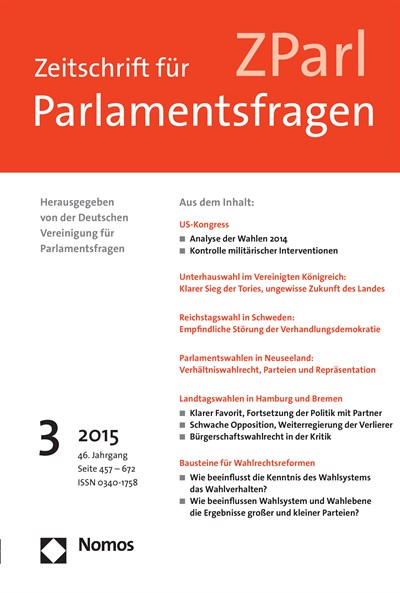
On May 10, 2015 the federal state of Bremen applied an electoral system with five votesand the possibility of accumulating and cross-voting for the second time. The participationrate declined to 50.2 percent, the lowest level ever. Contrary to the...
The result of the British general election surprised the pollsters. They had expected a neck and neck race of the two big parties. They did not predict a clear majority for either of them but a new coalition government. The election produced,...
About half of German voters have a correct understanding of the German electoral system. The other half incorrectly believes that either the first vote or that the first and second vote together are decisive for the distribution of seats. As a...
Prior to the state elections in Bremen, it looked like the governing coalition of SPD and Greens would score a comfortable victory despite predicted losses for the Greens and growing public discontent with the coalition’s rigid policy of cutbacks....
After having governed successfully for four years and being led by widely respected Mayor Olaf Scholz, the SPD was the clear favorite when going into the election of the Hamburg state parliament on February 15, 2015. There was no doubt that the...
The results of the 2014 election to the Swedish Riksdag led to a change as well as to a severe crisis of government. The strengthened Sverigedemokraterna disrupted the delicate balance of power in Sweden’s negotiation democracy with its minority...
The 2011 reforms of the laws guiding the elections to the state parliaments in Bremen and Hamburg introduced systems of combined open and closed list proportional representation: Each voter can now cast five votes for party lists (list vote) and/or...
Previous studies have characterized the U.S. Congress as uniformly weak in carrying out its constitutional responsibility in the politics of military interventions vis-a-vis the president. The picture, however, has more nuances when not only...
In September 2014, New Zealand’s voters elected a new parliament. This was already the seventh election under a mixed-member proportional system (MMP) similar to the one used in Germany. Particular features of MMP in New Zealand include special...
In the 2014 Congressional election the Republican party was able to expand its majority in the House of Representatives while winning back the majority in the Senate, resulting in a “divided government” in the 114th U.S. Congress. It became...
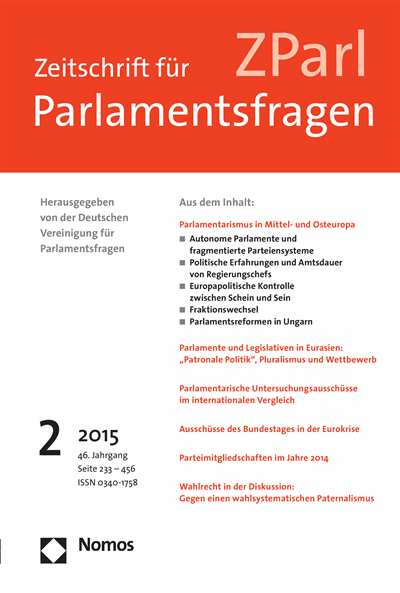
In Germany’s political system elections are held on different political levels with electoralsystems that differ across time and levels. Making use of this variance and analyzing local,state, federal, and European elections since 1990, our...
Parliament’s right of inquiry, one of the most important tools of the opposition to control the government backed by the parliamentary majority, was designed as a minority right for the first time in Germany. In contrast to the optional minority...
In the euro crisis, the committees of the Bundestag have regularly discussed draft laws for the implementation of euro rescue measures, which were previously agreed on by the heads of state and government of the EU. This article traces the control...