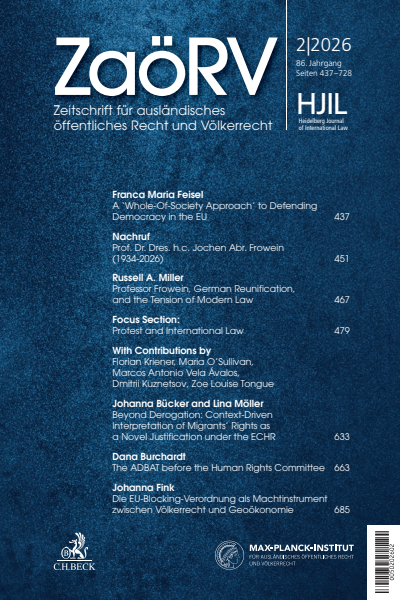
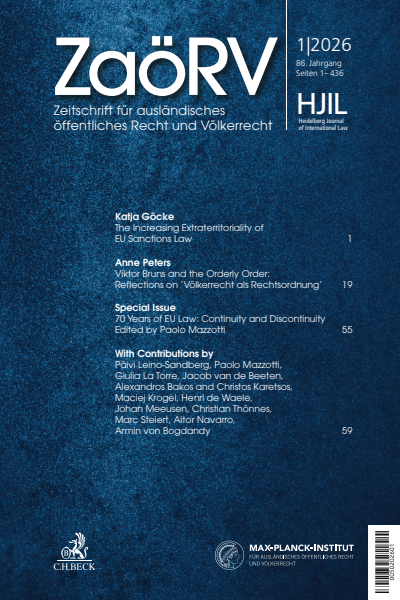
Zeitschrift für ausländisches öffentliches Recht und Völkerrecht / Heidelberg Journal of International Law
Zeitschrift für ausländisches öffentliches Recht und Völkerrecht / Heidelberg Journal of International Law
Herausgeber:innen:
Prof. Dr. Armin von Bogdandy und Prof. Dr. Dr. h.c. Anne Peters in Gemeinschaft mit Prof. Dr. Dr. h.c. Jochen Abr. Frowein und Prof. Dr. Dr. h.c. Rüdiger Wolfrum
This article examines how European states have responded to the so-called ‘instrumentalisation’ of migration at the Belarus-European Union border by advancing a novel, context-driven justification for restricting migrants’ rights under the...
This paper examines the actions of the current climate protest movement and the criminal sanctions and other laws which have been introduced in a number of jurisdictions aimed at restricting such protests. It analyses these developments from an...
Angesichts zunehmender geoökonomischer Spannungen hat Kommissionspräsidentin von der Leyen 2024 angekündigt, den wirtschaftsstrategischen Rahmen der Europäischen Union (EU) während ihrer zweiten Amtszeit zu erneuern. Dies fügt sich ein in eine...
This paper explores the impact of international law and the Council of Europe’s (CoE) freedom of assembly standards on the Russian legal system. It specifically examines their role in safeguarding the right to protest amidst the repressive...
The regulation of peaceful protest in international law remains a largely uncharted territory. Despite the pivotal role protests retain in societal conflicts and the implementation of international rights, the absence of explicit recognition and...
International human rights institutions provide critical support and leverage to social movements, but rather than viewing this as a top-down process, more attention ought to be paid to the bottom-up realisation of human rights. In this article, I...
In its views adopted on 18 July 2024 that concerned the Administrative Tribunal of the Asian Development Bank, the United Nations (UN) Human Rights Committee adopted the rationale of the Waite and Kennedy decision of the European Court of Human...
This paper examines the Inter-American standards on protests, which navigate complex social realities and a heterogenous human rights framework. The essay argues that Inter-American human rights law recognises a human right to protest derived from...
Planck Institute in Heidelberg in January 2024 to discuss and celebrate ‘70 Years of EU Law’ based on a book written by lawyers working in the Commission Legal Service. The book invites us to look backwards at the great achievements of the past....
This Article uses 70 Years of EU Law – A Union for Its Citizens to illustrate how different positionalities in the present lead to divergent (re-)constructions of the past of European Union (EU) law. This, in turn, configures different...
The recent portrayal of legal evolutions in the last 70-odd years by the Legal Service of the European Commission paints a remarkably rosy picture of the European Union’s (EU) role as a promotor of the universality and indivisibility of human...
This article interrogates the celebratory narrative advanced in 70 Years of EU Law – A Union for Its Citizens. It focuses on those aspects of European Union (EU) law’s history that are omitted from the narrative or only appear in a heavily...
Reading the Legal Service’s book on ‘70 Years of EU Law’, one could almost have the impression that the EU is not in the business of combating crime and upholding public safety. In this contribution, I argue that this narrative choice is no...
The contribution critically examines the idea that the common values from Art. 2 of the Treaty on European Union (TEU) constitute the identity of the European Union (EU) legal order. This idea, formulated by the Court of Justice in the rule of law...
In its book on 70 Years of European Union (EU) Law, the Commission’s Legal Service characterises EU citizenship as a status ‘in the service of EU citizens’ which, to a large extent, has been developed through European Court of Justice (ECJ)...
European Union (EU) integration is political and contingent, yet many legal accounts portray it as a process of steady institutional expansion and individual emancipation. This framing is particularly problematic for the social dimension of...
This paper critically analyses the taxation chapter in the book 70 Years of EU Law – A Union for Its Citizens (2023), edited by the Legal Service of the European Union (EU) Commission. The said chapter provides a clear explanation of how...
The European Union’s (EU) geoeconomic turn has had a considerable impact on decision-making that involves security considerations. Tools such as the Foreign Subsidies Regulation or the Anti-Coercion Instrument address the weaponisation of...