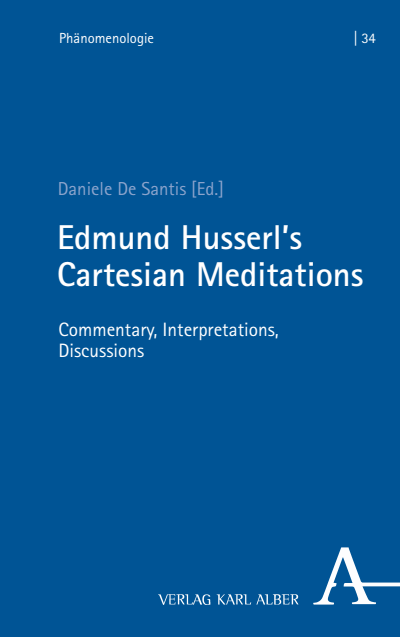
Edmund Husserl’s Cartesian Meditations
Commentary, Interpretations, Discussions- Herausgeber:innen:
- Reihe:
- Phänomenologie, Band 34
- Verlag:
- 2023
Zusammenfassung
Dieses Buch bietet die erste systematische Diskussion von Husserls Cartesianischen Meditationen. Beginnend mit einem Kommentar zum Text der fünf Meditationen werden in den hier veröffentlichten Aufsätzen einige der wichtigsten Begriffe der Husserlschen Philosophie untersucht und geklärt: Intentionalität, Synthese, Evidenz, Intersubjektivität. Darüber hinaus bietet das Buch die erste Diskussion von Husserls später Version der Transzendentalphilosophie und ihrer Relevanz für zeitgenössische Debatten in der kontinentalen und analytischen Philosophie. Mit Beiträgen vonAndreea Smaranda Aldea | Lilian Alweiss | Stefano Bancalari | Jakub Čapek | Emanuela Carta | Daniele De Santis | Aurélien Djian | Saulius Geniusas | Sara Heinämaa | Leonard Ip | Hynek Janoušek | Federico Lijoi | Claudio Majolino | Danilo Manca | Sergio Pérez-Gatica | Witold Plotka | Alice Pugliese | Ignacio Quepons | Rosemary Rizo-Patrón de Lerner | Agustín Serrano de Haro | Wojciech Starzyński
Schlagworte
Publikation durchsuchen
Bibliographische Angaben
- Copyrightjahr
- 2023
- ISBN-Print
- 978-3-495-99554-9
- ISBN-Online
- 978-3-495-99555-6
- Verlag
- Karl Alber, Baden-Baden
- Reihe
- Phänomenologie
- Band
- 34
- Sprache
- Englisch
- Seiten
- 0
- Produkttyp
- Sammelband
Inhaltsverzeichnis
- Titelei/Inhaltsverzeichnis Kein Zugriff Seiten 1 - 8
- Introduction Kein Zugriff Seiten 9 - 20Autor:innen:
- Autor:innen:
- 1. Introduction Kein Zugriff
- 2.1. The »motif« and the »content« Kein Zugriff
- 2.2. The repetition and variation of the »motif« Kein Zugriff
- 2.3. The critique of the »doctrinal content«. Kein Zugriff
- 2.4. Insightfulness and tradition Kein Zugriff
- 2.5. The »motif« and the »motive« Kein Zugriff
- 2.6. The »idea« of science and the »factual« sciences Kein Zugriff
- 3.1. On the manifold beginnings of philosophy Kein Zugriff
- 3.2. The »first beginning«: the Pre-Socratics Kein Zugriff
- 3.3. Towards the »second beginning«: the Sophists Kein Zugriff
- 3.4. The »second beginning«: Socrates and Plato Kein Zugriff
- 3.5. The »third beginning«: Descartes Kein Zugriff
- 3.6. Descartes and the Sophist Kein Zugriff
- 4.1. Splinters Kein Zugriff
- 4.2. Unity and pseudo-unity Kein Zugriff
- 4.3. The Sophist within Kein Zugriff
- 4.4. The scientist without Kein Zugriff
- 5.1. Biographical and structural dependency Kein Zugriff
- 5.2. The variation of the first layer: from »private« to »personal ego« Kein Zugriff
- 5.3. The variation of the first layer and its way to the »deeper« layer Kein Zugriff
- 5.4. The variation of the deeper layer: from »doubt« to »bracketing« Kein Zugriff
- 5.5. The variation of the deeper layer: from »pure« to »transcendental« ego Kein Zugriff
- 5.6. The variation of the deeper layer: from »sheer« to »inadequate« apodicticity Kein Zugriff
- 5.6. The variation of the second layer and its way to the doctrinal critique Kein Zugriff
- 5.7. The critique of the doctrine: »substances« and »axioms« Kein Zugriff
- 5.8. The critique of the doctrine: »solipsism« Kein Zugriff
- 6. Concluding remark. Columbus above the Tartarus—an analogy Kein Zugriff
- Autor:innen:
- Introduction Kein Zugriff
- 1. A broadening of, and deviation from, the Cartesian doctrinal content: The theoretical background of the conceptual network of the horizon Kein Zugriff
- a. Intentionality and reflection Kein Zugriff
- b. Synthesis. Kein Zugriff
- c. Horizon Kein Zugriff
- 3. Intentional analysis Kein Zugriff
- Conclusion Kein Zugriff
- Autor:innen:
- 1. Introduction Kein Zugriff
- 2. The Bracketing of the Natural Attitude Kein Zugriff
- 3. An Inquiry into Existence and Non-Existence Kein Zugriff
- 4. Kant’s response to Hume’s circle Kein Zugriff
- 5. Husserl’s response to Hume’s circle Kein Zugriff
- 6. The limit of ontology Kein Zugriff
- Autor:innen:
- 1. Introduction Kein Zugriff
- 2. Preliminary remarks on transcendental idealism Kein Zugriff
- 3. The essence of the monad Kein Zugriff
- Intermezzo on Ideas I Kein Zugriff
- 4. The structure of the monad Kein Zugriff
- 5. Systematic remarks on transcendental idealism Kein Zugriff
- Autor:innen:
- 1. Introduction Kein Zugriff
- 2. The Problem Kein Zugriff
- 3. The Sphere of Ownness Kein Zugriff
- 4. Living Bodiliness (Leiblichkeit) Kein Zugriff
- 5. Transfer of Sense Kein Zugriff
- Autor:innen:
- 1. Introduction Kein Zugriff
- 2. Unity as a nucleus of presentation (§ 55) Kein Zugriff
- 4. The unity of the monad Kein Zugriff
- 5. Conclusions: Phenomenology and metaphysics Kein Zugriff
- Autor:innen:
- 1. The sublation of the natural attitude Kein Zugriff
- 2. The sublation of the disinterested onlooker Kein Zugriff
- 3. Unconscious life and the method of phenomenology Kein Zugriff
- Autor:innen:
- 1. Introduction Kein Zugriff
- 2. On the historical context of Ingarden’s reading of CM Kein Zugriff
- 3. Ingarden on CM and the realism-idealism controversy Kein Zugriff
- 4. The problem of the beginning Kein Zugriff
- 5. Developments of Ingarden’s reading of CM Kein Zugriff
- 6. Conclusion Kein Zugriff
- Autor:innen:
- 1. Landgrebe and the reception of Husserl’s Cartesianism after World War II Kein Zugriff
- 2. Landgrebe’s argument in Husserl’s departure from Cartesianism Kein Zugriff
- 3. Behind Husserl’s back: Contexts and motivations of Landgrebe’s position Kein Zugriff
- 4. Critical assessment of Landgrebe’s interpretation of the role of horizons in his critique of Husserl’s Cartesianism Kein Zugriff
- Autor:innen:
- 1. Between objectivity and intersubjectivity: Levinas on the place of the Meditations in Husserl’s work Kein Zugriff
- 2. Deduction and dissimulation: The interpretation of the Fifth Meditation Kein Zugriff
- 3. Apodicticity and intersubjective reduction: Extending the Cartesian Meditations beyond Husserl’s phenomenology Kein Zugriff
- Autor:innen:
- 1. Criticism: Husserl made the problem of the other unsolvable Kein Zugriff
- 2. Encountering others: Sharing of the same corporeity and culture Kein Zugriff
- 3. Undifferentiated generality vs. appresentation Kein Zugriff
- 4. »We must return to the cogito« Kein Zugriff
- Conclusion: Sharing and exposure Kein Zugriff
- Autor:innen:
- 1. Introduction Kein Zugriff
- 2. How Cartesian are the Cartesian Meditations? Kein Zugriff
- 3. How descriptive is Husserl’s descriptive phenomenology? Kein Zugriff
- 4. How egological is Husserl’s egology? Kein Zugriff
- 5. Conclusion: Ricoeur and the Husserlian Heresies Kein Zugriff
- Autor:innen: |
- 1.1. Patočka’s stay in Paris and his first encounter with Husserl Kein Zugriff
- 1.2. Deepening the Cartesian theme Kein Zugriff
- 2.1. Descartes as the thinker of the total system of the scientific revolution Kein Zugriff
- 2.2. Descartes as a cunning destroyer of ancient metaphysics Kein Zugriff
- 2.3. Descartes as the founder of psychologized subjectivity Kein Zugriff
- 2.4. Descartes and the end of metaphysics through its instrumentalization Kein Zugriff
- 3.1. The Brentanian roots of Husserl’s Cartesianism Kein Zugriff
- 3.2 Epochē and reduction Kein Zugriff
- 3.3. Aspects of Husserl’s Cartesianism Kein Zugriff
- 4. Conclusion Kein Zugriff
- Autor:innen:
- 1. Where and when Kein Zugriff
- 2. »Kantian« meditations: A dispute about science Kein Zugriff
- 3. »Cartesian« (and »neo-Kantian«) meditations: Grundnorm and intersubjectivity Kein Zugriff
- 4. Kelsen versus Husserl? Kein Zugriff
- Autor:innen:
- 0. Introduction Kein Zugriff
- 1.1 The core thesis Kein Zugriff
- 1.2 The corollary thesis Kein Zugriff
- 2.1 Evidence and the truth-connection Kein Zugriff
- 2.2 The incompatibility of metaphysical realism and the phenomenological perspective Kein Zugriff
- 2.3 An alternative to The Standard View Kein Zugriff
- 3. Why evidence justifies belief Kein Zugriff
- 4. Conclusion Kein Zugriff
- Autor:innen:
- 1. An »ancient staging of an ancient theater« Kein Zugriff
- 2. Two directions: Begründung and Fundierung Kein Zugriff
- 3. Husserl’s two antithetical rational demands Kein Zugriff
- 4. The Cartesian Meditations and the so-called »Cartesian way« Kein Zugriff
- 5. Geltungsfundierung and Genesisfundierung in the Cartesian Meditations Kein Zugriff
- 5. Concluding remarks Kein Zugriff
- Autor:innen:
- 1. Husserl on self-variation and eidetic variation Kein Zugriff
- 2. Reflexion, Ichspaltung, Wiedererfahrung—self-imagining reconsidered Kein Zugriff
- 3. Self-variation anew … Radikale Selbstbesinnung revisited Kein Zugriff
- Autor:innen:
- 1. The powerful work of Jean-François Lavigne Kein Zugriff
- 2. The so-called »ontological psychologism« of the Logical Investigations Kein Zugriff
- 3. The metaphysical postulates of transcendental phenomenology Kein Zugriff
- 4. Absolute affection and transcendence Kein Zugriff
- Autor:innen:
- 1. The Cartesian path Kein Zugriff
- 2. The basic distinction Kein Zugriff
- 3. First philosophy as such Kein Zugriff
- 4. Closing remarks: first philosophy and phenomenology Kein Zugriff
- Autor:innen:
- 1. From »First Philosophy« to »Second Philosophy« Kein Zugriff
- 2. From »Second Philosophy« to »Last Philosophy« Kein Zugriff
- 3. »Last Philosophy« in the Cartesian Meditations Kein Zugriff
Literaturverzeichnis (821 Einträge)
Es wurden keine Treffer gefunden. Versuchen Sie einen anderen Begriff.
- Heck, Philipp (1914a): Begriffsbildung und Interessenjurisprudenz. Tübingen: J.C.B. Mohr (Paul Siebeck) Google Scholar öffnen doi.org/10.5771/9783495995556-353
- Heck, Philipp (1914b): Gesetzauslegung und Interessenjurisprudenz. Tübingen: J.C.B. Mohr (Paul Siebeck) Google Scholar öffnen doi.org/10.5771/9783495995556-353
- Hold-Ferneck, Alexander (1926): Der Staat als Übermensch. Zugleich eine Auseinandersetzung mit der Rechtslehre Kelsens. Jena: Gustav Fischer. Google Scholar öffnen doi.org/10.5771/9783495995556-353
- Husserl, Edmund (1908): »Zur Auseinandersetzung meiner transzendentalen Phänomenologie mit Kants Transzendentalphilosophie.« In: Erste Philosophie (1923/24). Erster Teil: Kritische Ideengeschichte. Hua VII. Den Haag: Martinus Nijhoff (1956), pp. 381–395. Google Scholar öffnen doi.org/10.5771/9783495995556-353
- Husserl, Edmund (1924): Kant und die Idee der transzendentalphilosophie. In: Erste Philosophie (1923/24). Erster Teil: Kritische Ideengeschichte. Hua VII. Den Haag: Martinus Nijhoff (1956), pp. 230–287. Google Scholar öffnen doi.org/10.5771/9783495995556-353
- Husserl, Edmund (1939): Erfahrung und Urteil. Untersuchungen zur Genealogie der Logik, Ludwig Landgrebe (Ed.). Prag: Academia Verlag. Google Scholar öffnen doi.org/10.5771/9783495995556-353
- Husserl, Edmund (1950): Die Idee der Phänomenologie. Fünf Vorlesungen. Hua II. Den Haag: Martinus Nijhoff (The Idea of Phenomenology. Lee Hardy [Trans.]. Dordrecht: Kluwer Academic Publishers, 1999). Google Scholar öffnen doi.org/10.5771/9783495995556-353
- Husserl, Edmund (1968): Logische Untersuchungen. Erster Band: Prolegomena zur reinen Logik. Tübingen: Max Niemayer Verlag (Logical Investigations, vol. 1. J.N. Findlay [Trans.], Dermot Moran [Ed.]. London: Routledge, 2001). Google Scholar öffnen doi.org/10.5771/9783495995556-353
- Husserl, Edmund (1973a): Cartesianische Meditationen und Pariser Vorträge. Hua I. Den Haag: Martinus Nijhoff. Google Scholar öffnen doi.org/10.5771/9783495995556-353
- Husserl, Edmund (1973b): Zur Phänomenologie der Intersubjektivität. Texte aus dem Nachlass. Dritter Teil: 1929–1935. Hua XV. Den Haag: Martinus Nijhoff. Google Scholar öffnen doi.org/10.5771/9783495995556-353
- Husserl, Edmund (1988): Vorlesungen über Ethik und Wertlehre 1908–1914. Hua XXVIII. Dordrecht: Kluwer Academic Publishers. Google Scholar öffnen doi.org/10.5771/9783495995556-353
- Husserl, Gerhart (1925): Rechtskraft und Rechtsgeltung. Eine rechtsdogmatische Untersuchung. Berlin: Julius Springer. Google Scholar öffnen doi.org/10.5771/9783495995556-353
- Husserl, Gerhart (1929): Recht und Welt. Halle: Max Niemeyer. Google Scholar öffnen doi.org/10.5771/9783495995556-353
- Kantorowicz, Hermann (1906): Der Kampf um die Rechtswissenschaft. Heidelberg: C. Winter. Google Scholar öffnen doi.org/10.5771/9783495995556-353
- Kaufmann, Felix (1922): Logik und Rechtswissenschaft. Tübingen: J.C.B. Mohr (Paul Siebeck). Google Scholar öffnen doi.org/10.5771/9783495995556-353
- Kaufmann, Felix (1924): Die Kriterien des Rechts. Eine Untersuchung über die Prinzipien der juristischen Methodenlehre. Tübingen: J.C.B. Mohr (Paul Siebeck) Google Scholar öffnen doi.org/10.5771/9783495995556-353
- Kelsen, Hans (1911): Hauptprobleme der Staatsrechtslehre. Tübingen: J.C.B. Mohr (Paul Siebeck). Google Scholar öffnen doi.org/10.5771/9783495995556-353
- Kelsen, Hans (1914): »Reichsgesetz und Landesgesetz nach der österreichischen Verfassung.« In: Archiv des öffentlichen Rechts 32, pp. 202–245, 390–438. Google Scholar öffnen doi.org/10.5771/9783495995556-353
- Kelsen, Hans (1916): »Die Rechtswissenschaft als Norm- oder als Kulturwissenschaft.« In: Schmollers Jahrbuch für Gesetzgebung, Verwaltung und Volkswirtschaft im Deutschen Reiche 40, pp. 1181–1239. Google Scholar öffnen doi.org/10.5771/9783495995556-353
- Kelsen, Hans (1922): »Rechtswissenschaft und Recht.« In: F. Sander and H. Kelsen, Die Rolle des Neukantianismus in der Reinen Rechtslehre. Eine Debatte zwischen Sander und Kelsen. Aalen: Scientia Verlag (1988), pp. 279–411. Google Scholar öffnen doi.org/10.5771/9783495995556-353
- Kelsen, Hans (1923): Hauptprobleme der Staatsrechtslehre entwickelt aus der Lehre vom Rechtssatze (1911). Tübingen: J.C.B. Mohr (Paul Siebeck) Google Scholar öffnen doi.org/10.5771/9783495995556-353
- Kelsen, Hans (1926a): Der Staat als Übermensch. Eine Erwiderung. Wien: Julius Springer. Google Scholar öffnen doi.org/10.5771/9783495995556-353
- Kelsen, Hans (1926b): Grundriß einer allgemeinen Theorie des Staates. Wien: R.M. Rohner. Google Scholar öffnen doi.org/10.5771/9783495995556-353
- Kelsen, Hans (1928): Der soziologische und der juristische Staatsbegriff. Kritische Untersuchung des Verhältnisses von Staat und Recht (1922). Tübingen: J.C.B. Mohr (Paul Siebeck) Google Scholar öffnen doi.org/10.5771/9783495995556-353
- Kelsen, Hans (1953): »Reine Rechtslehre und egologische Theorie.« In: Österreichische Zeitschrift für öffentliches Recht 5, pp. 449–482. Google Scholar öffnen doi.org/10.5771/9783495995556-353
- Kelsen, Hans (1962): »Derogation.« In: R.A. Newman (Ed.), Essays in Jurisprudence in Honor of Roscoe Pound. Indianapolis: The Bobb-Merrill Company, pp. 339–355. Google Scholar öffnen doi.org/10.5771/9783495995556-353
- Kelsen, Hans (1965a): »Eine phänomenologische Rechtstheorie.« In: Österreichische Zeitschrift für öffentliches Recht 15, pp. 353–409. Google Scholar öffnen doi.org/10.5771/9783495995556-353
- Kelsen, Hans (1965b): »Law and Logic.« In: W. F. de Gaay Fortman et al. (Ed.): Philosophy and Christianity: Philosophical Essays Dedicated to Herman Dooyeweerd. Amsterdam: North Holland Publishing Company, pp. 231–236. Google Scholar öffnen doi.org/10.5771/9783495995556-353
- Kelsen, Hans (1965c): »Recht und Logik.« In: Forum 12, pp. 421–425, 495–500, 579. Google Scholar öffnen doi.org/10.5771/9783495995556-353
- Kelsen, Hans (1966): »Recht, Rechtswissenschaft und Logik.« In: Archiv für Rechts- und Sozialphilosophie 52, pp. 545–552. Google Scholar öffnen doi.org/10.5771/9783495995556-353
- Kelsen, Hans (1967): »Nochmals: Recht und Logik. Zur Frage der Anwendbarkeit logischer Prinzipien auf Rechtsnormen.« In: Forum 14, pp. 39–40. Google Scholar öffnen doi.org/10.5771/9783495995556-353
- Kelsen, Hans (1968): »Zur Frage des praktischen Syllogismus.« In: Neues Forum 15, pp. 333–334. Google Scholar öffnen doi.org/10.5771/9783495995556-353
- Kelsen, Hans (1979): Allgemeine Theorie der Normen. Wien: Manz Verlag. Google Scholar öffnen doi.org/10.5771/9783495995556-353
- Kelsen, Hans (1994): Reine Rechtslehre. Einleitung in die rechtswissenschaftliche Problematik (1934). Aalen: Scientia Verlag. Google Scholar öffnen doi.org/10.5771/9783495995556-353
- Kelsen, Hans (2006): Im Selbstzeugnis. Tübingen: J.C.B. Mohr (Paul Siebeck) Google Scholar öffnen doi.org/10.5771/9783495995556-353
- Kelsen, Hans (2010): »Justiz und Verwaltung« (1929). In: H.R. Klecatsky, R. Marcic, and H. Schambeck (Eds.), Die Wiener Rechtstheoretische Schule, vol. 2. Wien: Verlag Österreich, pp. 1459–1484. Google Scholar öffnen doi.org/10.5771/9783495995556-353
- Kelsen, Hans, and Klug, Ulrich (1981): Rechtsnormen und logische Analyse. Ein Briefwechsel 1959 bis 1965. Wien: Deuticke. Google Scholar öffnen doi.org/10.5771/9783495995556-353
- Kelsen, Hans, and Treves, Renato (1992): Formalismo giuridico e realtà sociale. Napoli: ESI. Google Scholar öffnen doi.org/10.5771/9783495995556-353
- Kern, Iso (1964): Husserl und Kant. Den Haag: Martinus Nijhoff. Google Scholar öffnen doi.org/10.5771/9783495995556-353
- Klug, Ulrich (1951): Juristische Logik. Berlin: Springer. Google Scholar öffnen doi.org/10.5771/9783495995556-353
- Krawietz, Werner (1974): »Grundnorm.« In: J. Ritter (Ed.), Historisches Wörterbuch der Philosophie, vol. 3. Darmstadt: Wissenschaftliche Buchhandlung, pp. 918–922. Google Scholar öffnen doi.org/10.5771/9783495995556-353
- Larenz, Karl (1975): Methodenlehre der Rechtswissenschaft (1960). Berlin: Springer. Google Scholar öffnen doi.org/10.5771/9783495995556-353
- Lijoi, Federico (2016): »Ethics and Law in Paul Natorp.« In: E. Pattaro and C. Roversi (Eds.), A Treatise of Legal Philosophy and General Jurisprudence, vol. 12, I. Wien: Springer, pp. 29–31. Google Scholar öffnen doi.org/10.5771/9783495995556-353
- Lijoi, Federico (2020): »The Democratic Value of Law: Hans Kelsen on the Theory and Praxis of Relativism.« In: M. Jestaedt, R. Poscher, and J. Kammerhofer (Eds.), Die Reine Rechtslehre auf dem Prüfstand. Stuttgart: Franz Steiner Verlag, pp. 393–411. Google Scholar öffnen doi.org/10.5771/9783495995556-353
- Merkl, Adolf (1918): »Das doppelte Rechtsanlitz. Eine Betrachtung aus der Erkenntnistheorie des Rechts.« In: Juristische Blätter 47, pp. 425–427, 444–447, 463–465. Google Scholar öffnen doi.org/10.5771/9783495995556-353
- Métall, Rudolf Aladar (1969): Hans Kelsen. Leben und Werk. Wien: Deuticke. Google Scholar öffnen doi.org/10.5771/9783495995556-353
- Natorp, Paul (1887): »Über objektive und subjektive Begründung der Erkenntnis.« In: Philosophische Monatschrifte 23, pp. 256–283. Google Scholar öffnen doi.org/10.5771/9783495995556-353
- Natorp, Paul (1901): »Zur Frage nach der logischen Methode. Mit Beziehung auf Edmund Husserls ›Prolegomena zur reinen Logik.‹« In: Kant-Studien 6, pp. 270–283. Google Scholar öffnen doi.org/10.5771/9783495995556-353
- Olechowski, Thomas (2020): Hans Kelsen. Biographie eines Rechtswissenschaftlers. Tübingen: J.C.B. Mohr (Paul Siebeck) Google Scholar öffnen doi.org/10.5771/9783495995556-353
- Opalek, Kazimierz (1980): Überlegungen zu Hans Kelsens »Allgemeine Theorie der Normen.« Wien: Manz Verlag. Google Scholar öffnen doi.org/10.5771/9783495995556-353
- Paulson, Stanley L. (1993): »Die unterschiedlichen Formulierungen der ›Grundnorm.‹« In: A. Aarnio, S.L. Paulson, and O. Weinberger (Eds.), Rechtsnorm und Rechtswirklichkeit. Festschrift für Werner Krawietz zum 60. Geburtstag. Berlin: Duncker & Humblot, pp. 53–74. Google Scholar öffnen doi.org/10.5771/9783495995556-353
- Rickert, Heinrich (1913): Die Grenzen der naturwissenschaftlichen Begriffsbildung (1896–1902). Tübingen: J.C.B. Mohr (Paul Siebeck) Google Scholar öffnen doi.org/10.5771/9783495995556-353
- Rickert, Heinrich (1915): Kulturwissenschaft und Naturwissenschaft (1898). Tübingen J.C.B. Mohr (Paul Siebeck) Google Scholar öffnen doi.org/10.5771/9783495995556-353
- Rothacker, Erich (1930): Einleitung in die Geisteswissenschaften. Tübingen: J.C.B. Mohr (Paul Siebeck) Google Scholar öffnen doi.org/10.5771/9783495995556-353
- Sander, Fritz (1922): Staat und Recht. Prolegomena zu einer Theorie der Rechtserfahrung. Wien: Deuticke. Google Scholar öffnen doi.org/10.5771/9783495995556-353
- Sander, Fritz (1923): Kelsens Rechtslehre. Kampfschrift wider die normative Jurisprudenz. Tübingen: J.C.B. Mohr (Paul Siebeck) Google Scholar öffnen doi.org/10.5771/9783495995556-353
- Schreier, Fritz (1924): Grundbegriffe und Grundformen des Rechts (Wiener staatswissenschaftliche Studien, Neue Folge, Bd. 4). Wien: Deuticke. Google Scholar öffnen doi.org/10.5771/9783495995556-353
- Stella, Giuliana (1990): I giuristi di Husserl. Milano: Giuffrè. Google Scholar öffnen doi.org/10.5771/9783495995556-353
- Stella, Giuliana (1997): Stato e scienza. I fondamenti epistemologici della dottrina pura del diritto. Napoli: ESI. Google Scholar öffnen doi.org/10.5771/9783495995556-353
- Stella, Giuliana (2016): »From Criticism to the Phenomenology of Law.« In: E. Pattaro and C. Roversi (Eds.), A Treatise of Legal Philosophy and General Jurisprudence, vol. 12, I. Wien: Springer, pp. 157–188. Google Scholar öffnen doi.org/10.5771/9783495995556-353
- Treves, Renato (1993): Il diritto come relazione. Saggi di filosofia della cultura. Napoli: ESI. Google Scholar öffnen doi.org/10.5771/9783495995556-353
- Vida, Silvia (2007): Sinn e Bedeutung della norma nell’ultimo Kelsen. Bologna: Gedit. Google Scholar öffnen doi.org/10.5771/9783495995556-353
- Walter, Robert (1992): »Entstehung und Entwicklung des Gedankens der Grundnorm«. In: Robert Walter (Ed.), Schwerpunkte der Reinen Rechtslehre. Wien: Manz Verlag, pp. 47–59. Google Scholar öffnen doi.org/10.5771/9783495995556-353
- Windelband, Wilhelm (1882): »Normen und Naturgesetze.« In: Wilhelm Windelband, Präludien, vol. 2. Tübingen J.C.B. Mohr (Paul Siebeck), 1911, pp. 59–98. Google Scholar öffnen doi.org/10.5771/9783495995556-353
- Windelband, Wilhelm (1912): »Prinzipien der Logik.« In: A. Ruge (Ed.), Enzyklopädie der philosophischen Wissenschaften, vol. 1. Tübingen J.C.B. Mohr (Paul Siebeck), pp. 1–60. Google Scholar öffnen doi.org/10.5771/9783495995556-353
- Winternitz, Emanuel (1922–1923): »Zum Gegenstandsproblem der Rechtstheorie. Kritische Bemerkungen zu Fritz Sanders ›Kampfschrift wider die normative Jurisprudenz: Kelsens Rechtslehre.‹« In: Zeitschrift für öffentliches Recht, 3, pp. 684–698. Google Scholar öffnen doi.org/10.5771/9783495995556-353
- Berghofer, Philipp (2018): »Husserl's Conception of Experiential Justification: What It is and Why It Matters.« In: Husserl Studies 34 (2), pp. 145–170. Google Scholar öffnen doi.org/10.5771/9783495995556-375
- Berghofer, Philipp (2019): »On the Nature and Systematic Role of Evidence: Husserl as a Proponent of Mentalist Evidentialism?« In: European Journal of Philosophy 27 (1), pp. 98–117. Google Scholar öffnen doi.org/10.5771/9783495995556-375
- Bernet, Rudolf (2004): »Husserl’s Transcendental Realism Revisited.« In: The New Yearbook for Phenomenology and Phenomenological Philosophy 4, pp. 1–20. Google Scholar öffnen doi.org/10.5771/9783495995556-375
- Breyer, Thiemo (2010): »Bewährung.« In: Husserl-Lexikon. Hans-Helmuth Gander (Ed.). Darmstadt: WBG, pp. 44–45. Google Scholar öffnen doi.org/10.5771/9783495995556-375
- Carta, Emanuela (2022): »On the Distinction between Husserl’s Notions of Essence and of Idea in the Kantian Sense.« In: The New Yearbook for Phenomenology and Phenomenological Philosophy 19, pp. 177–194. Google Scholar öffnen doi.org/10.5771/9783495995556-375
- Doyon, Maxime (2021). »The Normative Turn of Perceptual Intentionality and its Metaphysical Consequences (or why Husserl was neither a disjunctivist nor a conjunctivist).« In: The Husserlian Mind. Hanne Jacobs (Ed.). London and New York: Routledge, pp. 172–183. Google Scholar öffnen doi.org/10.5771/9783495995556-375
- Dutant, Julien (2015): »The Legend of the Justified True Belief Analysis.« In: Philosophical Perspectives 29 (1), pp. 95–145. Google Scholar öffnen doi.org/10.5771/9783495995556-375
- Dupre, Luis (1964): »The Concept of Truth in Husserl’s.« In: Philosophy and Phenomenological Research 24 (3), pp. 345–354. Google Scholar öffnen doi.org/10.5771/9783495995556-375
- Hardy, Lee (2013): Nature’s Suit: Husserl's Phenomenological Philosophy of the Physical Sciences. Athens, OH: Ohio University Press. Google Scholar öffnen doi.org/10.5771/9783495995556-375
- Heffernan, George (1998): »Miscellaneous Lucubrations on Husserl’s Answer to the Question ›was die Evidenz sei‹: A Contribution to the Phenomenology of Evidence on the Occasion of the Publication of Husserliana Volume XXX.« In: Husserl Studies 15, pp. 1–75. Google Scholar öffnen doi.org/10.5771/9783495995556-375
- Heffernan, George (2020): »Truth and Evidence.« In: The Routledge Handbook of Phenomenology and Phenomenological Philosophy. Daniele De Santis, Burt C. Hopkins, Claudio Majolino (Eds.). London: Routledge, pp. 412–424. Google Scholar öffnen doi.org/10.5771/9783495995556-375
- Hopp, Walter (2011): Perception and Knowledge: A Phenomenological Account. Cambridge: Cambridge University Press. Google Scholar öffnen doi.org/10.5771/9783495995556-375
- Hopp, Walter (2016): »Phenomenal Conservatism and the Principle of all Principles.« In: Philosophy of Mind and Phenomenology. Daniel Dahlstrom, Andrea Elpidorou and Walter Hopp (Eds.). New York: Routledge, pp. 180–202. Google Scholar öffnen doi.org/10.5771/9783495995556-375
- Husserl, Edmund (1950): Cartesianische Meditationen und Pariser Vorträge, Hua I. Den Haag: M. Nijhoff. Google Scholar öffnen doi.org/10.5771/9783495995556-375
- Husserl, Edmund (1952): Ideen zu einer reinen Phänomenologie und phänomenologischen Philosophie. Drittes Buch: Die Phänomenologie und die Fundamente der Wissenschaften, Hua V. The Hague: M. Nijhoff. Google Scholar öffnen doi.org/10.5771/9783495995556-375
- Husserl, Edmund (1960): Cartesian Meditations. Trans. by Dorion Cairns. The Hague: M. Nijhoff. Google Scholar öffnen doi.org/10.5771/9783495995556-375
- Husserl, Edmund (1966): Analysen zur passiven Synthesis. Aus Vorlesungs- und Forschungsmanuskripten 1918–1926, Hua XI. The Hague: M. Nijhoff. Google Scholar öffnen doi.org/10.5771/9783495995556-375
- Husserl, Edmund (1969): Formal and Transcendental Logic. Trans. by Dorion Cairns. The Hague: M. Nijhoff. Google Scholar öffnen doi.org/10.5771/9783495995556-375
- Husserl, Edmund (1973): Experience and Judgment Investigations in a Genealogy of Logic. Trans. by James S. Churchill and Karl Ameriks. London: Routledge & Kegan Paul. Google Scholar öffnen doi.org/10.5771/9783495995556-375
- Husserl, Edmund (1996): Erste Philosophie (1923/24). Zweiter Teil, Hua VIII. Dordrecht, Boston, London: Kluwer Academic Publisher. Google Scholar öffnen doi.org/10.5771/9783495995556-375
- Husserl, Edmund (1997): Thing and Space. Lectures of 1907. Trans. by Richard Rojcewicz. Dordrecht: Springer. Google Scholar öffnen doi.org/10.5771/9783495995556-375
- Husserl, Edmund (2001a): Analyses Concerning Passive and Active Synthesis. Lectures on Transcendental Logic. Trans. by Anthony J. Steinbock. Dordrecht: Kluwer Academic Publisher. Google Scholar öffnen doi.org/10.5771/9783495995556-375
- Husserl, Edmund (2001b): Logical Investigation. Volume I. Trans. by. John N. Findlay. London and New York, NY: Routledge. Google Scholar öffnen doi.org/10.5771/9783495995556-375
- Husserl, Edmund (2001c): Logical Investigation. Volume II. Trans. by. John N. Findlay. London and New York, NY: Routledge. Google Scholar öffnen doi.org/10.5771/9783495995556-375
- Husserl, Edmund (2001d): Natur und Geist. Vorlesungen Sommersemester 1927, Hua XXXII. Boston, Dordrecht, London: Kluwer Academic Publisher. Google Scholar öffnen doi.org/10.5771/9783495995556-375
- Husserl, Edmund (2002): Logische Untersuchungen. Ergänzungsband. Erster Teil. Entwürfe zur Umarbeitung der VI. Untersuchung und zur Vorrede für die Neuauflage der Logischen Untersuchungen (Sommer 1913), Hua XX/1. Dordrecht, Boston, London: Kluwer Academic Publisher. Google Scholar öffnen doi.org/10.5771/9783495995556-375
- Husserl, Edmund (2008): Introduction to Logic and Theory of Knowledge. Lectures 1906/07. Trans. by Claire Ortiz Hill. Dordrecht: Springer. Google Scholar öffnen doi.org/10.5771/9783495995556-375
- Husserl, Edmund (2014): Ideas for a Pure Phenomenology and Phenomenological Philosophy First Book: General Introduction to Pure Phenomenology. Trans. by Daniel Dahlstrom. Indianapolis, IN: Hackett Publishing Company. Google Scholar öffnen doi.org/10.5771/9783495995556-375
- Husserl, Edmund (2019): First Philosophy. Lectures 1923/24 and Related Texts from the Manuscripts (1920–1925). Trans. by Sebastian Luft and Thane M. Naberhaus. Dordrecht: Springer. Google Scholar öffnen doi.org/10.5771/9783495995556-375
- Kidd, Chad (2014): »Husserl’s Phenomenological Theory of Intuition.« In: Rational Intuition. Linda Osbeck and Barbara Held (Eds.). Cambridge: Cambridge University Press, pp. 131–150. Google Scholar öffnen doi.org/10.5771/9783495995556-375
- Patzig, Günther. (1977): »Husserl on Truth and Evidence.« In: Readings on Edmund Husserl’s Logical Investigations. Jitendra N. Mohanty (Eds.). The Hague: M. Nijhoff, pp. 179–196. Google Scholar öffnen doi.org/10.5771/9783495995556-375
- Piazza, Tommaso (2013): »The Evidence of the Senses is no Evidence from the Senses. Husserl’s Sixth Logical Investigation on the Justification of Perceptual Beliefs.« In: History of Philosophy & Logical Analysis 16 (1), pp. 174–191. Google Scholar öffnen doi.org/10.5771/9783495995556-375
- Pietersma, Henry (1977): »Husserl’s Views on the Evident and the True.« In: Husserl: Expositions and Appraisals. Frederick A. Elliston and Peter McCormick (Eds.). Notre Dame: University of Notre Dame Press, pp. 38–53. Google Scholar öffnen doi.org/10.5771/9783495995556-375
- Silva, Paul and Oliveira, Luis (forthcoming): »Propositional Justification and Doxastic Justification«. In: The Routledge Handbook of the Philosophy of Evidence. Maria Lasonen-Aarnio and Clayton Littlejohn (Eds.). London: Routledge. Google Scholar öffnen doi.org/10.5771/9783495995556-375
- Ströker, Elisabeth (1997): The Husserlian Foundations of Science. Dordrecht: Springer. Google Scholar öffnen doi.org/10.5771/9783495995556-375
- Tugendhat, Ernst (1967): Der Wahrheitsbegriff bei Husserl und Heidegger. Berlin: De Gruyter. Google Scholar öffnen doi.org/10.5771/9783495995556-375
- Zahavi, Dan (2010): »Husserl and the ›Absolute.‹ In Philosophy, phenomenology, science. Essays in Commemoration of Edmund Husserl. Carlo Ierna, Hanne Jacobs and Filip Mettens (Eds.). Dordrecht: Springer, pp. 71–92. Google Scholar öffnen doi.org/10.5771/9783495995556-375
- Zahavi, Dan (2017): Husserl’s Legacy. Phenomenology, Metaphysics, and Transcendental Philosophy. Oxford: Oxford University Press. Google Scholar öffnen doi.org/10.5771/9783495995556-375
- Zuidervaart, Lambert (2016): »Synthetic Evidence and Objective Identity: The Contemporary Significance of Early Husserl’s Conception of Truth.« In: European Journal of Philosophy 26 (1), pp. 122–144. Google Scholar öffnen doi.org/10.5771/9783495995556-375
- Wiltsche, Harald A. (2015): »Intuitions, Seemings, and Phenomenology.« In: Teorema: Revista Internacional de Filosofía 34 (3), pp. 57–78. Google Scholar öffnen doi.org/10.5771/9783495995556-375
- Wiltsche, Harald A. (2021): »Husserl on Rationality.« In: European Journal of Philosophy, pp. 1–13. Google Scholar öffnen doi.org/10.5771/9783495995556-375
- Angern, Emil (1986): »Krise der Vernunft? Neuere Beiträge zur Diagnose und Kritik der Moderne.« Philosophische Rundschau, vol. 33, 3/4, pp. 169–179. Google Scholar öffnen doi.org/10.5771/9783495995556-401
- Aristotle (1937): Parts of Animals. Cambridge, MA: Harvard University Press (Loeb Classical Library). DOI: 10.4159/DLCL.aristotle-parts_animals, visited on 15 December 2021. Google Scholar öffnen doi.org/10.5771/9783495995556-401
- Aristotle (1960): Posterior Analytics. Cambridge, MA: Harvard University Press (Loeb Classical Library). DOI: 10.4159/DLCL.aristotle-posterior_analytics, visited on 15 December 2021. Google Scholar öffnen doi.org/10.5771/9783495995556-401
- Aristotle (1975): The Metaphysics Books I–IX. Cambridge, MA., London: Harvard University Press, William Heinemann Ltd. Google Scholar öffnen doi.org/10.5771/9783495995556-401
- Berghofer, Philipp (2017): »Why Husserl is a Moderate Foundationalist.« Husserl Studies, vol. 34, pp. 1–23. Google Scholar öffnen doi.org/10.5771/9783495995556-401
- Boehm, Rudolf (1982): »A Tale of Estrangement: Husserl and Contemporary Philosophy.« Research in Phenomenology, vol. 12, pp. 13–20. Google Scholar öffnen doi.org/10.5771/9783495995556-401
- Cavallaro, Marco (2013): »Der Beitrag der Phänomenologie Edmund Husserls zur Debatte über die Fundierung des Gesteswissenschaften.« Phänomenologische Forschungen, pp. 77–93, http://www.jstor.org/stable/24360746. Google Scholar öffnen doi.org/10.5771/9783495995556-401
- Correia, Febrice (2004): »Husserl on Foundation.« Dialectica, vol. 58, 3, pp. 349–367. Google Scholar öffnen doi.org/10.5771/9783495995556-401
- Crowell, Steven G. (2001): Husserl, Heidegger and the Space of Meaning: Paths toward Transcendental Phenomenology. Evanston, IL: Northwestern University Press. Google Scholar öffnen doi.org/10.5771/9783495995556-401
- Descartes, René (1956): Discourse on Method. L.J. LaFleur (Trans.). Indianapolis, New York: The Bobbs-Merrill Co., Inc., subsidiary of Howard W. Sams & Co., Inc., Publishers. Google Scholar öffnen doi.org/10.5771/9783495995556-401
- Descartes, René (1960): Meditations on First Philosophy. L.J. LaFleur (Trans.). Indianapolis, New York: The Bobbs-Merrill Co., Inc., subsidiary of Howard W. Sams & Co., Inc., Publishers. Google Scholar öffnen doi.org/10.5771/9783495995556-401
- Descartes, René (1966): Règles pour la direction de l'esprit. Trans. J. Sirven. Paris: Vrin. Google Scholar öffnen doi.org/10.5771/9783495995556-401
- Drummond, John J. (1990): Husserlian Intentionality and Non-foundational Realism: Noema and Object. Dordrecht: Kluwer Academic Publishers. Google Scholar öffnen doi.org/10.5771/9783495995556-401
- Fink, Eugen (1966): »Was will die Phänomenologie Edmund Husserls? (Die phänomenologische Grundlegungsidee).« In: Studien zur Phänomenologie 1930–1939. The Hague: Martinus Nijhoff, pp. 157–178 = (1972): »What Does the Phenomenology of Edmund Husserl Want to Accomplish? (The Phenomenological Idea of Laying-a-Ground).« Arthur Grugan (Trans.). Research in Phenomenology vol. 2, pp. 5–27. Google Scholar öffnen doi.org/10.5771/9783495995556-401
- Granel, Gérard (1976): Préface du Traducteur.« In: La crise des sciences européennes et la phénoménologie transcendantale d’E. Husserl. Paris: Gallimard, pp. v–vii. Google Scholar öffnen doi.org/10.5771/9783495995556-401
- Guéroult, Martial (1953): Descartes selon l’ordre des raisons. Paris: Aubier-Éditions Montaigne. Google Scholar öffnen doi.org/10.5771/9783495995556-401
- Hopp, Walter (2008): »Husserl, Phenomenology, and Foundationalism.« Inquiry, vol. 51, 2, pp. 194–216. Google Scholar öffnen doi.org/10.5771/9783495995556-401
- Husserl, Edmund (1939): Erfahrung und Urteil. Untersuchungen zur Genealogie der Logik. Ludwig Landgrebe (Ed.). Prague: Academia Verlagsbuchhandlung = (1973): Experience and Judgment: Investigations in a Genealogy of Logic. Ludwig Landgrebe (Ed.), James Churchill and Karl Ameriks (Trans.), Lothar Eley (Afterword). Evanston, IL: Northwestern University Press. Google Scholar öffnen doi.org/10.5771/9783495995556-401
- Husserl, Edmund (1950): Cartesianische Meditationen und Pariser Vorträge. Hua I. Ed. Stephan Strasser. Den Haag: Martinus Nijhoff = (1960): Cartesian Meditations: An Introduction to Phenomenology. Dorion Cairns (Trans.). The Hague: Martinus Nijhoff. Google Scholar öffnen doi.org/10.5771/9783495995556-401
- Husserl, Edmund (1952a): Ideen zu einer reinen Phänomenologie und phänomenologischen Philosophie. Zweites Buch: Phänomenologische Untersuchungen zur Konstitution. Hua IV. Marly Biemel (Ed.) Den Haag: Martinus Nijhoff = (1989): Ideas Pertaining to a Pure Phenomenology and to a Phenomenological Philosophy. Second Book: Studies in the Phenomenology of Constitution. Richard Rojcewicz and André Schuwer (Trans.). Dordrecht: Kluwer Academic Publishers. Google Scholar öffnen doi.org/10.5771/9783495995556-401
- Husserl, Edmund (1952b): Ideen zu einer reinen Phänomenologie und phänomenologischen Philosophie. Drittes Buch: Die Phänomenologie und die Fundamente der Wissenschaften. Hua V. Marly Biemel (Ed.). Den Haag: Martinus Nijhoff, »Nachwort« [pp. 138–162] = (1989): Ideas Pertaining to a Pure Phenomenology and to a Phenomenological Philosophy. Second Book: Studies in the Phenomenology of Constitution. Richard Rojcewicz and André Schuwer (Trans.). Dordrecht: Kluwer Academic Publishers, »Epilogue,« pp. 405–430. Google Scholar öffnen doi.org/10.5771/9783495995556-401
- Husserl, Edmund. (1954): Die Krisis der europäischen Wissenschaften und die transzendentale Phänomenologie. Eine Einleitung in die phänomenologische Philosophie. Hua VI. Walter Biemel (Ed.). Den Haag: Martinus Nijhoff = 1970. The Crisis of European Sciences and Transcendental Philosophy: An Introduction to Phenomenological Philosophy. David Carr (Trans.). Evanston, IL: Northwestern University Press. Google Scholar öffnen doi.org/10.5771/9783495995556-401
- Husserl, Edmund. (1956): Erste Philosophie (1923–1924). Erster Teil: Kritische Ideengeschichte. Hua VII. Rudolf Boehm (Ed.). Den Haag: Martinus Nijhoff = (2019): First Philosophy: Lectures 1923/24 and Related Texts from the Manuscripts (1920–1925). Sebastian Luft and Thane Naberhaus (Trans.). Dordrecht: Springer, pp. 3–205. Google Scholar öffnen doi.org/10.5771/9783495995556-401
- Husserl, Edmund (1959): Erste Philosophie (1923–1924). Zweiter Teil: Theorie der phänomenologischen Reduktion. Hua VIII. Rudolf Boehm (Ed.). Den Haag: Martinus Nijhoff = (2019): First Philosophy: Lectures 1923/24 and Related Texts from the Manuscripts (1920–1925). Sebastian Luft and Thane Naberhaus (Trans.) Dordrecht: Springer, pp. 207–390. Google Scholar öffnen doi.org/10.5771/9783495995556-401
- Husserl, Edmund (1968): Phänomenologische Psychologie, Vorlesungen Sommer Semester 1925. Hua IX. W. Biemel (Ed.). Den Haag: Martinus Nijhoff. [pp. 1–234] = (1977): Phenomenological Psychology, Lectures, Summer Semester 1925. Trans. John Scanlon. The Hague: Martinus Nijhoff. [pp. 237–301] = (1997): Psychological and Transcendental Phenomenology and the Confrontation with Heidegger (1927–1931). Thomas Sheehan and Richard E. Palmer (Ed. & Trans.). Dordrecht: Kluwer Academic Publishers, pp. 83–179. Google Scholar öffnen doi.org/10.5771/9783495995556-401
- Husserl, Edmund (1970): Philosophie der Arithmetik. Mit ergänzenden Texten (1890–1901). Hua XII. Lothar Eley (Ed.). The Hague: Martinus Nijhoff = (2003): Philosophy of Arithmetic: Psychological and Logical Investigations. Dallas Willard (Trans.). Dordrecht: Kluwer Academic Publishers. Google Scholar öffnen doi.org/10.5771/9783495995556-401
- Husserl, Edmund (1973a): Zur Phänomenologie der Intersubjektivität. Texte aus dem Nachlass. Erster Teil: 1905–1920. Hua XIII. Iso Kern (Ed.). Den Haag: Martinus Nijhoff. [pp. 112–234, 90–98, 8–9] = (2006): The Basic Problems of Phenomenology: From the Lectures, Winter Semester, 1910–1911. Ingo Farin and James G. Hart (Trans.). Dordrecht: Springer. Google Scholar öffnen doi.org/10.5771/9783495995556-401
- Husserl, Edmund (1973b): Zur Phänomenologie der Intersubjektivität. Texte aus dem Nachlass. Zweiter Teil: 1921–1928. Hua XIV. Iso Kern (Ed.) Den Haag: Martinus Nijhoff. Google Scholar öffnen doi.org/10.5771/9783495995556-401
- Husserl, Edmund (1973c): Zur Phänomenologie der Intersubjektivität. Texte aus dem Nachlass. Dritter Teil: 1929–1935. Hua XV. Iso Kern (Ed.). Den Haag: Martinus Nijhoff. Google Scholar öffnen doi.org/10.5771/9783495995556-401
- Husserl, Edmund (1973d): Die Idee der Phänomenologie. Fünf Vorlesungen. Hua II. W. Biemel (Ed.). Den Haag: Martinus Nijhoff = (1964): The Idea of Phenomenology. William P. Alston and George Nakhnikian (Trans.). The Hague: Martinus Nijhoff. Google Scholar öffnen doi.org/10.5771/9783495995556-401
- Husserl, Edmund (1974): Formale und transzendentale Logik. Versuch einer Kritik der logischen Vernunft. Hua XVII. Paul Janssen (Ed.). Den Haag: Martinus Nijhoff = (1969): Formal and Transcendental Logic. Dorion Cairns (Trans.). The Hague: Martinus Nijhoff. Google Scholar öffnen doi.org/10.5771/9783495995556-401
- Husserl, Edmund (1975): Logische Untersuchungen. Erster Band: Prolegomena zur reinen Logik. Text der 1. und der 2. Auflage. Hua XVIII. Elmar Holenstein (Ed.). Den Haag: Martinus Nijhoff = (2001): Logical Investigations. J.N. Findlay (Trans.), Dermot Moran (Ed.), vol. 1. London: Routledge, pp. 1–161. Google Scholar öffnen doi.org/10.5771/9783495995556-401
- Husserl, Edmund (1976): Ideen zu einer reinen Phänomenologie und phänomenologischen Philosophie. Erstes Buch: Allgemeine Einführung in die reine Phänomenologie. Hua III/1. Karl Schuhmann (Ed.). Den Haag: Martinus Nijhoff = (1982): Ideas Pertaining to a Pure Phenomenology and to a Phenomenological Philosophy. First Book: General Introduction to a Pure Phenomenology. Frederik Kersten (Trans.). Dordrecht: Kluwer Academic Publishers. Google Scholar öffnen doi.org/10.5771/9783495995556-401
- Husserl, Edmund (1979): Aufsätze und Rezensionen (1890–1910), mit ergänzenden Texten. Hua XXII. Bernhard Rang (Ed). Den Haag: Martinus Nijhoff [pp. 92–123, 132–135] = (1994): Early Writings in the Philosophy of Logic and Mathematics. Dallas Willard (Trans.). Dordrecht: Kluwer Academic Publishers, pp. 139–170, 178–182. Google Scholar öffnen doi.org/10.5771/9783495995556-401
- Husserl, Edmund (1984a): Logische Untersuchungen. Zweiter Band, Erster und zweiter Teile Untersuchungen zur Phänomenologie und Theorie der Erkenntnis. Hua XIX/1–2. Ursula Panzer (Ed.). Den Haag: Martinus Nijhoff [pp. 5–226; 227–778] = (2001): Logical Investigations. J.N. Findlay (Trans.), Dermot Moran (Ed.), London: Routledge, pp. 163–331 (vol. I), pp. 1–358 (vol. II). Google Scholar öffnen doi.org/10.5771/9783495995556-401
- Husserl, Edmund (1984b): Einleitung in die Logik und Erkenntnistheorie. Vorlesungen 1906/07. Hua XXIV. Ullrich Melle (Ed.). Dordrecht: Martinus Nijhoff [pp. 442–447] = (1994): Early Writings in the Philosophy of Logic and Mathematics. Dallas Willard (Trans.). Dordrecht: Kluwer Academic Publishers, pp. 490–497. Google Scholar öffnen doi.org/10.5771/9783495995556-401
- Husserl, Edmund (1987): »Philosophie als strenge Wissenschaft.« In Aufsätze und Vorträge (1911–1921). Mit ergänzenden Texten. Hua XXV. Thomas Nenon and Hans-Rainer Sepp (Eds.). Dordrecht: Martinus Nijhoff [pp. 8–41] = (1965): »Philosophy as Rigorous Science.« Quentin Lauer (Trans.). In: Phenomenology and the Crisis of Philosophy. New York: Harper & Row, pp. 79–122. Google Scholar öffnen doi.org/10.5771/9783495995556-401
- Husserl, Edmund (1988): VI. Cartesianische Meditation. Teil 1. Die Idee einer transzendentalen Methodenlehre. Texte aus dem Nachlass Eugen Finks (1932) mit Anmerkungen und Beilagen aus dem Nachlass Edmund Husserls (1933/34). Hua-Dok II/1. Hans Ebeling, Jann Holl, and Guy van Kerckhoven (Eds.). Dordrecht: Kluwer Academic Publishers = (1995): Eugen Fink. Sixth Cartesian Meditation: The Idea of a Transcendental Theory of Method. With Textual Notations by Edmund Husserl. Ronald Bruzina (Trans.). Bloomington: Indiana University Press. Google Scholar öffnen doi.org/10.5771/9783495995556-401
- Husserl, Edmund (1994): Briefwechsel. Philosophenbriefe, Hua-Dok III/6. Ed. Karl Schuhmann with Elisabeth Schuhmann. Dordrecht: Kluwer Academic Publisher. Google Scholar öffnen doi.org/10.5771/9783495995556-401
- Husserl, Edmund (1995): Logik und allgemeine Wissenschaftstheorie Vorlesungen 1917/1918. Mit ergänzenden Texten aus den ersten Fassung 1910/11. Hua XXX. Ursula Panzer (Ed.). Dordrecht: Kluwer Academic Publishers = (2019): Logic and General Theory of Science. Lectures 1917/18 with Supplementary Texts from the First Version of 1910/11. Claire Ortiz Hill (Trans.). Cham, Switzerland: Springer Nature. Google Scholar öffnen doi.org/10.5771/9783495995556-401
- Husserl, Edmund (2002a): Logische Untersuchungen Ergänzungsband. Erster Teil. Entwürfe zur Umarbeitung der VI. Untersuchung und zur Vorrede für die Neuauflage der Logische Untersuchungen (Sommer 1913). Hua XX/1. Ullrich Melle (Ed.). Dordrecht: Kluwer Academic Publishers [pp. 272–329] = (1975): Introduction to the Logical Investigation. J. Bossert and C.H. Peters (Trans.). The Hague: Martinus Nijhoff. Google Scholar öffnen doi.org/10.5771/9783495995556-401
- Husserl, Edmund (2002b): Einleitung in die Philosophie. Vorlesungen 1922/23. Hua XXXV. Berndt Goosens (Ed.). Dordrecht: Kluwer Academic Publishers. Google Scholar öffnen doi.org/10.5771/9783495995556-401
- Husserl, Edmund (2008): Die Lebenswelt. Auslegungen der vorgegebenen Welt und ihrer Konstitution. Texte aus dem Nachlass (1916–1937). Hua XXXIX. Rochus Sowa (Ed.). Dordrecht: Springer. Google Scholar öffnen doi.org/10.5771/9783495995556-401
- Kant, Immanuel (1974): Kritik der reinen Vernunft, 1–2. Werkausgabe, vol. 3. W. Weischedel (Ed.). Frankfurt am Main: Suhrkamp = (1999): Critique of Pure Reason. Paul Guyer and Allen Wood (Trans.). Cambridge: Cambridge University Press. Google Scholar öffnen doi.org/10.5771/9783495995556-401
- Kern, Iso (1964): Husserl und Kant. Eine Untersuchung über Husserls Verhältnis zu Kant und zum Neukantianismus. Den Haag: Martinus Nijhoff. Google Scholar öffnen doi.org/10.5771/9783495995556-401
- Kern, Iso (1977): »The Three Ways to the Transcendental Phenomenological Reduction in the Philosophy of Edmund Husserl.« In: Frederick Elliston and Peter McCormick (Eds.). Husserl: Expositions and Appraisals. Notre Dame, IN: University of Notre Dame Press, pp. 126–149. Google Scholar öffnen doi.org/10.5771/9783495995556-401
- Landgrebe, Ludwig (1963): »Husserls Abschied vom Cartesianismus [1962].« In his: Der Weg der Phänomenologie. Das Problem einer ursprünglichen Erfahrung. Gütersloh: Gerd Mohn, pp. 163–206 = (1970): »Husserl’s Departure from Cartesianism.« In: R.O. Elveton (Ed.). The Phenomenology of Husserl: Selected Critical Readings. Chicago: Quadrangle Books, pp. 259–306. Google Scholar öffnen doi.org/10.5771/9783495995556-401
- Ladrière, Jean (1976): »L’Abîme.« In: Savoir, faire, espérer. Les limites de la raison. Bruxelles: Facultés Universitaires de Saint Louis, pp. 171–191. Google Scholar öffnen doi.org/10.5771/9783495995556-401
- Lerner, Rosemary R.P. (1992): »Analyse intentionnelle et crise des fondements dans les recherches phénoménologiques d’Edmond Husserl.« In: Gérard Granel and Élisabeth Rigal (Eds.). La notion d’analyse. Toulouse: Presses Universitaires du Mirail, pp. 193–216. Google Scholar öffnen doi.org/10.5771/9783495995556-401
- Lerner, Rosemary R.P. (2004): »Husserl versus Neo-Kantianism Revisited: On Skepticism, Foundationalism, and Intuition.« The New Yearbook for Phenomenology and Phenomenological Philosophy, vol. 4, pp. 173–208. Google Scholar öffnen doi.org/10.5771/9783495995556-401
- Lerner, Rosemary R.P. (2010): »The Cartesian Meditations’ Foundational Discourse: An Obsolete Project?« The New Yearbook for Phenomenology and Phenomenological Philosophy, vol. 10, pp. 145–165. Google Scholar öffnen doi.org/10.5771/9783495995556-401
- Lyotard, Jean-François (1989): »Argumentation et présentation: la crise des fondements.« In: André Jacob (Ed.). Encyclopédie philosophique universelle I: L’Univers Philosophique. Paris: Presses Universitaires de France, pp. 738–750. Google Scholar öffnen doi.org/10.5771/9783495995556-401
- Kranz, Walther, and Hermann Diels (Eds.). (1966): Die Fragmente der Vorsokratiker. Dublin, Zurich: Weidman. Google Scholar öffnen doi.org/10.5771/9783495995556-401
- Mertens, Karl (1996): Zwischen Letztbegründung und Skepsis. Kritische Untersuchungen zum Selbstverständnis der transzendentalen Phänomenologie Edmund Husserls. Freiburg, Munich: Alber. Google Scholar öffnen doi.org/10.5771/9783495995556-401
- Nenon, Thomas (2008): »Deux modèles de fondation dans les Recherches logiques.« Methodos: Savoir et Textes [Online], vol. 9, 20, http://journals.openedition.org/methodos/2186. Google Scholar öffnen doi.org/10.5771/9783495995556-401
- Posada Varela, Pablo (2014): »Phénomènes et concrétudes. De la réduction phénoménologique comme réduction méréologique.« Eikasia, nº 55, pp. 187–202. Google Scholar öffnen doi.org/10.5771/9783495995556-401
- Pryor, Jim (2005): »There is Immediate Justification.« In: Matthias Steup and Ernst Sosa (Eds.). Contemporary Debates in Epistemology. Oxford: Blackwell, pp. 181–202 Google Scholar öffnen doi.org/10.5771/9783495995556-401
- Rinofner-Kreidl, Sonja (2013): »Husserls Fundierungsmodell als Grundlage einer intentionalen Wertungsanalyse.« Metodo: International Studies in Phenomenology and Philosophy, vol. 1, 2, pp. 59–82. Google Scholar öffnen doi.org/10.5771/9783495995556-401
- Schlick, Moritz (1969): »Gibt es ein materiales Apriori?« In: Friedrich Waismann (Ed.). Gesammelte Aufsätze 1926–1936. Hildesheim: Olms, pp. 20–30 = (1949): »Is there a Factual Apriori?« In: Herbert Feigl, and Wilfrid Sellars (Eds.). Readings in Philosophical Analysis. W. Sellars (Trans.). New York: Appleton-Century-Crofts, pp. 277–285. Google Scholar öffnen doi.org/10.5771/9783495995556-401
- Waldenfels, Bernhard (1982): »The Despised Doxa: Husserl and the Continuing Crisis of Western Reason.« Research in Phenomenology, vol. 12, pp. 21–38. Google Scholar öffnen doi.org/10.5771/9783495995556-401
- Aldea, Andreea Smaranda (2016): »Phenomenology as Critique: Teleological-Historical Reflection and Husserl’s Transcendental Eidetics.« In: Husserl Studies 31(1), pp. 21–46. Google Scholar öffnen doi.org/10.5771/9783495995556-429
- Aldea, Andreea Smaranda (2017): »Making Sense of Husserl’s Notion of Teleology—Normativity, Reason, Progress and Phenomenology as ›Critique from Within.‹« In: Hegel Bulletin 38(1), pp. 104–128. Google Scholar öffnen doi.org/10.5771/9783495995556-429
- Aldea, Andreea Smaranda (2019): »Critical imagination and lived possibilities—An Other Kind of Otherwise.« In: New Yearbook for Phenomenology and Phenomenological Philosophy: Imagination in Kant and Husserl, XVII, pp. 204–224. Google Scholar öffnen doi.org/10.5771/9783495995556-429
- Aldea, Andreea Smaranda (2020): »Modality Matters: Imagination as Consciousness of Possibilities and Husserl’s Transcendental Eidetics.« Special Issue: Imagination in Phenomenology: Variations and Modalities, Husserl Studies 36(3), pp. 303–318. Google Scholar öffnen doi.org/10.5771/9783495995556-429
- Aldea, Andreea Smaranda (2022): »Husserlian Phenomenology as Radical Immanent Critique— Or How Phenomenology ImaginesIitself.« In Aldea, A.S., Carr, D. & Heinämaa, S. (Eds.): Why Method Matters: Phenomenology as Critique. London, New York: Routledge. Google Scholar öffnen doi.org/10.5771/9783495995556-429
- Aldea, Andreea Smaranda & Jansen, Julia (2020): »We Have only just Begun: On the Reach of the Imagination and the Depths of Conscious Life.« In: Husserl Studies, 36(3), pp. 205–211. Google Scholar öffnen doi.org/10.5771/9783495995556-429
- Altobrando, Andrea et al. (Eds.) (2018): Realizations of the Self. Palgrave Macmillan. Google Scholar öffnen doi.org/10.5771/9783495995556-429
- Bernet, Rudolf (2002): »Unconscious consciousness in Husserl and Freud.« In: Phenomenology and the Cognitive Sciences, 1, pp. 327–351. Google Scholar öffnen doi.org/10.5771/9783495995556-429
- Carr, David (1986): Time, Narrative, History. Indianapolis: Indiana University Press. Google Scholar öffnen doi.org/10.5771/9783495995556-429
- Cavallaro, Marco (2017): »The Phenomenon of Ego-Splitting in Husserl’s Phenomenology of Pure Phantasy.« In: Journal of the British Society for Phenomenology, 48(2), pp. 162–177. Google Scholar öffnen doi.org/10.5771/9783495995556-429
- Davis, Duane (2020). »The Phenomenological Method.« In: Wiess, G. Murphy, A., Salamon, G. (Eds.): 50 Concepts for a Critical Phenomenology. Evanston, IL: Northwestern University Press, pp. 3–9. Google Scholar öffnen doi.org/10.5771/9783495995556-429
- De Santis, Daniele (2020): »›Self-Variation‹: A Problem of Method in Husserl’s Phenomenology.« In: Husserl Studies, 36, pp. 255–269. Google Scholar öffnen doi.org/10.5771/9783495995556-429
- Geniusas, Saulius (2020): »Towards a Phenomenology of the Unconscious: Husserl and Fink on Versunkenheit.« Journal of the British Society for Phenomenology, online first October 15, 2020. https://doi.org/10.1080/00071773.2020.1834334 Google Scholar öffnen doi.org/10.5771/9783495995556-429
- Guenther, Lisa (2020). »Critical Phenomenology.« In: Wiess, G. Murphy, A., Salamon, G. (Eds.): 50 Concepts for a Critical Phenomenology. Evanston, IL: Northwestern University Press, pp. 11–16. Google Scholar öffnen doi.org/10.5771/9783495995556-429
- Hartimo, Mirja (2022): »Radical Besinnung as a Method for Phenomenological Critique.« In: Aldea, A.S., Carr, D. & Heinämaa, S. (Eds.): Why Method Matters: Phenomenology as Critique, Londong, New York, Routledge. Google Scholar öffnen doi.org/10.5771/9783495995556-429
- Heinämaa, Sara, Carr, David, Aldea, Andreea Smaranda (2022): »Matters of Method: Suspension, Imagination, and Critique.« In: Aldea, A.S., Carr, D. & Heinämaa, S. (Eds.): Why Method Matters: Phenomenology as Critique. London, New York: Routledge. Google Scholar öffnen doi.org/10.5771/9783495995556-429
- Husserl, Edmund (1948): Erfahrung und Urteil, Landgrebe, L. (Ed.). Hamburg: Claassen & Goverts. In English: Experience and judgment, Churchill, J. and Ameriks, K. (Trans). Evanston: Northwestern University Press, 1973. Google Scholar öffnen doi.org/10.5771/9783495995556-429
- Husserl, Edmund (1950): Cartesianische Meditationen und Pariser Vorträge. Stephan Strasser (ed.). The Hague: Martinus Nijhoff. Cartesian Meditations: An Introduction to Phenomenology. Dorion Cairns (Trans.). The Hague: Martinus Nijhoff. Google Scholar öffnen doi.org/10.5771/9783495995556-429
- Husserl, Edmund (1954): Die Krisis de Europäischen Wissenschaften und die Transzendentale Phänomenologie. Walter Biemel (Ed.). The Hague: Martinus Nijhoff. The Crisis of European Sciences and Transcendental Phenomenology. David Carr (Trans.). Evanston: Northwestern University Press, 1970. Google Scholar öffnen doi.org/10.5771/9783495995556-429
- Husserl, Edmund (1959): Erste Philosophie (1923/24). Zweiter Teil: Theorie der phänomenologischen Reduktion. Rudolf Boehm (Ed.). The Hague: Martinus Nijhoff. First Philosophy Lectures 1923/24. Sebastian Luft & Thane Naberhaus (Trans.). Dordrecht: Springer, 2019. Google Scholar öffnen doi.org/10.5771/9783495995556-429
- Husserl, Edmund (1962): Phänomenologische Psychologie. Walter Biemel (ed.). Den Haag: Martinus Nijhoff. Google Scholar öffnen doi.org/10.5771/9783495995556-429
- Husserl, Edmund (1966): Analysen zur Passiven Synthesis. Aus Vorlesungs- und Forschungsmanuskripten 1918–1926. Margot Fleischer (ed.). The Hague: Martinus Nijhoff. Google Scholar öffnen doi.org/10.5771/9783495995556-429
- Husserl, Edmund (1973a): Zur Phänomenologie der Intersubjektivität. Texte aus dem Nachlass. Erster Teil: 1905–1920. Iso Kern (ed.). The Hague: Martinus Nijhoff. Google Scholar öffnen doi.org/10.5771/9783495995556-429
- Husserl, Edmund (1973b): Zur Phänomenologie der Intersubjektivität. Texte aus dem Nachlass. Dritter Teil: 1929–1935. Iso Kern (ed.). The Hague: Martinus Nijhoff. Google Scholar öffnen doi.org/10.5771/9783495995556-429
- Husserl, Edmund (1974): Formale und Transzendentale Logik. Paul Janssen (Ed.). The Hague: Martinus Nijhoff. Formal and Transcendental Logic. Dorion Cairns (Trans.). The Hague: Martinus Nijhoff, 1969. Google Scholar öffnen doi.org/10.5771/9783495995556-429
- Husserl, Edmund (1976): Ideen zu Einer Reinen Phänomenologie und Phänomenologischen Philosophie, Erstes Buch. Karl Schuhmann (ed.). The Hague: Martinus Nijhoff. Google Scholar öffnen doi.org/10.5771/9783495995556-429
- Husserl, Edmund (1980): Phantasie, Bildbewusstsein, Erinnerung 1898–1925. Eduard Marbach (ed.). The Hague: Martinus Nijhoff. Google Scholar öffnen doi.org/10.5771/9783495995556-429
- Husserl, Edmund (1993): Die Krisis der Europäischen Wissenschaften und die transzendentale Phänomenologie. Ergänzungsband. Texte aus dem Nachlass (1934–1937). Dordrecht: Springer. Google Scholar öffnen doi.org/10.5771/9783495995556-429
- Husserl, Edmund (2002): Einleitung in die Philosophie. Vorlesungen 1922/23. Dordrecht: Springer. Google Scholar öffnen doi.org/10.5771/9783495995556-429
- Husserl, Edmund (2012): Zur Lehre vom Wesen und zur Methode der eidetischen Variation. Texte aus dem Nachlass (1891–1935). Dirk Fonfara (ed.). Dordrecht: Springer. Google Scholar öffnen doi.org/10.5771/9783495995556-429
- Husserl, Edmund (2014): Grenzprobleme der Phänomenologie. Analysen des Unbewusstseins und der Instinkte. Metaphysik. Späte Ethik. Texte aus dem Nachlass (1908–1937). Rochus Sowa and Thomas Vongehr (eds.). Dordrecht: Springer. Google Scholar öffnen doi.org/10.5771/9783495995556-429
- Lobo, Carlos (2013). »Self-Variation and Self-Modification or the Different Ways of Being Other.« In: R.T. Jensen and D. Moran (Eds.): The Phenomenology of Embodied Subjectivity, Contributions to Phenomenology 71. Dordrecht: Springer, pp. 263–283. Google Scholar öffnen doi.org/10.5771/9783495995556-429
- Merleau-Ponty, Maurice (2012): Phenomenology of Perception, trans. Landes, D. New York, NY: Routledge. Google Scholar öffnen doi.org/10.5771/9783495995556-429
- Mohanty, Jitendra Nath (1999): Logic, Truth and the Modalities: From a Phenomenological Perspective. Dordrecht: Kluwer Academic Publishers. Google Scholar öffnen doi.org/10.5771/9783495995556-429
- Ricoeur, Paul (1990): Oneself As Another. Chicago: University of Chicago Press. Google Scholar öffnen doi.org/10.5771/9783495995556-429
- Summa, Michela (2022): »On the Functions of Examples in Critical Philosophy.« In Aldea, A.S., Carr, D. & Heinämaa, S. (Eds.): Why Method Matters: Phenomenology as Critique. London, New York, Routledge. Google Scholar öffnen doi.org/10.5771/9783495995556-429
- Drummond, John J. (2003): »Husserl’s Third Logical Investigation: Parts and Wholes, Founding Connections, and the Synthetic A Priori.« In: Daniel O. Dahlstrom (Ed.): Husserl’s Logical Investigations. Dordrecht: Kluwer Academic Publishers, pp. 57–68. Google Scholar öffnen doi.org/10.5771/9783495995556-459
- García-Baró, Miguel (1993): La verdad y el tiempo. Salamanca: Sígueme. Google Scholar öffnen doi.org/10.5771/9783495995556-459
- García-Baró, Miguel (2008): Teoría fenomenológica de la verdad. Madrid: Universidad Pontificia Comillas. Google Scholar öffnen doi.org/10.5771/9783495995556-459
- Heidegger, Martin (1963): »Mein Weg in die Phänomenologie.« In: Zur Sache des Denkens (1962–1964), GA 14. Frankfurt: Vittorio Klostermann, pp. 91–104. Google Scholar öffnen doi.org/10.5771/9783495995556-459
- Husserl, Edmund (1950): Cartesianische Meditationen und Pariser Vorträge, Hua I. Den Haag: Martinus Nijhoff. Google Scholar öffnen doi.org/10.5771/9783495995556-459
- Husserl, Edmund (1960): Cartesian Meditations: An Introduction to Phenomenology. Trans. Dorion Cairns. The Hague: Martinus Nijhoff. Google Scholar öffnen doi.org/10.5771/9783495995556-459
- Husserl, Edmund (1966): Zur Phänomenologie des inneren Zeitbewusstseins (1893–1917), Hua X. Den Haag: Martinus Nijhoff. Google Scholar öffnen doi.org/10.5771/9783495995556-459
- Husserl, Edmund (1969): Formal and Transcendental Logic. Trans. Dorion Cairns. The Hague: Martinus Nijhoff. Google Scholar öffnen doi.org/10.5771/9783495995556-459
- Husserl, Edmund (1970): Logical Investigations. Trans. J. N. Findlay. 2 vols. [continuous pagination]. London: Routledge & Kegan Paul. Google Scholar öffnen doi.org/10.5771/9783495995556-459
- Husserl, Edmund (1974): Formale und transzendentale Logik. Versuch einer Kritik der logischen Vernunft, Hua XVII. Den Haag: Martinus Nijhoff Google Scholar öffnen doi.org/10.5771/9783495995556-459
- Husserl, Edmund (1976): Ideen zu einer reinen Phänomenologie und phänomenologischen Philosophie. Erstes Buch, Hua III/1. Den Haag: Martinus Nijhoff. Google Scholar öffnen doi.org/10.5771/9783495995556-459
- Husserl, Edmund (1982): Ideas Pertaining to a Pure Phenomenology and to a Phenomenological Philosophy. First Book: General Introduction to a Pure Phenomenology. Trans. Fred Kersten. The Hague: Martinus Nijhoff. Google Scholar öffnen doi.org/10.5771/9783495995556-459
- Husserl, Edmund (1984): Logische Unterschungen. Zweiter Teil, Hua XIX/1–2. Den Haag: Martinus Nijhoff. Google Scholar öffnen doi.org/10.5771/9783495995556-459
- Husserl, Edmund (1991): On the Phenomenology of the Consciousness of Internal Time (1893–1917). Trans. John Barnett Brough. Dordrecht: Kluwer Academic Publishers. Google Scholar öffnen doi.org/10.5771/9783495995556-459
- Husserl, Edmund (2001): Allgemeine Erkenntnistheorie (1902–1903), Hua Mat I. Dordrecht: Kluwer Academic Publishers. Google Scholar öffnen doi.org/10.5771/9783495995556-459
- Jacobs, Hanne (2007): »Lavigne, Jean-François, Husserl et la naissance de la phénoménologie (1900–1913).« In: Husserl Studies 23, pp. 71–82. Google Scholar öffnen doi.org/10.5771/9783495995556-459
- Lavigne, Jean-François (2005): Husserl et la naissance de la phénoménologie (1900–1913). Des Recherches logiques aux Ideen: La genèse de l’idéalisme transcendantal phénoménologique. Paris: PUF. Google Scholar öffnen doi.org/10.5771/9783495995556-459
- Lavigne, Jean-François (2009): Accéder au transcendantal? Réduction et idéalisme transcendantal dans les Idées I de Husserl. Paris: Vrin. Google Scholar öffnen doi.org/10.5771/9783495995556-459
- Serrano de Haro, Agustín (2010): »Husserl’s Mereological Argument for Intentional Constitution.« In: Carlo Ierna, Hanne Jacobs, Filip Mattens (Eds.): Philosophy, Phenomenology, Sciences: Essays in Commemoration of Edmund Husserl. Dordrecht: Springer, pp. 543–559. Google Scholar öffnen doi.org/10.5771/9783495995556-459
- Serrano de Haro, Agustín (2021): »The Development of Husserl`s Analysis of Physical Pain.« In: Phenomenology in the Hispanic World, Antonio Zirión Q., Jethro Bravo, Noé Expósito, and Jonathan Guereca (Eds.): The New Yearbook for Phenomenology and Phenomenological Philosophy 19, pp. forthcoming. Google Scholar öffnen doi.org/10.5771/9783495995556-459
- Zahavi, Dan (2017): Husserl’s Legacy: Phenomenology, Metaphysics, Transcendental Philosophy. Oxford: Oxford University Press. Google Scholar öffnen doi.org/10.5771/9783495995556-459
- Aristotle (1922): Lehre vom Beweis oder Zweite Analytik (Organon IV). Trans. Eugen Rolfes. Hamburg: Meiner (reprint 1975). Google Scholar öffnen doi.org/10.5771/9783495995556-481
- Aristotle (1966): Über die Seele. Trans. Willy Theiler. Berlin: Akademie / Darmstadt: Wissenschaftliche Buchgesellschaft. Google Scholar öffnen doi.org/10.5771/9783495995556-481
- Aristotle (1990): Metaphysik. Trans. Friedrich Bassenge. Berlin: Akademie. Google Scholar öffnen doi.org/10.5771/9783495995556-481
- Berghofer, Philipp (2020): »Husserl’s Project of Ultimate Elucidation and the Principle of all Principles«. In: Canadian Journal of Philosophy 50 (3), pp. 285–296. Google Scholar öffnen doi.org/10.5771/9783495995556-481
- Biemel, Walter (1954): »Einleitung des Herausgebers«. In: Husserl 1954, pp. xiii-xxii. Google Scholar öffnen doi.org/10.5771/9783495995556-481
- Bußmann, Hadumod (Ed.) (2008): Lexikon der Sprachwissenschaft. Stuttgart: Kröner. Google Scholar öffnen doi.org/10.5771/9783495995556-481
- Fabbianelli, Faustino (2017): »Phänomenologie als Erste Philosophie«. In: Luft, Sebastian/Wehrle, Maren (Eds.): Husserl Handbuch. Leben—Werk—Wirkung. Stuttgart: J. B. Metzler, pp. 135–142. Google Scholar öffnen doi.org/10.5771/9783495995556-481
- Folger-Fonfara, Sabine (2008): Das »Super«-Transzendentale und die Spaltung der Metaphysik. Der Entwurf des Franziskus von Marchia. Leiden: Brill. Google Scholar öffnen doi.org/10.5771/9783495995556-481
- Fonfara, Dirk (2016): »Zur Auseinandersetzung Edmund Husserls mit Platon und Aristoteles. Metaphysik, Ontologie und Theologie in Husserls eidetischer Phänomenologie als Erster Philosophie«. In: Murat, Ates; Bruns, Oliver; Han, Choong-Su; Sören Schulz, Ole (eds.). Überwundene Metaphysik? Beiträge zur Konstellation von Phänomenologie und Metaphysik-kritik, Freiburg / München: Karl Alber, pp. 29–47. Google Scholar öffnen doi.org/10.5771/9783495995556-481
- Geniusas, Saulius (2012): The Origins of the Horizon in Husserl’s Phenomenology. Dordrecht: Springer. Google Scholar öffnen doi.org/10.5771/9783495995556-481
- Husserl, Edmund (1950a): Cartesianische Meditationen und Pariser Vorträge. Hua I. Den Haag: M. Nijhoff. Google Scholar öffnen doi.org/10.5771/9783495995556-481
- Husserl, Edmund (1950b): Die Idee der Phänomenologie. Hua II. Den Haag: M. Nijhoff. Google Scholar öffnen doi.org/10.5771/9783495995556-481
- Husserl, Edmund (1952): Ideen zu einer reinen Phänomenologie und phänomenologischen Philosophie. Drittes Buch: Die Phänomenologie und die Fundamente der Wissenschaften. Hua V. Den Haag: M. Nijhoff. Google Scholar öffnen doi.org/10.5771/9783495995556-481
- Husserl, Edmund (1954): Die Krisis der europäischen Wissenschaften und die transzendentale Phänomenologie. Eine Einleitung in die phänomenologische Philosophie. Hua VI. Den Haag: M. Nijhoff. Google Scholar öffnen doi.org/10.5771/9783495995556-481
- Husserl, Edmund (1956a): Erste Philosophie (1923/24). Erster Teil: Kritische Ideengeschichte. Hua VII. Den Haag: M. Nijhoff. Google Scholar öffnen doi.org/10.5771/9783495995556-481
- Husserl, Edmund (1956b): Philosophy as Strict Science. Trans. Quentin Lauer. In: Cross Currents, 6(4), pp. 325–344. Google Scholar öffnen doi.org/10.5771/9783495995556-481
- Husserl, Edmund (1959): Erste Philosophie (1923/24). Zweiter Teil: Theorie der phänomenologischen Reduktion. Hua VIII. Den Haag: M. Nijhoff. Google Scholar öffnen doi.org/10.5771/9783495995556-481
- Husserl, Edmund (1960): Cartesian Meditations: An Introduction to Phenomenology. Trans. Dorion Cairns. The Hague: M. Nijhoff. Google Scholar öffnen doi.org/10.5771/9783495995556-481
- Husserl, Edmund (1969): Formal and Transcendental Logic. Trans. Dorion Cairns. The Hague: Martinus Nijhoff. Google Scholar öffnen doi.org/10.5771/9783495995556-481
- Husserl, Edmund (1970): The Crisis of European Sciences and Transcendental Philosophy: An Introduction to Phenomenological Philosophy. Trans. David Carr. Evanston: Northwestern University Press. Google Scholar öffnen doi.org/10.5771/9783495995556-481
- Husserl, Edmund (1974): Formale und transzendentale Logik. Versuch einer Kritik der logischen Vernunft. Mit ergänzenden Texten. Hua XVII. Den Haag: M. Nijhoff. Google Scholar öffnen doi.org/10.5771/9783495995556-481
- Husserl, Edmund (1975): Logische Untersuchungen. Erster Band: Prolegomena zur reinen Logik. Hua XVIII. Den Haag: M. Nijhoff. Google Scholar öffnen doi.org/10.5771/9783495995556-481
- Husserl, Edmund (1980): Ideas Pertaining to a Pure Phenomenology and to a Phenomenological Philosophy. Third Book: Phenomenology and the Foundations of the Sciences. Trans. Ted E. Klein and William E. Pohl. The Hague: M. Nijhoff. Google Scholar öffnen doi.org/10.5771/9783495995556-481
- Husserl, Edmund (1984a): Einleitung in die Logik und Erkenntnistheorie. Vorlesungen 1906/07. Hua XXIV. Dordrecht: M. Nijhoff. Google Scholar öffnen doi.org/10.5771/9783495995556-481
- Husserl, Edmund (1984b): Logische Untersuchungen. Zweiter Band: Untersuchungen zur Phänomenologie und Theorie der Erkenntnis. Hua XIX/1–2. The Hague: M. Nijhoff. Google Scholar öffnen doi.org/10.5771/9783495995556-481
- Husserl, Edmund (1987): Aufsätze und Vorträge (1911–1921). Mit ergänzenden Texten. Hua XXV. Dordrecht: M. Nijhoff. Google Scholar öffnen doi.org/10.5771/9783495995556-481
- Husserl, Edmund (1989a): Aufsätze und Vorträge (1922–1937). Mit ergänzenden Texten. Hua XXVII. Dordrecht: Kluwer. Google Scholar öffnen doi.org/10.5771/9783495995556-481
- Husserl, Edmund (1989b): Ideas Pertaining to a Pure Phenomenology and to a Phenomenological Philosophy. Second Book: Studies in the Phenomenology of Constitution. Trans. Richard Rojcewicz and André Schuwer. Dordrecht: Kluwer. Google Scholar öffnen doi.org/10.5771/9783495995556-481
- Husserl, Edmund (1994): Briefwechsel. Teil 3: Die Göttinger Schule. Hua-Dok III/3. Dordrecht: Springer. Google Scholar öffnen doi.org/10.5771/9783495995556-481
- Husserl, Edmund (1999): The Idea of Phenomenology. Trans. Lee Hardy. Dordrecht: Springer. Google Scholar öffnen doi.org/10.5771/9783495995556-481
- Husserl, Edmund (2001): Logical Investigations. Vol. 1. Trans. John Niemeyer Findlay. Ed. Dermot Moran. London: Routledge. Google Scholar öffnen doi.org/10.5771/9783495995556-481
- Husserl, Edmund (2002a): Einleitung in die Philosophie. Vorlesungen 1922/23. Hua XXXV. Dordrecht: Kluwer. Google Scholar öffnen doi.org/10.5771/9783495995556-481
- Husserl, Edmund (2002b): Logische Untersuchungen. Ergänzungsband. Erster Teil: Entwürfe zur Umarbeitung der VI. Untersuchung und zur Vorrede für die Neuauflage der Logischen Untersuchungen (Sommer 1913). Hua XX/1. Dordrecht: Kluwer. Google Scholar öffnen doi.org/10.5771/9783495995556-481
- Husserl, Edmund (2002c): Zur phänomenologischen Reduktion. Texte aus dem Nachlass (1926–1935). Hua XXXIV. Dordrecht: Kluwer. Google Scholar öffnen doi.org/10.5771/9783495995556-481
- Husserl, Edmund (2005): Einführung in die Phänomenologie der Erkenntnis. Vorlesung 1909. Hua Mat VII. Dordrecht: Springer. Google Scholar öffnen doi.org/10.5771/9783495995556-481
- Husserl, Edmund (2008): Die Lebenswelt. Auslegungen der vorgegebenen Welt und ihrer Konstitution. Texte aus dem Nachlass (1916–1937). Hua XXXIX. Dordrecht: Springer. Google Scholar öffnen doi.org/10.5771/9783495995556-481
- Husserl, Edmund (2012): Einleitung in die Philosophie. Vorlesungen 1916–1920. Hua Mat IX. Dordrecht: Springer. Google Scholar öffnen doi.org/10.5771/9783495995556-481
- Husserl, Edmund (2019): First Philosophy: Lectures 1923/24 and Related Texts from the Manuscripts (1920–1925). Trans. Sebastian Luft and Thane M. Naberhaus. Dordrecht: Springer. Google Scholar öffnen doi.org/10.5771/9783495995556-481
- Kern, Iso (1962): »Die drei Wege zur transzendental-phänomenologischen Reduktion in der Philosophie Edmund Husserls«. In: Tijdschrift voor Filosofie 24, pp. 303–349. Google Scholar öffnen doi.org/10.5771/9783495995556-481
- Lohmar, Dieter (2000): Edmund Husserls »Formale und transzendentale Logik«. Darmstadt: Wissenschaftliche Buchgesellschaft. Google Scholar öffnen doi.org/10.5771/9783495995556-481
- Lohmar, Dieter (2016): Denken ohne Sprache. Phänomenologie des nicht-sprachlichen Denkens bei Mensch und Tier im Licht der Evolutionsforschung, Primatologie und Neurologie. Cham: Springer. Google Scholar öffnen doi.org/10.5771/9783495995556-481
- Mertens, Karl (1996): Zwischen Letztbegründung und Skepsis. Kritische Untersuchungen zum Selbstverständnis der transzendentalen Phänomenologie Edmund Husserls. Freiburg / München: Karl Alber. Google Scholar öffnen doi.org/10.5771/9783495995556-481
- Pérez-Gatica, Sergio (2020): Anfang und Methode. Zur Verwandlung der Ersten Philosophie in eine Grundlagenwissenschaft bei Husserl. KUPS: Universität zu Köln <https://kups.ub.uni-koeln.de/62926/>. Google Scholar öffnen doi.org/10.5771/9783495995556-481
- Pérez-Gatica, Sergio (2021): »Die Diskussion zwischen José Gaos und Luis Villoro über den Begriff der Lebenswelt—Kritische Auswertung einer entscheidenden Episode der Rezeptionsgeschichte von Husserls Phänomenologie in Spanien und Mexiko«. In: Husserl Studies, 37(3), pp. 271–286 <https://doi.org/10.1007/s10743-021-09293-y>. Google Scholar öffnen doi.org/10.5771/9783495995556-481
- Perkins, Patricio (2017): »A critical taxonomy of the theories about the paths into the reduction«. In: Husserl Studies, 33(2), pp. 127–148 <https://doi.org/10.1007/s10743-016-9206-8>. Google Scholar öffnen doi.org/10.5771/9783495995556-481
- Vollrath, Ernst (1962): »Die Gliederung der Metaphysik in eine metaphysica generalis und eine metaphysica specialis«. In: Zeitschrift für philosophische Forschung 16, pp. 258–284. Google Scholar öffnen doi.org/10.5771/9783495995556-481
- Arnold, Thomas (2017): Phänomenologie als Platonismus. Zu den Platonischen Wesensmomenten der Philosophie Edmund Husserls. Berlin, New York: De Gruyter. Google Scholar öffnen doi.org/10.5771/9783495995556-497
- Arnold, Thomas/D’Angelo, Diego (2020): »Edmund Husserl – Ein Weg in die Metaphysik?«. In: Tobias Keiling (Ed.): Phänomenologische Metaphysik. Konturen eines Problems seit Husserl. Tübingen: Mohr Siebeck. Google Scholar öffnen doi.org/10.5771/9783495995556-497
- Bernet, Rudolf/Kern, Iso/Marbach, Eduard (1993): An Introduction to Husserlian Phenomenology. Evanston: Northwestern University Press. Google Scholar öffnen doi.org/10.5771/9783495995556-497
- Boehm, Rudolf (1956): »Einleitung des Herausgebers«. In: Erste Philosophie (1923/24). Erster Teil, Hua VII. Den Haag: M. Nijhoff. Google Scholar öffnen doi.org/10.5771/9783495995556-497
- Breuer, Irene (2020): »Towards a Phenomenological Metaphysics: The Contingent Core of the ego and of all Eidetic Forms«. In: Iulian Apostolescu/Claudia Serban (Eds.): Husserl, Kant and Transcendental Phenomenology. Berlin, New York: De Gruyter, pp. 213–233. Google Scholar öffnen doi.org/10.5771/9783495995556-497
- Boehm, Rudolf (1968): Vom Gesichtspunkt der Phänomenologie. Husserl-Studien. Den Haag: Martinus Nijhoff. Google Scholar öffnen doi.org/10.5771/9783495995556-497
- Chernavin, Georgy (2012): Transzendentale Archäologie – Ontologie – Metaphysik. Methodologische Alternativen in der phänomenologischen Philosophie Husserls. Nordhausen: Traugott Bautz. Google Scholar öffnen doi.org/10.5771/9783495995556-497
- De Santis, Daniele (2018). »›Metaphysische Ergebnisse‹: Phenomenology and Metaphysics in Edmund Husserl’s Cartesianische Meditationen (§60). Attempt at Commentary.« In: Husserl Studies 34, pp. 63–83. Google Scholar öffnen doi.org/10.5771/9783495995556-497
- De Santis, Daniele (2021). »Husserl’s Concept of Metaphysics in its Historical Context«. In: Hanne Jacobs (Ed.): The Husserlian Mind. New York, London: Routledge, 2021, pp. 481–493. Google Scholar öffnen doi.org/10.5771/9783495995556-497
- Fink, Eugen (1988): VI. Cartesianische Meditation. Teil 1. Die Idee einer transzendentalen Methodenlehre. Texte aus dem Nachlass Eugen Finks (1932) mit Anmerkungen und Beilagen aus dem Nachlass Edmund Husserls (1933/34), Hua-Dok II/1. Dordrecht, Boston, London: Kluwer Academic Publishers. Google Scholar öffnen doi.org/10.5771/9783495995556-497
- Held, Klaus (1966): Lebendige Gegenwart. Die Frage nach der Seinsweise des transzendentalen Ich bei Edmund Husserl, entwickelt am Leitfaden der Zeitproblematik. Den Haag: Martinus Nijhoff. Google Scholar öffnen doi.org/10.5771/9783495995556-497
- Held, Klaus (2010): »Gott in Edmund Husserls Phänomenologie«. In: Carlo Ierne/Hanne Jacobs/Filip Mattens (Eds.): Philosophy, Phenomenology, Sciences: Essays in Commemoration of Edmund Husserl. Dordrecht: Springer, pp. 723–738. Google Scholar öffnen doi.org/10.5771/9783495995556-497
- Husserl, Edmund (1950): Cartesianische Meditationen und Pariser Vorträge, Hua I. Den Haag: M. Nijhoff. Google Scholar öffnen doi.org/10.5771/9783495995556-497
- Husserl, Edmund (1952): Ideen zu einer reinen Phänomenologie und phänomenologischen Philosophie. Zweites Buch. Phänomenologische Untersuchungen zur Konstitution, Den Haag: Martinus Nijhoff. Google Scholar öffnen doi.org/10.5771/9783495995556-497
- Husserl, Edmund (1956a): Erste Philosophie (1923/24). Erster Teil, Hua VII. Den Haag: M. Nijhoff. Google Scholar öffnen doi.org/10.5771/9783495995556-497
- Husserl, Edmund (1956b): Erste Philosophie (1923/24). Zweiter Teil, Hua VII. Den Haag: M. Nijhoff. Google Scholar öffnen doi.org/10.5771/9783495995556-497
- Husserl, Edmund (1966): Analysen zur passiven Synthesis. Aus Vorlseungs- und Forschungsmanuskripten 1918–1926, Hua XI. Den Haag: Martinus Nijhoff. Google Scholar öffnen doi.org/10.5771/9783495995556-497
- Husserl, Edmund (1968): Phänomenologische Psychologie. Vorlesungen Sommersemester 1925, Hua IX. Den Haag: Martinus Nijhoff. Google Scholar öffnen doi.org/10.5771/9783495995556-497
- Husserl, Edmund (1973a): Die Idee der Phänomenologie. Fünf Vorlesungen, Hua II. Den Haag: Martinus Nijhoff. Google Scholar öffnen doi.org/10.5771/9783495995556-497
- Husserl, Edmund (1973b): Zur Phänomenologie der Intersubjektivität. Texte aus dem Nachlass. Dritter Teil: 1929–1935, Hua XV. Den Haag: M. Nijhoff Google Scholar öffnen doi.org/10.5771/9783495995556-497
- Husserl, Edmund (1976a): Ideen zu einer reinen Phänomenologie und phänomenologischen Philosophie. Erstes Buch. Allgemeine Einführung in die reine Phänomenologie, Hua III/1. Den Haag: M. Nijhoff. Google Scholar öffnen doi.org/10.5771/9783495995556-497
- Husserl, Edmund (1976b): Die Krisis der Europäischen Wissenschaften und die Transzendentale Phänomenologie. Ein Einleitung in die Phänomenologische Philosophie, Hua VI. Den Haag: Martinus Nijhoff. Google Scholar öffnen doi.org/10.5771/9783495995556-497
- Husserl, Edmund (1988): Vorlesungen über Ethik und Wertlehre 1908–1914, Hua XXVIII. Dordrecht: Springer. Google Scholar öffnen doi.org/10.5771/9783495995556-497
- Husserl, Edmund (1994): Briefwechsel. Philosophenbriefe, Hua-Dok III/6. Dordrecht: Springer. Google Scholar öffnen doi.org/10.5771/9783495995556-497
- Husserl, Edmund (1999): The Idea of Phenomenology. Dordrecht: Springer. Google Scholar öffnen doi.org/10.5771/9783495995556-497
- Husserl, Edmund (2001): Allgemeine Erkenntnistheorie. Vorlesung 1902/03, Hua-Mat III. Dordrecht: Springer. Google Scholar öffnen doi.org/10.5771/9783495995556-497
- Husserl, Edmund (2002a): Zur Phänomenologischen Reduktion. Texte aus dem Nachlass (1926–1935), Hua XXXIV. Dordrecht: Springer. Google Scholar öffnen doi.org/10.5771/9783495995556-497
- Husserl, Edmund (2002b): Einleitung in die Philosophie. Vorlesungen 1922/23, Hua XXXV. Dordrecht: Springer. Google Scholar öffnen doi.org/10.5771/9783495995556-497
- Husserl, Edmund (2006): Späte Texte über Zeitkonstitution (1929–1934). Die C-Manuskripte, Hua-Mat VIII. Dordrecht: Springer. Google Scholar öffnen doi.org/10.5771/9783495995556-497
- Husserl, Edmund (2013): Grenzprobleme der Phänomenologie. Analysen des Unbewusstseins und der Instinkte. Metaphysik. Späte Ethik. Texte aus dem Nachlass (1908–1937), Hua XLII. Dordrecht: Springer. Google Scholar öffnen doi.org/10.5771/9783495995556-497
- Husserl, Edmund (2019): First Philosophy Lectures 1923/24 and Related Texts from the Manuscripts (1920–1925). Dordrecht: Springer. Google Scholar öffnen doi.org/10.5771/9783495995556-497
- Kern, Iso (1962): Husserl und Kant. Eine Untersuchung über Husserl Verhältnis zu Kant und zum Neukantianismus. Den Haag: Martinus Nijhoff. Google Scholar öffnen doi.org/10.5771/9783495995556-497
- Kern, Iso (1975): Idee und Methode der Philosophie. Leitgedanken für eine Theorie der Vernunft. Berlin, New York: De Gruyter. Google Scholar öffnen doi.org/10.5771/9783495995556-497
- Landgrebe, Ludwig (1976): »Die Phänomenologie als transzendentale Theorie der Geschichte«. In: Phänomenologische Forschungen 3, pp. 17–47. Google Scholar öffnen doi.org/10.5771/9783495995556-497
- Landgrebe, Ludwig (1982): Faktizität und Individuation. Studien zu den Grundfragen der Phänomenologie. Hamburg: Felix Meiner. Google Scholar öffnen doi.org/10.5771/9783495995556-497
- Lee, Nam-In (1993): Edmund Husserls Phänomenologie der Instinkte. Dordrecht: Springer. Google Scholar öffnen doi.org/10.5771/9783495995556-497
- Lee, Nam-In (2007): »Husserl’s View of Metaphysics: The Role of Genuine Metaphysics in Phenomenological Philosophy«. In: Cheung Chan-Fai/Yu Chung-Chi (Eds.): Phenomenology 2005, Vol. I, Selected Essays from Asia. Bucharest: Zeta Books, pp. 441–462. Google Scholar öffnen doi.org/10.5771/9783495995556-497
- Lembeck, Karl-Heinz (1987): »›Faktum Geschichte‹ und die Grenzen phänomenologischer Geschichtsphilosophie«. In: Husserl Studies 4, pp. 209–224. Google Scholar öffnen doi.org/10.5771/9783495995556-497
- Lo, Lee-Chun (2008): Die Gottesauffassung in Husserls Phänomenologie. Frankfurt a. M.: Peter Lang. Google Scholar öffnen doi.org/10.5771/9783495995556-497
- Luft, Sebastian (2015): »Phänomenologische Lebensweltwissenschaft und empirische Wissenschaften vom Leben -Bruch oder Kontinuität?«. In: Phänomenologische Forschungen, pp. 47–65. Google Scholar öffnen doi.org/10.5771/9783495995556-497
- Majolino, Claudio (2015): »Individuum and region of being: On the unifying principle of Husserl’s »headless« ontology«. In: Andrea Staiti (Ed.): Commentary on Husserl's »Ideas I«. Berlin/Boston: De Gruyter, pp. 33–50. Google Scholar öffnen doi.org/10.5771/9783495995556-497
- Majolino, Claudio (2020): »Husserl and the Reach of Attitudes«. In: Phänomenologische Forschungen, pp. 85–108. Google Scholar öffnen doi.org/10.5771/9783495995556-497
- Marosan, Bence Peter (2016): »Husserls Gedanke einer phänomenologisch neubegründeten Metaphysik am Leitfaden der Idee der indirekten Apodiktizität«. In: Murat Ates/Oliver Bruns/Choong-Su Han/Ole Sören Schulz (Eds.): Überwundene Metaphysik? Beiträge zur Konstellation von Phänomenologie und Metaphysikkritik. Freiburg, Munich: Karl Alber, pp. 59–70. Google Scholar öffnen doi.org/10.5771/9783495995556-497
- Micali, Stefano (2008): Überschüsse der Erfahrung. Grenzdimensionen des Ichs nach Husserl. Dordrecht: Springer. Google Scholar öffnen doi.org/10.5771/9783495995556-497
- Richir, Marc (1992): Méditations phénoménologiques. Phénoménologie et phénoménologie du langage. Grenoble: Jérôme Million. Google Scholar öffnen doi.org/10.5771/9783495995556-497
- Richir, Marc (2004): Phantasia, imagination, affectivité. Grenoble: Jérôme Million. Google Scholar öffnen doi.org/10.5771/9783495995556-497
- Römer, Inga (2017a): »Ontologie und Metaphysik«. In: Sebastian Luft/Maren Wehrle (Eds.): Husserl-Handbuch. Leben – Werk – Wirkung. Stuttgart: J. B. Metzler, pp. 327–331. Google Scholar öffnen doi.org/10.5771/9783495995556-497
- Römer, Inga (2017b): »Was ist phänomenologische Metaphysik?«. In: Markus Gabriel/Csaba Olay/Sebastian Ostritsch (Eds.): Welt und Unendlichkeit – ein deutsch-ungarischer Dialog in memoriam László Tengelyi. Freiburg, Munich: Karl Alber. Google Scholar öffnen doi.org/10.5771/9783495995556-497
- Schuhmann, Karl (1977): Husserl-Chronik. Den Haag: Martinus Nijhoff. Google Scholar öffnen doi.org/10.5771/9783495995556-497
- Schuhmann, Karl (1988): »Husserls Idee der Philosophie«. In: Husserl Studies 5, pp. 235–256. Google Scholar öffnen doi.org/10.5771/9783495995556-497
- Sowa, Rochus/Vongehr, Thomas (2013): »Einleitung«. In: Sowa, Rochus/Vongehr, Thomas (Eds.): Grenzprobleme der Phänomenologie. Analysen des Unbewusstseins und der Instinkte. Metaphysik. Späte Ethik. Texte aus dem Nachlass (1908–1937), Hua XLII. Dordrecht: Springer, pp. XIX-CXV. Google Scholar öffnen doi.org/10.5771/9783495995556-497
- Tengelyi, László (2014): Welt und Unendlichkeit. Zum Problem phänomenologischer Metaphysik. Freiburg, Munich: Karl Alber. Google Scholar öffnen doi.org/10.5771/9783495995556-497
- Trizio, Emiliano (2017): »Husserl’s Early Concept of Metaphysics As the Ultimate Science of Reality«. In: Phainomenon 26, pp. 37–68. Google Scholar öffnen doi.org/10.5771/9783495995556-497
- Zahavi, Dan (2003). »Phenomenology and metaphysics«. In: S. Heinamaa/Hans Ruin/D. Zahavi (Eds.): Metaphysics, facticity, interpretation. Phenomenology in the Nordic countries. Dordrecht: Springer, pp. 3–22. Google Scholar öffnen doi.org/10.5771/9783495995556-497
- Zahavi, Dan (2017): Husserl’s Legacy: Phenomenology, Metaphysics, and Transcendental Philosophy. Oxford: Oxford University Press. Google Scholar öffnen doi.org/10.5771/9783495995556-497
- Altobrando, Andrea (2017): »Prefazione.« In: Edmund Husserl, Meditazioni cartesiane. Traduzione italiana di A. Altobrando. Napoli-Salerno: Orthotes, pp. 7–21. Google Scholar öffnen doi.org/10.5771/9783495995556-9
- Becker, Oskar (1930): »Die Philosophie Edmund Husserls.« In: Kant Studien 35, pp. 119–150. Google Scholar öffnen doi.org/10.5771/9783495995556-9
- Bruzina, Ronald (2004): Edmund Husserl & Eugen Fink: Beginnings and Ends in Phenomenology, 1928–1938. New Haven: Yale University Press. Google Scholar öffnen doi.org/10.5771/9783495995556-9
- Cairns, Dorion (1976): Conversations with Husserl and Fink. The Hague: Martinus Nijhoff. Google Scholar öffnen doi.org/10.5771/9783495995556-9
- De Santis, Daniele (2018): »›Metaphysische Ergebnisse‹: Phenomenology and Metaphysics in Edmund Husserl’s Cartesianische Meditationen (§60). Attempt at Commentary.« In: Husserl Studies 34, pp. 63–83. Google Scholar öffnen doi.org/10.5771/9783495995556-9
- De Santis, Daniele (2020): »›Self-Variation‹: A Problem of Method in Husserl’s Phenomenology.« In: Husserl Studies 36, pp. 255–269. Google Scholar öffnen doi.org/10.5771/9783495995556-9
- De Santis, Daniele (2021): »Problemas limite de la fenomenología trascendental. Teleología, generatividad, absoluto.« In: Agustín Serrano de Haro (Ed.), Guía Comares de Husserl. Granada: Comares Editorial, pp. 237–255. Google Scholar öffnen doi.org/10.5771/9783495995556-9
- Farber, Marvin (1935): »Husserl’s Méditations Cartésiennes.« In: The Philosophical Review 44, pp. 380–387. Google Scholar öffnen doi.org/10.5771/9783495995556-9
- Franck, Didier (1981): Chair et corps. Sur la phénoménologie de Husserl. Paris: Minuit. Google Scholar öffnen doi.org/10.5771/9783495995556-9
- Gaiser, Konrad (1960): »Hans Kuhn, Sokrates. Versuch über den Ursprung der Metaphysik.« In: Philosophische Rundschau 8, pp. 160–170. Google Scholar öffnen doi.org/10.5771/9783495995556-9
- Gaos, José (1996): »Historia y significado.« In: Edmund Husserl, Meditaciones cartesianas. Mexico D. F.: Fondo de Cultura Económica, pp. 11–34. Google Scholar öffnen doi.org/10.5771/9783495995556-9
- Heidegger, Martin (1986): Seminare, GA 15. Frankfurt am Main: Vittorio Klostermann. Google Scholar öffnen doi.org/10.5771/9783495995556-9
- Heidegger, Martin (2003): Four Seminars. Translated by Andrew Mitchell and Francois Raffoul. Bloomington: Indiana University Press. Google Scholar öffnen doi.org/10.5771/9783495995556-9
- Husserl, Edmund (1950): Cartesianische Meditationen und Pariser Vorträge, Hua I. Den Haag: Martinus Nijhoff. Google Scholar öffnen doi.org/10.5771/9783495995556-9
- Husserl, Edmund (1952): Ideen zu einer reinen Phänomenologie und phänomenologischen Philosophie. Drittes Band: Die Phänomenologie und die Fundamente der Wissenschaften, Hua V. Den Haag: Martinus Nijhoff. Google Scholar öffnen doi.org/10.5771/9783495995556-9
- Husserl, Edmund (1956): Erste Philosophie (1923/1924). Erster Teil: Kritische Ideengeschichte, Hua VII. Den Haag: Martinus Nijhoff. Google Scholar öffnen doi.org/10.5771/9783495995556-9
- Husserl, Edmund (1960): Cartesian Meditations: An Introduction to Phenomenology. Dorion Cairns (Trans.). The Hague: Martinus Nijhoff. Google Scholar öffnen doi.org/10.5771/9783495995556-9
- Husserl, Edmund (1968): Briefe an Roman Ingarden. Den Haag: Martinus Nijhoff. Google Scholar öffnen doi.org/10.5771/9783495995556-9
- Husserl, Edmund (1976): Ideen zu einer reinen Phänomenologie und phänomenologischen Philosophie. Erstes Band: Allgemeine Einführung in die reine Phänomenologie, Hua III/1. Den Haag: Martinus Nijhoff. Google Scholar öffnen doi.org/10.5771/9783495995556-9
- Husserl, Edmund (1994a): Briefwechsel. Philosophenbriefe, Hua-Dok III/6. Dordrecht: Kluwer Academic Publishers. Google Scholar öffnen doi.org/10.5771/9783495995556-9
- Husserl, Edmund (1994b): Briefwechsel. Familienbriefe, Hua-Dok III/9. Dordrecht: Kluwer Academic Publishers. Google Scholar öffnen doi.org/10.5771/9783495995556-9
- Husserl, Edmund (2014): Ideas I. Daniel O. Dahlstrom (Trans.). Indianapolis: Hackett. Google Scholar öffnen doi.org/10.5771/9783495995556-9
- Husserl, Edmund (2019): First Philosophy: Lectures 1923/24 and Related Texts from the Manuscripts (1920–1925). Sebastian Luft and Thane M. Naberhaus (Trans.). Dordrecht: Springer. Google Scholar öffnen doi.org/10.5771/9783495995556-9
- Lavigne, Jean-François (Ed.) (2016): Les Méditations Cartésiennes de Husserl. Paris: Vrin. Google Scholar öffnen doi.org/10.5771/9783495995556-9
- Kuhn, Helmut (1933): »Edmund Husserl, Méditations Cartésiennes.« In: Kant Studien 38, pp. 209–216. Google Scholar öffnen doi.org/10.5771/9783495995556-9
- Kuhn, Helmut (1959): Sokrates. Versuch über den Ursprung der Metaphysik. München: Kösel Verlag. Google Scholar öffnen doi.org/10.5771/9783495995556-9
- Maritain, Jacques (1932): »Notes sur la connaissance.« In: Rivista di filosofia neo-scolastica 24, pp. 13–23. Google Scholar öffnen doi.org/10.5771/9783495995556-9
- Sartre, Jean-Paul (2003): La transcendance de l’ego et autres textes phénoménologiques. Paris: Vrin. Google Scholar öffnen doi.org/10.5771/9783495995556-9
- Smith, Arthur David (2003): Guidebook to Husserl and the Cartesian Meditations. London: Routledge. Google Scholar öffnen doi.org/10.5771/9783495995556-9
- Stout, Alan Ker (1932): »Edmund Husserl, Méditations Cartésiennes.« In: Mind 41, pp. 513–516. Google Scholar öffnen doi.org/10.5771/9783495995556-9
- Becker, Oskar (1936–37): »Husserl und Descartes, im Anschluß an Husserls ›Meditations cartesiennes‹«. Archiv für Rechts- und Sozialphilosophie, 30, pp. 616–621. Google Scholar öffnen doi.org/10.5771/9783495995556-21
- Husserl, Edmund (1952): Ideen zur einer reinen Phänomenologie und phänomenologischen Philosophie. Zweites Buch. The Hague: M. Nijhoff (Husserliana IV; Engl. tr. Husserl collected works III. Dordrecht: Springer, 1989). Google Scholar öffnen doi.org/10.5771/9783495995556-21
- Husserl, Edmund (1956): Erste Philosophie. Erste Teil. Kritische Ideengeschichte. The Hague: M. Nijhoff (Husserliana VII; Engl. tr. Husserl collected works XIV, 3–206. Dordrecht: Springer 2019). Google Scholar öffnen doi.org/10.5771/9783495995556-21
- Husserl, Edmund (1973a): Cartesianische Meditationen und Pariser Vorträge. The Hague: M. Nijhoff, 1973 (Husserliana I; Engl. tr. Cartesian Meditations. The Hague: Nijhoff 1960). Google Scholar öffnen doi.org/10.5771/9783495995556-21
- Husserl, Edmund (1973b): Zur Phänomenologie der Intersubjektivität. Erster Teil. The Hague: M. Nijhoff (Husserliana XIII). Google Scholar öffnen doi.org/10.5771/9783495995556-21
- Husserl, Edmund (1973c): Zur Phänomenologie der Intersubjektivität. Dritter Teil. The Hague: M. Nijhoff, (Husserliana XV). Google Scholar öffnen doi.org/10.5771/9783495995556-21
- Husserl, Edmund (1973d): Zur Phänomenologie der Intersubjektivität. Zweiter Teil. The Hague: M. Nijhoff (Husserliana XIV). Google Scholar öffnen doi.org/10.5771/9783495995556-21
- Husserl, Edmund (1976): Die Krisis der europäischen Wissenschaften und die transzendentale Phänomenologie. The Hague: M. Nijhoff (Husserliana VI; Engl tr. The crisis of European sciences and transcendental phenomenology. Evanston: Northwestern, 1989). Google Scholar öffnen doi.org/10.5771/9783495995556-21
- Husserl, Edmund (1977): Ideen zu einer reinen Phänomenologie und phänomenologischen Philosophie. Erstes Buch. The Hague: M. Nijhoff (Husserliana III/1; Engl. tr. Husserl collected works II. Dordrecht: Springer, 1980). Google Scholar öffnen doi.org/10.5771/9783495995556-21
- Husserl, Edmund (1986): Aufsätze und Vorträge. 1911–1921. The Hague: M. Nijhoff (Husserliana XXV). Google Scholar öffnen doi.org/10.5771/9783495995556-21
- Husserl, Edmund (2002): Einleitung in die Philosophie. Vorlesungen 1922/23. Dordrecht: Kluwer Academic Publishers (Husserliana XXXV). Google Scholar öffnen doi.org/10.5771/9783495995556-21
- Husserl, Edmund (2012): Einleitung in die Philosophie. Vorlesungen 1916–1919. Dordrecht: Springer, (Husserliana Materialien IX). Google Scholar öffnen doi.org/10.5771/9783495995556-21
- Kittstein, Lothar (1995): »Die res cogitans bei Descartes und das transzendentale Bewußtsein bei Husserl. Ein Vergleich mit Blick auf die Entwicklung von Husserls Spätphilosophie«. Prima philosophia, 8, pp. 35–67. Google Scholar öffnen doi.org/10.5771/9783495995556-21
- Lavigne, Jean-François (2008): Les Méditations cartésiennes de Husserl (ed.). Paris: Vrin. Google Scholar öffnen doi.org/10.5771/9783495995556-21
- Von Hermann, Friedrich-Wilhelm: Husserl und die Meditationen des Descartes. Frankfurt a.M.: Klostermann. Google Scholar öffnen doi.org/10.5771/9783495995556-21
- Wüstenberg, Klaus (1985): Kritische Analyse zu den Grundproblemen der transzendentalen Phänomenologie Husserls unter besonderer Berücksichtigung der Philosophie Descartes’. Leiden: Brill. Google Scholar öffnen doi.org/10.5771/9783495995556-21
- Blumenberg, Hans (2010): Theorie der Lebenswelt. Ed. Manfred Sommer. Berlin: Suhrkamp. Google Scholar öffnen doi.org/10.5771/9783495995556-63
- Derrida, Jacques, and Marion, Jean-Luc (1999): »On the Gift: A Discussion between Jacques Derrida and Jean-Luc Marion.« In: John D. Caputo and Michael Scanlon (Eds.), God, Gift, and Post-Modernism. Bloomington: Indiana University Press, pp. 54–78. Google Scholar öffnen doi.org/10.5771/9783495995556-63
- De Santis, Daniele (2021): Husserl and the A Priori. Cham: Springer. Google Scholar öffnen doi.org/10.5771/9783495995556-63
- Djian, Aurélien (2018): »L’horizon et le destin de la phénoménologie.« In: Philosophiques 45, pp. 343–364. Google Scholar öffnen doi.org/10.5771/9783495995556-63
- Djian, Aurélien (2021): Husserl et l’horizon comme problème. Une contribution à l’histoire de la phénoménologie. Lille: Presses Universitaires du Septentrion. Google Scholar öffnen doi.org/10.5771/9783495995556-63
- Geniusas, Saulius (2012): The Origin of the Horizon in Husserl’s Phenomenology. Dordrecht: Springer. Google Scholar öffnen doi.org/10.5771/9783495995556-63
- Heidegger, Martin (1959): Gelassenheit. Pfullingen: Günther Neske Google Scholar öffnen doi.org/10.5771/9783495995556-63
- Henry, Michel (2011): L’essence de la manifestation. Paris: PUF. Google Scholar öffnen doi.org/10.5771/9783495995556-63
- Husserl, Edmund (1960): Cartesian Meditations: An Introduction to Phenomenology. Dorion Cairns (Trans.). The Hague: Martinus Nijhoff. Google Scholar öffnen doi.org/10.5771/9783495995556-63
- Husserl, Edmund (1973): Experience and Judgment: Investigations in a Genealogy of Logic. Ludwig Landgrebe (Ed.), James S. Churchill and Karl Ameriks (Trans.). Evanston IL: Northwestern University Press Google Scholar öffnen doi.org/10.5771/9783495995556-63
- Husserl, Edmund (1983): Ideas Pertaining to a Pure Phenomenology and to a Phenomenological Philosophy. First Book: General Introduction to a Pure Phenomenology. Fred Kersten (Trans.). The Hague: Martinus Nijhoff. Google Scholar öffnen doi.org/10.5771/9783495995556-63
- Husserl, Edmund (1989): Ideas Pertaining to a Pure Phenomenology and to a Phenomenological Philosophy. Second Book: Studies in the Phenomenology of Constitution. Richard Rojcewicz and André Schuwer (Trans.). Dordrecht: Kluwer Academic Publishers. Google Scholar öffnen doi.org/10.5771/9783495995556-63
- Husserl, Edmund (1997): Thing and Space: Lectures of 1907. Richard Rojcewicz (Trans.). Dordrecht: Kluwer Academic Publishers. Google Scholar öffnen doi.org/10.5771/9783495995556-63
- Husserl, Edmund (1999): The Idea of Phenomenology. Lee Hardy (Trans.). Dordrecht: Kluwer Academic Publishers. Google Scholar öffnen doi.org/10.5771/9783495995556-63
- Husserl, Edmund (2008): Introduction to Logic and Theory of Knowledge: Lectures 1906/07. Claire Ortiz Hill (Trans.). Dordrecht: Springer. Google Scholar öffnen doi.org/10.5771/9783495995556-63
- Levinas, Emmanuel (1990): Totalité et infini. Essai sur l’extériorité. Paris: Le Livre de Poche. Google Scholar öffnen doi.org/10.5771/9783495995556-63
- Majolino, Claudio (2020): »Husserl and the Reach of Attitude.« In: Phänomenologische Forschungen 1, pp. 85–107. Google Scholar öffnen doi.org/10.5771/9783495995556-63
- Marion, Jean-Luc (2013): Étant donné. Essai d’une phénoménologie de la donation. Paris: PUF. Google Scholar öffnen doi.org/10.5771/9783495995556-63
- Romano, Claude (2010): Au cœur de la raison, la phénoménologie. Paris: Gallimard. Google Scholar öffnen doi.org/10.5771/9783495995556-63
- Alweiss, Lilian (1999a): »The Presence of Husserl.« In: The Journal of the British Society for Phenomenology, 30, pp. 59–75. Google Scholar öffnen doi.org/10.5771/9783495995556-91
- Alweiss, Lilian (1999b): »The Enigma of Time.« In; Phänomenologische Forschungen, 4 (3), pp. 150–203. Google Scholar öffnen doi.org/10.5771/9783495995556-91
- Alweiss, Lilian (2002): »Heidegger and the Concept of Time.« In: History of the Human Sciences, 15 (3), pp. 117–132. Google Scholar öffnen doi.org/10.5771/9783495995556-91
- Alweiss, Lilian (2005): »Is there an ›End‹ to Philosophical Scepticism.« In: Philosophy, 80 (313), pp. 395–411. Google Scholar öffnen doi.org/10.5771/9783495995556-91
- Alweiss, Lilian (2007): »Leaving Metaphysics to Itself.« In: International Journal of Philosophical Studies, 15 (3), pp. 349–365. Google Scholar öffnen doi.org/10.5771/9783495995556-91
- Alweiss, Lilian (2010): »Thinking about Non-Existence.« In: Carlo Ierna/Hanne Jacobs/Filip Mattens (Eds.): Philosophy, Phenomenology, Sciences. Essays in Commemoration of Edmund Husserl. Dordrecht: Springer, pp. 695–721. Google Scholar öffnen doi.org/10.5771/9783495995556-91
- Alweiss, Lilian (2013): »Beyond Existence and Non-Existence.« In: International Journal of Philosophical Studies. Special Issue: Intentionality, 21 (3), pp 448–469. Google Scholar öffnen doi.org/10.5771/9783495995556-91
- Bernet, Rudolf (2004): »Husserl’s Transcendental Idealism.« In: New Yearbook for Phenomenology and Phenomenological Philosophy, 4, pp. 1–20. Google Scholar öffnen doi.org/10.5771/9783495995556-91
- Fulda, Hans Friedrich (1988): »Ontologie nach Kant und Hegel.« In: Henrich, Dieter/Rolf-Peter Horstmann (Eds.): Metaphysik nach Kant?, Stuttgart: Klett-Gotta, pp. 44–82 Google Scholar öffnen doi.org/10.5771/9783495995556-91
- Heidegger, Martin (1962): Being and Time. Translation by John Macquarrie and Edward Robinson. Oxford: Basil Blackwell. Google Scholar öffnen doi.org/10.5771/9783495995556-91
- Heidegger, Marting (1971): »Building Dwelling Thinking.« In: Poetry Language Truth. New York: Harper & Row, pp. 145–61. Google Scholar öffnen doi.org/10.5771/9783495995556-91
- Held, Klaus (2000): »The Controversy Concerning Truth: Towards a Prehistory of Phenomenology.« In: Husserl Studies, 17 (1), pp. 35–48. Google Scholar öffnen doi.org/10.5771/9783495995556-91
- Hume, David (1975): Enquiries Concerning Human Understanding and Concerning the Principles of Morals, 3rd and revised ed. by P. H. Nidditch. Oxford: Clarendon Press. Google Scholar öffnen doi.org/10.5771/9783495995556-91
- Hume, David (1978): A Treatise of Human Nature edited by L. A. Selby-Bigge and revised by P. H. Nidditch. Oxford: Clarendon Press Google Scholar öffnen doi.org/10.5771/9783495995556-91
- Husserl, Edmund (1950): Cartesianische Meditationen und Pariser Vorträge, Hua I. Den Haag: M. Nijhoff. Google Scholar öffnen doi.org/10.5771/9783495995556-91
- Husserl, Edmund (1960): Cartesian Meditations. An Introduction to Phenomenology. Translated by Dorion Cairns. The Hague: M. Nijhoff. Google Scholar öffnen doi.org/10.5771/9783495995556-91
- Husserl, Edmund (1964): The Idea of Phenomenology. Translated by William P. Alston and George Nakhnikian. The Hague: M. Nijhoff. Google Scholar öffnen doi.org/10.5771/9783495995556-91
- Husserl, Edmund (1982): Ideas Pertaining to a Pure Phenomenology and to a Phenomenological Philosophy. First Book: General Introduction to a Pure Phenomenology. Translated by F. Kersten. The Hague: M. Nijhoff Google Scholar öffnen doi.org/10.5771/9783495995556-91
- Kant, Immanuel (1933): Immanuel Kant’s Critique of Pure Reason. Translated by Norman Kemp Smith. London: Macmillan Press. Google Scholar öffnen doi.org/10.5771/9783495995556-91
- Kant, Immanuel (1997): Prolegomena to any Future Metaphysics. Edited by G. Hatfield. Cambridge: Cambridge University Press Google Scholar öffnen doi.org/10.5771/9783495995556-91
- Nietzsche, Friedrich (1989): »On Truth and Lying in an Extra-Moral Sense.« In: Friedrich Nietzsche on Rhetoric and Language. ed. and trans. by Gilman, Blair and Parent, David. Oxford: Oxford University Press, pp. 246–257. Google Scholar öffnen doi.org/10.5771/9783495995556-91
- Strawson, Peter Frederick (1959): Individuals. London: Methuen. Google Scholar öffnen doi.org/10.5771/9783495995556-91
- Strawson, Peter Frederick (1966): The Bounds of Sense. London: Methuen Google Scholar öffnen doi.org/10.5771/9783495995556-91
- Wittgenstein, Ludwig (1981): Tractatus Logico-Philosophicus. Translation by C. K. Ogden. London: Routledge. Google Scholar öffnen doi.org/10.5771/9783495995556-91
- Wittgenstein, L. (1975) On Certainty, Über Gewissheit, bilingual ed., eds. G. E. M. Anscombe and G. H. von Wright, trans. Denis Paul and G. E. M. Anscombe, Oxford: Basil Blackwell Google Scholar öffnen doi.org/10.5771/9783495995556-91
- De Santis, Daniele (2017): »Husserl on Leib and Transcendental Idealism. Sketching a Counter-Approach Based on Husserliana XXXVI.« In: Interpretationes, pp. 34–50. Google Scholar öffnen doi.org/10.5771/9783495995556-113
- De Santis, Daniele (2021): »Variation.« In: Daniele De Santis/Burt Hopkins/Claudio Majolino (Eds.): The Routledge Handbook of Phenomenology and Phenomenological Philosophy. London and New York: Routledge, pp. 425–434 Google Scholar öffnen doi.org/10.5771/9783495995556-113
- Heidegger, Martin (1967): Sein und Zeit. Tübingen: Max Niemeyer. Google Scholar öffnen doi.org/10.5771/9783495995556-113
- Heidegger, Martin (1991): Kant und das Problem der Metaphysik. Frankfurt a. M.: V. Klostermann. Google Scholar öffnen doi.org/10.5771/9783495995556-113
- Hering, Jean (1921): »Bemerkungen über das Wesen, die Wesenheit und die Idee.« In: Jahrbuch für Phänomenologie und phänomenologische Philosophie, 4, pp. 495–543. Google Scholar öffnen doi.org/10.5771/9783495995556-113
- Hering, Jean (1926): Phénoménologie et philosophie religieuse. Paris: Alcan. Google Scholar öffnen doi.org/10.5771/9783495995556-113
- Housset, Emmanuel (2016): »Quatrième méditation (§ 30–41).« In: Jean-François Lavigne (Ed.): Les Méditations Cartésiennes de Husserl. Paris: Vrin, pp. 101–134. Google Scholar öffnen doi.org/10.5771/9783495995556-113
- Husserl, Edmund (1950): Cartesianische Meditationen und Pariser Vorträge, Hua I. Den Haag: M. Nijhoff. Google Scholar öffnen doi.org/10.5771/9783495995556-113
- Husserl, Edmund (1953): Méditations Cartésiennes. Paris: Vrin. Google Scholar öffnen doi.org/10.5771/9783495995556-113
- Husserl, Edmund (1956): Erste Philosophie (1923/24). Zweiter Teil, Hua VIII. Den Haag: M. Nijhoff. Google Scholar öffnen doi.org/10.5771/9783495995556-113
- Husserl, Edmund (1968a): Phänomenologische Psychologie. Vorlesungen Sommersemester 1925, Hua IX. Den Haag: M. Nijhoff. Google Scholar öffnen doi.org/10.5771/9783495995556-113
- Husserl, Edmund (1968b): Karteziánské meditace. Praha: Nakladatelství Svoboda. Google Scholar öffnen doi.org/10.5771/9783495995556-113
- Husserl, Edmund (1971): Ideen zu einer reinen Phänomenologie und phänomenologischen Philosophie. Drittes Buch, Hua V. Den Haag: M. Nijhoff. Google Scholar öffnen doi.org/10.5771/9783495995556-113
- Husserl, Edmund (1973): Zur Phänomenologie der Intersubjektivität. Texte aus dem Nachlass. Dritter Teil: 1929–1935, Hua XV. Den Haag: M. Nijhoff. Google Scholar öffnen doi.org/10.5771/9783495995556-113
- Husserl, Edmund (1974): Formale und transzendentale Logik. Versuch einer Kritik der logischen Vernunft, Hua XVII. Den Haag: M. Nijhoff. Google Scholar öffnen doi.org/10.5771/9783495995556-113
- Husserl, Edmund (1976): Ideen zu einer reinen Phänomenologie und phänomenologischen Philosophie. Erstes Buch, Hua III/1. Den Haag: M. Nijhoff. Google Scholar öffnen doi.org/10.5771/9783495995556-113
- Husserl, Edmund (1984): Logische Unterschungen. Zweiter Teil, Hua XIX/1. Den Haag: M. Nijhoff. Google Scholar öffnen doi.org/10.5771/9783495995556-113
- Husserl, Edmund (1986): Meditaciones Cartesianas. México: Fondo de cultura económica. Google Scholar öffnen doi.org/10.5771/9783495995556-113
- Husserl, Edmund (1989): Aufsätze und Vorträge (1922–1937), Hua XXVII. Boston, Dordrecht, London: Kluwer Academic Publisher. Google Scholar öffnen doi.org/10.5771/9783495995556-113
- Husserl, Edmund (1994a): Briefwechsel. Wissenschaftlerkorrespondenz, Hua-Dok III/7. Boston, Dordrecht, London: Kluwer Academic Publisher. Google Scholar öffnen doi.org/10.5771/9783495995556-113
- Husserl, Edmund (1994b): Briefwechsel. Die Göttinger Schule, Hua-Dok III/3. Boston, Dordrecht, London: Kluwer Academic Publisher. Google Scholar öffnen doi.org/10.5771/9783495995556-113
- Husserl, Edmund (1997): Psychological and Transcendental Phenomenology and the Confrontation with Heidegger (1927–1931). Boston, Dordrecht, London: Kluwer Academic Publisher. Google Scholar öffnen doi.org/10.5771/9783495995556-113
- Husserl, Edmund (2002a): Zur Phänomenologischen Reduktion. Texte aus dem Nachlass (1926–1935), Hua XXXIV. Boston, Dordrecht, London: Kluwer Academic Publisher. Google Scholar öffnen doi.org/10.5771/9783495995556-113
- Husserl, Edmund (2002b): Einleitung in die Philosophie 1922/23, Hua XXXV. Boston, Dordrecht, London: Kluwer Academic Publisher. Google Scholar öffnen doi.org/10.5771/9783495995556-113
- Husserl, Edmund (2002c): Natur und Geist. Vorlesungen Sommersemester 1919, Hua-Mat IV. Boston, Dordrecht, London: Kluwer Academic Publisher. Google Scholar öffnen doi.org/10.5771/9783495995556-113
- Husserl, Edmund (2003): Transzendentaler Idealismus. Texte aus dem Nachlass (1908–1921), Hua XXXVI. Dordrecht: Kluwer Academic Publisher. Google Scholar öffnen doi.org/10.5771/9783495995556-113
- Husserl, Edmund (2005): Einführung in die Phänomenologie der Erkenntnis. Vorlesung 1909, Hua-Mat VII. Dordrecht: Kluwer Academic Publisher. Google Scholar öffnen doi.org/10.5771/9783495995556-113
- Husserl, Edmund (2008): Die Lebenswelt. Auslegungen der vorgegebenen Welt und ihrer Konstitution. Texte aus dem Nachlass (1916–1937), Hua XXXIX. Boston, Dordrecht, London: Kluwer Academic Publisher. Google Scholar öffnen doi.org/10.5771/9783495995556-113
- Ingarden, Roman (1964): Der Streit um die Existenz der Welt I. Tübingen: Max Niemeyer Google Scholar öffnen doi.org/10.5771/9783495995556-113
- Lavigne, Jean-François (2005): Husserl et la naissance de la phénoménologie. Paris: PUF. Google Scholar öffnen doi.org/10.5771/9783495995556-113
- Loidolt, Sophie (2015): »Transzendentalphilosophie und Idealismus in der Phänomenologie«. In: Metodo. International Studies in Phenomenology and Philosophy, 1, pp. 103–135. Google Scholar öffnen doi.org/10.5771/9783495995556-113
- Meixner, Uwe (2010): »Husserls transzendentaler Idealismus als Supervenienzthese. Ein interner Realismus.« In: Manfred Frank/Niels Weidtmann (Eds.): Husserl und die Philosophie des Geistes. Berlin: Suhrkamp Verlag. Google Scholar öffnen doi.org/10.5771/9783495995556-113
- Millán-Puelles, Antonio (1990): Teoría del objecto puro. Madrin: Ediciones Rialp, S. A. Google Scholar öffnen doi.org/10.5771/9783495995556-113
- Philipse, Herman (1995): »Transcendental Idealism.« In: Barry Smith/David Woodruf Smith (Eds.): Cambridge Companion to Husserl. Cambridge: Cambridge University Press, pp. 239–322- Google Scholar öffnen doi.org/10.5771/9783495995556-113
- Ricoeur, Paul (1954): »Étude sur les ›Méditations Cartésiennes‹ de Husserl.« In: Revue philosophique de Louvain, pp. 75–109. Google Scholar öffnen doi.org/10.5771/9783495995556-113
- Scheler, Max (1927): »Idealismus-Realismus.« Philosophicher Anzeiger, pp. 255–324. Google Scholar öffnen doi.org/10.5771/9783495995556-113
- Severino, Emanuele (1994): Heidegger e la metafisica. Milano: Adelphi. Google Scholar öffnen doi.org/10.5771/9783495995556-113
- Smith, Arthur David (2003): Guidebook to Husserl and the Cartesian Meditations. London and New York: Routledge. Google Scholar öffnen doi.org/10.5771/9783495995556-113
- Spiegelberg, Herbert (1982): »Epoché und Reduktion bei Pfänder und Husserl.« In: Herbert Spiegelberg/Eberhard Avè-Lallement (Eds.): Pfänder-Studien. Den Haag: M. Nijhoff, pp. 3–34. Google Scholar öffnen doi.org/10.5771/9783495995556-113
- Stein, Edith (2010): Aus dem Leben einer jüdischen Familie. Freiburg: Herder. Google Scholar öffnen doi.org/10.5771/9783495995556-113
- Stein, Edith (2014): »Freiheit und Gnade« und weitere Beiträge zur Phänomenologie und Ontologie. Freiburg: Herder Google Scholar öffnen doi.org/10.5771/9783495995556-113
- Zahavi, Dan (2017): Husserl’s Legacy. Phenomenology, Metaphysics and Transcendental Philosophy. Oxford: Oxford University Press Google Scholar öffnen doi.org/10.5771/9783495995556-113
- Benkhe, Elisabeth (2011): »Edmund Husserl: Phenomenology of embodiment.« In: Internet Encyclopedia of Philosophy. https://iep.utm.edu/husspemb/ Google Scholar öffnen doi.org/10.5771/9783495995556-141
- Birnbaum, Daniel (1998): The Hospitality of Presence: Problems of Otherness in Husserl’s Phenomenology. Stockholm: Almqvist and Wicksell International. Google Scholar öffnen doi.org/10.5771/9783495995556-141
- Carman, Taylor (2008): Merleau-Ponty. London and New York: Routledge. Google Scholar öffnen doi.org/10.5771/9783495995556-141
- Carr, David (1973): »The ›fifth Meditation‹ and Husserl’s Cartesianism.« In: Philosophy and Phenomenological Research 34. No. 1, pp. 14–35. Google Scholar öffnen doi.org/10.5771/9783495995556-141
- Crowell, Steven (2012): »Transcendental phenomenology and the seductions of naturalism: Subjectivity, consciousness, and meaning.« In Dan Zahavi (Ed.): The Oxford Handbook of Contemporary Phenomenology. Oxford: Oxford University Press, pp. 25–47. Google Scholar öffnen doi.org/10.5771/9783495995556-141
- Crowell, Steven (2013): Normativity and Phenomenology in Husserl and Heidegger. Cambridge: Cambridge University Press. Google Scholar öffnen doi.org/10.5771/9783495995556-141
- Depraz, Natalie (1995): Transcendance et incarnation: la statut de l’intersubjectivité comme altérité à soi chez Husserl. Paris: Vrin. Google Scholar öffnen doi.org/10.5771/9783495995556-141
- De Preester, Helena (2008): »From ego to alter ego: Husserl, Merleau-Ponty and a layered approach to intersubjectivity.« In: Phenomenology and the Cognitive Sciences 7. No. 1, pp. 133–142. Google Scholar öffnen doi.org/10.5771/9783495995556-141
- Derrida, Jacques ([1962] 1974): »Introduction.« In Edmund Husserl: L’origine de la géométrie, trans. Jacques Derrida. Paris: PUF. In English Edmund Husserl’s »Origin of Geometry«: An Introduction, trans. John P. Leavey. Lincoln: University of Nebraska Press, 1989. Google Scholar öffnen doi.org/10.5771/9783495995556-141
- Derrida, Jacques ([1990] 2003): The Problem of Genesis in Husserl’s Philosophy, trans. Marian Hobson. Chicago: University of Chicago Press. Google Scholar öffnen doi.org/10.5771/9783495995556-141
- Friedman, Randy (2014): »Alterity and asymmetry in Levinas’s ethical phenomenology.« In: The Journal of Scriptural Reasoning 13. No. 1, pp. 1–27. Google Scholar öffnen doi.org/10.5771/9783495995556-141
- Guenther, Lisa (2011): »Subjects without a world? A Husserlian analysis of solitary confinement.« In: Human Studies 34. No. 3, pp. 257–276. Google Scholar öffnen doi.org/10.5771/9783495995556-141
- Hart, James (1992): The Person and the Common Life: Studies in a Husserlian Social Ethics. Dordrecht: Kluwer. Google Scholar öffnen doi.org/10.5771/9783495995556-141
- Heidegger, Martin ([1927] 1993): Sein und Zeit. Tübingen: Max Niemeyer Verlag. In English: Being and Time, trans. Macquerrie and Robinson. Oxford: Blackwell, 1992. Google Scholar öffnen doi.org/10.5771/9783495995556-141
- Heidegger, Martin (1979): Gesamtausgabe, II. Abteilung: Vorlesungen 1923–1944, Band 20: Prolegomena zur Geschichte des Zeitbegriffs, eds. Petra Jaeger. Frankfurt: Vittorio Klostermann. In English: History of the Concept of Time, Prolegomena, trans. Theodore Kisiel. Bloomington and Indianapolis: Indiana University Press, 1985. Google Scholar öffnen doi.org/10.5771/9783495995556-141
- Heinämaa, Sara (1918): »Embodiment and bodily becoming.« In Dan Zahavi (Ed.): The Oxford Handbook of the History of Phenomenology. Oxford: Oxford University Press, 2018, pp. 533–557. Google Scholar öffnen doi.org/10.5771/9783495995556-141
- Heinämaa, Sara (1919): »Two ways of understanding persons: A Husserlian distinction.« In: Phenomenology and Mind. No. 15, eds. Roberta De Monticelli and Francesca De Vecchi. Firenze University Press, pp. 92–103. Google Scholar öffnen doi.org/10.5771/9783495995556-141
- Heinämaa, Sara (2020): »Values of love: Two forms of infinity characteristic of human persons.« In: Phenomenology and the Cognitive Sciences 19. No. 3, pp. 431–450. Google Scholar öffnen doi.org/10.5771/9783495995556-141
- Heinämaa, Sara (2021): »On the transcendental undercurrents of phenomenology: The case of the living body.« In: Continental Philosophy Review 54. No. 2, pp. 237 – 257. Google Scholar öffnen doi.org/10.5771/9783495995556-141
- Heinämaa, Sara, David Carr and Andreea Smaranda Aldea (2022): »Introduction: Critique – matter of methods.« In: Andreea Smaranda Aldea, Davic Carr and Sara Heinämaa (Eds.): Phenomenology as Critique: Why Method Matters. London, New York: Routledge. Google Scholar öffnen doi.org/10.5771/9783495995556-141
- Held, Klaus (1972): »Das Problem der Intersubjektivität und die Idee einer phänomenologischen Transzendentalphilosophie.« In Klaus Held and Ulrich Claesges (Eds.): Perspektiven transzendentalphänomenologischer Forschung: Für Ludwig Langdgrebe zum 70. Geburstag von seinem Kölner Schülern. Hague: Martinus Nijhoff, pp. 3–60. Google Scholar öffnen doi.org/10.5771/9783495995556-141
- Husserl, Edmund ([1901] 1984a): Logische Untersuchungen, Zweiter Band, Erster Teil, Untersuchungen zur Phänomenologie und Theorie der Erkenntnis, Husserliana XIX/1, ed. Ursula Panzer. The Hague, Netherlands: Martinus Nijhoff. In English: Logical Investigations, Volume II, ed. D. Moran, trans. J.N. Findley. London and New York: Routledge, 2001. Google Scholar öffnen doi.org/10.5771/9783495995556-141
- Husserl, Edmund ([1901] 1984b): Logische Untersuchungen, Zweiter Band, Zweiter Teil, Untersuchungen zur Phänomenologie und Theorie der Erkenntnis, Husserliana XIX/2, ed. Ursula Panzer. The Hague, Netherlands: Martinus Nijhoff. In English: Logical Investigations, Volume II, ed. D. Moran, trans. J.N. Findley. London and New York: Routledge, 2001. Google Scholar öffnen doi.org/10.5771/9783495995556-141
- Husserl, Edmund ([1939] 1985): Erfahrung und Urteil: Untersuchungen zur Genealogie der Logik, revised and ed. Ludwig Landgrebe. Hamburg: Felix Mayer Verlag. In English: Experience and Judgement: Investigations in a Genealogy of Logic, trans. James S. Churchill and Karl Ameriks. Evanston, Illinois: Northwestern University Press, 1973. Google Scholar öffnen doi.org/10.5771/9783495995556-141
- Husserl, Edmund (1950): Cartesianische Meditationen und Pariser Vorträge, Husserliana I, ed. Stephan Strasser. The Hague: Martinus Nijhoff. In English: Cartesian Meditations, trans. Dorion Cairns. The Hague: Martinus Nijhoff, 1960. Google Scholar öffnen doi.org/10.5771/9783495995556-141
- Husserl, Edmund (1952a): Ideen zu einer einen Phänomenologie und phänomenologischen Philosophie, Drittes Buch: Die Phänomenologie und die Fundamente der Wissenschaften, Husserliana V, ed. Marly Biemel. The Hague: Martinus Nijhoff. In English: Ideas Pertaining to a Pure Phenomenology and to a Phenomenological Philosophy, Second Book: Studies in the Phenomenological Constitution, Collected Works II, trans. Richard Rojcewicz and André Schuwer. Dordrecht, Boston, London: Kluwer, 1993. Google Scholar öffnen doi.org/10.5771/9783495995556-141
- Husserl, Edmund (1952b): Ideen zu einer reinen Phänomenologie und phänomenologischen Philosophie, Drittes Buch: Die Phänomenologie und die Fundamente der Wissenschaft, Husserliana V, ed. Marly Biemel. The Hague: Martinus Nijhoff. In English: Ideas Pertaining to a Pure Phenomenology and to a Phenomenological Philosophy, Third Book: Phenomenology and the Foundations of the Sciences, Collected Works I, trans. Ted E. Klein and William E. Pohl. The Hague, Boston, London: Martinus Nijhoff, 1971; and for pages 138–162: Ideas Pertaining to a Pure Phenomenology and to a Phenomenological Philosophy, Second Book: Studies in the Phenomenological Constitution, Collected Works II, trans. Richard Rojcewicz and André Schuwer. Dordrecht, Boston, London: Kluwer, 1993. Google Scholar öffnen doi.org/10.5771/9783495995556-141
- Husserl, Edmund (1954): Die Krisis der europäischen Wissenschaften und die transzendentale Phänomenologie: Eine Einleitung in die phänomenologische Philosophie, Husserliana VI, ed. Walter Biemel. The Hague: Martinus Nijhoff. In English: The Crisis of European Sciences and Transcendental Phenomenology: An Introduction to Phenomenological Philosophy, trans. David Carr. Evanston: Northwestern University, 1988. Google Scholar öffnen doi.org/10.5771/9783495995556-141
- Husserl, Edmund (1960): Cartesian Meditations, trans. Dorion Cairns. The Hague: Martinus Nijhoff. Google Scholar öffnen doi.org/10.5771/9783495995556-141
- Husserl, Edmund (1966): Analysen zur passiven Synthesis, Aus Vorlesungs- und Forschungsmanuskripten, 1918–1926, Husserliana XI, ed. Margot Fleischer. The Hague: Martinus Nijhoff. In English: Analyses Concerning Passive and Active Synthesis: Lectures on Transcendental Logic, trans. Anthony J. Steinbock. Dordrecht: Kluwer, 2001. Google Scholar öffnen doi.org/10.5771/9783495995556-141
- Husserl, Edmund (1968): Phänomenologische Psychologie, Vorlesung Sommersemester 1925, Husserliana IX, ed. Walter Biemel. The Hague: Martinus Nijhoff. Google Scholar öffnen doi.org/10.5771/9783495995556-141
- Husserl, Edmund (1973a): Zur Phänomenologie der Intersubjektivität: Texte aus dem Nachlass, Erster Teil: 1905–1920, Husserliana XIII, ed. Iso Kern. The Hague: Martinus Nijhoff. Google Scholar öffnen doi.org/10.5771/9783495995556-141
- Husserl, Edmund (1973b): Zur Phänomenologie der Intersubjektivität: Texte aus dem Nachlass, Zweiter Teil: 1921–1928, Husserliana XIV, ed. Iso Kern. The Hague: Martinus Nijhoff. Google Scholar öffnen doi.org/10.5771/9783495995556-141
- Husserl, Edmund (1973c): Zur Phänomenologie der Intersubjektivität: Texte aus dem Nachlass, Dritter Teil: 1929–1935, Husserliana XV, ed. Iso Kern. The Hague: Martinus Nijhoff. Google Scholar öffnen doi.org/10.5771/9783495995556-141
- Husserl, Edmund (1974): Formale und transzendentale Logik: Versuch einer Kritik der logischen Vernunft, Husserliana XVII, ed. Paul Janssen. The Hague: Martinus Nijhoff. In English: Formal and Transcendental Logic, trans. Dorion Cairns. The Hague: Martinus Nijhoff, 1969. Google Scholar öffnen doi.org/10.5771/9783495995556-141
- Husserl, Edmund (1976): Ideen zu einer reinen Phänomenologie und phänomenologischen Philosophie, Erstes Buch, Husserliana III/1, ed. Karl Schumann. The Hague: Martinus Nijhoff. Google Scholar öffnen doi.org/10.5771/9783495995556-141
- Husserl, Edmund (1993): Die Krisis der europäischen Wissenschaften und die transzendentale Phänomenologie, Ergänzungsband: Texte aus dem Nachlass 1934–1937, Husserliana XXIX, ed. Reinhold N. Smid. Dordrecht: Kluwer. Google Scholar öffnen doi.org/10.5771/9783495995556-141
- Husserl, Edmund (2008): Die Lebenswelt: Auslegungen der Vorgegebenen Welt und ihrer Constitution, Texte aus dem Nachlass (1916–1937), Husserliana XXXIX, ed. Rochus Sowa. Dordrecht: Springer. Google Scholar öffnen doi.org/10.5771/9783495995556-141
- Husserl, Edmund (2012): Einleitung in die Philosophie, Vorlesungen 1916–1919, Husserliana Materien IX, ed. Hanne Jacobs. Dordrecht: Springer. Google Scholar öffnen doi.org/10.5771/9783495995556-141
- Husserl, Edmund (2013): Grenzprobleme der Phänomenologie: Analysen des Unbewusstseins und der Instinkte, Metaphysik, Späte Ethik, Texte aus dem Nachlass (1908–1937), Husserliana XLII, eds. Rochus Sowa and Thomas Vongehr. Dordrecht: Springer. Google Scholar öffnen doi.org/10.5771/9783495995556-141
- Husserl, Edmund (2020): Ideen zu einer reinen Phänomenologie und phänomenologischen Philosophie, Zweites Buch: Phänomenologische Untersuchungen zur Konstitution und Wissenschaftstheorie, Husserliana IV/V, ed. Dirk Fonfara. The Hague: Springer. Google Scholar öffnen doi.org/10.5771/9783495995556-141
- Jardine, James (2014): »Husserl and Stein on the phenomenology of empathy: Perception and explication,« In: Synthesis Philosophica 29. No. 2, pp. 273–288. Google Scholar öffnen doi.org/10.5771/9783495995556-141
- Jardine, James (2021): Empathy, Embodiment and the Person: Husserlian Investigations of Social Experience and the Self. Dordrecht: Springer. Google Scholar öffnen doi.org/10.5771/9783495995556-141
- Kern, Iso (2019): »Husserl’s phenomenology of intersubjectivity.« In Frode Kjosavik, Christian Beyer and Christel Fricke (Eds.): Husserl’s Phenomenology of Intersubjectivity: Historical Interpretations and Contemporary Applications. New York: Routledge, pp. 11–90. Google Scholar öffnen doi.org/10.5771/9783495995556-141
- Kern, Iso (2021): Phänomenologie der Intersubjektivität und metaphysische Monadologie: Zu einer Synthese von Husserl und Leibniz. Basel, Berlin: Schwabe Google Scholar öffnen doi.org/10.5771/9783495995556-141
- Levinas, Emmanuel ([1947] 1994): Le temps et l'autre. Paris: Quadrige/PUF. In English: Time and Other, trans. R.A. Cohen. Pittsburgh: Duquesne University Press, 1987. Google Scholar öffnen doi.org/10.5771/9783495995556-141
- Levinas, Emmanuel ([1961] 1988): Totalité et infini: essai sur l’extériorité. Paris: Kluwer. In English: Totality and Infinity: An Essay on Exteriority, trans. A. Lingis. Pittsburgh, PA: Duquesne University Press, 1969. Google Scholar öffnen doi.org/10.5771/9783495995556-141
- Levinas, Emmanuel ([1974] 1988): »From consciousness to wakefulness,« trans. Richard A. Cohen and Michal B. Smith. In: Discovering Existence with Husserl. Evanston, Illinois: Northwestern University Press, 1988, pp. 307–317. Original »De la conscience a la veille: A partir de Husserl.« In: Bijdragen 35. No. 3–4, pp. 235–249. Google Scholar öffnen doi.org/10.5771/9783495995556-141
- Lohmar, Dieter (2017): »Eine genetische Analyse des Zugangs zum Anderen.« In: Gestalt Theory 39. No. 2/3, pp. 129–154. Google Scholar öffnen doi.org/10.5771/9783495995556-141
- Luo, Zhida (2017): »Motivating empathy: The problem of bodily similarity in Husserl’s theory of empathy.« In: Husserl Studies 33. No. 1, pp. 45–61. Google Scholar öffnen doi.org/10.5771/9783495995556-141
- Luo, Zhida (2018): »› Seeing-in‹ and twofold empathetic intentionality: A Husserlian account.« In: Continental Philosophy Review 51. No. 3, pp. 301–321. Google Scholar öffnen doi.org/10.5771/9783495995556-141
- Merleau-Ponty, Maurice ([1945] 1993): Phénoménologie de la perception, Paris: Gallimard. In English: Phenomenology of Perception, trans. Colin Smith. London: Routledge, 1995. Google Scholar öffnen doi.org/10.5771/9783495995556-141
- Merleau-Ponty, Maurice (1964b): Le visible et l’invisible, ed. Claude Lefort. Paris: Gallimard. In English: The Visible and the Invisible, trans. Alphonso Lingis. Evanston: Northwestern University Press, 1975. Google Scholar öffnen doi.org/10.5771/9783495995556-141
- Merten Karl (2012): »The subject and the self.« In Sebastian Luft and Søren Overgaard (Eds.): The Routledge Companion to Phenomenology. London: Routledge, pp. 168–179. Google Scholar öffnen doi.org/10.5771/9783495995556-141
- Moran, Dermot (2011): Edmund Husserl: The Crisis of the European Sciences and Transcendental Phenomenology: An Introduction. Cambridge: Cambridge University Press. Google Scholar öffnen doi.org/10.5771/9783495995556-141
- Overgaard, Søren (2003): »On Levinas’ critique of Husserl.« In Dan Zahavi, Sara Heinämaa and Hans Ruin (Eds.): Metaphysics, Facticity, Interpretation. Dordrecht: Springer, pp. 115–138. Google Scholar öffnen doi.org/10.5771/9783495995556-141
- Reynaert, Peter (2001): »Intersubjectivity and naturalism – Husserl’s Fifth Cartesian Meditation revisited.« In: Husserl Studies 17. No. 3, pp. 207–216. Google Scholar öffnen doi.org/10.5771/9783495995556-141
- Ricœur, Paul (1967): »Husserl’s fifth Cartesian meditation.« In Husserl: An Analysis of his Phenomenology. Evanston, Illinois: Northwestern University Press, pp. 82–114. Google Scholar öffnen doi.org/10.5771/9783495995556-141
- Sakakibara, Tetsuya (1997): »Das problem des Ich und der Ursprung der genetischen Phänomenologie.« In: Husserl Studies 14. No. 1, pp. 21–37. Google Scholar öffnen doi.org/10.5771/9783495995556-141
- de Santis, Daniele (2017): »Edmund Husserl on Leib and transcendental idealism: A Counter-approach based in Husserliana 36.« In: Acta Universitatis Carolinae, Interpretationes, Studia Philosophica Europeanea 2, pp. 34–50. Google Scholar öffnen doi.org/10.5771/9783495995556-141
- Scheler, Max (1913–1916): Der Formalismus in der Ethik und die materiale Wertethik. Halle, Verlag von Max Niemeyer. Google Scholar öffnen doi.org/10.5771/9783495995556-141
- Schmiedgen, Peter (2000): »Levinas and the infinite: Between Husserlian phenomenology and Cartesian infinity.« In: Synthesis Philosophica 15. No. 1–2, pp. 145–161. Google Scholar öffnen doi.org/10.5771/9783495995556-141
- Schnell, Alexander (2010): »Intersubjectivity in Husserl’s works.« In: Research in Hermeneutics, Phenomenology and Practical Philosophy II. No. 1, pp. 9–32. Google Scholar öffnen doi.org/10.5771/9783495995556-141
- Schütz, Alfred (1962): Collected Papers, Volume I: The Problem of Social Reality. The Hague: Martinus Nijhoff. Google Scholar öffnen doi.org/10.5771/9783495995556-141
- Schütz, Alfred (1966): Collected Papers, Volume III: Studies in Phenomenological Philosophy. The Hague: Martinus Nijhoff. Google Scholar öffnen doi.org/10.5771/9783495995556-141
- Smith, A. David (2003): Husserl and the Cartesian Meditations. London and New York: Routledge. Google Scholar öffnen doi.org/10.5771/9783495995556-141
- Stawarska, Beata (2009). Between You and I: Dialogical Phenomenology. Athens: Ohio State University. Google Scholar öffnen doi.org/10.5771/9783495995556-141
- Stein, Edith (1917): Zum Problem der Einfühlung. Dio., Halle. In English: On the Problem of Empathy, trans. Walter Stein. The Hague: Martinus Nijhoff, 1964. Google Scholar öffnen doi.org/10.5771/9783495995556-141
- Steinbock, Anthony (1995): Home and Beyond: Generative Phenomenology after Husserl. Evanston, Illinois: Northwestern University Press. Google Scholar öffnen doi.org/10.5771/9783495995556-141
- Szanto, Thomas and Dermot Moran (2020): »Edith Stein.« In Edward N. Zalta (Ed.): Stanford Encyclopedia of Philosophy (Spring 2020 Edition), URL = <https://plato.stanford.edu/archives/spr2020/entries/stein/>. Google Scholar öffnen doi.org/10.5771/9783495995556-141
- Taipale, Joona (2009): Incarnate Subjectivity: The Constitutive Significance of Embodiment in Husserlian Phenomenology. PhD Dissertation, University of Helsinki. Google Scholar öffnen doi.org/10.5771/9783495995556-141
- Taipale, Joona (2014): Phenomenology and Embodiment: Husserl and the Constitution of Subjectivity. Evanston, Illinois: Northwestern University Press. Google Scholar öffnen doi.org/10.5771/9783495995556-141
- Taipale, Joona (2015): »Beyond Cartesianism: Body-perception and the immediacy of empathy.« In: Continental Philosophy Review 48. No. 2, pp. 161–178. Google Scholar öffnen doi.org/10.5771/9783495995556-141
- Tengelyi, László [1998] 2004: The Wild Region of Life-History, trans. Géza Kállay. Evanston, Illinois: Northwestern University Press. Google Scholar öffnen doi.org/10.5771/9783495995556-141
- Waldenfels, Bernhard (1990): »Experience of the alien in Husserl’s phenomenology,« trans. Anthony J. Steinbock. In: Research in Phenomenology 20, pp. 19–33. Google Scholar öffnen doi.org/10.5771/9783495995556-141
- Williams, Bernard [1986] 2006: »Hylomorphism.« In: The Sense of the Past: Essays in the History of Philosophy, ed. Myles Burnyeat. Princeton and Oxford: Princeton University Press, 218–227. Google Scholar öffnen doi.org/10.5771/9783495995556-141
- Zahavi, Dan (1996): Husserl und die transzendentale Intersubjektivität: Eine Antwort auf die sprachpragmatische Kritik. Dordrecht: Kluwer. In English: Husserl and Transcendental Intersubjectivity: A Response to the Linguistic-Pragmatic Critique, trans. Elisabeth A. Behnke. Athens: Ohio University Press, 2001. Google Scholar öffnen doi.org/10.5771/9783495995556-141
- Zahavi, Dan. (2003). Husserl’s Phenomenology. Stanford: Stanford University Press. Google Scholar öffnen doi.org/10.5771/9783495995556-141
- Zahavi, Dan (2008): »Simulation, projection and empathy.« In: Consciousness and Cognition 17. No. 2, pp. 514–522. Google Scholar öffnen doi.org/10.5771/9783495995556-141
- Zahavi, Dan (2010): »Empathy, embodiment and interpersonal understanding: From Lipps to Schutz.« In: Inquiry 53. No. 3, pp. 285–306. Google Scholar öffnen doi.org/10.5771/9783495995556-141
- Zahavi, Dan (2014): Self and Other: Exploring Subjectivity, Empathy, and Shame. Oxford: Oxford University Press. Google Scholar öffnen doi.org/10.5771/9783495995556-141
- Zahavi, Dan (2015): »You, me, and we: The sharing of emotional experiences.« In: Consciousness Studies 22. No. 1–2, pp. 84–101. Google Scholar öffnen doi.org/10.5771/9783495995556-141
- Aldea, Andrea (2016): »Phenomenology as Critique: Teleological–Historical Reflection and Husserl’s Transcendental Eidetics.« In: Husserl Studies 32, pp. 21–46. Google Scholar öffnen doi.org/10.5771/9783495995556-169
- Altobrando, Andrea (2010): Husserl e il problema della monade. Torino: Trauben. Google Scholar öffnen doi.org/10.5771/9783495995556-169
- Altobrando, Andrea (2017): »Prefazione.« In: Edmund Husserl, Meditazioni cartesiane. Napoli-Salerno: Orthotes, pp. 7–21. Google Scholar öffnen doi.org/10.5771/9783495995556-169
- Bachelard, Suzanne (1968): A Study of Husserl’s Formal and Transcendental Logic. Evanston, IL: Northwestern University Press. Google Scholar öffnen doi.org/10.5771/9783495995556-169
- Beierwaltes, Werner (1972): Platonismus und Idealismus. Frankfurt am Main: Vittorio Klostermann. Google Scholar öffnen doi.org/10.5771/9783495995556-169
- Benoist, Jocelyn (1997): Phénoménologie, sémantique, ontologie. Paris: PUF. Google Scholar öffnen doi.org/10.5771/9783495995556-169
- Bernet, Rudolf (1997): »Husserls Begriff des Phantasiebewusstseins als Fundierung von Freuds Begriff des Unbewußten.« In: Christoph Jamme (Ed.), Grundlinien der Vernunftkritik. Frankfurt am Main: Suhrkamp, pp. 277–306. Google Scholar öffnen doi.org/10.5771/9783495995556-169
- Bernet, Rudolf (2013): Force–pulsion–désir. Une autre philosophie de la psychanalyse. Paris: Vrin. Google Scholar öffnen doi.org/10.5771/9783495995556-169
- Brudzinska, Jagna (2018): »Husserls Psychologie in neuem Licht.« In: G. Benetka and H. Werbik (Eds.), Die philosophischen und kulturellen Wurzeln der Psychologie. Traditionen in Europa, Indien und China. Gießen: Psychosozial-Verlag, pp. 225–245. Google Scholar öffnen doi.org/10.5771/9783495995556-169
- Brudzinska, Jagna (2020a): Bi-Valenz der Erfahrung. Assoziation, Imaginäres und Trieb in der Genesis der Subjektivität bei Husserl und Freud. Dordrecht: Springer. Google Scholar öffnen doi.org/10.5771/9783495995556-169
- Brudzinska, Jagna (2020b): »Beyond You and Me: Unconscious Dynamics of Individuation.« In: T. Fuchs and S. Kristiansen (Eds.), Modes of Unconscious: The Routledge Companion to Phenomenology. London: Routledge, forthcoming. Google Scholar öffnen doi.org/10.5771/9783495995556-169
- Canguilhem, Georges (1991): The Normal and the Pathological. C. R. Fawcett in collaboration with R. S. Cohen (Trans.). New York: Zone Books. Google Scholar öffnen doi.org/10.5771/9783495995556-169
- Ciocan, Cristian (2017): »Husserl’s Phenomenology of Animality and the Paradoxes of Normality.« In: Human Studies 40, pp. 175–190. Google Scholar öffnen doi.org/10.5771/9783495995556-169
- Cristin, Renato (1990): »Phänomenologie und Monadologie. Husserl und Leibniz.« In: Studia Leibnitiana 22, pp. 163–174. Google Scholar öffnen doi.org/10.5771/9783495995556-169
- D’Angelo, Diego (2019): Zeichenhorizonte. Semiotische Strukturen in Husserls Phänomenologie der Wahrnehmung. New York: Springer. Google Scholar öffnen doi.org/10.5771/9783495995556-169
- De Palma, Vittorio (2012): »Die Phänomenologie als radikaler Empirismus.« In: Studia Phaenomenologica 12, pp. 331–357. Google Scholar öffnen doi.org/10.5771/9783495995556-169
- De Santis, Daniele (2018): »›Metaphysische Ergebnisse‹: Phenomenology and Metaphysics in Edmund Husserl’s Cartesianische Meditationen (§60). Attempt at Commentary.« In: Husserl Studies 34, pp. 63–83. Google Scholar öffnen doi.org/10.5771/9783495995556-169
- de Warren, Nicolas (2015): »Husserl’s Cartesianism, anew.« In: Emanuele Mariani (Ed.), A partire da Husserl. Figure, funzioni, e critica della soggettività. In: Discipline Filosofiche 25, pp. 231–248. Google Scholar öffnen doi.org/10.5771/9783495995556-169
- Descartes, René (1641): Meditations on First Philosophy. J. Cottingham (Trans.). Cambridge: Cambridge University Press. Google Scholar öffnen doi.org/10.5771/9783495995556-169
- Descartes, René (1649): The Passions of the Soul. In: J. Cottingham, R. Stoothoff, and D. Murdoch (Eds.), The Philosophical Writings of Descartes. Vol. 1. Cambridge: Cambridge University Press, 1984. Google Scholar öffnen doi.org/10.5771/9783495995556-169
- Fink, Eugen (1988): VI. Cartesianische Meditation. Teil I: Die Idee einer transzendentalen Methodenlehre. Texte aus dem Nachlass Eugen Finks (1932) mit Anmerkungen und Beilagen aus dem Nachlass Edmund Husserls (1933/34), Hua-Dok II/1. Ed. H. Ebeling, J. Holl, and G. van Kerckhoven. Dordrecht: Kluwer Academic Publishers. Google Scholar öffnen doi.org/10.5771/9783495995556-169
- Hartimo, Mirja (2018): »Radical Besinnung in Formale und transzendentale Logik (1929).« In: Husserl Studies 34, pp. 247–266. Google Scholar öffnen doi.org/10.5771/9783495995556-169
- Heffernan, George (1997): »An Essay in Epistemic Kuklophobia: Husserl’s Critique of Descartes’ Conception of Evidence.« In: Husserl Studies 13, pp. 89–140. Google Scholar öffnen doi.org/10.5771/9783495995556-169
- Heinämaa, Sara, and Taipale, Joona (2018): »Normality.« In: G. Stanghellini, A. Raballo, M. Broome, A. V. Fernandez, P. Fusar-Poli, and R. Rosfort (Eds.), The Oxford Handbook of Phenomenological Psychopathology. Oxford: Oxford University Press, pp. 284–296. Google Scholar öffnen doi.org/10.5771/9783495995556-169
- Husserl, Edmund (1950): Cartesianische Meditationen und Pariser Vorträge, Hua I. Ed. Stephan Strasser. Den Haag: Martinus Nijhoff. Google Scholar öffnen doi.org/10.5771/9783495995556-169
- Husserl, Edmund (1956): Erste Philosophie (1923/24). Zweiter Teil: Theorie der phänomenologischen Reduktion, Hua VIII. Ed. Rudolf Boehm. Den Haag: Martinus Nijhoff. Google Scholar öffnen doi.org/10.5771/9783495995556-169
- Husserl, Edmund (1960): Cartesian Meditations: An Introduction to Phenomenology. Dorion Cairns (Trans.). The Hague: Martinus Nijhoff. Google Scholar öffnen doi.org/10.5771/9783495995556-169
- Husserl, Edmund (1966): Analysen zur passiven Synthesis. Aus Vorlesungs- und Forschungsmanuskripten 1918–1926, Hua XI. Ed. Margot Fleischer. Den Haag: Martinus Nijhoff Google Scholar öffnen doi.org/10.5771/9783495995556-169
- Husserl, Edmund (1973): Zur Phänomenologie der Intersubjektivität. Texte aus dem Nachlass. Google Scholar öffnen doi.org/10.5771/9783495995556-169
- Erster Teil: 1905–1920, Hua XIII. Ed. Iso Kern. Den Haag: Martinus Nijhoff. Google Scholar öffnen doi.org/10.5771/9783495995556-169
- Husserl, Edmund (1976): Ideen zu einer reinen Phänomenologie und phänomenologischen Philosophie. Erstes Buch: Allgemeine Einführung in die reine Phänomenologie, Hua III/1. Ed. Karl Schuhmann. Den Haag: Martinus Nijhoff. Google Scholar öffnen doi.org/10.5771/9783495995556-169
- Husserl, Edmund (1984): Logische Untersuchungen. Zweiter Band: Untersuchungen zur Phänomenologie und Theorie der Erkenntnis, Erster Teil, Hua XIX/1. Ed. Ursula Panzer. Den Haag: Martinus Nijhoff. Google Scholar öffnen doi.org/10.5771/9783495995556-169
- Husserl, Edmund (2006): Späte Texte über Zeitkonstitution (1929–1934). Die C-Manuskripte, Hua Mat VIII. Ed. Dieter Lohmar. Dordrecht: Springer. Google Scholar öffnen doi.org/10.5771/9783495995556-169
- Husserl, Edmund (2014): Grenzprobleme der Phänomenologie. Analysen des Unbewusstseins und der Instinkte. Metaphysik. Späte Ethik, Hua XLII. Ed. Rochus Sowa and Thomas Vongehr. Dordrecht: Springer Google Scholar öffnen doi.org/10.5771/9783495995556-169
- Jansen, Julia (2016): »Kant’s and Husserl’s Agentive and Proprietary Accounts of Cognitive Phenomenology.« In: Philosophical Explorations 19, pp. 161–172. Google Scholar öffnen doi.org/10.5771/9783495995556-169
- Kaehler, Klaus E. (1995): »Die Monade in Husserls Phänomenologie der Intersubjektivität.« In: Tijdschrift voor Filosofie 57, pp. 672–709. Google Scholar öffnen doi.org/10.5771/9783495995556-169
- Kern, Iso (1964): Husserl und Kant. Eine Untersuchung über Husserls Verhältnis zu Kant und zum Neukantianismus. Den Haag: Martinus Nijhoff. Google Scholar öffnen doi.org/10.5771/9783495995556-169
- Leibniz, G. Wilhelm (1989): First Truths. In: L. E. Loemker (Ed.), Philosophical Papers and Letters: The New Synthese Historical Library (Texts and Studies in the History of Philosophy), vol. 2. Dordrecht: Kluwer Academic Publishers. Google Scholar öffnen doi.org/10.5771/9783495995556-169
- Lohmar, Dieter (1998): Erfahrung und kategoriales Denken. Hume, Kant und Husserl über vorprädikative Erfahrung und prädikative Erkenntnis. Dordrecht: Kluwer Academic Publishers. Google Scholar öffnen doi.org/10.5771/9783495995556-169
- Lohmar, Dieter (2000): Edmund Husserls »Formale und transzendentale Logik.« Darmstadt: Wissenschaftliche Buchgesellschaft. Google Scholar öffnen doi.org/10.5771/9783495995556-169
- Luft, Sebastian (2002): Phänomenologie der Phänomenologie. Systematik und Methodologie der Phänomenologie in der Auseinandersetzung zwischen Husserl und Fink. Dordrecht: Kluwer Academic Publishers. Google Scholar öffnen doi.org/10.5771/9783495995556-169
- Majolino, Claudio (2012): »Molteplicità e costituzione. Un manifesto per la fenomenologia.« In: Carmine Di Martino (Ed.), Attualità della fenomenologia. Soveria Mannelli: Rubbettino, pp. 95–133. Google Scholar öffnen doi.org/10.5771/9783495995556-169
- Majolino, Claudio (2017): »The Infinite Academy: Husserl on how to be a Platonist with some (Aristotelian?) help.« In: The New Yearbook for Phenomenology and Phenomenological Philosophy 15, pp. 164–221. Google Scholar öffnen doi.org/10.5771/9783495995556-169
- Mertens, Karl (2000): »Husserls Phänomenologie der Monade. Bemerkungen zu Husserls Auseinandersetzung mit Leibniz.« In: Husserl Studies 17, pp.1 – 20. Google Scholar öffnen doi.org/10.5771/9783495995556-169
- Paci, Enzo (1961): Tempo e verità nella fenomenologia di Husserl. Bari: Laterza. Google Scholar öffnen doi.org/10.5771/9783495995556-169
- Paci, Enzo (1978): Il problema della monadologia da Leibniz a Husserl. Per una concezione scientifica e umana della società. Milano: Unicopli. Google Scholar öffnen doi.org/10.5771/9783495995556-169
- Peucker, Henning (2002): Von der Psychologie zur Phänomenologie. Husserls Weg in die Phänomenologie der »Logischen Untersuchungen.« Hamburg: Meiner. Google Scholar öffnen doi.org/10.5771/9783495995556-169
- Pugliese, Alice (2018): »Motivational Analysis in Husserl’s Genetic Phenomenology.« In: Studia Phaenomenologica 18, pp. 91–108. Google Scholar öffnen doi.org/10.5771/9783495995556-169
- Rinofner, Sonja (2010): »Husserls phänomenologische Theorie der Motivation.« In: Petr Urban (Ed.), Geburt der Phänomenologie. Edmund Husserl zu Ehren. Prag: Filosofický Casopis, pp. 9–27. Google Scholar öffnen doi.org/10.5771/9783495995556-169
- Sakai, Kiyoshi (2002): »Die Fensterlosigkeit der Monade. Ein Aspekt der Frage nach dem Anderen.« In: H. Hüni and P. Trawny (Eds.), Die erscheinende Welt. Festschrift für Klaus Held. Berlin: Duncker & Humblot, pp. 751–771. Google Scholar öffnen doi.org/10.5771/9783495995556-169
- Shim, K. Michael (2013): »Monad and Consciousness in Husserl: A Quasi-representationalist Interpretation.« In: Discipline Filosofiche 23, pp. 175–190. Google Scholar öffnen doi.org/10.5771/9783495995556-169
- Simons, Peter (1982): »Three essays in formal ontology.« In: B. Smith (Ed.), Parts and moments: Studies in logic and formal ontology, Analytica series, Munich: Philosophia Verlag, pp.111 – 260. Google Scholar öffnen doi.org/10.5771/9783495995556-169
- Smith, Barry, and Mulligan, Kevin (1982): »Pieces of a theory.« In: B. Smith (Ed.), Parts and moments: Studies in logic and formal ontology, Analytica series, Munich: Philosophia Verlag, pp. 15–110. Google Scholar öffnen doi.org/10.5771/9783495995556-169
- Sokolowski, Robert (1977): »The Logic of Parts and Wholes in Husserl’s Investigations.« In: J. N. Mohanty (Ed.), Readings on Edmund Husserl’s Logical Investigations. The Hague: Martinus Nijhoff, pp. 94–111. Google Scholar öffnen doi.org/10.5771/9783495995556-169
- Strasser, Stephan (1989): »Monadologie und Teleologie in der Philosophie Edmund Husserls.« In: Phänomenologische Forschungen 22, pp. 217–235. Google Scholar öffnen doi.org/10.5771/9783495995556-169
- Taipale, Joona (2012): »Twofold Normality: Husserl and the Normative Relevance of Primordial Constitution.« In: Husserl Studies 28, pp. 49–60. Google Scholar öffnen doi.org/10.5771/9783495995556-169
- Tieszen, Richard (2012): »Monads and Mathematics: Gödel and Husserl.« In: Axiomathes 22, pp. 31–52. Google Scholar öffnen doi.org/10.5771/9783495995556-169
- Walsh, Philip J. (2013): »Husserl’s Concept of Motivation: The Logical Investigations and Beyond.« In: Logical Analysis and History of Philosophy 16, pp. 70–83. Google Scholar öffnen doi.org/10.5771/9783495995556-169
- Wehrle, Maren (2018): »›There is a Crack in Everything.‹ Fragile Normality: Husserl’s Account of Normality Re-visited.« In: Phainomenon 28, pp. 49–76. Google Scholar öffnen doi.org/10.5771/9783495995556-169
- Zahavi, Dan (2003): »Phenomenology and metaphysics.« In: Dan Zahavi, Sara Heinämaa, and Hans Ruin (Eds.), Metaphysics, Facticity, Interpretation. Dordrecht: Kluwer Academic Publishers, pp. 3–22. Google Scholar öffnen doi.org/10.5771/9783495995556-169
- Zahavi, Dan (2017): Husserl’s Legacy: Phenomenology, Metaphysics, and Transcendental Philosophy. Oxford: Oxford University Press. Google Scholar öffnen doi.org/10.5771/9783495995556-169
- Bernet, Rudolf (1996): »The Unconscious between Representation and Desire: Freud, Husserl, and Schopenhauer.« Trans. Michael Brockman. In: The Truthful and the Good: Essays in Honor of Robert Sokolowski. Ed. John J. Drummond and James G. Hart. Dordrecht: Kluwer, pp. 81–95. Google Scholar öffnen doi.org/10.5771/9783495995556-193
- Bernet, Rudolf (2003): »Unconscious Consciousness in Husserl and Freud.« In: The New Husserl: A Critical Reader. Ed. Donn Welton. Bloomington: Indiana University Press, pp. 199–222. Google Scholar öffnen doi.org/10.5771/9783495995556-193
- Bodei, Remo (2014): La civetta e la talpa: Sistema ed epoca in Hegel. Bologna: Il Mulino. Google Scholar öffnen doi.org/10.5771/9783495995556-193
- Bruzina, Ronald (2002): »Eugen Fink and Maurice Merleau-Ponty: The Philosophical Lineage in Phenomenology.« In: Merleau-Ponty’s Reading of Husserl. Ed. Ted Toadvine and Lester Embree. Dordrecht: Springer, pp. 173–200. Google Scholar öffnen doi.org/10.5771/9783495995556-193
- Bruzina, Ronald (2009): Edmund Husserl and Eugen Fink: Beginnings and Ends in Phenomenology 1928–1938. New Haven, London: Yale University Press. Google Scholar öffnen doi.org/10.5771/9783495995556-193
- Cairns, Dorion (1976): Conversations with Husserl and Fink. Ed. Husserl-Archives. Den Haag: Nijhoff. Google Scholar öffnen doi.org/10.5771/9783495995556-193
- Derrida, Jacques (1972): »La différance.« In: Marges de la philosophie. Paris: Les Éditions de Minuit, pp. 1–29; (1982): »Différance.« Trans. Alan Bass. In: Margins of Philosophy. Brighton: The Harvester Press, pp. 1–28. Google Scholar öffnen doi.org/10.5771/9783495995556-193
- Ferrarin, Alfredo (2017): »Hegel and Husserl on the Emergence of the I out of Subjectivity.« In: Hegel Bulletin 38, pp. 7–23. Google Scholar öffnen doi.org/10.5771/9783495995556-193
- Ferrarin, Alfredo (2019a): Thinking and the I: Hegel and the Critique of Kant. Evanston: Northwestern University Press. Google Scholar öffnen doi.org/10.5771/9783495995556-193
- Ferrarin, Alfredo (2019b): »Hegel, Husserl and Imagination.« In: Hegel and Phenomenology. Ed. Alfredo Ferrarin, Dermot Moran, Elisa Magrì, and Danilo Manca. Cham: Springer, pp. 115–130. Google Scholar öffnen doi.org/10.5771/9783495995556-193
- Finetti, Stéphane (2013): La phénoménologie de la phénoménologie de E. Fink et son problème directeur. Grenoble: Millon. Google Scholar öffnen doi.org/10.5771/9783495995556-193
- Finetti, Stéphane (2015): »L’idea di una dialettica fenomenologica: Per un confronto tra Fink e Hegel.« In: Hegel e la fenomenologia trascendentale. Ed. Danilo Manca, Elisa Magrì, and Alfredo Ferrarin. Pisa: Edizioni ETS, pp. 218–235. Google Scholar öffnen doi.org/10.5771/9783495995556-193
- Fink, Eugen (1966): Studien zur Phänomenologie 1930–1939. Den Haag: Nijhoff. Google Scholar öffnen doi.org/10.5771/9783495995556-193
- Fink, Eugen (1988a): VI. Cartesianische Meditation. Teil 1: Die Idee einer transzendentalen Methodenlehre. Texte aus dem Nachlass Eugen Finks (1932) mit Anmerkungen und Beilagen aus dem Nachlass Edmund Husserls (1933/34). Husserliana Dokumente. Vol. II/1. Ed. Hans Ebeling, Jann Holl, and Guy van Kerckhoven. Dordrecht, Boston, London: Kluwer; (1994): Sixth Cartesian Meditation: The Idea of a Transcendental Theory of Method. Trans. Ronald Bruzina. Bloomington: Indiana University Press. Google Scholar öffnen doi.org/10.5771/9783495995556-193
- Fink, Eugen (1988b): VI. Cartesianische Meditation. Teil 2: Ergänzungsband. Husserliana Dokumente. Vol. II/2. Ed. Guy van Kerckhoven. Dordrecht, Boston, London: Kluwer. Google Scholar öffnen doi.org/10.5771/9783495995556-193
- Fink, Eugen (2006): Phänomenologische Werkstatt. Teilband 1: Die Doktorarbeit und erste Assistenzjahre bei Husserl. Ed. Ronald Bruzina. Freiburg, München: Karl Alber. Google Scholar öffnen doi.org/10.5771/9783495995556-193
- Fink, Eugen (2008): Phänomenologische Werkstatt. Teilband 2: Die Bernauer Zeitmanuskripte, Cartesianische Meditationen und System der phänomenologischen Philosophie. Ed. Ronald Bruzina. Freiburg, München: Karl Alber. Google Scholar öffnen doi.org/10.5771/9783495995556-193
- Guzzoni, Ute (1982): Werden zu sich. Eine Untersuchung zu Hegel’s »Wissenschaft der Logik.« 3rd Ed. Freiburg, München: Karl Alber. Google Scholar öffnen doi.org/10.5771/9783495995556-193
- Hegel, Georg Wilhelm Friedrich (1968): »Differenz des Fichteschen und Schellingschen Systems der Philosophie in Beziehung auf Reinhold’s Beyträge zur leichtern Übersicht des Zustands der Philosophie zu Anfang des neunzchnten Jahrhunderts.« In: Jenaer Kritische Schriften. Ed. Hartmut Buchner und Otto Pöggeler. Hamburg: Meiner, pp. 1–92; (1977): Difference between Fichte’s and Schelling’s System of Philosophy in connection with the first fascicle of Reinhold’s Contributions to a more convenient survey of the state of philosophy at the beginning of the nineteenth century. Trans. H. S. Harris and Walter Cerf. Albany: State University of New York Press. Google Scholar öffnen doi.org/10.5771/9783495995556-193
- Hegel, Georg Wilhelm Friedrich (1970): Enzyklopädie der philosophischen Wissenschaften im Grundrisse 1830. Erster Teil: Die Wissenschaft der Logik, mit mündlichen Zusätzen. Ed. Eva Moldenhauer and Karl Markus Michel. Werke in zwanzig Bänden. Vol. 8. Stuttgart: Suhrkamp; (2010): Encyclopedia of Philosophical Sciences in Basic Outline. Part I: The Science of Logic. Trans. Klaus Brinkmann and Daniel O. Dahlstrom. Cambridge: Cambridge University Press, 2010. Google Scholar öffnen doi.org/10.5771/9783495995556-193
- Hegel, Georg Wilhelm Friedrich (1971): Vorlesungen über die Geschichte der Philosophie III. Ed. Eva Moldenhauer and Karl Markus Michel. Werke in zwanzig Bänden. Vol. 10. Stuttgart: Suhrkamp; (1995): Lectures on the History of Philosophy. Vol. 3. Trans. Elizabeth Sanderson Haldane and Francis H. Simson on the basis of Michelet’s 1940 edition (London: Kegan Paul, originally published in 1892 by Trübner). Lincoln, London: University of Nebraska Press 1995. Google Scholar öffnen doi.org/10.5771/9783495995556-193
- Hegel, Georg Wilhelm Friedrich (1978): Wissenschaft der Logik. Zweites Buch: Die Lehre vom Wesen. In: Wissenschaft der Logik. Erster Band: Die objective Logik (1812/1813). Ed. Friedrich Hogemann and Walter Jaeschke. Gesammelte Werke. Vol. 11. Hamburg: Meiner, pp. 233–412; (2010): The Science of Logic. Trans. and ed. George Di Giovanni. New York: Cambridge University Press, pp. 337–506. Google Scholar öffnen doi.org/10.5771/9783495995556-193
- Hegel, Georg Wilhelm Friedrich (1980): Phänomenologie des Geistes. Ed. Wolfgang Bonsiepen and Reinhard Heede. Gesammelte Werke. Vol. 9. Hamburg: Meiner; (2018): The Phenomenology of Spirit. Trans. and ed. Terry Pinkard. Cambridge: Cambridge University Press. Google Scholar öffnen doi.org/10.5771/9783495995556-193
- Hegel, Georg Wilhelm Friedrich (1985): Wissenschaft der Logik. Teil I: Die objektive Logik. Band I: Die Lehre vom Sein (1832). Ed. Friedrich Hogemann and Walter Jaeschke. Gesammelte Werke. Vol. 21. Hamburg: Meiner; (2010): The Science of Logic. Trans. and ed. George Di Giovanni. New York: Cambridge University Press, pp. 1–336. Google Scholar öffnen doi.org/10.5771/9783495995556-193
- Houlgate, Stephen (2006): The Opening of Hegel’s Logic: From Being to Infinity. West Lafayette, IN: Purdue University Press. Google Scholar öffnen doi.org/10.5771/9783495995556-193
- Husserl, Edmund (1950): Cartesianische Meditationen und Pariser Vorträge. Husserliana I. Ed. Stephan Strasser. Den Haag: M. Nijhoff; (19827): Cartesian Meditations: An Introduction to Phenomenology. Trans. Dorion Cairns. Den Haag: Nijhoff. Google Scholar öffnen doi.org/10.5771/9783495995556-193
- Husserl, Edmund (1952): Ideen zu einer reinen Phänomenologie und phänomenologischen Philosophie. Zweites Buch: Phänomenologische Untersuchungen zur Konstitution. Husserliana IV. Ed. Marly Biemel. Den Haag: M. Nijhoff; (1989): Ideas Pertaining to a Pure Phenomenology and to a Phenomenological Philosophy. Second Book: Studies in the Phenomenology of Constitution. Trans. Richard Rojcewicz and André Schuwer. Dordrecht, Boston, London: Kluwer. Google Scholar öffnen doi.org/10.5771/9783495995556-193
- Husserl, Edmund (1974): Formale und transzendentale Logik. Versuch einer Kritik der logischen Vernunft. Husserliana XVII. Ed. Paul Janssen. Den Haag: M. Nijhoff; (1969): Formal and Transcendental Logic. Trans. from the original ed. by Dorion Cairns. Den Haag: Nijhoff. Google Scholar öffnen doi.org/10.5771/9783495995556-193
- Husserl, Edmund (1976): Die Krisis der europäischen Wissenschaften und die transzendentale Phänomenologie. Husserliana VI. Ed. Walter Biemel. 2nd ed. Den Haag: M. Nijhoff; (1970): The Crisis of European Sciences and Transcendental Phenomenology. Trans. David Carr. Evanston: Northwestern University Press. Google Scholar öffnen doi.org/10.5771/9783495995556-193
- Husserl, Edmund (1994): Briefwechsel. Husserliana Dokumente. Ed. Karl Schuhmann and Elisabeth Schuhmann. Hua-Dok III/5: Die Neukantianer; III/7: Wissenschaftlerkorrespondenz. Dordrecht: Kluwer. Google Scholar öffnen doi.org/10.5771/9783495995556-193
- Husserl, Edmund (2002): Zur phänomenologischen Reduktion. Texte aus dem Nachlass (1926–1935). Husserliana XXXIV. Ed. Sebastian Luft. Dordrecht, Boston, London: Kluwer. Google Scholar öffnen doi.org/10.5771/9783495995556-193
- Luft, Sebastian (2002): »Phänomenologie der Phänomenologie.« Systematik und Methodologie der Phänomenologie in der Auseinandersetzung zwischen Husserl und Fink. Dordrecht, Boston, London: Kluwer. Google Scholar öffnen doi.org/10.5771/9783495995556-193
- Manca, Danilo (2016): Esperienza della ragione: Hegel e Husserl in dialogo. Pisa: Edizioni ETS. Google Scholar öffnen doi.org/10.5771/9783495995556-193
- Manca, Danilo (2017): »The phenomenologizing subject as an active power: An Aristotelian model for Husserl’s theory of subjectivity.« In: The New Yearbook for Phenomenology and Phenomenological Philosophy 15, pp. 247–268 Google Scholar öffnen doi.org/10.5771/9783495995556-193
- Manca, Danilo (2018): »Husserl e l’inconscio fenomenologico.« In: Paradigmi 3, pp. 595–606. Google Scholar öffnen doi.org/10.5771/9783495995556-193
- Manca, Danilo (2019): »Hegel and Husserl on the History of Reason.« In: Hegel and Phenomenology. Ed. Alfredo Ferrarin, Dermot Moran, Elisa Magrì, and Danilo Manca. Cham: Springer, pp. 45–60. Google Scholar öffnen doi.org/10.5771/9783495995556-193
- Merleau-Ponty, Maurice (1960): »Le philosophe et son ombre.« In: Signes. Paris: Gallimard, pp. 201–228; (1964): »The Philosopher and his Shadow.« In: Signs. Trans. Richard C. McCleary. Evanston: Northwestern University Press 1964, pp. 159–181. Google Scholar öffnen doi.org/10.5771/9783495995556-193
- Nuzzo, Angelica (2003): »The Truth of ›absolutes Wissen‹ in Hegel’s Phenomenology.« In: Hegel’s »Phenomenology of Spirit.« Ed. A. Denker. Amherst, NY: Humanities Press, pp. 265–294. Google Scholar öffnen doi.org/10.5771/9783495995556-193
- Ricœur, Paul (1965): De l’interprétation: Essai sur Freud. Paris: Seuil; (1970): Freud and Philosophy: Essays on Interpretation. Trans. Denis Savage. New Haven, London: Yale University Press. Google Scholar öffnen doi.org/10.5771/9783495995556-193
- Van Kerckhoven, Guy (2003): Mundanisierung und Individuation bei Edmund Husserl und Eugen Fink. Die sechste Cartesianische Meditation und ihr »Einsatz.« Würzburg: Königshausen & Neumann. Google Scholar öffnen doi.org/10.5771/9783495995556-193
- Bostar, Leo (1994): »Reading Ingarden Read Husserl: Metaphysics, Ontology, and Phenomenological Method.« In: Husserl Studies 10 (3), pp. 211–36. Google Scholar öffnen doi.org/10.5771/9783495995556-215
- Byrne, Thomas (2020): »Ingarden’s Husserl: A Critical Assessment of the 1915 Review of the Logical Investigations«. In: Horizon. Studies in Phenomenology 9 (2), pp. 513–31. Google Scholar öffnen doi.org/10.5771/9783495995556-215
- Chrudzimski, Arkadiusz (1999): Die Erkenntnistheorie von Roman Ingarden. Dordrecht: Kluwer Academic Publishers. Google Scholar öffnen doi.org/10.5771/9783495995556-215
- De Santis, Daniele (2020): »›Self-variation:‹ A Problem of Method in Husserl’s Phenomenology.« In: Husserl Studies 36 (3), pp. 255–69. Google Scholar öffnen doi.org/10.5771/9783495995556-215
- Gierulanka, Danuta (1989): »Ingarden’s Philosophical Work. A Systematic Outline.« In: Bohdan Dziemidok, Peter McCornick (Eds.): On the Aesthetics of Roman Ingarden: Interpretations and Assessments. Dordrecht: Kluwer Academic Publishers, pp. 1–20. Google Scholar öffnen doi.org/10.5771/9783495995556-215
- Głombik, Czesław (2011): Husserl und die Polen. Frühgeschichte einer Rezeption. Würzburg: Königshausen & Neumann. Google Scholar öffnen doi.org/10.5771/9783495995556-215
- Gniazdowski, Andrzej (2010): »Roman Ingarden (1893–1970).« In: Hans R. Sepp, Lester Embree (Eds.), Handbook of Phenomenological Aesthetics. Dordrecht: Springer, pp. 167–70. Google Scholar öffnen doi.org/10.5771/9783495995556-215
- Husserl, Edmund (1950): Cartesianische Meditationen und Pariser Vorträge, Hua I. Den Haag: M. Nijhoff. Google Scholar öffnen doi.org/10.5771/9783495995556-215
- Husserl, Edmund (1959): Erste Philosophie (1923/24). Zweiter Teil. Theorie der phänomenologischen Reduktion, Hua VIII. Haag: M. Nijhoff. Google Scholar öffnen doi.org/10.5771/9783495995556-215
- Husserl, Edmund (1960): Cartesian Meditations. An Introduction to Phenomenology. Trans. Dorion Cairns. The Hague, Boston, London: M. Nijhoff. Google Scholar öffnen doi.org/10.5771/9783495995556-215
- Husserl, Edmund (1994a): Briefwechsel. Die Brentanoschule, Hua-Dok III/1. Boston, Dordrecht, London: Kluwer Academic Publisher. Google Scholar öffnen doi.org/10.5771/9783495995556-215
- Husserl, Edmund (1994b): Briefwechsel. Die Göttinger Schule, Hua-Dok III/3. Boston, Dordrecht, London: Kluwer Academic Publisher. Google Scholar öffnen doi.org/10.5771/9783495995556-215
- Husserl, Edmund (1994c): Briefwechsel. Die Freiburger Schüler, Hua-Dok III/4. Boston, Dordrecht, London: Kluwer Academic Publisher. Google Scholar öffnen doi.org/10.5771/9783495995556-215
- Husserl, Edmund (2019): First Philosophy. Lectures 1923/24 and Related Texts from the Manuscripts (1920–1925), CW XIV. Trans. Sebastian Luft & Thane M. Naberhaus. Dordrecht: Springer. Google Scholar öffnen doi.org/10.5771/9783495995556-215
- Ingarden, Roman (1921): »Über die Gefahr einer Petitio Principii in der Erkenntnistheorie.« In: Jahrbuch für Philosophie und phänomenologische Forschung 4, pp. 545–68. Google Scholar öffnen doi.org/10.5771/9783495995556-215
- Ingarden, Roman (1925): »Essentiale Fragen. Ein Beitrag zu dem Wesensproblem«. Jahrbuch für Philosophie und phänomenologische Forschung 7, pp. 125–304. Google Scholar öffnen doi.org/10.5771/9783495995556-215
- Ingarden, Roman (1926): Über die Stellung der Erkenntnistheorie im System der Philosophie. Habilitationsvortrag. Halle: Max Niemeyer. Google Scholar öffnen doi.org/10.5771/9783495995556-215
- Ingarden, Roman (1929). »Bemerkungen zum Problem ›Idealismus-Realismus.‹« In: Jahrbuch für Philosophie und phänomenologische Forschung 10, pp. 159–90. Google Scholar öffnen doi.org/10.5771/9783495995556-215
- Ingarden, Roman (1931): Das literarische Kunstwerk. Eine Untersuchung aus dem Grenzgebiet der Ontologie, Logik und Literaturwissenschaft. Halle: Max Niemeyer. Google Scholar öffnen doi.org/10.5771/9783495995556-215
- Ingarden, Roman (1939): »Lecture of Roman Ingarden on the Meeting of Lviv Scientific Society 15.06.1939.« In: The Roman Ingarden Digital Archive, signature K_III-26_84. http://ingarden.archive.uj.edu.pl/en/archiwum/lecture-of-roman-ingarden-on-the-meeting-of-lwow-scientific-society-15-06-1939/, visited on 2 February 2021. Google Scholar öffnen doi.org/10.5771/9783495995556-215
- Ingarden, Roman (1968): »Erläuterungen zu den Briefen Husserls.« In: Edmund Husserl, Briefe an Roman Ingarden mir Erläuterungen un Erinnerungen an Husserl, Phaenomenologica, vol. 25. Roman Ingarden (Ed.), pp. 136–84. Google Scholar öffnen doi.org/10.5771/9783495995556-215
- Ingarden, Roman (1971): »Stanowisko teorii poznania w systemie nauk filozoficznych.« In: Roman Ingarden, U podstaw teorii poznania. Część pierwsza. Warsaw: Państwowe Wydawnictwo Naukowe, pp. 381–406. Google Scholar öffnen doi.org/10.5771/9783495995556-215
- Ingarden, Roman (1973): The Literary Work of Art. An Investigation on the Borderlines of Ontology, Logic, and Theory of Literature. Trans. George G. Grabowicz. Evanston: Northwestern University Press. Google Scholar öffnen doi.org/10.5771/9783495995556-215
- Ingarden, Roman (1976): »Probleme der Husserlschen Reduktion. Vorlesung gehalten an der Universitat Oslo, Oktober/November 1967.« In: Anna-Teresa Tymieniecka (Ed.), Ingardeniana, Analecta Husserliana, vol. 4. Dordrecht: D. Reidel Publishing Company, pp. 1–71. Google Scholar öffnen doi.org/10.5771/9783495995556-215
- Ingarden, Roman (1983): »Man and Time.« In: Roman Ingarden, Man and Value. Trans. Arthur Szylewicz. München, Wien: Philosophia Verlag, pp. 33–52. Google Scholar öffnen doi.org/10.5771/9783495995556-215
- Ingarden, Roman (1994): Frühe Schriften zur Erkenntnistheorie, Roman Ingarden: Gesammelte Werke, Bd. 6. Tübingen: Max Niemeyer. Google Scholar öffnen doi.org/10.5771/9783495995556-215
- Ingarden, Roman (1998): Schriften zur Phänomenologie Edmund Husserls, Roman Ingarden: Gesammelte Werke, Bd. 5. Tübingen: Max Niemeyer. Google Scholar öffnen doi.org/10.5771/9783495995556-215
- Ingarden, Roman (1999): »Dzieje mojej ›kariery uniwersyteckiej.‹« Ryszard Jadczak (Ed.). In: Kwartalnik Filozoficzny 27 (2), pp. 183–201. Google Scholar öffnen doi.org/10.5771/9783495995556-215
- Ingarden, Roman / Twardowski, Kazimierz (2016): Korespondencja Romana Witolda Ingardena z Kazimierzem Twardowskim. Radosław Kuliniak, Dorota Leszczyna, Mariusz Pandura (Eds.). Kęty: Wydawnictwo Marek Derewiecki. Google Scholar öffnen doi.org/10.5771/9783495995556-215
- Kockelmans, Joseph J. (1987): »Husserl’s Original View on Phenomenological Psychology.« In: Joseph J. Kockelmans (Ed.), Phenomenological Psychology. The Dutch School, Phaenomenological, vol. 103. Dordrecht, Boston, Lancaster: M. Nijhoff, pp. 3–29. Google Scholar öffnen doi.org/10.5771/9783495995556-215
- Kuliniak, Radosław / Pandura, Mariusz (2019): »Jestem filozofem świata« (Κόσμου φιλόσοφός εἰμι). Roman Witold Ingarden (1893–1970). Część pierwsza: lata 1893–1938. Kęty: Wydawnictwo Marek Derewiecki. Google Scholar öffnen doi.org/10.5771/9783495995556-215
- Laskey, Dallas (1972): »Ingarden’s Criticism of Husserl.« In: Anna-Teresa Tymieniecka (Ed.), The Later Husserl and the Idea of Phenomenology, Analecta Husserliana, vol. 2. Dordrecht: D. Reidel Publishing Company, pp. 48–54. Google Scholar öffnen doi.org/10.5771/9783495995556-215
- Luft, Sebastian (2004): »Husserl’s Theory of the Phenomenological Reduction: Between Life-world and Cartesianism.« In: Research in Phenomenology 34, pp. 198–234. Google Scholar öffnen doi.org/10.5771/9783495995556-215
- Mitscherling, Jeff (1997): Roman Ingarden’s Ontology and Aesthetics. Ottawa: University of Ottawa Press. Google Scholar öffnen doi.org/10.5771/9783495995556-215
- Mohanty, J.N. (1997): Between Essentialism and Transcendental Philosophy. Evanston: Northwestern University Press. Google Scholar öffnen doi.org/10.5771/9783495995556-215
- Piwowarczyk, Marek (2020): »The Ingardenian Distinction Between Inseparability and Dependence: Historical and Systematic Considerations.« In: Horizon. Studies in Phenomenology 9 (2), pp. 532–51. Google Scholar öffnen doi.org/10.5771/9783495995556-215
- Płotka, Witold (2017a): »Early Phenomenology in Poland (1895–1945): Origins, Development, and Breakdown.« In: Studies in East European Thought 69 (1), pp. 79–91. Google Scholar öffnen doi.org/10.5771/9783495995556-215
- Płotka, Witold (2017b): »Le motif cartésien dans la phénoménologie polonaise (1895–2015): Transformations, polémiques, perspectives.« In: Les Études philosophiques (2), pp. 167–96. Google Scholar öffnen doi.org/10.5771/9783495995556-215
- Płotka, Witold (2020): »A Controversy over the Existence of Fictional Objects: Husserl and Ingarden on Imagination and Fiction.« In: Journal of the British Society for Phenomenology 51 (1), pp. 33–54. Google Scholar öffnen doi.org/10.5771/9783495995556-215
- Półtawski, Andrzej (1982): »Słowo wstępne.« In: Edmund Husserl, Medytacje kartezjańskie z dodaniem uwag krytycznych Romana Ingardena. Trans. Andrzej Wajs. Warsaw: Państwowe Wydawnictwo Naukowe, pp. xi-xxvii. Google Scholar öffnen doi.org/10.5771/9783495995556-215
- Scheler, Max (1927): »Idealismus-Realismus.« In: Philosophicher Anzeiger 2, pp. 255–324. Google Scholar öffnen doi.org/10.5771/9783495995556-215
- Spiegelberg, Herbert (1994): The Phenomenological Movement: A Historical Introduction, third revisited and enlarged edition. With the collaboration of Karl Schuhmann. Dordrecht, Boston, London: Kluwer Academic Publishers. Google Scholar öffnen doi.org/10.5771/9783495995556-215
- Starzyński, Wojciech (2022): »Roman Ingarden’s Egology and Cartesianism.« In: Studia UBB. Philosophia 66 (1), pp. 189–211. Google Scholar öffnen doi.org/10.5771/9783495995556-215
- Wajs, Andrzej (1982): »Od wydawcy«. In: Edmund Husserl, Medytacje kartezjańskie z dodaniem uwag krytycznych Romana Ingardena. Trans. Andrzej Wajs. Warsaw: Państwowe Wydawnictwo Naukowe, pp. xviii-xxx. Google Scholar öffnen doi.org/10.5771/9783495995556-215
- Wallner, Ingrid M. (1987): »In Defense of Husserl’s Transcendental Idealism: Roman Ingarden’s Critique Re-examined.« In: Husserl Studies 4 (1), pp. 3–43. Google Scholar öffnen doi.org/10.5771/9783495995556-215
- Welton, Donn (2000): The Other Husserl. The Horizons of Transcendental Phenomenology. Bloomington, Indianapolis: Indiana University Press. Google Scholar öffnen doi.org/10.5771/9783495995556-215
- Zahavi, Dan (2017): Husserl’s Legacy. Phenomenology, Metaphysics and Transcendental Philosophy. Oxford: Oxford University Press. Google Scholar öffnen doi.org/10.5771/9783495995556-215
- Gaos, José (1986): »Historia y significado.« In: Edmund Husserl, Meditaciones Cartesianas. Trans. José Gaos. México: Fondo de Cultura Económica, pp. 11–34. Google Scholar öffnen doi.org/10.5771/9783495995556-237
- Geniusas, Saulius (2012): The Origin of the Horizon in Husserl’s Phenomenology. Dordrecht: Springer. Google Scholar öffnen doi.org/10.5771/9783495995556-237
- Held, Klaus (1996): »Abschied vom Cartesianismus. Die Phänomenologie Edmund Husserls.« Neue Zuercher Zeitung (30.03.1996), p. 67. Google Scholar öffnen doi.org/10.5771/9783495995556-237
- Hopkins, Burt C. (1993): Intentionality in Husserl and Heidegger. Dordrecht: Springer. Google Scholar öffnen doi.org/10.5771/9783495995556-237
- Husserl, Edmund (1950): Cartesianische Meditationen und Pariser Vorträge. Hua I. Stephan Strasser (Ed.). Den Haag: M. Nijhoff; (1960): Cartesian Meditations: An Introduction to Phenomenology. Trans. Dorion Cairns. The Hague: Martinus Nijhoff. Google Scholar öffnen doi.org/10.5771/9783495995556-237
- Husserl, Edmund (1952): Ideen zu einer reinen Phänomenologie und phänomenologische Philosophie. Zweites Buch: Phänomenologische Untersuchungen zur Konstitution. Hua IV. Marly Biemel (Ed.). Den Haag: M. Nijhoff. Google Scholar öffnen doi.org/10.5771/9783495995556-237
- Husserl, Edmund (1954): Die Krisis der europäischen Wissenschaften und die transzendentale Phänomenologie. Eine Einleitung in die phänomenologische Philosophie. Hua VI. Walter Biemel (Ed.). Den Haag: M. Nijhoff. Google Scholar öffnen doi.org/10.5771/9783495995556-237
- Husserl, Edmund (1959): Erste Philosophie (1923/24). Zweiter Teil: Theorie der phänomenologischen Reduktion. Hua VIII. Rudolf Boehm (Ed.). Den Haag: M. Nijhoff. Google Scholar öffnen doi.org/10.5771/9783495995556-237
- Husserl, Edmund (1962): Phänomenologische Psychologie. Vorlesungen Sommersemester 1925. Hua IX. Walter Biemel (Ed.). Den Haag: M. Nijhoff. Google Scholar öffnen doi.org/10.5771/9783495995556-237
- Husserl, Edmund (1973): Zur Phänomenologie der Intersubjektivität. Texte aus dem Nachlass. Erster Teil: 1905–1920. Hua XIII. Iso Kern (Ed.). Den Haag: M. Nijhoff. Google Scholar öffnen doi.org/10.5771/9783495995556-237
- Husserl, Edmund (1976): Ideen zu einer reinen Phänomenologie und phänomenologischen Philosophie. Erstes Buch: Allgemeine Einführung in die reine Phänomenologie. Hua III/1. Karl Schuhmann (Ed.). Den Haag: M. Nijhoff. Google Scholar öffnen doi.org/10.5771/9783495995556-237
- Husserl, Edmund (1994a): Briefwechsel: Die Göttinger Schule. Hua-Dok III/3. Karl Schuhmann with Elisabeth Schuhmann (Eds.). Dordrecht: Kluwer Academic Publishers. Google Scholar öffnen doi.org/10.5771/9783495995556-237
- Husserl, Edmund (1994b): Briefwechsel: Die Freiburger Schüler. Hua-Dok III/4. Karl Schuhmann with Elisabeth Schuhmann (Eds.). Dordrecht: Kluwer Academic Publishers. Google Scholar öffnen doi.org/10.5771/9783495995556-237
- Husserl, Edmund (2008): Die Lebenswelt. Auslegungen der vorgegebenen Welt und ihre Konstitution. Texte aus dem Nachlass. Hua XXXIX.. Rochus Sowa (Ed.). Dordrecht: Springer. Google Scholar öffnen doi.org/10.5771/9783495995556-237
- Husserl, Edmund (2020): Studien zur Struktur des Bewusstseins. Teilbände I-IV. Ullrich Melle/Thomas Vongehr (Eds.). Cham: Springer. Google Scholar öffnen doi.org/10.5771/9783495995556-237
- Landgrebe, Ludwig (1928): »W. Diltheys Theorie der Geisteswissenschaften. Analyse ihre Grundbegriffe.« In: Jahrbuch für Philosophie und phänomenologische Forschung 9, pp. 237–366. Google Scholar öffnen doi.org/10.5771/9783495995556-237
- Landgrebe, Ludwig (1981): »Husserl’s Departure from Cartesianism.« Trans. R. O. Elveton. In: D. Welton (Ed.): Ludwig Landgrebe, The Philosophy of Edmund Husserl: Six Essays. Ithaca: Cornell University Press, pp. 66–121. Google Scholar öffnen doi.org/10.5771/9783495995556-237
- Landgrebe, Ludwig (1982): Faktizität und Individuation. Hamburg: Felix Meiner. Google Scholar öffnen doi.org/10.5771/9783495995556-237
- Landgrebe, Ludwig (2010): Der Begriff des Erlebens. Ein Beitrag zur Kritik unseres Selbstverständnisses und zum Problem der seelischen Ganzheit. Karel Novotný (Ed.). Würzburg: Königshausen & Neumann. Google Scholar öffnen doi.org/10.5771/9783495995556-237
- Lohmar, Dieter (1996): »Zu der Entstehung und den Ausgangsmaterialien von Edmund Husserls Werk Erfahrung und Urteil.« In: Husserl Studies 13, pp. 31–71. Google Scholar öffnen doi.org/10.5771/9783495995556-237
- Luft, Sebastian (2019): »Introduction to the Translation.« In: Edmund Husserl, First Philosophy: Lectures 1923/1924 and Related Texts from the Manuscripts (1920–1925). Trans. Sebastian Luft/Thane M. Naberhaus. Dordrecht: Springer, pp. xiii-lxxv. Google Scholar öffnen doi.org/10.5771/9783495995556-237
- Misch, Georg (1930): Lebensphilosophie und Phänomenologie. Eine Auseinandersetzung der Diltheyan Richtung mit Husserl und Heidegger. Bonn: F. Cohen. Google Scholar öffnen doi.org/10.5771/9783495995556-237
- Perkins, Patricio A. (2014): »Acerca de la interpretación de Landgrebe sobre el cartesianismo de Husserl.« In: Investigaciones Fenomenológicas 11, pp. 203–222. Google Scholar öffnen doi.org/10.5771/9783495995556-237
- San Martín, Javier (1997): »La despedida de Husserl del cartesianismo según Landgrebe.« In: Agora: Papeles de Filosofía 16, pp. 101–121. Google Scholar öffnen doi.org/10.5771/9783495995556-237
- San Martín, Javier (2015): El nuevo Husserl: Lecciones de Guanajuato. Madrid: Trotta. Google Scholar öffnen doi.org/10.5771/9783495995556-237
- Schuhmann, Karl (1977): Husserl-Chronik. Denk- und Lebensweg Edmund Husserls. Hua-Dok I. Den Haag: Martinus Nijhoff. Google Scholar öffnen doi.org/10.5771/9783495995556-237
- Spiegelberg, Herbert (1982): The Phenomenological Movement: A Historical Introduction. The Hague: M. Nijhoff. Google Scholar öffnen doi.org/10.5771/9783495995556-237
- Villoro, Luis (1960): »Edmund Husserl, Erste Philosophie (1923–1924). Zweiter Teil: Theorie der Phänomenologischen Reduktion.« In: Diánoia: Revista de Filosofía (Ciudad de México) 6, pp. 231–235. Google Scholar öffnen doi.org/10.5771/9783495995556-237
- Walton, Roberto (2015): Intencionalidad y horizonticidad. Cali: Aula Editorial, Universidad San Buenaventura. Google Scholar öffnen doi.org/10.5771/9783495995556-237
- Welton, Donn (2000): The Other Husserl: The Horizons of Transcendental Phenomenology. Bloomington: Indiana University Press. Google Scholar öffnen doi.org/10.5771/9783495995556-237
- Xolocotzi, Angel (2011): Una crónica de Ser y Tiempo de Martin Heidegger. México: Ítaca, Benemérita Universidad Autónoma de Puebla. Google Scholar öffnen doi.org/10.5771/9783495995556-237
- Bancalari, Stefano (2015): Logica dell’epochè. Per un’introduzione alla fenomenologia della religione. Pisa: ETS. Google Scholar öffnen doi.org/10.5771/9783495995556-259
- Hering, Jean (1932): »Recension de E. Levinas: La théorie de l’intuition dans la phénoménologie de Husserl.« In: Revue philosophique de la France et de l’étranger 113, pp. 474–481. Google Scholar öffnen doi.org/10.5771/9783495995556-259
- Husserl, Edmund (1953): Méditations Cartésiennes. Introduction à la phénoménologie. Gabrielle Peiffer and Emmanuel Levinas (Trans.). Paris: Vrin. Google Scholar öffnen doi.org/10.5771/9783495995556-259
- Husserl, Edmund (1982): Cartesian Meditations: An Introduction to Phenomenology. Dorion Cairns (Trans.). The Hague: Martinus Nijhoff. Google Scholar öffnen doi.org/10.5771/9783495995556-259
- Husserl, Edmund (1994): »Brief an Roman Ingarden vom 31.VIII.1931.« In Briefwechsel. Hua Dok III/3. Dordrecht: Kluwer Academic Publishers, p. 278. Google Scholar öffnen doi.org/10.5771/9783495995556-259
- Kobayashi, Reiko (2002): »Totalité et infini et la cinquième Méditation cartésienne.« In: Revue philosophique de Louvain 100, pp. 149–185. Google Scholar öffnen doi.org/10.5771/9783495995556-259
- Lavigne, Jean-François (2000): »Lévinas avant Lévinas. L’introducteur et le traducteur de Husserl.« In: Jean-Luc Marion (Ed.), Lévinas et la phénoménologie. Paris: PUF, pp. 49–72. Google Scholar öffnen doi.org/10.5771/9783495995556-259
- Lescourret, Marie-Anne (1994): Emmanuel Lévinas. Paris: Flammarion. Google Scholar öffnen doi.org/10.5771/9783495995556-259
- Levinas, Emmanuel (1979): Totality and Infinity: An Essay on Exteriority. Alphonso Lingis (Trans.). The Hague: Martinus Nijhoff (French edition: Totalité et infini. Essai sur l’extériorité [1961]. Paris: Librairie Générale Française, 2000). Google Scholar öffnen doi.org/10.5771/9783495995556-259
- Levinas, Emmanuel (1995): The Theory of Intuition in Husserl’s Phenomenology. André Orianne (Trans.). Evanston, IL: Northwestern University Press (French edition: La théorie de l’intuition dans la phénoménologie de Husserl [1930]. Paris: Vrin, 1994). Google Scholar öffnen doi.org/10.5771/9783495995556-259
- Levinas, Emmanuel (1998): Discovering Existence with Husserl. Richard A. Cohen and Michael B. Smith (Trans.). Evanston, IL: Northwestern University Press: Google Scholar öffnen doi.org/10.5771/9783495995556-259
- a: »On Ideas,« pp. 3–31 (»Sur les ›Ideen‹ de M. E. Husserl« [1929]. In: Les imprévus de l’histoire. Paris: Librairie Générale Française, 1994, pp. 37–80). Google Scholar öffnen doi.org/10.5771/9783495995556-259
- b: »The Work of Edmund Husserl,« pp. 47–87 (»L’oeuvre d’Edmond Husserl« [1940]. In: En découvrant l’existence avec Husserl et Heidegger. Paris: Vrin, 1994, pp. 7–52). Google Scholar öffnen doi.org/10.5771/9783495995556-259
- c: »The Ruin of Representation,« pp. 111–121 (»La ruine de la representation« [1959]. In: En découvrant l’existence avec Husserl et Heidegger. Paris: Vrin, 1994, pp. 125–135). Google Scholar öffnen doi.org/10.5771/9783495995556-259
- d: »Intentionality and Metaphysics,« pp. 122–129 (»Intentionalité et métaphysique« [1959]. In: En découvrant l’existence avec Husserl et Heidegger. Paris: Vrin, 1994, pp. 137–144). Google Scholar öffnen doi.org/10.5771/9783495995556-259
- e: »From Consciousness to Wakefulness,« pp. 153–168 (»De la conscience à la veille« [1974]. In: De Dieu qui vient à l’idée. Paris: Vrin, 1992, pp. 34–61). Google Scholar öffnen doi.org/10.5771/9783495995556-259
- f: »Philosophy and Awakening,« pp. 169–179 (»La philosophie et l’éveil« [1977]. In: Entre nous. Essais sur le penser-à-l’autre. Paris: Librairie Générale Française, 1991, pp. 86–99). Google Scholar öffnen doi.org/10.5771/9783495995556-259
- Schütz, Alfred (1957): »Das Problem der transzendentale Intersubjektivität bei Husserl.« In: Philosophische Rundschau 5, pp. 81–107. Google Scholar öffnen doi.org/10.5771/9783495995556-259
- Vergani, Mario (2011): Levinas fenomenologo. Umano senza condizioni. Brescia: Morcelliana. Google Scholar öffnen doi.org/10.5771/9783495995556-259
- Barbaras, Renaud (1998): Le tournant de l’expérience. Paris: Vrin. Google Scholar öffnen doi.org/10.5771/9783495995556-281
- Barbaras, Renaud (2001): De l’être du phénomène. Sur l’ontologie de Merleau-Ponty. Grenoble: Millon. Google Scholar öffnen doi.org/10.5771/9783495995556-281
- Butler, Judith (2005): Giving an Account of Oneself. New York: Fordham University Press. Google Scholar öffnen doi.org/10.5771/9783495995556-281
- Carman, Taylor (2008). Merleau-Ponty. New York – London: Routledge. Google Scholar öffnen doi.org/10.5771/9783495995556-281
- Husserl, Edmund (1960): Cartesian Meditations: An Introduction to Phenomenology. Trans. D. Cairns. The Hague/Boston/London: M. Nijhoff. Google Scholar öffnen doi.org/10.5771/9783495995556-281
- Husserl, Edmund (1963): Cartesianische Meditationen und Pariser Vorträge. Dordrecht: Kluwer. Google Scholar öffnen doi.org/10.5771/9783495995556-281
- Husserl, Edmund (1931): Méditations cartésiennes. Trans. E. Levinas. Paris: Armand Colin. Google Scholar öffnen doi.org/10.5771/9783495995556-281
- Kearney, Richard (2021): Touch. Recovering our Most Vital Sense. New York: Columbia University Press. Google Scholar öffnen doi.org/10.5771/9783495995556-281
- Krueger, Joel (2013): »Merleau-Ponty on shared emotions and the joint ownership thesis.« In: Continental Philosophy Review, 46, pp. 509–531. Google Scholar öffnen doi.org/10.5771/9783495995556-281
- Lefort, Claude (1992): »Flesh and Otherness.« In: Johnson, G. A.; Smith, M. B. (eds.), Ontology and Alterity in Merleau-Ponty. Evanston: Northwestern University Press, pp. 3–13. Google Scholar öffnen doi.org/10.5771/9783495995556-281
- Levinas, Emmanuel (1987) : »De l’intersubjectivité. Notes sur Merleau-Ponty.« In: Hors sujet, Paris: Fata Morgana, pp. 143–153. Google Scholar öffnen doi.org/10.5771/9783495995556-281
- McWeeny, Jennifer (2019) : »The Panpsychism Question in Merleau-Ponty’s Ontology.« In: Alloa, Emmanuel; Chouraqui, Frank; Kaushik, Rajiv (eds.), Merleau-Ponty and Contemporary Philosophy, Albany, SUNY Press, pp. 121–144. Google Scholar öffnen doi.org/10.5771/9783495995556-281
- Merleau-Ponty, Maurice (1964a): »On the Phenomenology of Language.« In: Signs. Evanston: Northwestern University Press, pp. 84–97. Google Scholar öffnen doi.org/10.5771/9783495995556-281
- Merleau-Ponty, Maurice (1964b): »The Philosopher and His Shadow.« In: Signs. Evanston: Northwestern University Press, pp. 159–181. Google Scholar öffnen doi.org/10.5771/9783495995556-281
- Merleau-Ponty, Maurice (1964c): »Phenomenology and the Sciences of Man.« In: The Primacy of Perception and Other Essays on Phenomenological Psychology the Philosophy of Art, History and Politics. Evanston: Northwestern University Press, pp. 43–95. Google Scholar öffnen doi.org/10.5771/9783495995556-281
- Merleau-Ponty, Maurice (1964d): »The Child’s Relations with Others.« In: The Primacy of Perception and Other Essays on Phenomenological Psychology the Philosophy of Art, History and Politics, transl. by James M. Edie. Evanston: Northwestern University Press, pp. 96–155. Google Scholar öffnen doi.org/10.5771/9783495995556-281
- Merleau-Ponty, Maurice (1964e): »Primacy of Perception.« In: The Primacy of Perception and Other Essays on Phenomenological Psychology the Philosophy of Art, History and Politics, transl. by James M. Edie. Evanston: Northwestern University Press, pp. 12–42. Google Scholar öffnen doi.org/10.5771/9783495995556-281
- Merleau-Ponty, Maurice (1968): The Visible and the Invisible. Evanston: Northwestern University Press. Google Scholar öffnen doi.org/10.5771/9783495995556-281
- Merleau-Ponty, Maurice (1973): The Prose of the World. Evanston: Northwestern University Press. Google Scholar öffnen doi.org/10.5771/9783495995556-281
- Merleau-Ponty, Maurice (2002): Parcours deux. 1951–1961. Lagrasse: Verdier. Google Scholar öffnen doi.org/10.5771/9783495995556-281
- Merleau-Ponty, Maurice (2001). Psychologie et pédagogie de l’enfant. Cours de Sorbonne 1949–1952. Lagrasse: Verdier. Google Scholar öffnen doi.org/10.5771/9783495995556-281
- Merleau-Ponty, Maurice (2010) : Child Psychology and Pedagogy. The Sorbonne Lectures 1949–1952. Evanston: Northwestern University Press. Google Scholar öffnen doi.org/10.5771/9783495995556-281
- Merleau-Ponty, Maurice (2014): Phenomenology of Perception. London/New York: Routledge. Google Scholar öffnen doi.org/10.5771/9783495995556-281
- Moran, Dermot (2010): »Husserl and Merleau-Ponty on Embodied Experience.« In: Nenon, Thomas; Blosser, Philip (eds.), Advancing Phenomenology. Essays in Honor of Lester Embree. Springer, pp. 179–195. Google Scholar öffnen doi.org/10.5771/9783495995556-281
- Scheler, Max (1973): Wesen und Formen der Sympathie. Bern: Francke. Google Scholar öffnen doi.org/10.5771/9783495995556-281
- Scheler, Max (2017): The Nature of Sympathy. London/New York: Routledge. Google Scholar öffnen doi.org/10.5771/9783495995556-281
- Smith, Arthur David (2007): »The Flesh of Perception. Merleau-Ponty and Husserl.« In: Baldwin, Thomas (ed.), Reading Merleau-Ponty. On Phenomenology of Perception. London – New York: Routledge, pp. 1–22. Google Scholar öffnen doi.org/10.5771/9783495995556-281
- Taipale, Joona (2007): »Perceiving the Other: Husserl and Merleau-Ponty on the Genesis of Intersubjectivity.« In: Sepp, Hans Reiner; Copoeru, Ion (eds.), Phenomenology 2005. Volume IV: Selected Essays from Northern Europe. Bucharest: Zeta Books, pp. 735–763. Google Scholar öffnen doi.org/10.5771/9783495995556-281
- Tengelyi, László (2004): The Wild Region in Life-History. Evanston: Northwestern University Press. Google Scholar öffnen doi.org/10.5771/9783495995556-281
- Toadvine, Ted; Embree, Lester (2002): Merleau-Ponty’s Reading of Husserl. Springer. Google Scholar öffnen doi.org/10.5771/9783495995556-281
- Zahavi, Dan (2001): Husserl and Transcendental Intersubjectivity. Athens: Ohio University Press. Google Scholar öffnen doi.org/10.5771/9783495995556-281
- Zahavi, Dan (2002): »Merleau-Ponty on Husserl. A Reappraisal.« In: Toadvine, Ted; Embree, Lester (eds.): Merleau-Ponty’s Reading of Husserl. Springer, pp. 3–30. Google Scholar öffnen doi.org/10.5771/9783495995556-281
- Bello, Angela Ales (1991): »Phenomenology as Archeology vs. Contemporary Hermeneutics.« In: Tymnieniecka, Anna-Teresa (Ed.), The Yearbook of Phenomenological Research, Vol. XXXVI: Husserl’s Legacy in Phenomenological Philosophies. Dordrecht: Springer, pp. 3–16. Google Scholar öffnen doi.org/10.5771/9783495995556-303
- Čapek, Jakub (2017): »Oneself Through Another: Ricoeur and Patočka on Husserl’s Fifth Cartesian Meditation. Meta: Research in Hermeneutics, Phenomenology, and Practical Philosophy XI/2, pp. 387–415. Google Scholar öffnen doi.org/10.5771/9783495995556-303
- Davidson, Scott (2013): »The Husserl Heretics: Levinas, Ricoeur, and the French Reception of Husserlian Phenomenology.« Studia Phaenomenologica XIII, pp. 209–230. Google Scholar öffnen doi.org/10.5771/9783495995556-303
- Husserl, Edmund (1950): Cartesianische Meditationen und Pariser Vorträge. Hua I. Ed. by Stephan Strasser. The Hague: M. Nijhoff. Google Scholar öffnen doi.org/10.5771/9783495995556-303
- Husserl, Edmund (1960): Cartesian Meditations. Trans. by Dorion Cairns. The Hague: M. Nijhoff. Google Scholar öffnen doi.org/10.5771/9783495995556-303
- Husserl, Edmund (1970): The Crisis of European Sciences and Transcendental Phenomenology. An Introduction to Phenomenological Philosophy. D. Carr (trans.). Evanston, IL: Northwestern Univ. Press. Google Scholar öffnen doi.org/10.5771/9783495995556-303
- Husserl, Edmund (1976): Die Krisis der europäischen Wissenschaften und die transzendentale Phänomenologie. Eine Einleitung in die phänomenologische Philosophie. Hua VI. Ed. Walter Biemel. The Hague: M. Nijhoff. Google Scholar öffnen doi.org/10.5771/9783495995556-303
- Jervolino, Domenico (1991): »Ricoeur and Husserl: Towards a Hermeneutic Phenomenology.« In: Tymnieniecka, Anna-Teresa (Ed.), The Yearbook of Phenomenological Research, Vol. XXXVI: Husserl’s Legacy in Phenomenological Philosophies. Dordrecht: Springer, pp. 23–30. Google Scholar öffnen doi.org/10.5771/9783495995556-303
- Moran, Dermot (2017): »Husserl and Ricoeur: The Influence of Phenomenology on the Formation of Ricoeur’s Hermeneutics of the ›Capable Human.‹« Journal of the French and Francophone Philosophy XXV/1, pp. 182–199. Google Scholar öffnen doi.org/10.5771/9783495995556-303
- Million, Pierre (1991): »Can Hermeneutics Respond to the Predicament of Reason? From Husserl to Ricoeur.« In: Tymnieniecka, Anna-Teresa (Ed.), The Yearbook of Phenomenological Research, Vol. XXXVI: Husserl’s Legacy in Phenomenological Philosophies. Dordrecht: Springer, pp. 53–72. Google Scholar öffnen doi.org/10.5771/9783495995556-303
- Ricoeur, Paul (1966): Freedom and Nature: The Voluntary and the Involuntary. Trans. by Erazim V. Kohak. Evanston, Ill: Northwestern University Press. Google Scholar öffnen doi.org/10.5771/9783495995556-303
- Ricoeur, Paul (1967): Husserl: An Analysis of His Phenomenology. Trans. by Edward G. Ballard and Lester E. Embree. Evanston, Ill: Northwestern University Press. Google Scholar öffnen doi.org/10.5771/9783495995556-303
- Ricoeur, Paul (1974): »Phenomenology.« Trans. by Daniel J. Herman and Donald V. Morano. The Southwestern Journal of Philosophy 5/3, pp. 149–168. Google Scholar öffnen doi.org/10.5771/9783495995556-303
- Ricoeur, Paul (1975): »Phenomenology and Hermeneutics.« Nous 9/1, pp. 85–102. Google Scholar öffnen doi.org/10.5771/9783495995556-303
- Ricoeur, Paul (1991): From Text to Action: Essays in Hermeneutics, II. Trans. by Kathleen Blamey and John B. Thompson. Evanston, Ill: Northwestern University Press. Google Scholar öffnen doi.org/10.5771/9783495995556-303
- Ricoeur, Paul (1992): Oneself as Another. Trans. by Kathleen Blamey. Chicago and London: The University of Chicago Press. Google Scholar öffnen doi.org/10.5771/9783495995556-303
- Ricoeur, Paul (2005): The Course of Recognition. Trans. by David Pellauer. Cambridge, MA and London, UK: Harvard University Press. Google Scholar öffnen doi.org/10.5771/9783495995556-303
- Sokolowski, Robert (1970): The Formation of Husserl’s Concept of Constitution. The Hague: Martinus Nijhoff. Google Scholar öffnen doi.org/10.5771/9783495995556-303
- Spiegelberg, Herbert (1971): The Phenomenological Movement: A Historical Introduction. Vol. 2. Second Edition. Dordrecht: Springer. Google Scholar öffnen doi.org/10.5771/9783495995556-303
- Brentano, Franz (1981): The Theory of Categories. R. Chisholm and N. Guterman (Trans.). The Hague: Martinus Nijhoff. Google Scholar öffnen doi.org/10.5771/9783495995556-329
- Descartes, René (1996): Oeuvres de Descartes. 11 vols. Charles Adam and Paul Tannery (Eds.), new ed. Paris: Vrin. Google Scholar öffnen doi.org/10.5771/9783495995556-329
- Husserl, Edmund (1956): Erste Philosophie (1923/24). Erster Teil: Kritische Ideengeschichte. Hua VII. Den Haag: Martinus Nijhoff. Google Scholar öffnen doi.org/10.5771/9783495995556-329
- Husserl, Edmund (1960): Cartesian Meditations: An Introduction to Phenomenology. Dorion Cairns (Trans.). The Hague: Martinus Nijhoff. Google Scholar öffnen doi.org/10.5771/9783495995556-329
- Husserl, Edmund (1964): The Paris Lectures. Peter Koestenbaum (Trans.). The Hague: Martinus Nijhoff. Google Scholar öffnen doi.org/10.5771/9783495995556-329
- Husserl, Edmund (1983): Ideas Pertaining to a Pure Phenomenology and to a Phenomenological Philosophy. First Book: General Introduction to a Pure Phenomenology. Fred Kersten (Trans.). The Hague: Martinus Nijhoff. Google Scholar öffnen doi.org/10.5771/9783495995556-329
- Marion, Jean-Luc (2018): »En quel sens la phénoménologie peut-elle ou non se réclamer de Descartes?« In: D. Pradelle and C. Riquier (Eds.), Descartes et la phénoménologie. Paris: Hermann, pp. 339–361. Google Scholar öffnen doi.org/10.5771/9783495995556-329
- Mezei, Balazs M. (1994): »Brentano, Cartesianism and Jan Patočka.« In: Brentano Studien 5, pp. 69–87. Google Scholar öffnen doi.org/10.5771/9783495995556-329
- Parker, Rodney (2018): »The History Between Koyré and Husserl.« In: R. Pisano et al. (Eds.), Hypotheses and Perspectives in the History and Philosophy of Science. Cham: Springer, pp. 243–275. Google Scholar öffnen doi.org/10.5771/9783495995556-329
- Patočka, Jan (2008 [1931]): Pojem evidence a jeho význam pro noetiku. In: Jan Patočka (2008), pp. 13–125. Google Scholar öffnen doi.org/10.5771/9783495995556-329
- Patočka, Jan (1992 [1933]): »Doslov.« In: R. Descartes, Rozprava o metodě, jak správně vésti svůj rozum a hledati pravdu ve vědách. Praha: Svoboda: pp. 65–68. Google Scholar öffnen doi.org/10.5771/9783495995556-329
- Patočka, Jan (2008 [1936]): Přirozený svět jako filosofický problém. In: Jan Patočka (2008), pp. 127–262. Google Scholar öffnen doi.org/10.5771/9783495995556-329
- Patočka, Jan (1937): »Descartes a metafysika.« In: Česká mysl 33, pp. 143–156. Google Scholar öffnen doi.org/10.5771/9783495995556-329
- Patočka, Jan, and Zumr, Josef (1967): »K filosofovým šedesátinám. S Janem Patočkou o filosofii a filosofech.« In: Filosofický časopis 15, pp. 585–598. Google Scholar öffnen doi.org/10.5771/9783495995556-329
- Patočka, Jan (1965): »Nepublikovaný původní závěr VI. Kapitoly z autorského strojopisu.« In: Jan Patočka (2009), pp. 106–113. Google Scholar öffnen doi.org/10.5771/9783495995556-329
- Patočka, Jan (1968): »Husserlův pojem názoru a prafenomén jazyka.« In: Jan Patočka (2009), pp. 542–549. Google Scholar öffnen doi.org/10.5771/9783495995556-329
- Patočka, Jan (1970a): »›Přirozený svět‹ v meditaci svého autora po třiatřiceti letech.« In: Jan Patočka (2009), pp. 265–334. Google Scholar öffnen doi.org/10.5771/9783495995556-329
- Patočka, Jan (1970b): »Subjektivismus Husserlovy fenomenologie a možnost ›asubjektivní‹ fenomenologie.« In: Jan Patočka (2009), pp. 379–396. Google Scholar öffnen doi.org/10.5771/9783495995556-329
- Patočka, Jan (1971): »Subjektivismus Husserlovy fenomenologie a požadavek fenomenologie asubjektivní.« In: Jan Patočka (2009), pp. 397–418. Google Scholar öffnen doi.org/10.5771/9783495995556-329
- Patočka, Jan (1975): »Epoché a redukce. Několik poznámek.« In: Jan Patočka (2009), pp. 442–452. Google Scholar öffnen doi.org/10.5771/9783495995556-329
- Patočka, Jan (1976a): »Karteziánství a fenomenologie.« In: Jan Patočka (2009), pp. 453–496. Google Scholar öffnen doi.org/10.5771/9783495995556-329
- Patočka, Jan (1976b): »Autorův doslov k francouzskému vydání díla ›Přirozený svět jako filosofický problém.‹« In: Jan Patočka (2009), pp. 367–378. Google Scholar öffnen doi.org/10.5771/9783495995556-329
- Patočka, Jan (1996 [1965]): Introduction to Husserl’s Phenomenology. Erazim Kohák (Trans.), James Dodd (Ed.). Chicago: Open Court. Google Scholar öffnen doi.org/10.5771/9783495995556-329
- Patočka, Jan (2008): Fenomenologické spisy I. Texty z let 1931–1949. Přirozený svět. Praha: Oikoymenh. Google Scholar öffnen doi.org/10.5771/9783495995556-329
- Patočka, Jan (2009): Fenomenologické spisy II. Co je existence. Publikované texty z let 1967–1977. Praha: Oikoymenh. Google Scholar öffnen doi.org/10.5771/9783495995556-329
- Pradelle, Dominique, and Riquier, Camille (Eds.) (2018): Descartes et la phénoménologie. Paris: Hermann. Google Scholar öffnen doi.org/10.5771/9783495995556-329
- Amselek, Paul (1964): Méthode phénoménologique et theorie du droit. Paris: R. Pichon et R. Durand-Auzias. Google Scholar öffnen doi.org/10.5771/9783495995556-353
- Bernet, Rudolf, Kern, Iso, and Marbach, Eduard (1993): An Introduction to Husserlian Phenomenology. Evanston, IL: Northwestern University Press. Google Scholar öffnen doi.org/10.5771/9783495995556-353
- Bindreiter, Uta (2002): Why Grundnorm? A Treatise on the Implications of Kelsen’s Doctrine. The Hague: Kluwer Law International. Google Scholar öffnen doi.org/10.5771/9783495995556-353
- Cohen, Hermann (1987): Logik der reinen Erkenntnis. In: Hermann Cohen, Werke, Hermann Cohen–Archiv Zürich (Ed.), vol. 6. Hildesheim: Olms. Google Scholar öffnen doi.org/10.5771/9783495995556-353
- Ehrlich, Eugen (1913): Grundlegung der Soziologie des Rechts. München: Duncker & Humblot. Google Scholar öffnen doi.org/10.5771/9783495995556-353
- Fassò, Guido (2003): Storia della filosofia del diritto, III. Ottocento e Novecento. Roma: Laterza. Google Scholar öffnen doi.org/10.5771/9783495995556-353
- Heck, Philipp (1912): Das Problem der Rechtsgewinnung. Tübingen: J.C.B. Mohr (Paul Siebeck) Google Scholar öffnen doi.org/10.5771/9783495995556-353