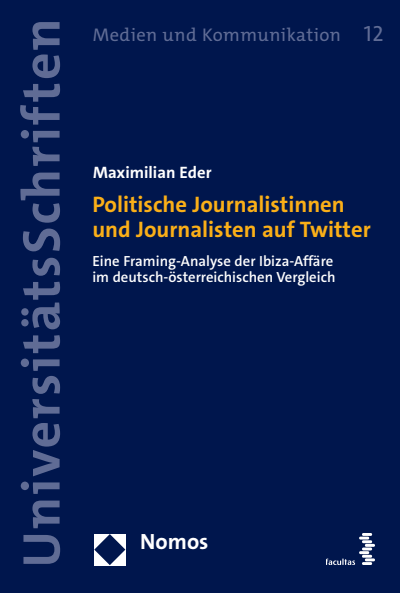
Politische Journalistinnen und Journalisten auf Twitter
Eine Framing-Analyse der Ibiza-Affäre im deutsch-österreichischen Vergleich- Autor:innen:
- Reihe:
- Nomos Universitätsschriften - Medien und Kommunikation, Band 12
- Verlag:
- 2023
Zusammenfassung
Weichen Politikjournalistinnen und -journalisten von ihrer Rolle als objektive Beobachtende auf Twitter ab? Die Untersuchung widmet sich dieser demokratietheoretisch relevanten Frage mittels einer international vergleichenden Framing-Analyse auf Twitter in Deutschland und Österreich. Die Ergebnisse basieren auf einer quantitativen Inhaltsanalyse und werden durch Leitfadeninterviews mit Politikjournalistinnen und -journalisten ergänzt. Es zeigt sich, dass journalistische Objektivität und Neutralität auf beiden Seiten der Alpen zwar nach wie vor bestehen, aber Journalistinnen und Journalisten auf Twitter durchaus von den Kriterien des objektiven Journalismus abweichen und meinungsbasierte Informationen verbreiten. Die Studie ergänzt zudem die Forschung hinsichtlich politischer Skandale.
Schlagworte
Publikation durchsuchen
Bibliographische Angaben
- Copyrightjahr
- 2023
- ISBN-Print
- 978-3-7560-0649-6
- ISBN-Online
- 978-3-7489-3983-2
- Verlag
- Nomos, Baden-Baden
- Reihe
- Nomos Universitätsschriften - Medien und Kommunikation
- Band
- 12
- Sprache
- Deutsch
- Seiten
- 372
- Produkttyp
- Monographie
Inhaltsverzeichnis
- Titelei/Inhaltsverzeichnis Kein Zugriff Seiten 1 - 18
- 1 Einleitung Kein Zugriff Seiten 19 - 26
- 2.1 Begriffsdefinition: Politischer Journalismus und politische Journalist:innen Kein Zugriff
- 2.2.1 Merkmale und Einstellungen Kein Zugriff
- 2.2.2 Rollenbild Kein Zugriff
- 2.2.3 Arbeitsort, Arbeitgeber und Einkommen Kein Zugriff
- 2.2.4 Tätigkeiten und Informationsquellen Kein Zugriff
- 2.3 Politischer Journalismus im Digitalen Kein Zugriff
- 2.4.1 Journalistische Eigenschaften und Vorstellungen Kein Zugriff
- 2.4.2 Ebene der Medienorganisationen Kein Zugriff
- 2.4.3 Ebene kontextueller Faktoren Kein Zugriff
- 2.4.4 Ebene der Mediensysteme Kein Zugriff
- 2.4.5 Ebene des politischen Systems Kein Zugriff
- 2.5.1 Interpretativer Journalismus Kein Zugriff
- 2.5.2 Kommerzialisierung Kein Zugriff
- 2.5.3 Personalisierung Kein Zugriff
- 2.5.4 Boulevardisierung Kein Zugriff
- 2.6 Zusammenfassung Kein Zugriff
- 3.1.1 Journalistische Rollenkonzeption Kein Zugriff
- 3.1.2 Journalistische Rollenwahrnehmung Kein Zugriff
- 3.1.3 Journalistische Rollenausübung Kein Zugriff
- 3.1.4 Journalistische Rollenperformanz Kein Zugriff
- 3.2 Journalistische Rollen im digitalen Journalismus und sozialen Medien Kein Zugriff
- 3.3 Journalistische Normen Kein Zugriff
- 3.4 Journalismuskulturen Kein Zugriff
- 3.5 Zusammenfassung Kein Zugriff
- 4.1 Entwicklung digitaler Medien zu sozialen Medien Kein Zugriff
- 4.2 Soziale Medien und Öffentlichkeit Kein Zugriff
- 4.3 Journalistisches Gatekeeping in sozialen Medien Kein Zugriff
- 4.4.1 Forschungsüberblick Kein Zugriff
- 4.4.2 Potenziale für den Journalismus Kein Zugriff
- 4.4.3 Journalistische Interaktionsnetzwerke Kein Zugriff
- 4.5 Zusammenfassung Kein Zugriff
- 5.1 Begriffsdefinition: Skandal und Skandalisierung Kein Zugriff
- 5.2 Medialisierte Skandale und Medienskandale Kein Zugriff
- 5.3 Digitale Medien, soziale Medien und Skandale Kein Zugriff
- 5.4 Mechanismen medialer Skandalisierung Kein Zugriff
- 5.5 Phasen des Medienskandals Kein Zugriff
- 5.6 Skandalisierung und Framing Kein Zugriff
- 5.7.1 Politische Skandale in Deutschland und Österreich Kein Zugriff
- 5.7.2 Wirkung politischer Skandale Kein Zugriff
- 5.8 Zusammenfassung Kein Zugriff
- 6.1 Forschungsüberblick Kein Zugriff
- 6.2.1 Begriffsdefinition: Journalistisches Framing Kein Zugriff
- 6.2.2 Kommunikationsprozesse journalistischen Framings Kein Zugriff
- 6.3 Framing in sozialen Medien Kein Zugriff
- 6.4 Frame-Building und Frame-Setting Kein Zugriff
- 6.5.1 Begriffsdefinition: Frame-Elemente nach Entman (1993) Kein Zugriff
- 6.5.2.1 Entstehung von Medien-Frames Kein Zugriff
- 6.5.2.2 Wirkung von Medien-Frames Kein Zugriff
- 6.5.3.1 Themenübergreifende Medien-Frames in der politischen Berichterstattung Kein Zugriff
- 6.5.3.2 Themenspezifische Medien-Frames in politischen Skandalen Kein Zugriff
- 6.6 Zusammenfassung Kein Zugriff
- 7.1 Mediensysteme Kein Zugriff
- 7.2.1 Kritik Kein Zugriff
- 7.2.2 Weiterentwicklung Kein Zugriff
- 7.3.1.1 Deutschland Kein Zugriff
- 7.3.1.2 Österreich Kein Zugriff
- 7.3.2 Pressemarkt ‒ Online Kein Zugriff
- 7.4.1 Leitmedien Kein Zugriff
- 7.4.2 Qualitätsmedien Kein Zugriff
- 7.5 Zusammenfassung Kein Zugriff
- 8.1 Forschungsfragen Kein Zugriff
- 8.2.1 Akteure Kein Zugriff
- 8.2.2 Veröffentlichung und Inhalt Kein Zugriff
- 8.2.3 Folgen Kein Zugriff
- 8.2.4 Weitere Entwicklungen Kein Zugriff
- 8.3 Forschungsdesign Kein Zugriff
- 8.4 Untersuchungs- und Erhebungszeitraum Kein Zugriff
- 9.1.1 Methodischer Zugang: Framing-Analyse Kein Zugriff
- 9.1.2 Stichprobe Kein Zugriff
- 9.1.3 Untersuchungsinstrument Kein Zugriff
- 9.1.4.1 Aufbau des Codebuchs Kein Zugriff
- 9.1.4.2 Variablen und Ausprägungen Kein Zugriff
- 9.1.5 Untersuchungsdurchführung Kein Zugriff
- 9.2.1 Methodischer Zugang: Expert:inneninterviews Kein Zugriff
- 9.2.2 Stichprobe Kein Zugriff
- 9.2.3 Untersuchungsinstrument und Untersuchungsdurchführung Kein Zugriff
- 10.1.1 Variablengruppe: Formale Kategorien I Kein Zugriff
- 10.1.2 Variablengruppe: Formale Kategorien II Kein Zugriff
- 10.1.3 Variablengruppe: Inhaltliche Kategorien I Kein Zugriff
- 10.1.4 Variablengruppe: Inhaltliche Kategorien II Kein Zugriff
- 10.2.1 Themenbereich I: Erfahrungen zur Twitternutzung in der journalistischen Arbeit Kein Zugriff
- 10.2.2 Themenbereich II: Erfahrungen zu Kommunikationsstrukturen von Twitter Kein Zugriff
- 11.1 Beantwortung der Forschungsfragen Kein Zugriff
- 11.2 Vertiefende Befunde Kein Zugriff
- 11.3 Einordnung der Ergebnisse Kein Zugriff
- 11.4 Implikationen Kein Zugriff
- 11.5 Limitationen Kein Zugriff
- Literaturverzeichnis Kein Zugriff Seiten 295 - 372
Literaturverzeichnis (1102 Einträge)
Es wurden keine Treffer gefunden. Versuchen Sie einen anderen Begriff.
- Schuck, A. R., Azrout, R., Boomgaarden, H., Elenbaas, M., van Spanje, J., Vliegenthart, R. & de Vreese, C. (2011). Media visibility and framing of the European parliamentary elections 2009: A media content analysis in 27 countries. In M. Maier, J. Strömbäck & L. L. Kaid (Hrsg.), Political communication in European parliamentary elections (S. 175–196). Ashgate. Google Scholar öffnen doi.org/10.5771/9783748939832
- Schuck, A. R. & de Vreese, C. H. (2006). Between risk and opportunity: News framing and its effects on public support for EU enlargement. European Journal of Communication, 21(1), 5–32. https://doi.org/10.1177/0267323106060987 Google Scholar öffnen doi.org/10.5771/9783748939832
- Schulz, W [Winfried], Berens, H. & Zeh, R. (1998). Der Kampf um Castor in den Medien: Konfliktbewertung, Nachrichtenresonanz und journalistische Qualität. Fischer. Google Scholar öffnen doi.org/10.5771/9783748939832
- Schumacher, N. F., Maurer, P. & Nuernbergk, C. (2023). Towards new standards? Interaction patterns of German political journalists in the Twittersphere. The International Journal of Press/Politics, 28(1) 257–277. https://doi.org/10.1177/19401612211025502 Google Scholar öffnen doi.org/10.5771/9783748939832
- Schwarzenegger, C. (2019). Eine Geschichte der Social Media in Österreich. In M. Karmasin & C. Oggolder (Hrsg.), Österreichische Mediengeschichte: Band 2: Von Massenmedien zu sozialen Medien (1918 bis heute) (S. 291–314). Springer VS. Google Scholar öffnen doi.org/10.5771/9783748939832
- Seethaler, J. (2015). Qualität des tagesaktuellen Informationsangebots in den österreichischen Medien: Eine crossmediale Untersuchung. Rundfunk und Telekom Regulierungs-GmbH (RTR). https://www.rtr.at/medien/aktuelles/publikationen/Band1-2015.pdf Google Scholar öffnen doi.org/10.5771/9783748939832
- Seethaler, J., Hanitzsch, T., Keel, G., Lauerer, C., Steindl, N. & Wyss, V. (2019). Zwischen Kontinuität und Wandel: Journalismus in Deutschland, Österreich und der Schweiz. In T. Hanitzsch, J. Seethaler & V. Wyss (Hrsg.), Journalismus in Deutschland, Österreich und der Schweiz (S. 237–256). Springer VS. Google Scholar öffnen doi.org/10.5771/9783748939832
- Seethaler, J. & Melischek, G. (2006). Die Pressekonzentration in Österreich im europäischen Vergleich. Österreichische Zeitschrift für Politikwissenschaft, 35(4), 337–360. https://webapp.uibk.ac.at/ojs/index.php/OEZP/article/view/1204/899 Google Scholar öffnen doi.org/10.5771/9783748939832
- Seethaler, J. & Melischek, G. (2015). Koexistenz von scheinbar Inkompatiblem? Zum Wandel der österreichischen Medien- und Kommunikationsstrukturen. In K.-D. Altmeppen, P. Donges, M. Künzler, M. Puppis, U. Röttger & H. Wessler (Hrsg.), Soziale Ordnung durch Kommunikation? (S. 67–88). Nomos. Google Scholar öffnen doi.org/10.5771/9783748939832
- Seethaler, J. & Melischek, G. (2019). Twitter as a tool for agenda building in election campaigns? The case of Austria. Journalism, 20(8), 1087–1107. https://doi.org/10.1177/1464884919845460 Google Scholar öffnen doi.org/10.5771/9783748939832
- Sehl, A., Cornia, A. & Nielsen, R. K. (2016). Public service news and digital media. Oxford, UK. Reuters Institute for the Study of Journalism. https://reutersinstitute.politics.ox.ac.uk/sites/default/files/research/files/Public%2520Service%2520News%2520and%2520Digital%2520Media.pdf Google Scholar öffnen doi.org/10.5771/9783748939832
- Sehl, A., Cornia, A. & Nielsen, R. K. (2021). How do funding models and organizational legacy shape news organizations’ social media strategies? A comparison of public service and private sector news media in six countries. Digital Journalism. Online-Vorveröffentlichung. 1–20. https://doi.org/10.1080/21670811.2021.1968920 Google Scholar öffnen doi.org/10.5771/9783748939832
- Sehl, A. & Eder, M. (2020). Editorial Analytics: Chancen und Herausforderungen für den digitalen Journalismus. In T. Köhler (Hrsg.), Fake-News, Framing, Fact-Checking: Nachrichten im digitalen Zeitalter. Ein Handbuch (S. 205–220). Transcript. Google Scholar öffnen doi.org/10.5771/9783748939832
- Sehl, A., Eder, M. & Kretzschmar, S. (2022). Journalismus auf Instagram: Qualität neu definiert? In J. Schützeneder & M. Graßl (Hrsg.), Journalismus und Instagram: Analysen, Strategien, Perspektiven aus Wissenschaft und Praxis (S. 45–58). Springer VS. Google Scholar öffnen doi.org/10.5771/9783748939832
- Sehl, A., Fletcher, R. & Picard, R. G. (2020). Crowding out: Is there evidence that public service media harm markets? A cross-national comparative analysis of commercial television and online news providers. European Journal of Communication, 35(4), 389–409. https://doi.org/10.1177/0267323120903688 Google Scholar öffnen doi.org/10.5771/9783748939832
- Semetko, H. A., Blumler, J. G., Gurevitch, M. & Weaver, D. H. (1991). The formation of campaign agendas: A comparative analysis of party and media roles in recent American and British elections. Lawrence Erlbaum Associates. Google Scholar öffnen doi.org/10.5771/9783748939832
- Semetko, H. A. & Valkenburg, P. M. (2000). Framing European politics: A content analysis of press and television news. Journal of Communication, 50(2), 93–109. https://doi.org/10.1111/j.1460-2466.2000.tb02843.x Google Scholar öffnen doi.org/10.5771/9783748939832
- Shah, D. V., Domke, D. & Wackman, D. B. (2001). The effects of value-framing on political judgment and reasoning. In S. D. Reese, O. H. Gandy & A. E. Grant (Hrsg.), Framing public life: Perspectives on media and our understanding of the social world (S. 227–243). Lawrence Erlbaum Associates. Google Scholar öffnen doi.org/10.5771/9783748939832
- Shah, D. V., Watts, M. D., Domke, D. & Fan, D. P. (2002). News framing and cueing of issue regimes: Explaining Clinton’s public approval in spite of scandal. Public Opinion Quarterly, 66(3), 339–370. https://doi.org/10.1086/341396 Google Scholar öffnen doi.org/10.5771/9783748939832
- Shehata, A. (2014). Game frames, issue frames, and mobilization: Disentangling the effects of frame exposure and motivated news attention on political cynicism and engagement. International Journal of Public Opinion Research, 26(2), 157–177. https://doi.org/10.1093/ijpor/edt034 Google Scholar öffnen doi.org/10.5771/9783748939832
- Shoemaker, P. J. & Reese, S. D. (1996). Mediating the message: Theories of influences on mass media content (2. Aufl.). Longman. Google Scholar öffnen doi.org/10.5771/9783748939832
- Shoemaker, P. J. & Reese, S. D. (2014). Mediating the message in the 21st century: A media sociology perspective (3. Aufl.). Routledge. Google Scholar öffnen doi.org/10.5771/9783748939832
- Shoemaker, P. J. & Vos, T. (2009). Gatekeeping Theory. Routledge. https://doi.org/10.4324/9780203931653 Google Scholar öffnen doi.org/10.5771/9783748939832
- Sickinger, H. (2007). Von der „Insel der Seligen“ zur „Skandalrepublik“? Politische Skandale in der Zweiten Republik. In M. Gehler (Hrsg.), Politische Affären und Skandale in Österreich: Von Mayerling bis Waldheim (S. 698–743). Studien Verlag. Google Scholar öffnen doi.org/10.5771/9783748939832
- Sickinger, H. (2011). Politische Korruption und der Wandel der Rahmenbedingungen für politische Skandale in der Zweiten Republik. In E. Bruckmüller (Hrsg.), Korruption in Österreich: Historische Streiflichter (S. 111–130). Braumüller. Google Scholar öffnen doi.org/10.5771/9783748939832
- Sickinger, H. (2019). Wahlkampffinanzierung im Schatten der Wahl 2017. In B. Tóth & T. Hofer (Hrsg.), Wahl 2019: Strategien, Schnitzel, Skandale (S. 151–161). Ecowin. Google Scholar öffnen doi.org/10.5771/9783748939832
- Siebert, F. S., Peterson, T. & Schramm, W. (1956). Four theories of the press: The authoritarian, libertarian, social responsibility and Soviet communist concepts of what the press should be and do. University of Illinois Press. Google Scholar öffnen doi.org/10.5771/9783748939832
- Simon, F. M. (2019). What determines a journalist’s popularity on Twitter? A case study of behaviour and self-presentation. Journalism Studies, 20(8), 1200–1220. https://doi.org/10.1080/1461670X.2018.1500491 Google Scholar öffnen doi.org/10.5771/9783748939832
- Singer, J. B. (2005). The political j-blogger: „Normalizing“ a new media form to fit old norms and parctices. Journalism, 6(2), 173–198. https://doi.org/10.1177/1464884905051009 Google Scholar öffnen doi.org/10.5771/9783748939832
- Singer, J. B. (2007). Contested autonomy: Professional and popular claims on journalistic norms. Journalism Studies, 8(1), 79–95. https://doi.org/10.1080/14616700601056866 Google Scholar öffnen doi.org/10.5771/9783748939832
- Singer, J. B. (2010). Quality control: Perceived effects of user-generated content on newsroom norms, values and routines. Journalism Practice, 4(2), 127–142. https://doi.org/10.1080/17512780903391979 Google Scholar öffnen doi.org/10.5771/9783748939832
- Singer, J. B. (2014). User-generated visibility: Secondary gatekeeping in a shared media space. New Media & Society, 16(1), 55–73. https://doi.org/10.1177/1461444813477833 Google Scholar öffnen doi.org/10.5771/9783748939832
- Singer, J. B. (2015). Out of bounds: Professional norms as boundary markers. In M. Carlson & S. C. Lewis (Hrsg.), Boundaries of journalism: Professionalism, practices and participation (S. 21–36). Routledge. Google Scholar öffnen doi.org/10.5771/9783748939832
- Sipes, C. (2011). Men, mistresses, and media framing: Examining political sex scandals. In A. Dagnes (Hrsg.), Sex scandals in American politics: A multidisciplinary approach to the construction and aftermath of contemporary political sex scandals (S. 94–112). Bloomsbury Academic. https://doi.org/10.5040/9781501300660.ch-006 Google Scholar öffnen doi.org/10.5771/9783748939832
- Sjøvaag, H. & Ohlsson, J. (2019). Media ownership and journalism. Oxford Research Encyclopedia of Communication. https://doi.org/10.1093/acrefore/9780190228613.013.839 Google Scholar öffnen doi.org/10.5771/9783748939832
- Skovsgaard, M., Albæk, E., Bro, P. & de Vreese, C. (2013). A reality check: How journalists’ role perceptions impact their implementation of the objectivity norm. Journalism, 14(1), 22–42. https://doi.org/10.1177/1464884912442286 Google Scholar öffnen doi.org/10.5771/9783748939832
- Slothuus, R. (2008). More than weighting cognitive importance: A dual-process model of issue framing effects. Political Psychology, 29(1), 1–28. https://doi.org/10.1111/j.1467-9221.2007.00610.x Google Scholar öffnen doi.org/10.5771/9783748939832
- Small, T. A. (2011). What the hashtag? A content analysis of Canadian politics on Twitter. Information, Communication & Society, 14(6), 872–895. https://doi.org/10.1080/1369118X.2011.554572 Google Scholar öffnen doi.org/10.5771/9783748939832
- Smilova, R. & Smilov, D. (2015). Informal politics and formal media structures. In J. Zielonka (Hrsg.), Media and politics in new democracies: Europe in a comparative perspective (S. 197–213). Oxford University Press. Google Scholar öffnen doi.org/10.5771/9783748939832
- Sniderman, P. M. & Theriault, S. M. (2004). The structure of political argument and the logic of issue framing. In W. E. Saris & P. M. Sniderman (Hrsg.), Studies in public opinion: Attitudes, nonattitudes, measurement error, and change (S. 133–165). Princeton University Press. Google Scholar öffnen doi.org/10.5771/9783748939832
- Snow, D. A., Rochford, E. B., Worden, S. K. & Benford, R. D. (1986). Frame alignment processes, micromobilization, and movement participation. American Sociological Review, 51(4), 464–481. https://doi.org/10.2307/2095581 Google Scholar öffnen doi.org/10.5771/9783748939832
- Snow, D. A., Vliegenthart, R. & Ketelaars, P. (2019). The framing perspective on social movements: Its conceptual roots and architecture. In D. A. Snow, S. A. Soule, H. Kriesi & H. J. McCammon (Hrsg.), The Wiley Blackwell companion to social movements (2. Aufl., S. 392–410). John Wiley & Sons. Google Scholar öffnen doi.org/10.5771/9783748939832
- Solomon, E. D., Hackathorn, J. M. & Crittendon, D. (2019). Judging scandal: Standards or bias in politics. The Journal of Social Psychology, 159(1), 61–74. https://doi.org/10.1080/00224545.2018.1453468 Google Scholar öffnen doi.org/10.5771/9783748939832
- Song, H., Tolochko, P., Eberl, J.‑M., Eisele, O., Greussing, E., Heidenreich, T., Lind, F., Galyga, S. & Boomgaarden, H. G. (2020). In validations we trust? The impact of imperfect human annotations as a gold standard on the quality of validation of automated content analysis. Political Communication, 37(4), 550–572. https://doi.org/10.1080/10584609.2020.1723752 Google Scholar öffnen doi.org/10.5771/9783748939832
- Sparviero, S. & Trappel, J. (2022). Austria. In Reuters Institute Digital News Report 2022 (S. 64–65). Oxford, UK: Reuters Institute for the Study of Journalism. Google Scholar öffnen doi.org/10.5771/9783748939832
- Spatzenegger, A. (2020). Social Media als Quelle journalistischer Arbeit: Einfluss der Facebook- und Twitter-Beiträge von PolitikerInnen auf die Berichterstattung von Tageszeitungen. Journalistik. Zeitschrift für Journalismusforschung, 3(3), 197–215. https://doi.org/10.1453/2569-152X-32020-10976-de Google Scholar öffnen doi.org/10.5771/9783748939832
- Staab, P. & Thiel, T. (2021). Privatisierung ohne Privatismus: Soziale Medien im digitalen Strukturwandel der Öffentlichkeit. In M. Seeliger & S. Sevignani (Hrsg.), Leviathan Sonderband: Bd. 37. Ein neuer Strukturwandel der Öffentlichkeit? (S. 277–297). Nomos. Google Scholar öffnen doi.org/10.5771/9783748939832
- Standaert, O. (2022). Beyond the family resemblance: Mapping the normative roles of journalists across Europe in the early 2010s. The International Journal of Press/Politics, 27(1), 58-75. https://doi.org/10.1177/1940161221994093 Google Scholar öffnen doi.org/10.5771/9783748939832
- Standaert, O., Hanitzsch, T. & Dedonder, J. (2021). In their own words: A normative-empirical approach to journalistic roles around the world. Journalism, 22(4), 919–936. https://doi.org/10.1177/1464884919853183 Google Scholar öffnen doi.org/10.5771/9783748939832
- Stanek, J. (2019, 18. Mai). Böhmermann, immer wieder Böhmermann. Spiegel. https://www.spiegel.de/politik/ausland/jan-boehmermann-und-oesterreich-was-wusste-er-ueber-das-strache-video-a-1268123.html Google Scholar öffnen doi.org/10.5771/9783748939832
- Stark, B. & Magin, M. (2013). Boulevardisierungstendenzen deutscher und österreichischer Tageszeitungen im Kontext nationaler Marktstrukturen: Eine ländervergleichende Untersuchung. In M. Puppis, M. Künzler & O. Jarren (Hrsg.), Media structures and media performance: Medienstrukturen und Medienperformanz (S. 401–428). Verlag der österreichischen Akademie der Wissenschaften. Google Scholar öffnen doi.org/10.5771/9783748939832
- Stark, B., Riedl, A., Eisenegger, M., Schneider, J., Udris, L. & Jandura, O. (2021). Qualität des politischen Nachrichtenangebots in Deutschland: Empirische Kernbefunde aus dem Projekt „Media Performance and Democracy“. Media Perspektiven(9), 430–449. Google Scholar öffnen doi.org/10.5771/9783748939832
- Steindl, N., Hanitzsch, T. & Lauerer, C. (2021). Kumpanei oder Disziplinierung? Zur Wahrnehmung politischer und wirtschaftlicher Einflüsse durch österreichische PolitikjournalistInnen im internationalen Vergleich. In M. Magin, U. Rußmann & B. Stark (Hrsg.), Demokratie braucht Medien (S. 159–174). Springer VS. Google Scholar öffnen doi.org/10.5771/9783748939832
- Steindl, N., Lauerer, C. & Hanitzsch, T. (2017). Journalismus in Deutschland: Aktuelle Befunde zu Kontinuität und Wandel im deutschen Journalismus. Publizistik, 62(4), 401–423. https://doi.org/10.1007/s11616-017-0378-9 Google Scholar öffnen doi.org/10.5771/9783748939832
- Steiner, M. (2020). Soft presentation of hard news? A content analysis of political Facebook posts. Media and Communication, 8(3), 244–257. https://doi.org/10.17645/mac.v8i3.3152 Google Scholar öffnen doi.org/10.5771/9783748939832
- Steininger, C. (2004). Das politische Dilemma medialer Produktion. In K. Imhof, R. Blum, H. Bonfadelli & O. Jarren (Hrsg.), Mediengesellschaft: Strukturen, Merkmale, Entwicklungsdynamiken (S. 295–313). VS Verlag für Sozialwissenschaften. Google Scholar öffnen doi.org/10.5771/9783748939832
- Steinke, I. (2007). Qualitätssicherung in der qualitativen Forschung. In U. Kuckartz, H. Grunenberg & T. Dresing (Hrsg.), Qualitative Datenanalyse: computergestützt: Methodische Hintergründe und Beispiele aus der Forschungspraxis (2. Aufl., S. 176–187). VS Verlag für Sozialwissenschaften. Google Scholar öffnen doi.org/10.5771/9783748939832
- Steinmaurer, T. (2002). Österreichs Mediensystem: Ein Überblick. In T. Steinmaurer (Hrsg.), Konzentriert und verflochten: Österreichs Mediensystem im Überblick (S. 11–69). Studien Verlag. Google Scholar öffnen doi.org/10.5771/9783748939832
- Steinmaurer, T. (2012). Medien und Medienpolitik in Österreich - ein Überblick. Informationen zur Politischen Bildung, 35, 5–16. http://www.politischebildung.com/wp-content/uploads/izpb35.pdf Google Scholar öffnen doi.org/10.5771/9783748939832
- Stengel, K. & Marschall, J. (2010). Verwandte und konkurrierende Ansätze. In M. Maier, K. Stengel & J. Marschall (Hrsg.), Nachrichtenwerttheorie (S. 116–131). Nomos. Google Scholar öffnen doi.org/10.5771/9783748939832
- Stępińska, A., Jurga-Wosik, E., Adamczewska, K., Secler, B. & Narożna, D. (2016). Journalistic role performance in Poland. Środkowoeuropejskie Studia Polityczne(2), 37–51. https://doi.org/10.14746/ssp.2016.2.3 Google Scholar öffnen doi.org/10.5771/9783748939832
- Stern, S., Livan, G. & Smith, R. E. (2020). A network perspective on intermedia agenda-setting. Applied Network Science, 5. https://doi.org/10.1007/s41109-020-00272-4 Google Scholar öffnen doi.org/10.5771/9783748939832
- Stier, S., Mangold, F., Scharkow, M. & Breuer, J. (2022). Post post-broadcast democracy? News exposure in the age of online intermediaries. American Political Science Review, 116(2), 768–774. https://doi.org/10.1017/S0003055421001222 Google Scholar öffnen doi.org/10.5771/9783748939832
- Stoycheff, E. (2019). Selecting scandal: How legacy and social media gatekeep the news. In H. Tumber & S. R. Waisbord (Hrsg.), The Routledge companion to media and scandal (S. 86–94). Routledge. Google Scholar öffnen doi.org/10.5771/9783748939832
- Strömbäck, J. (2008). Four phases of mediatization: An analysis of the mediatization of politics. The International Journal of Press/Politics, 13(3), 228–246. https://doi.org/10.1177/1940161208319097 Google Scholar öffnen doi.org/10.5771/9783748939832
- Strömbäck, J. & Dimitrova, D. V. (2011). Mediatization and media interventionism: A comparative analysis of Sweden and the United States. The International Journal of Press/Politics, 16(1), 30–49. https://doi.org/10.1177/1940161210379504 Google Scholar öffnen doi.org/10.5771/9783748939832
- Strömbäck, J. & Esser, F. (2014). Mediatization of politics: Towards a theoretical framework. In F. Esser & J. Strömbäck (Hrsg.), Mediatization of politics: Understanding the transformation of Western democracies (S. 3–28). Palgrave Macmillan. Google Scholar öffnen doi.org/10.5771/9783748939832
- Strömbäck, J. & Luengo, Ó. G. (2008). Polarized pluralist and democratic corporatist models: A comparison of election news coverage in Spain and Sweden. International Communication Gazette, 70(6), 547–562. https://doi.org/10.1177/1748048508096398 Google Scholar öffnen doi.org/10.5771/9783748939832
- Strömbäck, J., Negrine, R., Hopmann, D. N., Maier, M., Jalali, C., Berganza, R., Seeber, G. U. H., Seceleanu, A., Volek, J., Dobek-Ostrowska, B., Mykkänen, J., Belluati, M. & Róka, J. (2011). The mediatization and framing of European parliamentary election campaigns. In M. Maier, J. Strömbäck & L. L. Kaid (Hrsg.), Political communication in European parliamentary elections (S. 161–174). Ashgate. Google Scholar öffnen doi.org/10.5771/9783748939832
- Strömbäck, J. & Shehata, A. (2018). Political journalism. Oxford Research Encyclopedia of Communication. https://doi.org/10.1093/acrefore/9780190228613.013.859 Google Scholar öffnen doi.org/10.5771/9783748939832
- Stumpp, S. & Michelis, D. (2021). Einführung in die Sozialen Medien. In S. Stumpp, D. Michelis & T. Schildhauer (Hrsg.), Social Media Handbuch: Theorien, Methoden, Modelle und Praxis (4. Aufl., S. 23–38). Nomos. Google Scholar öffnen doi.org/10.5771/9783748939832
- Taddicken, M. & Schmidt, J.‑H. (2017). Entwicklung und Verbreitung sozialer Medien. In J.-H. Schmidt & M. Taddicken (Hrsg.), Handbuch Soziale Medien (S. 3–22). Springer VS. Google Scholar öffnen doi.org/10.5771/9783748939832
- Tagle, F. (2021). Generic frames in corruption scandals in Chile (2015-2019): Differences and similarities between print and online media. International Journal of Communication, 15, 3067–3088. https://ijoc.org/index.php/ijoc/article/view/16852 Google Scholar öffnen doi.org/10.5771/9783748939832
- Tandoc, E. C., Jr., Cabañes, J. V. A. & Cayabyab, Y. M. (2019). Bridging the Gap: Journalists’ role orientation and role performance on Twitter. Journalism Studies, 20(6), 857–871. https://doi.org/10.1080/1461670X.2018.1463168 Google Scholar öffnen doi.org/10.5771/9783748939832
- Tandoc, E. C., Jr., Hellmueller, L. & Vos, T. P. (2013). Mind the gap: Between journalistic role conception and role enactment. Journalism Practice, 7(5), 539–554. https://doi.org/10.1080/17512786.2012.726503 Google Scholar öffnen doi.org/10.5771/9783748939832
- Tandoc, E. C., Jr. & Vos, T. P. (2016). The journalist is marketing the news: Social media in the gatekeeping process. Journalism Practice, 10(8), 950–966. https://doi.org/10.1080/17512786.2015.1087811 Google Scholar öffnen doi.org/10.5771/9783748939832
- Tankard, J. W., Jr. (2001). The empirical approach to the study of media framing. In S. D. Reese, O. H. Gandy & A. E. Grant (Hrsg.), Framing public life: Perspectives on media and our understanding of the social world (S. 95–106). Lawrence Erlbaum Associates. Google Scholar öffnen doi.org/10.5771/9783748939832
- Tenenboim-Weinblatt, K. & Neiger, M. (2015). Print is future, online is past: Cross-media analysis of temporal orientations in the news. Communication Research, 42(8), 1047–1067. https://doi.org/10.1177/0093650214558260 Google Scholar öffnen doi.org/10.5771/9783748939832
- Tenscher, J. & Golja, R. (2014). Der Fall Grasser im Spiegel der Boulevard- und Qualitätspresse. SWS-Rundschau, 54(4), 362–384. https://nbn-resolving.org/urn:nbn:de:0168-ssoar-51970-1 Google Scholar öffnen doi.org/10.5771/9783748939832
- Terren, L. & Borge Bravo, R. (2021). Echo chambers on social media: A systematic review of the literature. Review of Communication Research, 9, 99–118. https://doi.org/10.12840/ISSN.2255-4165.028 Google Scholar öffnen doi.org/10.5771/9783748939832
- Tewksbury, D. & Riles, J. M. (2018). Framing in an interactive news environment. In P. D’Angelo (Hrsg.), Doing news framing analysis II: Empirical and theoretical perspectives (S. 137–162). Routledge. Google Scholar öffnen doi.org/10.5771/9783748939832
- Thimm, C. (2016). The mediatization of politics and the digital public sphere: The dynamics of Mini-Publics. In A. Frame & G. Brachotte (Hrsg.), Citizen participation and political communication in a digital world (S. 167–183). Routledge. Google Scholar öffnen doi.org/10.5771/9783748939832
- Thimm, C. (2017). Soziale Netzwerke als Arenen politischer Partizipation: Neue Optionen für Demokratie oder aber Datafication, Fragmentierung und Radikalisierung? Medienjournal, 41(2), 76–89. https://doi.org/10.24989/medienjournal.v41i2.1472 Google Scholar öffnen doi.org/10.5771/9783748939832
- Thomaß, B. (2013a). Mediensysteme vergleichen. In B. Thomaß (Hrsg.), Mediensysteme im internationalen Vergleich (2. Aufl., S. 12–45). UVK. Google Scholar öffnen doi.org/10.5771/9783748939832
- Thomaß, B. (2013b). Weltregionen im Vergleich: Westeuropa. In B. Thomaß (Hrsg.), Mediensysteme im internationalen Vergleich (2. Aufl., S. 220–238). UVK. Google Scholar öffnen doi.org/10.5771/9783748939832
- Thompson, J. B. (2000). Political scandal: Power and visibility in the media age. Polity Press. Google Scholar öffnen doi.org/10.5771/9783748939832
- Thompson, J. B. (2011). Shifting boundaries of public and private life. Theory, Culture & Society, 28(4), 49–70. https://doi.org/10.1177/0263276411408446 Google Scholar öffnen doi.org/10.5771/9783748939832
- Thränhardt, D. (1991). Scandals, changing norms and agenda setting in German politics. The Journal of Social Science, 30(2), 13–32. http://id.nii.ac.jp/1130/00003506 Google Scholar öffnen doi.org/10.5771/9783748939832
- Thurman, N., Moeller, J., Helberger, N. & Trilling, D. (2019). My friends, editors, algorithms, and I: Examining audience attitudes to news selection. Digital Journalism, 7(4), 447–469. https://doi.org/10.1080/21670811.2018.1493936 Google Scholar öffnen doi.org/10.5771/9783748939832
- Thussu, D. K. (2007). News as entertainment: The rise of global infotainment. Sage. Google Scholar öffnen doi.org/10.5771/9783748939832
- Töpfl, F. (2011). Mediensysteme in Transformationsprozessen: Wie entstehen pluralistische Mediensysteme – und warum nicht? Nomos. Google Scholar öffnen doi.org/10.5771/9783748939832
- Tóth, B. (2019). Einmal Ibiza und zurück. In B. Tóth & T. Hofer (Hrsg.), Wahl 2019: Strategien, Schnitzel, Skandale (S. 127–140). Ecowin. Google Scholar öffnen doi.org/10.5771/9783748939832
- Trappel, J. (2019). Medienkonzentration - trotz Internet kein Ende in Sicht. In M. Karmasin & C. Oggolder (Hrsg.), Österreichische Mediengeschichte: Band 2: Von Massenmedien zu sozialen Medien (1918 bis heute) (S. 199–226). Springer VS. Google Scholar öffnen doi.org/10.5771/9783748939832
- Trilling, D., Tolochko, P. & Burscher, B. (2017). From newsworthiness to shareworthiness: How to predict news sharing based on article characteristics. Journalism & Mass Communication Quarterly, 94(1), 38–60. https://doi.org/10.1177/1077699016654682 Google Scholar öffnen doi.org/10.5771/9783748939832
- Trilling, D. & van Hoof, M. (2020). Between article and topic: News events as level of analysis and their computational identification. Digital Journalism, 8(10), 1317–1337. https://doi.org/10.1080/21670811.2020.1839352 Google Scholar öffnen doi.org/10.5771/9783748939832
- Tromble, R. & Meffert, M. F. (2016). The life and death of frames: Dynamics of media frame duration. International Journal of Communication, 10, 5079–5101. https://ijoc.org/index.php/ijoc/article/view/4681 Google Scholar öffnen doi.org/10.5771/9783748939832
- Trotier, K. (2011). Der Fall Günter Grass: Eine Inhaltsanalyse ausgewählter Qualitätsmedien nach dem Waffen-SS-Geständnis. Publizistik, 56(1), 7–25. https://doi.org/10.1007/s11616-010-0105-2 Google Scholar öffnen doi.org/10.5771/9783748939832
- Trottier, D. (2018). Scandal mining: Political nobodies and remediated visibility. Media, Culture & Society, 40(6), 893–908. https://doi.org/10.1177/0163443717734408 Google Scholar öffnen doi.org/10.5771/9783748939832
- Tuchman, G. (1978). Making news: A study in the construction of social reality. Free Press. Google Scholar öffnen doi.org/10.5771/9783748939832
- Tumber, H. (2001). Democracy in the information age: The role of the fourth estate in cyberspace. Information, Communication & Society, 4(1), 95–112. https://doi.org/10.1080/13691180122542 Google Scholar öffnen doi.org/10.5771/9783748939832
- Tumber, H. & Waisbord, S. R. (2004). Introduction: Political scandals and media across democracies, Volume I. American Behavioral Scientist, 47(8), 1031–1039. https://doi.org/10.1177/0002764203262275 Google Scholar öffnen doi.org/10.5771/9783748939832
- Tumber, H. & Waisbord, S. R. (2019). Media and scandal. In H. Tumber & S. R. Waisbord (Hrsg.), The Routledge companion to media and scandal (S. 10–21). Routledge. Google Scholar öffnen doi.org/10.5771/9783748939832
- Twitter. (2020). Global impact report. https://about.twitter.com/content/dam/about-twitter/en/company/global-impact-2020.pdf Google Scholar öffnen doi.org/10.5771/9783748939832
- Udris, L. & Lucht, J. (2009). Öffentliche Kommunikation im Umbruch? Wandel der Medienstrukturen und Medieninhalte in ländervergleichender und diachroner Perspektive. In B. Stark & M. Magin (Hrsg.), Die österreichische Medienlandschaft im Umbruch (S. 17–40). Österreichische Akademie der Wissenschaften. Google Scholar öffnen doi.org/10.5771/9783748939832
- Umbricht, A. & Esser, F. (2014). Changing political news? Long-term trends in American, British, French, Italien, German, and Swiss print media reporting. In R. Kuhn & R. K. Nielsen (Hrsg.), Political journalism in transition: Western Europe in a comparative perspective (S. 195–217). I.B. Tauris. Google Scholar öffnen doi.org/10.5771/9783748939832
- Umbricht, A. & Esser, F. (2016). The push to popularize politics: Understanding the audience-friendly packaging of political news in six media systems since the 1960s. Journalism Studies, 17(1), 100–121. https://doi.org/10.1080/1461670x.2014.963369 Google Scholar öffnen doi.org/10.5771/9783748939832
- Urban, J. & Schweiger, W. (2014). News quality from the recipients’ perspective: Investigating recipients’ ability to judge the normative quality of news. Journalism Studies, 15(6), 821–840. https://doi.org/10.1080/1461670x.2013.856670 Google Scholar öffnen doi.org/10.5771/9783748939832
- Urman, A. (2020). Context matters: Political polarization on Twitter from a comparative perspective. Media, Culture & Society, 42(6), 857–879. https://doi.org/10.1177/0163443719876541 Google Scholar öffnen doi.org/10.5771/9783748939832
- Usher, B. (2021). The celebrified columnist and opinion spectacle: Journalism’s changing place in networked public spheres. Journalism, 22(11), 2836–2854. https://doi.org/10.1177/1464884919897815 Google Scholar öffnen doi.org/10.5771/9783748939832
- Usher, N. (2012). Service journalism as community experience: Personal technology and personal finance at The New York Times. Journalism Practice, 6(1), 107–121. https://doi.org/10.1080/17512786.2011.628782 Google Scholar öffnen doi.org/10.5771/9783748939832
- Usher, N., Holcomb, J. & Littman, J. (2018). Twitter makes it worse: Political journalists, gendered echo chambers, and the amplification of gender bias. The International Journal of Press/Politics, 23(3), 324–344. https://doi.org/10.1177/1940161218781254 Google Scholar öffnen doi.org/10.5771/9783748939832
- Usher, N. & Ng, Y. M. M. (2020). Sharing knowledge and “microbubbles”: Epistemic communities and insularity in US political journalism. Social Media + Society, 6(2), 1-13. https://doi.org/10.1177/2056305120926639 Google Scholar öffnen doi.org/10.5771/9783748939832
- Valenzuela, S., Piña, M. & Ramírez, J. (2017). Behavioral effects of framing on social media users: How conflict, economic, human interest, and morality frames drive news sharing. Journal of Communication, 67(5), 803–826. https://doi.org/10.1111/jcom.12325 Google Scholar öffnen doi.org/10.5771/9783748939832
- Valkenburg, P. M., Semetko, H. A. & de Vreese, C. H. (1999). The effects of news frames on readers’ thoughts and recall. Communication Research, 26(5), 550–569. https://doi.org/10.1177/009365099026005002 Google Scholar öffnen doi.org/10.5771/9783748939832
- van Aelst, P., Sehata, A. & van Dalen, A. (2010). Members of parliament: Equal competitors for media attention? An analysis of personal contacts between MPs and political journalists in five European countries. Political Communication, 27(3), 310–325. https://doi.org/10.1080/10584609.2010.496711 Google Scholar öffnen doi.org/10.5771/9783748939832
- van Aelst, P., Sheafer, T., Hubé, N. & Papathanassopoulos, S. (2017). Personalization. In C. de Vreese, F. Esser & D. N. Hopmann (Hrsg.), Comparing political journalism (S. 112–130). Routledge. Google Scholar öffnen doi.org/10.5771/9783748939832
- van Aelst, P., Sheafer, T. & Stanyer, J. (2012). The personalization of mediated political communication: A review of concepts, operationalizations and key findings. Journalism, 13(2), 203–220. https://doi.org/10.1177/1464884911427802 Google Scholar öffnen doi.org/10.5771/9783748939832
- van Aelst, P., Strömbäck, J., Aalberg, T., Esser, F., de Vreese, C., Matthes, J., Hopmann, D., Salgado, S., Hubé, N., Stępińska, A., Papathanassopoulos, S., Berganza, R., Legnante, G., Reinemann, C., Sheafer, T. & Stanyer, J. (2017). Political communication in a high-choice media environment: A challenge for democracy? Annals of the International Communication Association, 41(1), 3–27. https://doi.org/10.1080/23808985.2017.1288551 Google Scholar öffnen doi.org/10.5771/9783748939832
- van Dalen, A. (2012a). The people behind the political headlines: A comparison of political journalists in Denmark, Germany, the United Kingdom and Spain. International Communication Gazette, 74(5), 464–483. https://doi.org/10.1177/1748048512445154 Google Scholar öffnen doi.org/10.5771/9783748939832
- van Dalen, A. (2012b). Structural bias in cross-national perspective: How political systems and journalism cultures influence government dominance in the news. The International Journal of Press/Politics, 17(1), 32–55. https://doi.org/10.1177/1940161211411087 Google Scholar öffnen doi.org/10.5771/9783748939832
- van Dalen, A., Albæk, E. & de Vreese, C. (2011). Suspicious minds: Explaining political cynicism among political journalists in Europe. European Journal of Communication, 26(2), 147–162. https://doi.org/10.1177/0267323111404841 Google Scholar öffnen doi.org/10.5771/9783748939832
- van Dalen, A., de Vreese, C. H. & Albæk, E. (2012). Different roles, different content? A four-country comparison of the role conceptions and reporting style of political journalists. Journalism, 13(7), 903–922. https://doi.org/10.1177/1464884911431538 Google Scholar öffnen doi.org/10.5771/9783748939832
- van der Goot, E., Kruikemeier, S., de Ridder, J. & Vliegenthart, R. (2022). Online and offline battles: Usage of different political conflict frames. The International Journal of Press/Politics. Online-Vorveröffentlichung. 1-21. https://doi.org/10.1177/19401612221096633 Google Scholar öffnen doi.org/10.5771/9783748939832
- van der Goot, E., van der Meer, T. G. L. A. & Vliegenthart, R. (2021). Reporting on political acquaintances: Personal interactions between political journalists and politicians as a determinant of media coverage. International Journal of Communication(15), 229–251. https://ijoc.org/index.php/ijoc/article/view/15313 Google Scholar öffnen doi.org/10.5771/9783748939832
- van der Pas, D. J., van der Brug, W. & Vliegenthart, R. (2017). Political parallelism in media and political agenda-setting. Political Communication, 34(4), 491–510. https://doi.org/10.1080/10584609.2016.1271374 Google Scholar öffnen doi.org/10.5771/9783748939832
- van Dijck, J. (2012). Culture of connectivity: A critical history of social media. Oxford University Press. Google Scholar öffnen doi.org/10.5771/9783748939832
- van Dijck, J. & Poell, T. (2013). Understanding social media logic. Media and Communication, 1(1), 2–14. https://doi.org/10.12924/mac2013.01010002 Google Scholar öffnen doi.org/10.5771/9783748939832
- van Eimeren, B. & Frees, B. (2014). 79 Prozent der Deutschen online - Zuwachs bei mobiler Internetnutzung und Bewegtbild: Ergebnisse der ARD/ZDF-Onlinestudie 2014. Media Perspektiven(7-8), 378–396. Google Scholar öffnen doi.org/10.5771/9783748939832
- van Gorp, B. (2007). The constructionist approach to framing: Bringing culture back in. Journal of Communication, 57(1), 60–78. https://doi.org/10.1111/j.0021-9916.2007.00329.x Google Scholar öffnen doi.org/10.5771/9783748939832
- van Zoonen, L. (1998). A professional, unreliable, heroic marionette (M/F): Structure, agency and subjectivity in contemporary journalism. European Journal of Cultural Studies, 1(1), 123–143. https://doi.org/10.1177/136754949800100108 Google Scholar öffnen doi.org/10.5771/9783748939832
- Vargo, C. J. & Guo, L. (2017). Networks, big data, and intermedia agenda setting: An analysis of traditional, partisan, and emerging online U.S. news. Journalism & Mass Communication Quarterly, 94(4), 1031–1055. https://doi.org/10.1177/1077699016679976 Google Scholar öffnen doi.org/10.5771/9783748939832
- Vasko, V. & Trilling, D. (2019). A permanent campaign? Tweeting differences among members of congress between campaign and routine periods. Journal of Information Technology & Politics, 16(4), 342–359. https://doi.org/10.1080/19331681.2019.1657046 Google Scholar öffnen doi.org/10.5771/9783748939832
- Vermeer, S., Trilling, D., Kruikemeier, S. & de Vreese, C. (2020). Online news user journeys: The role of social media, news websites, and topics. Digital Journalism, 8(9), 1114–1141. https://doi.org/10.1080/21670811.2020.1767509 Google Scholar öffnen doi.org/10.5771/9783748939832
- Verweij, P. (2012). Twitter links between politicians and journalists. Journalism Practice, 6(5-6), 680–691. https://doi.org/10.1080/17512786.2012.667272 Google Scholar öffnen doi.org/10.5771/9783748939832
- Vis, F. (2013). Twitter as a reporting tool for breaking news: Journalists tweeting the 2011 UK riots. Digital Journalism, 1(1), 27–47. https://doi.org/10.1080/21670811.2012.741316 Google Scholar öffnen doi.org/10.5771/9783748939832
- Vliegenthart, R., Boomgaarden, H. G. & Boumans, J. W. (2011). Changes in political news coverage: Personalization, conflict and negativity in British and Dutch newspapers. In K. Brants & K. Voltmer (Hrsg.), Political communication in postmodern democracy: Challenging the primacy of politics (S. 92–110). Palgrave Macmillan. Google Scholar öffnen doi.org/10.5771/9783748939832
- Vliegenthart, R. & van Zoonen, L. (2011). Power to the frame: Bringing sociology back to frame analysis. European Journal of Communication, 26(2), 101–115. https://doi.org/10.1177/0267323111404838 Google Scholar öffnen doi.org/10.5771/9783748939832
- Vobič, I., Maksuti, A. & Deželan, T. (2017). Who leads the Twitter tango? Studying the journalist-politician relationship in Slovenia through Twitter conversations. Digital Journalism, 5(9), 1134–1154. https://doi.org/10.1080/21670811.2016.1259002 Google Scholar öffnen doi.org/10.5771/9783748939832
- Vogel, A. (2020). Publikumszeitschriften 2020: Konsolidierung und Rückgang der Titelzahl: Daten zum Markt und zur Konzentration der Publikumspresse im I. Quartal 2020. Media Perspektiven(6), 353–378. Google Scholar öffnen doi.org/10.5771/9783748939832
- Vogelgesang, J. & Scharkow, M. (2012). Reliabilitätstests in Inhaltsanalysen: Eine Analyse der Dokumentationspraxis in Publizistik und Medien & Kommunikationswissenschaft. Publizistik, 57(3), 333–345. https://doi.org/10.1007/s11616-012-0154-9 Google Scholar öffnen doi.org/10.5771/9783748939832
- Vogl, E. (2021, 13. Oktober). Erste Festnahmen: Wer packt noch alles aus? Kronen Zeitung. https://www.krone.at/2530259 Google Scholar öffnen doi.org/10.5771/9783748939832
- Voltmer, K. (2012). How far can media systems travel? Applying Hallin and Mancini’s comparative framework outside the Western world. In D. C. Hallin & P. Mancini (Hrsg.), Comparing media systems beyond the Western world (S. 224–245). Cambridge University Press. Google Scholar öffnen doi.org/10.5771/9783748939832
- von Bredow, W. (1992). Legitimation durch Empörung: Vorüberlegungen zu einer politischen Theorie des Skandals. In J. H. Schoeps (Hrsg.), Der politische Skandal (S. 190–208). Burg. Google Scholar öffnen doi.org/10.5771/9783748939832
- von Nordheim, G., Boczek, K. & Koppers, L. (2018). Sourcing the sources: An analysis of the use of Twitter and Facebook as a journalistic source over 10 years in The New York Times, The Guardian, and Süddeutsche Zeitung. Digital Journalism, 6(7), 807–828. https://doi.org/10.1080/21670811.2018.1490658 Google Scholar öffnen doi.org/10.5771/9783748939832
- von Sikorski, C. (2017). Politische Skandalberichterstattung: Ein Forschungsüberblick und Systematisierungsversuch. Publizistik, 62(3), 299–323. https://doi.org/10.1007/s11616-017-0355-3 Google Scholar öffnen doi.org/10.5771/9783748939832
- von Sikorski, C. (2018a). The aftermath of political scandals: A meta-analysis. International Journal of Communication, 12, 3109–3133. https://ijoc.org/index.php/ijoc/article/view/7100 Google Scholar öffnen doi.org/10.5771/9783748939832
- von Sikorski, C. (2018b). The contents and effects of political scandals: A synopsis. In A. Haller, H. Michael & M. Kraus (Hrsg.), Scandalogy: An interdisciplinary field (S. 135–154). Herbert von Halem. Google Scholar öffnen doi.org/10.5771/9783748939832
- von Sikorski, C. (2020a). The affective tipping point in political scandals: Explanations from political psychology on the conditional effects of scandals. In A. Haller & H. Michael (Hrsg.), Scandalogy 2: Cultures of scandals – scandals in culture (S. 36–50). Herbert von Halem. Google Scholar öffnen doi.org/10.5771/9783748939832
- von Sikorski, C. (2020b). Scandalous?! Examining the differential effects of news coverage about (non-)severe political misconduct on voting intentions and news source evaluations. Journalism & Mass Communication Quarterly, 97(3), 762–789. https://doi.org/10.1177/1077699020911081 Google Scholar öffnen doi.org/10.5771/9783748939832
- von Sikorski, C., Heiss, R. & Matthes, J. (2020). How political scandals affect the electorate: Tracing the eroding and spillover effects of scandals with a panel study. Political Psychology, 41(3), 549–568. https://doi.org/10.1111/pops.12638 Google Scholar öffnen doi.org/10.5771/9783748939832
- von Sikorski, C. & Knoll, J. (2018). All at once or bit by bit? How serialization of news affects people’s attitudes toward politicians involved in scandals. International Journal of Communication, 12, 1389–1407. https://ijoc.org/index.php/ijoc/article/view/7918 Google Scholar öffnen doi.org/10.5771/9783748939832
- von Sikorski, C. & Knoll, J. (2019). Framing political scandals: Exploring the multimodal effects of isolation cues in scandal news coverage on candidate evaluations and voting intentions. International Journal of Communication, 13, 206–228. https://ijoc.org/index.php/ijoc/article/view/9616 Google Scholar öffnen doi.org/10.5771/9783748939832
- von Sikorski, C. & Kubin, E. (2021). Are we living in a post-scandal era? High-choice media environments, political polarization, and their consequences for political scandals. In A. Haller, H. Michael & L. Seeber (Hrsg.), Scandology 3: Scandals in new media (S. 45–57). Springer. Google Scholar öffnen doi.org/10.5771/9783748939832
- von Sikorski, C. & Ludwig, M. (2016). Zur Relevanz und Wirkung visueller Skandalberichterstattung: Theoretische Überlegungen und empirische Erkenntnisse. In M. Ludwig, T. Schierl & C. von Sikorski (Hrsg.), Mediated Scandals: Gründe, Genese und Folgeeffekte von medialer Skandalberichterstattung (S. 191–209). Herbert von Halem. Google Scholar öffnen doi.org/10.5771/9783748939832
- von Weizsäcker, R. (1987, 10. November). Gedanken über Wahrheit und Freiheit in der Politik. Ansprache des Bundespräsidenten bei der Verleihung des Romano-Guardini-Preises in München (Bulletin der Bundesregierung 118-87). https://www.bundesregierung.de/breg-de/service/bulletin/gedanken-ueber-wahrheit-und-freiheit-in-der-politik-ansprache-des-bundespraesidenten-bei-der-verleihung-des-romano-guardini-preises-in-muenchen-810170 Google Scholar öffnen doi.org/10.5771/9783748939832
- Vonbun, R., Kleinen-von Königslöw, K. & Schoenbach, K. (2016). Intermedia agenda-setting in a multimedia news environment. Journalism, 17(8), 1054–1073. https://doi.org/10.1177/1464884915595475 Google Scholar öffnen doi.org/10.5771/9783748939832
- Vu, H. T., Trieu, L. T. & Nguyen, H. T. (2020). Routinizing Facebook: How journalists’ role conceptions influence their social media use for professional purposes in a socialist-communist country. Digital Journalism, 8(7), 885–903. https://doi.org/10.1080/21670811.2020.1770111 Google Scholar öffnen doi.org/10.5771/9783748939832
- Wagner, H. (2007). Vom Gespenst, das als „Vierte Gewalt“ erscheint: Bemerkungen zu einer Demokratiegefährdung, die sich als ihr Gegenteil ausgibt. ZfP - Zeitschrift für Politik, 54(3), 324–351. https://doi.org/10.5771/0044-3360-2007-3-324 Google Scholar öffnen doi.org/10.5771/9783748939832
- Wahl-Jorgensen, K. (2014). The production of political coverage: The push and pull of power, routines and constraints. In C. Reinemann (Hrsg.), Political communication (S. 305–324). de Gruyter Mouton. Google Scholar öffnen doi.org/10.5771/9783748939832
- Waisbord, S. & Russell, A. (2020). News flashpoints: Networked journalism and waves of coverage of social problems. Journalism & Mass Communication Quarterly, 97(2), 376–392. https://doi.org/10.1177/1077699020917116 Google Scholar öffnen doi.org/10.5771/9783748939832
- Wallace, J. (2018). Modelling contemporary gatekeeping: The rise of individuals, algorithms and platforms in digital news dissemination. Digital Journalism, 6(3), 274–293. https://doi.org/10.1080/21670811.2017.1343648 Google Scholar öffnen doi.org/10.5771/9783748939832
- Wang, D [Dan], Huang, V. L. & Guo, S. Z. (2020). Malleable multiplicity and power reliance: Identity presentation by Chinese journalists on social media. Digital Journalism, 8(10), 1280–1297. https://doi.org/10.1080/21670811.2020.1832900 Google Scholar öffnen doi.org/10.5771/9783748939832
- Washietl, E. (2010). „Wiener Zeitung“ ist eine „öffentliche Zeitung“. Der Österreichische Journalist (6+7), S. 60–61. http://www.journalist.at/archiv/2010-2/ausgabe-06072010/wiener-zeitung-ist-eine-offentliche-zeitung/ Google Scholar öffnen doi.org/10.5771/9783748939832
- Wasike, B. S. (2013). Framing news in 140 characters: How social media editors frame the news and interact with audiences via Twitter. Global Media Journal - Canadian Edition, 6(1), 5–23. http://gmj-canadianedition.ca//wp-content/uploads/2018/11/v6i1_wasike.pdf Google Scholar öffnen doi.org/10.5771/9783748939832
- Weaver, D. H. (2007). Thoughts on agenda setting, framing, and priming. Journal of Communication, 57(1), 142–147. https://doi.org/10.1111/j.1460-2466.2006.00333.x Google Scholar öffnen doi.org/10.5771/9783748939832
- Weaver, D. H., Beam, R. A., Brownlee, B. J., Voakes, P. S. & Wilhoit, G. C. (2007). The American journalist in the 21st century: U.S. news people at the dawn of a new millennium. Erlbaum. Google Scholar öffnen doi.org/10.5771/9783748939832
- Weaver, D. H. & Wilhoit, G. C. (1986). The American journalist: A portrait of U.S. news people and their work. Indiana University Press. Google Scholar öffnen doi.org/10.5771/9783748939832
- Weaver, D. H. & Wilhoit, G. C. (1996). The American journalist in the 1990s: U.S. news people at the end of an era. Erlbaum. Google Scholar öffnen doi.org/10.5771/9783748939832
- Weaver, D. H. & Willnat, L. (2012). Journalists in the 21st century: Conclusions. In D. H. Weaver & L. Willnat (Hrsg.), The global journalist in the 21st century (S. 529–551). Routledge. Google Scholar öffnen doi.org/10.5771/9783748939832
- Weaver, D. H., Willnat, L. & Wilhoit, G. C. (2019). The American journalist in the digital age: Another look at U.S. news people. Journalism & Mass Communication Quarterly, 96(1), 101–130. https://doi.org/10.1177/1077699018778242 Google Scholar öffnen doi.org/10.5771/9783748939832
- Weber, P. (2011). Determinanten von Skandalisierung in der politischen Auslandsberichterstattung: Eine empirische Analyse. In K. Bulkow & C. Petersen (Hrsg.), Skandale: Strukturen und Strategien öffentlicher Aufmerksamkeitserzeugung (S. 105–127). VS Verlag für Sozialwissenschaften. Google Scholar öffnen doi.org/10.5771/9783748939832
- Weischenberg, S. (1995). Journalistik: Theorie und Praxis aktueller Medienkommunikation. Medientechnik, Medienfunktionen, Medienakteure: Bd. 2. Springer Fachmedien Wiesbaden. Google Scholar öffnen doi.org/10.5771/9783748939832
- Weischenberg, S. (2006). Medienqualitäten: Zur Einführung in den kommunikationswissenschaftlichen Diskurs über Maßstäbe und Methoden zur Bewertung öffentlicher Kommunikation. In S. Weischenberg, W. Loosen & M. Beuthner (Hrsg.), Medien-Qualitäten: Öffentliche Kommunikation zwischen ökonomischem Kalkül und Sozialverantwortung (S. 9–34). UVK. Google Scholar öffnen doi.org/10.5771/9783748939832
- Weischenberg, S., Malik, M. & Scholl, A. (2006). Die Souffleure der Mediengesellschaft: Report über die Journalisten in Deutschland. UVK. Google Scholar öffnen doi.org/10.5771/9783748939832
- Weischenberg, S., Malik, M. & Scholl, A. (2012). Journalism in Germany in the 21st century. In D. H. Weaver & L. Willnat (Hrsg.), The global journalist in the 21st century (S. 205–219). Routledge. Google Scholar öffnen doi.org/10.5771/9783748939832
- Weiß, R., Kösters, R. & Mahrt, M. (2020). Democratic theory and the potential of value frames in assessing media performance. Media and Communication, 8(3), 281–292. https://doi.org/10.17645/mac.v8i3.3058 Google Scholar öffnen doi.org/10.5771/9783748939832
- Weissenberger, E. (2021). Die Schauplätze aufsuchen: Orte des politischen Journalismus: Medienhauptstadt Wien. In M. Prinzing & R. Blum (Hrsg.), Handbuch Politischer Journalismus (S. 305–310). Herbert von Halem. Google Scholar öffnen doi.org/10.5771/9783748939832
- Welbers, K., van Atteveldt, W., Kleinnijenhuis, J., Ruigrok, N. & Schaper, J. (2016). News selection criteria in the digital age: Professional norms versus online audience metrics. Journalism: Theory, Practice & Criticism, 17(8), 1037–1053. https://doi.org/10.1177/1464884915595474 Google Scholar öffnen doi.org/10.5771/9783748939832
- Welchering, P. (2020). Gesinnung oder Haltung: Klärung in einer journalistischen Werte- und Erkenntnisdebatte. Journalistik. Zeitschrift für Journalismusforschung, 3(3), 234–249. https://doi.org/10.1453/2569-152X-32020-10980-de Google Scholar öffnen doi.org/10.5771/9783748939832
- Wessler, H. & Rinke, E. M. (2016). Journalismus und Politik. In M. Löffelholz & L. Rothenberger (Hrsg.), Handbuch Journalismustheorien (S. 639–653). Springer VS. Google Scholar öffnen doi.org/10.5771/9783748939832
- Wichgers, L., Jacobs, L. & van Spanje, J. (2021). The battle of frame building: The reciprocal relationship between journalists and frame sponsors. The International Journal of Press/Politics, 26(3), 674–698. https://doi.org/10.1177/1940161220942760 Google Scholar öffnen doi.org/10.5771/9783748939832
- Wiio, O. A. (1983). The mass media role in the Western world. In L. J. Martin & A. G. Chaudhary (Hrsg.), Comparative mass media systems (S. 85–94). Longman. Google Scholar öffnen doi.org/10.5771/9783748939832
- Wilhelm, C., Stehle, H. & Detel, H. (2021). Digital visibility and the role of mutual interaction expectations: Reframing the journalist-audience relationship through the lens of interpersonal communication. New Media & Society, 23(5), 1004–1021. https://doi.org/10.1177/1461444820907023 Google Scholar öffnen doi.org/10.5771/9783748939832
- Wilke, J. (1999). Leitmedien und Zielgruppenorgane. In J. Wilke (Hrsg.), Mediengeschichte der Bundesrepublik Deutschland (S. 302–329). Böhlau. Google Scholar öffnen doi.org/10.5771/9783748939832
- Wilke, J. (2009). Historische und intermediale Entwicklungen von Leitmedien: Journalistische Leitmedien in Konkurrenz zu anderen. In D. Müller, A. Ligensa & P. Gendolla (Hrsg.), Leitmedien: Konzepte - Relevanz - Geschichte (S. 29–52). Transcript. Google Scholar öffnen doi.org/10.5771/9783748939832
- Wilke, J. & Leidecker, M. (2010). Ein Wahlkampf, der keiner war? Die Presseberichterstattung zur Bundestagswahl 2009 im Langzeitvergleich. In C. Holtz-Bacha (Hrsg.), Die Massenmedien im Wahlkampf: Das Wahljahr 2009 (S. 339–372). VS Verlag für Sozialwissenschaften. Google Scholar öffnen doi.org/10.5771/9783748939832
- Williams, B. A. & Delli Carpini, M. X. (2004). Monica and Bill all the time and everywhere: The collapse of gatekeeping and agenda setting in the new media environment. American Behavioral Scientist, 47(9), 1208–1230. https://doi.org/10.1177/0002764203262344 Google Scholar öffnen doi.org/10.5771/9783748939832
- Willnat, L., Weaver, D. H. & Wilhoit, G. C. (2019). The American journalist in the digital age: How journalists and the public think about journalism in the United States. Journalism Studies, 20(3), 423–441. https://doi.org/10.1080/1461670X.2017.1387071 Google Scholar öffnen doi.org/10.5771/9783748939832
- Wodak, R. (2013). „Anything Goes!“ – The Haiderization of Europe. In R. Wodak, M. KhosraviNik & B. Mral (Hrsg.), Right-wing populism in Europe: Politics and discourse (S. 23–37). Bloomsbury Academic. https://doi.org/10.5040/9781472544940.ch-002 Google Scholar öffnen doi.org/10.5771/9783748939832
- Wodak, R. (2019). Und täglich grüßt „das Silberstein“. In B. Tóth & T. Hofer (Hrsg.), Wahl 2019: Strategien, Schnitzel, Skandale (S. 223–237). Ecowin. Google Scholar öffnen doi.org/10.5771/9783748939832
- Wolfgang, J. D., Vos, T. P. & Kelling, K. (2019). Journalism’s relationship to democracy: Roles, attitudes, and practices. Journalism Studies, 20(14), 1977–1994. https://doi.org/10.1080/1461670x.2018.1547123 Google Scholar öffnen doi.org/10.5771/9783748939832
- Wolling, J. (2001). Skandalberichterstattung in den Medien und die Folgen für die Demokratie: Die Bedeutung von Wahrnehmung und Bewertung der Berichterstattung für die Einstellung zur Legitimität des politischen Systems. Publizistik, 46(1), 20–36. https://doi.org/10.1007/s11616-001-0002-9 Google Scholar öffnen doi.org/10.5771/9783748939832
- Wu, F. & Choy, C. H. Y. (2018). Frames and framing effects in Chinese online and offline crisis communication: The case study of a celebrity scandal. Chinese Journal of Communication, 11(3), 324–343. https://doi.org/10.1080/17544750.2018.1473265 Google Scholar öffnen doi.org/10.5771/9783748939832
- Wu, Y. (2019). How age affects journalists’ adoption of social media as an innovation: A multi-group SEM analysis. Journalism Practice, 13(5), 537–557. https://doi.org/10.1080/17512786.2018.1511821 Google Scholar öffnen doi.org/10.5771/9783748939832
- Xia, Y., Robinson, S., Zahay, M. & Freelon, D. (2020). The evolving journalistic roles on social media: Exploring “engagement” as relationship-building between journalists and citizens. Journalism Practice, 14(5), 556–573. https://doi.org/10.1080/17512786.2020.1722729 Google Scholar öffnen doi.org/10.5771/9783748939832
- Yen, N. Y., Zhang, C [Chengcui], Waluyo, A. B. & Park, J. J. (2015). Social media services and technologies towards Web 3.0. Multimedia Tools and Applications, 74(14), 5007–5013. https://doi.org/10.1007/s11042-015-2461-4 Google Scholar öffnen doi.org/10.5771/9783748939832
- Zamora, R. & Albaladejo, J. A. M. (2010). La representación simbólica del escándalo político: Hacia una tipoloía de los marcos periodícos (frames) utilizados en la narración del escándalo de corrupción política. Razón y Palabra, agosto - octubre(73). http://www.razonypalabra.org.mx/N/N73/Varia73/34ZamoraMarin_V73.pdf Google Scholar öffnen doi.org/10.5771/9783748939832
- Zeitungsmarktforschung Gesellschaft der deutschen Zeitungen (ZMG). (2022). Zeitungsqualitäten 2022. https://www.die-zeitungen.de/fileadmin/files/images/01_die-zeitungen.de_ab_Mai_2016/3_Argumente/Zeitungsqualitaeten_2022/Zeitungsqualitaeten2022.pdf Google Scholar öffnen doi.org/10.5771/9783748939832
- Zelizer, B. (1993). Journalists as interpretive communities. Critical Studies in Mass Communication, 10(3), 219–237. https://doi.org/10.1080/15295039309366865 Google Scholar öffnen doi.org/10.5771/9783748939832
- Zelizer, B. (2010). Journalists as interpretative communities, revisited. In S. Allan (Hrsg.), The Routledge companion to news and journalism (181-190). Routledge. Google Scholar öffnen doi.org/10.5771/9783748939832
- Zelizer, B. (2013). On the shelf life of democracy in journalism scholarship. Journalism, 14(4), 459–473. https://doi.org/10.1177/1464884912464179 Google Scholar öffnen doi.org/10.5771/9783748939832
- Zeveleva, O. (2020). Towards a Bourdieusian sociology of self-censorship: What we can learn from journalists adapting to rapid political change in Crimea after 2014. European Journal of Communication, 35(1), 46–59. https://doi.org/10.1177/0267323119897798 Google Scholar öffnen doi.org/10.5771/9783748939832
- Zhang, X. & Li, W. (2020). From social media with news: Journalists’ social media use for sourcing and verification. Journalism Practice, 14(10), 1193–1210. https://doi.org/10.1080/17512786.2019.1689372 Google Scholar öffnen doi.org/10.5771/9783748939832
- Zintz, K. & Roennefahrt, S. (1990). Der politische Skandal im Spannungsfeld zwischen Inszenierung und Kontrolle: Zur „Skandalogie“ am Beispiel der Kieler Affäre. Zeitschrift für Parlamentsfragen, 21(4), 600–609. https://www.jstor.org/stable/24224745 Google Scholar öffnen doi.org/10.5771/9783748939832
- Zöchling, C. (2015, 7. August). FPÖ: Johann Gudenus, die unheimliche Nummer zwei. Profil. https://www.profil.at/oesterreich/fpoe-johann-gudenus-die-unheimliche-nummer-zwei-5790699 Google Scholar öffnen doi.org/10.5771/9783748939832
- Zulli, D. (2020). Political scandals in the modern media environment: Applying a new analytical framework to Hillary Clinton’s Whitewater and e-mail scandals. International Journal of Communication, 14, 5218–5236. https://ijoc.org/index.php/ijoc/article/view/14397 Google Scholar öffnen doi.org/10.5771/9783748939832
- Jungblut, M. & Zakareviciute, I. (2019). Do pictures tell a different story? A multimodal frame analysis of the 2014 Israel-Gaza conflict. Journalism Practice, 13(2), 206–228. https://doi.org/10.1080/17512786.2017.1412804 Google Scholar öffnen doi.org/10.5771/9783748939832
- Jungherr, A. & Schroeder, R. (2021). Digital transformations of the public arena. Cambridge University Press. Google Scholar öffnen doi.org/10.5771/9783748939832
- Jungnickel, K. (2011). Nachrichtenqualität aus Nutzersicht: Ein Vergleich zwischen Leserurteilen und wissenschaftlich-normativen Qualitätsansprüchen. Medien & Kommunikationswissenschaft, 59(3), 360–378. https://doi.org/10.5771/1615-634x-2011-3-360 Google Scholar öffnen doi.org/10.5771/9783748939832
- Juntunen, L. & Väliverronen, E. (2010). Politics of sexting: Re-negotiating the boundaries of private and public in political journalism. Journalism Studies, 11(6), 817–831. https://doi.org/10.1080/14616701003643996 Google Scholar öffnen doi.org/10.5771/9783748939832
- Just, M. R. & Crigler, A. N. (2019). Media coverage of political scandals: Effects of personalization and potential for democratic reforms. In H. Tumber & S. R. Waisbord (Hrsg.), The Routledge companion to media and scandal (S. 34–45). Routledge. Google Scholar öffnen doi.org/10.5771/9783748939832
- Kahneman, D. & Tversky, A. (1979). Prospect theory: An analysis of decision under risk. Econometrica, 47(2), 263–291. https://doi.org/10.2307/1914185 Google Scholar öffnen doi.org/10.5771/9783748939832
- Kahneman, D. & Tversky, A. (1984). Choices, values, and frames. American Psychologist, 39(4), 341–350. https://doi.org/10.1037/0003-066X.39.4.341 Google Scholar öffnen doi.org/10.5771/9783748939832
- Kaiser, J., Fähnrich, B., Rhomberg, M. & Filzmaier, P. (2018). What happend to the public sphere? The networked public sphere and public opinion formation. In E. G. Carayannis, D. F. J. Campbell & M. P. Efthymiopoulos (Hrsg.), Handbook of cyber-development, cyber-democracy, and cyber-defense (S. 433–459). Springer. Google Scholar öffnen doi.org/10.5771/9783748939832
- Kalogeropoulos, A. (2019). How younger generations consume news differently. In Reuters Institute Digital News Report 2019 (S. 55–59). Oxford, UK: Reuters Institute for the Study of Journalism. Google Scholar öffnen doi.org/10.5771/9783748939832
- Kaltenbrunner, A. (2010). Was bin ich? Leitmotive und Leitmedien im Politikjournalismus. In A. Kaltenbrunner, M. Karmasin & D. Kraus (Hrsg.), Der Journalisten-Report III: Politikjournalismus in Österreich (S. 109–134). Facultas. Google Scholar öffnen doi.org/10.5771/9783748939832
- Kaltenbrunner, A. (2019). Geschichte der Tagespresse und Magazine nach 1945. In M. Karmasin & C. Oggolder (Hrsg.), Österreichische Mediengeschichte: Band 2: Von Massenmedien zu sozialen Medien (1918 bis heute) (S. 175–197). Springer VS. Google Scholar öffnen doi.org/10.5771/9783748939832
- Kaltenbrunner, A. (2021). Scheinbar transparent: Inserate und Presseförderung der österreichischen Bundesregierung. Delta X. Google Scholar öffnen doi.org/10.5771/9783748939832
- Kaltenbrunner, A., Karmasin, M. & Kraus, D. (Hrsg.). (2010). Der Journalisten-Report III: Politikjournalismus in Österreich. Facultas. Google Scholar öffnen doi.org/10.5771/9783748939832
- Kaltenbrunner, A., Karmasin, M., Kraus, D. & Zimmermann, A. (2007). Der Journalisten-Report: Österreichs Medien und ihre Macher. Eine empirische Erhebung. Facultas. Google Scholar öffnen doi.org/10.5771/9783748939832
- Kaltenbrunner, A., Karmasin, M., Kraus, D. & Zimmermann, A. (2008). Der Journalisten-Report II: Österreichs Medienmacher und ihre Motive: Eine repräsentative Befragung. Facultas. Google Scholar öffnen doi.org/10.5771/9783748939832
- Kaltenbrunner, A., Lugschitz, R., Karmasin, M., Luef, S. & Kraus, D. (2020). Der österreichische Journalismus-Report: Eine empirische Erhebung und eine repräsentative Befragung. Facultas. Google Scholar öffnen doi.org/10.5771/9783748939832
- Kampf, Z. (2019). To bark or to bite? Journalism and entrapment. In H. Tumber & S. R. Waisbord (Hrsg.), The Routledge companion to media and scandal (S. 245–253). Routledge. Google Scholar öffnen doi.org/10.5771/9783748939832
- Kantola, A. & Vesa, J. (2013). Mediated scandals as social dramas: Transforming the moral order in Finland. Acta Sociologica, 56(4), 295–308. https://doi.org/10.1177/0001699313477872 Google Scholar öffnen doi.org/10.5771/9783748939832
- Kapel, S. & Schmidt, K. D. (2018). Media literacy and newspapers of record. Reference Services Review, 46(2), 205–216. https://doi.org/10.1108/RSR-02-2018-0012 Google Scholar öffnen doi.org/10.5771/9783748939832
- Kapidzic, S., Neuberger, C., Stieglitz, S. & Mirbabaie, M. (2018). The quality of tweets and the adoption of journalistic norms. In K. Otto & A. Köhler (Hrsg.), Trust in media and journalism: Empirical perspectives on ethics, norms, impact and populism in Europe (S. 61–69). Springer VS. https://doi.org/10.1007/978-3-658-20765-6_4 Google Scholar öffnen doi.org/10.5771/9783748939832
- Kaplan, A. M. & Haenlein, M. (2010). Users of the world, unite! The challenges and opportunities of social media. Business Horizons, 53(1), 59–68. https://doi.org/10.1016/j.bushor.2009.09.003 Google Scholar öffnen doi.org/10.5771/9783748939832
- Karidi, M. (2018). News media logic on the move? In search of commercial media logic in German news. Journalism Studies, 19(9), 1237–1256. https://doi.org/10.1080/1461670X.2016.1266281 Google Scholar öffnen doi.org/10.5771/9783748939832
- Karidi, M., Meyen, M. & Mahl, D. (2018). Scandals in the era of commercial media logic. In A. Haller, H. Michael & M. Kraus (Hrsg.), Scandalogy: An interdisciplinary field (S. 115–134). Herbert von Halem. Google Scholar öffnen doi.org/10.5771/9783748939832
- Karlsson, M. (2010). Rituals of transparency: Evaluating online news outlets’ uses of transparency rituals in the United States, United Kingdom and Sweden. Journalism Studies, 11(4), 535–545. https://doi.org/10.1080/14616701003638400 Google Scholar öffnen doi.org/10.5771/9783748939832
- Karmasin, M. (2005). Journalismus: Beruf ohne Moral? Von der Berufung zur Profession. WUV. Google Scholar öffnen doi.org/10.5771/9783748939832
- Karmasin, M. (2010). Vierte Gewalt oder Hofberichterstatter? Rollenbilder im Politikjournalismus. In A. Kaltenbrunner, M. Karmasin & D. Kraus (Hrsg.), Der Journalisten-Report III: Politikjournalismus in Österreich (S. 11–28). Facultas. Google Scholar öffnen doi.org/10.5771/9783748939832
- Karmasin, M., Kraus, D., Kaltenbrunner, A. & Bichler, K. (2011). Austria: A border-crosser. In T. Eberwein, S. Fengler, E. Lauk & T. Leppik-Bork (Hrsg.), Mapping media accountability - in Europe and beyond (S. 22–35). Herbert von Halem. Google Scholar öffnen doi.org/10.5771/9783748939832
- Karner, C. (2021). „Ibizagate“: Capturing a political field in flux. Austrian History Yearbook, 52, 253–269. https://doi.org/10.1017/S0067237820000557 Google Scholar öffnen doi.org/10.5771/9783748939832
- Karvonen, L. (2010). The personalisation of politics: A study of parliamentary democracies. ECPR monographs. ECPR Press. Google Scholar öffnen doi.org/10.5771/9783748939832
- Kearney, M. (2019). Rtweet: Collecting and analyzing Twitter data. Journal of Open Source Software, 4(42), 1829. https://doi.org/10.21105/joss.01829 Google Scholar öffnen doi.org/10.5771/9783748939832
- Kelle, U. (2019). Mixed Methods. In N. Baur & J. Blasius (Hrsg.), Handbuch Methoden der empirischen Sozialforschung (2. Aufl., S. 159–172). Springer VS. Google Scholar öffnen doi.org/10.5771/9783748939832
- Kepplinger, H. M. (1996). Skandale und Politikverdrossenheit - ein Langzeitvergleich. In O. Jarren, H. Schatz & H. Weßler (Hrsg.), Medien und politischer Prozeß: Politische Öffentlichkeit und massenmediale Politikvermittlung im Wandel (S. 41–58). Westdeutscher Verlag. Google Scholar öffnen doi.org/10.5771/9783748939832
- Kepplinger, H. M. (1998). Die Demontage der Politik in der Informationsgesellschaft. Alber. Google Scholar öffnen doi.org/10.5771/9783748939832
- Kepplinger, H. M. (2001). Der Ereignisbegriff in der Publizistikwissenschaft. Publizistik, 46(2), 117–139. https://doi.org/10.1007/s11616-001-0032-3 Google Scholar öffnen doi.org/10.5771/9783748939832
- Kepplinger, H. M. (2009). Publizistische Konflikte und Skandale. VS Verlag für Sozialwissenschaften. Google Scholar öffnen doi.org/10.5771/9783748939832
- Kepplinger, H. M. (2012). Die Mechanismen der Skandalisierung: Zu Guttenberg, Kachelmann, Sarrazin & Co.: Warum einige öffentlich untergehen - und andere nicht. Olzog. Google Scholar öffnen doi.org/10.5771/9783748939832
- Kepplinger, H. M. (2018a). Hidden traps: An essay on scandals. International Journal of Communication, 12, 3153–3166. https://ijoc.org/index.php/ijoc/article/view/9617/2420 Google Scholar öffnen doi.org/10.5771/9783748939832
- Kepplinger, H. M. (2018b). Die Mechanismen der Skandalisierung: Warum man den Medien gerade dann nicht vertrauen kann, wenn es darauf ankommt (4. aktualisierte und erheblich erweiterte Auflage). Lau. Google Scholar öffnen doi.org/10.5771/9783748939832
- Kepplinger, H. M. (2018c). Medien und Skandale. Springer VS. Google Scholar öffnen doi.org/10.5771/9783748939832
- Kepplinger, H. M. (2020). Functional analysis or impact research: Where is scandal research going? In A. Haller & H. Michael (Hrsg.), Scandalogy 2: Cultures of scandals – scandals in culture (S. 16–35). Herbert von Halem. Google Scholar öffnen doi.org/10.5771/9783748939832
- Kepplinger, H. M., Ehmig, S. C. & Hartung, U. (2002). Alltägliche Skandale: Eine repräsentative Analyse regionaler Fälle. UVK. Google Scholar öffnen doi.org/10.5771/9783748939832
- Kepplinger, H. M., Geiss, S. & Siebert, S. (2012). Framing scandals: Cognitive and emotional media effects. Journal of Communication, 62(4), 659–681. https://doi.org/10.1111/j.1460-2466.2012.01653.x Google Scholar öffnen doi.org/10.5771/9783748939832
- Kepplinger, H. M. & Hartung, U. (1993). Am Pranger: Eine Fallstudie zur Rationalität öffentlicher Kommunikation. Verlag Reinhard Fischer. Google Scholar öffnen doi.org/10.5771/9783748939832
- Kepplinger, H. M. & Viererbl, B. (2021). Borderline journalism: Why do journalists accept and justify questionable practices that establish scandals? A quantitative survey. Journalism, 22(3), 650–670. https://doi.org/10.1177/1464884918801077 Google Scholar öffnen doi.org/10.5771/9783748939832
- Ketelaars, P. & van Aelst, P. (2021). An actor approach to mediatization: Linking politicians’ media perceptions, communication behaviour and appearances in the news. Politics of the Low Countries, 3(1), 5–31. https://doi.org/10.5553/PLC/.000004 Google Scholar öffnen doi.org/10.5771/9783748939832
- Keyling, T. (2017). Kollektives Gatekeeping: Die Herstellung von Publizität in Social Media. Springer VS. Google Scholar öffnen doi.org/10.5771/9783748939832
- Kietzmann, J. H., Hermkens, K., McCarthy, I. P. & Silvestre, B. S. (2011). Social media? Get serious! Understanding the functional building blocks of social media. Business Horizons, 54(3), 241–251. https://doi.org/10.1016/j.bushor.2011.01.005 Google Scholar öffnen doi.org/10.5771/9783748939832
- Kim, M., Hale, B. J., Grabe, M. E. & Bas, O. (2021). Who is responsible? The impact of emotional personalization on explaining the origins of social problems. Atlantic Journal of Communication, 29(4), 202–215. https://doi.org/10.1080/15456870.2020.1752693 Google Scholar öffnen doi.org/10.5771/9783748939832
- Kim, N., Duffy, A., Tandoc, E. C., Jr. & Ling, R. (2022). All news is not the same: Divergent effects of news plattforms on civic and political participation. International Journal of Communication, 16, 1148–1168. https://ijoc.org/index.php/ijoc/article/view/17302 Google Scholar öffnen doi.org/10.5771/9783748939832
- Kim, Y [Yonghwan], Kim, Y [Youngju], Lee, J. S., Oh, J. & Lee, N. Y. (2015). Tweeting the public: Journalists’ Twitter use, attitudes toward the public‘s tweets, and the relationship with the public. Information, Communication & Society, 18(4), 443–458. https://doi.org/10.1080/1369118X.2014.967267 Google Scholar öffnen doi.org/10.5771/9783748939832
- Kinder, D. R. & Sanders, L. M. (1996). Divided by color: Racial politics and democratic ideals. University of Chicago Press. Google Scholar öffnen doi.org/10.5771/9783748939832
- Klawier, T., Prochazka, F. & Schweiger, W. (2022). Comparing frame repertoires of mainstream and right-wing alternative media. Digital Journalism, 10(8), 1387–1408. https://doi.org/10.1080/21670811.2022.2048186 Google Scholar öffnen doi.org/10.5771/9783748939832
- Kleemans, M., Hendriks Vettehen, P. G. J., Beentjes, J. W. J. & Eisinga, R. (2018). The influence of sensationalist features in television news stories on perceived news quality and perceived sensationalism of viewers in different age groups. Studies in Communication Sciences, 17(2), 183–194. https://doi.org/10.24434/j.scoms.2017.02.004 Google Scholar öffnen doi.org/10.5771/9783748939832
- Kleinsteuber, H. J. (2003). Medien und Kommunikation im internationalen Vergleich: Konzepte, Methoden und Befunde. In F. Esser & B. Pfetsch (Hrsg.), Politische Kommunikation im internationalen Vergleich: Grundlagen, Anwendungen, Perspektiven (S. 78–103). Westdeutscher Verlag. Google Scholar öffnen doi.org/10.5771/9783748939832
- Klenk, C. (2014). Medialisierter Skandal oder skandalöse Medien? Eine kritische Betrachtung der Berichterstattung im Fall Tebartz-van Elst. In J. Valentin (Hrsg.), Der „Fall“ Tebartz-van Elst: Kirchenkrise unter dem Brennglas (S. 25–50). Herder. Google Scholar öffnen doi.org/10.5771/9783748939832
- Klenk, F. (2019, 23. Juli). Ratsch, Ratsch, Ratsch. Falter. https://www.falter.at/zeitung/20190723/ratsch-ratsch-ratsch Google Scholar öffnen doi.org/10.5771/9783748939832
- Klenk, F. (2021, 6. Oktober). Die „Österreich“-Affäre. Falter. https://www.falter.at/zeitung/20211006/razzia-im-kanzleramt-wer-zahlt-schafft-an-ich-liebe-das Google Scholar öffnen doi.org/10.5771/9783748939832
- Kligler-Vilenchik, N., Baden, C. & Yarchi, M. (2020). Interpretative polarization across platforms: How political disagreement develops over time on Facebook, Twitter, and WhatsApp. Social Media + Society, 6(3), 1-13. https://doi.org/10.1177/2056305120944393 Google Scholar öffnen doi.org/10.5771/9783748939832
- Klotz, T. M. (2019). Die FPÖ auf dem Weg zur Catch-All Party? In E. Jesse, T. Mannewitz & I.-C. Panreck (Hrsg.), Populismus und Demokratie: Interdisziplinäre Perspektiven (S. 73–97). Nomos. Google Scholar öffnen doi.org/10.5771/9783748939832
- Knittelfelder, K. (2021). News from a different league: The rise of the digital party press in Austria. Oxford, UK. Reuters Institute for the Study of Journalism. https://reutersinstitute.politics.ox.ac.uk/sites/default/files/2021-12/RISJ%20paper_Klaus%20Knittelfelder_Mt21_FINAL.pdf Google Scholar öffnen doi.org/10.5771/9783748939832
- Kohring, M., Marcinkowski, F., Donk, A., Metag, J. & Friedemann, A. (2011). Das Bild der Nanotechnologie in deutschen Printmedien: Eine frameanalytische Langzeitstudie. Publizistik, 56(2), 199–219. https://doi.org/10.1007/s11616-011-0117-6 Google Scholar öffnen doi.org/10.5771/9783748939832
- Kohring, M. & Matthes, J. (2002). The face(t)s of biotech in the nineties: How the German press framed modern biotechnology. Public Understanding of Science, 11(2), 143–154. https://doi.org/10.1088/0963-6625/11/2/304 Google Scholar öffnen doi.org/10.5771/9783748939832
- Köster, J. & Wolling, J. (2006). Nachrichtenqualität im internationalen Vergleich: Operationalisierungen und empirische Ergebnisse. In S. Weischenberg, W. Loosen & M. Beuthner (Hrsg.), Medien-Qualitäten: Öffentliche Kommunikation zwischen ökonomischem Kalkül und Sozialverantwortung (S. 75–94). UVK. Google Scholar öffnen doi.org/10.5771/9783748939832
- Kovach, B. & Rosenstiel, T. (2001). Are watchdogs an endangered species? Crucial as they are, their existence isn’t guaranted. Columbia Journalism Review, 40(1), 50-51, 53. Google Scholar öffnen doi.org/10.5771/9783748939832
- Kovach, B. & Rosenstiel, T. (2010). Blur: How to know what’s true in the age of information overload. Bloomsbury. Google Scholar öffnen doi.org/10.5771/9783748939832
- Kovach, B. & Rosenstiel, T. (2014). The elements of journalism: What newspeople should know and the public should expect (3. überarbeitete und aktualisierte Auflage). Three Rivers Press. Google Scholar öffnen doi.org/10.5771/9783748939832
- Kozman, C. (2017). Measuring issue-specific and generic frames in the media’s coverage of the steroids issue in baseball. Journalism Practice, 11(6), 777–797. https://doi.org/10.1080/17512786.2016.1190660 Google Scholar öffnen doi.org/10.5771/9783748939832
- Krakovsky, C. (2021). Scandalogy meets field theory: Utilizing scandal theory for the analysis of journalistic practices over time. In A. Haller, H. Michael & L. Seeber (Hrsg.), Scandology 3: Scandals in new media (S. 181–200). Springer. Google Scholar öffnen doi.org/10.5771/9783748939832
- Kramer, E. (2013). When news becomes entertainment: Representations of corruption in Indonesia’s media and the implication of scandal. Media Asia, 40(1), 60–72. https://doi.org/10.1080/01296612.2013.11689951 Google Scholar öffnen doi.org/10.5771/9783748939832
- Krämer, B., Schroll, T. & Daschmann, G. (2009). Die Funktion der Koorientierung für den Journalismus. In D. Müller, A. Ligensa & P. Gendolla (Hrsg.), Leitmedien: Konzepte - Relevanz - Geschichte (S. 93–112). Transcript. Google Scholar öffnen doi.org/10.5771/9783748939832
- Kraus, D. (2010). Total digital? Onlinerecherche im Politikjournalismus. In A. Kaltenbrunner, M. Karmasin & D. Kraus (Hrsg.), Der Journalisten-Report III: Politikjournalismus in Österreich (S. 49–78). Facultas. Google Scholar öffnen doi.org/10.5771/9783748939832
- Kretzschmar, S., Möhring, W. & Timmermann, L. (2009). Lokaljournalismus. VS Verlag für Sozialwissenschaften. Google Scholar öffnen doi.org/10.5771/9783748939832
- Kriechbaumer, R. (2016). „Es reicht!“: Die Regierung Gusenbauer - Molterer. Österreich 2007/2008. Böhlau. Google Scholar öffnen doi.org/10.5771/9783748939832
- Kriesi, H. (2012). Personalization of national election campaigns. Party Politics, 18(6), 825–844. https://doi.org/10.1177/1354068810389643 Google Scholar öffnen doi.org/10.5771/9783748939832
- Krippendorff, K. (2004). Reliability in content analysis: Some common misconceptions and recommendations. Human Communication Research, 30(3), 411–433. https://doi.org/10.1111/j.1468-2958.2004.tb00738.x Google Scholar öffnen doi.org/10.5771/9783748939832
- Krippendorff, K. (2011). Agreement and information in the reliability of coding. Communication Methods and Measures, 5(2), 93–112. https://doi.org/10.1080/19312458.2011.568376 Google Scholar öffnen doi.org/10.5771/9783748939832
- Krippendorff, K. (2013). Content analysis: An introduction to its methodology (3. Aufl.). Sage. Google Scholar öffnen doi.org/10.5771/9783748939832
- Krippendorff, K. (2017). Three concepts to retire. Annals of the International Communication Association, 41(1), 92–99. https://doi.org/10.1080/23808985.2017.1291281 Google Scholar öffnen doi.org/10.5771/9783748939832
- Krippendorff, K. (2021). A quadrilogy for (big) data reliabilities. Communication Methods and Measures, 15(3), 165–189. https://doi.org/10.1080/19312458.2020.1861592 Google Scholar öffnen doi.org/10.5771/9783748939832
- Kristensen, L. M. (2021). Audience metrics: Operationalizing news value for the digital newsroom. Journalism Practice. Online-Vorveröffentlichung. 1–18. https://doi.org/10.1080/17512786.2021.1954058 Google Scholar öffnen doi.org/10.5771/9783748939832
- Kuckartz, U. (2007). QDA-Software im Methodendiskurs: Geschichte, Potenziale, Effekte. In U. Kuckartz, H. Grunenberg & T. Dresing (Hrsg.), Qualitative Datenanalyse: computergestützt: Methodische Hintergründe und Beispiele aus der Forschungspraxis (2. Aufl., S. 15–31). VS Verlag für Sozialwissenschaften. Google Scholar öffnen doi.org/10.5771/9783748939832
- Kühne, R. & Schemer, C. (2015). The emotional effects of news frames on information processing and opinion formation. Communication Research, 42(3), 387–407. https://doi.org/10.1177/0093650213514599 Google Scholar öffnen doi.org/10.5771/9783748939832
- Kumlin, S. & Esaiasson, P. (2012). Scandal fatigue? Scandal elections and satisfaction with democracy in Western Europe, 1977-2007. British Journal of Political Science, 42(2), 263–282. https://doi.org/10.1017/S000712341100024X Google Scholar öffnen doi.org/10.5771/9783748939832
- Kümpel, A. S. (2022). Social media information environments and their implications for the uses and effects of news: The PINGS framework. Communication Theory, 32(2), 223–242. https://doi.org/10.1093/ct/qtab012 Google Scholar öffnen doi.org/10.5771/9783748939832
- Künzler, M. (2013). Leitmedien. In G. Bentele, H.-B. Brosius & O. Jarren (Hrsg.), Lexikon Kommunikations- und Medienwissenschaft (2. Aufl., S. 183–184). Springer VS. Google Scholar öffnen doi.org/10.5771/9783748939832
- Lacy, S., Watson, B. R., Riffe, D. & Lovejoy, J. (2015). Issues and best practices in content analysis. Journalism & Mass Communication Quarterly, 92(4), 791–811. https://doi.org/10.1177/1077699015607338 Google Scholar öffnen doi.org/10.5771/9783748939832
- Landis, B. T. & Allen, W. L. (2022). Cascading activation revisited: How audiences contribute to news agendas using social media. Digital Journalism, 10(4), 537–555. https://doi.org/10.1080/21670811.2021.1962728 Google Scholar öffnen doi.org/10.5771/9783748939832
- Landmeier, C. & Daschmann, G. (2011). Im Seichten kann man nicht ertrinken? Boulevardisierung in der überregionalen deutschen Qualitätspresse. In R. Blum, H. Bonfadelli, K. Imhof & O. Jarren (Hrsg.), Krise der Leuchttürme öffentlicher Kommunikation: Vergangenheit und Zukunft der Qualitätsmedien (S. 177–191). VS Verlag für Sozialwissenschaften. Google Scholar öffnen doi.org/10.5771/9783748939832
- Langenbucher, W. R. (2007). Politik - Medien - Journalisten: Politischer Journalismus. In B. Krause, B. Fretwurst & J. Vogelgesang (Hrsg.), Fortschritte der politischen Kommunikationsforschung: Festschrift für Lutz Erbring (S. 75–106). VS Verlag für Sozialwissenschaften. Google Scholar öffnen doi.org/10.5771/9783748939832
- Langer, A. I. (2010). The politicization of private persona: Exceptional leaders or the new rule? The case of the United Kingdom and the Blair effect. The International Journal of Press/Politics, 15(1), 60–76. https://doi.org/10.1177/1940161209351003 Google Scholar öffnen doi.org/10.5771/9783748939832
- Langer, A. I. & Gruber, J. B. (2021). Political agenda setting in the hybrid media system: Why legacy media still matter a great deal. The International Journal of Press/Politics, 26(2), 313–340. https://doi.org/10.1177/1940161220925023 Google Scholar öffnen doi.org/10.5771/9783748939832
- Larsson, A. O. (2011). Interactive to me – interactive to you? A study of use and appreciation of interactivity on Swedish newspaper websites. New Media & Society, 13(7), 1180–1197. https://doi.org/10.1177/1461444811401254 Google Scholar öffnen doi.org/10.5771/9783748939832
- Larsson, A. O. (2015). The EU Parliament on Twitter: Assessing the permanent online practices of parliamentarians. Journal of Information Technology & Politics, 12(2), 149–166. https://doi.org/10.1080/19331681.2014.994158 Google Scholar öffnen doi.org/10.5771/9783748939832
- Larsson, A. O. & Ihlebæk, K. A. (2017). Beyond “J-Tweeters”: Assessing the social media use of Norwegian journalists across multiple platforms. Journalism Practice, 11(6), 689–704. https://doi.org/10.1080/17512786.2016.1181983 Google Scholar öffnen doi.org/10.5771/9783748939832
- Larsson, A. O., Kalsnes, B. & Christensen, C. (2017). Elite Interaction: Public service broadcasters’ use of Twitter during national elections in Norway and Sweden. Journalism Practice, 11(9), 1137–1157. https://doi.org/10.1080/17512786.2016.1234943 Google Scholar öffnen doi.org/10.5771/9783748939832
- Larsson, A. O. & Moe, H. (2012). Studying political microblogging: Twitter users in the 2010 Swedish election campaign. New Media & Society, 14(5), 729–747. https://doi.org/10.1177/1461444811422894 Google Scholar öffnen doi.org/10.5771/9783748939832
- Lasorsa, D. L. (2012). Transparency and other journalistic norms on Twitter. Journalism Studies, 13(3), 402–417. https://doi.org/10.1080/1461670X.2012.657909 Google Scholar öffnen doi.org/10.5771/9783748939832
- Lasorsa, D. L., Lewis, S. C. & Holton, A. E. (2012). Normalizing Twitter: Journalism practice in an emerging communication space. Journalism Studies, 13(1), 19–36. https://doi.org/10.1080/1461670X.2011.571825 Google Scholar öffnen doi.org/10.5771/9783748939832
- Lauerer, C., Dingerkus, F. & Steindl, N. (2019). Journalisten in ihrem Arbeitsumfeld. In T. Hanitzsch, J. Seethaler & V. Wyss (Hrsg.), Journalismus in Deutschland, Österreich und der Schweiz (S. 71–102). Springer VS. Google Scholar öffnen doi.org/10.5771/9783748939832
- Lauf, E. (2001). „.96 nach Holsti“: Zur Reliabilität von Inhaltsanalysen und deren Darstellung in kommunikationswissenschaftlichen Fachzeitschriften. Publizistik, 46(1), 57–68. https://doi.org/10.1007/s11616-001-0004-7 Google Scholar öffnen doi.org/10.5771/9783748939832
- Lawrence, R. G. (2000). Game-framing the issues: Tracking the strategy frame in public policy news. Political Communication, 17(2), 93–114. https://doi.org/10.1080/105846000198422 Google Scholar öffnen doi.org/10.5771/9783748939832
- Lawrence, R. G. & Bennett, W. L. (2001). Rethinking media politics and public opinion: Reactions to the Clinton-Lewinsky scandal. Political Science Quarterly, 116(3), 425–446. https://doi.org/10.2307/798024 Google Scholar öffnen doi.org/10.5771/9783748939832
- Lawrence, R. G., Molyneux, L., Coddington, M. & Holton, A. (2014). Tweeting conventions: Political journalists’ use Twitter to cover the 2012 presidential campaign. Journalism Studies, 15(6), 789–806. https://doi.org/10.1080/1461670X.2013.836378 Google Scholar öffnen doi.org/10.5771/9783748939832
- Lazer, D. M. J., Baum, M. A., Benkler, Y., Berinsky, A. J., Greenhill, K. M., Menczer, F., Metzger, M. J., Nyhan, B., Pennycook, G., Rothschild, D., Schudson, M., Sloman, S. A., Sunstein, C. R., Thorson, E. A., Watts, D. J. & Zittrain, J. L. (2018). The science of fake news. Science, 359(6380), 1094–1096. https://doi.org/10.1126/science.aao2998 Google Scholar öffnen doi.org/10.5771/9783748939832
- Leavitt, A. (2014). From #FollowFriday to YOLO: Exploring the cultural salience of Twitter memes. In K. Weller, A. Bruns, J. Burgess, M. Mahrt & C. Puschmann (Hrsg.), Twitter and society (S. 137–154). Peter Lang. Google Scholar öffnen doi.org/10.5771/9783748939832
- Lecheler, S. (2018). Down the rabbit hole: Integrating emotions into news framing effects research. In P. D’Angelo (Hrsg.), Doing news framing analysis II: Empirical and theoretical perspectives (S. 71–89). Routledge. Google Scholar öffnen doi.org/10.5771/9783748939832
- Lecheler, S. & de Vreese, C. H. (2012). News framing and public opinion: A mediation analysis of framing effects on political attitudes. Journalism & Mass Communication Quarterly, 89(2), 185–204. https://doi.org/10.1177/1077699011430064 Google Scholar öffnen doi.org/10.5771/9783748939832
- Lecheler, S. & de Vreese, C. H. (2019). News framing effects. Routledge. Google Scholar öffnen doi.org/10.5771/9783748939832
- Lecheler, S., de Vreese, C. & Slothuus, R. (2009). Issue importance as a moderator of framing effects. Communication Research, 36(3), 400–425. https://doi.org/10.1177/0093650209333028 Google Scholar öffnen doi.org/10.5771/9783748939832
- Lecheler, S., Keer, M., Schuck, A. R. & Hänggli, R. (2015). The effects of repetitive news framing on political opinions over time. Communication Monographs, 82(3), 339–358. https://doi.org/10.1080/03637751.2014.994646 Google Scholar öffnen doi.org/10.5771/9783748939832
- Lecheler, S. & Kruikemeier, S. (2016). Re-evaluating journalistic routines in a digital age: A review of research on the use of online sources. New Media & Society, 18(1), 156–171. https://doi.org/10.1177/1461444815600412 Google Scholar öffnen doi.org/10.5771/9783748939832
- Lee, A. M., Lewis, S. C. & Powers, M. (2014). Audience clicks and news placement: A study of time-lagged influence in online journalism. Communication Research, 41(4), 505–530. https://doi.org/10.1177/0093650212467031 Google Scholar öffnen doi.org/10.5771/9783748939832
- Lee, F. L. F. (2019). Scandals, media effects and public opinion. In H. Tumber & S. R. Waisbord (Hrsg.), The Routledge companion to media and scandal (S. 445–455). Routledge. Google Scholar öffnen doi.org/10.5771/9783748939832
- Lee, J. (2015). The double-edged sword: The effects of journalists’ social media activities on audience perceptions of journalists and their news products. Journal of Computer-Mediated Communication, 20(3), 312–329. https://doi.org/10.1111/jcc4.12113 Google Scholar öffnen doi.org/10.5771/9783748939832
- Lee, J. (2016). Opportunity or risk? How news organizations frame social media in their guidelines for journalists. The Communication Review, 19(2), 106–127. https://doi.org/10.1080/10714421.2016.1161328 Google Scholar öffnen doi.org/10.5771/9783748939832
- Lee, J. (2020). “Friending” journalists on social media: Effects on perceived objectivity and intention to consume news. Journalism Studies, 21(15), 2096–2112. https://doi.org/10.1080/1461670X.2020.1810102 Google Scholar öffnen doi.org/10.5771/9783748939832
- Lengauer, G., Esser, F. & Berganza, R. (2012). Negativity in political news: A review of concepts, operationalizations and key findings. Journalism, 13(2), 179–202. https://doi.org/10.1177/1464884911427800 Google Scholar öffnen doi.org/10.5771/9783748939832
- Lengauer, G., Pallaver, G. & Pig, C. (2004). Redaktionelle Politikvermittlung in der Mediendemokratie. In F. Plasser (Hrsg.), Politische Kommunikation in Österreich: Ein praxisnahes Handbuch (S. 149–236). WUV. Google Scholar öffnen doi.org/10.5771/9783748939832
- Levin, Schneider & Gaeth (1998). All frames are not created equal: A typology and critical analysis of framing effects. Organizational behavior and human decision processes, 76(2), 149–188. https://doi.org/10.1006/obhd.1998.2804 Google Scholar öffnen doi.org/10.5771/9783748939832
- Lewis, J. & Cushion, S. (2009). The thirst to be first: An analysis of breaking news stories and their impact on the quality of 24-hour news coverage in the UK. Journalism Practice, 3(3), 304–318. https://doi.org/10.1080/17512780902798737 Google Scholar öffnen doi.org/10.5771/9783748939832
- Lewis, S. C. (2012). The tension between professional control and open participation: Journalism and its boundaries. Information, Communication & Society, 15(6), 836–866. https://doi.org/10.1080/1369118X.2012.674150 Google Scholar öffnen doi.org/10.5771/9783748939832
- Lewis, S. C., Holton, A. E. & Coddington, M. (2014). Reciprocal journalism: A concept of mutual exchange between journalists and audiences. Journalism Practice, 8(2), 229–241. https://doi.org/10.1080/17512786.2013.859840 Google Scholar öffnen doi.org/10.5771/9783748939832
- Lewis, S. C. & Molyneux, L. (2018). A decade of research on social media and journalism: Assumptions, blind spots, and a way forward. Media and Communication, 6(4), 11–23. https://doi.org/10.17645/mac.v6i4.1562 Google Scholar öffnen doi.org/10.5771/9783748939832
- Li, M. & Chitty, N. (2021). Paradox of professionalism: The professional identity of journalists who work across media cultures. Journalism, 22(1), 157–175. https://doi.org/10.1177/1464884917743175 Google Scholar öffnen doi.org/10.5771/9783748939832
- Lilleker, D. G., Tenscher, J. & Štětka, V. (2015). Towards hypermedia campaigning? Perceptions of new media’s importance for campaigning by party strategists in comparative perspective. Information, Communication & Society, 18(7), 747–765. https://doi.org/10.1080/1369118X.2014.993679 Google Scholar öffnen doi.org/10.5771/9783748939832
- Lilleker, D. G. & Thompson, S. (2022). Protecting the citizen: Political journalists as gatekeepers in the digital age. In Morrison, James, Birks, Jen & M. Berry (Hrsg.), The Routledge companion to political journalism (S. 293–301). Routledge. Google Scholar öffnen doi.org/10.5771/9783748939832
- Lim, J. (2011). Intermedia agenda setting and news discourse: A strategic responses model for a competitor’s breaking stories. Journalism Practice, 5(2), 227–244. https://doi.org/10.1080/17512786.2010.509184 Google Scholar öffnen doi.org/10.5771/9783748939832
- Lischka, J. A. (2021). Logics in social media news making: How social media editors marry the Facebook logic with journalistic standards. Journalism, 22(2), 430–447. https://doi.org/10.1177/1464884918788472 Google Scholar öffnen doi.org/10.5771/9783748939832
- Lischka, J. A. & Garz, M. (2021). Clickbait news and algorithmic curation: A game theory framework of the relation between journalism, users, and platforms. New Media & Society. Online-Vorveröffentlichung. 1-22. https://doi.org/10.1177/14614448211027174 Google Scholar öffnen doi.org/10.5771/9783748939832
- Liu, J., Lee, B., McLeod, D. M. & Choung, H. (2019). Effects of frame repetition through cues in the online environment. Mass Communication and Society, 22(4), 447–465. https://doi.org/10.1080/15205436.2018.1560475 Google Scholar öffnen doi.org/10.5771/9783748939832
- Liu, J. & McLeod, D. M. (2019). Counter-framing effects of user comments. International Journal of Communication, 13, 2484–2503. https://ijoc.org/index.php/ijoc/article/view/11392 Google Scholar öffnen doi.org/10.5771/9783748939832
- Liu, S., Boukes, M. & de Swert, K. (2022). Strategy framing in the international arena: A cross-national comparative content analysis on the China-US trade conflict coverage. Journalism. Online-Vorveröffentlichung. 1-20. https://doi.org/10.1177/14648849211052438 Google Scholar öffnen doi.org/10.5771/9783748939832
- Liu, Z. & Berkowitz, D. (2020). Blurring boundaries: Exploring tweets as a legitimate journalism artifact. Journalism, 21(5), 652–669. https://doi.org/10.1177/1464884918775073 Google Scholar öffnen doi.org/10.5771/9783748939832
- Löblich, M. (2014). Qualitative Inhaltsanalyse von Medienframes: Kategoriengeleitetes Vorgehen am Beispiel der Presseberichterstattung über den 12. Rundfunkänderungsstaatsvertrag. In F. Marcinkowski (Hrsg.), Framing als politischer Prozess: Beiträge zum Deutungskampf in der politischen Kommunikation (S. 63–78). Nomos. Google Scholar öffnen doi.org/10.5771/9783748939832
- Lombard, M., Snyder-Duch, J. & Bracken, C. C. (2002). Content analysis in mass communication: Assessment and reporting of intercoder reliability. Human Communication Research, 28(4), 587–604. https://doi.org/10.1111/j.1468-2958.2002.tb00826.x Google Scholar öffnen doi.org/10.5771/9783748939832
- Loosen, W. (2016). Das Leitfadeninterview - eine unterschätzte Methode. In S. Averbeck-Lietz & M. Meyen (Hrsg.), Handbuch nicht standardisierte Methoden in der Kommunikationswissenschaft (S. 139–155). Springer VS. Google Scholar öffnen doi.org/10.5771/9783748939832
- Loosen, W., Reimer, J. & Hölig, S. (2020). What journalists want and what they ought to do: (In)Congruences between journalists’ role conceptions and audiences’ expectations. Journalism Studies, 21(12), 1744–1774. https://doi.org/10.1080/1461670X.2020.1790026 Google Scholar öffnen doi.org/10.5771/9783748939832
- Loosen, W. & Schmidt, J.-H. (2012). (Re-)discovering the audience: The relationship between journalism and audience in networked digital media. Information, Communication & Society, 15(6), 867–887. https://doi.org/10.1080/1369118x.2012.665467 Google Scholar öffnen doi.org/10.5771/9783748939832
- Loosen, W. & Scholl, A. (2011). Validierung oder Ergänzung? Zur Praxis von Methodenkombinationen in der Journalismusforschung. In O. Jandura, T. Quandt & J. Vogelgesang (Hrsg.), Methoden der Journalismusforschung (S. 109–121). VS Verlag für Sozialwissenschaften. Google Scholar öffnen doi.org/10.5771/9783748939832
- López-Rabadán, P. (2022). Framing studies evolution in the social media era: Digital advancement and reorientation of the research agenda. Social Sciences, 11(1), Artikel 9, 1–19. https://doi.org/10.3390/socsci11010009 Google Scholar öffnen doi.org/10.5771/9783748939832
- Lough, K., Molyneux, L. & Holton, A. E. (2018). A clearer picture: Journalistic identity practices in words and images on Twitter. Journalism Practice, 12(10), 1277–1291. https://doi.org/10.1080/17512786.2017.1389292 Google Scholar öffnen doi.org/10.5771/9783748939832
- Lovejoy, J., Watson, B. R., Lacy, S. & Riffe, D. (2016). Three decades of reliability in communication content analyses: Reporting of reliability statistics and coefficient levels in three top journals. Journalism & Mass Communication Quarterly, 93(4), 1135–1159. https://doi.org/10.1177/1077699016644558 Google Scholar öffnen doi.org/10.5771/9783748939832
- Ludwig, M. & Schierl, T. (2016). Mediated scandals und ihre Folgeeffekte: Eine einführende Betrachtung der Risiken und Relevanz medialer Berichterstattung. In M. Ludwig, T. Schierl & C. von Sikorski (Hrsg.), Mediated Scandals: Gründe, Genese und Folgeeffekte von medialer Skandalberichterstattung (S. 16–32). Herbert von Halem. Google Scholar öffnen doi.org/10.5771/9783748939832
- Luna, J. P., Toro, S. & Valenzuela, S. (2022). Amplifying counter-public spheres on social media: News sharing of alternative versus traditional media after the 2019 Chilean uprising. Social Media + Society, 8(1), 1-11. https://doi.org/10.1177/20563051221077308 Google Scholar öffnen doi.org/10.5771/9783748939832
- Lünenborg, M. (2008). Die Aufmacher: Geschlechterverhältnisse im Politikressort. In J. Dorer, B. Geiger & R. Köpl (Hrsg.), Medien - Politik - Geschlecht: Feministische Befunde zur politischen Kommunikationsforschung (S. 155–171). VS Verlag für Sozialwissenschaften. Google Scholar öffnen doi.org/10.5771/9783748939832
- Lünenborg, M. & Berghofer, S. (2010). Politikjournalistinnen und -journalisten: Aktuelle Befunde zu Merkmalen und Einstellungen vor dem Hintergrund ökonomischer und technologischer Wandlungsprozesse im deutschen Journalismus. Berlin. Deutscher Fachjournalisten Verband. https://www.dfjv.de/wp-content/uploads/DFJV-Studie-Politikjournalismus.pdf Google Scholar öffnen doi.org/10.5771/9783748939832
- Lünenborg, M. & Sell, S. (2018). Politischer Journalismus als Forschungsfeld: Theoretische Verortung und empirische Zugänge. In M. Lünenborg & S. Sell (Hrsg.), Politischer Journalismus im Fokus der Journalistik (S. 3–31). Springer VS. Google Scholar öffnen doi.org/10.5771/9783748939832
- Luqiu, L. R. & Lu, S. (2021). Bounded or boundless: A case study of foreign correspondents’ use of Twitter during the 2019 Hong Kong protests. Social Media + Society, 7(1), 1-10. https://doi.org/10.1177/2056305121990637 Google Scholar öffnen doi.org/10.5771/9783748939832
- Lüter, A. (2008). Die Kommentarlage: Profilbildung und Polyphonie in medienöffentlichen Diskursen. VS Verlag für Sozialwissenschaften. Google Scholar öffnen doi.org/10.5771/9783748939832
- Maares, P., Lind, F. & Greussing, E. (2021). Showing off your social capital: Homophily of professional reputation and gender in journalistic networks on Twitter. Digital Journalism, 9(4), 500–517. https://doi.org/10.1080/21670811.2020.1835513 Google Scholar öffnen doi.org/10.5771/9783748939832
- Magin, M. (2012). Wahlkampf in Deutschland und Österreich: Ein Langzeitvergleich der Presseberichterstattung (1949–2006). Böhlau. Google Scholar öffnen doi.org/10.5771/9783748939832
- Magin, M. (2013). Die „Abflachungsspirale“ - Fakt oder Fiktion? Boulevardisierungstendenzen in der Wahlkampfberichterstattung deutscher und österreichischer Tageszeitungen (1949-2006). In T. Roessing & N. Podschuweit (Hrsg.), Politische Kommunikation in Zeiten des Medienwandels (S. 257–287). De Gruyter. Google Scholar öffnen doi.org/10.5771/9783748939832
- Magin, M. (2019). Attention, please! Structural influences on tabloidization of campaign coverage in German and Austrian elite newspapers (1949-2009). Journalism, 20(12), 1704–1724. https://doi.org/10.1177/1464884917707843 Google Scholar öffnen doi.org/10.5771/9783748939832
- Magin, M. & Geiß, S. (2019). Beyond time and space: The impact of autonomy from politics and commercialization pressure on mediatization in German and Austrian newspapers - A multilevel approach. Political Communication, 36(4), 543–564. https://doi.org/10.1080/10584609.2019.1608605 Google Scholar öffnen doi.org/10.5771/9783748939832
- Magin, M., Geiß, S., Stark, B. & Jürgens, P. (2022). Common core in danger? Personalized information and the fragmentation of the public agenda. The International Journal of Press/Politics, 27(4), 887–909. https://doi.org/10.1177/19401612211026595 Google Scholar öffnen doi.org/10.5771/9783748939832
- Magin, M., Podschuweit, N., Haßler, J. & Russmann, U. (2017). Campaigning in the fourth age of political communication: A multi-method study on the use of Facebook by German and Austrian parties in the 2013 national election campaigns. Information, Communication & Society, 20(11), 1698–1719. https://doi.org/10.1080/1369118x.2016.1254269 Google Scholar öffnen doi.org/10.5771/9783748939832
- Magin, M. & Stark, B. (2011). Österreich - Land ohne Leuchttürme? Qualitätszeitungen im Spannungsfeld zwischen publizistischer Leistung und strukturellen Zwängen. In R. Blum, H. Bonfadelli, K. Imhof & O. Jarren (Hrsg.), Krise der Leuchttürme öffentlicher Kommunikation: Vergangenheit und Zukunft der Qualitätsmedien (S. 97–114). VS Verlag für Sozialwissenschaften. Google Scholar öffnen doi.org/10.5771/9783748939832
- Magin, M. & Stark, B. (2015). Explaining national differences of tabloidisation between Germany and Austria: Structure, conduct and performance. Journalism Studies, 16(4), 577–595. https://doi.org/10.1080/1461670x.2014.921398 Google Scholar öffnen doi.org/10.5771/9783748939832
- Magin, M., Steiner, M., Häuptli, A., Stark, B. & Udris, L. (2021). Is Facebook driving tabloidization? A cross-channel comparison of two German newspapers. In M. Conboy & S. A. Eldridge II. (Hrsg.), Global Tabloid: Culture and Technology (S. 56–74). Routledge. Google Scholar öffnen doi.org/10.5771/9783748939832
- Maier, J. (2011). The impact of political scandals on political support: An experimental test of two theories. International Political Science Review, 32(3), 283–302. https://doi.org/10.1177/0192512110378056 Google Scholar öffnen doi.org/10.5771/9783748939832
- Maier, J., Jansen, C. & von Sikorski, C. (2019). Media framing of political scandals: Theoretical framework and empirical evidence. In H. Tumber & S. R. Waisbord (Hrsg.), The Routledge companion to media and scandal (S. 104–114). Routledge. Google Scholar öffnen doi.org/10.5771/9783748939832
- Maier, M. & Marschall, J. (2010). Forschungsdesigns und empirische Befunde der Schlüsselstudien zur Nachrichtenwerttheorie. In M. Maier, K. Stengel & J. Marschall (Hrsg.), Nachrichtenwerttheorie (S. 73–96). Nomos. Google Scholar öffnen doi.org/10.5771/9783748939832
- Malik, M. & Scholl, A. (2009). Eine besondere Spezies: Strukturen und Merkmale des Internetjournalismus. Ergebnisse der repräsentativen Befragung „Journalismus in Deutschland II“. In C. Neuberger, C. Nuernbergk & M. Rischke (Hrsg.), Journalismus im Internet: Profession, Partizipation, Technisierung (S. 169–195). VS Verlag für Sozialwissenschaften. Google Scholar öffnen doi.org/10.5771/9783748939832
- Malik, M. M. & Pfeffer, J. (2016). A macroscopic analysis of news content in Twitter. Digital Journalism, 4(8), 955–979. https://doi.org/10.1080/21670811.2015.1133249 Google Scholar öffnen doi.org/10.5771/9783748939832
- Mancini, P. (2015). The news media between volatility and hybridization. In J. Zielonka (Hrsg.), Media and politics in new democracies: Europe in a comparative perspective (S. 25–37). Oxford University Press. Google Scholar öffnen doi.org/10.5771/9783748939832
- Mancini, P. (2018). „Assassination campaigns”: Corruption scandals and news media instrumentalization. International Journal of Communication, 12, 3067–3086. https://ijoc.org/index.php/ijoc/article/view/7098 Google Scholar öffnen doi.org/10.5771/9783748939832
- Mancini, P. (2019). Corruption scandals and the media system. In H. Tumber & S. R. Waisbord (Hrsg.), The Routledge companion to media and scandal (S. 156–164). Routledge. Google Scholar öffnen doi.org/10.5771/9783748939832
- Mancini, P. (2020). Comparing media systems and the digital age. International Journal of Communication, 14, 5761–5774. https://ijoc.org/index.php/ijoc/article/view/14553 Google Scholar öffnen doi.org/10.5771/9783748939832
- Mancini, P., Mazzoni, M., Cornia, A. & Marchetti, R. (2017). Representations of corruption in the British, French, and Italian Press: Audience segmentation and the Lack of unanimously shared indignation. The International Journal of Press/Politics, 22(1), 67–91. https://doi.org/10.1177/1940161216674652 Google Scholar öffnen doi.org/10.5771/9783748939832
- Marcinkowski, F. (2014). Framing als politischer Prozess: Eine Einleitung. In F. Marcinkowski (Hrsg.), Framing als politischer Prozess: Beiträge zum Deutungskampf in der politischen Kommunikation (S. 7–13). Nomos. Google Scholar öffnen doi.org/10.5771/9783748939832
- Marinov, R. (2020). Mapping the infotainment literature: Current trajectories and suggestions for future research. The Communication Review, 23(1), 1–28. https://doi.org/10.1080/10714421.2019.1682894 Google Scholar öffnen doi.org/10.5771/9783748939832
- Marion, N. E. (2010). The politics of disgrace: The role of political scandal in American politics. Carolina Academic Press. Google Scholar öffnen doi.org/10.5771/9783748939832
- Markoff, J. (2006). Entrepreneurs see a web guided by common sense. The New York Times. https://www.nytimes.com/2006/11/12/business/12web.html Google Scholar öffnen doi.org/10.5771/9783748939832
- Márquez-Ramírez, M., Mellado, C., Humanes, M. L., Amado, A., Beck, D., Davydov, S., Mick, J., Mothes, C., Olivera, D., Panagiotu, N., Roses, S., Silke, H., Sparks, C., Stępińska, A., Szabó, G., Tandoc, E. & Wang, H. (2020). Detached or interventionist? Comparing the performance of watchdog journalism in transitional, advanced and non-democratic countries. The International Journal of Press/Politics, 25(1), 53–75. https://doi.org/10.1177/1940161219872155 Google Scholar öffnen doi.org/10.5771/9783748939832
- Martin, J. A. (2022). Agenda-setting theory in a networked world. In Morrison, James, Birks, Jen & M. Berry (Hrsg.), The Routledge companion to political journalism (S. 312–321). Routledge. Google Scholar öffnen doi.org/10.5771/9783748939832
- Martini, F. (2020). Wer ist #MeToo? Eine netzwerkanalytische Untersuchung (anti-)feministischen Protests auf Twitter. Medien & Kommunikationswissenschaft, 68(3), 255–272. https://doi.org/10.5771/1615-634X-2020-3-255 Google Scholar öffnen doi.org/10.5771/9783748939832
- Mast, C. (2018). ABC des Journalismus: Ein Handbuch (13., völlig überarbeitete Auflage). Herbert von Halem. Google Scholar öffnen doi.org/10.5771/9783748939832
- Masullo Chen, G. (2019). Social media and scandal. In H. Tumber & S. R. Waisbord (Hrsg.), The Routledge companion to media and scandal (S. 165–173). Routledge. Google Scholar öffnen doi.org/10.5771/9783748939832
- Matthes, J. (2007). Framing-Effekte: Zum Einfluss der Politikberichterstattung auf die Einstellungen der Rezipienten. Verlag Reinhard Fischer. Google Scholar öffnen doi.org/10.5771/9783748939832
- Matthes, J. (2008). Media frames and political judgments: Exploring the boundaries of framing effects in a two-wave panel study. Studies in Communication Sciences, 8(2-3), 251–278. https://doi.org/10.5169/seals-791028 Google Scholar öffnen doi.org/10.5771/9783748939832
- Matthes, J. (2009). What’s in a frame? A content analysis of media framing studies in the world’s leading communication journals, 1990-2005. Journalism & Mass Communication Quarterly, 86(2), 349–367. https://doi.org/10.1177/107769900908600206 Google Scholar öffnen doi.org/10.5771/9783748939832
- Matthes, J. (2010). Frames in political communication: Towards clarification of a research program. In S. Allan (Hrsg.), Rethinking communication: Keywords in communication research (S. 123–136). Hampton Press. Google Scholar öffnen doi.org/10.5771/9783748939832
- Matthes, J. (2012). Framing politics: An integrative approach. American Behavioral Scientist, 56(3), 247–259. https://doi.org/10.1177/0002764211426324 Google Scholar öffnen doi.org/10.5771/9783748939832
- Matthes, J. (2014a). Framing. Nomos. https://doi.org/10.5771/9783845260259 Google Scholar öffnen doi.org/10.5771/9783748939832
- Matthes, J. (2014b). Zum Gehalt der Framing-Forschung: Eine kritische Bestandsaufnahme. In F. Marcinkowski (Hrsg.), Framing als politischer Prozess: Beiträge zum Deutungskampf in der politischen Kommunikation (S. 17–28). Nomos. https://doi.org/10.5771/9783845246024-15 Google Scholar öffnen doi.org/10.5771/9783748939832
- Matthes, J. & Kohring, M. (2004). Die empirische Erfassung von Medien-Frames. Medien & Kommunikationswissenschaft, 52(1), 56–75. https://doi.org/10.5771/1615-634x-2004-1-56 Google Scholar öffnen doi.org/10.5771/9783748939832
- Matthes, J. & Kohring, M. (2008). The content analysis of media frames: Toward improving reliability and validity. Journal of Communication, 58(2), 258–279. https://doi.org/10.1111/j.1460-2466.2008.00384.x Google Scholar öffnen doi.org/10.5771/9783748939832
- Mattoni, A. & Ceccobelli, D. (2018). Comparing hybrid media systems in the digital age: A theoretical framework for analysis. European Journal of Communication, 33(5), 540–557. https://doi.org/10.1177/0267323118784831 Google Scholar öffnen doi.org/10.5771/9783748939832
- Maurer, M., Jost, P., Schaaf, M., Sülflow, M. & Kruschinski, S. (2022). How right-wing populists instrumentalize news media: Deliberate provocations, scandalizing media coverage, and public awareness for the Alternative for Germany (AfD). The International Journal of Press/Politics. Online-Vorveröffentlichung. 1-23. https://doi.org/10.1177/19401612211072692 Google Scholar öffnen doi.org/10.5771/9783748939832
- Maurer, M. & Reinemann, C. (2006). Medieninhalte: Eine Einführung. VS Verlag für Sozialwissenschaften. Google Scholar öffnen doi.org/10.5771/9783748939832
- Maurer, P. (2019). In the grip of politics? How political journalists in France and Germany perceive political influence on their work. Journalism, 20(9), 1242–1259. https://doi.org/10.1177/1464884917707139 Google Scholar öffnen doi.org/10.5771/9783748939832
- Maurer, P. & Beiler, M. (2021). Die Kontakte aufdröseln: Beziehungsnetze des politischen Journalismus: Nähe und Distanz zu Politikern. In M. Prinzing & R. Blum (Hrsg.), Handbuch Politischer Journalismus (S. 374–380). Herbert von Halem. Google Scholar öffnen doi.org/10.5771/9783748939832
- Maurer, P. & Riedl, A. (2021). Why bite the hand that feeds you? Politicians’ and journalists’ perceptions of common conflicts. Journalism, 22(11), 2855–2872. https://doi.org/10.1177/1464884919899304 Google Scholar öffnen doi.org/10.5771/9783748939832
- Mayring, P. (2015). Qualitative Inhaltsanalyse: Grundlagen und Techniken (12., überarbeitete Auflage). Beltz. Google Scholar öffnen doi.org/10.5771/9783748939832
- McCay-Peet, L. & Quan-Haase, A. (2017). What is social media and what questions can social media research help us answer? In L. Sloan & A. Quan-Haase (Hrsg.), The SAGE handbook of social media research methods (S. 13–26). Sage. Google Scholar öffnen doi.org/10.5771/9783748939832
- McDowell-Naylor, D., Cushion, S. & Thomas, R. (2023). A typology of alternative online political media in the United Kingdom: A longitudinal content analysis (2015-2018). Journalism, 24(1), 41–61. https://doi.org/10.1177/14648849211059585 Google Scholar öffnen doi.org/10.5771/9783748939832
- McGregor, S. C. (2019). Social media as public opinion: How journalists use social media to represent public opinion. Journalism, 20(8), 1070–1086. https://doi.org/10.1177/1464884919845458 Google Scholar öffnen doi.org/10.5771/9783748939832
- McLachlan, S. & Golding, P. (2000). Tabloidization in the British press: A quantitative investigation into changes in British newspapers, 1952-1997. In C. Sparks & J. Tulloch (Hrsg.), Tabloid tales: Global debates over media standards (S. 75–90). Rowman & Littlefield. Google Scholar öffnen doi.org/10.5771/9783748939832
- McManus, J. H. (2009). The commercialization of news. In K. Wahl-Jorgensen & T. Hanitzsch (Hrsg.), The handbook of journalism studies (S. 218–233). Routledge. Google Scholar öffnen doi.org/10.5771/9783748939832
- McNair, B. (1999). News and journalism in the UK: A textbook (3. Aufl.). Routledge. Google Scholar öffnen doi.org/10.5771/9783748939832
- McNair, B. (2000). Journalism and democracy: An evaluation of the political public sphere. Routledge. Google Scholar öffnen doi.org/10.5771/9783748939832
- McNair, B. (2019). Scandal and news values. In H. Tumber & S. R. Waisbord (Hrsg.), The Routledge companion to media and scandal (S. 76–85). Routledge. Google Scholar öffnen doi.org/10.5771/9783748939832
- McQuail, D. (2010). McQuail‘s mass communication theory (6. Aufl.). Sage. Google Scholar öffnen doi.org/10.5771/9783748939832
- Meier, K. (2018). Journalistik (4. überarbeitete Auflage). UVK. Google Scholar öffnen doi.org/10.5771/9783748939832
- Meier, K. (2019). Quality in Journalism. In T. P. Vos, F. Hanusch, D. Dimitrakopoulou, M. Geertsema-Sligh & A. Sehl (Hrsg.), The international encyclopedia of journalism studies (S. 1–8). Wiley-Blackwell. https://doi.org/10.1002/9781118841570.iejs0041 Google Scholar öffnen doi.org/10.5771/9783748939832
- Mellado, C. (2015). Professional roles in news content: Six dimensions of journalistic role performance. Journalism Studies, 16(4), 596–614. https://doi.org/10.1080/1461670X.2014.922276 Google Scholar öffnen doi.org/10.5771/9783748939832
- Mellado, C. (2020). Theorizing journalistic roles. In C. Mellado (Hrsg.), Beyond journalistic roles: Role performance and news in comparative perspective (S. 22–45). Routledge. Google Scholar öffnen doi.org/10.5771/9783748939832
- Mellado, C. & Alfaro, A. (2020). Platforms, journalists and their digital selves. Digital Journalism, 8(10), 1258–1279. https://doi.org/10.1080/21670811.2020.1817763 Google Scholar öffnen doi.org/10.5771/9783748939832
- Mellado, C., Hellmueller, L. & Donsbach, W. (2017). Journalistic role performance: A new reserach agenda in a digital and global media environment. In C. Mellado, L. Hellmueller & W. Donsbach (Hrsg.), Journalistic role performance: Concepts, contexts, and methods (S. 1–18). Routledge. Google Scholar öffnen doi.org/10.5771/9783748939832
- Mellado, C., Hellmueller, L., Márquez-Ramírez, M., Humanes, M. L., Sparks, C., Stępińska, A., Pasti, S., Schielicke, A.‑M., Tandoc, E. & Wang, H. (2017). The hybridization of journalistic cultures: A comparative study of journalistic role performance. Journal of Communication, 67(6), 944–967. https://doi.org/10.1111/jcom.12339 Google Scholar öffnen doi.org/10.5771/9783748939832
- Mellado, C. & Hermida, A. (2021). The promoter, celebrity, and joker roles in journalists’ social media performance. Social Media + Society, 7(1), 1-11. https://doi.org/10.1177/2056305121990643 Google Scholar öffnen doi.org/10.5771/9783748939832
- Mellado, C. & Hermida, A. (2022). A conceptual framework for journalistic identity on social media: How the personal and professional contribute to power and profit. Digital Journalism, 10(2), 284–299. https://doi.org/10.1080/21670811.2021.1907203 Google Scholar öffnen doi.org/10.5771/9783748939832
- Mellado, C., Humanes, M. L., Scherman, A. & Ovando, A. (2021). Do digital platforms really make a difference in content? Mapping journalistic role performance in Chilean print and online news. Journalism, 22(2), 358–377. https://doi.org/10.1177/1464884918792386 Google Scholar öffnen doi.org/10.5771/9783748939832
- Mellado, C. & Lagos, C. (2014). Professional roles in news content: Analyzing journalistic role performance in the Chilean national press. International Journal of Communication, 8, 2090–2112. https://ijoc.org/index.php/ijoc/article/view/2651 Google Scholar öffnen doi.org/10.5771/9783748939832
- Mellado, C., Márquez-Ramírez, M., Humanes, M. L., Amado, A., Mothes, C., Silke, H., Stępińska, A., Szabó, G., Davydov, S., Mick, J., Olivera, D., Panagiotou, N. S., Pasti, S., Raemy, P., Roses, S., Schielicke, A.‑M. & Tandoc, E., Jr. (2020). Mapping professional roles in news content across 18 countries: A descriptive overview. In C. Mellado (Hrsg.), Beyond journalistic roles: Role performance and news in comparative perspective (S. 67–84). Routledge. Google Scholar öffnen doi.org/10.5771/9783748939832
- Mellado, C., Márquez-Ramírez, M., Mothes, C. & Humanes, M. L. (2021). News beat fluidity in civic, infotainment, and service role performance across cultures. Journalism Practice, 15(9), 1240–1271. https://doi.org/10.1080/17512786.2021.1971548 Google Scholar öffnen doi.org/10.5771/9783748939832
- Mellado, C. & Mothes, C. (2020). Measuring the link between professional role conceptions, perceived role enactment, and journalistic role performance across countries. In C. Mellado (Hrsg.), Beyond journalistic roles: Role performance and news in comparative perspective (S. 147–166). Routledge. Google Scholar öffnen doi.org/10.5771/9783748939832
- Mellado, C., Mothes, C., Hallin, D. C., Humanes, M. L., Lauber, M., Mick, J., Silke, H., Sparks, C., Amado, A., Davydov, S. & Olivera, D. (2020). Investigating the gap between newspaper journalists’ role conceptions and role performance in iine European, Asian, and Latin American countries. The International Journal of Press/Politics, 25(4), 552–575. https://doi.org/10.1177/1940161220910106 Google Scholar öffnen doi.org/10.5771/9783748939832
- Mellado, C. & van Dalen, A. (2014). Between rhetoric and practice: Explaining the gap between role conception and performance in journalism. Journalism Studies, 15(6), 859–878. https://doi.org/10.1080/1461670X.2013.838046 Google Scholar öffnen doi.org/10.5771/9783748939832
- Menke, M., Kinnebrock, S., Kretzschmar, S., Aichberger, I., Broersma, M., Hummel, R., Kirchhoff, S., Prandner, D., Ribeiro, N. & Salaverría, R. (2018). Convergence culture in European newsrooms: Comparing editorial strategies for cross-media news production in six countries. Journalism Studies, 19(6), 881–904. https://doi.org/10.1080/1461670X.2016.1232175 Google Scholar öffnen doi.org/10.5771/9783748939832
- Meraz, S. (2011). Twitter. In G. A. Barnett (Hrsg.), Encyclopedia of social networks (S. 885). Sage. Google Scholar öffnen doi.org/10.5771/9783748939832
- Meraz, S. (2019). Scandals and agenda setting. In H. Tumber & S. R. Waisbord (Hrsg.), The Routledge companion to media and scandal (S. 55–66). Routledge. Google Scholar öffnen doi.org/10.5771/9783748939832
- Meraz, S. & Papacharissi, Z. (2013). Networked gatekeeping and networked framing on #Egypt. The International Journal of Press/Politics, 18(2), 138–166. https://doi.org/10.1177/1940161212474472 Google Scholar öffnen doi.org/10.5771/9783748939832
- Metag, J. & Rauchfleisch, A. (2017). Journalists’ use of political tweets: Functions for journalistic work and the role of perceived influences. Digital Journalism, 5(9), 1155–1172. https://doi.org/10.1080/21670811.2016.1248989 Google Scholar öffnen doi.org/10.5771/9783748939832
- Meyen, M. (2009). Medialisierung. Medien & Kommunikationswissenschaft, 57(1), 23–38. https://doi.org/10.5771/1615-634x-2009-1-23 Google Scholar öffnen doi.org/10.5771/9783748939832
- Meyen, M. (2020). Die Leitmedien als Problem: Warum der Gegendiskurs dem Journalismus helfen könnte. Journalistik. Zeitschrift für Journalismusforschung, 3(3), 262–273. https://doi.org/10.1453/2569-152X-32020-10984-de Google Scholar öffnen doi.org/10.5771/9783748939832
- Meyer, L. (2016). Gesundheit und Skandal: Organspende und Organspendeskandal in medialer Berichterstattung und interpersonal-öffentlicher Kommunikation. Nomos. Google Scholar öffnen doi.org/10.5771/9783748939832
- Meyn, H. & Tonnemacher, J. (2012). Massenmedien in Deutschland (4., völlig überarbeitete Neuauflage). UVK. Google Scholar öffnen doi.org/10.5771/9783748939832
- Michelis, D. & Schildhauer, T. (2018). Social Media. In R. Voigt (Hrsg.), Handbuch Staat (S. 1203–1209). Springer Fachmedien Wiesbaden. https://doi.org/10.1007/978-3-658-20744-1_108 Google Scholar öffnen doi.org/10.5771/9783748939832
- Midtbø, T. (2012). Do mediated political scandals affect party popularity in Norway? In S. Allern & E. Pollack (Hrsg.), Scandalous! The mediated construction of political scandals in four nordic countries (S. 151–163). Nordicom. Google Scholar öffnen doi.org/10.5771/9783748939832
- Miecznikowska, J. M. (2019). The 2019 Austrian government crisis: Political consequences of the Ibiza affair. Annales Universitatis Mariae Curie-Sklodowska, sectio M – Balcaniensis et Carpathiensis, 4, 53. https://doi.org/10.17951/bc.2019.4.53-67 Google Scholar öffnen doi.org/10.5771/9783748939832
- Miller, M. M. & Riechert, B. P. (2001). The spiral of opportunity and frame resonance: Mapping the issue cycle in news and public discourse. In S. D. Reese, O. H. Gandy & A. E. Grant (Hrsg.), Framing public life: Perspectives on media and our understanding of the social world (S. 106–121). Lawrence Erlbaum Associates. Google Scholar öffnen doi.org/10.5771/9783748939832
- Mills, T., Mullan, K. & Fooks, G. (2021). Impartiality on platforms: The politics of BBC journalists’ Twitter networks. Journalism Studies, 22(1), 22–41. https://doi.org/10.1080/1461670X.2020.1852099 Google Scholar öffnen doi.org/10.5771/9783748939832
- Mincigrucci, R., Stanziano, A. & Mazzoni, M. (2018). Spectacularization and instrumentalization of political corruption scandals in the Italian press: The case of „Villa in Monte Carlo“. In A. Haller, H. Michael & M. Kraus (Hrsg.), Scandalogy: An interdisciplinary field (S. 88–114). Herbert von Halem. Google Scholar öffnen doi.org/10.5771/9783748939832
- Mitchell, A., Jurkowitz, M., Oliphant, J. B. & Shearer, E. (2021). How Americans navigated the news in 2020: A tumultuous year in review. Pew Research Center. https://www.journalism.org/wp-content/uploads/sites/8/2021/02/PJ_2021.02.22_News-Pathways-2020-Lookback_FINAL.pdf Google Scholar öffnen doi.org/10.5771/9783748939832
- Mitchelstein, E. & Boczkowski, P. J. (2009). Between tradition and change: A review of recent research on online news production. Journalism, 10(5), 562–586. https://doi.org/10.1177/1464884909106533 Google Scholar öffnen doi.org/10.5771/9783748939832
- Möchel, K. & Schreiber, D. (2019, 13. August). Ibiza-Affäre: Die blaue Glücksspiel-Connection. Kurier. https://kurier.at/politik/inland/ibiza-affaere-die-blaue-gluecksspiel-connection/400577501 Google Scholar öffnen doi.org/10.5771/9783748939832
- Molyneux, L. (2015). What journalists retweet: Opinion, humor, and brand development on Twitter. Journalism, 16(7), 920–935. https://doi.org/10.1177/1464884914550135 Google Scholar öffnen doi.org/10.5771/9783748939832
- Molyneux, L. (2019). A personalized self-image: Gender and branding practices among journalists. Social Media + Society, 5(3), 1-10. https://doi.org/10.1177/2056305119872950 Google Scholar öffnen doi.org/10.5771/9783748939832
- Molyneux, L., Holton, A. & Lewis, S. C. (2018). How journalists engage in branding on Twitter: Individual, organizational, and institutional levels. Information, Communication & Society, 21(10), 1386–1401. https://doi.org/10.1080/1369118X.2017.1314532 Google Scholar öffnen doi.org/10.5771/9783748939832
- Molyneux, L., Lewis, S. C. & Holton, A. E. (2019). Media work, identity, and the motivations that shape branding practices among journalists: An explanatory framework. New Media & Society, 21(4), 836–855. https://doi.org/10.1177/1461444818809392 Google Scholar öffnen doi.org/10.5771/9783748939832
- Molyneux, L. & McGregor, S. C. (2022). Legitimating a platform: Evidence of journalists’ role in transferring authority to Twitter. Information, Communication & Society, 25(11), 1577–1595. https://doi.org/10.1080/1369118X.2021.1874037 Google Scholar öffnen doi.org/10.5771/9783748939832
- Molyneux, L. & Mourão, R. R. (2019). Political journalists’ normalization of Twitter: Interaction and new affordances. Journalism Studies, 20(2), 248–266. https://doi.org/10.1080/1461670X.2017.1370978 Google Scholar öffnen doi.org/10.5771/9783748939832
- Molyneux, L., Mourão, R. R. & Coddington, M. (2017). US political journalists’ use of Twitter: Lessons from 2012 and a look ahead. In R. Davis, C. Holtz-Bacha & M. R. Just (Hrsg.), Twitter and elections around the world: Campaigning in 140 characters or less (S. 43–56). Routledge. Google Scholar öffnen doi.org/10.5771/9783748939832
- Moon, S. J. & Hadley, P. (2014). Routinizing a new technology in the newsroom: Twitter as a news source in mainstream media. Journal of Broadcasting & Electronic Media, 58(2), 289–305. https://doi.org/10.1080/08838151.2014.906435 Google Scholar öffnen doi.org/10.5771/9783748939832
- Moon, Y. E. & Lawrence, R. G. (2021). Disseminator, watchdog and neighbor? Positioning local journalism in the 2018 #FreePress editorials campaign. Journalism Practice. Online-Vorveröffentlichung. 1–19. https://doi.org/10.1080/17512786.2021.1981150 Google Scholar öffnen doi.org/10.5771/9783748939832
- Morasso, S. G. (2012). Contextual frames and their argumentative implications: A case study in media argumentation. Discourse Studies, 14(2), 197–216. https://doi.org/10.1177/1461445611433636 Google Scholar öffnen doi.org/10.5771/9783748939832
- Mourão, R., Diehl, T. & Vasudevan, K. (2016). I love Big Bird: How journalists tweeted humor during the 2012 presidential debates. Digital Journalism, 4(2), 211–228. https://doi.org/10.1080/21670811.2015.1006861 Google Scholar öffnen doi.org/10.5771/9783748939832
- Mourão, R. R. (2015). The boys on the timeline: Political journalists’ use of Twitter for building interpretive communities. Journalism, 16(8), 1107–1123. https://doi.org/10.1177/1464884914552268 Google Scholar öffnen doi.org/10.5771/9783748939832
- Mourão, R. R., Kilgo, D. K. & Sylvie, G. (2021). Framing Ferguson: The interplay of advocacy and journalistic frames in local and national newspaper coverage of Michael Brown. Journalism, 22(2), 320–340. https://doi.org/10.1177/1464884918778722 Google Scholar öffnen doi.org/10.5771/9783748939832
- Müller, D. & Ligensa, A. (2009). Einleitung. In D. Müller, A. Ligensa & P. Gendolla (Hrsg.), Leitmedien: Konzepte - Relevanz - Geschichte (S. 11–27). Transcript. Google Scholar öffnen doi.org/10.5771/9783748939832
- Münker, S. (2009). Emergenz digitaler Öffentlichkeiten: Die Sozialen Medien im Web 2.0. Suhrkamp. Google Scholar öffnen doi.org/10.5771/9783748939832
- Münker, S. (2015). Kapitel 3: Die Sozialen Medien des Web 2.0. In D. Michelis & T. Schildhauer (Hrsg.), Social Media Handbuch: Theorien, Methoden, Modelle und Praxis (3. Aufl., S. 59–71). Nomos. https://doi.org/10.5771/9783845263823-59 Google Scholar öffnen doi.org/10.5771/9783748939832
- Nawratil, U. & Schönhagen, P. (2021). Die qualitative Inhaltsanalyse: Rekonstruktion der Kommunikationswirklichkeit. In H. Wagner & P. Schönhagen (Hrsg.), Qualitative Methoden der Kommunikationswissenschaft (3. Aufl., S. 315–327). Nomos. Google Scholar öffnen doi.org/10.5771/9783748939832
- Neckel, S. (1989). Das Stellhölzchen der Macht: Zur Soziologie des politischen Skandals. In R. Ebbighausen & S. Neckel (Hrsg.), Anatomie des politischen Skandals (S. 55–80). Suhrkamp. Google Scholar öffnen doi.org/10.5771/9783748939832
- Negreira-Rey, M.‑C., Vázquez-Herrero, J. & López-García, X. (2022). Blurring boundaries between journalists and Tiktokers: Journalistic role performance on TikTok. Media and Communication, 10(1), 146–156. https://doi.org/10.17645/mac.v10i1.4699 Google Scholar öffnen doi.org/10.5771/9783748939832
- Neidhardt, F. & Rucht, D. (1993). Auf dem Weg in die „Bewegungsgesellschaft“? Über die Stabilisierbarkeit sozialer Bewegungen. Soziale Welt, 44(3), 305–326. https://www.jstor.org/stable/40877879 Google Scholar öffnen doi.org/10.5771/9783748939832
- Nelson, J. L. (2021, 2. Dezember). A Twitter tightrope without a net: Journalists’ reactions to newsroom social media policies. Tow Center for Digital Journalism. https://www.cjr.org/tow_center_reports/newsroom-social-media-policies.php Google Scholar öffnen doi.org/10.5771/9783748939832
- Nelson, T. E. & Oxley, Z. M. (1999). Issue framing effects on belief importance and opinion. The Journal of Politics, 61(4), 1040–1067. https://doi.org/10.2307/2647553 Google Scholar öffnen doi.org/10.5771/9783748939832
- Nelson, T. E. & Willey, E. A. (2001). Issue frames that strike a value balance: A political psychology perspective. In S. D. Reese, O. H. Gandy & A. E. Grant (Hrsg.), Framing public life: Perspectives on media and our understanding of the social world (S. 245–266). Lawrence Erlbaum Associates. Google Scholar öffnen doi.org/10.5771/9783748939832
- Neu, M. (2004). Der Skandal. In J. Bellers & M. Königsberg (Hrsg.), Skandal oder Medienrummel? Starfighter, Spiegel, Flick, Parteienfinanzierung, AKWs, „Dienstreisen“, Ehrenworte, Mehmet, Aktenvernichtungen (S. 3–23). LIT. Google Scholar öffnen doi.org/10.5771/9783748939832
- Neuberger, C. (2009). Internet, Journalismus und Öffentlichkeit: Analyse des Medienumbruchs. In C. Neuberger, C. Nuernbergk & M. Rischke (Hrsg.), Journalismus im Internet: Profession, Partizipation, Technisierung (S. 19–105). VS Verlag für Sozialwissenschaften. Google Scholar öffnen doi.org/10.5771/9783748939832
- Neuberger, C. (2014). Social Media und Journalismus. In C. Neuberger, S. Langenohl & C. Nuernbergk (Hrsg.), LfM-Dokumentation: Bd. 50. Social Media und Journalismus (S. 15–33). Landesanstalt für Medien Nordrhein-Westfalen (LfM). Google Scholar öffnen doi.org/10.5771/9783748939832
- Neuberger, C. (2017). Soziale Medien und Journalismus. In J.-H. Schmidt & M. Taddicken (Hrsg.), Handbuch Soziale Medien (S. 101–127). Springer VS. Google Scholar öffnen doi.org/10.5771/9783748939832
- Neuberger, C. (2018). Journalismus in der Netzwerköffentlichkeit: Zum Verhältnis zwischen Profession, Partizipation und Technik. In C. Nuernbergk & C. Neuberger (Hrsg.), Journalismus im Internet: Profession - Partizipation - Technisierung (2. Aufl., S. 11–80). Springer VS. Google Scholar öffnen doi.org/10.5771/9783748939832
- Neuberger, C., Nuernbergk, C. & Langenohl, S. (2019). Journalism as multichannel communication: A newsroom survey on the multiple uses of social media. Journalism Studies, 20(9), 1260–1280. https://doi.org/10.1080/1461670X.2018.1507685 Google Scholar öffnen doi.org/10.5771/9783748939832
- Neuberger, C., Nuernbergk, C. & Rischke, M. (2009). Journalismus – neu vermessen: Die Grundgesamtheit journalistischer Internetangebote – Methode und Ergebnisse. In C. Neuberger, C. Nuernbergk & M. Rischke (Hrsg.), Journalismus im Internet: Profession, Partizipation, Technisierung (S. 197–230). VS Verlag für Sozialwissenschaften. Google Scholar öffnen doi.org/10.5771/9783748939832
- Neuberger, C., vom Hofe, H. J. & Nuernbergk, C. (2011). Twitter und Journalismus: Der Einfluss des „Social Web“ auf die Nachrichten (3. Aufl.). LfM-Dokumentation: Bd. 38. Landesanstalt für Medien Nordrhein-Westfalen (LfM). Google Scholar öffnen doi.org/10.5771/9783748939832
- Neuberger, C., vom Hofe, H. J. & Nuernbergk, C. (2014). The use of Twitter by professional journalists: Results of a newsroom survey in Germany. In K. Weller, A. Bruns, J. Burgess, M. Mahrt & C. Puschmann (Hrsg.), Twitter and society (S. 345–358). Peter Lang. Google Scholar öffnen doi.org/10.5771/9783748939832
- Neuman, W. R., Guggenheim, L., Jang, S. M. & Bae, S. Y. (2014). The dynamics of public attention: Agenda-setting theory meets big data. Journal of Communication, 64(2), 193–214. https://doi.org/10.1111/jcom.12088 Google Scholar öffnen doi.org/10.5771/9783748939832
- Neuman, W. R., Just, M. R. & Crigler, A. N. (1992). Common knowledge: News and the construction of political meaning. University of Chicago Press. Google Scholar öffnen doi.org/10.5771/9783748939832
- Neveu, E. (2002). Four generations of political journalism. In R. Kuhn & E. Neveu (Hrsg.), Political journalism: New challenges, new practices (S. 22–43). Routledge. Google Scholar öffnen doi.org/10.5771/9783748939832
- Newman, N. (2022a). Executive summary and key findings. In Reuters Institute Digital News Report 2022 (S. 9–30). Oxford, UK: Reuters Institute for the Study of Journalism. Google Scholar öffnen doi.org/10.5771/9783748939832
- Newman, N. (2022b). Journalism, Media, and technology trends and predictions 2022. Oxford, UK. Reuters Institute for the Study of Journalism. https://reutersinstitute.politics.ox.ac.uk/sites/default/files/2022-01/Newman%20-%20Trends%20and%20Predictions%202022%20FINAL.pdf Google Scholar öffnen doi.org/10.5771/9783748939832
- Newman, N., Fletcher, R., Kalogeropoulos, A. & Nielsen, R. K. (2019). Reuters Institute Digital News Report 2019. Oxford, UK. Reuters Institute for the Study of Journalism. https://reutersinstitute.politics.ox.ac.uk/sites/default/files/inline-files/DNR_2019_FINAL.pdf Google Scholar öffnen doi.org/10.5771/9783748939832
- Newman, N. & Kalogeropoulos, A. (2018). Who uses alternative and partisan brands? In Reuters Institute Digital News Report 2018 (S. 45–47). Oxford, UK: Reuters Institute for the Study of Journalism. Google Scholar öffnen doi.org/10.5771/9783748939832
- Newmark, A. J., Vaughan, S. K. & Pleites‐Hernandez, G. D. (2019). Surviving political scandals: Why some transgressions end political careers and others do not. Social Science Quarterly, 100(4), 1268–1283. https://doi.org/10.1111/ssqu.12645 Google Scholar öffnen doi.org/10.5771/9783748939832
- Nielsen, R. K. (2013). The absence of structural americanization: Media system developments in six affluent democracies, 2000-2009. The International Journal of Press/Politics, 18(4), 392–412. https://doi.org/10.1177/1940161213502285 Google Scholar öffnen doi.org/10.5771/9783748939832
- Nielsen, R. K., Fletcher, R., Newman, N., Brennen, J. S. & Howard, P. N. (2020). Navigating the „Infodemic“: How people in six countries access and rate news and information about Coronavirus. Oxford, UK. Reuters Institute for the Study of Journalism. https://reutersinstitute.politics.ox.ac.uk/sites/default/files/2020-04/Navigating%20the%20Coronavirus%20Infodemic%20FINAL.pdf Google Scholar öffnen doi.org/10.5771/9783748939832
- Nielsen, R. K. & Kuhn, R. (2014). Political journalism in Western Europe: Change and continuity. In R. Kuhn & R. K. Nielsen (Hrsg.), Political journalism in transition: Western Europe in a comparative perspective (S. 1–23). I.B. Tauris. Google Scholar öffnen doi.org/10.5771/9783748939832
- Noguera Vivo, J. M. (2013). How open are journalists on Twitter? Trends towards the end-user journalism. Communication & Society/Communicación y Sociedad, 26(1), 93–114. Google Scholar öffnen doi.org/10.5771/9783748939832
- Nölleke, D. (2013). Experten im Journalismus: Systemtheoretischer Entwurf und empirische Bestandsaufnahme. Nomos. https://doi.org/10.5771/9783845245317 Google Scholar öffnen doi.org/10.5771/9783748939832
- Norris, P. (2009). Comparative political communications: Common frameworks or Babelian confusion? Government and Opposition, 44(3), 321–340. https://doi.org/10.1111/j.1477-7053.2009.01290.x Google Scholar öffnen doi.org/10.5771/9783748939832
- Nuernbergk, C. (2016). Political journalists’ interaction networks: The German federal press conference on Twitter. Journalism Practice, 10(7), 868–879. https://doi.org/10.1080/17512786.2016.1162669 Google Scholar öffnen doi.org/10.5771/9783748939832
- Nuernbergk, C. (2020). Das Publikum von Politikjournalisten als Interaktionspartner auf Twitter: Interaktionsstruktur, Motive und Erfahrungen anschreibender Nutzer. Zeitschrift für Politikwissenschaft, 30(2), 241–259. https://doi.org/10.1007/s41358-020-00219-2 Google Scholar öffnen doi.org/10.5771/9783748939832
- Nuernbergk, C. & Schmidt, J.‑H. (2020). Twitter im Politikjournalismus: Ergebnisse einer Befragung und Netzwerkanalyse von Hauptstadtjournalisten der Bundespressekonferenz. Publizistik, 65(1), 41–61. https://doi.org/10.1007/s11616-019-00557-4 Google Scholar öffnen doi.org/10.5771/9783748939832
- Nyhan, B. (2015). Scandal potential: How political context and news congestion affect the president’s vulnerability to media scandal. British Journal of Political Science, 45(2), 435–466. https://doi.org/10.1017/S0007123413000458 Google Scholar öffnen doi.org/10.5771/9783748939832
- Nyhan, B. (2017). Media scandals are political events: How contextual factors affect public controversies over alleged misconduct by U.S. governors. Political Research Quarterly, 70(1), 223–236. https://doi.org/10.1177/1065912916684034 Google Scholar öffnen doi.org/10.5771/9783748939832
- Obermaier, F. & Obermayer, B. (2019). Die Ibiza-Affäre: Innenansichten eines Skandals. Wie wir die geheimen Pläne von Rechtspopulisten enttarnten und darüber die österreichische Regierung stürzte. Kiepenheuer & Witsch. Google Scholar öffnen doi.org/10.5771/9783748939832
- Obijiofor, L. & Hanusch, F. (2011). Journalism across cultures: An introduction. Palgrave Macmillan. Google Scholar öffnen doi.org/10.5771/9783748939832
- Oelrichs, I. (2016). Strukturmerkmale der Skandalberichterstattung. In M. Ludwig, T. Schierl & C. von Sikorski (Hrsg.), Mediated Scandals: Gründe, Genese und Folgeeffekte von medialer Skandalberichterstattung (S. 164–190). Herbert von Halem. Google Scholar öffnen doi.org/10.5771/9783748939832
- Ohliger, U. A. (2019). Komplexitätsreduktion durch Kontextualisierung: Narrativität und Frames in der boulevardjournalistischen Politikberichterstattung. In B. Dernbach, A. Godulla & A. Sehl (Hrsg.), Komplexität im Journalismus (S. 117–129). Springer Fachmedien Wiesbaden. Google Scholar öffnen doi.org/10.5771/9783748939832
- Ojala, M., Pantti, M. & Kangas, J. (2018). Professional role enactment amid information warfare: War correspondents tweeting on the Ukraine conflict. Journalism, 19(3), 297–313. https://doi.org/10.1177/1464884916671158 Google Scholar öffnen doi.org/10.5771/9783748939832
- Olausson, U. (2018). The celebrified journalist: Journalistic self-promotion and branding in celebrity constructions on Twitter. Journalism Studies, 19(16), 2379–2399. https://doi.org/10.1080/1461670X.2017.1349548 Google Scholar öffnen doi.org/10.5771/9783748939832
- Onken, H. (2013). Parteiensysteme im Wandel: Deutschland, Großbritannien, die Niederlande und Österreich im Vergleich. Springer VS. Google Scholar öffnen doi.org/10.5771/9783748939832
- Opgenhaffen, M. & Scheerlinck, H. (2014). Social media guidelines for journalists: An investigation into the sense and nonsense among Flemish journalists. Journalism Practice, 8(6), 726–741. https://doi.org/10.1080/17512786.2013.869421 Google Scholar öffnen doi.org/10.5771/9783748939832
- O’Reilly, T. (2005a). Web 2.0: Compact definition? http://radar.oreilly.com/2005/10/web-20-compact-definition.html Google Scholar öffnen doi.org/10.5771/9783748939832
- O’Reilly, T. (2005b). What is Web 2.0: Design patterns and business models for the next generation of software. https://www.oreilly.com/pub/a/web2/archive/what-is-web-20.html Google Scholar öffnen doi.org/10.5771/9783748939832
- Oschatz, C., Stier, S. & Maier, J. (2022). Twitter in the news: An analysis of embedded tweets in political news coverage. Digital Journalism, 10(9), 1526–1545. https://doi.org/10.1080/21670811.2021.1912624 Google Scholar öffnen doi.org/10.5771/9783748939832
- Ostfeld, M. & Mutz, D. (2014). Revisiting the effects of case reports in the news. Political Communication, 31(1), 53–72. https://doi.org/10.1080/10584609.2013.799106 Google Scholar öffnen doi.org/10.5771/9783748939832
- Oswald, M. (2019). Strategisches Framing: Eine Einführung. Springer VS. Google Scholar öffnen doi.org/10.5771/9783748939832
- Otto, L., Glogger, I. & Boukes, M. (2017). The softening of journalistic political communication: A comprehensive framework model of sensationalism, soft news, infotainment, and tabloidization. Communication Theory, 27(2), 136–155. https://doi.org/10.1111/comt.12102 Google Scholar öffnen doi.org/10.5771/9783748939832
- Otto, L. P., Glogger, I. & Maier, M. (2019). Personalization 2.0? Testing the personalization hypothesis in citizens’, journalists’, and politicians’ campaign Twitter communication. Communications, 44(4), 359–381. https://doi.org/10.1515/commun-2018-2005 Google Scholar öffnen doi.org/10.5771/9783748939832
- Ottovordemgentschenfelde, S. (2017). „Organizational, professional, personal“: An exploratory study of political journalists and their hybrid brand on Twitter. Journalism, 18(1), 64–80. https://doi.org/10.1177/1464884916657524 Google Scholar öffnen doi.org/10.5771/9783748939832
- Palau, A. M. & Palomo, J. (2021). The role of the news media in fighting corruption practices: A case study of Spain. Journalism Studies, 22(7), 839–859. https://doi.org/10.1080/1461670X.2021.1895871 Google Scholar öffnen doi.org/10.5771/9783748939832
- Pallaver, G. & Lengauer, G. (2008). Weibliche Repräsentanz und Media Frames: Politikerinnen in Österreichs Medien. In J. Dorer, B. Geiger & R. Köpl (Hrsg.), Medien - Politik - Geschlecht: Feministische Befunde zur politischen Kommunikationsforschung (S. 104–123). VS Verlag für Sozialwissenschaften. Google Scholar öffnen doi.org/10.5771/9783748939832
- Pan, Z. & Kosicki, G. M. (2001). Framing as a strategic action in public deliberation. In S. D. Reese, O. H. Gandy & A. E. Grant (Hrsg.), Framing public life: Perspectives on media and our understanding of the social world (S. 35–65). Lawrence Erlbaum Associates. Google Scholar öffnen doi.org/10.5771/9783748939832
- Panayırcı, U. C., İşeri, E. & Şekercioğlu, E. (2016). Political agency of news outlets in a polarized media system: Framing the corruption probe in Turkey. European Journal of Communication, 31(5), 551–567. https://doi.org/10.1177/0267323116669455 Google Scholar öffnen doi.org/10.5771/9783748939832
- Papacharissi, Z. (2015). We have always been social. Social Media + Society, 1(1), 1-2. https://doi.org/10.1177/2056305115581185 Google Scholar öffnen doi.org/10.5771/9783748939832
- Park, C. S. (September 2012). How the media frame political corruption: Episodic and thematic frame stories found in Illinois newspapers. Paul Simon Public Policy Institute. https://paulsimoninstitute.siu.edu/_common/documents/whats-in-the-water/water-illinois/park.pdf Google Scholar öffnen doi.org/10.5771/9783748939832
- Parmelee, J. H. (2013). Political journalists and Twitter: Influences on norms and practices. Journal of Media Practice, 14(4), 291–305. https://doi.org/10.1386/jmpr.14.4.291_1 Google Scholar öffnen doi.org/10.5771/9783748939832
- Parmelee, J. H., Roman, N., Beasley, B. & Perkins, S. C. (2019). Gender and generational differences in political reporters’ interactivity on Twitter. Journalism Studies, 20(2), 232–247. https://doi.org/10.1080/1461670x.2017.1364140 Google Scholar öffnen doi.org/10.5771/9783748939832
- Patterson, T. E. (2000). Doing well and doing good: How soft news and critical journalism are shrinking the news audience and weakening democracy - and what news outlets can do about it. Boston. Shorenstein Center on Media, Politics, and Public Policy. https://shorensteincenter.org/wp-content/uploads/2012/03/soft_news_and_critical_journalism_2000.pdf Google Scholar öffnen doi.org/10.5771/9783748939832
- Patterson, T. E. (2013). The American democracy (11. Aufl.). McGraw-Hill. Google Scholar öffnen doi.org/10.5771/9783748939832
- Patterson, T. E. & Donsbach, W. (1996). News decisions: Journalists as partisan actors. Political Communication, 13(4), 455–468. https://doi.org/10.1080/10584609.1996.9963131 Google Scholar öffnen doi.org/10.5771/9783748939832
- Paulussen, S. & Harder, R. A. (2014). Social media references in newspapers: Facebook, Twitter and YouTube as sources in newspaper journalism. Journalism Practice, 8(5), 542–551. https://doi.org/10.1080/17512786.2014.894327 Google Scholar öffnen doi.org/10.5771/9783748939832
- Pavlik, J. V., Dennis, E. E., Mersey, R. D. & Gengler, J. (2019). Conducting research on the world’s changing mediascape: Principles and practices. Media and Communication, 7(1), 189–192. https://doi.org/10.17645/mac.v7i1.1982 Google Scholar öffnen doi.org/10.5771/9783748939832
- Pearson, G. D. H. & Kosicki, G. M. (2017). How way-finding is challenging gatekeeping in the digital age. Journalism Studies, 18(9), 1087–1105. https://doi.org/10.1080/1461670X.2015.1123112 Google Scholar öffnen doi.org/10.5771/9783748939832
- Peltzer, A. & Pilipets, E. (2020). Die Ironie der Empörung: Affektive Politik im digitalen Afterlife des Ibiza-Videos. Berliner Debatte Initial, 31(2), 108–122. Google Scholar öffnen doi.org/10.5771/9783748939832
- Pereira, M. M. & Waterbury, N. W. (2019). Do voters discount political scandals over time? Political Research Quarterly, 72(3), 584–595. https://doi.org/10.1177/1065912918795059 Google Scholar öffnen doi.org/10.5771/9783748939832
- Perreault, G. P. & Ferrucci, P. (2020). What is digital journalism? Defining the practice and role of the digital journalist. Digital Journalism, 8(10), 1298–1316. https://doi.org/10.1080/21670811.2020.1848442 Google Scholar öffnen doi.org/10.5771/9783748939832
- Peruško, Z., Čuvalo, A. & Vozab, D. (2020). Mediatization of journalism: Influence of the media system and media organization on journalistic practices in European digital mediascapes. Journalism, 21(11), 1630–1654. https://doi.org/10.1177/1464884917743176 Google Scholar öffnen doi.org/10.5771/9783748939832
- Peter, C. & Zerback, T. (2020). Ordinary citizens in the news: A conceptual framework. Journalism Studies, 21(8), 1003–1016. https://doi.org/10.1080/1461670x.2020.1758190 Google Scholar öffnen doi.org/10.5771/9783748939832
- Pew Research Center. (2011, 14. November). How mainstream media outlets use Twitter. https://www.pewresearch.org/wp-content/uploads/sites/8/legacy/How-Mainstream-Media-Outlets-Use-Twitter.pdf Google Scholar öffnen doi.org/10.5771/9783748939832
- Pew Research Center. (2019, 23. Juli). State of the news media: Digital news fact sheet. https://www.journalism.org/fact-sheet/digital-news Google Scholar öffnen doi.org/10.5771/9783748939832
- Pew Research Center. (2021, 7. April). State of the news media: Social media fact sheet. https://www.pewresearch.org/internet/fact-sheet/social-media Google Scholar öffnen doi.org/10.5771/9783748939832
- Pfaffenberger, F. (2016). Twitter als Basis wissenschaftlicher Studien: Eine Bewertung gängiger Erhebungs- und Analysemethoden der Twitter-Forschung. Springer VS. Google Scholar öffnen doi.org/10.5771/9783748939832
- Pfetsch, B. (1998). Akteure und Institutionen: Bürger - Publikum. In O. Jarren, U. Sarcinelli & U. Saxer (Hrsg.), Politische Kommunikation in der demokratischen Gesellschaft: Ein Handbuch mit Lexikonteil (S. 406–413). Westdeutscher Verlag. Google Scholar öffnen doi.org/10.5771/9783748939832
- Pfetsch, B., Eilders, C. & Neidhardt, F. (2004). Das „Kommentariat“: Rolle und Status einer Öffentlichkeitselite. In C. Eilders, F. Neidhardt & B. Pfetsch (Hrsg.), Die Stimme der Medien: Pressekommentare und politische Öffentlichkeit in der Bundesrepublik (S. 39–73). VS Verlag für Sozialwissenschaften. Google Scholar öffnen doi.org/10.5771/9783748939832
- Pfetsch, B., Maier, D., Stoltenberg, D., Waldherr, A., Kligler-Vilenchik, N. & de Vries Kedem, M. (2021). Topographies of local public spheres on social media: The scope of issues and interactions. International Journal of Communication, 15, 3645–3670. https://ijoc.org/index.php/ijoc/article/view/17253 Google Scholar öffnen doi.org/10.5771/9783748939832
- Pfetsch, B. & Mayerhöffer, E. (2011). Vordergründige Nähe: Zur Kommunikationskultur von Politik- und Medieneliten in Deutschland. Medien & Kommunikationswissenschaft, 59(1), 40–59. https://doi.org/10.5771/1615-634x-2011-1-40 Google Scholar öffnen doi.org/10.5771/9783748939832
- Pflügler, S. & Baugut, P. (2015). Normverstoß, Medienkonstrukt, Machtkampf oder Internethysterie? Der Skandal und die Typen seiner Erforschung. Publizistik, 60(3), 305–324. https://doi.org/10.1007/s11616-015-0236-6 Google Scholar öffnen doi.org/10.5771/9783748939832
- Picard, R. G. (2014). Twilight or new dawn of journalism? Evidence from the changing news ecosystem. Digital Journalism, 2(3), 273–283. https://doi.org/10.1080/21670811.2014.895531 Google Scholar öffnen doi.org/10.5771/9783748939832
- Plasser, F. & Lengauer, G. (2010a). Die österreichische Medienarena: Besonderheiten des politischen Kommunikationssystems. In F. Plasser (Hrsg.), Politik in der Medienarena: Praxis politischer Kommunikation in Österreich (S. 19–52). Facultas. Google Scholar öffnen doi.org/10.5771/9783748939832
- Plasser, F. & Lengauer, G. (2010b). Politik vor Redaktionsschluss: Kommunikationsorientierungen von Macht- und Medieneliten in Österreich. In F. Plasser (Hrsg.), Politik in der Medienarena: Praxis politischer Kommunikation in Österreich (S. 53–100). Facultas. Google Scholar öffnen doi.org/10.5771/9783748939832
- Plasser, F., Lengauer, G. & Meixner, W. (2004). Politischer Journalismus in der Mediendemokratie. In F. Plasser (Hrsg.), Politische Kommunikation in Österreich: Ein praxisnahes Handbuch (S. 237–308). WUV. Google Scholar öffnen doi.org/10.5771/9783748939832
- Plasser, F. & Pallaver, G. (2017). Österreichische Medien und politische Kommunikation in komparativer Sicht. In L. Helms & D. M. Wineroither (Hrsg.), Die österreichische Demokratie im Vergleich (2. Aufl., S. 315–336). Nomos. Google Scholar öffnen doi.org/10.5771/9783748939832
- Plasser, F. & Seeber, G. U. H. (2010). Wahlentscheidung in der Boulevard-Demokratie: Die Kronen Zeitung, News Bias und Medieneffekte. In F. Plasser (Hrsg.), Politik in der Medienarena: Praxis politischer Kommunikation in Österreich (S. 273–312). Facultas. Google Scholar öffnen doi.org/10.5771/9783748939832
- Plasser, F. & Ulram, P. A. (2004). Öffentliche Aufmerksamkeit in der Mediendemokratie. In F. Plasser (Hrsg.), Politische Kommunikation in Österreich: Ein praxisnahes Handbuch (S. 37–99). WUV. Google Scholar öffnen doi.org/10.5771/9783748939832
- Pollack, E., Allern, S., Kantola, A. & Ørsten, M. (2018). The new normal: Scandals as a standard feature of political life in nordic countries. International Journal of Communication, 12, 3087–3108. https://ijoc.org/index.php/ijoc/article/view/7099 Google Scholar öffnen doi.org/10.5771/9783748939832
- Pörksen, B. (31. März 2021). Alle mit allen verbinden. Die Zeit, 2021(14), S. 19. Google Scholar öffnen doi.org/10.5771/9783748939832
- Pörksen, B. & Detel, H. (2011). Evidenzerfahrungen für alle: Das kontraproduktive Krisenmanagement des Verteidigungsministers und die Logik der Skandalisierung im digitalen Zeitalter. In O. Lepsius & R. Meyer-Kalkus (Hrsg.), Inszenierung als Beruf: Der Fall Guttenberg (S. 57–70). Suhrkamp. Google Scholar öffnen doi.org/10.5771/9783748939832
- Pörksen, B. & Detel, H. (2012). Der entfesselte Skandal: Das Ende der Kontrolle im digitalen Zeitalter. Herbert von Halem. Google Scholar öffnen doi.org/10.5771/9783748939832
- Post, S. (2015). Scientific objectivity in journalism? How journalists and academics define objectivity, assess its attainability, and rate its desirability. Journalism, 16(6), 730–749. https://doi.org/10.1177/1464884914541067 Google Scholar öffnen doi.org/10.5771/9783748939832
- Potthoff, M. (2012). Medien-Frames und ihre Entstehung. Springer VS. Google Scholar öffnen doi.org/10.5771/9783748939832
- Potthoff, M. & Kohring, M. (2014). Die Berücksichtigung von Kohärenz in der empirischen Analyse textueller Frames. In F. Marcinkowski (Hrsg.), Framing als politischer Prozess: Beiträge zum Deutungskampf in der politischen Kommunikation (S. 29–43). Nomos. Google Scholar öffnen doi.org/10.5771/9783748939832
- Powers, M. & Vera-Zambrano, S. (2018). How journalists use social media in France and the United States: Analyzing technology use across journalistic fields. New Media & Society, 20(8), 2728–2744. https://doi.org/10.1177/1461444817731566 Google Scholar öffnen doi.org/10.5771/9783748939832
- Prager, A. & Hameleers, M. (2021). Disseminating information or advocating peace? Journalists’ role perceptions in the face of conflict. Journalism, 22(2), 395–413. https://doi.org/10.1177/1464884918791788 Google Scholar öffnen doi.org/10.5771/9783748939832
- Prandner, D. & Glatz, C. (2021). News repertoires and information behavior in Austria: What is the role of social inequality? Österreichische Zeitschrift für Soziologie, 46(1), 45–67. https://doi.org/10.1007/s11614-020-00433-w Google Scholar öffnen doi.org/10.5771/9783748939832
- Prinzing, M. & Blum, R. (2021). Einleitung. In M. Prinzing & R. Blum (Hrsg.), Handbuch Politischer Journalismus (S. 19–29). Herbert von Halem. Google Scholar öffnen doi.org/10.5771/9783748939832
- Prior, M. (2003). Any good news in soft news? The impact of soft news preference on political knowledge. Political Communication, 20(2), 149–171. https://doi.org/10.1080/10584600390211172 Google Scholar öffnen doi.org/10.5771/9783748939832
- Prior, M. (2013). Media and political polarization. Annual Review of Political Science, 16, 101–127. https://doi.org/10.1146/annurev-polisci-100711-135242 Google Scholar öffnen doi.org/10.5771/9783748939832
- Przyborski, A. & Wohlrab-Sahr, M. (2021). Qualitative Sozialforschung: Ein Arbeitsbuch (5., überarbeitete und erweiterte Auflage). De Gruyter. Google Scholar öffnen doi.org/10.5771/9783748939832
- Pundt, C. (2008). Medien und Diskurs: Zur Skandalisierung von Privatheit in der Geschichte des Fernsehens. Transcript. Google Scholar öffnen doi.org/10.5771/9783748939832
- Pürer, H. (2015). Medien in Deutschland: Presse - Rundfunk - Online. UVK. Google Scholar öffnen doi.org/10.5771/9783748939832
- Pürer, H. & Raabe, J. (2007). Presse in Deutschland (3., völlig überarbeitete und erweiterte Auflage). UVK. Google Scholar öffnen doi.org/10.5771/9783748939832
- Puschmann, C. & Peters, I. (2017). Informationsverbreitung in sozialen Medien. In J.-H. Schmidt & M. Taddicken (Hrsg.), Handbuch Soziale Medien (S. 211–232). Springer VS. Google Scholar öffnen doi.org/10.5771/9783748939832
- Qin, J. (2015). Hero on Twitter, traitor on news: How social media and legacy news frame Snowden. The International Journal of Press/Politics, 20(2), 166–184. https://doi.org/10.1177/1940161214566709 Google Scholar öffnen doi.org/10.5771/9783748939832
- Quandt, T., Löffelholz, M., Weaver, D. H., Hanitzsch, T. & Altmeppen, K.‑D. (2006). American and German online journalists at the beginning of the 21st century: A bi-national survey. Journalism Studies, 7(2), 171–186. https://doi.org/10.1080/14616700500533486 Google Scholar öffnen doi.org/10.5771/9783748939832
- Rädiker, S. & Kuckartz, U. (2019). Analyse qualitativer Daten mit MAXQDA: Text, Audio und Video. Springer VS. Google Scholar öffnen doi.org/10.5771/9783748939832
- Raemy, P., Beck, D. & Hellmueller, L. (2019). Swiss journalists’ role performance: The relationship between conceptualized, narrated, and practiced roles. Journalism Studies, 20(6), 765–782. https://doi.org/10.1080/1461670X.2018.1423631 Google Scholar öffnen doi.org/10.5771/9783748939832
- Raemy, P., Hellmueller, L. & Beck, D. (2021). Journalists’ contributions to political life in Switzerland: Professional role conceptions and perceptions of role enactment. Journalism, 22(3), 767–786. https://doi.org/10.1177/1464884918802542 Google Scholar öffnen doi.org/10.5771/9783748939832
- Raemy, P. & Vos, T. P. (2021). A negotiative theory of journalistic roles. Communication Theory, 31(1), 107–126. https://doi.org/10.1093/ct/qtaa030 Google Scholar öffnen doi.org/10.5771/9783748939832
- Rainie, L. (2020). The everything-ness and the more-ness of the internet: How digital is different from other media. International Journal of Communication, 14, 5860–5879. https://ijoc.org/index.php/ijoc/article/view/14555 Google Scholar öffnen doi.org/10.5771/9783748939832
- Raupp, J. & Kocks, J. N. (2015). Zwischen Anpassung und Kontinuität: Die Beziehungen zwischen politischer Pressearbeit und Journalismus im Zeitalter von Social Media. Zeitschrift für Politikberatung, 7(3), 100–109. https://doi.org/10.5771/1865-4789-2015-3-100 Google Scholar öffnen doi.org/10.5771/9783748939832
- Raupp, J. & Völker, D. (2014). Was ist strategisch am strategischen Framing? Eine Untersuchung zur Gestaltung von Frame-Elementen am Beispiel der Regierungskommunikation in der Finanzkrise. In F. Marcinkowski (Hrsg.), Framing als politischer Prozess: Beiträge zum Deutungskampf in der politischen Kommunikation (S. 127–141). Nomos. Google Scholar öffnen doi.org/10.5771/9783748939832
- Razis, G. & Anagnostopoulos, I. (2014a). InfluenceTracker: Rating the impact of a Twitter account. In L. Iliadis, I. Maglogiannis, H. Papadopoulos, S. Sioutas & C. Makris (Hrsg.), Artificial intelligence applications and innovations: AIAI 2014 Workshops: CoPA, MHDW, IIVC, and MT4BD (S. 184–195). Springer. Google Scholar öffnen doi.org/10.5771/9783748939832
- Razis, G. & Anagnostopoulos, I. (2014b). Semantifying Twitter: The influenceTracker ontology. In 9th International Workshop on Semantic and Social Media Adaptation and Personalization (S. 98–103). IEEE. https://doi.org/10.1109/SMAP.2014.23 Google Scholar öffnen doi.org/10.5771/9783748939832
- Reese, S. D. (2001). Framing public life: A bridging model for media research. In S. D. Reese, O. H. Gandy & A. E. Grant (Hrsg.), Framing public life: Perspectives on media and our understanding of the social world (S. 7–31). Lawrence Erlbaum Associates. Google Scholar öffnen doi.org/10.5771/9783748939832
- Reese, S. D. (2007). The framing project: A bridging model for media research revisited. Journal of Communication, 57(1), 148–154. https://doi.org/10.1111/j.1460-2466.2006.00334.x Google Scholar öffnen doi.org/10.5771/9783748939832
- Reese, S. D. (2010). Finding frames in a web of culture: The case of the war on terror. In P. D’Angelo & J. A. Kuypers (Hrsg.), Doing news framing analysis: Empirical and theoretical perspectives (S. 17–42). Routledge. Google Scholar öffnen doi.org/10.5771/9783748939832
- Reese, S. D. & Shoemaker, P. J. (2016). A media sociology for the networked public sphere: The hierarchy of influences model. Mass Communication and Society, 19(4), 389–410. https://doi.org/10.1080/15205436.2016.1174268 Google Scholar öffnen doi.org/10.5771/9783748939832
- Reich, Z. (2011a). Comparing reporters’ work across print, radio, and online: Converged origination, diverged packaging. Journalism & Mass Communication Quarterly, 88(2), 285–300. https://doi.org/10.1177/107769901108800204 Google Scholar öffnen doi.org/10.5771/9783748939832
- Reich, Z. (2011b). Source credibility and journalism: Between visceral and discretional judgment. Journalism Practice, 5(1), 51–67. https://doi.org/10.1080/17512781003760519 Google Scholar öffnen doi.org/10.5771/9783748939832
- Reich, Z. (2016). Comparing news reporting across print, radio, television and online: Still distinct manufacturing houses. Journalism Studies, 17(5), 552–572. https://doi.org/10.1080/1461670x.2015.1006898 Google Scholar öffnen doi.org/10.5771/9783748939832
- Reinemann, C. (2003). Medienmacher als Mediennutzer: Kommunikations- und Einflussstrukturen im politischen Journalismus der Gegenwart. Böhlau. Google Scholar öffnen doi.org/10.5771/9783748939832
- Reinemann, C. (2005). Bild, BamS und Glotze? Zum Wandel der Kommunikations- und Einflussstrukturen im politischen Journalismus. In M. Behmer, B. Blöbaum, A. Scholl & R. Stöber (Hrsg.), Journalismus und Wandel: Analysedimensionen, Konzepte, Fallstudien (S. 225–244). VS Verlag für Sozialwissenschaften. Google Scholar öffnen doi.org/10.5771/9783748939832
- Reinemann, C. & Baugut, P. (2014a). Alter Streit unter neuen Bedingungen: Einflüsse politischer Einstellungen von Journalisten auf ihre Arbeit. Zeitschrift für Politik, 61(4), 480–505. https://doi.org/10.5771/0044-3360-2014-4-480 Google Scholar öffnen doi.org/10.5771/9783748939832
- Reinemann, C. & Baugut, P. (2014b). German political journalism between change and stability. In R. Kuhn & R. K. Nielsen (Hrsg.), Political journalism in transition: Western Europe in a comparative perspective (S. 73–91). I.B. Tauris. Google Scholar öffnen doi.org/10.5771/9783748939832
- Reinemann, C., Stanyer, J., Scherr, S. & Legnante, G. (2012). Hard and soft news: A review of concepts, operationalizations and key findings. Journalism, 13(2), 221–239. https://doi.org/10.1177/1464884911427803 Google Scholar öffnen doi.org/10.5771/9783748939832
- Reisinger, W. (2021, 3. April). Chat-Protokolle: Das „System Kurz“ und die Korruptionsvorwürfe. Augsburger Allgemeine Zeitung. https://www.augsburger-allgemeine.de/politik/Oesterreich-Chat-Protokolle-Das-System-Kurz-und-die-Korruptionsvorwuerfe-id59432691.html Google Scholar öffnen doi.org/10.5771/9783748939832
- Reiter, F. & Matthes, J. (2021). Correctives of the mainstream media? A panel study on mainstream media use, alternative digital media use, and the erosion of political interest as well as political knowledge. Digital Journalism. Online-Vorveröffentlichung. 1–20. https://doi.org/10.1080/21670811.2021.1974916 Google Scholar öffnen doi.org/10.5771/9783748939832
- Renger, R. & Spudich, H. (2000). Karl Kraus hätte im Internet publiziert: Online-Journalismus in Österreich. In K.-D. Altmeppen, H.-J. Bucher & M. Löffelholz (Hrsg.), Online-Journalismus: Perspektiven für Wissenschaft und Praxis (S. 317–333). Westdeutscher Verlag. Google Scholar öffnen doi.org/10.5771/9783748939832
- Renger, R. & Wiesner, C. (2007). Politik zum Lachen: „Feel Good“-Faktoren in der Politikberichterstattung österreichischer Tageszeitungen. In A. Scholl, R. Renger & B. Blöbaum (Hrsg.), Journalismus und Unterhaltung: Theoretische Ansätze und empirische Befunde (S. 233–254). VS Verlag für Sozialwissenschaften. Google Scholar öffnen doi.org/10.5771/9783748939832
- Revers, M. (2014). The twitterization of news making: Transparency and journalistic professionalism. Journal of Communication, 64(5), 806–826. https://doi.org/10.1111/jcom.12111 Google Scholar öffnen doi.org/10.5771/9783748939832
- Revers, M. (2017). Contemporary journalism in the US and Germany: Agents of accountability. Palgrave Macmillan. https://doi.org/10.1057/978-1-137-51537-7 Google Scholar öffnen doi.org/10.5771/9783748939832
- Rheingold, H. (1994). Virtuelle Gemeinschaft: Soziale Beziehungen im Zeitalter des Computers. Addison-Wesley. Google Scholar öffnen doi.org/10.5771/9783748939832
- Rhomberg, M. (2005). Wirklich die „vierte Gewalt“? Funktionsverständnisse für die Massenmedien in der Gesellschaft. In S. A. Jansen & B. P. Priddat (Hrsg.), Korruption: Unaufgeklärter Kapitalismus – multidisziplinäre Perspektiven zu Funktionen und Folgen der Korruption (S. 123–140). VS Verlag für Sozialwissenschaften. Google Scholar öffnen doi.org/10.5771/9783748939832
- Riedl, A. & Eberl, J.‑M. (2022). Audience expectations of journalism: What’s politics got to do with it? Journalism, 23(8), 1682–1699. https://doi.org/10.1177/1464884920976422 Google Scholar öffnen doi.org/10.5771/9783748939832
- Riedl, A. A., Rohrbach, T. & Krakovsky, C. (2022). “I can’t just pull a woman out of a hat”: A mixed-methods study on journalistic drivers of women’s representation in political news. Journalism & Mass Communication Quarterly. Online-Vorveröffentlichung. 1-24. https://doi.org/10.1177/10776990211073454 Google Scholar öffnen doi.org/10.5771/9783748939832
- Riegert, K. & Collins, S. (2015). Politainment. In G. Mazzoleni (Hrsg.), The international encyclopedia of political communication (S. 1–11). Wiley. https://doi.org/10.1002/9781118541555.wbiepc157 Google Scholar öffnen doi.org/10.5771/9783748939832
- Riffe, D., Lacy, S., Watson, B. R. & Fico, F. (2019). Analyzing media messages: Using quantitative content analysis in research (4. Aufl.). Routledge. Google Scholar öffnen doi.org/10.5771/9783748939832
- Rimal, R. N. & Lapinski, M. K. (2015). A re-explication of social norms, ten years later. Communication Theory, 25(4), 393–409. https://doi.org/10.1111/comt.12080 Google Scholar öffnen doi.org/10.5771/9783748939832
- Rinke, E. M., Wessler, H., Löb, C. & Weinmann, C. (2013). Deliberative qualities of generic news frames: Assessing the democratic value of strategic game and contestation framing in election campaign coverage. Political Communication, 30(3), 474–494. https://doi.org/10.1080/10584609.2012.737432 Google Scholar öffnen doi.org/10.5771/9783748939832
- Riquelme, F. & González-Cantergiani, P. (2016). Measuring user influence on Twitter: A survey. Information Processing & Management, 52(5), 949–975. https://doi.org/10.1016/j.ipm.2016.04.003 Google Scholar öffnen doi.org/10.5771/9783748939832
- Ritzer, G., Dean, P. & Jurgenson, N. (2012). The coming of age of the prosumer. American Behavioral Scientist, 56(4), 379–398. https://doi.org/10.1177/0002764211429368 Google Scholar öffnen doi.org/10.5771/9783748939832
- Robinson, S., Xia, Y. & Zahay, M. (2019). Public political talk on Twitter and Facebook: The view from journalists. Knight Foundation. https://knightfoundation.org/wp-content/uploads/2019/12/KF-Twitter-Report-Part2.pdf Google Scholar öffnen doi.org/10.5771/9783748939832
- Rogstad, I. D. (2014). Political news journalists in social media: Transforming political reporters into political pundits? Journalism Practice, 8(6), 688–703. https://doi.org/10.1080/17512786.2013.865965 Google Scholar öffnen doi.org/10.5771/9783748939832
- Röper, H. (2020). Tageszeitungen 2020 - Schrumpfender Markt und sinkende Vielfalt: Daten zur Konzentration der Tagespresse im I. Quartal 2020. Media Perspektiven(6), 331–352. Google Scholar öffnen doi.org/10.5771/9783748939832
- Roses, S. & Humanes, M. L. (2019). Conflicts in the professional roles of journalists in Spain: Ideals and practice. Comunicar, 27(58), 65–74. https://doi.org/10.3916/C58-2019-06 Google Scholar öffnen doi.org/10.5771/9783748939832
- Ross, A. R. N. & Dumitrescu, D. (2019). „Vox Twitterati“: Investigating the effects of social media exemplars in online news articles. New Media & Society, 21(4), 962–983. https://doi.org/10.1177/1461444818817313 Google Scholar öffnen doi.org/10.5771/9783748939832
- Rössler, P. (2015). Thematisierung und Issues Framing. In R. Fröhlich, P. Szyszka & G. Bentele (Hrsg.), Handbuch der Public Relations: Wissenschaftliche Grundlagen und berufliches Handeln. Mit Lexikon (3. Aufl., S. 461–478). Springer Fachmedien Wiesbaden. Google Scholar öffnen doi.org/10.5771/9783748939832
- Rössler, P. (2017). Inhaltsanalyse (3., völlig überarbeitete Auflage). UVK. Google Scholar öffnen doi.org/10.5771/9783748939832
- Rössler, P. & Geise, S. (2013). Standardisierte Inhaltsanalyse: Grundprinzipien, Einsatz und Anwendung. In W. Möhring & D. Schlütz (Hrsg.), Handbuch standardisierte Erhebungsverfahren in der Kommunikationswissenschaft (S. 269–287). Springer VS. Google Scholar öffnen doi.org/10.5771/9783748939832
- Rottinghaus, B. (2014). Surviving scandal: The institutional and political dynamics of national and state executive scandals. PS: Political Science & Politics, 47(1), 131–140. https://doi.org/10.1017/S1049096513001509 Google Scholar öffnen doi.org/10.5771/9783748939832
- Rowe, D. (2010). Tabloidization of news. In S. Allan (Hrsg.), The Routledge companion to news and journalism (S. 350–361). Routledge. Google Scholar öffnen doi.org/10.5771/9783748939832
- Rühl, M. (2009). Journalismuswissen - kommunikationswissenschaftlich rekonstruiert: Thesen zur Spezialisierung des Journalismus. In B. Dernbach & T. Quandt (Hrsg.), Spezialisierung im Journalismus (S. 49–58). VS Verlag für Sozialwissenschaften. Google Scholar öffnen doi.org/10.5771/9783748939832
- Russmann, U. (2021). With greetings from Ibiza: The 2019 EP election in Austria. In J. Haßler, M. Magin, U. Russmann & V. Fenoll (Hrsg.), Campaigning on Facebook in the 2019 European parliament election: Informing, interacting with, and mobilising voters (S. 55–68). Palgrave Macmillan. Google Scholar öffnen doi.org/10.5771/9783748939832
- Safko, L. & Brake, D. K. (2009). The social media bible: Tactics, tools, and strategies for business success. Wiley. Google Scholar öffnen doi.org/10.5771/9783748939832
- Safori, A. O. (2018). Journalist use of social media: Guidelines for media organizations. The Journal of Social Sciences Research(Special Issue 5), 772–779. https://doi.org/10.32861/jssr.spi5.772.779 Google Scholar öffnen doi.org/10.5771/9783748939832
- Salgado, S. & Strömbäck, J. (2012). Interpretive journalism: A review of concepts, operationalizations and key findings. Journalism, 13(2), 144–161. https://doi.org/10.1177/1464884911427797 Google Scholar öffnen doi.org/10.5771/9783748939832
- Salgado, S., Strömbäck, J., Aalberg, T. & Esser, F. (2017). Interpretative journalism. In C. de Vreese, F. Esser & D. N. Hopmann (Hrsg.), Comparing political journalism (S. 50–70). Routledge. Google Scholar öffnen doi.org/10.5771/9783748939832
- Salonen, M., Olbertz-Siitonen, M., Uskali, T. & Laaksonen, S.‑M. (2022). Conversational gatekeeping: Social interactional practices of post-publication gatekeeping on newspapers’ Facebook pages. Journalism Practice. Online-Vorveröffentlichung. 1–25. https://doi.org/10.1080/17512786.2022.2034520 Google Scholar öffnen doi.org/10.5771/9783748939832
- Sanders, K. (2012). Scandalization in the news. In W. Donsbach (Hrsg.), The international encyclopedia of communication (S. 1–5). John Wiley & Sons. https://doi.org/10.1002/9781405186407.wbiecs009 Google Scholar öffnen doi.org/10.5771/9783748939832
- Sanders, K. & Canel, M. J. (2006). A scribbling tribe: Reporting political scandal in Britain and Spain. Journalism, 7(4), 453–476. https://doi.org/10.1177/1464884906068362 Google Scholar öffnen doi.org/10.5771/9783748939832
- Santana, A. D. & Hopp, T. (2016). Tapping into a new stream of (personal) data: Assessing journalists’ different use of social media. Journalism & Mass Communication Quarterly, 93(2), 383–408. https://doi.org/10.1177/1077699016637105 Google Scholar öffnen doi.org/10.5771/9783748939832
- Saxer, U. (1998). Mediengesellschaft: Verständnisse und Mißverständnissse. In U. Sarcinelli (Hrsg.), Politikvermittlung und Demokratie in der Mediengesellschaft: Beiträge zur politischen Kommunikationskultur (S. 52–73). Bundeszentrale für politische Bildung. Google Scholar öffnen doi.org/10.5771/9783748939832
- Schemer, C. (2013). Priming, Framing, Stereotype. In W. Schweiger & A. Fahr (Hrsg.), Handbuch Medienwirkungsforschung (S. 153–169). Springer VS. Google Scholar öffnen doi.org/10.5771/9783748939832
- Schemer, C., Wirth, W. & Matthes, J. (2012). Value resonance and value framing effects on voting intentions in direct-democratic campaigns. American Behavioral Scientist, 56(3), 334–352. https://doi.org/10.1177/0002764211426329 Google Scholar öffnen doi.org/10.5771/9783748939832
- Scherr, S., Bachl, M. & de Vreese, C. H. (2019). Searching for watchdogs: Investigating journalistic role performance using latent-class analysis. Journalism Studies, 20(11), 1635–1652. https://doi.org/10.1080/1461670X.2018.1533417 Google Scholar öffnen doi.org/10.5771/9783748939832
- Scheufele, B. (2003). Frames - Framing - Framing-Effekte: Theoretische und methodische Grundlegung des Framing-Ansatzes sowie empirische Befunde zur Nachrichtenproduktion. Westdeutscher Verlag. Google Scholar öffnen doi.org/10.5771/9783748939832
- Scheufele, B. (2004). Framing-effects approach: A theoretical and methodological critique. European Journal of Communication, 29(4), 401–428. https://doi.org/10.1515/comm.2004.29.4.401 Google Scholar öffnen doi.org/10.5771/9783748939832
- Scheufele, B. (2006). Frames, schemata, and news reporting. Communications, 31(1), 65–83. https://doi.org/10.1515/COMMUN.2006.005 Google Scholar öffnen doi.org/10.5771/9783748939832
- Scheufele, B. & Brosius, H.‑B. (1999). The frame remains the same? Stabilität und Kontinuität journalistischer Selektionskriterien am Beispiel der Berichterstattung über Anschläge auf Ausländer und Asylbewerber. Rundfunk und Fernsehen, 47(3), 409–432. Google Scholar öffnen doi.org/10.5771/9783748939832
- Scheufele, B. & Engelmann, I. (2013). Die publizistische Vermittlung von Wertehorizonten der Parteien: Normatives Modell und empirische Befunde zum Value-Framing und News Bias der Qualitäts- und Boulevardpresse bei vier Bundestagswahlen. Medien & Kommunikationswissenschaft, 61(4), 532–550. https://doi.org/10.5771/1615-634x-2013-4-532 Google Scholar öffnen doi.org/10.5771/9783748939832
- Scheufele, B. & Engelmann, I. (2016). Journalismus und Framing. In M. Löffelholz & L. Rothenberger (Hrsg.), Handbuch Journalismustheorien (S. 443–456). Springer VS. Google Scholar öffnen doi.org/10.5771/9783748939832
- Scheufele, B. & Engelmann, I. (2018). Mediale Value-Frames: Theoretisches Konzept und mthodisches Vorgehen. In A. Ziem, L. Inderelst & D. Wulf (Hrsg.), Frame-Theorien im Vergleich: Modelle, Anwendungsfelder, Methoden (S. 123–153). Düsseldorf University Press. Google Scholar öffnen doi.org/10.5771/9783748939832
- Scheufele, B. & Scheufele, D. A. (2010). Of spreading activation, applicability and schemas: Conceptual distinctions and their operational implications for measuring frames and framing effects. In P. D’Angelo & J. A. Kuypers (Hrsg.), Doing news framing analysis: Empirical and theoretical perspectives (S. 110–134). Routledge. Google Scholar öffnen doi.org/10.5771/9783748939832
- Scheufele, D. A. (1999). Framing as a theory of media effects. Journal of Communication, 49(1), 103–122. https://doi.org/10.1111/j.1460-2466.1999.tb02784.x Google Scholar öffnen doi.org/10.5771/9783748939832
- Scheufele, D. A. (2000). Agenda-setting, priming, and framing revisited: Another look at cognitive effects of political communication. Mass Communication and Society, 3(2-3), 297–316. https://doi.org/10.1207/S15327825MCS0323_07 Google Scholar öffnen doi.org/10.5771/9783748939832
- Scheufele, D. A. & Iyengar, S. (2017). The state of framing research: A call for new directions. In K. Kenski & K. H. Jamieson (Hrsg.), The Oxford handbook of political communication (S. 619–632). Oxford University Press. Google Scholar öffnen doi.org/10.5771/9783748939832
- Scheufele, D. A. & Tewksbury, D. (2007). Framing, agenda setting, and priming: The evolution of three media effects models. Journal of Communication, 57(1), 9–20. https://doi.org/10.1111/j.0021-9916.2007.00326.x Google Scholar öffnen doi.org/10.5771/9783748939832
- Schicha, C. (2010). Öffentlichkeit und Journalismus in der Mediendemokartie. In T. Eberwein & D. Müller (Hrsg.), Journalismus und Öffentlichkeit: Eine Profession und ihr gesellschaftlicher Auftrag (S. 23–41). VS Verlag für Sozialwissenschaften. Google Scholar öffnen doi.org/10.5771/9783748939832
- Schimpfössl, E. & Yablokov, I. (2020). Post-socialist self-censorship: Russia, Hungary and Latvia. European Journal of Communication, 35(1), 29–45. https://doi.org/10.1177/0267323119897797 Google Scholar öffnen doi.org/10.5771/9783748939832
- Schlögl, S. & Maireder, A. (2015). Struktur politischer Öffentlichkeiten auf Twitter am Beispiel österreichischer Innenpolitik. Österreichische Zeitschrift für Politikwissenschaft, 44(1), 16–31. https://doi.org/10.15203/ozp.213.vol44iss1 Google Scholar öffnen doi.org/10.5771/9783748939832
- Schmidauer, D. (2007). „Nix seh‘n, nix hör‘n, nix red‘n, so lebst am besten“: Der Noricum-Skandal. In M. Gehler (Hrsg.), Politische Affären und Skandale in Österreich: Von Mayerling bis Waldheim (S. 568–591). Studien Verlag. Google Scholar öffnen doi.org/10.5771/9783748939832
- Schmid-Petri, H. (2012). Das Framing von Issues in Medien und Politik: Eine Analyse systemspezifischer Besonderheiten. Springer VS. Google Scholar öffnen doi.org/10.5771/9783748939832
- Schmidt, J.‑H. (2014). Twitter and the rise of personal politics. In K. Weller, A. Bruns, J. Burgess, M. Mahrt & C. Puschmann (Hrsg.), Twitter and society (S. 3–14). Peter Lang. Google Scholar öffnen doi.org/10.5771/9783748939832
- Schmidt, J.‑H. (2018). Social Media (2., aktualisierte und erweiterte Auflage). Springer VS. Google Scholar öffnen doi.org/10.5771/9783748939832
- Schmidt, J.‑H., Merten, L., Hasebrink, U., Petrich, I. & Rolfs, A. (2019). How do intermediaries shape news-related media repertoires and practices? Findings from a qualitative study. International Journal of Communication, 13, 853–873. https://ijoc.org/index.php/ijoc/article/view/9080 Google Scholar öffnen doi.org/10.5771/9783748939832
- Schmuck, D., Heiss, R., Matthes, J., Engesser, S. & Esser, F. (2017). Antecedents of strategic game framing in political news coverage. Journalism, 18(8), 937–955. https://doi.org/10.1177/1464884916648098 Google Scholar öffnen doi.org/10.5771/9783748939832
- Schneider, B., Schönbach, K. & Stürzebecher, D. (1993). Journalisten im vereinigten Deutschland: Strukturen, Arbeitsweisen und Einstellungen im Ost-West-Vergleich. Publizistik, 38(3), 353–382. Google Scholar öffnen doi.org/10.5771/9783748939832
- Scholl, A. & Weischenberg, S. (1998). Journalismus in der Gesellschaft: Theorie, Methodologie und Empirie. Westdeutscher Verlag. Google Scholar öffnen doi.org/10.5771/9783748939832
- Schraewer, C. (2003). Skandale und Missstände — zur Bedeutung der Sprache für die Realitätsdarstellung. Publizistik, 48(1), 47–62. https://doi.org/10.1007/s11616-003-0003-y Google Scholar öffnen doi.org/10.5771/9783748939832
- Schrag, W. (2007). Medienlandschaft Deutschland. UVK. Google Scholar öffnen doi.org/10.5771/9783748939832
- Schrape, J.‑F. (2012). Komplementarität statt Konkurrenz: Social Media und Massenmedien in der gesellschaftlichen Wirklichkeitskonstruktion. In U. Dolata & J.-F. Schrape (Hrsg.), Internet, Mobile Devices und die Transformation der Medien: Radikaler Wandel als schrittweise Rekonfiguration (S. 277–306). Nomos. Google Scholar öffnen doi.org/10.5771/9783748939832
- Aalberg, T. (2014). Issues, events and frames in political media coverage. In C. Reinemann (Hrsg.), Political communication (S. 275–388). de Gruyter Mouton. Google Scholar öffnen doi.org/10.5771/9783748939832
- Aalberg, T., de Vreese, C. & Strömbäck, J. (2017). Strategy and game framing. In C. de Vreese, F. Esser & D. N. Hopmann (Hrsg.), Comparing political journalism (S. 33–49). Routledge. Google Scholar öffnen doi.org/10.5771/9783748939832
- Aalberg, T., Strömbäck, J. & de Vreese, C. H. (2012). The framing of politics as strategy and game: A review of concepts, operationalizations and key findings. Journalism, 13(2), 162–178. https://doi.org/10.1177/1464884911427799 Google Scholar öffnen doi.org/10.5771/9783748939832
- Aalberg, T., van Aelst, P. & Curran, J. (2010). Media systems and the political information environment: A cross-national comparison. The International Journal of Press/Politics, 15(3), 255–271. https://doi.org/10.1177/1940161210367422 Google Scholar öffnen doi.org/10.5771/9783748939832
- Aarøe, L. (2011). Investigating frame strength: The case of episodic and thematic frames. Political Communication, 28(2), 207–226. https://doi.org/10.1080/10584609.2011.568041 Google Scholar öffnen doi.org/10.5771/9783748939832
- Abdenour, J., McIntyre, K. & Smith Dahmen, N. (2021). Seeing eye to eye: A comparison of audiences’ and journalists’ perceptions of professional roles and how they relate to trust. Journalism Practice, 15(3), 329–347. https://doi.org/10.1080/17512786.2020.1716828 Google Scholar öffnen doi.org/10.5771/9783748939832
- Adam, S. & Maier, M. (2010). Personalization of politics: A critical review and agenda for research. Annals of the International Communication Association, 34(1), 213–257. https://doi.org/10.1080/23808985.2010.11679101 Google Scholar öffnen doi.org/10.5771/9783748939832
- Agarwal, S. D. & Barthel, M. L. (2015). The friendly barbarians: Professional norms and work routines of online journalists in the United States. Journalism, 16(3), 376–391. https://doi.org/10.1177/1464884913511565 Google Scholar öffnen doi.org/10.5771/9783748939832
- Ahmad, A. N. (2010). Is Twitter a useful tool for journalists? Journal of Media Practice, 11(2), 145–155. https://doi.org/10.1386/jmpr.11.2.145_1 Google Scholar öffnen doi.org/10.5771/9783748939832
- Albæk, E., van Dalen, A., Jebril, N. & de Vreese, C. H. (2014). Political journalism in comparative perspective. Cambridge University Press. Google Scholar öffnen doi.org/10.5771/9783748939832
- Alieva, I. (2023). How American media framed 2016 presidential election using data visualization: The case study of the New York Times and the Washington Post. Journalism Practice, 17(4), 814–840. https://doi.org/10.1080/17512786.2021.1930573 Google Scholar öffnen doi.org/10.5771/9783748939832
- Allcott, H., Gentzkow, M. & Yu, C. (2019). Trends in the diffusion of misinformation on social media. Research & Politics, 6(2), 1-8. https://doi.org/10.1177/2053168019848554 Google Scholar öffnen doi.org/10.5771/9783748939832
- Allen, M. (2013). What was Web 2.0? Versions as the dominant mode of internet history. New Media & Society, 15(2), 260–275. https://doi.org/10.1177/1461444812451567 Google Scholar öffnen doi.org/10.5771/9783748939832
- Allern, S., Kantola, A., Pollack, E. & Blach-Ørsten, M. (2012). Increased scandalization: Nordic political scandals 1980-2010. In S. Allern & E. Pollack (Hrsg.), Scandalous! The mediated construction of political scandals in four nordic countries (S. 29–50). Nordicom. Google Scholar öffnen doi.org/10.5771/9783748939832
- Allern, S. & Pollack, E. (2012). Mediated scandals. In S. Allern & E. Pollack (Hrsg.), Scandalous! The mediated construction of political scandals in four nordic countries (S. 9–28). Nordicom. Google Scholar öffnen doi.org/10.5771/9783748939832
- Allern, S. & Pollack, E. (2019). New nordic noir: Political scandals as drama and media hunts. In H. Tumber & S. R. Waisbord (Hrsg.), The Routledge companion to media and scandal (S. 129–137). Routledge. Google Scholar öffnen doi.org/10.5771/9783748939832
- Allern, S. & von Sikorski, C. (2018). Political scandals as a democratic challenge: From important revelations to provocations, trivialities, and neglect. International Journal of Communication, 12, 3014–3023. https://ijoc.org/index.php/ijoc/article/view/7094 Google Scholar öffnen doi.org/10.5771/9783748939832
- Al-Serori, L., Das Gupta, O., Münch, P., Obermaier, F. & Obermayer, B. (2019, 17. Mai). Straches Mann fürs Grobe. Süddeutsche Zeitung. https://www.sueddeutsche.de/politik/strache-video-johann-gudenus-fpoe-1.4451178 Google Scholar öffnen doi.org/10.5771/9783748939832
- Amsalem, E. & Zoizner, A. (2022). Real, but limited: A meta-analytic assessment of framing effects in the political domain. British Journal of Political Science, 52(1), 221–237. https://doi.org/10.1017/S0007123420000253 Google Scholar öffnen doi.org/10.5771/9783748939832
- Anderson, C. W. (2011). Between creative and quantified audiences: Web metrics and changing patterns of newswork in local US newsrooms. Journalism, 12(5), 550–566. https://doi.org/10.1177/1464884911402451 Google Scholar öffnen doi.org/10.5771/9783748939832
- Anderson, M., Toor, S., Rainie, L. & Smith, A. (2018, 11. Juli). Activism in the social media age. Pew Research Center. https://www.pewresearch.org/internet/wp-content/uploads/sites/9/2018/07/PI_2018.07.11_social-activism_FINAL.pdf Google Scholar öffnen doi.org/10.5771/9783748939832
- Andı, S. (2021). How and why do consumers access news on social media? In Reuters Institute Digital News Report 2021 (S. 52–56). Oxford, UK: Reuters Institute for the Study of Journalism. Google Scholar öffnen doi.org/10.5771/9783748939832
- Anger, I. & Kittl, C. (2011). Measuring influence on Twitter. In S. Lindstaedt & M. Granitzer (Hrsg.), Proceedings of the 11th International Conference on Knowledge Management and Knowledge Technologies. ACM Press. https://doi.org/10.1145/2024288.2024326 Google Scholar öffnen doi.org/10.5771/9783748939832
- Ares, M., Breitenstein, S. & Hernández, E. (2019). The political consequences of corruption scandals: Main findings and challenges. In H. Tumber & S. R. Waisbord (Hrsg.), The Routledge companion to media and scandal (S. 456–465). Routledge. Google Scholar öffnen doi.org/10.5771/9783748939832
- Armstrong, C. L. (2004). The influence of reporter gender on source selection in newspaper stories. Journalism & Mass Communication Quarterly, 81(1), 139–154. https://doi.org/10.1177/107769900408100110 Google Scholar öffnen doi.org/10.5771/9783748939832
- Armstrong, C. L. & Gao, F. (2010). Now tweet this: How news organizations use Twitter. Electronic News, 4(4), 218–235. https://doi.org/10.1177/1931243110389457 Google Scholar öffnen doi.org/10.5771/9783748939832
- Armstrong, C. L. & Gao, F. (2011). Gender, Twitter and news content. Journalism Studies, 12(4), 490–505. https://doi.org/10.1080/1461670X.2010.527548 Google Scholar öffnen doi.org/10.5771/9783748939832
- Arnold, K. (2009). Qualitätsjournalismus: Die Zeitung und ihr Publikum. UVK. Google Scholar öffnen doi.org/10.5771/9783748939832
- Arnold, K. (2016). Qualität des Journalismus. In M. Löffelholz & L. Rothenberger (Hrsg.), Handbuch Journalismustheorien (S. 551–563). Springer VS. Google Scholar öffnen doi.org/10.5771/9783748939832
- Artwick, C. G. (2013). Reporters on Twitter: Product or service. Digital Journalism, 1(2), 212–228. https://doi.org/10.1080/21670811.2012.744555 Google Scholar öffnen doi.org/10.5771/9783748939832
- Aruguete, N. & Calvo, E. (2018). Time to #protest: Selective exposure, cascading activation, and framing in social media. Journal of Communication, 68(3), 480–502. https://doi.org/10.1093/joc/jqy007 Google Scholar öffnen doi.org/10.5771/9783748939832
- Ausserhofer, J. & Maireder, A. (2013). National politics on Twitter. Information, Communication & Society, 16(3), 291–314. https://doi.org/10.1080/1369118X.2012.756050 Google Scholar öffnen doi.org/10.5771/9783748939832
- Bachmann, P., Eisenegger, M. & Ingenhoff, D. (2022). Defining and measuring news media quality: Comparing the content perspective and the audience perspective. The International Journal of Press/Politics, 27(1), 9–37. https://doi.org/10.1177/1940161221999666 Google Scholar öffnen doi.org/10.5771/9783748939832
- Baden, C. (2018). Reconstructing frames from intertextual news discourse: A semantic network approach to news framing analysis. In P. D’Angelo (Hrsg.), Doing news framing analysis II: Empirical and theoretical perspectives (S. 3–26). Routledge. Google Scholar öffnen doi.org/10.5771/9783748939832
- Baden, C. (2020). Framing the news. In K. Wahl-Jorgensen & T. Hanitzsch (Hrsg.), The handbook of journalism studies (2. Aufl., S. 229–245). Routledge. Google Scholar öffnen doi.org/10.5771/9783748939832
- Baden, C. & Lecheler, S. (2012). Fleeting, fading, or far-reaching? A knowledge-based model of the persistence of framing effects. Communication Theory, 22(4), 359–382. https://doi.org/10.1111/j.1468-2885.2012.01413.x Google Scholar öffnen doi.org/10.5771/9783748939832
- Baden, C., Pipal, C., Schoonvelde, M. & van der Velden, M. A. C. G. (2022). Three gaps in computational text analysis methods for social sciences: A research agenda. Communication Methods and Measures, 16(1), 1–18. https://doi.org/10.1080/19312458.2021.2015574 Google Scholar öffnen doi.org/10.5771/9783748939832
- Baden, C. & Springer, N. (2017). Conceptualizing viewpoint diversity in news discourse. Journalism, 18(2), 176–194. https://doi.org/10.1177/1464884915605028 Google Scholar öffnen doi.org/10.5771/9783748939832
- Baden, C. & Tenenboim-Weinblatt, K. (2017). Convergent news? A longitudinal study of similarity and dissimilarity in the domestic and global coverage of the Israeli-Palestinian conflict. Journal of Communication, 67(1), 1–25. https://doi.org/10.1111/jcom.12272 Google Scholar öffnen doi.org/10.5771/9783748939832
- Baden, C. & Tenenboim-Weinblatt, K. (2018). Viewpoint, testimony, action: How journalists reposition source frames within news frames. Journalism Studies, 19(1), 143–161. https://doi.org/10.1080/1461670X.2016.1161495 Google Scholar öffnen doi.org/10.5771/9783748939832
- Bakker, P. & Seethaler, J. (2009). Supporting concentration or promoting diversity? The impact of free dailies on the Austrian newspaper market. In B. Stark & M. Magin (Hrsg.), Die österreichische Medienlandschaft im Umbruch (S. 67–80). Österreichische Akademie der Wissenschaften. Google Scholar öffnen doi.org/10.5771/9783748939832
- Barassi, V. & Treré, E. (2012). Does Web 3.0 come after Web 2.0? Deconstructing theoretical assumptions through practice. New Media & Society, 14(8), 1269–1285. https://doi.org/10.1177/1461444812445878 Google Scholar öffnen doi.org/10.5771/9783748939832
- Barberá, P. (2020). Social media, echo chambers, and political polarization. In N. Persily & J. A. Tucker (Hrsg.), Social media and democracy: The state of the field and prospects for reform (S. 34–55). Cambridge University Press. Google Scholar öffnen doi.org/10.5771/9783748939832
- Baresch, B., Hsu, S.‑H. & Reese, S. D. (2010). The power of framing: New challenges for researching the structure of meaning in news. In S. Allan (Hrsg.), The Routledge companion to news and journalism (S. 637–647). Routledge. Google Scholar öffnen doi.org/10.5771/9783748939832
- Barnard, S. R. (2016). „Tweet or be sacked“: Twitter and the new elements of journalistic practice. Journalism, 17(2), 190–207. https://doi.org/10.1177/1464884914553079 Google Scholar öffnen doi.org/10.5771/9783748939832
- Barnidge, M., Heath, W., Zhang, J. & Broussard, R. (2020). Business as usual? A social capital approach to understanding interactions with journalists on Twitter. Journalism Studies, 21(3), 406–424. https://doi.org/10.1080/1461670X.2019.1670091 Google Scholar öffnen doi.org/10.5771/9783748939832
- Bartholomé, G., Lecheler, S. & de Vreese, C. (2015). Manufacturing conflict? How journalists intervene in the conflict frame building process. The International Journal of Press/Politics, 20(4), 438–457. https://doi.org/10.1177/1940161215595514 Google Scholar öffnen doi.org/10.5771/9783748939832
- Bartholomé, G., Lecheler, S. & de Vreese, C. (2018). Towards a typology of conflict frames. Journalism Studies, 19(12), 1689–1711. https://doi.org/10.1080/1461670X.2017.1299033 Google Scholar öffnen doi.org/10.5771/9783748939832
- Barzilai-Nahon, K. (2008). Toward a theory of network gatekeeping: A framework for exploring information control. Journal of the American Society for Information Science and Technology, 59(9), 1493–1512. https://doi.org/10.1002/asi.20857 Google Scholar öffnen doi.org/10.5771/9783748939832
- Barzilai-Nahon, K. (2009). Gatekeeping: A critical review. Annual Review of Information Science and Technology, 43(1), 1–79. https://doi.org/10.1002/aris.2009.1440430117 Google Scholar öffnen doi.org/10.5771/9783748939832
- Bastos, M. T., Raimundo, R. L. G. & Travitzki, R. (2013). Gatekeeping Twitter: Message diffusion in political hashtags. Media, Culture & Society, 35(2), 260–270. https://doi.org/10.1177/0163443712467594 Google Scholar öffnen doi.org/10.5771/9783748939832
- Baugut, P. & Scherr, S. (2013). Der Einfluss politischer Einstellungen auf Rollenverständnis und Arbeitszufriedenheit von Journalisten. Studies in Communication and Media, 2(4), 437–468. https://doi.org/10.5771/2192-4007-2013-4-437 Google Scholar öffnen doi.org/10.5771/9783748939832
- Baym, G. (2005). The Daily Show: Discursive integration and the reinvention of political journalism. Political Communication, 22(3), 259–276. https://doi.org/10.1080/10584600591006492 Google Scholar öffnen doi.org/10.5771/9783748939832
- Beam, R. A., Brownlee, B. J., Weaver, D. H. & Di Cicco, D. T. (2009). Journalism and public service in troubled times. Journalism Studies, 10(6), 734–753. https://doi.org/10.1080/14616700903274084 Google Scholar öffnen doi.org/10.5771/9783748939832
- Beck, K. (2006). Computervermittelte Kommunikation im Internet. R. Oldenbourg. Google Scholar öffnen doi.org/10.5771/9783748939832
- Beck, K. (2018). Das Mediensystem Deutschlands: Strukturen, Märkte, Regulierung (2., überarbeitete und aktualisierte Auflage). Springer VS. Google Scholar öffnen doi.org/10.5771/9783748939832
- Behmer, M. (2013). Pressesysteme. In B. Thomaß (Hrsg.), Mediensysteme im internationalen Vergleich (2. Aufl., S. 99–116). UVK. Google Scholar öffnen doi.org/10.5771/9783748939832
- Beiler, M. & Gerstner, J. R. (2019). Newsroom- und Newsdeskstrukturen zur Reduzierung von Binnenkomplexität im crossmedialen Journalismus: Quantitativ-qualitative Mehrmethodenstudie zur Struktur und Bewertung der Redaktionsform bei den deutschen Tageszeitungen. In B. Dernbach, A. Godulla & A. Sehl (Hrsg.), Komplexität im Journalismus (S. 91–99). Springer Fachmedien Wiesbaden. Google Scholar öffnen doi.org/10.5771/9783748939832
- Bell, E. J. & Owen, T. (2017). The platform press: How Silicon Valley reengineered journalism. New York. Tow Center for Digital Journalism. https://doi.org/10.7916/D8R216ZZ Google Scholar öffnen doi.org/10.5771/9783748939832
- Bene, M., Ceron, A., Fenoll, V., Haßler, J., Kruschinski, S., Larsson, A. O., Magin, M., Schlosser, K. & Wurst, A.‑K. (2022). Keep them engaged! Investigating the effects of self-centered social media communication style on user engagement in 12 European countries. Political Communication, 39(4) , 429–453. https://doi.org/10.1080/10584609.2022.2042435 Google Scholar öffnen doi.org/10.5771/9783748939832
- Benford, R. D. & Snow, D. A. (2000). Framing processes and social movements: An overview and assessment. Annual Review of Sociology, 26(1), 611–639. https://doi.org/10.1146/annurev.soc.26.1.611 Google Scholar öffnen doi.org/10.5771/9783748939832
- Beninger, W. (2011). Korruption in der Zweiten Republik: Einige Fälle und deren mediale Aufarbeitung. In E. Bruckmüller (Hrsg.), Korruption in Österreich: Historische Streiflichter (S. 165–190). Braumüller. Google Scholar öffnen doi.org/10.5771/9783748939832
- Bennett, W. L. (1996). An introduction to journalism norms and representations of politics. Political Communication, 13(4), 373–384. https://doi.org/10.1080/10584609.1996.9963126 Google Scholar öffnen doi.org/10.5771/9783748939832
- Benson, R., Blach-Ørsten, M., Powers, M., Willig, I. & Vera Zambrano, S. (2012). Media systems online and off: Comparing the form of news in the United States, Denmark, and France. Journal of Communication, 62(1), 21–38. https://doi.org/10.1111/j.1460-2466.2011.01625.x Google Scholar öffnen doi.org/10.5771/9783748939832
- Benson, R. & Hallin, D. C. (2007). How states, markets and globalization shape the news: The French and US national press, 1965-97. European Journal of Communication, 22(1), 27–48. https://doi.org/10.1177/0267323107073746 Google Scholar öffnen doi.org/10.5771/9783748939832
- Bentivegna, S. & Marchetti, R. (2018). Journalists at a crossroads: Are traditional norms and practices challenged by Twitter? Journalism, 19(2), 270–290. https://doi.org/10.1177/1464884917716594 Google Scholar öffnen doi.org/10.5771/9783748939832
- Berk, N., Eberl, J.‑M. & Partheymüller, J. (2021). Die Nationalratswahl 2017 unter besonderer Berücksichtigung der Silberstein-Affäre. In B. Weßels & H. Schoen (Hrsg.), Wahlen und Wähler: Analysen aus Anlass der Bundestagswahl 2017 (S. 503–520). Springer VS. Google Scholar öffnen doi.org/10.5771/9783748939832
- Bernhard, U. & Scharf, W. (2008). „Infotainment“ in der Presse: Eine Längsschnittuntersuchung 1980-2007 dreier regionaler Tageszeitungen. Publizistik, 53(2), 231–250. https://doi.org/10.1007/s11616-008-0077-7 Google Scholar öffnen doi.org/10.5771/9783748939832
- Berry, S. J. (2009). Watchdog journalism: The art of investigative reporting. Oxford University Press. Google Scholar öffnen doi.org/10.5771/9783748939832
- Berti, C. (2019). Rotten apples or rotten system? Media framing of political corruption in New Zealand and Italy. Journalism Studies, 20(11), 1580–1597. https://doi.org/10.1080/1461670X.2018.1530068 Google Scholar öffnen doi.org/10.5771/9783748939832
- Berti, C. & Loner, E. (2021). Character assassination as a right-wing populist communication tactic on social media: The case of Matteo Salvini in Italy. New Media & Society. Online-Vorveröffentlichung. 1-22. https://doi.org/10.1177/14614448211039222 Google Scholar öffnen doi.org/10.5771/9783748939832
- Bird, S. E. (2009). Tabloidization: What is it, and does it really matter? In B. Zelizer (Hrsg.), The changing faces of journalism: Tabloidization, technology and truthiness (S. 40–50). Routledge. Google Scholar öffnen doi.org/10.5771/9783748939832
- Birkner, T. (2017). Medialisierung und Mediatisierung. Nomos. Google Scholar öffnen doi.org/10.5771/9783748939832
- Birkner, T. & Hase, V. (2017). Framing German and global politics over three decades: A quantitative content analysis of the journalistic work of Helmut Schmidt. Medien & Zeit, 32(2), 30–42. https://medienundzeit.at/thomas-birkner-valerie-hase-framing-german-and-global-politics-over-three-decades Google Scholar öffnen doi.org/10.5771/9783748939832
- Blassnig, S. & Esser, F. (2022). The „audience logic“ in digital journalism: An exploration of shifting news logics across media types and time. Journalism Studies, 23(1), 48–69. https://doi.org/10.1080/1461670x.2021.2000339 Google Scholar öffnen doi.org/10.5771/9783748939832
- Blöbaum, B. (2011). Wandel von Qualitätsmedien. In R. Blum, H. Bonfadelli, K. Imhof & O. Jarren (Hrsg.), Krise der Leuchttürme öffentlicher Kommunikation: Vergangenheit und Zukunft der Qualitätsmedien (S. 49–63). VS Verlag für Sozialwissenschaften. Google Scholar öffnen doi.org/10.5771/9783748939832
- Blöbaum, B. (2016). Journalismus als Funktionssystem der Gesellschaft. In M. Löffelholz & L. Rothenberger (Hrsg.), Handbuch Journalismustheorien (S. 151–163). Springer VS. Google Scholar öffnen doi.org/10.5771/9783748939832
- Blöbaum, B., Nölleke, D. & Scheu, A. M. (2016). Das Experteninterview in der Kommunikationswissenschaft. In S. Averbeck-Lietz & M. Meyen (Hrsg.), Handbuch nicht standardisierte Methoden in der Kommunikationswissenschaft (S. 175–190). Springer VS. Google Scholar öffnen doi.org/10.5771/9783748939832
- Bloom, T., Cleary, J. & North, M. (2016). Traversing the “Twittersphere”: Social media policies in international news operations. Journalism Practice, 10(3), 343–357. https://doi.org/10.1080/17512786.2015.1017408 Google Scholar öffnen doi.org/10.5771/9783748939832
- Blum, R. (2005). Politikjournalismus. In S. Weischenberg, H. J. Kleinsteuber & B. Pörksen (Hrsg.), Handbuch Journalismus und Medien (S. 346–348). UVK. Google Scholar öffnen doi.org/10.5771/9783748939832
- Blum, R. (2011). Leidende Leuchttürme: Über die Unentbehrlichkeit von Qualitätsmedien. In R. Blum, H. Bonfadelli, K. Imhof & O. Jarren (Hrsg.), Krise der Leuchttürme öffentlicher Kommunikation: Vergangenheit und Zukunft der Qualitätsmedien (S. 7–14). VS Verlag für Sozialwissenschaften. Einleitung. Google Scholar öffnen doi.org/10.5771/9783748939832
- Blum, R. (2014). Lautsprecher und Widersprecher: Ein Ansatz zum Vergleich der Mediensysteme. Herbert von Halem. Google Scholar öffnen doi.org/10.5771/9783748939832
- Blum, R. (2021). Die Ursprünge ergründen: Geschichte des politischen Journalismus. In M. Prinzing & R. Blum (Hrsg.), Handbuch Politischer Journalismus (S. 71–116). Herbert von Halem. Google Scholar öffnen doi.org/10.5771/9783748939832
- Blumenthal, S. (1980). The permanent campaign: Inside the world of elite political operatives. Beacon Press. Google Scholar öffnen doi.org/10.5771/9783748939832
- Blumler, J. G. (2016). The fourth age of political communication. Politiques de communication, 6(1), 19–30. https://doi.org/10.3917/pdc.006.0019 Google Scholar öffnen doi.org/10.5771/9783748939832
- Blumler, J. G. & Gurevitch, M. (1995). The crisis of public communication. Routledge. Google Scholar öffnen doi.org/10.5771/9783748939832
- Böcking, T. (2009). Strategisches Framing: Gesellschaftliche Akteure und ihre Einflussnahmeversuche auf die mediale Debatte über die embryonale Stammzellforschung in Deutschland 2000 bis 2002. Herbert von Halem. Google Scholar öffnen doi.org/10.5771/9783748939832
- Bodlos, A. & Plescia, C. (2018). The 2017 Austrian snap election: A shift rightward. West European Politics, 41(6), 1354–1363. https://doi.org/10.1080/01402382.2018.1429057 Google Scholar öffnen doi.org/10.5771/9783748939832
- Boesman, J., Berbers, A., d’Haenens, L. & van Gorp, B. (2017). The news is in the frame: A journalist-centered approach to the frame-building process of the Belgian Syria fighters. Journalism, 18(3), 298–316. https://doi.org/10.1177/1464884915610988 Google Scholar öffnen doi.org/10.5771/9783748939832
- Bonner, F. & McKay, S. (2003). Magazine features and infotainment values. Media International Australia, 107(1), 117–133. https://doi.org/10.1177/1329878X0310700112 Google Scholar öffnen doi.org/10.5771/9783748939832
- Borah, P. (2011). Conceptual issues in framing theory: A systematic examination of a decade’s literature. Journal of Communication, 61(2), 246–263. https://doi.org/10.1111/j.1460-2466.2011.01539.x Google Scholar öffnen doi.org/10.5771/9783748939832
- Borah, P. (2018). Addressing theoretical and methodological challenges of doing news framing analysis in the contemporary media landscape. In P. D’Angelo (Hrsg.), Doing news framing analysis II: Empirical and theoretical perspectives (S. 163–187). Routledge. Google Scholar öffnen doi.org/10.5771/9783748939832
- Bösch, F. (2009). Öffentliche Geheimnisse: Skandale, Politik und Medien in Deutschland und Großbritannien 1880-1914. R. Oldenbourg. Google Scholar öffnen doi.org/10.5771/9783748939832
- Boukes, M. (2019). Infotainment. In T. P. Vos, F. Hanusch, D. Dimitrakopoulou, M. Geertsema-Sligh & A. Sehl (Hrsg.), The international encyclopedia of journalism studies (S. 1–9). Wiley-Blackwell. Google Scholar öffnen doi.org/10.5771/9783748939832
- Boukes, M. (2022). Episodic and thematic framing effects on the attribution of responsibility: The effects of personalized and contextualized news on perceptions of individual and political responsibility for causing the economic crisis. The International Journal of Press/Politics, 27(2), 374–395. https://doi.org/10.1177/1940161220985241 Google Scholar öffnen doi.org/10.5771/9783748939832
- Boukes, M., Boomgaarden, H. G., Moorman, M. & de Vreese, C. H. (2015). Political news with a personal touch: How human interest framing indirectly affects policy attitudes. Journalism & Mass Communication Quarterly, 92(1), 121–141. https://doi.org/10.1177/1077699014558554 Google Scholar öffnen doi.org/10.5771/9783748939832
- Bouvier, G. (2019). How journalists source trending social media feeds. Journalism Studies, 20(2), 212–231. https://doi.org/10.1080/1461670X.2017.1365618 Google Scholar öffnen doi.org/10.5771/9783748939832
- Bowe, B. J., Gosen, J. & Fahmy, S. (2019). Personal choice or political provocation: Examining the visual framing and stereotyping of the burkini debate. Journalism & Mass Communication Quarterly, 96(4), 1076–1098. https://doi.org/10.1177/1077699019826093 Google Scholar öffnen doi.org/10.5771/9783748939832
- Bowman, S. & Willis, C. (2003). We media: How audiences are shaping the future of news and information. The Media Center at the American Press Institute. https://ict4peace.org/wp-content/uploads/2007/05/we_media.pdf Google Scholar öffnen doi.org/10.5771/9783748939832
- boyd, d. (2015). Social media: A phenomenon to be analyzed. Social Media + Society, 1(1), 1-2. https://doi.org/10.1177/2056305115580148 Google Scholar öffnen doi.org/10.5771/9783748939832
- boyd, d. m. & Ellison, N. B. (2007). Social network sites: Definition, history, and scholarship. Journal of Computer-Mediated Communication, 13(1), 210–230. https://doi.org/10.1111/j.1083-6101.2007.00393.x Google Scholar öffnen doi.org/10.5771/9783748939832
- boyd, d. m., Golder, S. & Lotan, G. (2010). Tweet, tweet, retweet: Conversational aspects of retweeting on Twitter. In R. H. Sprague Jr. (Hrsg.), Proceedings of the 43rd Hawaii International Conference on System Sciences (S. 1–10). IEEE Computer Society. https://doi.org/10.1109/HICSS.2010.412 Google Scholar öffnen doi.org/10.5771/9783748939832
- Boydstun, A. E., Card, D., Gross, J. H., Resnik, P. & Smith, N. A. (2014). Tracking the development of media frames within and across policy issues. Carnegie Mellon University. https://kilthub.cmu.edu/ndownloader/files/11903384 Google Scholar öffnen doi.org/10.5771/9783748939832
- Brants, K. (1998). Who’s afraid of infotainment? European Journal of Communication, 13(3), 315–335. https://doi.org/10.1177/0267323198013003002 Google Scholar öffnen doi.org/10.5771/9783748939832
- Brants, K. & Neijens, P. (1998). The infotainment of politics. Political Communication, 15(2), 149–164. https://doi.org/10.1080/10584609809342363 Google Scholar öffnen doi.org/10.5771/9783748939832
- Brants, K. & van Kempen, H. (2002). The ambivalent watchdog: The changing culture of political journalism and its effects. In R. Kuhn & E. Neveu (Hrsg.), Political journalism: New challenges, new practices (S. 168–185). Routledge. Google Scholar öffnen doi.org/10.5771/9783748939832
- Brants, K. & van Praag, P. (2006). Signs of media logic: Half a century of political communication in the Netherlands. Javnost - The Public, 13(1), 25–40. https://doi.org/10.1080/13183222.2006.11008905 Google Scholar öffnen doi.org/10.5771/9783748939832
- Brekken, T., Thorbjørnsrud, K. & Aalberg, T. (2012). News substance: The relative importance of soft and de-contextualized news. In T. Aalberg & J. Curran (Hrsg.), How media inform the democracy: A comparative approach (S. 64–78). Routledge. Google Scholar öffnen doi.org/10.5771/9783748939832
- Brems, C., Temmerman, M., Graham, T. & Broersma, M. (2017). Personal branding on Twitter: How employed and freelance journalists stage themselves on social media. Digital Journalism, 5(4), 443–459. https://doi.org/10.1080/21670811.2016.1176534 Google Scholar öffnen doi.org/10.5771/9783748939832
- Brewer, P. R., Graf, J. & Willnat, L. (2003). Priming or Framing. Gazette: The International Journal of Communication Studies, 65(6), 493–508. https://doi.org/10.1177/0016549203065006005 Google Scholar öffnen doi.org/10.5771/9783748939832
- Brinkmann, S. & Kvale, S. (2018). Doing interviews (2. Aufl.). Sage. Google Scholar öffnen doi.org/10.5771/9783748939832
- Broersma, M. (2022). Walking the line: Political journalism and social media publics. In Morrison, James, Birks, Jen & M. Berry (Hrsg.), The Routledge companion to political journalism (S. 262–270). Routledge. Google Scholar öffnen doi.org/10.5771/9783748939832
- Broersma, M. & Graham, T. (2013). Twitter as a news source: How Dutch and British newspapers used tweets in their news coverage 2007-2011. Journalism Practice, 7(4), 446–464. https://doi.org/10.1080/17512786.2013.802481 Google Scholar öffnen doi.org/10.5771/9783748939832
- Brosius, H.‑B. & Eps, P. (1993). Verändern Schlüsselereignisse journalistische Selektionskriterien? Framing am Beispiel der Berichterstattung über Anschläge gegen Ausländer und Asylanten. Rundfunk und Fernsehen, 41(4), 512–530. Google Scholar öffnen doi.org/10.5771/9783748939832
- Brosius, H.‑B. & Eps, P. (1995). Prototyping through key events: News selection in the case of violence against aliens and asylum seekers in Germany. European Journal of Communication, 10(3), 391–412. https://doi.org/10.1177/0267323195010003005 Google Scholar öffnen doi.org/10.5771/9783748939832
- Brosius, H.‑B., Haas, A. & Koschel, F. (2016). Methoden der empirischen Kommunikationsforschung: Eine Einführung (7., überarbeitete und aktualisierte Auflage). Springer VS. Google Scholar öffnen doi.org/10.5771/9783748939832
- Brownlee, B. J. & Beam, R. A. (2012). U.S. journalists in the tumultuous early years of the 21st century. In D. H. Weaver & L. Willnat (Hrsg.), The global journalist in the 21st century (S. 348–362). Routledge. Google Scholar öffnen doi.org/10.5771/9783748939832
- Brüggemann, M. (2014). Between frame setting and frame sending: How journalists contribute to news frames. Communication Theory, 24(1), 61–82. https://doi.org/10.1111/comt.12027 Google Scholar öffnen doi.org/10.5771/9783748939832
- Brüggemann, M., Engesser, S., Büchel, F., Humprecht, E. & Castro, L. (2014). Hallin and Mancini revisited: Four empirical types of Western media systems. Journal of Communication, 64(6), 1037–1065. https://doi.org/10.1111/jcom.12127 Google Scholar öffnen doi.org/10.5771/9783748939832
- Brugman, B. C., Burgers, C. & Steen, G. J. (2017). Recategorizing political frames: A systematic review of metaphorical framing in experiments on political communication. Annals of the International Communication Association, 41(2), 181–197. https://doi.org/10.1080/23808985.2017.1312481 Google Scholar öffnen doi.org/10.5771/9783748939832
- Bruno, N. (2011). Tweet first, verify later? How real-time information is changing the coverage of worldwide crisis events (Reuters Institute Fellowship Paper). Oxford, UK. Reuters Institute for the Study of Journalism. Google Scholar öffnen doi.org/10.5771/9783748939832
- Bruns, A. (2005). Gatewatching: Collaborative online news production. Peter Lang. Google Scholar öffnen doi.org/10.5771/9783748939832
- Bruns, A. (2012). Journalists and Twitter: How Australian news organisations adapt to a new medium. Media International Australia, 144(1), 97–107. https://doi.org/10.1177/1329878X1214400114 Google Scholar öffnen doi.org/10.5771/9783748939832
- Bruns, A. (2018). Gatewatching and news curation: Journalism, social media, and the public sphere. Peter Lang. Google Scholar öffnen doi.org/10.5771/9783748939832
- Bruns, A. (2019). Filter bubble. Internet Policy Review, 8(4), 1–14. https://doi.org/10.14763/2019.4.1426 Google Scholar öffnen doi.org/10.5771/9783748939832
- Bruns, A. & Burgess, J. (2012). Researching news discussion on Twitter: New methodologies. Journalism Studies, 13(5-6), 801–814. https://doi.org/10.1080/1461670X.2012.664428 Google Scholar öffnen doi.org/10.5771/9783748939832
- Bruns, A. & Nuernbergk, C. (2019). Political journalists and their social media audiences: New power relations. Media and Communication, 7(1), 198–212. https://doi.org/10.17645/mac.v7i1.1759 Google Scholar öffnen doi.org/10.5771/9783748939832
- Büchel, F., Humprecht, E., Castro-Herrero, L., Engesser, S. & Brüggemann, M. (2016). Building empirical typologies with QCA: Toward a classification of media systems. The International Journal of Press/Politics, 21(2), 209–232. https://doi.org/10.1177/1940161215626567 Google Scholar öffnen doi.org/10.5771/9783748939832
- Bucher, H.‑J. (2003). Journalistische Qualität und Theorien des Journalismus. In H.-J. Bucher & K.-D. Altmeppen (Hrsg.), Qualität im Journalismus: Grundlagen, Dimensionen, Praxismodelle (S. 11–34). Westdeutscher Verlag. Google Scholar öffnen doi.org/10.5771/9783748939832
- Bude, H. (1989). Typen von Skandalpolitikern. In R. Ebbighausen & S. Neckel (Hrsg.), Anatomie des politischen Skandals (S. 396–414). Suhrkamp. Google Scholar öffnen doi.org/10.5771/9783748939832
- Bulkow, K. & Petersen, C. (2011). Skandalforschung: Eine methodische Einführung. In K. Bulkow & C. Petersen (Hrsg.), Skandale: Strukturen und Strategien öffentlicher Aufmerksamkeitserzeugung (S. 9–25). VS Verlag für Sozialwissenschaften. Google Scholar öffnen doi.org/10.5771/9783748939832
- Burgess, J., Marwick, A. E. & Poell, T. (2017). Editors’ introduction. In J. Burgess, A. E. Marwick & T. Poell (Hrsg.), The SAGE handbook of social media (S. 1–10). Sage. Google Scholar öffnen doi.org/10.5771/9783748939832
- Burkart, R. (2021). Die Absichten benennen: Funktionen des politischen Journalismus. In M. Prinzing & R. Blum (Hrsg.), Handbuch Politischer Journalismus (S. 117–150). Herbert von Halem. Google Scholar öffnen doi.org/10.5771/9783748939832
- Burkhardt, S. (2011). Skandal, medialisierter Skandal, Medienskandal: Eine Typologie öffentlicher Empörung. In K. Bulkow & C. Petersen (Hrsg.), Skandale: Strukturen und Strategien öffentlicher Aufmerksamkeitserzeugung (S. 131–155). VS Verlag für Sozialwissenschaften. Google Scholar öffnen doi.org/10.5771/9783748939832
- Burkhardt, S. (2015). Medienskandale: Zur moralischen Sprengkraft öffentlicher Diskurse (2., überarbeitete und ergänzte Auflage). Herbert von Halem. Google Scholar öffnen doi.org/10.5771/9783748939832
- Burkhardt, S. (2018). Scandals in the network society. In A. Haller, H. Michael & M. Kraus (Hrsg.), Scandalogy: An interdisciplinary field (S. 18–44). Herbert von Halem. Google Scholar öffnen doi.org/10.5771/9783748939832
- Busby, E., Flynn, D. J. & Druckman, J. N. (2018). Studying framing effects on political preferences: Existing research and lingering questions. In P. D’Angelo (Hrsg.), Doing news framing analysis II: Empirical and theoretical perspectives (S. 27–50). Routledge. Google Scholar öffnen doi.org/10.5771/9783748939832
- Buturoiu, D. R. & Corbu, N. (2015). Moderators of framing effects on political attitudes: Is source credibility worth investigating? Středoevropské politické studie | Central European Political Studies Review, 17(2), 155–177. https://doi.org/10.5817/CEPSR.2015.2.155 Google Scholar öffnen doi.org/10.5771/9783748939832
- Cacciatore, M. A., Scheufele, D. A. & Iyengar, S. (2016). The end of framing as we know it … and the future of media effects. Mass Communication and Society, 19(1), 7–23. https://doi.org/10.1080/15205436.2015.1068811 Google Scholar öffnen doi.org/10.5771/9783748939832
- Callaghan, K. J. & Schnell, F. (2005). Introduction: Framing political issues in American politics. In K. J. Callaghan & F. Schnell (Hrsg.), Framing American politics (S. 1–17). University of Pittsburgh Press. Google Scholar öffnen doi.org/10.5771/9783748939832
- Canel, M. J. & Sanders, K. (2006). Morality tales: Political scandals and journalism in Britain and Spain in the 1990s. Hampton Press. Google Scholar öffnen doi.org/10.5771/9783748939832
- Canter, L. (2013). The interactive spectrum: The use of social media in UK regional newspapers. Convergence: The International Journal of Research into New Media Technologies, 19(4), 472–495. https://doi.org/10.1177/1354856513493698 Google Scholar öffnen doi.org/10.5771/9783748939832
- Canter, L. (2015). Personalised tweeting: The emerging practices of journalists on Twitter. Digital Journalism, 3(6), 888–907. https://doi.org/10.1080/21670811.2014.973148 Google Scholar öffnen doi.org/10.5771/9783748939832
- Canter, L. & Brookes, D. (2016). Twitter as a flexible tool: How the job role of the journalist influences tweeting habits. Digital Journalism, 4(7), 875–885. https://doi.org/10.1080/21670811.2016.1168707 Google Scholar öffnen doi.org/10.5771/9783748939832
- Cappella, J. N. & Jamieson, K. H. (1997). Spiral of cynicism: The press and the public good. Oxford University Press. Google Scholar öffnen doi.org/10.5771/9783748939832
- Carlson, J., Ganiel, G. & Hyde, M. S. (2000). Scandal and political candidate image. Southeastern Political Review, 28(4), 747–757. https://doi.org/10.1111/j.1747-1346.2000.tb00798.x Google Scholar öffnen doi.org/10.5771/9783748939832
- Carlson, M. & Berkowitz, D. (2014). „The emperor lost his clothes“: Rupert Murdoch, News of the World and journalistic boundary work in the UK and USA. Journalism, 15(4), 389–406. https://doi.org/10.1177/1464884913477280 Google Scholar öffnen doi.org/10.5771/9783748939832
- Carlson, M. & Lewis, S. C. (Hrsg.). (2015). Boundaries of journalism: Professionalism, practices and participation. Routledge. Google Scholar öffnen doi.org/10.5771/9783748939832
- Carpenter, S., Boehmer, J. & Fico, F. (2016). The measurement of journalistic role enactments: A study of organizational constraints and support in for-profit and nonprofit journalism. Journalism & Mass Communication Quarterly, 93(3), 587–608. https://doi.org/10.1177/1077699015607335 Google Scholar öffnen doi.org/10.5771/9783748939832
- Carr, C. T. & Hayes, R. A. (2015). Social media: Defining, developing, and divining. Atlantic Journal of Communication, 23(1), 46–65. https://doi.org/10.1080/15456870.2015.972282 Google Scholar öffnen doi.org/10.5771/9783748939832
- Carragee, K. M. & Roefs, W. (2004). The neglect of power in recent framing research. Journal of Communication, 54(2), 214–233. https://doi.org/10.1111/j.1460-2466.2004.tb02625.x Google Scholar öffnen doi.org/10.5771/9783748939832
- Carrera Álvarez, P., Sainz de Baranda Andújar, C., Herrero Curiel, E. & Limón Serrano, N. (2012). Periodismo y social media: Cómo están usando Twitter los periodistas españoles. Estudios sobre el Mensaje Periodístico, 18(1), 31–53. https://doi.org/10.5209/rev_eSMP.2012.v18.n1.39353 Google Scholar öffnen doi.org/10.5771/9783748939832
- Cassidy, W. P. (2005). Variations on a theme: The professional role conceptions of print and online newspaper journalists. Journalism & Mass Communication Quarterly, 82(2), 264–280. https://doi.org/10.1177/107769900508200203 Google Scholar öffnen doi.org/10.5771/9783748939832
- Castells, M. (2019). Communication power: Mass communication, mass self-communication and power relationships in the network society. In J. Curran & Hesmondhalgh (Hrsg.), Media and society (6. Aufl., S. 83–97). Bloomsbury Academic. Google Scholar öffnen doi.org/10.5771/9783748939832
- Castro Herrero, L., Humprecht, E., Engesser, S., Brüggemann, M. & Büchel, F. (2017). Rethinking Hallin and Mancini beyond the West: An analysis of media systems in Central and Eastern Europe. International Journal of Communication, 11, 4797–4823. https://ijoc.org/index.php/ijoc/article/view/6035 Google Scholar öffnen doi.org/10.5771/9783748939832
- Cha, M., Haddadi, H., Benvenuto, F. & Gummadi, K. P. (2010). Measuring user influence in Twitter: The million follower fallacy. In Proceedings of the Fourth International AAAI Conference on Weblogs and Social Media (S. 10–17). AAAI Press. Google Scholar öffnen doi.org/10.5771/9783748939832
- Chadwick, A. (2013). The hybrid media system: Politics and power. Oxford University Press. Google Scholar öffnen doi.org/10.5771/9783748939832
- Chadwick, A., Dennis, J. & Smith, A. P. (2016). Politics in the age of hybrid media: Power, systems, and media logics. In A. Bruns, G. Enli, E. Skogerbø, A. O. Larsson & C. Christensen (Hrsg.), The Routledge companion to social media and politics (S. 7–22). Routledge. Google Scholar öffnen doi.org/10.5771/9783748939832
- Chandler, D. & Munday, R. (2020). A dictionary of media and communication (3. Aufl.). Oxford University Press. Google Scholar öffnen doi.org/10.5771/9783748939832
- Chan-Olmsted, S. M., Cho, M. & Lee, S. (2013). User perceptions of social media: A comparative study of perceived characteristics and user profiles by social media. Online Journal of Communication and Media Technologies, 3(4), 149–178. https://doi.org/10.29333/ojcmt/2451 Google Scholar öffnen doi.org/10.5771/9783748939832
- Cheas, K. (2019). Permeating boundaries in news media and academia: A comparative analysis of overlapping news frames and disciplinary perspectives. Issues in Interdisciplinary Studies, 37(1), 108–138. http://interdisciplinarystudies.org/docs/Vol37No12019/No7_pp108_138_Chea.pdf Google Scholar öffnen doi.org/10.5771/9783748939832
- Chen, M. & Zhang, C [Christina] (2016). Framing corruption in the Chinese government: A comparison of frames between media, government, and netizens. International Journal of Communication, 10, 5494–5513. https://ijoc.org/index.php/ijoc/article/view/4169 Google Scholar öffnen doi.org/10.5771/9783748939832
- Cho, S. H. & Gower, K. K. (2006). Framing effect on the public’s response to crisis: Human interest frame and crisis type influencing responsibility and blame. Public Relations Review, 32(4), 420–422. https://doi.org/10.1016/j.pubrev.2006.09.011 Google Scholar öffnen doi.org/10.5771/9783748939832
- Chong, A., De La O, A. L., Karlan, D. & Wantchekon, L. (2015). Does corruption information inspire the fight or quash the hope? A field experiment in Mexico on voter turnout, choice, and party identification. The Journal of Politics, 77(1), 55–71. https://doi.org/10.1086/678766 Google Scholar öffnen doi.org/10.5771/9783748939832
- Chong, D. & Druckman, J. N. (2007). Framing theory. Annual Review of Political Science, 10, 103–126. https://doi.org/10.1146/annurev.polisci.10.072805.103054 Google Scholar öffnen doi.org/10.5771/9783748939832
- Christians, C. G., Glasser, T. L., McQuail, D., Nordenstreng, K. & White, R. A. (2009). Normative theories of the media: Journalism in democratic societies. University of Illinois Press. Google Scholar öffnen doi.org/10.5771/9783748939832
- Chyi, H. I. & McCombs, M. (2004). Media salience and the process of framing: Coverage of the Columbine school shootings. Journalism & Mass Communication Quarterly, 81(1), 22–35. https://doi.org/10.1177/107769900408100103 Google Scholar öffnen doi.org/10.5771/9783748939832
- Cik, T., Renner, G., Miller, M., & Binder, J. (2022). Das Handy des Thomas S. Kleine Zeitung. https://interaktiv.kleinezeitung.at/handy-thomas-schmid/#medien Google Scholar öffnen doi.org/10.5771/9783748939832
- Cleary, J., al Nashmi, E., Bloom, T. & North, M. (2015). Valuing Twitter: Organizational and individual representations at CNN International. Digital Journalism, 3(6), 908–924. https://doi.org/10.1080/21670811.2014.990255 Google Scholar öffnen doi.org/10.5771/9783748939832
- Clemente, M. & Gabbioneta, C. (2017). How does the media frame corporate scandals? The case of German newspapers and the Volkswagen diesel scandal. Journal of Management Inquiry, 26(3), 287–302. https://doi.org/10.1177/1056492616689304 Google Scholar öffnen doi.org/10.5771/9783748939832
- Coddington, M., Molyneux, L. & Lawrence, R. G. (2014). Fact checking the campaign: How political reporters use Twitter to set the record straight (or not). The International Journal of Press/Politics, 19(4), 391–409. https://doi.org/10.1177/1940161214540942 Google Scholar öffnen doi.org/10.5771/9783748939832
- Cohen, B. C. (1963). The press and foreign policy. Princeton University Press. Google Scholar öffnen doi.org/10.5771/9783748939832
- Conners, J. L. (2014). He “Can’t say with certitude”: Framing the Anthony Weiner scandal in political cartoons. In A. Dagnes & M. Sachleben (Hrsg.), Scandal! An interdisciplinary approach to the consequences, outcomes, and significance of political scandals (S. 231–250). Bloomsbury Academic. Google Scholar öffnen doi.org/10.5771/9783748939832
- Conway, B. A., Kenski, K. & Wang, D [Di] (2015). The rise of Twitter in the political campaign: Searching for intermedia agenda-setting effects in the presidential primary. Journal of Computer-Mediated Communication, 20(4), 363–380. https://doi.org/10.1111/jcc4.12124 Google Scholar öffnen doi.org/10.5771/9783748939832
- Conway-Silva, B. A. (2019). Exploring the networks of news production: Frame building and source use during the 2014 U.S. midterm elections. Journalism & Mass Communication Quarterly, 96(2), 537–557. https://doi.org/10.1177/1077699018803083 Google Scholar öffnen doi.org/10.5771/9783748939832
- Coombs, W. T. & Holladay, S. J. (2021). Social amplification of scandals: One social media effect. In A. Haller, H. Michael & L. Seeber (Hrsg.), Scandology 3: Scandals in new media (S. 11–23). Springer. Google Scholar öffnen doi.org/10.5771/9783748939832
- Cornia, A., Sehl, A., Levy, D. A. L. & Nielsen, R. K. (2018). Private sector news, social media distribution, and algorithmic change. Oxford, UK. Reuters Institute for the Study of Journalism. https://reutersinstitute.politics.ox.ac.uk/sites/default/files/2018-10/Cornia_Private_Sector_News_FINAL.pdf Google Scholar öffnen doi.org/10.5771/9783748939832
- Costera Meijer, I. (2020). Understanding the audience turn in journalism: From quality discourse to innovation discourse as anchoring practices 1995-2020. Journalism Studies, 21(16), 2326–2342. https://doi.org/10.1080/1461670x.2020.1847681 Google Scholar öffnen doi.org/10.5771/9783748939832
- Costera Meijer, I. & Groot Kormelink, T. (2015). Checking, sharing, clicking and linking: Changing patterns of news use between 2004 and 2014. Digital Journalism, 3(5), 664–679. https://doi.org/10.1080/21670811.2014.937149 Google Scholar öffnen doi.org/10.5771/9783748939832
- Cunningham, B. (2003). Re-thinking objectivity. Columbia Journalism Review. https://archives.cjr.org/feature/rethinking_objectivity.php Google Scholar öffnen doi.org/10.5771/9783748939832
- Cushion, S. (2015). News and politics: The rise of live and interpretive journalism. Communication and Society. Routledge. Google Scholar öffnen doi.org/10.5771/9783748939832
- D’Angelo, P. (2010). Conclusion: Arriving at the horizons of news framing analysis. In P. D‘Angelo & J. A. Kuypers (Hrsg.), Doing news framing analysis: Empirical and theoretical perspectives (S. 356–368). Routledge. Google Scholar öffnen doi.org/10.5771/9783748939832
- D’Angelo, P. (Hrsg.). (2018). Doing news framing analysis II: Empirical and theoretical perspectives. Routledge. Google Scholar öffnen doi.org/10.5771/9783748939832
- D’Angelo, P. & Kuypers, J. A. (2010a). Introduction: Doing news framing analysis. In P. D‘Angelo & J. A. Kuypers (Hrsg.), Doing news framing analysis: Empirical and theoretical perspectives (S. 1–13). Routledge. Google Scholar öffnen doi.org/10.5771/9783748939832
- D’Angelo, P., Lule, J., Neuman, W. R., Rodriguez, L., Dimitrova, D. V. & Carragee, K. M. (2019). Beyond framing: A forum for framing researchers. Journalism & Mass Communication Quarterly, 96(1), 12–30. https://doi.org/10.1177/1077699018825004 Google Scholar öffnen doi.org/10.5771/9783748939832
- D’Angelo, P. & Shaw, D. (2018). Journalism as framing. In T. P. Vos (Hrsg.), Journalism (S. 205–233). De Gruyter. https://doi.org/10.1515/9781501500084-011 Google Scholar öffnen doi.org/10.5771/9783748939832
- Dagoula, C. (2019). Mapping political discussions on Twitter: Where the elites remain elites. Media and Communication, 7(1), 225–234. https://doi.org/10.17645/mac.v7i1.1764 Google Scholar öffnen doi.org/10.5771/9783748939832
- Dahinden, U. (2006). Framing: Eine integrative Theorie der Massenkommunikation. UVK. Google Scholar öffnen doi.org/10.5771/9783748939832
- Dahlgren, P. M. (2021). A critical review of filter bubbles and a comparison with selective exposure. Nordicom Review, 42(1), 15–33. https://doi.org/10.2478/nor-2021-0002 Google Scholar öffnen doi.org/10.5771/9783748939832
- Dan, V. (2018). Integrative framing analysis: Farming health through words and visuals. Routledge. Google Scholar öffnen doi.org/10.5771/9783748939832
- Dan, V. & Raupp, J. (2018). A systematic review of frames in news reporting of health risks: Characteristics, construct consistency vs. name diversity, and the relationship of frames to framing functions. Health, Risk & Society, 20(5-6), 203–226. https://doi.org/10.1080/13698575.2018.1522422 Google Scholar öffnen doi.org/10.5771/9783748939832
- D‘Angelo, P. (2002). News framing as a multiparadigmatic research program: A response to Entman. Journal of Communication, 52(4), 870–888. https://doi.org/10.1111/j.1460-2466.2002.tb02578.x Google Scholar öffnen doi.org/10.5771/9783748939832
- D‘Angelo, P. (2017). Framing: Media frames. In P. Rössler, C. A. Hoffner & L. van Zoonen (Hrsg.), The international encyclopedia of media effects (S. 634–644). Wiley. Google Scholar öffnen doi.org/10.5771/9783748939832
- D‘Angelo, P. & Kuypers, J. A. (Hrsg.). (2010b). Doing news framing analysis: Empirical and theoretical perspectives. Routledge. Google Scholar öffnen doi.org/10.5771/9783748939832
- David, C. C., Atun, J. M., Fille, E. & Monterola, C. (2011). Finding frames: Comparing two methods of frame analysis. Communication Methods and Measures, 5(4), 329–351. https://doi.org/10.1080/19312458.2011.624873 Google Scholar öffnen doi.org/10.5771/9783748939832
- Davis, A. (2014). The impact of market forces, new technologies, and political PR on UK journalism. In R. Kuhn & R. K. Nielsen (Hrsg.), Political journalism in transition: Western Europe in a comparative perspective (S. 111–128). I.B. Tauris. Google Scholar öffnen doi.org/10.5771/9783748939832
- Davis, J. L. & Jurgenson, N. (2014). Context collapse: Theorizing context collusions and collisions. Information, Communication & Society, 17(4), 476–485. https://doi.org/10.1080/1369118X.2014.888458 Google Scholar öffnen doi.org/10.5771/9783748939832
- Dawson, P. (2020). Hashtag narrative: Emergent storytelling and affective publics in the digital age. International Journal of Cultural Studies, 23(6), 968–983. https://doi.org/10.1177/1367877920921417 Google Scholar öffnen doi.org/10.5771/9783748939832
- de Beus, J. (2011). Audience democracy: An emerging pattern in postmodern political communication. In K. Brants & K. Voltmer (Hrsg.), Political communication in postmodern democracy: Challenging the primacy of politics (S. 19–38). Palgrave Macmillan. Google Scholar öffnen doi.org/10.5771/9783748939832
- de Miguel Pascual, R. & Berganza, R. (2019). Media priming effects and ethical ambivalence in corruption scandals. In H. Tumber & S. R. Waisbord (Hrsg.), The Routledge companion to media and scandal (S. 466–474). Routledge. Google Scholar öffnen doi.org/10.5771/9783748939832
- de Vreese, C. H. (2005). News framing: Theory and typology. Information Design Journal + Document Design, 13(1), 51–62. https://doi.org/10.1075/idjdd.13.1.06vre Google Scholar öffnen doi.org/10.5771/9783748939832
- de Vreese, C. H. (2012). New avenues for framing research. American Behavioral Scientist, 56(3), 365–375. https://doi.org/10.1177/0002764211426331 Google Scholar öffnen doi.org/10.5771/9783748939832
- de Vreese, C. H., Banducci, S. A., Semetko, H. A. & Boomgaarden, H. G. (2006). The news coverage of the 2004 European parliamentary election campaign in 25 countries. European Union Politics, 7(4), 477–504. https://doi.org/10.1177/1465116506069440 Google Scholar öffnen doi.org/10.5771/9783748939832
- de Vreese, C. H., Boomgaarden, H. G. & Semetko, H. A. (2011). (In)direct framing effects: The effects of news media framing on public support for Turkish membership in the European Union. Communication Research, 38(2), 179–205. https://doi.org/10.1177/0093650210384934 Google Scholar öffnen doi.org/10.5771/9783748939832
- de Vreese, C. H. & Lecheler, S. (2012). News framing research: An overview and new developments. In H. A. Semetko & M. Scammell (Hrsg.), The SAGE handbook of political communication (S. 292–306). Sage. Google Scholar öffnen doi.org/10.5771/9783748939832
- de Vreese, C. H., Peter, J. & Semetko, H. A. (2001). Framing politics at the launch of the Euro: A cross-national comparative study of frames in the news. Political Communication, 18(2), 107–122. https://doi.org/10.1080/105846001750322934 Google Scholar öffnen doi.org/10.5771/9783748939832
- Degen, M [Martin]. (2015). Codierer-Effekte in Inhaltsanalysen - ein vernachlässigtes Forschungsfeld. In W. Wirth, K. Sommer, M. Wettstein & J. Matthes (Hrsg.), Qualitätskriterien in der Inhaltsanalyse (S. 78–95). Herbert von Halem. Google Scholar öffnen doi.org/10.5771/9783748939832
- Degen, M [Matthias] & Olgemöller, M. (2021). German political journalists and the normalization of Twitter. Journalism Studies, 22(10), 1317–1338. https://doi.org/10.1080/1461670X.2021.1952472 Google Scholar öffnen doi.org/10.5771/9783748939832
- Dekavalla, M. (2018). Issue and game frames in the news: Frame-building factors in television coverage of the 2014 Scottish independence referendum. Journalism, 19(11), 1588–1607. https://doi.org/10.1177/1464884916674231 Google Scholar öffnen doi.org/10.5771/9783748939832
- Delli Carpini, M. X. (2005). News from somewhere: Journalistic frames and the debate over „public journalism“. In K. J. Callaghan & F. Schnell (Hrsg.), Framing American politics (S. 21–53). University of Pittsburgh Press. Google Scholar öffnen doi.org/10.5771/9783748939832
- Demirhan, K. (2017). Scandal politics and political scandals in the era of digital interactive media. In K. Demirhan & D. Çakır-Demirhan (Hrsg.), Political scandal, corruption, and legitimacy in the age of social media (S. 25–50). IGI Global. Google Scholar öffnen doi.org/10.5771/9783748939832
- Deuze, M. (2003). The web and its journalisms: Considering the consequences of different types of newsmedia online. New Media & Society, 5(2), 203–230. https://doi.org/10.1177/1461444803005002004 Google Scholar öffnen doi.org/10.5771/9783748939832
- Deuze, M. (2005). What is journalism? Professional identity and ideology of journalists reconsidered. Journalism, 6(4), 442–464. https://doi.org/10.1177/1464884905056815 Google Scholar öffnen doi.org/10.5771/9783748939832
- Deuze, M. & Dimoudi, C. (2002). Online journalists in the Netherlands: Towards a profile of a new profession. Journalism, 3(1), 85–100. https://doi.org/10.1177/146488490200300103 Google Scholar öffnen doi.org/10.5771/9783748939832
- Deuze, M. & Paulussen, S. (2002). Research note: Online journalism in the low countries: Basic, occupational and professional characteristics of online journalists in Flanders and the Netherlands. European Journal of Communication, 17(2), 237–245. https://doi.org/10.1177/0267323102017002697 Google Scholar öffnen doi.org/10.5771/9783748939832
- Di Salvo, P. (2019). From Snowden to Cambridge Analytica: An overview of whistleblowing cases as scandals. In H. Tumber & S. R. Waisbord (Hrsg.), The Routledge companion to media and scandal (S. 254–262). Routledge. Google Scholar öffnen doi.org/10.5771/9783748939832
- Dimitrova, D. V. (2018). Comparative news framing: Explaining and measuring patterns of frames in political news. In P. D’Angelo (Hrsg.), Doing news framing analysis II: Empirical and theoretical perspectives (S. 274–291). Routledge. Google Scholar öffnen doi.org/10.5771/9783748939832
- Dingerkus, F. & Keel, G. (2021). Die Personen durchleuchten: Merkmale der politischen Journalisten. In M. Prinzing & R. Blum (Hrsg.), Handbuch Politischer Journalismus (S. 408–419). Herbert von Halem. Google Scholar öffnen doi.org/10.5771/9783748939832
- Djerf-Pierre, M., Ghersetti, M. & Hedman, U. (2016). Appropriating social media: The changing uses of social media among journalists across time. Digital Journalism, 4(7), 849–860. https://doi.org/10.1080/21670811.2016.1152557 Google Scholar öffnen doi.org/10.5771/9783748939832
- Djerf-Pierre, M. & Shehata, A. (2017). Still an agenda setter: Traditional news media and public opinion during the transition from low to high choice media environments. Journal of Communication, 67(5), 733–757. https://doi.org/10.1111/jcom.12327 Google Scholar öffnen doi.org/10.5771/9783748939832
- Djerf-Pierre, M. & Weibull, L. (2008). From public educator to interpreting ombudsman: Regimes of political journalism in Swedish public service broadcasting 1925-2005. In J. Strömbäck, M. Ørsten & T. Aalberg (Hrsg.), Communicating politics: Political communication in the nordic countries (S. 195–214). Nordicom. Google Scholar öffnen doi.org/10.5771/9783748939832
- Dogruel, L., Berghofer, S., Vonbun-Feldbauer, R. & Beck, K. (2019). Die Publizistische Einheit als Auslaufmodell: Zur abnehmenden Validität eines pressestatistischen Standardmaßes. Publizistik, 64(3), 329–344. https://doi.org/10.1007/s11616-019-00505-2 Google Scholar öffnen doi.org/10.5771/9783748939832
- Doherty, D., Dowling, C. M. & Miller, M. G. (2011). Are financial or moral scandals worse? It depends. PS: Political Science & Politics, 44(04), 749–757. https://doi.org/10.1017/S1049096511001247 Google Scholar öffnen doi.org/10.5771/9783748939832
- Donges, P. & Jarren, O. (2017). Politische Kommunikation in der Mediengesellschaft: Eine Einführung (4. Auflage). Springer VS. Google Scholar öffnen doi.org/10.5771/9783748939832
- Dongo, I., Cardinale, Y., Aguilera, A., Martinez, F., Quintero, Y., Robayo, G. & Cabeza, D. (2021). A qualitative and quantitative comparison between web scraping and API methods for Twitter credibility analysis. International Journal of Web Information Systems, 17(6), 580–606. https://doi.org/10.1108/IJWIS-03-2021-0037 Google Scholar öffnen doi.org/10.5771/9783748939832
- Donsbach, W. (2004). Psychology of news decisions: Factors behind journalists’ professional behavior. Journalism, 5(2), 131–157. https://doi.org/10.1177/146488490452002 Google Scholar öffnen doi.org/10.5771/9783748939832
- Donsbach, W. (2012). Journalists’ role perception. In W. Donsbach (Hrsg.), The international encyclopedia of communication (S. 1–6). John Wiley & Sons. https://doi.org/10.1002/9781405186407.wbiecj010.pub2 Google Scholar öffnen doi.org/10.5771/9783748939832
- Donsbach, W. & Gattwinkel, D. (1998). Öl ins Feuer: Die publizistische Inszenierung des Skandals um die Rolle der Ölkonzerne in Nigeria. Dresden University Press. Google Scholar öffnen doi.org/10.5771/9783748939832
- Donsbach, W. & Klett, B. (1993). Subjective objectivity: How journalists in four countries define a key term of their profession. International Communication Gazette, 51(1), 53–83. https://doi.org/10.1177/001654929305100104 Google Scholar öffnen doi.org/10.5771/9783748939832
- Donsbach, W. & Patterson, T. E. (2004). Political news journalists: Partisanship, professionalism, and political roles in five countries. In B. Pfetsch & F. Esser (Hrsg.), Comparing political communication: Theories, cases, and challenges (S. 251–270). Cambridge University Press. Google Scholar öffnen doi.org/10.5771/9783748939832
- Döring, N. & Bortz, J. (2016). Forschungsmethoden und Evaluation in den Sozial- und Humanwissenschaften (5. vollständig überarbeitete, aktualisierte und erweiterte Auflage). Springer. Google Scholar öffnen doi.org/10.5771/9783748939832
- Doudaki, V. & Spyridou, L.‑P. (2013). Print and online news: Remediation practices in content and form. Journalism Studies, 14(6), 907–925. https://doi.org/10.1080/1461670X.2012.746860 Google Scholar öffnen doi.org/10.5771/9783748939832
- Druckman, J. N. (2001a). The implications of framing effects for citizen competence. Political Behavior, 23(3), 225–256. https://doi.org/10.1023/A:1015006907312 Google Scholar öffnen doi.org/10.5771/9783748939832
- Druckman, J. N. (2001b). On the limits of framing effects: Who can frame? The Journal of Politics, 63(4), 1041–1066. https://doi.org/10.1111/0022-3816.00100 Google Scholar öffnen doi.org/10.5771/9783748939832
- Druckman, J. N. (2004). Political preference formation: Competition, deliberation, and the (ir)relevance of framing effects. American Political Science Review, 98(4), 671–686. https://doi.org/10.1017/S0003055404041413 Google Scholar öffnen doi.org/10.5771/9783748939832
- Druckman, J. N. & Nelson, K. R. (2003). Framing and deliberation: How citizens’ conversations limit elite influence. American Journal of Political Science, 47(4), 729–745. https://doi.org/10.1111/1540-5907.00051 Google Scholar öffnen doi.org/10.5771/9783748939832
- Drüecke, R. (2018). Medien, Öffentlichkeit und Demokratie: Zur Watchdog-Funktion von Medien. Forschungsjournal Soziale Bewegungen, 31(3), 19–28. http://forschungsjournal.de/sites/default/files/downloads/fjsb_2018-3_drueeke.pdf Google Scholar öffnen doi.org/10.5771/9783748939832
- Dunaway, J. (2013). Media ownership and story tone in campaign news. American Politics Research, 41(1), 24–53. https://doi.org/10.1177/1532673x12454564 Google Scholar öffnen doi.org/10.5771/9783748939832
- Eberl, J.‑M., Huber, L. M. & Plescia, C. (2020). A tale of firsts: The 2019 Austrian snap election. West European Politics, 43(6), 1350–1363. https://doi.org/10.1080/01402382.2020.1717836 Google Scholar öffnen doi.org/10.5771/9783748939832
- Ebersbach, A., Glaser, M. & Heigl, R. (2016). Social Web (3., überarbeitete Auflage). UVK. Google Scholar öffnen doi.org/10.5771/9783748939832
- Echeverría, M. (2018). Personalización política e infoentretenimiento periodístico: Un estudio desde los encuadres. Cuadernos de información, 41, 71–87. https://doi.org/10.7764/cdi.41.1099 Google Scholar öffnen doi.org/10.5771/9783748939832
- Eddy, K. (2022). The changing news habits and attitudes of younger audiences. In Reuters Institute Digital News Report 2022 (S. 42–45). Oxford, UK: Reuters Institute for the Study of Journalism. Google Scholar öffnen doi.org/10.5771/9783748939832
- Ehmig, S. C. (2016). Wie der Alltag zum Skandal wird: Implikationen der Anprangerung von Missständen mit regionaler und überregionaler Reichweite. In M. Ludwig, T. Schierl & C. von Sikorski (Hrsg.), Mediated Scandals: Gründe, Genese und Folgeeffekte von medialer Skandalberichterstattung (S. 126–145). Herbert von Halem. Google Scholar öffnen doi.org/10.5771/9783748939832
- Eichhorn, W. (2005). Agenda-Setting-Prozesse: Eine theoretische Analyse individueller und gesellschaftlicher Themenstrukturierung. München. https://doi.org/10.5282/ubm/epub.734 Google Scholar öffnen doi.org/10.5771/9783748939832
- Eilders, C. (2004). Von Links bis Rechts: Deutung und Meinung in Pressekommentaren. In C. Eilders, F. Neidhardt & B. Pfetsch (Hrsg.), Die Stimme der Medien: Pressekommentare und politische Öffentlichkeit in der Bundesrepublik (S. 129–166). VS Verlag für Sozialwissenschaften. Google Scholar öffnen doi.org/10.5771/9783748939832
- Eilders, C. (2006). News factors and news decisions: Theoretical and methodological advances in Germany. Communications, 31(1), 5–24. https://doi.org/10.1515/commun.2006.002 Google Scholar öffnen doi.org/10.5771/9783748939832
- Eilders, C. (2016). Journalismus und Nachrichtenwert. In M. Löffelholz & L. Rothenberger (Hrsg.), Handbuch Journalismustheorien (S. 431–442). Springer VS. Google Scholar öffnen doi.org/10.5771/9783748939832
- Eisenegger, M. (2016). Negierte Reputation: Zur Logik medienöffentlicher Skandalisierung. In M. Ludwig, T. Schierl & C. von Sikorski (Hrsg.), Mediated Scandals: Gründe, Genese und Folgeeffekte von medialer Skandalberichterstattung (S. 33–57). Herbert von Halem. Google Scholar öffnen doi.org/10.5771/9783748939832
- Eisenegger, M., Orizet, J. & Schranz, M. (2015). #Journalismus 2.0: Ein Beitrag zur Qualitätssteigerung? In K. Imhof, R. Blum, H. Bonfadelli, O. Jarren & V. Wyss (Hrsg.), Demokratisierung durch Social Media? Mediensymposium 2012 (S. 233–258). Springer VS. Google Scholar öffnen doi.org/10.5771/9783748939832
- Ekman, M. & Widholm, A. (2015). Politicians as media producers: Current trajectories in the relation between journalists and politicians in the age of social media. Journalism Practice, 9(1), 78–91. https://doi.org/10.1080/17512786.2014.928467 Google Scholar öffnen doi.org/10.5771/9783748939832
- Ekström, M. & Johansson, B. (2008). Talk scandals. Media, Culture & Society, 30(1), 61–79. https://doi.org/10.1177/0163443707084350 Google Scholar öffnen doi.org/10.5771/9783748939832
- Ekström, M. & Johansson, B. (2019). Talk scandals: The power of mediated talk. In H. Tumber & S. R. Waisbord (Hrsg.), The Routledge companion to media and scandal (S. 183–192). Routledge. Google Scholar öffnen doi.org/10.5771/9783748939832
- Ekström, M., Patrona, M. & Thornborrow, J. (2022). Reporting the unsayable: Scandalous talk by right-wing populist politicians and the challenge for journalism. Journalism, 23(5), 955–972. https://doi.org/10.1177/14648849211001779 Google Scholar öffnen doi.org/10.5771/9783748939832
- Ellinas, A. A. (2010). The media and the far right in western Europe: Playing the nationalist card. Cambridge University Press. Google Scholar öffnen doi.org/10.5771/9783748939832
- Elter, A. & Raue, S. (2013). Politik: Basiswissen für die Medienpraxis. Herbert von Halem. Google Scholar öffnen doi.org/10.5771/9783748939832
- Engelke, K. M. (2018). Die journalistische Darstellung von Vertrauen, Misstrauen und Vertrauensproblemen im Kontext der Digitalisierung: Theoretische Entwicklung und empirische Erfassung von Vertrauensdimensions-Frames. Nomos. Google Scholar öffnen doi.org/10.5771/9783748939832
- Engelmann, I. (2016). Gatekeeping. Nomos. Google Scholar öffnen doi.org/10.5771/9783748939832
- Engesser, S. & Humprecht, E. (2015). Frequency or skillfulness: How professional news media use Twitter in five Western countries. Journalism Studies, 16(4), 513–529. https://doi.org/10.1080/1461670X.2014.939849 Google Scholar öffnen doi.org/10.5771/9783748939832
- Enli, G. & Simonsen, C.‑A. (2018). „Social media logic“ meets professional norms: Twitter hashtags usage by journalists and politicians. Information, Communication & Society, 21(8), 1081–1096. https://doi.org/10.1080/1369118X.2017.1301515 Google Scholar öffnen doi.org/10.5771/9783748939832
- Ennser-Jedenastik, L. (2019). Von der Fundamentalopposition auf die Regierungsbank: Die FPÖ unter Heinz-Christian Strache. In E. Tálos (Hrsg.), Die Schwarz-Blaue Wende in Österreich: Eine Bilanz (S. 29–48). LIT. Google Scholar öffnen doi.org/10.5771/9783748939832
- Entman, R. M. (1993). Framing: Toward clarification of a fractured paradigm. Journal of Communication, 43(4), 51–58. https://doi.org/10.1111/j.1460-2466.1993.tb01304.x Google Scholar öffnen doi.org/10.5771/9783748939832
- Entman, R. M. (2003). Cascading activation: Contesting the White House's frame after 9/11. Political Communication, 20(4), 415–432. https://doi.org/10.1080/10584600390244176 Google Scholar öffnen doi.org/10.5771/9783748939832
- Entman, R. M. (2007). Framing bias: Media in the distribution of power. Journal of Communication, 57(1), 163–173. https://doi.org/10.1111/j.1460-2466.2006.00336.x Google Scholar öffnen doi.org/10.5771/9783748939832
- Entman, R. M. (2012). Scandal and silence: Media responses to presidential misconduct. Polity Press. Google Scholar öffnen doi.org/10.5771/9783748939832
- Entman, R. M., Matthes, J. & Pellicano, L. (2009). Nature, sources, and framing effects of news framing. In K. Wahl-Jorgensen & T. Hanitzsch (Hrsg.), The handbook of journalism studies (S. 175–190). Routledge. Google Scholar öffnen doi.org/10.5771/9783748939832
- Entman, R. M. & Usher, N. (2018). Framing in a fractured democracy: Impacts of digital technology on ideology, power and cascading network activation. Journal of Communication, 68(2), 298–308. https://doi.org/10.1093/joc/jqx019 Google Scholar öffnen doi.org/10.5771/9783748939832
- Eps, P., Hartung, U. & Dahlem, S. (1996). Von der Anprangerung zum Skandal: Konsensbildung im Fall Werner Höfer. In O. Jarren, H. Schatz & H. Weßler (Hrsg.), Medien und politischer Prozeß: Politische Öffentlichkeit und massenmediale Politikvermittlung im Wandel (S. 103–118). Westdeutscher Verlag. Google Scholar öffnen doi.org/10.5771/9783748939832
- Eriksson, G. & Östman, J. (2013). Cooperative or adversarial? Journalists’ enactment of the watchdog function in political news production. The International Journal of Press/Politics, 18(3), 304–324. https://doi.org/10.1177/1940161213482493 Google Scholar öffnen doi.org/10.5771/9783748939832
- Esser, F. (1999). „Tabloidization“ of news: A comparative analysis of Anglo-American and German press journalism. European Journal of Communication, 14(3), 291–324. https://doi.org/10.1177/0267323199014003001 Google Scholar öffnen doi.org/10.5771/9783748939832
- Esser, F. (2016). Journalismustheorie und komparative Forschung. In M. Löffelholz & L. Rothenberger (Hrsg.), Handbuch Journalismustheorien (S. 111–129). Springer VS. Google Scholar öffnen doi.org/10.5771/9783748939832
- Esser, F., de Vreese, C. & Hopmann, D. N. (2017). The explanatory logic: Factors that shape political news. In C. de Vreese, F. Esser & D. N. Hopmann (Hrsg.), Comparing political journalism (S. 22–32). Routledge. Google Scholar öffnen doi.org/10.5771/9783748939832
- Esser, F., de Vreese, C. H., Strömbäck, J., van Aelst, P., Aalberg, T., Stanyer, J., Lengauer, G., Berganza, R., Legnante, G., Papathanassopoulos, S., Salgado, S., Sheafer, T. & Reinemann, C. (2012). Political information opportunities in Europe: A longitudinal study of thirteen television systems. The International Journal of Press/Politics, 17(3), 247–274. https://doi.org/10.1177/1940161212442956 Google Scholar öffnen doi.org/10.5771/9783748939832
- Esser, F., Engesser, S., Matthes, J. & Berganza, R. (2017). Negativity. In C. de Vreese, F. Esser & D. N. Hopmann (Hrsg.), Comparing political journalism (S. 71–91). Routledge. Google Scholar öffnen doi.org/10.5771/9783748939832
- Esser, F. & Hanitzsch, T. (2011). Komparative Kommunikationsforschung als Mehrebenenforschung. In T. Quandt & B. Scheufele (Hrsg.), Ebenen der Kommunikation: Mikro-Meso-Makro-Links in der Kommunikationswissenschaft (S. 261–278). VS Verlag. Google Scholar öffnen doi.org/10.5771/9783748939832
- Esser, F. & Hanitzsch, T. (2012). On the why and how of comparative inquiry in communication studies. In F. Esser & T. Hanitzsch (Hrsg.), Handbook of comparative communication research (S. 3–22). Routledge. Google Scholar öffnen doi.org/10.5771/9783748939832
- Esser, F. & Hartung, U. (2004). Nazis, pollution, and no sex: Political scandals as a reflection of political culture in Germany. American Behavioral Scientist, 47(8), 1040–1071. https://doi.org/10.1177/0002764203262277 Google Scholar öffnen doi.org/10.5771/9783748939832
- Esser, F., Strömbäck, J. & de Vreese, C. H. (2012). Reviewing key concepts in research on political news journalism: Conceptualizations, operationalizations, and propositions for future research. Journalism, 13(2), 139–143. https://doi.org/10.1177/1464884911427795 Google Scholar öffnen doi.org/10.5771/9783748939832
- Esser, F. & Umbricht, A. (2013). Competing models of journalism? Political affairs coverage in US, British, German, Swiss, French and Italian newspapers. Journalism, 14(8), 989–1007. https://doi.org/10.1177/1464884913482551 Google Scholar öffnen doi.org/10.5771/9783748939832
- Esser, F. & Umbricht, A. (2014). The evolution of objective and interpretative journalism in the Western press: Comparing six news systems since the 1960s. Journalism & Mass Communication Quarterly, 91(2), 229–249. https://doi.org/10.1177/1077699014527459 Google Scholar öffnen doi.org/10.5771/9783748939832
- Eurotopics. (2020). Österreich: Boulevardmedien und Politik auf Du und Du. https://www.eurotopics.net/de/149419/oesterreich-boulevardmedien-und-politik-auf-du-und-du Google Scholar öffnen doi.org/10.5771/9783748939832
- Evers, T., Greck, R. & Altmeppen, K.‑D. (2021). Die Strickmuster auseinanderhalten: Konzepte des politischen Journalismus. In M. Prinzing & R. Blum (Hrsg.), Handbuch Politischer Journalismus (S. 439–462). Herbert von Halem. Google Scholar öffnen doi.org/10.5771/9783748939832
- Fallend, F. (2019). Von Schwarz-Blau zu Türkis-Blau: Ursachen und Folgen der Koalitionsstrategien der ÖVP 1999/2000 und 2017. In E. Tálos (Hrsg.), Die Schwarz-Blaue Wende in Österreich: Eine Bilanz (S. 5–28). LIT. Google Scholar öffnen doi.org/10.5771/9783748939832
- Feezell, J. T., Glazier, R. A. & Boydstun, A. E. (2021). Framing, identity, and responsibility: Do episodic vs. thematic framing effects vary by target population? Politics, Groups, and Identities, 9(2), 347–368. https://doi.org/10.1080/21565503.2019.1584751 Google Scholar öffnen doi.org/10.5771/9783748939832
- Feng, M., Brewer, P. R. & Ley, B. L. (2012). Framing the Chinese baby formula scandal: A comparative analysis of US and Chinese news coverage. Asian Journal of Communication, 22(3), 253–269. https://doi.org/10.1080/01292986.2012.662517 Google Scholar öffnen doi.org/10.5771/9783748939832
- Fengler, S. & Vestring, B. (2009). Politikjournalismus. VS Verlag für Sozialwissenschaften. Google Scholar öffnen doi.org/10.5771/9783748939832
- Ferracioli, P., Kniess, A. B. & Marques, F. P. J. (2022). The watchdog role of fact-checkers in different media systems. Digital Journalism. 10(5). 717–737. https://doi.org/10.1080/21670811.2021.2021377 Google Scholar öffnen doi.org/10.5771/9783748939832
- Fidler, H. (2021, 4. August). Österreichs größte Medienhäuser 2021. Der Standard. https://www.derstandard.at/story/2000128050483/oesterreichs-groesste-medienhaeuser-2021 Google Scholar öffnen doi.org/10.5771/9783748939832
- Fincham, K. (2019). Exploring political journalism homophily on Twitter: A comparative analysis of US and UK elections in 2016 and 2017. Media and Communication, 7(1), 213–224. https://doi.org/10.17645/mac.v7i1.1765 Google Scholar öffnen doi.org/10.5771/9783748939832
- Firmstone, J. & Whittington, R. (2022). Local political journalism: Systematic pressures on the normative functions of local news. In Morrison, James, Birks, Jen & M. Berry (Hrsg.), The Routledge companion to political journalism (S. 84–93). Routledge. Google Scholar öffnen doi.org/10.5771/9783748939832
- Flaxman, S., Goel, S. & Rao, J. M. (2016). Filter bubbles, echo chambers, and online news consumption. Public Opinion Quarterly, 80(S1), 298–320. https://doi.org/10.1093/poq/nfw006 Google Scholar öffnen doi.org/10.5771/9783748939832
- Fletcher, R. & Nielsen, R. K. (2017). Are news audiences increasingly fragmented? A cross-national comparative analysis of cross-platform news audience fragmentation and duplication. Journal of Communication, 67(4), 476–498. https://doi.org/10.1111/jcom.12315 Google Scholar öffnen doi.org/10.5771/9783748939832
- Flick, U. (2020). Gütekriterien qualitativer Forschung. In G. Mey & K. Mruck (Hrsg.), Handbuch Qualitative Forschung in der Psychologie: Band 2: Designs und Verfahren (2. Aufl., S. 247–263). Springer. Google Scholar öffnen doi.org/10.5771/9783748939832
- Föderl-Schmid, A. (2021, 10. April). Infantile Politik. Süddeutsche Zeitung. https://www.sueddeutsche.de/politik/oesterreich-politik-kurz-bluemel-1.5259818 Google Scholar öffnen doi.org/10.5771/9783748939832
- Fogarty, B. J. (2013). Scandals, news coverage, and the 2006 congressional elections. Political Communication, 30(3), 419–433. https://doi.org/10.1080/10584609.2012.737431 Google Scholar öffnen doi.org/10.5771/9783748939832
- Frank, R. (2003). „These crowded circumstances”: When pack journalists bash pack journalism. Journalism, 4(4), 441–458. https://doi.org/10.1177/14648849030044003 Google Scholar öffnen doi.org/10.5771/9783748939832
- Freelon, D. (2019). Tweeting left, right & center: How users and attention are distributed across Twitter. Knight Foundation. https://knightfoundation.org/wp-content/uploads/2019/12/KF-Twitter-Report-Part1-v6.pdf Google Scholar öffnen doi.org/10.5771/9783748939832
- Friedland, L. A., Hove, T. & Rojas, H. (2006). The networked public sphere. Javnost - The Public, 13(4). https://doi.org/10.1080/13183222.2006.11008922 Google Scholar öffnen doi.org/10.5771/9783748939832
- Früh, W. (2017). Inhaltsanalyse: Theorie und Praxis (9., überarbeitete Auflage). UVK. Google Scholar öffnen doi.org/10.5771/9783748939832
- Früh, W. & Früh, H. (2015). Empirische Methoden in den Sozialwissenschaften und die Rolle der Inhaltsanalyse: Eine Analyse deutscher und internationaler Fachzeitschriften 2000 bis 2009. In W. Wirth, K. Sommer, M. Wettstein & J. Matthes (Hrsg.), Qualitätskriterien in der Inhaltsanalyse (S. 15–77). Herbert von Halem. Google Scholar öffnen doi.org/10.5771/9783748939832
- Fuchs, C. (2008). Internet and society: Social theory in the information age. Routledge. Google Scholar öffnen doi.org/10.5771/9783748939832
- Fuchs, C. (2019). Soziale Medien und Kritische Theorie: Eine Einführung. UVK. Google Scholar öffnen doi.org/10.5771/9783748939832
- Funck, A. S. & McCabe, K. T. (2021). Partisanship, information, and the conditional effects of scandal on voting decisions. Political Behavior. 44. 1389–1409. https://doi.org/10.1007/s11109-020-09670-x Google Scholar öffnen doi.org/10.5771/9783748939832
- Gamson, W. A. (1992). Talking politics. Cambridge University Press. Google Scholar öffnen doi.org/10.5771/9783748939832
- Gamson, W. A. & Modigliani, A. (1987). The changing culture of affirmative action. In R. G. Braungart & M. M. Braungart (Hrsg.), Research in political sociology: A research annual (S. 137–177). Jai Press. Google Scholar öffnen doi.org/10.5771/9783748939832
- Gamson, W. A. & Modigliani, A. (1989). Media discourse and public opinion on nuclear power: A constructionist approach. American Journal of Sociology, 95(1), 1–37. https://doi.org/10.1086/229213 Google Scholar öffnen doi.org/10.5771/9783748939832
- García-Perdomo, V., Salaverría, R., Kilgo, D. K. & Harlow, S. (2018). To share or not to share: The influence of news values and topics on popular social media content in the United States, Brazil, and Argentina. Journalism Studies, 19(8), 1180–1201. https://doi.org/10.1080/1461670X.2016.1265896 Google Scholar öffnen doi.org/10.5771/9783748939832
- Garimella, V. R. K. & Weber, I. (2017). A long-term analysis of polarization on Twitter. In Proceedings of the Eleventh International AAAI Conference on Web and Social Media (S. 528–531). AAAI Press. Google Scholar öffnen doi.org/10.5771/9783748939832
- Garz, M. & Sörensen, J. (2021). Political scandals, newspapers, and the election cycle. Political Behavior, 43(3), 1017–1036. https://doi.org/10.1007/s11109-019-09577-2 Google Scholar öffnen doi.org/10.5771/9783748939832
- Geber, S. & Hefner, D. (2019). Social norms as communicative phenomena: A communication perspective on the theory of normative social behavior. Studies in Communication and Media, 8(1), 6–28. https://doi.org/10.5771/2192-4007-2019-1-6 Google Scholar öffnen doi.org/10.5771/9783748939832
- Gehler, M. (2007). „… eine grotesk überzogene Dämonisierung eines Mannes…“: Die Waldheim-Affäre 1986-1992. In M. Gehler (Hrsg.), Politische Affären und Skandale in Österreich: Von Mayerling bis Waldheim (S. 614–665). Studien Verlag. Google Scholar öffnen doi.org/10.5771/9783748939832
- Geiger, T. & Steinbach, A. (1996). Auswirkungen politischer Skandale auf die Karriere der Skandalisierten. In O. Jarren, H. Schatz & H. Weßler (Hrsg.), Medien und politischer Prozeß: Politische Öffentlichkeit und massenmediale Politikvermittlung im Wandel (S. 119–133). Westdeutscher Verlag. Google Scholar öffnen doi.org/10.5771/9783748939832
- Geiß, S. (2021). Statistical power in content analysis designs: How effect size, sample size and coding accuracy jointly affect hypothesis testing - A Monte Carlo simulation approach. Computational Communication Research, 3(1), 61–89. https://computationalcommunication.org/ccr/article/view/44 Google Scholar öffnen doi.org/10.5771/9783748939832
- Germis, C. (1988). Parlamentarische Untersuchungsausschüsse und politischer Skandal: Dargestellt am Beispiel des Deutschen Bundestages. Haag + Herchen. Google Scholar öffnen doi.org/10.5771/9783748939832
- Giglioli, P. P. (1996). Political corruption and the media: The Tangentopoli affair. International Social Science Journal, 48(149), 381–394. https://doi.org/10.1111/1468-2451.00039 Google Scholar öffnen doi.org/10.5771/9783748939832
- Gil de Zúñiga, H., Diehl, T. & Ardèvol-Abreu, A. (2018). When citizens and journalists interact on Twitter: Expectations of journalists’ performance on social media and perceptions of media bias. Journalism Studies, 19(2), 227–246. https://doi.org/10.1080/1461670X.2016.1178593 Google Scholar öffnen doi.org/10.5771/9783748939832
- Gitlin, T. (1980). The whole world is watching: Mass media in the making and unmaking of the New Left. University of California Press. Google Scholar öffnen doi.org/10.5771/9783748939832
- Gläser, J. & Laudel, G. (2010). Experteninterviews und qualitative Inhaltsanalyse als Instrumente rekonstruierender Untersuchungen (4. Auflage). VS Verlag für Sozialwissenschaften. Google Scholar öffnen doi.org/10.5771/9783748939832
- Gleich, U. (2019). Agenda Setting in der digitalen Medienwelt: Evolution eines Ansatzes der Medienwirkungsforschung. Media Perspektiven(3), 126–140. Google Scholar öffnen doi.org/10.5771/9783748939832
- Glogger, I. (2019). Soft spot for soft news? Influences of journalistic role conceptions on hard and soft news coverage. Journalism Studies, 20(16), 2293–2311. https://doi.org/10.1080/1461670X.2019.1588149 Google Scholar öffnen doi.org/10.5771/9783748939832
- Goffman, E. (1974). Frame analysis: An essay on the organization of experience. Harvard University Press. Google Scholar öffnen doi.org/10.5771/9783748939832
- Grabe, M. E., Zhou, S. & Barnett, B. (2001). Explicating sensationalism in television news: Content and the bells and whistles of form. Journal of Broadcasting & Electronic Media, 45(4), 635–655. https://doi.org/10.1207/s15506878jobem4504_6 Google Scholar öffnen doi.org/10.5771/9783748939832
- Graber, R. (2020, 11. März). Wieder Razzien bei Novomatic, FPÖ-nahe Vereine im Visier. Der Standard. https://www.derstandard.at/story/2000115614258/wieder-razzien-bei-novomatic-wegen-postenschachers-bei-casinos Google Scholar öffnen doi.org/10.5771/9783748939832
- Graβl, P., Schaap, G., Spagnuolo, F. & van ’t Riet, J. (2021). The effects of scandalization in political news messages on political trust and message evaluation. Journalism, 22(10), 2566–2582. https://doi.org/10.1177/1464884919879582 Google Scholar öffnen doi.org/10.5771/9783748939832
- Greck, R. (2017). Elitäre Verhältnisse: Selbst- und Fremdbild der Eliten in Journalismus und Politik. Springer VS. Google Scholar öffnen doi.org/10.5771/9783748939832
- Gronemeyer, M.‑E., del Pino, M. & Porath, W. (2020). The use of generic frames in elite press: Between conflict, neutrality, and an empowered journalist. Journalism Practice, 14(8), 954–970. https://doi.org/10.1080/17512786.2019.1665473 Google Scholar öffnen doi.org/10.5771/9783748939832
- Groshek, J. & Tandoc, E. (2017). The affordance effect: Gatekeeping and (non)reciprocal journalism on Twitter. Computers in Human Behavior, 66, 201–210. https://doi.org/10.1016/j.chb.2016.09.020 Google Scholar öffnen doi.org/10.5771/9783748939832
- Gross, K. (2008). Framing persuasive appeals: Episodic and thematic framing, emotional response, and policy opinion. Political Psychology, 29(2), 169–192. https://doi.org/10.1111/j.1467-9221.2008.00622.x Google Scholar öffnen doi.org/10.5771/9783748939832
- Grubenmann, S. & Meckel, M. (2017). Journalists’ professional identity: A resource to cope with change in the industry? Journalism Studies, 18(6), 732–748. https://doi.org/10.1080/1461670X.2015.1087812 Google Scholar öffnen doi.org/10.5771/9783748939832
- Grünangerl, M., Trappel, J. & Tomaz, T. (2021). Austria: Confirmed democratic performance while slowly digitalising. In J. Trappel & T. Tomaz (Hrsg.), The media for democracy monitor 2021: How leading news media survive digital transformation (S. 95–152). Nordicom. Google Scholar öffnen doi.org/10.5771/9783748939832
- Guerrini, F. (2013). Newsroom curators & independent storytellers: Content curation as a new form of journalism (Reuters Institute Fellowship Paper). Oxford, UK. Reuters Institute for the Study of Journalism. Google Scholar öffnen doi.org/10.5771/9783748939832
- Guggenheim, L., Jang, S. M., Bae, S. Y. & Neuman, W. R. (2015). The dynamics of issue frame competition in traditional and social media. The ANNALS of the American Academy of Political and Social Science, 659(1), 207–224. https://doi.org/10.1177/0002716215570549 Google Scholar öffnen doi.org/10.5771/9783748939832
- Gulyas, A. (2013). The influence of professional variables on journalists’ uses and views of social media: A comparative study of Finland, Germany, Sweden and the United Kingdom. Digital Journalism, 1(2), 270–285. https://doi.org/10.1080/21670811.2012.744559 Google Scholar öffnen doi.org/10.5771/9783748939832
- Gulyas, A. (2017). Hybridity and social media adoption by journalists: An international comparison. Digital Journalism, 5(7), 884–902. https://doi.org/10.1080/21670811.2016.1232170 Google Scholar öffnen doi.org/10.5771/9783748939832
- Habermas, J. (2019). Faktizität und Geltung: Beiträge zur Diskurstheorie des Rechts und des demokratischen Rechtsstaats (7. Aufl.). Suhrkamp. Google Scholar öffnen doi.org/10.5771/9783748939832
- Habermas, J. (2021). Überlegungen und Hypothesen zu einem erneuten Strukturwandel der politischen Öffentlichkeit. In M. Seeliger & S. Sevignani (Hrsg.), Leviathan Sonderband: Bd. 37. Ein neuer Strukturwandel der Öffentlichkeit? (S. 470–500). Nomos. Google Scholar öffnen doi.org/10.5771/9783748939832
- Häder, M. (2019). Empirische Sozialforschung: Eine Einführung (4. Aufl.). Springer VS. Google Scholar öffnen doi.org/10.5771/9783748939832
- Hagen, L. M. (1995). Informationsqualität von Nachrichten: Meßmethoden und ihre Anwendung auf die Dienste von Nachrichtenagenturen. Westdeutscher Verlag. Google Scholar öffnen doi.org/10.5771/9783748939832
- Haim, M., Weimann, G. & Brosius, H.‑B. (2018). Who sets the cyber agenda? Intermedia agenda-setting online: The case of Edward Snowden’s NSA revelations. Journal of Computational Social Science, 1(2), 277–294. https://doi.org/10.1007/s42001-018-0016-y Google Scholar öffnen doi.org/10.5771/9783748939832
- Hajdu, M., Pápay, B., Szántó, Z. & Tóth, I. J. (2018). Content analysis of corruption coverage: Cross-national differences and commonalities. European Journal of Communication, 33(1), 7–21. https://doi.org/10.1177/0267323117750673 Google Scholar öffnen doi.org/10.5771/9783748939832
- Halamuda, T., Klimczak, P., Breidenbach, S. & Schilling, N. (2021). Zeitungen auf Twitter: Takt- und Impulsgeber im digitalen Diskurs. Zeitungsmarktforschung Gesellschaft der deutschen Zeitungen (ZMG). https://zmg.de/fileadmin/Mediapool/Dokumente/Studien/Twitter-Studie_Zeitungen_-_Taktgeber_und_Foerderer_im_digitalen_Diskurs.pdf Google Scholar öffnen doi.org/10.5771/9783748939832
- Haller, A. (2014). Dissens als kommunikatives Instrument: Theorie der intendierten Selbstskandalisierung in der politischen Kommunikation (2., korrigierte Auflage). University of Bamberg Press. Google Scholar öffnen doi.org/10.5771/9783748939832
- Haller, A., Holt, K. & de La Brosse, R. (2019). The other alternatives: Political right-wing alternative media. Journal of Alternative & Community Media, 4(1), 1–6. https://doi.org/10.1386/joacm_00039_2 Google Scholar öffnen doi.org/10.5771/9783748939832
- Hallin, D. C. (2020). Comparative research, system change, and the complexity of media systems. International Journal of Communication, 14, 5775–5786. https://ijoc.org/index.php/ijoc/article/view/14550 Google Scholar öffnen doi.org/10.5771/9783748939832
- Hallin, D. C. & Mancini, P. (2003). Amerikanisierung, Globalisierung und Säkularisierung: Zur Konvergenz von Mediensystemen und politischer Kommunikation in westlichen Demokratien. In F. Esser & B. Pfetsch (Hrsg.), Politische Kommunikation im internationalen Vergleich: Grundlagen, Anwendungen, Perspektiven (S. 35–55). Westdeutscher Verlag. Google Scholar öffnen doi.org/10.5771/9783748939832
- Hallin, D. C. & Mancini, P. (2004). Comparing media systems: Three models of media and politics. Cambridge University Press. Google Scholar öffnen doi.org/10.5771/9783748939832
- Hallin, D. C. & Mancini, P. (2012). Conclusion. In D. C. Hallin & P. Mancini (Hrsg.), Comparing media systems beyond the Western world (S. 278–304). Cambridge University Press. Google Scholar öffnen doi.org/10.5771/9783748939832
- Hallin, D. C. & Mancini, P. (2017). Ten years after comparing media systems: What have we learned? Political Communication, 34(2), 155–171. https://doi.org/10.1080/10584609.2016.1233158 Google Scholar öffnen doi.org/10.5771/9783748939832
- Hallin, D. C. & Mellado, C. (2018). Serving consumers, citizens, or elites: Democratic roles of journalism in Chilean newspapers and television news. The International Journal of Press/Politics, 23(1), 24–43. https://doi.org/10.1177/1940161217736888 Google Scholar öffnen doi.org/10.5771/9783748939832
- Halmburger, A., Rothmund, T., Schulte, M. & Baumert, A. (2012). Psychological reactions to political scandals: Effects on emotions, trust, and the need for punishment. Politische Psychologie, 2(2), 30–51. Google Scholar öffnen doi.org/10.5771/9783748939832
- Hameleers, M. (2019). Partisan media, polarized audiences? A qualitative analysis of online political news and responses in the United States, U.K., and the Netherlands. International Journal of Public Opinion Research, 31(3), 485–505. https://doi.org/10.1093/ijpor/edy022 Google Scholar öffnen doi.org/10.5771/9783748939832
- Hameleers, M., Bos, L. & de Vreese, C. H. (2019). Shoot the messenger? The media’s role in framing populist attributions of blame. Journalism, 20(9), 1145–1164. https://doi.org/10.1177/1464884917698170 Google Scholar öffnen doi.org/10.5771/9783748939832
- Hänggli, R. (2012). Key factors in frame building: How strategic political actors shape news media coverage. American Behavioral Scientist, 56(3), 300–317. https://doi.org/10.1177/0002764211426327 Google Scholar öffnen doi.org/10.5771/9783748939832
- Hänggli, R. (2020). The origin of dialogue in the news media. Palgrave Macmillan. Google Scholar öffnen doi.org/10.5771/9783748939832
- Hanitzsch, T. (2007). Deconstructing journalism culture: Toward a universal theory. Communication Theory, 17(4), 367–385. https://doi.org/10.1111/j.1468-2885.2007.00303.x Google Scholar öffnen doi.org/10.5771/9783748939832
- Hanitzsch, T. (2013). Journalismuskulturen: „Journalismuskultur“ als Paradigma der Journalismusforschung. In B. Thomaß (Hrsg.), Mediensysteme im internationalen Vergleich (2. Aufl., S. 183–198). UVK. Google Scholar öffnen doi.org/10.5771/9783748939832
- Hanitzsch, T. (2017). Professional identity and roles of journalists. Oxford Research Encyclopedia of Communication. https://doi.org/10.1093/acrefore/9780190228613.013.95 Google Scholar öffnen doi.org/10.5771/9783748939832
- Hanitzsch, T., Anikina, M., Berganza, R., Cangoz, I., Coman, M., Hamada, B., Hanusch, F., Karadjov, C. D., Mellado, C., Moreira, S. V., Mwesige, P. G., Plaisance, P. L., Reich, Z., Seethaler, J., Skewes, E. A., Noor, D. V. & Yuen, K. W. (2010). Modeling perceived influences on journalism: Evidence from a cross-national survey of journalists. Journalism & Mass Communication Quarterly, 87(1), 5–22. https://doi.org/10.1177/107769901008700101 Google Scholar öffnen doi.org/10.5771/9783748939832
- Hanitzsch, T., Hanusch, F. & Lauerer, C. (2016). Setting the agenda, influencing public opinion, and advocating for social change: Determinants of journalistic interventionism in 21 countries. Journalism Studies, 17(1), 1–20. https://doi.org/10.1080/1461670x.2014.959815 Google Scholar öffnen doi.org/10.5771/9783748939832
- Hanitzsch, T., Hanusch, F., Mellado, C., Anikina, M., Berganza, R., Cangoz, I., Coman, M., Hamada, B., Elena Hernández, M., Karadjov, C. D., Virginia Moreira, S., Mwesige, P. G., Plaisance, P. L., Reich, Z., Seethaler, J., Skewes, E. A., Vardiansyah Noor, D. & Yuen, E. K. W. (2011). Mapping journalism cultures across nations: A comparative study of 18 countries. Journalism Studies, 12(3), 273–293. https://doi.org/10.1080/1461670X.2010.512502 Google Scholar öffnen doi.org/10.5771/9783748939832
- Hanitzsch, T., Hanusch, F., Ramaprasad, J. & de Beer, A. S. (2019a). Exploring the worlds of journalism: An introduction. In T. Hanitzsch, F. Hanusch, J. Ramaprasad & A. S. de Beer (Hrsg.), Worlds of journalism: Journalistic cultures around the globe (S. 1–22). Columbia University Press. Google Scholar öffnen doi.org/10.5771/9783748939832
- Hanitzsch, T., Hanusch, F., Ramaprasad, J. & de Beer, A. S. (Hrsg.). (2019b). Worlds of journalism: Journalistic cultures around the globe. Columbia University Press. Google Scholar öffnen doi.org/10.5771/9783748939832
- Hanitzsch, T. & Lauerer, C. (2019). Berufliches Rollenverständnis. In T. Hanitzsch, J. Seethaler & V. Wyss (Hrsg.), Journalismus in Deutschland, Österreich und der Schweiz (S. 135–161). Springer VS. Google Scholar öffnen doi.org/10.5771/9783748939832
- Hanitzsch, T. & Örnebring, H. (2020). Professionalism, professional identity and journalistic roles. In K. Wahl-Jorgensen & T. Hanitzsch (Hrsg.), The handbook of journalism studies (2. Aufl., S. 105–122). Routledge. Google Scholar öffnen doi.org/10.5771/9783748939832
- Hanitzsch, T., Ramaprasad, J., Arroyave, J., Berganza, R., Hermans, L., Hovden, J. F., Láb, F., Lauerer, C., Tejkalová, A. & Vos, T. P. (2019). Perceived influences: Journalists’ awareness of pressures on their work. In T. Hanitzsch, F. Hanusch, J. Ramaprasad & A. S. de Beer (Hrsg.), Worlds of journalism: Journalistic cultures around the globe (S. 103–132). Columbia University Press. Google Scholar öffnen doi.org/10.5771/9783748939832
- Hanitzsch, T. & Rick, J. (2021). Prekarisierung im Journalismus: Erster Ergebnisbericht März 2021. München. Ludwig-Maximilians-Universität München. Google Scholar öffnen doi.org/10.5771/9783748939832
- Hanitzsch, T. & Seethaler, J. (2009). Journalismuswelten: Ein Vergleich von Journalismuskulturen in 17 Ländern. Medien & Kommunikationswissenschaft, 57(4), 464–483. https://doi.org/10.5771/1615-634x-2009-4-464 Google Scholar öffnen doi.org/10.5771/9783748939832
- Hanitzsch, T., Seethaler, J. & Wyss, V. (Hrsg.). (2019). Journalismus in Deutschland, Österreich und der Schweiz. Springer VS. Google Scholar öffnen doi.org/10.5771/9783748939832
- Hanitzsch, T. & Vos, T. P. (2017). Journalistic roles and the struggle over institutional identity: The discursive constitution of journalism. Communication Theory, 27(2), 115–135. https://doi.org/10.1111/comt.12112 Google Scholar öffnen doi.org/10.5771/9783748939832
- Hanitzsch, T. & Vos, T. P. (2018). Journalism beyond democracy: A new look into journalistic roles in political and everyday life. Journalism, 19(2), 146–164. https://doi.org/10.1177/1464884916673386 Google Scholar öffnen doi.org/10.5771/9783748939832
- Hanitzsch, T., Vos, T. P., Standaert, O., Hanusch, F., Hovden, J. F., Hermans, L. & Ramaprasad, J. (2019). Role orientations: Journalists’ views on their place in society. In T. Hanitzsch, F. Hanusch, J. Ramaprasad & A. S. de Beer (Hrsg.), Worlds of journalism: Journalistic cultures around the globe (161-197). Columbia University Press. Google Scholar öffnen doi.org/10.5771/9783748939832
- Hänska, M. & Bauchowitz, S. (2019). Can social media facilitate a European public sphere? Transnational communication and the Europeanization of Twitter during the Eurozone crisis. Social Media + Society, 5(3), 1-14. https://doi.org/10.1177/2056305119854686 Google Scholar öffnen doi.org/10.5771/9783748939832
- Hanusch, F. (2018). Political journalists’ corporate and personal identities on Twitter profile pages: A comparative analysis in four Westminster democracies. New Media & Society, 20(4), 1488–1505. https://doi.org/10.1177/1461444817698479 Google Scholar öffnen doi.org/10.5771/9783748939832
- Hanusch, F. (2019). Journalistic roles and everyday life. Journalism Studies, 20(2), 193–211. https://doi.org/10.1080/1461670X.2017.1370977 Google Scholar öffnen doi.org/10.5771/9783748939832
- Hanusch, F. & Bruns, A. (2017). Journalistic branding on Twitter: A representative study of Australian journalists’ profile descriptions. Digital Journalism, 5(1), 26–43. https://doi.org/10.1080/21670811.2016.1152161 Google Scholar öffnen doi.org/10.5771/9783748939832
- Hanusch, F. & Hanitzsch, T. (2019). Modeling journalistic cultures: A global approach. In T. Hanitzsch, F. Hanusch, J. Ramaprasad & A. S. de Beer (Hrsg.), Worlds of journalism: Journalistic cultures around the globe (S. 283–307). Columbia University Press. Google Scholar öffnen doi.org/10.5771/9783748939832
- Hanusch, F. & Nölleke, D. (2019). Journalistic homophily on social media: Exploring journalists’ interactions with each other on Twitter. Digital Journalism, 7(1), 22–44. https://doi.org/10.1080/21670811.2018.1436977 Google Scholar öffnen doi.org/10.5771/9783748939832
- Harcup, T. & O’Neill, D. (2017). What is news? News values revisited (again). Journalism Studies, 18(12), 1470–1488. https://doi.org/10.1080/1461670X.2016.1150193 Google Scholar öffnen doi.org/10.5771/9783748939832
- Harden, L. (2002). Rahmen der Orientierung: Eine Längsschnittanalyse von Frames in der Philosophieberichterstattung deutscher Qualitätsmedien. Deutscher Universitäts-Verlag. Google Scholar öffnen doi.org/10.5771/9783748939832
- Harder, R. A., Paulussen, S. & van Aelst, P. (2016). Making sense of Twitter buzz. Digital Journalism, 4(7), 933–943. https://doi.org/10.1080/21670811.2016.1160790 Google Scholar öffnen doi.org/10.5771/9783748939832
- Harder, R. A., Sevenans, J. & van Aelst, P. (2017). Intermedia agenda setting in the social media age: How traditional players dominate the news agenda in election times. The International Journal of Press/Politics, 22(3), 275–293. https://doi.org/10.1177/1940161217704969 Google Scholar öffnen doi.org/10.5771/9783748939832
- Harlow, S. & Kilgo, D. K. (2022). Perceptions versus performance: How routines, norms and values influence journalists’ protest coverage decisions. Journalism, 23(2), 372–390. https://doi.org/10.1177/1464884920983058 Google Scholar öffnen doi.org/10.5771/9783748939832
- Hart, P. S. (2011). One or many? The influence of episodic and thematic climate change frames on policy preferences and individual behavior change. Science Communication, 33(1), 28–51. https://doi.org/10.1177/1075547010366400 Google Scholar öffnen doi.org/10.5771/9783748939832
- Hase, V., Mahl, D. & Schäfer, M. S. (2022). Der „Computational Turn“: ein „interdisziplinärer Turn“? Ein systematischer Überblick zur Nutzung der automatisierten Inhaltsanalyse in der Journalismusforschung. Medien & Kommunikationswissenschaft, 70(1-2), 60–78. https://doi.org/10.5771/1615-634X-2022-1-2-60 Google Scholar öffnen doi.org/10.5771/9783748939832
- Hayes, A. F. & Krippendorff, K. (2007). Answering the call for a standard reliability measure for coding data. Communication Methods and Measures, 1(1), 77–89. https://doi.org/10.1080/19312450709336664 Google Scholar öffnen doi.org/10.5771/9783748939832
- Hedman, U. (2015). J-Tweeters: Pointing towards a new set of professional practices and norms in journalism. Digital Journalism, 3(2), 279–297. https://doi.org/10.1080/21670811.2014.897833 Google Scholar öffnen doi.org/10.5771/9783748939832
- Hedman, U. (2016). When journalists tweet: Disclosure, participatory, and personal transparency. Social Media + Society, 2(1), 1-13. https://doi.org/10.1177/2056305115624528 Google Scholar öffnen doi.org/10.5771/9783748939832
- Hedman, U. (2020). Making the most of Twitter: How technological affordances influence Swedish journalists’ self-branding. Journalism, 21(5), 670–687. https://doi.org/10.1177/1464884917734054 Google Scholar öffnen doi.org/10.5771/9783748939832
- Hedman, U. & Djerf-Pierre, M. (2013). The social journalist: Embracing the social media life or creating a new digital divide? Digital Journalism, 1(3), 368–385. https://doi.org/10.1080/21670811.2013.776804 Google Scholar öffnen doi.org/10.5771/9783748939832
- Heiberger, R., Majó-Vázquez, S., Castro Herrero, L., Nielsen, R. K. & Esser, F. (2022). Do not blame the media! The role of politicians and parties in fragmenting online political debate. The International Journal of Press/Politics, 27(4). 910–941. https://doi.org/10.1177/19401612211015122 Google Scholar öffnen doi.org/10.5771/9783748939832
- Heiselberg, L. & Stępińska, A. (2022). Transforming qualitative interviewing techniques for video conferencing platforms. Digital Journalism. Online-Vorveröffentlichung. 1–12. https://doi.org/10.1080/21670811.2022.2047083 Google Scholar öffnen doi.org/10.5771/9783748939832
- Heiss, R. & Matthes, J. (2021). Funny cats and politics: Do humorous context posts impede or foster the elaboration of news posts on social media? Communication Research, 48(1), 100–124. https://doi.org/10.1177/0093650219826006 Google Scholar öffnen doi.org/10.5771/9783748939832
- Heiss, R., von Sikorski, C. & Matthes, J. (2019). Populist Twitter posts in news stories: Statement recognition and the polarizing effects on candidate evaluation and anti-immigrant attitudes. Journalism Practice, 13(6), 742–758. https://doi.org/10.1080/17512786.2018.1564883 Google Scholar öffnen doi.org/10.5771/9783748939832
- Helfer, L. & van Aelst, P. (2016). What makes party messages fit for reporting? An experimental study of journalistic news selection. Political Communication, 33(1), 59–77. https://doi.org/10.1080/10584609.2014.969464 Google Scholar öffnen doi.org/10.5771/9783748939832
- Hellmueller, L. & Mellado, C. (2015). Professional roles and news construction: A media sociology conceptualization of journalists’ role conception and performance. Communication & Society, 28(3), 1–11. https://doi.org/10.15581/003.28.3.1-11 Google Scholar öffnen doi.org/10.5771/9783748939832
- Hellmueller, L. & Mellado, C. (2016). Watchdogs in Chile and the United States: Comparing the networks of sources and journalistic role performances. International Journal of Communication, 10, 3261–3280. https://ijoc.org/index.php/ijoc/article/view/5181 Google Scholar öffnen doi.org/10.5771/9783748939832
- Henkel, I., Thurman, N., Möller, J. & Trilling, D. (2020). Do online, offline, and multiplatform journalists differ in their professional principles and practices? Findings from a multinational study. Journalism Studies, 21(10), 1363–1383. https://doi.org/10.1080/1461670X.2020.1749111 Google Scholar öffnen doi.org/10.5771/9783748939832
- Heravi, B. R. & Harrower, N. (2016). Twitter journalism in Ireland: Sourcing and trust in the age of social media. Information, Communication & Society, 19(9), 1194–1213. https://doi.org/10.1080/1369118X.2016.1187649 Google Scholar öffnen doi.org/10.5771/9783748939832
- Herkman, J. (2018). Old patterns on new clothes? Populism and political scandals in the Nordic countries. Acta Sociologica, 61(4), 341–355. https://doi.org/10.1177/0001699317737816 Google Scholar öffnen doi.org/10.5771/9783748939832
- Herkman, J. & Matikainen, J. (2019). Right-wing populism, media and political scandal. In H. Tumber & S. R. Waisbord (Hrsg.), The Routledge companion to media and scandal (S. 147–155). Routledge. Google Scholar öffnen doi.org/10.5771/9783748939832
- Hermida, A. (2010a). Tweet the news: Social media streams and the practice of journalism. In S. Allan (Hrsg.), The Routledge companion to news and journalism (S. 671–682). Routledge. Google Scholar öffnen doi.org/10.5771/9783748939832
- Hermida, A. (2010b). Twittering the news: The emergence of ambient journalism. Journalism Practice, 4(3), 297–308. https://doi.org/10.1080/17512781003640703 Google Scholar öffnen doi.org/10.5771/9783748939832
- Hermida, A. (2012a). Social journalism: Exploring how social media is shaping journalism. In E. Siapera & A. Veglis (Hrsg.), The Handbook of Global Online Journalism (S. 309–328). Wiley-Blackwell. Google Scholar öffnen doi.org/10.5771/9783748939832
- Hermida, A. (2012b). Tweets and truth: Journalism as a discipline of collaborative verification. Journalism Practice, 6(5-6), 659–668. https://doi.org/10.1080/17512786.2012.667269 Google Scholar öffnen doi.org/10.5771/9783748939832
- Hermida, A. (2013). #Journalism: Reconfiguring journalism reserach about Twitter, one tweet at a time. Digital Journalism, 1(3), 295–313. https://doi.org/10.1080/21670811.2013.808456 Google Scholar öffnen doi.org/10.5771/9783748939832
- Hermida, A. (2017). Twitter, breaking the news, and hybridity in journalism. In B. Franklin & S. A. Eldridge II. (Hrsg.), The Routledge companion to digital journalism studies (S. 407–416). Routledge. https://doi.org/10.4324/9781315713793-41 Google Scholar öffnen doi.org/10.5771/9783748939832
- Hermida, A., Fletcher, F., Korell, D. & Logan, D. (2012). Share, like, recommend: Decoding the social media news consumer. Journalism Studies, 13(5-6), 815–824. https://doi.org/10.1080/1461670X.2012.664430 Google Scholar öffnen doi.org/10.5771/9783748939832
- Hermida, A. & Mellado, C. (2020). Dimensions of social media logics: Mapping forms of journalistic norms and practices on Twitter and Instagram. Digital Journalism, 8(7), 864–884. https://doi.org/10.1080/21670811.2020.1805779 Google Scholar öffnen doi.org/10.5771/9783748939832
- Hermida, A. & Thurman, N. (2008). A clash of cultures: The integration of user-generated content within professional journalistic frameworks at British newspaper websites. Journalism Practice, 2(3), 343–356. https://doi.org/10.1080/17512780802054538 Google Scholar öffnen doi.org/10.5771/9783748939832
- Herrera-Damas, S. & Hermida, A. (2014). Tweeting but not talking: The missing element in talk radio’s institutional use of Twitter. Journal of Broadcasting & Electronic Media, 58(4), 481–500. https://doi.org/10.1080/08838151.2014.966361 Google Scholar öffnen doi.org/10.5771/9783748939832
- Hertog, J. K. & McLeod, D. M. (2001). A multiperspectival approach to framing analysis: A field guide. In S. D. Reese, O. H. Gandy & A. E. Grant (Hrsg.), Framing public life: Perspectives on media and our understanding of the social world (S. 139–161). Lawrence Erlbaum Associates. Google Scholar öffnen doi.org/10.5771/9783748939832
- Hitzler, R. (1989). Skandal ist Ansichtssache: Zur Inszenierungslogik ritueller Spektakel in der Politik. In R. Ebbighausen & S. Neckel (Hrsg.), Anatomie des politischen Skandals (S. 334–354). Suhrkamp. Google Scholar öffnen doi.org/10.5771/9783748939832
- Hladík, R. & Štětka, V. (2017). The powers that tweet: Social media as news sources in the Czech Republic. Journalism Studies, 18(2), 154–174. https://doi.org/10.1080/1461670X.2015.1046995 Google Scholar öffnen doi.org/10.5771/9783748939832
- Hölig, S., Behre, J. & Schulz, W [Wolfgang]. (2022). Germany. In Reuters Institute Digital News Report 2022 (S. 80–81). Oxford, UK: Reuters Institute for the Study of Journalism. Google Scholar öffnen doi.org/10.5771/9783748939832
- Holton, A., Lee, N. & Coleman, R. (2014). Commenting on health: A framing analysis of user comments in response to health articles online. Journal of Health Communication, 19(7), 825–837. https://doi.org/10.1080/10810730.2013.837554 Google Scholar öffnen doi.org/10.5771/9783748939832
- Holtz-Bacha, C. (2003). Bundestagswahl 2002: Ich oder der. In C. Holtz-Bacha (Hrsg.), Die Massenmedien im Wahlkampf: Die Bundestagswahl 2002 (S. 9–28). Westdeutscher Verlag. Google Scholar öffnen doi.org/10.5771/9783748939832
- Holtz-Bacha, C. (2008). Die Darstellung von Politikerinnen in den deutschen Medien. In J. Dorer, B. Geiger & R. Köpl (Hrsg.), Medien - Politik - Geschlecht: Feministische Befunde zur politischen Kommunikationsforschung (S. 79–90). VS Verlag für Sozialwissenschaften. Google Scholar öffnen doi.org/10.5771/9783748939832
- Holtz-Bacha, C., Langer, A. I. & Merkle, S. (2014). The personalization of politics in comparative perspective: Campaign coverage in Germany and the United Kingdom. European Journal of Communication, 29(2), 153–170. https://doi.org/10.1177/0267323113516727 Google Scholar öffnen doi.org/10.5771/9783748939832
- Holtz-Bacha, C., Lessinger, E.‑M. & Hettesheimer, M. (1998). Personalisierung als Strategie der Wahlwerbung. In K. Imhof & P. Schulz (Hrsg.), Die Veröffentlichung des Privaten - die Privatisierung des Öffentlichen (S. 240–250). Westdeutscher Verlag. Google Scholar öffnen doi.org/10.5771/9783748939832
- Hondrich, K. O. (1989). Skandalmärkte und Skandalkultur. In M. Haller, H.-J. Hoffmann-Nowotny & W. Zapf (Hrsg.), Kultur und Gesellschaft: Verhandlungen des 24. Deutschen Soziologentags, des 11. Österreichischen Soziologentags und des 8. Kongresses der Schweizerischen Gesellschaft für Soziologie in Zürich 1988 (S. 575–586). Campus. https://nbn-resolving.org/urn:nbn:de:0168-ssoar-148657 Google Scholar öffnen doi.org/10.5771/9783748939832
- Hondrich, K. O. (1992). Skandale als gesellschaftliche Lernmechanismen. In J. H. Schoeps (Hrsg.), Der politische Skandal (S. 175–189). Burg. Google Scholar öffnen doi.org/10.5771/9783748939832
- Hondrich, K. O. (2002). Enthüllung und Entrüstung: Eine Phänomenologie des politischen Skandals. Suhrkamp. Google Scholar öffnen doi.org/10.5771/9783748939832
- Horz-Ishak, C. & Thomaß, B. (2021). Germany: Solid journalistic professionalism and strong public service media. In J. Trappel & T. Tomaz (Hrsg.), The media for democracy monitor 2021: How leading news media survive digital transformation (S. 197–256). Nordicom. Google Scholar öffnen doi.org/10.5771/9783748939832
- Howard, P. N. & Parks, M. R. (2012). Social media and political change: Capacity, constraint, and consequence. Journal of Communication, 62(2), 359–362. https://doi.org/10.1111/j.1460-2466.2012.01626.x Google Scholar öffnen doi.org/10.5771/9783748939832
- Humanes, M. L. & Roses, S. (2018). Journalistic role performance in the Spanish national press. International Journal of Communication, 12, 1032–1053. https://ijoc.org/index.php/ijoc/article/view/8109 Google Scholar öffnen doi.org/10.5771/9783748939832
- Humayun, M. F. & Ferrucci, P. (2022). Understanding social media in journalism practice: A typology. Digital Journalism, 10(9). 1502–1525. https://doi.org/10.1080/21670811.2022.2086594 Google Scholar öffnen doi.org/10.5771/9783748939832
- Humprecht, E., Castro Herrero, L., Blassnig, S., Brüggemann, M. & Engesser, S. (2022). Media systems in the digital age: An empirical comparison of 30 countries. Journal of Communication, 72(2), 145–164. https://doi.org/10.1093/joc/jqab054 Google Scholar öffnen doi.org/10.5771/9783748939832
- Hurcombe, E., Burgess, J. & Harrington, S. (2021). What’s newsworthy about „social news“? Characteristics and potential of an emerging genre. Journalism, 22(2), 378–394. https://doi.org/10.1177/1464884918793933 Google Scholar öffnen doi.org/10.5771/9783748939832
- Hutter, S. (2019). Quantitative Inhaltsanalyse. In C. Wagemann, A. Goerres & M. Siewert (Hrsg.), Handbuch Methoden der Politikwissenschaft (S. 1–23). Springer VS. Google Scholar öffnen doi.org/10.5771/9783748939832
- Informationsgemeinschaft zur Feststellung der Verbreitung von Werbeträgern (IVW). (2022). Auflagenliste 4/2021. https://www.ivw.de/sites/default/files/20214_ivw_auflagenliste.pdf Google Scholar öffnen doi.org/10.5771/9783748939832
- Iyengar, S. (1990). Framing responsibility for political issues: The case of poverty. Political Behavior, 12(1), 19–40. https://doi.org/10.1007/BF00992330 Google Scholar öffnen doi.org/10.5771/9783748939832
- Iyengar, S. (1991). Is anyone responsible? How television frames political issues. University of Chicago Press. Google Scholar öffnen doi.org/10.5771/9783748939832
- Iyengar, S. (1992). Wie Fernsehnachrichten die Wähler beeinflussen: Von der Themensetzung zur Herausbildung von Bewertungsmaßstäben. In J. Wilke (Hrsg.), Öffentliche Meinung. Theorie, Methoden, Befunde: Beiträge zu Ehren von Elisabeth Noelle-Neumann (S. 123–142). Alber. Google Scholar öffnen doi.org/10.5771/9783748939832
- Iyengar, S. (1996). Framing responsibility for political issues. The ANNALS of the American Academy of Political and Social Science, 546(1), 59–70. https://doi.org/10.1177/0002716296546001006 Google Scholar öffnen doi.org/10.5771/9783748939832
- Jäger, M. & Jäger, S. (2007). Deutungskämpfe: Theorie und Praxis Kritischer Diskursanalyse. VS Verlag für Sozialwissenschaften. Google Scholar öffnen doi.org/10.5771/9783748939832
- Jakubowicz, K. (2010). Media systems research: An overview. In B. Dobek-Ostrowska, M. Gtowacki, K. Jakubowicz & M. Sükösd (Hrsg.), Comparative media systems: European and global perspectives (S. 1–22). Central European University Press. Google Scholar öffnen doi.org/10.5771/9783748939832
- Jandura, O. & Kösters, R. (2017). Neue Medienumgebungen, andere Auswahlkriterien? Überlegungen zur Auswahl von Medienangeboten bei Inhaltsanalysen. Publizistik, 62(1), 25–41. https://doi.org/10.1007/s11616-017-0320-1 Google Scholar öffnen doi.org/10.5771/9783748939832
- Janowitz, M. (1975). Professional models in journalism: The gatekeeper and the advocate. Journalism Quarterly, 52(4), 618–626. https://doi.org/10.1177/107769907505200402 Google Scholar öffnen doi.org/10.5771/9783748939832
- Jarren, O. & Donges, P. (2011). Politische Kommunikation in der Mediengesellschaft: Eine Einführung (3. Aufl.). Studienbücher zur Kommunikations- und Medienwissenschaft. VS Verlag für Sozialwissenschaften. Google Scholar öffnen doi.org/10.5771/9783748939832
- Jarren, O. & Sarcinelli, U. (1998). „Politische Kommunikation“ als Forschungs- und als politisches Handlungsfeld: Einleitende Anmerkungen zum Versuch der systematischen Erschließung. In O. Jarren, U. Sarcinelli & U. Saxer (Hrsg.), Politische Kommunikation in der demokratischen Gesellschaft: Ein Handbuch mit Lexikonteil (S. 13–20). Westdeutscher Verlag. Google Scholar öffnen doi.org/10.5771/9783748939832
- Jarren, O. & Vogel, M. (2009). Gesellschaftliche Selbstbeobachtung und Koorientierung: Die Leitmedien der modernen Gesellschaft. In D. Müller, A. Ligensa & P. Gendolla (Hrsg.), Leitmedien: Konzepte - Relevanz - Geschichte (S. 71–92). Transcript. Google Scholar öffnen doi.org/10.5771/9783748939832
- Jarren, O. & Vogel, M. (2011). „Leitmedien“ als Qualitätsmedien: Theoretisches Konzept und Indikatoren. In R. Blum, H. Bonfadelli, K. Imhof & O. Jarren (Hrsg.), Krise der Leuchttürme öffentlicher Kommunikation: Vergangenheit und Zukunft der Qualitätsmedien (S. 17–29). VS Verlag für Sozialwissenschaften. Google Scholar öffnen doi.org/10.5771/9783748939832
- Jebril, N., Albæk, E. & de Vreese, C. H. (2013). Infotainment, cynicism and democracy: The effects of privatization vs personalization in the news. European Journal of Communication, 28(2), 105–121. https://doi.org/10.1177/0267323112468683 Google Scholar öffnen doi.org/10.5771/9783748939832
- Jecker, C. (2014). Entmans Framing-Ansatz: Theoretische Grundlegung und empirische Umsetzung. UVK. Google Scholar öffnen doi.org/10.5771/9783748939832
- Jenderek, B. (2006). Excel-Tool für Reliabilitätstests. Universität Leipzig. https://web.archive.org/web/20111107190413/http://www.uni-leipzig.de/~jenderek/tool/Reli.xls Google Scholar öffnen doi.org/10.5771/9783748939832
- Jenssen, A. T. & Fladmoe, A. (2012). Ten commandments for the scandalization of political opponents. In S. Allern & E. Pollack (Hrsg.), Scandalous! The mediated construction of political scandals in four nordic countries (S. 51–71). Nordicom. Google Scholar öffnen doi.org/10.5771/9783748939832
- Jiménez, F. (2004). The politics of scandal in Spain: Morality plays, social trust, and the battle for public opinion. American Behavioral Scientist, 47(8), 1099–1121. https://doi.org/10.1177/0002764203262279 Google Scholar öffnen doi.org/10.5771/9783748939832
- Johnson, K. A. (2020). I got a new puppy! The impact of personal, opinion, and objective tweets on a journalist’s and a news organization’s perceived credibility. Journalism Practice, 14(1), 48–66. https://doi.org/10.1080/17512786.2019.1597637 Google Scholar öffnen doi.org/10.5771/9783748939832
- Johnson, M., Paulussen, S. & van Aelst, P. (2018). Much ado about nothing? The low importance of Twitter as a sourcing tool for economic journalists. Digital Journalism, 6(7), 869–888. https://doi.org/10.1080/21670811.2018.1490657 Google Scholar öffnen doi.org/10.5771/9783748939832
- Joslyn, M. R. (2003). Framing the Lewinsky affair: Third-person judgments by scandal frame. Political Psychology, 24(4), 829–844. https://doi.org/10.1046/j.1467-9221.2003.00356.x Google Scholar öffnen doi.org/10.5771/9783748939832
- Jukes, S. (2019). Crossing the line between news and the business of news: Exploring journalists’ use of Twitter. Media and Communication, 7(1), 248–258. https://doi.org/10.17645/mac.v7i1.1772 Google Scholar öffnen doi.org/10.5771/9783748939832