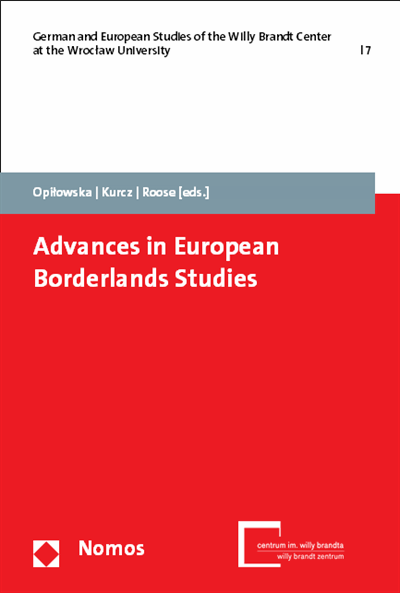
Advances in European Borderlands Studies
- Herausgeber:innen:
- | |
- Verlag:
- 2017
Zusammenfassung
Da historische Ereignisse, politische Mächte sowie soziale und kulturelle Kräfte die Funktion von Grenzen prägen, werden diese kontinuierlich ausgehandelt. Aus multidisziplinärer Perspektive, die von historischen, politischen und sozialen bis hin zu geografischen Aspekten der Grenzen reicht, werden in dem Band ausgewählte Ansätze und aktuelle Forschungsergebnisse im Bereich der europäischen Grenzraumstudien diskutiert. Somit wird die Rolle der Grenzen in Europa mit einer Präsentation und kritischen Bewertung neuer Forschungsergebnisse empirisch und theoretisch beleuchtet. Der Band greift vielfältige Befunde der Grenzraumforschung für eine Neubewertung im Licht der aktuellen politischen und wissenschaftlichen Entwicklungen auf und bietet dadurch nicht nur einen breiten Überblick über aktuelle Debatten und neueste Erkenntnisse, sondern präsentiert angesichts neuerer Entwicklungen auch neue Überlegungen zu Fruchtbarkeit und Defiziten der Studien.
Mit Beiträgen von
Elżbieta Opiłowska, Jochen Roose, Zbigniew Kurcz, Dariusz Wojakowski, Ulrike Kaden, Raphael Bossong, Domink Gerst, Imke Kerber, Maria Klessmann, Hannes Krämer, Peter Ulrich, Hans-Joachim Bürkner, Andrzej Sadowski, Martin Klatt, Jarosław Jańczak, Bartosz Czepil, Wojciech Opioła, Tadeusz Popławski, Renata Kusiak-Winter, Izabela Bal, Sylwia Dołzbłasz, Kamilla Dolińska, Julita Makaro, Natalia Niedźwiecka-Iwańczak, Andrzej Sakson, Krzysztof Wojciechowski, Bogusław Grużewski, Simonas Šabanovas, Irena Szlachcicowa, Katarzyna Stokłosa, Anna Śliz, Marek S. Szczepański, Marcin Dębicki, Robert Bartłomiejski, Máté Dávid Tamáska
Publikation durchsuchen
Bibliographische Angaben
- Auflage
- 1/2017
- Copyrightjahr
- 2017
- ISBN-Print
- 978-3-8487-3363-7
- ISBN-Online
- 978-3-8452-7689-2
- Verlag
- Nomos, Baden-Baden
- Reihe
- German and European Studies of the Willy Brandt Center at the University of Wrocław
- Band
- 7
- Sprache
- Englisch
- Seiten
- 426
- Produkttyp
- Sammelband
Inhaltsverzeichnis
- Titelei/Inhaltsverzeichnis Kein Zugriff Seiten 1 - 8
- Autor:innen: | |
- Structure of the Volume Kein ZugriffAutor:innen: | |
- Acknowledgments Kein ZugriffAutor:innen: | |
- Autor:innen:
- Introduction Kein ZugriffAutor:innen:
- Boundaries and borderlands – Ambiguity of the term and three theoretical paradigms Kein ZugriffAutor:innen:
- Border and borderland as a social performance Kein ZugriffAutor:innen:
- Concluding remarks Kein ZugriffAutor:innen:
- Autor:innen: |
- Introduction Kein ZugriffAutor:innen: |
- Why borderland research? Kein ZugriffAutor:innen: |
- Borderlands as cases Kein ZugriffAutor:innen: |
- Borderlands as specific regions Kein ZugriffAutor:innen: |
- Borderlands as quasi-experimental settings Kein ZugriffAutor:innen: |
- Conclusions Kein ZugriffAutor:innen: |
- Benefits of borderland sociology Kein Zugriff Seiten 47 - 64Autor:innen:
- Autor:innen: | | | | |
- Introduction Kein ZugriffAutor:innen: | | | | |
- An interdisciplinary heuristic of multidimensional borders Kein ZugriffAutor:innen: | | | | |
- Borders and orders Kein ZugriffAutor:innen: | | | | |
- Concluding remarks Kein ZugriffAutor:innen: | | | | |
- Autor:innen:
- Introduction Kein ZugriffAutor:innen:
- The Bordering approach: getting borders back into everyday life Kein ZugriffAutor:innen:
- The Borderscapes approach: exploring the multiplicity of borders Kein ZugriffAutor:innen:
- Imaginaries: Post-structural approximations Kein ZugriffAutor:innen:
- Autor:innen:
- Empirical setting and methodology Kein ZugriffAutor:innen:
- Imaginaries as elements of everyday re-politicising: empirical evidence Kein ZugriffAutor:innen:
- Conclusion: What effects do imaginaries have on a borderscape? Kein ZugriffAutor:innen:
- Autor:innen:
- Introduction Kein ZugriffAutor:innen:
- Borderlands – directions of dependence Kein ZugriffAutor:innen:
- Political parties as a form of initiative for national minorities in borderland Kein ZugriffAutor:innen:
- Conclusions Kein ZugriffAutor:innen:
- Quo vadis borderlands studies? The transformation of European borders and new research perspectives Kein Zugriff Seiten 121 - 130Autor:innen:
- Autor:innen:
- Introduction Kein ZugriffAutor:innen:
- Kein ZugriffAutor:innen:
- The borders of EUrope – classical paradigms Kein ZugriffAutor:innen:
- Geopolitical models and geostrategies of the European Union Kein ZugriffAutor:innen:
- The polycentric perspective and a new approach in defining the borders of EUrope Kein ZugriffAutor:innen:
- Conclusions Kein ZugriffAutor:innen:
- Autor:innen: |
- Introduction Kein ZugriffAutor:innen: |
- Theoretical background Kein ZugriffAutor:innen: |
- Characteristics of the Opole Voivodship Kein ZugriffAutor:innen: |
- Borderlandness of the Opole Voivodeship Kein ZugriffAutor:innen: |
- Rise of Silesian identity Kein ZugriffAutor:innen: |
- Migration patterns Kein ZugriffAutor:innen: |
- Regional community Kein ZugriffAutor:innen: |
- Multiculturalism, civil society and quality of governance – defining the concepts Kein ZugriffAutor:innen: |
- Quantitative analysis Kein ZugriffAutor:innen: |
- Conclusions Kein ZugriffAutor:innen: |
- Acknowledgements Kein ZugriffAutor:innen: |
- Autor:innen:
- Introduction – peripherality of borderlands Kein ZugriffAutor:innen:
- The results of borderlands’ peripherisation Kein ZugriffAutor:innen:
- Managing borderland as a process of recovering from peripherality Kein ZugriffAutor:innen:
- Good neighborhood policy and the role of political elite - positive and negative examples Kein ZugriffAutor:innen:
- Conclusion Kein ZugriffAutor:innen:
- Autor:innen:
- Introduction Kein ZugriffAutor:innen:
- Cross-border cooperation supporting local communities Kein ZugriffAutor:innen:
- Cross-border cooperation for implementing EU policies Kein ZugriffAutor:innen:
- Cross-border relations in public administration Kein ZugriffAutor:innen:
- Conclusions Kein ZugriffAutor:innen:
- Autor:innen: |
- Introduction Kein ZugriffAutor:innen: |
- Demographic disparities of the borderland Kein ZugriffAutor:innen: |
- Efficiently counteracting negative effects of demographic change – the case of Saxony Kein ZugriffAutor:innen: |
- Cross-border cooperation for tackling the effects of depopulation Kein ZugriffAutor:innen: |
- Summary Kein ZugriffAutor:innen: |
- Autor:innen: | |
- Introduction Kein ZugriffAutor:innen: | |
- Opportunities and threats – an empirical analysis Kein ZugriffAutor:innen: | |
- Conclusions Kein ZugriffAutor:innen: | |
- Specific nature of the Polish–German scientific cooperation in borderlands Kein Zugriff Seiten 239 - 248Autor:innen:
- Does a border bring people closer or draw them apart? A handful of general remarks about transborder university collaboration Kein Zugriff Seiten 249 - 258Autor:innen:
- Autor:innen: |
- Introduction Kein ZugriffAutor:innen: |
- Theoretical approach. Wallerstein’s world system theory adopted at municipal level Kein ZugriffAutor:innen: |
- Results Kein ZugriffAutor:innen: |
- Conclusions Kein ZugriffAutor:innen: |
- Autor:innen:
- Introduction Kein ZugriffAutor:innen:
- Border Kein ZugriffAutor:innen:
- he concept of the border is usually defined in a narrow sense, i.e. a territorial or spatial sense, but the definition can also be more abstract in nature, with a much broader reference. Questions pos... Kein ZugriffAutor:innen:
- The narration of disappearing borders Kein ZugriffAutor:innen:
- Border, frontier, identity Kein ZugriffAutor:innen:
- Troubling question of identity Kein ZugriffAutor:innen:
- Conclusions Kein ZugriffAutor:innen:
- Autor:innen: |
- A little history at the beginning Kein ZugriffAutor:innen: |
- Borderland in sociological meaning Kein ZugriffAutor:innen: |
- Historical transformation of the Silesian borderland Kein ZugriffAutor:innen: |
- Residents of Upper Silesia Kein ZugriffAutor:innen: |
- The identity of a Silesian borderland Kein ZugriffAutor:innen: |
- Contemporaneity of the Silesian borderland Kein ZugriffAutor:innen: |
- Autor:innen:
- Introduction Kein ZugriffAutor:innen:
- Which twin towns? Kein ZugriffAutor:innen:
- Experience of war and division Kein ZugriffAutor:innen:
- Narva–Ivangorod Kein ZugriffAutor:innen:
- Veľké Slemence–Mali Slemenci Kein ZugriffAutor:innen:
- Conclusions Kein ZugriffAutor:innen:
- Autor:innen:
- Introduction Kein ZugriffAutor:innen:
- Data and conceptual framework Kein ZugriffAutor:innen:
- History of the twin city Frankfurt (Oder) and Słubice. A short overview Kein ZugriffAutor:innen:
- Frankfurt (Oder) and Słubice – a twin city without borders? Kein ZugriffAutor:innen:
- The Kleist Route Kein ZugriffAutor:innen:
- The bilingual city Kein ZugriffAutor:innen:
- Conclusion Kein ZugriffAutor:innen:
- Autor:innen: |
- The Polish–German borderland and the Gubin–Guben neighbourhood Kein ZugriffAutor:innen: |
- Conception of the research Kein ZugriffAutor:innen: |
- Empirical findings Kein ZugriffAutor:innen: |
- Source: the authors’ own research. Kein ZugriffAutor:innen: |
- Conclusion Kein ZugriffAutor:innen: |
- Autor:innen:
- Research objectives Kein ZugriffAutor:innen:
- From macro structures to the milieu of spaces Kein ZugriffAutor:innen:
- The milieu of border in the townscape Kein ZugriffAutor:innen:
- Methodology Kein ZugriffAutor:innen:
- Autor:innen:
- Milieus of division Kein ZugriffAutor:innen:
- The common milieus of twin towns Kein ZugriffAutor:innen:
- The inner structure and milieus of the twin towns Kein ZugriffAutor:innen:
- Conclusion Kein ZugriffAutor:innen:
- Autor:innen:
- Introduction Kein ZugriffAutor:innen:
- Theoretical perspective Kein ZugriffAutor:innen:
- Method and background Kein ZugriffAutor:innen:
- The case of Polish participation in PEGIDA’s anti-immigrant protests Kein ZugriffAutor:innen:
- Conclusions Kein ZugriffAutor:innen:
- Notes on Contributors Kein Zugriff Seiten 413 - 426