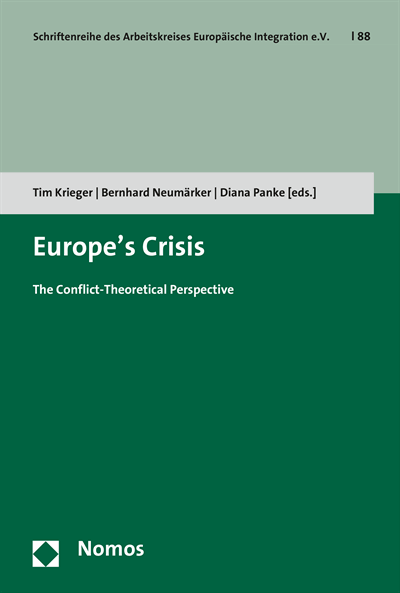
Europe's Crisis
The Conflict-Theoretical Perspective- Herausgeber:innen:
- | |
- Reihe:
- Schriftenreihe des Arbeitskreises Europäische Integration e.V., Band 88
- Verlag:
- 2016
Zusammenfassung
Seit 2008 berichten die Medien in Deutschland und Europa von Krisen in den europäischen Arbeitsmärkten, Volkswirtschaften und der europäischen Währungs- und Finanzarchitektur. Das Thema hat an Aktualität nichts verloren, nicht zuletzt weil die Krise zu einer Vielzahl von Konfliktkonstellation in Politik, Wirtschaft und Gesellschaft geführt hat.
Das Buch bietet einen interdisziplinären Zugang zur gegenwärtigen Krise der Europäischen Union. Die wirtschaftswissenschaftlichen, politikwissenschaftlichen, soziologischen und rechtswissenschaftlichen Beiträge untersuchen die Entstehung der Krise, ihre Dynamiken auf staatlicher und europäischer Ebene und reflektieren über Implikationen und mögliche Lösungsansätze.
Die Beiträge greifen auf eine Vielzahl wirtschafts- und sozialwissenschaftlicher sowie juristischer Methoden zurück und leisten damit eine umfassende Analyse, die neue Erkenntnisse schafft. Damit bietet der Sammelband einen wichtigen und höchst aktuellen Zugang zu dieser Thematik für Studierende und Lehrende, Praktiker der europäischen Politik und für interessierte Bürger.
Mit Beiträgen von:
Tim Krieger, Bernhard Neumärker, Diana Panke, Kai Konrad, Maximilian Stephan, Robert Kappius, Martha Kontodaimon, Moritz Sommer, Maria Daniela Poli, Bernd Schlipphak, Karsten Mause, Rafal Ulatowski, Christian Joerges, Francesco Nicoli, Stefan Oeter
Publikation durchsuchen
Bibliographische Angaben
- Auflage
- 1/2016
- Copyrightjahr
- 2016
- ISBN-Print
- 978-3-8487-2149-8
- ISBN-Online
- 978-3-8452-6248-2
- Verlag
- Nomos, Baden-Baden
- Reihe
- Schriftenreihe des Arbeitskreises Europäische Integration e.V.
- Band
- 88
- Sprache
- Englisch
- Seiten
- 226
- Produkttyp
- Sammelband
Inhaltsverzeichnis
- Titelei/Inhaltsverzeichnis Kein Zugriff Seiten 1 - 10
- Autor:innen: | |
- The economic contributions Kein ZugriffAutor:innen: | |
- The social scientific contributions Kein ZugriffAutor:innen: | |
- The legal contributions Kein ZugriffAutor:innen: | |
- Bibliography Kein ZugriffAutor:innen: | |
- Autor:innen:
- I. Introduction Kein ZugriffAutor:innen:
- II. The Origins and Progression of the Financial Crisis Kein ZugriffAutor:innen:
- III. A Conflict Theoretical Interpretation of Government Actions in the Current Crisis Kein ZugriffAutor:innen:
- IV. Outlining the Conditions for Structural Reforms: Rule-Based vs. Power-Based Decision-Making Kein ZugriffAutor:innen:
- V. Conclusion Kein ZugriffAutor:innen:
- Autor:innen: |
- I. Introduction Kein ZugriffAutor:innen: |
- II. Exit Rules in Self-Enforcing International Agreements Kein ZugriffAutor:innen: |
- Autor:innen: |
- High ai shock and the ‘downward’ exit (France) Kein ZugriffAutor:innen: |
- Low ai shock and an ‘upward’ exit (Germany) Kein ZugriffAutor:innen: |
- IV. Discussion and Implications Kein ZugriffAutor:innen: |
- Bibliography Kein ZugriffAutor:innen: |
- Autor:innen:
- I. Introduction Kein ZugriffAutor:innen:
- II. The Distinctiveness of Sovereign Debt Kein ZugriffAutor:innen:
- Autor:innen:
- Asymmetric information Kein ZugriffAutor:innen:
- Willingness-to-pay problem Kein ZugriffAutor:innen:
- Uncertainty during debt restructuring Kein ZugriffAutor:innen:
- The run-for-the-exit problem Kein ZugriffAutor:innen:
- Holdout Kein ZugriffAutor:innen:
- IV. The Economic Debt Crisis in Europe Kein ZugriffAutor:innen:
- V. Conclusion Kein ZugriffAutor:innen:
- Bibliography Kein ZugriffAutor:innen:
- Autor:innen: |
- I. Introduction Kein ZugriffAutor:innen: |
- Autor:innen: |
- Delayed reforms: The Alesina/Drazen model of the “war of attrition”. Kein ZugriffAutor:innen: |
- Entangled domestic and international policies: Putnam’s two level game model Kein ZugriffAutor:innen: |
- III. Reform Delay in the Two Level Game Kein ZugriffAutor:innen: |
- IV. International Aid before Stabilization Policies Kein ZugriffAutor:innen: |
- V. When International Aid is Provided upon Stabilization Kein ZugriffAutor:innen: |
- VI. Stabilizing the Greek S.O.E.s Kein ZugriffAutor:innen: |
- VII. Policy Implications and Conclusions Kein ZugriffAutor:innen: |
- Bibliography Kein ZugriffAutor:innen: |
- Autor:innen: | | |
- I. Introduction Kein ZugriffAutor:innen: | | |
- II. The Attribution of Responsibility – Conceptual Considerations Kein ZugriffAutor:innen: | | |
- III. Method and Data: Discursive Actor Attribution Analysis Kein ZugriffAutor:innen: | | |
- IV. Party Involvement in Greek and German Crisis Debates Kein ZugriffAutor:innen: | | |
- V. Attribution Types in the Party Conflicts Kein ZugriffAutor:innen: | | |
- VI. Attribution Addressees in the Party Conflicts Kein ZugriffAutor:innen: | | |
- VII. Discussion and Conclusion Kein ZugriffAutor:innen: | | |
- Bibliography Kein ZugriffAutor:innen: | | |
- Autor:innen: |
- I. Introduction Kein ZugriffAutor:innen: |
- II. Hypotheses: The Winners-Losers Divide and Europe’s Economic Crisis Kein ZugriffAutor:innen: |
- III. Data and Research Design Kein ZugriffAutor:innen: |
- IV. Empirical Findings Kein ZugriffAutor:innen: |
- V. Robustness Checks Kein ZugriffAutor:innen: |
- VI. Conclusion Kein ZugriffAutor:innen: |
- Bibliography Kein ZugriffAutor:innen: |
- Autor:innen:
- I. Introduction Kein ZugriffAutor:innen:
- II. Hegemony in the European Union – What Hegemony? Kein ZugriffAutor:innen:
- III. European Integration before the Outbreak of the Eurozone Crisis Kein ZugriffAutor:innen:
- IV. Political Implications of the Euro Crisis Kein ZugriffAutor:innen:
- V. Toward Hegemony in the EU? Kein ZugriffAutor:innen:
- VI. Conclusions Kein ZugriffAutor:innen:
- Bibliography Kein ZugriffAutor:innen:
- Autor:innen:
- I. Introductory Remarks Kein ZugriffAutor:innen:
- II. The Disintegrative Effects of Economic Integration through Law Kein ZugriffAutor:innen:
- III. The Alternative of Conflicts-Law Constitutionalism Kein ZugriffAutor:innen:
- IV. EMU as an Irresolvable Diagonal Conflict Constellation Kein ZugriffAutor:innen:
- V. Conflict ‘Resolution’ through Authoritarian Managerialism Kein ZugriffAutor:innen:
- VI. ‘Wo aber Gefahr ist, wächst das Rettende auch’ or Does It? An Epilogue Kein ZugriffAutor:innen:
- Bibliography Kein ZugriffAutor:innen:
- Autor:innen:
- Autor:innen:
- Before the crisis: A legitimized European Union Kein ZugriffAutor:innen:
- The impact of the crisis: Rise of the democratic deficit Kein ZugriffAutor:innen:
- Fiscal integration during the crisis Kein ZugriffAutor:innen:
- Fiscal integration and legitimacy Kein ZugriffAutor:innen:
- The no demos thesis and its implications Kein ZugriffAutor:innen:
- A legitimacy trilemma? Kein ZugriffAutor:innen:
- Autor:innen:
- Democratic principle, no demos thesis Kein ZugriffAutor:innen:
- Monetary union, no demos thesis Kein ZugriffAutor:innen:
- Monetary union, democratic principle. Kein ZugriffAutor:innen:
- III. Conclusions Kein ZugriffAutor:innen:
- Bibliography Kein ZugriffAutor:innen:
- Autor:innen:
- I. Starting Point Kein ZugriffAutor:innen:
- Autor:innen:
- Procedural issues Kein ZugriffAutor:innen:
- Referral to the European Court of Justice Kein ZugriffAutor:innen:
- Interpretation of Art. 119 (3) and 127 (1) TFEU Kein ZugriffAutor:innen:
- The OMT measures of the ECB as an act of general economic policy? Kein ZugriffAutor:innen:
- The OMT measures of the ECB and political conditionality Kein ZugriffAutor:innen:
- The OMT measures of the ECB as a monetary financing of state budgets? Kein ZugriffAutor:innen:
- Proposed restrictive reading of OMT measure of the ECB Kein ZugriffAutor:innen:
- Implications of the path taken by the Bundesverfassungsgericht Kein ZugriffAutor:innen:
- III. Cognitive Dissonance as a Driver of Crisis? Kein ZugriffAutor:innen:
- IV. Conclusions Kein ZugriffAutor:innen:
- Bibliography Kein ZugriffAutor:innen:
- About the authors Kein Zugriff Seiten 221 - 226