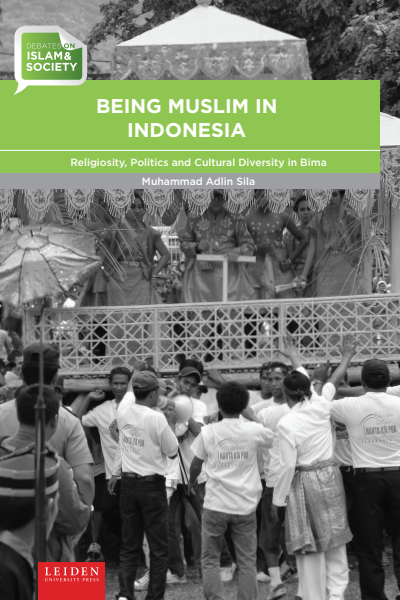
Being Muslim in Indonesia
Religiosity, Politics and Cultural Diversity in Bima- Autor:innen:
- Reihe:
- Debates on Islam & Society
- Verlag:
- 2021
Zusammenfassung
How Muslims in Indonesia consider their religious practices, politics and culture as Islamic is described in this volume. By examining the various ways Bima Muslims constitute their Islamic identities and agencies through rituals and festivals, this book argues that religious practice is still vigorous in present Bima. It explores the reproduction of religious meanings among various local Muslims and the differences between social groups. Islam is represented as divided between the traditionalist Muslims and the reformist Muslims, between the royal family and the ordinary Muslims, and between Muslim clerics and lay people. Consequently, there is no single picture of Islam. As Bima Muslims construe their Islam in response to their surroundings, what it means to be a Muslim is constantly being negotiated. The complexity of religious life has been a result of the duality of socio-political settings in Bima which stems from the early period of the Islamization of Bima to the present.
Publikation durchsuchen
Bibliographische Angaben
- Auflage
- 1/2021
- Copyrightjahr
- 2021
- ISBN-Print
- 978-90-8728-362-9
- ISBN-Online
- 978-94-006-0406-3
- Verlag
- Leiden University Press, Leiden
- Reihe
- Debates on Islam & Society
- Sprache
- Englisch
- Seiten
- 251
- Produkttyp
- Monographie
Inhaltsverzeichnis
- Preface Kein Zugriff
- Acknowledgements Kein Zugriff
- Notes on Transliteration and Style Kein Zugriff
- 1.1. Why Bima is important? Kein Zugriff
- 1.2. Sultan and Raja Bicara: Dyadic Leadership Kein Zugriff
- 1.3. Being Muslim as Social Phenomena Kein Zugriff
- 1.4. Outline of the Book Kein Zugriff
- 2.1. Previous Studies on Islam and Muslims in Bima Kein Zugriff
- 2.2. Methodological and Theoretical Framework Kein Zugriff
- 2.3. Bima as a Study Site Kein Zugriff
- 2.4. Choosing the field Kein Zugriff
- 2.5. Methods of collecting data Kein Zugriff
- 3.1. Historical accounts of the festival Kein Zugriff
- 3.2. Dato di Banda and Kampung Melayu Kein Zugriff
- 3.3. The celebration of the Prophet Muhammad’s birthday Kein Zugriff
- 3.4. Mawlid texts: the many versions of written words in praise of the Prophet Kein Zugriff
- 3.5. The Festival of Hanta Ua Pua Kein Zugriff
- 3.6. Majelis Hadat Dana Mbojo and Hanta Ua Pua: the Politics of Festival Kein Zugriff
- 3.7. The local dimensions of the NU and Muhammadiyah in Bima19 Kein Zugriff
- 3.8. Conclusion Kein Zugriff
- 4.1. Imam and Sultan Kein Zugriff
- 4.2. Imam and Royal Foundation Kein Zugriff
- 4.3. Ritual prayer among Muslims in Bima Kein Zugriff
- 4.4. Social dimension of ritual prayers Kein Zugriff
- 4.5. Accommodation during Ramadan ritual prayers Kein Zugriff
- 4.6. The festival of breaking the fast: Idul Fitri Kein Zugriff
- 4.7. Friday congregational prayer: Regional by-laws and politics of ritual Kein Zugriff
- 4.8. Conclusion Kein Zugriff
- 5.1. Sando, spirit possession and spirit mediumship Kein Zugriff
- 5.2. The local belief in supernatural beings and types of sickness Kein Zugriff
- 5.3. Religious reformism and the belief of ancestral spirits: from parafu ro pambora to padasa Kein Zugriff
- 5.4. The power of water and Qur’anic verses in healing rituals Kein Zugriff
- 5.5. Being submissive and healing the sick with the help of God: Karana ala Kein Zugriff
- 5.6. Protecting the village, interceding for salvation: doa dana Kein Zugriff
- 5.7. Healing practice and its relationship to Islamic mysticism Kein Zugriff
- 5.8. Fitua, Silsilah and the Seven Grades (Martabat Tujuh) Kein Zugriff
- 5.9. Conclusion Kein Zugriff
- 6.1. Concepts of solidarity in lifetime rituals Kein Zugriff
- 6.2. Ritual for pregnant mother Kein Zugriff
- 6.3. Birth delivery ritual Kein Zugriff
- 6.4. Hair-shaving and name-giving Kein Zugriff
- 6.5. Circumcision Kein Zugriff
- 6.6. Complete Qur’an recital and veiling Kein Zugriff
- 6.7. Conclusion Kein Zugriff
- 7.1. Village gathering Kein Zugriff
- 7.2. Marriage ceremony Kein Zugriff
- 7.3. Bride-service at the potential parents-in-laws’ residence Kein Zugriff
- 7.4. Marriage payment delivery Kein Zugriff
- 7.5. Henna Night Kein Zugriff
- 7.6. Marriage contract ceremony Kein Zugriff
- 7.7. Commemoration of the deceased Kein Zugriff
- 7.8. Feasting and praying for the deceased Kein Zugriff
- 7.9. Conclusion Kein Zugriff
- 8.1. Religiosity Kein Zugriff
- 8.2. Politics Kein Zugriff
- 8.3. Cultural Diversity Kein Zugriff
- 8.4. Conclusion Kein Zugriff
- Appendix I. The List of Bima Sultans Kein Zugriff Seiten 205 - 207
- Appendix II. The List of Raja Bicara Kein Zugriff Seiten 208 - 210
- Glossary Kein Zugriff Seiten 211 - 216
- Notes Kein Zugriff Seiten 217 - 230
- Bibliography Kein Zugriff Seiten 231 - 244
- Index Kein Zugriff Seiten 245 - 250