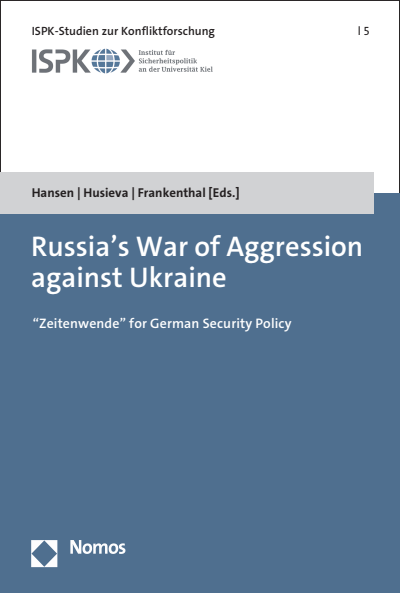
Russia's War of Aggression against Ukraine
“Zeitenwende“ for German Security Policy- Herausgeber:innen:
- | |
- Reihe:
- ISPK-Studien zur Konfliktforschung, Band 5
- Verlag:
- 2023
Zusammenfassung
Der russische Angriffskrieg gegen die Ukraine stellt eine Zeitenwende in der deutschen Außen- und Sicherheitspolitik dar, die eine völlige Neubestimmung der Rolle Deutschlands in der künftigen europäischen Sicherheitsordnung erfordert. Der Sammelband informiert mit Beiträgen renommierter Experten:innen über die Ursachen, Entwicklungen und absehbaren Folgen des russischen Angriffskrieges. Dieses Buch richtet sich an Wissenschaftler:innen, Entscheidungsträger:innen, Student:innen und alle, die sich für internationale Politik, Konfliktforschung und die militärisch-strategische Dimension des russisch-ukrainischen Krieges interessieren.Mit Beiträgen vonChristina Binder | Hugo von Essen | Timo Graf | Markus Kaim | Ronja Kempin | Sarah Kirchberger | Joachim Krause | Arthur de Liedekerke | Tobias Lindner | Angela Mehrer | Oleksiy Melnyk | Johanna Möhring | Jana Puglierin | Markus Reisner | Susanne Spahn | Marie-Agnes Strack-Zimmermann | Maximilian Terhalle | Andreas Umland | Joris Van Bladel | Jakob Wöllenstein
Schlagworte
Publikation durchsuchen
Bibliographische Angaben
- Copyrightjahr
- 2023
- ISBN-Print
- 978-3-7560-1159-9
- ISBN-Online
- 978-3-7489-1720-5
- Verlag
- Nomos, Baden-Baden
- Reihe
- ISPK-Studien zur Konfliktforschung
- Band
- 5
- Sprache
- Englisch
- Seiten
- 359
- Produkttyp
- Sammelband
Inhaltsverzeichnis
- Titelei/InhaltsverzeichnisSeiten 1 - 16 Download Kapitel (PDF)
- Autor:innen:Download Kapitel (PDF)
- Abstract
- 1 Introduction
- 2 The Grinding Power of Geopolitics
- 3 NATO Enlargement: A Complicated and Controversial Process
- 4 Ukraine as an Integral Part of Europe’s Security Landscape
- 5 Conclusion
- Autor:innen:Download Kapitel (PDF)
- Abstract
- 1 Introduction
- 2 Continuities
- 3 Russia’s Path to Ideology-Driven Authoritarianism
- 4 Lessons for the West
- 5 Conclusion
- Autor:innen:Download Kapitel (PDF)
- Abstract
- 1 Introduction
- 2 Russia’s State Media Circumvent EU Sanctions
- 3 Narrative 1: The Fight against Fascists
- 4 Narrative 2: Ukraine is Not a Separate Nation with Its Own History
- 5 Narrative 3: Ukrainians Must Be Liberated from Nazis
- 6 Narrative 4: The West Wages War against Russia
- 7 Narrative 5: The West is Decadent and Weak
- 8 Narrative 6: Russia Is an Empire in Eurasia
- 9 Narrative 7: Supporting Ukraine Leads the West to Its Downfall
- 10 Conclusion
- Autor:innen:Download Kapitel (PDF)
- Abstract
- 1 Introduction
- 2.1 “Velikaya Derzhava”: Great(er) Russia
- 2.2 “Pravoslavie”: Russian Orthodoxy
- 2.3 “Us” versus “the West”
- 2.4 Post-Soviet Nostalgia
- 3 Russian Appeals to Historical Hegemony: Transnistria and Chechnya
- 4 A Decade of Certainty: Putin’s Ambition to Transform Russia into a Superpower
- 5 Conclusion
- Autor:innen: |Download Kapitel (PDF)
- Abstract
- 1 Introduction
- 2.1 Legitimation of International Legal Nihilism
- 2.2 Ignoring Basic Democratic Principles
- 2.3 Letting the Aggressor Reap the Fruits of the Aggression
- 3 Conclusions and Recommendations for Action
- Autor:innen:Download Kapitel (PDF)
- Abstract
- 1 Introduction
- 2 The Years of the Kohl Government (1990–1998)
- 3 The Phase of the Red-Green Coalition (1998–2005)
- 4 The First Merkel Coalition (2005–2009)
- 5 The Years of the Christian-Liberal Coalition (2009–2013)
- 6 The Years of the Coalition between the CDU/CSU and the SPD (2013–2021)
- 7 How Much Did Germany Harm Ukraine?
- Autor:innen:Download Kapitel (PDF)
- Abstract
- 1.1 Russia's Neo-Imperial Consolidation of Power and Systemic Competition
- 1.2 Ukraine as the Key to Russian Great Power Politics
- 2.1 Russia’s Domestic and Foreign Policy Dual Strategy
- 2.2 Permanent Confrontation by Indirect Means
- 2.3 The Strategic Role of the Russian Military
- 3.1 Preventing Western Integration through the Annexation of Crimea and War in Eastern Ukraine
- 3.2 Genesis of a “Regime Change by Military Means”
- 4.1 The Failure of Russian Warfare
- 4.2 The Russian War against Ukraine in the Shadow of Atomic Weapons
- 5 Outlook
- Autor:innen:Download Kapitel (PDF)
- Abstract
- 1 Introduction
- 2 The Russian Battalion Tactical Group (BTG)
- 3.1 Deployment of Combined Armies
- 3.2 The Defensive Success of Ukraine
- 4.1 The “Russian Steamroller”
- Factor Terrain
- Factor Force
- Time Factor
- Factor Information
- Factor Terrain
- Factor Force
- Time Factor
- Factor Information
- 6 Historical Comparisons
- 7 Summary and Outlook
- Autor:innen: |Download Kapitel (PDF)
- Abstract
- 1 The Ukrainian Defense Army until 2022: Experience is Gained
- 2 Reaction to the Russian Invasion in 2022
- 3 The Military Support from the West
- 4 National Weapons Development and Production in Ukraine
- 5 The Non-Material Component of Ukrainian Defense: A Factor of Morale
- 6 Ukraine’s Security Cooperation with the West: From Formal Contacts to Existential Partnership
- 7 Complicated but Vital Relations between Ukraine and Germany in 2022
- 8 Conclusion
- Autor:innen:Download Kapitel (PDF)
- Abstract
- 1 Introduction
- 2 General International Law: ius ad bellum
- 3 International Humanitarian Law (IHL): ius in bello
- 4 International Human Rights
- 5 International Criminal Law
- 6 International Court of Justice (ICJ)
- 7 Conclusion
- Autor:innen: |Download Kapitel (PDF)
- Abstract
- 1 Introduction
- 2 The Role of Cyber-Based Operations in Russia’s War against Ukraine in 2022
- 3 The Cyber Resistance of Ukraine
- 4 The Impact of Russian Cyberattacks on Europe and Germany
- 5 First Lessons
- 6 Conclusion
- Autor:innen:Download Kapitel (PDF)
- Abstract
- 1 Introduction
- 2 On the Importance of Public Opinion for Alliance Defense
- 3 On the Importance of Threat Perceptions
- 4 Russia as a Threat from the Perspective of the German Population
- 5 Between Principle and Practice: The Alliance Solidarity of the Germans
- 6 The Influence of Threat Perceptions on Alliance Solidarity
- 7 Low Level of Knowledge about NATO Missions Remains a Problem
- 8 Conclusion
- Autor:innen:Download Kapitel (PDF)
- Abstract
- 1 What Does Zeitenwende Mean in Terms of Security Policy?
- 2 What Does Zeitenwende Mean for Our Russia Policy?
- 3 What Does Zeitenwende Mean for Our Ukraine Policy?
- 4 Conclusion
- Autor:innen: |Download Kapitel (PDF)
- Abstract
- 1 European Reactions to the Russian Invasion of Ukraine
- 2.1 A “Visa Ban” for Russian Citizens
- 2.2 A (Partial) Oil and Gas Embargo
- 3 The Future of Europe: A New Orientation of the European Security Order
- 4 Conclusion
- Autor:innen: |Download Kapitel (PDF)
- Abstract
- 1 The USA as a “European Power”
- 2 A Snapshot
- 3 American Ambivalence
- 4.1 Strategic Compass
- 4.2 European Peace Facility
- 4.3 EUMAM Ukraine
- 5 Ambivalence of the EU Member States
- 6 Conclusion: What Next?
- Autor:innen:Download Kapitel (PDF)
- Abstract
- 1 Introduction
- 2 Before the Invasion: Ignored U.S. Warnings and a Sino-Russian Declaration of “Limitless” Friendship
- 3 After the Beginning of the Invasion: Only Covert Chinese Support for Russia, but Why?
- 4 The War Becomes a Problem: Shielding from the Consequences of Putin’s Strategic Miscalculation
- 5 Effects of the Ukraine War on the Relations Between China and Russia
- 6 What Tactical Lessons Could China Learn from the War in Ukraine?
- 7 Conclusions
- Autor:innen:Download Kapitel (PDF)
- Abstract
- 1 Introduction
- 2.1 Wars Cannot Be Banned, Only Defined Away
- 2.2 Strategists Do Not See “Policy Areas”, Only Instruments of State Power
- 2.3 Not International Law, Only Power-Political Will Preserves Internationally Its Own Concept of Order
- 2.4 Strategists Do Not Disregard the “Big Picture” that the Military Superpowers Draw of an Era
- 3 Strategy, the Time Factor and Strategy Planning
- 4 Zeitenwende Must Be Strategically Thought of Globally, not in Terms of Central Europe
- 5 No Zeitenwende Without Strategic Mindset: Three Flaws
- Autor:innen:Download Kapitel (PDF)
- Abstract
- 1 Introduction
- 2 Challenges of German Security Policy
- 3 Conclusion
- The EditorsSeiten 355 - 355 Download Kapitel (PDF)
- Contributing AuthorsSeiten 356 - 359 Download Kapitel (PDF)