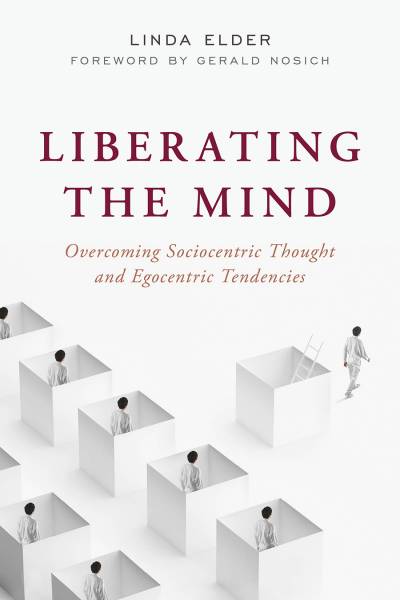
Liberating the Mind
Overcoming Sociocentric Thought and Egocentric Tendencies- Autor:innen:
- Verlag:
- 2019
Zusammenfassung
Throughout history, thinkers within every part of society have been crippled by an ingrained bias toward their own views and the views of their preferred social groups. As these dangerous egocentric and sociocentric tendencies continue to pose the greatest threat to the advancement of rational societies, Liberating the Mind reveals a way forward.
Dissecting the core of how humans naturally learn, think, and choose to act, internationally recognized critical thinking leader Linda Elder illuminates root causes of dysfunctional thought andshows us how to free ourselves from both selfishness and groupthink through explicit tools of rationality. This instant intellectual classic offers a cohesive, integrated theory of mind that takes into account pathological tendencies shared by all humans, while offering a clear path toward the cultivation of fairminded critical thinking throughout the world. Elder illuminates how, by taking the intrinsic problems in our thinking seriously, we can follow the example of Socrates and live the examined life, even in times of upheaval and doubt.
Schlagworte
Publikation durchsuchen
Bibliographische Angaben
- Copyrightjahr
- 2019
- ISBN-Print
- 978-1-5381-3762-8
- ISBN-Online
- 978-1-5381-3763-5
- Verlag
- Rowman & Littlefield, Lanham
- Sprache
- Englisch
- Seiten
- Back Cover1
- Produkttyp
- Monographie
Inhaltsverzeichnis
- FOREWORD Kein Zugriff
- DEDICATION Kein Zugriff
- CONTENTS Kein Zugriff
- PREFACE: COMMANDING THE DARK SIDE WITHIN Kein Zugriff
- ACKNOWLEDGMENTS Kein Zugriff
- Sociocentric Thought Should Be Distinguished from Sociological Thought Kein Zugriff
- Humans Are Influenced by Groups within Groups Kein Zugriff
- The Logic of Groupishness Kein Zugriff
- Many Group-Validated Beliefs Are Dangerous Kein Zugriff
- Groups Impose Ideologies on Group Members Kein Zugriff
- People Tend to Blindly Conform to Group Rules and Groupthink Kein Zugriff
- Group Conformity Is Often Dangerous Kein Zugriff
- Dissenters Are Frequently Punished Kein Zugriff
- Groupishness, Group Validation, Group Control, and Group Conformity Interconnect and Interact Kein Zugriff
- Some Historical Notes on Sociocentric Thinking Kein Zugriff
- Concepts in Natural Languages That Imply Sociocentric Thinking or Its Opposite Kein Zugriff
- Mass Media Shape and Are Shaped by Sociocentric Thinking Kein Zugriff
- Unbridled Global Capitalism Is a Powerful Sociocentric Force in Human Life Kein Zugriff
- Schooling Is a Prevailing Sociocentric Agent Kein Zugriff
- Speciescentrism Is a Dangerous Form of Sociocentrism Kein Zugriff
- Many Studies Illuminate Problems Implicit in Sociocentric Thinking Kein Zugriff
- Case Notes: Psychology and Psychiatry Often Foster Sociocentric Thought Kein Zugriff
- The Mind Naturally Generates Concepts and Perspectives That Serve Its Interests Kein Zugriff
- Humans Often Distort Reality through Irrational Lenses Kein Zugriff
- People Often Have Trouble Seeing through Ideological Uses of Words Kein Zugriff
- People Frequently Use Inappropriate Analogies to Serve Sociocentric Interests Kein Zugriff
- It Is Essential to Distinguish among Questions of Ethics, Social Conventions, Religion, and the Law Kein Zugriff
- Ethics versus Religion Kein Zugriff
- Ethics versus Political Ideology Kein Zugriff
- Overturning Unethical Laws Is Often Difficult Due to Groupthink Kein Zugriff
- Social Mores Vary across Cultures Kein Zugriff
- Taboos Are Prevalent in Human Societies Kein Zugriff
- Some Acts Are Unethical in and of Themselves Kein Zugriff
- The Human Mind Is Frequently Irrational while Having the Capacity for Rational Thought Kein Zugriff
- Humans Are Frequently Egocentric Kein Zugriff
- Two Primary Tendencies of Egocentric Thought Kein Zugriff
- Sociocentricity Can Be Directly Linked to Egocentric Thought Kein Zugriff
- Distinguishing Rational from Egocentric and Sociocentric Thoughts Kein Zugriff
- Self-Deception Plays a Primary Role in Sociocentric Thought Kein Zugriff
- Many Complex Relationships Exist between and Among Egocentric, Sociocentric, and Rational Thought Kein Zugriff
- The Human Mind Kein Zugriff
- Sociocentric Thought Can Be More Dangerous Than Egocentric Thought Kein Zugriff
- Egocentric Dominating and Submissive Tendencies Are Often Transformed into Sociocentric Domination and Submission Kein Zugriff
- People Often Use Egocentric Standards for Determining What to Believe Kein Zugriff
- Sociocentric Standards for Determining What to Believe Are Linked with Egocentric Standards Kein Zugriff
- Piaget’s Insights on Egocentricity Can Be Linked to Sociocentric Thought Kein Zugriff
- Sociocentric Pathological Tendencies Are Common in Human Life Kein Zugriff
- Sociocentric Pathological Tendencies Can Be Challenged Kein Zugriff
- Groups Routinely Use Sociocentric Defense Mechanisms Kein Zugriff
- Intrinsic Cognitive Processes Can Serve Rational, Egocentric, or Sociocentric Agendas Kein Zugriff
- Cultivating Critical Thinking Is the Key to Fairminded Critical Societies Kein Zugriff
- Critical Thinking Is Largely Ignored in Today’s Societies Kein Zugriff
- 20 Barriers to Critical Societies Kein Zugriff
- Critical Societies Support Maximum Freedoms Kein Zugriff
- Critical Societies Encourage Intellectual Autonomy and Responsibility Kein Zugriff
- Critical Societies Entail the Following Six Hallmarks Kein Zugriff
- Conceptualizing Everyday Ways of Thinking in Critical Societies Kein Zugriff
- Why Critical Thinking? Kein Zugriff
- Why the Analysis of Critical Thinking Is Important Kein Zugriff
- All Thinking Is Defined by the Eight Elements That Make It Up Kein Zugriff
- The Elements of Thought and Questions They Imply Kein Zugriff
- To Evaluate Thinking We Must Understand and Apply Intellectual Standards Kein Zugriff
- Critical Thinkers Routinely Apply Intellectual Standards to the Elements of Reasoning in Order to Develop Intellectual Virtues Kein Zugriff
- Critical Thinkers Commit Themselves to the Development of Intellectual Virtues Kein Zugriff
- Essential Intellectual Traits Kein Zugriff
- The Mind’s Three Distinctive Functions Kein Zugriff
- Conclusion: Some Elements of Critical Societies Can Be Found Throughout Human History Kein Zugriff
- AFTERWORD BY RICHARD PAUL Kein Zugriff Seiten 201 - 202
- REFERENCES Kein Zugriff Seiten 203 - 209
- IMAGE SOURCES Kein Zugriff Seiten 210 - 213
- APPENDIX A: SOME BASIC DEFINITIONS Kein Zugriff Seiten 214 - 223
- APPENDIX B: THE LOGIC OF SOCIOCENTRIC THOUGHT Kein Zugriff Seiten 224 - 229
- INDEX Kein Zugriff Seiten 230 - 235
- ABOUT THE AUTHOR Kein Zugriff Seiten 236 - Back Cover1