, um zu prüfen, ob Sie einen Vollzugriff auf diese Publikation haben.
Monographie Kein Zugriff
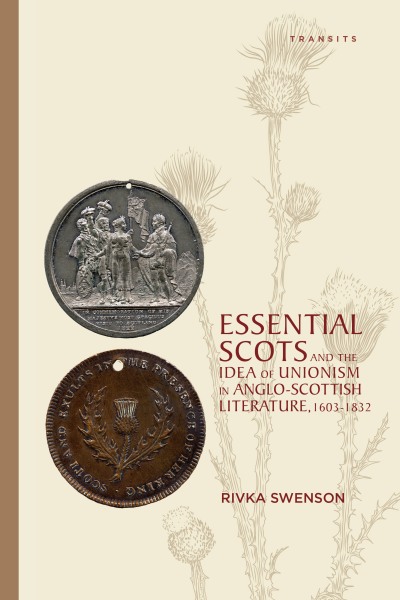
Essential Scots and the Idea of Unionism in Anglo-Scottish Literature, 1603–1832
Autor:innen:
Verlag:
2015
Zusammenfassung
John Locke asked, “since all things that exist are merely particulars, how come we by general terms?” Essential Scots and the Idea of Unionism in Anglo-Scottish Literature, 1603–1832 tells a story about aesthetics and politics that looks back to the 1603 Union of Crowns and James VI/I’s emigration from Edinburgh to London. Considering the emergence of British unionism alongside the literary rise of both description and “the individual,” Rivka Swenson builds on extant scholarship with original close readings that illuminate the inheritances of 1603, a date of considerable but untraced importance in Anglo-Scottish literary and cultural history whose legacies are still being negotiated today. The 1603 Union of Crowns spurred interest in exploring the aesthetic politics of unionism in relation to an alleged Scottish essence that could be manipulated to resist or support “Britishness,” even as the king’s emigration generated a legacy of gendered representations of traveling Scots and “Scotlands-left-behind.”
Discussing writers such as Bacon, Defoe, Smollett, Johnson, Macpherson, Ferrier, and Scott along with lesser-known or forgotten popular authors (and ballads, transparencies, newspapers, joke books, cant dictionaries, political speeches, histories, travel narratives, engravings, material artifacts such as medals and snuffboxes), Essential Scots describes the years 1603 to 1832 as a crucial period in British history. Paradoxically, the political and cultural exploration of ideas about “unionism” in relation to a supposed “essential Scottishness” participated in the increasing prominence of both description and the “individual” in nineteenth-century Scottish literature; Swenson persuasively concludes that essential Scottishness (as both “identity” and symbolism) was refigured to mediate a national synthesis between the emergent individual and the nascent British nation—as well as the naturalized, even de-politicized, literary synthesis of particulars within putatively analogous narrative wholes.
Schlagworte
Publikation durchsuchen
Bibliographische Angaben
Auflage
1/2015
Copyrightjahr
2015
ISBN-Print
978-1-61148-678-0
ISBN-Online
978-1-61148-679-7
Verlag
University Press Copublishing, Lanham
Sprache
Englisch
Seiten
330
Produkttyp
Monographie
Inhaltsverzeichnis
KapitelSeiten
CONTENTS Kein Zugriff
ILLUSTRATIONS Kein Zugriff
ACKNOWLEDGMENTS Kein Zugriff
ABBREVIATIONS Kein Zugriff
INTRODUCTION Kein Zugriff Seiten 1 - 22
CHAPTER 1. WRITING ANGLO-SCOTTISH UNIONISM AND ITS DISCONTENTS IN 1603 AND 1707: Francis Bacon, Daniel Defoe, and English Anxieties of Narration Kein Zugriff
CHAPTER 2. WRITING REUNION, REWRITING UNION FOR THE ATOMIC SCOT: Tobias Smollett’s Traveling Types after the ’45 and Seven Years War Kein Zugriff
CHAPTER 3. WRITING REVOLUTION AS ESSENTIAL RECOVERY: Samuel Johnson’s Return to Scotland after Ossian Kein Zugriff
CHAPTER 4. INDIVIDUAL CONCERNS, THE MOCK-GOTHIC, AND MARRIAGE TROUBLE: Anglo-Scottish Self-Difference in Susan Ferrier’s Laboratory Kein Zugriff
CHAPTER 5. DESCRIBING THE SUBNATIONAL HINGE IN 1822: Robert Mudie and the Aesthetic Politics of the Synthetic British Text Kein Zugriff
CODA. WALTER SCOTT AND THE LEGACY OF CHOSEN SCOTTISHNESS Kein Zugriff
NOTES Kein Zugriff Seiten 249 - 290
BIBLIOGRAPHY Kein Zugriff Seiten 291 - 314
INDEX Kein Zugriff Seiten 315 - 328
ABOUT THE AUTHOR Kein Zugriff Seiten 329 - 330
Ähnliche Veröffentlichungen
aus dem Schwerpunkt "Sprachwissenschaft & Linguistik"