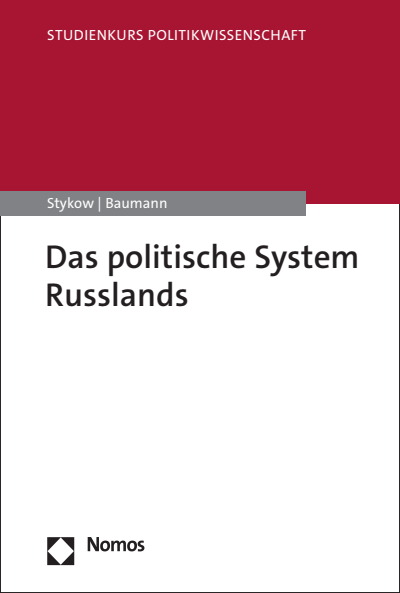
Das politische System Russlands
- Autor:innen:
- |
- Verlag:
- 2023
Zusammenfassung
Das Studienbuch analysiert das politische System Russlands und seinen Wandel. Anschaulich werden die Veränderungen nachgezeichnet, die sich in der institutionellen Architektur, den relevanten Akteuren in Politik und Zivilgesellschaft sowie in der öffentlichen Meinung vollzogen haben. In der Perspektive der institutionalistischen Autoritarismusforschung wird die postsowjetische Entwicklung Russlands von einem unterinstitutionalisierten pluralistischen zu einem konsolidierten autoritären System theoretisch interpretiert sowie die innere Logik seines patronalen Regimes entschlüsselt. Das Buch richtet sich an Studierende der Sozialwissenschaften, Dozent:innen und Interessent:innen für russische und internationale Politik.
Schlagworte
Publikation durchsuchen
Bibliographische Angaben
- Copyrightjahr
- 2023
- ISBN-Print
- 978-3-8487-7971-0
- ISBN-Online
- 978-3-7489-2355-8
- Verlag
- Nomos, Baden-Baden
- Reihe
- Studienkurs Politikwissenschaft
- Sprache
- Deutsch
- Seiten
- 311
- Produkttyp
- Lehrbuch
Inhaltsverzeichnis
- Titelei/Inhaltsverzeichnis Kein Zugriff Seiten 1 - 16
- Die Sowjetunion als staatssozialistisches Einparteiregime Kein Zugriff
- Die Sowjetunion als multiethnischer Staat Kein Zugriff
- Die Sowjetunion als imperialer Hegemon in einer bipolaren Welt Kein Zugriff
- Das System der Sowjets Kein Zugriff
- Die KPdSU als zentrale Institution des Sowjetsystems Kein Zugriff
- Politische Partizipation und politische Kultur Kein Zugriff
- Die Perestrojka als Versuch der „sozialistischen Erneuerung“ Kein Zugriff
- Demokratisierung und politische Mobilisierung der Gesellschaft Kein Zugriff
- Die Auflösung der Sowjetunion Kein Zugriff
- Die Kontroverse über den Charakter des Sowjetsystems Kein Zugriff
- Konkurrierende Erklärungen für das Ende der Sowjetunion Kein Zugriff
- Demokratische und autoritäre politische Systeme Kein Zugriff
- Wie hat sich die Qualität des politischen Systems Russlands verändert? Kein Zugriff
- War Russland in den 1990er Jahren eine Demokratie? Kein Zugriff
- Elektorale oder geschlossene Autokratie? Kein Zugriff
- Ein personalistisches und patronales Regime Kein Zugriff
- Das Zusammenspiel formaler und informeller Institutionen Kein Zugriff
- Die Dynamik des politischen Systems Russlands Kein Zugriff
- Wirtschaftsreformen und ihre Auswirkungen Kein Zugriff
- Das Entscheidungsjahr 1993 Kein Zugriff
- Geschwächter Staat, liberal-patrimonialer Kapitalismus und patronale Politik Kein Zugriff
- Grundzüge der politischen Entwicklung Kein Zugriff
- Wirtschaftsentwicklung und crony capitalism Kein Zugriff
- Verfassungsgebung und -wandel Kein Zugriff
- Die obersten Staatsorgane Russlands Kein Zugriff
- Ein semipräsidentielles Regierungssystem? Kein Zugriff
- Eine patronal-präsidentialistische Verfassung Kein Zugriff
- Präsident und Regierung Kein Zugriff
- Präsidialadministration, Räte und Konsultationsgremien Kein Zugriff
- Das persönliche Netzwerk Putins Kein Zugriff
- Konstitutionelle Grundlagen des Föderalismus Kein Zugriff
- Von der autoritären Dezentralisierung zur Re-Zentralisierung Kein Zugriff
- Die Integration der regionalen Eliten in das Regime Kein Zugriff
- Die Republik Tschetschenien Kein Zugriff
- Das fluide Parteiensystem der 1990er Jahre Kein Zugriff
- Der Aufstieg von Einiges Russland zur „Partei der Macht“ Kein Zugriff
- Das dominante Mehrparteiensystem (seit Mitte der 2000er Jahre) Kein Zugriff
- Einiges Russlandals „Partei der Macht“ Kein Zugriff
- Die systemische Opposition Kein Zugriff
- Kooperation und Wettbewerb innerhalb des Parteienkartells Kein Zugriff
- Vom Gegenspieler zur legislativen Maschine des Präsidenten Kein Zugriff
- Mehr als eine Abstimmungsmaschine? Kein Zugriff
- Liberale Parteien zu Beginn der 2020er Jahre Kein Zugriff
- Hybride Organisationen des demokratischen Lagers Kein Zugriff
- Rechte nationalistische Organisationen und lagerübergreifende Bündnisse Kein Zugriff
- Überblick: Präsidentschafts- und Parlamentswahlen 1990–2021 Kein Zugriff
- Russland als elektorale Autokratie: Funktionen von Wahlen Kein Zugriff
- Die Logik patronaler Politik: Wahlen und die „Nachfolgefrage“ Kein Zugriff
- Verzerrung der Wettbewerbsbedingungen Kein Zugriff
- Manipulationen von Wahlentscheidungen der Bürger:innen Kein Zugriff
- Wahlfälschungen und ihr Ausmaß Kein Zugriff
- Politisch motivierte Ausschlüsse von der Wahl Kein Zugriff
- Elektorale Strategien der Opposition Kein Zugriff
- „Smart Voting“: Koordination statt Kooperation Kein Zugriff
- Subnationale Muster des elektoralen Autoritarismus Kein Zugriff
- Die Bedeutung der regionalen Vielfalt für nationale Wahlen Kein Zugriff
- Schwankende Zustimmungswerte Kein Zugriff
- Konkurrierende Erklärungen für Putins Popularität Kein Zugriff
- Rallying around the flag? Kein Zugriff
- Der Wandel der Legitimationspolitik Kein Zugriff
- „Nationale Frage“ und offizieller Identitätsdiskurs Kein Zugriff
- Eine illiberale Ideologie Kein Zugriff
- Einstellungen zur „nationalen Frage“ Kein Zugriff
- Wie moralkonservativ ist die Gesellschaft? Kein Zugriff
- Will die Bevölkerung in die sowjetische Vergangenheit zurück? Kein Zugriff
- Vorstellungen über Demokratie und politische Führung Kein Zugriff
- Entstehung und Wandel des Gesellschaftsvertrags der Putin-Ära Kein Zugriff
- Können die Bürger:innen die Vertragsbedingungen beeinflussen? Kein Zugriff
- Bürgerschaftliches Engagement im Wandel Kein Zugriff
- Warum hat sich das bürgerschaftliche Engagement verändert? Kein Zugriff
- „Zivilgesellschaft“ und autoritäres Regime Kein Zugriff
- Zwei Kategorien von NPOs Kein Zugriff
- „Ausländische Agenten“ und ihre Diskriminierung Kein Zugriff
- Können NPOs die Politik beeinflussen? Kein Zugriff
- Gesellschaftskammern und Beratungsgremien Kein Zugriff
- Parastaatliche Organisationen und Bewegungen Kein Zugriff
- Protestdynamiken in den 1990er und 2000er Jahren Kein Zugriff
- Die Bewegung „Für faire Wahlen“ 2011/12 Kein Zugriff
- Politische Proteste in der Spätphase des Putin-Regimes Kein Zugriff
- Herstellung der Kontrolle über das Fernsehen (2000er Jahre) Kein Zugriff
- Erweiterung der Medienkontrolle und neue Kontrollinstrumente seit 2012 Kein Zugriff
- Vom „Infotainment“ zum „Agitainment“: Medien als Propaganda-Instrument Kein Zugriff
- Wie effektiv sind die Medien als Instrument der Regime-Propaganda? Kein Zugriff
- „Legaler Dualismus“ und Rechtstradition Kein Zugriff
- Der Wandel des Justizsystems Kein Zugriff
- Rechtsprechung in Alltagsfällen und politisierte Justiz Kein Zugriff
- Die politische Bedeutung der siloviki Kein Zugriff
- Strukturen der staatlichen Gewaltapparate Kein Zugriff
- Irreguläre Gewaltakteure und der Krieg gegen die Ukraine Kein Zugriff
- Formen und Intensität politischer Repressionen Kein Zugriff
- 2021: Eskalation politischer Repressionen Kein Zugriff
- Repressionen unter den Bedingungen des Krieges Kein Zugriff
- Strukturen vs. Akteure Kein Zugriff
- Akteure und Institutionen Kein Zugriff
- Die Langlebigkeit des Putin-Regimes Kein Zugriff
- Außenpolitik im Wandel: Vom Integrations- zum Konfrontationskurs Kein Zugriff
- Die Ukraine-Krise 2014 und der Angriffskrieg 2022 Kein Zugriff
- Konkurrierende Erklärungen für Russlands Ukraine-Politik Kein Zugriff
- Kriegswirtschaft und Regime-Eliten Kein Zugriff
- Regime und Gesellschaft Kein Zugriff
- Ist das Putin-Regime faschistisch? Kein Zugriff
- Wie wird das Putin-Regime enden? Kein Zugriff
- Szenario I: Intraelitäre Lösungen des Nachfolgeproblems Kein Zugriff
- Szenario II: Massenproteste Kein Zugriff
- Szenario III: Zusammentreffen von Massenprotesten und Elitenspaltung Kein Zugriff
- Wie wahrscheinlich ist ein neuer Demokratisierungsversuch? Kein Zugriff
- Literaturverzeichnis Kein Zugriff Seiten 269 - 298
- Sach- und Personenregister Kein Zugriff Seiten 299 - 306
- Bereits erschienen in der Reihe STUDIENKURS POLITIKWISSENSCHAFT (ab 2017) Kein Zugriff Seiten 307 - 311
Literaturverzeichnis (636 Einträge)
Es wurden keine Treffer gefunden. Versuchen Sie einen anderen Begriff.
- Aasland, Aadne/Berg-Nordlie, Mikkel/Bogdanova, Elena (2016): Encouraged but Controlled: Governance Networks in Russian Regions. In: East European Politics 32: 2, 148–169. Google Scholar öffnen DOI: 10.5771/9783748923558
- Agadjanian, Alexander (2017): Tradition, Morality and Community: Elaborating Orthodox Identity in Putin’s Russia. In: Religion, State and Society 45: 1, 39–60. Google Scholar öffnen DOI: 10.5771/9783748923558
- Alexeev, Michael V./Pyle, William (2022): A Blind and Militant Attachment: Russian Patriotism in Comparative Perspective, München. CESifo Working Paper: 9994. DOI: https://dx.doi.org/10.2139/ssrn.4246401, 24.3.2023. Google Scholar öffnen DOI: 10.5771/9783748923558
- Alexseev, Mikhail A./Hale, Henry E. (2016): Rallying ’round the Leader More Than the Flag: Changes in Russian Nationalist Public Opinion 2013–14. In: Kolstø, Pål/Blakkisrud, Helge (Hrsg.): The New Russian Nationalism: Ethnicity and Authoritarianism 2000–2015, Edinburgh: Edinburgh University Press, 192–220. Google Scholar öffnen DOI: 10.5771/9783748923558
- Aljukov, Maksim/Belokrysova, Aida/Denisenko, Alja/Erpyleva, Svetlana et al. (2023): Smirit’sja s neizbežnost’ju: Kak rossijane opravdyvajut voennoe vtorženie v Ukrainu? Osen’-zima 2022. Laboratorija publičnoj sociologii, 10.5.2023. https://drive.google.com/file/d/1j8EhDTFJu5vnzz-gjKzF7DmYPTH3V8ni/view, 14.5.2023. Google Scholar öffnen DOI: 10.5771/9783748923558
- Almond, Gabriel/Verba, Sydney (1963): The Civic Culture: Political Attitudes and Democracy in Five Nations, Princeton: Princeton University Press. Google Scholar öffnen DOI: 10.5771/9783748923558
- Almond, Gabriel A./Powell, G. Bingham (1966): Comparative Politics. A Developmental Approach, Boston: Little & Brown. Google Scholar öffnen DOI: 10.5771/9783748923558
- Al’perovič, Vera (2022): Russkie nacionalisty na ukrainskom i ideologičeskom “frontach”. Publičnaja aktivnost’ ul’trapravych grupp, leto-osen’ 2022 goda. SOVA, 19.12.2022. https://www.sova-center.ru/racism-xenophobia/publications/2022/12/d47447/, 21.7.2023. Google Scholar öffnen DOI: 10.5771/9783748923558
- Al’perovič, Vera (2023): Nacionalisty naraščivajut temp. Publičnaja aktivnost’ ul’trapravych grupp, zima-vesna 2023 goda. SOVA, 10.7.2023. https://www.sova-center.ru/racism-xenophobia/publications/2023/07/d48353/?sphrase_id=1570067/, 21.7.2023. Google Scholar öffnen DOI: 10.5771/9783748923558
- Alyukov, Maxim (2021): News Reception and Authoritarian Control in a Hybrid Media System: Russian TV Viewers and the Russia-Ukraine Conflict. In: Politics. DOI: 10.1177/02633957211041440. Google Scholar öffnen DOI: 10.5771/9783748923558
- Alyukov, Maxim (2022): Making Sense of the News in an Authoritarian Regime: Russian Television Viewers’ Reception of the Russia–Ukraine Conflict. In: Europe-Asia Studies 74: 3, 337–359. Google Scholar öffnen DOI: 10.5771/9783748923558
- Armstrong, David/Reuter, Ora John/Robertson, Graeme B. (2020): Getting the Opposition Together: Protest Coordination in Authoritarian Regimes. In: Post-Soviet Affairs 36: 1, 1–19. Google Scholar öffnen DOI: 10.5771/9783748923558
- Arnason, Johann P. (2000): Communism and Modernity. In: Daedalus 129: 1, 61–90. Google Scholar öffnen DOI: 10.5771/9783748923558
- Arutjunov, Andronik/Špil’kin, Sergej (2022): Matematičeskie metody fiksacii sposobov dostiženija celej i zadač avtoritarnoj vlasti. In: Luk’janova, Elena/Porošin, Evgenij (Hrsg.): Vybory strogogo režima, Moskva: Mysl’, 341–364. Google Scholar öffnen DOI: 10.5771/9783748923558
- Askerov, Ali/Brooks, Stefan/Tchantouridzé, Lasha (2020): Post-Soviet Conflicts. The Thirty Years’ Crisis, Lanham: Lexington Books. Google Scholar öffnen DOI: 10.5771/9783748923558
- Åslund, Anders (2019): Russia’s Crony Capitalism. The Path from Market Economy to Kleptocracy, New Haven: Yale University Press. Google Scholar öffnen DOI: 10.5771/9783748923558
- Bach, Daniel C./Gazibo, Mamoudou (2012): Neopatrimonialism in Africa and Beyond, London: Routledge. Google Scholar öffnen DOI: 10.5771/9783748923558
- Bader, Max/van Ham, Carolien (2015): What Explains Regional Variation in Election Fraud? Evidence from Russia: A Research Note. In: Post-Soviet Affairs 31: 6, 514–528. Google Scholar öffnen DOI: 10.5771/9783748923558
- Bækken, Håvard (2019): Law and Power in Russia. Making Sense of Quasi-Legal Practices, New York: Routledge. Google Scholar öffnen DOI: 10.5771/9783748923558
- Bailey, Riley/Stepanenko, Kateryna (2023): Russian Offensive Campaign Assessment. Institute for the Study of War, 30.4.2023. https://www.understandingwar.org/backgrounder/russian-offensive-campaign-assessment-april-30-2023, 22.5.2023. Google Scholar öffnen DOI: 10.5771/9783748923558
- Barany, Zoltan (2023): Armies and Autocrats: Why Putin’s Military Failed. In: Journal of Democracy 34: 1, 80–94. Google Scholar öffnen DOI: 10.5771/9783748923558
- Batinti, Alberto/Kopstein, Jeffrey (2022): Is Russia Really a Normal Country? A Numerical Taxonomy of Russia in Comparative Perspective. In: Constitutional Political Economy 33: 2, 217–232. Google Scholar öffnen DOI: 10.5771/9783748923558
- Baturo, Alexander/Elkink, Johan A. (2021): The New Kremlinology: Understanding Regime Personalization in Russia, Oxford: Oxford University Press. Google Scholar öffnen DOI: 10.5771/9783748923558
- Baunov, Aleksandr/Komin, Michail/Šul’man, Ekaterina: V svoem piru pochmel’e. Kakie poseldstviya budut u mjateža Prigožina. Carnegie Endowment for International Peace, 10.7.2023. https://carnegieendowment.org/politika/90155, 20.7.2023. Google Scholar öffnen DOI: 10.5771/9783748923558
- BBC (2012): Russia Expels USAID Development Agency, 19.9.2012. https://www.bbc.com/news/world-europe-19644897, 17.1.2023. Google Scholar öffnen DOI: 10.5771/9783748923558
- Becker, Uwe/Vasileva, Alexandra (2017): Russia’s Political Economy Re-conceptualized: A Changing Hybrid of Liberalism, Statism and Patrimonialism. In: Journal of Eurasian Studies 8: 1, 83–96. Google Scholar öffnen DOI: 10.5771/9783748923558
- Bederson, Vsevolod/Semenov, Andrei (2021): Political Foundations of State Support for Civil Society: Analysis of the Distribution of Presidential Grants in Russia. In: Post-Soviet Affairs 37: 6, 544–558. Google Scholar öffnen DOI: 10.5771/9783748923558
- Beissinger, Mark R. (2002): Nationalist Mobilization and the Collapse of the Soviet State, Cambridge: Cambridge University Press. Google Scholar öffnen DOI: 10.5771/9783748923558
- Belokrysova, Aida/Aljukov, Maksim/Denisenko, Alja/Erpyleva, Svetlana et al. (2022): Dalëkaja blizkaja vojna: Kak rossijane vosprinimajut voennye dejstvija v Ukraine. Fevral’-ijun 2022. Laboratorija publichnoj sociologii, 12.9.2022. https://drive.google.com/file/d/1I7fkLApAHhDiMp1sz7gbPokCYTCdOC6n/view, 14.5.2023. Google Scholar öffnen DOI: 10.5771/9783748923558
- Belton, Catherine (2022): Putins Netz. Wie sich der KGB Russland zurückholte und dann den Westen ins Auge fasste, Hamburg: HarperCollins. Google Scholar öffnen DOI: 10.5771/9783748923558
- Bernhard, Michael/Edgell, Amanda B./Lindberg, Staffan I. (2020): Institutionalising Electoral Uncertainty and Authoritarian Regime Survival. In: European Journal of Political Research 59: 2, 465–487. Google Scholar öffnen DOI: 10.5771/9783748923558
- Bindman, Eleanor/Kulmala, Meri/Bogdanova, Elena (2019): NGOs and the Policy‐Making Process in Russia: The Case of Child Welfare Reform. In: Governance 32: 2, 207–222. Google Scholar öffnen DOI: 10.5771/9783748923558
- Blackburn, Matthew (2021): Mainstream Russian Nationalism and the “State-Civilization” Identity: Perspectives from Below. In: Nationalities Papers 49: 1, 89–107. Google Scholar öffnen DOI: 10.5771/9783748923558
- Blackburn, Matthew/Petersson, Bo (2022): Parade, Plebiscite, Pandemic: Legitimation Efforts in Putin’s Fourth Term. In: Post-Soviet Affairs 38: 4, 293–311. Google Scholar öffnen DOI: 10.5771/9783748923558
- Blakkisrud, Helge (2014): Governing the Governors: Legitimacy vs. Control in the Reform of the Russian Regional Executive. In: East European Politics 31: 1, 104–121. Google Scholar öffnen DOI: 10.5771/9783748923558
- Blakkisrud, Helge (2023): Russkii as the New Rossiiskii? Nation-Building in Russia After 1991. In: Nationalities Papers 51: 1, 64–79. Google Scholar öffnen DOI: 10.5771/9783748923558
- Blasi, Joseph R./Kroumova, Maya/Kruse, Douglas L. (1997): Kremlin Capitalism. The Privatization of the Russian Economy, Ithaca: Cornell University Press. Google Scholar öffnen DOI: 10.5771/9783748923558
- Bluhm, Katharina/Brand, Martin (2019): “Traditional Values” Unleashed. The Ultraconservative Influence on Russian Family Policy. In: Bluhm, Katharina/Varga, Mihai (Hrsg.): New Conservatives in Russia and East Central Europe, London, New York: Routledge, 223–244. Google Scholar öffnen DOI: 10.5771/9783748923558
- Bluhm, Katharina (2023): Russland und der Westen. Ideologie, Ökonomie und Politik seit dem Ende der Sowjetunion, Berlin: Matthes & Seitz. Google Scholar öffnen DOI: 10.5771/9783748923558
- Bogdanova, Elena/Cook, Linda J./Kulmala, Meri (2018): The Carrot or the Stick? Constraints and Opportunities of Russia’s CSO Policy. In: Europe-Asia Studies 70: 4, 501–513. Google Scholar öffnen DOI: 10.5771/9783748923558
- Boix, Carles/Miller, Michael/Rosato, Sebastian (2013): A Complete Data Set of Political Regimes, 1800–2007. In: Comparative Political Studies 46: 12, 1523–1554. Google Scholar öffnen DOI: 10.5771/9783748923558
- Boix, Carles/Svolik, Milan W. (2013): The Foundations of Limited Authoritarian Government: Institutions, Commitment, and Power-Sharing in Dictatorships. In: The Journal of Politics 75: 2, 300–316. Google Scholar öffnen DOI: 10.5771/9783748923558
- Bönker, Kirsten (2022): Den Kalten Krieg neu denken? Neue Studien zum Kalten Krieg. In: Neue politische Literatur 67: 2, 168–204. Google Scholar öffnen DOI: 10.5771/9783748923558
- Borisova, Tatiana/Burbank, Jane (2018): Russia’s Legal Trajectories. In: Kritika: Explorations in Russian and Eurasian History 19: 3, 469–508. Google Scholar öffnen DOI: 10.5771/9783748923558
- Borogan, Irina/Soldatov, Andrei/Grossfeld, Elena/Richterova, Daniela (2023): What Impact Has the War on Ukraine Had on Russian Security and Intelligence? King’s College London, 22.2.2023. https://www.kcl.ac.uk/what-impact-has-the-war-on-ukraine-had-on-russian-security-and-intelligence, 22.5.2023. Google Scholar öffnen DOI: 10.5771/9783748923558
- Bova, Russell (1991): Political Dynamics of the Post-Communist Transition: A Comparative Perspective. In: World Politics 44: 1, 113–138. Google Scholar öffnen DOI: 10.5771/9783748923558
- Brancati, Dawn (2014): Democratic Authoritarianism: Origins and Effects. In: Annual Review of Political Science 17: 1, 313–326. Google Scholar öffnen DOI: 10.5771/9783748923558
- Brand, Martin (2018): Carrot and Stick: How It Was Possible to Raise the Retirement Age in Russia. Russian Analytical Digest: 225, 2–6. https://css.ethz.ch/publikationen/russian-analytical-digest/russian-analytical-digest-alle-ausgaben.html, 6.3.2023. Google Scholar öffnen DOI: 10.5771/9783748923558
- Brooks, Stephen G./Wohlforth, William C. (2000): Power, Globalization, and the End of the Cold War. In: International Security 25: 3, 5–53. Google Scholar öffnen DOI: 10.5771/9783748923558
- Brown, Archie (2000): Der Gorbatschow-Faktor. Wandel einer Weltmacht, Frankfurt am Main: Insel. Google Scholar öffnen DOI: 10.5771/9783748923558
- Brubaker, Rogers (1994): Nationhood and the National Question in the Soviet Union and Post-Soviet Eurasia: An Institutionalist Account. In: Theory and Society 23: 1, 47–78. Google Scholar öffnen DOI: 10.5771/9783748923558
- Brunner, Georg (1977): Politische Soziologie der UdSSR. Teil II, Wiesbaden: Akademische Verlagsgesellschaft. Google Scholar öffnen DOI: 10.5771/9783748923558
- BTI (2022): Bertelsmann Transformation Index 2022. Bertelsmann Stiftung. www.bti-project.org/de/, 27.6.2022. Google Scholar öffnen DOI: 10.5771/9783748923558
- Bunce, Valerie/Echols, John M. (1980): Soviet Politics in the Brezhnev Era: “Pluralism” or “Corporatism”? In: Kelley, Donald R. (Hrsg.): Soviet Politics in the Brezhnev Era, New York: Praeger, 1–26. Google Scholar öffnen DOI: 10.5771/9783748923558
- Bunce, Valerie (1983): The Political Economy of the Brezhnev Era: The Rise and Fall of Corporatism. In: British Journal of Political Science 13: 2, 129–158. Google Scholar öffnen DOI: 10.5771/9783748923558
- Bunce, Valerie (2000): Comparative Democratization. Big and Bounded Generalizations. In: Comparative Political Studies 33: 6/7, 703–734. Google Scholar öffnen DOI: 10.5771/9783748923558
- Bunce, Valerie/Wolchik, Sharon L. (2011): Defeating Authoritarian Leaders in Postcommunist Countries, Cambridge: Cambridge University Press. Google Scholar öffnen DOI: 10.5771/9783748923558
- Chaisty, Paul/Schleiter, Petra (2002): Productive but Not Valued: The Russian State Duma, 1994-2001. In: Europe-Asia Studies 54: 5, 701–724. Google Scholar öffnen DOI: 10.5771/9783748923558
- Chaisty, Paul/Whitefield, Stephen (2013): Forward to Democracy or Back to Authoritarianism? The Attitudinal Bases of Mass Support for the Russian Election Protests of 2011–2012. In: Post-Soviet Affairs 29: 5, 387–403. Google Scholar öffnen DOI: 10.5771/9783748923558
- Chebankova, Elena (2009): Russia’s Noncovenantal Federalism: Past and Present. In: Journal of Church and State 51: 2, 312–340. Google Scholar öffnen DOI: 10.5771/9783748923558
- Cheibub, José Antonio/Gandhi, Jennifer/Vreeland, James Raymond (2010): Democracy and Dictatorship Revisited. In: Public Choice 143: 1/2, 67–101. Google Scholar öffnen DOI: 10.5771/9783748923558
- Chronicles (2023): A Year of War as Seen by Russians. Chronicles Project. https://www.chronicles.report/en, 5.6.2023. Google Scholar öffnen DOI: 10.5771/9783748923558
- Colomer, Josep M. (2000): Strategic Transitions. Game Theory and Democratization, Baltimore, London: The Johns Hopkins University Press. Google Scholar öffnen DOI: 10.5771/9783748923558
- Colton, Timothy J./McFaul, Michael (2003): Russian Democracy under Putin. In: Problems of Post-Communism 50: 4, 12–21. Google Scholar öffnen DOI: 10.5771/9783748923558
- Cook, Linda J. (2007): Postcommunist Welfare States. Reform Politics in Russia and Eastern Europe, Ithaca: Cornell University Press. Google Scholar öffnen DOI: 10.5771/9783748923558
- Cook, Linda J./Dimitrov, Martin K. (2017): The Social Contract Revisited: Evidence from Communist and State Capitalist Economies. In: Europe-Asia Studies 69: 1, 8–26. Google Scholar öffnen DOI: 10.5771/9783748923558
- Coppedge, Michael/Denison, Benjamin/Friesen, Paul/Tiscornia, Lucía/Xu, Yang (2022): International Influence: The Hidden Dimension. In: Coppedge, Michael (Hrsg.): Why Democracies Develop and Decline, Cambridge: Cambridge University Press, 80–118. Google Scholar öffnen DOI: 10.5771/9783748923558
- Coppedge, Michael et al. (2023): Varieties of Democracy (V-Dem) Dataset v. 13. Varieties of Democracy (V-Dem) Project. https://doi.org/10.23696/vdemds23, 29.3.2023. Google Scholar öffnen DOI: 10.5771/9783748923558
- CPI (2022): Corruption Perceptions Index 2021. Transparency International. www.transparency.org/en/cpi/2021, 24.7.2022. Google Scholar öffnen DOI: 10.5771/9783748923558
- Croco, Sarah E./Weeks, Jessica L. P. (2016): War Outcomes and Leader Tenure. In: World Politics 68: 4, 577–607. Google Scholar öffnen DOI: 10.5771/9783748923558
- Crowley, Stephen (2021): Putin’s Labor Dilemma. Russian Politics between Stability and Stagnation, Ithaca: ILR Press. Google Scholar öffnen DOI: 10.5771/9783748923558
- D’Anieri, Paul (2022): Commitment Problems and the Failure of the Minsk Process: The Second-Order Commitment Challenge. In: Post-Soviet Affairs 39: 4, 257–272. Google Scholar öffnen DOI: 10.5771/9783748923558
- Dahl, Robert A. (1989): Democracy and Its Critics, New Haven: Yale University Press. Google Scholar öffnen DOI: 10.5771/9783748923558
- Dekoder (2022): Krieg in der Ukraine. Hintergründe. Debattenschau № 87: Ist Russland faschistisch?, 16.6.2022. www.dekoder.org/de/article/debattenschau-russland-faschistisch-snyder, 9.7.2022. Google Scholar öffnen DOI: 10.5771/9783748923558
- Diamond, Larry Jay (1999): Developing Democracy. Toward Consolidation, Baltimore, Md.: Johns Hopkins University Press. Google Scholar öffnen DOI: 10.5771/9783748923558
- Dollbaum, Jan Matti/Semenov, Andrey/Sirotkina, Elena (2018): A Top-Down Movement with Grass-Roots Effects? Alexei Navalny’s Electoral Campaign. In: Social Movement Studies 17: 5, 618–625. Google Scholar öffnen DOI: 10.5771/9783748923558
- Dollbaum, Jan Matti/Lallouet, Morvan/Noble, Ben (2021): Nawalny: Seine Ziele, seine Gegner, seine Zukunft, Hamburg: Hoffmann und Campe. Google Scholar öffnen DOI: 10.5771/9783748923558
- Domrin, Alexander N. (2003): Ten Years Later: Society, “Civil Society,” and the Russian State. In: The Russian Review 62: 2, 193–211. Google Scholar öffnen DOI: 10.5771/9783748923558
- Dossier FSB (2020): Čislennost’ FSB. https://fsb.dossier.center/number/, 17.5.2023. Google Scholar öffnen DOI: 10.5771/9783748923558
- Doyle, David/Elgie, Robert (2016): Maximizing the Reliability of Cross-National Measures of Presidential Power. In: British Journal of Political Science 46: 4, 731–741. Google Scholar öffnen DOI: 10.5771/9783748923558
- Dubowy, Alexander/Luzyanina, Ilona (2021): Das Strafvollzugssystem der Russischen Föderation. Bestrafung statt Resozialisierung? Russland-Analysen 401, 27–31. https://www.laender-analysen.de/russland-analysen/archiv/, 10.6.2023. Google Scholar öffnen DOI: 10.5771/9783748923558
- Duma (2003): Gosudarstvennaja Duma Federal’nogo Sobranija RF. Tekst stenogrammy zasedanija. In: Bjulleten’ 1 (715), ch. 1, 4–31. www.web.archive.org/web/20111208142048/http://www.cir.ru/docs/duma/302/420464?QueryID=3739136&HighlightQuery=3739136, 21.4.2022. Google Scholar öffnen DOI: 10.5771/9783748923558
- Dunn, John A. (2009): Where Did it All Go Wrong? Russian Television in the Putin Era. In: Beumers, Birgit/Hutchings, Stephen/Rulyova, Natalia (Hrsg.): The Post-Soviet Russian Media, London: Routledge, 42–55. Google Scholar öffnen DOI: 10.5771/9783748923558
- Dylan, Huw/Gioe, David V./Grossfeld, Elena (2022): The Autocrat’s Intelligence Paradox: Vladimir Putin’s (Mis)Management of Russian Strategic Assessment in the Ukraine War. In: British Journal of Politics and International Relations. DOI: 10.1177/13691481221146113. Google Scholar öffnen DOI: 10.5771/9783748923558
- Edenborg, Emil (2021): Anti-Gender Politics as Discourse Coalitions: Russia’s Domestic and International Promotion of “Traditional Values”. In: Problems of Post-Communism 70: 2, 1–10. Google Scholar öffnen DOI: 10.5771/9783748923558
- Edgell, Amanda B./Mechkova, Valeriya/Altman, David/Bernhard, Michael/Lindberg, Staffan I. (2018): When and Where Do Elections Matter? A Global Test of the Democratization by Elections Hypothesis, 1900–2010. In: Democratization 25: 3, 422–444. Google Scholar öffnen DOI: 10.5771/9783748923558
- Ekiert, Grzegorz/Perry, Elizabeth J. (2020): State-Mobilized Movements: A Research Agenda. In: Ekiert, Grzegorz/Perry, Elizabeth J./Yan, Xiaojun (Hrsg.): Ruling by Other Means, Cambridge: Cambridge University Press, 1–23. Google Scholar öffnen DOI: 10.5771/9783748923558
- Elgie, Robert (2011): Semi-Presidentialism: Sub-Types and Democratic Performance, Oxford: Oxford University Press. Google Scholar öffnen DOI: 10.5771/9783748923558
- Elster, Jon (1993): The Necessity and Impossibility of Simultaneous Economic and Political Reform. In: Greenberg, Douglas/Katz, Stanley N./Wheatley, Steven C./Oliviero, Melanie Beth (Hrsg.): Constitutionalism and Democracy: Transitions in the Contemporary World, Oxford: Oxford University Press, 267–274. Google Scholar öffnen DOI: 10.5771/9783748923558
- Engerman, David C. (2009): Know Your Enemy. The Rise and Fall of America’s Soviet Experts, Oxford: Oxford University Press. Google Scholar öffnen DOI: 10.5771/9783748923558
- ER (2021): Ustav Partii „Edinaja Rossija“. Webseite der Partei „Einiges Russland“. https://er.ru/party/rule, 16.1.2023. Google Scholar öffnen DOI: 10.5771/9783748923558
- Escribà-Folch, Abel/Böhmelt, Tobias/Pilster, Ulrich (2020): Authoritarian Regimes and Civil-Military Relations: Explaining Counterbalancing in Autocracies. In: Conflict Management and Peace Science 37: 5, 559–579. Google Scholar öffnen DOI: 10.5771/9783748923558
- Etkind, Alexander/Shcherbak, Andrei (2008): The Double Monopoly and Its Technologists: The Russian Preemptive Counterrevolution. In: Demokratizatsiya 16: 3, 229–239. Google Scholar öffnen DOI: 10.5771/9783748923558
- Evans, Alfred B./Henry, Laura A./Sundstrom, Lisa McIntosh (Hrsg.) (2006): Russian Civil Society: A Critical Assessment, Armonk: Routledge. Google Scholar öffnen DOI: 10.5771/9783748923558
- Evans, Alfred B./Plantan, Elizabeth (2023): Civil Society and Social Movements. In: Slider, Darrell/Wegren, Stephen K. (Hrsg.): Putin’s Russia, 8. Aufl., Lanham: Rowman & Littlefield, 111–138. Google Scholar öffnen DOI: 10.5771/9783748923558
- Evans, Geoffrey/Whitefield, Stephen (1993): Identifying the Bases of Party Competition in Eastern Europe. In: British Journal of Political Science 23: 4, 521–548. Google Scholar öffnen DOI: 10.5771/9783748923558
- Fainsod, Merle (1953): How Russia Is Ruled, Cambridge, MA: Harvard University Press. Google Scholar öffnen DOI: 10.5771/9783748923558
- FGA (2023): Noch lange kein Frieden. Friedensgutachten 2023 der deutschen Friedensforschungsinstitute BICC, HSFK, IFSH, INEF, Bielefeld: transcript. www.friedensgutachten.de. Google Scholar öffnen DOI: 10.5771/9783748923558
- Filippov, Mikhail/Ordeshook, Peter C. (1997): Who Stole What in Russia’s December 1993 Elections. In: Demokratizatsiya 4: 1, 36–52. Google Scholar öffnen DOI: 10.5771/9783748923558
- Fish, M. Steven (1995): Democracy from Scratch. Opposition and Regime in the New Russian Revolution, Princeton: Princeton University Press. Google Scholar öffnen DOI: 10.5771/9783748923558
- Fish, M. Steven/Kroenig, Matthew (2009): The Handbook of National Legislatures, Cambridge: Cambridge University Press. Google Scholar öffnen DOI: 10.5771/9783748923558
- Fish, M. Steven (2017): What Has a Quarter Century of Post-Communism Taught Us About the Correlates of Democracy? In: Fish, M. Steven/Gill, Graeme J./Petrović, Milenko (Hrsg.): A Quarter Century of Post-Communism Assessed, Cham: Palgrave Macmillan, 11–40. Google Scholar öffnen DOI: 10.5771/9783748923558
- Fontanka (2019): „Peterburg uže ne budet prežnim“. Nezavisimye municipal’nye deputaty Peterburga ob”edinilis’ v associaciju, 15.9.2019. https://www.fontanka.ru/2019/09/15/042/, 26.8.2022. Google Scholar öffnen DOI: 10.5771/9783748923558
- Forrat, Natalia (2018): Shock-Resistant Authoritarianism: Schoolteachers and Infrastructural State Capacity in Putin’s Russia. In: Comparative Politics 50: 3, 417–434. Google Scholar öffnen DOI: 10.5771/9783748923558
- Fortescue, Stephen (2017): Russia’s Security-Related Decision-Making: The Case of Crimea. In: Fish, M. Steven/Gill, Graeme J./Petrović, Milenko (Hrsg.): A Quarter Century of Post-Communism Assessed, Cham: Palgrave Macmillan, 295–318. Google Scholar öffnen DOI: 10.5771/9783748923558
- Fortin, Jessica (2013): Measuring Presidential Powers: Some Pitfalls of Aggregate Measurement. In: International Political Science Review 34: 1, 91–112. Google Scholar öffnen DOI: 10.5771/9783748923558
- Freedom House (2023): Freedom in the World. www.freedomhouse.org/reports/publication-archives, 24.1.2023. Google Scholar öffnen DOI: 10.5771/9783748923558
- Friedrich, Carl Joachim (1957): Totalitäre Diktatur, Stuttgart: Kohlhammer. Google Scholar öffnen DOI: 10.5771/9783748923558
- Fritsch, Rüdiger von (2020): Russlands Weg. Als Botschafter in Moskau, Berlin: Aufbau. Google Scholar öffnen DOI: 10.5771/9783748923558
- Fröhlich, Christian (2018): Taking Every Opportunity against the State: Anarchists in Contemporary Russia. In: Wennerhag, Magnus/Fröhlich, Christian/Piotrowski, Grzegorz (Hrsg.): Radical Left Movements in Europe, London: Routledge, 230–247. Google Scholar öffnen DOI: 10.5771/9783748923558
- Fröhlich, Christian/Skokova, Yulia (2020): Two for One: Public Welfare and Regime Legitimacy through State Funding for CSOs in Russia. In: Voluntas 31: 4, 698–709. Google Scholar öffnen DOI: 10.5771/9783748923558
- Frye, Timothy/Reuter, Ora John/Szakonyi, David (2014): Political Machines at Work Voter Mobilization and Electoral Subversion in the Workplace. In: World Politics 66: 2, 195–228. Google Scholar öffnen DOI: 10.5771/9783748923558
- Frye, Timothy/Reuter, Ora John/Szakonyi, David (2019): Vote Brokers, Clientelist Appeals, and Voter Turnout: Evidence from Russia and Venezuela. In: World Politics 71: 4, 710–746. Google Scholar öffnen DOI: 10.5771/9783748923558
- Frye, Timothy (2021): Weak Strongman. The Limits of Power in Putin’s Russia, Princeton: Princeton University Press. Google Scholar öffnen DOI: 10.5771/9783748923558
- Frye, Timothy (2023): Casualties Won’t Topple Putin. Foreign Policy, 10.4.2023. https://foreignpolicy.com/2023/04/10/russia-ukraine-casualties-putin-war-military-politics/, 1.5.2023. Google Scholar öffnen DOI: 10.5771/9783748923558
- Frye, Timothy/Gehlbach, Scott/Marquardt, Kyle L./Reuter, Ora John (2023): Is Putin’s Popularity (Still) Real? In: Post-Soviet Affairs 39: 3, 213–222. Google Scholar öffnen DOI: 10.5771/9783748923558
- FT (2022): How Putin’s Technocrats Saved the Economy to Fight a War They Opposed. Financial Times, 15.12.2022. https://www.ft.com/content/fe5fe0ed-e5d4-474e-bb5a-10c9657285d2, 9.6.2023. Google Scholar öffnen DOI: 10.5771/9783748923558
- Fumagalli, Matteo/Rymarenko, Margaryta (2022): Krym. Rossiya…Navsegda? Critical Junctures, Critical Antecedents, and the Paths Not Taken in the Making of Crimea’s Annexation. In: Nationalities Papers, 1–21. DOI: 10.1017/nps.2021.75. Google Scholar öffnen DOI: 10.5771/9783748923558
- Gabowitsch, Mischa (2017): Protest in Putin’s Russia, Cambridge: Polity. Google Scholar öffnen DOI: 10.5771/9783748923558
- Galeotti, Mark (2020): The Presidential Administration. George C. Marshall European Center for Security Studies: 44, Februar 2022. https://www.marshallcenter.org/en/publications/security-insights/presidential-administration-command-and-control-nexus-putins-russia-0, 26.4.2022. Google Scholar öffnen DOI: 10.5771/9783748923558
- Galeotti, Mark (2021): The Siloviki-Industrial Complex: Russia’s National Guard as Coercive, Political, Economic and Cultural Force. In: Demokratizatsiya 29: 1, 3–30. Google Scholar öffnen DOI: 10.5771/9783748923558
- Gandhi, Jennifer/Przeworski, Adam (2006): Cooperation, Cooptation, and Rebellion under Dictatorships. In: Economics & Politics 18: 1, 1–26. Google Scholar öffnen DOI: 10.5771/9783748923558
- Gandhi, Jennifer/Przeworski, Adam (2007): Authoritarian Institutions and the Survival of Autocrats. In: Comparative Political Studies 40: 11, 1279–1301. Google Scholar öffnen DOI: 10.5771/9783748923558
- Gandhi, Jennifer (2008): Political Institutions under Dictatorship, Cambridge, NY: Cambridge University Press. Google Scholar öffnen DOI: 10.5771/9783748923558
- Gandhi, Jennifer/Lust-Okar, Ellen (2009): Elections under Authoritarianism. In: Annual Review of Political Science 12: 1, 403–422. Google Scholar öffnen DOI: 10.5771/9783748923558
- Gandhi, Jennifer/Heller, Abigail/Reuter, Ora John (2020): Shoring up Power: Electoral Reform and the Consolidation of Authoritarian Rule. https://ssrn.com/abstract=3660944, 13.5.2022. Google Scholar öffnen DOI: 10.5771/9783748923558
- Geddes, Barbara (2003): Paradigms and Sand Castles. Theory Building and Research Design in Comparative Politics, Ann Arbor: University of Michigan Press. Google Scholar öffnen DOI: 10.5771/9783748923558
- Geddes, Barbara/Wright, Joseph/Frantz, Erica (2014): Autocratic Breakdown and Regime Transitions: A New Data Set. In: Perspectives on Politics 12: 2, 313–331. Google Scholar öffnen DOI: 10.5771/9783748923558
- Geddes, Barbara/Wright, Joseph/Frantz, Erica (2018): How Dictatorships Work. Power, Personalization, and Collapse, Cambridge, UK: Cambridge University Press. Google Scholar öffnen DOI: 10.5771/9783748923558
- Gel’man, Vladimir (2005): Political Opposition in Russia. Is it Becoming Extinct? In: Russian Politics and Law 43: 3, 25–50. Google Scholar öffnen DOI: 10.5771/9783748923558
- Gel’man, Vladimir (2009): Leviathan’s Return. The Policy of Recentralization in Contemporary Russia. In: Ross, Cameron/Campbell, Adrian (Hrsg.): Federalism and Local Politics in Russia, London, New York: Routledge, 1–24. Google Scholar öffnen DOI: 10.5771/9783748923558
- Gel’man, Vladimir (2015a): Authoritarian Russia. Analyzing Post-Soviet Regime Changes, Pittsburgh: University of Pittsburgh Press. Google Scholar öffnen DOI: 10.5771/9783748923558
- Gel’man, Vladimir (2015b): Political Opposition in Russia: A Troubled Transformation. In: Europe-Asia Studies 67: 2, 177–191. Google Scholar öffnen DOI: 10.5771/9783748923558
- Gel’man, Vladimir (2015c): The Politics of Fear. How Russia’s Rulers Counter Their Rivals. In: Russian Politics & Law 53: 5-6, 6–26. Google Scholar öffnen DOI: 10.5771/9783748923558
- Gel’man, Vladimir (2022): Why the Kremlin Invaded Ukraine. Wilson Center, 25.3.2022. https://www.wilsoncenter.org/blog-post/why-kremlin-invaded-ukraine, 2.6.2023. Google Scholar öffnen DOI: 10.5771/9783748923558
- Gel’man, Vladimir (2023): “Po dobroj vole nikto nikogda ne kaetsja”. Kakoj budet Rossija posle vojny, Sever.Realii, 24.3.2023. https://tinyurl.com/2p86wdaj, 31.5.2023. Google Scholar öffnen DOI: 10.5771/9783748923558
- Gellner, Ernest (1991): Nationalismus und Moderne, Berlin: Rotbuch. Google Scholar öffnen DOI: 10.5771/9783748923558
- Gerber, Theodore P./Zavisca, Jane (2016): Does Russian Propaganda Work? In: The Washington Quarterly 39: 2, 79–98. Google Scholar öffnen DOI: 10.5771/9783748923558
- Gessen, Masha (2018): Die Zukunft ist Geschichte. Wie Russland die Freiheit gewann und verlor, Berlin: Suhrkamp. Google Scholar öffnen DOI: 10.5771/9783748923558
- Geyer, Dietrich (1966): „Gesellschaft“ als staatliche Veranstaltung: Bemerkungen zur Sozialgeschichte der russischen Staatsverwaltung im 18. Jahrhundert. In: Jahrbücher für Geschichte Osteuropas 14: 1, 21–50. Google Scholar öffnen DOI: 10.5771/9783748923558
- GFP (2023): 2023 Military Strength Ranking. Global Firepower 2023. https://www.globalfirepower.com/countries-listing.php, 24.5.2023. Google Scholar öffnen DOI: 10.5771/9783748923558
- Gill, Graeme (2018): Collective Leadership in Soviet Politics, Cham: Palgrave Macmillan. Google Scholar öffnen DOI: 10.5771/9783748923558
- Gill, Graeme (Hrsg.) (2023): Routledge Handbook of Russian Politics and Society. 2. Aufl., Milton: Taylor & Francis. Google Scholar öffnen DOI: 10.5771/9783748923558
- Ginsburg, Tom/Simpser, Alberto (2014): Introduction. In: Ginsburg, Tom/Simpser, Alberto (Hrsg.): Constitutions in Authoritarian Regimes, New York: Cambridge University Press, 1–17. Google Scholar öffnen DOI: 10.5771/9783748923558
- Glazunova, Sofya (Hrsg.) (2022): Digital Activism in Russia. The Communication Tactics of Political Outsiders, Cham: Springer. Google Scholar öffnen DOI: 10.5771/9783748923558
- Goldgeier, James/Shifrinson, Joshua R. Itzkowitz (Hrsg.) (2023): Evaluating NATO Enlargement. From Cold War Victory to the Russia-Ukraine War, Cham: Palgrave Macmillan. Google Scholar öffnen DOI: 10.5771/9783748923558
- Goldstone, Jack (2001): Toward a Fourth Generation of Revolutionary Theory. In: Annual Review of Political Science 4, 139–187. Google Scholar öffnen DOI: 10.5771/9783748923558
- Golos (2018): Sravnitel’nyj analiz finansirovanija parlamentskich partij Rossii v 2012-2017 gg., 7.6.2018. www.golosinfo.org/articles/142780, 26.4.2022. Google Scholar öffnen DOI: 10.5771/9783748923558
- Golos (2021): Zatiš’e pered burej: Telekanaly zatailis’ nakanune dnja golosovanija, 14.9.2021. www.golosinfo.org/articles/145475, 3.2.2022. Google Scholar öffnen DOI: 10.5771/9783748923558
- Golos (2022): Otvet na popytki CIK Rossii zanizit’ čislennost’ „lišencev“ - graždan Rossii, lišennych passivnogo izbiratel’nogo prava, 2.2.2022. www.golosinfo.org/articles/145787, 18.2.2022. Google Scholar öffnen DOI: 10.5771/9783748923558
- Golosov, Grigorii V. (2011): The Regional Roots of Electoral Authoritarianism in Russia. In: Europe-Asia Studies 63: 4, 623–639. Google Scholar öffnen DOI: 10.5771/9783748923558
- Golosov, Grigorii V. (2012): The 2012 Political Reform in Russia. In: Problems of Post-Communism 59: 6, 3–14. Google Scholar öffnen DOI: 10.5771/9783748923558
- Golosov, Grigorii V./Konstantinova, Marina (2016): Gubernatorial Powers in Russia. In: Problems of Post-Communism 63: 4, 241–252. Google Scholar öffnen DOI: 10.5771/9783748923558
- Golosov, Grigorii V. (2017): Authoritarian Learning in the Development of Russia’s Electoral System. In: Russian Politics 2: 2, 182–205. Google Scholar öffnen DOI: 10.5771/9783748923558
- Golosov, Grigorii V. (2018): Russia’s Centralized Authoritarianism in the Disguise of Democratic Federalism: Evidence from the September 2017 Sub-National Elections. In: International Area Studies Review 21: 3, 231–248. Google Scholar öffnen DOI: 10.5771/9783748923558
- Golosov, Grigorii V. (2022): Nedorejch. The Insider, 21.6.2022. https://theins.ru/opinions/grigorii-golosov/252340, 6.6.2023. Google Scholar öffnen DOI: 10.5771/9783748923558
- Golosov, Grigorii V. (2023): Možet li ulica svergnut’ Putina? Holod, 18.1.2023. https://holod.media/2023/01/18/ulichniy_protest/, 31.5.2023. Google Scholar öffnen DOI: 10.5771/9783748923558
- Goode, J. Paul (2007): The Puzzle of Putin’s Gubernatorial Appointments. In: Europe-Asia Studies 59: 3, 365–399. Google Scholar öffnen DOI: 10.5771/9783748923558
- Goode, J. Paul (2010): The Fall and Rise of Regionalism? In: Journal of Communist Studies and Transition Politics 26: 2, 233–256. Google Scholar öffnen DOI: 10.5771/9783748923558
- Goode, J. Paul (2021a): Becoming Banal: Incentivizing and Monopolizing the Nation in Post-Soviet Russia. In: Ethnic and Racial Studies 44: 4, 679–697. Google Scholar öffnen DOI: 10.5771/9783748923558
- Goode, J. Paul (2021b): Patriotic Legitimation and Everyday Patriotism in Russia’s Constitutional Reform. In: Russian Politics 6: 1, 112–129. Google Scholar öffnen DOI: 10.5771/9783748923558
- Gorlizki, Yoram/Khlevniuk, Oleg (2020): Substate Dictatorship. Networks, Loyalty, and Institutional Change in the Soviet Union, New Haven: Yale University Press. Google Scholar öffnen DOI: 10.5771/9783748923558
- Gorokhovskaia, Yana (2019): What It Takes to Win When the Game Is Rigged: The Evolution of Opposition Electoral Strategies in Moscow, 2012–2017. In: Democratization 26: 6, 975–992. Google Scholar öffnen DOI: 10.5771/9783748923558
- Götz, Elias (2022): Near Abroad: Russia’s Role in Post-Soviet Eurasia. In: Europe-Asia Studies 74: 9, 1529–1550. Google Scholar öffnen DOI: 10.5771/9783748923558
- Götz, Elias/Staun, Jørgen (2022): Why Russia Attacked Ukraine: Strategic Culture and Radicalized Narratives. In: Contemporary Security Policy 43: 3, 482–497. Google Scholar öffnen DOI: 10.5771/9783748923558
- Grauvogel, Julia/Soest, Christian von (2017): Legitimationsstrategien von Autokratien im Vergleich: Ergebnisse einer neuen Expertenumfrage. In: Zeitschrift für Vergleichende Politikwissenschaft 11: 2, 153–180. Google Scholar öffnen DOI: 10.5771/9783748923558
- Greene, Samuel A. (2013): Beyond Bolotnaia. In: Problems of Post-Communism 60: 2, 40–52. Google Scholar öffnen DOI: 10.5771/9783748923558
- Greene, Samuel A. (2017): From Boom to Bust: Hardship, Mobilization and Russia’s Social Contract. In: Daedalus 146: 2, 113-127. Google Scholar öffnen DOI: 10.5771/9783748923558
- Greene, Samuel A./Robertson, Graeme B. (2019): Putin v. the People. The Perilous Politics of a Divided Russia, New Haven: Yale University Press. Google Scholar öffnen DOI: 10.5771/9783748923558
- Greene, Samuel A./Robertson, Graeme B. (2022): Affect and Autocracy: Emotions and Attitudes in Russia after Crimea. In: Perspectives on Politics 20: 1, 38–52. Google Scholar öffnen DOI: 10.5771/9783748923558
- Grek, Ivan (2023): The Grassroots of Putin’s Ideology: Civil Origins of an Uncivil Regime. In: East European Politics 39: 2, 220–239. Google Scholar öffnen DOI: 10.5771/9783748923558
- Grundholm, Alexander Taaning (2020): Taking It Personal? Investigating Regime Personalization as an Autocratic Survival Strategy. In: Democratization 27: 5, 797–815. Google Scholar öffnen DOI: 10.5771/9783748923558
- Gunitsky, Seva/Tsygankov, Andrei P. (2018): The Wilsonian Bias in the Study of Russian Foreign Policy. In: Problems of Post-Communism 65: 6, 385–393. Google Scholar öffnen DOI: 10.5771/9783748923558
- Guriev, Sergei/Treisman, Daniel (2015): How Modern Dictators Survive: An Informational Theory of the New Authoritarianism, NBER Working Paper 21136. https://www.nber.org/papers/w21136, 31.5.2023. Google Scholar öffnen DOI: 10.5771/9783748923558
- Guriev, Sergei/Treisman, Daniel (2022): Spin Dictators. The Changing Face of Tyranny in the 21st Century, Oxford: Princeton University Press. Google Scholar öffnen DOI: 10.5771/9783748923558
- Halbach, Uwe (2018): Tschetscheniens Stellung in der Russischen Föderation: Ramsan Kadyrows Privatstaat und Wladimir Putins föderale Machtvertikale. Stiftung Wissenschaft und Politik. SWP-Studie 2018/S01. https://www.swp-berlin.org/publications/products/studien/2018S01_hlb.pdf, 16.12.2021. Google Scholar öffnen DOI: 10.5771/9783748923558
- Halbach, Uwe (2019): Kirche und Staat in Russland. Stiftung Wissenschaft und Politik. SWP-Studie 2019/S08. https://www.swp-berlin.org/publikation/kirche-und-staat-in-russland-1, 20.3.2023. Google Scholar öffnen DOI: 10.5771/9783748923558
- Hale, Henry E. (2003): Explaining Machine Politics in Russia’s Regions: Economy, Ethnicity, and Legacy. In: Post-Soviet Affairs 19: 3, 228–263. Google Scholar öffnen DOI: 10.5771/9783748923558
- Hale, Henry E. (2005): The Makeup and Breakup of Ethnofederal States: Why Russia Survives Where the USSR Fell. In: Perspectives on Politics 3: 1, 55–70. Google Scholar öffnen DOI: 10.5771/9783748923558
- Hale, Henry E. (2006): Why Not Parties in Russia? Democracy, Federalism, and the State, Cambridge: Cambridge University Press. Google Scholar öffnen DOI: 10.5771/9783748923558
- Hale, Henry E. (2010): Eurasian Polities as Hybrid Regimes: The Case of Putin’s Russia. In: Journal of Eurasian Studies 1: 1, 33–41. Google Scholar öffnen DOI: 10.5771/9783748923558
- Hale, Henry E. (2011): The Myth of Mass Russian Support for Autocracy: The Public Opinion Foundations of a Hybrid Regime. In: Europe-Asia Studies 63: 8, 1357–1375. Google Scholar öffnen DOI: 10.5771/9783748923558
- Hale, Henry E. (2015): Patronal Politics: Eurasian Regime Dynamics in Comparative Perspective, New York: Cambridge University Press. Google Scholar öffnen DOI: 10.5771/9783748923558
- Hale, Henry E. (2016a): 25 Years After The USSR: What’s Gone Wrong? In: Journal of Democracy 27: 3, 24–35. Google Scholar öffnen DOI: 10.5771/9783748923558
- Hale, Henry E. (2016b): How Nationalism and Machine Politics Mix in Russia. In: Kolstø, Pål/Blakkisrud, Helge (Hrsg.): The New Russian Nationalism. Ethnicity and Authoritarianism, 2000–2015, Edinburgh: Edinburgh University Press, 221–248. Google Scholar öffnen DOI: 10.5771/9783748923558
- Hale, Henry E. (2019): How Should We Now Conceptualize Protest, Diffusion, and Regime Change? In: Journal of Conflict Resolution 63: 10, 2402–2415. Google Scholar öffnen DOI: 10.5771/9783748923558
- Hale, Henry E./Lipman, Maria/Petrov, Nikolay (2019): Russia’s Regime-on-the-Move. In: Russian Politics 4: 4, 168–195. Google Scholar öffnen DOI: 10.5771/9783748923558
- Hale, Henry E./Laruelle, Marlene (2021): A New Wave of Research on Civilizational Politics. In: Nationalities Papers 49: 4, 597–608. Google Scholar öffnen DOI: 10.5771/9783748923558
- Hale, Henry E. (2022a): Authoritarian Rallying as Reputational Cascade? Evidence from Putin’s Popularity Surge after Crimea. In: American Political Science Review 116: 2, 580–594. Google Scholar öffnen DOI: 10.5771/9783748923558
- Hale, Henry E. (2022b): How Conservative Are Russians? PONARS Eurasia Policy Memo 794. https://www.ponarseurasia.org/how-conservative-are-russians-findings-from-the-2021-legitruss-survey/, 16.9.2023. Google Scholar öffnen DOI: 10.5771/9783748923558
- Hall, Stephen G. F. (2019): Improving the Kremlin’s Preventive Counter-Revolution Practices after the 2011–2012 Winter of Discontent and the Euromaidan. In: Russian Politics 4: 4, 466–491. Google Scholar öffnen DOI: 10.5771/9783748923558
- Harrison, Mark (2017): The Soviet Economy, 1917–1991: Its Life and Afterlife. In: The Independent Review 22: 2, 199–206. Google Scholar öffnen DOI: 10.5771/9783748923558
- Heinemann-Grüder, Andreas (2000): Der heterogene Staat: Föderalismus und regionale Vielfalt in Rußland, Berlin: Berlin Verlag Arno Spitz. Google Scholar öffnen DOI: 10.5771/9783748923558
- Heinemann-Grüder, Andreas (2017): Die Resilienz des Putinismus. In: Zeitschrift für Politik 64: 2, 214–234. Google Scholar öffnen DOI: 10.5771/9783748923558
- Heinemann-Grüder, Andreas (2022): Russlands irreguläre Armeen. Das Beispiel „Wagner“. In: Osteuropa 72: 11, 127–155. Google Scholar öffnen DOI: 10.5771/9783748923558
- Hemment, Julie (2012): Nashi, Youth Voluntarism, and Potemkin NGOs: Making Sense of Civil Society in Post-Soviet Russia. In: Slavic Review 71: 2, 234–260. Google Scholar öffnen DOI: 10.5771/9783748923558
- Hemment, Julie (2020): Occupy Youth! State-Mobilized Movements in the Putin Era (or, What Was Nashi and What Comes Next?). In: Ekiert, Grzegorz/Perry, Elizabeth J./Yan, Xiaojun (Hrsg.): Ruling by Other Means, Cambridge: Cambridge University Press, 166–192. Google Scholar öffnen DOI: 10.5771/9783748923558
- Henderson, Jane (2011): The Constitution of the Russian Federation, Oxford: Hart. Google Scholar öffnen DOI: 10.5771/9783748923558
- Henderson, Sarah L. (2003): Building Demoracy in Contemporary Russia. Western Support for Grassroots Organizations, New York: Cornell University Press. Google Scholar öffnen DOI: 10.5771/9783748923558
- Hendley, Kathryn (2017): Everyday Law in Russia, Ithaca: Cornell University Press. Google Scholar öffnen DOI: 10.5771/9783748923558
- Hendley, Kathryn (2023): The Rule of Law. In: Slider, Darrell/Wegren, Stephen K. (Hrsg.): Putin’s Russia, 8. Aufl., Lanham: Rowman & Littlefield, 85–109. Google Scholar öffnen DOI: 10.5771/9783748923558
- Henry, Laura/Plantan, Elizabeth (2022): Activism in Exile: How Russian Environmentalists Maintain Voice after Exit. In: Post-Soviet Affairs 38: 4, 274–292. Google Scholar öffnen DOI: 10.5771/9783748923558
- Henry, Laura A. (2021): People Power in Putin’s Russia. Social versus Political Protests. In: Stoltzfus, Nathan/Osmar, Christopher (Hrsg.): The Power of Populism and People. Resistance and Protest in the Modern World, London: Bloomsbury Academic, 137–161. Google Scholar öffnen DOI: 10.5771/9783748923558
- Hildermeier, Manfred (2017): Geschichte der Sowjetunion 1917-1991. 2. Aufl., München: C.H.Beck. Google Scholar öffnen DOI: 10.5771/9783748923558
- Hill, Fiona/Gaddy, Clifford (2015): Mr. Putin. Operative in the Kremlin. Washington, D.C.: Brookings Institution Press. Google Scholar öffnen DOI: 10.5771/9783748923558
- Hill, Ronald J./Frank, Peter (1988): The Soviet Communist Party. 3. Aufl., Winchester, MA: Allen & Unwin. Google Scholar öffnen DOI: 10.5771/9783748923558
- Hinck, Robert S./Kluver, Randolph/Cooley, Skye (2018): Russia Re-Envisions the World: Strategic Narratives in Russian Broadcast and News Media During 2015. In: Russian Journal of Communication 10: 1, 21–37. Google Scholar öffnen DOI: 10.5771/9783748923558
- Hirsch, Francine (2005): Empire of Nations. Ethnographic Knowledge and the Making of the Soviet Union, Ithaca: Cornell University Press. Google Scholar öffnen DOI: 10.5771/9783748923558
- Holmes, Stephen (1993): Superpresidentialism and Its Problems. In: East European Constitutional Review 2: 4, 123–126. Google Scholar öffnen DOI: 10.5771/9783748923558
- Hopf, Ted (2016): “Crimea is Ours”: A Discursive History. In: International Relations 30: 2, 227–255. Google Scholar öffnen DOI: 10.5771/9783748923558
- Horvath, Robert (2015): “Sakharov Would Be with Us”: Limonov, Strategy-31, and the Dissident Legacy. In: The Russian Review 74: 4, 581–598. Google Scholar öffnen DOI: 10.5771/9783748923558
- Horvath, Robert (2021): Putin’s Fascists. Russkii Obraz and the Politics of Managed Nationalism in Russia, Milton: Taylor & Francis. Google Scholar öffnen DOI: 10.5771/9783748923558
- Hough, Jerry F./Fainsod, Merle (1979): How the Soviet Union Is Governed. 4. Aufl., Cambridge, MA: Harvard University Press. Google Scholar öffnen DOI: 10.5771/9783748923558
- Howard, Marc Morjé (2002): The Weakness of Postcommunist Civil Society. In: Journal of Democracy 13: 1, 157–169. Google Scholar öffnen DOI: 10.5771/9783748923558
- Hughes, James (2007): Chechnya. From Nationalism to Jihad, Philadelphia: University of Pennsylvania Press. Google Scholar öffnen DOI: 10.5771/9783748923558
- Hutcheson, Derek S./McAllister, Ian (2017): Explaining Party Support in the 2016 Russian State Duma Election. In: Russian Politics 2: 4, 454–481. Google Scholar öffnen DOI: 10.5771/9783748923558
- Hutcheson, Derek S. (2018): Parliamentary Elections in Russia. A Quarter-Century of Multiparty Politics, Oxford: Oxford University Press. Google Scholar öffnen DOI: 10.5771/9783748923558
- IEA (2022): Frequently Asked Questions on Energy Security. International Energy Agency, 16.11.2022. https://www.iea.org/articles/frequently-asked-questions-on-energy-security, 17.4.2023. Google Scholar öffnen DOI: 10.5771/9783748923558
- Ikenberry, G. John (2018): The End of Liberal International Order? In: International Affairs 94: 1, 7–23. Google Scholar öffnen DOI: 10.5771/9783748923558
- IMR (2020): Russia under Putin: 20 Years of Battling over Civil Society. Institute of Modern Russia. https://putin20.imrussia.org/assets/files/IMR_CSO-report_eng.pdf, 21.12.2022. Google Scholar öffnen DOI: 10.5771/9783748923558
- Inglehart, Ronald/Welzel, Christian (2005): Modernization, Cultural Change, and Democracy. The Human Development Sequence, Cambridge: Cambridge University Press. Google Scholar öffnen DOI: 10.5771/9783748923558
- Inglehart-Welzel WCM (2023): The Inglehart-Welzel World Cultural Map 2023. https://www.worldvaluessurvey.org/WVSNewsShow.jsp?ID=467, 19.2.2023. Google Scholar öffnen DOI: 10.5771/9783748923558
- INID (2021): Pokazateli valovogo regional’nogo produkta v Rossii: Ob”edinennye dannye za 1998—2019 gg. data-in.ru/data-catalog/datasets/184/, 10.2.2022. Google Scholar öffnen DOI: 10.5771/9783748923558
- Inkeles, Alex (1968): Social Change in Soviet Russia, Cambridge, MA: Harvard University Press. Google Scholar öffnen DOI: 10.5771/9783748923558
- Ivanov, Yevgeny/Petrov, Nikolay (2021): Transition to a New Model of Russian Governors’ Appointments as a Reflection of Regime Transformation. In: Russian Politics 6: 2, 153–184. Google Scholar öffnen DOI: 10.5771/9783748923558
- Jabloko (2023): Politkomitet “Jabloka”: “My ne namereny pokidat’ Rossiju i budem borot’sja za ee buduščee”. Webseite der Partei „Jabloko“, 28.3.2023. https://www.yabloko.ru/cat-news/2023/03/28, 9.7.2023. Google Scholar öffnen DOI: 10.5771/9783748923558
- Jakobson, Lev/Sanovich, Sergey (2010): The Changing Models of the Russian Third Sector: Import Substitution Phase. In: Journal of Civil Society 6: 3, 279–300. Google Scholar öffnen DOI: 10.5771/9783748923558
- Jakovlev, Igor’ (2016): Sud’ba ekologičeskich NKO, popavšich v reestr “inostrannych agentov”, Ekologija i pravo 63. https://bellona.ru/2016/10/24/inagent/, 31.12.2022. Google Scholar öffnen DOI: 10.5771/9783748923558
- Javeline, Debra/Lindemann-Komarova, Sarah (2020): Financing Russian Civil Society. In: Europe-Asia Studies 72: 4, 644–685. Google Scholar öffnen DOI: 10.5771/9783748923558
- Jobst, Kerstin S./Obertreis, Julia/Vulpius, Ricarda (2008): Neuere Imperiumsforschung in der Osteuropäischen Geschichte: die Habsburgermonarchie, das Russländische Reich und die Sowjetunion. In: Comparativ 18: 2, 27–56. Google Scholar öffnen DOI: 10.5771/9783748923558
- Johnson, Janet Elise (2014): Pussy Riot as a Feminist Project: Russia’s Gendered Informal Politics. In: Nationalities Papers 42: 4, 583–590. Google Scholar öffnen DOI: 10.5771/9783748923558
- Johnson, Janet Elise/Novitskaya, Alexandra/Sperling, Valerie/Sundstrom, Lisa McIntosh (2021): Mixed Signals: What Putin Says about Gender Equality. In: Post-Soviet Affairs 37: 6, 507–525. Google Scholar öffnen DOI: 10.5771/9783748923558
- Jowitt, Ken (1983): Soviet Neotraditionalism: The Political Corruption of a Leninist Regime. In: Soviet Studies 35: 3, 275–297. Google Scholar öffnen DOI: 10.5771/9783748923558
- Judin, Grigorij (2022): Atomizirovannaja bomba. Social’naja razobščennost’ rossijskogo obščestva strašnee jadernoj vojny. Nowaya Gaseta, 14.3.2022. https://novayagazeta.ru/articles/2022/03/14/atomizirovannaia-bomba, 16.6.2023. Google Scholar öffnen DOI: 10.5771/9783748923558
- Kaltseis, Magdalena (2022): TV-Talkshows als Propagandainstrument Russlands im Ukrainekonflikt (2014), Berlin: De Gruyter. Google Scholar öffnen DOI: 10.5771/9783748923558
- Kappeler, Andreas (2014): Russland und Europa – Russland in Europa. In: Ertl, Thomas/Komlosy, Andrea/Puhle, Hans-Jürgen (Hrsg.): Europa als Weltregion. Zentrum, Modell oder Provinz?, Wien: New Academic Press, 96–110. Google Scholar öffnen DOI: 10.5771/9783748923558
- Kappeler, Andreas (2021): Revisionismus und Drohungen. Vladimir Putins Text zur Einheit von Russen und Ukrainern. In: Osteuropa 71: 7, 67–76. Google Scholar öffnen DOI: 10.5771/9783748923558
- Kappeler, Andreas (2022a): Rußland als Vielvölkerreich. Entstehung, Geschichte, Zerfall. 4. Aufl., München: C.H.Beck. Google Scholar öffnen DOI: 10.5771/9783748923558
- Kappeler, Andreas (2022b): Ungleiche Brüder. Russen und Ukrainer vom Mittelalter bis zur Gegenwart, München: C.H.Beck. Google Scholar öffnen DOI: 10.5771/9783748923558
- Katz, Richard S./Mair, Peter (1995): Changing Models of Party Organization and Party Democracy: The Emergence of the Cartel Party. In: Party Politics 1: 1, 5–28. Google Scholar öffnen DOI: 10.5771/9783748923558
- Kendall-Taylor, Andrea/Frantz, Erica (2022): After Putin: Lessons from Autocratic Leadership Transitions. In: The Washington Quarterly 45: 1, 79–96. Google Scholar öffnen DOI: 10.5771/9783748923558
- Kendall-Taylor, Andrea/Frantz, Erica (2023): Putin’s Forever War. Foreign Affairs, 23.3.2023. https://www.foreignaffairs.com/ukraine/putins-forever-war, 31.5.2023. Google Scholar öffnen DOI: 10.5771/9783748923558
- Khaldarova, Irina (2021): Brother or ‘Other’? Transformation of Strategic Narratives in Russian Television News During the Ukrainian Crisis. In: Media, War & Conflict 14: 1, 3–20. Google Scholar öffnen DOI: 10.5771/9783748923558
- Kirsch, Helen/Welzel, Christian (2019): Democracy Misunderstood: Authoritarian Notions of Democracy around the Globe. In: Social Forces 98: 1, 59–92. Google Scholar öffnen DOI: 10.5771/9783748923558
- Kitschelt, Herbert/Mansfeldova, Zdenka/Markowski, Radoslaw/Toka, Gabor (1999): Post-Communist Party Systems. Competition, Representation, and Inter-Party Cooperation, Cambridge: Cambridge University Press. Google Scholar öffnen DOI: 10.5771/9783748923558
- Kivelson, Valerie Ann/Suny, Ronald Grigor (2017): Russia’s Empires, New York: Oxford University Press. Google Scholar öffnen DOI: 10.5771/9783748923558
- Klimovich, Stanislav/Kropp, Sabine (2022): Federal Regression and the Authoritarian Turn in Russia. In: Keil, Soeren/Kropp, Sabine (Hrsg.): Emerging Federal Structures in the Post-Cold War Era, Cham: Palgrave Macmillan, 73–94. Google Scholar öffnen DOI: 10.5771/9783748923558
- Klugman, J./Braithwaite, J. (1998): Poverty in Russia during the Transition: An Overview. In: The World Bank Research Observer 13: 1, 37–58. Google Scholar öffnen DOI: 10.5771/9783748923558
- Knutsen, Carl Henrik/Dahlum, Sirianne (2022): Economic Determinants. In: Coppedge, Michael (Hrsg.): Why Democracies Develop and Decline, Cambridge: Cambridge University Press, 119–160. Google Scholar öffnen DOI: 10.5771/9783748923558
- Kobak, Dmitry/Shpilkin, Sergey/Pshenichnikov, Maxim S. (2016): Integer Percentages as Electoral Falsification Fingerprints. In: The Annals of Applied Statistics 10: 1, 54–73. Google Scholar öffnen DOI: 10.5771/9783748923558
- Kobak, Dmitry/Shpil’kin, Sergey/Pshenichnikov, Maxim S. (2018): Putin’s Peaks. Russian Election Data Revisited. In: Significance 15: 3, 8–9. Google Scholar öffnen DOI: 10.5771/9783748923558
- Koesel, Karrie J. (2018): Guardians of the Status Quo: Stopping the Diffusion of Popular Challenges to Authoritarian Rule. In: Demokratizatsiya 26: 2, 251–284. Google Scholar öffnen DOI: 10.5771/9783748923558
- Kolstø, Pål/Blakkisrud, Helge (Hrsg.) (2016): The New Russian Nationalism: Ethnicity and Authoritarianism, 2000–2015, Edinburgh: Edinburgh University Press. Google Scholar öffnen DOI: 10.5771/9783748923558
- Kolstø, Pål/Blakkisrud, Helge (Hrsg.) (2018): Russia Before and After Crimea: Nationalism and Identity, 2010–2017, Edinburgh: Edinburgh University Press. Google Scholar öffnen DOI: 10.5771/9783748923558
- Kolstø, Pål/Blakkisrud, Helge (2021): Not So Traditional after All? The Russian Orthodox Church’s Failure as a “Moral Norm Entrepreneur”. PONARS Eurasia Policy Memo 710. https://www.ponarseurasia.org/not-so-traditional-after-all-the-russian-orthodox-churchs-failure-as-a-moral-norm-entrepreneur/, 9.3.2023. Google Scholar öffnen DOI: 10.5771/9783748923558
- Kolstø, Pål (2022): Strategic Uses of Nationalism and Ethnic Conflict: Interest and Identity in Russia and the Post-Soviet Space, Edinburgh: Edinburgh University Press. Google Scholar öffnen DOI: 10.5771/9783748923558
- Kondrašev, Andrej (2017): Svoboda sobranij v Rossii: Sistemnye defekty zakonodatel’stva i politiko-pravovaja praktika. In: Sravnitel’noe Konstitucionnoe Obozrenie 121, 24–44. Google Scholar öffnen DOI: 10.5771/9783748923558
- Kondrašev, Andrej (2021): Inostrannye agenty v Rossii: Kak zaimstvovannyj amerikanskij pravovoj institut priobrël inoj smysl v rossijskom zakonodatel’stve i pravoprimenitel’noj praktike. In: Sravnitel’noe Konstitucionnoe Obozrenie 143, 97–121. Google Scholar öffnen DOI: 10.5771/9783748923558
- Kotkin, Stephen/Beissinger, Mark (2014): The Historical Legacies of Communism: An Empirical Agenda. In: Beissinger, Mark/Kotkin, Stephen (Hrsg.): Historical Legacies of Communism in Russia and Eastern Europe, Cambridge: Cambridge University Press, 1–27. Google Scholar öffnen DOI: 10.5771/9783748923558
- Kozlov, Vladimir A. (2002): Mass Uprisings in the USSR. Protest and Rebellion in the Post-Stalin Years, London: Routledge. Google Scholar öffnen DOI: 10.5771/9783748923558
- KPRF (o.J.): Programma partii. Webseite der KPRF. https://kprf.ru/party/program, 16.1.2023. Google Scholar öffnen DOI: 10.5771/9783748923558
- Krastev, Ivan (2011): Paradoxes of the New Authoritarianism. In: Journal of Democracy 22: 2, 5–16. Google Scholar öffnen DOI: 10.5771/9783748923558
- Krickovic, Andrej (2022): Revisionism Revisited: Developing a Typology for Classifying Russia and Other Revisionist Powers. In: International Politics 59: 4, 616–639. Google Scholar öffnen DOI: 10.5771/9783748923558
- Kryshtanovskaya, Olga/White, Stephen (2003): Putin’s Militocracy. In: Post-Soviet Affairs 19: 4, 289–306. Google Scholar öffnen DOI: 10.5771/9783748923558
- Kryshtanovskaya, Ol’ga/White, Stephen (2009): The Sovietization of Russian Politics. In: Post-Soviet Affairs 25: 4, 283–309. Google Scholar öffnen DOI: 10.5771/9783748923558
- Kulmala, Meri/Tarasenko, Anna (2016): Interest Representation and Social Policy Making: Russian Veterans’ Organisations as Brokers between the State and Society. In: Europe-Asia Studies 68: 1, 138–163. Google Scholar öffnen DOI: 10.5771/9783748923558
- Kuran, Timur (1991): Now Out of Never: The Element of Surprise in the East European Revolution of 1989. In: World Politics 44: 1, 7–48. Google Scholar öffnen DOI: 10.5771/9783748923558
- Kurilla, Ivan (2023): Understanding the Immortal Regiment: Memory Dualism in a Social Movement. In: Europe-Asia Studies, 1–20. DOI: 10.1080/09668136.2023.2197179. Google Scholar öffnen DOI: 10.5771/9783748923558
- Kuzio, Taras (2001): Das Dilemma der Gleichzeitigkeit. Demokratisierung und Marktwirtschaft in Osteuropa. In: Politics 21: 3, 168–177. Google Scholar öffnen DOI: 10.5771/9783748923558
- Kuzmina, Yulia (2023): “The Defenders of Shiyes”: Traditionalism as a Mobilisation Resource in a Russian Protest Camp. In: East European Politics 39: 2, 260–280. Google Scholar öffnen DOI: 10.5771/9783748923558
- Kuznetsova, Alexandra/Sergeev, Sergey (2018): Revolutionary Nationalism in Contemporary Russia. In: Kolstø, Pål/Blakkisrud, Helge (Hrsg.): Russia Before and After Crimea: Nationalism and Identity, 2010–2017, Edinburgh: Edinburgh University Press, 119–141. Google Scholar öffnen DOI: 10.5771/9783748923558
- Kynev, Aleksandr (2017a): Disproporcional’naja Rossija: Territorial’noe predstavitel’stvo v gosudarstvennoj Dume pri vyborach po proporcional’noj sisteme. In: Politiya: 86, 25–41. Google Scholar öffnen DOI: 10.5771/9783748923558
- Kynev, Aleksandr (2020a): Prodolženie novoj departizacii i karantinnyj elektoral’nyj avtoritarizm v uslovijach pandemii. Obščie političeskie i pravovye osobennosti vyborov 13 sentjabrja 2020 goda, 10.8.2020. Moskva: Fond „Liberal’naja Missija“. https://liberal.ru/ekspertiza/7637, 14.7.2021. Google Scholar öffnen DOI: 10.5771/9783748923558
- Kynev, Aleksandr (2020b): Zapros na peremeny, nizkaja javka i trechdnevnoe golosovanie. Obščie itogi elektoral’nych rezul’tatov izbiratel’noj kampanii 2020, 30.9.2020. Moskva: Fond „Liberal’naja Missija“. https://liberal.ru/ekspertiza/7668, 15.7.2021. Google Scholar öffnen DOI: 10.5771/9783748923558
- Kynev, Aleksandr (2021a): Obščie itogi vyborov i izbiratel’noj kampanii-2021. Moskva: Fond „Liberal’naja Missija“, 6.12.2021. https://liberal.ru/ekspertiza/obshhie-itogi-elektoralnyh-rezultatov-izbiratelnoj-kampanii-2021, 26.4.2022. Google Scholar öffnen DOI: 10.5771/9783748923558
- Kynev, Aleksandr (2021b): Osobennosti konkurencii-2021: Itogi vydviženija i registracii kandidatov i partijnych spiskov na regional’nych i federal’nych vyborach 19.09.2021, 6.9.2021. Moskva: Fond „Liberal’naja Missija“. liberal.ru/reports/osobennosti-konkurenczii-2021-itogi-vydvizheniya-i-registraczii-kandidatov-i-partijnyh-spiskov-na-regionalnyh-i-federalnyh-vyborah-19-09-2021, 10.9.2021. Google Scholar öffnen DOI: 10.5771/9783748923558
- Kynev, Aleksandr (2021c): Vybory 2021 goda i tri ėpochi stanovlenija ėlektoral’noj avtokratii. In: Rogov, Kirill (Hrsg.): Novaja real’nost’: Kreml’ i Golem, Moskva: Fond „Liberal’naja Missija“. www.liberal.ru/ekspertiza/novaya-realnost-kreml-i-golem-chto-govoryat-itogi-vyborov-o-soczialno-politicheskoj-situaczii-v-rossii, 24–41, 19.2.2022. Google Scholar öffnen DOI: 10.5771/9783748923558
- Kynev, Aleksandr (2021d): Vybory regional’nych parlamentov v Rossii 2014–2020. Moskva: Fond „Liberal’naja Missija“, 3.8.2021. www.liberal.ru/library/vybory-regionalnyh-parlamentov-v-rossii-2014-2020, 23.02.2022. Google Scholar öffnen DOI: 10.5771/9783748923558
- Kynev, Alexander (2017b): How the Electoral Policy of the Russian State Predetermined the Results of the 2016 State Duma Elections. In: Russian Politics 2: 2, 206–226. Google Scholar öffnen DOI: 10.5771/9783748923558
- Kynev, Alexander (2022): An Autocracy Tightening the Screws. Russia.Post, 1.6.2022. https://russiapost.info/politics/an_autocracy_tightening_the_screws, 9.7.2022. Google Scholar öffnen DOI: 10.5771/9783748923558
- Kynev, Alexander (2023): The Four Voids in Russia after February 24, 2022. Russia.Post, 10.3.2023. https://www.russiapost.info/politics/four_voids, 5.6.2023. Google Scholar öffnen DOI: 10.5771/9783748923558
- Ladwig, Bernd (2022): „Realisten“ und Realisten. Eine Replik auf Roland Czada. In: Leviathan 50: 3, 381–394. Google Scholar öffnen DOI: 10.5771/9783748923558
- Lake, David A./Martin, Lisa L./Risse, Thomas (2021): Challenges to the Liberal Order: Reflections on International Organization. In: International Organization 75: 2, 225–257. Google Scholar öffnen DOI: 10.5771/9783748923558
- Lane, David (1978): Politics and Society in the USSR, London: Robertson. Google Scholar öffnen DOI: 10.5771/9783748923558
- Lankina, Tomila (2015): The Dynamics of Regional and National Contentious Politics in Russia: Evidence from a New Dataset. In: Problems of Post-Communism 62: 1, 26–44. Google Scholar öffnen DOI: 10.5771/9783748923558
- Lankina, Tomila/Tertytchnaya, Katerina (2020): Protest in Electoral Autocracies: A New Dataset. In: Post-Soviet Affairs 36: 1, 20–36. Google Scholar öffnen DOI: 10.5771/9783748923558
- Laruelle, Marlene (2009): In the Name of the Nation. Nationalism and Politics in Contemporary Russia, New York: Palgrave Macmillan. Google Scholar öffnen DOI: 10.5771/9783748923558
- Laruelle, Marlene (2012): Discussing Neopatrimonialism and Patronal Presidentialism in the Central Asian Context. In: Demokratizatsiya 20: 4, 301–324. Google Scholar öffnen DOI: 10.5771/9783748923558
- Laruelle, Marlene (2016): Russia as an Anti-Liberal European Civilisation. In: Kolstø, Pål/Blakkisrud, Helge (Hrsg.): The New Russian Nationalism: Ethnicity and Authoritarianism, 2000–2015, Edinburgh: Edinburgh University Press, 275–297. Google Scholar öffnen DOI: 10.5771/9783748923558
- Laruelle, Marlene (2019a): National Identity and the Contested Nation. In: Sakwa, Richard/Hale, Henry E./White, Stephen L. (Hrsg.): Developments in Russian Politics 9, Basingstoke, Hampshire: Palgrave Macmillan, 67–79. Google Scholar öffnen DOI: 10.5771/9783748923558
- Laruelle, Marlene (2019b): Russian Nationalism. Imaginaries, Doctrines, and Political Battlefields, Abingdon: Routledge. Google Scholar öffnen DOI: 10.5771/9783748923558
- Laruelle, Marlene/Howells, Laura (2020): Ideological or Pragmatic? A Data-Driven Analysis of the Russian Presidential Grant Fund. In: Russian Politics 5: 1, 29–51. Google Scholar öffnen DOI: 10.5771/9783748923558
- Laruelle, Marlene (2021): Is Russia Fascist? Unraveling Propaganda East and West, Ithaca: Cornell University Press. Google Scholar öffnen DOI: 10.5771/9783748923558
- Laruelle, Marlene (2022a): A Grassroots Conservatism? Taking a Fine-Grained View of Conservative Attitudes among Russians. In: East European Politics 39: 2, 173–193. Google Scholar öffnen DOI: 10.5771/9783748923558
- Laruelle, Marlene (2022b): Illiberalism: A Conceptual Introduction. In: East European Politics 38: 2, 303–327. Google Scholar öffnen DOI: 10.5771/9783748923558
- Laruelle, Marlene (2022c): So, Is Russia Fascist Now? Labels and Policy Implications. In: The Washington Quarterly 45: 2, 149–168. Google Scholar öffnen DOI: 10.5771/9783748923558
- Lasnier, Virginie (2018): Can Authoritarian Regimes Breed Loyalty? The Case of Nashi. In: Russian Politics 3: 4, 461-485. Google Scholar öffnen DOI: 10.5771/9783748923558
- Lassila, Jussi/Sanina, Anna (2022): Attitudes to Putin-Era Patriotism Amongst Russia’s ‘In Between’ Generation. In: Europe-Asia Studies 74: 7, 1190–1209. Google Scholar öffnen DOI: 10.5771/9783748923558
- LDPR (o.J.): Partija. Programma. Webseite der LDPR. https://ldpr.ru/party, 16.1.2023. Google Scholar öffnen DOI: 10.5771/9783748923558
- Ledeneva, Alena V. (2014): Can Russia Modernise? Sistema, Power Networks and Informal Governance. 4. Aufl., Cambridge: Cambridge University Press. Google Scholar öffnen DOI: 10.5771/9783748923558
- Lenta (2014): Volodin otoždestvil Rossiju i Putina. Lenta.ru, 22.10.2014. https://lenta.ru/news/2014/10/22/waldai/, 26.1.2023. Google Scholar öffnen DOI: 10.5771/9783748923558
- Lenta (2023): GRU – poslednie novosti, 19.1.2023. https://m.lenta.ru/tags/organizations/gru/, 17.5.2023. Google Scholar öffnen DOI: 10.5771/9783748923558
- Levada-Centr (2019): Otnošenie žitelej Archangel’skoj oblasti k proektu stroitel’stva Ėkotechnoparka Šies, 26.8.2019. https://tinyurl.com/4xywct5e, 8.5.2023. Google Scholar öffnen DOI: 10.5771/9783748923558
- Levada-Centr (2020a): Gordost’ i identičnost’, 19.10.2020. https://www.levada.ru/2020/10/19/gordost-i-identichnost/, 20.3.2023. Google Scholar öffnen DOI: 10.5771/9783748923558
- Levada-Centr (2020b): „Velikaja deržava“, 28.1.2020. https://www.levada.ru/2020/01/28/velikaya-derzhava/, 9.3.2023. Google Scholar öffnen DOI: 10.5771/9783748923558
- Levada-Centr (2021a): Krym, 26.4.2021. https://www.levada.ru/2021/04/26/krym/, 28.2.2023. Google Scholar öffnen DOI: 10.5771/9783748923558
- Levada-Centr (2021b): Otnošenie rossijan k LGBT ljudjam, 15.10.2021. https://www.levada.ru/2021/10/15/otnoshenie-rossiyan-k-lgbt-lyudyam/, 14.3.2023. Google Scholar öffnen DOI: 10.5771/9783748923558
- Levada-Centr (2021c): Prezidentskie rejtingi i položenie del v strane, 4.2.2021. https://www.levada.ru/2021/02/04/prezidentskie-rejtingi-i-polozhenie-del-v-strane/, 17.5.2023. Google Scholar öffnen DOI: 10.5771/9783748923558
- Levada-Centr (2022a): Doverie obščestvennym institutam, 22.9.2023. https://www.levada.ru/2022/09/20/doverie-obshhestvennym-institutam-2/, 22.5.2023. Google Scholar öffnen DOI: 10.5771/9783748923558
- Levada-Centr (2022b): Obščestvennoe mnenie-2021. Ežegodnik. https://www.levada.ru/sbornik-obshhestvennoe-mnenie/, 19.12.2022. Google Scholar öffnen DOI: 10.5771/9783748923558
- Levada-Centr (2022c): Religioznye predstavlenija, 16.5.2022. https://www.levada.ru/2022/05/16/religioznye-predstavleniya/, 27.3.2023. Google Scholar öffnen DOI: 10.5771/9783748923558
- Levada-Centr (2023a): Aleksej Naval’nyj: Otnošenie k politiku i ego ugolovnomu presledovaniju, 8.2.2023. https://www.levada.ru/2023/02/08/aleksej-navalnyj-otnoshenie-k-politiku-i-ego-ugolovnomu-presledovaniyu/, 5.5.2023. Google Scholar öffnen DOI: 10.5771/9783748923558
- Levada-Centr (2023b): Massovye strachi v dekabre 2022 goda, 9.1.2023. https://www.levada.ru/2023/01/09/massovye-strahi-v-dekabre-2022-goda/, 26.2.2023. Google Scholar öffnen DOI: 10.5771/9783748923558
- Levada-Centr (2023c): Odobrenie organov vlasti. www.levada.ru/indikatory/odobrenie-organov-vlasti/, 17.7.2023. Google Scholar öffnen DOI: 10.5771/9783748923558
- Levada-Centr (2023d): Položenie del v strane. https://www.levada.ru/indikatory/polozhenie-del-v-strane/, 6.7.2023. Google Scholar öffnen DOI: 10.5771/9783748923558
- Levada-Centr (2023e): Osnovnye istočniki informacii i populjarnye žurnalisty, 20.4.2023. https://www.levada.ru/2023/04/20/osnovnye-istochniki-informatsii-i-populyarnye-zhurnalisty/, 11.6.2023. Google Scholar öffnen DOI: 10.5771/9783748923558
- Levitsky, Steven/Way, Lucan A. (2010): Competitive Authoritarianism. Hybrid Regimes after the Cold War, Cambridge: Cambridge University Press. Google Scholar öffnen DOI: 10.5771/9783748923558
- Levitsky, Steven/Way, Lucan (2020): The New Competitive Authoritarianism. In: Journal of Democracy 31: 1, 51–65. Google Scholar öffnen DOI: 10.5771/9783748923558
- Lewada, Juri (1992): Die Sowjetmenschen 1989–1991. Soziogramm eines Zerfalls, Berlin: Argon. Google Scholar öffnen DOI: 10.5771/9783748923558
- Libman, Alexander (2023): Between Depoliticization and Nationalist Awakening: Russian Society and Regime in the Shadow of a Prolonged War. Russian Analytical Digest 294, 9–10. https://css.ethz.ch/en/publications/rad/rad-all-issues.html, 10.6.2023. Google Scholar öffnen DOI: 10.5771/9783748923558
- Linz, Juan J. (1990): The Perils of Presidentialism. In: Journal of Democracy 1: 1, 51–69. Google Scholar öffnen DOI: 10.5771/9783748923558
- Lipman, Maria (2022): Dissent, its Persecutors, and the New Russia. In: New Perspectives 30: 1, 6–18. Google Scholar öffnen DOI: 10.5771/9783748923558
- Lipman, Maria (2023): The Media. In: Slider, Darrell/Wegren, Stephen K. (Hrsg.): Putin’s Russia, 8. Aufl., Lanham: Rowman & Littlefield, 139–166. Google Scholar öffnen DOI: 10.5771/9783748923558
- Lipset, Seymour Martin (1959): Some Social Requisites of Democracy: Economic Development and Political Legitimacy. In: American Political Science Review 53: 1, 69–105. Google Scholar öffnen DOI: 10.5771/9783748923558
- Ljubownikow, Sergej/Crotty, Jo (2020): The Hybridisation of Russian Non-Profit Organisations. In: Billis, David/Rochester, Colin (Hrsg.): Handbook on Hybrid Organisations, Cheltenham, UK: Edward Elgar, 332–347. Google Scholar öffnen DOI: 10.5771/9783748923558
- Loewe, Markus/Zintl, Tina/Houdret, Annabelle (2021): The Social Contract as a Tool of Analysis. In: World Development 145: 104982. Google Scholar öffnen DOI: 10.5771/9783748923558
- Ludwikowski, Rett R. (1998): “Mixed” Constitutions – Product of an East-Central European Constitutional Melting Pot. In: Boston University International Law Journal 16: 1, 1–70. Google Scholar öffnen DOI: 10.5771/9783748923558
- Lührmann, Anna/Tannenberg, Marcus/Lindberg, Staffan I. (2018): Regimes of the World (RoW): Opening New Avenues for the Comparative Study of Political Regimes. In: Politics and Governance 6: 1, 60–77. Google Scholar öffnen DOI: 10.5771/9783748923558
- Lussier, Danielle N. (2021): The Political Participation that Enables Putin. PONARS Eurasia Policy Memo 699. https://www.ponarseurasia.org/wp-content/uploads/2021/05/Pepm699_Lussier_May2021.pdf, 25.3.2023. Google Scholar öffnen DOI: 10.5771/9783748923558
- Lust-Okar, Ellen (2006): Elections under Authoritarianism: Preliminary Lessons from Jordan. In: Democratization 13: 3, 456–471. Google Scholar öffnen DOI: 10.5771/9783748923558
- Lyubarev, Arkadii E. (2018): How Russian Electoral Legislation Has Changed. In: Russian Politics 3: 3, 359–371. Google Scholar öffnen DOI: 10.5771/9783748923558
- Magaloni, Beatriz/Kricheli, Ruth (2010): Political Order and One-Party Rule. In: Annual Review of Political Science 13: 1, 123–143. Google Scholar öffnen DOI: 10.5771/9783748923558
- Mahoney, James/Snyder, Richard (1999): Rethinking Agency and Structure in the Study of Regime Change. In: Studies in Comparative International Development 34: 2, 3–32. Google Scholar öffnen DOI: 10.5771/9783748923558
- Makarychev, Andrey (2023): Can War Be Normalized? Russian Analytical Digest 294, 2. https://css.ethz.ch/en/publications/rad/rad-all-issues.html, 6.6.2023. Google Scholar öffnen DOI: 10.5771/9783748923558
- Makhotina, Ekaterina (2021): Versprechen der Vergangenheit. Die Zeit der Sowjetunion in der russischen Geschichtspolitik und der kollektiven Erinnerung nach 1991. In: Rüthers, Monica/Retterath, Jörn (Hrsg.): Gute Erinnerungen an schlechte Zeiten?, Berlin: De Gruyter, 175-198. Google Scholar öffnen DOI: 10.5771/9783748923558
- Malia, Martin (1994): The Soviet Tragedy. A History of Socialism in Russia, 1917–1991, New York: Free Press. Google Scholar öffnen DOI: 10.5771/9783748923558
- Malia, Martin (1999): The Highest State of Socialism. In: Edwards, Lee (Hrsg.): The Collapse of Communism, Stanford, CA: Hoover Institution, 71–92. Google Scholar öffnen DOI: 10.5771/9783748923558
- Malinova, Olga (2017): Political Uses of the Great Patriotic War in Post-Soviet Russia from Yeltsin to Putin. In: Fedor, Julie/Kangaspuro, Markku/Lassila, Jussi/Žurženko, Tatʹjana/Ėtkind, Aleksandr Markovič (Hrsg.): War and Memory in Russia, Ukraine and Belarus, Cham, Switzerland: Palgrave Macmillan, 43–70. Google Scholar öffnen DOI: 10.5771/9783748923558
- Malinova, Olga (2020): “Nation” and “Civilization” as Templates for Russian Identity Construction: A Historical Overview. In: Mjør, Kåre Johan/Turoma, Sanna (Hrsg.): Russia as Civilization. Ideological Discourses in Politics, Media and Academia, Milton: Taylor & Francis, 27–46. Google Scholar öffnen DOI: 10.5771/9783748923558
- Malinova, Olga (2021): Framing the Collective Memory of the 1990s as a Legitimation Tool for Putin’s Regime. In: Problems of Post-Communism 68: 5, 429–441. Google Scholar öffnen DOI: 10.5771/9783748923558
- Mälksoo, Maria (2022): The Postcolonial Moment in Russia’s War Against Ukraine. In: Journal of Genocide Research 13: 1, 1–21. Google Scholar öffnen DOI: 10.5771/9783748923558
- Malle, Silvana (2016): The All-Russian National Front – For Russia: A New Actor in the Political and Economic Landscape. In: Post-Communist Economies 28: 2, 199–219. Google Scholar öffnen DOI: 10.5771/9783748923558
- Malycha, Andreas/Winters, Peter Jochen (2009): Die SED. Geschichte einer deutschen Partei, München: C.H.Beck. Google Scholar öffnen DOI: 10.5771/9783748923558
- March, Luke (2002): The Communist Party in Post-Soviet Russia, Manchester: Manchester University Press. Google Scholar öffnen DOI: 10.5771/9783748923558
- March, Luke (2015): The “Post-Soviet” Russian Left:Escaping the Shadow of Stalinism? In: Ross, Cameron (Hrsg.): Systemic and Non-Systemic Opposition in the Russian Federation. Civil Society Awakens?, Farnham: Ashgate, 97–120. Google Scholar öffnen DOI: 10.5771/9783748923558
- March, Luke (2017): Populism in the Post-Soviet States. In: Rovira Kaltwasser, Cristóbal/Taggart, Paul/Espejo, Paulina Ochoa/Ostiguy, Pierre/March, Luke (Hrsg.): The Oxford Handbook of Populism, Oxford: Oxford University Press, 214–231. Google Scholar öffnen DOI: 10.5771/9783748923558
- March, Luke (2023): The Eastern European Context. In: Escalona, Fabien/Keith, Daniel/March, Luke (Hrsg.): The Palgrave Handbook of Radical Left Parties in Europe, London: Palgrave Macmillan, 573–596. Google Scholar öffnen DOI: 10.5771/9783748923558
- Markus, Stanislav (2023): Russia’s Oligarchs. In: Wengle, Susanne A. (Hrsg.): Russian Politics Today. Stability and Fragility, Cambridge: Cambridge University Press, 270–292. Google Scholar öffnen DOI: 10.5771/9783748923558
- Marshall, Monty G./Gurr, Ted R./Jaggers, Keith (2020): Polity5 Project. Political Regime Characteristics and Transitions, 1800–2018. http://www.systemicpeace.org/inscrdata.html, 30.11.2022. Google Scholar öffnen DOI: 10.5771/9783748923558
- Martin, Terry (2001): The Affirmative Action Empire. Nations and Nationalism in the Soviet Union, 1923-1939, Ithaca, NY: Cornell University Press. Google Scholar öffnen DOI: 10.5771/9783748923558
- Matveev, Ilya (2019): Big Business in Putin’s Russia: Structural and Instrumental Power. In: Demokratizatsiya 27: 4, 401–422. Google Scholar öffnen DOI: 10.5771/9783748923558
- Matveev, Ilya (2020): Benefits or Services? Politics of Welfare Retrenchment in Russia, 2014–2017. In: East European Politics 37: 3, 534–551. Google Scholar öffnen DOI: 10.5771/9783748923558
- McFaul, Michael (2001): Russia’s Unfinished Revolution. Political Change from Gorbachev to Putin, Ithaka: Cornell University Press. Google Scholar öffnen DOI: 10.5771/9783748923558
- McFaul, Michael (2002): The Fourth Wave of Democracy and Dictatorship: Noncooperative Transitions in the Postcommunist World. In: World Politics 54: 2, 212–244. Google Scholar öffnen DOI: 10.5771/9783748923558
- McFaul, Michael (2018a): Choosing Autocracy: Actors, Institutions, and Revolution in the Erosion of Russian Democracy. In: Comparative Politics 50: 3, 305–325. Google Scholar öffnen DOI: 10.5771/9783748923558
- McFaul, Michael (2018b): Is Putinism the Russian Norm or an Aberration? In: Current History 117: 801, 251–257. Google Scholar öffnen DOI: 10.5771/9783748923558
- McFaul, Michael (2020): Putin, Putinism, and the Domestic Determinants of Russian Foreign Policy. In: International Security 45: 2, 95–139. Google Scholar öffnen DOI: 10.5771/9783748923558
- McFaul, Michael (2021): Russia’s Road to Autocracy. In: Journal of Democracy 32: 4, 11–26. Google Scholar öffnen DOI: 10.5771/9783748923558
- Mearsheimer, John J. (2014): Why the Ukraine Crisis is the West’s Fault: The Liberal Delusions that Provoked Putin. In: Foreign Affairs 93: 5, 77–89. Google Scholar öffnen DOI: 10.5771/9783748923558
- Mearsheimer, John J. (2019): Bound to Fail: The Rise and Fall of the Liberal International Order. In: International Security 43: 4, 7–50. Google Scholar öffnen DOI: 10.5771/9783748923558
- Mearsheimer, John J. (2022): The Causes and Consequences of the Ukraine Crisis. The National Interest, 23.2.2022. https://nationalinterest.org/feature/causes-and-consequences-ukraine-crisis-203182, 20.5.2023. Google Scholar öffnen DOI: 10.5771/9783748923558
- Meduza (2023): Just Try It Again, Mercenaries. Meduza, 26.7.2023. https://meduza.io/en/cards/just-try-it-again-mercenaries, 27.7.2023. Google Scholar öffnen DOI: 10.5771/9783748923558
- Melnikov, Kirill (2022): Fused and Diffused Systems of Public Power in Russia – PONARS Eurasia. https://www.ponarseurasia.org/fused-and-diffused-systems-of-public-power-in-russia/, 6.3.2023. Google Scholar öffnen DOI: 10.5771/9783748923558
- Memorial (2021): V preddverii Dnja pamjati žertv političeskich repressij “Memorial” publikuet novye spiski politzaključënnych, 27.10.2021. https://memohrc.org/ru/news_old/v-preddverii-dnya-pamyati-zhertv-politicheskih-repressiy-memorial-publikuet-novye-spiski, 4.1.2023. Google Scholar öffnen DOI: 10.5771/9783748923558
- Merkel, Wolfgang/Puhle, Hans-Jürgen/Croissant, Aurel/Eicher, Claudia/Thiery, Peter (2003): Defekte Demokratie: Theorie, Wiesbaden: Springer VS. Google Scholar öffnen DOI: 10.5771/9783748923558
- Merkel, Wolfgang (2010): Systemtransformation. Eine Einführung in die Theorie und Empirie der Transformationsforschung. 2. Aufl., Wiesbaden: Springer VS. Google Scholar öffnen DOI: 10.5771/9783748923558
- Merl, Stephan (2011): Elections in the Soviet Union, 1937–1989: A View into a Paternalistic World from Below. In: Jessen, Ralph/Richter, Hedwig (Hrsg.): Voting for Hitler and Stalin. Elections under 20th Century Dictatorships, Frankfurt am Main: Campus, 276–308. Google Scholar öffnen DOI: 10.5771/9783748923558
- Merl, Stephan (2012): Politische Kommunikation in der Diktatur. Deutschland und die Sowjetunion im Vergleich, Göttingen: Wallstein. Google Scholar öffnen DOI: 10.5771/9783748923558
- Meyer, Alfred G. (1965): The Soviet Political System: An Interpretation, New York: Random House. Google Scholar öffnen DOI: 10.5771/9783748923558
- Miller, Chris (2018): Putinomics. Power and Money in Resurgent Russia, Chapel Hill: The University of North Carolina Press. Google Scholar öffnen DOI: 10.5771/9783748923558
- MinEkon (2023): Reestr social’no orientirovannych nekommerčeskich organizacij, Moskau. Webseite des Wirtschaftsministeriums, 20.1.2023. https://data.economy.gov.ru/analytics/sonko/all, 21.1.2023. Google Scholar öffnen DOI: 10.5771/9783748923558
- MinJust (2023a): Reestr innostrannych agentov. Webseite des Justizministeriums, 21.4.2023. https://minjust.gov.ru/uploaded/files/kopiya-reestr-inostrannyih-agentov-21-04-2023.pdf, 5.5.2023. Google Scholar öffnen DOI: 10.5771/9783748923558
- MinJust (2023b): Reestr neželatel’nych organizacij. Webseite des Justizministeriums, 12.5.2023. https://minjust.gov.ru/ru/documents/7756/, 14.5.2023. Google Scholar öffnen DOI: 10.5771/9783748923558
- MinJust (2023c): Svedenija reestra nekommerčeskich organizacij-ispolnitelej obščestvenno poleznych uslug Minjusta Rossii. Webseite des Justizministeriums, 5.1.2023. http://unro.minjust.ru/NKOPerfServ.aspx, 5.1.2023. Google Scholar öffnen DOI: 10.5771/9783748923558
- Mishler, William/Willerton, John P. (2003): The Dynamics of Presidential Popularity in Post-Communist Russia: Cultural Imperative versus Neo-Institutional Choice? In: The Journal of Politics 65: 1, 111–141. Google Scholar öffnen DOI: 10.5771/9783748923558
- Morgan-Jones, Edward/Schleiter, Petra (2004): Governmental Change in a President-Parliamentary Regime: The Case of Russia 1994–2003. In: Post-Soviet Affairs 20: 2, 123–163. Google Scholar öffnen DOI: 10.5771/9783748923558
- Morris, Jeremy/Semenov, Andrei/Smyth, Regina (Hrsg.) (2023): Varieties of Russian Activism: State-Society Contestation in Everyday Life, Bloomington: Indiana University Press. Google Scholar öffnen DOI: 10.5771/9783748923558
- Moscow Times (2022): Genprokuratura raskryla masštaby provalov importozameščenija v „oboronke“, 17.10.2022. https://www.moscowtimes.ru/2022/10/17/bloomberg-v-rossii-znali-o-polnom-provale-importozamescheniya-v-vpk-za-10-mesyatsev-do-vtorzheniya-a25391, 5.6.2023. Google Scholar öffnen DOI: 10.5771/9783748923558
- Moser, Robert G. (2001): The Consequences of Russia’s Mixed-Member Electoral System. In: Shugart, Matthew Soberg/Wattenberg, Martin P. (Hrsg.): Mixed-Member Electoral Systems. The Best of Both Worlds?, Oxford: Oxford University Press, 494–518. Google Scholar öffnen DOI: 10.5771/9783748923558
- Moser, Robert G./White, Allison C. (2017): Does Electoral Fraud Spread? The Expansion of Electoral Manipulation in Russia. In: Post-Soviet Affairs 33: 2, 85–99. Google Scholar öffnen DOI: 10.5771/9783748923558
- Moses, Joel C. (2014): The Political Resurrection of Russian Governors. In: Europe-Asia Studies 66: 9, 1395–1424. Google Scholar öffnen DOI: 10.5771/9783748923558
- Muchametšina, Elena (2020): Tri četverti rossijan govorjat o neobchodimosti sil’noj ruki v rukovodstve strany. Vedomosti, 25.2.2020. https://www.vedomosti.ru/society/articles/2020/02/24/823697-rossiyan-neobhodimosti, 27.8.2022. Google Scholar öffnen DOI: 10.5771/9783748923558
- Mudde, Cas (2007): Populist Radical Right Parties in Europe, Cambridge: Cambridge University Press. Google Scholar öffnen DOI: 10.5771/9783748923558
- Mueller, John (2022): Why Putin May Endure: Powerful Leaders Have Often Withstood Staggering Defeats. Foreign Affairs, 29.11.2022. https://www.foreignaffairs.com/ukraine/why-putin-may-endure, 31.5.2023. Google Scholar öffnen DOI: 10.5771/9783748923558
- Myagkov, Mikhail/Ordeshook, Peter C. (2001): The Trail of Votes in Russia’s 1999 Duma and 2000 Presidential Elections. In: Communist and Post-Communist Studies 34: 3, 353–370. Google Scholar öffnen DOI: 10.5771/9783748923558
- Myagkov, Mikhail G./Ordeshook, Peter C./Shakin, Dimitri (2009): The Forensics of Election Fraud. Russia and Ukraine, Cambridge: Cambridge University Press. Google Scholar öffnen DOI: 10.5771/9783748923558
- Neumann, Iver B. (2017): Russia’s Return as True Europe, 1991–2017. In: Conflict and Society 3: 1, 78–91. Google Scholar öffnen DOI: 10.5771/9783748923558
- Neustrojew, Nikolai (2020): Itogi vyborov 2020 goda dlja oppozicii. https://web.archive.org/web/20220908070408/https://tjournal.ru/analysis/212933-itogi-vyborov-2020-goda-dlya-oppozicii-tablica, 30.12.22. Google Scholar öffnen DOI: 10.5771/9783748923558
- Newport, Frank/Saad, Lydia (2021): The Polls-Review: Presidential Job Approval. In: Public Opinion Quarterly 85: 1, 223–241. Google Scholar öffnen DOI: 10.5771/9783748923558
- Niedermayer, Oskar (2020): Mitgliederentwicklung der Parteien. Bundeszentrale für Politische Bildung, 18.9.2020. www.bpb.de/politik/grundfragen/parteien-in-deutschland/zahlen-und-fakten/138672/mitgliederentwicklung, 14.3.2022. Google Scholar öffnen DOI: 10.5771/9783748923558
- Noble, Ben/Schulmann, Ekaterina (2018): Not Just a Rubber Stamp. Parliament and Lawmaking. In: Treisman, Daniel (Hrsg.): The New Autocracy. Information, Politics, and Policy in Putin’s Russia, Washington, D.C.: Brookings Institution, 49–82. Google Scholar öffnen DOI: 10.5771/9783748923558
- Noble, Ben (2020): Authoritarian Amendments: Legislative Institutions as Intraexecutive Constraints in Post-Soviet Russia. In: Comparative Political Studies 53: 9, 1417–1454. Google Scholar öffnen DOI: 10.5771/9783748923558
- Noonan, Jeff (2023): Ukraine Conflict as a Case of the Political Contradictions of Contemporary Imperialism. In: International Critical Thought 13: 1, 1–21. Google Scholar öffnen DOI: 10.5771/9783748923558
- Novokmet, Filip/Piketty, Thomas/Zucman, Gabriel (2018): From Soviets to Oligarchs: Inequality and Property in Russia 1905–2016. In: The Journal of Economic Inequality 16: 2, 189–223. Google Scholar öffnen DOI: 10.5771/9783748923558
- Nußberger, Angelika (2010): Rechtswesen und Rechtskultur. In: Pleines, Heiko/Schröder, Hans-Henning (Hrsg.): Länderbericht Russland, Bonn: Bundeszentrale für Politische Bildung, 131–152. Google Scholar öffnen DOI: 10.5771/9783748923558
- Nußberger, Angelika (2022a): Report on Russia’s Legal and Administrative Practice in Light of Its OSCE Human Dimension Commitments, 16.9.2022. https://www.osce.org/files/f/documents/7/5/526720.pdf, 31.5.2023. Google Scholar öffnen DOI: 10.5771/9783748923558
- Nußberger, Angelika (2022b): Tabubruch mit Ansage. Putins Krieg und das Recht. In: Osteuropa 72: 1–3, 51–64. Google Scholar öffnen DOI: 10.5771/9783748923558
- O’Donnell, Guillermo A. (1998): Horizontal Accountability in New Democracies. In: Journal of Democracy 9: 3, 112–126. Google Scholar öffnen DOI: 10.5771/9783748923558
- O’Donnell, Guillermo/Schmitter, Philippe C. (1986): Transitions from Authoritarian Rule: Tentative Conclusions about Uncertain Democracies, Baltimore: Johns Hopkins University Press. Google Scholar öffnen DOI: 10.5771/9783748923558
- Oates, Sarah (2016): Russian Media in the Digital Age: Propaganda Rewired. In: Russian Politics 1: 4, 398–417. Google Scholar öffnen DOI: 10.5771/9783748923558
- Offe, Claus (1991): Das Dilemma der Gleichzeitigkeit. Demokratisierung und Marktwirtschaft in Osteuropa. In: Merkur: 505 (4), 279–292. Google Scholar öffnen DOI: 10.5771/9783748923558
- OPRF (2022): Missija obščestvennoj palaty Rossii. https://www.oprf.ru/about_the_chamber/4, 2.1.2023. Google Scholar öffnen DOI: 10.5771/9783748923558
- Østbø, Jardar (2017): Between Opportunist Revolutionaries and Mediating Spoilers: Failed Politicization of the Russian Truck Drivers’ Protest, 2015-2016. In: Demokratizatsiya 25: 3, 279–303. Google Scholar öffnen DOI: 10.5771/9783748923558
- Oswald, Ingrid/Voronkov, Viktor (2003): Licht an, Licht aus! „Öffentlichkeit” in der (post-)sowjetischen Gesellschaft. In: Rittersporn, Gábor Tamás (Hrsg.): Sphären von Öffentlichkeit in Gesellschaften sowjetischen Typs, Frankfurt am Main: Lang, 37–61. Google Scholar öffnen DOI: 10.5771/9783748923558
- OVD-Info (2020): Svoboda sobranij na fone pandemii: Polgoda zapretov, 17.9.2020. https://reports.ovdinfo.org/svoboda-sobraniy-na-fone-pandemii, 23.5.2023. Google Scholar öffnen DOI: 10.5771/9783748923558
- OVD-Info (2021): Crackdown on Peaceful Protests in January – February 2021 in Russia. https://english.ovdinfo.org/winter-2021-supression-en, 17.1.2023. Google Scholar öffnen DOI: 10.5771/9783748923558
- OVD-Info (2022): Dannye o rassmotrenii del po stat’e 20.2 KoAP. https://data.ovdinfo.org/20_2/, 23.5.2023. Google Scholar öffnen DOI: 10.5771/9783748923558
- OVD-Info (2023a): „Antivoennoe delo“: Gid OVD-Info. https://tinyurl.com/2zs8p4bt, 26.5.2023. Google Scholar öffnen DOI: 10.5771/9783748923558
- OVD-Info (2023b): Summary of Russian Wartime Repression: One Year Since the Full-Scale Invasion, February 2023. https://tinyurl.com/4s4uybt9, 26.5.2023. Google Scholar öffnen DOI: 10.5771/9783748923558
- Owen, Catherine (2016): A Genealogy of Kontrol’ in Russia: From Leninist to Neoliberal Governance. In: Slavic Review 75: 2, 331–353. Google Scholar öffnen DOI: 10.5771/9783748923558
- Owen, Catherine (2020): Participatory Authoritarianism: From Bureaucratic Transformation to Civic Participation in Russia and China. In: Review of International Studies 46: 4, 415–434. Google Scholar öffnen DOI: 10.5771/9783748923558
- Paneyakh, Ella/Rosenberg, Dina (2018): The Courts, Law Enforcement, and Politics. In: Treisman, Daniel (Hrsg.): The New Autocracy. Information, Politics, and Policy in Putin’s Russia, Washington, D.C.: Brookings Institution, 217–247. Google Scholar öffnen DOI: 10.5771/9783748923558
- Pape, Ulla/Skokova, Yulia (2022): Nonprofit Advocacy in Russia’s Regions. In: Journal of Civil Society 18: 1, 1–22. Google Scholar öffnen DOI: 10.5771/9783748923558
- PARNAS (2015): Platforma. Webseite der Partei für Volksfreiheit, 5.7.2015. https://parnasparty.ru/party/platform, 16.1.2023. Google Scholar öffnen DOI: 10.5771/9783748923558
- Parsons, Talcott (1971): The System of Modern Societies, Englewood Cliffs, NJ: Prentice-Hall. Google Scholar öffnen DOI: 10.5771/9783748923558
- Partlett, William (2012): Separation of Powers without Checks and Balances: The Failure of Semi-Presidentialism and the Making of the Russian Constitutional System, 1991–1993. In: Simons, William B./Borisova, Tatiana (Hrsg.): The Legal Dimension in Cold-War Interactions, Leiden: Brill, 105–140. Google Scholar öffnen DOI: 10.5771/9783748923558
- Partlett, William (2021): Russia’s 2020 Constitutional Amendments: A Comparative Analysis. In: Cambridge Yearbook of European Legal Studies 23, 311–342. Google Scholar öffnen DOI: 10.5771/9783748923558
- Pepinsky, Thomas (2014): The Institutional Turn in Comparative Authoritarianism. In: British Journal of Political Science 44: 3, 631–653. Google Scholar öffnen DOI: 10.5771/9783748923558
- Person, Robert/McFaul, Michael (2022): What Putin Fears Most. In: Journal of Democracy 33: 2, 18–27. Google Scholar öffnen DOI: 10.5771/9783748923558
- Pertsev, Andrey (2022): What is the Russian Party of War like? Riddle, 25.4.2022. https://ridl.io/what-is-the-russian-war-party-like/, 5.6.2023. Google Scholar öffnen DOI: 10.5771/9783748923558
- Pertsev, Andrey (2023): “Almost Greater than Most”. A Required Ideological Curriculum Is about to Be Thrust upon Russia’s Colleges. Meduza, 31.5.2023. https://meduza.io/en/feature/2023/05/31/almost-greater-than-most, 10.6.2023. Google Scholar öffnen DOI: 10.5771/9783748923558
- Petrov, Nikolai/Slider, Darrell (2023): Regional Politics. In: Slider, Darrell/Wegren, Stephen K. (Hrsg.): Putin’s Russia, 8. Aufl., Lanham: Rowman & Littlefield, 61–84. Google Scholar öffnen DOI: 10.5771/9783748923558
- Petrov, Nikolay/Lipman, Maria/Hale, Henry E. (2014): Three Dilemmas of Hybrid Regime Governance: Russia from Putin to Putin. In: Post-Soviet Affairs 30: 1, 1–26. Google Scholar öffnen DOI: 10.5771/9783748923558
- Petrov, Nikolay/Nazrullaeva, Eugenia (2018): Regional Elites and Moscow. In: Treisman, Daniel (Hrsg.): The New Autocracy. Information, Politics, and Policy in Putin’s Russia, Washington, D.C.: Brookings Institution, 109–135. Google Scholar öffnen DOI: 10.5771/9783748923558
- Petrov, Nikolay/Rochlitz, Michael (2019): Control Over the Security Services in Periods of Political Uncertainty: A Comparative Study of Russia and China. In: Russian Politics 4: 4, 546–573. Google Scholar öffnen DOI: 10.5771/9783748923558
- Petrov, Nikolay (2021): The Spiral of Repressiveness: Internal Dynamics, and Problems of Entry and Exit. In: Russian Politics & Law 58: 1-2, 45–70. Google Scholar öffnen DOI: 10.5771/9783748923558
- Pipes, Richard (1995): The Communist System. In: Dallin, Alexander/Lapidus, Gail W. (Hrsg.): The Soviet System. From Crisis to Collapse, 2. Aufl., Boulder: Westview Press, 16–27. Google Scholar öffnen DOI: 10.5771/9783748923558
- Pipes, Richard (2001): Communism. A Brief History, London: Weidenfeld & Nicolson. Google Scholar öffnen DOI: 10.5771/9783748923558
- Pipes, Richard (2004): Flight from Freedom: What Russians Think and Want. In: Foreign Affairs 83: 3, 9–15. Google Scholar öffnen DOI: 10.5771/9783748923558
- Pipija, Karina (2020): Struktura i vosproizvodstvo pamjati o Sovetskom Sojuze v rossijskom obščestvennom mnenii. Levada-Centr, 24.3.2020. https://www.levada.ru/2020/03/24/struktura-i-vosproizvodstvo-pamyati-o-sovetskom-soyuze/, 19.2.2023. Google Scholar öffnen DOI: 10.5771/9783748923558
- Piplani, Varun/Talmadge, Caitlin (2016): When War Helps Civil–Military Relations. In: Journal of Conflict Resolution 60: 8, 1368–1394. Google Scholar öffnen DOI: 10.5771/9783748923558
- Plaggenborg, Stefan (2006): Experiment Moderne. Der sowjetische Weg, Frankfurt: Campus. Google Scholar öffnen DOI: 10.5771/9783748923558
- Plantan, Elizabeth (2022): Not All NGOs Are Treated Equally: Selectivity in Civil Society Management in China and Russia. In: Comparative Politics 54: 3, 501–524. Google Scholar öffnen DOI: 10.5771/9783748923558
- Politbarometer (2021): Arbeit Merkel. Forschungsgruppe Wahlen e.V. https://t1p.de/ip9e7, 3.2.2023. Google Scholar öffnen DOI: 10.5771/9783748923558
- Pomeranz, William (2019): Law and the Russian State. Russia’s Legal Evolution from Peter the Great to Vladimir Putin, London: Bloomsbury. Google Scholar öffnen DOI: 10.5771/9783748923558
- Pomeranz, William E. (2021): Putin’s 2020 Constitutional Amendments: What Changed? What Remained the Same? In: Russian Politics 6: 1, 6–26. Google Scholar öffnen DOI: 10.5771/9783748923558
- Ponarin, Eduard/Komin, Michael (2018): The Russian Elite’s Imperial Nationalism and the Russian Society: The Emergence of a Grand Consensus. In: Sociology Compass 12: 12, e12641. Google Scholar öffnen DOI: 10.5771/9783748923558
- Präsidialadministration (2022): Informacionno-statističeskij obzor rassmotrennych v 2021 godu obraščenij graždan, organizacij i obščestvennych ob”edinenij. https://tinyurl.com/2p9ykrzr, 5.3.2023. Google Scholar öffnen DOI: 10.5771/9783748923558
- Proekt (2020): Triumf boli. Issledovanie o tom, skol’ko v Rossii silovikov i mnogo li oni polučajut, 19.2.2020. https://www.proekt.media/research/zarplata-siloviki/, 17.5.2023. Google Scholar öffnen DOI: 10.5771/9783748923558
- Przeworski, Adam (1991): Democracy and the Market, Cambridge: Cambridge University Press. Google Scholar öffnen DOI: 10.5771/9783748923558
- Przeworski, Adam/Limongi, Fernando (1997): Modernization: Theories and Facts. In: World Politics 49: 2, 155–183. Google Scholar öffnen DOI: 10.5771/9783748923558
- Przeworski, Adam (2014): Ruling against Rules. In: Ginsburg, Tom/Simpser, Alberto (Hrsg.): Constitutions in Authoritarian Regimes, New York: Cambridge University Press, 21–35. Google Scholar öffnen DOI: 10.5771/9783748923558
- Putin, Vladimir V. (1999): Rossija na rubeže tysjačeletij. Nezavisimaja gazeta, 30.12.1999. https://www.ng.ru/politics/1999-12-30/4_millenium.html, 13.5.2022. Google Scholar öffnen DOI: 10.5771/9783748923558
- Putin, Vladimir V. (2000): Interview with the French Newspaper “Le Figaro”. Webseite des Präsidenten, 26.10.2000. http://en.kremlin.ru/events/president/transcripts/21634, 13.5.2022. Google Scholar öffnen DOI: 10.5771/9783748923558
- Putin, Vladimir V. (2004): Vstupitel’noe slovo na rasširennom zasedanii Pravitel’stva s učastiem glav sub“ektov Rossijskoj Federacii. Webseite des Präsidenten, 13.9.2014. www.kremlin.ru/events/president/transcripts/22592, 13.5.2022. Google Scholar öffnen DOI: 10.5771/9783748923558
- Putin, Vladimir V. (2005): Poslanie Prezidenta Federal’nomu Sobraniju. Webseite des Präsidenten, 25.4.2005. http://kremlin.ru/events/president/transcripts/22931, 13.3.2023. Google Scholar öffnen DOI: 10.5771/9783748923558
- Putin, Vladimir V. (2012): Rossija: Nacional’nyj vopros. Nezavisimaja gazeta, 23.1.2012. https://www.ng.ru/politics/2012-01-23/1_national.html, 13.5.2022. Google Scholar öffnen DOI: 10.5771/9783748923558
- Putin, Vladimir V. (2019): Bol’šaja press-konferencija Vladimira Putina. Webseite des Präsidenten, 19.12.2019. http://kremlin.ru/events/president/news/62366, 12.2.2023. Google Scholar öffnen DOI: 10.5771/9783748923558
- Putin, Vladimir V. (2020): Poslanie Prezidenta Federal’nomu Sobraniju. Webseite des Präsidenten, 15.1.2020. www.kremlin.ru/events/president/news/62582, 13.5.2022. Google Scholar öffnen DOI: 10.5771/9783748923558
- Putin, Vladimir V. (2021): Zasedanie diskussionnogo kluba „Valdaj“. Webseite des Präsidenten, 21.10.2021. http://www.kremlin.ru/events/president/transcripts/deliberations/66975, 12.2.2023. Google Scholar öffnen DOI: 10.5771/9783748923558
- Putnam, Robert D. (1993): Making Democracy Work. Civic Traditions in Modern Italy, Princeton: Princeton University Press. Google Scholar öffnen DOI: 10.5771/9783748923558
- RAD (2023): The Value of Public Opinion Polls. Russian Analytical Digest 292. https://css.ethz.ch/publikationen/russian-analytical-digest.html, 6.3.2023. Google Scholar öffnen DOI: 10.5771/9783748923558
- Rahat, Gideon (2011): The Politics of Electoral Reform: The State of Research. In: Journal of Elections, Public Opinion & Parties 21: 4, 523–543. Google Scholar öffnen DOI: 10.5771/9783748923558
- Reisinger, William/Moraski, Bryon (2017): The Regional Roots of Russia’s Political Regime, Ann Arbor: University of Michigan Press. Google Scholar öffnen DOI: 10.5771/9783748923558
- Reiter, Svetlana (2022): “Toxic Assets”: How Russia’s Invasion of Ukraine Tore Yandex Apart. Meduza, 6.5.2022. https://meduza.io/en/feature/2022/05/06/toxic-assets, 12.5.2023. Google Scholar öffnen DOI: 10.5771/9783748923558
- Remington, Thomas F. (1988): The Truth of Authority. Ideology and Communication in the Soviet Union, Pittsburgh: University of Pittsburgh Press. Google Scholar öffnen DOI: 10.5771/9783748923558
- Remington, Thomas F. (2003): Majorities without Mandates: The Russian Federation Council since 2000. In: Europe-Asia Studies 55: 5, 667–691. Google Scholar öffnen DOI: 10.5771/9783748923558
- Remington, Thomas F. (2007): The Russian Federal Assembly, 1994–2004. In: The Journal of Legislative Studies 13: 1, 121–141. Google Scholar öffnen DOI: 10.5771/9783748923558
- Remington, Thomas F. (2012): Politics in Russia. 7. Aufl., Boston: Longman. Google Scholar öffnen DOI: 10.5771/9783748923558
- Remington, Thomas F. (2014): Presidential Decrees in Russia. A Comparative Perspective, New York: Cambridge University Press. Google Scholar öffnen DOI: 10.5771/9783748923558
- Remington, Thomas F. (2019): Inequality and Social Policy in Russia. In: Sakwa, Richard/Hale, Henry E./White, Stephen L. (Hrsg.): Developments in Russian Politics 9, Basingstoke: Palgrave Macmillan, 150–164. Google Scholar öffnen DOI: 10.5771/9783748923558
- Renz, Bettina (2006): Putin’s Militocracy? An Alternative Interpretation of Siloviki in Contemporary Russian Politics. In: Europe-Asia Studies 58: 6, 903–924. Google Scholar öffnen DOI: 10.5771/9783748923558
- Renz, Bettina (2023): The Military. In: Slider, Darrell/Wegren, Stephen K. (Hrsg.): Putin’s Russia, 8. Aufl., Lanham: Rowman & Littlefield, 405–425. Google Scholar öffnen DOI: 10.5771/9783748923558
- Reuter, Ora John/Gandhi, Jennifer (2011): Economic Performance and Elite Defection from Hegemonic Parties. In: British Journal of Political Science 41: 1, 83–110. Google Scholar öffnen DOI: 10.5771/9783748923558
- Reuter, Ora John/Robertson, Graeme B. (2015): Legislatures, Cooptation, and Social Protest in Contemporary Authoritarian Regimes. In: The Journal of Politics 77: 1, 235–248. Google Scholar öffnen DOI: 10.5771/9783748923558
- Reuter, Ora John (2017): The Origins of Dominant Parties. Building Authoritarian Institutions in Post-Soviet Russia, New York, NY: Cambridge University Press. Google Scholar öffnen DOI: 10.5771/9783748923558
- Reuter, Ora John/Turovsky, Rostislav (2022): Vote Mobilization, Economic Performance and Gubernatorial Appointments in Russia. In: Russian Politics 7: 2, 183–209. Google Scholar öffnen DOI: 10.5771/9783748923558
- RFE/RL (2023): Putin Claims Russia's Military Had Crucial Role in Stopping Wagner Mutiny, Admits Group Funded by State. Radio Free Europe/Radio Liberty, 27.7.2023. https://www.rferl.org/a/russia-putin-military-wagner-civil-war/32477931.html, 28.7.2023. Google Scholar öffnen DOI: 10.5771/9783748923558
- Riabov, Oleg/Riabova, Tatiana (2014): The Remasculinization of Russia? In: Problems of Post-Communism 61: 2, 23–35. Google Scholar öffnen DOI: 10.5771/9783748923558
- Richter, James (2009a): Putin and the Public Chamber. In: Post-Soviet Affairs 25: 1, 39–65. Google Scholar öffnen DOI: 10.5771/9783748923558
- Richter, James (2009b): The Ministry of Civil Society? The Public Chambers in the Regions. In: Problems of Post-Communism 56: 6, 7–20. Google Scholar öffnen DOI: 10.5771/9783748923558
- Rigby, T. H. (1990a): Political Elites in the USSR. Central Leaders and Local Cadres from Lenin to Gorbachev, Aldershot: Edward Elgar. Google Scholar öffnen DOI: 10.5771/9783748923558
- Rigby, T. H. (1990b): The Changing Soviet System. Mono-Organisational Socialism from Its Origins to Gorbachev’s Restructuring, Aldershot: Edward Elgar. Google Scholar öffnen DOI: 10.5771/9783748923558
- Rivera, David W./Rivera, Sharon Werning (2014): Is Russia a Militocracy? Conceptual Issues and Extant Findings Regarding Elite Militarization. In: Post-Soviet Affairs 30: 1, 27–50. Google Scholar öffnen DOI: 10.5771/9783748923558
- Rivera, David W./Rivera, Sharon Werning (2019): Are Siloviki Still Undemocratic? Elite Support for Political Pluralism during Putin’s Third Presidential Term. In: Russian Politics 4: 4, 499–519. Google Scholar öffnen DOI: 10.5771/9783748923558
- Robertson, Graeme B. (2009): Managing Society: Protest, Civil Society, and Regime in Putin’s Russia. In: Slavic Review 68: 3, 528–547. Google Scholar öffnen DOI: 10.5771/9783748923558
- Robertson, Graeme B. (2011): The Politics of Protest in Hybrid Regimes. Managing Dissent in Post-Communist Russia, New York: Cambridge University Press. Google Scholar öffnen DOI: 10.5771/9783748923558
- Robertson, Graeme B. (2013): Protesting Putinism. In: Problems of Post-Communism 60: 2, 11–23. Google Scholar öffnen DOI: 10.5771/9783748923558
- Robinson, Neil (2017): Russian Neo-Patrimonialism and Putin’s ‘Cultural Turn’. In: Europe-Asia Studies 69: 2, 348–366. Google Scholar öffnen DOI: 10.5771/9783748923558
- Rochlitz, Michael (2016): Political Loyalty vs Economic Performance: Evidence from Machine Politics in Russia’s Regions. Higher School of Economics Research Paper WP BRP 34/PS/2016, 10.5.2016. https://ssrn.com/abstract=2778007, 4.12.2022. Google Scholar öffnen DOI: 10.5771/9783748923558
- Rochlitz, Michael/Kazun, Anton/Yakovlev, Andrei (2020): Property Rights in Russia after 2009: From Business Capture to Centralized Corruption? In: Post-Soviet Affairs 36: 5-6, 434–450. Google Scholar öffnen DOI: 10.5771/9783748923558
- Rochlitz, Michael (2023): Im Abseits: Russlands Weg in die wirtschaftliche Stagnation. In: Ifo Schnelldienst 76: 5, 9–12. Google Scholar öffnen DOI: 10.5771/9783748923558
- Roeder, Philip G. (1993): Red Sunset. The Failure of Soviet Politics, Princeton, NJ: Princeton University Press. Google Scholar öffnen DOI: 10.5771/9783748923558
- Rogov, Kirill (2016): “Crimean Syndrome”. In: Russian Politics & Law 54: 1, 28–54. Google Scholar öffnen DOI: 10.5771/9783748923558
- Rogov, Kirill (2018): Administrative Mobilization and the Dynamics of Electoral Manipulations on Putin’s Presidential Election. PONARS Eurasia Policy Memo 537. www.ponarseurasia.org/administrative-mobilization-and-the-dynamics-of-electoral-manipulations-on-putin-s-presidential-election/, 19.2.2022. Google Scholar öffnen DOI: 10.5771/9783748923558
- Rogov, Kirill (2023a): Having It Both Ways: Russians Both Support and Oppose War. Wilson Center, 17.3.2023. https://www.wilsoncenter.org/blog-post/having-it-both-ways-russians-both-support-and-oppose-war, 5.6.2023. Google Scholar öffnen DOI: 10.5771/9783748923558
- Rogov, Kirill (2023b): Hot Summer in Snowy Africa: Why the Priogozhin Uprising was Possible, How it Ended, and What it Revealed. Re:Russia, 30.6.2023. https://re-russia.net/en/analytics/085/, 20.7.2023. Google Scholar öffnen DOI: 10.5771/9783748923558
- Roskomsvoboda (2022): V 2022 godu vlasti zablokirovali bolee 247 tysjač internet-resursov. https://roskomsvoboda.org/post/o-blokirovkah/, 16.1.2023. Google Scholar öffnen DOI: 10.5771/9783748923558
- Ross, Cameron (2010): Federalism and Inter-Governmental Relations in Russia. In: Journal of Communist Studies and Transition Politics 26: 2, 165–187. Google Scholar öffnen DOI: 10.5771/9783748923558
- Ross, Cameron/Turovsky, Rostislav (2013): The Representation of Political and Economic Elites in the Russian Federation Council. In: Demokratizatsiya 21: 1, 59–88. Google Scholar öffnen DOI: 10.5771/9783748923558
- Ross, Cameron/Panov, Petr (2019): The Range and Limitation of Sub-national Regime Variations under Electoral Authoritarianism: The Case of Russia. In: Regional & Federal Studies 29: 3, 355–380. Google Scholar öffnen DOI: 10.5771/9783748923558
- RSF (2023): Europe – Central Asia. Press Freedom in Europa Overshadowed by the War in Ukraine. Reporters Without Borders. https://rsf.org/en/classement/2023/europe-central-asia, 26.5.2023. Google Scholar öffnen DOI: 10.5771/9783748923558
- Russian Field (2023): God „special’noj voennoj operacii“ v Ukraine: Оtnošenie rossijan (31.1.2023 – 6.2.2023). https://russianfield.com/godsvo, 3.3.2023. Google Scholar öffnen DOI: 10.5771/9783748923558
- Rutland, Peter (2023): Whither Russia and Russian Studies? Russian Analytical Digest 294, 3–4. https://css.ethz.ch/en/publications/rad/rad-all-issues.html, 6.6.2023. Google Scholar öffnen DOI: 10.5771/9783748923558
- Saikkonen, Inga A.-L. (2016): Variation in Subnational Electoral Authoritarianism: Evidence from the Russian Federation. In: Democratization 23: 3, 437–458. Google Scholar öffnen DOI: 10.5771/9783748923558
- Saikkonen, Inga A.-L./White, Allison C. (2021): Strategic Targeting: Authoritarian Capacity, State Dependent Populations, and Electoral Manipulation. In: Journal of Elections, Public Opinion & Parties 31: 2, 159–179. Google Scholar öffnen DOI: 10.5771/9783748923558
- Sakwa, Richard (2011): The Crisis of Russian Democracy: The Dual State, Factionalism and the Medvedev Succession, Cambridge: Cambridge University Press. Google Scholar öffnen DOI: 10.5771/9783748923558
- Sakwa, Richard (2013): The Soviet Collapse: Contradictions and Neo-Modernisation. In: Journal of Eurasian Studies 4: 1, 65–77. Google Scholar öffnen DOI: 10.5771/9783748923558
- Sakwa, Richard/Hale, Henry E./White, Stephen L. (Hrsg.) (2019): Developments in Russian Politics 9, Basingstoke: Palgrave Macmillan. Google Scholar öffnen DOI: 10.5771/9783748923558
- Sakwa, Richard (2021): Russian Politics and Society. 5. Aufl., London: Routledge. Google Scholar öffnen DOI: 10.5771/9783748923558
- Sakwa, Richard (2023): Democratisation. In: Gill, Graeme (Hrsg.): Routledge Handbook of Russian Politics and Society, London: Routledge, 33–45. Google Scholar öffnen DOI: 10.5771/9783748923558
- Salamon, Lester M./Anheier, Helmut K. (1998): Social Origins of Civil Society: Explaining the Nonprofit Sector Cross-Nationally. In: Voluntas 9: 3, 213–248. Google Scholar öffnen DOI: 10.5771/9783748923558
- Salamon, Lester M./Benevolenski, Vladimir B./Jakobson, Lev I. (2015): Penetrating the Dual Realities of Government–Nonprofit Relations in Russia. In: Voluntas 26: 6, 2178–2214. Google Scholar öffnen DOI: 10.5771/9783748923558
- Sarotte, Mary Elise (2021): Not One Inch. America, Russia, and the Making of Post-Cold War Stalemate, New Haven: Yale University Press. Google Scholar öffnen DOI: 10.5771/9783748923558
- Sartori, Giovanni (1970): Concept Misformation in Comparative Politics. In: American Political Science Review 64: 4, 1033–1053. Google Scholar öffnen DOI: 10.5771/9783748923558
- Sartori, Giovanni (1994): Comparative Constitutional Engineering. An Inquiry into Structures, Incentives and Outcomes, New York: New York University Press. Google Scholar öffnen DOI: 10.5771/9783748923558
- Schalamow, Warlam (2013): Erzählungen aus Kolyma 1-4, Berlin: Matthes & Seitz. Google Scholar öffnen DOI: 10.5771/9783748923558
- Schapiro, Leonard (1972): Totalitarianism, London: Pall Mall. Google Scholar öffnen DOI: 10.5771/9783748923558
- Schedler, Andreas (Hrsg.) (2006): Electoral Authoritarianism. The Dynamics of Unfree Competition, Boulder, Colorado: Lynne Rienner. Google Scholar öffnen DOI: 10.5771/9783748923558
- Schedler, Andreas (2013): The Politics of Uncertainty. Sustaining and Subverting Electoral Authoritarianism, Oxford: Oxford University Press. Google Scholar öffnen DOI: 10.5771/9783748923558
- Scheppele, Kim Lane (2018): Autocratic Legalism. In: The University of Chicago Law Review 85: 2, 545–584. Google Scholar öffnen DOI: 10.5771/9783748923558
- Scherbakowa, Irina (1999): Gefängnisse und Lager im sowjetischen Herrschaftssystem. In: Deutscher Bundestag (Hrsg.): Materialien der Enquete-Kommission „Überwindung der Folgen der SED-Diktatur im Prozeß der Deutschen Einheit“, Band 6, Baden-Baden: Nomos, 567–622. Google Scholar öffnen DOI: 10.5771/9783748923558
- Schleiter, Petra/Morgan-Jones, Edward (2008): Russia: The Benefits and Perils of Presidential Leadership. In: Elgie, Robert/Moestrup, Sophia (Hrsg.): Semi-Presidentialism in Central and Eastern Europe, Manchester: Manchester University Press, 159–179. Google Scholar öffnen DOI: 10.5771/9783748923558
- Schlögel, Karl (2017): Das sowjetische Jahrhundert. Archäologie einer untergegangenen Welt, München: C.H.Beck. Google Scholar öffnen DOI: 10.5771/9783748923558
- Schmidt, Manfred G. (2019): Demokratietheorien. 6. Aufl., Wiesbaden: Springer VS. Google Scholar öffnen DOI: 10.5771/9783748923558
- Schmid, Ulrich (2015): Technologien der Seele. Vom Verfertigen der Wahrheit in der russischen Gegenwartskultur, Berlin: Suhrkamp. Google Scholar öffnen DOI: 10.5771/9783748923558
- Schulmann, Ekaterina/Galeotti, Mark (2021): A Tale of Two Councils: The Changing Roles of the Security and State Councils during the Transformation Period of Modern Russian Politics. In: Post-Soviet Affairs 37: 5, 453–469. Google Scholar öffnen DOI: 10.5771/9783748923558
- Schumpeter, Joseph A. (2020 [1942]): Kapitalismus, Sozialismus und Demokratie. 10. Aufl., Stuttgart: utb. Google Scholar öffnen DOI: 10.5771/9783748923558
- Sedelius, Thomas/Linde, Jonas (2018): Unravelling Semi-Presidentialism: Democracy and Government Performance in Four Distinct Regime Types. In: Democratization 25: 1, 136–157. Google Scholar öffnen DOI: 10.5771/9783748923558
- Semenov, Andrei (2020): Electoral Performance and Mobilization of Opposition Parties in Russia. In: Russian Politics 5: 2, 236–254. Google Scholar öffnen DOI: 10.5771/9783748923558
- Semenov, Andrey/Lobanova, Olesya/Zavadskaya, Margarita (2016): When Do Political Parties Join Protests? A Comparative Analysis of Party Involvement in “For Fair Elections” Movement. In: East European Politics 32: 1, 81–104. Google Scholar öffnen DOI: 10.5771/9783748923558
- Shamiev, Kirill/Renz, Bettina (2023): The Security Services. In: Gill, Graeme (Hrsg.): Routledge Handbook of Russian Politics and Society, London: Routledge, 227–238. Google Scholar öffnen DOI: 10.5771/9783748923558
- Sharafutdinova, Gulnaz (2014): The Pussy Riot Affair and Putin’s Démarche from Sovereign Democracy to Sovereign Morality. In: Nationalities Papers 42: 4, 615–621. Google Scholar öffnen DOI: 10.5771/9783748923558
- Sharafutdinova, Gulnaz (2017): Managing National Ressentiment: Morality Politics in Putin’s Russia. In: Makarychev, Andrey/Yatsyk, Alexandra (Hrsg.): Vocabularies of International Relations after the Crisis in Ukraine, London, New York: Routledge, 130–151. Google Scholar öffnen DOI: 10.5771/9783748923558
- Sharafutdinova, Gulnaz/Turovsky, Rostislav (2017): The Politics of Federal Transfers in Putin’s Russia: Regional Competition, Lobbying, and Federal Priorities. In: Post-Soviet Affairs 33: 2, 161–175. Google Scholar öffnen DOI: 10.5771/9783748923558
- Sharafutdinova, Gulnaz (2019): Was There a “Simple Soviet” Person? Debating the Politics and Sociology of “Homo Sovieticus”. In: Slavic Review 78: 1, 173–195. Google Scholar öffnen DOI: 10.5771/9783748923558
- Sharafutdinova, Gulnaz (2020): The Red Mirror. Putin’s Leadership and Russia’s Insecure Identity, New York: Oxford University Press. Google Scholar öffnen DOI: 10.5771/9783748923558
- Sharafutdinova, Gulnaz (2022): Putin’s War in Ukraine is a Grim Diversion from Domestic Failures. Riddle, 1.3.2022. https://ridl.io/putin-s-war-in-ukraine-is-a-grim-diversion-from-domestic-failures/, 27.5.2023. Google Scholar öffnen DOI: 10.5771/9783748923558
- Sharlet, Robert (1998): Constitution-Making in the Region of Former Soviet Dominance. In: The Russian Review 57: 2, 283–320. Google Scholar öffnen DOI: 10.5771/9783748923558
- Shcherbak, Andrey (2022): Russia’s “Conservative Turn” after 2012: Evidence from the European Social Survey. In: East European Politics 39: 2, 194–219. Google Scholar öffnen DOI: 10.5771/9783748923558
- Sherlock, Thomas (2016): Russian Politics and the Soviet Past: Reassessing Stalin and Stalinism under Vladimir Putin. In: Communist and Post-Communist Studies 49: 1, 45–59. Google Scholar öffnen DOI: 10.5771/9783748923558
- Shevel, Oxana (2011): Russian Nation-Building from Yel’tsin to Medvedev: Ethnic, Civic or Purposefully Ambiguous? In: Europe-Asia Studies 63: 2, 179–202. Google Scholar öffnen DOI: 10.5771/9783748923558
- Shleifer, Andrei/Treisman, Daniel (2005): A Normal Country: Russia after Communism. In: Journal of Economic Perspectives 19: 1, 151–174. Google Scholar öffnen DOI: 10.5771/9783748923558
- Shugart, Matthew Soberg/Carey, John M. (1992): Presidents and Assemblies. Constitutional Design and Electoral Dynamics, Cambridge: Cambridge University Press. Google Scholar öffnen DOI: 10.5771/9783748923558
- Siegel, Achim (Hrsg.) (1998): Totalitarismustheorien nach dem Ende des Kommunismus, Köln: Böhlau. Google Scholar öffnen DOI: 10.5771/9783748923558
- Simpser, Alberto (2013): Why Governments and Parties Manipulate Elections. Theory, Practice, and Implications, Cambridge: Cambridge University Press. Google Scholar öffnen DOI: 10.5771/9783748923558
- Sirotkina, Elena/Zavadskaya, Margarita (2020): When the Party’s Over: Political Blame Attribution under an Electoral Authoritarian Regime. In: Post-Soviet Affairs 36: 1, 37–60. Google Scholar öffnen DOI: 10.5771/9783748923558
- Skilling, Harold Gordon/Griffiths, Franklyn (Hrsg.) (1971): Interest Groups in Soviet Politics, Princeton, NJ: Princeton University Press. Google Scholar öffnen DOI: 10.5771/9783748923558
- Skokova, Yulia/Pape, Ulla/Krasnopolskaya, Irina (2018): The Non-Profit Sector in Today’s Russia: Between Confrontation and Co-optation. In: Europe-Asia Studies 70: 4, 531–563. Google Scholar öffnen DOI: 10.5771/9783748923558
- Slider, Darrell/Wegren, Stephen K. (Hrsg.) (2023): Putin’s Russia. 8. Aufl., Lanham: Rowman & Littlefield. Google Scholar öffnen DOI: 10.5771/9783748923558
- Smyth, Regina/Sokhey, Sarah Wilson (2021): Constitutional Reform and the Value of Social Citizenship. In: Russian Politics 6: 1, 91–111. Google Scholar öffnen DOI: 10.5771/9783748923558
- Smyth, Regina (2021): Elections, Protest, and Authoritarian Regime Stability. Russia 2008–2020, Cambridge: Cambridge University Press. Google Scholar öffnen DOI: 10.5771/9783748923558
- Snegovaya, Maria/Petrov, Kirill (2022): Long Soviet Shadows: The Nomenklatura Ties of Putin Elites. In: Post-Soviet Affairs 38: 4, 329–348. Google Scholar öffnen DOI: 10.5771/9783748923558
- Snyder, Timothy (2018): The Road to Unfreedom. Russia, Europe, America, New York: T. Duggan. Google Scholar öffnen DOI: 10.5771/9783748923558
- Snyder, Timothy (2022a): The Making of the Modern Ukraine. YaleCourses. https://www.youtube.com/watch?v=bJczLlwp-d8, 29.5.2023. Google Scholar öffnen DOI: 10.5771/9783748923558
- Snyder, Timothy (2022b): We Should Say It. Russia Is Fascist. The New York Times, 19.5.2022. https://www.nytimes.com/2022/05/19/opinion/russia-fascism-ukraine-putin.html, 9.7.2022. Google Scholar öffnen DOI: 10.5771/9783748923558
- Sobolev, Anton/Zakharov, Alexei (2018): Civic and Political Activism in Russia. In: Treisman, Daniel (Hrsg.): The New Autocracy. Information, Politics, and Policy in Putin’s Russia, Washington, D.C.: Brookings Institution, 249–276. Google Scholar öffnen DOI: 10.5771/9783748923558
- Solanko, Laura (2023): Economic Policies and Russia’s Global Economic Integration. In: Wengle, Susanne A. (Hrsg.): Russian Politics Today. Stability and Fragility, Cambridge: Cambridge University Press, 225–246. Google Scholar öffnen DOI: 10.5771/9783748923558
- Soldatov, Andrei/Borogan, Irina (2015): The Red Web. The Struggle between Russia’s Digital Dictators and the New Online Revolutionaries, New York: PublicAffairs. Google Scholar öffnen DOI: 10.5771/9783748923558
- Soldatov, Andrei/Rochlitz, Michael (2018): The Siloviki in Russian Politics. In: Treisman, Daniel (Hrsg.): The New Autocracy. Information, Politics, and Policy in Putin’s Russia, Washington, D.C.: Brookings Institution, 83–108. Google Scholar öffnen DOI: 10.5771/9783748923558
- Solschenizyn, Alexander (2019): Der Archipel Gulag. 8. Aufl., Frankfurt am Main: Fischer Taschenbuch. Google Scholar öffnen DOI: 10.5771/9783748923558
- Spahn, Susanne (2023): Russlands Narrative und Desinformation im Krieg gegen die Ukraine. In: Hansen, Stefan/Husieva, Olha/Frankenthal, Kira (Hrsg.): Russlands Angriffskrieg gegen die Ukraine. Zeitenwende für die deutsche Sicherheitspolitik, Baden-Baden: Nomos, 45–66. Google Scholar öffnen DOI: 10.5771/9783748923558
- Špil’kin, Sergej (2020): Chvost vertit kometoj: Masštaby i geografija anomalij „popravočnogo“ golosovanija 2020 goda. In: Rogov, Kirill (Hrsg.): Novaja (ne)legitimnost’. Kak prochodilo i chto prineslo Rossii perepisyvanie Konstitucii, Moskva: Fond “Liberal’naja Missija”, 31–45. https://liberal.ru/ekspertiza/7625, 17.6.2023 Google Scholar öffnen DOI: 10.5771/9783748923558
- Statista (2023): Russland: Lebenserwartung bei der Geburt. https://de.statista.com/statistik/daten/studie/18677/umfrage/lebenserwartung-in-russland/, 19.6.2023. Google Scholar öffnen DOI: 10.5771/9783748923558
- Steinsdorff, Silvia von (1995): Die Verfassungsgenese der Zweiten Russischen und der Fünften Französischen Republik im Vergleich. In: Zeitschrift für Parlamentsfragen 26: 3, 486–504. Google Scholar öffnen DOI: 10.5771/9783748923558
- Steinsdorff, Silvia von (2002): Die russische Staatsduma zwischen politischer Marginalisierung und institutioneller Selbstbehauptung. In: Kraatz, Susanne/Steinsdorff, Silvia von (Hrsg.): Parlamente und Systemtransformation im postsozialistischen Europa, Wiesbaden: Springer VS, 267–292. Google Scholar öffnen DOI: 10.5771/9783748923558
- Stykow, Petra (2006): Staat und Wirtschaft in Russland. Interessenvermittlung zwischen Korruption und Konzertierung, Wiesbaden: Springer VS. Google Scholar öffnen DOI: 10.5771/9783748923558
- Stykow, Petra (2010): „Bunte Revolutionen“: Durchbruch zur Demokratie oder Modus der autoritären Systemreproduktion? In: Politische Vierteljahresschrift 51: 137-162. Google Scholar öffnen DOI: 10.5771/9783748923558
- Stykow, Petra (2019): The Devil in the Details: Constitutional Regime Types in Post-Soviet Eurasia. In: Post-Soviet Affairs 35: 2, 122–139. Google Scholar öffnen DOI: 10.5771/9783748923558
- Sundstrom, Lisa McIntosh/Henry, Laura A./Sperling, Valerie (2022): The Evolution of Civic Activism in Contemporary Russia. In: East European Politics and Societies: and Cultures 36: 4, 1377-1399. Google Scholar öffnen DOI: 10.5771/9783748923558
- Suny, Ronald Grigor (2006): Reading Russia and the Soviet Union in the Twentieth Century: How the “West” Wrote Its History of the USSR. In: Suny, Ronald Grigor (Hrsg.): The Cambridge History of Russia. Vol. 3: The Twentieth Century, Cambridge: Cambridge University Press, 5–64. Google Scholar öffnen DOI: 10.5771/9783748923558
- Surkov, Vladislav (2008): Teksty 97–07, Moskva: Evropa. Google Scholar öffnen DOI: 10.5771/9783748923558
- Svolik, Milan W. (2009): Power Sharing and Leadership Dynamics in Authoritarian Regimes. In: American Journal of Political Science 53: 2, 477–494. Google Scholar öffnen DOI: 10.5771/9783748923558
- Svolik, Milan W. (2012): The Politics of Authoritarian Rule, Cambridge: Cambridge University Press. Google Scholar öffnen DOI: 10.5771/9783748923558
- Tannenberg, Marcus/Bernhard, Michael/Gerschewski, Johannes/Lührmann, Anna/Soest, Christian von (2021): Claiming the Right to Rule: Regime Legitimation Strategies from 1900 to 2019. In: European Political Science Review 13: 1, 77–94. Google Scholar öffnen DOI: 10.5771/9783748923558
- TASS (2018): Rezul’taty pobeditelej na vyborach prezidenta Rossii s 1991 goda, 19.3.2018. https://tass.ru/info/5044607, 30.12.22. Google Scholar öffnen DOI: 10.5771/9783748923558
- TASS (2022): Kak menjalas’ štatnaja čislennost’ Vooružennych sil Rossii. https://tass.ru/info/15563581, 17.5.2023. Google Scholar öffnen DOI: 10.5771/9783748923558
- Taubman, William (2018): Gorbatschow. Der Mann und seine Zeit: Eine Biographie, München: C.H.Beck. Google Scholar öffnen DOI: 10.5771/9783748923558
- Taylor, Brian D. (2011): State Building in Putin’s Russia. Policing and Coercion after Communism, Cambridge: Cambridge University Press. Google Scholar öffnen DOI: 10.5771/9783748923558
- Teets, Jessica C. (2014): Civil Society under Authoritarianism: The China Model, Cambridge: Cambridge University Press. Google Scholar öffnen DOI: 10.5771/9783748923558
- Tolz, Vera (2003): Right-Wing Extremism in Russia: The Dynamics of the 1990s. In: Merkl, Peter H./Weinberg, Peter H. (Hrsg.): Right-Wing Extremism in the Twenty-First Century, 2. Aufl., London: Frank Cass, 243–261. Google Scholar öffnen DOI: 10.5771/9783748923558
- Tolz, Vera/Teper, Yuri (2018): Broadcasting Agitainment: A New Media Strategy of Putin’s Third Presidency. In: Post-Soviet Affairs 34: 4, 213–227. Google Scholar öffnen DOI: 10.5771/9783748923558
- Tolz, Vera/Hutchings, Stephen (2023): Truth with a Z: Disinformation, War in Ukraine, and Russia’s Contradictory Discourse of Imperial Identity. In: Post-Soviet Affairs, 1–19. DOI: 10.1080/1060586X.2023.2202581. Google Scholar öffnen DOI: 10.5771/9783748923558
- Toročešnikova, Tat’jana (2021): Vbrosy, za kotorye ne sažajut: Kak nakazyvajut za fal’sifikacii na vyborach. Dožd’, 29.9.2021. tvrain.ru/teleshow/notes/vbrosy_za_kotorye_ne_sazhajut_kak_nakazyvajut_za_falsifikatsii_na_vyborah-538723/, 19.2.2022. Google Scholar öffnen DOI: 10.5771/9783748923558
- Transparency International (2017): People and Corruption: Citizens’ Voices from around the World. Global Corruption Barometer. Transparency International. https://images.transparencycdn.org/images/GCB_Citizens_voices_FINAL.pdf, 10.5.2023. Google Scholar öffnen DOI: 10.5771/9783748923558
- Treisman, Daniel (1996): Why Yeltsin Won. In: Foreign Affairs 75: 5, 64–77. Google Scholar öffnen DOI: 10.5771/9783748923558
- Treisman, Daniel (2007): Putin’s Silovarchs. In: Orbis 51: 1, 141–153. Google Scholar öffnen DOI: 10.5771/9783748923558
- Treisman, Daniel (2010): “Loans for Shares” Revisited. In: Post-Soviet Affairs 26: 3, 207–227. Google Scholar öffnen DOI: 10.5771/9783748923558
- Treisman, Daniel (2011): Presidential Popularity in a Hybrid Regime: Russia under Yeltsin and Putin. In: American Journal of Political Science 55: 3, 590–609. Google Scholar öffnen DOI: 10.5771/9783748923558
- Treisman, Daniel (2014): Putin’s Popularity since 2010: Why Did Support for the Kremlin Plunge, Then Stabilize? In: Post-Soviet Affairs 30: 5, 370–388. Google Scholar öffnen DOI: 10.5771/9783748923558
- Treisman, Daniel (2018a): Crimea: Anatomy of a Decision. In: Treisman, Daniel (Hrsg.): The New Autocracy. Information, Politics, and Policy in Putin’s Russia, Washington, D.C.: Brookings Institution, 277–297. Google Scholar öffnen DOI: 10.5771/9783748923558
- Treisman, Daniel (Hrsg.) (2018b): The New Autocracy. Information, Politics, and Policy in Putin’s Russia, Washington, D.C.: Brookings Institution. Google Scholar öffnen DOI: 10.5771/9783748923558
- Treisman, Daniel (2020): Democracy by Mistake: How the Errors of Autocrats Trigger Transitions to Freer Government. In: American Political Science Review 114: 3, 792–810. Google Scholar öffnen DOI: 10.5771/9783748923558
- Treisman, Daniel (2022a): Putin Unbound: How Repression at Home Presaged Belligerence Abroad. In: Foreign Affairs 101: 3, 40–53. Google Scholar öffnen DOI: 10.5771/9783748923558
- Treisman, Daniel (2022b): The Reverse Evolution of a Spin Dictatorship. Re: Russia, 10.10.2022. https://re-russia.net/en/expertise/026/, 26.5.2023. Google Scholar öffnen DOI: 10.5771/9783748923558
- Trochev, Alexei (2012): Suing Russia at Home. In: Problems of Post-Communism 59: 5, 18–34. Google Scholar öffnen DOI: 10.5771/9783748923558
- Trochev, Alexei/Solomon, Peter H. (2018): Authoritarian Constitutionalism in Putin’s Russia: A Pragmatic Constitutional Court in a Dual State. In: Communist and Post-Communist Studies 51: 3, 201–214. Google Scholar öffnen DOI: 10.5771/9783748923558
- Trochev, Alexei (2022): Three Sources of Dynamism of Russia’s Constitutional Law: The Constitutional Court in Political Process. In: Sravnitel’noe Konstitucionnoe Obozrenie 147, 125–146. Google Scholar öffnen DOI: 10.5771/9783748923558
- Tsygankov, Andrei P. (Hrsg.) (2018): Routledge Handbook of Russian Foreign Policy, London: Routledge. Google Scholar öffnen DOI: 10.5771/9783748923558
- Tsygankov, Andrei P./Tsygankov, Pavel A. (2021): Constructing National Values: The Nationally Distinctive Turn in Russian IR Theory and Foreign Policy. In: Foreign Policy Analysis 17: 4. Google Scholar öffnen DOI: 10.5771/9783748923558
- Tsygankov, Andrei P. (2022a): Russia, Eurasia and the Meaning of Crimea. In: Europe-Asia Studies 74: 9, 1551–1573. Google Scholar öffnen DOI: 10.5771/9783748923558
- Tsygankov, Andrei P. (2022b): Russia’s Foreign Policy. Continuity and Change in National Identity. 6. Aufl., Lanham: Rowman & Littlefield. Google Scholar öffnen DOI: 10.5771/9783748923558
- Turchenko, Mikhail (2020): Electoral Engineering in the Russian Regions (2003–2017). In: Europe-Asia Studies 72: 1, 80–98. Google Scholar öffnen DOI: 10.5771/9783748923558
- Turchenko, Mikhail/Golosov, Grigorii V. (2021): Smart Enough to Make a Difference? An Empirical Test of the Efficacy of Strategic Voting in Russia’s Authoritarian Elections. In: Post-Soviet Affairs 37: 1, 65–79. Google Scholar öffnen DOI: 10.5771/9783748923558
- Turchenko, Mikhail/Golosov, Grigorii V. (2022): Coordinated Voting against the Autocracy: The Case of the ‘Smart Vote’ Strategy in Russia. In: Europe-Asia Studies 75: 5, 820–841. Google Scholar öffnen DOI: 10.5771/9783748923558
- Tysiachniouk, Maria/Tulaeva, Svetlana/Henry, Laura A. (2018): Civil Society under the Law “On Foreign Agents”: NGO Strategies and Network Transformation. In: Europe-Asia Studies 70: 4, 615–637. Google Scholar öffnen DOI: 10.5771/9783748923558
- Tyushka, Andriy (2022): Weaponizing Narrative: Russia Contesting EUrope’s Liberal Identity, Power and Hegemony. In: Journal of Contemporary European Studies 30: 1, 115–135. Google Scholar öffnen DOI: 10.5771/9783748923558
- Ukaz (2022): Ob utverždenii Osnov gosudarstvennoj politiki po sochraneniju i ukrepleniju tradicionnych rossijskich duchovno-nravstvennych cennostej. Ukaz Prezidenta RF No. 809, 9.11.2022. http://kremlin.ru/acts/news/69810, 9.2.2023. Google Scholar öffnen DOI: 10.5771/9783748923558
- Uzlaner, Dmitry/Stoeckl, Kristina (2019): From Pussy Riot’s “Punk Prayer” to Matilda: Orthodox Believers, Critique, and Religious Freedom in Russia. In: Journal of Contemporary Religion 34: 3, 427–445. Google Scholar öffnen DOI: 10.5771/9783748923558
- Vanhanen, Tatu (2019): Measures of Democracy (1810-2018). Dataset. Version 8.0, Finnish Social Science Data Archive. https://services.fsd.tuni.fi/catalogue/FSD1289?lang=en&study_language=en, 16.9.2021. Google Scholar öffnen DOI: 10.5771/9783748923558
- Vendil Pallin, Carolina (2017): Internet Control through Ownership: The Case of Russia. In: Post-Soviet Affairs 33: 1, 16–33. Google Scholar öffnen DOI: 10.5771/9783748923558
- Venice Commission (2020): Russian Federation: Opinion on the Draft Amendments to the Constitution. European Commission for Democracy and Law, Strasbourg: Opinion No. 981/2020 CDL-AD(2020)009. www.venice.coe.int/webforms/documents/default.aspx?pdffile=CDL-AD(2020)009-e, 26.4.2022. Google Scholar öffnen DOI: 10.5771/9783748923558
- Venice Commission (2021): Russian Federation: Interim Opinion on Constitutional Amendments and the Procedure for their Adoption. European Commission for Democracy and Law, Strasbourg: Opinion No. 992/2020 CDL-AD(2021)005. www.venice.coe.int/webforms/documents/default.aspx?pdffile=CDL-AD(2021)005-e, 26.4.2022. Google Scholar öffnen DOI: 10.5771/9783748923558
- Verkhovsky, Alexander (2018): The Russian Nationalist Movement at Low Ebb. In: Kolstø, Pål/Blakkisrud, Helge (Hrsg.): Russia Before and After Crimea: Nationalism and Identity, 2010–2017, Edinburgh: Edinburgh University Press, 142–162. Google Scholar öffnen DOI: 10.5771/9783748923558
- Volkov, Denis (2021a): Demobilizacija i poljarizacija: Parlamentskie vybory v zerkale oprosov obščestvennogo mnenija. In: Rogov, Kirill (Hrsg.): Novaja real’nost’: Kreml’ i Golem, Moskva: Fond “Liberal’naja Missija”, www.liberal.ru/ekspertiza/novaya-realnost-kreml-i-golem-chto-govoryat-itogi-vyborov-o-soczialno-politicheskoj-situaczii-v-rossii, 55–74, 19.2.2022. Google Scholar öffnen DOI: 10.5771/9783748923558
- Volkov, Denis (2021b): „Stirb gefälligst hier, wie wir!“. In: Osteuropa 71: 3, 39. Google Scholar öffnen DOI: 10.5771/9783748923558
- Volkov, Vadim (2002): Violent Entrepreneurs. The Use of Force in the Making of Russian Capitalism, Ithaca, N.Y.: Cornell University Press. Google Scholar öffnen DOI: 10.5771/9783748923558
- Wahman, Michael/Teorell, Jan/Hadenius, Axel (2013): Authoritarian Regime Types Revisited: Updated Data in Comparative Perspective. In: Contemporary Politics 19: 1, 19–34. Google Scholar öffnen DOI: 10.5771/9783748923558
- Walzer, Michael (Hrsg.) (1992): Zivile Gesellschaft und amerikanische Demokratie, Berlin: Rotbuch. Google Scholar öffnen DOI: 10.5771/9783748923558
- Weber, Max (1972): Wirtschaft und Gesellschaft. Grundriss der verstehenden Soziologie. 5. Aufl., Tübingen: Mohr Siebeck. Google Scholar öffnen DOI: 10.5771/9783748923558
- Welzel, Christian (2021a): Meanings of Democracy: Mapping Lay Perceptions on Scholarly Norms. In: Zeitschrift für Vergleichende Politikwissenschaft 15: 1, 107–118. Google Scholar öffnen DOI: 10.5771/9783748923558
- Welzel, Christian (2021b): Why the Future Is Democratic. In: Journal of Democracy 32: 2, 132–144. Google Scholar öffnen DOI: 10.5771/9783748923558
- Wengle, Susanne/Rasell, Michael (2008): The Monetisation of l’goty: Changing Patterns of Welfare Politics and Provision in Russia. In: Europe-Asia Studies 60: 5, 739–756. Google Scholar öffnen DOI: 10.5771/9783748923558
- Wengle, Susanne A. (Hrsg.) (2023): Russian Politics Today. Stability and Fragility, Cambridge: Cambridge University Press. Google Scholar öffnen DOI: 10.5771/9783748923558
- Westad, Odd Arne (2019): Der Kalte Krieg. Eine Weltgeschichte, Stuttgart: Klett-Cotta. Google Scholar öffnen DOI: 10.5771/9783748923558
- White, Allison C. (2020): Shifting Votes on Shifting Sands: Opposition Party Electoral Performance in Dominant Party Authoritarian Regimes. In: Problems of Post-Communism 67: 4/5, 388–401. Google Scholar öffnen DOI: 10.5771/9783748923558
- White, David (2017): Modifying Electoral Authoritarianism. What the 2016 Parliamentary Elections Tell Us about the Nature and Resilience of the Putin Regime. In: Russian Politics 2: 4, 482–501. Google Scholar öffnen DOI: 10.5771/9783748923558
- White, David (2018): State Capacity and Regime Resilience in Putin’s Russia. In: International Political Science Review 39: 1, 130–143. Google Scholar öffnen DOI: 10.5771/9783748923558
- Whitefield, Stephen/Evans, Geoffrey (1999): Class, Markets and Partisanship in Post-Soviet Russia: 1993-96. In: Electoral Studies 18: 2, 155–178. Google Scholar öffnen DOI: 10.5771/9783748923558
- Wilhelmsen, Julie (2005): Between a Rock and a Hard Place: The Islamisation of the Chechen Separatist Movement. In: Europe-Asia Studies 57: 1, 35–59. Google Scholar öffnen DOI: 10.5771/9783748923558
- Willerton, John P. (1992): Patronage and Politics in the USSR, Cambridge: Cambridge University Press. Google Scholar öffnen DOI: 10.5771/9783748923558
- Wilson, Kenneth (2016): How Increased Competition Can Strengthen Electoral Authoritarianism. In: Problems of Post-Communism 63: 4, 199–209. Google Scholar öffnen DOI: 10.5771/9783748923558
- Wollmann, Hellmut/Gritsenko, Elena (2009): Local Self-Government in Russia: Between Decentralization and Recentralization. In: Ross, Cameron/Campbell, Adrian (Hrsg.): Federalism and Local Politics in Russia, London, New York: Routledge, 227–247. Google Scholar öffnen DOI: 10.5771/9783748923558
- World Bank (2005): Russian Federation: From Transition to Development. A Country Economic Memorandum for the Russian Federation. www.openknowledge.worldbank.org/handle/10986/8628, 23.12.22. Google Scholar öffnen DOI: 10.5771/9783748923558
- WPB (2023): World Prison Brief Data. https://www.prisonstudies.org/world-prison-brief-data, 17.5.2023. Google Scholar öffnen DOI: 10.5771/9783748923558
- WVS (2022): World Values Survey: Data and Documentation – Online Data Analysis. http://www.worldvaluessurvey.org/, 16.2.2023. Google Scholar öffnen DOI: 10.5771/9783748923558
- Yudin, Greg (2022): The Neoliberal Roots of Putin’s War. In: Emancipations: A Journal of Critical Social Analysis 1: 4, Article 1. Google Scholar öffnen DOI: 10.5771/9783748923558
- Yurchak, Alexei (2005): Everything Was Forever, until It Was No More. The Last Soviet Generation, Princeton: Princeton University Press. Google Scholar öffnen DOI: 10.5771/9783748923558
- Zavadskaya, Margarita/Rumiantseva, Aleksandra (2022): The Party of People’s Distrust: The Roots of Electoral Success of the Communists in 2021. In: Russian Politics 7: 2, 265–288. Google Scholar öffnen DOI: 10.5771/9783748923558
- ZIK (2021a): O rezul’tatach vyborov, sostojavšichsja v Edinyj den’ golosovanija 19 sentjabrja 2021 goda. Central’naja Izbiratel’naja Kommissija RF. http://www.cikrf.ru/smi/informatsionnye-materialy/o-rezultatakh-vyborov-19-sentyabrya-2021-goda.php#uchastie, 11.2.2022. Google Scholar öffnen DOI: 10.5771/9783748923558
- ZIK (2021b): Vybory Prezidenta Rossijskoj Federacii 1996, 2000, 2004, 2008, 2012, 2018. Central’naja Izbiratel’naja Kommissija RF. www.cikrf.ru/banners/vib_arhiv/president/, 11.2.2022. Google Scholar öffnen DOI: 10.5771/9783748923558
- Zimmer, Annette (2010): Zivilgesellschaft und Demokratie in Zeiten des gesellschaftlichen Wandels. In: Der moderne Staat 3: 1, 147–163. Google Scholar öffnen DOI: 10.5771/9783748923558
- Zubok, Vladislav M. (2021): Collapse. The Fall of the Soviet Union, New Haven: Yale University Press. Google Scholar öffnen DOI: 10.5771/9783748923558
- Zuev, Denis (2013): The Russian March: Investigating the Symbolic Dimension of Political Performance in Modern Russia. In: Europe-Asia Studies 65: 1, 102–126. Google Scholar öffnen DOI: 10.5771/9783748923558
- Zürn, Michael (2022): Macht Putin den (Neo-)Realismus stark? In: Leviathan 50: 3, 395–412. Google Scholar öffnen DOI: 10.5771/9783748923558
- Zygar’, Mikhail (2021): Vse svobodny: Istorija o tom, kak v 1996 godu v Rossii zakončilis’ vybory, Moskva: Alpina. Google Scholar öffnen DOI: 10.5771/9783748923558