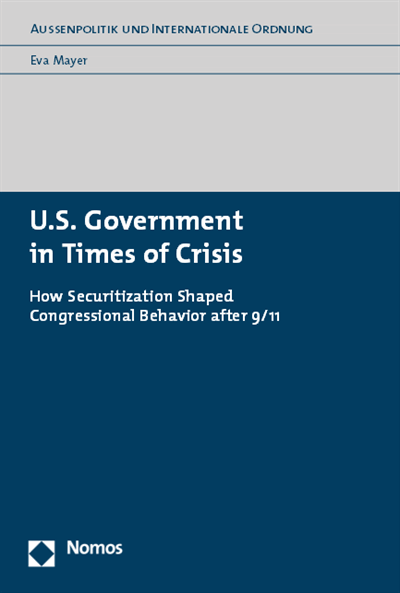
U.S. Government in Times of Crisis
How Securitization Shaped Congressional Behavior after 9/11- Autor:innen:
- Verlag:
- 2018
Zusammenfassung
Das in der Studie angelegte Analyseraster prüft die Korrelation zwischen einer Übernahme von Verlust- bzw. Gewinndarstellungen des Präsidenten durch Abgeordnete des US-Kongresses (Messung des Grades der Sekuritisierung /Desekuritisierung) und überparteilichem Abstimmungsverhalten durch Abgeordnete des US-Kongresses (Messung des Rally Effects). Der Ansatz der Versicherheitlichung, die methodisch um den Aspekt der Verlust- und Gewinndarstellungen der Neuen Erwartungstheorie erweitert wurde, dient als theoretischer Rahmen der Studie. Der Analysekorpus besteht aus einer qualitativen Fallstudie (Prozessanalyse) von sicherheitsrelevanten Gesetzen nach dem 11. September. Neben der kausalanalytischen Operationalisierung des Rally Effects im US-Kongress leistet diese Arbeit eine Weiterentwicklung der Securitization Theory um multiple Referenzobjekte und –subjekte und führt somit miteinander konkurrierende Bedrohungs- beziehungsweise Risikostimuli ein.
Schlagworte
Publikation durchsuchen
Bibliographische Angaben
- Auflage
- 1/2018
- Copyrightjahr
- 2018
- ISBN-Print
- 978-3-8487-4239-4
- ISBN-Online
- 978-3-8452-8496-5
- Verlag
- Nomos, Baden-Baden
- Reihe
- Außenpolitik und Internationale Ordnung
- Sprache
- Englisch
- Seiten
- 246
- Produkttyp
- Monographie
Inhaltsverzeichnis
- Titelei/Inhaltsverzeichnis Kein Zugriff Seiten 1 - 14
- 1.1 Relevance and Scope of Work Kein Zugriff
- 1.2 Outline Kein Zugriff
- 1.3 Research Design Kein Zugriff
- The Audience in the Securitization Process Kein Zugriff
- The Referent Objects and Referent Subjects Kein Zugriff
- Measuring Desecuritization Kein Zugriff
- 2.2 The President as Securitizing Actor Kein Zugriff
- Schools of Thought and Theoretical Explanations Kein Zugriff
- Rally Effect in Congress Kein Zugriff
- Origins of Prospect Theory Kein Zugriff
- Enhancement of Prospect Theory Kein Zugriff
- Adaptation of Prospect Theory Kein Zugriff
- Setting the Reference Point Kein Zugriff
- Prospect Theory to explain Decision-Making Processes Kein Zugriff
- Government-Posed Risk before 9/11 Kein Zugriff
- Relevance of the Laws for the GPR Kein Zugriff
- Threat vs. Risk Kein Zugriff
- Authorization for Use of Military Force Against Terrorists 2001 Kein Zugriff
- USA PATRIOT Act Kein Zugriff
- Intelligence Reform and Terrorist Prevention Act of 2004 Kein Zugriff
- PATRIOT Reauthorization Laws Kein Zugriff
- Protect America Act Kein Zugriff
- FISA Amendments Act Kein Zugriff
- Interim Conclusion Kein Zugriff
- Authorization for Use of Military Force Against Terrorists 2001 Kein Zugriff
- USA PATRIOT Act Kein Zugriff
- Intelligence Reform and Terrorist Prevention Act of 2004 Kein Zugriff
- PATRIOT Reauthorization Laws Kein Zugriff
- Protect America Act Kein Zugriff
- FISA Amendments Act Kein Zugriff
- Interim Conclusion Kein Zugriff
- Authorization for Use of Military Force Against Terrorists 2001 Kein Zugriff
- USA PATRIOT Act Kein Zugriff
- Intelligence Reform and Terrorism Prevention Act of 2004 Kein Zugriff
- PATRIOT Reauthorization Laws Kein Zugriff
- Protect America Act Kein Zugriff
- FISA Amendments Act Kein Zugriff
- Interim Conclusion Kein Zugriff
- Authorization for Use of Military Force Against Terrorists 2001 Kein Zugriff
- USA PATRIOT Act Kein Zugriff
- Intelligence Reform and Terrorist Prevention Act of 2004 Kein Zugriff
- PATRIOT Reauthorization Laws Kein Zugriff
- Protect America Act Kein Zugriff
- FISA Amendments Act Kein Zugriff
- Interim Conclusion Kein Zugriff
- 4.1 Theoretical Considerations Kein Zugriff
- 4.2 Empirical Considerations Kein Zugriff
- 4.3 Discussion and Future Research Kein Zugriff
- 5 Bibliography Kein Zugriff Seiten 225 - 246
Literaturverzeichnis (376 Einträge)
Es wurden keine Treffer gefunden. Versuchen Sie einen anderen Begriff.
- “ACLU Fact Sheet on the Police America Act.” ACLU. August 8, 2007. Retrieved April 13, 2008. http://www.aclu.org/safefree/nsaspying/31203res20070807.html Accessed on February 18, 2014. Google Scholar öffnen DOI: 10.5771/9783845284965
- “Authorization for Use of Military Force (P.L.107-40).” Congressional Record, 107th Congress, October 1, 2001, pp. S9949-S9951. Google Scholar öffnen DOI: 10.5771/9783845284965
- “Boumediene et al. v. Bush, President of the United States, et al., Supreme Court of the United States.“ No. 06-1195, Argued December 5, 2007—Decided June 12, 2008. Google Scholar öffnen DOI: 10.5771/9783845284965
- “Congressional Record” Library of Congress. http://thomas.loc.gov/home/cr_help.htm. Accesed May, 23, 2013. Google Scholar öffnen DOI: 10.5771/9783845284965
- “CQ Roll Call’s Vote Studies.” Congressional Quarterly. http://media.cq.com/votestudies/. Accessed September 3, 2014. Google Scholar öffnen DOI: 10.5771/9783845284965
- “Homeland Security Act 2002 (P.L. 107-296): 116 STAT. 2135, U.S.“ Government Printing Office. Google Scholar öffnen DOI: 10.5771/9783845284965
- “House Roll Call 414 for H.R. 3199. July 21, 2005.“ http://clerk.house.gov/evs/2005/roll414.xml . Accessed January, 13 2014. Google Scholar öffnen DOI: 10.5771/9783845284965
- “Intelligence Reform and Terrorism Prevention Act of 2004 (P.L.108–458) December. 17, 2004.” 118 STAT. 3638. Google Scholar öffnen DOI: 10.5771/9783845284965
- “Intelligence Reform and Terrorism Prevention Act of 2004: Roll Call Vote 199.” Congressional Record, Vol. 150, No. 125 U.S. p. S10479-S10481. Google Scholar öffnen DOI: 10.5771/9783845284965
- “James R. Clapper, Jr., Director of National Intelligence, et al., Petitioners v. Amnesty International USA, et al., 568 U.S. (2011).“ United States Court of Appeals for the Second Circuit (09-4112-cv). Google Scholar öffnen DOI: 10.5771/9783845284965
- “On the Amendment S.Amdt. 5088. Kennedy Amdt. No. 5088. To provide for the protection of United States persons in the implementation of treaty obligations. Roll Call Vote No. 258.” Congressional Record Vol. 151, No. 162. p. S13934. Google Scholar öffnen DOI: 10.5771/9783845284965
- “Presidential Approval Ratings George W. Bush.” Gallup Poll. http://www.gallup.com/poll/116500/presidential-approval-ratings-george-bush.aspx Accessed February 5, 2011. Google Scholar öffnen DOI: 10.5771/9783845284965
- “PROTECT AMERICA Act of 2007: Roll Vote No. 309.” Congressional Record Vol. 153, No. 127 p. S10861. Google Scholar öffnen DOI: 10.5771/9783845284965
- “PROTECT AMERICA Act of 2007: Roll Vote No. 836.” Congressional Record Vol. 153, No. 128. pp. H9965-H9966. Google Scholar öffnen DOI: 10.5771/9783845284965
- “Public Papers of the Presidents of the United States.” U.S. Government Publishing Office. http://www.gpo.gov/help/about_public_papers_of_the_presidents_of_the_united_states.htm. Accessed January 11, 2011. Google Scholar öffnen DOI: 10.5771/9783845284965
- “Uniting and Strengthening America by Providing Appropriate Tools Required to Intercept and Obstruct Terrorism Act of 2001 (P.L. 107-5).” U.S. Government Printing Office. P. 115 STAT. 272. Google Scholar öffnen DOI: 10.5771/9783845284965
- Altheide, David L. (2006): Terrorism and the Politcs of Fear. Lanham: Alta Mira Press. Google Scholar öffnen DOI: 10.5771/9783845284965
- American Civil Liberties Union: Surveillance under the USA PATRIOT Act. https://www.aclu.org/surveillance-under-usa-patriot-act. Accessed September 21, 2012. Google Scholar öffnen DOI: 10.5771/9783845284965
- Aradau, Claudia (2004): “Security and the Democratic Scene. Desecuritization and Emancipation.” Journal of International Relations and Development. Vol. 7, No. 4 pp. 389-491. Google Scholar öffnen DOI: 10.5771/9783845284965
- Aras, Bülent; Polat, Rabia Karakaya (2008): “From Conflict to Cooperation. Desecuritization of Turkey’s Relationship with Syria and Iran.” Security Dialogue. Vol. 39, No. 495, pp. 495-515. Google Scholar öffnen DOI: 10.5771/9783845284965
- Associated Press: ACLU Withdraws Lawsuit Challenging Patriot Act. October 29, 2006. http://www.washingtonpost.com/wp-dyn/content/article/2006/10/28/AR2006102801001.html Accessed February 10, 2014. Google Scholar öffnen DOI: 10.5771/9783845284965
- Baker, Peter (2015); “In Debate Over Patriot Act, Lawmakers Weigh Risks vs. Liberty” http://www.nytimes.com/2015/06/02/us/politics/in-debate-over-patriot-act-lawmakers-weigh-risks-vs-liberty.html. Accessed December 18, 2015. Google Scholar öffnen DOI: 10.5771/9783845284965
- Ball, Harald; Vasan, Mildred (2004): U.S.A. Patriot Act of 2001. Balancing Civil Liberties and National Security: A Reference Handbook. Santa Barbara: ABC-Clio. Google Scholar öffnen DOI: 10.5771/9783845284965
- Balzacq, Thierry (2005): “The Three Faces of Securitization. Political Agency, Audience and Context”, European Journal of International Relations. Vol. 11. pp. 177-183. Google Scholar öffnen DOI: 10.5771/9783845284965
- Balzacq, Thierry (2011): Securitization Theory. How Security Problems Emerge and Dissolve. New York: Routledge. Google Scholar öffnen DOI: 10.5771/9783845284965
- Balzacq, Thierry (2015): “Desecuritization. Editors Introduction.” In: Balzacq, Thierry (Ed.), Contesting Security. Strategies and Logics, New York: Routledge. pp. 11-15. Google Scholar öffnen DOI: 10.5771/9783845284965
- Barthawal-Datta, Monika (2012): Understanding Security Practices in South Asia. Securitization Theory and the Role of Non-State Actors. New York: Routledge. Google Scholar öffnen DOI: 10.5771/9783845284965
- Bazan, Elisabeth (2008): “P.L. 110-55, the Protect America Act of 2007: Modifications to the Foreign Intelligence Surveillance Act:” Congressional Research Service. RL34143. Google Scholar öffnen DOI: 10.5771/9783845284965
- Bazerman, Max H. ;Giuliano, Toni; Appelman, Alan (1984): “ Escalation of Commitment in Individual and Group Decision Making.” Organizational Behavior and Human Decision Processes. Vol. 57, No. 1. pp. 59-82. Google Scholar öffnen DOI: 10.5771/9783845284965
- Bennett, Andrew (2008): “Process Tracing: A Bayesian Perspective,” In: The Oxford Handbook of Political Methodology, Janet M. Box-Steffensmeier, Henry E. Brady, David Collier (Ed). Oxford: Oxford University Press. pp. 702-721. Google Scholar öffnen DOI: 10.5771/9783845284965
- Bilgin, Pinar (2007): “Making Turkey’s Transformation Possible. Claiming ‘Security-Speak’- not Desecuritization!.”Southeast European and Black Sea Studies. Vol. 7, No. 4. pp. 555-571. Google Scholar öffnen DOI: 10.5771/9783845284965
- Boettcher, III, William A. (2004): “The Prospects for Prospect Theory. An Empirical Evaluation of International Relations Applications of Framing and Loss Aversion.” Political Psychology, Vol. 25, No. 3, Special Issue (Part Two): Prospect Theory. Jun., 2004. pp. 331-363. Google Scholar öffnen DOI: 10.5771/9783845284965
- Boettcher, III, William A. (2004): Presidential Risk Behavior in Foreign Policy. Prudence or Peril?. New York: Palgrave MacMillan. Google Scholar öffnen DOI: 10.5771/9783845284965
- Brady, David W.; Han, Hahrie (2004): “An Extended Historical View of Congressional Party Polarization.” Working Paper Prepared for Presentation at Princeton University, Dec. 2, 2004. Google Scholar öffnen DOI: 10.5771/9783845284965
- Branigin, William (2005): “Bush Calls Blockage of Patriot Act 'Inexcusable’.” Washington Post.http://www.washingtonpost.com/wpdyn/content/article/2005/12/19/AR2005121900447.html. Accessed January 13, 2014. Google Scholar öffnen DOI: 10.5771/9783845284965
- Brigitte L.; Bloch-Elkon, Yaeli; Shapiro (2011): Selling Fear. Counterterrorism, the Media, and the Public Opinion. Chicago: University of Chicago Press. Google Scholar öffnen DOI: 10.5771/9783845284965
- Brody, Bryan; Anna Lillian; Oneal, John R. (1995): “The Rally ‘Round the Flag Effect in U.S. Foreign Policy Crises, 1950-1985.” Political Behavior, Vol 17, No. 4. pp. 379-394. Google Scholar öffnen DOI: 10.5771/9783845284965
- Brody, Richard (1991): Assessing the President. The Media, Elite Opinion and Public Support. Stanford: Stanford University Press. Google Scholar öffnen DOI: 10.5771/9783845284965
- Brown, Eugene; Snow, Donald, M. (1994): Puzzle Palaces and Foggy Bottom. U.S. Foreign and Defense Policy Making in the 1990s. London: Palgrave Macmillan. Google Scholar öffnen DOI: 10.5771/9783845284965
- Brummer, Klaus; Oppermann, Kai (2014): Außenpolitikanalyse. München: Oldenburg Wissenschaftsverlag. Google Scholar öffnen DOI: 10.5771/9783845284965
- Burbach, David T. (2003): Diversionary Temptations. Presidential Incentives and the Political Use of Force. Boston: Massachusetts Institute of Technology. Google Scholar öffnen DOI: 10.5771/9783845284965
- Bush, George W. (2001): “President Bush's Address to a Joint Session of Congress and the Nation”, Public Papers of the Presidents of the United States. pp. 129-135. Google Scholar öffnen DOI: 10.5771/9783845284965
- Bush, George W. (2001): “Address Before a Joint Session of the Congress on the United States Response to the Terrorist Attacks of September 11, Sept. 20, 2001” Public Papers of the Presidents of the United States. pp. 1140-1144. Google Scholar öffnen DOI: 10.5771/9783845284965
- Bush, George W. (2001): “Memorandum on the Congressional Subpoena for Executive Branch Documents, December 12, 2001.” Public Papers of the Presidents of the United States. pp. 1509-1510. Google Scholar öffnen DOI: 10.5771/9783845284965
- Bush, George W. (2001): “Remarks Following a Meeting with the National Security Team, September 12, 2001” Public Papers of the Presidents of the United States. pp. 1100-1101. Google Scholar öffnen DOI: 10.5771/9783845284965
- Bush, George W. (2001): “Remarks Prior to Discussions With King Abdullah II of Jordan and an Exchange With Reporters, September 28, 2001” Public Papers of the Presidents of the United States. pp. 1173-1175. Google Scholar öffnen DOI: 10.5771/9783845284965
- Bush, George W. (2001): “Remarks to Employees in the Pentagon and an Exchange with Reporters in Arlington, Virginia, September 17, 2001” Public Papers of the Presidents of the United States. pp. 1117-1120. Google Scholar öffnen DOI: 10.5771/9783845284965
- Bush, George W. (2001): “Remarks to Federal Bureau of Investigation Employees, September 25, 2001” Public Papers of the Presidents of the United States. pp. 1160-1162. Google Scholar öffnen DOI: 10.5771/9783845284965
- Bush, George W. (2001): “Statement on Signing the Authorization for Use of Military Force, September 18, 2001” Public Papers of the Presidents of the United States. pp. 1124-1125. Google Scholar öffnen DOI: 10.5771/9783845284965
- Bush, George W. (2001): “The President’s Radio Address, December 29, 2001.” Public Papers of the Presidents of the United States. pp. 1555-1556. Google Scholar öffnen DOI: 10.5771/9783845284965
- Bush, George W. (2001): “The President’s Radio Address, October 27, 2001.” Public Papers of the Presidents of the United States. pp. 1312-1314. Google Scholar öffnen DOI: 10.5771/9783845284965
- Bush, George W. (2002): “Remarks at Southern Maine Technical College in Portland, January 25, 2002.” Public Papers of the Presidents of the United States. pp. 115-119. Google Scholar öffnen DOI: 10.5771/9783845284965
- Bush, George W. (2002): “The President's State of the Union Address, US Capitol, Washington, D.C., Jan. 29, 2002”. Public Papers of the Presidents of the United States, pp. 129-136. Google Scholar öffnen DOI: 10.5771/9783845284965
- Bush, George W. (2004): “Remarks in a Discussion at Kutztown University of Pennsylvania in Kutztown, Pennsylvania, July 9, 2004” Public Papers of the Presidents of the United States. pp. 1251-1266. Google Scholar öffnen DOI: 10.5771/9783845284965
- Bush, George W. (2004): “Remarks in Albuquerque, New Mexico, November 1, 2004” Public Papers of the Presidents of the United States. pp. 2924-2930. Google Scholar öffnen DOI: 10.5771/9783845284965
- Bush, George W. (2004): “Remarks in Manchester, New Hampshire, October 29, 2004.” Public Papers of the Presidents of the United States. pp. 2815-2821. Google Scholar öffnen DOI: 10.5771/9783845284965
- Bush, George W. (2004): “Remarks in Marlton, New Jersey, October 18, 2004” Public Papers of the Presidents of the United States. pp. 25-74-2575. Google Scholar öffnen DOI: 10.5771/9783845284965
- Bush, George W. (2004): “Remarks in Marlton, New Jersey, October 18, 2004.” Public Papers of the Presidents of the United States. pp. 2574-2575. Google Scholar öffnen DOI: 10.5771/9783845284965
- Bush, George W. (2004): “The President’s Radio Address, December 4, 2004” Public Papers of the Presidents of the United States. pp. 3044-3035. Google Scholar öffnen DOI: 10.5771/9783845284965
- Bush, George W. (2005): “Remarks at an Independence Day Celebration in Morgantown, West Virginia, July 4, 2005.” Public Papers of the Presidents of the United States. pp. 1180-1183. Google Scholar öffnen DOI: 10.5771/9783845284965
- Bush, George W. (2005): “Remarks Following a Meeting with Congressional Leaders, February 15, 2008.” Public Papers of the Presidents of the United States. pp. 208-209. Google Scholar öffnen DOI: 10.5771/9783845284965
- Bush, George W. (2005): “Remarks on Intelligence Reform Legislation, February 13, 2008.” Public Papers of the Presidents of the United States. pp. 179-180. Google Scholar öffnen DOI: 10.5771/9783845284965
- Bush, George W. (2005): “Remarks on the PATRIOT Act in Baltimore, Maryland, July 20, 2005.” Public Papers of the Presidents of the United States. pp. 1249-1256. Google Scholar öffnen DOI: 10.5771/9783845284965
- Bush, George W. (2005): “Remarks on the PATRIOT Act in McLean, Virginia, June 10, 2005.” Public Papers of the Presidents of the United States. pp. 965-969. Google Scholar öffnen DOI: 10.5771/9783845284965
- Bush, George W. (2005): “Remarks to the American Legislative Exchange Council in Grapevine, Texas August 3, 2005.” Public Papers of the Presidents of the United States. pp. 1295-1305. Google Scholar öffnen DOI: 10.5771/9783845284965
- Bush, George W. (2005): “Statement on House of Representatives Passage of PATRIOT Act Reauthorization Legislation, December 14, 2005.” Public Papers of the Presidents of the United States. p. 1857. Google Scholar öffnen DOI: 10.5771/9783845284965
- Bush, George W. (2005): “Statement on Senate Action to Reauthorize PATRIOT Act Reauthorization Legislation, December 21, 2005.” Public Papers of the Presidents of the United States. pp. 1897-1898. Google Scholar öffnen DOI: 10.5771/9783845284965
- Bush, George W. (2005): “Statement on Senate Filibuster of PATRIOT Act Reauthorization Legislation, December 16, 2005.” Public Papers of the Presidents of the United States. p. 1862. Google Scholar öffnen DOI: 10.5771/9783845284965
- Bush, George W. (2005): “The President’s News Conference, December 19, 2005.” Public Papers of the Presidents of the United States. pp. 1875-1888. Google Scholar öffnen DOI: 10.5771/9783845284965
- Bush, George W. (2005): “The President’s Radio Address , December 10, 2005.” Public Papers of the Presidents of the United States. pp. 1835-1836. Google Scholar öffnen DOI: 10.5771/9783845284965
- Bush, George W. (2005): “The President’s Radio Address, December 17, 2005.” Public Papers of the Presidents of the United States. pp. 1870-1872. Google Scholar öffnen DOI: 10.5771/9783845284965
- Bush, George W. (2005): “The President’s Radio Address, February 16, 2008.” Public Papers of the Presidents of the United States. pp. 217-218. Google Scholar öffnen DOI: 10.5771/9783845284965
- Bush, George W. (2005): “The President’s Radio Address, February 23, 2008.” Public Papers of the Presidents of the United States. pp. 259-260. Google Scholar öffnen DOI: 10.5771/9783845284965
- Bush, George W. (2005): “The President’s Radio Address, July 9, 2005.” Public Papers of the Presidents of the United States. pp. 1201-1202. Google Scholar öffnen DOI: 10.5771/9783845284965
- Bush, George W. (2006): “Remarks in Nashville, Tennessee, February 1, 2006.” Public Papers of the Presidents of the United States. pp. 154-169. Google Scholar öffnen DOI: 10.5771/9783845284965
- Bush, George W. (2006): “Remarks on Signing the USA PATRIOT Improvement and Reauthorization Act of 2005, March 9, 2006.” Public Papers of the Presidents of the United States. pp. 428-430. Google Scholar öffnen DOI: 10.5771/9783845284965
- Bush, George W. (2006): “Remarks on the War on Terror and a Question-and-Answer Session in Louisville, Kentucky January 11, 2006.” Public Papers of the Presidents of the United States. pp. 41-58. Google Scholar öffnen DOI: 10.5771/9783845284965
- Bush, George W. (2006): “Statement on Senate Passage of PATRIOT Act Reauthorization Legislation, March 2, 2006.” Public Papers of the Presidents of the United States. pp. 388. Google Scholar öffnen DOI: 10.5771/9783845284965
- Bush, George W. (2007): “President’s Radio Address, July 28, 2007.” Public Papers of the President of the United States. pp. 1027-1028. Google Scholar öffnen DOI: 10.5771/9783845284965
- Bush, George W. (2007): “Remarks at the Naval War College and a Question-and-Answer Session in Newport, Rhode Island, June 28, 2007.” Public Papers of the Presidents of the United States. pp. 816-829. Google Scholar öffnen DOI: 10.5771/9783845284965
- Bush, George W. (2007): “Remarks on the Federal Budget and a Question-and-Answer Session in Nashville, Tennessee, July 19, 2007.” Public Papers of the Presidents of the United States. pp. 982-1000. Google Scholar öffnen DOI: 10.5771/9783845284965
- Bush, George W. (2007): “Remarks to the Democracy and Security Conference in Prague, June 5, 2007.” Public Papers of the Presidents of the United States. pp. 685-690. Google Scholar öffnen DOI: 10.5771/9783845284965
- Bush, George W. (2007): “Statement on Congressional Passage of Intelligence Reform Legislation, August 5, 2007.” Public Papers of the Presidents of the United States. pp. 1044-1045. Google Scholar öffnen DOI: 10.5771/9783845284965
- Bush, George W. (2007): “Statement on the Conclusion of Negotiations with India on a Bilateral Agreement for Peaceful Nuclear Cooperation, July 27, 2007.” Public Papers of the Presidents of the United States. pp. 1026-1027. Google Scholar öffnen DOI: 10.5771/9783845284965
- Bush, George W. (2008): “Interview with Matt Frei of BBC World News America, February 14, 2008.” Public Papers of the Presidents of the United States. pp. 192-197. Google Scholar öffnen DOI: 10.5771/9783845284965
- Bush, George W. (2008): “Remarks at the National Republican Congressional Committee Dinner, March 12, 2008.” Public Papers of the Presidents of the United States. pp. 361-366. Google Scholar öffnen DOI: 10.5771/9783845284965
- Bush, George W. (2008): “Remarks at the President’s Dinner, June 18, 2008.” Public Papers of the Presidents of the United States. pp. 846-850. Google Scholar öffnen DOI: 10.5771/9783845284965
- Bush, George W. (2008): “Remarks Following a Meeting with Congressional Leaders, February 15, 2008.” Public Papers of the Presidents of the United States. pp. 208-209. Google Scholar öffnen DOI: 10.5771/9783845284965
- Bush, George W. (2008): “Remarks Following a Meeting With Prime Minister Mirek Topolanek of the Czech Republic and an Exchange With Reporters, February 27, 2008.” Public Papers of the Presidents of the United States. pp. 278-282. Google Scholar öffnen DOI: 10.5771/9783845284965
- Bush, George W. (2008): “Remarks on Congressional Action on the Legislative Agenda, June 20, 2008.” Public Papers of the Presidents of the United States. p. 858. Google Scholar öffnen DOI: 10.5771/9783845284965
- Bush, George W. (2008): “Remarks on Intelligence Reform Legislation, February 13, 2008.” Public Papers of the Presidents of the United States. pp. 179-180. Google Scholar öffnen DOI: 10.5771/9783845284965
- Bush, George W. (2008): “Remarks on Signing the FISA Amendments Act of 2008, July 10, 2008.” Public Papers of the Presidents of the United States. pp. 1007-1009. Google Scholar öffnen DOI: 10.5771/9783845284965
- Bush, George W. (2008): “Remarks to the Conservative Political Action Conference, February 8, 2008.” Public Papers of the Presidents of the United States. pp. 161-168. Google Scholar öffnen DOI: 10.5771/9783845284965
- Bush, George W. (2008): “Remarks to the National Association of Attorneys General, March 3, 2008.” Public Papers of the Presidents of the United States. pp. 307-309. Google Scholar öffnen DOI: 10.5771/9783845284965
- Bush, George W. (2008): “Statement on Congressional Action on Intelligence Reform Legislation, January 24, 2008.” Public Papers of the Presidents of the United States. pp. 110-111. Google Scholar öffnen DOI: 10.5771/9783845284965
- Bush, George W. (2008): “The President’s News Conference, February 28, 2008.” Public Papers of the Presidents of the United States. pp. 285-297. Google Scholar öffnen DOI: 10.5771/9783845284965
- Bush, George W. (2008): “The President’s Radio Address, February 16, 2008.” Public Papers of the Presidents of the United States. pp. 217-218. Google Scholar öffnen DOI: 10.5771/9783845284965
- Bush, George W. (2008): “The President’s Radio Address, January 26, 2008.” Public Papers of the Presidents of the United States. pp. 112-113. Google Scholar öffnen DOI: 10.5771/9783845284965
- Buzan, Barry; Waever, Ole; de Wilde, Jaap (1998): Security. A New Framework for Analysis. Boulder: Lynne Rienner Publisher. Google Scholar öffnen DOI: 10.5771/9783845284965
- Cardaras, Mary (2015): Fear, Power, and Politics. The Recipe for War in Iraq after 9/11. Lanham: Lexington Books. Google Scholar öffnen DOI: 10.5771/9783845284965
- Nacos, Brigitte L.; Bloch-Elkon, Yaeli; Shapiro, Robert Y. (2011): Selling Fear. Counterterrorism, the Media, and the Public Opinion. Chicago: University of Chicago Press. Google Scholar öffnen DOI: 10.5771/9783845284965
- Carlisle, Rodney (2006): Encyclopedia of Intelligence and Counterintelligence. Armok, New York: M.E. Sharpe. Google Scholar öffnen DOI: 10.5771/9783845284965
- Cochran, John; Christensen, Mike (2001): “Regrouping with a Common Purpose.” CQ Weekly. No. 59. pp. 2114–2117. Google Scholar öffnen DOI: 10.5771/9783845284965
- Cohen, Jeffrey E. (2006): “Presidential Rhetoric and the Public Agenda”. American Journal of Political Science, Vol. 39, No. 1. pp. 87-107. Google Scholar öffnen DOI: 10.5771/9783845284965
- Cole, David; Dempsey, James X. (2013): Terrorism and the Constitution. Sacrificing Civil Liberties in the Name of National Security. New York: W. W. Norton & Co. Google Scholar öffnen DOI: 10.5771/9783845284965
- Cox, Louis Anthony (Jr.) (2009): Risk Analysis of Complex and Uncertain Systems. New York City: Springer. Google Scholar öffnen DOI: 10.5771/9783845284965
- Cruise, Rebecca J.; D’Erman, Valerie J.L; Grillot, Suzette R. (2013): Protecting our Ports. Domestic and International Politics of Containerized freight Security. London: Ashgate Publishing Ltd. Google Scholar öffnen DOI: 10.5771/9783845284965
- Davis, Darren (2007): Negative Liberty: Public Opinion and the Terrorist Attacks on America. New York: Russell Sage Foundation. Google Scholar öffnen DOI: 10.5771/9783845284965
- Davis, Darren; Silver, Brian D. (2004): “The Threat of Terrorism, Presidential Approval, and the 2004 Election.” Paper delivered at the Annual Meeting of the American Political Science Assiociaton. Google Scholar öffnen DOI: 10.5771/9783845284965
- de Bonis, Mike (2015): “Congress turns away from post-9/11 law, retooling U.S. surveillance powers”, Washington Post. https://www.washingtonpost.com/politics/senate-moves-ahead-with-retooling-of-us-surveillance-powers/2015/06/02/28f5e1ce-092d-11e5-a7ad-b430fc1d3f5c_story.html June 2 2015. Accessed December 18, 2015. Google Scholar öffnen DOI: 10.5771/9783845284965
- Denton, Robert E. (2006): Language, symbols, and the media. Communication in the aftermath of the World Trade Center attack. New Brunswick, N.J: Transaction Publishers. Google Scholar öffnen DOI: 10.5771/9783845284965
- DeRouen, Karl (Jr.) (2000): “Presidents and the Diversionary Use of Force. A Research Note.” International Studies Quarterly. Vol. 44, No.2. pp.317-328. Google Scholar öffnen DOI: 10.5771/9783845284965
- Diamond, John (2006): “Senate passes Patriot Act changes.” USA Today. March 1, 2006. http://usatoday30.usatoday.com/news/washington/2006-03-01-patriot-act_x.htm. Accessed January 13, 2014. Google Scholar öffnen DOI: 10.5771/9783845284965
- Dixon, Pam (2016): Surveillance in America: An Encyclopedia of History, Politics, and the Law. Santa Barbara: ABC-Clio. Google Scholar öffnen DOI: 10.5771/9783845284965
- Dodd, Lawrence C.; Oppenheimer. Bruce I. (2012): “Congress Reconsidered” New York: SAGE Publishing. Google Scholar öffnen DOI: 10.5771/9783845284965
- Donsbach, Wolfgang (2003): Chancen und Gefahren der Mediendemokratie. Konstanz: UVK Verlagsgesellschaft. Google Scholar öffnen DOI: 10.5771/9783845284965
- Doyle, Charels (2002): “The USA PATRIOT Act. A Sketch.” CRS Report for Congress. Google Scholar öffnen DOI: 10.5771/9783845284965
- Doyle, Charles (2005): “USA PATRIOT Act Reauthorization Proposals and Realated Matters in Brief.” CRS Report for Congress. Google Scholar öffnen DOI: 10.5771/9783845284965
- Drury, A. Cooper; Overby, Marvin L.; Ang, Adrian; Li, Yitan (2010): “’Pretty Prudent’ Or Rhetorically Responsive? The American Public’s Support for Military Action.“ Political Research Quarterly. Vol. 63, No. 1. pp.83-96. Google Scholar öffnen DOI: 10.5771/9783845284965
- Edwards, George C., III. (1989): At the Margins: Presidential Leadership of Congress. New Haven: Yale University Press. Google Scholar öffnen DOI: 10.5771/9783845284965
- Erikson, Robert S.; MacKuen, Michael B.; Stimson, James A. (2002): The Makro Polity. Cambridge: Cambridge University Press. Google Scholar öffnen DOI: 10.5771/9783845284965
- Farnham, Barbara (1994): Avoiding Losses/Taking Risks. Prospect Theory and International Conflict. Ann Arbor: The University of Michigan Press. Google Scholar öffnen DOI: 10.5771/9783845284965
- Feingold, Russell (2001): “On Opposing The U.S.A. Patriot Act.” Archipelago, Vol. 6 No.2 http://www.archipelago.org/vol6-2/feingold.htm Accessed September 19, 2014. Google Scholar öffnen DOI: 10.5771/9783845284965
- Felbab-Brown, Vanda (2012): “Slip-Sliding on a Yellow Brick Road: Stabilization Efforts in Afghanistan.” Stability: International Journal of Security and Development Vol. 1, No.1. pp.4-19. Google Scholar öffnen DOI: 10.5771/9783845284965
- Fenno; Richard (1978): Home Style. House Members in Their District. Boston: Little Brown and Company. Google Scholar öffnen DOI: 10.5771/9783845284965
- Fitzgerald, Brian (2006): McCarthyism. The Red Scare. Minneapolis: Compass Point Books. Google Scholar öffnen DOI: 10.5771/9783845284965
- Floyd, Rita (2011): “Can Securitization Theory be used in Noramtive Analysis? Towards a Just Securitization Theory.” Security Dialogue. Vol. 42, No. 5. pp. 427-439. Google Scholar öffnen DOI: 10.5771/9783845284965
- Foreign Intelligence Surveillance Law.” Scholarly Works. Vol. 50, No. 347. p. 425-478. Google Scholar öffnen DOI: 10.5771/9783845284965
- Fuhrmann, Matthew and Bryan R. Early (2008): “Following START. Risk Acceptance and the 1991-92 Presidential Nuclear Initiatives.” Foreign Policy Analysis, Vol. 4, No. 1. pp. 21-43. Google Scholar öffnen DOI: 10.5771/9783845284965
- Furedi, Frank (2005): Politics of Fear: Byond Left and Right. New York: Continuum International Publishing. Google Scholar öffnen DOI: 10.5771/9783845284965
- Gaeth, Gary J.; Levin, Irwin P.; Schneider, Sandra L. (1998): “All Frames Are Not Created Equal. A Typology and Critical Analysis of Framing Effects.” Organizational Behavior and Human Decision Processes. Vol. 76, No. 2. pp. 149-188. Google Scholar öffnen DOI: 10.5771/9783845284965
- Griffin, David Ray (2005): The New Pearl Harbor: Disturbing Questions About the Bush Administration and 9/11. Northampton: Interlink Pub Group Inc. Google Scholar öffnen DOI: 10.5771/9783845284965
- Grimmet, Richard F. (2007): “Authorization For Use Of Military Force in Response to the 9/11 Attacks (P.L. 107-40): Legislative History.“ Congressional Research Service. RS22357. Google Scholar öffnen DOI: 10.5771/9783845284965
- Hansen, Lene (2011): “Reconstructing Desecuritization. The Normative-Political in the Copenhagen School and Directions for how to Apply it.” Review of International Studies. Vol. 38, No. 3. pp. 525-546. Google Scholar öffnen DOI: 10.5771/9783845284965
- Hendrickson, Ryan C. (2002): The Clinton Wars. The Constitution, Congress, And War Powers. Nashville: Vanderbilt University Press. Google Scholar öffnen DOI: 10.5771/9783845284965
- Henehan, Marie T. (2000): Foreign Policy And Congress: An International Relations Perspective. Ann Arbor: University Of Michigan Press. Google Scholar öffnen DOI: 10.5771/9783845284965
- Heng, Yee-Kuang (2006): War as Risk Management. Strategy and Conflict in an Age of Globalized Risks. London: Routledge. Google Scholar öffnen DOI: 10.5771/9783845284965
- Hetherington, Marc J.; Nelson, Michael (2003): “Anatomy of a Rally Effect. George W. Bush and the War on Terrorism.“ Political Science & Politics,Vol. 36, No.1. pp. 37-52. Google Scholar öffnen DOI: 10.5771/9783845284965
- Hibbing, John R.; Theiss-Morse, Elizabeth (1995): Congress as Public Enemy. Public Attitudes toward American Political Institutions. Cambridge: Cambridge University Press. Google Scholar öffnen DOI: 10.5771/9783845284965
- Hodges, Adam (2011): The ‘War on Terror’ Narrative. Discourse and Intertextuality in the Construction and Contestation of Sociopolitical Reality. Oxford: University Press. Google Scholar öffnen DOI: 10.5771/9783845284965
- Holland, Jesse J. (2006): “Legislation Renewing Patriot Act Stalls” Washington Post. http://www.washingtonpost.com/wp-dyn/content/article/2005/11/17/AR2005111700844.html. Accessed February 12, 2014. Google Scholar öffnen DOI: 10.5771/9783845284965
- Howell, William G.; Pevehouse, Jon C. (2007): While Dangers Gather. Congressional Checks on Presidential War Powers. Princeton: Princeton University Press. Google Scholar öffnen DOI: 10.5771/9783845284965
- Huddy, Lenie; Feldman, Stanley; Taber, Charles; Lahav, Gallya (2005): “Threat, Anxiety, and Support of Antiterrorism Policies.” American Journal of Political Science. Vol. 49, No. 3. pp. 593-608. Google Scholar öffnen DOI: 10.5771/9783845284965
- Huddy, Leonie (2004): “Fear and How It Works. Science and the Social Sciences.” Social Research. Vol. 7, No. 4, pp. 801-805. Google Scholar öffnen DOI: 10.5771/9783845284965
- Huysmanns, Jef (1998): “The Question of the Limit. Desecuritization and the Aesthetics of horror in political realism.” Millenium Journal of International Relations, Vol 27, No. 3. pp. 570-571. Google Scholar öffnen DOI: 10.5771/9783845284965
- Isenberg, Daniel J. (1986): “Group polarization: A critical review and meta-analysis.” Journal of Personality and Social Psychology. Vol. 50, No. 6, p. 1141-1151. Google Scholar öffnen DOI: 10.5771/9783845284965
- Iyengar, S. (1991): Is Anyone Responsible? How Television Frames Political Issues. Chicago: University of Chicago Press. Google Scholar öffnen DOI: 10.5771/9783845284965
- Iyengar, Shanto, and Kinder, Donald R. (1994): News that Matters: Television and American Opinion. American Politics and Political Economy. Chicago: Chicago University Press. Google Scholar öffnen DOI: 10.5771/9783845284965
- Jackson, Richard (2005): Writing the War on Terrorism. Language, Politics and Counter-terrorism. Manchester: Manchester University Press. Google Scholar öffnen DOI: 10.5771/9783845284965
- Jacobson, Gary C. (2012): The Politics of Congressional Elections. New York: Pearson. Google Scholar öffnen DOI: 10.5771/9783845284965
- Jacobsen, Michael (2004): “The Intelligence Reform and Terrorism Prevention Act. Addressing Controversies, Expanding Powers.” The Washington Institute. PolicyWatch 929. http://www.washingtoninstitute.org/policy-analysis/view/the-intelligence-reform-and-terrorism-prevention-act-addressing-controversi. Accessed January 14, 2015. Google Scholar öffnen DOI: 10.5771/9783845284965
- Jervis, Robert (1992): “Political Implications of Loss Aversion.” Political Psychology. Vol. 13, No. 2, Special Issue: Prospect Theory and Political Psychology, Jun., 1992. P. 187-204 Google Scholar öffnen DOI: 10.5771/9783845284965
- Johnson, Loch K. (2014): A Season Of Inquiry, Congress And Intelligence. Chicago: Dorsey Press. Google Scholar öffnen DOI: 10.5771/9783845284965
- Jones, David; McDermott, Monica L. (2010): Americans, Congress, and Democratic Responsiveness. Public Evaluations of Congress and Electoral Consequences. Ann Arbor: The University of Michigan Press. Google Scholar öffnen DOI: 10.5771/9783845284965
- Jutila, Matti (2006): “Desecuritizating Minority Rights. Against Determinism.”Security Dialogue. Vol. 37, No. 2. pp. 167-175. Google Scholar öffnen DOI: 10.5771/9783845284965
- Kahneman, Daniel; Tversky, Amos (1997): “Prospect Theory: An Analysis of Decision under Risk.” Econometrica. Vol. 47, No. 2. pp. 263-292. Google Scholar öffnen DOI: 10.5771/9783845284965
- Kameda, Tatsuya; Davis, James (1190): “The Function of the Reference Point in Individual and Group Risk Decision Making.” Organizational Behavior and Human Decision Processes. Vol. 46, No. 1. pp. 55-76. Google Scholar öffnen DOI: 10.5771/9783845284965
- Kane, Paul (2015): “Patriot Act debate Highlights ‘stark’ differences between 2001, 2015 Views” https://www.washingtonpost.com/politics/patriot-act-debate-highlights-stark-differences-between-2001-2015-views/2015/06/03/a716e2d6-0961-11e5-95fd-d580f1c5d44e_story.html. Accessed December 18, 2015. Google Scholar öffnen DOI: 10.5771/9783845284965
- Kassop, Nancy (2003): “The War Power and its Limits.” Presidential Studies Quarterly, Vol. 33, No. 3, p. 509-529. Google Scholar öffnen DOI: 10.5771/9783845284965
- Kelley, Christopher S.; Marshall, Bryan W. (2008): “The Last Word. Presidential Power and the Role of Signing Statements.” Presidential Studies Quarterly. Vol. 32, No. 2. p. 248-267. Google Scholar öffnen DOI: 10.5771/9783845284965
- Kellner, Douglas (2007): “Bushspeak and the Politics of Lying. Presidential Rhetoric in the ‘War on Terror’.” Presidential Studies Quarterly. Vol. 37, No. 4. p. 622-644. Google Scholar öffnen DOI: 10.5771/9783845284965
- Kenneth N. Waltz (1967): “Electoral Punishment and Foreign Policy Crisis.” In: James N. Rosenau, Domestic Sources of Foreign Policy. New York: Free Press. pp. 263-293. Google Scholar öffnen DOI: 10.5771/9783845284965
- Kim, Sung-han; Lee, Geun (2011): “When Security met Politics. Desecuritization of North Korean threats by South Korea’s Kim Dae-jung Government.”Interntaional Relations of the Asia-Pacific.Vol. 11, No. 1. pp. 25-55. Google Scholar öffnen DOI: 10.5771/9783845284965
- Kühberger, Anton (1998): “The influence of Framing on Risky Decisions. A Meta-Analysis.” Organizational Behavior and Human Decision Processes, Vol. 75, No. 1. pp. 23-55. Google Scholar öffnen DOI: 10.5771/9783845284965
- Lamm, Helmut (1988): ”A Review of our Research on Group Polarization. Eleven Experiments on the Effects of Group Discussion on Risk Acceptance, Probability Estimation, and Negotiation Positions.” Psychological Reports. Vol. 62, No. 1. pp. 807-813. Google Scholar öffnen DOI: 10.5771/9783845284965
- Lancaster, John and Krim Jonathan (2001): “Ashcroft Presents Anti-Terrorism Plan to Congress. Lawmakers Promise Swift Action, Disgrace and Extent of Measures.” The Washington Post, 20/2001, p. A24. Google Scholar öffnen DOI: 10.5771/9783845284965
- Landau, Susan Eva (2010): Surveillance or Security? The Risks Posed by New Wiretapping Technologies. Cambridge: MIT Press. Google Scholar öffnen DOI: 10.5771/9783845284965
- Lee, Barbara (2001): “Why I opposed the Resolution to Authorize Force.” San Francisco Gate. September 23, 2001. http://www.sfgate.com/opinion/article/Why-I-opposed-the-resolution-to-authorize-force-2876893.php. Accessed September 19, 2014. Google Scholar öffnen DOI: 10.5771/9783845284965
- Lee, Jong R. (1977): “Rallying round the Flag. Foreign Policy Events and Presidential Popularity.” Presidential Studies Quarterly. Vol. 7, No. 4, pp. 252-256. Google Scholar öffnen DOI: 10.5771/9783845284965
- LeVeaux, Christine; Garand, James C. (2001): “Race, Roll Call, and Redistricting. The Impact of Race-Based Redistricting on Congressional Roll-Call.” Political Research Quarterly, Vol. 54, No. 1. pp. 31-51. Google Scholar öffnen DOI: 10.5771/9783845284965
- Levi, Ariel; Whyte, Glenn (1997): “The origins and function of the reference point in risky group decision making the case of the Cuban Missile Crisis.” Journal of Behavioral Decision Making, Vol. 7, No. 4. pp. 243-260. Google Scholar öffnen DOI: 10.5771/9783845284965
- Levi, Ariel; Whyte, Glenn (1997): “A Cross-Cultural Exploration of the Reference Dependence of Crucial Group Decisions under Risk.” Journal of Conflict Resolution. Vol. 41, No. 6. pp. 792-813. Google Scholar öffnen DOI: 10.5771/9783845284965
- Levy, Jack S. (1997): “Prospect Theory, Rational Choice, and International Relations.” International Studies Quarterly, Vol. 41, No. 3. pp 87-112. Google Scholar öffnen DOI: 10.5771/9783845284965
- Levy, Jack S. (2003): “Applications of Prospect Theory to Political Science” Synthese, Vol. 135, No. 2. pp. 215-241. Google Scholar öffnen DOI: 10.5771/9783845284965
- Lichtblau, Eric (2005): “Senate Makes Permanent Nearly All Provisions of Patriot Act, With a Few Restrictions.” New York Times. http://www.nytimes.com/2005/07/30/politics/senate-makes-permanent-nearly-all-provisions-of-patriot-act-with-a-few-restrictions.html. Accessed February 12, 2014. Google Scholar öffnen DOI: 10.5771/9783845284965
- Lichtblau, Eric (2008): “Senate Approves Bill to Broaden Wiretap Powers.” New York Times. http://www.nytimes.com/2008/07/10/washington/10fisa.html. Accessed January 13, 2014. Google Scholar öffnen DOI: 10.5771/9783845284965
- Lichtblau, Eric; Risen, James (2006): “Bush Lets U.S. Spy on Callers Without Courts.” New York Times. http://www.nytimes.com/2005/12/16/politics/bush-lets-us-spy-on-callers-without-courts.html?_r=0 Accessed February 12, 2014. Google Scholar öffnen DOI: 10.5771/9783845284965
- Lindsay, James M. (2003): “Deference and Defiance. The Shifting Rhythms of Executive-Legislative Relations in Foreign Policy.” Presidential Studies Quarterly Vol. 33, No. 3: 530–546. Google Scholar öffnen DOI: 10.5771/9783845284965
- Lui, Edward C. (2013): “Reauthorization of the FISA Amendments Act.” Congressional Research Service. R42725. Google Scholar öffnen DOI: 10.5771/9783845284965
- MacKenzie, Megan (2009): “Securitization and Desecuritization. Female Soldiers and the Reconstruction of Women in Post-Conflict Sierra Leone.” Security Studies. Vol. 18, No. 2, pp. 241–261. Google Scholar öffnen DOI: 10.5771/9783845284965
- MacKuen, Rod (1983): “Political Drama, Economic Conditions, and the Dynamics of Presidential Popularity.” American Journal of Political Science, No. 27. pp. 165-192. Google Scholar öffnen DOI: 10.5771/9783845284965
- Maoz, Zeev (1990): “Framing National Interest: The Manipulation of Foreign Policy Decisions in Group Settings.” World Politics, Vol. 43, No.1. pp. 77-110. Google Scholar öffnen DOI: 10.5771/9783845284965
- McDermott, Rose (2004): “Prospect Theory in Political Science. Gains and Losses from the First Decade.” Political Psychology. Vol. 25, No. 2. pp. 289-312. Google Scholar öffnen DOI: 10.5771/9783845284965
- McDonald, Matt (2011): “Deliberation and Resecuritization. Australian Asylum-Seekers and the Normative Limits of the Copenhagen School.” Australien Journal of Political Science. Vol. 46, No.2. pp. 281-295. Google Scholar öffnen DOI: 10.5771/9783845284965
- Mead, Walter Russel (2007): Power, Terror, Peace, and War. America’s Grnad Strategy in a World at Risk. New York: Knopf Doubleday Publishing Group. Google Scholar öffnen DOI: 10.5771/9783845284965
- Merolla, Jennifer L.; Zechmeister, Elizabeth J. (2010): Democracy at Risk. How Terrorist Threats Affect the Public. Chicago: University of Chicago Press. Google Scholar öffnen DOI: 10.5771/9783845284965
- Mueller, John (1970): “Presidential Popularity from Truman to Johnson.” American Political Science Review. Vol. 64, No.1. pp. 18-34. Google Scholar öffnen DOI: 10.5771/9783845284965
- Mueller, John (1973): War, Presidents, and Public Opinion. New York: Wiley. Google Scholar öffnen DOI: 10.5771/9783845284965
- Nacos, Brigitte L., and Torres-Reyna, Oscar (2003): “Framing Muslim-Americans Before and After 9/11.“ In: Pippa Norris, Montague Kern und Marion Just (Ed.). Framing Terrorism: The News Media, the Government, and the Public. New York: Routledge. pp. 133-159. Google Scholar öffnen DOI: 10.5771/9783845284965
- Nacos, Brigitte L.; Bloch-Elkon, Yaeli; Shapiro, Robert Y. (2011): Selling Fear. Counterterrorism, the Media, and the Public Opinion. Chicago: University of Chicago Press. Google Scholar öffnen DOI: 10.5771/9783845284965
- Newsome, Bruce (2013): A Practical Introduction to Security and Risk Management. London: Sage Publications, Inc. Google Scholar öffnen DOI: 10.5771/9783845284965
- Nolan, Andrew (2013): “Foreign Surveillance and the Future of Standing to Sue Post-Clapper.” Congressional Research Service. R43107. Google Scholar öffnen DOI: 10.5771/9783845284965
- Norris, Pippa, Kern, Montague, and Just, Marion (2003): Framing Terrorism: The News Media, the Government, and the Public. New York: Routledge. Google Scholar öffnen DOI: 10.5771/9783845284965
- Ohaegbulam, F. Ugboaja (2007): A Culture of Deference. Congress, the President, and the Course of the U.S.-Led Invasion and Occupation of Iraq. New York: Peter Lang Publishing, Inc. Google Scholar öffnen DOI: 10.5771/9783845284965
- Ostrom, Charles W. (Jr.); Simon, Dennis M. (1985): “Promise and Performance. A Dynamic Model of Presidential Popularity.” The American Political Science Review. Vol. 79, No. 2. pp. 334-358. Google Scholar öffnen DOI: 10.5771/9783845284965
- Peake, Jeffrey S. (2001): “Presidential Agenda Setting in Foreign Policy.” Political Research Quarterly. Vol. 54, No.1 pp. 69-86. Google Scholar öffnen DOI: 10.5771/9783845284965
- Polsby, Nelson W. (1964): Congress and the Presidency. Englewood Cliffs, N.J.: Prentice-Hall. Google Scholar öffnen DOI: 10.5771/9783845284965
- Poole, Keith T., Rosenthal, Howard L. (2011): Ideology and Congress. New Brunswick: Transaction Publishers. Google Scholar öffnen DOI: 10.5771/9783845284965
- Popkin, Samuel L. (1987): The Reasoning Voter. Communication and Persuasion in PresidentialCcampaigns. Chicago: University Of Chicago Press. Google Scholar öffnen DOI: 10.5771/9783845284965
- Regens, James; Gaddie, Ronald Keith; Lockerbie, Brad (1995): “The Electoral Consequences of Voting to Declare War.” Journal of Conflict Resolution. Vol. 39, No 1. pp. 168-182. Google Scholar öffnen DOI: 10.5771/9783845284965
- Representative Arcuri (D-NY). “FISA Amendments Act of 2008 (March 14, 2008).” Congressional Record Vol. 154, No. 44. p. H1708. Google Scholar öffnen DOI: 10.5771/9783845284965
- Representative Armey (R-TX). “PATRIOT Act of 2001 (October 12, 2001).” Congressional Record Vol. 147, No. 120. p. H6768. Google Scholar öffnen DOI: 10.5771/9783845284965
- Representative Baca (D-CA). “On the House Approval of H.R. 3773 – Extension of Remarks (April 08, 2008).” Congressional Record Vol. 154, No. 103. E537. Google Scholar öffnen DOI: 10.5771/9783845284965
- Representative Baca (D-CA). “Resore Act of 2007 (October 17, 2007).” Congressional Record Vol. 153, No. 157. p. H11666. Google Scholar öffnen DOI: 10.5771/9783845284965
- Representative Bentsen (D-TA) PATRIOT Act of 2001 (October 12, 2001). Congressional Record Vol. 147, No. 137. p. H6769. Google Scholar öffnen DOI: 10.5771/9783845284965
- Representative Boehner (R-OH). “Protect America Act of 2007 (August 04, 2007).” Congressional Record Vol. 153, No. 128. p. S9561. Google Scholar öffnen DOI: 10.5771/9783845284965
- Representative Boyd (R-FL). “PATRIOT Act of 2001 (October 12, 2001).” Congressional Record Vol. 167, No. 137. p. H6770. Google Scholar öffnen DOI: 10.5771/9783845284965
- Representative Conyers (D-MI). “Authorizing Use of United States Armed Forces Against Those Responsible for Recent Attacks against the United States (September 14, 2001).” Congressional Record Vol. 147, No. 120. p. H5680. Google Scholar öffnen DOI: 10.5771/9783845284965
- Representative Coyne (D-PA).”Authorizing Use of United States Armed Forces against those Responsible for Recent Attacks against the United States. Protect America Act of 2007 (September 14, 2001).” Congressional Record Vol. 147, No. 120. p. H5677. Google Scholar öffnen DOI: 10.5771/9783845284965
- Representative DeLay (R-TX). “Authorizing Use of United States Armed Forces against Those Responsible for Recent Attacks against the United States (September 14, 2001).” Congressional Record Vol. 152, No. 112. p. H5648. Google Scholar öffnen DOI: 10.5771/9783845284965
- Representative Diaz-Balart (R-FL). “Authorizing Use of United States Armed Forces against Those Responsible for Recent Attacks against the United States (September 14, 2001).” Congressional Record Vol. 152, No. 112. p. H5638. Google Scholar öffnen DOI: 10.5771/9783845284965
- Representative Diaz-Balart (R-FL). “Providing for Consideration of H.R. 2975, Patriot Act of 2001 (October 12, 2001).” Congressional Record Vol. 161, No. 142. 112. p. H6724. Google Scholar öffnen DOI: 10.5771/9783845284965
- Representative Gephardt (D-MO). “Authorizing Use of United States Armed Forces Against Those Responsible for Recent Attacks against the United States (September 14, 2001).” Congressional Record Vol. 147, No. 120. p. H5658. Google Scholar öffnen DOI: 10.5771/9783845284965
- Representative Gingrey (R-GA). “USA Patriot and Terrorism Prevention Reauthorization Act of 2005 (December 14, 2005).” Congressional Record Vol. 151, No. 160. p. H11515. Google Scholar öffnen DOI: 10.5771/9783845284965
- Representative Goodlatte (R-VA). “PATRIOT Act of 2001 (October 12, 2001).” Congressional Record Vol. 147, No. 137. p. H6761. Google Scholar öffnen DOI: 10.5771/9783845284965
- Representative Hoekstra (R-MI). “USA Patriot and Terrorism Prevention Reauthorization Act of 2005 (July 21, 2005).” Congressional Record Vol. 151, No. 100. p. H6240. Google Scholar öffnen DOI: 10.5771/9783845284965
- Representative Holt (D-NJ). “Conference Report on S. 2845, Intelligence Reform and Terrorism Prevention Act of 2004 (December 07, 2004).” Congressional Record Vol. 150, No. 138. p. H6770. Google Scholar öffnen DOI: 10.5771/9783845284965
- Representative Issa (R-CA). “FISA Amendments Act of 2008 (June 20, 2008).” Congressional Record Vol. 154, No. 103. H5765. Google Scholar öffnen DOI: 10.5771/9783845284965
- Representative Jackson-Lee (D-TX). “Authorizing Use of United States Armed Forces against those responsible for recent Attacks against the United States (September 14, 2001).” Congressional Record Vol. 160, No. 99. p. H5665. Google Scholar öffnen DOI: 10.5771/9783845284965
- Representative Jackson-Lee (D-TX). “Protect America Act of 2007 (August 04, 2007).” Congressional Record Vol. 153, No. 128. p. S9561. Google Scholar öffnen DOI: 10.5771/9783845284965
- Representative Jackson-Lee (D-TX). “USA Patriot and Terrorism Prevention Reauthorization Act of 2005 (July 21, 2005).” Congressional Record Vol. 151, No. 100. p. H6228. Google Scholar öffnen DOI: 10.5771/9783845284965
- Representative Kennedy (D-RI). “USA Patriot and Terrorism Prevention Reauthorization Act of 2005 - Extensions of Remarks (July 22, 2005).” Congressional Record Vol. 151, No. 101. p. E1584. Google Scholar öffnen DOI: 10.5771/9783845284965
- Representative Kennedy (D-RI). “USA Patriot and Terrorism Prevention Reauthorization Act of 2005 (July 22, 2005).” Congressional Record Vol. 151, No. 101. p. E1585. Google Scholar öffnen DOI: 10.5771/9783845284965
- Representative Kilpatrick (D-MI).”Authorizing Use of United States Armed Forces against those responsible for recent Attacks against the United States (September 14, 2001).” Congressional Record Vol. 161, No. 121. p. H5646. Google Scholar öffnen DOI: 10.5771/9783845284965
- Representative Kucinich (D-OH). “PATRIOT Act of 2001 (October 12, 2001).” Congressional Record Vol. 147, No. 120. p. H6767. Google Scholar öffnen DOI: 10.5771/9783845284965
- Representative Kucinich (D-OH). “Protect America Act of 2007 (August 04, 2007).” Congressional Record Vol. 153, No. 128. p. H9964. Google Scholar öffnen DOI: 10.5771/9783845284965
- Representative Kucinich (D-OH). “Protect America Act of 2007 Extension (January 29, 2008).” Congressional Record Vol. 154, No. 14. p. H512. Google Scholar öffnen DOI: 10.5771/9783845284965
- Representative Langevin (D-RI). “Conference Report on S. 2845, Intelligence Reform and Terrorism Prevention Act of 2014 (December 07, 2004).” Congressional Record Vol. 150, No. 138. p. H11016. Google Scholar öffnen DOI: 10.5771/9783845284965
- Representative Larson (D-CT). “Conference Report on S. 2845, Intelligence Reform and Terrorism Prevention Act of 2014 (December 07, 2004).” Congressional Record Vol. 147, No. 137. p. H6771. Google Scholar öffnen DOI: 10.5771/9783845284965
- Representative Larson (D-CT). “Report on S.2845, Intelligence Reform and Terrorism Prevention Act of 2004 (December 07, 2004).” Congressional Record Vol. 162, No. 26. p. H11019. Google Scholar öffnen DOI: 10.5771/9783845284965
- Representative Lee (D-CA). “Conference Report on S. 2845, Intelligence Reform and Terrorism Prevention Act of 2004 (December 07, 2004).” Congressional Record Vol. 150, No. 138. p. H6770. Google Scholar öffnen DOI: 10.5771/9783845284965
- Representative Linder (R-PA). “Conference Report on S. 2845, Intelligence Reform and Terrorism Prevention Act of 2014 (December 07, 2004).” Congressional Record Vol. 150, No. 138. p. H10995. Google Scholar öffnen DOI: 10.5771/9783845284965
- Representative Lofgren (D-CA). “PATRIOT Act of 2001 (October 12, 2001).” Congressional Record Vol. 147, No. 120. p. H6761. Google Scholar öffnen DOI: 10.5771/9783845284965
- Representative McCaul (D-TX). “FISA Amendments Act of 2008 (June 20, 2008).” Congressional Record Vol. 154, No. 103. p. H1747. Google Scholar öffnen DOI: 10.5771/9783845284965
- Representative McCollum (D-MN). “USA Patriot and Terrorism Prevention Reauthorization Act of 2005 (July 29, 2005).” Congressional Record Vol. 151, No. 106. p. E1714. Google Scholar öffnen DOI: 10.5771/9783845284965
- Representative Miller (D-CA). “USA Patriot and Terrorism Prevention Reauthorization Act of 2005 (July 21, 2005).” Congressional Record Vol. 151, No. 100. p. H6230. Google Scholar öffnen DOI: 10.5771/9783845284965
- Representative Nadler (D-NY). “PATRIOT Act of 2001 (October 12, 2001).” Congressional Record Vol. 147, No. 120. p. H6708. Google Scholar öffnen DOI: 10.5771/9783845284965
- Representative Nadler (D-NY). “Waving Requirement of Clause 6(a) of Rule XIII with Respect of Certain Resolutions (October 12, 2001).” Congressional Record Vol. 147, No. 120. p. H6708. Google Scholar öffnen DOI: 10.5771/9783845284965
- Representative Oxley (R-OH). “Authorizing Use of United States Armed Forces against those responsible for recent Attacks against the United States (September 14, 2001).” Congressional Record Vol. 161, No. 121. p. H5673. Google Scholar öffnen DOI: 10.5771/9783845284965
- Representative Oxley (R-OH). “PATRIOT Act of 2001 (October 12, 2001).” Congressional Record Vol. 147, No. 120. p. H6770. Google Scholar öffnen DOI: 10.5771/9783845284965
- Representative Oxley (R-OH). “USA Patriot and Terrorism Prevention Reauthorization Act of 2005 (July 21, 2005).” Congressional Record Vol. 151, No. 100. p. H6245. Google Scholar öffnen DOI: 10.5771/9783845284965
- Representative Paul (R-TX). “Authorizing Use of United States Armed Forces Against Those Responsible for Recent Attacks against the United States (September 14, 2001).” Congressional Record Vol. 147, No. 120. p. H5640. Google Scholar öffnen DOI: 10.5771/9783845284965
- Representative Paul (R-TX). “PATRIOT Act of 2001 (October 12, 2001).” Congressional Record Vol. 161, No. 143. p. H6768. Google Scholar öffnen DOI: 10.5771/9783845284965
- Representative Pelosi (D-CA). “Restore Act of 2007 (November 15, 2007).” Congressional Record Vol. 153, No. 177. p. H14053. Google Scholar öffnen DOI: 10.5771/9783845284965
- Representative Pence (R-IN). “FISA Amendments Act of 2008 (June 20, 2008).” Congressional Record Vol. 154, No. 103. H5762. Google Scholar öffnen DOI: 10.5771/9783845284965
- Representative Putnam (R-FL). “FISA Amendments Act of 2008 (March 14, 2008).” Congressional Record Vol. 154, No. 44. p. H1713. Google Scholar öffnen DOI: 10.5771/9783845284965
- Representative Reyes (D-TX). “FISA Amendments Act of 2008 (June 20, 2008).” Congressional Record Vol. 154, No. 103. H5758. Google Scholar öffnen DOI: 10.5771/9783845284965
- Representative Reyes (D-TX). “Protect America Act of 2007 (August 04, 2007).” Congressional Record Vol. 153, No. 128. p. H9955. Google Scholar öffnen DOI: 10.5771/9783845284965
- Representative Royce (R-CA). “Conference Report on S. 2845, Intelligence Reform and Terrorism Prevention Act of 2014 (December 07, 2004).” Congressional Record Vol. 147, No. 137. p. H11002. Google Scholar öffnen DOI: 10.5771/9783845284965
- Representative Schakowsky (D-IL). “FISA Amendments Act of 2008 (June 20, 2008).” Congressional Record Vol. 154, No. 103. H1750. Google Scholar öffnen DOI: 10.5771/9783845284965
- Representative Sensenbrenner (R-WI). “Uniting and Strengthening America by Providing Appropriate Tools Required to Intercept and Obstruct Terrorism (USA PATRIOT) Act of 2001 (October 23, 2001).” Congressional Record Vol. 147, No. 143. p. H7207. Google Scholar öffnen DOI: 10.5771/9783845284965
- Representative Shuster (R-PA). “USA Patriot and Terrorism Prevention Reauthorization Act of 2005 (July 21, 2005).” Congressional Record Vol. 151, No. 100. 34. p. H6245. Google Scholar öffnen DOI: 10.5771/9783845284965
- Representative Smith (D-WA). “Conference Report on S. 2845, Intelligence Reform and Terrorism Prevention Act of 2014 (December 07, 2004).” Congressional Record Vol. 150, No. 138. p. H11016. Google Scholar öffnen DOI: 10.5771/9783845284965
- Representative Smith (D-WA). “FISA Amendments Act of 2008 (March 14, 2008).” Congressional Record Vol. 154, No. 44. p. H1742. Google Scholar öffnen DOI: 10.5771/9783845284965
- Representative Smith (D-WA). “Protect America Act of 2007 (August 04, 2007).” Congressional Record Vol. 153, No. 128. p. H9954. Google Scholar öffnen DOI: 10.5771/9783845284965
- Representative Souder (R-IN). “Conference Report on S. 2845, Intelligence Reform and Terrorism Prevention Act of 2014 (December 07, 2004).” Congressional Record Vol. 150, No. 138. p. H11016. Google Scholar öffnen DOI: 10.5771/9783845284965
- Representative Stark (D-CA). “FISA Amendments Act of 2008 (June 20, 2008).” Congressional Record Vol. 154, No. 103. H1760. Google Scholar öffnen DOI: 10.5771/9783845284965
- Representative Stark (D-CA). PATRIOT Act of 2001 (October 12, 2001). Congressional Record Vol. 147, No. 137. p. H6771. Google Scholar öffnen DOI: 10.5771/9783845284965
- Representative Tiahrt (R-SD). “Protect America Act of 2007 (August 04, 2007).” Congressional Record Vol. 153, No. 128. p. H9962. Google Scholar öffnen DOI: 10.5771/9783845284965
- Representative Tierney (D-MA). “FISA Amendments Act of 2008 (June 20, 2008).” Congressional Record Vol. 154, No. 103. P. H1754. Google Scholar öffnen DOI: 10.5771/9783845284965
- Representative Tierney (D-MA). “Protect America Act of 2007 (August 04, 2007).” Congressional Record Vol. 153, No. 128. p. H9955. Google Scholar öffnen DOI: 10.5771/9783845284965
- Representative Udall (D-CO). “Restore Act of 2007 (November 15, 2007).” Congressional Record Vol. 153, No. 177. p. H14057. Google Scholar öffnen DOI: 10.5771/9783845284965
- Representative Wasserman Schulz (D-FL). “Restore Act of 2007 (November 15, 2007).” Congressional Record Vol. 153, No. 177. p. H14050. Google Scholar öffnen DOI: 10.5771/9783845284965
- Representative Watt (D-NC). “Conference Report on S. 2845, Intelligence Reform and Terrorism Prevention Act of 2004 (December 07, 2004).” Congressional Record Vol. 150, No. 138. p. H6770. Google Scholar öffnen DOI: 10.5771/9783845284965
- Representative Weldon (R-FL). “Conference Report on S. 2845, Intelligence Reform and Terrorism Prevention Act of 2014 (December 07, 2004).” Congressional Record Vol. 150, No. 138. p. H11019. Google Scholar öffnen DOI: 10.5771/9783845284965
- Roe, Paul (2004): “Securitization and Minority Rights. Conditions of Desecuritization.” Security Dialogue. Vol 35, No. 3. pp. 279-294. Google Scholar öffnen DOI: 10.5771/9783845284965
- Roe, Paul (2006): Reconstructing Identities or Managing Minorities? Desecuritizing Minority Rights. A Response to Jutila.” Security Dialogue. Vol. 37, No. 2. pp. 425-238. Google Scholar öffnen DOI: 10.5771/9783845284965
- Roe, Paul (2008): “Actor, Audience(s) and Emergency Measures. Securitization and the UK’s Decision to Invade Iraq.” Security Dialogue. No. 39. pp. 615-635. Google Scholar öffnen DOI: 10.5771/9783845284965
- Rüb, Katja; Wilzewski, Jürgen (2001): Dominanz statt Abschreckung. Amerikanische Außenpolitik nach dem 11. September. Tier: Wissenschaftlicher Verlag Trier. Google Scholar öffnen DOI: 10.5771/9783845284965
- Rudolf, Peter (2007): Imperiale Illusionen. Amerikanische Außenpolitik unter Präsident George W. Bush. Baden-Baden: Nomos Verlagsgesellschaft (Internationale Politik und Sicherheit, 61). Google Scholar öffnen DOI: 10.5771/9783845284965
- Schmitt, Eric; Shanker, Thom (2005): “U.S. Officials Retool Slogan for Terror War.” New York Times.http://www.nytimes.com/2005/07/26/politics/us-officials-retool-slogan-for-terror-war.html. Accessed September 03, 2014. Google Scholar öffnen DOI: 10.5771/9783845284965
- Seibert, Scott E.; Goltz, Sonia M. (2001): “Comparison of Allocations by Individuals and Google Scholar öffnen DOI: 10.5771/9783845284965
- Interacting Groups in an Escalation of Commitment Situation.” Journal of Applied Social Google Scholar öffnen DOI: 10.5771/9783845284965
- Psychology. Vol. 31, No 1. pp. 134-156. Google Scholar öffnen DOI: 10.5771/9783845284965
- Senate Roll Call 258 for H.R. 3199. December 16, 2005. http://www.senate.gov/legislative/LIS/roll_call_lists/roll_call_vote_cfm.cfm?congress=109&session=1&vote=00358. Accessed January 13, 2014. Google Scholar öffnen DOI: 10.5771/9783845284965
- Senator Bond (R-MO). “FISA Amendments Act of 2007 (January 24, 2008).” Congressional Record Vol. 154, No. 11. p. S229. Google Scholar öffnen DOI: 10.5771/9783845284965
- Senator Boxer (D-CA). “Foreign Intelligence Surveillance Act – Motion to Proceed (December 17, 2007).” Congressional Record Vol. 153, No. 193. p. S15727. Google Scholar öffnen DOI: 10.5771/9783845284965
- Senator Boxer (D-NY). “Intelligence Reform and Terrorism Prevention Act of 2004 – Conference Report (December 08, 2004).” Congressional Record Vol. 147, No. 137. p. S11983. Google Scholar öffnen DOI: 10.5771/9783845284965
- Senator Brownback (R-KS). “FISA Amendments Act of 2007 (January 24, 2008).” Congressional Record Vol. 154, No. 11. S237. Google Scholar öffnen DOI: 10.5771/9783845284965
- Senator Byrd (D-VA). “A United Response (September 14, 2001).” Congressional Record Volume 147, Issue 120. p. S9423. Google Scholar öffnen DOI: 10.5771/9783845284965
- Senator Byrd (D-VA).”A United Response (September 14, 2001).” Congressional Record Vol. 144, No. 105. p. S9424. Google Scholar öffnen DOI: 10.5771/9783845284965
- Senator Byrd (D-WV). “Intelligence Reform and Terrorism Prevention Act of 2004 (December 08, 2004).” Congressional Record Vol. 150, No. 139. p. H6770. Google Scholar öffnen DOI: 10.5771/9783845284965
- Senator Clinton (D-NY). “Intelligence Reform and Terrorism Prevention Act of 2004 – Conference Report (December 08, 2004).” Congressional Record Vol. 150, No. 139. p. S11994. Google Scholar öffnen DOI: 10.5771/9783845284965
- Senator Collins (R-ME). “Intelligence Reform and Terrorism Prevention Act of 2004 – Conference Report (December 08, 2004).” Congressional Record Vol. 150, No. 139. p. S12009. Google Scholar öffnen DOI: 10.5771/9783845284965
- Senator Collins (R-ME). “Intelligence Reform and Terrorism Prevention Act of 2004 (December 08, 2004).” Congressional Record Vol. 150, No. 139. p. H6770. Google Scholar öffnen DOI: 10.5771/9783845284965
- Senator Cornyn (R-TX). “FISA Amendments Act of 2007 (January 28, 2008).” Congressional Record Vol. 154, No. 14. p. S381. Google Scholar öffnen DOI: 10.5771/9783845284965
- Senator Cornyn (R-TX). “Patriot and Terrorism Prevention Reauthorization Act of 2005 –Conference Report – Continued (December 16, 2005).” Congressional Record Vol. 151, No. 162. p. S13710. Google Scholar öffnen DOI: 10.5771/9783845284965
- Senator Cornyn (R-TX). “USA Patriot Act (December 17, 2005).” Congressional Record Vol. 151, No. 163. p. S13950. Google Scholar öffnen DOI: 10.5771/9783845284965
- Senator Daschle (R-SD). “Use of Force to Defend America against Terrorist Attacks (September 14, 2001).” Congressional Record Vol. 148, No. 124. p. S9459. Google Scholar öffnen DOI: 10.5771/9783845284965
- Senator Dodd (D-CT). “Extension of the USA Patriot Act (December 21, 2005).” Congressional Record Vol. 151, No. 167. p. S14280. Google Scholar öffnen DOI: 10.5771/9783845284965
- Senator Durbin (D-IL). “Intelligence Reform and Terrorism Prevention Act of 2004 (December 08, 2004).” Congressional Record Vol. 150, No. 139. p. H6770. Google Scholar öffnen DOI: 10.5771/9783845284965
- Senator Durbin (D-IL). “The Patriot Act (December 16, 2005).” Congressional Record Vol. 151, No. 162. p. S13739. Google Scholar öffnen DOI: 10.5771/9783845284965
- Senator Durbin (D-IL). “USA Patriot and Terrorism Prevention Reauthorization Act of 2005 (July 29, 2005).” Congressional Record Vol. 151, No. 104. p. S9561. Google Scholar öffnen DOI: 10.5771/9783845284965
- Senator Feingold (D-WI). “FISA Amendments Act of 2007 (February 05, 2008).” Congressional Record Vol. 154, No. 18. S892. Google Scholar öffnen DOI: 10.5771/9783845284965
- Senator Feingold (D-WI). “The Patriot Act (December 16, 2005).” Congressional Record Vol. 151, No. 162. p. S13716. Google Scholar öffnen DOI: 10.5771/9783845284965
- Senator Feingold (D-WI). “USA PATRIOT Act of 2001 (October 25, 2001).” Congressional Record Vol. 147, No. 144. p. S11021. Google Scholar öffnen DOI: 10.5771/9783845284965
- Senator Feingold (D-WI). “USA Patriot Additional Reauthorizing Amendments Act of 2006 – Motion to Proceed (February 15, 2006).” Congressional Record Vol. 152, No. 19. p. S13559. Google Scholar öffnen DOI: 10.5771/9783845284965
- Senator Feinstein (D-CA). “Protect America Act of 2007 – Extension of Remarks (September 07, 2007).” Congressional Record Vol. 153, No. 132. p. E1842. Google Scholar öffnen DOI: 10.5771/9783845284965
- Senator Frist (R-TN). “Intelligence Reform and Terrorism Prevention Act of 2004 – Conference Report (December 08, 2004).” Congressional Record Vol. 150, No. 139. p. S12009. Google Scholar öffnen DOI: 10.5771/9783845284965
- Senator Frist (R-TN). “Patriot and Terrorism Prevention Reauthorization Act of 2005 –Conference Report – Continued (December 16, 2005).” Congressional Record Vol. 151, No. 162. p. S13719. Google Scholar öffnen DOI: 10.5771/9783845284965
- Senator Hatch (R-PA). “FISA Amendments Act of 2007 (January 24, 2008).” Congressional Record Vol. 154, No. 11. p. S246. Google Scholar öffnen DOI: 10.5771/9783845284965
- Senator Hatch (R-PA). “USA PATRIOT Act of 2001 (October 25, 2001).” Congressional Record Vol. 147, No. 144. p. S11054. Google Scholar öffnen DOI: 10.5771/9783845284965
- Senator Hatch (R-UT). “American Housing Rescue and Foreclosure Prevention Act of 2008 (June 25, 2008).” Congressional Record Vol. 154, No. 106. S6127. Google Scholar öffnen DOI: 10.5771/9783845284965
- Senator Hatch (R-UT). “Foreign Intelligence Surveillance Act – Motion to Proceed (December 17, 2007).” Congressional Record Vol. 153, No. 193. p. S15760. Google Scholar öffnen DOI: 10.5771/9783845284965
- Senator Hatch (R-UT). “USA PATRIOT Act of 2001 (October 25, 2001).” Congressional Record Vol. 147, No. 144. p. S11022. Google Scholar öffnen DOI: 10.5771/9783845284965
- Senator Hutchinson (R-TX). “A United Response (September 14, 2001).” Congressional Record Vol. 152, No. 112. p. S9422. Google Scholar öffnen DOI: 10.5771/9783845284965
- Senator Kennedy (D-MA). “FISA Amendments Act of 2007 (January 24, 2008).” Congressional Record Vol. 154, No. 11. p. S6123. Google Scholar öffnen DOI: 10.5771/9783845284965
- Senator Kennedy (D-MA). “Protect America Act of 2007 (August 03, 2007).” Congressional Record Vol. 153, No. 127. p. S10867. Google Scholar öffnen DOI: 10.5771/9783845284965
- Senator Kennedy (D-RI). “Protect America Act of 2007 (August 03, 2007).” Congressional Record Vol. 153, No. 127. p. S10866. Google Scholar öffnen DOI: 10.5771/9783845284965
- Senator Kyl (R-AZ). “The Patriot Act (November 18, 2005).” Congressional Record Vol. 151, No. 154. p. S13297. Google Scholar öffnen DOI: 10.5771/9783845284965
- Senator Lautenberg (D-NJ). “Protect America Act of 2007 (August 03, 2007).” Congressional Record Vol. 153, No. 127. p. S10868. Google Scholar öffnen DOI: 10.5771/9783845284965
- Senator Leahy (D-VT). “Executive Session (September 21, 2001).” Congressional Record Vol. 146, No. 120. p. S9563. Google Scholar öffnen DOI: 10.5771/9783845284965
- Senator Leahy (D-VT). “Protect America Act of 2007 (August 03, 2007).” Congressional Record Vol. 153, No. 127. p. S10867. Google Scholar öffnen DOI: 10.5771/9783845284965
- Senator Leahy (D-VT). “USA PATRIOT Act (October 25, 2001),” Congressional Record Vol. 147, No. 120. 112. p. S10991. Google Scholar öffnen DOI: 10.5771/9783845284965
- Senator Leahy (D-VT). “USA PATRIOT Act of 2001 (October 25, 2001).” Congressional Record Vol. 147, No. 144. p. S11019. Google Scholar öffnen DOI: 10.5771/9783845284965
- Senator Leahy (D-VT). “USA PATRIOT Act of 2001 (October 25, 2001).” Congressional Record Vol. 147, No. 144. p. H5680. Google Scholar öffnen DOI: 10.5771/9783845284965
- Senator Leahy (D-VT). USA PATRIOT Act of 2001 (October 25, 2001). Congressional Record Vol. 147, No. 144. p. S11015. Google Scholar öffnen DOI: 10.5771/9783845284965
- Senator Levin (D-MI). “Use of Force Authority by the President (October 01, 2001).” Congressional Record Vol. 149, No. 112. p. S9953. Google Scholar öffnen DOI: 10.5771/9783845284965
- Senator Liebermann (D-CT). “Intelligence Reform and Terrorism Prevention Act of 2004 – Conference Report (December 08, 2004).” Congressional Record Vol. 150, No. 139. p. S12009. Google Scholar öffnen DOI: 10.5771/9783845284965
- Senator McCain (R-AZ). “Intelligence Reform and Terrorism Prevention Act of 2004 – Conference Report (December 08, 2004).” Congressional Record Vol. 150, No. 139. p. S12008. Google Scholar öffnen DOI: 10.5771/9783845284965
- Senator McCollum (D-MN). “FISA Amendments Act of 2008 – Extension of Remarks (April 03, 2008).” Congressional Record Vol. 154, No. 52. p. E491. Google Scholar öffnen DOI: 10.5771/9783845284965
- Senator McCollum (D-MN). “FISA Amendments Act of 2008 (April 03, 2008).” Congressional Record Vol. 154, No. 52. p. S654. Google Scholar öffnen DOI: 10.5771/9783845284965
- Senator Mikulski (D-MD). “Protect America Act of 2007 (August 03, 2007).” Congressional Record Vol. 153, No. 127. p. S10870. Google Scholar öffnen DOI: 10.5771/9783845284965
- Senator Murray (D-WA). “Protect America Act of 2007 (August 03, 2007).” Congressional Record Vol. 153, No. 127. p. S10867. Google Scholar öffnen DOI: 10.5771/9783845284965
- Senator Nelson (D-FL). “Intelligence Reform and Terrorism Prevention Act of 2004 – Conference Report (December 08, 2004).” Congressional Record Vol. 150, No. 139. p. S12002. Google Scholar öffnen DOI: 10.5771/9783845284965
- Senator Obama (D-OH). “Patriot Act (December 15, 2005).” Congressional Record Vol. 151, No. 161. p. S13629. Google Scholar öffnen DOI: 10.5771/9783845284965
- Senator Reid (D-NV). “FISA Amendments Act of 2007 (January 28, 2008).” Congressional Record Vol. 154, No. 14. p. S387. Google Scholar öffnen DOI: 10.5771/9783845284965
- Senator Reid (D-NV). “USA Patriot Act (December 19, 2005).” Congressional Record Vol. 151, No. 165. p. S13995. Google Scholar öffnen DOI: 10.5771/9783845284965
- Senator Reid II.(D-NV). “Liability Protection for Telecommunications Companies FISA Amendments Act of 2007 (February 05, 2008).” Congressional Record Vol. 154, No. 18. p. S652. Google Scholar öffnen DOI: 10.5771/9783845284965
- Senator Rockefeller (D-NY). “FISA Amendments Act of 2007 (January 28, 2008).” Congressional Record Vol. 154, No. 14. p. S377. Google Scholar öffnen DOI: 10.5771/9783845284965
- Senator Rockefeller (D-NY). “FISA Amendments Act of 2007 (January 24, 2008).” Congressional Record Vol. 154, No. 11. p. S229. Google Scholar öffnen DOI: 10.5771/9783845284965
- Senator Rockefeller (D-WV). “FISA Amendments Act of 2007 (January 24, 2008).” Congressional Record Vol. 154, No. 11. p. S228. Google Scholar öffnen DOI: 10.5771/9783845284965
- Senator Sanders (D-VT). “American Housing Rescue and Foreclosure Prevention Act of 2008 (June 25, 2008).” Congressional Record Vol. 154, No. 106. p. S6123. Google Scholar öffnen DOI: 10.5771/9783845284965
- Senator Snowe (R-ME). USA PATRIOT Act of 2001 (October 25, 2001). Congressional Record Vol. 147, No. 144. p. S11053. Google Scholar öffnen DOI: 10.5771/9783845284965
- Senator Specter (R-PA). “USA Patriot and Terrorism Prevention Reauthorization Act of 2005 (July 29, 2005).” Congressional Record Vol. 151, No. 106. p. S9559. Google Scholar öffnen DOI: 10.5771/9783845284965
- Senator Thurmond (D-SC). USA PATRIOT Act of 2001 (October 25, 2001). Congressional Record Vol. 147, No. 144. p. S11051. Google Scholar öffnen DOI: 10.5771/9783845284965
- Senator Warner (D-VA). “Protect America Act of 2007 (August 03, 2007).” Congressional Record Vol. 153, No. 127. p. S10863. Google Scholar öffnen DOI: 10.5771/9783845284965
- Senator Wellstone (D-MN). “USA PATRIOT Act of 2001 (October 25, 2001).” Congressional Record Vol. 147, No. 144. p. S11026. Google Scholar öffnen DOI: 10.5771/9783845284965
- Senator Wyden (D-OR). “USA Patriot and Terrorism Prevention Reauthorization Act of 2005 – Conference Report (December 15, 2005).” Congressional Record Vol. 151, No. 161. p. S13616. Google Scholar öffnen DOI: 10.5771/9783845284965
- Shapiro. Martin M.; Levin, Martin A. (2001): Seeking the Center. Politics and Policymaking at the New Century. Washington, D.C.: Georgetown University Press. Google Scholar öffnen DOI: 10.5771/9783845284965
- Shawl, Jeannie (2006): “Breaking News. Bush signs Patriot Act renewal.” JURIST. March 9, 2006. http://jurist.org/paperchase/2006/03/breaking-news-bush-signs-patriot-act.php. Accessed January 13, 2014. Google Scholar öffnen DOI: 10.5771/9783845284965
- Shull, Steven A.; Shaw, Thomas C. (1999): Explaining Congressional-Presidential Relations. A Multiple Perspective Approach. Albany: State University of New York Press. Google Scholar öffnen DOI: 10.5771/9783845284965
- Simona, Patricia E.; Bellia, Patricia L. (2005): “The ‘Lone Wolf’ Amendment and the Future of Foreign Intelligence Surveillance Law.” Scholarly Works. Vol. 50, No. 347. pp. 425-478. Google Scholar öffnen DOI: 10.5771/9783845284965
- Simonson, Itamar (1989): “Choice Based on Reasons. The Case of Attraction and Google Scholar öffnen DOI: 10.5771/9783845284965
- Compromise Effects.” Journal of Consumer Research. Vol. 16, No. 2, pp.158-174. Google Scholar öffnen DOI: 10.5771/9783845284965
- Sinclair, Barbara (2003): Patriotism, Partisanship and Institutional Protection. The Congressional Response to 9/11. Gainesville: University of Florida. Google Scholar öffnen DOI: 10.5771/9783845284965
- Spaulding, Suzanne E. (2007): “Building Checks and Balances for National Security Policy. The role of Congress.” The Journal of the ACS Issue Groups, Vol. 2, No. 2. pp 73-88. Google Scholar öffnen DOI: 10.5771/9783845284965
- Stimson, James A. (2004): How Public Opinion Shapes American Politics. Cambridge: Cambridge University Press. Google Scholar öffnen DOI: 10.5771/9783845284965
- Stolberg, Sharyl G. (2006): “Senate Passes Legislation to Renew Patriot Act.” Washington Post. http://www.nytimes.com/2006/03/03/politics/03patriot.html. Accessed February 12, 2014. Google Scholar öffnen DOI: 10.5771/9783845284965
- Stolberg, Sheryl G.; Lichtblau, Eric (2005): “Senators Thwart Bush Bid to Renew Law on Terrorism.” New York Times. http://www.nytimes.com/2005/12/17/politics/senators-thwart-bush-bid-to-renew-law-on-terrorism.html Accessed January 13, 2014. Google Scholar öffnen DOI: 10.5771/9783845284965
- Stoll, Richard J. (1987): “The Sound of Guns. Is there a Congressional Rally Effect after US Military Action?.” American Politics Quarterly. Vol. 15, No. 2, pp. 223-237. Google Scholar öffnen DOI: 10.5771/9783845284965
- Stratmann, Thomas (2000): “Congressional Voting over Legislative Careers. Shifting Positions and Changing Constraints.” American Political Science Review. pp. 665-676. Google Scholar öffnen DOI: 10.5771/9783845284965
- Tatelman, Todd B. (2006): “Intelligence Reform and Terrorism Prevention Act of 2004. National Standards for Drivers’ Licenses, Social Security Cards, and Birth Certificates.” Congressional Research Service. RL32722. Google Scholar öffnen DOI: 10.5771/9783845284965
- The Presidential Data Archive. Average Support Scores. http://presdata.tamu.edu/ArchiveData/average.htm. Accessed September 19, 2011. Google Scholar öffnen DOI: 10.5771/9783845284965
- Thrall, A. Trevor; Cramer, K. Jane (2009): American Foreign Policy and The Politics of Fear: Threat Inflation since 9/11, New York: Routledge. Google Scholar öffnen DOI: 10.5771/9783845284965
- Tufte, Edward (1980): Political Control of the Economy. Princeton: Princeton University Press. Google Scholar öffnen DOI: 10.5771/9783845284965
- Thurber James A., Yoshinaka (2015): American Gridlock. The Sources, Character, and Google Scholar öffnen DOI: 10.5771/9783845284965
- Impact of Political Polarization. Boston: Cambridge University Press. Google Scholar öffnen DOI: 10.5771/9783845284965
- Tversky, Amos; Kahneman, Daniel (1979): “Prospect theory: An Analysis of Decision under Risk.” Econometrica. Vol. 47, No. 2. pp. 263-292. Google Scholar öffnen DOI: 10.5771/9783845284965
- Tversky, Amos; Kahneman, Daniel (1981): “The Framing of Decisions and the Psychology of Choice.” Science, New Series. Vol. 211, No. 4481. P. 453-458. Google Scholar öffnen DOI: 10.5771/9783845284965
- Tversky, Amos; Kahneman, Daniel (1992): “Advances in Prospect Theory: Cumulative Representation of Uncertainty.” In: Choices, Values and Frames. Ed. Kahneman D., Tversky A. Cambridge: Cambridge University Press. pp. 44-66. Google Scholar öffnen DOI: 10.5771/9783845284965
- Tversky, Amos; Shafir, Eldar (1992): “Choice under Conflict. The Dynamics of Deferred Decision.” Psychological Science, Vol. 3, No. 6. pp. 358-361. Google Scholar öffnen DOI: 10.5771/9783845284965
- U.S. Department of Justice (2006): The NSA Program to Direct and Prevent Terrorist Attacks. Myth v. Reality. January 27, 2006. http://www.justice.gov/sites/default/files/opa/legacy/2006/02/02/nsa_myth_v_reality.pdf Accessed February 13, 2014. Google Scholar öffnen DOI: 10.5771/9783845284965
- van Evera, Stephen (1997): Guide to Methods for Students of Political Science. Ithaca: Cornell University Press. pp. 64-67. Google Scholar öffnen DOI: 10.5771/9783845284965
- Vis, Barbara (2011): “Prospect Theory and Political Decision Making.” Political Studies Review. Vol. 9, No.3. pp. 334-343. Google Scholar öffnen DOI: 10.5771/9783845284965
- Vultee, Fred (2011): “Securitization as a Media Frame. What happens when the Media ‘speak Security’.” In: Understanding Securitization Theory. How Security Problems Emerge and Dissovle. Thierry Balzacq (Ed.). New York: Routledge. pp. 77-94. Google Scholar öffnen DOI: 10.5771/9783845284965
- Wæver, Ole (1995): “Securitization and Desecuritization”, In: Lipschutz, Ronnie D. (Ed.): On Security. New York: Columbia University Press. pp. 46–86. Google Scholar öffnen DOI: 10.5771/9783845284965
- Waltz, Kenneth N. (1967): Foreign Policy and Democratic Politics. New York: Little, Brown and Company. Google Scholar öffnen DOI: 10.5771/9783845284965
- Wayne, Stephen J. (2006): “Presidential Leadership of Congress. Structures and Strategies.” In: James A. Thurber (Ed.): Rivals for Power. Presidential Congressional Relations. 3. Lanham: Rowman & Littlefield Publishing Group, Inc, pp. 59-83. Google Scholar öffnen DOI: 10.5771/9783845284965
- Williams, Joseph P. (2015): “Last Call. Don’t Think the USA Freedom Act Will Stop Government Snooping”, U.S. News. http://www.usnews.com/news/blogs/washington-whispers/2015/06/03/last-call-dont-think-the-usa-freedom-act-will-stop-government-snooping Accessed December 18, 2015. Google Scholar öffnen DOI: 10.5771/9783845284965
- Williams, M.J. (2008): NATO, Security and Risk Management. From Kosovo to Khandahar. London: Routledge. Google Scholar öffnen DOI: 10.5771/9783845284965
- Williams, Michael C. (2011): “The continuing Evolution of Securitization Theory.” In: Understanding Securitization Theory. How Security Problems Emerge and Dissovle. Thierry Balzacq (Ed.). New York: Routledge. pp. 212-223. Google Scholar öffnen DOI: 10.5771/9783845284965
- Wolfe, Wojtek M. (2008): Winning the War of Words. Selling the war on terror from Afghanistan to Iraq. Westport, Conn: Prager Security International. Google Scholar öffnen DOI: 10.5771/9783845284965
- Whyte, Glenn (1993): “Escalating Commitment in Individual and Group Decision Making. A Prospect Theory Approach.” Organizational Behavior and Human Decision Processes.Vol. 54, No. 3. pp. 430-455. Google Scholar öffnen DOI: 10.5771/9783845284965
- Yeh, Brian T. (2006): “USA PATRIOT Act Additional Reauthorizing Amendments Act of 2006 (S. 2271).” Congressional Research Service. RS22384. Google Scholar öffnen DOI: 10.5771/9783845284965
- Zarefsky, David (2004): “Presidential Rhetoric and the Power of Definition.” Presidential Studies Quarterly, Vol. 34, No. 3. pp. 607-619. Google Scholar öffnen DOI: 10.5771/9783845284965