, um zu prüfen, ob Sie einen Vollzugriff auf diese Publikation haben.
Ausgabe Teilzugriff

Jahrgang 66 (2015), Heft 3

SozW Soziale Welt
Autor:innen:
Zeitschrift:
SozW Soziale Welt
Verlag:
 2015

Über die Zeitschrift

Die Soziale Welt ist eine der großen, auch im Ausland gelesenen Fachzeitschriften innerhalb der deutschen Soziologie. Sie bringt empirische und theoretische Arbeiten aus allen Bereichen des Faches und versucht auf diese Weise, die Entwicklung der Soziologie einerseits zu spiegeln und ihr andererseits auch neue Impulse zu geben. Dies geschieht neben den viermal pro Jahr erscheinenden regulären Heften auch durch die Arbeit an Sonderbänden mit einheitlicher Thematik. Die Zeitschrift "Soziale Welt" wendet sich an Soziologen, Sozialwissenschaftler, Interessierte allgemein. Homepage: www.soziale-welt.de

Publikation durchsuchen


Bibliographische Angaben

ISSN-Print
0038-6073
ISSN-Online
2942-3414
Verlag
Nomos, Baden-Baden
Sprache
Deutsch
Produkttyp
Ausgabe

Artikel

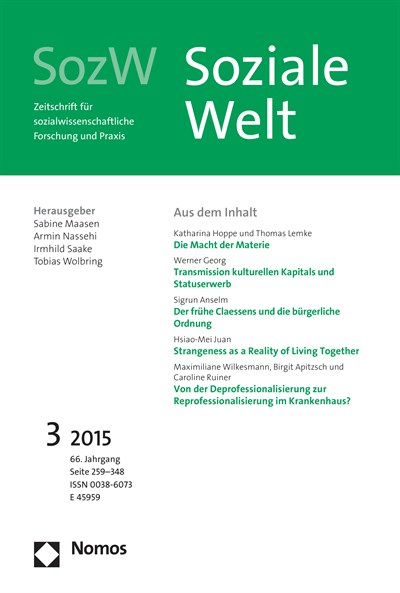
Cover der Ausgabe: SozW Soziale Welt Jahrgang 66 (2015), Heft 3
Artikel
Teilzugriff
Seite 259 - 260
Nomos Verlagsgesellschaft mbH & Co. KG, Baden-Baden 2015

Cover der Ausgabe: SozW Soziale Welt Jahrgang 66 (2015), Heft 3
Artikel
Vollzugriff

Seite 261 - 280
Im Mittelpunkt des Artikels steht die kritische Analyse der Arbeiten der wohl wirkmächtigsten und einflussreichsten Vertreterin des Neuen Materialismus: der Physikerin und Wissenschaftstheoretikern Karen Barad. Der von ihr konzipierte „agentielle...
Nomos Verlagsgesellschaft mbH & Co. KG, Baden-Baden 2015
Autor:innen:

Cover der Ausgabe: SozW Soziale Welt Jahrgang 66 (2015), Heft 3
Artikel
Vollzugriff

Seite 281 - 300
Ausgehend von der bourdieuschen Kapital- und Habitustheorie geht dieser Artikel der Frage nach, wie die kulturellen Ressourcen der Familie und der befragten ehemaligen Schüler sich im Alter zwischen 15 und 45 Jahren auf Statuserwerbsprozess...
Nomos Verlagsgesellschaft mbH & Co. KG, Baden-Baden 2015
Autor:innen:

Cover der Ausgabe: SozW Soziale Welt Jahrgang 66 (2015), Heft 3
Artikel
Vollzugriff

Seite 301 - 310
Dieter Claessens gehörte zu den ersten Soziologieprofessoren in der BRD, die nach dem Krieg studiert hatten. Nach Kriegserfahrung und Gefangenschaft beschäftigte ihn besonders in den ersten Jahren die Frage, welche Mechanismen die Gesellschaft...
Nomos Verlagsgesellschaft mbH & Co. KG, Baden-Baden 2015
Autor:innen:

Cover der Ausgabe: SozW Soziale Welt Jahrgang 66 (2015), Heft 3
Artikel
Vollzugriff

Seite 311 - 326
Nomos Verlagsgesellschaft mbH & Co. KG, Baden-Baden 2015
Autor:innen:

Cover der Ausgabe: SozW Soziale Welt Jahrgang 66 (2015), Heft 3
Artikel
Vollzugriff

Seite 327 - 346
Seit den 1990er Jahren lassen sich Ökonomisierungsprozesse im Gesundheitswesen beobachten. In diesem Zusammenhang hält das Prinzip der Effizienzsteigerung Einzug in die Organisation Krankenhaus und damit in den ärztlichen Handlungsbereich. Vor...
Nomos Verlagsgesellschaft mbH & Co. KG, Baden-Baden 2015
Autor:innen:

Cover der Ausgabe: SozW Soziale Welt Jahrgang 66 (2015), Heft 3
Artikel
Teilzugriff
Seite 347 - 348
Nomos Verlagsgesellschaft mbH & Co. KG, Baden-Baden 2015

Literaturverzeichnis (255 Einträge)

  1. Agamben, Giorgio (2008): Was ist ein Dispositiv?, Zürich – Berlin. Google Scholar öffnen doi.org/10.5771/0038-6073-2015-3-261
  2. Ahmed, Sara (2008): Open Forum Imaginary Prohibitions. Some Preliminary Remarks on the Founding Gestures of the ‚New Materialism‘, in: European Journal of Women’s Studies 15, S.23-39. Google Scholar öffnen doi.org/10.5771/0038-6073-2015-3-261
  3. Alaimo Stacy / Susan Hekman (2008)(Hrsg.): Material Feminisms, Bloomington / MN – Indianapolis / IN. Google Scholar öffnen doi.org/10.5771/0038-6073-2015-3-261
  4. Althusser, Louis ([1977]2010): Ideologie und ideologische Staatsapparate. Aufsätze zur marxistischen Theorie, Hamburg – Berlin. Google Scholar öffnen doi.org/10.5771/0038-6073-2015-3-261
  5. Appadurai, Arjun (1998): The Social Life of Things. Commodities in Cultural Perspectives, Cambridge. Google Scholar öffnen doi.org/10.5771/0038-6073-2015-3-261
  6. Aradau Claudia (2010): Security that Matters. Critical Infrastructure and Objects of Protection, in: Security Dialogue 41, S.491-514. Google Scholar öffnen doi.org/10.5771/0038-6073-2015-3-261
  7. Åsberg, Cecilia (2013): The Timely Ethics of Posthuman Gender Studies, in: Feministische Studien 13, S.7-12. Google Scholar öffnen doi.org/10.5771/0038-6073-2015-3-261
  8. Åsberg, Cecilia / Redi Koobak / Ericka Johnson (2011): Beyond the Humanist Imagination, in: NORA – Nordic Journal of Feminist and Gender Research 19, S.218-230. Google Scholar öffnen doi.org/10.5771/0038-6073-2015-3-261
  9. Barad, Karen (2003): Posthumanist Performativity. Toward an Understanding of How Matter Comes to Matter, in: Signs. Journal of Women in Culture and Society 28, S.801-831. Google Scholar öffnen doi.org/10.5771/0038-6073-2015-3-261
  10. Barad, Karen (2007): Meeting the Universe Halfway. Quantum Physics and the Entanglement of Matter and Meaning, Durham – London. Google Scholar öffnen doi.org/10.5771/0038-6073-2015-3-261
  11. Barad, Karen (2010): Quantum Entanglements and Hauntological Relations of Inheritance. Dis / continuities, SpaceTime Enfoldings, and Justice-to-Come, in: Derrida Today 3, S.240-268. Google Scholar öffnen doi.org/10.5771/0038-6073-2015-3-261
  12. Barad, Karen (2011): Erasers and Erasures. Pinch’s Unfortunate ‚Uncertainty Principle’, in: Social Studies of Science 41, S.443-454. Google Scholar öffnen doi.org/10.5771/0038-6073-2015-3-261
  13. Barad, Karen (2012a): Agentieller Realismus. Über die Bedeutung materiell-diskursiver Praktiken, Berlin. Google Scholar öffnen doi.org/10.5771/0038-6073-2015-3-261
  14. Barad, Karen (2012b): Intra-active Entanglements. An Interview with Karen Barad by Malou Juelskjær and Nete Schwennesen, in: Kvinder, Køn & Forskning / Women, Gender and Research 1-2, S.10-24. Google Scholar öffnen doi.org/10.5771/0038-6073-2015-3-261
  15. Barad, Karen (2012c): On Touching. The Inhuman That Therefor I am, in: differences. A Journal of Feminist Cultural Studies 23, S.206-223. Google Scholar öffnen doi.org/10.5771/0038-6073-2015-3-261
  16. Barad, Karen (2012d): Nature’s Queer Performativity, in: Kvinder, Køn & Forskning / Women, Gender and Research 1-2, S.25-53. Google Scholar öffnen doi.org/10.5771/0038-6073-2015-3-261
  17. Barad, Karen (2014): Diffracting Diffraction. Cutting Together-Apart, in: Parallax 20, S.168-187. Google Scholar öffnen doi.org/10.5771/0038-6073-2015-3-261
  18. Barla, Josef (2014): Apparate körperlicher Produktion und die Materialität der Figuration, in: Tobias Goll / Daniel Keil / Thomas Telios (Hrsg.), Critical Matter. Diskussionen eines neuen Materialismus, Berlin, S.148-164. Google Scholar öffnen doi.org/10.5771/0038-6073-2015-3-261
  19. Bath, Corinna / Hanna Meißner / Stephan Trinkaus / Susanne Völker (Hrsg.) (2013): Geschlechter Interferenzen. Wis-sensformen – Subjektivierungsweisen – Materialisierungen, Münster. Google Scholar öffnen doi.org/10.5771/0038-6073-2015-3-261
  20. Bennett, Jane (2004): The Force of Things. Steps Toward an Ecology of Matter, in: Political Theory 32, S.347-372. Google Scholar öffnen doi.org/10.5771/0038-6073-2015-3-261
  21. Bennett, Jane (2010): Vibrant Matter. A Political Ecology of Things, Durham – London. Google Scholar öffnen doi.org/10.5771/0038-6073-2015-3-261
  22. Blaser, Mario (2013): Ontological Conflicts and the Stories of Peoples in Spite of Europe. Toward a Conversation on Political Ontology, in: Current Anthropology 54, S.547-568. Google Scholar öffnen doi.org/10.5771/0038-6073-2015-3-261
  23. Bolt, Barbara / Estelle Barrett (Hrsg.)(2013): Carnal Knowledge. Towards a New Materialism Through the Arts, London. Google Scholar öffnen doi.org/10.5771/0038-6073-2015-3-261
  24. Bohr, Niels ([1958]1985): Atomphysik und Philosophie. Kausalität und Komplementarität, in: Ders., Atomphysik und menschliche Erkenntnis. Aufsätze und Vorträge aus den Jahren 1930 bis 1961, Braunschweig, S.104-110. Google Scholar öffnen doi.org/10.5771/0038-6073-2015-3-261
  25. Braun, Bruce / Sarah J. Whatmore (2010a) (Hrsg.): Political Matter. Technoscience, Democracy, and Public Life, Min-neapolis / MN – London. Google Scholar öffnen doi.org/10.5771/0038-6073-2015-3-261
  26. Braun, Bruce / Sarah J. Whatmore (2010b): The Stuff of Politics. An Introduction, in: Dies. (Hrsg.), Political Matter. Technoscience, Democracy, and Public Life, Minneapolis / MN – London, S.ix-xl. Google Scholar öffnen doi.org/10.5771/0038-6073-2015-3-261
  27. Bryant, Levi / Graham Harman / Nick Srnicek (Hrsg.) (2011): The Speculative Turn: Continental Materialism and Realism, Melbourne. Google Scholar öffnen doi.org/10.5771/0038-6073-2015-3-261
  28. Braidotti, Rosi (2002): Metamorphoses. Towards a Materialist Theory of Becoming, Cambridge. Google Scholar öffnen doi.org/10.5771/0038-6073-2015-3-261
  29. Braidotti, Rosi (2010): The Politics of,Life Itself‘ and New Ways of Dying, in: Diana Coole / Samantha Frost (Hrsg.), New Materialisms. Ontology, Agency, and Politics, Durham – London, S.1-43. Google Scholar öffnen doi.org/10.5771/0038-6073-2015-3-261
  30. Braidotti, Rosi (2013): The Posthuman, Cambridge. Google Scholar öffnen doi.org/10.5771/0038-6073-2015-3-261
  31. Bruining, Dennis (2013): A Somatechnics of Moralism: New Materialism or Material Foundationalism?, in: Somatechnics 3, S.149-168. Google Scholar öffnen doi.org/10.5771/0038-6073-2015-3-261
  32. Buddeberg, Eva (2012):,Du wirst nicht töten!‘ Lévinas’ Ethik der Verantwortung als erste Philosophie, in: Deutsche Zeitschrift für Philosophie 60, S.705-724. Google Scholar öffnen doi.org/10.5771/0038-6073-2015-3-261
  33. Butler, Judith (1992): Contingent Foundations. Feminism and the Question of Postmodernism, in: Dies. / Joan W. Scott (Hrsg.), Feminists Theorize the Political, London – New York / NY, S.3-21. Google Scholar öffnen doi.org/10.5771/0038-6073-2015-3-261
  34. Butler, Judith (1997): Körper von Gewicht. Die diskursiven Grenzen des Geschlechts, Frankfurt am Main. Google Scholar öffnen doi.org/10.5771/0038-6073-2015-3-261
  35. Colebrook, Claire (2008): On Non Becoming Man. The Materialist Politics of Unactualized Potential, in: Stacy Alaimo / Susan Hekman (Hrsg.), Material Feminisms, Bloomington / MN – Indianapolis / IN, S.52-84. Google Scholar öffnen doi.org/10.5771/0038-6073-2015-3-261
  36. Connolly, William E. (2013): The ‚New Materialism‘ and the Fragility of Things, in: Millenium: Journal of International Studies 41, S.399-412. Google Scholar öffnen doi.org/10.5771/0038-6073-2015-3-261
  37. Coole, Diana / Frost, Samantha (Hrsg.)(2010a): New Materialisms. Ontology, Agency, and Politics, Durham – London. Google Scholar öffnen doi.org/10.5771/0038-6073-2015-3-261
  38. Coole, Diana / Frost, Samantha (2010b): Introducing the New Materialisms, in: Dies. (Hrsg.), New Materialisms. Ontology, Agency, and Politics, Durham – London, S.1-43. Google Scholar öffnen doi.org/10.5771/0038-6073-2015-3-261
  39. Critchley, Simon (2008): Unendlich fordernd. Ethik der Verpflichtung, Politik des Widerstands, Zürich – Berlin. Google Scholar öffnen doi.org/10.5771/0038-6073-2015-3-261
  40. Deleuze, Gilles (1987): Foucault, Frankfurt / Main. Google Scholar öffnen doi.org/10.5771/0038-6073-2015-3-261
  41. Deleuze, Gilles / Felix Guattari (1992): Tausend Plateaus. Kapitalismus und Schizophrenie, Berlin. Google Scholar öffnen doi.org/10.5771/0038-6073-2015-3-261
  42. Dolphijn, Rick / Iris van der Tuin (Hrsg.) (2012): New Materialism. Interviews & Cartographies, Ann Arbor / MI. Google Scholar öffnen doi.org/10.5771/0038-6073-2015-3-261
  43. Fitsch, Hannah (2014): …dem Gehirn beim Denken zusehen? Sicht- und Sagbarkeiten in der funktionellen Magnetre-sonanztomographie, Bielefeld. Google Scholar öffnen doi.org/10.5771/0038-6073-2015-3-261
  44. Fitsch, Hannah / Lukas Engelmann (2013): Das Bild als Phänomen. Visuelle Argumentationsweisen und ihre Logiken am Beispiel von Sichtbarmachungen des ‚AIDS-Virus‘ und der funktionellen MRT, in: Peter Lucht / Lisa-Marian Schmidt / René Tuma (Hrsg.), Visuelles Wissen und Bilder des Sozialen. Aktuelle Entwicklungen in der Soziologie des Visuellen, Wiesbaden, S.213-230. Google Scholar öffnen doi.org/10.5771/0038-6073-2015-3-261
  45. Folkers, Andreas (2013): Was ist neu am neuen Materialismus? – Von der Praxis zum Ereignis, in: Tobias Goll / Daniel Keil / Thomas Telios (Hrsg.), Critical Matter. Diskussionen eines neuen Materialismus, Münster, S.17-34. Google Scholar öffnen doi.org/10.5771/0038-6073-2015-3-261
  46. Foucault, Michel ([1977]2003): Das Spiel des Michel Foucault, in: Ders., Dits et Ecrits, Schriften Dritter Band, Frankfurt / Main, S.391-429. Google Scholar öffnen doi.org/10.5771/0038-6073-2015-3-261
  47. Foucault, Michel (2004a): Geschichte der Gouvernementalität I. Sicherheit, Territorium, Bevölkerung, Frankfurt / Main. Google Scholar öffnen doi.org/10.5771/0038-6073-2015-3-261
  48. Foucault, Michel (2004b): Geschichte der Gouvernementalität II. Die Geburt der Biopolitik, Frankfurt / Main. Google Scholar öffnen doi.org/10.5771/0038-6073-2015-3-261
  49. Fuller, Matthew (2005): Media Ecologies. Materialist Energies in Art and Technoculture, Cambridge / MA. Google Scholar öffnen doi.org/10.5771/0038-6073-2015-3-261
  50. Garske, Pia (2014): What’s the ‚Matter‘? Der Materialitätsbegriff des ‚New Materialism‘ und dessen Konsequenzen für feministisch-politische Handlungsfähigkeit, in: PROKLA 174, S.111-129. Google Scholar öffnen doi.org/10.5771/0038-6073-2015-3-261
  51. Grosz, Elizabeth (2008): Darwin and Feminism. Preliminary Investigations for a Possible Alliance, in: Stacy Alaimo / Susan Hekman (Hrsg.), Material Feminisms, Bloomington – Indianapolis, S.23-51. Google Scholar öffnen doi.org/10.5771/0038-6073-2015-3-261
  52. Haraway, Donna J. (1995): Die Neuerfindung der Natur. Primaten, Cyborgs und Frauen, Frankfurt / Main – New York / NY. Google Scholar öffnen doi.org/10.5771/0038-6073-2015-3-261
  53. Haraway, Donna J. (1997): Modest_Witness@Second_Millenium. FemaleMan©_ Meets_Onco MouseTM. Feminism and Technoscience, New York / NY – London. Google Scholar öffnen doi.org/10.5771/0038-6073-2015-3-261
  54. Harding, Sandra (1994): Das Geschlecht des Wissens. Frauen denken die Wissenschaft neu, Frankfurt am Main – New York / NY. Google Scholar öffnen doi.org/10.5771/0038-6073-2015-3-261
  55. Hartsock, Nancy C. M. (1998): The Feminist Standpoint Revisited and Other Essays, Boulder / CO – Oxford. Google Scholar öffnen doi.org/10.5771/0038-6073-2015-3-261
  56. Harman, Graham (2011): On the Undermining of Objects. Grant, Bruno, and Radical Philosophy, in: Levi Byrant / Graham Harman / Nick Srnicek (Hrsg.), The Speculative Turn. Continental Materialism and Realism, Melbourne, S.21-40 Google Scholar öffnen doi.org/10.5771/0038-6073-2015-3-261
  57. Hekman, Susan (2008): Constructing the Ballast. An Ontology for Feminism, in: Stacy Alaimo / Dies. (Hrsg.), Material Feminisms, Bloomington / MN – Indianapolis / IN, S.85-119. Google Scholar öffnen doi.org/10.5771/0038-6073-2015-3-261
  58. Henare, Amiria / Martin Holbraad / Sari Wastell (Hrsg.) (2007): Thinking Through Things. Theorising Artefacts Eth-nographically, London – New York / NY. Google Scholar öffnen doi.org/10.5771/0038-6073-2015-3-261
  59. Hinton, Peta (2013): The Quantum Dance and the World’s ‚Extraordinary Liveliness‘: Refiguring Corporeal Ethics in Karen Barad’s Agential Realism, in: Somatechnics 3, S.169-189. Google Scholar öffnen doi.org/10.5771/0038-6073-2015-3-261
  60. Hinton, Peta (2014): ‚Situated Knowledges‘ and New Materialism(s). Rethinking a Politics of Location, in: Woman: A Cultural Review 25, Special Issue: Feminist Matters. The Politics of New Materialism, S.99-113. Google Scholar öffnen doi.org/10.5771/0038-6073-2015-3-261
  61. Hinton, Peta / Iris van der Tuin (2014): Preface, in: Woman: A Cultural Review 25, Special Issue: Feminist Matters. The Politics of New Materialism, S.1-8. Google Scholar öffnen doi.org/10.5771/0038-6073-2015-3-261
  62. Hird, Myra (2004): Feminist Matters. New Materialist Considerations of Sexual Difference, Feminist Theory 5, S.223-232. Google Scholar öffnen doi.org/10.5771/0038-6073-2015-3-261
  63. Hird, Myra (2009): Material Feminist Engagements, in: Feminist Studies 35, S.329-346. Google Scholar öffnen doi.org/10.5771/0038-6073-2015-3-261
  64. Højgaard, Lis / Dorte Marie Søndergaard (2011): Theorizing the complexities of discursive and material subjectivity: Agential realism and poststructural analyses, in: Theory & Psychology June 2011, S.338-354. Google Scholar öffnen doi.org/10.5771/0038-6073-2015-3-261
  65. Kerin, Jacinta (1999): The Matter at Hand. Butler, Ontology and the Natural Sciences, in: Australian Feminist Studies 14, S.91-104. Google Scholar öffnen doi.org/10.5771/0038-6073-2015-3-261
  66. Kirby, Vicki (2006): Judith Butler. Live Theory, London – New York / NY. Google Scholar öffnen doi.org/10.5771/0038-6073-2015-3-261
  67. Latour, Bruno / Peter Weibel (2005): Making Things Public. Atmospheres of Democracy, Cambridge / MA. Google Scholar öffnen doi.org/10.5771/0038-6073-2015-3-261
  68. Lemke, Thomas (2014): New Materialisms. Foucault and the Government of Things, in: Theory, Culture & Society 0263276413519340 (online first). Google Scholar öffnen doi.org/10.5771/0038-6073-2015-3-261
  69. Lévinas, Emmanuel ([1961]1987): Totalität und Unendlichkeit. Versuch über die Exteriorität, Freiburg – München. Google Scholar öffnen doi.org/10.5771/0038-6073-2015-3-261
  70. Luhmann, Niklas (1990): Die Wissenschaft der Gesellschaft, Frankfurt / Main. Google Scholar öffnen doi.org/10.5771/0038-6073-2015-3-261
  71. Luhmann, Niklas (2001): Erkenntnis als Konstruktion, in: Ders., Aufsätze und Reden, Stuttgart, S.218-242. Google Scholar öffnen doi.org/10.5771/0038-6073-2015-3-261
  72. Marchart, Oliver (2010): Die politische Differenz. Zum Denken des Politischen bei Nancy, Lefort, Badiou, Laclau und Agamben, Berlin. Google Scholar öffnen doi.org/10.5771/0038-6073-2015-3-261
  73. Marchart, Oliver (2013): Das unmögliche Objekt. Eine postfundamentalistische Theorie der Gesellschaft, Berlin. Google Scholar öffnen doi.org/10.5771/0038-6073-2015-3-261
  74. Meillassoux, Quentin (2008): Nach der Endlichkeit. Versuch über die Notwendigkeit der Kontingenz, Berlin – Zürich. Google Scholar öffnen doi.org/10.5771/0038-6073-2015-3-261
  75. Meißner, Hanna (2013): Feministische Gesellschaftskritik als onto-epistemologisches Projekt, in: Corinna Bath / Hanna Meißner / Stephan Trinkaus / Susanne Völker (Hrsg.), Geschlechter Interferenzen. Wissensformen – Subjektiv-ierungsweisen – Materialisierungen, Münster, S.163-208. Google Scholar öffnen doi.org/10.5771/0038-6073-2015-3-261
  76. Mol, Annemarie (1999): Ontological Politics. A Word and Some Questions, in: John Law / John Hassard (Hrsg.), Actor Network Theory and After, Oxford, S.74-89. Google Scholar öffnen doi.org/10.5771/0038-6073-2015-3-261
  77. Mol, Annemarie (2013): Mind your Plate! The Ontonorms of Dutch Dieting, in: Social Studies of Science 43, S.379-396. Google Scholar öffnen doi.org/10.5771/0038-6073-2015-3-261
  78. Pinch, Trevor (2011): Review Essay: Karen Barad, Quantum Mechanics, and the Paradox of Mutual Exclusivity, in: Socical Studies of Science 41, S.431-441. Google Scholar öffnen doi.org/10.5771/0038-6073-2015-3-261
  79. Reckwitz, Andreas (2003): Grundelemente einer Theorie sozialer Praktiken. Eine sozialtheoretische Perspektive, in: Zeitschrift für Soziologie 32, S.282-301. Google Scholar öffnen doi.org/10.5771/0038-6073-2015-3-261
  80. Reckwitz, Andreas (2008): Der Ort des Materiellen in den Kulturtheorien. Von sozialen Strukturen zu Artefakten, in: Ders., Unscharfe Grenzen. Perspektiven der Kultursoziologie, Bielefeld, S.131-156. Google Scholar öffnen doi.org/10.5771/0038-6073-2015-3-261
  81. Roßler, Gustav (2008): Kleine Galerie neuer Dingbegriffe. Hybriden, Quasi-Objekte, Grenzobjekte, epistemische Dinge, in: Georg Kneer / Markus Schroer / Erhard Schüttpelz (Hrsg.), Bruno Latours Kollektive. Kontroversen zu Entgrenzung des Sozialen, Frankfurt / Main, S.76-107. Google Scholar öffnen doi.org/10.5771/0038-6073-2015-3-261
  82. Rouse, Joseph (2002): How Scientific Practices Matter. Reclaiming Philosophical Naturalism, Chicago / IL – London. Google Scholar öffnen doi.org/10.5771/0038-6073-2015-3-261
  83. Rouse, Joseph (2004): Barad’s Feminist Naturalism, in: Hypatia 19, S.142-161. Google Scholar öffnen doi.org/10.5771/0038-6073-2015-3-261
  84. Saar, Martin (2007): Genealogie als Kritik. Geschichte und Theorie des Subjekts nach Nietzsche und Foucault, Frankfurt / Main – New York / NY. Google Scholar öffnen doi.org/10.5771/0038-6073-2015-3-261
  85. Schadler, Cornelia (2013): Vater, Mutter, Kind werden. Eine posthumanistische Ethnographie der Schwangerschaft, Bielefeld. Google Scholar öffnen doi.org/10.5771/0038-6073-2015-3-261
  86. Schwennesen, Nete / Lene Koch (2009): Visualizing and Calculating Life: Matters of Fact in the Context of Prenatal Risk Assessment, in: Susanne Bauer / Ayo Wahlberg (Hrsg.), Contested Categories. Life Science in Society, Farnham, S.69-87. Google Scholar öffnen doi.org/10.5771/0038-6073-2015-3-261
  87. van der Tuin, Iris (2011): ‚A Different Starting Point, a Different Metaphysics’. Reading Bergson and Barad Diffractively, in: Hypatia 26, S.22-42. Google Scholar öffnen doi.org/10.5771/0038-6073-2015-3-261
  88. van der Tuin, Iris (2014): Diffraction as a Methodology for Feminist Onto-Epistemology. On Encountering Chantal Chawaf and Posthuman Interpellation, in: Parallax 20, S.231-244. Google Scholar öffnen doi.org/10.5771/0038-6073-2015-3-261
  89. Vogelmann, Frieder (2011): Zur Archäologie der Praktiken. Eine Komplikation praxeologischer Foucault-Deutungen. XXII. Deutscher Kongress für Philosophie, 11.-15. September 2011, München, online verfügbar unter: http://epub.ub.uni-muenchen.de/12428/1/Vogelmann_Die_Archaeologie_der_Praktiken.pdf, letztes Abrufdatum: 30.8.2013. Google Scholar öffnen doi.org/10.5771/0038-6073-2015-3-261
  90. Wiley, Stephen (2005): Spatial Materialism. Grossberg’s Deleuzean Cultural Studies, in: Cultural Studies 19, S.63-99. Google Scholar öffnen doi.org/10.5771/0038-6073-2015-3-261
  91. Woolgar, Steve / Javier Lezaun (2013): The Wrong Bin Bag. A Turn to Ontology in Science and Technology Studies?, in: Social Studies of Science 43, S.321-340. Google Scholar öffnen doi.org/10.5771/0038-6073-2015-3-261
  92. Aschaffenburg, K. / Maas, I. (1997): Cultural and educational careers: The dynamics of social reproduction. American Sociological Review 62, S.573-587. Google Scholar öffnen doi.org/10.5771/0038-6073-2015-3-281
  93. Baumert, J. / Watermann, R. / Schümer, G. (2003): Disparitäten der Bildungsbeteiligung und des Kompetenzerwerbs. Ein institutionelles und individuelles Mediationsmodell. Zeitschrift für Erziehungswissenschaften 6, S.46-72. Google Scholar öffnen doi.org/10.5771/0038-6073-2015-3-281
  94. Boudon, R. (1974): Education, opportunity and social inequality. New York: Wiley. Google Scholar öffnen doi.org/10.5771/0038-6073-2015-3-281
  95. Becker, R. (2000): Klassenlage und Bildungsentscheidungen. Eine empirische Anwendung der Wert-Erwartungstheorie. Kölner Zeitschrift für Soziologie und Sozialpsychologie 53, S.450-475. Google Scholar öffnen doi.org/10.5771/0038-6073-2015-3-281
  96. Blau, P. M. / Duncan, O. D. (1967): The American occupational structure. New York: Wiley. Google Scholar öffnen doi.org/10.5771/0038-6073-2015-3-281
  97. Bourdieu, P. (1982): Die feinen Unterschiede. Kritik der gesellschaftlichen Urteilskraft. Frankfurt a.M.: Suhrkamp. Google Scholar öffnen doi.org/10.5771/0038-6073-2015-3-281
  98. Bourdieu, P. (1983): Ökonomisches Kapital, kulturelles Kapital und soziales Kapital. In: Kreckel, R. (Hrsg.): Soziale Ungleichheiten (Soziale Welt, Sonderband 2). Göttingen: Verlag Otto Schwartz, S.183-198. Google Scholar öffnen doi.org/10.5771/0038-6073-2015-3-281
  99. Bourdieu, P. / Passeron, J. C. (1971): Die Illusion der Chancengleichheit. Stuttgart: Klett. Google Scholar öffnen doi.org/10.5771/0038-6073-2015-3-281
  100. Breen, R. / Goldthorpe, J. (1997): Explaining educational differentials: towards a formal rational action theory. Rationality and Society 9, S.275-305. Google Scholar öffnen doi.org/10.5771/0038-6073-2015-3-281
  101. Coleman, J. (1988): Social capital in the creation of human capital. American Journal of Sociology 94, S.95-120. Google Scholar öffnen doi.org/10.5771/0038-6073-2015-3-281
  102. Covey, E. / Carbonaro, W. (2010): After the bell: Participation in extracurricular activities, classroom behavior, and academic achievement. Sociology of Education 83, S.20-45. Google Scholar öffnen doi.org/10.5771/0038-6073-2015-3-281
  103. De Graaf, P. M. (1986): The impact of financial and cultural resources on educational attainment in the Netherlands. Sociology of Education 59, S.237-246. Google Scholar öffnen doi.org/10.5771/0038-6073-2015-3-281
  104. De Graaf, N. D. / De Graaf P. M. / Kraaykamp, G. (2000): Parental cultural capital and educational attainment in the Netherlands: A refinement of the cultural capital perspective. Sociology of Education 73, S.91-111. Google Scholar öffnen doi.org/10.5771/0038-6073-2015-3-281
  105. Deutsches PISA-Konsortium (Hrsg.) (2001): PISA 2000. Basiskompetenzen von Schülerinnen und Schülern im internationalen Vergleich. Opladen: Leske und Budrich. Google Scholar öffnen doi.org/10.5771/0038-6073-2015-3-281
  106. Di Maggio, P. (1982): Cultural capital and school success: the impact of status culture participation on the grades of US highschool students. American Sociological Review 47, S.189-201. Google Scholar öffnen doi.org/10.5771/0038-6073-2015-3-281
  107. Di Maggio, P. / Mohr J. (1985): Cultural Capital, educational attainment and marital status. American Journal of Sociology 90, S.1231-1257. Google Scholar öffnen doi.org/10.5771/0038-6073-2015-3-281
  108. Downey, D. B. (1995): When bigger is not better: Family size, parental resources and children’s educational performance. American Sociological Review 60, S.746-761. Google Scholar öffnen doi.org/10.5771/0038-6073-2015-3-281
  109. Dumais, S.A. (2002): Cultural capital, gender and school success: The role of habitus. Sociology of Education 75, S.44-68. Google Scholar öffnen doi.org/10.5771/0038-6073-2015-3-281
  110. Eitle, P. M. / Eitle; D. J. (2002): Race, cultural capital and the educational effects of participation in sports. Sociology of Education 75, S.123-146. Google Scholar öffnen doi.org/10.5771/0038-6073-2015-3-281
  111. Fend, H. (1990): Vom Kind zum Jugendlichen. Der Übergang und seine Risiken. Entwicklungspsychologie der Adoleszens in der Moderne. Band 1. Huber: Bern, Stuttgart, Toronto . Google Scholar öffnen doi.org/10.5771/0038-6073-2015-3-281
  112. Ganzeboom, H. B. G. / De Graaf, P. M. / Treiman, D. J. / de Leeuw, J. (1992): A standard international socio-economic index of occupational status. Social Science Research 21, S.1-56. Google Scholar öffnen doi.org/10.5771/0038-6073-2015-3-281
  113. Georg, W. (1998): Soziale Lage und Lebensstil. Eine Typologie. Opladen: Leske und Budrich. Google Scholar öffnen doi.org/10.5771/0038-6073-2015-3-281
  114. Georg, W. (2005): Die Reproduktion sozialer Ungleichheit im Lebenslauf. Zeitschrift für Soziologie der Erziehung und Sozialisation 25, S.178-197. Google Scholar öffnen doi.org/10.5771/0038-6073-2015-3-281
  115. Hille, A. / Schupp, J. (2013): How learning a musical instrument affects the development of skills. SOEPpapers 591, S.1-33. Google Scholar öffnen doi.org/10.5771/0038-6073-2015-3-281
  116. Hu, L. T. / Bentler, P. M. (1999): Cutoff criteria for fit indices in covariance structure analysis: conventional criteria versus new alternatives. Structural Equation Modeling 6, S.1-55. Google Scholar öffnen doi.org/10.5771/0038-6073-2015-3-281
  117. Jaeger, M. M. (2011): Does cultural capital really affect academic achievement? New evidence from combined sibling and panel data. Sociology of Education 84, S.281-298. Google Scholar öffnen doi.org/10.5771/0038-6073-2015-3-281
  118. Jaeger, M. M. / Holm A. (2007): Does parent’s economic, cultural and social capital explain the social class effect on educational attainment in the Scandinavian mobility regime? Social Science Research 36, S.719-744. Google Scholar öffnen doi.org/10.5771/0038-6073-2015-3-281
  119. Kalmijn, M. / Kraaykamp G. (1996): Race, cultural capital and schooling: An analysis of trends in the United States. Sociology of Education 69, S.22-34. Google Scholar öffnen doi.org/10.5771/0038-6073-2015-3-281
  120. Katsilis, J. / Robinson, R. (1990): Cultural capital, student achievement and educational reproduction: The case of Greece. American Sociological Review 55, S.270-279. Google Scholar öffnen doi.org/10.5771/0038-6073-2015-3-281
  121. Kaufmann, J. / Gabler, J. (2004): Cultural capital and extracurricular activities of girls and boys in the college attainment process. Poetics 32, S.145-168. Google Scholar öffnen doi.org/10.5771/0038-6073-2015-3-281
  122. Kloostermann, R. / Notten, N. / Tolsma, J. / Kraaykamp, G. (2011): The effect of parental reading socialization and early school involvement on children’s academic performance: A panel study of primary school pupils in the Netherlands. European Sociological Review 27, S.291-306. Google Scholar öffnen doi.org/10.5771/0038-6073-2015-3-281
  123. Lareau, L. / Weininger E. B. (2003): Cultural capital in educational research: A critical assessment. Theory and Society 32, S.568-606. Google Scholar öffnen doi.org/10.5771/0038-6073-2015-3-281
  124. Lauterbach, W. / Fend, H. / Gläßer, J. (2015): LifE – Lebensverläufe ins fortgeschrittene Erwachsenenalter. Die Studie. http://www.uni-potsdam.de/life-studie/index.php?id=38. Zugriff: 10.11.2015 Google Scholar öffnen doi.org/10.5771/0038-6073-2015-3-281
  125. Meulemann, H. / Wiese, W. (1984): Bildungsexpansion und Bildungschancen. Zeitschrift für Sozialisationsforschung und Erziehungssoziologie 4, S.287-306. Google Scholar öffnen doi.org/10.5771/0038-6073-2015-3-281
  126. Muthen, B. O. (1998-2004): Mplus technical appendices. Los Angeles, CA: Muthen / Muthen. Google Scholar öffnen doi.org/10.5771/0038-6073-2015-3-281
  127. Muthén, L.K. and Muthén, B.O. (1998-2012): Mplus User’s Guide. Seventh Edition. Google Scholar öffnen doi.org/10.5771/0038-6073-2015-3-281
  128. Los Angeles, CA: Muthén / Muthén. Google Scholar öffnen doi.org/10.5771/0038-6073-2015-3-281
  129. Nagel, I. (2010): Cultural participation between the ages of 14 and 24: Intergenerational transmission or cultural mobility. European Sociological Review 26, S.541-556. Google Scholar öffnen doi.org/10.5771/0038-6073-2015-3-281
  130. Schulze, G. (1992): Die Erlebnisgesellschaft. Kultursoziologie der Gegenwart. Frankfurt a.M.: Campus. Google Scholar öffnen doi.org/10.5771/0038-6073-2015-3-281
  131. Sullivan, A. (2001): Cultural capital and educational attainment. Sociology 35, S.893-912. Google Scholar öffnen doi.org/10.5771/0038-6073-2015-3-281
  132. Teachman, J. D. (1987): Family background, educational resources and educational attainment. American Sociological Review 52, S.548-557. Google Scholar öffnen doi.org/10.5771/0038-6073-2015-3-281
  133. Van de Werfhorst, H. G. / Hofstede, S. (2007): Cultural capital and relative risk aversion? Two mechanisms for educational inequality compared. British Journal of Sociology 58, S.391-415. Google Scholar öffnen doi.org/10.5771/0038-6073-2015-3-281
  134. Weber, M. (1976): Wirtschaft und Gesellschaft. Grundriss der verstehenden Soziologie. Tübingen: Mohr. Google Scholar öffnen doi.org/10.5771/0038-6073-2015-3-281
  135. Yaish, M. / Katz-Gerro, T. (2010): Disentangling ´cultural capital´: The consequences of cultural and economic resources for taste and participation. European Sociological Review 26, S.1-17. Google Scholar öffnen doi.org/10.5771/0038-6073-2015-3-281
  136. Yu, C.-Y. / Muthen, B. (2002): Evaluation of model fit indices for latent variable models with categorical and continuous outcomes. Technical Report. Los Angeles, CA: Muthen / Muthen. Google Scholar öffnen doi.org/10.5771/0038-6073-2015-3-281
  137. Budde, Gunilla / Eckhart Conze / Cornelia Rauh (2010): Bürgertum nach dem bürgerlichen Zeitalter. Leitbilder und Praxis seit 1945, Göttingen. Google Scholar öffnen doi.org/10.5771/0038-6073-2015-3-301
  138. Claessens, Dieter (1965): Status als entwicklungssoziologischer Begriff., Dortmund (Berlin: Dissertation von 1956). Google Scholar öffnen doi.org/10.5771/0038-6073-2015-3-301
  139. Claessens, Dieter (1968): Grundfragen der Soziologie, Band 6: Rolle und Macht, Weinheim – München. Google Scholar öffnen doi.org/10.5771/0038-6073-2015-3-301
  140. Claessens, Dieter (1989): Heraustreten aus der Masse, in: Ästhetik&Kommunikation 70/71 / 18, S.97-106. Google Scholar öffnen doi.org/10.5771/0038-6073-2015-3-301
  141. Claessens, Dieter (1993): Das Konkrete und das Abstrakte. Soziologische Skizzen zur Anthropologie, Frankfurt / Main. Google Scholar öffnen doi.org/10.5771/0038-6073-2015-3-301
  142. Claessens, Dieter / Karin Claessens (1979): Kapitalismus als Kultur. Entstehung und Grundlagen der bürgerlichen Ge-sellschaft, Frankfurt / Main. Google Scholar öffnen doi.org/10.5771/0038-6073-2015-3-301
  143. Hacke, Jens (2006): Philosophie der Bürgerlichkeit. Die liberalkonservative Begründung der Bundesrepublik, Göttingen. Google Scholar öffnen doi.org/10.5771/0038-6073-2015-3-301
  144. Nolte, Paul (2009): Religion und Bürgergesellschaft. Brauchen wir einen religionsfreundlichen Staat?, Berlin. Google Scholar öffnen doi.org/10.5771/0038-6073-2015-3-301
  145. Schelsky, Helmut (1955): Wandlungen der deutschen Familie in der Gegenwart, Stuttgart. Google Scholar öffnen doi.org/10.5771/0038-6073-2015-3-301
  146. Anderson, B. (1991): Imagined Communities: Reflections on the Origin and Spread of Nationalism, London, New York / NY. Google Scholar öffnen doi.org/10.5771/0038-6073-2015-3-311
  147. Beck-Gernsheim, E. (2007): Transnational Lives, Transnational Marriages: A Review of the Evidence from Migrant Communoities in Europe, in: Global Networks 7 / 3, p.271-288. Google Scholar öffnen doi.org/10.5771/0038-6073-2015-3-311
  148. Beck, U. / E. Beck-Gernsheim (2002): Individualization. London, Thousand Oaks / CA – New Delhi. Google Scholar öffnen doi.org/10.5771/0038-6073-2015-3-311
  149. Breger, R. / R. Hill (1998): Introducing Mixed Marriages, in: R. Breger / R. Hill (Eds.), Cross-Cultural Marriage, New York / NY, p.1-31. Google Scholar öffnen doi.org/10.5771/0038-6073-2015-3-311
  150. Butler, J. (1993): Bodies that matter: on the discursive limits of „sex“, New York / NY. Google Scholar öffnen doi.org/10.5771/0038-6073-2015-3-311
  151. Butler, J. (2001): Giving an Account of Oneself, in: Diacritics 31 / 4, p.22-40. Google Scholar öffnen doi.org/10.5771/0038-6073-2015-3-311
  152. Chen, C. J. / T. Yu (2005): Public Attitudes toward Taiwan's Immigration Polices, in: Taiwanese Sociology 10, p.95-148. Google Scholar öffnen doi.org/10.5771/0038-6073-2015-3-311
  153. Chiou, S.(2003): Gender and Immigration: Asia Brides in Japan and Taiwan, Taipei. Google Scholar öffnen doi.org/10.5771/0038-6073-2015-3-311
  154. Constable, N. (2003): Romance on a global stage: pen pals, virtual ethnograhpy, and „mail-order marriages“, Los Angeles / CA. Google Scholar öffnen doi.org/10.5771/0038-6073-2015-3-311
  155. Finkelstein, J. (2007): The Art of Self Invention. Imaged and Identity in Popular Visual Culture, London – New York / NY. Google Scholar öffnen doi.org/10.5771/0038-6073-2015-3-311
  156. Fung, H. / C. Liang (2008): Vietnamese mothers, Taiwanese children: Socializing practices with young children in Sino-Vietnamese cross-border marriage families in Taipei, Taiwan, in: Taiwan Journal of Anthropology 6 / 2, p.47-88. Google Scholar öffnen doi.org/10.5771/0038-6073-2015-3-311
  157. Goffman, E. (1963): Behavior in Public Places. Notes on the Social Organization of Gatherings, New York / NY. Google Scholar öffnen doi.org/10.5771/0038-6073-2015-3-311
  158. Hall, S. (1996): Who Needs „Identity“?, in: S. Hall / P. du Gay (Eds.), Questions of cultural identity, London – Thousands Oaks / CA – New Delhi, p.1-17. Google Scholar öffnen doi.org/10.5771/0038-6073-2015-3-311
  159. Hsia, H.-C. (2002): Diaspora and Settlement: The Phenomenon of „Foreign Brides“ in the globalization of captialism, Taipei. Google Scholar öffnen doi.org/10.5771/0038-6073-2015-3-311
  160. Hsia, H.-C. (2005): Searching for Light: A hard Way from language course to Executive Yuan, in: H. Hsiao-Chuan (Ed.), Do not call me a foreign bride any more, Taipei, p.12-48. Google Scholar öffnen doi.org/10.5771/0038-6073-2015-3-311
  161. Hussein, S. / J. Manthorpe (2007): Women from the Middle East and North Africa in Europe: Understanding Their Marriage and Family Dynamics, in: European Journal of Social Work 10 / 4, p.465-480. Google Scholar öffnen doi.org/10.5771/0038-6073-2015-3-311
  162. Ito, R. (2005): Crafting Migrant Women’s Citizenship in Japan: Taking „Familiy as a Vantage Point“, in: International Journal of Japanese Sociology 14, p.52-69. Google Scholar öffnen doi.org/10.5771/0038-6073-2015-3-311
  163. Lan, P.-C. (2008a): Global Cinderellas, Taipei. Google Scholar öffnen doi.org/10.5771/0038-6073-2015-3-311
  164. Lan, P.-C. (2008b): Migrant Women’s Bodies as Boundary Markers: Reproductive Crisis and Sexual Control in the Ethnic Frontiers of Taiwan. Sings, in: Journal in Women in Culture and Society 33 / 4, p.833-861. Google Scholar öffnen doi.org/10.5771/0038-6073-2015-3-311
  165. Lauser, A. (2008): Philippine Women on the Move: Marriage across Borders, in: International Migration 46 / 4, p.85-110. Google Scholar öffnen doi.org/10.5771/0038-6073-2015-3-311
  166. Lievens, J. (1999): Family-Forming Migration from Turkey and Morocco to Belgium: The Demand for Marriage Partners from the Countries of Origin, in: International Migration Review 33, p.717-744. Google Scholar öffnen doi.org/10.5771/0038-6073-2015-3-311
  167. Lin, H.-M. (2006.04.01): Lau Ben-Yen: the government should inspect remaining chemical toxins of Vietnamese brides, in: United daily news A3 / Focus. Google Scholar öffnen doi.org/10.5771/0038-6073-2015-3-311
  168. Luhmann, N. (1989): Individuum, Individualität, Individualismus Gesellschaftsstruktur und Semantik. Studien zur Wis-senssoziologie der modernen Gesellschaft, Band 3, Frankfurt / Main, p.149-258. Google Scholar öffnen doi.org/10.5771/0038-6073-2015-3-311
  169. Meijer, I.C / B. Prins (1998): How Bodies Come to Matter: An Interview with Judith Butler, in: Signs: Journal in Women in Culture and Society 23 / 2, p.275-286. Google Scholar öffnen doi.org/10.5771/0038-6073-2015-3-311
  170. Ministry of the Interior. (2013). General Fertility Rate, Age-Specific Fertility Rate and Total Fertility Rate Per Thousand Childbearing Age Women by Education Attainment. from http://www.ris.gov.tw/en/web/ris3-english/end-of-year http://www.ris.gov.tw/en/web/ris3-english/end-of-year Google Scholar öffnen doi.org/10.5771/0038-6073-2015-3-311
  171. Ministry of the Interior. (2015a). 2014 Marriage Registration: http://sowf.moi.gov.tw/stat/week/list.htm. Google Scholar öffnen doi.org/10.5771/0038-6073-2015-3-311
  172. Ministry of the Interior. (2015c). 出生按生母原屬國籍: http://www.ris.gov.tw/zh_TW/346. Google Scholar öffnen doi.org/10.5771/0038-6073-2015-3-311
  173. Ministry of the Interior. (2015e). 縣市外裔、外籍與大陸配偶人數: http://www.ris.gov.tw/zh_TW/346. Google Scholar öffnen doi.org/10.5771/0038-6073-2015-3-311
  174. Nassehi, A. (1997): Inklusion, Exklusion – Integration, Desintegration, in: W. Heitmeyer (Ed.), Bundesrepublik Deutschland: Auf dem Weg von der Konsens- zur Konfliktgesellschaft, Band 2, Frankfurt / Main, p.113-148. Google Scholar öffnen doi.org/10.5771/0038-6073-2015-3-311
  175. Parsons, T. (1964): Full Citizenship for the Negro American? Politics and Social Structure, New York / NY. Google Scholar öffnen doi.org/10.5771/0038-6073-2015-3-311
  176. Spivak, G.C. (1990): The Post-colonial Critic: Interviews, Strategies, Dialogues, London. Google Scholar öffnen doi.org/10.5771/0038-6073-2015-3-311
  177. Stichweh, R. (2004): Strangers in World Society – Indifference and Minimal Sympathy, in: S. Iglhaut (Ed.), Science + Fiction: Between Nanoworlds and Global Culture, Berlin, p.111-123. Google Scholar öffnen doi.org/10.5771/0038-6073-2015-3-311
  178. Stichweh, R. (2009): Leitgesichtspunkte einer Soziologie der Inklusion und Exklusion, in: R. Stichweh / P. Windolf (Eds.), Inklusion und Exklusion: Analysen zur Sozialstruktur und sozialen Ungleichheit, Wiesbaden, p.29-42. Google Scholar öffnen doi.org/10.5771/0038-6073-2015-3-311
  179. Suzuki, N. (2005): Tripartite Desires: Filipina-Japanese Marriages and Fantasies of Transnational Travel, in: N. Constable (Ed.), Cross-Border Marriages: Gender and Mobility in Transnaitonal Asia, Philadelphia / PA, p.269-280. Google Scholar öffnen doi.org/10.5771/0038-6073-2015-3-311
  180. Tsay, C. (2004): Marriage Migration of Women from China and Southeast Asia to Taiwan, in: G. Jones / K. Ramdas (Eds.), (Un)Tying the Knot: Ideal and Reality in Asian Marriage, Singapore. Google Scholar öffnen doi.org/10.5771/0038-6073-2015-3-311
  181. Villa, P.-I. (2011): Symbolische Gewalt und ihr potenzielles Scheitern. Eine Annäherung zwischen Butler and Bourdieu, in: Österreichische Zeitschrift für Soziologie 36, p.51-69. Google Scholar öffnen doi.org/10.5771/0038-6073-2015-3-311
  182. Wang, H.-Z. (2007): Hidden Spaces of Resistance of the Subordinated: Case Studies from Vietnamese Female Migrant Partners in Taiwan, in: International Migration Review 41, p.706-727. Google Scholar öffnen doi.org/10.5771/0038-6073-2015-3-311
  183. Wang, H.-Z. / H.-H.M. Hsiao (2009): Gender, Family and State in East Asian Cross-Border Marriages, in: H.-Z. Wang / H.-H. M. Hsiao (Eds.), Cross-Border Marriages with Asian Charachteristics, Taipei, p.1-12. Google Scholar öffnen doi.org/10.5771/0038-6073-2015-3-311
  184. Wang, H.-Z. / C.-Y. Tien (2009): Who Marries Vietnamese Bride? Masculinities and Cross-Border Marriages, in: H.-Z. Wang / H.-H. M. Hsiao (Eds.), Cross-Border Marriages with Asian Charachteristics, Taipei, p.13-37. Google Scholar öffnen doi.org/10.5771/0038-6073-2015-3-311
  185. Williams, L. (2010): Global Marriage. Cross-Broder Marriage Migration in Global Context, London. Google Scholar öffnen doi.org/10.5771/0038-6073-2015-3-311
  186. Abbott, A. (1988): The System of Professions. An Essay on the Division of Expert Labor, Chicago / IL. Google Scholar öffnen doi.org/10.5771/0038-6073-2015-3-327
  187. Annandale, E. (1989): Proletarianization or Restratification of the Medical Profession? The Case of Obstetrics, in: In-ternational Journal of Health Services 19, S.611-634. Google Scholar öffnen doi.org/10.5771/0038-6073-2015-3-327
  188. Bär, S. (2011): Das Krankenhaus zwischen ökonomischer und medizinischer Vernunft. Krankenhausmanager und ihre Konzepte, Wiesbaden. Google Scholar öffnen doi.org/10.5771/0038-6073-2015-3-327
  189. Baron, J.N. / W.T. Bielby (1980): Bringing the Firms Back in: Stratification, Segmentation and the Organisation of Work, in: American Sociological Review 45, S.737-765. Google Scholar öffnen doi.org/10.5771/0038-6073-2015-3-327
  190. Betzelt, S. / K. Gottschall (2007): Jenseits von Profession und Geschlecht? Erwerbsmuster in Kulturberufen, in: R. Gildemeister / A. Wetterer (Hrsg.), Erosion oder Reproduktion geschlechtlicher Differenzierungen?, Münster, S.122-144. Google Scholar öffnen doi.org/10.5771/0038-6073-2015-3-327
  191. Bode, I. (2010): Die Malaise der Krankenhäuser, in: Leviathan 38, S.189-211. Google Scholar öffnen doi.org/10.5771/0038-6073-2015-3-327
  192. Bode, I. / M. Märker (2012): Wettbewerb mit Vorbehalten. Vielfalt und Ambivalenz in der neuen Marktkultur des Krankenhauswesens, in: Soziale Welt 63, S.253-271. Google Scholar öffnen doi.org/10.5771/0038-6073-2015-3-327
  193. Borgetto, B. / L. Kälble (2007): Medizinsoziologie – Sozialer Wandel, Krankheit, Gesundheit und das Gesundheitssystem, Weinheim. Google Scholar öffnen doi.org/10.5771/0038-6073-2015-3-327
  194. Bortz, J. / N. Döring (2013): Forschungsmethoden und Evaluation für Sozialwissenschaftler, Heidelberg. Google Scholar öffnen doi.org/10.5771/0038-6073-2015-3-327
  195. Braun, B. / P. Buhr / S. Klinke / R. Müller / R. Rosenbrock (2010): Pauschalpatienten, Kurzlieger und Draufzahler – Auswirkungen der DRGs auf Versorgungsqualität und Arbeitsbedingungen im Krankenhaus, Krankenhausmanagement, Bern. Google Scholar öffnen doi.org/10.5771/0038-6073-2015-3-327
  196. Carr-Saunders, A.M. (1955): Metropolitan Conditions and Traditional Professional Relationships, in: R.M. Fisher (Hrsg.), The Metropolis in Modern Life, New York / NY, S.279-288. Google Scholar öffnen doi.org/10.5771/0038-6073-2015-3-327
  197. Daheim, H. (1992): Zum Stand der Professionssoziologie: Rekonstruktion machttheoretischer Modelle der Profession, in: B. Dewe / W. Ferchhoff / F.-O. Radke (Hrsg.), Erziehen als Profession zur Logik professionellen Handelns in päda-gogischen Feldern, Opladen, S.21-35. Google Scholar öffnen doi.org/10.5771/0038-6073-2015-3-327
  198. Demszky von der Hagen, A. / G.G. Voß (2010): Beruf und Profession, in: F. Böhle / G.G. Voß / G. Wachtler (Hrsg.), Handbuch Arbeitssoziologie, Wiesbaden, S.751-805. Google Scholar öffnen doi.org/10.5771/0038-6073-2015-3-327
  199. Ernst, C. / A. Szczesny (2005): Cost Accounting Implications of Surgical Learning in the DRG Era – Data Evidence from a German Hospital, in: Schmalenbach Business Review 57, S.127-166. Google Scholar öffnen doi.org/10.5771/0038-6073-2015-3-327
  200. Evetts, J. (2006): Introduction: Trust and Professionalism: Challenges and Occupational Changes, in: Current Sociology 54, S.515-531. Google Scholar öffnen doi.org/10.5771/0038-6073-2015-3-327
  201. Ferlie, E. / L. Ashburner / L. Fitzgerald / A. Pettigrew (1996): The New Public Management in Action, Oxford. Google Scholar öffnen doi.org/10.5771/0038-6073-2015-3-327
  202. Freidson, E. (1994): Professionalism Reborn: Theory, Prophecy and Policy, Chicago / IL. Google Scholar öffnen doi.org/10.5771/0038-6073-2015-3-327
  203. Freidson, E. (2001): Professionalism, the Third Logic. On the Practice of Knowledge, Chicago / IL. Google Scholar öffnen doi.org/10.5771/0038-6073-2015-3-327
  204. Gerlinger, T. (2014): Gesundheitsreform in Deutschland, in: A. Manzei / R. Schmiede (Hrsg.), 20 Jahre Wettbewerb im Gesundheitswesen. Theoretische und empirische Analysen zur Ökonomisierung von Medizin und Pflege, Wiesbaden, S.35-69. Google Scholar öffnen doi.org/10.5771/0038-6073-2015-3-327
  205. Goode, W. J. (1957): Community within the Community: The Professions, in: American Sociological Review 22, S.194-200. Google Scholar öffnen doi.org/10.5771/0038-6073-2015-3-327
  206. Greef, S. (2012): Die Transformation des Marburger Bundes, Wiesbaden. Google Scholar öffnen doi.org/10.5771/0038-6073-2015-3-327
  207. Greenwood, E. (1957): Attributes of a Profession, in: Social Work 2, S.45-55. Google Scholar öffnen doi.org/10.5771/0038-6073-2015-3-327
  208. Henninger, A. / K. Gottschall (2007): Freelancers in the German New Media Industry: Beyond Standard Patterns of Work and Life, in: K. Gottschall / H. Wolf (Hrsg.), Work Unbound? Patterns of Work and Organization in German Media and Cultural Industries, Critical Sociology 33, S.43-72. Google Scholar öffnen doi.org/10.5771/0038-6073-2015-3-327
  209. Hesse, H.A. (1972): Berufe im Wandel. Ein Beitrag zur Soziologie des Berufs, der Berufspolitik und des Berufsrechts, Stuttgart. Google Scholar öffnen doi.org/10.5771/0038-6073-2015-3-327
  210. Hughes, E.C. (1971): The Sociological Eye: Selected Papers, Chicago / IL. Google Scholar öffnen doi.org/10.5771/0038-6073-2015-3-327
  211. Iseringhausen, O. / J. Staender (2012): Das Krankenhaus als Organisation, in: M. Apelt / V. Tacke (Hrsg.), Handbuch Organisationstypen, Wiesbaden, S.185-203. Google Scholar öffnen doi.org/10.5771/0038-6073-2015-3-327
  212. Johnson, T.J. (1972): Professions and Power, Basingstoke. Google Scholar öffnen doi.org/10.5771/0038-6073-2015-3-327
  213. Keller, B. / M. Wilkesmann (2014): Untypisch atypisch Beschäftigte. Honorarärzte zwischen Befristung, Leiharbeit und (Solo-)Selbstständigkeit, in: Industrielle Beziehungen 21, S.99-125. Google Scholar öffnen doi.org/10.5771/0038-6073-2015-3-327
  214. Klegon, D. (1978): The Sociology of Professions: An Emerging Perspective, in: Work and Occupations 5, S.259-283. Google Scholar öffnen doi.org/10.5771/0038-6073-2015-3-327
  215. Köhler, C. / O. Struck / M. Grotheer / A. Krause / I. Krause / T. Schröder (2008): Offene und geschlossene Beschäfti-gungssysteme. Determinanten, Risiken und Nebenwirkungen, Wiesbaden. Google Scholar öffnen doi.org/10.5771/0038-6073-2015-3-327
  216. Larson, M.S. (1977): The Rise of Professionalism, Berkeley / CA. Google Scholar öffnen doi.org/10.5771/0038-6073-2015-3-327
  217. Lüngen, M. / K.W. Lauterbach (2002): Wandel der Krankenhausfinanzierung, in: Betriebswirtschaftliche Forschung und Praxis 54, S.419-431. Google Scholar öffnen doi.org/10.5771/0038-6073-2015-3-327
  218. Manske, A. (2007): Prekarisierung auf hohem Niveau: Eine Feldstudie über Alleinunternehmer in der IT-Branche, München – Mering. Google Scholar öffnen doi.org/10.5771/0038-6073-2015-3-327
  219. Manzei, A. (2014): Über die neue Unmittelbarkeit des Marktes im Gesundheitswesen, in: A. Manzei / R. Schmiede (Hrsg.), 20 Jahre Wettbewerb im Gesundheitswesen. Theoretische und empirische Analysen zur Ökonomisierung von Medizin und Pflege, Wiesbaden, S.219-239. Google Scholar öffnen doi.org/10.5771/0038-6073-2015-3-327
  220. Mayring, P. (2010): Qualitative Inhaltsanalyse: Grundlagen und Techniken, Weinheim. Google Scholar öffnen doi.org/10.5771/0038-6073-2015-3-327
  221. McLaughlin, K. / S.P. Osborne / E. Ferlie (Hrsg.) (2001): New Public Management: Current Trends and Future Prospects, New York / NY. Google Scholar öffnen doi.org/10.5771/0038-6073-2015-3-327
  222. Medjedović, I. / A. Witzel (2010): Wiederverwendung qualitativer Daten. Archivierung und Sekundärnutzung qualitati-ver Interviewtranskripte, Wiesbaden. Google Scholar öffnen doi.org/10.5771/0038-6073-2015-3-327
  223. Nagel, E. / B. Kunze (2009): Die Auswirkungen der DRG-Einführung auf Berufsethos, Arbeitsbedingungen und Ver-sorgungsprozesse in Krankenhäusern – Case Management als Lösungsstrategie?, in: F.W. Schwartz / P. Angerer (Hrsg.), Arbeitsbedingungen und Befinden von Ärztinnen und Ärzten. Befunde und Interventionen, Köln, S.263-270. Google Scholar öffnen doi.org/10.5771/0038-6073-2015-3-327
  224. Noordegraaf, M. (2006): Professional Management of Professionals. Hybrid Organisations and Professional Management in Care and Welfare, in: J.W. Duyvendak / T. Knijn / M. Kremer (Hrsg.), Policy, People, and the New Professional. De-professionalisation and Re-professionalisation in Care and Welfare, Amsterdam, S.181-193. Google Scholar öffnen doi.org/10.5771/0038-6073-2015-3-327
  225. Noordegraaf, M. (2013): Reconfiguring Professional Work: Changing Forms of Professionalism in Public Services, in: Administration & Society. Google Scholar öffnen doi.org/10.5771/0038-6073-2015-3-327
  226. Oevermann, U. (2000): Dienstleistung der Sozialbürokratie aus professionalisierungstheoretischer Sicht, in: E.-M. v. Harrach / T. Loer / O. Schmidtke / U. Oevermann / T. Ley (Hrsg.), Verwaltung des Sozialen: Formen der subjektiven Bewältigung eines Strukturkonflikts, Konstanz, S.57-77. Google Scholar öffnen doi.org/10.5771/0038-6073-2015-3-327
  227. Parsons, T. (1951): Struktur und Funktion der modernen Medizin. Eine soziologische Analyse, in: R. König / M. Tön-nesmann (Hrsg.), Probleme der Medizin-Soziologie: Sonderheft Nr. 3 der Kölner Zeitschrift für Soziologie und Sozial-psychologie, S.10-57. Google Scholar öffnen doi.org/10.5771/0038-6073-2015-3-327
  228. Pfadenhauer, M. / T. Sander (2010): Professionssoziologie, in: G. Kneer / M. Schroer (Hrsg.), Handbuch Spezielle Soziologien, Wiesbaden, S.361-378. Google Scholar öffnen doi.org/10.5771/0038-6073-2015-3-327
  229. Reich, A. (2012): Disciplined Doctors: The Electronic Medical Record and Physicians’ Changing Relationship to Medical Knowledge, in: Social Science & Medicine 74, S.1021-1028. Google Scholar öffnen doi.org/10.5771/0038-6073-2015-3-327
  230. Roth, J. A. (1974): Professionalism: The Sociologist's Decoy, in: Work and Occupations 1, S.6-23. Google Scholar öffnen doi.org/10.5771/0038-6073-2015-3-327
  231. Rychner, M. (2006): Grenzen der Marktlogik. Die unsichtbare Hand in der ärztlichen Praxis, Wiesbaden. Google Scholar öffnen doi.org/10.5771/0038-6073-2015-3-327
  232. Saake, I. (2003): Die Performanz des Medizinischen: Zur Asymmetrie in der Arzt-Patienten-Interaktion, in: Soziale Welt 54, S.429-459. Google Scholar öffnen doi.org/10.5771/0038-6073-2015-3-327
  233. Saks, M. (2012): Defining a Profession: The Role of Knowledge and Expertise, in: Professions & Professionalism 2, S.1-10. Google Scholar öffnen doi.org/10.5771/0038-6073-2015-3-327
  234. Schimank, U. (2008): Gesellschaftliche Ökonomisierung und unternehmerisches Agieren, in: A. Maurer / U. Schimank (Hrsg.), Die Gesellschaft der Unternehmen – Die Unternehmen der Gesellschaft. Gesellschaftstheoretische Zugänge zum Wirtschaftsgeschehen, Wiesbaden, S.220-236. Google Scholar öffnen doi.org/10.5771/0038-6073-2015-3-327
  235. Schimank, U. / U. Volkmann (2008): Ökonomisierung der Gesellschaft, in: A. Maurer (Hrsg.), Handbuch der Wirt-schaftssoziologie, Wiesbaden, S.382-393. Google Scholar öffnen doi.org/10.5771/0038-6073-2015-3-327
  236. Schmeiser, M. (2006): Soziologische Ansätze der Analyse von Professionen, der Professionalisierung und des professi-onellen Handelns, in: Soziale Welt 57, S.295-318. Google Scholar öffnen doi.org/10.5771/0038-6073-2015-3-327
  237. Schmitz, C. J. / P. Berchtold (2009): Managing Professionals – Führung im Krankenhaus, in: V.E. Amelung / J. Sydow / A. Windeler (Hrsg.), Vernetzung im Gesundheitswesen: Wettbewerb und Kooperation, Stuttgart, S.167-179. Google Scholar öffnen doi.org/10.5771/0038-6073-2015-3-327
  238. Schnell, C. (2007): Regulierung der Kulturberufe in Deutschland. Strukturen, Akteure, Strategien, Wiesbaden. Google Scholar öffnen doi.org/10.5771/0038-6073-2015-3-327
  239. Schneller, E.S. / K.R. Epstein (2006): The Hospitalist Movement in the United States: Agency and Common Agency Issues, in: Health Care Management Review 31, S.308-316. Google Scholar öffnen doi.org/10.5771/0038-6073-2015-3-327
  240. Siepmann, M. / D.A. Groneberg (2012): Der Arztberuf als Profession – Deprofessionalisierung, in: Zentralblatt für Arbeitsmedizin, Arbeitsschutz und Ergonomie 62, S.288-292. Google Scholar öffnen doi.org/10.5771/0038-6073-2015-3-327
  241. Simon, M. (2001): Die Ökonomisierung des Krankenhauses: Der wachsende Einfluß ökonomischer Ziele auf patienten-bezogene Entscheidungen, Veröffentlichungsreihe der Arbeitsgruppe Public Health Wissenschaftszentrum Berlin für Sozialforschung, Berlin. Google Scholar öffnen doi.org/10.5771/0038-6073-2015-3-327
  242. Simon, M. (2008): Gesundheitspolitik im Spannungsfeld widerstreitender Interessen. Tauziehen um konsensfähige Entscheidungen, in: CNE – Certified Nursing Education. Fortbildung und Wissen in der Pflege, S.2-5. Google Scholar öffnen doi.org/10.5771/0038-6073-2015-3-327
  243. Simon, M. (2014): Ökonomisierung und soziale Ungleichheit in Organisationen des Gesundheitswesens. Das Beispiel des Pflegedienstes im Krankenhaus, in: A. Manzei / R. Schmiede (Hrsg.), 20 Jahre Wettbewerb im Gesundheitswesen. Theoretische und empirische Analysen zur Ökonomisierung von Medizin und Pflege, Wiesbaden, S.157-177. Google Scholar öffnen doi.org/10.5771/0038-6073-2015-3-327
  244. Teske, A. (2010): Honorararztstudie. Mehr Geld und mehr Flexibilität, in: Deutsches Ärzteblatt 107, S.A 1093-1094. Google Scholar öffnen doi.org/10.5771/0038-6073-2015-3-327
  245. Teske, A. / N. Schäfer (2011): Einleitung, in: N. Schäfer (Hrsg.), Honorararzt – Flexibilität und Freiberuflichkeit. Ak-quise, Organisation, Recht, Finanzen, Berlin – Heidelberg, S.1-18. Google Scholar öffnen doi.org/10.5771/0038-6073-2015-3-327
  246. Vera, A. (2009): Die „Industrialisierung” des Krankenhauswesens durch DRG-Fallpauschalen. Eine interdisziplinäre Analyse, in: Das Gesundheitswesen 71, S.e10-e17. Google Scholar öffnen doi.org/10.5771/0038-6073-2015-3-327
  247. Vogd, W. (2004): Ärztliche Entscheidungsprozesse des Krankenhauses im Spannungsfeld von System und Zweckratio-nalität. Eine qualitativ rekonstruktive Studie unter dem besonderen Blickwinkel von Rahmen („frames“) und Rah-mungsprozessen, Berlin. Google Scholar öffnen doi.org/10.5771/0038-6073-2015-3-327
  248. Voß, G.G. (2012): Subjektivierte Professionalität. Zur Selbstprofessionalisierung von Arbeitskraftunternehmern und arbeitenden Kunden, in: W. Dunkel / M. Weihrich (Hrsg.), Interaktive Arbeit. Theorie, Praxis und Gestaltung von Dienstleistungsbeziehungen, Wiesbaden, S.15-28. Google Scholar öffnen doi.org/10.5771/0038-6073-2015-3-327
  249. Voß, G.G. / H.-J. Pongratz (1998): Der Arbeitskraftunternehmer. Eine neue Grundform der Ware Arbeitskraft?, in: Kölner Zeitschrift für Soziologie und Sozialpsychologie 50, S.131-158. Google Scholar öffnen doi.org/10.5771/0038-6073-2015-3-327
  250. Wendt, C. (2005): Der Gesundheitssystemvergleich: Konzepte und Perspektiven, Arbeitspapiere, Mannheimer Zentrum für Europäische Sozialforschung. Google Scholar öffnen doi.org/10.5771/0038-6073-2015-3-327
  251. Wilensky, H.L. (1964): The Professionalization of Everyone?, in: American Journal of Sociology 70, S.137. Google Scholar öffnen doi.org/10.5771/0038-6073-2015-3-327
  252. Wilkesmann, M. (2009): Wissenstransfer in Krankenhäusern. Strukturelle und institutionelle Voraussetzungen, Wies-baden. Google Scholar öffnen doi.org/10.5771/0038-6073-2015-3-327
  253. Wilkesmann, M. (2016): From Demigods in White to Normal Employees – Employment Relations and New Incentive Structures in German Hospitals, in: P. Mattei (Hrsg.), Public Accountability and healthcare governance: Palgrave Mac-millan, i.E. Google Scholar öffnen doi.org/10.5771/0038-6073-2015-3-327
  254. Wilkesmann, M. / B. Apitzsch / C. Ruiner (2016): Hochqualifizierte Solo-Selbstständige im operativen Kern – Auswir-kungen des Einsatzes von Honorarärzten auf die Professionsorganisation Krankenhaus, in: W. Matiaske / A. Czaya (Hrsg.), Periphere Arbeit im Zentrum, Baden-Baden: Nomos, i.E. Google Scholar öffnen doi.org/10.5771/0038-6073-2015-3-327
  255. Witzel, A. (2000): Das problemzentrierte Interview, in: Forum Qualitative Sozialforschung 1, Art. 22, online abrufbar unter: http://nbn-resolving.de/urn:nbn:de:0114-fqs0001228, letztes Abrufdatum: 25.8.2015. Google Scholar öffnen doi.org/10.5771/0038-6073-2015-3-327

Neuesten Ausgaben

SozW Soziale Welt
Alle Ausgaben anzeigen
Cover der Ausgabe: SozW Soziale Welt Jahrgang 76 (2025), Heft 4
Ausgabe Teilzugriff
Zeitschrift für sozialwissenschaftliche Forschung. The German Sociological Review
Jahrgang 76 (2025), Heft 4
Cover der Ausgabe: SozW Soziale Welt Jahrgang 76 (2025), Heft 3
Ausgabe Teilzugriff
Zeitschrift für sozialwissenschaftliche Forschung. The German Sociological Review
Jahrgang 76 (2025), Heft 3
Cover der Ausgabe: SozW Soziale Welt Jahrgang 76 (2025), Heft 1-2
Ausgabe Teilzugriff
Zeitschrift für sozialwissenschaftliche Forschung. The German Sociological Review
Jahrgang 76 (2025), Heft 1-2
Cover der Ausgabe: SozW Soziale Welt Jahrgang 75 (2024), Heft 4
Ausgabe Teilzugriff
Zeitschrift für sozialwissenschaftliche Forschung. The German Sociological Review
Jahrgang 75 (2024), Heft 4
Cover der Ausgabe: SozW Soziale Welt Jahrgang 75 (2024), Heft 3
Ausgabe Kein Zugriff
Zeitschrift für sozialwissenschaftliche Forschung. The German Sociological Review
Jahrgang 75 (2024), Heft 3