, um zu prüfen, ob Sie einen Vollzugriff auf diese Publikation haben.
Sammelband Kein Zugriff
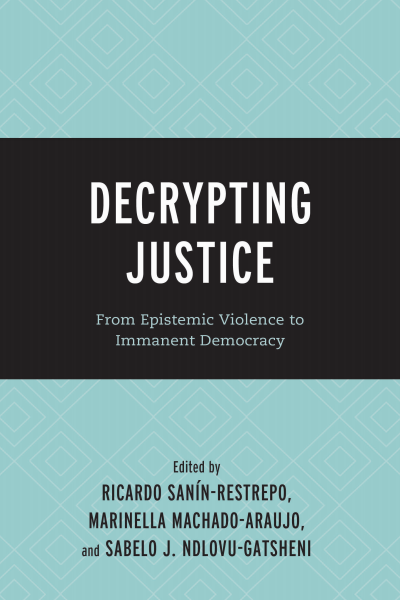
Decrypting Justice
From Epistemic Violence to Immanent Democracy
Herausgeber:innen:
| |
Verlag:
2025
Zusammenfassung
This book deploys the theory of encryption of to decrypt justice, setting in opposition Justice, written with the hegemonic capital letters of Western ideas, and justice, in its everyday workings within disparate communal forms and the exercise of multiplicity.
As it decrypts justice, the book argues that late-coloniality, through its construction of the “hidden people,” shattered the possibility of true communities in the service of a transcendent model, consisting ofthe market, the constitution, the nation, and the economy. The first three chapters serve as the theoretical backbone of the book, engaging sovereignty, posthumanism, Artificial Intelligence, and epistemic injustice. Chapters 4 and 5 describe the emancipation of the people through alternate communal practices: “Quilombismo” in Brazil and “Corazonar” of Tseltal women in Mexico. Chapter 7 examines the Tosepan’s practices in Mexico to decrypt hegemonic territorial forms, and chapters 6 and 8 explore how Western judicial systems disempower the people, focusing on Central American migrants and critiques from the Colombian peace process.
Edited by Ricardo Sanín-Restrepo, Marinella Machado-Araujo, and Sabelo J. Ndlovu-Gatsheni, Decrypting Justice: From Epistemic Violence to Immanent Democracy is a transforming force, not only in the way which we understand reality but also in the tools with which we build it.
Publikation durchsuchen
Bibliographische Angaben
Auflage
1/2025
Copyrightjahr
2025
ISBN-Print
978-1-6669-6115-7
ISBN-Online
978-1-6669-6116-4
Verlag
Lexington, Lanham
Sprache
Englisch
Seiten
230
Produkttyp
Sammelband
Inhaltsverzeichnis
KapitelSeiten
Contents Kein Zugriff
Prologue: A Conceptual Framework of theTheory of Encryption of Power Kein Zugriff
Decrypting Justice Kein Zugriff Seiten 1 - 14
Chapter 1: A Prolific Paradox of Justice and Two Theses on the Encryption of the Hidden People Kein Zugriff Seiten 15 - 42
Chapter 2: Let’s Dance (On Fantastic Critique) Kein Zugriff Seiten 43 - 70
Chapter 3: Toward a Decolonial Paradigm of Justice Kein Zugriff Seiten 71 - 100
Chapter 4: The Communal Practice of Quilombismo as a Technique of Decryption: Forms of (R)existence through the Subversion of Colonial Encryption Kein Zugriff Seiten 101 - 118
Chapter 5: The Justice(s) of the O’tan (Corazonar): Tseltal Women’s Experiences in the Pursuit of Self-Justice Kein Zugriff Seiten 119 - 136
Chapter 6: Decryption of Liberal Transitional Justice: Critical Approaches from the Land as Central Problem in the Colombian Case Kein Zugriff Seiten 137 - 160
Chapter 7: Decrypting Power in the Territory: The Case of the Union of Cooperatives Tosepan, Titataniske Kein Zugriff Seiten 161 - 178
Chapter 8: Multiple Layers of Asylum Access in Mexico: An Example of the Encryption of Administrative Justice Kein Zugriff Seiten 179 - 196
Conclusions Kein Zugriff Seiten 197 - 206
Index Kein Zugriff Seiten 207 - 226
About the Contributors Kein Zugriff Seiten 227 - 230