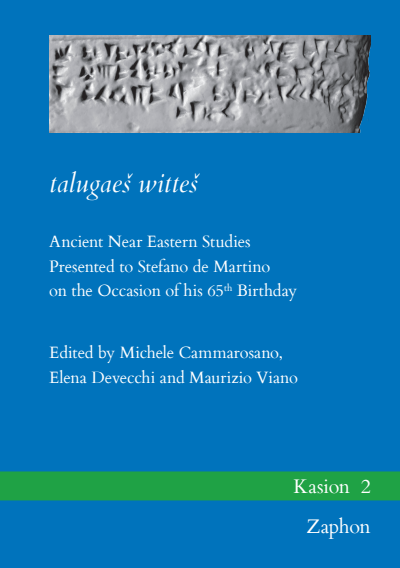
talugaeš witteš
Ancient Near Eastern Studies Presented to Stefano de Martino on the Occasion of his 65th Birthday- Herausgeber:innen:
- | |
- Reihe:
- Kasion / Publikationen zur ostmediterranen Antike / Publications on Eastern Mediterranean Antiquity, Band 2
- Verlag:
- 2020
Zusammenfassung
Vierunddreißig Studien sind dem Altorientalisten Stefano de Martino gewidmet. Entsprechend seinem Forschungsgebiet bilden Studien zu den Bereichen Alt-Anatolien und Nord-Syrien sowie zu hethitischen und akkadischen Texten einen Schwerpunkt der Festschrift. Neue Texte und neue archäologische Funde werden ebenso vorgestellt wie neue Aspekte bekannter Werke und Ausgrabungsstätten der Region. In den Fokus gerückt werden auch übergreifende Fragen zur Geschichte und Geographie des nordwestlichen Alten Orients.
Thirty-four studies are devoted to the Ancient Near Eastern scholar Stefano de Martino. In accordance with his own research area studies on Ancient Anatolia and North-Syria as well as on Hittite and Akkadian texts are in the focus of the festschrift. Newly discovered texts and archaeological finds are presented, and new aspects of well-known literary compositions and excavation sites of the region are taken into consideration. Further studies focus on history and geography of the north-western part of the Ancient Near East.
Reihe
E009677300 - Band 2
Publikation durchsuchen
Bibliographische Angaben
- Auflage
- 1/2020
- Copyrightjahr
- 2020
- ISBN-Print
- 978-3-96327-110-6
- ISBN-Online
- 978-3-96327-111-3
- Verlag
- Zaphon, Münster
- Reihe
- Kasion / Publikationen zur ostmediterranen Antike / Publications on Eastern Mediterranean Antiquity
- Band
- 2
- Sprache
- Englisch
- Seiten
- 528
- Produkttyp
- Sammelband
Inhaltsverzeichnis
- Indice Kein Zugriff
- Prefazione Kein Zugriff
- Pubblicazioni di Stefano de Martino Kein Zugriff
- La vera storia di un clamoroso falso ittita di fine Ottocento Kein Zugriff Seiten 1 - 22Autor:innen:
- Ein neues Tontafelfragment aus Boğazköy. Boğazkale 1-1-2018 Kein Zugriff Seiten 23 - 26Autor:innen: |
- Personal Names of Proto-Anatolian Indo-European-Speaking Populations East of the Euphrates (24th Cent. BC) Kein Zugriff Seiten 27 - 36Autor:innen:
- “Awīliš īwē”. L’uomo mesopotamico come figlio della città Kein Zugriff Seiten 37 - 50Autor:innen:
- Il sigillo a cilindro IM 115642 dalla Tomba Reale III a Nimrud. Una raffigurazione enigmatica Kein Zugriff Seiten 51 - 70Autor:innen:
- Forging an Empire. The Borders of Carchemish. According to CTH 50 (KUB 19.27) Kein Zugriff Seiten 71 - 80Autor:innen: |
- Reorganization vs. Resilience in Early Iron Age. Monumental Art of Central Anatolia Kein Zugriff Seiten 81 - 102Autor:innen:
- Sealings from Renewed Excavations at Alalakh Kein Zugriff Seiten 103 - 108Autor:innen: |
- Visual Communication and the Audience. An Observation Point on Mesopotamia Kein Zugriff Seiten 109 - 120Autor:innen:
- The Rural Hinterland of Assyrian Cities. Clusters of Toponyms Kein Zugriff Seiten 121 - 140Autor:innen:
- Il contesto storico delle istruzioni “umanitarie” hittite e l’“invasione” dei caschei (Kaška) Kein Zugriff Seiten 141 - 174Autor:innen:
- The Name of Babylon in Hittite Texts Kein Zugriff Seiten 175 - 192Autor:innen:
- Nochmals zum Brief des Labarna an Tunija von Tikunani Kein Zugriff Seiten 193 - 202Autor:innen: |
- “She did not call me father, so I will not call her my daughter!” The Episode of the “Daughter” in CTH 6 and Its Historical Significance Kein Zugriff Seiten 203 - 214Autor:innen:
- On the Old Assyrian tuzzinnum Kein Zugriff Seiten 215 - 224Autor:innen:
- KUB 32.121: il quinto frammento del rituale di Šalašu? Kein Zugriff Seiten 225 - 236Autor:innen:
- The Urkesh Mittani Horizon: Ceramic Evidence Kein Zugriff Seiten 237 - 256Autor:innen:
- Nochmals zur Schreibung der Konjunktion maḫḫan und ihrer Geschichte Kein Zugriff Seiten 257 - 274Autor:innen:
- From Turin to Karakorum. Archaeology for the Public through Asia Kein Zugriff Seiten 275 - 286Autor:innen: |
- Sulle origini del commercio carovaniero tra la Penisola Arabica e il Vicino Oriente antico Kein Zugriff Seiten 287 - 300Autor:innen:
- PORTA, PORTA2 und „Hofeingang“ in den Hieroglypheninschriften des 2. Jts. v. Chr. Kein Zugriff Seiten 301 - 316Autor:innen:
- On the Historical Events of the Hurro-Hittite “Song of Release” Kein Zugriff Seiten 317 - 330Autor:innen:
- A Statue of the mušḫuššu of Marduk at Babylon? Kein Zugriff Seiten 331 - 344Autor:innen:
- Two Notes on Kizzuwatna’s Status as a Hittite Vassal in the Middle Hittite Period Kein Zugriff Seiten 345 - 350Autor:innen:
- Cylinder Seals as a Status Symbol in Hittite Anatolia Kein Zugriff Seiten 351 - 360Autor:innen:
- Far nascere una statua, uccidere una statua. Ebla e gli Ittiti (?) nel periodo paleosiriano Kein Zugriff Seiten 361 - 376Autor:innen:
- Essere senza un padre. Una nota su Gilgamesh Kein Zugriff Seiten 377 - 382Autor:innen:
- Some Considerations on Empire and Mental Mapping. Conceptualizing the Ends of the World in the First Millennium BCE Kein Zugriff Seiten 383 - 398Autor:innen:
- The Power of Geography. Criteria for Selecting the Location of Hattuša, the Capital City of the Hittite Empire Kein Zugriff Seiten 399 - 420Autor:innen:
- A Mould from Ortaköy/Šapinuwa Kein Zugriff Seiten 421 - 432Autor:innen:
- Potters and Pottery in Hittite Society, According to Written Sources Kein Zugriff Seiten 433 - 452Autor:innen:
- Cinture di sovrani, nobili e cavalieri nella statuaria di H atra Kein Zugriff Seiten 453 - 468Autor:innen: |
- Hurrian in a Tablet from Tigunānum Kein Zugriff Seiten 469 - 488Autor:innen:
- Allaituraḫe Kein Zugriff Seiten 489 - 500Autor:innen: