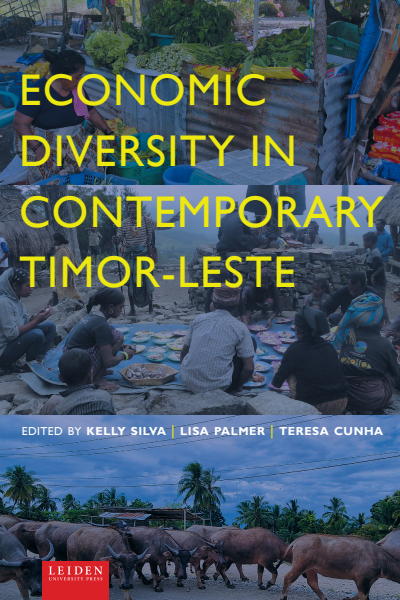
Economic Diversity in Contemporary Timor-Leste
- Herausgeber:innen:
- | |
- Verlag:
- 2023
Zusammenfassung
Economic Diversity in Contemporary Timor-Leste
analyses various economic dynamics in past and present Timor-Leste. Comprising 14 research chapters, the volume brings to the fore: 1) local, community-based economic values and arrangements; 2) community-based entanglements with a market-driven economy; 3) the colonial and postcolonial governance praxis through which a market-driven economy has permeated the country, and 4) the creative and place-based ways through which local people have responded to these transformations. The collection challenges hegemonic, market-driven analyses which characterise Timor-Leste’s economy as weak, deformed and homogenised and demonstrates the myriad of socially embedded ways through which Timor-Leste’s economy is diverse, richly complex and continually brought into being. To frame the analysis of these complex economic dynamics in Timor-Leste, the collection’s introduction develops the concept of economic ecologies: the assemblages of institutions and their localised and historical relationships mobilised for reproducing collective life, both in its material
and
immaterial aspects.
Publikation durchsuchen
Bibliographische Angaben
- Auflage
- 1/2023
- Copyrightjahr
- 2023
- ISBN-Print
- 978-90-8728-395-7
- ISBN-Online
- 978-94-006-0440-7
- Verlag
- Leiden University Press, Leiden
- Sprache
- Englisch
- Seiten
- 327
- Produkttyp
- Sammelband
Inhaltsverzeichnis
- Table of Contents
- List of Illustrations and Tables
- Chapter 1. The colonial bazaar in ‘Portuguese Timor’: the taming of the ‘savage marketers’Seiten 45 - 64Autor:innen:Download Kapitel (PDF)
- Chapter 2. Indexing social space: A marketplace in Timor-LesteSeiten 65 - 84Autor:innen:Download Kapitel (PDF)
- Chapter 3. Flirting with Ford, reverting to race? Housing, urban planning and the making of an economic and social order in Portuguese Timor in trans-colonial perspective, 1959-1963Seiten 85 - 104Autor:innen:Download Kapitel (PDF)
- Chapter 4. On the existence and persistence of the social category of atan in contemporary Timor-LesteSeiten 107 - 122Autor:innen:Download Kapitel (PDF)
- Chapter 5. The serimónia network: economic mobilisation through rituals in the hamlet of Faulara, LiquiçáSeiten 123 - 146Autor:innen: |Download Kapitel (PDF)
- Chapter 6. Household decision-making processes and family resources: A case study from ViquequeSeiten 147 - 160Autor:innen: |Download Kapitel (PDF)
- Chapter 7. Gift economy and the acknowledgement of debt: (On) Living and eating with ‘mystical’ actors in Timorese housesSeiten 161 - 176Autor:innen:Download Kapitel (PDF)
- Chapter 8. The work of women in Eluli and land economies in Timor-LesteSeiten 177 - 192Autor:innen: |Download Kapitel (PDF)
- Chapter 9. Land and diet under pressure: The impacts of Suai Supply Base in Kamanasa kingdomSeiten 195 - 214Autor:innen:Download Kapitel (PDF)
- Chapter 10. The socio-cultural benefits of emerging market-based instruments for carbon in Timor-LesteSeiten 215 - 234Autor:innen: |Download Kapitel (PDF)
- Chapter 11. China’s engagement in Timor-Leste’s economySeiten 235 - 254Autor:innen:Download Kapitel (PDF)
- Chapter 12. Migrant work and homecoming: Experiences of Timorese seasonal workersSeiten 255 - 274Autor:innen: |Download Kapitel (PDF)
- Chapter 14. The frente ekonomika (economic front): Timorese perspectives on seasonal work in AustraliaSeiten 295 - 312Autor:innen:Download Kapitel (PDF)
- About the AuthorsSeiten 313 - 316 Download Kapitel (PDF)
- IndexSeiten 317 - 326 Download Kapitel (PDF)