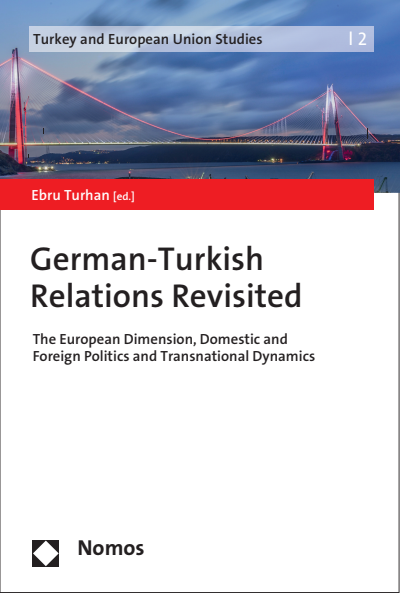
German-Turkish Relations Revisited
The European Dimension, Domestic and Foreign Politics and Transnational Dynamics- Herausgeber:innen:
- Reihe:
- Turkey and European Union Studies, Band 2
- Verlag:
- 2019
Zusammenfassung
In den letzten Jahren ist der deutsch-türkische Dialog zunehmend Gegenstand politischer, akademischer und öffentlicher Debatten geworden. Die Entwicklung der bilateralen Beziehungen zwischen den beiden Ländern war geprägt von Höhen und Tiefen. In jüngster Zeit überwiegen jedoch die Konfliktphasen: Entfremdung und gegenseitiges Misstrauen zwischen Deutschland und der Türkei nehmen zu. Endet die „Achterbahnfahrt“ in den vielschichtigen und dynamischen Beziehungen zwischen beiden Ländern womöglich in einem Unglück? Ausgehend von den „intermestischen“ (inter-lokalen) Tendenzen und den außergewöhnlichen Interdependenzen in den deutsch-türkischen Beziehungen beleuchtet dieser Band die Potenziale für zukünftige Kooperationen und Konflikte. Im Zentrum stehen die drei Dimensionen der deutsch-türkischen Beziehungen, die sich insbesondere auf konfliktreichen oder kooperativen Dialog beziehen: die europäische Dimension, die Innen- und Außenpolitik sowie transnationale Dynamiken. Mit Beiträgen von Mirja Schröder, Funda Tekin, Ebru Turhan, Thomas Krumm, Ludwig Schulz, Yaşar Aydın, Deniz Kuru, Defne Kadıoğlu Polat, Çetin Çelik, Elif Posos Devrani und Wolfgang Wessels
Schlagworte
Publikation durchsuchen
Bibliographische Angaben
- Auflage
- 1/2019
- Copyrightjahr
- 2019
- ISBN-Print
- 978-3-8487-5888-3
- ISBN-Online
- 978-3-7489-0019-1
- Verlag
- Nomos, Baden-Baden
- Reihe
- Turkey and European Union Studies
- Band
- 2
- Sprache
- Englisch
- Seiten
- 291
- Produkttyp
- Sammelband
Inhaltsverzeichnis
- Titelei/Inhaltsverzeichnis Kein Zugriff Seiten 1 - 8
- Autor:innen:
- 1. Introduction Kein ZugriffAutor:innen:
- 2. From an “almost” train crash to a quick full recovery? Kein ZugriffAutor:innen:
- 3. Changing dynamics of German-Turkish relations Kein ZugriffAutor:innen:
- 4. Germany and Turkey: intermestic affairs and conflictual cooperation as a result of complex interdependence Kein ZugriffAutor:innen:
- 5. Revisiting the German-Turkish affairs: three dimensions Kein ZugriffAutor:innen:
- 6. The structure of the edited volume Kein ZugriffAutor:innen:
- Autor:innen: |
- 1. Introduction Kein ZugriffAutor:innen: |
- Autor:innen: |
- 2.1 A historical institutionalist account of EU-Turkey relations Kein ZugriffAutor:innen: |
- 2.2 Germany-Turkey relations – reinforcing or undermining the EU-Turkey relationship? Kein ZugriffAutor:innen: |
- Autor:innen: |
- 3.1 The association framework – a relict of past times? Kein ZugriffAutor:innen: |
- 3.2 The accession process – Turkey an exceptional case? Kein ZugriffAutor:innen: |
- 3.3 Striking the balance between accession and association Kein ZugriffAutor:innen: |
- Autor:innen: |
- 4.1 Accession Kein ZugriffAutor:innen: |
- 4.2 Cooperation, association and integration in the policy areas of trade, energy, security and migration Kein ZugriffAutor:innen: |
- 5. Conclusions – Turkish accession to the EU: an empty but lasting promise? Kein ZugriffAutor:innen: |
- Autor:innen:
- 1. Introduction Kein ZugriffAutor:innen:
- 2. Theorizing the formation of official German attitude towards Turkish accession to the EU Kein ZugriffAutor:innen:
- Autor:innen:
- 3.1 From Luxembourg to Helsinki Kein ZugriffAutor:innen:
- 3.2 Changing understanding of security post September 11 Kein ZugriffAutor:innen:
- 3.3 Arab Spring and the refugee crisis Kein ZugriffAutor:innen:
- Autor:innen:
- 4.1 Turkish economy and German position on Turkey’s EU accession process throughout the pre-negotiation phase Kein ZugriffAutor:innen:
- 4.2 Germany’s Turkey policy during the Eurozone crisis Kein ZugriffAutor:innen:
- 4.3 German position throughout the 2018 economic turmoil in Turkey Kein ZugriffAutor:innen:
- Autor:innen:
- 5.1 The shift from the “Black-Yellow” to the “Red-Green” coalition: implications for the perception of Turkey’s “Europeanness” Kein ZugriffAutor:innen:
- 5.2 Germany’s perception of Turkish identity throughout the official negotiation phase Kein ZugriffAutor:innen:
- Autor:innen:
- 6.1 From Luxembourg to Helsinki to Brussels: The fluctuating impact of moral norms on the German position Kein ZugriffAutor:innen:
- 6.2 Official negotiation phase: moral norms, the German veto on Chapter 22 and the bilateral relations post-coup attempt Kein ZugriffAutor:innen:
- 7. Conclusion Kein ZugriffAutor:innen:
- Autor:innen:
- 1. Introduction Kein ZugriffAutor:innen:
- 2. Don’t mess with Merkel? EU internal and external relations post Brexit Kein ZugriffAutor:innen:
- 3. Shopping around for alternatives? Turkey’s European and regional ambitions post Brexit Kein ZugriffAutor:innen:
- 4. Reluctant multilateralists? Bi- and multilateral styles of policy-making in Britain, Turkey and Germany Kein ZugriffAutor:innen:
- 5. Conclusion Kein ZugriffAutor:innen:
- Autor:innen:
- 1. Introduction Kein ZugriffAutor:innen:
- 2. The Prototype: Hans-Peter Schwarz’s concept of Germany as Europe’s Zentralmacht Kein ZugriffAutor:innen:
- 3. German central power in action: first rejected, then embraced? Kein ZugriffAutor:innen:
- 4. Central power à la turca: İsmail Cem’s and Ahmet Davutoğlu’s vision of Turkey as a global “Merkez Ülke” Kein ZugriffAutor:innen:
- 5. The rise of Turkish central power – and its struggle against turmoil Kein ZugriffAutor:innen:
- 6. Conclusion and outlook Kein ZugriffAutor:innen:
- Autor:innen:
- 1. Introduction Kein ZugriffAutor:innen:
- 2. Evolution of Germany’s European policy and German influence in the EU Kein ZugriffAutor:innen:
- 3. The Eurozone crisis, domestic politics, Germany’s constrained European and Turkey policies Kein ZugriffAutor:innen:
- Autor:innen:
- 4.1 German Alleingang, the domestication of the refugee crisis and Germany’s constrained leadership in the EU Kein ZugriffAutor:innen:
- 4.2 German influence in the making of the EU-Turkey refugee “deal” Kein ZugriffAutor:innen:
- 5. Conclusion: a constrained leader’s constrained European and Turkey policies Kein ZugriffAutor:innen:
- Autor:innen:
- 1. Introduction Kein ZugriffAutor:innen:
- Autor:innen:
- 2.1 The historical context of German-Turkish relations Kein ZugriffAutor:innen:
- 2.2 Areas of common interests Kein ZugriffAutor:innen:
- 2.3 Points of contention Kein ZugriffAutor:innen:
- Autor:innen:
- 3.1 German-Turkish relations: conflicting interests Kein ZugriffAutor:innen:
- 3.2 Shift of power Kein ZugriffAutor:innen:
- 3.3 Transnationalism Kein ZugriffAutor:innen:
- 3.4 Turkey-sceptic public opinion Kein ZugriffAutor:innen:
- 4. Concluding remarks and prospects Kein ZugriffAutor:innen:
- Autor:innen:
- 1. Introduction Kein ZugriffAutor:innen:
- 2. Setting the stage: Practices and elections with expatriates’ voting explained Kein ZugriffAutor:innen:
- 3. Transnational electoral campaigns: The Turkish case Kein ZugriffAutor:innen:
- 4. Practicing electoral campaigns transnationally Kein ZugriffAutor:innen:
- 5. In lieu of conclusion: More migration, more rights, more transnational campaigns Kein ZugriffAutor:innen:
- Autor:innen:
- 1. Introduction Kein ZugriffAutor:innen:
- Autor:innen:
- 2.1 Poor but sexy: immigrants in Berlin under the banner of the creative city Kein ZugriffAutor:innen:
- 3. Reuterkiez: from ghetto to creative quarter Kein ZugriffAutor:innen:
- 4. Gentrification and housing in conjunction with latest developments Kein ZugriffAutor:innen:
- 5. Conclusion Kein ZugriffAutor:innen:
- Acknowledgement Kein ZugriffAutor:innen:
- Autor:innen:
- 1. Introduction Kein ZugriffAutor:innen:
- 2. How to explain educational performance of Turkish second-generation Kein ZugriffAutor:innen:
- 3. Ethnic boundaries and ethno-religious hierarchies Kein ZugriffAutor:innen:
- Autor:innen:
- 4.1 Exclusionary public discourses Kein ZugriffAutor:innen:
- 4.2 Mono-ethnic citizenship regime Kein ZugriffAutor:innen:
- 4.3 Impoverishment due to the deindustrialization process Kein ZugriffAutor:innen:
- 4.4 Rigid tracking in the educational system as part of class struggle Kein ZugriffAutor:innen:
- 5. Conclusions and discussions Kein ZugriffAutor:innen:
- Autor:innen:
- 1. Introduction Kein ZugriffAutor:innen:
- 2. Theoretical points of departure Kein ZugriffAutor:innen:
- 3. Gastarbeiter’s first step to Germany: the period of 1961-1973 Kein ZugriffAutor:innen:
- 4. From being a Gastarbeiter to being a foreigner: the period of 1973-1984 Kein ZugriffAutor:innen:
- 5. After 1984: Ausländer are not going out! Kein ZugriffAutor:innen:
- 6. 2000 s and the national integration plan Kein ZugriffAutor:innen:
- 7. New challenges for integration strategies: the refugee flow Kein ZugriffAutor:innen:
- 8. Conclusion Kein ZugriffAutor:innen:
- Autor:innen: |
- 1. No train crash but a roller-coaster ride Kein ZugriffAutor:innen: |
- 2. Challenging dynamics in the relationship Kein ZugriffAutor:innen: |
- 3. Triangulation of the relationship: Germany, Turkey and the EU Kein ZugriffAutor:innen: |
- 4. Thinking ahead and squaring the circle Kein ZugriffAutor:innen: |
- Acknowledgements Kein Zugriff Seiten 281 - 282
- Notes on Contributors Kein Zugriff Seiten 283 - 284
- Series Editors Kein Zugriff Seiten 285 - 286
- Index Kein Zugriff Seiten 287 - 291