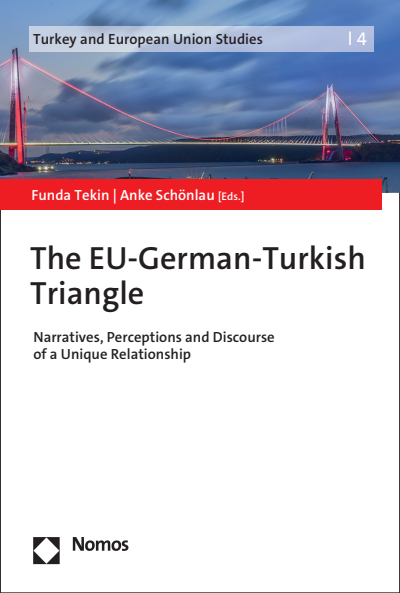
The EU-German-Turkish Triangle
Narratives, Perceptions and Discourse of a Unique Relationship- Herausgeber:innen:
- |
- Reihe:
- Turkey and European Union Studies, Band 4
- Verlag:
- 2022
Zusammenfassung
Um eine solide Bewertung der Beziehungen zwischen der EU und der Türkei und ihrer Zukunftsaussichten zu ermöglichen, konzentriert sich dieser Band auf die Dreiecksbeziehung zwischen dem Block und der Türkei einerseits und den bilateralen Beziehungen zwischen Deutschland und der Türkei andererseits. Auf der Grundlage des historischen Institutionalismus geht er von der Annahme aus, dass eine grundlegende Umstrukturierung der Beziehungen zwischen der EU und der Türkei „kritische Wendepunkte“ erfordert, die einen „Paradigmenwechsel“ nach sich ziehen. Es wird der politische Diskurs über die Beziehungen zwischen der EU und der Türkei dekonstruiert, um die wichtigsten Wahrnehmungen und Narrative der Beziehungen zwischen der EU und der Türkei nicht nur in Deutschland und der Türkei, sondern auch auf EU-Ebene in Brüssel zu identifizieren, zu analysieren und zu bewerten. Die analytischen Beiträge zielen auf die Beantwortung der allgemeinen Fragen ab, ob und zu welchem Zeitpunkt ein Paradigmenwechsel zu erkennen ist; wenn ja, was die treibenden Faktoren eines solchen Wechsels sind; und ob sich die Narrative der EU-Türkei-Beziehungen im Laufe der Zeit verändern.Mit Beiträgen von Esra Çengel, Atila Eralp, Denise Ersoy, Hanna-Lisa Hauge, Ebru Ece Özbey, Ardahan Özkan Gedikli, Moritz Rau, Anke Schönlau, Mirja Schröder, Nurdan Selay Bedir, Özgehan Şenyuva, Funda Tekin, Helena Weise und Wolfgang Wessels.
Schlagworte
Publikation durchsuchen
Bibliographische Angaben
- Copyrightjahr
- 2022
- ISBN-Print
- 978-3-8487-8054-9
- ISBN-Online
- 978-3-7489-2441-8
- Verlag
- Nomos, Baden-Baden
- Reihe
- Turkey and European Union Studies
- Band
- 4
- Sprache
- Englisch
- Seiten
- 214
- Produkttyp
- Sammelband
Inhaltsverzeichnis
- Titelei/InhaltsverzeichnisSeiten 1 - 8 Download Kapitel (PDF)
- Autor:innen: |Download Kapitel (PDF)
- 1. Introduction
- 2. A Narrative Approach – A New Perspective in Analysis of EU-Turkey Relations
- 3.1 Narratives in Political Science Analysis – What Do They Tell Us?
- 3.2 Four Elements of Analysis
- 3.3 Methodological Considerations
- 4.1 Findings
- 4.2 Outlook
- Autor:innen: | |Download Kapitel (PDF)
- 1. Introduction
- 2. A Love-Hate Relationship: The Role of Identity in Forming the EU-Turkey Partnership
- 3.1 Narratives in Turkey
- 3.2 Narratives in the EU
- 4. Conclusion: What about the Future?
- Autor:innen: |Download Kapitel (PDF)
- 1. Introduction: Diving into Germany’s Role in EU-Turkey Relations
- 2.1 Method
- 2.2 Four Narrative Dimensions in EU-German-Turkish Relations
- 3.1 The 1960s: Turkey as Partner of the West
- 3.2 The 1970s: Military Alliances in Times of Conflict
- 3.4 The 1980s: Growing Conflict
- 3.5 A Rocky Road to Candidacy: The 1990s Under Helmut Kohl
- 3.6 A Turning Point: The 1990s Under Gerhard Schröder
- 4. Conclusion
- Autor:innen: |Download Kapitel (PDF)
- 1. Introduction
- 2.1 Conceptual Definition and Delineation
- 2.2 Operationalisation
- 3.1 Parliamentary Debates on the Opening of Accession Negotiations 2002–2005: Sustainable European Perspective versus Privileged Partnership
- 3.2. The Years After the Start of Accession Talks (2005–2012)
- 3.3 Positive Agenda 2012 and Gezi Protests 2013 – Test and Turning Point
- 3.4 A Peak in every Respect – Geostrategic Relevance and Political Crisis in 2015/2016
- 3.5 Still at the Crossroads? Developments after 2016
- 4. Conclusions
- Autor:innen: | |Download Kapitel (PDF)
- 1. Introduction
- 2. Methodology
- 3. Leaders and Foreign Policy: Why It Matters What They Say?
- 4.1. The Geopolitical Dimension
- 4.2. The Political Dimension
- 4.3. The Economic Dimension
- 4.4. The Societal Dimension
- 4.5. The Cross-Cutting Dimension
- 5. Conclusion
- Autor:innen: | |Download Kapitel (PDF)
- 1. Introduction: Why Should We Study EU Leaders’ Narratives on Turkey?
- 2.1. Turkey in the EU’s Spotlight: Relationship Milestones
- 2.2. Empirical Evidence: European Council Conclusions on Turkey
- 2.3. Narrative of Membership: Turkey as a Candidate for EU Accession
- 2.4. Narrative of a Transactional Partnership: Forms and Areas of Cooperation
- 2.5. Narrative of Conflict: Turkey as a Problematic Neighbour
- 3. Conclusion and Outlook
- Autor:innen: |Download Kapitel (PDF)
- 1. Introduction
- 2. Methodology and Data Sources
- 3.1 Glass half full: Germany as a Partner
- 3.2 They are Out to Get Us: Threat Perceptions
- 3.3 Leadership Matters: Foreign Leaders in the eyes of Turkish public.
- 3.4. Compartmentalisation of Relations: The Case of Education
- 4. Discussion and Contextualisation
- 5. Conclusion
- Autor:innen: |Download Kapitel (PDF)
- 1. Introduction: Narrating a Roller Coaster Relationship
- 2.1 Narratives on EU-Turkey Relations: Three Main Storylines
- 2.2 The Difficulties of Breaking the Vicious Circle of Mutual Accusations
- 2.3 Thematic Trends and Narrated Turning Points in EU-Turkey Relations
- 3. Scenarios – Is There a Paradigm Shift and Which Vision for the Future Does it Correspond to?
- 4. Which Way Forward in EU-Turkey Relations and the Role of Germany
- AcknowledgementSeiten 203 - 204 Download Kapitel (PDF)
- Notes on ContributorsSeiten 205 - 206 Download Kapitel (PDF)
- Series EditorsSeiten 207 - 208 Download Kapitel (PDF)
- AnnexSeiten 209 - 212 Download Kapitel (PDF)
- IndexSeiten 213 - 214 Download Kapitel (PDF)