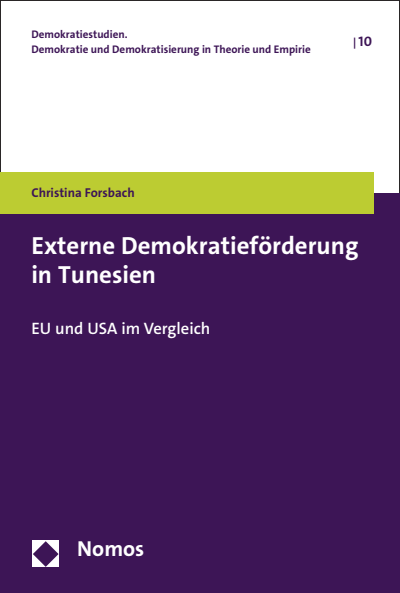
Externe Demokratieförderung in Tunesien
EU und USA im Vergleich- Autor:innen:
- Verlag:
- 2022
Zusammenfassung
Die Studie bietet einen innovativen und systematischen Vergleich der Demokratieförderagenden seitens der beiden externen Akteure USA und EU in Tunesien, dem Hoffnungsland des Arabischen Frühlings. Dafür untersucht sie Strategien, Methoden und Instrumente, wie sie die Vereinigten Staaten und die Europäische Union in allen Phasen des tunesischen Demokratisierungsprozesses eingesetzt haben. Neben dem Vergleich der Handlungsmuster wird zudem beleuchtet, wie beide externen Akteure mit sich in ihrer Politikgestaltung ergebenden Zielkonflikten umgegangen sind. Die Analyse weist insgesamt auf ein sehr personalisiertes, kurzfristiges und pragmatisches Handeln auf US-Seite sowie auf ein personenungebundenes, kalkulierendes und längerfristiges Vorgehen auf EU-Seite hin.
Schlagworte
Publikation durchsuchen
Bibliographische Angaben
- Copyrightjahr
- 2022
- ISBN-Print
- 978-3-8487-7544-6
- ISBN-Online
- 978-3-7489-3520-9
- Verlag
- Nomos, Baden-Baden
- Reihe
- Demokratiestudien. Demokratie und Demokratisierung in Theorie und Empirie
- Band
- 10
- Sprache
- Deutsch
- Seiten
- 558
- Produkttyp
- Monographie
Inhaltsverzeichnis
- Titelei/Inhaltsverzeichnis Kein Zugriff Seiten 1 - 14
- Vorwort Kein Zugriff Seiten 15 - 16
- 1.1 Erkenntnisinteresse Kein Zugriff
- 1.2 Forschungsstand und -desiderate Kein Zugriff
- 1.3 Methodisches Vorgehen und Materialzugang Kein Zugriff
- 1.4 Aufbau Kein Zugriff
- 2.1.1.1 Avantgardisten Kein Zugriff
- 2.1.1.2 Carnegie-Perspektive Kein Zugriff
- 2.1.1.3 Ordnende W-Fragen Kein Zugriff
- 2.1.1.4 Externe Akteure [1] und ihre Motive [2] Kein Zugriff
- 2.1.1.5 Adressaten und Adressatenfelder [4] Kein Zugriff
- 2.1.1.6 Instrumentenkataloge und Art der Umsetzung der Maßnahmen [3] Kein Zugriff
- 2.1.1.7 Ergebnisse des externen Einflusses Kein Zugriff
- 2.1.2.1 Identifizierung der Zielkonflikte Kein Zugriff
- 2.1.2.2 Aktualität der Forschungsperspektive Kein Zugriff
- (1) „Warten auf Godot“ Kein Zugriff
- (2) „The Arab 1989“ Kein Zugriff
- (3) „Transition to Somewhere“ Kein Zugriff
- (4) „Transitions from Authoritarian Rule“ Kein Zugriff
- 2.2.1 Auswahl eines Analysekonzepts Kein Zugriff
- 2.2.2 Äpfel und Birnen? Kein Zugriff
- 3.1 „Beacon“ oder „Crusader“? Kein Zugriff
- 3.2 „Constructing the Self” oder „Changing Others“? Kein Zugriff
- 3.3.1 „High policy“-Ebene Kein Zugriff
- 3.3.2 „Low policy“-Ebene Kein Zugriff
- 3.4.1 „High policy“-Ebene Kein Zugriff
- 3.4.2 „Low policy“-Ebene Kein Zugriff
- 3.5 Zwischenfazit: Flexible versus holistische Politikgestaltung Kein Zugriff
- 4.1 Nichtdemokratisches System Kein Zugriff
- 4.2.1 Ursachen Kein Zugriff
- 4.2.2 Verlaufsform der Ablösung Kein Zugriff
- 4.3 Transition Kein Zugriff
- (1) Konstitutionelle Konsolidierung Kein Zugriff
- (2) Repräsentative Konsolidierung Kein Zugriff
- (3) Verhaltenskonsolidierung der informellen politischen Akteure Kein Zugriff
- (4) Konsolidierung der Bürgerschaft Kein Zugriff
- 5.1.1 Strategische Ebene Kein Zugriff
- 5.1.2 Umsetzungsebene Kein Zugriff
- 5.1.3 Ergebnisse Kein Zugriff
- 5.2.1 Strategische Ebene Kein Zugriff
- 5.2.2 Umsetzungsebene Kein Zugriff
- 5.2.3 Ergebnisse Kein Zugriff
- 5.3.1 Strategische Ebene Kein Zugriff
- 5.3.2 Umsetzungsebene Kein Zugriff
- 5.3.3 Ergebnisse Kein Zugriff
- 5.4.1 Strategische Ebene Kein Zugriff
- 5.4.2 Umsetzungsebene Kein Zugriff
- 5.4.3 Ergebnisse Kein Zugriff
- 5.5 Zwischenfazit Kein Zugriff
- 6.1.1 Strategische Ebene Kein Zugriff
- 6.1.2 Umsetzungsebene Kein Zugriff
- 6.1.3 Ergebnisse Kein Zugriff
- 6.2.1 Strategische Ebene Kein Zugriff
- 6.2.2 Umsetzungsebene Kein Zugriff
- 6.2.3 Ergebnisse Kein Zugriff
- 6.3.1 Strategische Ebene Kein Zugriff
- 6.3.2 Umsetzungsebene Kein Zugriff
- 6.3.3 Ergebnisse Kein Zugriff
- 6.4.1 Strategische Ebene Kein Zugriff
- 6.4.2 Umsetzungsebene Kein Zugriff
- 6.4.3 Ergebnisse Kein Zugriff
- 6.5 Zwischenfazit Kein Zugriff
- 7.1.1 Strategien Kein Zugriff
- 7.1.2 Extrinsische Zielkonflikte Kein Zugriff
- 7.1.3 Adressatenfelder Kein Zugriff
- 7.1.4 Methoden und Instrumente Kein Zugriff
- 7.1.5 Intrinsische Zielkonflikte Kein Zugriff
- 7.1.6 Ergebnisse Kein Zugriff
- 7.2.1 Umgang mit extrinsischen Zielkonflikten Kein Zugriff
- 7.2.2 Umgang mit intrinsischen Zielkonflikten Kein Zugriff
- 8.1 Nützlichkeit des Analysekonzepts und weitere Forschungsdesiderate Kein Zugriff
- 8.2 Bewährte Verfahren der Demokratieförderpraxen Kein Zugriff
- 8.3 Politikempfehlungen und Ausblick Kein Zugriff
- 9.1.1 USA Kein Zugriff
- 9.1.2 Europäische Union Kein Zugriff
- 9.1.3 Andere Kein Zugriff
- 9.2 Sekundärquellen Kein Zugriff
- 9.3.1 Interviewreise nach Washington, D.C., Juli 2019 Kein Zugriff
- 9.3.2 Interviewreise nach Tunis, September 2019 Kein Zugriff
- 9.3.3 Interviewreise nach Brüssel, Oktober 2019 Kein Zugriff
- 9.3.4 Telefonische Interviews, August bis November 2019 Kein Zugriff
- 9.3.5 Interview in Berlin, Juli 2019 Kein Zugriff
- Anhang Kein Zugriff Seiten 551 - 558
Literaturverzeichnis (1220 Einträge)
Es wurden keine Treffer gefunden. Versuchen Sie einen anderen Begriff.
- Adams, John Quincy, Speech to the U.S. House of Representatives on Foreign Policy, 4. Juli 1821, https://millercenter.org/the-presidency/presidential-speeches/july-4-1821-speech-us-house-representatives-foreign-policy; 18.10.2018. Google Scholar öffnen DOI: 10.5771/9783748935209
- African Manager, Tunisia: full text of the Tunisian-US Memorandum of Understanding, 18. August 2015, https://en.africanmanager.com/tunisia-full-text-of-the-tunisian-us-memorandum-of-understanding-will-it-put-an-end-to-the-controversy/; 30.10.2020. Google Scholar öffnen DOI: 10.5771/9783748935209
- Burns, William J., American Strategy in a New Middle East, Statement before the Senate Committee on Foreign Relations, 17. März 2011, https://2009-2017.state.gov/p/us/rm/2011/158516.htm; 27.09.2020. Google Scholar öffnen DOI: 10.5771/9783748935209
- Bush, George W., Statement by the President in His Address to the Nation, 11. September 2001, https://georgewbush-whitehouse.archives.gov/news/releases/2001/09/20010911-16.html; 26.08.2019. Google Scholar öffnen DOI: 10.5771/9783748935209
- Bush, George W., President Delivers State of the Union Address, 29. Januar 2002, https://georgewbush-whitehouse.archives.gov/news/releases/2002/01/20020129-11.html; 06.11.2019. Google Scholar öffnen DOI: 10.5771/9783748935209
- Bush, George W., President’s Remarks at the United Nations General Assembly, 12. September 2002, https://georgewbush-whitehouse.archives.gov/news/releases/2002/09/20020912-1.html; 27.08.2019. Google Scholar öffnen DOI: 10.5771/9783748935209
- Bush, George W., President George W. Bush Speaks at AEI’s Annual Dinner, 28. Februar 2003, http://www.aei.org/publication/president-george-w-bush-speaks-at-aeis-annual-dinner/; 27.08.2019. Google Scholar öffnen DOI: 10.5771/9783748935209
- Bush, George W., Remarks by President George W. Bush at the 20th Anniversary of the National Endowment for Democracy, 6. November 2003, https://georgewbush-whitehouse.archives.gov/news/releases/2003/11/20031106-2.html; 27.09.2020. Google Scholar öffnen DOI: 10.5771/9783748935209
- Bush, George W., President Addresses the Nation in Prime Time Press Conference, 13. April 2004, https://georgewbush-whitehouse.archives.gov/news/releases/2004/04/text/20040413-20.html; 27.09.2020. Google Scholar öffnen DOI: 10.5771/9783748935209
- Bush, George W., Inaugural Address, 20. Januar 2005, https://www.presidency.ucsb.edu/documents/inaugural-address-13; 27.08.2019. Google Scholar öffnen DOI: 10.5771/9783748935209
- Godec, Robert F., Corruption in Tunisia: What’s Yours Is Mine, 23. Juni 2008, Classified Cable, https://wikileaks.org/plusd/cables/08TUNIS679_a.html; 27.08.2019. Google Scholar öffnen DOI: 10.5771/9783748935209
- Godec, Robert F., Troubled Tunisia: What Should We Do?, 17. Juli 2009, Classified Cable, https://www.theguardian.com/world/us-embassy-cables-documents/217138; 27.08.2019. Google Scholar öffnen DOI: 10.5771/9783748935209
- Godec, Robert F., Tunisia: Dinner With Sakher El Materi, 27. Juli 2009, Classified Cable, https://www.theguardian.com/world/us-embassy-cables-documents/218324; 27.08.2019. Google Scholar öffnen DOI: 10.5771/9783748935209
- Hudson, William, Succession in Tunisia: Finding a Successor or Feet First?, 9. Januar 2006, Classified Cable, https://www.theguardian.com/world/us-embassy-cables-documents/49401; 27.08.2019. Google Scholar öffnen DOI: 10.5771/9783748935209
- Kerry, John, Formation of New Tunisian Government, Press Statement, 29. Januar 2014, https://2009-2017.state.gov/secretary/remarks/2014/01/220727.htm; 27.08.2019. Google Scholar öffnen DOI: 10.5771/9783748935209
- Kerry, John, Meeting With Staff and Families of Embassy Tunis, Remarks, 18. Februar 2014, https://2009-2017.state.gov/secretary/remarks/2014/02/221751.htm; 27.08.2019. Google Scholar öffnen DOI: 10.5771/9783748935209
- Kerry, John, Remarks at a Solo Press Availability in Tunis, 18. Februar 2014, https://2009-2017.state.gov/secretary/remarks/2014/02/221754.htm; 27.08.2019. Google Scholar öffnen DOI: 10.5771/9783748935209
- Kerry, John, Tunisia National Day, Press Statement, 20. März 2015, https://2009-2017.state.gov/secretary/remarks/2015/03/239610.htm; 27.08.2019. Google Scholar öffnen DOI: 10.5771/9783748935209
- Kerry, John, The Nobel Peace Prize for the Tunisian National Dialogue Quartet, Press Statement, 9. Oktober 2015, https://2009-2017.state.gov/secretary/remarks/2015/10/248084.htm; 27.08.2019. Google Scholar öffnen DOI: 10.5771/9783748935209
- Kerry, John, Remarks at the Carnegie Endowment for International Peace, 28. Oktober 2015, https://2009-2017.state.gov/secretary/remarks/2015/10/248937.htm; 21.11.2020. Google Scholar öffnen DOI: 10.5771/9783748935209
- Library of Congress, Thomas Jefferson to John Dickinson, 6. März 1801, http://memory.loc.gov/service/mss/mtj/mtj1/023/023_0118_0118.pdf; 27.09.2020. Google Scholar öffnen DOI: 10.5771/9783748935209
- Monroe, James, Seventh Annual Message (Monroe Doctrine), Transcript, 2. Dezember 1823, https://millercenter.org/the-presidency/presidential-speeches/december-2-1823-seventh-annual-message-monroe-doctrine; 30.11.2018. Google Scholar öffnen DOI: 10.5771/9783748935209
- National Democratic Institute, Grant Proposal Tunisia: Supporting Inclusive and Multi-Partisan Democratic Processes. Submitted to U.S. Department of State, Middle East Partnership Initiative, 11. April 2011, Unveröffentlichtes Dokument. Google Scholar öffnen DOI: 10.5771/9783748935209
- National Democratic Institute, Final Report on the Tunisian National Constituent Assembly Elections, 23. Oktober 2011, https://www.ndi.org/sites/default/files/tunisia-final-election-report-021712_v2.pdf; 07.11.2019. Google Scholar öffnen DOI: 10.5771/9783748935209
- Obama, Barack, Remarks by the President at Cairo University, 4. Juni 2009, https://obamawhitehouse.archives.gov/the-press-office/remarks-president-cairo-university-6-04-09; 27.08.2019. Google Scholar öffnen DOI: 10.5771/9783748935209
- Obama, Barack, Remarks by the President to the United Nations General Assembly, 23. September 2009, https://obamawhitehouse.archives.gov/the-press-office/remarks-president-united-nations-general-assembly; 27.08.2019. Google Scholar öffnen DOI: 10.5771/9783748935209
- Obama, Barack, Nobel Lecture by Barack H. Obama, 10. Dezember 2009, https://www.nobelprize.org/prizes/peace/2009/obama/26183-nobel-lecture-2009/; 27.08.2019. Google Scholar öffnen DOI: 10.5771/9783748935209
- Obama, Barack, Remarks by the President to the United Nations General Assembly, 23. September 2010, https://obamawhitehouse.archives.gov/the-press-office/2010/09/23/remarks-president-united-nations-general-assembly; 27.09.2020. Google Scholar öffnen DOI: 10.5771/9783748935209
- Obama, Barack, Remarks by the President on Egypt, 11. Februar 2011, https://obamawhitehouse.archives.gov/the-press-office/2011/02/11/remarks-president-egypt; 11.04.2022. Google Scholar öffnen DOI: 10.5771/9783748935209
- Obama, Barack, Remarks by the President to the United Nations General Assembly, 21. September 2011, https://obamawhitehouse.archives.gov/the-press-office/2011/09/21/remarks-president-obama-address-united-nations-general-assembly; 27.09.2020. Google Scholar öffnen DOI: 10.5771/9783748935209
- Obama, Barack, Statement by the President on Events in Tunisia, 14. Januar 2011, https://obamawhitehouse.archives.gov/the-press-office/2011/01/14/statement-president-events-tunisia; 27.08.2019. Google Scholar öffnen DOI: 10.5771/9783748935209
- Obama, Barack, Remarks by the President in State of Union Address, 25. Januar 2011, https://obamawhitehouse.archives.gov/the-press-office/2011/01/25/remarks-president-state-union-address; 27.08.2019. Google Scholar öffnen DOI: 10.5771/9783748935209
- Obama, Barack, Remarks by the President on the Middle East and North Africa, 19. Mai 2011, https://obamawhitehouse.archives.gov/the-press-office/2011/05/19/remarks-president-middle-east-and-north-africa; 27.09.2020. Google Scholar öffnen DOI: 10.5771/9783748935209
- Obama, Barack, Remarks by President Obama and Prime Minister Essebsi After Bilateral Meeting, 7. Oktober 2011, https://obamawhitehouse.archives.gov/the-press-office/2011/10/07/remarks-president-obama-and-prime-minister-essebsi-after-bilateral-meeti; 06.11.2019. Google Scholar öffnen DOI: 10.5771/9783748935209
- Obama, Barack, President Obama’s Farewell Address, 10. Januar 2017, https://obamawhitehouse.archives.gov/farewell; 27.09.2020. Google Scholar öffnen DOI: 10.5771/9783748935209
- Panetta, Leon E., Remarks by Secretary of Defense Leon Panetta En Route to Tunisia, 29. Juli 2012, https://archive.defense.gov/transcripts/transcript.aspx?transcriptid=5090; 27.09.2020. Google Scholar öffnen DOI: 10.5771/9783748935209
- Powell, Colin L., The U.S.-Middle East Partnership Initiative: Building Hope for the Years Ahead, 12. Dezember 2002, https://2001-2009.state.gov/secretary/former/powell/remarks/2002/15920.htm; 27.09.2020. Google Scholar öffnen DOI: 10.5771/9783748935209
- Powell, Colin L., Press Availability in Tunisia, 2. Dezember 2003, https://2001-2009.state.gov/secretary/former/powell/remarks/2003/26808.htm; 27.08.2019. Google Scholar öffnen DOI: 10.5771/9783748935209
- Powell, Colin L., Press Briefing En Route to Marrakesh, 2. Dezember 2003, https://2001-2009.state.gov/secretary/former/powell/remarks/2003/26810.htm; 27.08.2019. Google Scholar öffnen DOI: 10.5771/9783748935209
- Powell, Colin L., Remarks Following Meeting With Tunisian President Zine El Abidine Ben Ali, 2. Dezember 2003, https://2001-2009.state.gov/secretary/former/powell/remarks/2003/26800.htm; 27.08.2019. Google Scholar öffnen DOI: 10.5771/9783748935209
- Reagan, Ronald, Address to Members of the British Parliament, 8. Juni 1982; https://www.reaganlibrary.gov/research/speeches/60882a; 23. 07.2020. Google Scholar öffnen DOI: 10.5771/9783748935209
- Reagan, Ronald, Remarks on East-West Relations at the Brandenburg Gate in West Berlin, 12. Juni 1987; https://www.reaganfoundation.org/media/50908/remarks_on_east_west_relations_at_brandenburg-gate_061287.pdf; 23.07.2020. Google Scholar öffnen DOI: 10.5771/9783748935209
- Rice, Condoleezza, Remarks after Meeting with Tunisian President Ben Ali, 6. September 2008, https://2001-2009.state.gov/secretary/rm/2008/09/109228.htm; 27.08.2019. Google Scholar öffnen DOI: 10.5771/9783748935209
- Rodham Clinton, Hillary, Remarks on the Human Rights Agenda for the 21st Century, 14. Dezember 2009, https://2009-2017.state.gov/secretary/20092013clinton/rm/2009a/12/133544.htm; 27.08.2019. Google Scholar öffnen DOI: 10.5771/9783748935209
- Rodham Clinton, Hillary, Remarks on Internet Freedom, 21. Januar 2010, https://2009-2017.state.gov/secretary/20092013clinton/rm/2010/01/135519.htm; 27.08.2019. Google Scholar öffnen DOI: 10.5771/9783748935209
- Rodham Clinton, Hillary, “Civil Society: Supporting Democracy in the 21st Century,” at the Community of Democracies, 3. Juli 2010, https://2009-2017.state.gov/secretary/20092013clinton/rm/2010/07/143952.htm; 27.08.2019. Google Scholar öffnen DOI: 10.5771/9783748935209
- Rodham Clinton, Hillary, Interview With Taher Barake of Al Arabiya, 11. Januar 2011, https://2009-2017.state.gov/secretary/20092013clinton/rm/2011/01/154295.htm; 16.11.2019. Google Scholar öffnen DOI: 10.5771/9783748935209
- Rodham Clinton, Hillary, Forum for the Future: Partnership Dialogue Panel Session with Q&A Session, 13. Januar 2011, https://2009-2017.state.gov/secretary/20092013clinton/rm/2011/01/154635.htm; 27.08.2019. Google Scholar öffnen DOI: 10.5771/9783748935209
- Rodham Clinton, Hillary, Recent Events in Tunisia, 14. Januar 2011, https://2009-2017.state.gov/secretary/20092013clinton/rm/2011/01/154684.htm; 27.08.2019. Google Scholar öffnen DOI: 10.5771/9783748935209
- Rodham Clinton, Hillary, Remarks With Spanish Foreign Minister Trinidad Jimenez After Their Meeting, 25. Januar 2011, https://2009-2017.state.gov/secretary/20092013clinton/rm/2011/01/155280.htm; 27.08.2019. Google Scholar öffnen DOI: 10.5771/9783748935209
- Rodham Clinton, Hillary, Remarks at U.S. Embassy Tunis, 17. März 2011, https://2009-2017.state.gov/secretary/20092013clinton/rm/2011/03/158566.htm; 27.08.2019. Google Scholar öffnen DOI: 10.5771/9783748935209
- Rodham Clinton, Hillary, Remarks With Tunisian Foreign Minister Mouldi Kefi, 17. März 2011, https://2009-2017.state.gov/secretary/20092013clinton/rm/2011/03/158552.htm; 27.08.2019. Google Scholar öffnen DOI: 10.5771/9783748935209
- Rodham Clinton, Hillary, Townterview Hosted by Nessma TV, 17. März 2011, https://2009-2017.state.gov/secretary/20092013clinton/rm/2011/03/158567.htm; 27.08.2019. Google Scholar öffnen DOI: 10.5771/9783748935209
- Rodham Clinton, Hillary, Remarks With Tunisian Foreign Minister Mouldi Kefi at Signing Ceremony, 22. September 2011, https://2009-2017.state.gov/secretary/20092013clinton/rm/2011/09/173785.htm; 27.08.2019. Google Scholar öffnen DOI: 10.5771/9783748935209
- Rodham Clinton, Hillary, Keynote Address at the National Democratic Institute's 2011 Democracy Awards Dinner, 7. November 2011, https://2009-2017.state.gov/secretary/20092013clinton/rm/2011/11/176750.htm; 21.11.2020. Google Scholar öffnen DOI: 10.5771/9783748935209
- Rodham Clinton, Hillary, Assistance to Tunisia, Press Statement, 29. März 2012, https://2009-2017.state.gov/secretary/20092013clinton/rm/2012/03/187078.htm; 27.08.2019. Google Scholar öffnen DOI: 10.5771/9783748935209
- Rodham Clinton, Hillary, Signing Ceremony With the Tunisian Ambassador to the United States Mohamed Salah Tekaya, 17. Mai 2012, https://2009-2017.state.gov/secretary/20092013clinton/rm/2012/05/190269.htm; 27.08.2019. Google Scholar öffnen DOI: 10.5771/9783748935209
- Rodham Clinton, Hillary, Remarks With Tunisian Foreign Minister Rafik Abdessalem Before Their Meeting, 21. September 2012, https://2009-2017.state.gov/secretary/20092013clinton/rm/2012/09/198033.htm; 27.08.2019. Google Scholar öffnen DOI: 10.5771/9783748935209
- Taylor, William, Special Briefing on U.S. Support for the Democratic Transitions Underway in Tunisia, Egypt, and Libya, 3. November 2011, https://2009-2017.state.gov/r/pa/prs/ps/2011/11/176653.htm; 21.11.2020. Google Scholar öffnen DOI: 10.5771/9783748935209
- The Middle East Partnership Initiative, Transition Support for Tunisia, 2011, https://photos.state.gov/libraries/tunisia/126725/country%20pages/PDF%20-%20MEPI%20Tunisia%20Response%20English%20Aug%202011-%20Final.pdf; 06.11.2019. Google Scholar öffnen DOI: 10.5771/9783748935209
- The Middle East Partnership Initiative, MEPI-Funded Initiative Engages Half a Million Tunisian Voters During Municipal Elections, 24. Juli 2018, https://mepi.state.gov/ifes/; 30.10.2020. Google Scholar öffnen DOI: 10.5771/9783748935209
- The White House, President Bush Discusses War on Terrorism with Tunisian President, 18. Februar 2004, https://georgewbush-whitehouse.archives.gov/news/releases/2004/02/20040218-2.html; 27.08.2019. Google Scholar öffnen DOI: 10.5771/9783748935209
- The White House, President Bush Meets with President of Tunisia, Statement by the Press Secretary, 18. Februar 2004, https://georgewbush-whitehouse.archives.gov/news/releases/2004/02/20040218-8.html; 06.11.2019. Google Scholar öffnen DOI: 10.5771/9783748935209
- The White House, Press Briefing by Scott McClellan, 18. Februar 2004, https://georgewbush-whitehouse.archives.gov/news/releases/2004/02/20040218-9.html#14; 27.08.2019. Google Scholar öffnen DOI: 10.5771/9783748935209
- The White House, The National Security Strategy of the United States of America, 16. März 2006, http://nssarchive.us/NSSR/2006.pdf; 26.08.2019. Google Scholar öffnen DOI: 10.5771/9783748935209
- The White House, National Security Strategy, 27. Mai 2010, http://nssarchive.us/NSSR/2010.pdf; 26.08.2019. Google Scholar öffnen DOI: 10.5771/9783748935209
- The White House, The President's Framework for Investing in Tunisia, Fact Sheet, 7. Oktober 2011, https://obamawhitehouse.archives.gov/the-press-office/2011/10/07/fact-sheet-presidents-framework-investing-tunisia; 27.08.2019. Google Scholar öffnen DOI: 10.5771/9783748935209
- The White House, President Obama's Meeting with Prime Minister Mehdi Jomaa of Tunisia, Video, 4. April 2014, https://obamawhitehouse.archives.gov/realitycheck/photos-and-video/video/2014/04/04/president-obamas-meeting-prime-minister-mehdi-jomaa-tunisia?tid=8; 21.11.2020. Google Scholar öffnen DOI: 10.5771/9783748935209
- The White House, Remarks by President Obama and Prime Minister Jomaa of Tunisia Before Bilateral Meeting, 4. April 2014, https://obamawhitehouse.archives.gov/the-press-office/2014/04/04/remarks-president-obama-and-prime-minister-jomaa-tunisia-bilateral-meeti; 06.11.2019. Google Scholar öffnen DOI: 10.5771/9783748935209
- The White House, Statement by the President on Parliamentary Elections in Tunisia, 26. Oktober 2014, https://obamawhitehouse.archives.gov/the-press-office/2014/10/26/statement-president-parliamentary-elections-tunisia; 06.11.2019. Google Scholar öffnen DOI: 10.5771/9783748935209
- The White House, National Security Strategy, Februar 2015, http://nssarchive.us/wp-content/uploads/2015/02/2015.pdf; 26.08.2019. Google Scholar öffnen DOI: 10.5771/9783748935209
- The White House, Enduring U.S.-Tunisian Relations, Fact Sheet, 21. Mai 2015, https://obamawhitehouse.archives.gov/the-press-office/2015/05/21/fact-sheet-enduring-us-tunisian-relations; 27.06.2019. Google Scholar öffnen DOI: 10.5771/9783748935209
- The White House, Remarks by President Obama and President Essebsi of Tunisia after Bilateral Meeting, 21. Mai 2015, https://obamawhitehouse.archives.gov/the-press-office/2015/05/21/remarks-president-obama-and-president-essebsi-tunisia-after-bilateral-me; 06.11.2019. Google Scholar öffnen DOI: 10.5771/9783748935209
- The White House, Presidential Memorandum – Designation of the Republic of Tunisia as a Major Non-NATO Ally, 10. Juli 2015, https://obamawhitehouse.archives.gov/the-press-office/2015/07/10/presidential-memorandum-designation-republic-tunisia-major-non-nato-ally; 06.11.2019. Google Scholar öffnen DOI: 10.5771/9783748935209
- U.S. Agency for International Development, Domestic Election Monitoring – Tunisia, Fact Sheet, o.J., https://www.usaid.gov/sites/default/files/documents/1883/DEMT_Comarked_082018_USAID.pdf; 30.10.2020. Google Scholar öffnen DOI: 10.5771/9783748935209
- U.S. Agency for International Development, Foreign Aid Explorer, o.J., https://explorer.usaid.gov; 21.11.2020. Google Scholar öffnen DOI: 10.5771/9783748935209
- U.S. Agency for International Development, Tunisia. Democracy and Governance, o.J., https://www.usaid.gov/tunisia/democracy-and-governance; 21.11.2020. Google Scholar öffnen DOI: 10.5771/9783748935209
- U.S. Agency for International Development, Office of Transition Initiatives, Tunisia Transition Initiative, TTI, o.J., https://www.usaid.gov/sites/default/files/documents/1866/10.13%20OTI%20Tunisia%201-Pager.pdf; 16.11.2019. Google Scholar öffnen DOI: 10.5771/9783748935209
- U.S. Agency for International Development, Tunisia Accountability, Decentralization, and Effective Municipalities (TADAEEM), 3. Dezember 2018, https://www.usaid.gov/tunisia/fact-sheets/tadaeem; 30.10.2020. Google Scholar öffnen DOI: 10.5771/9783748935209
- U.S. Department of Defense, Rumsfeld Meets With Leaders in Tunisia, DoD News, 11. Februar 2006, https://archive.defense.gov/news/newsarticle.aspx?id=14876; 27.08.2019. Google Scholar öffnen DOI: 10.5771/9783748935209
- U.S. Department of Defense, U.S. Ready to Help Tunisia With Democracy, Panetta Says, DoD News, 30. Juli 2012, https://archive.defense.gov/news/newsarticle.aspx?id=117328; 27.09.2020. Google Scholar öffnen DOI: 10.5771/9783748935209
- U.S. Department of State, Office of the Historian, Visits By Foreign Leaders of Tunisia, o.J., https://history.state.gov/departmenthistory/visits/tunisia; 21.11.2020. Google Scholar öffnen DOI: 10.5771/9783748935209
- U.S. Department of State, Office of the Historian, Daily Press Briefing by Richard Boucher, Spokesman, 6. Januar 2004, https://2001-2009.state.gov/r/pa/prs/dpb/2004/27810.htm; 27.08.2019. Google Scholar öffnen DOI: 10.5771/9783748935209
- U.S. Department of State, Office of the Historian, Patterns of Global Terrorism 2003, April 2004, https://www.hsdl.org/?view&did=446526; 20.11.2020. Google Scholar öffnen DOI: 10.5771/9783748935209
- U.S. Department of State, Office of the Historian, Daily Press Briefing by Assistant Secretary Philip J. Crowley, 7. Januar 2011, https://2009-2017.state.gov/r/pa/prs/dpb/2011/01/154119.htm; 12.12.2019. Google Scholar öffnen DOI: 10.5771/9783748935209
- U.S. Department of State, Office of the Historian, Daily Press Briefing by Assistant Secretary Philip J. Crowley, 10. Januar 2011, https://2009-2017.state.gov/r/pa/prs/dpb/2011/01/154205.htm; 12.12.2019. Google Scholar öffnen DOI: 10.5771/9783748935209
- U.S. Department of State, Office of the Historian, Daily Press Briefing by Assistant Secretary Philip J. Crowley, 12. Januar 2011, https://2009-2017.state.gov/r/pa/prs/dpb/2011/01/154548.htm; 12.12.2019. Google Scholar öffnen DOI: 10.5771/9783748935209
- U.S. Department of State, Office of the Historian, Daily Press Briefing by Assistant Secretary Philip J. Crowley, 13. Januar 2011, https://2009-2017.state.gov/r/pa/prs/dpb/2011/01/154607.htm; 12.12.2019. Google Scholar öffnen DOI: 10.5771/9783748935209
- U.S. Department of State, Office of the Historian, Daily Press Briefing by Assistant Secretary Philip J. Crowley, 18. Januar 2011, https://2009-2017.state.gov/r/pa/prs/dpb/2011/01/154747.htm; 12.12.2019. Google Scholar öffnen DOI: 10.5771/9783748935209
- U.S. Department of State, Office of the Historian, Secretary Clinton’s Call to Tunisian Prime Minister Mohammed Ghannouchi, Media Note, 23. Januar 2011, https://2009-2017.state.gov/r/pa/prs/ps/2011/01/155128.htm; 16.11.2019. Google Scholar öffnen DOI: 10.5771/9783748935209
- U.S. Department of State, Office of the Historian, The United States and Jordan Sign a Memorandum of Understanding on U.S. Assistance, Fact Sheet, 3. Februar 2015, https://2009-2017.state.gov/r/pa/prs/ps/2015/02/237128.htm; 17.11.2019. Google Scholar öffnen DOI: 10.5771/9783748935209
- U.S. Department of State, Office of the Historian, Joint Statement by the Republic of Tunisia and the United States of America, 13. November 2015, Google Scholar öffnen DOI: 10.5771/9783748935209
- https://2009-2017.state.gov/r/pa/prs/ps/2015/11/249485.htm; 30.10.2020. Google Scholar öffnen DOI: 10.5771/9783748935209
- U.S. Department of State, Office of the Historian, Major Non-NATO Ally Status, Factsheet, 30. Januar 2020, https://www.state.gov/major-non-nato-ally-status/; 30.10.2020. Google Scholar öffnen DOI: 10.5771/9783748935209
- U.S. Department of State, Office of the Historian, The Summit for Democracy, Schedule, 10. Dezember 2021, https://www.state.gov/schedule-the-summit-for-democracy/; 13.12.2021. Google Scholar öffnen DOI: 10.5771/9783748935209
- U.S. Department of State Bureau of Democracy, Human Rights, and Labor, Supporting Human Rights and Democracy: The U.S. Record 2002–2003, Near East, https://2009-2017.state.gov/documents/organization/21946.pdf; 26.08.2019. Google Scholar öffnen DOI: 10.5771/9783748935209
- U.S. Department of State Bureau of Democracy, Supporting Human Rights and Democracy: The U.S. Record 2003–2004, Middle East and North Africa, https://2009-2017.state.gov/documents/organization/31167.pdf; 26.08.2019. Google Scholar öffnen DOI: 10.5771/9783748935209
- U.S. Department of State Bureau of Democracy, Supporting Human Rights and Democracy: The U.S. Record 2004–2005, Middle East and North Africa, https://2009-2017.state.gov/documents/organization/43227.pdf; 26.08.2019. Google Scholar öffnen DOI: 10.5771/9783748935209
- U.S. Department of State Bureau of Democracy, Supporting Human Rights and Democracy: The U.S. Record 2005–2006, Middle East and North Africa, https://2009-2017.state.gov/j/drl/rls/shrd/2005/63947.htm; 26.08.2019. Google Scholar öffnen DOI: 10.5771/9783748935209
- U.S. Department of State Bureau of Democracy, Supporting Human Rights and Democracy: The U.S. Record 2006, Middle East and North Africa, https://2009-2017.state.gov/j/drl/rls/shrd/2006/80589.htm; 26.08.2019. Google Scholar öffnen DOI: 10.5771/9783748935209
- U.S. Department of the Treasury, Tunisia Signs $500 Million Loan Guarantee Agreement With The United States, 3. Juni 2016, https://www.treasury.gov/press-center/press-releases/Pages/jl0476.aspx; 30.10.2020. Google Scholar öffnen DOI: 10.5771/9783748935209
- U.S. Embassy in Tunisia, Tunisian American Enterprise Fund (TAEF), o.J., https://tn.usembassy.gov/embassy/tunis/usaid-tunisia/economic-growth/taef/; 30.10.2020. Google Scholar öffnen DOI: 10.5771/9783748935209
- U.S. Embassy in Tunisia, Tunisia Accountability, Decentralization and Effective Municipalities Project (TADAEEM), o.J., https://tn.usembassy.gov/embassy/tunis/usaid-tunisia/democracy-and-governance/tadaeem/; 21.11.2020. Google Scholar öffnen DOI: 10.5771/9783748935209
- U.S. Embassy in Tunisia, U.S.-Tunisia Strategic Dialogue, 3. April 2014, https://tn.usembassy.gov/us-tunisia-strategic-dialogue/; 30.10.2020. Google Scholar öffnen DOI: 10.5771/9783748935209
- U.S. Embassy in Tunisia, United States Signs $500 million Loan Guarantee Agreement with Tunisia, 3. Juni 2014, https://tn.usembassy.gov/us-signs-500-million-loan-guarantee-agreement-with-tunisia/; 30.10.2020. Google Scholar öffnen DOI: 10.5771/9783748935209
- Washington, George, Washington’s Farewell Address to the People of the United States, 19. September 1796, https://www.senate.gov/artandhistory/history/resources/pdf/Washingtons_Farewell_Address.pdf; 27.09.2020. Google Scholar öffnen DOI: 10.5771/9783748935209
- Wilson, Woodrow, The Ideals of America, An address delivered on the one hundred and twenty-fifth anniversary of the battle of Trenton, 26. Dezember 1901, https://www.theatlantic.com/magazine/archive/1902/12/the-ideals-of-america/376192/; 23.07.2020. Google Scholar öffnen DOI: 10.5771/9783748935209
- Wilson, Woodrow, Woodrow Wilson’s War Message to Congress, 2. April 1917, https://www.ruhr-uni-bochum.de/gna/Quellensammlung/07/07_woodrowwilsonswarmessage_1917.htm; 23.07.2020. Google Scholar öffnen DOI: 10.5771/9783748935209
- Accord Portant Modification de la Quatrième Convention ACP-CE de Lomé, 4. November 1995, https://www.fdfa.be/sites/default/files/atoms/files/316_Ondertekende%20akte%20in%20het%20Frans.pdf; 13.09.2020. Google Scholar öffnen DOI: 10.5771/9783748935209
- Adenauer, Konrad, Ansprache vor der Unterzeichnung der „Römischen Verträge“, 25. März 1957, https://www.konrad-adenauer.de/quellen/reden/1957-03-25-ansprache-roemische-vertraege; 23.7.2020. Google Scholar öffnen DOI: 10.5771/9783748935209
- Ashton, Catherine, Remarks by the High Representative/Vice President Catherine Ashton at the end of her visit to Tunisia, 14. Februar 2011, https://ec.europa.eu/commission/presscorner/api/files/document/print/en/speech_11_101/SPEECH_11_101_EN.pdf; 13.09.2020. Google Scholar öffnen DOI: 10.5771/9783748935209
- Ashton, Catherine, Statement by EU High Representative Catherine Ashton on the adoption of the constitution and the appointment of the new government in Tunisia, 27. Januar 2014, https://eeas.europa.eu/archives/ashton/media/statements/docs/2014/140127_02_en.pdf; 30.10.2020. Google Scholar öffnen DOI: 10.5771/9783748935209
- Assoziationsrat EU-Tunesien, Beschluss des Assoziationsrates EU-Tunesien zur Einsetzung von Unterausschüssen des Assoziationsausschusses, 26. September 2003, UE-TU 2601/03, https://data.consilium.europa.eu/doc/document/ST-2601-2003-INIT/de/pdf; 07.11.2019. Google Scholar öffnen DOI: 10.5771/9783748935209
- Assoziationsrat EU-Tunesien, Projet de Procès-Verbal, La quatrième session du Conseil d'Association UE-Tunisie, 30. September 2003, UE-TU 2601/04. Google Scholar öffnen DOI: 10.5771/9783748935209
- Assoziationsrat EU-Tunesien, Neighbourhood action plan as amended at Tunisia's request, 23. Mai 2005, UE-TU 2603/1/05 REV 1, https://data.consilium.europa.eu/doc/document/ST-2603-2005-REV-1/en/pdf; 07.11.2019. Google Scholar öffnen DOI: 10.5771/9783748935209
- Assoziationsrat EU-Tunesien, Beschluss des Assoziationsrats EU-Tunesien zur Einsetzung eines Unterausschusses „Menschenrechte und Demokratie“, 6. November 2007, UE-TU 2601/07, https://data.consilium.europa.eu/doc/document/ST-2601-2007-INIT/de/pdf; 07.11.2019. Google Scholar öffnen DOI: 10.5771/9783748935209
- Assoziationsrat EU-Tunesien, Projet de Procès-Verbal, La sixième session du Conseil d'Association UE-Tunisie, 19. November 2007, UE-TU 2601/08. Google Scholar öffnen DOI: 10.5771/9783748935209
- Assoziationsrat EU-Tunesien, Projet de Procès-Verbal, La septième session du Conseil d'Association UE-Tunisie, 11. November 2008, UE-TU 2601/10. Google Scholar öffnen DOI: 10.5771/9783748935209
- Assoziationsrat EU-Tunesien, Projet de Procès-Verbal, La huitième session du Conseil d'Association UE-Tunisie, 11. Mai 2010, UE-TU 2602/12. Google Scholar öffnen DOI: 10.5771/9783748935209
- Barroso, José Manuel, Statement by President Barroso on the situation in North Africa, 2. März 2011, https://ec.europa.eu/commission/presscorner/api/files/document/print/en/speech_11_137/SPEECH_11_137_EN.pdf; 13.09.2020. Google Scholar öffnen DOI: 10.5771/9783748935209
- Délégation de l’Union européenne en Tunisie, Coopération de l’Union européenne en Tunisie, Rapport 2015, http://www.aleca.tn/wp-content/uploads/2016/09/rapport_cooperation_2015_fr.pdf; 21.11.2020. Google Scholar öffnen DOI: 10.5771/9783748935209
- Délégation de l’Union européenne en Tunisie, Coopération de l’Union européenne en Tunisie, Rapport d’activité, Édition 2017, https://eeas.europa.eu/sites/eeas/files/rapport_activite_due_2017_fr_20062017.pdf; 27.06.2019. Google Scholar öffnen DOI: 10.5771/9783748935209
- Einheitliche Europäische Akte vom 17./28. Februar 1987, https://eur-lex.europa.eu/legal-content/DE/TXT/PDF/?uri=CELEX:11986U/TXT&from=DE; 29.11.2018. Google Scholar öffnen DOI: 10.5771/9783748935209
- Europa-Mittelmeer-Abkommen zur Gründung einer Assoziation zwischen der Europäischen Gemeinschaft und ihren Mitgliedsstaaten einerseits und der Tunesischen Republik andererseits, 30. März 1998, https://eur-lex.europa.eu/resource.html?uri=cellar:d3eef257-9b3f-4adb-a4ed-941203546998.0004.02/DOC_4&format=PDF; 28.02.2019. Google Scholar öffnen DOI: 10.5771/9783748935209
- Europa-Mittelmeer-Konferenz, Erklärung von Barcelona, 27./28. November 1995, https://www.cvce.eu/content/publication/2004/5/25/0beb3332-0bba-4d00-bd07-46d8f758d897/publishable_de.pdf; 07.11.2019. Google Scholar öffnen DOI: 10.5771/9783748935209
- Europarat, Die Satzung des Europarates vom 5. Mai 1949, https://rm.coe.int/1680306051, 13.09.2020. Google Scholar öffnen DOI: 10.5771/9783748935209
- Europäische Kommission, Beziehungen EG-Tunesien, Factsheet, 16. Juli 1993, MEMO/93/30, https://ec.europa.eu/commission/presscorner/detail/de/MEMO_93_30; 13.09.2020. Google Scholar öffnen DOI: 10.5771/9783748935209
- Europäische Kommission, The European Union and the External Dimension of Human Rights Policy: From Rome to Maastricht and Beyond, 22. November 1995, Communication from the Commission to the Council and the European Parliament, https://eur-lex.europa.eu/LexUriServ.do?uri=COM:1995:0567:FIN:EN:PDF; 13.09.2020. Google Scholar öffnen DOI: 10.5771/9783748935209
- Europäische Kommission, Größeres Europa – Nachbarschaft: Ein neuer Rahmen für die Beziehungen der EU mit ihren östlichen und südlichen Nachbarn, Mitteilung der Kommission an den Rat und das Europäische Parlament, 11. März 2003, http://eeas.europa.eu/archives/docs/enp/pdf/pdf/com03_104_de.pdf; 26.08.2019. Google Scholar öffnen DOI: 10.5771/9783748935209
- Europäische Kommission, Kommissar Verheugen ruft Tunesien auf, sich die von der Europäischen Union vorgeschlagene Nachbarschaftspolitik zunutze zu machen, Pressemitteilung, 22. Januar 2004, IP/04/75, https://ec.europa.eu/commission/presscorner/detail/de/IP_04_75; 13.09.2020. Google Scholar öffnen DOI: 10.5771/9783748935209
- Europäische Kommission, Europäische Nachbarschaftspolitik Länderbericht Tunesien, 12. Mai 2004, Arbeitsdokument der Kommissionsdienststellen, SEC(2004) 570, https://library.euneighbours.eu/content/enp-country-report-tunisia; 26.08.2019. Google Scholar öffnen DOI: 10.5771/9783748935209
- Europäische Kommission, Europäische Nachbarschaftspolitik Strategiepapier, 12. Mai 2004, Mitteilung der Kommission, https://eur-lex.europa.eu/legal-content/DE/TXT/PDF/?uri=CELEX:52004DC0373&from=EN; 26.08.2019. Google Scholar öffnen DOI: 10.5771/9783748935209
- Europäische Kommission, EU-Kommissarin Benita Ferrero-Waldner reist nach Tunis, Pressemitteilung, 11. Oktober 2005, IP/05/1245, https://ec.europa.eu/commission/presscorner/detail/de/ip_05_1245; 7.11.2019. Google Scholar öffnen DOI: 10.5771/9783748935209
- Europäische Kommission, Partnerschaft Europa-Mittelmeer Tunesien, Nationales Richtprogramm 2005–2006, https://library.euneighbours.eu/sites/default/files/nip_05_06_de.pdf; 28.02.2019. Google Scholar öffnen DOI: 10.5771/9783748935209
- Europäische Kommission, Fortschrittsbericht ENP Tunesien, 4. Dezember 2006, Arbeitsdokument der Kommissionsdienststellen, SEK (2006) 1510, https://library.euneighbours.eu/sites/default/files/sec06_1510_de.pdf; 28.02.2019. Google Scholar öffnen DOI: 10.5771/9783748935209
- Europäische Kommission, Über die Stärkung der Europäischen Nachbarschaftspolitik, 4. Dezember 2006, Mitteilung der Kommission an den Rat und das Europäische Parlament, https://eur-lex.europa.eu/legal-content/DE/TXT/PDF/?uri=CELEX:52006DC0726&from=EN; 07.11.2019. Google Scholar öffnen DOI: 10.5771/9783748935209
- Europäische Kommission, Morocco, 2007–2010 National Indicative Programme, http://www.eeas.europa.eu/archives/docs/enp/pdf/financing-the-enp/morocco_national_indicative_programme_2007-2010_en.pdf; 13.09.2010. Google Scholar öffnen DOI: 10.5771/9783748935209
- Europäische Kommission, Partnerschaft Europa-Mittelmeer Tunesien, Strategiepapier 2007–2013 & Nationales Richtprogramm 2007–2010, https://library.euneighbours.eu/sites/default/files/enpi_csp_nip_tunisia_summary_de.pdf; 28.02.2019. Google Scholar öffnen DOI: 10.5771/9783748935209
- Europäische Kommission, Zirkuläre Migration und Mobilitätspartnerschaften zwischen der Europäischen Union und Drittstaaten, 16. Mai 2007, Mitteilung der Kommission an das Europäische Parlament, den Rat, den Europäischen Wirtschafts- und Sozialausschuss und den Ausschuss der Regionen, https://eur-lex.europa.eu/legal-content/DE/TXT/PDF/?uri=CELEX:52007DC0248&from=DE; 30.10.2020. Google Scholar öffnen DOI: 10.5771/9783748935209
- Europäische Kommission, Für eine starke Europäische Nachbarschaftspolitik, 5. Dezember 2007, Mitteilung der Kommission an das Europäische Parlament und den Rat, https://eur-lex.europa.eu/legal-content/DE/TXT/PDF/?uri=CELEX:52007DC0774&from=EN; 07.11.2019. Google Scholar öffnen DOI: 10.5771/9783748935209
- Europäische Kommission, Rapport de Suivi Tunisie, Mise en œuvre de la politique européenne de voisinage en 2007, 3. April 2008, Document de Travail des Services de la Commission, SEC(2008)401, https://library.euneighbours.eu/sites/default/files/sec08_401_fr.pdf; 28.02.2019. Google Scholar öffnen DOI: 10.5771/9783748935209
- Europäische Kommission, Barcelona-Prozess: Union für den Mittelmeerraum, 20. Mai 2008, Mitteilung der Kommission an das Europäische Parlament und den Rat, https://eur-lex.europa.eu/legal-content/DE/TXT/PDF/?uri=CELEX:52008DC0319&from=EN; 07.11.2019. Google Scholar öffnen DOI: 10.5771/9783748935209
- Europäische Kommission, Rapport de Suivi Tunisie, Mise en œuvre de la politique européenne de voisinage en 2008, 23. April 2009, Document de Travail des Services de la Commission, SEC(2009) 521/2, https://library.euneighbours.eu/sites/default/files/sec09_521_fr.pdf; 28.02.2019. Google Scholar öffnen DOI: 10.5771/9783748935209
- Europäische Kommission, Die Europäische Nachbarschaftspolitik – eine Bestandsaufnahme, 12. Mai 2010, Mitteilung der Kommission an das Europäische Parlament und den Rat, https://eur-lex.europa.eu/legal-content/DE/TXT/PDF/?uri=CELEX:52010DC0207&from=EN; 07.11.2019. Google Scholar öffnen DOI: 10.5771/9783748935209
- Europäische Kommission, Rapport de Suivi Tunisie, Mise en œuvre de la politique européenne de voisinage en 2009, 12. Mai 2010, SEC(2010) 514, https://library.euneighbours.eu/sites/default/files/sec10_514_fr.pdf; 28.02.2019. Google Scholar öffnen DOI: 10.5771/9783748935209
- Europäische Kommission, Partnerschaft Europa-Mittelmeer Tunesien, Nationales Richtprogramm 2011–2013, https://library.euneighbours.eu/sites/default/files/2011_enpi_nip_tunisia_fr.pdf; 28.02.2019. Google Scholar öffnen DOI: 10.5771/9783748935209
- Europäische Kommission, Ashton besucht Tunesien und den Nahen Osten, Pressemitteilung, 14. Februar 2011, IP/11/151, https://ec.europa.eu/commission/presscorner/api/files/document/print/de/ip_11_151/IP_11_151_DE.pdf; 7.11.2019. Google Scholar öffnen DOI: 10.5771/9783748935209
- Europäische Kommission, Erklärung der Hohen Vertreterin der EU für Außen- und Sicherheitspolitik und Vizepräsidentin der Kommission Catherine Ashton zur Ernennung des neuen Ministerpräsidenten in Tunesien, 27. Februar 2011, IP/11/233, https://ec.europa.eu/commission/presscorner/api/files/document/print/de/ip_11_233/IP_11_233_DE.pdf; 7.11.2019. Google Scholar öffnen DOI: 10.5771/9783748935209
- Europäische Kommission, Für Demokratie und gemeinsamen Wohlstand: Europäische Kommission ruft ehrgeizige Partnerschaft mit dem südlichen Mittelmeerraum ins Leben, Pressemitteilung, 8. März 2011, IP/11/268, https://ec.europa.eu/commission/presscorner/detail/de/ip_11_268; 07.11.2019. Google Scholar öffnen DOI: 10.5771/9783748935209
- Europäische Kommission, Antrittsbesuch von EU-Kommissar Füle in Tunesien, Pressemitteilung, 29. März 2010, IP/10/386, https://ec.europa.eu/commission/presscorner/api/files/document/print/de/ip_10_386/IP_10_386_DE.pdf; 9.11.2019. Google Scholar öffnen DOI: 10.5771/9783748935209
- Europäische Kommission, Ein neues ehrgeiziges Konzept für die Europäische Nachbarschaftspolitik, Factsheet, 25. Mai 2011, MEMO/11/342, https://ec.europa.eu/commission/presscorner/detail/de/memo_11_342; 07.11.2019. Google Scholar öffnen DOI: 10.5771/9783748935209
- Europäische Kommission, Antwort der EU auf den arabischen Frühling: neues Unterstützungspaket für Nordafrika und den Nahen Osten, Pressemitteilung, 27. September 2011, IP/11/1083, https://ec.europa.eu/commission/presscorner/detail/de/ip_11_1083; 19.10.2020. Google Scholar öffnen DOI: 10.5771/9783748935209
- Europäische Kommission, Erstes Treffen der EU-Tunesien Task Force zur Unterstützung des demokratischen Übergangs und der wirtschaftlichen Erholung, Pressemitteilung, 27. September 2011, IP/11/1087, https://ec.europa.eu/commission/presscorner/detail/de/ip_11_1087; 19.10.2020. Google Scholar öffnen DOI: 10.5771/9783748935209
- Europäische Kommission, Task Force EU-Tunesien vereinbart konkrete Unterstützung des Übergangs in Tunesien, Pressemitteilung, 29. September 2011, IP/11/1137, https://ec.europa.eu/commission/presscorner/detail/de/IP_11_1137; 30.10.2020. Google Scholar öffnen DOI: 10.5771/9783748935209
- Europäische Kommission, The EU’s response to the ‚Arab Spring‘, Factsheet, 16. Dezember 2011, MEMO/11/918, https://ec.europa.eu/commission/presscorner/detail/en/MEMO_11_918; 19.10.2020. Google Scholar öffnen DOI: 10.5771/9783748935209
- Europäische Kommission, Fiche Action pour la Tunisie, Programme d’appui à la réforme de la justice (PARJ), 28. September 2012, https://ec.europa.eu/neighbourhood-enlargement/sites/near/files/c20126858_parj_spring_tunisie_part_1_2012_fr_ad_1_024316.pdf; 21.11.2020. Google Scholar öffnen DOI: 10.5771/9783748935209
- Europäische Kommission, Programme d'appui à la réforme de la justice en Tunisie, 2. Oktober 2012, MEMO/12/728, https://ec.europa.eu/commission/presscorner/detail/fr/MEMO_12_728; 17.11.2019. Google Scholar öffnen DOI: 10.5771/9783748935209
- Europäische Kommission, EU und Tunesien vereinbaren Mobilitätspartnerschaft, Pressemitteilung, 3. März 2014, IP/14/208, https://ec.europa.eu/commission/presscorner/detail/de/ip_14_208; 30.10.2020. Google Scholar öffnen DOI: 10.5771/9783748935209
- Europäische Kommission, Auf dem Weg zu einer neuen Europäischen Nachbarschaftspolitik: Konsultation der EU zur künftigen Ausrichtung ihrer Nachbarschaftspolitik, Pressemitteilung, 4. März 2015, IP/15/4548, https://ec.europa.eu/commission/presscorner/detail/de/ip_15_4548; 30.10.2020. Google Scholar öffnen DOI: 10.5771/9783748935209
- Europäische Kommission, Diskussion über die Zukunft der Europäischen Nachbarschaftspolitik: informelle Ministertagung der EU mit südlichen Partnern, Pressemitteilung, 10. April 2015, IP/15/4757, https://ec.europa.eu/commission/presscorner/detail/de/ip_15_4757; 7.11.2019. Google Scholar öffnen DOI: 10.5771/9783748935209
- Europäische Kommission, Europäische Union – Tunesien: Ausbau der Partnerschaft und der EU- Unterstützung für den Übergang zur Demokratie in Tunesien, Pressemitteilung, 29. September 2016, IP/16/3192, https://ec.europa.eu/commission/presscorner/detail/de/ip_16_3192; 21.11.2020. Google Scholar öffnen DOI: 10.5771/9783748935209
- Europäische Kommission, Neu gestaltete Europäische Nachbarschaftspolitik: Förderung von Stabilisierung, Resilienz und Sicherheit, Pressemitteilung, 18. Mai 2017, IP/17/1334, https://europa.eu/rapid/press-release_IP-17-1334_de.htm; 20.11.2020. Google Scholar öffnen DOI: 10.5771/9783748935209
- Europäische Kommission, Financial Transparency System, 2020, https://ec.europa.eu/budget/fts/index_en.htm; 21.11.2020. Google Scholar öffnen DOI: 10.5771/9783748935209
- Europäische Kommission/Hoher Vertreter der Union für Außen- und Sicherheitspolitik, Eine Partnerschaft mit dem südlichen Mittelmeerraum für Demokratie und gemeinsamen Wohlstand, 8. März 2011, Gemeinsame Mitteilung an den Europäischen Rat, das Europäische Parlament, den Wirtschafts- und Sozialausschuss und den Ausschuss der Regionen, https://eur-lex.europa.eu/legal-content/DE/TXT/PDF/?uri=CELEX:52011DC0200&from=DE; 07.11.2019. Google Scholar öffnen DOI: 10.5771/9783748935209
- Europäische Kommission, A Medium Term Programme for a renewed European Neighbourhood Policy (2011–2014), 25. Mai 2011, Joint Staff Working Paper, https://eur-lex.europa.eu/LexUriServ/LexUriServ.do?uri=SEC:2011:0650:FIN:EN:PDF; 25.08.2020. Google Scholar öffnen DOI: 10.5771/9783748935209
- Europäische Kommission, Eine neue Antwort auf eine Nachbarschaft im Wandel, 25. Mai 2011, Gemeinsame Mitteilung an den Europäischen Rat, den Rat, den Europäischen Wirtschafts- und Sozialausschuss und den Ausschuss der Regionen, https://eur-lex.europa.eu/legal-content/DE/TXT/PDF/?uri=CELEX:52011DC0303&from=DE; 07.11.2019. Google Scholar öffnen DOI: 10.5771/9783748935209
- Europäische Kommission, Rapport Pays: Tunisie, Mise en œuvre de la politique européenne de voisinage en 2010, 25. Mai 2011, SEC(2011) 652, https://library.euneighbours.eu/sites/default/files/sec_11_652_fr.pdf; 28.02.2019. Google Scholar öffnen DOI: 10.5771/9783748935209
- Europäische Kommission, Mise en œuvre de la Politique Europénne de Voisinage en Tunisie. Progrès réalisés en 2011 et actions à mettre en œuvre, 15. Mai 2012, SWD(2012) 123 final, https://library.euneighbours.eu/sites/default/files/progress_report_tunisia_fr.pdf; 28.02.2019. Google Scholar öffnen DOI: 10.5771/9783748935209
- Europäische Kommission, Mise en œuvre de la Politique Europénne de Voisinage en Tunisie. Progrès réalisés en 2012 et actions à mettre en œuvre, 20. März 2013, SWD(2013) 83 final, https://library.euneighbours.eu/sites/default/files/2013_progress_report_tunisia_fr.pdf; 28.02.2019. Google Scholar öffnen DOI: 10.5771/9783748935209
- Europäische Kommission, Mise en œuvre de la Politique Europénne de Voisinage en Tunisie. Progrès réalisés en 2013 et actions à mettre en œuvre, 27. März 2014, SWD(2014) 97 final, https://library.euneighbours.eu/sites/default/files/tunisia_fr.pdf; 28.02.2019. Google Scholar öffnen DOI: 10.5771/9783748935209
- Europäische Kommission, Gemeinsamer Vorschlag für einen Beschluss des Rates über den Standpunkt der Union in dem durch das Europa-Mittelmeer-Abkommen zur Gründung einer Assoziation zwischen den Europäischen Gemeinschaften und ihren Mitgliedsstaaten einerseits und der Tunesischen Republik andererseits eingesetzten Assoziationsrat im Hinblick auf die Annahme einer Empfehlung zur Durchführung des Aktionsplans EU-Tunesien (2013–2017) zur Umsetzung einer privilegierten Partnerschaft, 29. Oktober 2014, https://data.consilium.europa.eu/doc/document/ST-15164-2014-INIT/de/pdf; 07.11.2019. Google Scholar öffnen DOI: 10.5771/9783748935209
- Europäische Kommission, Auf dem Weg zu einer neuen Europäischen Nachbarschaftspolitik, 4. März 2015, Gemeinsames Konsultationspapier, https://eur-lex.europa.eu/legal-content/DE/TXT/PDF/?uri=CELEX:52015JC0006&from=DE; 27.09.2020. Google Scholar öffnen DOI: 10.5771/9783748935209
- Europäische Kommission, Mise en œuvre de la Politique Europénne de Voisinage en Tunisie. Progrès réalisés en 2014 et actions à mettre en œuvre, 25. März 2015, SWD(2015) 73 final, https://library.euneighbours.eu/sites/default/files/tunisie-enp-report-2015_en.pdf; 28.02.2019. Google Scholar öffnen DOI: 10.5771/9783748935209
- Europäische Kommission, Review of the European Neighbourhood Policy, 18. November 2015, Joint Communication to the European Parliament, the European Economic and Social Committee and the Committee of the Regions, http://eeas.europa.eu/archives/docs/enp/documents/2015/151118_joint-communication_review-of-the-enp_en.pdf; 27.09.2020. Google Scholar öffnen DOI: 10.5771/9783748935209
- Europäische Kommission, Ausbau der EU-Unterstützung für Tunesien, 29. September 2016, Gemeinsame Mitteilung an das Europäische Parlament und den Rat, https://data.consilium.europa.eu/doc/document/ST-12899-2016-INIT/de/pdf; 07.11.2019. Google Scholar öffnen DOI: 10.5771/9783748935209
- Europäische Kommission, Rapport sur l'état des relations UE-Tunisie dans le cadre de la Politique européenne de voisinage révisée, 26. April 2017, Document de Travail Conjoint des Services, https://eeas.europa.eu/sites/eeas/files/rapport_sur_letat_des_relations_ue-tunisie_2017_0.pdf; 07.11.2019. Google Scholar öffnen DOI: 10.5771/9783748935209
- Europäische Kommission, Rapport sur l'état des relations UE-Tunisie dans le cadre de la Politique européenne de voisinage révisée, Mars 2018-Mars 2019, 14. Mai 2019, Document de Travail Conjoint des Services; https://eeas.europa.eu/sites/eeas/files/swd_2019_185_f1_joint_staff_working_paper_fr_v3_p1_1023657.pdf; 07.11.2019. Google Scholar öffnen DOI: 10.5771/9783748935209
- Europäische Kommission, EU-Aktionsplan für Menschenrechte und Demokratie 2020–2024, 25. März 2020, Gemeinsame Mitteilung an das Europäische Parlament und den Rat, https://eur-lex.europa.eu/resource.html?uri=cellar:e9112a36-6e95-11ea-b735-01aa75ed71a1.0001.02/DOC_3&format=PDF; 21.11.2020. Google Scholar öffnen DOI: 10.5771/9783748935209
- Europäische Kommission, Anhang des EU-Aktionsplan für Menschenrechte und Demokratie 2020–2024, 25. März 2020, https://eur-lex.europa.eu/resource.html?uri=cellar:e9112a36-6e95-11ea-b735-01aa75ed71a1.0001.02/DOC_4&format=PDF; 21.11.2020. Google Scholar öffnen DOI: 10.5771/9783748935209
- Europäische Union, Statement by EU High Representative Catherine Ashton and European Commissioner for Enlargement Štefan Füle on the situation in Tunisia, 10. Januar 2011, A 010/11, https://www.consilium.europa.eu/uedocs/cms_data/docs/pressdata/EN/foraff/118752.pdf; 13.09.2020. Google Scholar öffnen DOI: 10.5771/9783748935209
- Europäische Union, Joint statement by EU High Representative Catherine Ashton and Commissioner Štefan Füle on the events on Tunisia, 14. Januar 2011, A 016/11, https://www.consilium.europa.eu/uedocs/cms_data/docs/pressdata/EN/foraff/118865.pdf; 13.09.2020. Google Scholar öffnen DOI: 10.5771/9783748935209
- Europäische Union, Joint statement by EU High Representative Catherine Ashton and Commissioner Štefan Füle on the situation in Tunisia, 17. Januar 2011, A 018/11, https://www.consilium.europa.eu/uedocs/cms_data/docs/pressdata/EN/foraff/118873.pdf; 13.09.2020. Google Scholar öffnen DOI: 10.5771/9783748935209
- Europäische Union, EEAS senior officials’ mission to Tunisia, Pressemitteilung, 26. Januar 2011, A 029/11, https://www.consilium.europa.eu/uedocs/cms_data/docs/pressdata/EN/foraff/118956.pdf; 21.11.2020. Google Scholar öffnen DOI: 10.5771/9783748935209
- Europäische Union, Remarks by the EU High Representative Catherine Ashton at the Senior officials’ meeting on Egypt and Tunisia, 23. Februar 2011, A 069/11, https://www.consilium.europa.eu/uedocs/cms_data/docs/pressdata/EN/foraff/119459.pdf; 13.09.2020. Google Scholar öffnen DOI: 10.5771/9783748935209
- Europäische Union, Joint statement by Stefan Füle, EU Commissioner for Enlargement and European Neighbourhood Policy and Cecilia Malmström, EU Commissioner for Home Affairs, on their trip to Tunisia, 30. März 2011, MEMO/11/204, https://ec.europa.eu/commission/presscorner/detail/en/MEMO_11_204; 19.10.2020. Google Scholar öffnen DOI: 10.5771/9783748935209
- Europäischer Auswärtiger Dienst, Mission d’observation électorale de l’ Union européenne, Tunisie, Élection de l’Assemblée Nationale Constituante, Rapport final, 23. Oktober 2011, http://eeas.europa.eu/archives/eueom/pdf/missions/rapport-final-moe-ue-tunisie-2011_fr.pdf; 26.08.2019. Google Scholar öffnen DOI: 10.5771/9783748935209
- Europäischer Auswärtiger Dienst, Mission d’observation électorale de l’ Union européenne, Élections législatives et présidentielles, 26. Oktober 2014, 25. November und 21. Dezember 2014, http://eeas.europa.eu/archives/eueom/missions/2014/tunisia/pdf/150313-rapport-final-moeue-tunisie-2014_fr.pdf; 26.08.2019. Google Scholar öffnen DOI: 10.5771/9783748935209
- Europäischer Auswärtiger Dienst, Gemeinsame Vision, gemeinsames Handeln: Ein stärkeres Europa, Eine Globale Strategie für die Außen- und Sicherheitspolitik der Europäischen Union, 28. Juni 2016, https://publications.europa.eu/en/publication-detail/-/publication/3eaae2cf-9ac5-11e6-868c-01aa75ed71a1/language-de/format-PDF; 26.08.2019. Google Scholar öffnen DOI: 10.5771/9783748935209
- Europäischer Auswärtiger Dienst, Shared Vision, Common Action: A Stronger Europe A Global Strategy for the European Union’s Foreign And Security Policy, 28. Juni 2016, http://eeas.europa.eu/archives/docs/top_stories/pdf/eugs_review_web.pdf; 26.08.2019. Google Scholar öffnen DOI: 10.5771/9783748935209
- Europäischer Auswärtiger Dienst, Mission d’observation électorale de l’ Union européenne, Elections municipales Tunisie, 6. Mai 2018, Rapport Final, https://eeas.europa.eu/sites/eeas/files/moe_ue_tunisie_2018_rapport_final_french.pdf; 26.08.2019. Google Scholar öffnen DOI: 10.5771/9783748935209
- Europäischer Auswärtiger Dienst, Mission d’observation électorale de l’ Union européenne, Élection présidentielle, 15. September 2019/13. Oktober 2019, Élections législatives, 6. Oktober 2019, Rapport Final, https://eeas.europa.eu/sites/eeas/files/moe_ue_tunisie_rapport_final_decembre_2019.pdf; 30.10.2020. Google Scholar öffnen DOI: 10.5771/9783748935209
- Europäischer Auswärtiger Dienst, Einrichtung des EAD, Overview, 25. November 2019, https://eeas.europa.eu/headquarters/headQuarters-homepage/64763/einrichtung-des-ead_de; 13.09.2020. Google Scholar öffnen DOI: 10.5771/9783748935209
- Europäischer Auswärtiger Dienst/Europäische Kommission, Programmation de l'Instrument Européen de Voisinage (IEV), Cadre Unique d'Appui pour l'appui de l'UE à la Tunisie (2014–2016), https://eeas.europa.eu/sites/eeas/files/tunisia_ssf_2014-2016_en.pdf; 21.11.2020. Google Scholar öffnen DOI: 10.5771/9783748935209
- Europäischer Auswärtiger Dienst, Programmation de l'Instrument Européen de Voisinage (IEV), Cadre Unique d'Appui pour l'appui de l'UE à la Tunisie (2017–2020), https://eeas.europa.eu/sites/eeas/files/tunisia_ssf_2014-2016_en.pdf; 21.11.2020. Google Scholar öffnen DOI: 10.5771/9783748935209
- Europäischer Gipfel von Kopenhagen der Staats- und Regierungschefs der zukünftigen Neun, Dokument über die europäische Identität, 14. Dezember 1973, https://www.cvce.eu/content/publication/1999/1/1/02798dc9-9c69-4b7d-b2c9-f03a8db7da32/publishable_de.pdf; 29.11.2018. Google Scholar öffnen DOI: 10.5771/9783748935209
- Europäischer Rat, Ein sicheres Europa in einer besseren Welt, Europäische Sicherheitsstrategie, 12. Dezember 2003, https://www.cvce.eu/de/obj/europaische_sicherheitsstrategie_ein_sicheres_europa_in_einer_besseren_welt_brussel_12_dezember_2003-de-1df262f2-260c-486f-b414-dbf8dc112b6b.html; 26.08.2019. Google Scholar öffnen DOI: 10.5771/9783748935209
- Europäischer Rat, Message from the President of the European Council Herman Van Rompuy to the President of the Republic of Tunisia Moncef Marzouki, Pressemitteilung, 28. Januar 2014, https://data.consilium.europa.eu/doc/document/ST-26-2014-INIT/en/pdf; 07.11.2019. Google Scholar öffnen DOI: 10.5771/9783748935209
- Europäischer Rat von Dublin (Sondertagung), 28. April 1990, Schlussfolgerungen, https://www.consilium.europa.eu/media/20565/1990_april_-_dublin__de_.pdf; 13.09.2020. Google Scholar öffnen DOI: 10.5771/9783748935209
- Europäischer Rat von Dublin, 25./26. Juni 1990, Schlussfolgerungen, http://www.consilium.europa.eu/media/20557/1990_juni_-_dublin__de_.pdf; 13.09.2020. Google Scholar öffnen DOI: 10.5771/9783748935209
- Europäischer Rat von Rom, 27./28. Oktober 1990, Schlussfolgerungen, http://www.consilium.europa.eu/media/20548/1990_oktober_-_rom__de_.pdf; 13.09.2020. Google Scholar öffnen DOI: 10.5771/9783748935209
- Europäischer Rat von Kopenhagen, 21./22. Juni 1993, Schlussfolgerungen, http://www.consilium.europa.eu/media/21219/72924.pdf; 13.09.2020. Google Scholar öffnen DOI: 10.5771/9783748935209
- Europäischer Rat von Kopenhagen, 12./13. Dezember 2002, Schlussfolgerungen, https://www.consilium.europa.eu/media/20898/73845.pdf; 17.11.2019. Google Scholar öffnen DOI: 10.5771/9783748935209
- Europäischer Rat von Brüssel, 17./18. Juni 2004, Final Report on an EU Strategic Partnership with the Mediterranean and the Middle East, https://ec.europa.eu/europeaid/sites/devco/files/report-strategic-partnership-mediterranean-middle-east-final-200406_en.pdf, 26.08.2019. Google Scholar öffnen DOI: 10.5771/9783748935209
- uropäischer Rat von Brüssel, 4. Februar 2011, Schlussfolgerungen, https://data.consilium.europa.eu/doc/document/ST-2-2011-REV-1/de/pdf; 06.11.2019. Google Scholar öffnen DOI: 10.5771/9783748935209
- Europäischer Rechnungshof, EU-Hilfe für Tunesien, Sonderbericht Nr. 3/2017, https://www.eca.europa.eu/Lists/ECADocuments/SR17_3/SR_TUNISIA_DE.pdf; 30.10.2020. Google Scholar öffnen DOI: 10.5771/9783748935209
- Europäisches Parlament, Rapport fait au nom de la commission politique de l’Assemblée parlementaire européenne sur les aspects politiques et institutionnels de l’adhésion ou de l’association à la Communauté par M. Willi Birkelbach, Rapporteur, 19. Dezember 1961, https://www.cvce.eu/content/publication/2005/6/1/2d53201e-09db-43ee-9f80-552812d39c03/publishable_fr.pdf; 20.4.2018. Google Scholar öffnen DOI: 10.5771/9783748935209
- Europäisches Parlament, Protokoll der Sitzung vom 11. Mai 1967, https://eur-lex.europa.eu/legal-content/DE/TXT/PDF/?uri=OJ:P:1967:103:FULL&from=DE; 13.09.2020. Google Scholar öffnen DOI: 10.5771/9783748935209
- Europäisches Parlament, European Parliament resolution on Tunisia, 15. Juni 2000, https://www.europarl.europa.eu/sides/getDoc.do?pubRef=-//EP//TEXT+TA+P5-TA-2000-0277+0+DOC+XML+V0//EN&language=EN; 06.11.2019. Google Scholar öffnen DOI: 10.5771/9783748935209
- Europäisches Parlament, European Parliament resolution on Tunisia, 14. Dezember 2000, https://www.europarl.europa.eu/sides/getDoc.do?pubRef=-//EP//TEXT+TA+P5-TA-2000-0588+0+DOC+XML+V0//EN&language=EN; 06.11.2019. Google Scholar öffnen DOI: 10.5771/9783748935209
- Europäisches Parlament, European Parliament resolution on Tunisia, 14. März 2002, https://www.europarl.europa.eu/sides/getDoc.do?pubRef=-//EP//NONSGML+TA+P5-TA-2002-0134+0+DOC+PDF+V0//EN&language=EN; 06.11.2019. Google Scholar öffnen DOI: 10.5771/9783748935209
- Europäisches Parlament, European Parliament resolution on human rights in the world in 2002 and European Union's human rights policy, 4. September 2003, https://www.europarl.europa.eu/sides/getDoc.do?pubRef=-//EP//TEXT+TA+P5-TA-2003-0375+0+DOC+XML+V0//EN&language=EN; 06.11.2019. Google Scholar öffnen DOI: 10.5771/9783748935209
- Europäisches Parlament, European Parliament resolution on Tunisia, 29. September 2005, https://www.europarl.europa.eu/sides/getDoc.do?pubRef=-//EP//TEXT+TA+P6-TA-2005-0368+0+DOC+XML+V0//EN&language=EN; 06.11.2019. Google Scholar öffnen DOI: 10.5771/9783748935209
- Europäisches Parlament, European Parliament resolution on human rights and freedom of the press in Tunisia and evaluation of the World Summit on the Information Society held in Tunisia, 15. Dezember 2005, https://www.europarl.europa.eu/sides/getDoc.do?pubRef=-//EP//TEXT+TA+P6-TA-2005-0525+0+DOC+XML+V0//EN&language=EN; 06.11.2019. Google Scholar öffnen DOI: 10.5771/9783748935209
- Europäisches Parlament, European Parliament resolution on Tunisia, 15. Juni 2006, https://www.europarl.europa.eu/sides/getDoc.do?pubRef=-//EP//NONSGML+TA+P6-TA-2006-0269+0+DOC+PDF+V0//EN&language=EN; 06.11.2019. Google Scholar öffnen DOI: 10.5771/9783748935209
- Europäisches Parlament, Entschließung des Europäischen Parlaments zu der Menschenrechts- und Demokratieklausel in Abkommen der Europäischen Union, 29. November 2006, https://eur-lex.europa.eu/legal-content/DE/TXT/PDF/?uri=CELEX:52006IP0056&from=DE; 27.09.2020. Google Scholar öffnen DOI: 10.5771/9783748935209
- Europäisches Parlament, European Parliament resolution of 6 September 2007 on the functioning of the human rights dialogues and consultations on human rights with third countries, 6. September 2007, https://www.europarl.europa.eu/sides/getDoc.do?pubRef=-//EP//TEXT+TA+P6-TA-2007-0381+0+DOC+XML+V0//EN&language=EN; 06.11.2019. Google Scholar öffnen DOI: 10.5771/9783748935209
- Europäisches Parlament, Entschließung des Europäischen Parlaments zur Lage in Tunesien, 3. Februar 2011, https://www.europarl.europa.eu/doceo/document/TA-7-2011-02-03_DE.html#sdocta10; 11.04.2022. Google Scholar öffnen DOI: 10.5771/9783748935209
- Europäisches Parlament, Election de l’Assemblée Nationale Constituante en Tunisie, Délégation d’Observation des Elections, 20.-25. Oktober 2011, Rapport de Monsieur Gabriele Albertini, Président de la Délégation, http://www.epgencms.europarl.europa.eu/cmsdata/upload/0e12d307-ec12-4935-aa9d-5527ec80ff5c/Tunisia-parliamentary-elections_23-October-2011_European-Parliament-report_FR.pdf; 26.06.2019. Google Scholar öffnen DOI: 10.5771/9783748935209
- Europäisches Parlament, Committee on Foreign Affairs – Committee on Budgets – Delegation for Relations with the Maghreb Countries, Joint Mission to Tunisia, 2.-5. April 2012, Programme, https://www.europarl.europa.eu/meetdocs/2009_2014/documents/afet/dv/201/201205/20120530_delegation_tunisia_en.pdf; 21.11.2020. Google Scholar öffnen DOI: 10.5771/9783748935209
- Europäisches Parlament, Délégation d’observation des Élections Législatives et Présidentielles, 26. Oktober 2014, 25. November und 21. Dezember 2014, Rapport de Monsieur Michael Gahler, Chef de la Délégation, http://www.epgencms.europarl.europa.eu/cmsdata/upload/d4ee8193-cc3e-4d03-9cfb-2235bdf819fa/Tunisia_legislative-presidential-elections_26-October-25-November-21-December-2014_European-Parliament-report.pdf; 26.08.2019. Google Scholar öffnen DOI: 10.5771/9783748935209
- Europäisches Parlament, EU policies in Tunisia before and after the Revolution, Study, 21. April 2016, https://www.europarl.europa.eu/RegData/etudes/STUD/2016/578002/EXPO_STU%282016%29578002_EN.pdf; 19.10.2020. Google Scholar öffnen DOI: 10.5771/9783748935209
- Europäisches Parlament, Lage in Tunesien. Entschließung des Europäischen Parlaments vom 21. Oktober 2021 zur Lage in Tunesien. https://www.europarl.europa.eu/doceo/document/TA-9-2021-0440_DE.pdf; 18.11.2021. Google Scholar öffnen DOI: 10.5771/9783748935209
- Europe Agreement establishing an association between the European Communities and their Member States, of the one part, and the Republic of Hungary, of the other part, 31. Dezember 1993, https://wits.worldbank.org/GPTAD/PDF/archive/EC-Hungary.pdf; 13.09.2020. Google Scholar öffnen DOI: 10.5771/9783748935209
- Füle, Štefan, Address to the Committee on Foreign Affairs (AFET) of the European Parliament, 17. Mai 2010, https://ec.europa.eu/commission/presscorner/detail/es/SPEECH_10_243; 13.09.2020. Google Scholar öffnen DOI: 10.5771/9783748935209
- Füle, Štefan, Speech of Mr Füle on the situation in Tunisia, Plenary session of the European Parliament, 17. Januar 2011, Annex, https://data.consilium.europa.eu/doc/document/ST-5554-2011-INIT/en/pdf; 07.11.2019. Google Scholar öffnen DOI: 10.5771/9783748935209
- Füle, Štefan, Speech on the recent events in North Africa, Committee on Foreign Affairs (AFET), European Parliament Brussels, 28. Februar 2011, https://ec.europa.eu/commission/presscorner/detail/fr/SPEECH_11_130; 21.11.2020. Google Scholar öffnen DOI: 10.5771/9783748935209
- Füle, Štefan, Statement by Commissioner Štefan Füle on the occasion of his trip to Tunisia, 31. März 2011, https://ec.europa.eu/commission/presscorner/detail/en/MEMO_11_213; 19.10.2020. Google Scholar öffnen DOI: 10.5771/9783748935209
- Hallstein, Walter, Address by President Hallstein welcoming His Excellency Monsieur Habib Bourguiba, President of the Tunisian Republic, 14. Juli 1966, http://aei.pitt.edu/13681/1/S30%2DS31.pdf; 13.09.2020. Google Scholar öffnen DOI: 10.5771/9783748935209
- Karamanlis, Konstantin, Ansprache von Konstantin Karamanlis anlässlich der Unterzeichnung des Assoziationsabkommens zwischen Griechenland und der EWG, 9. Juli 1961, https://www.cvce.eu/de/obj/ansprache_von_konstantin_karamanlis_anlaßlich_der_unterzeichnung_des_assoziationsabkommens_zwischen_griechenland_und_der_ewg_9_juli_1961-de-9d82240f-52e9-4965-aede-0647fec81cd5.html; 23.7.2020. Google Scholar öffnen DOI: 10.5771/9783748935209
- Patten, Chris; Solana, Javier, Wider Europe, 7. August 2002, http://web.archive.org/web/20041023063525/http://www.europa.eu.int/comm/world/enp/pdf/_0130163334_001_en.pdf; 13.09.2020. Google Scholar öffnen DOI: 10.5771/9783748935209
- Présidence de la République, Déclaration commune du sommet de Paris pour la Méditerranée, 13. Juli 2008, https://www.diplomatie.gouv.fr/IMG/pdf/Declaration_commune_UPM_bis.pdf; 13.09.2020. Google Scholar öffnen DOI: 10.5771/9783748935209
- Prodi, Romano, Speech by Romano Prodi, President-designate of the European Commission to the European Parliament, 14. September 1999, https://www.cvce.eu/obj/speech_by_romano_prodi_strasbourg_14_september_1999-en-a4c723ef-383a-435d-ad90-581e0ee856d0.html; 17.01.2020. Google Scholar öffnen DOI: 10.5771/9783748935209
- Prodi, Romano, Das Legislativ- und Arbeitsprogramm der Kommission für 2003, 20. November 2002, https://ec.europa.eu/commission/presscorner/detail/de/SPEECH_02_578; 27.01.2020. Google Scholar öffnen DOI: 10.5771/9783748935209
- Prodi, Romano, Europe and the Mediterranean: time for action, 26. November 2002, https://ec.europa.eu/commission/presscorner/detail/en/SPEECH_02_589; 27.01.2020. Google Scholar öffnen DOI: 10.5771/9783748935209
- Prodi, Romano, Das größere Europa – eine Politik der Nachbarschaft als Schlüssel zur Stabilität, 6. Dezember 2002, http://europa.eu/rapid/press-release_SPEECH-02-619_de.htm; 20.4.2018. Google Scholar öffnen DOI: 10.5771/9783748935209
- Rat der Europäischen Union, Festlegung des gemeinsamen Standpunkts der Europäischen Union für die dritte Tagung des Assoziationsrates (Brüssel, 29. Januar 2002), 18. Januar 2002, 5409/02 LIMITE TU 1, https://data.consilium.europa.eu/doc/document/ST-5409-2002-INIT/de/pdf; 07.11.2019. Google Scholar öffnen DOI: 10.5771/9783748935209
- Rat der Europäischen Union, Council Session External Relations, 30. September 2002, Press Release, https://www.consilium.europa.eu/uedocs/cms_data/docs/pressdata/en/gena/72321.pdf; 27.01.2020. Google Scholar öffnen DOI: 10.5771/9783748935209
- Rat der Europäischen Union, Tagung des Rates (Auswärtige Angelegenheiten),18. November 2002, Pressemitteilung, https://ec.europa.eu/commission/presscorner/detail/de/PRES_02_350; 17.11.2019. Google Scholar öffnen DOI: 10.5771/9783748935209
- Rat der Europäischen Union, Festlegung des Standpunkts der Europäischen Union im Hinblick auf die 5. Tagung des Assoziationsrates EU-Tunesien (Brüssel, 31. Januar 2005), 25. Januar 2005, 5618/05 TU 3, https://data.consilium.europa.eu/doc/document/ST-5618-2005-INIT/de/pdf; 07.11.2019. Google Scholar öffnen DOI: 10.5771/9783748935209
- Rat der Europäischen Union, Erklärung im Namen der Europäischen Union zu der Behinderung der Arbeit der Tunesischen Liga für Menschenrechte (Ligue tunisienne pour la défense des droits de l'homme/LTDH), Pressemitteilung, 13. September 2005, P/05/100, https://ec.europa.eu/commission/presscorner/api/files/document/print/de/pesc_05_100/PESC_05_100_DE.pdf; 07.11.2019. Google Scholar öffnen DOI: 10.5771/9783748935209
- Rat der Europäischen Union, Human Rights violations in Tunisia, Written Reply to Question No. H-0935/05, Alain Hutchinson (PSE-BE) to the Council, 16. November 2005, https://data.consilium.europa.eu/doc/document/ST-14549-2005-INIT/en/pdf; 06.11.2019. Google Scholar öffnen DOI: 10.5771/9783748935209
- Rat der Europäischen Union, The European Union Strategy for Combating Radicalisation and Recruitment to Terrorism, 24. November 2005, http://register.consilium.europa.eu/doc/srv?l=EN&f=ST%2014781%202005%20REV%201; 17.08.2020. Google Scholar öffnen DOI: 10.5771/9783748935209
- Rat der Europäischen Union, Strategie der Europäischen Union zur Terrorismusbekämpfung, 30. November 2005, http://register.consilium.europa.eu/doc/srv?l=DE&f=ST%2014469%202005%20REV%204; 13.09.2020. Google Scholar öffnen DOI: 10.5771/9783748935209
- Rat der Europäischen Union, Absage der „Internationalen Konferenz über Beschäftigung und das Recht auf Arbeit im Europa-Mittelmeer-Raum” durch die tunesischen Behörden, Pressemitteilung, 18. Oktober 2006, C/06/293, https://ec.europa.eu/commission/presscorner/api/files/document/print/de/pres_06_293/PRES_06_293_DE.pdf; 07.11.2019. Google Scholar öffnen DOI: 10.5771/9783748935209
- Rat der Europäischen Union, Menschenrechte in Tunesien, Vorentwurf einer Antwort auf die schriftliche Anfrage E-4904/06 von Proinsias De Rossa (PSE), 20. November 2006, https://data.consilium.europa.eu/doc/document/ST-15541-2006-INIT/de/pdf; 07.11.2019. Google Scholar öffnen DOI: 10.5771/9783748935209
- Rat der Europäischen Union, Festlegung der Position der Europäischen Union im Hinblick auf die sechste Tagung des Assoziationsrates (Brüssel, 19. November 2007), 12. November 2007, 14910/07 LIMITE TU 5, https://data.consilium.europa.eu/doc/document/ST-14910-2007-INIT/de/pdf; 07.11.2019. Google Scholar öffnen DOI: 10.5771/9783748935209
- Rat der Europäischen Union, Annahme des Standpunkts der Europäischen Union für die siebte Tagung des Assoziationsrats (Brüssel, 11. November 2008), 6. November 2008, 14844/1/08 REV1 LIMITE TU 3, https://data.consilium.europa.eu/doc/document/ST-14844-2008-REV-1/de/pdf, 07.11.2019. Google Scholar öffnen DOI: 10.5771/9783748935209
- Rat der Europäischen Union, Tagung des Rates (Auswärtige Angelegenheiten), 17. November 2009, Council conclusions on Democracy Support in the EU’s External Relations, https://www.consilium.europa.eu/uedocs/cms_data/docs/pressdata/en/gena/111250.pdf; 27.09.2020. Google Scholar öffnen DOI: 10.5771/9783748935209
- Rat der Europäischen Union, Annahme des Standpunkts der Europäischen Union für die achte Tagung des Assoziationsrats (Brüssel, 11. Mai 2010), 4. Mai 2010, 9143/10 LIMITE TU 25, https://data.consilium.europa.eu/doc/document/ST-9143-2010-INIT/de/pdf; 07.11.2019. Google Scholar öffnen DOI: 10.5771/9783748935209
- Rat der Europäischen Union, Summary of the European Parliament Plenary meeting on 17 January 2011/ Statement by the President of the European Parliament on the situation in Tunisia, 19. Januar 2011, 5554/11, https://data.consilium.europa.eu/doc/document/ST-5554-2011-INIT/en/pdf; 07.11.2019. Google Scholar öffnen DOI: 10.5771/9783748935209
- Rat der Europäischen Union, Tagung des Rates (Auswärtige Angelegenheiten), 31. Januar 2011, Schlussfolgerungen des Rates zu Tunesien, 5953/11, https://data.consilium.europa.eu/doc/document/ST-5953-2011-INIT/de/pdf; 07.11.2019. Google Scholar öffnen DOI: 10.5771/9783748935209
- Rat der Europäischen Union, Tunisia: Council imposes assets freeze, Pressemitteilung, 7. Februar 2011, 6145/1/11 REV 1, https://data.consilium.europa.eu/doc/document/ST-6145-2011-REV-1/en/pdf; 07.11.2019. Google Scholar öffnen DOI: 10.5771/9783748935209
- Rat der Europäischen Union, Neunte Tagung des Assoziationsrates EU-Tunesien (Brüssel, 19. November 2012), Erklärung der Europäischen Union, 16. November 2012, 16447/12, https://data.consilium.europa.eu/doc/document/ST-16447-2012-INIT/de/pdf; 07.11.2019. Google Scholar öffnen DOI: 10.5771/9783748935209
- Rat der Europäischen Union, EU-Tunisia Association Council, Pressemitteilung, 19. November 2012, 16435/12 PRESSE 479, https://data.consilium.europa.eu/doc/document/ST-16435-2012-INIT/en/pdf; 07.11.2019. Google Scholar öffnen DOI: 10.5771/9783748935209
- Rat der Europäischen Union, Die Beziehungen zwischen Tunesien und der Europäischen Union: eine privilegierte Partnerschaft. Aktionsplan 2013–2017, Anhang 2 zum gemeinsamen Vorschlag für einen Beschluss des Rates über den Standpunkt der Union in dem durch das Europa-Mittelmeer-Abkommen zur Gründung einer Assoziation zwischen den Europäischen Gemeinschaften und ihren Mitgliedsstaaten einerseits und der Tunesischen Republik andererseits eingesetzten Assoziationsrat im Hinblick auf die Annahme einer Empfehlung zur Umsetzung des Aktionsplans EU-Tunesien zur Umsetzung der privilegierten Partnerschaft (2013–2017), https://data.consilium.europa.eu/doc/document/ST-15164-2014-ADD-1/de/pdf; 07.11.2019. Google Scholar öffnen DOI: 10.5771/9783748935209
- Rat der Europäischen Union, Schlussfolgerungen des Rates zu Tunesien, 10. Februar 2014, https://data.consilium.europa.eu/doc/document/ST-5441-2014-INIT/de/pdf; 07.11.2019. Google Scholar öffnen DOI: 10.5771/9783748935209
- Rat der Europäischen Union, Festlegung des Standpunkt der Europäischen Union für die zehnte Tagung des Assoziationsrats (Luxemburg, 14. April 2014), 9. April 2014, 8656/1/14 REV 1, https://data.consilium.europa.eu/doc/document/ST-8656-2014-REV-1/de/pdf; 07.11.2019. Google Scholar öffnen DOI: 10.5771/9783748935209
- Rat der Europäischen Union, Schlussfolgerungen des Rates zu Tunesien, 19. Januar 2015, https://data.consilium.europa.eu/doc/document/ST-5359-2015-INIT/de/pdf; 07.11.2019. Google Scholar öffnen DOI: 10.5771/9783748935209
- Rat der Europäischen Union, Festlegung des Standpunkt der Europäischen Union für die elfte Tagung des Assoziationsrats (Brüssel, 17. März 2015), 11. März 2015, 6926/15, https://data.consilium.europa.eu/doc/document/ST-6926-2015-INIT/de/pdf; 07.11.2019. Google Scholar öffnen DOI: 10.5771/9783748935209
- Rat der Europäischen Union, Festlegung des Standpunkt der Europäischen Union für die zwölfte Tagung des Assoziationsrats (Luxemburg, 18. April 2016), 12. April 2016, 7827/16, https://data.consilium.europa.eu/doc/document/ST-7827-2016-INIT/de/pdf; 07.11.2019. Google Scholar öffnen DOI: 10.5771/9783748935209
- Rat der Europäischen Union, Schlussfolgerungen des Rates zu Tunesien, 17. Oktober 2016, https://data.consilium.europa.eu/doc/document/ST-13056-2016-INIT/de/pdf; 07.11.2019. Google Scholar öffnen DOI: 10.5771/9783748935209
- Rat der Europäischen Union, Tagung des Rates (Auswärtige Angelegenheiten), 14. Oktober 2019, Schlussfolgerungen des Rates zur Demokratie, https://data.consilium.europa.eu/doc/document/ST-12836-2019-INIT/de/pdf; 27.09.2020. Google Scholar öffnen DOI: 10.5771/9783748935209
- Rat und Mitgliedsstaaten, Resolution of the Council and of the Member States meeting in the Council on human rights, democracy and development, 28. November 1991, https://www.ohchr.org/EN/Issues/RuleOfLaw/CompilationDemocracy/Pages/ResCouncil.aspx; 13.09.2020. Google Scholar öffnen DOI: 10.5771/9783748935209
- Rey, Jean, Der Abschluß des Assoziierungsabkommens mit Griechenland, November 1961, https://www.cvce.eu/content/publication/1997/10/13/d2005b42-b3ac-4bb2-81ba-c9308f71d2e2/publishable_de.pdf; 23.7.2020. Google Scholar öffnen DOI: 10.5771/9783748935209
- Schuman, Robert, Erklärung Robert Schumans vom 9. Mai 1950, https://www.robert-schuman.eu/de/doc/questions-d-europe/qe-204-de.pdf; 28.03.2018. Google Scholar öffnen DOI: 10.5771/9783748935209
- Spaak, Paul-Henri, Discours de Paul-Henri Spaak à l’occasion de la signature des traités de Rome, 25. März 1957, https://www.cvce.eu/en/obj/discours_de_paul_henri_spaak_a_l_occasion_de_la_signature_des_traites_de_rome_rome_25_mars_1957-fr-0d9aa0d0-ac45-43af-afd0-6ab08ddd3590.html; 23.07.2020. Google Scholar öffnen DOI: 10.5771/9783748935209
- Tusk, Donald, Remarks by President Donald Tusk during his visit to Tunisia, 31. März 2015, https://www.consilium.europa.eu/en/press/press-releases/2015/03/31/remarks-tusk-visit-tunisia/; 06.11.2019. Google Scholar öffnen DOI: 10.5771/9783748935209
- Van Rompuy, Herman, Ausführungen von Präsident Van Rompuy nach der abschließenden Pressekonferenz des Europäischen Rates, 24. Juni 2011, https://data.consilium.europa.eu/doc/document/ST-29-2011-INIT/de/pdf; 10.04.2022. Google Scholar öffnen DOI: 10.5771/9783748935209
- Van Rompuy, Herman, Press statement by the President of the European Council, Herman Van Rompuy, following his meeting with the Prime Minister of Tunisia, Hamadi Jebali, 2. Februar 2012, https://data.consilium.europa.eu/doc/document/ST-18-2012-INIT/en/pdf; 07.11.2019. Google Scholar öffnen DOI: 10.5771/9783748935209
- Van Rompuy, Herman, Press statement by the President of the European Council Mr Herman Van Rompuy, following the meeting with Mr Hamadi Jebali, Prime Minister of Tunisia, 2. Oktober 2012, https://data.consilium.europa.eu/doc/document/ST-180-2012-INIT/en/pdf; 07.11.2019. Google Scholar öffnen DOI: 10.5771/9783748935209
- Vertrag zur Gründung der Europäischen Wirtschaftsgemeinschaft vom 25. März 1957, https://eur-lex.europa.eu/legal-content/DE/TXT/PDF/?uri=CELEX:11957E/TXT&from=DE; 30.03.2019. Google Scholar öffnen DOI: 10.5771/9783748935209
- Vertrag über die Europäische Union vom 7. Februar 1992 (Vertrag von Maastricht), https://www.cvce.eu/content/publication/2002/4/9/2c2f2b85-14bb-4488-9ded-13f3cd04de05/publishable_de.pdf; 29.11.2018. Google Scholar öffnen DOI: 10.5771/9783748935209
- Vertrag über die Europäische Union (EUV) und Vertrag über die Arbeitsweise der Europäischen Union (AEUV) vom 13. Dezember 2007 (Vertrag von Lissabon), in: Informationsbüro des Europäischen Parlaments, Berlin 2010. Google Scholar öffnen DOI: 10.5771/9783748935209
- Organisation für wirtschaftliche Zusammenarbeit und Entwicklung (OECD), International Development Statistics, 2020, https://stats.oecd.org/qwids/; 21.11.2020. Google Scholar öffnen DOI: 10.5771/9783748935209
- The Correlates of War Project, National Material Capabilities (v5.0), 2020, https://correlatesofwar.org/data-sets/national-material-capabilities; 21.11.2020. Google Scholar öffnen DOI: 10.5771/9783748935209
- The World Bank, Foreign direct investment, net inflows (BoP, current US$) – Tunisia, 2020, https://data.worldbank.org/indicator/BX.KLT.DINV.CD.WD?end=2018&locations=TN&name_desc=false&start=1970&view=chart; 07.06.2020. Google Scholar öffnen DOI: 10.5771/9783748935209
- United Nations Conference on Trade and Development, FDI Statistics Bilateral, 2020, https://unctad.org/en/Pages/DIAE/FDI%20Statistics/FDI-Statistics-Bilateral.aspx; 07.06.2020. Google Scholar öffnen DOI: 10.5771/9783748935209
- United Nations Development Programme, Arab Human Development Report 2002, Creating Opportunities for Future Generations, 2002, http://hdr.undp.org/sites/default/files/rbas_ahdr2002_en.pdf; 27.09.2020. Google Scholar öffnen DOI: 10.5771/9783748935209
- Verfassung der Republik Tunesien, Übersetzung durch den Sprachendienst des Deutschen Bundestages, 26. Januar 2014, https://www.kas.de/c/document_library/get_file?uuid=78440ca0-cee2-4369-7ed6-7f248127d3c0&groupId=272546; 21.11.2020. Google Scholar öffnen DOI: 10.5771/9783748935209
- Aarts, Paul, van Dijke, Pieter, Kolman, Iris, Statema, Jort, & Dahhan, Ghassan. (2012). From Resilience to Revolt. Making Sense of the Arab Spring. Amsterdam: University of Amsterdam. https://pure.uva.nl/ws/files/1850981/141542_From_resilience_to_revolt.pdf. Zugegriffen: 25. Juli 2020. Google Scholar öffnen DOI: 10.5771/9783748935209
- Abderrahim, Tasnim, Krüger, Laura-Theresa, Besbes, Salma, & McLarren, Katharina (Hrsg.). (2018). Tunisia’s International Relations since the „Arab Spring“. Transition Inside and Out. Abingdon/New York: Routledge. Google Scholar öffnen DOI: 10.5771/9783748935209
- Abrams, Elliott. (2017). Realism and Democracy. American Foreign Policy after the Arab Spring. Cambridge: Cambridge University Press. Google Scholar öffnen DOI: 10.5771/9783748935209
- Aggestam, Lisbeth. (2008). Introduction: Ethical Power Europe? International Affairs, 84(1), 1–11. Google Scholar öffnen DOI: 10.5771/9783748935209
- Albrecht, Holger, & Schlumberger, Oliver. (2004). „Waiting for Godot“: Regime Change without Democratization in the Middle East. International Political Science Review, 25(4), 371–392. Google Scholar öffnen DOI: 10.5771/9783748935209
- Albright, Madeleine. (2021). The Coming Democratic Revival. Foreign Affairs, 100(6), 99–111. Google Scholar öffnen DOI: 10.5771/9783748935209
- AlDailami, Said. (2017). Tunesien – Demokratie ohne Ertrag? Interview mit Nordafrika-Experte Dr. Said AlDailami. Tunis: Hanns-Seidel-Stiftung. https://www.hss.de/news/detail/tunesien-demokratie-ohne-ertrag-news1113/. Zugegriffen: 30. Oktober 2020. Google Scholar öffnen DOI: 10.5771/9783748935209
- AlDailami, Said, & Papst, Martin. (2014). Der Arabische Umbruch – eine Zwischenbilanz. Interne Dynamik und externe Einmischung. München: Hanns-Seidel-Stiftung. https://www.hss.de/download/publications/Berichte_Studien_99.pdf. Zugegriffen: 10. August 2020. Google Scholar öffnen DOI: 10.5771/9783748935209
- Alexander, Christopher. (2010). Tunisia. Stability and Reform in the Modern Maghreb. Abingdon/New York: Routledge. Google Scholar öffnen DOI: 10.5771/9783748935209
- Alexander, Christopher. (2016). Tunisia. From Stability to Revolution in the Maghreb. Abingdon/New York: Routledge. Google Scholar öffnen DOI: 10.5771/9783748935209
- Allison, Graham T., & Beschel, Robert. (1992). Can the United States Promote Democracy? Political Science Quaterly, 107(1), 81–98. Google Scholar öffnen DOI: 10.5771/9783748935209
- Anderson, Lisa. (1991). Political Pacts, Liberalism, and Democracy: The Tunisian National Pact of 1988. Government and Opposition, 26(2), 244–260. Google Scholar öffnen DOI: 10.5771/9783748935209
- Alexander, Christopher. (1999). Politics in the Middle East. Opportunities and Limits in the Quest for Theory. In Tessler, Mark (Hrsg.), Area Studies and Social Science. Strategies for Understanding Middle East Politics. (S. 1–10). Bloomington/Indianapolis: Indiana University Press. Google Scholar öffnen DOI: 10.5771/9783748935209
- Alexander, Christopher. (2006). Searching Where the Light Shines: Studying Democratization in the Middle East. Annual Review of Political Science, 9(1), 189–214. Google Scholar öffnen DOI: 10.5771/9783748935209
- Alexander, Christopher. (2011). Demystifying the Arab Spring: Parsing the Differences Between Tunisia, Egypt, and Libya. Foreign Affairs, 90(3), 2–7. Google Scholar öffnen DOI: 10.5771/9783748935209
- Appleman Williams, William. (2011). The Contours of American History (1961). London/New York: Verso. Google Scholar öffnen DOI: 10.5771/9783748935209
- Arieff, Alexis. (2011). Political Transition in Tunisia. Washington, D.C.: Congressional Research Service. https://www.everycrsreport.com/files/20110202_RS21666_302717cf83bb38f733402ccf8018d39e52368fd5.pdf. Zugegriffen: 29. Juli 2020. Google Scholar öffnen DOI: 10.5771/9783748935209
- Arieff, Alexis. (2012). Political Transition in Tunisia. Washington, D.C.: Congressional Research Service. https://www.everycrsreport.com/files/20120618_RS21666_781751299464fd009bddbb543f66539fde30f699.pdf. Zugegriffen: 23. Oktober 2020. Google Scholar öffnen DOI: 10.5771/9783748935209
- Arieff, Alexis, & Humud, Carla E. (2015). Political Transition in Tunisia. Washington, D.C.: Congressional Research Service. https://fas.org/sgp/crs/row/RS21666.pdf. Zugegriffen: 14. Oktober 2017. Google Scholar öffnen DOI: 10.5771/9783748935209
- Asseburg, Muriel. (2011). Der Arabische Frühling. Herausforderung und Chance für die deutsche und europäische Politik. (No. 17). Stiftung Wissenschaft und Politik. https://www.swp-berlin.org/fileadmin/contents/products/studien/2011_S17_ass_ks.pdf. Zugegriffen: 20. April 2018. Google Scholar öffnen DOI: 10.5771/9783748935209
- Asseburg, Muriel. (2013). Kein großer Wurf. Eine vorläufige Bilanz europäischer Politik in Nordafrika seit Beginn der Transformationsprozesse. Berlin: Stiftung Wissenschaft und Politik. https://www.swp-berlin.org/fileadmin/contents/products/arbeitspapiere/Arbeitspapier_Asseburg_Kein_grosser_Wurf.pdf. Zugegriffen: 19. Oktober 2020. Google Scholar öffnen DOI: 10.5771/9783748935209
- Asseburg, Muriel & Henkel, Sarah Ch. (2021). (Wieder-)Annäherungen in Nahost. Eine konfliktträchtige neue regionale Ordnung gewinnt Kontur. Berlin: Stiftung Wissenschaft und Politik. https://www.swp-berlin.org/publications/products/aktuell/2021A50_AnnaeherungenNahost.pdf. Zugegriffen: 10. Januar 2022. Google Scholar öffnen DOI: 10.5771/9783748935209
- Asseburg, Muriel & Werenfels, Isabelle. (2011). Tunesien: Einzelfall oder erster Dominostein? Berlin: Stiftung Wissenschaft und Politik. https://www.swp-berlin.org/publications/products/aktuell/2011A04_ass_wrf_ks.pdf. Zugegriffen: 31. Oktober 2021. Google Scholar öffnen DOI: 10.5771/9783748935209
- Asseburg, Muriel, & Wimmen, Heiko. (2015). Die bittere Ernte des Arabischen Frühlings. Transformation, Elitenwandel und neue soziale Mobilisierung. Berlin: Stiftung Wissenschaft und Politik. https://www.swp-berlin.org/fileadmin/contents/products/studien/2015S22_ass_wmm.pdf. Zugegriffen: 21. Juli 2020. Google Scholar öffnen DOI: 10.5771/9783748935209
- Asseburg, Muriel, & Wimmen, Heiko. (2016). Dynamics of transformation, elite change and new social mobilization in the Arab World. Mediterranean Politics, 21(1), 1–22. Google Scholar öffnen DOI: 10.5771/9783748935209
- Axtmann, Dirk. (2007). Reform autoritärer Herrschaft in Nordafrika. Verfassungs- und Wahlrechtsreformen in Algerien, Tunesien und Marokko zwischen 1988 und 2004. Wiesbaden: Deutscher Universitäts-Verlag | GWV Fachverlage GmbH. Google Scholar öffnen DOI: 10.5771/9783748935209
- Ayata, Bilgin. (2017). Migration und das europäische Grenzregime nach den arabischen Revolutionen. In Demmelhuber, Thomas & Reinkowski, Maurus (Hrsg.), Arabellion. Vom Aufbruch zum Zerfall einer Region? (S. 114–133). Baden-Baden: Nomos. Google Scholar öffnen DOI: 10.5771/9783748935209
- Azpuru, Dinorah, Finkel, Steven E., Pérez-Liñán, Aníbal, & Seligson, Mitchell A. (2008). What has the United States Been Doing? Journal of Democracy, 19(2), 150–159. Google Scholar öffnen DOI: 10.5771/9783748935209
- Bachmann, Theresa. (2019). Der Nachbarschaftsraum nach Artikel 8 EUV. Status Quo und Potential europäischer Nachbarschaftsbeziehungen. Baden-Baden: Nomos. Google Scholar öffnen DOI: 10.5771/9783748935209
- Badalič, Vasja. (2019). Tunisia’s Role in the EU External Migration Policy: Immigration Law, Illegal Practices, and Their Impact on Human Rights. Journal of International Migration and Integration, 20(1), 85–100. Google Scholar öffnen DOI: 10.5771/9783748935209
- Bader, Julia, Grävingholt, Jörn, & Kästner, Antje. (2010). Would autocracies promote autocracy? A political economy perspective on regime-type export in regional neighbourhoods. Contemporary Politics, 16(1), 81–100. Google Scholar öffnen DOI: 10.5771/9783748935209
- Balfour, Rosa, Fabbri, Francesca, & Youngs, Richard. (2015). Report on Democracy Assistance from the European Union to the Middle East and North Africa. Coventry: University of Warwick. http://www2.warwick.ac.uk/fac/soc/pais/research/researchcentres/irs/euspring/euspring_eu_demo_assistance_on_template.4.pdf. Zugegriffen: 28. Juni 2017. Google Scholar öffnen DOI: 10.5771/9783748935209
- Bank, André. (2004). Rents, Cooptation, and Economized Discourse: Three Dimensions of Political Rule in Jordan, Morocco and Syria. Journal of Mediterranean Studies, 14(1/2), 155–179. Google Scholar öffnen DOI: 10.5771/9783748935209
- Bank, André. (2010). Die neue Autoritarismusforschung: Ansätze, Erkenntnisse und konzeptionelle Fallstricke. In Albrecht, Holger & Frankenberger, Rolf (Hrsg.), Autoritarismus Reloaded. Neuere Ansätze und Erkenntnisse der Autokratieforschung. (S. 21–36). Baden-Baden: Nomos. Google Scholar öffnen DOI: 10.5771/9783748935209
- Bank, André. (2010). Regionale Kriege und lokale Ordnungen im Nahen Osten: Irak, Palästina und neue Herrschaftsformen in Jordanien. Marburg: Philipps-Universität Marburg. https://archiv.ub.uni-marburg.de/diss/z2013/0725/pdf/dab.pdf. Zugegriffen: 29. August 2020. Google Scholar öffnen DOI: 10.5771/9783748935209
- Bank, André. (2011). Jordanien und Marokko: Lösungsweg Verfassungsreform? In Asseburg, Muriel (Hrsg.), Proteste, Aufstände und Regimewandel in der arabischen Welt. (S. 30–32). https://www.swp-berlin.org/fileadmin/contents/products/studien/2011_S27_ass_ks.pdf. Zugegriffen: 29. Juni 2016. Google Scholar öffnen DOI: 10.5771/9783748935209
- Bassotti, Giorgio. (2017). Did the European Union Light a Beacon of Hope in North Africa? Assessing the Effectiveness of EU Democracy Promotion in Tunisia. Brügge/Natolin: College of Europe. https://www.coleurope.eu/system/files_force/research-paper/edp-6-2017_bassotti.pdf?download=1. Zugegriffen: 14. August 2019. Google Scholar öffnen DOI: 10.5771/9783748935209
- Bayat, Asef. (2017). Revolution without Revolutionaries. Making Sense of the Arab Spring. Stanford: Stanford University Press. Google Scholar öffnen DOI: 10.5771/9783748935209
- Beck, Martin. (2013). Der „Arabische Frühling“ als Herausforderung für die Politikwissenschaft. Politische Vierteljahresschrift, 54(4), 641–661. Google Scholar öffnen DOI: 10.5771/9783748935209
- Beetz, Simone. (2017). External Democracy Promotion and Diversity Among International Agencies. Evaluating Variances in the Impact of the UNDP and the EC in Rwanda. Opladen/Berlin/Toronto: Budrich UniPress Ltd. Google Scholar öffnen DOI: 10.5771/9783748935209
- Behr, Timo. (2012). The European Union’s Mediterranean Policies after the Arab Spring: Can the Leopard Change its Spots? Amsterdam Law Forum, 4(2), 76–88. Google Scholar öffnen DOI: 10.5771/9783748935209
- Behr, Timo. (2014). The European Neighborhood Policy: Going Full Circle? In Mason, Robert (Hrsg.), The International Politics of the Arab Spring. Popular Unrest and Foreign Policy. (S. 61–81). Basingstoke/New York: Palgrave Macmillan. Google Scholar öffnen DOI: 10.5771/9783748935209
- Beichelt, Timm. (2012). The Research Field of Democracy Promotion. Living Reviews in Democracy, 3/2012, 1–13. Google Scholar öffnen DOI: 10.5771/9783748935209
- Belkaïd, Akram. (2019, 8. August). Was erbt eine Frau? In Tunesien scheitert ein bahnbrechendes Gesetzesvorhaben. Le Monde Diplomatique. https://monde-diplomatique.de/artikel/!5613519. Zugegriffen: 30. Oktober 2020. Google Scholar öffnen DOI: 10.5771/9783748935209
- Bellers, Jürgen, & Porsche-Ludwig, Markus. (2011). Weltgeschichte der Politik. Volk, Idee, Raum und Ruhm: Ein chronologisches Handbuch. Berlin: Lit Verlag. Google Scholar öffnen DOI: 10.5771/9783748935209
- Bellin, Eva. (1995). Civil Society in Formation: Tunisia. In Norton, Augustus Richard (Hrsg.), Civil Society in the Middle East. Volume 1. (S. 120–147). Leiden/New York/Köln: E.J. Brill. Google Scholar öffnen DOI: 10.5771/9783748935209
- Bellin, Eva. (2004). The Robustness of Authoritarianism in the Middle East. Exceptionalism in Comparative Perspective. Comparative Politics, 36(2), 139–157. Google Scholar öffnen DOI: 10.5771/9783748935209
- Bellin, Eva. (2011). Lessons from the Jasmine and Nile Revolutions: Possibilities of Political Transformation in the Middle East? Waltham, Massachusetts: Crown Center for Middle East Studies at Brandeis University. https://www.brandeis.edu/crown/publications/middle-east-briefs/pdfs/1-100/meb50.pdf. Zugegriffen: 22. Juli 2020. Google Scholar öffnen DOI: 10.5771/9783748935209
- Bellin, Eva. (2012). Reconsidering the Robustness of Authoritarianism in the Middle East: Lessons from the Arab Spring. Comparative Politics, 44(2), 127–149. Google Scholar öffnen DOI: 10.5771/9783748935209
- Bellin, Eva. (2018). The Puzzle of Democratic Divergence in the Arab World: Theory Confronts Experience in Egypt and Tunisia. Political Science Quaterly, 133(3), 435–474. Google Scholar öffnen DOI: 10.5771/9783748935209
- Ben Achour, Rafaâ, & Ben Achour, Sana. (2012). La Transition Démocratique en Tunisie: Entre Légalité Constitutionnelle et Légitimité Révolutionnaire. Revue française de Droit constitutionnel, 4/2012(92), 715–732. Google Scholar öffnen DOI: 10.5771/9783748935209
- Bendiek, Annegret & Röhrig, Timothy. (2007). Die Europäische Nachbarschaftspolitik – „Der Tragödie erster Teil“. (No. 2). Stiftung Wissenschaft und Politik. https://www.swp-berlin.org/publications/products/zeitschriftenschau/2007zs02_bdk_roehrig_ks.pdf. Zugegriffen: 12. Mai 2020. Google Scholar öffnen DOI: 10.5771/9783748935209
- Ben Rejeb, Lotfi. (2013). La politique américaine envers la Tunisie: quelle nouvelle approche depuis la révolution? Politique Américaine, 2/2013(22), 41–71. Google Scholar öffnen DOI: 10.5771/9783748935209
- Ben Rejeb, Lotfi (2013). United States Policy towards Tunisia: What New Engagement after an Enpendable „Friendship“? In Gana, Nouri (Hrsg.), The Making of the Tunisian Revolution. Contexts, Architects, Prospects. (S. 81–102). Edinburgh: Edinburgh University Press. Google Scholar öffnen DOI: 10.5771/9783748935209
- Ben Salem, Maryam. (2018). The Foreign Policy of Tunisia’s Ennahdha: Constancy and Changes. In Adraoui, Mohamed-Ali (Hrsg.), The Foreign Policy of Islamist Political Parties: Ideology in Practice. (S. 47–69). Edinburgh: Edinburgh University Press. Google Scholar öffnen DOI: 10.5771/9783748935209
- Berg, Manfred. (2016). US-Präsident Woodrow Wilson und der liberale Internationalismus. In Conze, Eckart, Scholtyseck, Joachim, & Weede, Erich (Hrsg.), Jahrbuch zur Liberalismus-Forschung (S. 67–90). Baden-Baden: Nomos. Google Scholar öffnen DOI: 10.5771/9783748935209
- Berggren, D. Jason, & Rae, Nicol C. (2006). Jimmy Carter and George W. Bush: Faith, Foreign Policy, and an Evangelical Presidential Style. Presidential Studies Quarterly, 36(4), 606–632. Google Scholar öffnen DOI: 10.5771/9783748935209
- Bermeo, Nancy. (2016). On Democratic Backsliding. Journal of Democracy, 27(1), 5–19. Google Scholar öffnen DOI: 10.5771/9783748935209
- Bertelsmann Stiftung. (o.J.). Transformation Atlas. Tunisia Overall Results. https://atlas.bti-project.org. Zugegriffen: 20. November 2020. Google Scholar öffnen DOI: 10.5771/9783748935209
- Bertelsmann Stiftung. (2014). BTI 2014. Tunisia Country Report. Gütersloh: Bertelsmann Stiftung. https://www.bti-project.org/content/en/downloads/reports/country_report_2014_TUN.pdf. Zugegriffen: 30. Oktober 2020. Google Scholar öffnen DOI: 10.5771/9783748935209
- Bertelsmann Stiftung. (2016). BTI 2016. Tunisia Country Report. Gütersloh: Bertelsmann Stiftung. https://www.bti-project.org/content/en/downloads/reports/country_report_2016_TUN.pdf. Zugegriffen: 30. Oktober 2020. Google Scholar öffnen DOI: 10.5771/9783748935209
- Bertelsmann Stiftung. (2018). BTI 2018. Bosnia and Herzegovina Country Report. Gütersloh: Bertelsmann Stiftung. https://www.bti-project.org/content/en/downloads/reports/country_report_2018_BIH.pdf. Zugegriffen: 30. Oktober 2020. Google Scholar öffnen DOI: 10.5771/9783748935209
- Bertelsmann Stiftung. (2018). BTI 2018. Tunisia Country Report. Gütersloh: Bertelsmann Stiftung. https://www.bti-project.org/content/en/downloads/reports/country_report_2018_TUN.pdf. Zugegriffen: 30. Oktober 2020. Google Scholar öffnen DOI: 10.5771/9783748935209
- Bertelsmann Stiftung. (2020). BTI 2020. Tunisia Country Report. Gütersloh: Bertelsmann Stiftung. https://www.bti-project.org/content/en/downloads/reports/country_report_2020_TUN.pdf. Zugegriffen: 30. Oktober 2020. Google Scholar öffnen DOI: 10.5771/9783748935209
- Besbes, Salma, & Abderrahim, Tasnim. (2018). The U.S. and Tunisia. From democracy promotion to security consolidation. In Abderrahim, Tasnim, Krüger, Laura-Theresa, Besbes, Salma, & McLarren, Katharina (Hrsg.), Tunisia’s International Relations since the „Arab Spring“. Transition Inside and Out. (S. 191–212). Abingdon/New York: Routledge. Google Scholar öffnen DOI: 10.5771/9783748935209
- Besier, Gerhard, & Lindemann, Gerhard. (2006). Im Namen der Freiheit. Die amerikanische Mission. Göttingen: Vandenhoeck&Ruprecht. Google Scholar öffnen DOI: 10.5771/9783748935209
- Bertelsmann Stiftung. (o.J.). Transformation Atlas. Tunisia Overall Results. https://atlas.bti-project.org. Zugegriffen: 20. November 2020. Google Scholar öffnen DOI: 10.5771/9783748935209
- Bertelsmann Stiftung. (2014). BTI 2014. Tunisia Country Report. Gütersloh: Bertelsmann Stiftung. https://www.bti-project.org/content/en/downloads/reports/country_report_2014_TUN.pdf. Zugegriffen: 30. Oktober 2020. Google Scholar öffnen DOI: 10.5771/9783748935209
- Bertelsmann Stiftung. (2016). BTI 2016. Tunisia Country Report. Gütersloh: Bertelsmann Stiftung. https://www.bti-project.org/content/en/downloads/reports/country_report_2016_TUN.pdf. Zugegriffen: 30. Oktober 2020. Google Scholar öffnen DOI: 10.5771/9783748935209
- Bertelsmann Stiftung. (2018). BTI 2018. Bosnia and Herzegovina Country Report. Gütersloh: Bertelsmann Stiftung. https://www.bti-project.org/content/en/downloads/reports/country_report_2018_BIH.pdf. Zugegriffen: 30. Oktober 2020. Google Scholar öffnen DOI: 10.5771/9783748935209
- Bertelsmann Stiftung. (2018). BTI 2018. Tunisia Country Report. Gütersloh: Bertelsmann Stiftung. https://www.bti-project.org/content/en/downloads/reports/country_report_2018_TUN.pdf. Zugegriffen: 30. Oktober 2020. Google Scholar öffnen DOI: 10.5771/9783748935209
- Bertelsmann Stiftung. (2020). BTI 2020. Tunisia Country Report. Gütersloh: Bertelsmann Stiftung. https://www.bti-project.org/content/en/downloads/reports/country_report_2020_TUN.pdf. Zugegriffen: 30. Oktober 2020. Google Scholar öffnen DOI: 10.5771/9783748935209
- Bicchi, Federica, & Gillespie, Richard (Hrsg.). (2012). The Union for the Mediterranean. Abingdon/New York: Routledge. Google Scholar öffnen DOI: 10.5771/9783748935209
- Biden, Joseph R. (2020). Why America Must Lead Again. Rescuing U.S. Foreign Policy After Trump. Foreign Affairs, 99(2). https://www.foreignaffairs.com/articles/united-states/2020-01-23/why-america-must-lead-again. Zugegriffen: 21. November 2020. Google Scholar öffnen DOI: 10.5771/9783748935209
- Bierling, Stephan. (2007). Geschichte der amerikanischen Außenpolitik. Von 1917 bis zur Gegenwart. (3. Aufl.). München: C.H. Beck. Google Scholar öffnen DOI: 10.5771/9783748935209
- Bindi, Federiga. (2010). European Union Foreign Policy: A Historical Overview. In Bindi, Federiga (Hrsg.), The Foreign Policy of the European Union. Assessing Europe’s Role in the World. (S. 13–40). Washington, D.C.: Brookings Institution Press. Google Scholar öffnen DOI: 10.5771/9783748935209
- Blaise, Lilia, Schmitt, Eric, & Gall, Carlotta. (2019, 2. März). Why the U.S. and Tunisia Keep Their Cooperation Secret. The New York Times. https://www.nytimes.com/2019/03/02/world/africa/us-tunisia-terrorism.html. Zugegriffen: 23. Oktober 2020. Google Scholar öffnen DOI: 10.5771/9783748935209
- Blaydes, Lisa. (2011). Elections and Distributive Politics in Mubarak’s Egypt. Cambridge: Cambridge University Press. Google Scholar öffnen DOI: 10.5771/9783748935209
- Boduszyński, Mieczysław. (2019). US Democracy Promotion in the Arab World. Beyond Interests vs. Ideals. Boulder/London: Lynne Rienner Publishers. Google Scholar öffnen DOI: 10.5771/9783748935209
- Börzel, Tanja A., Dandashly, Assem, & Risse, Thomas. (2015). Responses to the „Arabellions“: The EU in Comparative Perspective – Introduction. Journal of European Integration, 37(1), 1–17. Google Scholar öffnen DOI: 10.5771/9783748935209
- Börzel, Tanja A., Pamuk, Yasemin, & Stahn, Andreas. (2008). One Size Fits All? The European Union and the Promotion of Good Governance in its Near Abroad. Berlin: FU Berlin. https://www.files.ethz.ch/isn/95505/WP18e.pdf. Zugegriffen: 20. August 2020. Google Scholar öffnen DOI: 10.5771/9783748935209
- Börzel, Tanja A., & Risse, Thomas. (2004). One Size Fits All! EU Policies for the Promotion of Human Rights, Democracy and the Rule of Law. Workshop on Democracy Promotion, Center for Development, Democracy, and the Rule of Law, Stanford University. http://www.polsoz.fu-berlin.de/polwiss/forschung/international/atasp/publikationen/4_artikel_papiere/18/tandt_stanford_final.pdf. Zugegriffen: 17. Februar 2017. Google Scholar öffnen DOI: 10.5771/9783748935209
- Börzel, Tanja A., & Risse, Thomas. (2009). The Transformative Power of Europe. The European Union and the Diffusion of Ideas. Berlin: Kolleg-Forschergruppe „The Transformative Power of Europe“ at Freie Universität Berlin. http://mercury.ethz.ch/serviceengine/Files/ISN/115939/ipublicationdocument_singledocument/112e696b-b7f2-42c9-9565-a40e71859fd6/en/2009-Tranformative-Power-of-Europe.pdf. Zugegriffen: 15. Mai 2016. Google Scholar öffnen DOI: 10.5771/9783748935209
- Börzel, Tanja A., & Risse, Thomas.(2009). Venus Approaching Mars? The European Union’s Approaches to Democracy Promotion in Comparative Perspective. In Magen, Amichai, Risse, Thomas, & McFaul, Michael A. (Hrsg.), Promoting Democracy and the Rule of Law. American and European Strategies. (S. 34–60). Basingstoke/New York: Palgrave Macmillan. Google Scholar öffnen DOI: 10.5771/9783748935209
- Börzel, Tanja A., Risse, Thomas, & Dandashly, Assem. (2015). The EU, External Actors, and the Arabellions: Much Ado About (Almost) Nothing. Journal of European Integration, 37(1), 135–153. Google Scholar öffnen DOI: 10.5771/9783748935209
- Börzel, Tanja A., & Van Hüllen, Vera. (2014). One voice, one message, but conflicting goals: cohesiveness and consistency in the European Neighbourhood Policy. Journal of European Public Policy, 21(7), 1033–1049. Google Scholar öffnen DOI: 10.5771/9783748935209
- Bossuyt, Fabienne, & Kubiček, Paul J. (2011). Advancing Democracy on Difficult Terrain: EU Democracy Promotion in Central Asia. European Foreign Affairs Review, 16(5), 639–658. Google Scholar öffnen DOI: 10.5771/9783748935209
- Böttger, Katrin. (2014). Auf dem sicherheitspolitischen Auge blind: Die EU- Außenpolitik angesichts der Ukraine-Krise: Zustand und Entwicklungsoptionen. Integration, 37(2), 95–108. Google Scholar öffnen DOI: 10.5771/9783748935209
- Boubekeur, Amel. (2015). The Politics of Protest in Tunisia. Instrument in Parties’ Competition vs. Tool for Participation. Berlin: Stiftung Wissenschaft und Politik. https://www.swp-berlin.org/fileadmin/contents/products/comments/2015C13_boubekeur.pdf. Zugegriffen: 30. März 2019. Google Scholar öffnen DOI: 10.5771/9783748935209
- Boubekeur, Amel. (2016). Islamists, secularists and old regime elites in Tunisia: bargained competition. Mediterranean Politics, 21(1), 107–127. Google Scholar öffnen DOI: 10.5771/9783748935209
- Bouchet, Nicolas. (2010). Barack Obama’s Democracy Promotion after One Year. E-International Relations. https://www.e-ir.info/2010/02/25/barack-obama’s-democracy-promotion-after-one-year/. Zugegriffen: 15. März 2019. Google Scholar öffnen DOI: 10.5771/9783748935209
- Bouchet, Nicolas. (2013). Bill Clinton. In Lynch, Timothy J., Cox, Michael, & Bouchet, Nicolas (Hrsg.), US Foreign Policy and Democracy Promotion. From Theodore Roosevelt to Barack Obama. (S. 159–177). Abingdon/New York: Routledge. Google Scholar öffnen DOI: 10.5771/9783748935209
- Bouchet, Nicolas. (2015). Democracy Promotion as US Foreign Policy. Bill Clinton and Democratic Enlargement. Abingdon/New York: Routledge. Google Scholar öffnen DOI: 10.5771/9783748935209
- Bouchet, Nicolas & Aragona, Giancario. (2009). Obama and Democracy: The Quiet Democrat. The World Today, 65(7), 10–12. Google Scholar öffnen DOI: 10.5771/9783748935209
- Boughzala, Mongi, & Ben Romdhane, Saoussen. (2017). Tunisia: The Prospects for Democratic Consolidation. In Elbadawi, Ibrahim & Makdisi, Samir (Hrsg.), Democratic Transitions in the Arab World. (S. 107–132). Cambridge: Cambridge University Press. Google Scholar öffnen DOI: 10.5771/9783748935209
- Bourguiba, Habib. (1957). Nationalism: Antidote to Communism. Foreign Affairs, 35(4), 646–654. Google Scholar öffnen DOI: 10.5771/9783748935209
- Bouris, Dimitris, & Schumacher, Tobias (Hrsg.). (2017). The Revised European Neighbourhood Policy: Continuity and Change in EU Foreign Policy. London: Palgrave Macmillan. Google Scholar öffnen DOI: 10.5771/9783748935209
- Braml, Josef. (2011). Checks and Imbalances – Machtverschiebungen im institutionellen Gefüge der USA. In Jäger, Thomas (Hrsg.), Die Welt nach 9/11. Auswirkungen des Terrorismus auf Staatenwelt und Gesellschaft. (S. 17–31). Wiesbaden: VS Verlag für Sozialwissenschaften. Google Scholar öffnen DOI: 10.5771/9783748935209
- Brands, Hal. (2021, 29. Juni). The Emerging Biden Doctrine. Democracy, Autocracy, and the Defining Clash of Our Time. Foreign Affairs. https://www.foreignaffairs.com/articles/united-states/2021-06-29/emerging-biden-doctrine. Zugegriffen: 20. Dezember 2021. Google Scholar öffnen DOI: 10.5771/9783748935209
- Brands, H.W. (1998). What America Owes the World. The Struggle for the Soul of Foreign Policy. Cambridge: Cambridge University Press. Google Scholar öffnen DOI: 10.5771/9783748935209
- Bras, Jean-Philippe. (2016). Tunisie: L’élaboration de la loi antiterroriste de 2015 ou les paradoxes de la démocratie sécuritaire. L’Année du Maghreb, (15/2016), 309–323. Google Scholar öffnen DOI: 10.5771/9783748935209
- Bretherton, Charlotte, & Vogler, John. (1999). The European Union as a Global Actor. London/New York: Routledge. Google Scholar öffnen DOI: 10.5771/9783748935209
- Bras, Jean-Philippe. (2006). The European Union as a Global Actor. (2. Aufl.). Abingdon/New York: Routledge. Google Scholar öffnen DOI: 10.5771/9783748935209
- Bras, Jean-Philippe. (2013). A global actor past its peak? International Relations, 27(3), 375–390. Google Scholar öffnen DOI: 10.5771/9783748935209
- Bridoux, Jeff. (2019). Shaking off the neoliberal shackles: „democratic emergence“ and the negotiation of democratic knowledge in the Middle East North Africa context. Democratization, 26(5), 796–814. Google Scholar öffnen DOI: 10.5771/9783748935209
- Bridoux, Jeff, & Kurki, Milja. (2014). Democracy Promotion. A critical introduction. Abingdon/New York: Routledge. Google Scholar öffnen DOI: 10.5771/9783748935209
- Bridoux, Jeff, & Kurki, Milja. (2015). Cosmetic agreements and the cracks beneath: ideological convergences and divergences in US and EU democracy promotion in civil society. Cambridge Review of International Affairs, 28(1), 55–74. Google Scholar öffnen DOI: 10.5771/9783748935209
- Briki, Aymen, & Rummel, Reinhardt. (2018). The Essebsi government (2011). Continuity or change? In Abderrahim, Tasnim, Krüger, Laura-Theresa, Besbes, Salma, & McLarren, Katharina (Hrsg.), Tunisia’s International Relations since the „Arab Spring“. Transition Inside and Out. (S. 33–52). Abingdon/New York: Routledge. Google Scholar öffnen DOI: 10.5771/9783748935209
- Brinkley, Douglas. (1997). Democratic Enlargement: The Clinton Doctrine. Foreign Policy, (106), 110–127. Google Scholar öffnen DOI: 10.5771/9783748935209
- Brinks, Daniel, & Coppedge, Michael. (2006). Diffusion Is No Illusion. Neighbor Emulation in the Third Wave of Democracy. Comparative Political Studies, 39(4), 463–489. Google Scholar öffnen DOI: 10.5771/9783748935209
- Brown, Nathan J. (2013). Egypt’s Failed Transition. Journal of Democracy, 24(4), 45–58. Google Scholar öffnen DOI: 10.5771/9783748935209
- Brownlee, Jason, Masoud, Tarek, & Reynolds, Andrew. (2015). The Arab Spring. Pathways of Repression and Reform. Oxford: Oxford University Press. Google Scholar öffnen DOI: 10.5771/9783748935209
- Brückner, Julian. (2015). Strukturalismus. In Kollmorgen, Raj, Merkel, Wolfgang, & Wagener, Hans-Jürgen (Hrsg.), Handbuch Transformationsforschung. (S. 99–110). Wiesbaden: Springer. Google Scholar öffnen DOI: 10.5771/9783748935209
- Brückner, Julian. (2015). (2015). Transitionsansätze. In Kollmorgen, Raj, Merkel, Wolfgang, & Wagener, Hans-Jürgen (Hrsg.), Handbuch Transformationsforschung. (S. 89–97). Wiesbaden: Springer. Google Scholar öffnen DOI: 10.5771/9783748935209
- Brumberg, Daniel. (2002). Democratization in the Arab World? The Trap of Liberalized Autocracy. Journal of Democracy, 13(4), 56–68. Google Scholar öffnen DOI: 10.5771/9783748935209
- Brumberg, Daniel.. (2003). Liberalization versus Democracy. Understanding Arab Political Reform. (Working Papers No. 37). Washington, D.C.: Carnegie Endowment for Int. Peace. https://carnegieendowment.org/pdf/files/wp37.pdf. Zugegriffen: 21. Juli 2020. Google Scholar öffnen DOI: 10.5771/9783748935209
- Brumberg, Daniel.. (2003). The Trap of Liberalized Autocracy. In Diamond, Larry, Plattner, Marc F., & Brumberg, Daniel (Hrsg.), Islam and Democracy in the Middle East (S. 35–47). Baltimore/London: The Johns Hopkins University Press. Google Scholar öffnen DOI: 10.5771/9783748935209
- Brumberg, Daniel. (2013). Transforming the Arab World’s Protection-Racket Politics. Journal of Democracy, 24(3), 88–103. Google Scholar öffnen DOI: 10.5771/9783748935209
- Brumberg, Daniel, & Ben Salem, Maryam. (2020). Tunisia’s Endless Transition? Journal of Democracy, 31(2), 110–124. Google Scholar öffnen DOI: 10.5771/9783748935209
- Brusis, Martin. (2009). Indirekte Effekte der EU-Beitrittskonstellation für die Demokratien in Beitrittsländern. In Erdmann, Gero & Kneuer, Marianne (Hrsg.), Externe Faktoren der Demokratisierung. (S. 195–211). Baden-Baden: Nomos. Google Scholar öffnen DOI: 10.5771/9783748935209
- Bull, Hedley. (1982). Civilian Power Europe: A Contradiction in Terms? Journal of Common Market Studies, 21(2), 149–170. Google Scholar öffnen DOI: 10.5771/9783748935209
- Bunce, Valerie, & Wolchik, Sharon. (2010). A Regional Tradition: The Diffusion of Democratic Change under Communism and Postcommunism. In Bunce, Valerie, McFaul, Michael A., & Stoner-Weiss, Kathryn (Hrsg.), Democracy and Authoritarianism in the Postcommunist World. (S. 30–56). Cambridge: Cambridge University Press. Google Scholar öffnen DOI: 10.5771/9783748935209
- Burlafinger, Katharina Sophia. (2018). Neue Instrumente für die Europäische External Governance. Wertetransfer durch europäische Stiftungen in der arabischen Zivilgesellschaft. Wiesbaden: Springer. Google Scholar öffnen DOI: 10.5771/9783748935209
- Burnell, Peter. (2000). Democracy Assistance: Origins and Organizations. In Burnell, Peter (Hrsg.), Democracy Assistance. International Co-operation for Democratization. (S. 34–66). London/Portland OR: Frank Cass. Google Scholar öffnen DOI: 10.5771/9783748935209
- Burnell, Peter. (2000). Democracy Assistance: The State of the Discourse. In Burnell, Peter (Hrsg.), Democracy Assistance. International Co-operation for Democratization. (S. 3–33). London/Portland OR: Frank Cass. Google Scholar öffnen DOI: 10.5771/9783748935209
- Burnell, Peter. (2004). Democracy Promotion: The Elusive Quest for Grand Strategies. Internationale Politik und Gesellschaft, (3/2004), 100–116. Google Scholar öffnen DOI: 10.5771/9783748935209
- Burnell, Peter. (2005). Political Strategies of External Support for Democratization. Foreign Policy Analysis, 1(3), 361–384. Google Scholar öffnen DOI: 10.5771/9783748935209
- Burnell, Peter. (2007). Does International Democracy Promotion Work? (Discussion Paper No. 17/2007). Bonn: Deutsches Institut für Entwicklungspolitik. http://www.uwe-holtz.uni-bonn.de/lehrmaterial/begleit_burnell.pdf. Zugegriffen: 22. April 2015. Google Scholar öffnen DOI: 10.5771/9783748935209
- Burnell, Peter. (2008). From Evaluating Democracy Assistance to Appraising Democracy Promotion. Political Studies, 56(2), 414–434. Google Scholar öffnen DOI: 10.5771/9783748935209
- Burnell, Peter. (2008). International democracy promotion: a role for public goods theory? Contemporary Politics, 14(1), 37–52. Google Scholar öffnen DOI: 10.5771/9783748935209
- Burnell, Peter. (2013). Democratisation in the Middle East and North Africa: Perspectives from Democracy Support. Third World Quarterly, 34(5), 838–855. Google Scholar öffnen DOI: 10.5771/9783748935209
- Burnell, Peter. (2013). Review Article: Promoting Democracy. Government and Opposition, 48(2), 265–287. Google Scholar öffnen DOI: 10.5771/9783748935209
- Burnell, Peter, & Gerrits, André. (2010). Promoting party politics in emerging democracies. Democratization, 17(6), 1065–1084. Google Scholar öffnen DOI: 10.5771/9783748935209
- Burnell, Peter, & Schlumberger, Oliver. (2010). Promoting democracy – promoting autocracy? International politics and national political regimes. Contemporary Politics, 16(1), 1–15. Google Scholar öffnen DOI: 10.5771/9783748935209
- Burwell, Frances G., Hawthorne, Amy, Mezran, Karim, & Miller, Elissa. (2016). A Transatlantic Strategy for a Democratic Tunisia. Washington, D.C.: Atlantic Council Rafik Hariri Center for the Middle East. https://www.atlanticcouncil.org/images/publications/A_Transatlantic_Strategy_for_a_Democratic_Tunisia_web_0607.pdf. Zugegriffen: 6. Dezember 2019. Google Scholar öffnen DOI: 10.5771/9783748935209
- Bush, Sarah Sunn. (2015). The Taming of Democracy Assistance. Why Democracy Promotion Does Not Confront Dictators. Cambridge: Cambridge University Press. Google Scholar öffnen DOI: 10.5771/9783748935209
- Busse, Jan. (2013). Chronologie des Arabischen Frühlings: Die wichtigsten Ereignisse zu Beginn der Umwälzungen in ausgewählten Ländern. In Schneiders, Thorsten Gerald (Hrsg.), Der Arabische Frühling. Hintergründe und Analysen. (S. 289–306). Wiesbaden: Springer. Google Scholar öffnen DOI: 10.5771/9783748935209
- Campbell, Leslie. (2010). Party-building in the Middle East. International Journal, 65(3), 561–581. Google Scholar öffnen DOI: 10.5771/9783748935209
- Caporaso, James, Marks, Gary, Moravcsik, Andrew, & Pollack, Mark A. (1997). Does the European Union Represent an n of 1? ECSA Review, X(3), 1–5. Google Scholar öffnen DOI: 10.5771/9783748935209
- Carbone, Maurizio. (2011). The EU and the Developing World: Partnership, Poverty, Politicization. In Hill, Christopher & Smith, Michael (Hrsg.), International Relations and the European Union. (2. Aufl., S. 324–348). Oxford: Oxford University Press. Google Scholar öffnen DOI: 10.5771/9783748935209
- Carothers, Thomas. (1991). In the Name of Democracy. U.S. Policy Toward Latin America in the Reagan Years. Berkeley: University of California Press. Google Scholar öffnen DOI: 10.5771/9783748935209
- Carothers, Thomas. (1997). Democracy assistance: The question of strategy. Democratization, 4(3), 109–132. Google Scholar öffnen DOI: 10.5771/9783748935209
- Carothers, Thomas. (1999). Aiding Democracy Abroad. The Learning Curve. Washington, D.C.: Carnegie Endowment for Int. Peace. Google Scholar öffnen DOI: 10.5771/9783748935209
- Carothers, Thomas. (2000). The Clinton Record on Democracy Promotion. (Working Paper No. 16/2000). Washington, D.C.: Carnegie Endowment for Int. Peace. http://carnegieendowment.org/files/16carothers.pdf. Zugegriffen: 11. August 2020. Google Scholar öffnen DOI: 10.5771/9783748935209
- Carothers, Thomas. (2000). Taking Stock of US Democracy Assistance. In Cox, Michael, Ikenberry, John, & Inoguchi, Takashi (Hrsg.), American Democracy Promotion: Impulses, Strategies, and Impacts. (S. 181–199). Oxford: Oxford University Press. Google Scholar öffnen DOI: 10.5771/9783748935209
- Carothers, Thomas. (2002). The End of the Transition Paradigm. Journal of Democracy, 13(1), 5–21. Google Scholar öffnen DOI: 10.5771/9783748935209
- Carothers, Thomas. (2004). Critical Mission: Essays on Democracy Promotion. Washington, D.C.: Carnegie Endowment for Int. Peace. Google Scholar öffnen DOI: 10.5771/9783748935209
- Carothers, Thomas. (2005). Choosing a Strategy. In Carothers, Thomas & Ottaway, Marina (Hrsg.), Uncharted Journey. Promoting Democracy in the Middle East. (S. 193–208). Washington, D.C.: Carnegie Endowment for Int. Peace. Google Scholar öffnen DOI: 10.5771/9783748935209
- Carothers, Thomas. (2006). The Backlash Against Democracy Promotion. Foreign Affairs, 85(2), 55–68. Google Scholar öffnen DOI: 10.5771/9783748935209
- Carothers, Thomas. (2007). The “Sequencing” Fallacy“. Journal of Democracy, 18(1), 12–27. Google Scholar öffnen DOI: 10.5771/9783748935209
- Carothers, Thomas. (2007). U.S. Democracy Promotion During and After Bush. Washington, D.C.: Carnegie Endowment for Int. Peace. https://carnegieendowment.org/files/democracy_promotion_after_bush_final.pdf. Zugegriffen: 23. Januar 2018. Google Scholar öffnen DOI: 10.5771/9783748935209
- Carothers, Thomas. (2007). Misunderstanding Gradualism. Journal of Democracy, 18(3), 18–22. Google Scholar öffnen DOI: 10.5771/9783748935209
- Carothers, Thomas. (2009). Democracy Assistance: Political vs. Developmental? Journal of Democracy, 20(1), 5–19. Google Scholar öffnen DOI: 10.5771/9783748935209
- Carothers, Thomas. (2009). Democracy Promotion under Obama: Finding a Way Forward. Washington, D.C.: Carnegie Endowment for Int. Peace. https://carnegieendowment.org/files/democracy_promotion_obama.pdf. Zugegriffen: 10. August 2020. Google Scholar öffnen DOI: 10.5771/9783748935209
- Carothers, Thomas. (2009). Stepping Back From Democratic Pessimism. (Carnegie Papers No. 99). Washington, D.C.: Carnegie Endowment for Int. Peace. https://carnegieendowment.org/files/democratic_pessimism.pdf. Zugegriffen: 21. Juli 2020. Google Scholar öffnen DOI: 10.5771/9783748935209
- Carothers, Thomas. (2009). The Challenge of USAID. Revitalizing U.S. Democracy Assistance. Washington, D.C.: Carnegie Endowment for Int. Peace. https://carnegieendowment.org/files/revitalizing_democracy_assistance.pdf. Zugegriffen: 27. September 2020. Google Scholar öffnen DOI: 10.5771/9783748935209
- Carothers, Thomas. (2010). The Elusive Synthesis. Journal of Democracy, 21(4), 12–26. Google Scholar öffnen DOI: 10.5771/9783748935209
- Carothers, Thomas. (2010). The continuing backlash against democracy promotion. In Burnell, Peter & Youngs, Richard (Hrsg.), New Challenges to Democratization. (S. 59–72). Abingdon/New York: Routledge. Google Scholar öffnen DOI: 10.5771/9783748935209
- Carothers, Thomas. (2011). Approach analogies with caution. Washington, D.C.: Carnegie Endowment for Int. Peace. https://carnegieendowment.org/2011/12/01/approach-analogies-with-caution/8kqj. Zugegriffen: 21. Juli 2020. Google Scholar öffnen DOI: 10.5771/9783748935209
- Carothers, Thomas. (2012). Democracy Policy Under Obama. Revitalization or Retreat? Washington, D.C.: Carnegie Endowment for Int. Peace. https://carnegieendowment.org/files/democracy_under_obama.pdf. Zugegriffen: 3. Juli 2018. Google Scholar öffnen DOI: 10.5771/9783748935209
- Carothers, Thomas. (2012). Foreword. Democratization, 19(3), 389–390. Google Scholar öffnen DOI: 10.5771/9783748935209
- Carothers, Thomas. (2013). Barack Obama. In US Foreign Policy and Democracy Promotion. From Theodore Roosevelt to Barack Obama. (S. 196–213). London/New York: Routledge. Google Scholar öffnen DOI: 10.5771/9783748935209
- Carothers, Thomas. (2015). Democracy Aid at 25: Time to Choose. Journal of Democracy, 26(1), 59–73. Google Scholar öffnen DOI: 10.5771/9783748935209
- Carothers, Thomas. (2016, 8. September). Is the United States Giving Up on Supporting Democracy Abroad? Foreign Policy. https://foreignpolicy.com/2016/09/08/is-the-united-states-giving-up-on-supporting-democracy-abroad/. Zugegriffen: 10. Februar 2020. Google Scholar öffnen DOI: 10.5771/9783748935209
- Carothers, Thomas. (2017). Democracy Promotion Under Trump: What Has Been Lost? What Remains?. Carnegie Endowment for Int. Peace. http://carnegieendowment.org/2017/09/06/democracy-promotion-under-trump-what-has-been-lost-what-remains-pub-73021. Zugegriffen: 3. Juli 2018. Google Scholar öffnen DOI: 10.5771/9783748935209
- Carothers, Thomas. (2020). Rejuvenating Democracy Promotion. Journal of Democracy, 31(1), 114–123. Google Scholar öffnen DOI: 10.5771/9783748935209
- Carothers, Thomas, & Brown, Frances Z. (2018). Can U.S. Democracy Policy Survive Trump? Washington, D.C.: Carnegie Endowment for Int. Peace. https://carnegieendowment.org/2018/10/01/can-u.s.-democracy-policy-survive-trump-pub-77381. Zugegriffen: 2. Oktober 2019. Google Scholar öffnen DOI: 10.5771/9783748935209
- Carpenter, Scott. (2008). Why Support of Arab Democrats Is in the U.S. National Interest. Washington, D.C.: The Washington Institute for Near East Policy. https://www.washingtoninstitute.org/policy-analysis/view/why-support-of-arab-democrats-is-in-the-u.s.-national-interest. Zugegriffen: 10. August 2020. Google Scholar öffnen DOI: 10.5771/9783748935209
- Carpenter, Scott, Tabler, Andrew J., & Satloff, Robert. (2011). Obama, the Arab Spring, and the Peace Process: Assessing a Pivotal Moment in U.S. Middle East Policy. Washington, D.C.: The Washington Institute For Near East Policy. https://www.washingtoninstitute.org/policy-analysis/view/obama-the-arab-spring-and-the-peace-process-assessing-a-pivotal-moment-in-u. Zugegriffen: 26. Juni 2019. Google Scholar öffnen DOI: 10.5771/9783748935209
- Cavatorta, Francesco, Chari, Raj S., Kritzinger, Sylvia, & Gomez Arana, Arantza. (2008). EU External Policy-Making and The Case of Morocco: ‘Realistically’ Dealing with Authoritarianism? European Foreign Affairs Review, 13(3), 357–376. Google Scholar öffnen DOI: 10.5771/9783748935209
- Cavatorta, Francesco, & Durac, Vincent. (2009). Diverging or converging dynamics? EU and US policies in North Africa – an introduction. The Journal of North African Studies, 14(1), 1–9. Google Scholar öffnen DOI: 10.5771/9783748935209
- Cavatorta, Francesco, & Haugbølle, Rikke Hostrup. (2012). „Dégage!“ Das Ende des Autoritarismus in Tunesien? Der Bürger im Staat, 62(1/2), 16–25. Google Scholar öffnen DOI: 10.5771/9783748935209
- Cavatorta, Francesco, & Haugbølle, Rikke Hostrup. (2012). The End of Authoritarian Rule and the Mythology of Tunisia under Ben Ali. Mediterranean Politics, 17(2), 179–195. Google Scholar öffnen DOI: 10.5771/9783748935209
- Cavatorta, Francesco, & Merone, Fabio. (2013). Moderation through exclusion? The journey of the Tunisian Ennahda from fundamentalist to conservative party. Democratization, 20(5), 857–875. Google Scholar öffnen DOI: 10.5771/9783748935209
- Cavatorta, Francesco, & Merone, Fabio. (2015). Post-Islamism, ideological evolution and ‘la tunisianité’ of the Tunisian Islamist party al-Nahda. Journal of Political Ideologies, 20(1), 27–42. Google Scholar öffnen DOI: 10.5771/9783748935209
- Cebeci, Münevver. (2017). Deconstructing the „Ideal Power Europe“ Meta-Narrative in the European Neighbourhood Policy. In Bouris, Dimitris & Schumacher, Tobias (Hrsg.), The Revised European Neighbourhood Policy: Continuity and Change in EU Foreign Policy. (S. 57–76). London: Palgrave Macmillan. Google Scholar öffnen DOI: 10.5771/9783748935209
- Centre de Démocratie, Citoyenneté & Développement (CD2) Ben Arous, Evaluation CD2 2018, 2019, Unveröffentlichtes Evaluationspapier. Google Scholar öffnen DOI: 10.5771/9783748935209
- Centre Virtuel de la Connaissance sur l'Europe (CVCE), Die Europäische Parlamentarische Versammlung, 2020, https://www.cvce.eu/de/collections/unit-content/-/unit/02bb76df-d066-4c08-a58a-d4686a3e68ff/bfe343b9-ca20-4eae-94ce-2c200b12cca5. Zugegriffen: 13. September 2020. Google Scholar öffnen DOI: 10.5771/9783748935209
- Chabbi, Mourad. (2015). Armée et Transition Démocratique en Tunisie. Politique Étrangère, (1/2015), 103–113. Google Scholar öffnen DOI: 10.5771/9783748935209
- Cherif, Youssef. (2019). Tunisia and the EU. Too Close, Too Far. In Ghafar, Adel Abdel (Hrsg.), The European Union and North Africa. Prospects and Challenges. (S. 87–120). Washington, D.C.: Brookings Institution Press. Google Scholar öffnen DOI: 10.5771/9783748935209
- Chouikha, Larbi, & Gobe, Éric. (2013). La Tunisie en 2012: Heurs et malheurs d’une transition qui n’en finit pas. L’Année du Maghreb, (IX/2013), 385–407. Google Scholar öffnen DOI: 10.5771/9783748935209
- Clarke, Michael, & Ricketts, Anthony. (2017). Barack Obama and the Jeffersonian Tradition of American Foreign Policy. Shielding the Republic. Diplomacy & Statecraft, 28(3), 494–517. Google Scholar öffnen DOI: 10.5771/9783748935209
- Clemens, Gabriele, Reinfeldt, Alexander, & Wille, Gerhard. (2008). Geschichte der europäischen Integration. Paderborn: Schöningh. Google Scholar öffnen DOI: 10.5771/9783748935209
- Collier, David, & Levitsky, Steven. (1997). Democracy with Adjectives: Conceptual Innovation in Comparative Research. World Politics, 49(3), 430–451. Google Scholar öffnen DOI: 10.5771/9783748935209
- Colombo, Silvia, & Shapovalova, Natalia. (2018). The European Neighbourhood Policy promotion of civil society. In Schumacher, Tobias, Marchetti, Andreas, & Demmelhuber, Thomas (Hrsg.), The Routledge Handbook on the European Neighbourhood Policy. (S. 494–505). Abingdon/New York: Routledge. Google Scholar öffnen DOI: 10.5771/9783748935209
- Cox, Michael. (2000). Wilsonianism Resurgent? The Clinton Administration and the Promotion of Democracy. In Cox, Michael, Ikenberry, John, & Inoguchi, Takashi (Hrsg.), American Democracy Promotion – Impulses, Strategies, and Impacts. (S. 218–239). Oxford: Oxford University Press. Google Scholar öffnen DOI: 10.5771/9783748935209
- Cox, Michael. (2003). The Empire’s Back in Town: Or America’s Imperial Temptation – Again. Millenium. Journal of International Studies, 32(1), 1–27. Google Scholar öffnen DOI: 10.5771/9783748935209
- Cox, Michael, Ikenberry, John, & Inoguchi, Takashi. (2000). American Democracy Promotion: Impulses, Strategies, and Impacts. Oxford: Oxford University Press. Google Scholar öffnen DOI: 10.5771/9783748935209
- Cox, Michael, Ikenberry, John, & Inoguchi, Takashi. (2000). Introduction. In Cox, Michael, Ikenberry, John, & Inoguchi, Takashi (Hrsg.), American Democracy Promotion: Impulses, Strategies, and Impacts. (S. 1–21). Oxford: Oxford University Press. Google Scholar öffnen DOI: 10.5771/9783748935209
- Cox, Michael, Lynch, Timothy J., & Bouchet, Nicolas. (2013). US Foreign Policy and Democracy Promotion. From Theodore Roosevelt to Barack Obama. Abingdon/New York: Routledge. Google Scholar öffnen DOI: 10.5771/9783748935209
- Crawford, Gordon. (2001). Foreign aid and political reform: a comparative analysis of democracy assistance and political conditionality. Basingstoke/New York: Palgrave Macmillan. Google Scholar öffnen DOI: 10.5771/9783748935209
- Dahl, Robert A. (1971). Polyarchy. Participation and Opposition. New Haven/London: Yale University Press. Google Scholar öffnen DOI: 10.5771/9783748935209
- Dahl, Robert A. (1989). Democracy and its Critics. New Haven/London: Yale University Press. Google Scholar öffnen DOI: 10.5771/9783748935209
- Dalacoura, Katerina. (2005). US Democracy Promotion in the Arab Middle East Since September 11: A Critique. International Affairs, 81(5), 963–979. Google Scholar öffnen DOI: 10.5771/9783748935209
- Dalacoura, Katerina. (2018). US outlook on the Mediterranean. In Gillespie, Richard & Volpi, Frédéric (Hrsg.), Routledge Handbook of Mediterranean Politics. (S. 110–119). Abingdon/New York: Routledge. Google Scholar öffnen DOI: 10.5771/9783748935209
- Dandashly, Assem. (2015). The EU Response to Regime Change in the Wake of the Arab Revolt: Differential Implementation. Journal of European Integration, 37(1), 37–56. Google Scholar öffnen DOI: 10.5771/9783748935209
- Dandashly, Assem. (2016). The EU and the US reactions to the Arab Spring 2011: (new) response to a changing Middle East and North Africa. In Peters, Ingo (Hrsg.), The European Union’s Foreign Policy in Comparative Perspective. Beyond the „Actorness and Power“ Debate. (S. 142–162). Abingdon/New York: Routledge. Google Scholar öffnen DOI: 10.5771/9783748935209
- Dandashly, Assem. (2018). EU democracy promotion and the dominance of the security-stability nexus. Mediterranean Politics, 23(1), 62–82. Google Scholar öffnen DOI: 10.5771/9783748935209
- Dannreuther, Roland. (2006). Developing the Alternative to Enlargement: The European Neighbourhood Policy. European Foreign Affairs Review, 11(2), 183–201. Google Scholar öffnen DOI: 10.5771/9783748935209
- de Tocqueville, Alexis. (2012). De la démocratie en Amérique. (1835/1840). Paris: Institut Coppet. https://www.institutcoppet.org/wp-content/uploads/2012/01/De-la-démocratie-en-Amérique.pdf. Zugegriffen: 23. Juli 2020. Google Scholar öffnen DOI: 10.5771/9783748935209
- Del Biondo, Karen. (2015). Promoting democracy or the external context? Comparing the substance of EU and US democracy assistance in Ethiopia. Cambridge Review of International Affairs, 28(1), 95–114. Google Scholar öffnen DOI: 10.5771/9783748935209
- Del Sarto, Raffaella A. (2016). Normative Empire Europe: The European Union, Its Borderlands, and the “Arab Spring”. Journal of Common Market Studies, 54(2), 215–232. Google Scholar öffnen DOI: 10.5771/9783748935209
- Del Sarto, Raffaella A., & Schumacher, Tobias. (2005). From EMP to ENP: what’s at stake with the European Neighbourhood Policy towards the Southern Mediterranean? European Foreign Affairs Review, 10(1), 17–38. Google Scholar öffnen DOI: 10.5771/9783748935209
- Del Sarto, Raffaella A., & Schumacher, Tobias. (2011). From Brussels with love: leverage, benchmarking, and the action plans with Jordan and Tunisia in the EU’s democratization policy. Democratization, 18(4), 932–955. Google Scholar öffnen DOI: 10.5771/9783748935209
- Delcour, Laure. (2015). The 2015 ENP Review: Beyond Stocktaking, the Need for a Political Strategy. Brügge: College of Europe. https://www.coleurope.eu/system/tdf/research-paper/delcour_cepob_1-15_0.pdf?file=1&type=node&id=26745&force=. Zugegriffen: 30. Oktober 2020. Google Scholar öffnen DOI: 10.5771/9783748935209
- Delcour, Laure. (2017). Conclusions. Plus ça change, plus c’est la même chose? The European Neighbourhood Policy and Dynamics of Internal and External Change. In Bouris, Dimitris & Schumacher, Tobias (Hrsg.), The Revised European Neighbourhood Policy: Continuity and Change in EU Foreign Policy. (S. 285–297). London: Palgrave Macmillan. Google Scholar öffnen DOI: 10.5771/9783748935209
- della Porta, Donatella. (2014). Mobilizing for Democracy. Comparing 1989 and 2011. Oxford: Oxford University Press. Google Scholar öffnen DOI: 10.5771/9783748935209
- Demmelhuber, Thomas. (2009). EU-Mittelmeerpolitik und der Reformprozess in Ägypten. Von der Partnerschaft zur Nachbarschaft. Baden-Baden: Nomos. Google Scholar öffnen DOI: 10.5771/9783748935209
- Demmelhuber, Thomas. (2010). Das Familienunternehmen Ägypten: Autoritäre Herrschaftsmechanismen auf dem Prüfstand. In Albrecht, Holger & Frankenberger, Rolf (Hrsg.), Autoritarismus Reloaded. Neuere Ansätze und Erkenntnisse der Autokratieforschung. (S. 139–157). Baden-Baden: Nomos. Google Scholar öffnen DOI: 10.5771/9783748935209
- Demmelhuber, Thomas. (2013). Dilemma von Demokratisierung und Stabilitätspolitik im Mittelmeerraum: Herausforderungen für die EU und Ägypten nach dem Rücktritt Hosni Mubaraks. In Ruß-Satter, Sabine, Bender, Peter, & Walter, Georg (Hrsg.), Europa und der Arabische Frühling. Deutschland, Frankreich und die Umbrüche der EU-Mittelmeerpolitik. (S. 55–66). Baden-Baden: Nomos. Google Scholar öffnen DOI: 10.5771/9783748935209
- Demmelhuber, Thomas. (2014). Der Arabische Frühling seit 2011: Pluralität der Veränderung und die Suche nach Erklärungsansätzen. In Cavuldak, Ahmet, Hidalgo, Oliver, Hildmann, Philipp W., & Zapf, Holger (Hrsg.), Demokratie und Islam. Theoretische und empirische Studien. (S. 255–273). Wiesbaden: Springer. Google Scholar öffnen DOI: 10.5771/9783748935209
- Demmelhuber, Thomas. (2014). „Befreiungstechnologie” Internet: Social Media und die Diktatoren. Der Bürger im Staat, 64(4), 206–211. Google Scholar öffnen DOI: 10.5771/9783748935209
- Demmelhuber, Thomas. (2016). Umbruch und Kontinuität in Nahost seit 2011. Die Perspektivenfrage einer historischen Zäsur. In Gehler, Michael, Kneuer, Marianne, & Corsten, Michael (Hrsg.), Welthistorische Zäsuren. 1989 – 2001 – 2011. (2. Aufl.). Hildesheim: Universitätsverlag Hildesheim. Google Scholar öffnen DOI: 10.5771/9783748935209
- Demmelhuber, Thomas. (2017). Der Nahe Osten im Lichte der arabischen Umbrüche: Autokraten und ihre politische Halbwertszeit. In Müller-Graff, Peter-Christian (Hrsg.), EU-Nachbarschaftspolitik – Nordafrika und Nahost. (S. 9–19). Baden-Baden: Nomos. Google Scholar öffnen DOI: 10.5771/9783748935209
- Demmelhuber, Thomas. (2018). The Challenges of a Changing Southern Neighbourhood. In Schumacher, Tobias, Marchetti, Andreas, & Demmelhuber, Thomas (Hrsg.), The Routledge Handbook on the European Neighbourhood Policy. (S. 177–185). Abingdon/New York: Routledge. Google Scholar öffnen DOI: 10.5771/9783748935209
- Demmelhuber, Thomas, & Kaunert, Christian. (2014). The EU and the Gulf monarchies: normative power Europe in search of a strategy for engagement. Cambridge Review of International Affairs, 27(3), 574–592. Google Scholar öffnen DOI: 10.5771/9783748935209
- Demmelhuber, Thomas, & Marchetti, Andreas. (2011). Die Union für das Mittelmeer: Ambitionen und Realität – eine ernüchternde Zwischenbilanz der französisch-ägyptischen Präsidentschaft. Integration, 34(2), 132–147. Google Scholar öffnen DOI: 10.5771/9783748935209
- Demmelhuber, Thomas, Paul, Axel T., & Reinkowski, Maurus (Hrsg.). (2017). Arabellion. Vom Aufbruch zum Zerfall einer Region? Baden-Baden: Nomos. Google Scholar öffnen DOI: 10.5771/9783748935209
- Demmelhuber, Thomas, Paul, Axel T., & Reinkowski, Maurus (Hrsg.). (2017). Vorbemerkung. In Demmelhuber, Thomas, Paul, Axel T., & Reinkowski, Maurus (Hrsg.), Arabellion. Vom Aufbruch zum Zerfall einer Region? (S. 7–9). Baden-Baden: Nomos. Google Scholar öffnen DOI: 10.5771/9783748935209
- Demmelhuber, Thomas, & Zumbrägel, Tobias. (2017). Legitimität und politische Herrschaft. Ein historischer Längsschnitt im Lichte der arabischen Umbrüche seit 2011. In Demmelhuber, Thomas, Paul, Axel T., & Reinkowski, Maurus (Hrsg.), Arabellion. Vom Aufbruch zum Zerfall einer Region? (S. 47–65). Baden-Baden: Nomos. Google Scholar öffnen DOI: 10.5771/9783748935209
- Democracy Digest. (2020, 23. November). Democracy advocates assume higher profile. Washington, D.C.: National Endowment for Democracy. https://www.demdigest.org/democracy-advocates-assume-higher-profile/. Zugegriffen: 21. Dezember 2021. Google Scholar öffnen DOI: 10.5771/9783748935209
- Deutsche Welle. (2015, 25. Juli). Tunesien beschließt neues Antiterrorgesetz. https://www.dw.com/de/tunesien-beschließt-neues-antiterrorgesetz/a-18606800. Zugegriffen: 18. November 2021. Google Scholar öffnen DOI: 10.5771/9783748935209
- Deutsche Welle. (2021, 26. Juli). Tunesien: Hintergründe einer Staatskrise. https://www.dw.com/de/tunesien-hintergründe-einer-staatskrise/a-58649558. Zugegriffen: 18. November 2021. Google Scholar öffnen DOI: 10.5771/9783748935209
- Deutsche Welle. (2021, 1. Oktober). Tunesiens erste Premierministerin: Fortschritt oder Alibi?. https://www.dw.com/de/tunesiens-erste-premierministerin-fortschritt-oder-alibi/a-59375439. Zugegriffen: 18. November 2021. Google Scholar öffnen DOI: 10.5771/9783748935209
- Deutsche Welle. (2021, 11. Oktober). Neue Regierung in Tunesien vereidigt. https://www.dw.com/de/neue-regierung-in-tunesien-vereidigt/a-59473756. Zugegriffen: 18. November 2021. Google Scholar öffnen DOI: 10.5771/9783748935209
- Diamond, Larry. (1992). Promoting Democracy. Foreign Policy, (87), 25–46. Google Scholar öffnen DOI: 10.5771/9783748935209
- Deutsche Welle. (1995). Promoting Democracy in the 1990s. Actors and Instruments, Issues and Imperatives. A Report to the Carnegie Commission on Preventing Deadly Conflict. New York: Carnegie Corporation. https://www.carnegie.org/media/filer_public/96/2b/962b2e9f-5474-4494-ab81-dcadd02c18c6/ccny_report_1995_promoting.pdf. Zugegriffen: 18. Januar 2018. Google Scholar öffnen DOI: 10.5771/9783748935209
- Deutsche Welle. (1997). Is the Third Wave of Democratization Over? An Empirical Assessment (Working Paper No. 236). Kellogg Institute. https://kellogg.nd.edu/sites/default/files/old_files/documents/236.pdf. Zugegriffen: 20. Dezember 2021. Google Scholar öffnen DOI: 10.5771/9783748935209
- Deutsche Welle. (1999). Developing Democracy. Toward Consolidation. Baltimore/London: The Johns Hopkins University Press. Google Scholar öffnen DOI: 10.5771/9783748935209
- Deutsche Welle. (2005). Squandered Victory. The American Occupation and the Bungled Effort to Bring Democracy to Iraq. New York: Henry Holt and Company. Google Scholar öffnen DOI: 10.5771/9783748935209
- Deutsche Welle. (2008). The Spirit of Democracy: The Struggle to Build Free Societies throughout the World. New York: Henry Holt and Company. Google Scholar öffnen DOI: 10.5771/9783748935209
- Deutsche Welle. (2010). The Meanings of Democracy. Introduction. Journal of Democracy, 21(4), 102–105. Google Scholar öffnen DOI: 10.5771/9783748935209
- Deutsche Welle. (2010). Liberation Technology. Journal of Democracy, 21(3), 69–83. Google Scholar öffnen DOI: 10.5771/9783748935209
- Deutsche Welle. (2015). Facing up to the Democratic Recession. Journal of Democracy, 26(1), 141–155. Google Scholar öffnen DOI: 10.5771/9783748935209
- Deutsche Welle. (2016). In Search of Democracy. Abingdon/New York: Routledge. Google Scholar öffnen DOI: 10.5771/9783748935209
- Deutsche Welle. (2019). Democracy Demotion. How the Freedom Agenda Fell Apart. Foreign Affairs, 98(4), 17–25. Google Scholar öffnen DOI: 10.5771/9783748935209
- Diez, Thomas. (2005). Constructing the Self and Changing Others: Reconsidering „Normative Power Europe“. Millenium. Journal of International Studies, 33(3), 613–636. Google Scholar öffnen DOI: 10.5771/9783748935209
- Diez, Thomas. (2012). Not Quite ‘Sui Generis’ Enough. Interrogating European values. European Societies, 14(4), 522–539. Google Scholar öffnen DOI: 10.5771/9783748935209
- Diez, Thomas. (2013). Normative power as hegemony. Cooperation and Conflict, 48(2), 194–210. Google Scholar öffnen DOI: 10.5771/9783748935209
- Dihstelhoff, Julius. (2018). Umgang mit Frustration. Eine Selbsteinschätzung der tunesischen Jugend. FES MENA-Jugendstudie: Länderanalyse Tunesien. Berlin: Friedrich-Ebert-Stiftung. http://library.fes.de/pdf-files/iez/14152.pdf. Zugegriffen: 30. Oktober 2020. Google Scholar öffnen DOI: 10.5771/9783748935209
- Dihstelhoff, Julius, & Sold, Katrin. (2015). Friedensnobelpreis für einen temporären Vermittlungserfolg in Tunesien. Berlin: Deutsche Gesellschaft für Auswärtige Politik e.V. https://dgap.org/system/files/article_pdfs/2015-07-standpunkt_dihstelhoff_sold_friedensnobelpreis_fuer_einen_temporaeren_vermittlungserfolg_in_tunesien.pdf. Zugegriffen: 20. August 2020. Google Scholar öffnen DOI: 10.5771/9783748935209
- Dijkstra, Hylke & Vanhoonacker, Sophie. (2016). Why study EU foreign policy at all? A response to Keuleers, Fonck and Keukeleire. Cooperation and Conflict, 52(2), 280–286. Google Scholar öffnen DOI: 10.5771/9783748935209
- Dimitrova, Antoaneta. (2005). Europeanization and Civil Service Reform in Central and Eastern Europe. In Schimmelfennig, Frank & Sedelmeier, Ulrich (Hrsg.), The Europeanization of Central and Eastern Europe. (S. 71–90). Ithaca/London: Cornell University Press. Google Scholar öffnen DOI: 10.5771/9783748935209
- Dimitrova, Antoaneta, & Dragneva, Rilka. (2009). Constraining external governance: interdependence with Russia and the CIS as limits to the EU’s rule transfer in the Ukraine. Journal of European Public Policy, 16(6), 853–872. Google Scholar öffnen DOI: 10.5771/9783748935209
- Dix, Holger. (2017). Mehr Stabilität durch mehr Technokraten? Regierungschef Chahed tauscht zahlreiche Minister aus. Tunis: Konrad-Adenauer-Stiftung. https://www.kas.de/documents/252038/253252/7_dokument_dok_pdf_50126_1.pdf/ab313967-b713-3756-162a-14be2651229a?version=1.0&t=1539648585367. Zugegriffen: 30. Oktober 2020. Google Scholar öffnen DOI: 10.5771/9783748935209
- Dix, Holger. (2019). Parlaments- und Präsidentschaftswahlen in Tunesien. Tunis: Konrad-Adenauer-Stiftung. https://www.kas.de/documents/252038/4521287/Parlaments-+und+Präsidentschaftswahlen+in+Tunesien.pdf/d376ede5-a80d-47f8-bce1-61089c131be7?version=1.1&t=1571818713542. Zugegriffen: 30. Oktober 2020. Google Scholar öffnen DOI: 10.5771/9783748935209
- Dix, Holger. (2019). Tunesiens Präsident Beji Caid Essebsi gestorben. Tunis: Konrad-Adenauer-Stiftung. https://www.kas.de/de/einzeltitel/-/content/tunesiens-praesident-beji-caid-essebsi-gestorben. Zugegriffen: 30. Oktober 2020. Google Scholar öffnen DOI: 10.5771/9783748935209
- do Céu de Pinho Ferreira Pinto, Maria. (2012). Mapping the Obama administration’s response to the Arab Spring. Revista Brasileira de Política Internacional, 55(2), 109–130. Google Scholar öffnen DOI: 10.5771/9783748935209
- Dolan, Chris J. (2017). Obama’s Retrenchment-Protraction Doctrine: The Decline of the Middle East and the Rise of Asia and the Pacific. Political Science & Politics, 50(1), 54–58. Google Scholar öffnen DOI: 10.5771/9783748935209
- Drobnik, Immo Klaus, & Lauer, Jan-Hendrik. (2006). Die Europäische Nachbarschaftspolitik: „Erweiterungs- vermeidungspolitik“ oder Vorstufe zum EU-Beitritt? Integration, 29(4), 333–337. Google Scholar öffnen DOI: 10.5771/9783748935209
- Duchêne, François. (1972). Europe’s Role in World Peace. In Mayne, Richard (Hrsg.), Europe Tomorrow. Sixteen Europeans Look Ahead. (S. 32–47). London: Fontana. Google Scholar öffnen DOI: 10.5771/9783748935209
- Duchêne, François. (1973). The European Community and the Uncertainties of Interdependence. In Kohnstamm, Max & Hager, Wolfgang (Hrsg.), A Nation Writ Large? Foreign-Policy Problems before the European Community. (S. 1–21). London/Basingstoke: Palgrave Macmillan. Google Scholar öffnen DOI: 10.5771/9783748935209
- Dumbrell, John. (2012). America in the 1990s: searching for purpose. In Cox, Michael & Stokes, Doug (Hrsg.), US Foreign Policy. (2. Aufl., S. 82–96). Oxford: Oxford University Press. Google Scholar öffnen DOI: 10.5771/9783748935209
- Dumbrell, John. (2013). Jimmy Carter. In Lynch, Timothy J., Cox, Michael, & Bouchet, Nicolas (Hrsg.), US Foreign Policy and Democracy Promotion. From Theodore Roosevelt to Barack Obama. (S. 121–137). Abingdon/New York: Routledge. Google Scholar öffnen DOI: 10.5771/9783748935209
- Dunne, Michael. (2013). Kennedy’s Alliance for Progress: countering revolution in Latin America. Part I: From the White House to the Charter of Punta del Este. International Affairs, 89(6), 1389–1409. Google Scholar öffnen DOI: 10.5771/9783748935209
- Dunne, Michele. (2005). Integrating Democracy into the U.S. Policy Agenda. In Carothers, Thomas & Ottaway, Marina (Hrsg.), Uncharted Journey. Promoting Democracy in the Middle East. (S. 209–227). Washington, D.C.: Carnegie Endowment for Int. Peace. Google Scholar öffnen DOI: 10.5771/9783748935209
- Dunne, Michele.. (2009). The Baby, the Bathwater, and the Freedom Agenda in the Middle East. The Washington Quarterly, 32(1), 129–141. Google Scholar öffnen DOI: 10.5771/9783748935209
- Durac, Vincent, & Cavatorta, Francesco. (2009). Strengthening Authoritarian Rule through Democracy Promotion? Examining the Paradox of the US and EU Security Stratgies: The case of Bin Ali’s Tunisia. British Journal of Middle Eastern Studies, 36(1), 3–19. Google Scholar öffnen DOI: 10.5771/9783748935209
- Duss, Matthew. (2011). Secretary Clinton Opens Dialogue with Islamist Political Parties in Egypt and Tunisia. Recognizing Reality in the Middle East. Washington, D.C.: Center for American Progress. https://www.americanprogress.org/issues/security/news/2011/07/01/9951/recognizing-reality-in-the-middle-east/. Zugegriffen: 23. Oktober 2020. Google Scholar öffnen DOI: 10.5771/9783748935209
- Echagüe, Ana, Michou, Hélène, & Mikail, Barah. (2011). Europe and the Arab Uprisings: EU Vision versus Member State Action. Mediterranean Politics, 16(2), 329–335. Google Scholar öffnen DOI: 10.5771/9783748935209
- Ekiz, Seyma. (2018). The Role of the EU and Member States in the Arab Spring. Assessment of Interests and EU Strategy in Tunisia and Libya. Baden-Baden: Nomos. Google Scholar öffnen DOI: 10.5771/9783748935209
- Elbadawi, Ibrahim, & Makdisi, Samir (Hrsg.). (2017). Democratic Transitions in the Arab World. Cambridge: Cambridge University Press. Google Scholar öffnen DOI: 10.5771/9783748935209
- Elsholz, Miriam. (2016). Vom „ring of friends“ zum „ring of fire“ – Die Europäische Nachbarschaftspolitik auf dem Prüfstand anlässlich der ENP Review 2015. Halle/Saale: Juristische und Wirtschaftswissenschaftliche Fakultät der Martin-Luther-Universität Halle-Wittenberg. http://tietje.jura.uni-halle.de/sites/default/files/BeitraegeEVR/Heft%2012.pdf. Zugegriffen: 22. April 2018. Google Scholar öffnen DOI: 10.5771/9783748935209
- Emerson, Michael. (2006). Introduction. In Emerson, Michael (Hrsg.), The Elephant and the Bear Try Again: Options for a New Agreement Between the EU and Russia. (S. 1–14). Brüssel: Centre for European Policy Studies. Google Scholar öffnen DOI: 10.5771/9783748935209
- Endler, Tobias, & Thunert, Martin. (2016). Entzauberung: Skizzen und Ansichten zu den USA in der Ära Obama. Opladen/Berlin/Toronto: Verlag Barbara Budrich. Google Scholar öffnen DOI: 10.5771/9783748935209
- Engbrink, S. Dennis. (2014). Die Kohärenz des auswärtigen Handelns der Europäischen Union. Tübingen: Mohr Siebeck. Google Scholar öffnen DOI: 10.5771/9783748935209
- Epstein, Rachel A., & Sedelmeier, Ulrich (Hrsg.). (2009). International Influence Beyond Conditionality. Postcommunist Europe after EU enlargement. Abingdon/New York: Routledge. Google Scholar öffnen DOI: 10.5771/9783748935209
- Erdle, Steffen. (2007). Die europäische Nachbarschaftspolitik: Ein Motor für Reformen im Mittelmeerraum? Auslandsinformationen der Konrad-Adenauer-Stiftung, (4/2007), 4–40. Google Scholar öffnen DOI: 10.5771/9783748935209
- Erdmann, Gero. (1996). Demokratie und Demokratieförderung in der Dritten Welt: Ein Literaturbericht und eine Erhebung der Konzepte und Instrumente. Bonn: Wissenschaftliche Arbeitsgruppe f. weltkirchliche Aufgaben d. Deutschen Bischofskonferenz. Google Scholar öffnen DOI: 10.5771/9783748935209
- Erdmann, Gero & Kneuer, Marianne. (2009). Regressionsforschung: Tagungsbericht „Demokratische Regression: Qualitätsverlust, Hybridisierung und Zusammenbruch von Demokratien“ des Arbeitskreises Erdmann, Gero & Kneuer, Marianne. (2011). Introduction. In Erdmann, Gero & Kneuer, Marianne (Hrsg.), Regression of Democracy? (S. 9–19). Wiesbaden: VS Verlag für Sozialwissenschaften. Google Scholar öffnen DOI: 10.5771/9783748935209
- Esposito, John L., Sonn, Tamara, & Voll, John O. (2016). Islam and Democracy after the Arab Spring. Oxford: Oxford University Press. Google Scholar öffnen DOI: 10.5771/9783748935209
- Faath, Sigrid. (2017). Politische Parteien in Nordafrika nach 2011: Zum Untersuchungsgegenstand. In Faath, Sigrid (Hrsg.), Politische Parteien in Nordafrika. Ideologische Vielfalt – Aktivitäten – Einfluss. (S. 15–32). Sankt Augustin/Berlin: Konrad-Adenauer-Stiftung https://www.kas.de/c/document_library/get_file?uuid=4c572892-7e5f-7cf4-6f87-63feefeb9969&groupId=252038. Zugegriffen: 10. August 2020. Google Scholar öffnen DOI: 10.5771/9783748935209
- Fernández-Molina, Irene. (2017). EU and EU member states’ responses to the Arab Spring. In Szmolka, Inmaculada (Hrsg.), Political Change in the Middle East and North Africa. After the Arab Spring. (S. 301–325). Edinburgh: Edinburgh University Press. Google Scholar öffnen DOI: 10.5771/9783748935209
- Fernández-Molina, Irene. (2018). The European Neighbourhood Policy and EU-Maghreb Relations. In Schumacher, Tobias, Marchetti, Andreas, & Demmelhuber, Thomas (Hrsg.), The Routledge Handbook on the European Neighbourhood Policy. (S. 324–335). Abingdon/New York: Routledge. Google Scholar öffnen DOI: 10.5771/9783748935209
- Feuer, Sarah J. (2018). Regulating Islam. Religion and the State in Contemporary Morocco and Tunisia. Cambridge: Cambridge University Press. Google Scholar öffnen DOI: 10.5771/9783748935209
- Finkel, David. (2005, 18. Dezember). U.S. Ideals Meet Reality in Yemen. The Washington Post. https://www.washingtonpost.com/archive/politics/2005/12/18/us-ideals-meet-reality-in-yemen/c507277c-ef84-41a1-9171-0d1ec2604a63/. Zugegriffen: 11. Dezember 2019. Google Scholar öffnen DOI: 10.5771/9783748935209
- Finkel, Steven E., Pérez-Liñán, Aníbal, & Seligson, Mitchell A. (2006). Effects of U.S. Foreign Assistance on Democracy Building: Results of a Cross-National Quantitative Study. USAID/Vanderbilt University/University of Pittsburg. http://www.pitt.edu/~politics/democracy/downloads/USAID_Democracy_Assistance_and_its_Impact_on_Democratization_v34.pdf. Zugegriffen: 7. September 2017. Google Scholar öffnen DOI: 10.5771/9783748935209
- Finkel, Steven E., Pérez-Liñán, Aníbal, & Seligson, Mitchell A.. (2007). The Effects of U.S. Foreign Assistance on Democracy Building, 1990–2003. World Politics, 59(3), 404–438. Google Scholar öffnen DOI: 10.5771/9783748935209
- Finkel, Steven E., Pérez-Liñán, Aníbal, Seligson, Mitchell A., & Tate, C. Neal. (2008). Deepening Our Understanding of the Effects of US Foreign Assistance on Democracy Building. Final Report. USAID/Vanderbilt University/University of Pittsburg/Latin America Public Opinion Project. http://www.pitt.edu/~politics/democracy/democracy.html. Zugegriffen: 15. März 2017. Google Scholar öffnen DOI: 10.5771/9783748935209
- Folly, Martin H. (2013). Harry S. Truman. In Lynch, Timothy J., Cox, Michael, & Bouchet, Nicolas (Hrsg.), US Foreign Policy and Democracy Promotion. From Theodore Roosevelt to Barack Obama. (S. 86–101). Abingdon/New York: Routledge. Google Scholar öffnen DOI: 10.5771/9783748935209
- Forsbach, Christina. (2019). Weckrufe für einen normativen Akteur? Die externe EU-Demokratienorm an der Schwelle zu den Transformationsprozessen ab 1989 und 2011. In Jesse, Eckhard, Mannewitz, Tom, & Panreck, Isabelle-Christine (Hrsg.), Populismus und Demokratie. Interdisziplinäre Perspektiven. (S. 319–338). Baden-Baden: Nomos. Google Scholar öffnen DOI: 10.5771/9783748935209
- Freedom House. (o.J.). Global Freedom Status. https://freedomhouse.org/explore-the-map?type=fiw&year=2020. Zugegriffen: 20. März 2019. Google Scholar öffnen DOI: 10.5771/9783748935209
- Freigang, Lena. (2015). EU-Demokratie- und Menschenrechtsförderung im auswärtigen Handeln nach dem Vertrag von Lissabon. Baden-Baden: Nomos. Google Scholar öffnen DOI: 10.5771/9783748935209
- Freyburg, Tina. (2011). Demokratisierung durch Zusammenarbeit? Funktionale Kooperation mit autoritären Regimen und Sozialisation in demokratischem Regieren. Zeitschrift für Internationale Beziehungen, 18(1), 5–46. Google Scholar öffnen DOI: 10.5771/9783748935209
- Freyburg, Tina, Lavenex, Sandra, Schimmelfennig, Frank, Skripka, Tatiana, & Wetzel, Anne. (2009). EU promotion of democratic governance in the neighbourhood. Journal of European Public Policy, 16(6), 916–934. Google Scholar öffnen DOI: 10.5771/9783748935209
- Freyburg, Tina, Lavenex, Sandra, Schimmelfennig, Frank, Skripka, Tatiana, & Wetzel, Anne. (2015). Democracy Promotion by Functional Cooperation. The European Union and Its Neighbourhood. Basingstoke/New York: Palgrave Macmillan. Google Scholar öffnen DOI: 10.5771/9783748935209
- Freyburg, Tina & Richter, Solveig. (2015). Local actors in the driver’s seat: Transatlantic democracy promotion under regime competition in the Arab world. Democratization, 22(3), 496–518. Google Scholar öffnen DOI: 10.5771/9783748935209
- Friedman, Thomas L. (2001, 13. September). Foreign Affairs; World War III. The New York Times. https://www.nytimes.com/2001/09/13/opinion/foreign-affairs-world-war-iii.html. Zugegriffen: 15. März 2019. Google Scholar öffnen DOI: 10.5771/9783748935209
- Fröhlich, Stefan. (2007). The European Neighbourhood Policy: An Adequate Instrument for Democratisation? In Varwick, Johannes & Lang, Kai-Olaf (Hrsg.), European Neighbourhood Policy. Challenges for the EU-Policy Towards the New Neighbours. (S. 75–86). Opladen&Farmington Hills: Barbara Budrich Publishers. Google Scholar öffnen DOI: 10.5771/9783748935209
- Fukuyama, Francis. (1992). Das Ende der Geschichte. München: Kindler. Google Scholar öffnen DOI: 10.5771/9783748935209
- Fukuyama, Francis, Carothers, Thomas, Mansfield, Edward D., Snyder, Jack, & Berman, Sheri. (2007). The Debate on „Sequencing“. Journal of Democracy, 18(3), 5–22. Google Scholar öffnen DOI: 10.5771/9783748935209
- Furness, Mark. (2018). European Neighbourhood Policy Decision-Making at Critical Junctures. EU institutions, the Member States and neighbourhood countries. In Schumacher, Tobias, Marchetti, Andreas, & Demmelhuber, Thomas (Hrsg.), The Routledge Handbook on the European Neighbourhood Policy. (S. 200–210). Abingdon/New York: Routledge. Google Scholar öffnen DOI: 10.5771/9783748935209
- Gallien, Max, & Werenfels, Isabelle. (2019). Tunesiens Demokratisierung: Erhebliche Gegenbewegungen. Große Fortschritte, alte Seilschaften, unklare Perspektiven. Berlin: Stiftung Wissenschaft und Politik. https://www.swp-berlin.org/fileadmin/contents/products/aktuell/2019A07_wrf_Gallien.pdf. Zugegriffen: 10. August 2020. Google Scholar öffnen DOI: 10.5771/9783748935209
- Gana, Nouri. (2013). Introduction: Collaborative revolutionism. In Gana, Nouri (Hrsg.), The Making of the Tunisian Revolution. Contexts, Architects, Prospects (S. 1–31). Edinburgh: Edinburgh University Press. Google Scholar öffnen DOI: 10.5771/9783748935209
- Gana, Nouri. (2013). Postscript: Preserving the Exemplar. In Gana, Nouri (Hrsg.), The making of the Tunisian revolution. Contexts, Architects, Prospects. (S. 291–298). Edinburgh: Edinburgh University Press. Google Scholar öffnen DOI: 10.5771/9783748935209
- Gause III, F. Gregory. (2011). Why Middle East Studies Missed the Arab Spring: The Myth of Authoritarian Stability. Foreign Affairs, 90(4), 81–90. Google Scholar öffnen DOI: 10.5771/9783748935209
- Gawrich, Andrea. (2014). Demokratieförderung von Europarat und OSZE. Ein Beitrag zur europäischen Integration. Wiesbaden: Springer. Google Scholar öffnen DOI: 10.5771/9783748935209
- Geddes, Barbara. (2008). Party Creation as an Autocratic Survival Strategy. Dictatorships: Their Governance and Social Consequences’ Conference at Princeton University, Princeton. https://www.google.com/url?sa=t&rct=j&q=&esrc=s&source=web&cd=&cad=rja&uact=8&ved=2ahUKEwiBpNKhtZHtAhUJLewKHbg1B6AQFjABegQIAxAC&url=http%3A%2F%2Fwww.princeton.edu%2F~piirs%2FDictatorships042508%2FGeddes.doc&usg=AOvVaw1NVDOwUwtV9aLmfVNaALSt. Zugegriffen: 20. November 2020. Google Scholar öffnen DOI: 10.5771/9783748935209
- Gehler, Michael. (2017). Revolutionäre Ereignisse und geoökonomisch-strategische Ergebnisse: Die EU- und NATO-"Osterweiterungen" 1989–2015 im Vergleich. (Discussion Paper No. C239). Bonn: Zentrum für Europäische Integrationsforschung. https://www.zei.uni-bonn.de/dateien/discussion-paper/DP_C239-2017-Gehler.pdf. Zugegriffen: 28. März 2018. Google Scholar öffnen DOI: 10.5771/9783748935209
- Gehler, Michael. (2018). EUROPA. Ideen – Institutionen – Vereinigung – Zusammenhalt. (3. Aufl.). Reinbek: Lau-Verlag. Google Scholar öffnen DOI: 10.5771/9783748935209
- Geis, Anna, Brock, Lothar, & Müller, Harald (Hrsg.). (2006). Democratic Wars. Looking at the Dark Side of Democratic Peace. Basingstoke/New York: Palgrave Macmillan. Google Scholar öffnen DOI: 10.5771/9783748935209
- Geis, Anna, Müller, Harald, & Wagner, Wolfgang. (2007). Das Kantsche Friedensprogramm und seine Schattenseiten. In Geis, Anna, Müller, Harald, & Wagner, Wolfgang (Hrsg.), Schattenseiten des Demokratischen Friedens. Zur Kritik einer Theorie liberaler Außen- und Sicherheitspolitik. (S. 11–42). Frankfurt/New York: Campus. Google Scholar öffnen DOI: 10.5771/9783748935209
- Geisser, Vincent, & Gobe, Éric. (2005). Des fissures dans la « Maison Tunisie »? Le régime de Ben Ali face aux mobilisations protestataires. L’Année du Maghreb, (II/2005–2006), 353–414. Google Scholar öffnen DOI: 10.5771/9783748935209
- George, Alexander L., & Bennett, Andrew. (2004). Case Studies and Theory Development in the Social Sciences. Cambridge/London: MIT Press. Google Scholar öffnen DOI: 10.5771/9783748935209
- Gerges, Fawaz A. (2012). Obama and the Middle East. The End of America’s Moment? New York: St. Martin’s Press. Google Scholar öffnen DOI: 10.5771/9783748935209
- Gerges, Fawaz A. (2013). The Islamist Moment: From Islamic State to Civil Islam? Political Science Quaterly, 128(3), 389–426. Google Scholar öffnen DOI: 10.5771/9783748935209
- Gerges, Fawaz A. (2013). The Obama approach to the Middle East: the end of America’s moment? International Affairs, 89(2), 299–323. Google Scholar öffnen DOI: 10.5771/9783748935209
- Gerrits, André. (2007). Is there a Distinct European Democratic Model to Promote? In van Doorn, Marieke & von Meijenfeldt, Roel (Hrsg.), Democracy, Europe’s Core Value? On the European Profile in world-wide democracy assistance. (S. 51–63). Den Haag: Eburon Delft. Google Scholar öffnen DOI: 10.5771/9783748935209
- Gershman, Carl. (2011, 14. März). The Fourth Wave. The New Republic. https://newrepublic.com/article/85143/middle-east-revolt-democratization. Zugegriffen: 20. November 2020. Google Scholar öffnen DOI: 10.5771/9783748935209
- Geyer, Georgie Anne. (1998). Tunisia: A Country that Works. The Washington Quarterly, 21(4), 93–106. Google Scholar öffnen DOI: 10.5771/9783748935209
- Ghannouchi, Rached. (2018). Ennahda’s Democratic Commitments and Capabilities. Major Evolutionary Moments and Choices. In Democratic Transition in the Muslim World. (S. 15–28). New York: Columbia University Press. Google Scholar öffnen DOI: 10.5771/9783748935209
- Gillespie, Richard. (2003). Reshaping the Agenda? The Internal Politics of the Barcelona Process in the Aftermath of September 11. Mediterranean Politics, 8(2–3), 21–36. Google Scholar öffnen DOI: 10.5771/9783748935209
- Gillespie, Richard. (2011). The Union for the Mediterranean: An Intergovernmentalist Challenge for the European Union? Journal of Common Market Studies, 49(6), 1205–1225. Google Scholar öffnen DOI: 10.5771/9783748935209
- Gleditsch, Kristian Skrede, & Ward, Michael D. (2006). Diffusion and the International Context of Democratization. International Organization, 60(4), 911–933. Google Scholar öffnen DOI: 10.5771/9783748935209
- Gloser, Günter. (2007). Europäische Nachbarschaftspolitik nach der deutschen EU-Ratspräsidentschaft – Bilanz und Ausblick. Integration, 30(4), 493–498. Google Scholar öffnen DOI: 10.5771/9783748935209
- Go, Julian. (2011). Patterns of Empire. The British and American Empires, 1688 to the Present. Cambridge: Cambridge University Press. Google Scholar öffnen DOI: 10.5771/9783748935209
- Gobe, Éric. (2012). Tunisie an I: les chantiers de la transition. L’Année du Maghreb, (VIII/2012), 433–454. Google Scholar öffnen DOI: 10.5771/9783748935209
- Godfrey, Ken, & Youngs, Richard. (2019). Toward a New EU Democracy Strategy. Brüssel: Carnegie Europe. https://carnegieeurope.eu/2019/09/17/toward-new-eu-democracy-strategy-pub-79844. Zugegriffen: 21. Juli 2020. Google Scholar öffnen DOI: 10.5771/9783748935209
- Godfrey, Ken, & Youngs, Richard. (2019). Will a New EU Democracy Strategy Make Any Difference? Brüssel: Carnegie Europe. https://carnegieeurope.eu/strategiceurope/79980. Zugegriffen: 22. Juli 2020. Google Scholar öffnen DOI: 10.5771/9783748935209
- Goldberg, Jeffrey. (2016). The Obama Doctrine. The Atlantic, (April 2016). https://www.theatlantic.com/magazine/archive/2016/04/the-obama-doctrine/471525/. Zugegriffen: 30. Oktober 2020. Google Scholar öffnen DOI: 10.5771/9783748935209
- Göler, Daniel, & Zech, Lukas. (2015). Gemeinsame Sicherheits- und Verteidigungspolitik. In Weidenfeld, Werner & Wessels, Wolfgang (Hrsg.), Jahrbuch der Europäischen Integration 2015 (S. 295–300). Baden-Baden: Nomos. Google Scholar öffnen DOI: 10.5771/9783748935209
- Gómez Isa, Felipe. (2017). EU promotion of deep democracy in Egypt after the Arab spring: A missed opportunity? Revista Electrónica de Estudios Internacionales, (33), 1–31. Google Scholar öffnen DOI: 10.5771/9783748935209
- Grabbe, Heather. (2006). The EU’s Transformative Power. Europeanization through Conditionality in Central and Eastern Europe. Basingstoke/New York: Palgrave Macmillan. Google Scholar öffnen DOI: 10.5771/9783748935209
- Grabbe, Heather. (2014). Six Lessons of Enlargement Ten Years On: The EU’s Transformative Power in Retrospect and Prospect. Journal of Common Market Studies, 52(S1), 40–56. Google Scholar öffnen DOI: 10.5771/9783748935209
- Gratius, Susanne. (2003). Kuba unter Castro – Das Dilemma der dreifachen Blockade. Die kontraproduktive Politik der „Demokratieförderung“ seitens der USA und der EU. Opladen: Leske+Budrich. Google Scholar öffnen DOI: 10.5771/9783748935209
- Gray, Gordon. (2019, 1. August). How President Béji Caid Essebsi Helped Build Tunisia’s Democracy. The National Interest. https://nationalinterest.org/feature/how-president-béji-caid-essebsi-helped-build-tunisias-democracy-70626. Zugegriffen: 20. November 2020. Google Scholar öffnen DOI: 10.5771/9783748935209
- Gray, Gordon. (2020, 29. August). A New Vision for America’s North Africa Policy. The National Interest. https://nationalinterest.org/feature/new-vision-america’s-north-africa-policy-168022. Zugegriffen: 21. November 2020. Google Scholar öffnen DOI: 10.5771/9783748935209
- Gray, Gordon, Patterson, Anne, & Taylor, William B. (2019, 14. Februar). The Arab Uprisings 8 Years Later. Reflecting on Lessons Learned for U.S. Policy in the Middle East. Panel discussion at the Center for American Progress. https://www.americanprogress.org/events/2019/01/22/465421/arab-uprisings-8-years-later-rescheduled/. Zugegriffen: 21. November 2020. Google Scholar öffnen DOI: 10.5771/9783748935209
- Grewal, Sharan. (2015). Why Tunisia didn’t follow Egypt’s path. In Project on Middle East Political Science (Hrsg.), Tunisia’s Volatile Transition to Democracy. (S. 43–45). Washington, D.C.: The Project on Middle East Political Science (POMEPS) at the Elliott School of International Affairs. https://pomeps.org/wp-content/uploads/2015/11/POMEPS_BriefBooklet27_Tunisia_Draft31.pdf. Zugegriffen: 10. August 2020. Google Scholar öffnen DOI: 10.5771/9783748935209
- Grewal, Sharan. (2016). A Quiet Revolution: The Tunisian Military After Ben Ali. Washington, D.C.: Carnegie Endowment for Int. Peace. https://carnegieendowment.org/2016/02/24/quiet-revolution-tunisian-military-after-ben-ali-pub-62780. Zugegriffen: 14. Juli 2020. Google Scholar öffnen DOI: 10.5771/9783748935209
- Grewal, Sharan. (2021). Kais Saied’s power grab in Tunisia. Washington, D.C.: The Brookings Institution. https://www.brookings.edu/blog/order-from-chaos/2021/07/26/kais-saieds-power-grab-in-tunisia/. Zugegriffen: 18. November 2021. Google Scholar öffnen DOI: 10.5771/9783748935209
- Grimm, Jannis. (2015). Eine Schwalbe macht noch keinen Frühling: Die arabischen Umbrüche in der politikwissenschaftlichen Literatur. Zeitschrift für vergleichende Politikwissenschaft, 9(1–2), 97–118. Google Scholar öffnen DOI: 10.5771/9783748935209
- Grimm, Sonja. (2008). External Democratization after War: Success and Failure. Democratization, 15(3), 525–549. Google Scholar öffnen DOI: 10.5771/9783748935209
- Grimm, Sonja. (2010). Review: Promoting Democracy and the Rule of Law. American and European Strategies by Amichai Magen, Thomas Risse and Michael A. McFaul. Politische Vierteljahresschrift, 51(3), 582–584. Google Scholar öffnen DOI: 10.5771/9783748935209
- Grimm, Sonja, & Leininger, Julia. (2012). Not all good things go together: conflicting objectives in democracy promotion. Democratization, 19(3), 391–414. Google Scholar öffnen DOI: 10.5771/9783748935209
- Groß, Lisa, & Grimm, Sonja. (2014). The external-domestic interplay in democracy promotion: a case study on public administration reform in Croatia. Democratization, 21(5), 912–936. Google Scholar öffnen DOI: 10.5771/9783748935209
- Groß, Lisa, & Grimm, Sonja. (2016). Conflicts of preferences and domestic constraints: understanding reform failure in liberal state- building and democracy promotion. Contemporary Politics, 22(2), 125–143. Google Scholar öffnen DOI: 10.5771/9783748935209
- Grubman, Nate. (2022). Yea or Stay Away: Kaïs Saïed’s Autocratic Referendum. Washington D.C.: Project on Middle East Democracy (POMED). https://pomed.org/wp-content/uploads/2022/07/2022_07_Final_Tunisia_Grubman_Snapshot.pdf. Zugegriffen: 19. August 2022. Google Scholar öffnen DOI: 10.5771/9783748935209
- Haass, Richard N., & O’Sullivan, Meghan L. (2000). Honey and Vinegar: Incentives, Sanctions, and Foreign Policy. Washington, D.C.: Brookings Institution Press. Google Scholar öffnen DOI: 10.5771/9783748935209
- Hajar, Yasmine Jamal. (2019). Tunesien: Wie die „Kommission für Wahrheit und Würde“ zum Opfer der Parteien wurde. Tunis: Heinrich-Böll-Stiftung. https://www.boell.de/de/2019/04/03/tunesien-wie-die-kommission-fuer-wahrheit-und-wuerde-zum-opfer-der-parteien-wurde. Zugegriffen: 30. Oktober 2020. Google Scholar öffnen DOI: 10.5771/9783748935209
- Hamdi, Samiha, & Weipert-Fenner, Irene. (2020). Unemployed Protests in Tunisia: Between Grassroots Activism and Formal Organization. In Weipert-Fenner, Irene & Wolff, Jonas (Hrsg.), Socioeconomic Protests in MENA and Latin America. Egypt and Tunisia in Interregional Comparison. (S. 195–220). Basingstoke/New York: Palgrave Macmillan. Google Scholar öffnen DOI: 10.5771/9783748935209
- Hamilton, Alexander, Madison, James, & Jay, John. (2014). The Federalist Papers (1788). Mineola: Dover Publications. Google Scholar öffnen DOI: 10.5771/9783748935209
- Hanelt, Christian. (2021). Demokratie-Experiment Tunesien auf dem Prüfstand. Gütersloh: Bertelsmann Stiftung. https://blog.bti-project.de/2021/08/20/demokratie-experiment-tunesien-auf-dem-pruefstand/. Zugegriffen: 15. Dezember 2021. Google Scholar öffnen DOI: 10.5771/9783748935209
- Harders, Cilja. (2013). Revolution I und II – Ägypten zwischen Transformation und Restauration. In Jünemann, Annette & Zorob, Anja (Hrsg.), Arabellions. Zur Vielfalt von Protest und Revolte im Nahen Osten und Nordafrika. (S. 19–42). Wiesbaden: Springer. Google Scholar öffnen DOI: 10.5771/9783748935209
- Hardy, James D., & Hochberg, Leonard J. (2003). The Eagle Soars: A Comment on Wallerstein’s „The Eagle Has Crash Landed“. International Journal of Commerce and Management, 13(3/4), 73–82. Google Scholar öffnen DOI: 10.5771/9783748935209
- Harik, Iliya. (2006). Democracy, „Arab Exceptionalism“, and Social Science. Middle East Journal, 60(4), 664–684. Google Scholar öffnen DOI: 10.5771/9783748935209
- Haring, Melinda. (2017). Reforming the Democracy Bureaucracy. In Basora, Adrian A., Marczyk, Agnieszka, & Otarashvili, Maia (Hrsg.), Does Democracy Matter? The United States and Global Democracy Support. (S. 65–82). Lanham et al.: Rowman&Littlefield Publishers. Google Scholar öffnen DOI: 10.5771/9783748935209
- Harnisch, Sebastian & Stahl, Bernhard. (2009). Einleitung: EU-Außenpolitik und Actorness. In Stahl, Bernhard & Harnisch, Sebastian (Hrsg.), Vergleichende Außenpolitikforschung und nationale Identitäten. Die Europäische Union im Kosovo-Konflikt 1996–2008. (S. 15–30). Baden-Baden: Nomos. Google Scholar öffnen DOI: 10.5771/9783748935209
- Hartmann, Christof. (1999). Externe Faktoren im Demokratisierungsprozeß: eine vergleichende Untersuchung afrikanischer Länder. Opladen: Leske+Budrich. Google Scholar öffnen DOI: 10.5771/9783748935209
- Hassan, Mazen, Lorch, Jasmin, & Ranko, Annette. (2019). Explaining divergent transformation paths in Tunisia and Egypt: The role of inter-elite trust. Mediterranean Politics, 1–26. Google Scholar öffnen DOI: 10.5771/9783748935209
- Hassan, Oz. (2013). Constructing America’s Freedom Agenda for the Middle East. Democracy or Domination. Abingdon/New York: Routledge. Google Scholar öffnen DOI: 10.5771/9783748935209
- Hassan, Oz. (2015). Undermining the transatlantic democracy agenda? The Arab Spring and Saudi Arabia’s counteracting democracy strategy. Democratization, 22(3), 479–495. Google Scholar öffnen DOI: 10.5771/9783748935209
- Haugbølle, Rikke Hostrup. (2013). Rethinking the Role of the Media in the Tunisian Uprising. In Gana, Nouri (Hrsg.), The making of the Tunisian revolution. Contexts, Architects, Prospects. (S. 159–180). Edinburgh: Edinburgh University Press. Google Scholar öffnen DOI: 10.5771/9783748935209
- Haugbølle, Rikke Hostrup, & Cavatorta, Francesco. (2011). Will the Real Tunisian Opposition Please Stand Up? Opposition Coordination Failures under Authoritarian Constraints. British Journal of Middle Eastern Studies, 38(3), 323–341. Google Scholar öffnen DOI: 10.5771/9783748935209
- Haugbølle, Rikke Hostrup, Ghali, Amine, Yousfi, Hèla, Limam, Mohamed, & Mollerup, Nina Grønlykke. (2017). Tunisia’s 2013 National Dialogue. Political Crisis Management. Berlin: Berghof Foundation. https://www.berghof-foundation.org/fileadmin/redaktion/Publications/Other_Resources/NationalDialogue/NDH_Tunisia.pdf. Zugegriffen: 10. August 2020. Google Scholar öffnen DOI: 10.5771/9783748935209
- Haukkala, Hiski. (2011). The European Union as a Regional Normative Hegemon: The Case of European Neighbourhood Policy. In Whitman, Richard G. (Hrsg.), Normative Power Europe. Empirical and Theoretical Perspectives. (S. 45–64). Basingstoke/New York: Palgrave Macmillan. Google Scholar öffnen DOI: 10.5771/9783748935209
- Hawthorne, Amy. (2001). Do We Want Democracy in the Middle East? The „democracy dilemma“ in the Arab world: How do you promote reform without undermining key United States interests? Foreign Service Journal. http://www.mafhoum.com/press3/113S24.htm. Zugegriffen: 10. August 2020. Google Scholar öffnen DOI: 10.5771/9783748935209
- Hawthorne, Amy. (2005). The New Reform Ferment. In Carothers, Thomas & Ottaway, Marina (Hrsg.), Uncharted Journey. Promoting Democracy in the Middle East. (S. 57–77). Washington, D.C.: Carnegie Endowment for Int. Peace. Google Scholar öffnen DOI: 10.5771/9783748935209
- Hawthorne, Amy. (2016). Rethinking U.S. Economic Aid to Egypt. Washington D.C.: Project on Middle East Democracy (POMED). https://pomed.org/wp-content/uploads/2016/11/Rethinking_US_Economic_Aid_Egypt.pdf. Zugegriffen: 21. November 2020. Google Scholar öffnen DOI: 10.5771/9783748935209
- Hazelzet, Hadewych. (2001). Carrots or Sticks? EU and US Reactions to Human Rights Violations (1989–2000). Florenz: European University Institute Department of Social and Political Science. http://cadmus.eui.eu/bitstream/handle/1814/7157/2003_Hazelzet.pdf?sequence=3&isAllowed=y. Zugegriffen: 10. August 2020. Google Scholar öffnen DOI: 10.5771/9783748935209
- Held, David. (2008). Models of democracy. (3. Aufl.). Cambridge: Polity Press. Google Scholar öffnen DOI: 10.5771/9783748935209
- Held, David, Brahimi, Alia, & Coates Ulrichsen, Kristian. (2011, 11. Februar). The Arab 1989? openDemocracy. https://www.opendemocracy.net/en/arab-1989/. Zugegriffen: 14. Juli 2020. Google Scholar öffnen DOI: 10.5771/9783748935209
- Held, David, & Coates Ulrichsen, Kristian. (2011, 27. September). The Arab 1989 revisited. openDemocracy. https://www.opendemocracy.net/en/arab-1989-revisited/. Zugegriffen: 21. Juli 2020. Google Scholar öffnen DOI: 10.5771/9783748935209
- Hellyer, H.A. (2016). A Revolution Undone. Egypt’s Road Beyond Revolt. London: Hurst&Company. Google Scholar öffnen DOI: 10.5771/9783748935209
- Herrold, Catherine E. (2020). Delta Democracy. Pathways to Incremental Civic Revolution in Egypt and Beyond. Oxford: Oxford University Press. Google Scholar öffnen DOI: 10.5771/9783748935209
- Hessische Stiftung Friedens- und Konfliktforschung. (o.J.). Demokratieförderung als Risikostrategie: Die Demokratisierungspolitik der Demokratien. https://www.hsfk.de/forschung/projekt/demokratiefoerderung-als-risikostrategie-die-demokratisierungspolitik-der-demokratien/. Zugegriffen: 20. November 2020. Google Scholar öffnen DOI: 10.5771/9783748935209
- Heydemann, Steven. (2002). La question de la démocratie dans les travaux sur le monde arabe. Critique internationale, 4(17), 54–62. Google Scholar öffnen DOI: 10.5771/9783748935209
- Heydemann, Steven. (2007). Upgrading Authoritarianism in the Arab World. (Analysis Paper No. 13). Washington, D.C.: The Saban Center for Middle East Policy at the Brookings Institution. https://www.brookings.edu/wp-content/uploads/2016/06/10arabworld.pdf. Zugegriffen: 21. Juli 2020. Google Scholar öffnen DOI: 10.5771/9783748935209
- Heydemann, Steven. (2013). Tracking the “Arab Spring”: Syria and the Future of Authoritarianism. Journal of Democracy, 24(4), 59–73. Google Scholar öffnen DOI: 10.5771/9783748935209
- Heydemann, Steven. (2014). America’s Response to the Arab Uprisings: US Foreign Assistance in an Era of Ambivalence. Mediterranean Politics, 19(3), 299–317. Google Scholar öffnen DOI: 10.5771/9783748935209
- Heydemann, Steven. (2016). Explaining the Arab Uprisings: transformations in Comparative Perspective. Mediterranean Politics, 21(1), 192–204. Google Scholar öffnen DOI: 10.5771/9783748935209
- Hibou, Béatrice. (2006). La force de l’obéissance. Économie politique de la répression en Tunisie. Paris: Éditions La Découverte. Google Scholar öffnen DOI: 10.5771/9783748935209
- Hibou, Béatrice. (2009). Le réformisme, grand récit politique de la Tunisie contemporaine. Révue d’Histoire Moderne & Contemporaine, 2009/5(56–4 bis), 14–39. Google Scholar öffnen DOI: 10.5771/9783748935209
- Hibou, Béatrice, & Khiari, Sadri. (2011). „La Révolution Tunisienne ne vient pas de nulle part“. Entretien de Béatrice Hibou avec Sadri Khiari. Politique Africaine, (121), 23–34. Google Scholar öffnen DOI: 10.5771/9783748935209
- Hibou, Béatrice, Meddeb, Hamza, & Hamdi, Mohamed. (2011). La Tunisie d’après le 14 janvier et son économie politique et sociale. Les Enjeux d’une Reconfiguration de la Politique Européenne. Kopenhagen: Réseau Euro-Mediterranéen des Droits de l’Homme. https://www.ritimo.org/IMG/pdf/EuroMed-Rapport_Tunisie.pdf. Zugegriffen: 10. August 2020. Google Scholar öffnen DOI: 10.5771/9783748935209
- Hildebrandt, Achim, Jäckle, Sebastian, Wolf, Frieder, & Heindl, Andreas. (2015). Methodologie, Methoden, Forschungsdesign. Ein Lehrbuch für fortgeschrittene Studierende der Politikwissenschaft. Wiesbaden: Springer. Google Scholar öffnen DOI: 10.5771/9783748935209
- Hill, Christopher. (1993). The Capability-Expectations Gap, or Conceptualizing Europe’s International Role. Journal of Common Market Studies, 31(3), 305–328. Google Scholar öffnen DOI: 10.5771/9783748935209
- Hill, Christopher. (2004). Renationalizing or Regrouping? EU Foreign Policy Since 11 September 2001. Journal of Common Market Studies, 42(1), 143–163. Google Scholar öffnen DOI: 10.5771/9783748935209
- Hill, J.N.C. (2016). Democratisation in the Maghreb. Edinburgh: Edinburgh University Press. Google Scholar öffnen DOI: 10.5771/9783748935209
- Hill, Matthew Alan. (2010). Exploring USAID’s democracy promotion in Bosnia and Afghanistan: a ‘cookie-cutter approach’? Democratization, 17(1), 98–124. Google Scholar öffnen DOI: 10.5771/9783748935209
- Hobson, Christopher, & Kurki, Milja. (2013). Democracy Promotion as a Practice of Liberal World Order. In Dunne, Tim & Flockhart, Trine (Hrsg.), Liberal World Orders. (S. 193–210). Oxford: Oxford University Press. Google Scholar öffnen DOI: 10.5771/9783748935209
- Hoffmann, Nils & Niemann, Arne. (2018). EU Actorness and the European Neighbourhood Policy. In Schumacher, Tobias, Marchetti, Andreas, & Demmelhuber, Thomas (Hrsg.), The Routledge Handbook on the European Neighbourhood Policy. (S. 28–38). Abingdon/New York: Routledge. Google Scholar öffnen DOI: 10.5771/9783748935209
- Holden, Patrick. (2009). Security, power or profit? The economic diplomacy of the US and the EU in North Africa. The Journal of North African Studies, 14(1), 11–32. Google Scholar öffnen DOI: 10.5771/9783748935209
- Holthaus, Leonie. (2019). Is there difference in democracy promotion? A comparison of German and US democracy assistance in transitional Tunisia. Democratization, 26(7), 1216–1234. Google Scholar öffnen DOI: 10.5771/9783748935209
- Hopkins, A.G. (2018). American Empire. A Global History. Princeton: Princeton University Press. Google Scholar öffnen DOI: 10.5771/9783748935209
- Höse, Alexander. (2012). Die Bedeutung Europas in der Außenpolitik der USA. Salienz und Europabilder in der Exekutive und im Kongress. Wiesbaden: VS Verlag für Sozialwissenschaften. Google Scholar öffnen DOI: 10.5771/9783748935209
- Howard, Philip N., & Hussain, Muzammil M. (2011). The Role of Digital Media. Journal of Democracy, 22(3), 35–48. Google Scholar öffnen DOI: 10.5771/9783748935209
- Howard, Philip N., & Hussain, Muzammil M. (2013). Democracy’s Fourth Wave? Digital Media and the Arab Spring. Oxford: Oxford University Press. Google Scholar öffnen DOI: 10.5771/9783748935209
- HSS-Projektbüro Tunis. (2019, 11. September). Ungewisser Ausgang. Tunesien vor den Präsidentschaftswahlen. https://www.hss.de/news/detail/tunesien-vor-den-praesidentschaftswahlen-news5126/. Zugegriffen: 10. August 2020. Google Scholar öffnen DOI: 10.5771/9783748935209
- Huber, Daniela. (2008). Democracy Assistance in the Middle East and North Africa: A Comparison of US and EU Policies. Mediterranean Politics, 13(1), 43–62. Google Scholar öffnen DOI: 10.5771/9783748935209
- Huber, Daniela. (2015). A Pragmatic Actor — The US Response to the Arab Uprisings. Journal of European Integration, 37(1), 57–75. Google Scholar öffnen DOI: 10.5771/9783748935209
- Huber, Daniela. (2015). Democracy Promotion and Foreign Policy. Identity and Interests in US, EU and Non-Western Democracies. Basingstoke/New York: Palgrave Macmillan. Google Scholar öffnen DOI: 10.5771/9783748935209
- Hudson, Michael C. (2014). Arab Politics after the Uprisings: Still Searching for Legitimacy. In Sadiki, Larbi (Hrsg.), Routledge Handbook of the Arab Spring. Rethinking Democratization. (S. 28–38). London: Routledge. Google Scholar öffnen DOI: 10.5771/9783748935209
- Huntington, Samuel P. (1968). Political Order in Changing Societies. New Haven/London: Yale University Press. Google Scholar öffnen DOI: 10.5771/9783748935209
- Huntington, Samuel P. (1984). Will More Countries Become Democratic? Political Science Quaterly, 99(2), 193–218. Google Scholar öffnen DOI: 10.5771/9783748935209
- Huntington, Samuel P. (1993). The Third Wave. Democratization in the Late Twentieth Century. (2. Aufl.). Norman: University of Oklahoma Press. Google Scholar öffnen DOI: 10.5771/9783748935209
- Huntington, Samuel P. (1996). The Clash of Civilizations and the Remaking of World Order. London et al.: Touchstone. Google Scholar öffnen DOI: 10.5771/9783748935209
- Ikenberry, John. (2000). America’s Liberal Grand Strategy: Democracy and National Security in the Post-War Era. In Cox, Michael, Ikenberry, John, & Inoguchi, Takashi (Hrsg.), American Democracy Promotion: Impulses, Strategies, and Impacts. (S. 103–126). Oxford: Oxford University Press. Google Scholar öffnen DOI: 10.5771/9783748935209
- Indyk, Martin. (1993). The Clinton Administration’s Approach to the Middle East. Washington, D.C.: The Washington Institute for Near East Policy. https://www.washingtoninstitute.org/policy-analysis/view/the-clinton-administrations-approach-to-the-middle-east. Zugegriffen: 27. Juli 2020. Google Scholar öffnen DOI: 10.5771/9783748935209
- International Republican Institute. (2014). Survey of Tunisian Public Opinion, February 12–22, 2014. Washington, D.C.: International Republican Institue. http://www.iri.org/sites/default/files/2014%20April%2023%20Survey%20of%20Tunisian%20Public%20Opinion%2C%20February%2012-22%2C%202014.pdf. Zugegriffen: 17. November 2019. Google Scholar öffnen DOI: 10.5771/9783748935209
- International Republican Institute. (2019). Public Opinion Survey: Residents of Tunisia, January 25-February 11, 2019. Washington, D.C.: International Republican Institue. https://www.iri.org/sites/default/files/wysiwyg/final_-_012019_iri_tunisia_poll.pdf. Zugegriffen: 17. November 2019. Google Scholar öffnen DOI: 10.5771/9783748935209
- Jäger, Thomas. (2017). Der amerikanische Präsident. In Jäger, Thomas (Hrsg.), Die Außenpolitik der USA. Eine Einführung. (S. 11–28). Wiesbaden: Springer. Google Scholar öffnen DOI: 10.5771/9783748935209
- Jäger, Thomas. (2017). Der Kongress. In Jäger, Thomas (Hrsg.), Die Außenpolitik der USA. Eine Einführung. (S. 29–47). Wiesbaden: Springer. Google Scholar öffnen DOI: 10.5771/9783748935209
- Jahn, Detlef. (2013). Einführung in die vergleichende Politikwissenschaft. (2. Aufl.). Wiesbaden: Springer. Google Scholar öffnen DOI: 10.5771/9783748935209
- Jahn, Egbert. (2007). Ausdehnung und Überdehnung: Von der Integrationskonkurrenz zwischen Brüssel und Moskau zum Ende der europäischen Integrationsfähigkeit. Osteuropa, 57(2/3), 35–55. Google Scholar öffnen DOI: 10.5771/9783748935209
- Janse, Ronald. (2018). The evolution of the political criteria for accession to the European Community, 1957–1973. European Law Journal, 24(1), 57–76. Google Scholar öffnen DOI: 10.5771/9783748935209
- Jebel, Ameni. (2014). Tunisia’s Foreign Relations before and after the Arab Spring. International Journal of Business and Management Study, 1(4), 44–50. Google Scholar öffnen DOI: 10.5771/9783748935209
- Jervis, Robert. (2016). Understanding the Bush Doctrine: Preventive Wars and Regime Change. Political Science Quaterly, 131(2), 285–311. Google Scholar öffnen DOI: 10.5771/9783748935209
- Jetschko-Morcillo, Magdalena, Ostheimer, Andrea, Schrey, Denis, & Wientzek, Olaf. (2021). Ein Gipfel für die Demokratie – Motor oder Spaltkeil? Berlin/Brüssel/Genf/New York: Konrad-Adenauer-Stiftung. https://www.kas.de/documents/252038/10987758/Demokratieförderung+nach+dem+Summit+for+Democracy+2021.pdf/00ddfa77-98d9-b336-56e7-39460b8214f4?version=1.1&t=1639749486873. Zugegriffen: 21. Dezember 2021. Google Scholar öffnen DOI: 10.5771/9783748935209
- Jeune Afrique. (2013, 20. August). Que se sont dit Rached Ghannouchi et Béji Caïd Essebsi à Paris? Jeune Afrique. https://www.jeuneafrique.com/169039/politique/que-se-sont-dit-rached-ghannouchi-et-b-ji-caed-essebsi-paris/. Zugegriffen: 10. August 2020. Google Scholar öffnen DOI: 10.5771/9783748935209
- Jobelius, Matthias & Steinhilber, Jochen. (2020). Progressive Democracy Promotion. What We Can Learn from History for Securing the Future of Democracy. Berlin: Friedrich-Ebert-Stiftung. http://library.fes.de/pdf-files/iez/16500.pdf. Zugegriffen: 9. Juli 2021. Google Scholar öffnen DOI: 10.5771/9783748935209
- Joffé, George. (2008). The European Union, Democracy and Counter-Terrorism in the Maghreb. Journal of Common Market Studies, 46(1), 147–171. Google Scholar öffnen DOI: 10.5771/9783748935209
- Joffé, George. (2016). Barcelona, Twenty Years On. In Zoubir, Yahia H. & White, Gregory (Hrsg.), North African Politics. Change and continuity. (S. 309–328). Abingdon/New York: Routledge. Google Scholar öffnen DOI: 10.5771/9783748935209
- Johansson-Nogués, Elisabeth. (2011). The UfM’s Institutional Structure: Making Inroads towards ‘Co-Ownership’? Mediterranean Politics, 16(1), 21–38. Google Scholar öffnen DOI: 10.5771/9783748935209
- Johansson-Nogués, Elisabeth, & Rivera Escartin, Adrià. (2020). Supporting the Tunisian transition? Analysing (in)consistencies in EU democracy assistance with a tripartite nexus model. Democratization, 27(8), 1376–1393. Google Scholar öffnen DOI: 10.5771/9783748935209
- Joyner, Christopher C. (2002). The United Nations: Strengthening an International Norm. In Schraeder, Peter J. (Hrsg.), Exporting Democracy. Rhetoric vs. Reality. (S. 147–172). Boulder/London: Lynne Rienner Publishers. Google Scholar öffnen DOI: 10.5771/9783748935209
- Juncos, Ana E. (2017). Resilience as the new EU foreign policy paradigm: a pragmatist turn? European Security, 26(1), 1–18. Google Scholar öffnen DOI: 10.5771/9783748935209
- Jünemann, Annette. (1999). Europas Mittelmeerpolitik im regionalen und globalen Wandel: Interessen und Zielkonflikte. In Zippel, Wulfdiether (Hrsg.), Die Mittelmeerpolitik der EU (S. 29–63). Baden-Baden: Nomos. Google Scholar öffnen DOI: 10.5771/9783748935209
- Jünemann, Annette. (2000). Auswärtige Politikgestaltung im EU-Mehrebenensystem. Eine Analyse der strukturellen Probleme am Beispiel der Euro-Mediterranen Partnerschaft. In Schubert, Klaus & Müller-Brandeck-Bocquet, Gisela (Hrsg.), Die Europäische Union als Akteur der Weltpolitik. (S. 65–80). Opladen: Leske+Budrich. Google Scholar öffnen DOI: 10.5771/9783748935209
- Jünemann, Annette. (2001). Die EU und der Barcelona-Prozess – Bewertung und Perspektiven. Integration, 24(1), 42–57. Google Scholar öffnen DOI: 10.5771/9783748935209
- Jünemann, Annette. (2003). Security-Building in the Mediterranean After September 11. Mediterranean Politics, 8(2–3), 1–19. Google Scholar öffnen DOI: 10.5771/9783748935209
- Jünemann, Annette. (2005). Demokratie für die arabische Welt: Anmerkungen zu einem sperrigen Exportartikel. In Ehrhart, Hans-Georg & Johannsen, Margret (Hrsg.), Herausforderung Mittelost: Übernimmt sich der Westen? (S. 115–127). Baden-Baden: Nomos. Google Scholar öffnen DOI: 10.5771/9783748935209
- Jünemann, Annette. (2007). Realpolitisches Nutzenkalkül oder konstruktivistischer Rollenkonflikt? Erklärungsansätze für die Inkohärenz europäischer Demokratieförderung im südlichen Mittelmeerraum. In Jünemann, Annette & Knodt, Michèle (Hrsg.), Externe Demokratieförderung durch die Europäische Union. European External Democracy Promotion. (S. 295–315). Baden-Baden: Nomos. Google Scholar öffnen DOI: 10.5771/9783748935209
- Jünemann, Annette. (2009). Externe Demokratieförderung im südlichen Mittelmeerraum: Ein rollentheoretischer Erklärungsansatz für die Kluft zwischen Anspruch und Wirklichkeit in den EU-Außenbeziehungen. In Beck, Martin, Harders, Cilja, Jünemann, Annette, & Stetter, Stephan (Hrsg.), Der Nahe Osten im Umbruch. Zwischen Transformation und Autoritarismus. (S. 151–174). Wiesbaden: VS Verlag für Sozialwissenschaften | GWV Fachverlage GmbH. Google Scholar öffnen DOI: 10.5771/9783748935209
- Jünemann, Annette. (2012). Europa und der Arabische Frühling. Kritische Anmerkungen zur Lernfähigkeit der Europäischen Union. Die Friedens-Warte, 87(1), 95–119. Google Scholar öffnen DOI: 10.5771/9783748935209
- Jünemann, Annette. (2013). Vor dem Scherbenhaufen einer verfehlten Regionalpolitik: Europa und der Arabische Frühling. Hintergründe und Analysen zur Politik der Europäischen Union. In Schneiders, Thorsten Gerald (Hrsg.), Der Arabische Frühling. Hintergründe und Analysen. (S. 95–114). Wiesbaden: Springer. Google Scholar öffnen DOI: 10.5771/9783748935209
- Jünemann, Annette. (2013). Vorerst gescheitert: Perspektiven einer glaubwürdigen EU-Mittelmeerpolitik nach dem „Arabischen Frühling“. In Ruß-Satter, Sabine, Bender, Peter, & Walter, Georg (Hrsg.), Europa und der Arabische Frühling. Deutschland, Frankreich und die Umbrüche der EU-Mittelmeerpolitik. (S. 19–37). Baden-Baden: Nomos. Google Scholar öffnen DOI: 10.5771/9783748935209
- Jünemann, Annette. (2014). Geschlechterdemokratie für die Arabische Welt. Die EU-Förderpolitik zwischen Staatsfeminismus und Islamismus. Wiesbaden: Springer. Google Scholar öffnen DOI: 10.5771/9783748935209
- Jünemann, Annette, & Knodt, Michèle. (2006). Externe Demokratieförderung der Europäischen Union – die Instrumentenwahl der EU aus vergleichender Perspektive. Integration, 29(4), 287–296. Google Scholar öffnen DOI: 10.5771/9783748935209
- Jünemann, Annette, & Knodt, Michèle. (2007). Explaining EU-Instruments and Strategies of EU Democracy Promotion. Concluding Remarks. In Jünemann, Annette & Knodt, Michèle (Hrsg.), Externe Demokratieförderung durch die Europäische Union. European External Democracy Promotion. (S. 353–369). Baden-Baden: Nomos. Google Scholar öffnen DOI: 10.5771/9783748935209
- Jünemann, Annette, & Knodt, Michèle (Hrsg.). (2007). Externe Demokratieförderung durch die Europäische Union. European External Democracy Promotion. Baden-Baden: Nomos. Google Scholar öffnen DOI: 10.5771/9783748935209
- Jünemann, Annette, & Knodt, Michèle. (2007). Introduction: Theorizing EU external democracy promotion. In Jünemann, Annette & Knodt, Michèle (Hrsg.), Externe Demokratieförderung durch die Europäische Union. European External Democracy Promotion. (S. 9–32). Baden-Baden: Nomos. Google Scholar öffnen DOI: 10.5771/9783748935209
- Jünemann, Annette, & Simon, Julia. (2015). Der Arabische Frühling. Eine Analyse der Determinanten europäischer Mittelmeerpolitik. Wiesbaden: Springer. Google Scholar öffnen DOI: 10.5771/9783748935209
- Jünemann, Annette, & Zorob, Anja (2013). Einleitung. In Jünemann, Annette & Zorob, Anja (Hrsg.), Arabellions. Zur Vielfalt von Protest und Revolte im Nahen Osten und Nordafrika. (S. 9–17). Wiesbaden: Springer. Google Scholar öffnen DOI: 10.5771/9783748935209
- Jünemann, Annette, & Zorob, Anja. (Hrsg.). (2013). Arabellions. Zur Vielfalt von Protest und Revolte im Nahen Osten und Nordafrika. Wiesbaden: Springer. Google Scholar öffnen DOI: 10.5771/9783748935209
- Kaelble, Hartmut. (2001). Wege zur Demokratie. Von der französischen Revolution zur Europäischen Union. Stuttgart/München: Deutsche Verlags-Anstalt. Google Scholar öffnen DOI: 10.5771/9783748935209
- Kagan, Robert. (2002). Power and Weakness. Policy Review, (113), 3–28. Google Scholar öffnen DOI: 10.5771/9783748935209
- Kagan, Robert. (2003). Of Paradise and Power. America and Europe in the New World Order. New York: A. Knopf. Google Scholar öffnen DOI: 10.5771/9783748935209
- Kagan, Robert. (2006). Dangerous Nation. New York: A. Knopf. Google Scholar öffnen DOI: 10.5771/9783748935209
- Kagan, Robert. (2012). On Power and Weakness (Op-Ed). Washington, D.C.: The Brookings Institution. https://www.brookings.edu/opinions/on-power-and-weakness/. Zugegriffen: 21. Juli 2020. Google Scholar öffnen DOI: 10.5771/9783748935209
- Kagan, Robert. (2021). A Superpower, Like It or Not: Why Americans Must Accept their Global Role. Foreign Affairs, 100(2), 28–39. Google Scholar öffnen DOI: 10.5771/9783748935209
- Kahlaoui, Tarek. (2013). The Powers of Social Media. In Gana, Nouri (Hrsg.), The making of the Tunisian revolution. Contexts, Architects, Prospects. (S. 147–158). Edinburgh: Edinburgh University Press. Google Scholar öffnen DOI: 10.5771/9783748935209
- Kailitz, Steffen. (2009). Stand und Perspektiven der Autokratieforschung. Zeitschrift für Politikwissenschaft, 19(3), 437–488. Google Scholar öffnen DOI: 10.5771/9783748935209
- Kailitz, Steffen, & Köllner, Patrick. (2013). Zur Autokratieforschung der Gegenwart: Klassifikatorische Vorschläge, theoretische Ansätze und analytische Dimensionen. In Kailitz, Steffen & Köllner, Patrick (Hrsg.), Autokratien im Vergleich. (S. 9–34). Baden-Baden: Nomos. Google Scholar öffnen DOI: 10.5771/9783748935209
- Kallander, Amy Aisen. (2013). „Friends of Tunisia”: French Economic and Diplomatic Support of Tunisian Authoritarianism. In Gana, Nouri (Hrsg.), The making of the Tunisian revolution. Contexts, Architects, Prospects. (S. 103–124). Edinburgh: Edinburgh University Press. Google Scholar öffnen DOI: 10.5771/9783748935209
- Kausch, Kristina. (2007). Worldwide promotion of democracy: challenges, role and strategy of the European Union. (S. 37–40). Berlin: Konrad-Adenauer-Stiftung. https://www.kas.de/c/document_library/get_file?uuid=2873dff9-1770-d890-9039-882e31b1922f&groupId=252038. Zugegriffen: 30. Oktober 2020. Google Scholar öffnen DOI: 10.5771/9783748935209
- Kausch, Kristina. (2009). The European Union and Political Reform in Morocco. Mediterranean Politics, 14(2), 165–179. Google Scholar öffnen DOI: 10.5771/9783748935209
- Kausch, Kristina. (2013). ‘Foreign funding’ in post-revolution Tunisia. Arab Forum for Alternatives/FRIDE/HIVOS. http://fride.org/download/WP_Tunisia.pdf. Zugegriffen: 21. Februar 2018. Google Scholar öffnen DOI: 10.5771/9783748935209
- Kausch, Kristina, & Youngs, Richard. (2009). The end of the “Euro-Mediterranean vision“. International Affairs, 85(5), 963–975. Google Scholar öffnen DOI: 10.5771/9783748935209
- Kedourie, Elie. (1992). Democracy and Arab Political Culture. Washington, D.C.: The Washington Institute for Near East Policy. https://www.washingtoninstitute.org/uploads/Documents/pubs/DemocracyandArabPoliticalCulture.pdf.pdf. Zugegriffen: 10. August 2020. Google Scholar öffnen DOI: 10.5771/9783748935209
- Kelley, Judith (2004). Ethnic Politics in Europe. The Power of Norms and Incentives. Princeton: Princeton University Press. Google Scholar öffnen DOI: 10.5771/9783748935209
- Kelley, Judith. (2004). International Actors on the Domestic Scene. Membership Conditionality and Socialization by International Institutions. International Organization, 58(3), 425–457. Google Scholar öffnen DOI: 10.5771/9783748935209
- Kelley, Judith. (2006). New Wine in Old Wineskins: Promoting Political Reforms through the European Neighbourhood Policy. Journal of Common Market Studies, 44(1), 29–55. Google Scholar öffnen DOI: 10.5771/9783748935209
- Keohane, Robert O., & Nye, Joseph S. (2001). Power and Interdependence (3. Aufl.). New York: Longman. Google Scholar öffnen DOI: 10.5771/9783748935209
- Keßler, Ulrike. (2002). Deutsche Europapolitik unter Helmut Kohl: europäische Integration als „kategorischer Imperativ“? In Müller-Brandeck-Bocquet, Gisela, Leuchtweis, Nicole, Keßler, Ulrike, & Schukraft, Corina (Hrsg.), Deutsche Europapolitik von Konrad Adenauer bis Gerhard Schröder. (S. 115–166). Opladen: Leske+Budrich. Google Scholar öffnen DOI: 10.5771/9783748935209
- Khalilpour, Golareh. (2020). Western Conceptions of Democracy and the Transatlantic Divide over Democracy Promotion. Baden-Baden: Nomos. Google Scholar öffnen DOI: 10.5771/9783748935209
- Khanna, Parag. (2004). The Metrosexual Superpower. Foreign Policy, (143), 66–68. Google Scholar öffnen DOI: 10.5771/9783748935209
- Kirkpatrick, Jeane J. (1984). Democratic Elections and Democratic Government. World Affairs, 147(2), 61–69. Google Scholar öffnen DOI: 10.5771/9783748935209
- Khanna, Parag. (2007). Dictatorships & Double Standards. World Affairs, 170(2), 61–73. Google Scholar öffnen DOI: 10.5771/9783748935209
- Kirsch van de Water, Ina. (2011). Das Freihandelsabkommen mit der Europäischen Union (DCFTA). Berlin: Friedrich-Ebert-Stiftung. https://library.fes.de/pdf-files/id/08359.pdf. Zugegriffen: 29. August 2020. Google Scholar öffnen DOI: 10.5771/9783748935209
- Kissinger, Henry. (1994). Diplomacy. New York: Touchstone. Google Scholar öffnen DOI: 10.5771/9783748935209
- Kissinger, Henry. (2002). Die Herausforderung Amerikas. Weltpolitik im 21. Jahrhundert. München/Berlin: Propyläen Verlag. Google Scholar öffnen DOI: 10.5771/9783748935209
- Klein, Bettina. (2021, 12. Dezember). Interview Borrell, Josep, EU-Außenbeauftragter. Deutschlandfunk. https://www.deutschlandfunk.de/interview-borrell-josep-eu-aussenbeauftragter-dlf-c3756d43-100.html. Zugegriffen: 10. Januar 2022. Google Scholar öffnen DOI: 10.5771/9783748935209
- Kneuer, Marianne. (2007). Demokratisierung durch die EU. Süd- und Ostmitteleuropa im Vergleich. Wiesbaden: VS Verlag für Sozialwissenschaften | GWV Fachverlage GmbH. Google Scholar öffnen DOI: 10.5771/9783748935209
- Kneuer, Marianne. (2009). Externe Faktoren der Demokratisierung – zum Stand der Forschung. In Erdmann, Gero & Kneuer, Marianne (Hrsg.), Externe Faktoren der Demokratisierung. (S. 9–35). Baden-Baden: Nomos. Google Scholar öffnen DOI: 10.5771/9783748935209
- Kneuer, Marianne. (2010). Transformationsforschung, Systemwechselforschung, Demokratieforschung. In Gerlach, Irene, Jesse, Eckhard, Kneuer, Marianne, & Werz, Nikolaus (Hrsg.), Politikwissenschaft in Deutschland (S. 265–290). Baden-Baden: Nomos. Google Scholar öffnen DOI: 10.5771/9783748935209
- Kneuer, Marianne. (2011). Das Antriebsmoment Erweiterung und seine Grenzen – Zur Genese und Entwicklungslogik der europäischen Menschenrechts- und Demokratisierungspolitik. Integration, 34(3), 228–246. Google Scholar öffnen DOI: 10.5771/9783748935209
- Kneuer, Marianne. (2012). Die Suche nach Legitimität. Außenpolitik als Legitimationsstrategie autokratischer Regime. Politische Vierteljahresschrift, (Sonderheft 47/2012), 205–236. Google Scholar öffnen DOI: 10.5771/9783748935209
- Kneuer, Marianne. (2013). Demokratieförderung als globale Norm. Anspruch und Wirklichkeit. In Schapper, Andrea, Fleschenberg dos Ramos Pinéu, Andrea, & Kneuer, Marianne (Hrsg.), Globale Normen zwischen Anspruch und Wirklichkeit. (S. 35–70). Baden-Baden: Nomos. Google Scholar öffnen DOI: 10.5771/9783748935209
- Kneuer, Marianne. (2016). Schnittmengen und Zielkonvergenzen. Überlegungen zur Auswärtigen Kulturpolitik aus der Sicht der Demokratieforschung. In Schneider, Wolfgang & Kaitinnis, Anna (Hrsg.), Kulturarbeit in Transformationsprozessen. Innenansichten zur ‚Außenpolitik‘ des Goethe-Instituts. (S. 21–38). Wiesbaden: Springer. Google Scholar öffnen DOI: 10.5771/9783748935209
- Kneuer, Marianne. (2017). Demokratisierung und internationale Politik. In Sauer, Frank & Masala, Carlo (Hrsg.), Handbuch Internationale Beziehungen. (2. Aufl., S. 1017–1044). Wiesbaden: Springer. Google Scholar öffnen DOI: 10.5771/9783748935209
- Kneuer, Marianne. (2018). Schutz der Demokratie – der Hebel der EU vor und nach Erweiterungen. In Hilz, Wolfram & Nötzold, Antje (Hrsg.), Die Zukunft Europas in einer Welt im Umbruch. Festschrift zum 65. Geburtstag von Prof. Dr. Beate Neuss. (S. 207–231). Wiesbaden: Springer. Google Scholar öffnen DOI: 10.5771/9783748935209
- Kneuer, Marianne. (2021). Unravelling democratic erosion: who drives the slow death of democracy, and how? Democratization, 28(4), 1–21. Google Scholar öffnen DOI: 10.5771/9783748935209
- Kneuer, Marianne, & Demmelhuber, Thomas. (2012). Die Bedeutung Neuer Medien für die Demokratieentwicklung. Informationen zur Politischen Bildung, (35/2012), 30–38. Google Scholar öffnen DOI: 10.5771/9783748935209
- Kneuer, Marianne, & Demmelhuber, Thomas. (2016). Gravity centres of authoritarian rule: a conceptual approach. Democratization, 23(5), 775–796. Google Scholar öffnen DOI: 10.5771/9783748935209
- Kneuer, Marianne, & Demmelhuber, Thomas. (2021). Autocratization and its Pull and Push Factors – A Challenge for Comparative Research. In Kneuer, Marianne & Demmelhuber, Thomas (Hrsg.), Authoritarian Gravity Centers. A Cross-Regional Study of Authoritarian Promotion and Diffusion. (S. 3–25). Abingdon/New York: Routledge. Google Scholar öffnen DOI: 10.5771/9783748935209
- Kneuer, Marianne, & Demmelhuber, Thomas (Hrsg.). (2021). Authoritarian Gravity Centers. A Cross-Regional Study of Authoritarian Promotion and Diffusion. Abingdon/New York: Routledge. Google Scholar öffnen DOI: 10.5771/9783748935209
- Knock, Thomas J. (2009). “Playing for a Hundred Years Hence“. Woodrow Wilson’s Internationalism and His Would-Be Heirs. In Ikenberry, John, Knock, Thomas J., Slaughter, Anne-Marie, & Smith, Tony (Hrsg.), The Crisis of American Foreign Policy. Wilsonianism in the Twenty-first Century. (S. 25–52). Princeton: Princeton University Press. Google Scholar öffnen DOI: 10.5771/9783748935209
- Knodt, Michèle, Urdze, Sigita, Nodia, Ghia, & Paramonov, Vladimir. (2018). EU’s Policy of Democracy Promotion. Strategies and Impact in Central Asia and the South Caucasus. Baden-Baden: Nomos. Google Scholar öffnen DOI: 10.5771/9783748935209
- Köhler, Michael. (2017, 17. Mai). Mittelmeerraum stabilisieren – Entwicklungspolitische Kooperation ausbauen. Fachgespräch der CDU/CSU-Fraktion im Deutschen Bundestag. Berlin: CDU/CSU-Fraktion im Deutschen Bundestag. https://www.cducsu.de/veranstaltungen/mittelmeerraum-stabilisieren-entwicklungspolitische-kooperation-ausbauen/referenten. Zugegriffen: 21. November 2020. Google Scholar öffnen DOI: 10.5771/9783748935209
- Köhring, Martin Konstantin. (2007). Beyond „Venus and Mars“: Comparing Transatlantic Approaches to Democracy Promotion. Brügge/Natolin: College of Europe. http://aei.pitt.edu/9594/1/EDP_5%2D2007_Koehring.pdf. Zugegriffen: 21. Februar 2018. Google Scholar öffnen DOI: 10.5771/9783748935209
- Kollmorgen, Raj. (2015). Modernisierungstheoretische Ansätze. In Kollmorgen, Raj, Merkel, Wolfgang, & Wagener, Hans-Jürgen (Hrsg.), Handbuch Transformationsforschung. (S. 77–88). Wiesbaden: Springer. Google Scholar öffnen DOI: 10.5771/9783748935209
- Kollmorgen, Raj, Merkel, Wolfgang, & Wagener, Hans-Jürgen. (2015). Transformation und Transformationsforschung: Zur Einführung. In Kollmorgen, Raj, Merkel, Wolfgang, & Wagener, Hans-Jürgen (Hrsg.), Handbuch Transformationsforschung. (S. 11–27). Wiesbaden: Springer. Google Scholar öffnen DOI: 10.5771/9783748935209
- Köllner, Patrick. (2008). Autoritäre Regime – Ein Überblick über die jüngere Literatur. Zeitschrift für Vergleichende Politikwissenschaft, 2(2), 351–366. Google Scholar öffnen DOI: 10.5771/9783748935209
- Konrad-Adenauer-Stiftung. (2012). Die Rolle einer politischen Partei und ihrer Organisationsstruktur in einer Demokratie. Workshop. Tunis: Konrad-Adenauer-Stiftung. https://www.kas.de/de/web/tunesien/veranstaltungen/detail/-/content/die-rolle-einer-politischen-partei-und-ihrer-organissationsstruktur-in-einer-demokratie. Zugegriffen: 30. Oktober 2020. Google Scholar öffnen DOI: 10.5771/9783748935209
- Konrad-Adenauer-Stiftung. (2012). Politische Parteien und die Medien: welches Verhältnis? Tunis: Konrad-Adenauer-Stiftung. https://www.kas.de/de/web/tunesien/veranstaltungen/detail/-/content/politische-parteien-und-die-medien-welches-verhaeltnis-. Zugegriffen: 30. Oktober 2020. Google Scholar öffnen DOI: 10.5771/9783748935209
- Kopstein, Jeffrey. (2006). The Transatlantic Divide Over Democracy Promotion. The Washington Quarterly, 29(2), 85–98. Google Scholar öffnen DOI: 10.5771/9783748935209
- Kostanyan, Hrant. (2017). Assessing European Neighbourhood Policy. Perspectives from the literature. Brüssel: Centre for European Policy Studies. https://www.ceps.eu/system/files/ENP_LiteratureReviewWithCovers.pdf. Zugegriffen: 15. Februar 2018. Google Scholar öffnen DOI: 10.5771/9783748935209
- Kostanyan, Hrant. (2017). The EEAS and the Revised European Neighbourhood Policy: What Institutional Balance? In Bouris, Dimitris & Schumacher, Tobias (Hrsg.), The Revised European Neighbourhood Policy: Continuity and Change in EU Foreign Policy. (S. 117–134). London: Palgrave Macmillan. Google Scholar öffnen DOI: 10.5771/9783748935209
- Kotzian, Peter, Knodt, Michèle, & Urdze, Sigita. (2011). Instruments of the EU’s External Democracy Promotion. Journal of Common Market Studies, 49(5), 995–1018. Google Scholar öffnen DOI: 10.5771/9783748935209
- Krauthammer, Charles. (1990). The Unipolar Moment. Foreign Affairs, 70(1), 23–33. Google Scholar öffnen DOI: 10.5771/9783748935209
- Kotzian, Peter, Knodt, Michèle, & Urdze, Sigita. (2003, 14. Februar). Holiday From History. The Washington Post. https://www.washingtonpost.com/archive/opinions/2003/02/14/holiday-from-history/05dd0d16-b653-47bd-baab-06794e7291ec/. Zugegriffen: 10. August 2020. Google Scholar öffnen DOI: 10.5771/9783748935209
- Krüger, Laura-Theresa. (2018). France and Tunisia. Friendship reactivated? In Abderrahim, Tasnim, Besbes, Salma, & McLarren, Katharina (Hrsg.), Tunisia’s International Relations since the „Arab Spring“. Transition Inside and Out. (S. 103–127). Abingdon/New York: Routledge. Google Scholar öffnen DOI: 10.5771/9783748935209
- Kubiček, Paul J. (2003). International norms, the European Union, and democratization: tentative theory and evidence. In Kubiček, Paul J. (Hrsg.), The European Union and Democratization. (S. 1–29). London/New York: Routledge. Google Scholar öffnen DOI: 10.5771/9783748935209
- Kurki, Milja. (2013). Democratic Futures. Revisioning democracy promotion. Abingdon/New York: Routledge. Google Scholar öffnen DOI: 10.5771/9783748935209
- Kursawe, Janet. (2011). Pflicht zum Krieg? Der Libyenkonflikt als Testfall für die internationale Interventionspolitik. Zeitschrift für Außen- und Sicherheitspolitik, (4/2011), 573–583. Google Scholar öffnen DOI: 10.5771/9783748935209
- Lacroix, Stéphane, & Filiu, Jean-Pierre. (2019). Introduction. In Lacroix, Stéphane & Filiu, Jean-Pierre (Hrsg.), Revisiting the Arab Uprisings: The Politics of a Revolutionary Moment. (S. 1–8). Oxford: Oxford University Press. Google Scholar öffnen DOI: 10.5771/9783748935209
- Landler, Mark. (2011, 16. Februar). Secret Report Ordered by Obama Identified Potential Uprisings. The New York Times. https://www.nytimes.com/2011/02/17/world/middleeast/17diplomacy.html. Zugegriffen: 10. August 2020. Google Scholar öffnen DOI: 10.5771/9783748935209
- Lang, Kai-Olaf. (2007). European Neighbourhood Policy: Where do we Stand – Where are we Heading? In Varwick, Johannes & Lang, Kai-Olaf (Hrsg.), European Neighbourhood Policy. Challenges for the EU-Policy Towards the New Neighbours. (S. 15–23). Opladen&Farmington Hills: Barbara Budrich Publishers. Google Scholar öffnen DOI: 10.5771/9783748935209
- Langbein, Julia. (2013). Die Europäische Nachbarschaftspolitik: „One size fits all“ oder differenzierte Strategie? In Stratenschulte, Eckart D. (Hrsg.), Grenzen der Integration. Europas strategische Ansätze für die Nachbarregionen. (S. 29–53). Baden-Baden: Nomos. Google Scholar öffnen DOI: 10.5771/9783748935209
- Langbein, Julia. (2015). Transnationalization and Regulatory Change in the EU’s Eastern Neighbourhood. Ukraine between Brussels and Moscow. Abingdon/New York: Routledge. Google Scholar öffnen DOI: 10.5771/9783748935209
- Lavenex, Sandra, & Schimmelfennig, Frank. (2011). EU democracy promotion in the neighbourhood: from leverage to governance? Democratization, 18(4), 885–909. Google Scholar öffnen DOI: 10.5771/9783748935209
- Lavenex, Sandra, & Schimmelfennig, Frank (Hrsg.). (2013). Democracy Promotion in the EU’s Neighbourhood. From Leverage to Governance? Abingdon/New York: Routledge. Google Scholar öffnen DOI: 10.5771/9783748935209
- Lawson, Marian L., & Epstein, Susan B. (2019). Democracy Promotion: An Objective of U.S. Foreign Assistance. Washington, D.C.: Congressional Research Service. https://fas.org/sgp/crs/row/R44858.pdf. Zugegriffen: 27. September 2020. Google Scholar öffnen DOI: 10.5771/9783748935209
- Le Figaro. (2007, 12. Juli). À Tunis, Sarkozy reste discret sur les libertés. Le Figaro. https://www.lefigaro.fr/international/2007/07/12/01003-20070712ARTFIG90191-_tunis_sarkozy_reste_discret_sur_les_libertes.php. Zugegriffen: 29. August 2020. Google Scholar öffnen DOI: 10.5771/9783748935209
- Le Monde. (2003, 4. Dezember). Controverse sur les propos de M. Chirac sur les droits humains en Tunisie. Le Monde. https://www.lemonde.fr/archives/article/2003/12/04/controverse-sur-les-propos-de-m-chirac-sur-les-droits-humains-en-tunisie_344746_1819218.html. Zugegriffen: 29. August 2020. Google Scholar öffnen DOI: 10.5771/9783748935209
- Le Monde. (2019, 25. Juli). Tunisie : le président Essebsi, symbole des ambivalences de la révolution, est mort. Le Monde. https://www.lemonde.fr/afrique/article/2019/07/25/beji-caid-essebsi-chef-de-l-etat-tunisien-est-mort_5493321_3212.html. Zugegriffen: 20. November 2020. Google Scholar öffnen DOI: 10.5771/9783748935209
- Leaders. (2019, 9. Mai). Jacob Walles, ancien ambassadeur des Etats-Unis à Tunis (2012–2015): Moins d’enthousiasme à Washington, mais... https://www.leaders.com.tn/article/27077-jacob-walles-ancien-ambassadeur-des-etats-unis-a-tunis-2012-2015-moins-d-enthousiasme-a-washington-mais. Zugegriffen: 30. Oktober 2020. Google Scholar öffnen DOI: 10.5771/9783748935209
- Leffler, Melvyn P. (2013). The Foreign Policies of the George W. Bush Administration: Memoirs, History, Legacy. Diplomatic History, 37(2), 190–216. Google Scholar öffnen DOI: 10.5771/9783748935209
- Lehne, Stefan. (2014). Eine Agenda für Federica Mogherini – Vorschläge zur Weiterentwicklung der europäischen Außenpolitik. Integration, 37(3), 247–261. Google Scholar öffnen DOI: 10.5771/9783748935209
- Leininger, Julia. (2010). Demokratieförderung in außenabhängigen Entwicklungsländern. Ein Forschungsansatz zur kontextsensiblen Analyse internationaler Demokratieförderung. Heidelberg: Universitätsbibliothek Heidelberg. http://archiv.ub.uni-heidelberg.de/volltextserver/12515/1/Leininger_Manuskript.pdf. Zugegriffen: 21. Februar 2018. Google Scholar öffnen DOI: 10.5771/9783748935209
- Leininger, Julia. (2010). ‚Bringing the outside in‘: illustrations from Haiti and Mali for the re-conceptualization of democracy promotion. Contemporary Politics, 16(1), 63–80. Google Scholar öffnen DOI: 10.5771/9783748935209
- Leininger, Julia. (2015). Demokratieförderung. In Kollmorgen, Raj, Merkel, Wolfgang, & Wagener, Hans-Jürgen (Hrsg.), Handbuch Transformationsforschung (S. 509–516). Wiesbaden: Springer. Google Scholar öffnen DOI: 10.5771/9783748935209
- Leininger, Julia, & Richter, Solveig. (2012). Der Europäische Demokratiefonds zwischen Wunsch und Wirklichkeit. Flexibel und unbürokratisch? (Analysen und Stellungnahmen No. 9/2012). Bonn: Deutsches Institut für Entwicklungspolitik. https://www.die-gdi.de/uploads/media/AuS_9.2012.pdf. Zugegriffen: 21. November 2020. Google Scholar öffnen DOI: 10.5771/9783748935209
- Leininger, Julia, & Ziaja, Sebastian. (2014). Zielkonflikte in der Demokratieförderung: Pauschallösungen und unvollständige Demokratisierung vermeiden. (Analysen und Stellungnahmen No. 16/2014). Bonn: Deutsches Institut für Entwicklungspolitik. https://www.die-gdi.de/uploads/media/AuS_16_2014.pdf. Zugegriffen: 2. März 2018. Google Scholar öffnen DOI: 10.5771/9783748935209
- Lemke, Christiane. (2018). Internationale Beziehungen. Grundkonzepte, Theorien und Problemfelder. (4. Aufl.). Berlin: De Gruyter Oldenbourg. Google Scholar öffnen DOI: 10.5771/9783748935209
- Leonard, Mark. (2005). Why Europe Will Run the 21st Century. London/New York: Fourth Estate. Google Scholar öffnen DOI: 10.5771/9783748935209
- Leonhard, Jörn. (2018). Der überforderte Frieden. Versailles und die Welt 1918–1923. München: C.H. Beck. Google Scholar öffnen DOI: 10.5771/9783748935209
- Lerch, Marika. (2019). Demokratieförderung und Wahlbeobachtung. Factsheet. Brüssel: Europäisches Parlament. https://www.europarl.europa.eu/factsheets/de/sheet/166/demokratieforderung-und-wahlbeobachtung. Zugegriffen: 27. September 2020. Google Scholar öffnen DOI: 10.5771/9783748935209
- Lesch, Ann M. (2014). Troubled Political Transitions: Tunisia, Egypt and Libya. Middle East Policy, 21(1), 62–74. Google Scholar öffnen DOI: 10.5771/9783748935209
- Leverett, Flynt. (2005). Introduction: Bush and the Middle East. In Leverett, Flynt (Hrsg.), The Road Ahead. Middle East Policy in the Bush Administration’s Second Term. (S. 1–11). Washington, D.C.: Brookings Institution Press. Google Scholar öffnen DOI: 10.5771/9783748935209
- Levitsky, Steven & Way, Lucan A. (2002). The Rise of Competitive Authoritarianism. Journal of Democracy, 13(2), 51–65. Google Scholar öffnen DOI: 10.5771/9783748935209
- Levitsky, Steven & Way, Lucan A. (2005). International Linkage and Democratization. Journal of Democracy, 16(3), 20–34. Google Scholar öffnen DOI: 10.5771/9783748935209
- Levitsky, Steven & Way, Lucan A. (2015). The Myth of Democratic Recession. Journal of Democracy, 26(1), 45–58. Google Scholar öffnen DOI: 10.5771/9783748935209
- Levitsky, Steven & Way, Lucan A. (2010). Competitive authoritarianism. Hybrid regimes after the Cold War. Cambridge: Cambridge University Press. Google Scholar öffnen DOI: 10.5771/9783748935209
- Levy, Jack S. (1988). Domestic Politics and War. The Journal of Interdisciplinary History, 18(4), 653–673. Google Scholar öffnen DOI: 10.5771/9783748935209
- Lewis, Bernard. (1993). Islam and Liberal Democracy. The Atlantic, (February 1993). https://www.theatlantic.com/magazine/archive/1993/02/islam-and-liberal-democracy/308509/. Zugegriffen: 20. November 2020. Google Scholar öffnen DOI: 10.5771/9783748935209
- Lieckefett, Michael. (2012). La Haute Instance et les Élections en Tunisie: Du Consensus au „Pacte Politique“? Confluences Méditerranée, 3/2012(82), 133–144. Google Scholar öffnen DOI: 10.5771/9783748935209
- Lijphart, Arend. (1971). Comparative Politics and the Comparative Method. The American Political Science Review, 65(3), 682–693. Google Scholar öffnen DOI: 10.5771/9783748935209
- Limam, Mohamed, & Del Sarto, Raffaella A. (2015). Periphery under Pressure: Morocco, Tunisia and the European Union’s Mobility Partnership on Migration. Florenz: European University Institute. https://cadmus.eui.eu/bitstream/handle/1814/37521/RSCAS_2015_75.pdf. Zugegriffen: 13. September 2020. Google Scholar öffnen DOI: 10.5771/9783748935209
- Linz, Juan J., & Stepan, Alfred. (1996). Problems of Democratic Transition and Consolidation. Southern Europe, South America, and Post-Communist Europe. Baltimore/London: The Johns Hopkins University Press. Google Scholar öffnen DOI: 10.5771/9783748935209
- Lipowsky, Janosch. (2020). Drei Präsidenten in der Krise. Tunis: Konrad-Adenauer-Stiftung. https://www.kas.de/documents/252038/7938566/Drei+Präsidenten+in+der+Krise.pdf/e9d9c9a6-767c-e787-d97a-07e11b5aa1c6?version=1.1&t=1590144737012. Zugegriffen: 30. Oktober 2020. Google Scholar öffnen DOI: 10.5771/9783748935209
- Lippert, Barbara. (2009). Europäische Nachbarschaftspolitik. In Weidenfeld, Werner & Wessels, Wolfgang (Hrsg.), Jahrbuch der Europäischen Integration 2009 (S. 163–174). Baden-Baden: Nomos. Google Scholar öffnen DOI: 10.5771/9783748935209
- Lippert, Barbara. (2010). Europäische Nachbarschaftspolitik. In Weidenfeld, Werner & Wessels, Wolfgang (Hrsg.), Jahrbuch der Europäischen Integration 2010 (S. 233–242). Baden-Baden: Nomos. Google Scholar öffnen DOI: 10.5771/9783748935209
- Lippert, Barbara. (2011). Europäische Nachbarschaftspolitik. In Weidenfeld, Werner & Wessels, Wolfgang (Hrsg.), Jahrbuch der Europäischen Integration 2011 (S. 251–260). Baden-Baden: Nomos. Google Scholar öffnen DOI: 10.5771/9783748935209
- Lippert, Barbara. (2014). Europäische Nachbarschaftspolitik. In Weidenfeld, Werner & Wessels, Wolfgang (Hrsg.), Jahrbuch der Europäischen Integration 2014 (S. 281–292). Baden-Baden: Nomos. Google Scholar öffnen DOI: 10.5771/9783748935209
- Lippert, Barbara. (2015). Europäische Nachbarschaftspolitik. In Weidenfeld, Werner & Wessels, Wolfgang (Hrsg.), Jahrbuch der Europäischen Integration 2015 (S. 277–286). Baden-Baden: Nomos. Google Scholar öffnen DOI: 10.5771/9783748935209
- Lippert, Barbara. (2016). Europäische Nachbarschaftspolitik. In Weidenfeld, Werner & Wessels, Wolfgang (Hrsg.), Jahrbuch der Europäischen Integration 2016 (S. 333–340). Baden-Baden: Nomos. Google Scholar öffnen DOI: 10.5771/9783748935209
- Lippert, Barbara. (2019). Europäische Nachbarschaftspolitik. In Weidenfeld, Werner & Wessels, Wolfgang (Hrsg.), Jahrbuch der Europäischen Integration 2019. (S. 357–364). Baden-Baden: Nomos. Google Scholar öffnen DOI: 10.5771/9783748935209
- Lippert, Barbara. (2019). Die EU und ihre Nachbarschaftsbeziehungen: etablierte Assoziierungsmodelle und neue Grundformen. Integration, (2/2019), 83–96. Google Scholar öffnen DOI: 10.5771/9783748935209
- Lipset, Seymour Martin. (1959). Some Social Requisites of Democracy: Economic Development and Political Legitimacy. The American Political Science Review, 53(1), 69–105. Google Scholar öffnen DOI: 10.5771/9783748935209
- Lizza, Ryan. (2011). The Consequentialist. How the Arab Spring remade Obama’s Foreign Policy. The New Yorker, (May 2011). https://www.newyorker.com/magazine/2011/05/02/the-consequentialist. Zugegriffen: 15. September 2017. Google Scholar öffnen DOI: 10.5771/9783748935209
- Losada, Maria. (2009). Externe Strategien der Transformation: Die Demokratieförderung der Europäischen Union und Spaniens in Marokko aus der Perspektive der Transformationsforschung. In Beck, Martin, Harders, Cilja, Jünemann, Annette, & Stetter, Stephan (Hrsg.), Der Nahe Osten im Umbruch. Zwischen Transformation und Autoritarismus. (S. 199–223). Wiesbaden: VS Verlag für Sozialwissenschaften | GWV Fachverlage GmbH. Google Scholar öffnen DOI: 10.5771/9783748935209
- Loth, Wilfried. (2014). Europas Einigung. Eine unvollendete Geschichte. Frankfurt/New York: Campus. Google Scholar öffnen DOI: 10.5771/9783748935209
- Loth, Wilfried. (2016). Die Rettung der Welt. Entspannungspolitik im Kalten Krieg 1950–1991. Frankfurt/New York: Campus. Google Scholar öffnen DOI: 10.5771/9783748935209
- Lowenthal, Abraham F. (Hrsg.). (1991). Exporting Democracy: The United States and Latin America, Case Studies. Baltimore/London: The Johns Hopkins University Press. Google Scholar öffnen DOI: 10.5771/9783748935209
- Lübben, Ivesa. (2015). Ennahda und ihr Verhältnis zur Zivilgesellschaft: Selbstverständnis und Praxis. Marburg: Philipps Universität Marburg. https://archiv.ub.uni-marburg.de/es/2015/0009/pdf/MENAdirekt02.pdf. Zugegriffen: 30. Oktober 2020. Google Scholar öffnen DOI: 10.5771/9783748935209
- Lübben, Ivesa. (2017). Der Begriff des religiösen Feldes bei Bourdieu und die Neuordnung der Beziehung zwischen islamischem und politischem Feld in Tunesien und Ägypten im Kontext der Arabellion. In Demmelhuber, Thomas, Paul, Axel T., & Reinkowski, Maurus (Hrsg.), Arabellion. Vom Aufbruch zum Zerfall einer Region? (S. 230–258). Baden-Baden: Nomos. Google Scholar öffnen DOI: 10.5771/9783748935209
- Lüders, Michael. (2011). Tage des Zorns. Die arabische Revolution verändert die Welt. München: Beck. Google Scholar öffnen DOI: 10.5771/9783748935209
- Lührmann, Anna & Lindberg, Staffan I. (2019). A third wave of autocratization is here: what is new about it? Democratization, 26(7), 1095–1113. Google Scholar öffnen DOI: 10.5771/9783748935209
- Lust-Okar, Ellen. (2004). Divided They Rule: The Management and Manipulation of Political Opposition. Comparative Politics, 36(2), 159–179. Google Scholar öffnen DOI: 10.5771/9783748935209
- Lust-Okar, Ellen. (2007). The Management of Opposition: Formal Structures of Contestation and Informal Political Manipulation in Egypt, Jordan, and Morocco. In Schlumberger, Oliver (Hrsg.), Debating Arab Authoritarianism: Dynamics and Durability in Nondemocratic Regimes. (S. 39–58). Stanford: Stanford University Press. Google Scholar öffnen DOI: 10.5771/9783748935209
- Lutterbeck, Derek. (2013). Arab Uprisings, Armed Forces, and Civil–Military Relations. Armed Forces & Society, 39(1), 28–52. Google Scholar öffnen DOI: 10.5771/9783748935209
- Lynch, Marc. (2011, 6. Januar). Obama’s „Arab Spring“? Foreign Policy. https://foreignpolicy.com/2011/01/06/obamas-arab-spring/. Zugegriffen: 21. Juli 2020. Google Scholar öffnen DOI: 10.5771/9783748935209
- Lynch, Marc. (2012). The Arab Uprising. The Unfinished Revolutions of the New Middle East. New York: Public Affairs. Google Scholar öffnen DOI: 10.5771/9783748935209
- Lynch, Marc (Hrsg.). (2014). The Arab Uprisings Explained. New Contentious Politics in the Middle East. New York: Columbia University Press. Google Scholar öffnen DOI: 10.5771/9783748935209
- Lynch, Timothy J. (2013). George W. Bush. In Lynch, Timothy J., Cox, Michael, & Bouchet, Nicolas (Hrsg.), US Foreign Policy and Democracy Promotion. From Theodore Roosevelt to Barack Obama. (S. 178–195). Abingdon/New York: Routledge. Google Scholar öffnen DOI: 10.5771/9783748935209
- Magen, Amichai. (2009). The Rule of Law and Its Promotion Abroad: Three Problems of Scope. Stanford Journal of International Law, 45(51), 51–115. Google Scholar öffnen DOI: 10.5771/9783748935209
- Magen, Amichai, & McFaul, Michael A. (2009). Introduction. In Magen, Amichai, Risse, Thomas, & McFaul, Michael A. (Hrsg.), Promoting Democracy and the Rule of Law. American and European Strategies. (S. 1–33). Basingstoke/New York: Palgrave Macmillan. Google Scholar öffnen DOI: 10.5771/9783748935209
- Magen, Amichai, Risse, Thomas, & McFaul, Michael A. (Hrsg.). (2009). Promoting Democracy and the Rule of Law. American and European Strategies. Basingstoke: Palgrave Macmillan. Google Scholar öffnen DOI: 10.5771/9783748935209
- Malka, Haim. (2015, 4. November). U.S. Policy in North Africa. Statement before the Senate Foreign Relations Committee. https://www.foreign.senate.gov/imo/media/doc/110415_Malka_Testimony.pdf. Zugegriffen: 28. September 2020. Google Scholar öffnen DOI: 10.5771/9783748935209
- Mandelbaum, Michael. (2016). Mission Failure. America and the World in the Post-Cold War Era. Oxford: Oxford University Press. Google Scholar öffnen DOI: 10.5771/9783748935209
- Manners, Ian. (2002). Normative Power Europe: A Contradiction in Terms? Journal of Common Market Studies, 40(2), 235–258. Google Scholar öffnen DOI: 10.5771/9783748935209
- Manners, Ian. (2006). Normative power Europe reconsidered: beyond the crossroads. Journal of European Public Policy, 13(2), 182–199. Google Scholar öffnen DOI: 10.5771/9783748935209
- Manners, Ian. (2010). Global Europa: Mythology of the European Union in World Politics. Journal of Common Market Studies, 48(1), 67–87. Google Scholar öffnen DOI: 10.5771/9783748935209
- Manners, Ian. (2011). The European Union’s Normative Power: Critical Perspectives and Perspectives on the Critical. In Whitman, Richard G. (Hrsg.), Normative Power Europe. Empirical and Theoretical Perspectives. (S. 226–247). Basingstoke/New York: Palgrave Macmillan. Google Scholar öffnen DOI: 10.5771/9783748935209
- Marchetti, Andreas. (2018). Of Borders and Boundaries. The neighbourhood as the EU’s buffer zone. In Schumacher, Tobias, Marchetti, Andreas, & Demmelhuber, Thomas (Hrsg.), The Routledge Handbook on the European Neighbourhood Policy. (S. 130–141). Abingdon/New York: Routledge. Google Scholar öffnen DOI: 10.5771/9783748935209
- Marks, Monica. (2015). How Egypt’s coup really affected Tunisia’s Islamists. In Project on Middle East Political Science (Hrsg.), Tunisia’s Volatile Transition to Democracy. (S. 46–49). Washington, D.C.: The Project on Middle East Political Science (POMEPS) at the Elliott School of International Affairs. https://pomeps.org/wp-content/uploads/2015/11/POMEPS_BriefBooklet27_Tunisia_Draft31.pdf. Zugegriffen: 10. August 2020. Google Scholar öffnen DOI: 10.5771/9783748935209
- Marks, Monica. (2017). Tunisia’s Islamists and the “Turkish Model”. Journal of Democracy, 28(1), 102–115. Google Scholar öffnen DOI: 10.5771/9783748935209
- Marks, Monica. (2018). Purists and Pluralists: Cross-Ideological Coalition Building in Tunisia’s Democratic Transition. In Stepan, Alfred (Hrsg.), Democratic Transition in the Muslim World. A Global Perspective. (S. 91–120). New York: Columbia University Press. Google Scholar öffnen DOI: 10.5771/9783748935209
- Marzo, Pietro. (2019). Critical junctures, path dependence and Al- Nahda’s contribution to the Tunisian transition to democracy. The Journal of North African Studies, 24(6), 914–934. Google Scholar öffnen DOI: 10.5771/9783748935209
- Marzo, Pietro. (2019). International democracy promoters and transitional elites: favourable conditions for successful partnership. Evidence from Tunisia’s democratization. Cambridge Review of International Affairs, 33(3), 307–329. Google Scholar öffnen DOI: 10.5771/9783748935209
- Marzo, Pietro, & Cavatorta, Francesco. (2019). The demise of the Arab strongman? Authoritarianism and the future of the Middle East. In Akbarzadeh, Shahram (Hrsg.), Routledge Handbook of International Relations in the Middle East (S. 265–278). Abingdon/New York: Routledge. Google Scholar öffnen DOI: 10.5771/9783748935209
- Masala, Carlo. (2000). Die Euro-Mediterrane Partnerschaft. Geschichte – Struktur – Prozeß (Discussion Paper No. C 68/2000). Bonn: Zentrum für Europäische Integrationsforschung. http://aei.pitt.edu/194/1/dp_c68_masala.pdf. Zugegriffen: 4. Februar 2019. Google Scholar öffnen DOI: 10.5771/9783748935209
- Mason, Robert. (2014). The Obama Administration and the Arab Spring: Waiting for a Doctrine. In Mason, Robert (Hrsg.), The International Politics of the Arab Spring. Popular Unrest and Foreign Policy. (S. 37–60). Basingstoke/New York: Palgrave Macmillan. Google Scholar öffnen DOI: 10.5771/9783748935209
- Maull, Hanns W. (2005). Europe and the New Balance of Global Order. International Affairs, 81(4), 775–799. Google Scholar öffnen DOI: 10.5771/9783748935209
- Maurer, Heidi, & Simão, Licínia. (2013). From Regional Power to Global Power? The European Neighbourhood Policy after the Lisbon Treaty. In Boening, Astrid, Kremer, Jan-Frederik, & van Loon, Aukje (Hrsg.), Global Power Europe Vol. 1 -Theoretical and Institutional Approaches to the EU’s External Relations. (S. 93–108). Berlin/Heidelberg: Springer. Google Scholar öffnen DOI: 10.5771/9783748935209
- McCormick, Evan. (2014). Freedom Tide? Ideology, Politics, and the Origins of Democracy Promotion in U.S. Central America Policy, 1980–1984. Journal of Cold War Studies, 16(4), 60–109. Google Scholar öffnen DOI: 10.5771/9783748935209
- McFaul, Michael A. (2002). The Fourth Wave of Democracy and Dictatorship: Noncooperative Transitions in the Postcommunist World. World Politics, 54(2), 212–244. Google Scholar öffnen DOI: 10.5771/9783748935209
- McFaul, Michael A. (2010). Advancing Democracy Abroad. Why We Should and How We Can. Lanham et al.: Rowman&Littlefield Publishers. Google Scholar öffnen DOI: 10.5771/9783748935209
- McFaul, Michael A. (2018). From Cold War to Hot Peace. The Inside Story of Russia and America. London: Allen Lane. Google Scholar öffnen DOI: 10.5771/9783748935209
- McInerney, Stephen. (2008). The President’s Budget Request for Fiscal Year 2009. Democracy, Governance, and Human Rights in the Middle East. Washington, D.C.: Project on Middle East Democracy (POMED). https://pomed.org/wp-content/uploads/2008/05/FY2009-Budget-Report.pdf. Zugegriffen: 6. Juli 2019. Google Scholar öffnen DOI: 10.5771/9783748935209
- McInerney, Stephen. (2009). The Federal Budget and Appropriations for Fiscal Year 2010. Democracy, Governance, and Human Rights in the Middle East. Washington, D.C.: Project on Middle East Democracy (POMED). https://pomed.org/wp-content/uploads/2009/07/FY2010-Budget-Report.pdf. Zugegriffen: 6. Juli 2019. Google Scholar öffnen DOI: 10.5771/9783748935209
- McInerney, Stephen. (2010). The Federal Budget and Appropriations for Fiscal Year 2011. Democracy, Governance, and Human Rights in the Middle East. Washington, D.C.: Project on Middle East Democracy (POMED). https://pomed.org/wp-content/uploads/2010/04/FY2011-Budget-Report.pdf. Zugegriffen: 6. Juli 2019. Google Scholar öffnen DOI: 10.5771/9783748935209
- McInerney, Stephen. (2011). The Federal Budget and Appropriations for Fiscal Year 2012. Democracy, Governance, and Human Rights in the Middle East. Washington, D.C.: Project on Middle East Democracy (POMED). https://pomed.org/wp-content/uploads/2011/07/FY2012-Budget-Report.pdf. Zugegriffen: 6. Juli 2019. Google Scholar öffnen DOI: 10.5771/9783748935209
- McInerney, Stephen. (2012). The Federal Budget and Appropriations for Fiscal Year 2013. Democracy, Governance, and Human Rights in the Middle East and North Africa. Washington, D.C.: Project on Middle East Democracy (POMED). https://pomed.org/wp-content/uploads/2012/07/FY2013-Budget-Report.pdf. Zugegriffen: 6. Juli 2019. Google Scholar öffnen DOI: 10.5771/9783748935209
- McInerney, Stephen, & Bockenfeld, Cole. (2013). The Federal Budget and Appropriations for Fiscal Year 2014. Democracy, Governance, and Human Rights in the Middle East&North Africa. Washington, D.C.: Project on Middle East Democracy (POMED). https://pomed.org/wp-content/uploads/FY2014-Budget-Report.pdf. Zugegriffen: 27. September 2020. Google Scholar öffnen DOI: 10.5771/9783748935209
- McInerney, Stephen, & Bockenfeld, Cole. (2014). The Federal Budget and Appropriations for Fiscal Year 2015. Democracy, Governance, and Human Rights in the Middle East & North Africa. Washington, D.C.: Project on Middle East Democracy (POMED). https://pomed.org/wp-content/uploads/2014/06/FY2015-Budget-Report.pdf. Zugegriffen: 30. März 2019. Google Scholar öffnen DOI: 10.5771/9783748935209
- McInerney, Stephen, & Bockenfeld, Cole. (2015). The Federal Budget and Appropiations for Fiscal Year 2016. Democracy, Governance, and Human Rights in the Middle East and North Africa. Washington, D.C.: Project on Middle East Democracy (POMED). https://pomed.org/wp-content/uploads/2015/05/FY2016-Budget-Report.pdf. Zugegriffen: 30. März 2019. Google Scholar öffnen DOI: 10.5771/9783748935209
- McInerney, Stephen, & Bockenfeld, Cole. (2016). The Federal Budget and Appropriations for Fiscal Year 2017. Democracy, Governance, and Human Rights in the Middle East & North Africa. Washington, D.C.: Project on Middle East Democracy (POMED). https://pomed.org/wp-content/uploads/2016/07/POMED_BudgetReport_FY17_Final-Web.pdf. Zugegriffen: 30. März 2019. Google Scholar öffnen DOI: 10.5771/9783748935209
- McInerney, Stephen, & Bockenfeld, Cole. (2017). The Foreign Affairs Budget. Democracy, Governance, and Human Rights in the Middle East and North Africa. (FY2018). Washington, D.C.: Project on Middle East Democracy (POMED). https://pomed.org/wp-content/uploads/2017/07/POMED_BudgetReport_FY18_FINAL.pdf. Zugegriffen: 27. September 2020. Google Scholar öffnen DOI: 10.5771/9783748935209
- Mead, Walter Russell. (2002). Special Providence. American Foreign Policy and How It Changed the World. Abingdon/New York: Routledge. Google Scholar öffnen DOI: 10.5771/9783748935209
- Mead, Walter Russell. (2010). The Carter Syndrome. Foreign Policy, (177), 58–64. Google Scholar öffnen DOI: 10.5771/9783748935209
- Mead, Walter Russell. (2018, 22. Januar). Walter Russell Mead: The Full Transcript. https://www.politico.com/magazine/story/2018/01/22/walter-russell-mead-the-full-transcript-216492. Zugegriffen: 10. August 2020. Google Scholar öffnen DOI: 10.5771/9783748935209
- Meddeb, Hamza. (2021). President Qaïs Saied Has Suspended Tunisia’s Parliament, Dismissed the Prime Minister, and Enhanced His Judicial Authority. Washington, D.C.: Carnegie Endowment for Int. Peace. https://carnegie-mec.org/diwan/85042. Zugegriffen: 18. November 2021. Google Scholar öffnen DOI: 10.5771/9783748935209
- Melia, Thomas O. (2005). The Democracy Bureaucracy. The Infrastructure of American Democracy Promotion. (Discussion Paper). Princeton: The Princeton Project on National Security. https://www.princeton.edu/~ppns/papers/democracy_bureaucracy.pdf. Zugegriffen: 13. Oktober 2017. Google Scholar öffnen DOI: 10.5771/9783748935209
- Melzer, Ralf. (2012). Der Europarat und Russland 1992–2006. Demokratieförderung in Russland. Wiesbaden: Springer. Google Scholar öffnen DOI: 10.5771/9783748935209
- Merkel, Wolfgang. (1998). The consolidation of post‐autocratic democracies: A multi‐level model. Democratization, 5(3), 33–67. Google Scholar öffnen DOI: 10.5771/9783748935209
- Merkel, Wolfgang. (2004). Embedded and defective democracies. Democratization, 11(5), 33–58. Google Scholar öffnen DOI: 10.5771/9783748935209
- Merkel, Wolfgang. (2007). Gegen alle Theorie? Die Konsolidierung der Demokratie in Ostmitteleuropa. Politische Vierteljahresschrift, 48(3), 413–433. Google Scholar öffnen DOI: 10.5771/9783748935209
- Merkel, Wolfgang. (2010). Systemtransformation. Eine Einführung in die Theorie und Empirie der Transformationsforschung. (2. Aufl.). Wiesbaden: VS Verlag für Sozialwissenschaften | GWV Fachverlage GmbH. Google Scholar öffnen DOI: 10.5771/9783748935209
- Merkel, Wolfgang. (2011). Systemtransformation: Konsolidierung und Qualität der Demokratie. In Grotz, Florian & Müller-Rommel, Ferdinand (Hrsg.), Regierungssysteme in Mittel- und Osteuropa. Die neuen EU-Staaten im Vergleich. (S. 27–46). Wiesbaden: VS Verlag für Sozialwissenschaften. Google Scholar öffnen DOI: 10.5771/9783748935209
- Merkel, Wolfgang. Krise der Demokratie? Anmerkungen zu einem schwierigen Begriff. Aus Politik und Zeitgeschichte, 66(40–42/2016), 4–11. Google Scholar öffnen DOI: 10.5771/9783748935209
- Merkel, Wolfgang. (2016). Systemwandel und -wechsel in der Vergleichenden Politikwissenschaft. In Lauth, Hans-Joachim, Kneuer, Marianne, & Pickel, Gert (Hrsg.), Handbuch Vergleichende Politikwissenschaft. (S. 103–121). Wiesbaden: Springer. Google Scholar öffnen DOI: 10.5771/9783748935209
- Merkel, Wolfgang, Brückner, Julian, & Wagener, Hans-Jürgen. (2015). System. In Kollmorgen, Raj, Merkel, Wolfgang, & Wagener, Hans-Jürgen (Hrsg.), Handbuch Transformationsforschung. (S. 31–45). Wiesbaden: Springer. Google Scholar öffnen DOI: 10.5771/9783748935209
- Merkel, Wolfgang, & Heyne, Lea. (2015). Transformationsphasen. In Kollmorgen, Raj, Merkel, Wolfgang, & Wagener, Hans-Jürgen (Hrsg.), Handbuch Transformationsforschung. (S. 733–739). Wiesbaden: Springer. Google Scholar öffnen DOI: 10.5771/9783748935209
- Merkel, Wolfgang, & Thiery, Peter. (2010). Systemwechsel. In Lauth, Hans-Joachim (Hrsg.), Vergleichende Regierungslehre. Eine Einführung. (3. Aufl., S. 186–212). Wiesbaden: VS Verlag für Sozialwissenschaften | GWV Fachverlage GmbH. Google Scholar öffnen DOI: 10.5771/9783748935209
- Mersch, Sarah. (2016, 25. Mai). Politiker und keine Imame. Zeit Online. https://www.zeit.de/politik/ausland/2016-05/tunesien-ennahda-islamisten-partei. Zugegriffen: 30. Oktober 2020. Google Scholar öffnen DOI: 10.5771/9783748935209
- Meyer, Henrik. (2019, 12. Oktober). Die Trumpisierung Tunesiens? Zeit Online. https://www.zeit.de/politik/ausland/2019-10/nabil-karoui-praesidentschaftswahl-tunesien-medienunternehmer-kandidat/komplettansicht. Zugegriffen: 30. Oktober 2020. Google Scholar öffnen DOI: 10.5771/9783748935209
- Michalak, Laurence. (2013). Tunisia: Igniting Arab Democracy. In Kinsman, Jeremy & Bassuener, Kurt (Hrsg.), A Diplomat’s Handbook for Democracy Development Support. (3. Aufl., S. 101–142). Waterloo, Canada: The Centre for International Governance Innovation. Google Scholar öffnen DOI: 10.5771/9783748935209
- Michalski, Anna. (2005). The EU as a Soft Power: the Force of Persuasion. In Melissen, Jan (Hrsg.), The New Public Diplomacy. Soft Power in International Relations. (S. 124–144). Basingstoke/New York: Palgrave Macmillan. Google Scholar öffnen DOI: 10.5771/9783748935209
- Middle East Eye. (2019, 23. April). Kushner’s ‘deal of the century’ for Israel-Palestine peace process to be unveiled in June. https://www.middleeasteye.net/fr/node/129526. Zugegriffen: 10. Januar 2022. Google Scholar öffnen DOI: 10.5771/9783748935209
- Miller, Andrew & Ruffner, Todd. (2018). President Trump’s Second Foreign Affairs Budget. Democracy, Governance, and Human Rights In the Middle East and North Africa in FY19. Washington, D.C.: Project on Middle East Democracy (POMED). https://pomed.org/wp-content/uploads/2018/06/BudgetReportFY19_Digital.pdf. Zugegriffen: 20. Dezember 2019. Google Scholar öffnen DOI: 10.5771/9783748935209
- Miller, Andrew, Binder, Seth, & Keeler, Louisa. (2019). President Trump’s Third Foreign Affairs Budget. Democracy, Governance, and Human Rights In the Middle East and North Africa in FY20. Washington, D.C.: Project on Middle East Democracy (POMED). https://pomed.org/wp-content/uploads/2019/06/BudgetReport_FY20.pdf. Zugegriffen: 27. September 2020. Google Scholar öffnen DOI: 10.5771/9783748935209
- Miller, Andrew, Binder, Seth, & Keeler, Louisa. (2020). President Trump’s FY21 Budget. Examining U.S. Assistance to the Middle East and North Africa in the Shadow of Covid-19. Washington, D.C.: Project on Middle East Democracy (POMED). https://pomed.org/wp-content/uploads/2020/06/POMED_FY21BudgetReport.pdf. Zugegriffen: 27. September 2020. Google Scholar öffnen DOI: 10.5771/9783748935209
- Möller, Almut. (2007). Nahost- und Mittelmeerpolitik. In Weidenfeld, Werner & Wessels, Wolfgang (Hrsg.), Jahrbuch der Europäischen Integration 2007 (S. 265–270). Baden-Baden: Nomos. Google Scholar öffnen DOI: 10.5771/9783748935209
- Monten, Jonathan. (2005). The Roots of the Bush Doctrine: Power, Nationalism, and Democracy Promotion in U.S. Strategy. International Security, 29(4), 112–156. Google Scholar öffnen DOI: 10.5771/9783748935209
- Moore, Barrington. (1969). Soziale Ursprünge von Diktatur und Demokratie. Die Rolle der Grundbesitzer und Bauern bei der Entstehung der modernen Welt. Frankfurt/Main: Suhrkamp. Google Scholar öffnen DOI: 10.5771/9783748935209
- Moravcsik, Andrew. (1993). Preference and Power in the European Community: A Liberal Intergovernmentalist Approach. Journal of Common Market Studies, 31(4), 473–524. Google Scholar öffnen DOI: 10.5771/9783748935209
- Moravcsik, Andrew. (2003). Striking a New Transatlantic Bargain. Foreign Affairs, 82(4), 74–89. Google Scholar öffnen DOI: 10.5771/9783748935209
- Moravcsik, Andrew. (2010). Europe: Rising Superpower in a Bipolar World. Challenges for Global Governance. In Alexandroff, Alan S. & Cooper, Andrew F. (Hrsg.), Rising States, Rising Institutions. Challenges for Global Governance. (S. 151–174). Washington D.C.: Brookings Institution Press. Google Scholar öffnen DOI: 10.5771/9783748935209
- Morey, Daniel S., Thyne, Clayton L., Hayden, Sarah L., & Senters, Michael B. (2012). Leader, Follower, or Spectator? The Role of President Obama in the Arab Spring Uprisings. Social Science Quaterly, 93(5), 1185–1201. Google Scholar öffnen DOI: 10.5771/9783748935209
- Morisse-Schilbach, Melanie. (2010). Promoting Democracy in Algeria and Tunisia? Some Hard Choices for the EU. European Foreign Affairs Review, 15(4), 539–555. Google Scholar öffnen DOI: 10.5771/9783748935209
- Morlino, Leonardo, & Magen, Amichai. (2008). Methods of influence, layers of impact, cycles of change. A framework for analysis. In Magen, Amichai & Morlino, Leonardo (Hrsg.), International Actors, Democratization and the Rule of Law. Anchoring democracy? (S. 26–52). Abingdon/New York: Routledge. Google Scholar öffnen DOI: 10.5771/9783748935209
- Morlino, Leonardo, & Magen, Amichai. (2008). Scope, depth and limits of external influence: Conclusions. In Magen, Amichai & Morlino, Leonardo (Hrsg.), International Actors, Democratization and the Rule of Law. Anchoring democracy? (S. 224–258). Abingdon/New York: Routledge. Google Scholar öffnen DOI: 10.5771/9783748935209
- Mouhib, Leila. (2014). EU Democracy Promotion in Tunisia and Morocco: Between Contextual Changes and Structural Continuity. Mediterranean Politics, 19(3), 351–372. Google Scholar öffnen DOI: 10.5771/9783748935209
- Mrad, Hatem, Ben Salem, Maryam, Mejri, Khaled, Charfeddine, Moez, Ennouri, Belhassen, & Zgarni, Monia. (2015). Le Dialogue National en Tunisie. Tunis: Nirvana. Google Scholar öffnen DOI: 10.5771/9783748935209
- Müller, Harald. (2002). „Antinomien des demokratischen Friedens“. Politische Vierteljahresschrift, 43(1), 46–81. Google Scholar öffnen DOI: 10.5771/9783748935209
- Mrad, Hatem, Ben Salem, Maryam, Mejri, Khaled, Charfeddine, Moez, Ennouri, Belhassen, & Zgarni, Monia. (2004). The antinomy of democratic peace. International Politics, 41(4), 494–520. Google Scholar öffnen DOI: 10.5771/9783748935209
- Müller-Brandeck-Bocquet, Gisela. (2000). Die Mehrdimensionalität der EU-Außenbeziehungen. In Schubert, Klaus & Müller-Brandeck-Bocquet, Gisela (Hrsg.), Die Europäische Union als Akteur der Weltpolitik. (S. 29–44). Opladen: Leske+Budrich. Google Scholar öffnen DOI: 10.5771/9783748935209
- Müller-Brandeck-Bocquet, Gisela, & Rüger, Carolin. (2015). Die Außenpolitik der EU. Berlin/Boston: De Gruyter. Google Scholar öffnen DOI: 10.5771/9783748935209
- Muno, Wolfgang. (2016). Fallstudien und Process Tracing in der Vergleichenden Politikwissenschaft. In Lauth, Hans-Joachim, Kneuer, Marianne, & Pickel, Gert (Hrsg.), Handbuch Vergleichende Politikwissenschaft (S. 79–90). Wiesbaden: Springer. Google Scholar öffnen DOI: 10.5771/9783748935209
- Muravchik, Joshua. (2009). The Abandonment of Democracy. Commentary, (July 2009), 21–26. Google Scholar öffnen DOI: 10.5771/9783748935209
- Murphy, Emma C. (2011). The Tunisian Uprising and the Precarious Path to Democracy. Mediterranean Politics, 16(2), 299–305. Google Scholar öffnen DOI: 10.5771/9783748935209
- Murphy, Emma C. (2013). The Tunisian elections of October 2011: a democratic consensus. The Journal of North African Studies, 18(2), 231–247. Google Scholar öffnen DOI: 10.5771/9783748935209
- Murphy, Emma C. (2013). Under the Emperor’s Neoliberal Clothes! Why the International Financial Institutions Got it Wrong in Tunisia. In Gana, Nouri (Hrsg.), The Making of the Tunisian Revolution. Contexts, Architects, Prospects. (S. 35–57). Edinburgh: Edinburgh University Press. Google Scholar öffnen DOI: 10.5771/9783748935209
- Murphy, Emma C. (2016). From Democratic Consensus to a Struggle for Power. The fragility of transition in Tunisia. In Zoubir, Yahia H. & White, Gregory (Hrsg.), North African Politics. Change and Continuity. Abingdon/New York: Routledge. Google Scholar öffnen DOI: 10.5771/9783748935209
- Natter, Katharina. (2016). Mehr als nur Herkunftsländer. Migrationsmuster in Algerien, Marokko und Tunesien. Berlin: Friedrich-Ebert-Stiftung. https://library.fes.de/pdf-files/iez/12717.pdf. Zugegriffen: 29. August 2020. Google Scholar öffnen DOI: 10.5771/9783748935209
- Nau, Henry R. (2008). Conservative Internationalism. Policy Review, (150), 3–44. Google Scholar öffnen DOI: 10.5771/9783748935209
- Nau, Henry R. (2013). Ronald Reagan. In Lynch, Timothy J., Cox, Michael, & Bouchet, Nicolas (Hrsg.), US Foreign Policy and Democracy Promotion. From Theodore Roosevelt to Barack Obama. (S. 138–158). Abingdon/New York: Routledge. Google Scholar öffnen DOI: 10.5771/9783748935209
- Nautré, Zoé. (2010). U.S. Idealism Meets Reality. Democracy Administration in the Middle East During the George W. Bush Administration. Baden-Baden: Nomos. Google Scholar öffnen DOI: 10.5771/9783748935209
- Nebelung, Alexander, & Homp, Vincent. (2018). Die tunesische Verfassung im politischen Transformationsprozess nach dem arabischen Frühling. Tunis: Hanns-Seidel-Stiftung. https://www.hss.de/download/publications/AMEZ_23_Verfassung_02.pdf. Zugegriffen: 30. Oktober 2020. Google Scholar öffnen DOI: 10.5771/9783748935209
- Netterstrøm, Kasper Ly. (2015). The Islamists’ Compromise in Tunisia. Journal of Democracy, 26(4), 110–124. Google Scholar öffnen DOI: 10.5771/9783748935209
- Neuss, Beate. (2000). Geburtshelfer Europas? Die Rolle der Vereinigten Staaten im Europäischen Integrationsprozeß 1945–1958. Baden-Baden: Nomos. Google Scholar öffnen DOI: 10.5771/9783748935209
- Niemann, Arne, & Bretherton, Charlotte. (2013). EU external policy at the crossroads: The challenge of actorness and effectiveness. International Relations, 27(3), 261–275. Google Scholar öffnen DOI: 10.5771/9783748935209
- Niemann, Arne, & Junne, Gerd. (2011). Europa als normative Macht? In Simonis, Georg & Elbers, Helmut (Hrsg.), Externe EU-Governance. (S. 103–131). Wiesbaden: VS Verlag für Sozialwissenschaften. Google Scholar öffnen DOI: 10.5771/9783748935209
- Nolte, Paul. (2012). Was ist Demokratie? Geschichte und Gegenwart. München: C.H. Beck. Google Scholar öffnen DOI: 10.5771/9783748935209
- Norton, Augustus Richard (Hrsg.). (1995). Civil Society in the Middle East. Volume 1. Leiden/New York/Köln: E.J. Brill. Google Scholar öffnen DOI: 10.5771/9783748935209
- Noutcheva, Gergana. (2015). Institutional Governance of European Neighbourhood Policy in the Wake of the Arab Spring. Journal of European Integration, 37(1), 19–36. Google Scholar öffnen DOI: 10.5771/9783748935209
- Nye, Joseph S. (2004). Soft Power: The Means to Success in World Politics. New York: Public Affairs. Google Scholar öffnen DOI: 10.5771/9783748935209
- O’Donnell, Guillermo. (2002). In Partial Defense of an Evanescent “Paradigm“. Journal of Democracy, 13(3), 6–12. Google Scholar öffnen DOI: 10.5771/9783748935209
- O’Donnell, Guillermo, & Schmitter, Philippe C. (1986). Transitions from Authoritarian Rule. Tentative Conclusions about Uncertain Democracies. Baltimore/London: The Johns Hopkins University Press. Google Scholar öffnen DOI: 10.5771/9783748935209
- Offe, Claus. (1991). Das Dilemma der Gleichzeitigkeit. Demokratisierung und Marktwirtschaft in Osteuropa. Merkur, 45(4), 279–292. Google Scholar öffnen DOI: 10.5771/9783748935209
- Offner, John L. (2004). McKinley and the Spanish-American War. Presidential Studies Quaterly, 34(1), 50–61. Google Scholar öffnen DOI: 10.5771/9783748935209
- Oldopp, Birgit. (2013). Das politische System der USA. Eine Einführung. (2. Aufl.). Wiesbaden: Springer. Google Scholar öffnen DOI: 10.5771/9783748935209
- Orbie, Jan. (2006). Civilian Power Europe. Review of the Original and Current Debates. Cooperation and Conflict, 41(1), 123–128. Google Scholar öffnen DOI: 10.5771/9783748935209
- Ostry, Hardy, & Ratka, Edmund. (2016). Neue Tunesische Regierung: Jugendlichkeit und Kompetenz. Tunis: Konrad-Adenauer-Stiftung. https://www.kas.de/documents/252038/253252/7_dokument_dok_pdf_46136_1.pdf/fac3d22d-ac83-9a8f-44a2-13ba4430d421?version=1.0&t=1539650385764. Zugegriffen: 30. Oktober 2020. Google Scholar öffnen DOI: 10.5771/9783748935209
- Ottaway, Marina. (2003). Democracy Challenged. The Rise of Semi-Authoritarianism. Washington, D.C.: Carnegie Endowment for Int. Peace. Google Scholar öffnen DOI: 10.5771/9783748935209
- Ottaway, David B. & Ottaway, Marina. (2019). A Tale of Four Worlds: The Arab Region After the Uprisings. Oxford: Oxford University Press. Google Scholar öffnen DOI: 10.5771/9783748935209
- Ouaissa, Rachid, & Sold, Katrin. (2017). Mittelschichten im politischen Transformationsprozess der Maghreb-Staaten. In Demmelhuber, Thomas, Paul, Axel T., & Reinkowski, Maurus (Hrsg.), Arabellion. Vom Aufbruch zum Zerfall einer Region? (S. 66–92). Baden-Baden: Nomos. Google Scholar öffnen DOI: 10.5771/9783748935209
- Overhaus, Marco. (2011). Lücken im Instrumentenkasten. Die politischen Umbrüche in Nordafrika offenbaren Defizite im EU-Krisenmanagement. Berlin: Stiftung Wissenschaft und Politik. http://www.swp-berlin.org/fileadmin/contents/products/aktuell/2011A18_ovs_ks.pdf. Zugegriffen: 27. Juni 2016. Google Scholar öffnen DOI: 10.5771/9783748935209
- Pace, Michelle. (2007). Norm shifting from EMP to ENP: the EU as a norm entrepreneur in the south? Cambridge Review of International Affairs, 20(4), 659–675. Google Scholar öffnen DOI: 10.5771/9783748935209
- Pace, Michelle. (2009). Paradoxes and contradictions in EU democracy promotion in the Mediterranean: the limits of EU normative power. Democratization, 16(1), 39–58. Google Scholar öffnen DOI: 10.5771/9783748935209
- Pace, Michelle. (2014). The EU’s Interpretation of the „Arab Uprisings“: Understanding the Different Visions about Democratic Change in EU-MENA-Relations. Journal of Common Market Studies, 52(5), 969–984. Google Scholar öffnen DOI: 10.5771/9783748935209
- Pace, Michelle, & Cavatorta, Francesco. (2012). The Arab Uprisings in Theoretical Perspective – An Introduction. Mediterranean Politics, 17(2), 125–138. Google Scholar öffnen DOI: 10.5771/9783748935209
- Pace, Michelle, & Seeberg, Peter (Hrsg.). (2010). The European Union’s Democratization Agenda in the Mediterranean. Abingdon/New York: Routledge. Google Scholar öffnen DOI: 10.5771/9783748935209
- Pänke, Julian. (2017). Die Europäische Nachbarschaftspolitik als geeignetes Stabilisierungsinstrument der EU? In Müller-Graff, Peter-Christian (Hrsg.), EU-Nachbarschaftspolitik – Nordafrika und Nahost. (S. 107–132). Baden-Baden: Nomos. Google Scholar öffnen DOI: 10.5771/9783748935209
- Patterson, Eric. (2012). Obama and Sustainable Democracy Promotion. International Studies Perspectives, 13(1), 26–42. Google Scholar öffnen DOI: 10.5771/9783748935209
- Paul, Axel T. (2017). Arabellion. Vom Aufbruch zum Zerfall einer Region? Revolutionstheoretische Überlegungen. In Demmelhuber, Thomas, Paul, Axel T., & Reinkowski, Maurus (Hrsg.), Arabellion. Vom Aufbruch zum Zerfall einer Region? (S. 13–46). Baden-Baden: Nomos. Google Scholar öffnen DOI: 10.5771/9783748935209
- Peceny, Mark. (1999). Democracy at the Point of Bayonets. University Park, PA: The Pennsylvania State University Press. Google Scholar öffnen DOI: 10.5771/9783748935209
- Pee, Robert, & Schmidli, William Michael. (2019). Introduction: The Reagan Administration and Democracy Promotion. In Pee, Robert & Schmidli, William Michael (Hrsg.), The Reagan Administration, the Cold War, and the Transition to Democracy Promotion. (S. 1–28). Basingstoke/New York: Palgrave Macmillan. Google Scholar öffnen DOI: 10.5771/9783748935209
- Perkins, Kenneth. (2013). Playing the Islamic Card: The Use and Abuse of Religion in Tunisian Politics. In Gana, Nouri (Hrsg.), The Making of the Tunisian Revolution. Contexts, Architects, Prospects. (S. 58–80). Edinburgh: Edinburgh University Press. Google Scholar öffnen DOI: 10.5771/9783748935209
- Perkins, Kenneth. (2014). A History of Modern Tunisia. (2. Aufl.). Cambridge: Cambridge University Press. Google Scholar öffnen DOI: 10.5771/9783748935209
- Perlmutter, Amos. (1997). Making the World Safe for Democracy. A Century of Wilsonianism and Its Totalitarian Challengers. Chapel Hill: The University of North Carolina Press. Google Scholar öffnen DOI: 10.5771/9783748935209
- Perthes, Volker (Hrsg.). (2004). Arab Elites. Negotiating the Politics of Change. Boulder/London: Lynne Rienner Publishers. Google Scholar öffnen DOI: 10.5771/9783748935209
- Peters, Dirk, & Wagner, Wolfgang. (2005). Die Europäische Union in den internationalen Beziehungen. In Holzinger, Katharina, Knill, Christoph, Peters, Dirk, Rittberger, Berthold, Schimmelfennig, Frank, & Wagner, Wolfgang (Hrsg.), Die Europäische Union. Theorien und Analysekonzepte. (S. 215–272). Paderborn: Schöningh. Google Scholar öffnen DOI: 10.5771/9783748935209
- Peters, Ingo. (2016). Introduction. The European Union’s foreign policy „actorness and power“: foundations of and challenges for a comparative research design. In Peters, Ingo (Hrsg.), The European Union’s Foreign Policy in Comparative Perspective. Beyond the „Actorness and Power“Debate. (S. 1–38). Abingdon/New York: Routledge. Google Scholar öffnen DOI: 10.5771/9783748935209
- Peters, Ingo. (Hrsg.). (2016). The European Union’s Foreign Policy in Comparative Perspective. Beyond the „Actorness and Power“ Debate. Abingdon/New York: Routledge. Google Scholar öffnen DOI: 10.5771/9783748935209
- Pfeifer, Hanna. (2017). Islamisten und die Politik des Säkularismus in Ägypten und Tunesien. Autokratische Stabilität und das demokratische Moment der a-säkularen Arabellion. In Demmelhuber, Thomas, Paul, Axel T., & Reinkowski, Maurus (Hrsg.), Arabellion. Vom Aufbruch zum Zerfall einer Region? (S. 205–229). Baden-Baden: Nomos. Google Scholar öffnen DOI: 10.5771/9783748935209
- Pickel, Gert. (2016). Autokratien und Demokratien in der Vergleichenden Politikwissenschaft: Empirische Forschung und Befunde. In Lauth, Hans-Joachim, Kneuer, Marianne, & Pickel, Gert (Hrsg.), Handbuch Vergleichende Politikwissenschaft. (S. 287–302). Wiesbaden: Springer. Google Scholar öffnen DOI: 10.5771/9783748935209
- Pickel, Susanne. (2016). Methodologische Grundlagen des Vergleichs und Vergleichsdesigns. In Lauth, Hans-Joachim, Kneuer, Marianne, & Pickel, Gert (Hrsg.), Handbuch Vergleichende Politikwissenschaft. (S. 25–45). Wiesbaden: Springer. Google Scholar öffnen DOI: 10.5771/9783748935209
- Pierson, Paul. (2004). Politics in Time. History, Institutions, and Social Analysis. Princeton: Princeton University Press. Google Scholar öffnen DOI: 10.5771/9783748935209
- Pinfari, Marco. (2012). Tunisia and Libya. In Peters, Joel (Hrsg.), The European Union and the Arab Spring. Promoting Democracy and Human Rights in the Middle East. (S. 33–47). Lanham et al.: Lexington Books. Google Scholar öffnen DOI: 10.5771/9783748935209
- Poppe, Annika E. (2010). Whither to, Obama? U.S. democracy promotion after the Cold War. Frankfurt/Main: Hessische Stiftung Friedens- und Konfliktforschung. https://www.hsfk.de/fileadmin/HSFK/hsfk_downloads/prif96.pdf. Zugegriffen: 26. November 2017. Google Scholar öffnen DOI: 10.5771/9783748935209
- Pinfari, Marco. (2019). Harmony and Resilience: US Democracy Promotion’s Basic Premises. Foreign Policy Anaysis, 15(4), 530–547. Google Scholar öffnen DOI: 10.5771/9783748935209
- Pinfari, Marco. (2020). US Democracy Promotion after the Cold War. Stability, basic premises, and policy toward Egypt. London/New York: Routledge. Google Scholar öffnen DOI: 10.5771/9783748935209
- Poppe, Annika E., Woitschach, Bentje, & Wolff, Jonas. (2012). „Freiheitskämpfer“ versus „Zivilmacht“: Die USA und Deutschland im idealtypischen Vergleich. In Wolff, Jonas, Spanger, Hans-Joachim, & Puhle, Hans-Jürgen (Hrsg.), Zwischen Normen und Interessen. Demokratieförderung als internationale Politik. (S. 49–75). Baden-Baden: Nomos. Google Scholar öffnen DOI: 10.5771/9783748935209
- Portela, Clara. (2018). The European Neighbourhood Policy and the politics of Sanctions. In Schumacher, Tobias, Marchetti, Andreas, & Demmelhuber, Thomas (Hrsg.), The Routledge Handbook on the European Neighbourhood Policy. (S. 270–278). Abingdon/New York: Routledge. Google Scholar öffnen DOI: 10.5771/9783748935209
- Powel, Brieg, & Sadiki, Larbi. (2010). Europe and Tunisia. Democratization via association. Abingdon/New York: Routledge. Google Scholar öffnen DOI: 10.5771/9783748935209
- Powel, Brieg Tomos. (2009). A clash of norms: normative power and EU democracy promotion in Tunisia. Democratization, 16(1), 193–214. Google Scholar öffnen DOI: 10.5771/9783748935209
- Powel, Brieg Tomos. (2009). The stability syndrome: US and EU democracy promotion in Tunisia. The Journal of North African Studies, 14(1), 57–73. Google Scholar öffnen DOI: 10.5771/9783748935209
- Preysing, Domenica. (2013). Tunesien: Vorreiter des Aufbruchs, Vorbild des Wandels? In Jünemann, Annette & Zorob, Anja (Hrsg.), Arabellions. Zur Vielfalt von Protest und Revolte im Nahen Osten und Nordafrika. (S. 43–65). Wiesbaden: Springer. Google Scholar öffnen DOI: 10.5771/9783748935209
- Preysing, Domenica. (2016). Transitional Justice in Post-Revolutionary Tunisia (2011–2013). How the Past Shapes the Future. Wiesbaden: Springer. Google Scholar öffnen DOI: 10.5771/9783748935209
- Pridham, Geoffrey. (1991). International influences and democratic transition: problems of theory and practice in linkage politics. In Pridham, Geoffrey (Hrsg.), Encouraging Democracy: The International Context of Regime Transition in Southern Europe. (S. 1–30). Leicester/London: Leicester University Press. Google Scholar öffnen DOI: 10.5771/9783748935209
- Pridham, Geoffrey (Hrsg.). (1991). Encouraging Democracy: The International Context of Regime Transition in Southern Europe. Leicester/London: Leicester University Press. Google Scholar öffnen DOI: 10.5771/9783748935209
- Pridham, Geoffrey. (1991). The Politics of the European Community, Transnational Networks and Democratic Transitions in Southern Europe. In Pridham, Geoffrey (Hrsg.), Encouraging Democracy: The International Context of Regime Transition in Southern Europe. (S. 212–245). Leicester/London: Leicester University Press. Google Scholar öffnen DOI: 10.5771/9783748935209
- Pridham, Geoffrey. (1997). The international dimension of democratisation: theory, practice and inter-regional comparisons. In Pridham, Geoffrey, Herring, Eric, & Sanford, George (Hrsg.), Building Democracy? The International Dimension of Democratisation in Eastern Europe. (2. Aufl., S. 7–29). London/Washington: Leicester University Press. Google Scholar öffnen DOI: 10.5771/9783748935209
- Pridham, Geoffrey. (1999). Complying with the European Union’s Democratic Conditionality: Transnational Party Linkages and Regime Change in Slovakia, 1993–1998. Europe-Asia Studies, 51(7), 1221–1244. Google Scholar öffnen DOI: 10.5771/9783748935209
- Pridham, Geoffrey. (2002). The European Union’s Democratic Conditionality and Domestic Politics in Slovakia: The Mečiar and Dzurinda Governments Compared. Europe-Asia Studies, 54(2), 203–227. Google Scholar öffnen DOI: 10.5771/9783748935209
- Pridham, Geoffrey. (2005). Designing Democracy. EU Enlargement and Regime Change in Post-Communist Europe. Basingstoke/New York: Palgrave Macmillan. Google Scholar öffnen DOI: 10.5771/9783748935209
- Project on Middle East Democracy (POMED). (2018). U.S. Military Assistance to Egypt: Separating Fact from Fiction. Washington, D.C.: Project on Middle East Democracy (POMED). https://pomed.org/wp-content/uploads/2018/01/Egypt-FMF_resize.pdf. Zugegriffen: 27. September 2020. Google Scholar öffnen DOI: 10.5771/9783748935209
- Przeworski, Adam. (1991). Democracy and the Market: Political and Economic Reforms in Eastern Europe and Latin America. Cambridge: Cambridge University Press. Google Scholar öffnen DOI: 10.5771/9783748935209
- Przeworski, Adam, & Teune, Henry. (1970). The Logic of Comparative Social Inquiry. New York/London/Toronto/Sydney: Wiley-Interscience. Google Scholar öffnen DOI: 10.5771/9783748935209
- Puchala, Donald J. (1971). Of Blind Men, Elephants and International Integration. Journal of Common Market Studies, 10(3), 267–284. Google Scholar öffnen DOI: 10.5771/9783748935209
- Puddington, Arch. (2007). The Pushback Against Democracy. Journal of Democracy, 18(2), 125–137. Google Scholar öffnen DOI: 10.5771/9783748935209
- Puddington, Arch. (2008). Is the Tide Turning? Journal of Democracy, 19(2), 61–73. Google Scholar öffnen DOI: 10.5771/9783748935209
- Raik, Kristi. (2006). The EU as a Regional Power: Extended Governance and Historical Responsibility. In Mayer, Hartmut & Vogt, Henri (Hrsg.), A Responsible Europe? Ethical Foundations of EU External Affairs. (S. 76–97). Basingstoke/New York: Palgrave Macmillan. Google Scholar öffnen DOI: 10.5771/9783748935209
- Ratka, Edmund. (2017). Über den Werdegang einer arabischen Demokratie. Gesellschaftliche Brüche und politische Kompromisse in Tunesien. Auslandsinformationen der Konrad-Adenauer-Stiftung, (2/2017), 44–57. Google Scholar öffnen DOI: 10.5771/9783748935209
- Reiber, Tatjana. (2009). Demokratieförderung und Friedenskonsolidierung. Die Nachkriegsgesellschaften von Guatemala, El Salvador und Nicaragua. Wiesbaden: VS Verlag für Sozialwissenschaften | GWV Fachverlage GmbH. Google Scholar öffnen DOI: 10.5771/9783748935209
- Reiber, Tatjana. (2009). Instrumente der Demokratieförderung: Wer, wann, wie? Eine Strukturierung von Erfolgsbedingungen. In Erdmann, Gero & Kneuer, Marianne (Hrsg.), Externe Faktoren der Demokratisierung. (S. 213–234). Baden-Baden: Nomos. Google Scholar öffnen DOI: 10.5771/9783748935209
- Reuters. (2012, 29. März). U.S. to give $100 million to boost Tunisia finances: Clinton. https://www.reuters.com/article/us-tunisia-usa-aid/u-s-to-give-100-million-to-boost-tunisia-finances-clinton-idUSBRE82S0PB20120329. Zugegriffen: 30. Oktober 2020. Google Scholar öffnen DOI: 10.5771/9783748935209
- Reuters. (2017, 3. März). Merkel lobt Tunesien als „Leuchtturm der Hoffnung“ in Region. https://de.reuters.com/article/deutschland-tunesien-merkel-idDEKBN16A1Y7. Zugegriffen: 10. August 2020. Google Scholar öffnen DOI: 10.5771/9783748935209
- Rhodes, Ben. (2018). The World As It Is. A Memoir of the Obama White House. New York: Random House. Google Scholar öffnen DOI: 10.5771/9783748935209
- Reuters. (2020). The Democratic Renewal: What It Will Take to Fix U.S. Foreign Policy. Foreign Affairs, 99(5), 46–56. Google Scholar öffnen DOI: 10.5771/9783748935209
- Rhodes, Edward. (2003). American Grand Strategy. The Imperial Logic of Bush’s Liberal Agenda. Policy, 19(4), 29–41. Google Scholar öffnen DOI: 10.5771/9783748935209
- Rice, Condoleezza. (2011). No Higher Honor. A Memoir of My Years in Washington. New York: Broadway Books. Google Scholar öffnen DOI: 10.5771/9783748935209
- Richter, Thomas. (2011). Autoritäre Herrschaft, materielle Ressourcen und Außenwirtschaftsreformen. Marokko, Tunesien, Ägypten und Jordanien im Vergleich. Wiesbaden: VS Verlag für Sozialwissenschaften. Google Scholar öffnen DOI: 10.5771/9783748935209
- Rieffer-Flanagan, Barbara Ann. (2014). Democratic Dreams Neglected in the Land of the Pharaohs: US Democracy Assistance in Egypt. Human Rights Review, 15(4), 433–454. Google Scholar öffnen DOI: 10.5771/9783748935209
- Rinke, Stefan. (2015). Im Sog der Katastrophe. Lateinamerika und der Erste Weltkrieg. Frankfurt/New York: Campus. Google Scholar öffnen DOI: 10.5771/9783748935209
- Risse-Kappen, Thomas. (1996). Exploring the Nature of the Beast: International Relations Theory and Comparative Policy Analysis Meet the European Union. Journal of Common Market Studies, 34(1), 53–80. Google Scholar öffnen DOI: 10.5771/9783748935209
- Risse, Thomas. (2009). Conclusions: Towards Transatlantic Democracy Promotion? In Magen, Amichai, Risse, Thomas, & McFaul, Michael A. (Hrsg.), Promoting Democracy and the Rule of Law. American and European Strategies. (S. 244–271). Basingstoke/New York: Palgrave Macmillan. Google Scholar öffnen DOI: 10.5771/9783748935209
- Risse, Thomas & Babayan, Nelli. (2015). Democracy promotion and the challenges of illiberal regional powers: introduction to the special issue. Democratization, 22(3), 381–399. Google Scholar öffnen DOI: 10.5771/9783748935209
- Robinson, William I. (1996). Promoting Polyarchy: Globalization, US Intervention, and Hegemony. Cambridge: Cambridge University Press. Google Scholar öffnen DOI: 10.5771/9783748935209
- Roccu, Roberto, & Voltolini, Benedetta. (2018). Framing and reframing the EU’s engagement with the Mediterranean: Examining the security-stability nexus before and after the Arab uprisings. Mediterranean Politics, 23(1), 1–22. Google Scholar öffnen DOI: 10.5771/9783748935209
- Rogers, James. (2009). From „Civilian Power“ to „Global Power“: Explicating the European Union’s „Grand Strategy“ Through the Articulation of Discourse Theory. Journal of Common Market Studies, 47(4), 831–862. Google Scholar öffnen DOI: 10.5771/9783748935209
- Rogin, Josh. (2011, 18. März). How Obama turned on a dime toward war. Foreign Policy. https://foreignpolicy.com/2011/03/18/how-obama-turned-on-a-dime-toward-war/. Zugegriffen: 21. November 2020. Google Scholar öffnen DOI: 10.5771/9783748935209
- Rosenau, James N. (1969). Toward the Study of National-International Linkages. In Rosenau, James N. (Hrsg.), Linkage-Politics. Essays on Convergence of National and International Systems. (S. 44–67). New York/London: Free Press/Collier Macmillan. Google Scholar öffnen DOI: 10.5771/9783748935209
- Rüb, Friedbert. (2007). Guillermo O’Donnell/Philippe C. Schmitter, Transitions from Authoritarian Rule, Bd. 4: Tentative Conclusions about Uncertain Democracies, Baltimore/London 1986. In Kailitz, Steffen (Hrsg.), Schlüsselwerke der Politikwissenschaft. (S. 338–341). Wiesbaden: VS Verlag für Sozialwissenschaften | GWV Fachverlage GmbH. Google Scholar öffnen DOI: 10.5771/9783748935209
- Rüb, Friedbert. (1996). Die Herausbildung politischer Institutionen in Demokratisierungsprozessen. In Merkel, Wolfgang (Hrsg.), Systemwechsel 1. Theorien, Ansätze und Konzepte der Transitionsforschung (2. Aufl., S. 111–137). Opladen: Leske+Budrich. Google Scholar öffnen DOI: 10.5771/9783748935209
- Ruf, Werner. (2013). Die Revolten im Maghreb: Sozialer Hintergrund und Perspektiven. In Schneiders, Thorsten Gerald (Hrsg.), Der Arabische Frühling. Hintergründe und Analysen. (S. 193–203). Wiesbaden: Springer. Google Scholar öffnen DOI: 10.5771/9783748935209
- Ruf, Werner. (2013). Mittelmeerunion. Barcelona revisited. In Ruß-Sattar, Sabine, Bender, Peter, & Walter, Georg (Hrsg.), Europa und der Arabische Frühling. Deutschland, Frankreich und die Umbrüche der EU-Mittelmeerpolitik. (S. 91–102). Baden-Baden: Nomos. Google Scholar öffnen DOI: 10.5771/9783748935209
- Ruhnke, Simon. (2017). Ministerien und bürokratische Akteure. In Jäger, Thomas (Hrsg.), Die Außenpolitik der USA. Eine Einführung. (S. 49–64). Wiesbaden: Springer. Google Scholar öffnen DOI: 10.5771/9783748935209
- Rustow, Dankwart A. (1969). Huntington on Modernization. “The Organization Triumphs Over its Function“. Journal of International Affairs, 23(1), 119–132. Google Scholar öffnen DOI: 10.5771/9783748935209
- Rustow, Dankwart A. (1970). Transitions to Democracy: Toward a Dynamic Model. Comparative Politics, 2(3), 337–363. Google Scholar öffnen DOI: 10.5771/9783748935209
- Sadiki, Larbi. (2002). Bin Ali’s Tunisia: Democracy by Non-Democratic Means. British Journal of Middle Eastern Studies, 29(1), 57–78. Google Scholar öffnen DOI: 10.5771/9783748935209
- Sandschneider, Eberhard. (2003). Externe Demokratieförderung. Theoretische und praktische Aspekte der Außenunterstützung von Transformationsprozessen. München: Centrum für angewandte Politikforschung. http://www.cap.lmu.de/download/2003/2003_sandschneider.pdf. Zugegriffen: 12. April 2016. Google Scholar öffnen DOI: 10.5771/9783748935209
- Sartori, Giovanni. (1970). Concept Misformation in Comparative Politics. The American Political Science Review, 64(4), 1033–1053. Google Scholar öffnen DOI: 10.5771/9783748935209
- Sandschneider, Eberhard. (1991). Comparing and Miscomparing. Journal of Theoretical Politics, 3(3), 243–257. Google Scholar öffnen DOI: 10.5771/9783748935209
- Sandschneider, Eberhard. (1993). Totalitarianism, Model Mania and Learning from Error. Journal of Theoretical Politics, 5(1), 5–22. Google Scholar öffnen DOI: 10.5771/9783748935209
- Sasse, Gwendolyn. (2008). The European Neighbourhood Policy: Conditionality Revisited for the EU’s Eastern Neighbours. Europe-Asia Studies, 60(2), 295–316. Google Scholar öffnen DOI: 10.5771/9783748935209
- Sauers, Richard A. (2012). Manifest Destiny. In McMahon, Robert J. & Zeiler, Thomas W. (Hrsg.), U.S. Foreign Policy. A Diplomatic History. Volume 1. (S. 19–35). Los Angeles et al.: CQ Press. Google Scholar öffnen DOI: 10.5771/9783748935209
- Sautter, Udo. (1998). Geschichte der Vereinigten Staaten von Amerika. Stuttgart: Alfred Kröner. Google Scholar öffnen DOI: 10.5771/9783748935209
- Schäfer, Armin & Zürn, Michael. (2021). Die demokratische Regression. Die politischen Ursachen des autoritären Populismus. Berlin: Suhrkamp. Google Scholar öffnen DOI: 10.5771/9783748935209
- Schewe, Daniel, & Wolff, Jonas. (2012). Norm versus Interesse: Die Bestimmungsfaktoren im Überblick. In Wolff, Jonas, Spanger, Hans-Joachim, & Puhle, Hans-Jürgen (Hrsg.), Zwischen Normen und Interessen. Demokratieförderung als internationale Politik. (S. 77–90). Baden-Baden: Nomos. Google Scholar öffnen DOI: 10.5771/9783748935209
- Schieder, Siegfried. (2017). Institutionalismus in den Internationalen Beziehungen. In Sauer, Frank & Masala, Carlo (Hrsg.), Handbuch Internationale Beziehungen (2. Aufl., S. 177–214). Wiesbaden: Springer. Google Scholar öffnen DOI: 10.5771/9783748935209
- Schimmelfennig, Frank. (2003). The EU, NATO and the Integration of Europe. Rules and Rhetoric. Cambridge: Cambridge University Press. Google Scholar öffnen DOI: 10.5771/9783748935209
- Schimmelfennig, Frank, Engert, Stefan, & Knobel, Heiko. (2006). International Socialization in Europe. European Organizations, Political Conditionality, and Democratic Change. Basingstoke/New York: Palgrave Macmillan. Google Scholar öffnen DOI: 10.5771/9783748935209
- Schimmelfennig, Frank, & Scholtz, Hanno. (2008). EU Democracy Promotion in the European Neighbourhood. Political Conditionality, Economic Development and Transnational Exchange. European Union Politics, 9(2), 187–215. Google Scholar öffnen DOI: 10.5771/9783748935209
- Schimmelfennig, Frank, & Sedelmeier, Ulrich. (2002). Theorizing EU enlargement: research focus, hypotheses, and the state of research. Journal of European Public Policy, 9(4), 500–528. Google Scholar öffnen DOI: 10.5771/9783748935209
- Schimmelfennig, Frank, & Sedelmeier, Ulrich. (2004). Governance by conditionality: EU rule transfer to the candidate countries of Central and Eastern Europe. Journal of European Public Policy, 11(4), 661–679. Google Scholar öffnen DOI: 10.5771/9783748935209
- Schimmelfennig, Frank, & Sedelmeier, Ulrich. (2005). The politics of EU enlargement: theoretical and comparative perspectives. In Schimmelfennig, Frank & Sedelmeier, Ulrich (Hrsg.), The Politics of European Union Enlargement. Theoretical Approaches. (S. 3–29). Abingdon/New York: Routledge. Google Scholar öffnen DOI: 10.5771/9783748935209
- Schimmelfennig, Frank, & Sedelmeier, Ulrich (Hrsg.). (2005). The Politics of European Union Enlargement. Theoretical Approaches. Abingdon/New York: Routledge. Google Scholar öffnen DOI: 10.5771/9783748935209
- Schimmelfennig, Frank, & Sedelmeier, Ulrich (Hrsg.). (2005). The Europeanization of Central and Eastern Europe. Ithaca/London: Cornell University Press. Google Scholar öffnen DOI: 10.5771/9783748935209
- Schimmelfennig, Frank, & Sedelmeier, Ulrich. (2005). Introduction: Conceptualizing the Europeanization of Central and Eastern Europe. In Schimmelfennig, Frank & Sedelmeier, Ulrich (Hrsg.), The Europeanization of Central and Eastern Europe. (S. 1–28). Ithaca/London: Cornell University Press. Google Scholar öffnen DOI: 10.5771/9783748935209
- Schlesinger, Arthur. (1978). Human Rights and the American Tradition. Foreign Affairs, 57(3), 503–526. Google Scholar öffnen DOI: 10.5771/9783748935209
- Schlumberger, Oliver. (2000). The Arab middle east and the question of democratization: Some critical remarks. Democratization, 7(4), 104–132. Google Scholar öffnen DOI: 10.5771/9783748935209
- Schlumberger, Oliver. (2006). Dancing with Wolves: Dilemmas of Democracy Promotion in Authoritarian Contexts. In Jung, Dietrich (Hrsg.), Democratization and Development. New Political Strategies for the Middle East. (S. 33–60). Basingstoke/New York: Palgrave Macmillan. Google Scholar öffnen DOI: 10.5771/9783748935209
- Schlumberger, Oliver. (2007). Arab Authoritarianism: Debating the Dynamics and Durability of Nondemocratic Regimes. In Schlumberger, Oliver (Hrsg.), Debating Arab Authoritarianism: Dynamics and Durability in Nondemocratic Regimes. (S. 1–20). Stanford: Stanford University Press. Google Scholar öffnen DOI: 10.5771/9783748935209
- Schlumberger, Oliver. (2011). The Ties that do not Bind: The Union for the Mediterranean and the Future of Euro-Arab Relations. Mediterranean Politics, 16(1), 135–153. Google Scholar öffnen DOI: 10.5771/9783748935209
- Schlumberger, Oliver. (2011, 31. März). Nahost-Experten, echte und andere. Frankfurter Allgemeine Zeitung. https://www.faz.net/aktuell/feuilleton/forschung-und-lehre/kritik-an-politikwissenschaft-nahost-experten-echte-und-andere-1610582.html?printPagedArticle=true#pageIndex_3. Zugegriffen: 21. Juli 2020. Google Scholar öffnen DOI: 10.5771/9783748935209
- Schlumberger, Oliver. (2012). Nach dem arabischen Frühling. Welttrends, 20(82), 70–79. Google Scholar öffnen DOI: 10.5771/9783748935209
- Schlumberger, Oliver. (2019). Political regimes of the Middle East and North Africa. In Hinnebusch, Raymond & Gani, Jasmine K. (Hrsg.), The Routledge Handbook to the Middle East and North African State and States System. (S. 51–66). Abingdon/New York: Routledge. Google Scholar öffnen DOI: 10.5771/9783748935209
- Schlumberger, Oliver. (2021). Puzzles of political change in the Middle East: Political liberalisation, authoritarian resilience and the question of systemic change. Bonn: Deutsches Institut für Entwicklungspolitik. https://www.econstor.eu/bitstream/10419/228838/1/1745702296.pdf. Zugegriffen: 20. Dezember 2021. Google Scholar öffnen DOI: 10.5771/9783748935209
- Schlumberger, Oliver, & Karadag, Roy. (2006). Demokratisierung und Transitionsforschung. In Barrios, Harald & Stefes, Christoph H. (Hrsg.), Einführung in die Comparative Politics. (S. 227–250). München/Wien: Oldenbourg. Google Scholar öffnen DOI: 10.5771/9783748935209
- Schlumberger, Oliver, Kreitmeyr, Nadine, & Matzke, Thorsten. (2013). Arabische Revolten und politische Herrschaft: Wie überlebensfähig sind Autokratien im Vorderen Orient? In Schneiders, Thorsten Gerald (Hrsg.), Der Arabische Frühling. Hintergründe und Analysen. (S. 33–63). Wiesbaden: Springer. Google Scholar öffnen DOI: 10.5771/9783748935209
- Schmädeke, Philipp Christoph. (2012). Politische Regimewechsel. Grundlagen der Transitionsforschung. Tübingen: Narr Francke Attempto Verlag. Google Scholar öffnen DOI: 10.5771/9783748935209
- Schmid, Thomas. (2011). Tunesien: Die Jasmin-Revolution. In Nordhausen, Frank (Hrsg.), Die arabische Revolution. Demokratischer Aufbruch von Tunesien bis zum Golf. (S. 15–36). Berlin: Christoph Links Verlag. Google Scholar öffnen DOI: 10.5771/9783748935209
- Schmidt, Siegmar. (1999). Die Demokratie- und Menschenrechtsförderung der Europäischen Union unter besonderer Berücksichtigung Afrikas. München: Forschungsstelle Dritte Welt am Geschwister-Scholl-Institut für Politische Wissenschaft der Ludwig-Maximilians-Universität München. http://www.gsi.uni-muenchen.de/forschung/forsch_zentr/forschung_3_welt/arbeitspapier/ap28.pdf. Zugegriffen: 28. Februar 2017. Google Scholar öffnen DOI: 10.5771/9783748935209
- Schmidt, Siegmar. (2012). Afrikapolitik. In Weidenfeld, Werner & Wessels, Wolfgang (Hrsg.), Jahrbuch der Europäischen Integration 2012 (S. 311–314). Baden-Baden: Nomos. Google Scholar öffnen DOI: 10.5771/9783748935209
- Schmitter, Philippe C. (1995). Is it Safe for Transitologists and Consolidologists to Travel to the Middle East and North Africa? Paper presented at the Conference on Legitimacy and Governance: Transformation of Societies and Political Systems in the Middle East and North Africa, Paris, 11.-13. Juli 1995, Paris. https://fsi-live.s3.us-west-1.amazonaws.com/s3fs-public/evnts/media/Article_-_M-EAST3.pdf. Zugegriffen: 21. Juli 2020. Google Scholar öffnen DOI: 10.5771/9783748935209
- Schmitter, Philippe C. (1996). The Influence of the International Context upon the Choice of National Institutions and Policies in Neo-Democracies. In Whitehead, Laurence (Hrsg.), The International Dimensions of Democratization: Europe and the Americas. (S. 26–54). Oxford: Oxford University Press. Google Scholar öffnen DOI: 10.5771/9783748935209
- Schoch, Bruno. (2005). Washingtons „Greater Middle East Initiative“ – eine Ernst zu nehmende Vision. In Ehrhart, Hans-Georg & Johannsen, Margret (Hrsg.), Herausforderung Mittelost: Übernimmt sich der Westen? (S. 30–48). Baden-Baden: Nomos. Google Scholar öffnen DOI: 10.5771/9783748935209
- Schraeder, Peter J. (2003). The State of the Art in International Democracy Promotion: Results of a Joint European-North American Research Network. Democratization, 20(2), 21–44. Google Scholar öffnen DOI: 10.5771/9783748935209
- Schumacher, Tobias. (2015). Uncertainty at the EU’s borders: narratives of EU external relations in the revised European Neighbourhood Policy towards the southern borderlands. European Security, 24(3), 381–401. Google Scholar öffnen DOI: 10.5771/9783748935209
- Schumacher, Tobias. (2016). Back to the Future: The ‘New’ ENP towards the Southern Neighbourhood and the End of Ambition. Brügge: College of Europe. https://www.coleurope.eu/system/tdf/research-paper/schumacher_cepob_1-16.pdf?file=1&type=node&id=27371&force=. Zugegriffen: 30. Oktober 2020. Google Scholar öffnen DOI: 10.5771/9783748935209
- Schumacher, Tobias. (2018). The European Neighbourhood Policy. The challenge of demarcating a complex and contested field of study. In Schumacher, Tobias, Marchetti, Andreas, & Demmelhuber, Thomas (Hrsg.), The Routledge Handbook on the European Neighbourhood Policy. (S. 3–14). Abingdon/New York: Routledge. Google Scholar öffnen DOI: 10.5771/9783748935209
- Schumacher, Tobias, & Bouris, Dimitris. (2017). The 2011 Revised European Neighbourhood Policy: Continuity and Change in EU Foreign Policy. In Bouris, Dimitris & Schumacher, Tobias (Hrsg.), The Revised European Neighbourhood Policy: Continuity and Change in EU Foreign Policy. (S. 1–34). London: Palgrave Macmillan. Google Scholar öffnen DOI: 10.5771/9783748935209
- Schumann, Christoph. (2013). Revolution oder Revolte? Arabischer Frühling jenseits des Autoritarismus- und Transitionsparadigmas. In Albrecht, Holger & Demmelhuber, Thomas (Hrsg.), Revolution und Regimewandel in Ägypten. (S. 19–40). Baden-Baden: Nomos. Google Scholar öffnen DOI: 10.5771/9783748935209
- Schwedler, Jillian. (2006). Faith in Moderation. Islamist Parties in Jordan and Yemen. Cambridge: Cambridge University Press. Google Scholar öffnen DOI: 10.5771/9783748935209
- Schwedler, Jillian. (2013). Islamists in Power? Inclusion, Moderation, and the Arab Uprisings. Middle East Development Journal, 5(1), 1–18. Google Scholar öffnen DOI: 10.5771/9783748935209
- Sedelmeier, Ulrich. (2005). Eastern enlargement: Risk, rationality and role-compliance. In Schimmelfennig, Frank & Sedelmeier, Ulrich (Hrsg.), The Politics of European Union Enlargement. Theoretical Approaches. (S. 120–141). Abingdon/New York: Routledge. Google Scholar öffnen DOI: 10.5771/9783748935209
- Seeberg, Peter. (2009). The EU as a realist actor in normative clothes: EU democracy promotion in Lebanon and the European Neighbourhood Policy. Democratization, 16(1), 81–99. Google Scholar öffnen DOI: 10.5771/9783748935209
- Sharp, Jeremy M. (2005). The Broader Middle East and North Africa Initiative: An Overview. Washington, D.C.: Congressional Research Service. https://fas.org/sgp/crs/mideast/RS22053.pdf. Zugegriffen: 15. März 2019. Google Scholar öffnen DOI: 10.5771/9783748935209
- Silander, Daniel. (2005). Democracy From the Outside-In? The Conceptualization and Significance of Democracy Promotion. Växjö: Växjö University Press. Google Scholar öffnen DOI: 10.5771/9783748935209
- Simon, Julia. (2015). Euro-Mediterranean Political Cooperation for the Promotion of Democracy: Comparing Pre- and Post-Arab Spring Approaches. In Neuss, Beate & Nötzold, Antje (Hrsg.), The Southern Mediterranean. Challenges to the European Foreign and Security Policy. (S. 15–44). Baden-Baden: Nomos. Google Scholar öffnen DOI: 10.5771/9783748935209
- Skaaning, Svend-Erik. (2020). Waves of autocratization and democratization: a critical note on conceptualization and measurement. Democratization, 27(8), 1533–1542. Google Scholar öffnen DOI: 10.5771/9783748935209
- Slaughter, Anne-Marie. (2021, 12. November). It’s Time to Get Honest About the Biden Doctrine. The New York Times. https://www.nytimes.com/2021/11/12/opinion/biden-foreign-policy.html. Zugegriffen: 21. Dezember 2021. Google Scholar öffnen DOI: 10.5771/9783748935209
- Smith, Joseph. (2013). The Spanish-American War. Conflict in the Caribbean and the Pacific. 1895–1902. Abingdon/New York: Routledge. Google Scholar öffnen DOI: 10.5771/9783748935209
- Smith, Karen. (2004). Still “civilian power EU”? Gehalten auf der Paper presented at the CIDEL Workshop, Oslo. http://www.sv.uio.no/arena/english/research/projects/cidel/old/WorkshopOsloSecurity/Smith.pdf. Zugegriffen: 12. Mai 2017. Google Scholar öffnen DOI: 10.5771/9783748935209
- Smith, Karen. (2005). Beyond the Civilian Power EU Debate. Politique européenne, 17/2005, 63–82. Google Scholar öffnen DOI: 10.5771/9783748935209
- Smith, Robert W. (2012). From the Colonial Era to a New Nation. In McMahon, Robert J. & Zeiler, Thomas W. (Hrsg.), U.S. Foreign Policy. A Diplomatic History. Volume 1. (S. 3–17). Los Angeles et al.: CQ Press. Google Scholar öffnen DOI: 10.5771/9783748935209
- Smith, Steve. (2000). US Democracy Promotion: Critical Questions. In Cox, Michael, Ikenberry, John, & Inoguchi, Takashi (Hrsg.), American Democracy Promotion: Impulses, Strategies, and Impacts. (S. 63–85). Oxford: Oxford University Press. Google Scholar öffnen DOI: 10.5771/9783748935209
- Smith, Tony. (1994). America’s Mission. The United States and the Worldwide Struggle for Democracy. Princeton: Princeton University Press. Google Scholar öffnen DOI: 10.5771/9783748935209
- Smith, Tony. (2011). From Woodrow Wilson in 1902 to the Bush doctrine in 2002: Democracy promotion as imperialism. International Politics, 48(2/3), 229–250. Google Scholar öffnen DOI: 10.5771/9783748935209
- Smith, Tony. (2012). America’s Mission. The United States and the Worldwide Struggle for Democracy. Expanded Edition. Princeton: Princeton University Press. Google Scholar öffnen DOI: 10.5771/9783748935209
- Smith, Tony. (2013). Democracy Promotion from Wilson to Obama. In Lynch, Timothy J., Cox, Michael, & Bouchet, Nicolas (Hrsg.), US Foreign Policy and Democracy Promotion. From Theodore Roosevelt to Barack Obama. (S. 13–36). Abingdon/New York: Routledge. Google Scholar öffnen DOI: 10.5771/9783748935209
- Smith, Tony. (2017). Why Wilson Matters. The Origin of American Liberal Internationalism and Its Crisis Today. Princeton: Princeton University Press. Google Scholar öffnen DOI: 10.5771/9783748935209
- Spanger, Hans-Joachim, & Schesterinina, Anastasia. (2012). Demokratischer Frieden nach außen und innen? Der Forschungsstand zum Civil Democratic Peace. In Spanger, Hans-Joachim (Hrsg.), Der demokratische Unfrieden. Über das spannungsreiche Verhältnis zwischen Demokratie und innerer Gewalt. (S. 9–34). Baden-Baden: Nomos. Google Scholar öffnen DOI: 10.5771/9783748935209
- Spanger, Hans-Joachim, & Wolff, Jonas. (2007). Universales Ziel – partikulare Wege? Externe Demokratieförderung zwische einheitlicher Rhetorik und vielfältiger Praxis. In Geis, Anna, Müller, Harald, & Wagner, Wolfgang (Hrsg.), Schattenseiten des Demokratischen Friedens. Zur Kritik einer Theorie liberaler Außen- und Sicherheitspolitik. (S. 261–284). Frankfurt/New York: Campus. Google Scholar öffnen DOI: 10.5771/9783748935209
- Spanger, Hans-Joachim, & Wolff, Jonas. (2007). Why promote democratisation? Reflections on the instrumental value of democracy. In van Doorn, Marieke & von Maijenfeldt, Roel (Hrsg.), Democracy. Europe’s Core Value? On the European profile in world-wide democracy assistance. (S. 33–49). Delft, The Netherlands: Eburon Academic Publishers. Google Scholar öffnen DOI: 10.5771/9783748935209
- Spanger, Hans-Joachim, & Wolff, Jonas. (2014). Democracy promoters’ conflicting objectives. The research agenda. In Wolff, Jonas, Spanger, Hans-Joachim, & Puhle, Hans-Jürgen (Hrsg.), The Comparative International Politics of Democracy Promotion. (S. 3–36). Abingdon/New York: Routledge. Google Scholar öffnen DOI: 10.5771/9783748935209
- Staack, Michael, & Voigt, Rüdiger. (2004). Im Schatten des Goliath. Europa nach dem Irakkrieg. In Staack, Michael, & Voigt, Rüdiger (Hrsg.), Europa nach dem Irak-Krieg. Ende der transatlantischen Epoche? (S. 9–16). Baden-Baden: Nomos. Google Scholar öffnen DOI: 10.5771/9783748935209
- Stahl, Bernhard. (2017). Die Reaktion der EU auf die Arabellion – das Beispiel Tunesien. In Müller-Graff, Peter-Christian (Hrsg.), EU-Nachbarschaftspolitik – Nordafrika und Nahost. (S. 51–64). Baden-Baden: Nomos. Google Scholar öffnen DOI: 10.5771/9783748935209
- Starke, Peter. (2015). Prozessanalyse. In Wenzelburger, Georg & Zohlnhöfer, Reimut (Hrsg.), Handbuch Policy-Forschung. (S. 453–482). Wiesbaden: Springer. Google Scholar öffnen DOI: 10.5771/9783748935209
- Stauffer, Beat & Mnassri, Mohamed Larbi. (2021, 31. Juli). Kais Saied, der Undurchdringliche. Neue Zürcher Zeitung. https://nzzas.nzz.ch/international/kais-saied-der-undurchdringliche-ld.1638336?reduced=true. Zugegriffen: 18. November 2021. Google Scholar öffnen DOI: 10.5771/9783748935209
- Steinberg, Guido. (2014). Anführer der Gegenrevolution. Saudi-Arabien und der arabische Frühling. Berlin: Stiftung Wissenschaft und Politik. https://www.swp-berlin.org/publications/products/studien/2014_S08_sbg.pdf. Zugegriffen: 10. Januar 2021. Google Scholar öffnen DOI: 10.5771/9783748935209
- Steinmetz, George. (2005). Return to Empire: The New U.S. Imperialism in Comparative Historical Perspective. Sociological Theory, 23(4), 339–367. Google Scholar öffnen DOI: 10.5771/9783748935209
- Stepan, Alfred. (1986). Paths toward Redemocratization: Theoretical and Comparative Considerations. In O’Donnell, Guillermo, Schmitter, Philippe C., & Whitehead, Laurence (Hrsg.), Transitions from Authoritarian Rule. Comparative Perspectives. (S. 64–84). Baltimore/London: The Johns Hopkins University Press. Google Scholar öffnen DOI: 10.5771/9783748935209
- Stepan, Alfred. (2012). Tunisia’s Transition and the Twin Tolerations. Journal of Democracy, 23(2), 89–103. Google Scholar öffnen DOI: 10.5771/9783748935209
- Stepan, Alfred. (2018). Mutual Accomodation: Islamic and Secular Parties and Tunisia’s Democratic Transition. In Stepan, Alfred (Hrsg.), Democratic Transition in the Muslim World. A Global Perspective. (S. 43–71). New York: Columbia University Press. Google Scholar öffnen DOI: 10.5771/9783748935209
- Stepan, Alfred. (2019). Toward a ‘Democracy with Democrats’ in Tunisia. Mutual Accomodation Between Islamic and Secular Activists. In Lacroix, Stéphane & Filiu, Jean-Pierre (Hrsg.), Revisiting the Arab Uprisings: The Politics of a Revolutionary Moment. (S. 9–29). Oxford: Oxford University Press. Google Scholar öffnen DOI: 10.5771/9783748935209
- Stepan, Alfred, & Linz, Juan J. (2013). Democratization Theory and the „Arab Spring”. Journal of Democracy, 24(2), 15–30. Google Scholar öffnen DOI: 10.5771/9783748935209
- Stepan, Alfred, & Robertson, Graeme B. (2003). An „Arab” More Than a „Muslim“ Democracy Gap. Journal of Democracy, 14(3), 30–44. Google Scholar öffnen DOI: 10.5771/9783748935209
- Stepan, Alfred, & Robertson, Graeme B. (2004). Arab, Not Muslim, Exceptionalism. Journal of Democracy, 15(4), 140–146. Google Scholar öffnen DOI: 10.5771/9783748935209
- Storm, Lise. (2013). The Fragile Tunisian Democracy – What Prospects for the Future? In Gana, Nouri (Hrsg.), The making of the Tunisian revolution. Contexts, Architects, Prospects. (S. 270–290). Edinburgh: Edinburgh University Press. Google Scholar öffnen DOI: 10.5771/9783748935209
- Storm, Lise. (2014). Party Politics and the Prospects for Democracy in North Africa. Boulder/London: Lynne Rienner Publishers. Google Scholar öffnen DOI: 10.5771/9783748935209
- Stuster, J. Dana. (2013, 20. August). Mapped: The 7 Governments the U.S. Has Overthrown. Foreign Policy. https://foreignpolicy.com/2013/08/20/mapped-the-7-governments-the-u-s-has-overthrown/. Zugegriffen: 23. Juli 2020. Google Scholar öffnen DOI: 10.5771/9783748935209
- Talbott, Strobe. (1996). Democracy and the National Interest. Foreign Affairs, 75(6), 47–63. Google Scholar öffnen DOI: 10.5771/9783748935209
- Tannous, Isabelle. (2013). The Programming of EU’s External Assistance and Development Aid and the Fragile Balance of Power between EEAS and DG DEVCO. European Foreign Affairs Review, 18(3), 329–354. Google Scholar öffnen DOI: 10.5771/9783748935209
- Techau, Jan. (2016). The EU’s New Global Strategy: Useful or Pointless? Brüssel: Carnegie Europe. https://carnegieeurope.eu/strategiceurope/?fa=63994. Zugegriffen: 30. Oktober 2020. Google Scholar öffnen DOI: 10.5771/9783748935209
- Teti, Andrea, Abbott, Pamela, & Cavatorta, Francesco. (2019). Beyond elections: perceptions of democracy in four Arab countries. Democratization, 26(4), 645–665. Google Scholar öffnen DOI: 10.5771/9783748935209
- Teti, Andrea, Abbott, Pamela, Talbot, Valeria, & Maggiolini, Paolo. (2020). Democratisation against Democracy. How EU Foreign Policy Fails in the Middle East. Basingstoke/New York: Palgrave Macmillan. Google Scholar öffnen DOI: 10.5771/9783748935209
- Teusch, Ulrich, & Karl, Martin. (2001). Ein Theorem mit Verfallsdatum? Der »Demokratische Frieden« im Kontext der Globalisierung. Zeitschrift für Internationale Beziehungen, 8(2), 287–320. Google Scholar öffnen DOI: 10.5771/9783748935209
- The Association for Diplomatic Studies and Training. (2016). Foreign Affairs Oral History Project. Ambassador Gordon Gray. https://adst.org/wp-content/uploads/2013/12/Gray-Gordon.pdf. Zugegriffen: 14. November 2019. Google Scholar öffnen DOI: 10.5771/9783748935209
- The Economist. (2014, 1. März). How to be good neighbours. The Economist. https://www.economist.com/europe/2014/03/01/how-to-be-good-neighbours. Zugegriffen: 30. Oktober 2020. Google Scholar öffnen DOI: 10.5771/9783748935209
- Theise, Eugen, & Ostaptschuk, Markian. (2012, 29. März). Vorbehalte gegen EU-Ukraine-Abkommen. Deutsche Welle. https://www.dw.com/de/vorbehalte-gegen-eu-ukraine-abkommen/a-15845901. Zugegriffen: 29. August 2020. Google Scholar öffnen DOI: 10.5771/9783748935209
- Thomas, Daniel C. (2006). Constitutionalization through enlargement: the contested origins of the EU’s democratic identity. Journal of European Public Policy, 13(8), 1190–1210. Google Scholar öffnen DOI: 10.5771/9783748935209
- Thompson, John A. (2013). Woodrow Wilson. In Lynch, Timothy J., Cox, Michael, & Bouchet, Nicolas (Hrsg.), US Foreign Policy and Democracy Promotion (S. 53–68). London/New York: Routledge. Google Scholar öffnen DOI: 10.5771/9783748935209
- Tibi, Bassam. (2014). Vom Arabischen Frühling zum Orientalischen Winter: Warum die Hoffnung auf „Transition“ nicht erfüllt wurde! In Tamer, Georges, Röbbelen, Hanna, & Lintl, Peter (Hrsg.), Arabischer Aufbruch. Interdisziplinäre Studien zur Einordnung eines zeitgeschichtlichen Phänomens. (S. 111–127). Baden-Baden: Nomos. Google Scholar öffnen DOI: 10.5771/9783748935209
- Tocci, Nathalie. (2017). Framing the EU Global Strategy. A Stronger Europe in a Fragile World. Basingstoke/New York: Palgrave Macmillan. Google Scholar öffnen DOI: 10.5771/9783748935209
- Tolstrup, Jakob. (2015). Black knights and elections in authoritarian regimes: Why and how Russia supports authoritarian incumbents in post-Soviet states. European Journal of Political Research, 54(4), 673–690. Google Scholar öffnen DOI: 10.5771/9783748935209
- Tömmel, Ingeborg. (2008). Governance und Policy-Making im Mehrebenensystem der EU. In Tömmel, Ingeborg (Hrsg.), Die Europäische Union. Governance und Policy-Making. (S. 13–35). Wiesbaden: VS Verlag für Sozialwissenschaften | GWV Fachverlage GmbH. Google Scholar öffnen DOI: 10.5771/9783748935209
- Tömmel, Ingeborg. (2013). The New Neighborhood Policy of the EU: An Appropriate Response to the Arab Spring? Democracy and Security, 9(1–2), 19–39. Google Scholar öffnen DOI: 10.5771/9783748935209
- Toosi, Nahal. (2021, 16. Juli). Blinken to diplomats: It’s OK to admit U.S. flaws when promoting rights. Politico Magazine. https://www.politico.com/news/2021/07/16/blinken-us-human-rights-499833. Zugegriffen: 21. Dezember 2021. Google Scholar öffnen DOI: 10.5771/9783748935209
- Torelli, Stefano M., Merone, Fabio, & Cavatorta, Francesco. (2012). Salafism in Tunisia: Challenges and Opportunities for Democratization. Middle East Policy, 19(4), 140–154. Google Scholar öffnen DOI: 10.5771/9783748935209
- Tovar, Juan. (2017). The foreign policy of the United States following the Arab Spring. In Szmolka, Inmaculada (Hrsg.), Political Change in the Middle East and North Africa. After the Arab Spring. Edinburgh: Edinburgh University Press. Google Scholar öffnen DOI: 10.5771/9783748935209
- Transfeld, Mareike. (2016). Political bargaining and violent conflict: shifting elite alliances as the decisive factor in Yemen’s transformation. Mediterranean Politics, 21(1), 150–169. Google Scholar öffnen DOI: 10.5771/9783748935209
- Traub, James. (2021, 31. Juli). What Biden Really Thinks About Democracy Promotion. Foreign Policy. https://foreignpolicy.com/2021/07/31/what-biden-really-thinks-about-democracy-promotion/. Zugegriffen: 20. Dezember 2021. Google Scholar öffnen DOI: 10.5771/9783748935209
- Trautsch, Jasper M. (2019). Expansions- als Friedenspolitik: Krieg im Denken von Thomas Jefferson. In Schmied, Jürgen Peter (Hrsg.), Kriegerische Tauben. Liberale und linksliberale Interventionisten vom 19. Jahrhundert bis in die Gegenwart. (S. 37–56). Göttingen: Vandenhoeck & Ruprecht. Google Scholar öffnen DOI: 10.5771/9783748935209
- Travis, Rick. (1998). The Promotion of Democracy at the End of the Twentieth Century: A new Polestar for American Foreign Policy? In Scott, James M. (Hrsg.), After the End: Making U.S. Foreign Policy in the Post-Cold War World. (S. 251–276). Durham, NC: Duke University Press. Google Scholar öffnen DOI: 10.5771/9783748935209
- Tucker, Robert W., & Hendrickson, David C. (1990). Thomas Jefferson and American Foreign Policy. Foreign Affairs, 69(2), 135–156. Google Scholar öffnen DOI: 10.5771/9783748935209
- Urdze, Sigita. (2010). Die externe Demokratieförderung der EU in den zentralasiatischen Staaten. Baden-Baden: Nomos. Google Scholar öffnen DOI: 10.5771/9783748935209
- Urdze, Sigita, & Knodt, Michèle. (2013). Jenseits von Zuckerbrot und Peitsche: Zur Messung der externen Demokratieförderung der Europäischen Union am Beispiel Zentralasiens. Zeitschrift für Vergleichende Politikwissenschaft, 7(1), 49–74. Google Scholar öffnen DOI: 10.5771/9783748935209
- Vachudova, Milada Anna. (2005). Europe Undivided. Democracy, Leverage, and Integration After Communism. Oxford: Oxford University Press. Google Scholar öffnen DOI: 10.5771/9783748935209
- Valbjørn, Morten. (2015). Reflections on self-reflections – On framing the analytical implications of the Arab uprisings for the study of Arab politics. Democratization, 22(2), 218–238. Google Scholar öffnen DOI: 10.5771/9783748935209
- Valbjørn, Morten, & Bank, André. (2010). Examining the ‘Post’ in Post-Democratization: The Future of Middle Eastern Political Rule through Lenses of the Past. Middle East Critique, 19(3), 183–200. Google Scholar öffnen DOI: 10.5771/9783748935209
- Van Elsuwege, Peter, & Van der Loo, Guillaume. (2017). Continuity and Change in the Legal Relations Between the EU and Its Neighbours: A Result of Path Dependency and Spill-over Effects. In Bouris, Dimitris & Schumacher, Tobias (Hrsg.), The Revised European Neighbourhood Policy: Continuity and Change in EU Foreign Policy. (S. 97–116). London: Palgrave Macmillan. Google Scholar öffnen DOI: 10.5771/9783748935209
- Van Hüllen, Vera. (2010). It Takes Two to Tango. The European Union and Democracy Promotion in the Mediterranean. Berlin: Freie Universität Berlin. https://refubium.fu-berlin.de/bitstream/handle/fub188/2759/vanHuellen.pdf?sequence=1&isAllowed=y. Zugegriffen: 27. Februar 2017. Google Scholar öffnen DOI: 10.5771/9783748935209
- Van Hüllen, Vera. (2012). Europeanisation through Cooperation? EU Democracy Promotion in Morocco and Tunisia. West European Politics, 35(1), 117–134. Google Scholar öffnen DOI: 10.5771/9783748935209
- Van Hüllen, Vera. (2019). Negotiating democracy with authoritarian regimes. EU democracy promotion in North Africa. Democratization, 26(5), 869–888. Google Scholar öffnen DOI: 10.5771/9783748935209
- Van Hüllen, Vera, & Stahn, Andreas. (2009). Comparing EU and US Democracy Promotion in the Mediterranean and the Newly Independent States. In Magen, Amichai, Risse, Thomas, & McFaul, Michael A. (Hrsg.), Promoting Democracy and the Rule of Law. American and European Strategies. (S. 118–149). Basingstoke: Palgrave Macmillan. Google Scholar öffnen DOI: 10.5771/9783748935209
- Völkel, Jan Claudius. (2018). BTI 2018. Tyranneika. Regionalbericht Naher Osten und Nordafrika. Gütersloh: Bertelsmann Stiftung. https://www.bti-project.org/fileadmin/files/BTI/Downloads/Reports/2018/pdf_regional/BTI_2018_Regionalartikel_MENA_Web.pdf. Zugegriffen: 3. März 2019. Google Scholar öffnen DOI: 10.5771/9783748935209
- Völkel, Jan Claudius. (2020). BTI 2020. Im harten Griff der Autokraten. Regionalbericht Naher Osten und Nordafrika. Gütersloh: Bertelsmann Stiftung. https://www.bti-project.org/content/de/berichte/regional-reports/regional_report_ENA_2020_DE.pdf. Zugegriffen: 21. November 2020. Google Scholar öffnen DOI: 10.5771/9783748935209
- Volpi, Frédéric. (2013). Explaining (and re-explaining) political change in the Middle East during the Arab Spring: trajectories of democratization and of authoritarianism in the Maghreb. Democratization, 20(6), 969–990. Google Scholar öffnen DOI: 10.5771/9783748935209
- Volpi, Frédéric. (2014). Framing Political Revolutions in the Aftermath of the Arab Uprisings. Mediterranean Politics, 19(1), 153–156. Google Scholar öffnen DOI: 10.5771/9783748935209
- Volpi, Frédéric. (2017). Revolution and Authoritarianism in North Africa. London: Hurst & Company. Google Scholar öffnen DOI: 10.5771/9783748935209
- Voltolini, Benedetta, & Colombo, Silvia. (2018). The EU and Islamist parties in Tunisia and Egypt after the Arab uprisings: A story of selective engagement. Mediterranean Politics, 23(1), 83–102. Google Scholar öffnen DOI: 10.5771/9783748935209
- Von Beyme, Klaus. (1994). Systemwechsel in Osteuropa. Frankfurt/Main: Suhrkamp. Google Scholar öffnen DOI: 10.5771/9783748935209
- Von Beyme, Klaus. (1996). Ansätze zu einer Theorie der Transformation der ex-sozialistischen Länder Osteuropas. In Merkel, Wolfgang (Hrsg.), Systemwechsel 1. Theorien, Ansätze und Konzepte der Transitionsforschung (2. Aufl., S. 141–171). Opladen: Leske+Budrich. Google Scholar öffnen DOI: 10.5771/9783748935209
- von Ondarza, Nicolai. (2014). Stagnation statt Fortschritt. Die Gemeinsame Außen-, Sicherheits- und Verteidigungspolitik nach Lissabon. In Staack, Michael & Krause, Dan (Hrsg.), Europa als sicherheitspolitischer Akteur. (S. 125–146). Opladen/Berlin/Toronto: Verlag Barbara Budrich. Google Scholar öffnen DOI: 10.5771/9783748935209
- von Ondarza, Nicolai, & Scheler, Ronja. (2015). Die Hohe Vertreterin als Stimme der EU – eine Evaluation fünf Jahre nach ‚Lissabon‘. Integration, 38(2), 129–145. Google Scholar öffnen DOI: 10.5771/9783748935209
- von Ondarza, Nicolai, & Varwick, Johannes. (2013). Europa in der Welt: Die vielen Gesichter der EU-Außenbeziehungen. In Beichelt, Timm, Choluj, Bozena, Rowe, Gerard C., & Wagener, Hans-Jürgen (Hrsg.), Europa-Studien. Eine Einführung. (2. Aufl., S. 209–228). Wiesbaden: Springer. Google Scholar öffnen DOI: 10.5771/9783748935209
- von Soest, Christian. (2015). Democracy prevention: The international collaboration of authoritarian regimes. European Journal of Political Research, 54(4), 623–638. Google Scholar öffnen DOI: 10.5771/9783748935209
- Voss, Matthieu. (2012). Die Effektivität der europäischen Nachbarschaftspolitik. Eine Analyse am Beispiel Tunesien. Potsdam: WeltTrends. Google Scholar öffnen DOI: 10.5771/9783748935209
- Wallerstein, Immanuel. (2002). The Eagle Has Crash Landed. Foreign Policy, (131), 60–68. Google Scholar öffnen DOI: 10.5771/9783748935209
- Walles, Jacob. (2018). Half Full, or Half Empty? Washington D.C.: Carnegie Endowment for Int. Peace. https://carnegie-mec.org/diwan/75309. Zugegriffen: 30. Oktober 2020. Google Scholar öffnen DOI: 10.5771/9783748935209
- Walles, Jacob. (2018). Risk or Opportunity? Washington, D.C.: Carnegie Endowment for Int. Peace. https://carnegie-mec.org/diwan/75979. Zugegriffen: 30. Oktober 2020. Google Scholar öffnen DOI: 10.5771/9783748935209
- Weiler, J. H. H. (2011). The political and legal culture of European integration: An exploratory essay. I-CON, 9(3–4), 678–694. Google Scholar öffnen DOI: 10.5771/9783748935209
- Weipert-Fenner, Irene. (2014). Neue Akteure, neue Prozesse – alles beim Alten? Über den schwierigen Umgang mit der Ambivalenz der arabischen Transformationsprozesse. Politische Vierteljahresschrift, 55(1), 145–167. Google Scholar öffnen DOI: 10.5771/9783748935209
- Wesselink, Edzard, & Boschma, Ron. (2017). European Neighbourhood Policy: History, Structure, and Implemented Policy Measures. Tijdschrift voor economische en sociale geografie, 108(1), 4–20. Google Scholar öffnen DOI: 10.5771/9783748935209
- Wetzel, Anne. (2015). The Substance of EU Democracy Promotion: Introduction and Conceptual Framework. In Wetzel, Anne & Orbie, Jan (Hrsg.), The Substance of EU Democracy Promotion. Concepts and Cases. (S. 1–23). Basingstoke/New York: Palgrave Macmillan. Google Scholar öffnen DOI: 10.5771/9783748935209
- Wetzel, Anne, & Orbie, Jan. (2011). Promoting Embedded Democracy? Researching the Substance of EU Democracy Promotion. European Foreign Affairs Review, 16(5), 565–588. Google Scholar öffnen DOI: 10.5771/9783748935209
- Wetzel, Anne, & Orbie, Jan. (2015). Comparing Country Cases: Output-Oriented EU Democracy Promotion? In Wetzel, Anne & Orbie, Jan (Hrsg.), The Substance of EU Democracy Promotion. Concepts and Cases. (S. 236–254). Basingstoke/New York: Palgrave Macmillan. Google Scholar öffnen DOI: 10.5771/9783748935209
- Wetzel, Anne, & Orbie, Jan. (Hrsg.). (2015). The Substance of EU Democracy Promotion. Concepts and Cases. Basingstoke/New York: Palgrave Macmillan. Google Scholar öffnen DOI: 10.5771/9783748935209
- White, Brian. (1999). The European Challenge to Foreign Policy Analysis. European Journal of International Relations, 5(1), 37–66. Google Scholar öffnen DOI: 10.5771/9783748935209
- White, Brian. (2001). Understanding European Foreign Policy. Basingstoke/New York: Palgrave Macmillan. Google Scholar öffnen DOI: 10.5771/9783748935209
- White, Gordon. (1994). Civil society, democratization and development (I): Clearing the analytical ground. Democratization, 1(2), 375–390. Google Scholar öffnen DOI: 10.5771/9783748935209
- Whitehead, Laurence. (1986). International Aspects of Democratization. In O’Donnell, Guillermo, Schmitter, Philippe C., & Whitehead, Laurence (Hrsg.), Transitions from Authoritarian Rule. Comparative Perspectives. (S. 3–46). Baltimore/London: The Johns Hopkins University Press. Google Scholar öffnen DOI: 10.5771/9783748935209
- Whitehead, Laurence. (1996). Three International Dimensions of Democratization. In Whitehead, Laurence (Hrsg.), The International Dimensions of Democratization: Europe and the Americas. (S. 3–25). Oxford: Oxford University Press. Google Scholar öffnen DOI: 10.5771/9783748935209
- Whitehead, Laurence. (1996). Democracy by Convergence: Southern Europe. In Whitehead, Laurence (Hrsg.), The International Dimensions of Democratization: Europe and the Americas. (S. 261–284). Oxford: Oxford University Press. Google Scholar öffnen DOI: 10.5771/9783748935209
- Whitehead, Laurence. (2009). Losing ‘the Force’? The ‘Dark Side’ of democratization after Iraq. Democratization, 16(2), 215–242. Google Scholar öffnen DOI: 10.5771/9783748935209
- Whitehead, Laurence. (2012). On „cultivating” democracy. Enlivering the imagery for democracy promotion. In Hobson, Christopher & Kurki, Milja (Hrsg.), The Conceptual Politics of Democracy Promotion. (S. 19–37). Abingdon/New York: Routledge. Google Scholar öffnen DOI: 10.5771/9783748935209
- Whitman, Richard G., & Juncos, Ana E. (2012). The Arab Spring, the Eurozone Crisis and the Neighbourhood: A Region in Flux. Journal of Common Market Studies, 50(s2), 147–161. Google Scholar öffnen DOI: 10.5771/9783748935209
- Whitman, Richard G., & Wolff, Stefan (Hrsg.). (2010). The European Neighbourhood Policy in Perspective: Context, Implementation and Impact. Basingstoke/New York: Palgrave Macmillan. Google Scholar öffnen DOI: 10.5771/9783748935209
- Wickham, Carrie Rosefsky. (2018). The Challenges of Democratization in the Arab World. Some Reflections on the Egyptian Case. In Stepan, Alfred (Hrsg.), Democratic Transition in the Muslim World. A Global Perspective. (S. 29–42). New York: Columbia University Press. Google Scholar öffnen DOI: 10.5771/9783748935209
- Williamson, Scott. (2015). Transitional Justice Falters in Tunisia. Washington, D.C.: Carnegie Endowment for Int. Peace. https://carnegieendowment.org/sada/61365. Zugegriffen: 10. August 2020. Google Scholar öffnen DOI: 10.5771/9783748935209
- Winkler, Heinrich August. (2009). Geschichte des Westens. Von den Anfängen in der Antike bis zum 20. Jahrhundert (Band 1). München: C.H. Beck. Google Scholar öffnen DOI: 10.5771/9783748935209
- Winkler, Heinrich August. (2014). Geschichte des Westens. Vom Kalten Krieg zum Mauerfall (Band 3). München: C.H. Beck. Google Scholar öffnen DOI: 10.5771/9783748935209
- Wittes, Tamara. (2004). The New U.S. Proposal for a Greater Middle East Initiative: An Evaluation. Washington, D.C.: The Brookings Institution. https://www.brookings.edu/research/the-new-u-s-proposal-for-a-greater-middle-east-initiative-an-evaluation/. Zugegriffen: 15. März 2019. Google Scholar öffnen DOI: 10.5771/9783748935209
- Wittes, Tamara. (2005). Promoting Reform in the Arab World. In Leverett, Flynt (Hrsg.), The Road Ahead. Middle East Policy in the Bush Administration’s Second Term. (S. 21–35). Washington, D.C.: Brookings Institution Press. Google Scholar öffnen DOI: 10.5771/9783748935209
- Wittes, Tamara. (2008). Freedom’s Unsteady March. America’s Role in Building Arab Democracy. Washington, D.C.: Brookings Institution Press. Google Scholar öffnen DOI: 10.5771/9783748935209
- Wittes, Tamara, & Coleman, Isobel. (2008). Economic and Political Development in the Middle East. Managing Change, Building a New Kind of Partnership. In Restoring the Balance. A Middle East Strategy for the Next President. A Project of The Saban Center at Brookings and the Council on Foreign Relations. (S. 159–186). Washington, D.C.: Brookings Institution Press. Google Scholar öffnen DOI: 10.5771/9783748935209
- Wittes, Tamara, & Youngs, Richard. (2009). Europe, the United States, and Middle Eastern Democracy: Repairing the Breach. Washington, D.C.: The Saban Center for Middle East Policy at the Brookings Institution. https://www.brookings.edu/wp-content/uploads/2016/06/01_middle_eastern_democracy_wittes.pdf. Zugegriffen: 7. Oktober 2019. Google Scholar öffnen DOI: 10.5771/9783748935209
- Wittes, Tamara, & Yerkes, Sarah E. (2006). What Price Freedom? Assessing the Bush Administration’s Freedom Agenda. Washington, D.C.: The Saban Center for Middle East Policy at the Brookings Institution. https://www.brookings.edu/wp-content/uploads/2016/06/wittes20060901.pdf. Zugegriffen: 27. September 2017. Google Scholar öffnen DOI: 10.5771/9783748935209
- Wittkopf, Eugene R., & Jones, Christopher M. (2008). American Foreign Policy. Pattern and Process. (7. Aufl.). Belmont, CA: Thomson Wadsworth. Google Scholar öffnen DOI: 10.5771/9783748935209
- Wolf, Anne. (2017). Political Islam in Tunisia: The History of Ennahda. Oxford: Oxford University Press. Google Scholar öffnen DOI: 10.5771/9783748935209
- Wolff, Jonas. (2011). Theorie des Demokratischen Friedens – Politik der internationalen Demokratieförderung. Eine Skizze des Aufschwungs und der Fusion zweier Paradigmen. In Dülffer, Jost & Niedhart, Gottfried (Hrsg.), Frieden durch Demokratie? Genese, Wirkung und Kritik eines Deutungsmusters. (S. 227–242). Essen: Klartext. Google Scholar öffnen DOI: 10.5771/9783748935209
- Wolff, Jonas. (2012). Demokratieförderung als reflexive Politik: Vergleichende Analyse, theoretische und praktische Implikationen. In Wolff, Jonas, Puhle, Hans-Jürgen, & Spanger, Hans-Joachim (Hrsg.), Zwischen Normen und Interessen. Demokratieförderung als internationale Politik. (S. 289–335). Baden-Baden: Nomos. Google Scholar öffnen DOI: 10.5771/9783748935209
- Wolff, Jonas. (2014). From the Unity of Goodness to Conflicting Objectives: The Inherent Tensions in the External Promotion of Democracy and Civil Society. In Beichelt, Timm, Hahn-Fuhr, Irene, Schimmelfennig, Frank, & Worschech, Susann (Hrsg.), Civil Society and Democracy Promotion. (S. 67–85). Basingstoke/New York: Palgrave Macmillan. Google Scholar öffnen DOI: 10.5771/9783748935209
- Wolff, Jonas, & Spanger, Hans-Joachim. (2012). Bestimmungsfaktoren und Zielkonflikte der Demokratieförderung: Die Forschungsagenda. In Wolff, Jonas, Puhle, Hans-Jürgen, & Spanger, Hans-Joachim (Hrsg.), Zwischen Normen und Interessen. Demokratieförderung als internationale Politik. (S. 11–48). Baden-Baden: Nomos. Google Scholar öffnen DOI: 10.5771/9783748935209
- Wolff, Jonas, & Spanger, Hans-Joachim. (2017). The interaction of interests and norms in international democracy promotion. Journal of International Relations and Development, 20(1), 80–107. Google Scholar öffnen DOI: 10.5771/9783748935209
- Wolff, Jonas, Spanger, Hans-Joachim, & Puhle, Hans-Jürgen (Hrsg.). (2012). Zwischen Normen und Interessen. Demokratieförderung als internationale Politik. Baden-Baden: Nomos. Google Scholar öffnen DOI: 10.5771/9783748935209
- Wolff, Jonas, & Wurm, Iris. (2011). Towards a theory of external democracy promotion: A proposal for theoretical classification. Security Dialogue, 42(1), 77–96. Google Scholar öffnen DOI: 10.5771/9783748935209
- Wolff, Sarah. (2015). U.S. and EU Engagement with Islamists in the Middle East and North Africa. Washington, D.C.: Transatlantic Academy. https://www.clingendael.org/sites/default/files/pdfs/Wolff_EngagingIslamists_Aug15_complete.pdf. Zugegriffen: 29. August 2020. Google Scholar öffnen DOI: 10.5771/9783748935209
- Wulf, Andrea. (2018). Alexander von Humboldt und die Erfindung der Natur. (2. Aufl.). London: Penguin. Google Scholar öffnen DOI: 10.5771/9783748935209
- Yardımcı-Geyikçi, Şebnem, & Tür, Özlem. (2018). Rethinking the Tunisian miracle: a party politics view. Democratization, 25(5), 787–803. Google Scholar öffnen DOI: 10.5771/9783748935209
- Yerkes, Sarah. (2017). Democracy Derailed? Washington, D.C.: Carnegie Endowment for Int. Peace. https://carnegieendowment.org/2017/10/02/democracy-derailed-pub-73285. Zugegriffen: 30. Oktober 2020. Google Scholar öffnen DOI: 10.5771/9783748935209
- Yerkes, Sarah. (2019). As the U.S. and Tunisian delegations meet, anti-Americanism is on the rise. Washington, D.C.: Carnegie Endowment for Int. Peace. https://carnegieendowment.org/2019/07/14/as-u.s.-and-tunisian-delegations-meet-anti-americanism-is-on-rise-pub-79499. Zugegriffen: 30. Oktober 2020. Google Scholar öffnen DOI: 10.5771/9783748935209
- Yerkes, Sarah. (2019). The Tunisia Model. Lessons From a New Arab Democracy. Foreign Affairs, 98(6), 67–72. Google Scholar öffnen DOI: 10.5771/9783748935209
- Yerkes, Sarah. (2021, 28. Juli). Tunisia faces a new future. The National. https://www.thenationalnews.com/opinion/comment/2021/07/28/tunisia-faces-a-new-future/. Zugegriffen: 15. Dezember 2021. Google Scholar öffnen DOI: 10.5771/9783748935209
- Yerkes, Sarah, & Ben Yahmed, Zeineb. (2019). Tunisia’s Political System: From Stagnation to Competition. Washington, D.C.: Carnegie Endowment for Int. Peace. https://carnegieendowment.org/files/Yerkes_Yahmed_Tunisia_Stalemate_final.pdf. Zugegriffen: 20. August 2020. Google Scholar öffnen DOI: 10.5771/9783748935209
- Yerkes, Sarah & Mbarek, Nesrine. (2021). After Ten Years of Progress, How Far Has Tunisia Really Come? Washington, D.C.: Carnegie Endowment for Int. Peace. https://carnegieendowment.org/2021/01/14/after-ten-years-of-progress-how-far-has-tunisia-really-come-pub-83609. Zugegriffen: 18. November 2021. Google Scholar öffnen DOI: 10.5771/9783748935209
- Yerkes, Sarah, & Wittes, Tamara. (2004). The Middle East Partnership Initiative: Progress, Problems, and Prospects. Washington, D.C.: The Brookings Institution. https://www.brookings.edu/research/the-middle-east-partnership-initiative-progress-problems-and-prospects/. Zugegriffen: 6. Juli 2019. Google Scholar öffnen DOI: 10.5771/9783748935209
- Youngs, Richard. (2001). The European Union and the Promotion of Democracy: Europe’s Mediterranean and Asian Policies. Oxford: Oxford University Press. Google Scholar öffnen DOI: 10.5771/9783748935209
- Yerkes, Sarah, & Wittes, Tamara. (2002). The European Union and Democracy in Latin America. Latin American Politics and Society, 44(3), 111–139. Google Scholar öffnen DOI: 10.5771/9783748935209
- Yerkes, Sarah, & Wittes, Tamara. (2002). The European Union and Democracy Promotion in the Mediterranean: A New or Disingenuous Strategy? Democratization, 9(1), 40–62. Google Scholar öffnen DOI: 10.5771/9783748935209
- Yerkes, Sarah, & Wittes, Tamara. (2004). Europe’s Uncertain Pursuit of Middle East Reform. (Carnegie Papers No. 45). Washington, D.C.: Carnegie Endowment for Int. Peace. https://carnegieendowment.org/files/CP45.youngs.FINAL.pdf. Zugegriffen: 21. Juli 2020. Google Scholar öffnen DOI: 10.5771/9783748935209
- Yerkes, Sarah, & Wittes, Tamara. (2006). Democracy and Security in the Middle East. (Working Paper No. 21). Madrid: FRIDE. http://fride.org/download/WP21_DemoOriMed_ENG_mar06.pdf. Zugegriffen: 26. Juli 2018. Google Scholar öffnen DOI: 10.5771/9783748935209
- Yerkes, Sarah, & Wittes, Tamara. (2008). Trends in Democracy Assistance. What has Europe been Doing? Journal of Democracy, 19(2), 160–169. Google Scholar öffnen DOI: 10.5771/9783748935209
- Yerkes, Sarah, & Wittes, Tamara (Hrsg.). (2010). The European Union and Democracy Promotion. A Critical Global Assessment. Baltimore/London: The Johns Hopkins University Press. Google Scholar öffnen DOI: 10.5771/9783748935209
- Yerkes, Sarah, & Wittes, Tamara. (2014). Europe in the New Middle East. Opportunity or Exclusion? Oxford: Oxford University Press. Google Scholar öffnen DOI: 10.5771/9783748935209
- Yerkes, Sarah, & Wittes, Tamara. (2018). A New Era in Euro-Mediterranean Relations. In Gillespie, Richard & Volpi, Frédéric (Hrsg.), Routledge Handbook of Mediterranean Politics. (S. 72–82). Abingdon/New York: Routledge. Google Scholar öffnen DOI: 10.5771/9783748935209
- Yerkes, Sarah, & Wittes, Tamara. (2021). The European Union and Global Politics. London: Red Globe Press. Google Scholar öffnen DOI: 10.5771/9783748935209
- Youngs, Richard, & Wittes, Tamara. (2009). Europe, the United States, and Middle Eastern Democracy. In Magen, Amichai, Risse, Thomas, & McFaul, Michael A. (Hrsg.), Promoting Democracy and the Rule of Law. American and European Strategies. (S. 93–117). Basingstoke: Palgrave Macmillan. Google Scholar öffnen DOI: 10.5771/9783748935209
- Zaier, Mohamed Nidhal, & Völk, Ignaz. (2018). The Troika governments (2011–2014). Orientations and constaints. In Abderrahim, Tasnim, Krüger, Laura-Theresa, Besbes, Salma, & McLarren, Katharina (Hrsg.), Tunisia’s International Relations since the „Arab Spring“. Transition Inside and Out. (S. 53–75). Abingdon/New York: Routledge. Google Scholar öffnen DOI: 10.5771/9783748935209
- Zakaria, Fareed. (2012, 30. Januar). The Strategist. TIME Magazine. http://content.time.com/time/magazine/article/0,9171,2104842-4,00.html. Zugegriffen: 10. August 2020. Google Scholar öffnen DOI: 10.5771/9783748935209
- Zardo, Federica, & Cavatorta, Francesco. (2019). Friends will be friends? External-domestic interactions in the EU-Tunisia and EU-Morocco security cooperation after the uprisings. International Politics, 56(5), 678–696. Google Scholar öffnen DOI: 10.5771/9783748935209
- Zeghal, Malika. (2013). Competing Ways of Life: Islamism, Secularism, and Political Order in the Tunisian Transition. Constellations, 20(2), 254–274. Google Scholar öffnen DOI: 10.5771/9783748935209
- Zemni, Sami. (2013). From Socio-Economic Protest to National Revolt: The Labor Origins of the Tunisian Revolution. In Gana, Nouri (Hrsg.), The making of the Tunisian revolution. Contexts, Architects, Prospects. (S. 127–146). Edinburgh: Edinburgh University Press. Google Scholar öffnen DOI: 10.5771/9783748935209
- Zielonka, Jan. (1998). Explaining Euro-paralysis: Why Europe is Unable to Act in International Politics. Basingstoke/New York: Palgrave Macmillan. Google Scholar öffnen DOI: 10.5771/9783748935209
- Zielonka, Jan. (2006). Europe as Empire. The Nature of the Enlarged European Union. Oxford: Oxford University Press. Google Scholar öffnen DOI: 10.5771/9783748935209
- Zielonka, Jan. (2013). Europe’s new civilizing missions: the EU’s normative power discourse. Journal of Political Ideologies, 18(1), 35–55. Google Scholar öffnen DOI: 10.5771/9783748935209
- Zohlnhöfer, Reimut. (2008). Stand und Perspektiven der vergleichenden Staatstätigkeitsforschung. In Janning, Frank & Toens, Katrin (Hrsg.), Die Zukunft der Policy-Forschung. Theorien, Methoden, Anwendungen. (S. 157–174). Wiesbaden: VS Verlag für Sozialwissenschaften | GWV Fachverlage GmbH. Google Scholar öffnen DOI: 10.5771/9783748935209
- Zorob, Anja. (2013). Der Zusammenbruch des autoritären Gesellschaftsvertrags. Sozio-ökonomische Hintergründe der arabischen Proteste. In Jünemann, Annette & Zorob, Anja (Hrsg.), Arabellions. Zur Vielfalt von Protest und Revolte im Nahen Osten und Nordafrika. (S. 229–256). Wiesbaden: Springer. Google Scholar öffnen DOI: 10.5771/9783748935209
- Zorob, Anja, Amr, Heba, & Schmidt, Eva. (2012). Medien und die Revolution. Die Förderung von Geschäftsfrauen als Legitimierung des Regimes. Mediterranes, (1/2012), 62–66. Google Scholar öffnen DOI: 10.5771/9783748935209
- Zoubir, Yahia H. (2006). American Policy in the Maghreb: The Conquest of a New Region? Real Instituto Elcano. https://www.files.ethz.ch/isn/25177/WP%2013,%202006.pdf. Zugegriffen: 30. März 2019. Google Scholar öffnen DOI: 10.5771/9783748935209
- Zoubir, Yahia H. (2009). The United States and Maghreb-Sahel Security. International Affairs, 85(5), 977–995. Google Scholar öffnen DOI: 10.5771/9783748935209
- Zoubir, Yahia H. (2009). The US and Tunisia. Model of stable relations. In Looney, Robert E. (Hrsg.), Handbook of US-Middle East Relations. Formative factors and regional perspectives. (S. 249–261). London/New York: Routledge. Google Scholar öffnen DOI: 10.5771/9783748935209
- Zoubir, Yahia H., & Zunes, Stephen. (2016). The United States and North Africa. In Zoubir, Yahia H. & White, Gregory (Hrsg.), North African Politics. Change and continuity. (S. 277–308). London/New York: Routledge. Google Scholar öffnen DOI: 10.5771/9783748935209
- Zumbrägel, Tobias. (2021). Kingdom of Gravity: Autocratic Promotion and Diffusion in Saudi Arabia. In Kneuer, Marianne & Demmelhuber, Thomas (Hrsg.), Authoritarian Gravity Centers. A Cross-Regional Study of Authoritarian Promotion and Diffusion. (S. 55–88). Abingdon/New York: Routledge. Google Scholar öffnen DOI: 10.5771/9783748935209
- Zunes, Stephen. (2019). US hegemony and MENA. In Hinnebusch, Raymond & Gani, Jasmine K. (Hrsg.), The Routledge Handbook to the Middle East and North African State and States System. (S. 324–339). London/New York: Routledge. Google Scholar öffnen DOI: 10.5771/9783748935209