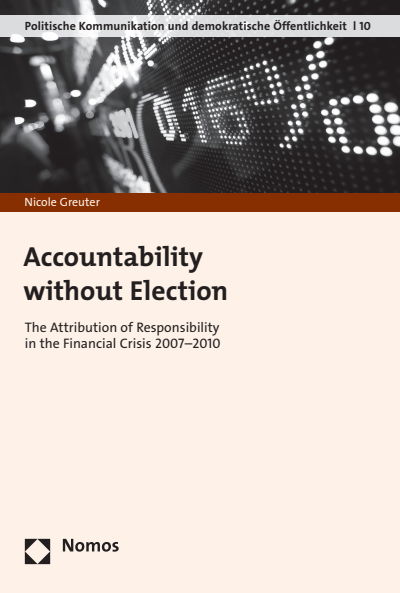
Accountability without Election
The Attribution of Responsibility in the Financial Crisis 2007-2010- Autor:innen:
- Reihe:
- Politische Kommunikation und demokratische Öffentlichkeit, Band 10
- Verlag:
- 2014
Zusammenfassung
Das Werk untersucht die Rolle der Medien in der Finanzkrise 2007–2010. Die Autorin geht der Frage nach, ob die Medien die komplexen Prozesse und politischen Verantwortlichkeiten in der Finanz-marktregulierung für die Wähler akkurat aufbereiten und so zur Kontrolle der politischen Akteure beitragen. Im Zentrum steht die Rolle der Medien als demokratische Kontrollinstanz von unabhängigen Regulierungsbehörden im Finanzsektor.
Die Arbeit schließt mit der Erkenntnis, dass eine „unabhängige“ Finanzmarktaufsicht, zumindest in Zeiten der Krise, in Frage gestellt werden muss. Wie ein gewählter Politiker ist die Aufsicht Teil des öffentlichen Diskurses. Die Bedingungen für die Aufgabenerfüllung der Aufsicht werden in ein neues Licht gestellt.
In englischer Sprache.
Publikation durchsuchen
Bibliographische Angaben
- Auflage
- 1/2014
- Copyrightjahr
- 2014
- ISBN-Print
- 978-3-8487-1449-0
- ISBN-Online
- 978-3-8452-5495-1
- Verlag
- Nomos, Baden-Baden
- Reihe
- Politische Kommunikation und demokratische Öffentlichkeit
- Band
- 10
- Sprache
- Englisch
- Seiten
- 274
- Produkttyp
- Monographie
Inhaltsverzeichnis
- Titelei/Inhaltsverzeichnis Kein Zugriff Seiten 1 - 18
- 1. Introduction Kein Zugriff Seiten 19 - 31
- 2. Responsibility of Non-Elected Policy Actors in Times of Crisis Kein Zugriff Seiten 32 - 84
- 3. Case selection and Methods Kein Zugriff Seiten 85 - 131
- 4. How do Institutional Features of Non-elected Policy Actors affect their Legitimacy? Kein Zugriff Seiten 132 - 189
- 5. Is there a Pattern to Redress Legitimacy? Kein Zugriff Seiten 190 - 236
- 6. Conclusion Kein Zugriff Seiten 237 - 246
- Appendix Kein Zugriff Seiten 247 - 262
- References Kein Zugriff Seiten 263 - 274
Literaturverzeichnis (186 Einträge)
Es wurden keine Treffer gefunden. Versuchen Sie einen anderen Begriff.
- Adcock, Robert; Collier David (2001): Measurement Validity: A Shared Standard for Qualitative and Quantitative Research. In American Political Science. Association 95 (03), pp. 529–546. Google Scholar öffnen DOI: 10.5771/9783845254951
- Arato, Andrew (2002): Representação, soberania popular, e accountability. In Lua Nova (55-56). Google Scholar öffnen DOI: 10.5771/9783845254951
- Arlt, Hans-Jürgen (2010): Wirtschaftsjournalismus in der Krise, Zum massenmedialen Umgang mit Finanzmarktpolitik. In OBS-Arbeitsheft (63), pp. 1–280. Google Scholar öffnen DOI: 10.5771/9783845254951
- Baumgartner, Sabrina (2010): Die Regierungskommunikation der Schweizer Kantone: Regeln, Organisation, Akteure und Instrumente im Vergleich. Wiesbaden: VS Verlag für Sozialwissenschaften. Google Scholar öffnen DOI: 10.5771/9783845254951
- Benoit, William L. (1995): Accounts, excuses, and apologies. A theory of image restoration strategies. Albany: State University of New York Press. Google Scholar öffnen DOI: 10.5771/9783845254951
- Benoit, William L. (2005): Image restoration theory. In Robert L. Heath (Ed.): Encyclopedia of public relations. Thousand Oaks, CA: Sage Publications, pp. 407–410. Google Scholar öffnen DOI: 10.5771/9783845254951
- Bentele, Günter (1998): Polititsche Öffentlichkeitsarbeit. In Ulrich Sarcinelli (Ed.): Politikvermittlung und Demokratie in der Mediengesellschaft : Beiträge zur politischen Kommunikationskultur. Opladen: Westdeutscher Verlag, pp. 124–145. Google Scholar öffnen DOI: 10.5771/9783845254951
- Berganza-Conde, Maria Rosa; Oller Alonso, Martín; Meier, Katrin (2010): Los roles periodísticos y la objetividad en el periodismo político escrito suizo y español: Revista Latina de Comunicación Social. Google Scholar öffnen DOI: 10.5771/9783845254951
- Berkel, Barbara (2008): Politischer Parallelismus in Sachen Europa — Zur Synchronisierung der Meinungen der europäischen Presse im Haider-Konflikt. In Barbara Pfetsch, Silke Adam (Eds.): Massenmedien als politische Akteure. Wiesbaden: VS Verlag für Sozialwissenschaften, pp. 245–265. Google Scholar öffnen DOI: 10.5771/9783845254951
- Birchler, Urs (2010): Inaugural Lecture: Too big too fail, University of Zurich, 10/04/2010. Google Scholar öffnen DOI: 10.5771/9783845254951
- Black, Julia (2008): Constructing and contesting legitimacy and accountability in polycentric regulatory regimes. In Regulation & Governance 2 (2), pp. 137–164. Google Scholar öffnen DOI: 10.5771/9783845254951
- Blöchlinger, Christoph (2009): Reputationsschutz im schweizerischen Kapitalmarktrecht. Zürich: Schulthess Juristische Medien. Google Scholar öffnen DOI: 10.5771/9783845254951
- Blum, Roger (2005): Politischer Journalismus in der Schweiz. In Patrick Donges, Otfried Jarren (Eds.): Politische Kommunikation in der Schweiz. Bern: Haupt, pp. 115–130. Google Scholar öffnen DOI: 10.5771/9783845254951
- Blumler, Jay G.; Gurevitch, Michael (1990): Political Communication Systems and Democratic Values. In Judith Lichtenberg (Ed.): Democracy and the mass media. A collection of essays. New York: Cambridge University Press, pp. 269–287. Google Scholar öffnen DOI: 10.5771/9783845254951
- Boin, Arjen; 't Hart, Paul, Stern; Eric; Sundelius, Bengt (2008): The politics of crisis mangagement. Public leadership under pressure. Cambridge: Cambridge University Press. Google Scholar öffnen DOI: 10.5771/9783845254951
- Bonner, Michelle D. (2009): Media as Social Accountability: The Case of Police Violence in Argentina. In The International Journal of Press/Politics 14 (3), pp. 296–312. Google Scholar öffnen DOI: 10.5771/9783845254951
- Boomgaarden, Hajo G.; van Spanje, Joost; Vliegenthart, Rens; Vreese, Claes H. de (2011): Covering the crisis: Media coverage of the economic crisis and citizens’ economic expectations. In Acta Polit 46 (4), pp. 353–379. Google Scholar öffnen DOI: 10.5771/9783845254951
- Born, Benjamin; Ehrmann, Michael; Fratzscher, Marcel (2011): How Should Central Banks Deal with a Financial Stability Objective? The Evolving Role of Communication as a Policy Instrument. In Sylvester Eijffinger, Donato Masciandaro (Eds.): Handbook of central banking, financial regulation and supervision : after the financial crisis. Cheltenham: Edward Elgar, pp. 244–267. Google Scholar öffnen DOI: 10.5771/9783845254951
- Bovens, Mark (2007): Analysing and Assessing Accountability: A Conceptual Frameworksup. In European Law Journal 13 (4), pp. 447–468. Google Scholar öffnen DOI: 10.5771/9783845254951
- Bovens, Mark; Schillemans, Thomas; t’ Hart; Paul (2008): Does Public Accountability Work? An Assessment Tool. In Public Administration 86 (1), pp. 225–242. Google Scholar öffnen DOI: 10.5771/9783845254951
- Brändström, Annika; Kuipers, Sanneke (2003): From ‘Normal Incidents’ to Political Crises: Understanding the Selective Politicization of Policy Failures. In Government and Opposition 38 (3), pp. 279–305. Google Scholar öffnen DOI: 10.5771/9783845254951
- Braun, Dietmar; Gilardi, Fabrizio; Thatcher, Mark; Giraudi, Giorgio; Genoud, Christophe (2002): Debate: State Intervention and Delegation to Independent Regulatory Agencies. In Swiss Political Science Review 8, pp. 93–125. Google Scholar öffnen DOI: 10.5771/9783845254951
- Bromley, Michael (2010): Media landscape: United Kingdom. Edited by European Journalism Centre. Google Scholar öffnen DOI: 10.5771/9783845254951
- Busch, Andreas (1994): Central bank independence and the Westminster model. In West European Politics 17 (1), pp. 53–72. Google Scholar öffnen DOI: 10.5771/9783845254951
- Christmann, Anna; Hasler, Karin (2012): Global Cities – Local News? A comparative approach to assess metropolitan media systems. Paper presented at the ECPR Joint Sessions of Workshops, Antwerp, April 2012. Google Scholar öffnen DOI: 10.5771/9783845254951
- Coglianese, Cary; Howard, Margaret (1998): Getting the Message Publications Out: Regulatory Policy and the Press. In International Journal of Press/Politics 3 (3), pp. 39–55. Google Scholar öffnen DOI: 10.5771/9783845254951
- Cook, Timothy E. (1989): Making laws and making news. Media strategies in the U.S. House of Representatives. Washington, D.C: Brookings Institution. Google Scholar öffnen DOI: 10.5771/9783845254951
- Coombs, Timothy W. (2008): The future of crisis communication from an international perspective. In Tobias Nolting, Ansgar Thießen (Eds.): Krisenmanagement in der Mediengesellschaft. Wiesbaden: VS Verlag für Sozialwissenschaften, pp. 275–287. Google Scholar öffnen DOI: 10.5771/9783845254951
- Coombs, Timothy W. (1995): Choosing the Right Words. In Management Communication Quarterly 8 (4), pp. 447–476. Google Scholar öffnen DOI: 10.5771/9783845254951
- Coombs, Timothy W. (2007): Attribution Theory as a guide for post-crisis communication research. In Public Relations Review 33 (2), pp. 135–139. Google Scholar öffnen DOI: 10.5771/9783845254951
- Coombs, Timothy W. (2012): Ongoing crisis communication. Planning, managing, and responding. 3rd ed. Thousand Oaks, CA: Sage Publications. Google Scholar öffnen DOI: 10.5771/9783845254951
- Coombs, Timothy W.; Holladay, Sherry J. (1996): Communication and Attributions in a Crisis: An Experiment Study in Crisis Communication. In Journal of Public Relations Research 8 (4), pp. 279–295. Google Scholar öffnen DOI: 10.5771/9783845254951
- Cukierman, Alex; Web, Steven B.; Neyapti, Bilin (1992): Measuring the Independence of Central Banks and Its Effect on Policy Outcomes. In World Bank Econ Rev 6 (3), pp. 353–398. Google Scholar öffnen DOI: 10.5771/9783845254951
- Curran, James (1996): Mass media and society. London: Arnold. Google Scholar öffnen DOI: 10.5771/9783845254951
- Curran, James; Iyengar, Shanto; Brink Lund, Anker; Salovaara-Moring, Inka (2009): Media System, Public Knowledge and Democracy: A Comparative Study. In European Journal of Communication 24 (1), pp. 5–26. Google Scholar öffnen DOI: 10.5771/9783845254951
- Deacon, David; Monk, Wendy (2001): Quangos and the `Communications Dependent Society'. In European Journal of Communication 16 (1), pp. 25–49. Google Scholar öffnen DOI: 10.5771/9783845254951
- Deutsche Bank (2010): Direct fiscal cost of the financial crisis: Research Briefing. Google Scholar öffnen DOI: 10.5771/9783845254951
- Donges, Patrick (2005): Medialisierung der Politik – Vorschlag einer Differenzierung. In Patrick Rössler, Friedrich Krotz (Eds.): Mythen der Mediengesellschaft. Konstanz: UVK Verlag. Schriftenreihe der Deutschen Gesellschaft für Publizistik- und Kommunikationswissenschaft, 32, pp. 341–370. Google Scholar öffnen DOI: 10.5771/9783845254951
- Donsbach, Wolfgang; Patterson, Thomas E. (2004): Political News Journalists. In Frank Esser, Barbara Pfetsch (Eds.): Comparing political communication : theories, cases, and challenges. New York: Cambridge University Press, pp. 251–270. Google Scholar öffnen DOI: 10.5771/9783845254951
- Downs, Anthony; Wildenmann, Rudolf; Walentik, Leonhard (1968): Ökonomische Theorie der Demokratie. Tübingen: J.C.B. Mohr. Google Scholar öffnen DOI: 10.5771/9783845254951
- Eidgenössische Finanzmarktaufsicht FINMA; Schweizerische Nationalbank SNB (2010): Memorandum of Understanding im Bereich Finanzmarktstabilität (23/02/2010). Google Scholar öffnen DOI: 10.5771/9783845254951
- Eidgenössisches Finanzdepartement EFD; Eidgenössische Finanzmarktaufsicht FINMA; Schweizerische Nationalbank SNB (2011): Memorandum of Understanding im Bereich Finanzstabilität und Informationsaustausch zur Finanzmarktregulierung (11/01/2011). Google Scholar öffnen DOI: 10.5771/9783845254951
- Entman, Robert M. (2004): Projections of power. Framing news, public opinion, and U.S. foreign policy. Chicago: University of Chicago Press. Google Scholar öffnen DOI: 10.5771/9783845254951
- Entman, Robert M. (2007): Framing Bias: Media in the Distribution of Power. In Journal of Communication 57 (1), pp. 163–173. Google Scholar öffnen DOI: 10.5771/9783845254951
- Esser, Frank (2013): Mediatization as a Challenge: Media Logic Versus Political Logic. In Hanspeter Kriesi, Sandra Lavenex, Frank Esser, Jörg Matthes, Marc Bühlmann, Daniel Bochsler (Eds.): Democracy in the age of globalization and mediatization, pp. 155–176. Google Scholar öffnen DOI: 10.5771/9783845254951
- Farvaque, Etienne (2002): Political determinants of central bank independence. In Economics Letters 77 (1), pp. 131–135. Google Scholar öffnen DOI: 10.5771/9783845254951
- Frach, Lotte (2008): Finanzaufsicht in Deutschland und Großbritannien. Wiesbaden: VS Verlag für Sozialwissenschaften. Google Scholar öffnen DOI: 10.5771/9783845254951
- Freelon, Deen G. (2010): ReCal: Intercoder Reliability Calculation as a Web Service. In International Journal of Internet Science 5 (1), pp. 20–33. Google Scholar öffnen DOI: 10.5771/9783845254951
- Früh, Werner (2007): Inhaltsanalyse. Theorie und Praxis. Konstanz: UVK Verlag. Google Scholar öffnen DOI: 10.5771/9783845254951
- Galtung, Johan; Ruge Holmboe, Mari (1965): The structure of foreign news. In Journal of peace research 2 (1), pp. 64–91. Google Scholar öffnen DOI: 10.5771/9783845254951
- Geiger, Hans (2009): Expertengutachten über das Verhalten der Finanzmarktaufsicht in der Finanzkrise zuhanden Eidgenössische Finanzverwaltung (EFV). Google Scholar öffnen DOI: 10.5771/9783845254951
- Gerhards, Jürgen; Roose, Jochen; Offerhaus, Anke (2007): Die Öffentliche Zuschreibung von Verantwotung. In KZfSS Kölner Zeitschrift für Soziologie und Sozialpsychologie 59 (1), pp. 105–124. Google Scholar öffnen DOI: 10.5771/9783845254951
- Gerhards, Jürgen; Roose, Jochen; Offerhaus, Anke (2009): Wer ist verantwortlich? Die Europäische Union, ihre Nationalstaaten und die massenmediale Attribution von Verantwortung für Erfolge und Misserfolge. In Frank Marcinkowski, Barbara Pfetsch (Eds.): Politik in der Mediendemokratie. Wiesbaden: VS Verlag für Sozialwissenschaften, pp. 529–558. Google Scholar öffnen DOI: 10.5771/9783845254951
- Gerhards; Jürgen; Roose, Jochen; Offerhaus, Anke (2004): AttrEU: Die Europäische Union und die massenmediale Attribution von Verantwortung. Eine länder-, zeit- und medienvergleichende Untersuchung. Codebuch zur Inhaltsanalyse der EU-Berichterstattung der Süddeutschen Zeitung, der Frankfurter Allgemeinen Zeitung, der Times und des Guardians von 1994-2003. Google Scholar öffnen DOI: 10.5771/9783845254951
- Gilardi, Fabrizio (2002): Policy credibility and delegation to independent regulatory agencies: a comparative empirical analysis. In Journal of European Public Policy 9 (6), pp. 873–893. Google Scholar öffnen DOI: 10.5771/9783845254951
- Gilardi, Fabrizio (2005): The Formal Independence of Regulators: A Comparison of 17 Countries and 7 Sectors. In Swiss Political Science Review 11 (4), pp. 139–167. Google Scholar öffnen DOI: 10.5771/9783845254951
- Gilardi, Fabrizio (2005b): The Institutional Foundations of Regulatory Capitalism: The Diffusion of Independent Regulatory Agencies in Western Europe. In The Annals of the American Academy of Political and Social Science 598 (1), pp. 84–101. Google Scholar öffnen DOI: 10.5771/9783845254951
- Gilardi, Fabrizio (2008): Delegation in the regulatory state. Independent regulatory agencies in Western Europe. Cheltenham, UK; Northampton, MA: Edward Elgar. Google Scholar öffnen DOI: 10.5771/9783845254951
- Glazer, Amihai; Segendorff, Bjorn (2005): Credit claiming. In Economics of Governance 6 (2), pp. 125–137. Google Scholar öffnen DOI: 10.5771/9783845254951
- Gormley, William T. (1983): The politics of public utility regulation. Pittsburgh (Pa.): University of Pittsburgh Press. Google Scholar öffnen DOI: 10.5771/9783845254951
- Green-Pedersein, Christoffer; Mortensen, Peter B. (2010): Who sets the agenda and who responds to it in the Danish parliament? A new model of issue competition and agenda-setting. In European Journal of Political Research 49 (2), pp. 257–281. Google Scholar öffnen DOI: 10.5771/9783845254951
- Grossenbacher, René (2010): Staatskommunikation und Medien – die ungleichen siamesischen Zwillinge. In Bernhard Ehrenzeller, Urs Saxer (Eds.): Recht und Praxis. St. Gallen: Institut für Rechtswissenschaft und Rechtspraxis, pp. 131–144. Google Scholar öffnen DOI: 10.5771/9783845254951
- Gurevitch, Michael; Blumler, Jay G. (1990): Political communication systems and democratic values. In Judith Lichtenberg (Ed.): Democracy and the mass media. A collection of essays. Cambridge, New York: Cambridge University Press, pp. 269–289. Google Scholar öffnen DOI: 10.5771/9783845254951
- Habermas, Jürgen (2006): Political Communication in Media Society: Does Democracy Still Enjoy an Epistemic Dimension? The Impact of Normative Theory on Empirical Research. In Communication Theory 16 (4), pp. 411–426. Google Scholar öffnen DOI: 10.5771/9783845254951
- Hagen, Lutz M. (1993): Opportune Witnesses: An Analysis of Balance in the Selection of Sources and Arguments in the Leading German Newspapers' Coverage of the Census Issue. In European Journal of Communication 8 (3), pp. 317–343. Google Scholar öffnen DOI: 10.5771/9783845254951
- Hallin, Daniel C.; Mancini, Paolo (2004): Comparing media systems: three models of media and politics. Cambridge: Cambridge University Press. Google Scholar öffnen DOI: 10.5771/9783845254951
- Hanitzsch, Thomas; Hanusch, Folker; Mellado, Claudia; Anikina, Maria; Berganza-Conde, Maria Rosa; Cangoz, Incilay (2011): Mapping Journalism Cultures across Nations. In Journalism Studies 12 (3), pp. 273–293. Google Scholar öffnen DOI: 10.5771/9783845254951
- Hanitzsch, Thomas; Mellado, Claudia (2008): Journalism Cultures. In Wolfgang Donsbach (Ed.): International encyclopedia of communication online. Malden, MA: Wiley/Blackwell. Google Scholar öffnen DOI: 10.5771/9783845254951
- Hardmeier, Sibylle (2005): Public Relations der öffentlichen Hand in der Schweiz. In Patrick Donges, Otfried Jarren (Eds.): Politische Kommunikation in der Schweiz. Bern: Haupt, pp. 91–113. Google Scholar öffnen DOI: 10.5771/9783845254951
- Hasler, Karin; Greuter, Nicole (2010): The public attribution of responsibility: an international comparison. In The Sixth Annual Graduate Conference in Political Science, The Hebrew University Mount Scopus Campus Jerusalem, 15 December 2010 – 17 December 2010, pp. 1–16. Google Scholar öffnen DOI: 10.5771/9783845254951
- Heath, Robert L. (2005): Encyclopedia of public relations. Thousand Oaks, CA: Sage Publications. Google Scholar öffnen DOI: 10.5771/9783845254951
- Hjarvard, Stig (2008): The Mediatization of Society The Mediatization of Society: A Theory of the Media as Agents of Social and Cultural Change. In Nordicom Review 29 (2), pp. 105–134. Google Scholar öffnen DOI: 10.5771/9783845254951
- Hodson, Dermot; Quaglia, Lucia (2009): European Perspectives on the Global Financial Crisis: Introduction. In Journal of Common Market Studies 47 (5), pp. 939–953. Google Scholar öffnen DOI: 10.5771/9783845254951
- Hood, Christopher (2002): The Risk Game and the Blame Game. In Government and Opposition 37 (1), pp. 15–37. Google Scholar öffnen DOI: 10.5771/9783845254951
- Hood, Christopher (2007): What happens when transparency meets blame-avoidance? In Public Management Review 9 (2), pp. 191–210. Google Scholar öffnen DOI: 10.5771/9783845254951
- Hood, Christopher; Rothstein, Henry (2001): Risk Regulation Under Pressure. In Administration & Society 33 (1), pp. 21–53. Google Scholar öffnen DOI: 10.5771/9783845254951
- Hooghe, Liesbeth; Marks, Gary (2003): Unraveling the Central State, but How? Types of Multi-level Governance. In American Political Science Review 97 (02). Google Scholar öffnen DOI: 10.5771/9783845254951
- Hüpkes, Eva (2005): The accountability of financial sector supervisors. Principles and practice. In IMF Working Paper 05, 2005 (51), pp. 1–51. Google Scholar öffnen DOI: 10.5771/9783845254951
- Iyengar, Shanto (1990): Framing Responsibility for Political Issues: The Case of Poverty. In Political Behavior 12 (1), pp. 19–40. Google Scholar öffnen DOI: 10.5771/9783845254951
- Jarren, Ottfried (2006): Politische Kommunikation in der Mediengesellschaft : eine Einführung. With assistance of Patrick Donges. Wiesbaden: VS Verlag für Sozialwissenschaften. Google Scholar öffnen DOI: 10.5771/9783845254951
- Jarren, Ottfried; Vogel, Martina (2008): Gesellschaftliche Selbstbeobachtung und Ko-Orientierung: Die Leitmedien der modernen Gesellschaft. In Peter Gendolla, Annemone Ligensa, Daniel Müller (Eds.): Leitmedien. Konzepte – Relevanz – Geschichte, Band 1. Bielefeld: Transcript, pp. 71–92. Google Scholar öffnen DOI: 10.5771/9783845254951
- Jones, Erik (2009): Output Legitimacy and the Global Financial Crisis: Perceptions Matter. In Journal of Common Market Studies 47 (5), pp. 1085–1105. Google Scholar öffnen DOI: 10.5771/9783845254951
- Kaltenthaler, Karl; Anderson, Christopher; Miler, William J. (2010): Accountability and Independent Central Banks: Europeans and Distrust of the European Central Bank. In Journal of Common Market Studies 48 (5), pp. 1261–1281. Google Scholar öffnen DOI: 10.5771/9783845254951
- Kleinsteuber, Hans J.; Thomass, Barbara (2012): Media landscape: Germany. Edited by European Journalism Centre. Google Scholar öffnen DOI: 10.5771/9783845254951
- Koop, Christel (2011): Explaining the Accountability of Independent Agencies: The Importance of Political Salience. In Journal of Public Policy 31 (02), pp. 209–234. Google Scholar öffnen DOI: 10.5771/9783845254951
- Kratochvil, Petr; Cibulkova, Petra; Benik, Michal (2011): The EU as a ‘Framing Actor’: Reflections on Media Debates about EU Foreign Policy. In Journal of Common Market Studies 49 (2), pp. 391–412. Google Scholar öffnen DOI: 10.5771/9783845254951
- Kriesi, Hanspeter (2004): Strategic Political Communication. In Frank Esser, Barbara Pfetsch (Eds.): Comparing political communication : theories, cases, and challenges. New York: Cambridge University Press, pp. 184–212. Google Scholar öffnen DOI: 10.5771/9783845254951
- Lauf, Edmund (2001): ».96 nach Holsti« Zur Reliabilität von Inhaltsanalysen und deren Darstellung in kommunikationswissenschaftlichen Fachzeitschriften. In Pub 46 (1), pp. 57–68. Google Scholar öffnen DOI: 10.5771/9783845254951
- Lijphart, Arend (1999): Patterns of democracy. Government forms and performance in thirty-six countries. New Haven: Yale University Press. Google Scholar öffnen DOI: 10.5771/9783845254951
- Lilleker, Darren G. (2009): Key concepts in political communication. London: Sage Publications. Google Scholar öffnen DOI: 10.5771/9783845254951
- Llewellyn, David T. (2006): Institutional Structure of Financial Regulation and Supervision: The Basic Issues. Paper presented at the World Bank Seminar: Aligning Supervisory Structures with Country Needs 6–7 June World Bank Washington DC. Google Scholar öffnen DOI: 10.5771/9783845254951
- Lundby, Knut (2009): Mediatization. Concept, changes, consequences. New York, NY: Lang. Google Scholar öffnen DOI: 10.5771/9783845254951
- Lybeck, Johan A. (2011): A global history of the financial crash of 2007-2010. New York: Cambridge University Press. Google Scholar öffnen DOI: 10.5771/9783845254951
- Macleavy, Julie (2005): The Quango Debate. Research Paper. With assistance of Oonagh Gay. Parliament and Constitution Centre. House of Commons Library (05/30). Google Scholar öffnen DOI: 10.5771/9783845254951
- Maggetti, Martino (2007): De facto independence after delegation: A fuzzy-set analysis. In Regulation & Governance 1 (4), pp. 271–294. Google Scholar öffnen DOI: 10.5771/9783845254951
- Maggetti, Martino (2009): The role of independent regulatory agencies in policy-making: a comparative analysis. In Journal of European Public Policy 16 (3), pp. 450–470. Google Scholar öffnen DOI: 10.5771/9783845254951
- Maggetti, Martino (2011): The media accountability of independent regulatory agencies. In European Political Science Review, pp. 1–24. Google Scholar öffnen DOI: 10.5771/9783845254951
- Maggetti, Martino; Puppis, Manuel (2012): The Accountability and Legitimacy of Regulatory Agencies in the Communication Sector. In Natascha Just, Manuel Puppis (Eds.): Trends in Communication Policy Research. Bristol: Intellect, pp. 75–94. Google Scholar öffnen DOI: 10.5771/9783845254951
- Magnette, Paul (2000): Towards 'Accountable Independence'? Parliamentary Controls of the European Central Bank and the Rise of a New Democratic Model. In European Law Journal 6 (4). Google Scholar öffnen DOI: 10.5771/9783845254951
- Maia, Rousiley Celi Moreira (2009): Media Visibility and the Scope of Accountability. In Critical Studies in Media Communication 26 (4), pp. 372–392. Google Scholar öffnen DOI: 10.5771/9783845254951
- Majone, Giandomenico (1994): The rise of the regulatory state in Europe. In West European Politics 17 (3), pp. 77–101. Google Scholar öffnen DOI: 10.5771/9783845254951
- Majone, Giandomenico (1997): From the Positive to the Regulatory State: Causes and Consequences of Changes in the Mode of Governance. In Journal of Public Policy 17 (2), pp. 139–167. Google Scholar öffnen DOI: 10.5771/9783845254951
- Majone, Giandomenico (1999): The regulatory state and its legitimacy problems. In West European Politics 22 (1), pp. 1–24. Google Scholar öffnen DOI: 10.5771/9783845254951
- Majone, Giandomenico (2001): Non-majoritarian Institutions and the Limits of Democratic Governance: A Political Transaction-Cost Approach. In Journal of Institutional and Theoretical Economics 157 (1), pp. 57–78. Google Scholar öffnen DOI: 10.5771/9783845254951
- Marcinkowski, Frank (2005): Die "Medialisierbarkeit" politischer Institutionen. In Patrick Rössler, Friedrich Krotz (Eds.): Mythen der Mediengesellschaft. Konstanz: UVK Verlag, Schriftenreihe der Deutschen Gesellschaft für Publizistik- und Kommunikationswissenschaft, 32, pp. 321–340. Google Scholar öffnen DOI: 10.5771/9783845254951
- Marcinkowski, Frank (2006): Mediensystem und politische Kommunikation. In Ulrich Klöti, Peter Knoepfel, Hanspeter Kriesi, Wolf Linder, Yannis Papadopoulos, Pascal Sciarini (Ed.): Handbuch der Schweizer Politik. 4th edition. Zürich: NZZ-Libro, pp. 393–424. Google Scholar öffnen DOI: 10.5771/9783845254951
- Marcinkowski, Frank; Pfetsch, Barbara (2009): Politik in der Mediendemokratie. Wiesbaden: VS Verlag für Sozialwissenschaften. Google Scholar öffnen DOI: 10.5771/9783845254951
- Marschall, Stefan (2009): Medialisierung komplexer politischer Akteure – Indikatoren und Hypothesen am Beispiel von Parlamenten. In Frank Marcinkowski, Barbara Pfetsch (Eds.): Politik in der Mediendemokratie. Wiesbaden: VS Verlag für Sozialwissenschaften, pp. 205–223. Google Scholar öffnen DOI: 10.5771/9783845254951
- Marti, Laurent; Keller, Dominic (2006): Medialisierung unabhängiger Regulierungsbehörden? Lizenziatsarbeit Universität Zürich. Google Scholar öffnen DOI: 10.5771/9783845254951
- Masciandaro, Donato (2007): Designing financial supervision institutions. Independence, accountability and governance. Cheltenham: Edward Elgar. Google Scholar öffnen DOI: 10.5771/9783845254951
- Masciandaro, Donato (2005): Handbook of central banking and financial authorities in Europe. New architectures in the supervision of financial markets. Cheltenham: Edward Elgar. Google Scholar öffnen DOI: 10.5771/9783845254951
- Masciandaro, Donato; Quintyn, Marc (2007): Designing financial supervision institutions. Independence, accountability and governance. Cheltenham: Edward Elgar. Google Scholar öffnen DOI: 10.5771/9783845254951
- Masciandaro, Donato; Quintyn, Marc (2011): Regulating the Regulators: The Changing Face of Financial Supervision Architectures Bedore and After the Financial Crisis. In Sylvester Eijffinger, Donato Masciandaro (Eds.): Handbook of central banking, financial regulation and supervision : after the financial crisis. Cheltenham: Edward Elgar, pp. 454–484. Google Scholar öffnen DOI: 10.5771/9783845254951
- Mazzoleni, Gianpietro; Schulz, Winfried (1999): "Mediatization" of Politics: A Challenge for Democracy? In Political Communication 16 (3), pp. 247–261. Google Scholar öffnen DOI: 10.5771/9783845254951
- Meier, Werner A. (2010): Media landscape: Switzerland. Edited by European Journalism Centre. Google Scholar öffnen DOI: 10.5771/9783845254951
- Merten, Klaus (1995): Inhaltsanalyse. Einführung in Theorie, Methode und Praxis. Opladen: Westdeutscher Verlag. Google Scholar öffnen DOI: 10.5771/9783845254951
- Meyer, Christoph (1999): Political Legitimacy and the Invisibility of Politics: Exploring the European Union’s Communication Deficit. In Journal of Common Market Studies 37 (4), pp. 617–639. Google Scholar öffnen DOI: 10.5771/9783845254951
- Meyer, Christoph (2005): The Europeanization of Media Discourse: A Study of Quality Press Coverage of Economic Policy Co-ordination since Amsterdam. In Journal of Common Market Studies 43 (1), pp. 121–148. Google Scholar öffnen DOI: 10.5771/9783845254951
- Müller, Wolfgang C.; Bergman, Torbjörn; Strøm, Kaare (2003): Parliamentary Democracy. With assistance of Torbjörn Bergman, Kaare Strøm. In Kaare Strøm, Wolfgang C. Müller, Torbjörn Bergman (Eds.): Delegation and accountability in parliamentary democracies. Oxford: Oxford University Press, pp. 3–32. Google Scholar öffnen DOI: 10.5771/9783845254951
- Nelkin, Dorothy (1992): Controversy. Politics of technical decisions. Newbury Park, CA: Sage Publications. Google Scholar öffnen DOI: 10.5771/9783845254951
- Neue Zürcher Zeitung (2012): Philipp Hildebrand tritt zurück. Neue Zürcher Zeitung, 9. Januar 2012. Google Scholar öffnen DOI: 10.5771/9783845254951
- Nobel, Peter; Zimmermann, Heinz (2005): Reguleriung, Selbstregulierung, Überregulierung. In Peter Nobel, Urs Bertschinger (Eds.): Aktuelle Rechtsprobleme des Finanz- und Börsenplatzes Schweiz. Bern: Stämpfli, pp. 53–94. Google Scholar öffnen DOI: 10.5771/9783845254951
- Nolting, Tobias; Thießen, Ansgar (2008): Krisenmanagement in der Mediengesellschaft. Wiesbaden: VS Verlag für Sozialwissenschaften. Google Scholar öffnen DOI: 10.5771/9783845254951
- Nord, Lars W.; Strömbäck, Jesper (2003): Making Sense of Different Types of Crises: A Study of the Swedish Media Coverage of the Terror Attacks Against the United States and the U.S. Attacks in Afghanistan. In International Journal of Press/Politics 8 (4), pp. 54–75. Google Scholar öffnen DOI: 10.5771/9783845254951
- Norris, Pippa (2008): Political Communication. In Daniele Caramani (Ed.): Comparative politics. Oxford: Oxford University Press, pp. 352–370. Google Scholar öffnen DOI: 10.5771/9783845254951
- Oldfield, Claire (2009): The credit crunch commentariat. A report. London: Editorial Intelligence. Google Scholar öffnen DOI: 10.5771/9783845254951
- Papadopoulos, Yannis (2010a): Accountability and Multi-level Governance: More Accountability, Less Democracy? In West European Politics 33 (5), pp. 1030–1049. Google Scholar öffnen DOI: 10.5771/9783845254951
- Papadopoulos, Yannis (2010b): Governance und Demokratie. In Arthur Benz (Ed.): Governance – Regieren in komplexen Regelsystemen : eine Einführung. 2nd ed. Wiesbaden: VS Verlag für Sozialwissenschaften, pp. 225–249. Google Scholar öffnen DOI: 10.5771/9783845254951
- Pfetsch, Barbara (2003): Politische Kommunikationskultur : politische Sprecher und Journalisten in der Bundesrepublik und den USA im Vergleich. Wiesbaden: Westdeutscher Verlag. Google Scholar öffnen DOI: 10.5771/9783845254951
- Pfetsch, Barbara; Adam, Silke (2008): Die Akteursperspektive in der politischen Kommunikationsforschung — Fragestellungen, Forschungsparadigmen und Problemlagen. In Barbara Pfetsch, Silke Adam (Eds.): Massenmedien als politische Akteure. Wiesbaden: VS Verlag für Sozialwissenschaften, pp. 9–26. Google Scholar öffnen DOI: 10.5771/9783845254951
- Pidgeon, Nick (1997): The Limits to Safety? Culture, Politics, Learning and Man-Made Disasters. In Journal of Contingencies & Crisis Management 5 (1), p. 1. Google Scholar öffnen DOI: 10.5771/9783845254951
- Polillo, Simone; Guillén, Mauro (2005): Globalization Pressures and the State: The Worldwide Spread of Central Bank Independence. In American Journal of Sociology 110 (6), pp. 1764–1802. Google Scholar öffnen DOI: 10.5771/9783845254951
- Pollak, Johannes; Riekmann, Sonja Puntscher (2008): European administration: Centralisation and fragmentation as means of polity-building? In West European Politics 31 (4), pp. 771–788. Google Scholar öffnen DOI: 10.5771/9783845254951
- Puppis, Manuel; Maggetti, Martino; Gilardi, Fabrizio; Papadopoulos, Yannis; Biela, Jan (2012): Accountability and the Political Communication of Indepdentent Regulatory Agencies. In Workshop Special Issues, pp. 1–25. Google Scholar öffnen DOI: 10.5771/9783845254951
- Quintyn, Marc (2009): Independent agencies: more than a cheap copy of independent central banks? In Constitutional Political Economy 20 (3-4), pp. 267–295. Google Scholar öffnen DOI: 10.5771/9783845254951
- Quiring, Oliver; Weber, Mathias (2012): Between Usefulness and Legitimacy: Media Coverage of Governmental Intervention during the Financial Crisis and Selected Effects. In International Journal of Press/Politics 17 (3), pp. 294–315. Google Scholar öffnen DOI: 10.5771/9783845254951
- Rasonyi, Peter (2012): Die Bank of England in schiefem Licht. In Neue Zürcher Zeitung 233, 18/07/2012 (165), p. 1. Google Scholar öffnen DOI: 10.5771/9783845254951
- Rössler, Patrick (2005): Inhaltsanalyse. Konstanz: UVK-Verlag. Google Scholar öffnen DOI: 10.5771/9783845254951
- Rudolph, Thomas J. (2003): Who's Responsible for the Economy? The Formation and Consequences of Responsibility Attributions. In American Journal of Political Science 47 (4), pp. 698–713. Google Scholar öffnen DOI: 10.5771/9783845254951
- Popkin, Samuel L. (1991): The reasoning voter: communication and persuasion in presidential campaigns. Chicago: The University of Chicago Press. Google Scholar öffnen DOI: 10.5771/9783845254951
- Saward, Michael (2006): The Representative Claim. In Contemporary Political Theory 5 (3), pp. 297–318. Google Scholar öffnen DOI: 10.5771/9783845254951
- Saxer, Urs (2012): Behördenkommunikation in der Krise. Presentation at the HSG Symposium Die Krisenkommunikation des Staates, Kongresshaus Zürich, 4th April 2012. Google Scholar öffnen DOI: 10.5771/9783845254951
- Scheufele, Bertram (2007): Berichterstattung, Emotionen und politische Legitimierung. Eine experimentelle Untersuchung zum Einfluss der Politikberichterstattung auf die Legitimierung politischer Entscheidungen am Beispiel von Bundeswehreinsätzen. In Medien & Kommunikationswissenschaft 55 (4), pp. 534–554. Google Scholar öffnen DOI: 10.5771/9783845254951
- Schifferes, Steve (2011): The Financial Crisis and the UK Media. In Anya Schiffrin (Ed.): Bad news. How America's business press missed the story of the century. New York: New Press, pp. 148–178. Google Scholar öffnen DOI: 10.5771/9783845254951
- Schlenker, Barry R.; Britt, Thomas W.; Pennington, John; Murphy, Rodolfo; Doherty, Kevin (1994): The Triangle Model of Responsibility. In Psychological Review 101 (4), pp. 632–652. Google Scholar öffnen DOI: 10.5771/9783845254951
- Schneider, Steffen; Haunss Sebastian (2011): The Media as Platform and Commentator of Political Self-Legitimations: A Discourse Network Analytical Perspective. In Paper presented at the Joint Conference of SVPW, ÖGPW and DVPW, Basel, 14 January 2011, pp. 1–35. Google Scholar öffnen DOI: 10.5771/9783845254951
- Schulz, Winfried (2008): Political Communication. In Wolfgang Donsbach (Ed.): International encyclopedia of communication online. Malden, MA: Wiley/Blackwell. Google Scholar öffnen DOI: 10.5771/9783845254951
- Schuppert, Gunnar Folke; Zürn, Michael (2008): Governance in einer sich wandelnden Welt. Wiesbaden: VS Verlag für Sozialwissenschaften. Google Scholar öffnen DOI: 10.5771/9783845254951
- Schwarz, Andreas (2008): Covariation-Based Causal Attributions during Organizational Crises: Suggestions for Extending Situational Crisis Communication Theory (SCCT). In International Journal of Strategic Communication 2 (1), pp. 31–53. Google Scholar öffnen DOI: 10.5771/9783845254951
- Seymour, Ure C. (1974): The political impact of mass media. London, Beverly Hills CA: Sage Publications. Google Scholar öffnen DOI: 10.5771/9783845254951
- Sheafer, Tamir; Gabay, Itay (2009): Mediated Public Diplomacy: A Strategic Contest over International Agenda Building and Frame Building. In Political Communication 26 (4), pp. 447–467. Google Scholar öffnen DOI: 10.5771/9783845254951
- Shoemaker, Pamela J.; Reese Stephan D. (1996): Mediating the Message: Theories of Influences on Mass Media Content. White Plains: Longman Publishers USA. Google Scholar öffnen DOI: 10.5771/9783845254951
- Sibun, Jonathan (2012): Libor scandal highlights the need to ask 'who will guard the guards?' In The Daily Telegraph, 18/07/2012 (National Edition), p. 2. Google Scholar öffnen DOI: 10.5771/9783845254951
- Smith, Denis (1990): Beyond contingency planning: towards a model of crisis management. In Organization & Environment 4 (4), pp. 263–275. Google Scholar öffnen DOI: 10.5771/9783845254951
- Strohmeier, Gerd (2011): Westminister im Wandel. In Aus Politik und Zeitgeschichte B (4), pp. 32–40. Google Scholar öffnen DOI: 10.5771/9783845254951
- Strömbäck, Jesper (2006): Mismanagement, mistrust and missed opportunities: a study of the 2004 tsunami and Swedish political communication. In Media, Culture & Society 28 (5), pp. 789–800. Google Scholar öffnen DOI: 10.5771/9783845254951
- Strömbäck, Jesper (2008): Four Phases of Mediatization: An Analysis of the Mediatization of Politics. In The International Journal of Press/Politics 13 (3), pp. 228–246. Google Scholar öffnen DOI: 10.5771/9783845254951
- Strömbäck, Jesper (2008): It’s the perceptions, stupid. In Communication Director (1), pp. 68–70. Google Scholar öffnen DOI: 10.5771/9783845254951
- Strömbäck, Jesper (2009): Shaping Poltics: Mediatization and Media Interventionism. With assistance of Frank Esser. In Knut Lundby (Ed.): Mediatization. Concept, changes, consequences. New York, NY: Lang, pp. 205–223. Google Scholar öffnen DOI: 10.5771/9783845254951
- Strömback, Jesper; Nord, Lars W. (2006): Do Politicians Lead the Tango? In European Journal of Communication 21 (2), pp. 147–164. Google Scholar öffnen DOI: 10.5771/9783845254951
- Tambini,; Damian (2010): Beyond the great crash of 2008: questioning journalists’ legal and ethical frameworks. In Ethical space: the international journal of communication ethics, 7 (3) 7 (3), pp. 1–14. Google Scholar öffnen DOI: 10.5771/9783845254951
- The Observer (2012): Banking: Our whole society has been warped by the City, 1/07/2012, p. 30. Google Scholar öffnen DOI: 10.5771/9783845254951
- Thesen, Gunnar (2011): Attack and Defend! Explaining Opposition and Government Responses to News Stories. In Paper prepared for the workshop "Agenda-setting and media", Paris, May 30, 2011, 2011, pp. 1–35. Google Scholar öffnen DOI: 10.5771/9783845254951
- Trechsel, Alexander H. (2010): Reflexive Accountability and Direct Democracy. In West European Politics 33 (5), pp. 1050–1064. Google Scholar öffnen DOI: 10.5771/9783845254951
- Tresch, Anke (2009): Politicians in the Media: Determinants of Legislators' Presence and Prominence in Swiss Newspapers. In The International Journal of Press/Politics 14 (1), pp. 67–90. Google Scholar öffnen DOI: 10.5771/9783845254951
- Twight, Charlotte (1991): From Claiming Credit to Avoiding Blame: The Evolution of Congressional Strategy for Asbestos Management. In Journal of Public Policy 11 (2), pp. 153–186. Google Scholar öffnen DOI: 10.5771/9783845254951
- Ulmer, Marion (2008): Finanzplatzkommunikation. Ansätze zur Steigerung der Wettbewerbsfähigkeit von Finanzplätzen durch Kommunikationspolitik am Beispiel der Schweiz. Bern: Haupt. Google Scholar öffnen DOI: 10.5771/9783845254951
- van Dalen, Arjen. (2011): Structural Bias in Cross-National Perspective: How Political Systems and Journalism Cultures Influence Government Dominance in the News. In The International Journal of Press/Politics 17 (1), pp. 32–55. Google Scholar öffnen DOI: 10.5771/9783845254951
- van Slyke, David. M. (2004): What Do They Know, and Whom Do They Hold Accountable? Citizens in the Government-Nonprofit Contracting Relationship. In Journal of Public Administration Research and Theory 14 (2), pp. 191–209. Google Scholar öffnen DOI: 10.5771/9783845254951
- Vatter, Adrian (2009): Lijphart expanded: three dimensions of democracy in advanced OECD countries? In European Political Science Review 1 (01), pp. 125–154. Google Scholar öffnen DOI: 10.5771/9783845254951
- Vibert, Frank (2007): The rise of the unelected. Democracy and the new separation of powers. Cambridge: Cambridge University Press. Google Scholar öffnen DOI: 10.5771/9783845254951
- Vogel, Martina (2010): Regierungskommunikation im 21. Jahrhundert : ein Vergleich zwischen Grossbritannien, Deutschland und der Schweiz. Baden-Baden: Nomos Verlag. Google Scholar öffnen DOI: 10.5771/9783845254951
- Voltmer, Katrin (1997): Medien und Parteien im Wahlkampf. Die ideologischen Präferenzen der meinungsführenden Tageszeitungen im Bundestagswahlkampf 1990. In Rundfunk und Fernsehen 45 (2), pp. 173-193. Google Scholar öffnen DOI: 10.5771/9783845254951
- Voltmer, Katrin (2007): Massenmedien und politische Entscheidungen – mediale Einflussfaktoren im Policyprozess. In Sigrid Koch-Baumgarten, Mez Lutz (Eds.): Medien und Policy : neue Machtkonstellationen in ausgewählten Politikfeldern. Frankfurt a.M: P. Lang, pp. 19–38. Google Scholar öffnen DOI: 10.5771/9783845254951
- Walgrave, Stefaan; Soroka, Stuart; Nuytemans, Michiel (2008): The Mass Media's Political Agenda-Setting Power. In Comparative Political Studies 41 (6), pp. 814–836. Google Scholar öffnen DOI: 10.5771/9783845254951
- Walgrave, Stefaan; van Aelst, Peter (2006): The Contingency of the Mass Media's Political Agenda Setting Power: Toward a Preliminary Theory. In Journal of Communication 56 (1), pp. 88–109. Google Scholar öffnen DOI: 10.5771/9783845254951
- Weaver, Kent R. (1986): The Politics of Blame Avoidance. In Journal of Public Policy 6 (4), pp. 371–398. Google Scholar öffnen DOI: 10.5771/9783845254951
- Wessels, Bernhard (2000): Die Entwicklung des deutschen Korporatismus. In Aus Politik und Zeitgeschichte 2000 (26-27), pp. 7–15. Google Scholar öffnen DOI: 10.5771/9783845254951
- Westrup, Jonathan (2007a): Independence and Accountability: Why Politicy Matters. In Donato Masciandaro, Marc Quintyn (Eds.): Designing financial supervision institutions. Independence, accountability and governance. Cheltenham: Edward Elgar, pp. 117–150. Google Scholar öffnen DOI: 10.5771/9783845254951
- Westrup, Jonathan (2007b): The Politics of Financial Regulatory Reform in Britain and Germany. In West European Politics 30 (5), pp. 1096–1119. Google Scholar öffnen DOI: 10.5771/9783845254951
- Würmli, Marcel (2010): Die Haftung der Finanzmarktaufsicht. Bern: Stämpfli. Google Scholar öffnen DOI: 10.5771/9783845254951
- Yannis Papadopoulos (2003): Cooperative forms of governance: Problems of democratic accountability in complex environments. In European Journal of Political Research 42 (4), pp. 473–501. Google Scholar öffnen DOI: 10.5771/9783845254951
- Yeung, Karen (2009): Presentational management and the pursuit of regulatory legitimacy: a comparative study of competition and consumer agencies in the United Kingdom and Australia. In Public Administration 87 (2), pp. 274–294. Google Scholar öffnen DOI: 10.5771/9783845254951
- Yin, Robert K. (2003): Case study research. Design and methods. 3rd ed. Thousand Oaks, CA: Sage Publications. Google Scholar öffnen DOI: 10.5771/9783845254951
- Yin, Robert K. (2009): How to do better Case Studies. In Leonard Bickman, Debra J. Rog (Eds.): The Sage Publications handbook of applied social research methods. 2nd ed. Los Angeles: Sage Publications, pp. 254–282. Google Scholar öffnen DOI: 10.5771/9783845254951
- Zufferey, Jean-Baptiste (2009): FINMA. The Swiss Financial Market Supervisory Authority. Basel: Helbing & Lichtenhahn. Google Scholar öffnen DOI: 10.5771/9783845254951