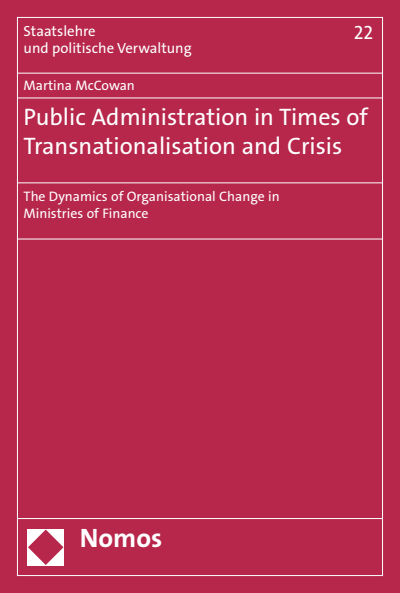
Public Administration in Times of Transnationalisation and Crisis
The Dynamics of Organisational Change in Ministries of Finance- Autor:innen:
- Reihe:
- Policy-Analyse und Verwaltungswissenschaft | Policy Analysis and Public Administration, Band 22
- Verlag:
- 2019
Zusammenfassung
Koordination in Ministerialbürokratien hat sich gewandelt. Das Buch analysiert den Wandel in Organisationsstrukturen und im Akteursverhalten in Zeiten von Transnationalisierung und der globalen Finanz- und Eurozonenkrise. Es geht damit einen Schritt weiter als die meisten existierenden Studien, welche vorwiegend formale Organisationsstrukturen und Transnationalisierungs- oder Kriseneinflüsse untersuchen. Dieser „inklusive“ Forschungsansatz ermöglicht es, ein differenziertes Bild von Wandel im dänischen und deutschen Finanzministerium zu zeichnen. Während kooperative Koordination auf tiefgreifenden Wandel zu Krisenzeiten hindeutet, erkennbar in einer Stärkung der „kosmopolitischen Identität“ von Akteuren, so vermag Transnationalisierung nicht die „lokalen Identitäten“ von Akteuren zu verändern, beobachtbar in der Kontinuität hierarchischer Koordination. Das Buch zeigt folglich, dass Krise eine notwendige Bedingung für Transnationalisierung ist, um ihr transformatives Potential zu entfalten.
Publikation durchsuchen
Bibliographische Angaben
- Auflage
- 1/2019
- Copyrightjahr
- 2019
- ISBN-Print
- 978-3-8487-5559-2
- ISBN-Online
- 978-3-8452-9737-8
- Verlag
- Nomos, Baden-Baden
- Reihe
- Policy-Analyse und Verwaltungswissenschaft | Policy Analysis and Public Administration
- Band
- 22
- Sprache
- Englisch
- Seiten
- 238
- Produkttyp
- Monographie
Inhaltsverzeichnis
- Titelei/Inhaltsverzeichnis Kein Zugriff Seiten 1 - 12
- Transnational constellations challenge bureaucratic organisations Kein Zugriff
- Societal and scientific relevance of this book Kein Zugriff
- The theoretical argument: Organisations ‘filter’ adaptive pressure, actors ‘shape’ organisational change Kein Zugriff
- Research design, case selection, data and analysis Kein Zugriff
- Structure of the book Kein Zugriff
- Change in coordination: Levels and modes Kein Zugriff
- Dimensions of change: Structures and behaviour Kein Zugriff
- Result of change: Profound or path dependent? Kein Zugriff
- Environmental factors: Transnationalisation and crisis exert adaptive pressure Kein Zugriff
- Institutional context: Organisational models ‘filter’ adaptive pressure Kein Zugriff
- Individual action: Rule takers and rule makers ‘shape’ organisational change Kein Zugriff
- Summary: The theoretical argument Kein Zugriff
- Similarities in transnationalisation and crisis affectedness Kein Zugriff
- Differences in underlying organisational models Kein Zugriff
- Differences in identities and scope of choice Kein Zugriff
- Summary: Pressures and preconditions for change Kein Zugriff
- The standard operating procedure: Hierarchical specialisation to handle transnational tasks Kein Zugriff
- Local identities and strategic reluctance restricting effective coordination of transnational tasks Kein Zugriff
- Summary Kein Zugriff
- Never change a winning team? Hierarchical specialisation reinforcing the need for contingent coordination Kein Zugriff
- Contingent coordination: Indications of a cosmopolitan identity through strategic action ‘at its best’ Kein Zugriff
- Summary Kein Zugriff
- The FM's transformation from a transnational 'nobody' to a 'key player' Kein Zugriff
- Prevailing local identities leading to a state of 'segmentation' between national and transnational politics Kein Zugriff
- Summary Kein Zugriff
- The loss of transnational responsibilities putting the FM under pressure to remain a transnational player Kein Zugriff
- Strategic opt-ins blurring identities Kein Zugriff
- Summary Kein Zugriff
- Result of change: Path dependence or profound change? Kein Zugriff
- Understanding organisational change Kein Zugriff
- Change in structure and behaviour Kein Zugriff
- Précising the empirical results Kein Zugriff
- Contribution of this book to existing research Kein Zugriff
- Avenues for further research Kein Zugriff
- Appendix Kein Zugriff Seiten 209 - 210
- Bibliography Kein Zugriff Seiten 211 - 238
Literaturverzeichnis (489 Einträge)
Es wurden keine Treffer gefunden. Versuchen Sie einen anderen Begriff.
- Bibliography Google Scholar öffnen DOI: 10.5771/9783845297378
- Scientific Literature Google Scholar öffnen DOI: 10.5771/9783845297378
- Aberbach, Joel D./Putnam, Robert D./Rockman, Bert A. (1981): Bureaucrats and Politicians in Western Democracies. Cambridge, MA: Harvard University Press. Google Scholar öffnen DOI: 10.5771/9783845297378
- Adler-Nissen, Rebecca (2014): Opting Out of the European Union. Diplomacy, Sovereignty and European Integration. Cambridge: Cambridge University Press. Google Scholar öffnen DOI: 10.5771/9783845297378
- Adler-Nissen, Rebecca/Nielsen, Julie Hassing/Sørensen, Catharina (2012): The Danish EU Presidency 2012: A Midterm Report. Sieps, Swedish Institute for European Policy Studies. Google Scholar öffnen DOI: 10.5771/9783845297378
- Aldrich, Howard E. (1979): Organizations and Environments. Englewood Cliffs, NJ: Prentice-Hall, Inc. Google Scholar öffnen DOI: 10.5771/9783845297378
- Allison, Graham T. (1971): Essence of Decision. Boston: Little, Brown and Company. Google Scholar öffnen DOI: 10.5771/9783845297378
- Andreae, Lisette/Kaiser, Karl (1998): Die ‘Außenpolitik’ der Fachministerien. In: Eberwein, Wolf-Dieter/Kaiser, Karl (ed.): Deutschlands neue Außenpolitik. München: Oldenbourg, 29-46. Google Scholar öffnen DOI: 10.5771/9783845297378
- Ansell, Christopher K./Boin, Arjen/Keller, Ann (2010): Managing Transboundary Crises: Identifying the Building Blocks of an Effective Response System. In: Journal of Contingencies and Crisis Management 18 (4), 195-207. Google Scholar öffnen DOI: 10.5771/9783845297378
- Ansell, Christopher/Trondal, Jarle/Øgård, Morten (2016): Turbulent Governance. In: Ansell, Christopher/Trondal, Jarle/Øgård, Morten (ed.): Governance in Turbulent Times. Oxford: Oxford University Press, 1-23. Google Scholar öffnen DOI: 10.5771/9783845297378
- Arellano-Gault, David/Demortain, David/Rouillard, Christian/Thoenig, Jean-Claude (2013): Bringing Public Organizations and Organizing Back In. In: Organization Studies 34 (2), 145-167. Google Scholar öffnen DOI: 10.5771/9783845297378
- Atteslander, Peter M. (1959): Konflikt und Kooperation im Industriebetrieb. Köln: Westdeutscher Verlag. Google Scholar öffnen DOI: 10.5771/9783845297378
- Auer, Astrid/Demmke, Christoph/Polet, Robert (1996): Civil Services in the Europe of Fifteen: Current Situation and Prospects. Maastricht: European Institute of Public Administration. Google Scholar öffnen DOI: 10.5771/9783845297378
- Bach, Maurizio (1999): Die Bürokratisierung Europas. Verwaltungseliten, Experten und politische Legitimation in Europa. Frankfurt a. M.: Campus. Google Scholar öffnen DOI: 10.5771/9783845297378
- Baker, Andrew/Hudson, David/Woodward, Richard (2005): Governing Financial Globalization: International Political Economy and Multi-Level Governance. London: Routledge. Google Scholar öffnen DOI: 10.5771/9783845297378
- Barnard, Chester I. (1938): The Functions of the Executive. Cambridge, MA: Harvard University Press. Google Scholar öffnen DOI: 10.5771/9783845297378
- Battilana, Julie/D'Aunno, Thomas (2009): Institutional work and the paradox of embedded agency. In: Lawrence, Thomas B./Suddaby, Roy/Leca, Bernard (ed.): Institutional Work. Actors and Agency in Institutional Studies of Organizations. Cambridge: Cambridge University Press, 31-58. Google Scholar öffnen DOI: 10.5771/9783845297378
- Bauer, Michael W. (2009): Impact of administrative reform of the European Commission: results from a survey of heads of unit in policy-making directorates. In: International Review of Administrative Sciences 75 (3), 459-472. Google Scholar öffnen DOI: 10.5771/9783845297378
- Bauer, Michael W./Grande, Edgar (2018): Status und Perspektiven der politikwissenschaftlichen Verwaltungsforschung in Deutschland. In: Bauer, Michael W./Grande, Edgar (ed.): Perspektiven der Verwaltungswissenschaft. Baden-Baden: Nomos, 9-38. Google Scholar öffnen DOI: 10.5771/9783845297378
- Bauer, Michael W./Trondal, Jarle (2015a): The Palgrave Handbook of the European Administrative System. Houndmills: Palgrave Macmillan. Google Scholar öffnen DOI: 10.5771/9783845297378
- Bauer, Michael W./Trondal, Jarle (2015b): The Administrative System of the European Union. In: Bauer, Michael W./Trondal, Jarle (ed.): The Palgrave Handbook of the European Administrative System. Houndmills: Palgrave Macmillan, 1-28. Google Scholar öffnen DOI: 10.5771/9783845297378
- Bauer, Michael W./Knill, Christoph/Ziegler, Maria (2007): Optimierung deutscher Ministerialkoordination in EU Angelegenheiten: Folgerungen aus einem Leistungsvergleich institutioneller Arrangements in Deutschland, Finnland und Großbritannien. In: Zeitschrift für Parlamentsfragen 38 (4), 737-754. Google Scholar öffnen DOI: 10.5771/9783845297378
- Beach, Derek (2013): The Fiscal Compact, Euro-Reforms and the Challenge for the Euro-Outs. In: Mouritzen, Hans/Hvidt, Nanna (ed.): Danish Foreign Policy Yearbook 2013. Copenhagen: Hans Reitzels Forlag, 113-133. Google Scholar öffnen DOI: 10.5771/9783845297378
- Beach, Derek/Pedersen, Rasmus Brun (2013): Process-Tracing Methods. Foundations and Guidelines. Ann Arbor: The University of Michigan Press. Google Scholar öffnen DOI: 10.5771/9783845297378
- Beck, Ulrich (2000): The cosmopolitan perspective: sociology of the second age of modernity. In: The British Journal of Sociology 51 (1), 79-105. Google Scholar öffnen DOI: 10.5771/9783845297378
- Beck, Ulrich (2004): Der kosmopolitische Blick. Frankfurt a. M.: Suhrkamp. Google Scholar öffnen DOI: 10.5771/9783845297378
- Beichelt, Timm (2007): Over-efficiency in German EU Policy Coordination. In: German Politics 16 (4), 421-433. Google Scholar öffnen DOI: 10.5771/9783845297378
- Benz, Arthur (2006): Eigendynamiken von Governance in der Verwaltung. In: Bogumil, Jörg/Werner, Jann/Nullmeier, Frank (ed.): Politik und Verwaltung. Wiesbaden: VS Verlag, 29-50. Google Scholar öffnen DOI: 10.5771/9783845297378
- Berg, Caspar van den (2011): Transforming for Europe. The reshaping of national bureaucracies in a system of multi-level governance. Leiden: Leiden University Press. Google Scholar öffnen DOI: 10.5771/9783845297378
- Berg, Caspar van den/Toonen, Theo A.J. (2007): National Civil Service Systems and the Implications of Multi-level Governance: Weberianism Revisited? In: Raadschelders, Jos C.N./Toonen, Theo A.J./van der Meer, Frits M. (ed.): The Civil Service in the 21st Century. Houndmills: Palgrave Macmillan, 103-120. Google Scholar öffnen DOI: 10.5771/9783845297378
- Beyers, Jan (2010): Conceptual and Methodological Challenges in the Study of European Socialisation. In: Journal of European Public Policy 17 (6), 909-920. Google Scholar öffnen DOI: 10.5771/9783845297378
- Blau, Peter M. (1955): The Dynamics of Bureaucracy. Chicago: Sage. Google Scholar öffnen DOI: 10.5771/9783845297378
- Boin, Arjen/Christensen, Tom (2008): The Development of Public Institutions: Reconsidering the Role of Leadership. In: Administration & Society 40 (3), 271-297. Google Scholar öffnen DOI: 10.5771/9783845297378
- Boin, Arjen/Rhinard, Mark (2008): Managing Transboundary Crises: What Role for the European Union? In: International Studies Review 10 (1), 1-26. Google Scholar öffnen DOI: 10.5771/9783845297378
- Boin, Arjen/t'Hart, Paul/Stern, Eric/Sundelius, Bengt (2005): The Politics of Crisis Management: Public Leadership under Pressure. Cambridge: Cambridge University Press. Google Scholar öffnen DOI: 10.5771/9783845297378
- Börzel, Tanja A./Risse, Thomas (2000): When Europe Hits Home: Europeanization and Domestic Change. In: European Integration online Papers 4 (15), 1-20. Google Scholar öffnen DOI: 10.5771/9783845297378
- Börzel, Tanja A./Risse, Thomas (2003): Conceptualizing the Domestic Impact of Europe. In: Featherstone, Kevin/Radaelli, Claudio M. (ed.): The Politics of Europeanization. Oxford: Oxford University Press, 57-80. Google Scholar öffnen DOI: 10.5771/9783845297378
- Börzel, Tanja/Risse, Thomas (2006): Europeanization: The Domestic Impact of European Union Politics. In: Jørgensen, Knud Erik/Pollack, Mark A./Rosamond, Ben (ed.): Handbook of European Union Politics. London: Sage, 483-504. Google Scholar öffnen DOI: 10.5771/9783845297378
- Bouckaert, Geert/Peters, B. Guy/Verhoest, Koen (2010): The Coordination of Public Sector Organizations. Shifting Patterns of Public Management. Houndmills: Palgrave Macmillan. Google Scholar öffnen DOI: 10.5771/9783845297378
- Bovens, Mark/’t Hart, Paul (1995): Understanding Policy Fiascoes. New Brunswick: Transaction Books. Google Scholar öffnen DOI: 10.5771/9783845297378
- Boxenbaum, Eva/Strandgaard Pedersen, Jesper (2009): Scandinavian institutionalism – a case of institutional work. In: Lawrence, Thomas B./Suddaby, Roy/Leca, Bernard (ed.): Institutional Work. Actors and Agency in Institutional Studies of Organizations. Cambridge: Cambridge University Press, 178-204. Google Scholar öffnen DOI: 10.5771/9783845297378
- Brans, Marleen (2007): Comparative Public Administration: From General Theory to General Frameworks. In: Peters, B. Guy/Pierre, Jon (ed.): Handbook of Public Administration. London: Sage, 269-284. Google Scholar öffnen DOI: 10.5771/9783845297378
- Breilmann, Ulrich (1990): Die Berücksichtigung der strategischen Wahl im Rahmen eines neokontingenz-theoretischen Ansatzes. Frankfurt a. M.: Peter Lang. Google Scholar öffnen DOI: 10.5771/9783845297378
- Bromley, Patricia/Powell, Walter W. (2012): From Smoke and Mirrors to Walking the Talk: Decoupling in the Contemporary World. In: The Academy of Management Annals 6 (1), 1-48. Google Scholar öffnen DOI: 10.5771/9783845297378
- Brouillette, John R./Quarantelli, E.L. (1971): Types of Patterned Variation in Bureaucratic Adaptations to Organisational Stress. In: Sociological Inquiry (1), 39-46. Google Scholar öffnen DOI: 10.5771/9783845297378
- Brunsson, Nils (2006) [1989]: The Organization of Hypocrisy. Oslo: Universitetsforlaget. Google Scholar öffnen DOI: 10.5771/9783845297378
- Brunsson, Nils/Olsen, Johan P. (1993): The Reforming Organization. London: Routledge. Google Scholar öffnen DOI: 10.5771/9783845297378
- Brunsson, Nils/Olsen, Johan P. (1998): Organization Theory: Thirty Years of Dismantling, and then…? In: Brunsson, Nils/Olsen, Johan P. (ed.): Organizing Organizations. Bergen: Fagbokforlaget, 13-43. Google Scholar öffnen DOI: 10.5771/9783845297378
- Bulmer, Simon (2014): Germany and the Eurozone Crisis: Between Hegemony and Domestic Politics. In: West European Politics 37 (6), 1244-1263. Google Scholar öffnen DOI: 10.5771/9783845297378
- Bulmer, Simon/Jeffery, Charlie/Paterson, William E. (1998): Deutschlands europäische Diplomatie: Die Entwicklung des regionalen Milieus. In: Weidenfeld, Werner (ed.): Deutsche Europapolitik. Optionen wirksamer Interessenvertretung. Bonn: Europa Union Verlag, 11-102. Google Scholar öffnen DOI: 10.5771/9783845297378
- Bulmer, Simon/Maurer, Andreas/Paterson, William E. (2001): The European policy-making machinery in the Berlin republic: hindrance or handmaiden. In: German Politics 10 (1), 177-206. Google Scholar öffnen DOI: 10.5771/9783845297378
- Burns, Tom/Stalker, G. M. (1961): The Management of Innovation. London: Tavistock Publications. Google Scholar öffnen DOI: 10.5771/9783845297378
- Campbell, John L. (2004): Institutional Change and Globalization. Princeton: Princeton University Press. Google Scholar öffnen DOI: 10.5771/9783845297378
- Carstensen, Martin B. (2011): New Financial Regulation in Denmark after the Crisis - or the Politics of Not Really Doing Anything. In: Hvidt, Nanna/Mouritzen, Hans (ed.): Danish Foreign Policy Yearbook. Copenhagen: Danish Institute for International Studies, 106-129. Google Scholar öffnen DOI: 10.5771/9783845297378
- Carstensen, Martin B. (2013a): Projecting from a Fiction: The Case of Denmark and the Financial Crisis. In: New Political Economy 18 (4), 555-578. Google Scholar öffnen DOI: 10.5771/9783845297378
- Carstensen, Martin B. (2013b): The Promise and Peril of Smallness in World Markets: The Case of Financial Crisis in Denmark. In: Panizza, Francisco/Philip, George (ed.): Moments of Truth: The Politics of Financial Crises in Comparative Perspective. New York: Routledge, 177-193. Google Scholar öffnen DOI: 10.5771/9783845297378
- Child, John (1972): Organizational Structure, Environment and Performance. The Role of Strategic Choice. In: Sociology 6 (1), 1-22. Google Scholar öffnen DOI: 10.5771/9783845297378
- Child, John (1997): Strategic Choice in the Analysis of Action, Structure, Organizations and Environment: Retrospect and Prospect. In: Organization Studies 18 (43), 43-76. Google Scholar öffnen DOI: 10.5771/9783845297378
- Christensen, Dag Arne/Christensen, Tom/Lægreid, Per/Midtbø, Tor (2012): Cross-Border Coordination Activities in Central Government Administration - Combining Organizational Conditions and Individual Features. In: Public Organization Review 12 (4), 367-382. Google Scholar öffnen DOI: 10.5771/9783845297378
- Christensen, Tom/Egeberg, Morten (1997): Sentraladministrasjonen - en oversikt over trekk ved department og direktorat. In: Christensen, Tom/Egeberg, Morten (ed.): Forvaltningskunnskap. Oslo: Tano. Google Scholar öffnen DOI: 10.5771/9783845297378
- Christensen, Tom/Peters, B. Guy (1999): Structure, Culture, and Governance: A Comparison of Norway and the United States. Lanham, MD: Rowman and Littlefield. Google Scholar öffnen DOI: 10.5771/9783845297378
- Christensen, Tom/Røvik, Kjell Arne (1999): The ambiguity of appropriateness. In: Egeberg, Morten/Lægreid, Per (ed.): Organizing Political Institutions. Olso: Universitetsforlaget, 159-180. Google Scholar öffnen DOI: 10.5771/9783845297378
- Christensen, Tom/Lægreid, Per (2001a): A Transformative Perspective on Administrative Reforms. In: Christensen, Tom/Lægreid, Per (ed.): New Public Management. The transformation of ideas and practice. Aldershot: Ashgate, 13-39. Google Scholar öffnen DOI: 10.5771/9783845297378
- Christensen, Tom/Lægreid, Per (2001b): New Public Management. The transformation of ideas and practice. Aldershot: Ashgate. Google Scholar öffnen DOI: 10.5771/9783845297378
- Christensen, Tom/Lægreid, Per (2006): Autonomy and Regulation. Cheltenham, UK/Northampton, MA: Edward Elgar. Google Scholar öffnen DOI: 10.5771/9783845297378
- Christensen, Tom/Lægreid, Per/Roness, Paul G./Rovik, Kjell Arne (2007): Organization Theory and the Public Sector. London: Routledge. Google Scholar öffnen DOI: 10.5771/9783845297378
- Christensen, Tom/Lægreid, Per (2007a): Introduction - Theoretical Approach and Research Questions. In: Christensen, Tom/Lægreid, Per (ed.): Transcending New Public Management. The Transformation of Public Sector Reforms. Aldershot: Ashgate, 1-16. Google Scholar öffnen DOI: 10.5771/9783845297378
- Christensen, Tom/Lægreid, Per (2007b): Transcending New Public Management. The Transformation of Public Sector Reforms. Aldershot: Ashgate. Google Scholar öffnen DOI: 10.5771/9783845297378
- Christensen, Tom/Lægreid, Per (2011a): Administrative reforms and the complexification of competencies requested from civil servants. The case of Norway. In: Eymeri-Douzans, Jean-Michel/Pierre, Jon (ed.): Administrative Reforms and Democratic Governance. London: Routledge, 41-54. Google Scholar öffnen DOI: 10.5771/9783845297378
- Christensen, Tom/Lægreid, Per (2011b): Complexity and Hybrid Public Administration - Theoretical and Empirical Challenges. In: Public Organization Review 11, 407-423. Google Scholar öffnen DOI: 10.5771/9783845297378
- Christensen, Tom/Lægreid, Per (2013): Contexts and administrative reforms: a transformative approach. In: Pollitt, Christopher (ed.): Context in Public Policy and Management. Cheltenham, UK/Northampton, MA: Edward Elgar, 131-156. Google Scholar öffnen DOI: 10.5771/9783845297378
- Coeuré, Benoit (2003): L'Eurogroupe: Bilan et Perspectives. In: Revue d'Économie Financière 65 (1), 1-10. Google Scholar öffnen DOI: 10.5771/9783845297378
- Coleman, William D. (2012): Governance and Global Public Policy. In: Levi-Faur, David (ed.): The Oxford Handbook of Governance. Oxford: Oxford University Press, 673-685. Google Scholar öffnen DOI: 10.5771/9783845297378
- Conceição-Held, Eugénia da/Koch, Martin/Liese, Andrea (2015) (ed.): Autonomie, Politisierung, interorganisationale Beziehungen und Wandel. Politische Vierteljahresschrift Sonderheft 49. Google Scholar öffnen DOI: 10.5771/9783845297378
- Connolly, Sara/Kassim, Hussein (2015): The Permanent Commission Bureaucrat. In: Bauer, Michael W./Trondal, Jarle (ed.): The Palgrave Handbook of the European Administrative System. Houndmills: Palgrave Macmillan, 161-187. Google Scholar öffnen DOI: 10.5771/9783845297378
- Cowles Green, Maria/Risse, Thomas/Caporaso, James A. (2001): Transforming Europe: Europeanization and Domestic Change. Ithaca, NY: Cornell University Press. Google Scholar öffnen DOI: 10.5771/9783845297378
- Crespy, Amandine/Schmidt, Vivien (2014): The clash of Titans: France, Germany and the discursive double game of EMU reform. In: Journal of European Public Policy 21 (8), 1085-1101. Google Scholar öffnen DOI: 10.5771/9783845297378
- Cyert, Richard M./March, James G. (1963): A Behavioural Theory of the Firm. Englewood Cliffs, NJ: Prentice-Hall, Inc. Google Scholar öffnen DOI: 10.5771/9783845297378
- Czarniawska, Barbara/Joerges, Bernward (1998): Winds of Organizational Change: How Ideas Translate into Objects and Actions. In: Brunsson, Nils/Olsen, Johan P. (ed.): Organizing Organizations. Bergen: Fagbokforlaget, 197-236. Google Scholar öffnen DOI: 10.5771/9783845297378
- Dalton, Meville (1959): Men who manage. New York: John Wiley & Sons. Google Scholar öffnen DOI: 10.5771/9783845297378
- Damgaard, Erik/Nørgaard, Asbjørn Sonne (2000): The European Union and Danish Parliamentary Democracy. In: Bergman, Torbjörn/Damgaard, Erik (ed.): Delegation and Accountability in European Integration. London: Frank Cass, 33-58. Google Scholar öffnen DOI: 10.5771/9783845297378
- Davis, Glyn (1997): Executive Coordination Mechanisms. In: Weller, Patrick/Bakvis, Herman/Rhodes, R.A.W. (ed.): The Hollow Crown. Countervailing Trends in Core Executives. Houndmills: Palgrave Macmillan, 126-147. Google Scholar öffnen DOI: 10.5771/9783845297378
- Dearborn, Dewitt C./Simon, Herbert A. (1958): Selective perception: A note on the departmental identifications of executives. In: Sociometry 21, 140-144. Google Scholar öffnen DOI: 10.5771/9783845297378
- Demers, Christiane (2007): Organizational Change Theories. A Synthesis. London: Sage. Google Scholar öffnen DOI: 10.5771/9783845297378
- Demmke, Christoph (2006): Europäisierung der Personalpolitiken in Europa. Die öffentlichen Dienste zwischen Tradition, Modernisierung und Vielfalt. In: Bogumil, Jörg/Jann, Werner/Nullmeier, Frank (ed.): Politik und Verwaltung. Wiesbaden: VS Verlag, 373-397. Google Scholar öffnen DOI: 10.5771/9783845297378
- Demmke, Christoph (2015): The Europeanization of Civil Services and Human Ressources Policies. In: Bauer, Michael W./Trondal, Jarle (ed.): The Palgrave Handbook of the European Administrative System. Houndmills: Palgrave Macmillan, 449-463. Google Scholar öffnen DOI: 10.5771/9783845297378
- Derlien, Hans-Ulrich (1984): Einstweiliger Ruhestand politischer Beamter des Bundes 1949-1983. In: Die Öffentliche Verwaltung 37 (17), 689-699. Google Scholar öffnen DOI: 10.5771/9783845297378
- Derlien, Hans-Ulrich (1996): Patterns of Postwar Administrative Development in Germany. In: Benz, Arthur/Goetz, Klaus H. (ed.): A New German Public Sector? Reform, Adaptation and Stability. Aldershot: Dartmouth, 27-48. Google Scholar öffnen DOI: 10.5771/9783845297378
- Derlien, Hans-Ulrich (1998): From Administrative Reform To Administrative Modernization. Universität Bamberg. Lehrstuhl für Verwaltungswissenschaft. Google Scholar öffnen DOI: 10.5771/9783845297378
- Derlien, Hans-Ulrich (2000): Germany. Failing Succesfully? In: Kassim, Hussein/Peters, Guy B./Wright, Vincent (ed.): The National Co-ordination of EU Policy. The Domestic Level. Oxford: Oxford University Press, 54-78. Google Scholar öffnen DOI: 10.5771/9783845297378
- Derlien, Hans-Ulrich (2008): Die politische und administrative Elite der Bundesrepublik. In: Werner, Jann/König, Klaus (ed.): Regieren zu Beginn des 21. Jahrhunderts. Tübingen: Mohr Siebeck, 291-328. Google Scholar öffnen DOI: 10.5771/9783845297378
- Döhler, Marian (1995): The State as Architect of Political Order: Policy Dynamics in German Health Care. In: Governance 8 (3), 380-404. Google Scholar öffnen DOI: 10.5771/9783845297378
- Döhler, Marian (2007): Vom Amt zur Agentur? Organisationsvielfalt, Anpassungsdruck und institutionelle Wandlungsprozesse im deutschen Verwaltungsmodell. In: Döhler, Marian/Jann, Werner (ed.): Agencies in Westeuropa. Wiesbaden: VS Verlag, 12-47. Google Scholar öffnen DOI: 10.5771/9783845297378
- Döhler, Marian (2012): Gesetzgebung auf Honorarbasis - Politik, Ministerialverwaltung und das Problem externer Beteiligung an Rechtsetzungsprozessen. In: Politische Vierteljahresschrift 53 (2), 181-210. Google Scholar öffnen DOI: 10.5771/9783845297378
- Döhler, Marian (2017): The Bias of Structures: How Multidivisional Organizations Work in the Public Sector. In: Public Organization Review 17 (1), 83-100. Google Scholar öffnen DOI: 10.5771/9783845297378
- Döhler, Marian/Fleischer, Julia/Hustedt, Thurid (2007): Government Reform as Institutional Politics. Varieties and Policy Patterns from a Comparative Perspective. Potsdam: Lehrstuhl für Politikwissenschaft, Verwaltung und Organisation. Google Scholar öffnen DOI: 10.5771/9783845297378
- Dosenrode, Søren Z. von (1998): Denmark: The Testing of a Hesitant Membership. In: Hanf, Kenneth/Soetendorp, Ben (ed.): Adapting to European Integration. Small States and the European Union. London/New York: Longman, 52-68. Google Scholar öffnen DOI: 10.5771/9783845297378
- Downs, Anthony (1967): Inside Bureaucracy. Boston: Little, Brown and Company, Google Scholar öffnen DOI: 10.5771/9783845297378
- Drezner, Daniel W. (2007): All Politics Is Global. Princeton: Princeton University Press. Google Scholar öffnen DOI: 10.5771/9783845297378
- Dunsire, Andrew (1987): Testing theories: the contribution of bureaumetrics. In: Lane, Jan-Erik (ed.): Bureaucracy and Public Choice. London: Sage, 94-144. Google Scholar öffnen DOI: 10.5771/9783845297378
- Dyson, Kenneth (2003): Economic policies: from pace-setter to beleaguered player. In: Dyson, Kenneth/Goetz, Klaus H. (ed.): Germany, Europe and the Politics of Constraint. Oxford: Oxford University Press, 201-230. Google Scholar öffnen DOI: 10.5771/9783845297378
- Eberlei, Walter (2001): Globalisierte Politikfelder mitgestalten. In: Fues, Thomas/Hamm, Brigitte I. (ed.): Die Weltkonferenzen der 90er Jahre: Baustellen für Global Governance. Bonn: Verlag J.H.W. Dietz, 225-261. Google Scholar öffnen DOI: 10.5771/9783845297378
- Eberlei, Walter/Weller, Christoph (2001): Deutsche Ministerien als Akteure von Global Governance. Eine Bestandsaufnahme der auswärtigen Beziehungen der Bundesministerien. Duisburg. Gerhard-Mercator-Universität Duisburg. INEF Report 51/2001. Google Scholar öffnen DOI: 10.5771/9783845297378
- Ebinger, Falk/Jochheim, Linda (2009): Wessen loyale Diener? Wie die große Koalition die deutsche Ministerialbürokratie veränderte. In: dms - der moderne staat - Zeitschrift für Public Policy, Recht und Management 2, 335-353. Google Scholar öffnen DOI: 10.5771/9783845297378
- Eckhardt, Andrea/Köhler, Holm/Pries, Ludger (1999): Die Verschränkung von Globalisierung und Konzernmodernisierung oder: Der ‘Elch-Test’ für die deutsche Automobilindustrie. In: Schmidt, Gert/Trinczek, Rainer (ed.): Globalisierung. Ökonomische und soziale Herausforderungen am Ende des zwanzigsten Jahrhunderts. Baden-Baden: Nomos, 167-190. Google Scholar öffnen DOI: 10.5771/9783845297378
- Egeberg, Morten (1994): Bridging the Gap Between Theory and Practice: The Case of Administrative Policy. In: Governance 7 (1), 83-98. Google Scholar öffnen DOI: 10.5771/9783845297378
- Egeberg, Morten (1995): Bureaucrats as Public Policy-Makers and their Self-Interests. In: Journal of Theoretical Politics 7 (2), 157-167. Google Scholar öffnen DOI: 10.5771/9783845297378
- Egeberg, Morten (1999a): The Impact of Bureaucratic Structure on Policy Making. In: Public Administration 77 (1), 155-170. Google Scholar öffnen DOI: 10.5771/9783845297378
- Egeberg, Morten (1999b): Transcending Intergovernmentalism? Identity and Role Perceptions of National Officials in EU-Decision Making. In: Journal of European Public Policy 6 (3), 456-474. Google Scholar öffnen DOI: 10.5771/9783845297378
- Egeberg, Morten (2007): How Bureaucratic Structure Matters: An Organizational Perspective. In: Peters, B. Guy/Pierre, Jon (ed.): The Handbook of Public Administration. London: Sage, 77-87. Google Scholar öffnen DOI: 10.5771/9783845297378
- Egeberg, Morten/Sætren, Harald (1999): Identities in Complex Organizations: A Study of Ministerial Bureaucrats. In: Organizing Political Institutions. Essays for Johan P. Olsen. Oslo: Scandinavian University Press, 93-108. Google Scholar öffnen DOI: 10.5771/9783845297378
- Egeberg, Morten/Schaefer, Günther/Trondal, Jarle (2003): The many faces of EU committee governance. In: West European Politics 26 (3), 19-40. Google Scholar öffnen DOI: 10.5771/9783845297378
- Egeberg, Morten/Åse, Gornitzka/Trondal, Jarle (2016): Organization Theory. In: Ansell, Christopher/Torfing, Jacob (ed.): Handbook on Theories of Governance. Cheltenham, UK/Northampton, MA: Edward Elgar, 32-45. Google Scholar öffnen DOI: 10.5771/9783845297378
- Eldrup, Anders (2001): Ledelse, viden og strategisk udvikling. In: Hildebrandt, Steen/Klausen, Kurt Klaudi (ed.): Offentlig ledelse pa dagsordenen - erfaringer fra topchefer i det offentlige sector. Copenhagen: Borsen, 59-74. Google Scholar öffnen DOI: 10.5771/9783845297378
- Esmark, Anders (2001): Mod en transnational forvaltning. In: Jacobsson, Bengt/Lægreid, Per/Pedersen, Ove K. (ed.): Europaveje. EU i de nordiske centralforvaltninger. Copenhagen: Jurist- og Økonomforbundets Forlag, 95-135. Google Scholar öffnen DOI: 10.5771/9783845297378
- Esmark, Anders (2002): Skyggeorganisering i Erhvervsministeriet. In: Pedersen, Ove K. (ed.): Den danske centraladministration og EU - Broen fra Slotsholmen til Bruxelles. Copenhagen: Jurist- og Økonomforbundets Forlag, 211-245. Google Scholar öffnen DOI: 10.5771/9783845297378
- Esmark, Anders (2008): Tracing the National Mandate: Administrative Europeanization made in Denmark. In: Public Administration 86 (1), 243-257. Google Scholar öffnen DOI: 10.5771/9783845297378
- Felder, Michael (2007): Wie vollzieht sich der (bürokratische) Wandel von Staatlichkeit? Das Beispiel der Europäisierung des Mehrebenenverwaltungssystems Deutschlands. Bremen SfB 598 ‘Staatlichkeit im Wandel‘. Google Scholar öffnen DOI: 10.5771/9783845297378
- Feldman, Martha S./Pentland, Brian T. (2003): Reconceptualizing Organizational Routines as a Source of Flexibility and Change. In: Administrative Science Quarterly 48, 94-118. Google Scholar öffnen DOI: 10.5771/9783845297378
- Fleischer, Julia (2010): A Dual Centre? Executive Politics under the Second Grand Coalition in Germany. In: German Politics 19, 353-368. Google Scholar öffnen DOI: 10.5771/9783845297378
- Fleischer, Julia (2012): Policy Advice and Institutional Politics: A Comparative Analysis of Germany and Britain. Dissertation, University of Potsdam. Faculty of Economics and Social Sciences. Google Scholar öffnen DOI: 10.5771/9783845297378
- Fleischer, Julia/Parrado, Salvador (2010): Power distribution in ambiguous times: The effects of the financial crisis on executive decision-making in Germany and Spain. In: dms - der moderne staat (2), 361-376. Google Scholar öffnen DOI: 10.5771/9783845297378
- Fleischer, Julia/Jann, Werner (2011): Shifting discourses, steady learning and sedimentation. In: Eymeri-Douzans, Jean-Michel/Pierre, Jon (ed.): Administrative Reforms and Democratic Governance. New York: Routledge, 68-79. Google Scholar öffnen DOI: 10.5771/9783845297378
- Foss Hansen, Hanne (1999): Den historiske arv - Denmark. In: Lægreid, Per/Pedersen, Ove K. (ed.): Fra opbygning til ombygning i staten. Organisationsforandringer i tre nordiske lande. København: Jurist- og Økonomforbundets Forlag, 69-104. Google Scholar öffnen DOI: 10.5771/9783845297378
- Foss Hansen, Hanne (2011): NPM in Scandinavia. In: Christensen, Tom/Lægreid, Per (ed.): The Ashgate Research Companion to New Public Management. Farnham: Ashgate, 113-129. Google Scholar öffnen DOI: 10.5771/9783845297378
- Foss Hansen, Hanne/Beck Jørgensen, Torben (2009): Den danske forvaltningsmodel og globaliseringens udfordringer. In: Marcussen, Martin/Ronit, Karsten (ed.): Globaliseringens udfordringer: politiske og administrative modeller under pres. Copenhagen: Hans Reitzels Forlag, 36-64. Google Scholar öffnen DOI: 10.5771/9783845297378
- Foss Hansen, Hanne/Kristiansen, Mads (2012a): The impact of fiscal crisis on public management and governance: The case of Denmark. Rome, Italy. Paper presented at IRSPM Conference. Google Scholar öffnen DOI: 10.5771/9783845297378
- Foss Hansen, Hanne/Kristiansen, Mads (2012b): Krisestyring: Reform- og besparelsestrategier. In: Politik 15 (4), 5-19. Google Scholar öffnen DOI: 10.5771/9783845297378
- Foss Hansen, Hanne/Kristiansen, Mads (2014a): Accountability in Times of Austerity: Democratic Gain but Learning Loss? Ottawa, Canada. Paper presented at Annual Conference IRSPM. Google Scholar öffnen DOI: 10.5771/9783845297378
- Foss Hansen, Hanne/Kristiansen, Mads (2014b): Styring af besparelser: Effektiv administration i centraladministrationen. In: Grøn, Caroline Howard/Foss Hansen, Hanne/Kristiansen, Mads (ed.): Offentlig styring. Forandringer i krisetider. Copenhagen: Hans Reitzels Forlag, 227-256. Google Scholar öffnen DOI: 10.5771/9783845297378
- Foss Hansen, Hanne/Kristiansen, Mads (2014c): Ansvarlighed i en krisetid - konsekvenser af budgetloven og nye krav til økonomistyring. In: Grøn, Caroline Howard/Foss Hansen, Hanne/Kristiansen, Mads (ed.): Offentlig styring. Forandringer i krisetider. Copenhagen: Hans Reitzels Forlag, 257-290. Google Scholar öffnen DOI: 10.5771/9783845297378
- George, Alexander L./Bennett, Andrew (2005): Case Studies and Theory Development in the Social Sciences. Cambridge, MA: MIT Press. Google Scholar öffnen DOI: 10.5771/9783845297378
- Gerring, John (2004): What Is a Case Study and What Is It Good for? In: American Political Science Review 98 (2), 341-354. Google Scholar öffnen DOI: 10.5771/9783845297378
- Geuijen, Karin/’t Hart, Paul/Princen, Sebastiaan/Yesilkagit, Kutsal (2008): The New Eurocrats. National Civil Servants in EU Policy-making. Amsterdam: Amsterdam University Press. Google Scholar öffnen DOI: 10.5771/9783845297378
- Goetz, Klaus H. (1999): Senior Officials in the German Federal Administration: Institutional Change and Positional Differentiation. In: Page, Edward/Wright, Vincent (ed.): Bureaucratic Élites in Western European States. Oxford: Oxford University Press, 147-177. Google Scholar öffnen DOI: 10.5771/9783845297378
- Goetz, Klaus H. (2003): The Federal Executive: Bureaucratic Fusion versus governmental Bifurcation. In: Dyson, Kenneth/Goetz, Klaus H. (ed.): Germany, Europe and the Politics of Constraint. Oxford: Oxford University Press, 57-72. Google Scholar öffnen DOI: 10.5771/9783845297378
- Goetz, Klaus H. (2006): Europäisierung der öffentlichen Verwaltung - oder europäische Verwaltung? In: Bogumil, Jörg/Jann, Werner/Nullmeier, Frank (ed.): Politik und Verwaltung. Wiesbaden: VS Verlag, 472-490. Google Scholar öffnen DOI: 10.5771/9783845297378
- Goetz, Klaus H./Hix, Simon (2000): Europeanised politics? European integration and national political systems. Essex: Frank Cass. Google Scholar öffnen DOI: 10.5771/9783845297378
- Goul Andersen, Jørgen (2011): From the Edge of the Abyss to Bonanza - and Beyond. Danish Economy and Economic Policies 1980-2011. In: Comparative Social Research. The Nordic Varieties of Capitalism 28, 89-165. Google Scholar öffnen DOI: 10.5771/9783845297378
- Gouldner, Alvin W. (1954): Patterns of Industrial Bureaucracy. New York: The Free Press. Google Scholar öffnen DOI: 10.5771/9783845297378
- Gouldner, Alvin W. (1957): Cosmopolitans and Locals: Toward an Analysis of Latent Social Roles. In: Administrative Science Quarterly 2 (3), 281-306. Google Scholar öffnen DOI: 10.5771/9783845297378
- Grande, Edgar (2006): Cosmopolitan political science. In: The British Journal of Sociology 57 (1), 87-111. Google Scholar öffnen DOI: 10.5771/9783845297378
- Grande, Edgar (2018): Verwaltung im globalen Wandel - Neue Perspektiven für die Verwaltungswissenschaft. In: Bauer, Michael W./Grande, Edgar (ed.): Perspektiven der Verwaltungswissenschaft. Baden-Baden: Nomos, 305-336. Google Scholar öffnen DOI: 10.5771/9783845297378
- Grande, Edgar/König, Markus/Pfister, Patrick/Sterzel, Paul (2007): Political transnationalisation: the future of the nation-state - a comparison of transnational policy regimes. In: Schirm, Stefan A. (ed.): Globalization. State of the art and perspectives. London: Routledge, 98-121. Google Scholar öffnen DOI: 10.5771/9783845297378
- Grande, Edgar/McCowan, Martina (2015): The Two Logics of Multilevel Administration in the EU. In: Bauer, Michael W./Trondal, Jarle (ed.): The Palgrave Handbook of the European Administrative System. Houndmills: Palgrave Macmillan, 48-66. Google Scholar öffnen DOI: 10.5771/9783845297378
- Gulick, Luther (1937): Notes on the theory of organization. In: Gulick, Luther/Lyndall, Urwick (ed.): Papers on the science of administration. New York: Columbia University, 1-45. Google Scholar öffnen DOI: 10.5771/9783845297378
- Grünhage, Jan (2007): Entscheidungsprozesse in der Europapolitik Deutschlands. Baden-Baden: Nomos. Google Scholar öffnen DOI: 10.5771/9783845297378
- Grøn, Caroline Howard (2014): Denmark and the European Commission. Entering the Heart of the Union. In: Miles, Lee/Wivel, Anders (ed.): Denmark and the European Union. London: Routledge, 109-125. Google Scholar öffnen DOI: 10.5771/9783845297378
- Grøn, Caroline Howard/Wivel, Anders (2011): Maximizing Influence in the European Union after the Lisbon Treaty: From Small State Policy to Smart State Strategy. In: Journal of European Integration 33 (5), 523-539. Google Scholar öffnen DOI: 10.5771/9783845297378
- Grønnegård Christensen, Jørgen (1981): Blurring the International-Domestic Politics Distinction: Danish Representation at EC Negotiations. In: Scandinavian Political Studies 4 (3), 191-208. Google Scholar öffnen DOI: 10.5771/9783845297378
- Grønnegård Christensen, Jørgen (1989): Centraladministrationen: organisation og politisk placering. Copenhagen: Samfundsvidenskabeligt Forlag. Google Scholar öffnen DOI: 10.5771/9783845297378
- Grønnegård Christensen, Jørgen (1997): Interpreting Administrative Change: Bureaucratic Self-Interest and Institutional Inheritance in Government. In: Governance 10 (2), 143-174. Google Scholar öffnen DOI: 10.5771/9783845297378
- Grønnegård Christensen, Jørgen (2003): Den fleksible og robuste forvaltning. In: Marcussen, Martin/Ronit, Karsten (ed.): Internationaliseringen af den offentlige forvaltning i Danmark - forandring og kontinuitet. Aarhus: Aarhus Universitetsforlag, 57-94. Google Scholar öffnen DOI: 10.5771/9783845297378
- Grønnegård Christensen, Jørgen/Ibsen, Marius (1991): Bureaukrati og bureaukrater. Herning: Systime. Google Scholar öffnen DOI: 10.5771/9783845297378
- Grønnegård Christensen, Jørgen/Christiansen, Peter Munk/Ibsen, Marius (2011): Politik og forvaltning. Copenhagen: Hans Reitzels Forlag. Google Scholar öffnen DOI: 10.5771/9783845297378
- Hale, Thomas N./Held, David (2011): Editors' Introduction: Mapping Changes in Transnational Governance. In: Hale, Thomas N./Held, David (ed.): Handbook of Transnational Governance. Institutions and Innovations. Cambridge: Polity Press, 1-38. Google Scholar öffnen DOI: 10.5771/9783845297378
- Hall, Peter A. (1962): Intraorganizational Structural Variation: Application of the Bureaucratic Model. In: Administrative Science Quarterly 7 (3), 295-308. Google Scholar öffnen DOI: 10.5771/9783845297378
- Hall, Peter A. (1993): Policy Paradigms, Social Learning and the State. In: Comparative Politics 25 (3), 275-296. Google Scholar öffnen DOI: 10.5771/9783845297378
- Hall, Peter A. (2010): Historical Institutionalism in Rationalist and Sociological Perspective. In: Mahoney, James/Thelen, Kathleen (ed.): Explaining Institutional Change. Ambiguity, Agency, and Power. Cambridge: Cambridge University Press, 204-223. Google Scholar öffnen DOI: 10.5771/9783845297378
- Hall, Peter A./Taylor, Rosemary C.R. (1996): Political science and the three new institutionalisms. In: Political Studies 44, 952-973. Google Scholar öffnen DOI: 10.5771/9783845297378
- Hallenberg, Peter (2005): En by i provinsen? Finansministeriet som budgetvogter i en europæiseret tidsalder. In: Jensen, Lotte (ed.): Centraladministrationen i en ny tid - kultur og kalkyler i forandringsprocessen. Copenhagen: Forlaget Politiske Studier, 176-209. Google Scholar öffnen DOI: 10.5771/9783845297378
- Hammerschmid, Gerhard/Proeller, Isabella/Reichard, Christoph/Röber, Manfred/Geißler, René (2010): Verwaltungsführung heute. Ergebnisse einer Führungskräftebefragung in der deutschen Ministerialverwaltung. Berlin: Institut für den öffentlichen Sektor e.V. Google Scholar öffnen DOI: 10.5771/9783845297378
- Handke, Stefan (2010): Yes, We Can (Control Them)! - Regulatory Agencies: Trustees or Agents? In: Goettingen Journal of International Law 2 (1), 11-134. Google Scholar öffnen DOI: 10.5771/9783845297378
- Handke, Stefan (2011): Die Angst des Ministeriums vor der Aufsicht. Das Bundesfinanzministerium in der deutschen Finanzmarktpolitik. In: Politische Vierteljahresschrift 52 (4), 663-687. Google Scholar öffnen DOI: 10.5771/9783845297378
- Handke, Stefan (2012): A problem of Chief and Indian - the role of the supervisory authority BaFin and the ministry of finance in German financial market policy. In: Policy and Society 31 (3), 237-247. Google Scholar öffnen DOI: 10.5771/9783845297378
- Handke, Stefan (2013): Koordiniert entmachtet: Die Schwächung der BaFin durch den Ausschuss für Finanzstabilität. In: Verwaltung und Management 19 (3), 136-143. Google Scholar öffnen DOI: 10.5771/9783845297378
- Hardie, Iain/Howarth, David (2009): Die Krise but not La Crise? The Financial Crisis and the Transformation of German and French Banking Systems. In: Journal of Common Market Studies 47 (5), 1017-1039. Google Scholar öffnen DOI: 10.5771/9783845297378
- Harmsen, Robert (1999): The Europeanization of National Administrations. A Comparative Study of France and the Netherlands. In: Governance 12 (1), 81-113. Google Scholar öffnen DOI: 10.5771/9783845297378
- Haverland, Marcus (2007): Methodology. In: Graziano, Paolo/Vink, Maarten P. (ed.): Europeanization. New Research Agendas. London: Palgrave Macmillan, 59-72. Google Scholar öffnen DOI: 10.5771/9783845297378
- Hay, Colin/Wincott, Daniel (1998): Structure, Agency and Historical Institutionalism. In: Political Studies XLVI, 951-957. Google Scholar öffnen DOI: 10.5771/9783845297378
- Hedström, Peter/Swedberg, Richard (1998): Social Mechanisms. An Analytical Approach to Social Theory. Cambridge: Cambridge University Press. Google Scholar öffnen DOI: 10.5771/9783845297378
- Heijden, Jeroen van der (2011): Institutional Layering: A Review of the Use of the Concept. In: Politics 31 (1), 9-18. Google Scholar öffnen DOI: 10.5771/9783845297378
- Held, David/McGrew, Anthony (2002): Governing Globalization. Power, Authority and Global Governance. Cambridge: Polity. Google Scholar öffnen DOI: 10.5771/9783845297378
- Henningsen, Ulla Rødgaard (1999): Strukturændringerne i Erhvervsministeriet. Copenhagen: Institut for Statskundskab, Demokratiprojektet: Arbeijdspapir 20/1999. Google Scholar öffnen DOI: 10.5771/9783845297378
- Hennis, Marjoleine (2001): Europeanization and Globalization: The Missing Link. In: Journal of Common Market Studies 39 (5), 829-850. Google Scholar öffnen DOI: 10.5771/9783845297378
- Héritier, Adrienne (2007): Explaining Institutional Change in Europe. Oxford: Oxford University Press. Google Scholar öffnen DOI: 10.5771/9783845297378
- Héritier, Adrienne/Knill, Christoph (2001): Differential Responses to European Policies: A Comparison. In: Héritier, Adrienne/Kerwer, Dieter/Knill, Christoph/Lehmkuhl, Dirk/Teutsch, Michael/Douillet, Anne-Cécile (ed.): Differential Europe. The European Union Impact on National Policymaking. Boston, Lanham, MD: Rowman and Littlefield, 257-295. Google Scholar öffnen DOI: 10.5771/9783845297378
- Herrmann, Richard K./Risse, Thomas/Brewer, Marilynn B. (2004): Transnational Identities. Becoming European in the EU. Lanham, MD: Rowman and Littlefield. Google Scholar öffnen DOI: 10.5771/9783845297378
- Hesse, Jens J./Goetz, Klaus H. (1992): Early Administrative Adjustment to the European Communities: The Case of the Federal Republic. In: Yearbook of European Administrative History 4, 181-205. Google Scholar öffnen DOI: 10.5771/9783845297378
- Hetmeier, Heinz (2004): Auswirkungen der europäischen Integration auf die deutsche Bundesverwaltung: Europapolitik aus der Perspektive des BMWi. In: Siedentopf, Heinrich (ed.): Der Europäische Verwaltungsraum - Beiträge einer Fachtagung. Baden-Baden: Nomos, 171-175. Google Scholar öffnen DOI: 10.5771/9783845297378
- Hitt, Michael A./Tyler, Beverley B. (1991): Strategic Decision Models: Integrating Different Perspectives. In: Strategic Management Journal 12 (5), 327-351. Google Scholar öffnen DOI: 10.5771/9783845297378
- Hitt, Michael A./Ireland, R.D/Hoskisson, R.E. (2015): Strategic Management: Competitiveness and Globalization, 11th ed. Mason, OH: Cengage Southwestern Publishing Co. Google Scholar öffnen DOI: 10.5771/9783845297378
- Hofstede, Geert (1980): Culture's Consequences: International Differences in Work-Related Values. Beverly Hills: Sage. Google Scholar öffnen DOI: 10.5771/9783845297378
- Hofstede, Geert (2001): Culture's Consequences. Comparing Values, Behaviors, Institutions, and Organizations Across Nations. Thousand Oaks: Sage. Google Scholar öffnen DOI: 10.5771/9783845297378
- Højbjerg, Erik/Pedersen, Dorthe (2002): Det danske koordinationssystem. In: Pedersen, Ove K. (ed.): EU i forvaltningen. Broen fra Slotsholmen til Bruxelles. Copenhagen: Jurist- og Økonomforbundets Forlag, 63-117. Google Scholar öffnen DOI: 10.5771/9783845297378
- Hood, Christopher/Lodge, Martin (2004): Competency, Bureaucracy, and Public Managment Reform: A Comparative Analysis. In: Governance 17 (3), 313-333. Google Scholar öffnen DOI: 10.5771/9783845297378
- Hood, Christopher/Lodge, Martin (2008): The Politics of Public Service Bargains. Oxford: Oxford University Press. Google Scholar öffnen DOI: 10.5771/9783845297378
- Howlett, Michael (2003): Administrative styles and the limits of administrative reform: A neo-institutional analysis of administrative culture. In: Canadian Public Administration 46 (4), 471-494. Google Scholar öffnen DOI: 10.5771/9783845297378
- Hoyer, Werner (1998): Nationale Entscheidungsstrukturen deutscher Europapolitik. In: Eberwein, Wolf-Dieter/Kaiser, Karl (ed.): Deutschlands neue Außenpolitik. München: Oldenbourg, 75-86. Google Scholar öffnen DOI: 10.5771/9783845297378
- Hustedt, Thurid (2013): Ministerialverwaltung im Wandel. Struktur und Rolle der Leitungsbereiche im deutsch-dänischen Vergleich. Baden-Baden: Nomos. Google Scholar öffnen DOI: 10.5771/9783845297378
- Hustedt, Thurid/Tiessen, Jan (2006): Central government coordination in Denmark, Germany and Sweden. An institutional policy perspective. Potsdam: Lehrstuhl für Politikwissenschaft, Verwaltung und Organisation. Google Scholar öffnen DOI: 10.5771/9783845297378
- Jabko, Nicolas (2013): The Divided Sovereignty of the Eurozone. In: Genschel, Philipp/Jachtenfuchs, Markus (ed.): Beyond the Regulatory Polity? The European Integration of Core State Powers. Oxford: Oxford University Press, 124-142. Google Scholar öffnen DOI: 10.5771/9783845297378
- Jacobsson, Bengt/Lægreid, Per/Pedersen, Ove K. (2004): Europeanization and Transnational States. Comparing Nordic central governments. London/New York: Routledge. Google Scholar öffnen DOI: 10.5771/9783845297378
- Jann, Werner (2003): State, Administration and Governance in Germany: Competing Traditions and Dominant Narratives. In: Public Administration 81 (1), 95-118. Google Scholar öffnen DOI: 10.5771/9783845297378
- Jann, Werner (2004): Verwaltungsmodernisierung auf Bundesebene. In: Jann, Werner/Bogumil, Jörg, Bouckaert, Geert/Budäus, Dietrich/Holtkamp, Lars/Kißler, Leo/Kuhlmann, Sabine/Mezger, Erika/Reichard, Christoph/Wollmann, Hellmut (ed.): Status-Report Verwaltungsreform. Eine Zwischenbilanz nach zehn Jahren. Berlin: Sigma, 100-112. Google Scholar öffnen DOI: 10.5771/9783845297378
- Jann, Werner (2006): Die skandinavische Schule der Verwaltungswissenschaft: Neo-Institutionalismus und die Renaissance der Bürokratie. In: Bogumil, Jörg/Jann, Werner/Nullmeier, Frank (ed.): Politik und Verwaltung. Wiesbaden: VS Verlag, 121-148. Google Scholar öffnen DOI: 10.5771/9783845297378
- Jensen, Lotte (2000): Finansministeriet. In: Knudsen, Tim (ed.): Regering og embedsmænd. Om magt og demokrati i staten. Aarhus: Systime, 209-248. Google Scholar öffnen DOI: 10.5771/9783845297378
- Jensen, Lotte (2001): Denmark: 'the island culture'. In: Rhodes, R.A.W./Weller, Patrick (ed.): The Changing World of Top Officials. Mandarins or Valets? Ballmoor/Philadelphia: Open University Press, 72-110. Google Scholar öffnen DOI: 10.5771/9783845297378
- Jensen, Lotte (2003a): Den store koordinator. Finansministeriet som moderne styringsaktør. Copenhagen: Jurist- og Økonomforbundets Forlag. Google Scholar öffnen DOI: 10.5771/9783845297378
- Jensen, Lotte (2003b): Aiming for Centrality: the Politico-Administrative Strategies of the Danish Ministry of Finance. In: Wanna, John/Jensen, Lotte/de Vries, Jouke (ed.): Controlling Public Expenditure. The Changing Roles of Central Budget Agencies - Better Guardians? Cheltenham, UK/Northampton, MA: Edward Elgar, 166-192. Google Scholar öffnen DOI: 10.5771/9783845297378
- Jensen, Lotte/Skovgaard Andersen, Torben/Henneberg, Stig (2014): Statens budget - processer, rammer og aktører. In: Christiansen, Peter Munk (ed.): Budgetlægning og offentlige udgifter. Copenhagen: Hans Reitzels Forlag, 125-169. Google Scholar öffnen DOI: 10.5771/9783845297378
- Jones, Bryan D./Baumgartner, Frank R. (2005): The Politics of Attention. How Government Prioritizes Problems. Chicago/London: The University of Chicago Press. Google Scholar öffnen DOI: 10.5771/9783845297378
- Jordan, Andrew (2002): The Europeanization of British Environmental Policy. Houndmills: Palgrave Macmillan. Google Scholar öffnen DOI: 10.5771/9783845297378
- Jordan, Andrew (2003): The Europeanization of National Government and Policy: A Departmental Perspective. In: British Journal of Political Science 33 (2), 261-282. Google Scholar öffnen DOI: 10.5771/9783845297378
- Jørgensen, Henning (2002): Consensus, Cooperation and Conflict - The Policy Making Process in Denmark. Cheltenham, UK/Northampton, MA: Edward Elgar. Google Scholar öffnen DOI: 10.5771/9783845297378
- Kaiser, Karl (1971): Transnational Politics: Toward a Theory of Multinational Politics. In: International Organization 25 (4), 790-817. Google Scholar öffnen DOI: 10.5771/9783845297378
- Kassim, Hussein (2003): Meeting the Demands of EU Membership: The Europeanization of National Administrative Systems. In: Featherstone, Kevin/Radaelli, Claudio M. (ed.): The Politics of Europeanization. Oxford: Oxford University Press, 83-111. Google Scholar öffnen DOI: 10.5771/9783845297378
- Kassim, Hussein/Peters, B. Guy/Wright, Vincent (2000): The National Co-Ordination of EU-Policy - The Domestic Level. Oxford: Oxford University Press. Google Scholar öffnen DOI: 10.5771/9783845297378
- Kassim, Hussein/Peterson, John/Bauer, Michael W./Connolly, Sara, Dehousse, Renaud/Hooghe, Liesbet/Thompson, Andrew (2013): The European Commission of the Twenty-First Century. Oxford: Oxford University Press. Google Scholar öffnen DOI: 10.5771/9783845297378
- Katzenstein, Peter J. (1985): Small States in World Markets: Industrial Policy in Europe. Ithaca, NY: Cornell University Press. Google Scholar öffnen DOI: 10.5771/9783845297378
- Katzenstein, Peter J. (2003): Small States and Small States Revisited. In: New Political Economy 8 (1), 9-30. Google Scholar öffnen DOI: 10.5771/9783845297378
- Katzenstein, Peter J. (2006): Denmark and Small States. In: Campbell, John L./Hall, John A./Pedersen, Ove K. (ed.): National identity and the varieties of capitalism. The Danish experience. Montreal: McGill-Queen's University Press, 431-440. Google Scholar öffnen DOI: 10.5771/9783845297378
- Kaufman, Herbert (1976): Are Government Organizations Immortal? Michigan: Brookings Inst. Press. Google Scholar öffnen DOI: 10.5771/9783845297378
- Kaul, Inge/Le Goulven, Katell (2003): Institutional Options for Producing Global Public Goods. In: Kaul, Inge/ Conceição, Pedro/Le Goulven, Katell/Mendoza, Ronald U. (ed.): Providing Global Public Goods. New York/Oxford: Oxford University Press, 371-409. Google Scholar öffnen DOI: 10.5771/9783845297378
- Kelstrup, Morten (2006): Denmark in the process of European integration: dilemmas, problems, and perspectives. In: Campbell, John L./Hall, John A./Pedersen, Ove K. (ed.): National identity and the varieties of capitalism. The Danish experience Montreal: McGill-Queen's University Press, 375-397. Google Scholar öffnen DOI: 10.5771/9783845297378
- Keohane, Robert O./Nye, Joseph S. (1974): Transgovernmental Relations and International Organizations. In: World Politics 27 (1), 39-62. Google Scholar öffnen DOI: 10.5771/9783845297378
- Kettl, Donald F. (2003): Contingent Coordination: Practical and Theoretical Puzzles for Homeland Security. In: The American Review of Public Administration 33 (3), 253-277. Google Scholar öffnen DOI: 10.5771/9783845297378
- Kickert, Walter (2013a): How the Danish government responded to financial crises. In: Public Money & Management 33 (1), 55-62. Google Scholar öffnen DOI: 10.5771/9783845297378
- Kickert, Walter (2013b): How the German government responded to the financial, economic and fiscal crises. In: Public Money & Management 33 (4), 291-296. Google Scholar öffnen DOI: 10.5771/9783845297378
- Kickert, Walter/Randma-Liiv, Tiina/Savi, Riin (2013): Fiscal Consolidation in Europe: A Comparative Analysis. COCOPS Trend Report. Google Scholar öffnen DOI: 10.5771/9783845297378
- Kieser, Alfred/Walgenbach, Peter (2010): Organisation. Stuttgart: Schäffer-Poeschel Verlag. Google Scholar öffnen DOI: 10.5771/9783845297378
- Kietz, Daniela/Maurer, Andreas (2007): Handlungsanreize und Handlungsbeschränkungen der EU-Ratspräsidentschaft. Eine Bilanz des deutschen Vorsitzes im Lichte des Reformvertrags. In: Kietz, Daniela/Perthes, Volker (ed.): Handlungsspielräume einer EU-Ratspräsidentschaft. Berlin: Stiftung Wissenschaft und Politik, 101-117. Google Scholar öffnen DOI: 10.5771/9783845297378
- Kim, Soonhee/Ashley, Shena/Lambright, Henry W. (2014): Public Administration in the Context of Global Governance. Cheltenham, UK: Edward Elgar. Google Scholar öffnen DOI: 10.5771/9783845297378
- Kingdon, John (1984): Agendas, Alternatives and Public Policies. Boston: Little and Brown. Google Scholar öffnen DOI: 10.5771/9783845297378
- Kleine, Mareike (2013): Informal Governance in the European Union. In: Journal of European Public Policy 21 (2), 303-314. Google Scholar öffnen DOI: 10.5771/9783845297378
- Kluth, Michael/Lynggaard, Kennet (2013): Explaining Policy Responses to Danish and Irish Banking Failures during the Financial Crisis. In: West European Politics 36 (4), 771-788. Google Scholar öffnen DOI: 10.5771/9783845297378
- Knill, Christoph (1999): Explaining Cross-National Variance in Administrative Reform: Autonomous versus Instrumental Bureaucracies. In: Journal of Public Policy 19 (2), 113-139. Google Scholar öffnen DOI: 10.5771/9783845297378
- Knill, Christoph (2001): The Europeanisation of National Administrations. Patterns of Institutional Change and Persistence. Cambridge: Cambridge University Press. Google Scholar öffnen DOI: 10.5771/9783845297378
- Knodt, Michèle (2004): International embeddedness of European multi-level governance. In: Journal of European Public Policy 11 (4), 701-719. Google Scholar öffnen DOI: 10.5771/9783845297378
- Knudsen, Tim (1995): Dansk statsbygning. Copenhagen: Jurist- og Økonomforbundets Forlag. Google Scholar öffnen DOI: 10.5771/9783845297378
- Knudsen, Tim (2000a): How Informal Can You Be? In: Peters, B. Guy/Rhodes, R.A.W./Wright, Vincent (ed.): Administering the Summit: Administration of the Core Executive in Developed Countries. London: Palgrave Macmillan, 153-176. Google Scholar öffnen DOI: 10.5771/9783845297378
- Knudsen, Tim (2000b): Ministrene og personaleledelsen. In: Knudsen, Tim (ed.): Regering og embedsmænd. Magt og demokrati i staten. Aarhus: Systime, 129-150. Google Scholar öffnen DOI: 10.5771/9783845297378
- Knudsen, Tim (2004): Niedergang des Absolutismus und Aufstieg des Ministerialsystems in Dänemark 1814-1849. In: Heyen, Erk Volkmar (ed.): Jahrbuch für Europäische Verwaltungsgeschichte 16 (Verwaltungsreformen im Ostseeraum). Baden-Baden: Nomos, 53-70. Google Scholar öffnen DOI: 10.5771/9783845297378
- Knudsen, Tim (2006): Fra enevælde til folkestyre. Dansk demokratihistorie indtil 1973. Copenhagen: Akademisk Forlag. Google Scholar öffnen DOI: 10.5771/9783845297378
- Knudsen, Tim (2007): Fra folkestyre til markedsdemokrati. Dansk demokratihistorie efter 1973. Copenhagen: Akademisk Forlag. Google Scholar öffnen DOI: 10.5771/9783845297378
- König, Klaus (2001): Öffentliche Verwaltung und Globalisierung. In: Verwaltungsarchiv 4, 475-506. Google Scholar öffnen DOI: 10.5771/9783845297378
- König, Markus (2009): Transnationale Steuer- und Fiskalpolitik. Regelungsprobleme, Strukturen und Entscheidungsprozesse. Baden-Baden: Nomos. Google Scholar öffnen DOI: 10.5771/9783845297378
- Krax, Michael (2010): Nationalstaatliche Koordination der europäischen Willensbildung. Opladen & Farmington Hills, MI: Verlag Barbara Budrich. Google Scholar öffnen DOI: 10.5771/9783845297378
- Kroll, Alexander/Krause, Tobias/Vogel, Dominik/Proeller, Isabella (2012): Was bestimmt die Reformbereitschaft von Führungskräften in der Ministerialverwaltung? In: Verwaltung und Management 18 (2), 75-80. Google Scholar öffnen DOI: 10.5771/9783845297378
- Krunke, Helle (2005): Peoples' Vengeances. In: European Constitutional Law Review (1), 339-356. Google Scholar öffnen DOI: 10.5771/9783845297378
- Kubicek, Herbert/Welter, Günter (1985): Messung der Organisationsstruktur. Stuttgart: Ferdinand Enke Verlag. Google Scholar öffnen DOI: 10.5771/9783845297378
- Laffan, Brigid (2007): Core Executives. In: Graziano, Paolo/Vink, Maarten P. (ed.): Europeanization. New Research Agendas. Houndmills: Palgrave Macmillan, 128-140. Google Scholar öffnen DOI: 10.5771/9783845297378
- Laffan, Brigid (2014): Testing Times: The Growing Primacy of Responsibility in the Euro Area. In: West European Politics 37 (2), 270-287. Google Scholar öffnen DOI: 10.5771/9783845297378
- Larsson, Torbjörn/Trondal, Jarle (2005): After Hierarchy? Domestic Executive Governance and the Differentiated Impact of the European Commission and the Council of Ministers. In: European Integration online Papers 9 (14), 1-25. Google Scholar öffnen DOI: 10.5771/9783845297378
- Laursen, Finn (2003): Denmark: in pursuit of influence and legitimacy. In: Wessels, Bernhard/Maurer, Andreas/Mittag, Jürgen (ed.): Fifteen into one? The European Union and its member states. Manchester: Manchester University Press, 92-114. Google Scholar öffnen DOI: 10.5771/9783845297378
- Laursen, Finn (2005): The role of national parliamentary committees in European scrutiny: Reflections based on the Danish case. In: The Journal of Legislative Studies 11 (3/4), 412-427. Google Scholar öffnen DOI: 10.5771/9783845297378
- Laursen, Finn (2013): The Eurozone Crisis and Other Policy Challenges in the EU. In: Laursen, Finn (ed.): The EU and the Eurozone Crisis. Policy Challenges and Strategic Choices. Farnham: Ashgate, 3-22. Google Scholar öffnen DOI: 10.5771/9783845297378
- Laursen, Finn/Andersen, Torben M. /Jahn, Detlef (2014): 2014 Denmark Report. Gütersloh: Bertelsmann Stiftung. Google Scholar öffnen DOI: 10.5771/9783845297378
- Lawrence, Paul R./Lorsch, Jay W. (1967): Organization and Environment. Managing Differentiation and Integration. Boston: Harvard University. Google Scholar öffnen DOI: 10.5771/9783845297378
- Leuffen, Dirk/Rittberger, Berthold/Schimmelfennig, Frank (2012): Differentiated Integration. Explaining Variation in the European Union. Houndmills: Palgrave Macmillan. Google Scholar öffnen DOI: 10.5771/9783845297378
- Lichtmanegger, Christina (2014): How Europeanization affects structural change of German ministries: A comparative study of European pressure and the mechanism of change from 1950-2001. PSA Conference 2014. Google Scholar öffnen DOI: 10.5771/9783845297378
- Lichtmannegger, Christina (2018): Task environment matters for intra-ministerial change: the interaction of international environment, organizational and opportunity factors. In: International Journal of Public Administration, April 2018. Google Scholar öffnen DOI: 10.5771/9783845297378
- Liefferink, Duncan (1997): The Netherlands: A net exporter of environmental policy concepts. In: Skou Andersen, Michael/Liefferink, Duncan (ed.): European environmental policy. Manchester/New York: Manchester University Press, 210-250. Google Scholar öffnen DOI: 10.5771/9783845297378
- Lindblom, Charles E. (1959): The Science of ‘Muddling Through’. In: Public Administration Review 19 (2), 79-88. Google Scholar öffnen DOI: 10.5771/9783845297378
- Lindblom, Charles E. (1979): Still Muddling, Not Yet Through. In: Public Administration Review 36 (6), 517-526. Google Scholar öffnen DOI: 10.5771/9783845297378
- Luhmann, Niklas (1964): Funktionen und Folgen formaler Organisationen. Berlin: Duncker & Humbolt. Google Scholar öffnen DOI: 10.5771/9783845297378
- Luhmann, Niklas (1966): Theorie der Verwaltungswissenschaft. Bestandsaufnahme und Entwurf. Köln/Berlin: Grote. Google Scholar öffnen DOI: 10.5771/9783845297378
- Lægreid, Per (1988): Oljebyråkratiet. Om statsadministrasjonen i ein oljealder. Oslo: Tano. Google Scholar öffnen DOI: 10.5771/9783845297378
- Lægreid, Per (2001): Organisasjonsformer: Robusthet og fleksibillitet. In: Jacobsson, Bengt/Lægreid, Per/Pedersen, Ove K. (ed.): Europaveje. EU i de nordiske centralforvaltinger. Gylling: Jurist- og Økonomforbundets Forlag, 43-68. Google Scholar öffnen DOI: 10.5771/9783845297378
- Lægreid, Per/Olsen, Johan P. (1984): Top civil servants in Norway: Key players - on different teams? In: Suleiman, Ezra N. (ed.): Bureaucrats and policy-making. New York: Holmes & Meier, 206-242. Google Scholar öffnen DOI: 10.5771/9783845297378
- Lægreid, Per/Roness, Paul G. (1999): Administrative Reform as Organized Attention. In: Egeberg, Morten/Lægreid, Per (ed.): Organizing Political Institutions. Oslo: Universitetsforlaget, 301-329. Google Scholar öffnen DOI: 10.5771/9783845297378
- Lütz, Susanne (2006): Einleitung: Governance in der politischen Ökonomie. In: Lütz, Susanne (ed.): Governance in der politischen Ökonomie. Struktur und Wandel des modernen Kapitalismus. Wiesbaden: VS Verlag, 13-55. Google Scholar öffnen DOI: 10.5771/9783845297378
- Mahoney, James/Thelen, Kathleen (2010): A Theory of Gradual Institutional Change. In: Mahoney, James/Thelen, Kathleen (ed.): Explaining Institutional Change. Ambiguity, Agency, and Power. Cambridge: Cambridge University Press, 1-37. Google Scholar öffnen DOI: 10.5771/9783845297378
- Mak, Jeannette (2003): Informality as an asset? The case of EMU. In: Christiansen, Thomas/Piattoni, Simona (ed.): Informal Governance in the European Union. Cheltenham, UK/Northampton, MA: Edward Elgar, 189-206. Google Scholar öffnen DOI: 10.5771/9783845297378
- March, James G. (1981): Footnotes to Organizational Change. In: Administrative Science Quarterly 26 (4), 563-577. Google Scholar öffnen DOI: 10.5771/9783845297378
- March, James G. (1994): A Primer on Decision Making. How Decisions Happen. New York: The Free Press. Google Scholar öffnen DOI: 10.5771/9783845297378
- March, James G./Simon, Herbert A. (1958): Organizations. New York: Wiley. Google Scholar öffnen DOI: 10.5771/9783845297378
- March, James G./Olsen, Johan P. (1976): Ambiguity and Choice in Organizations. Bergen: Universitetsforlaget. Google Scholar öffnen DOI: 10.5771/9783845297378
- March, James G./Olsen, Johan P. (1984): The New Institutionalism: Organizational Factors in Political Life. In: The American Political Science Review 78 (3), 734-749. Google Scholar öffnen DOI: 10.5771/9783845297378
- March, James G./Olsen, Johan P. (1989): Rediscovering Institutions. The Organizational Basis of Politics. New York: The Free Press. Google Scholar öffnen DOI: 10.5771/9783845297378
- March, James G./Olsen, Johan P. (1999): Institutional Perspectives on Political Institutions. In: March, James G. (ed.): The Pursuit of Intelligence. Oxford: Blackwell, 52-71. Google Scholar öffnen DOI: 10.5771/9783845297378
- March, James G./Olsen, Johan P. (2006a): Elaborating the ‘New Institutionalism'. In: Rhodes, R.A.W./Binder, Sarah A./Rockman, Bert A. (ed.): The Oxford Handbook of Political Institutions. Oxford: Oxford University Press, 3-20. Google Scholar öffnen DOI: 10.5771/9783845297378
- March, James G./Olsen, Johan P. (2006b): The Logic of Appropriateness. In: Moran, Michael/Rein, Martin/Goodin, Robert E. (ed.): The Oxford Handbook of Public Policy. Oxford: Oxford University Press, 689-708. Google Scholar öffnen DOI: 10.5771/9783845297378
- Marcussen, Martin (2000): Internationalisering, idéer og identiteter. In: Knudsen, Tim (ed.): Regering og embedsmænd. Om magt og demokrati i staten. Aarhus: Systime, 179-208. Google Scholar öffnen DOI: 10.5771/9783845297378
- Marcussen, Martin (2002): EMU: A Danish Delight and Dilemma. In: Dyson, Kenneth (ed.): European States and the Euro - Europeanization, Variation and Convergence. Oxford: Oxford University Press, 120-144. Google Scholar öffnen DOI: 10.5771/9783845297378
- Marcussen, Martin (2005): Denmark and European Monetary Integration: Out But Far From Over. In: European Integration 27 (1), 43-63. Google Scholar öffnen DOI: 10.5771/9783845297378
- Marcussen, Martin (2009): Out of the Box. Coping Successfully with Euro-Outsiderness. In: Cooperation and Conflict 44 (2), 167-187. Google Scholar öffnen DOI: 10.5771/9783845297378
- Marcussen, Martin/Zølner, Mette (2001): The Danish EMU Referendum 2000: Business as Usual. In: Government and Opposition 36 (3), 379-402. Google Scholar öffnen DOI: 10.5771/9783845297378
- Marcussen, Martin/Ronit, Karsten (2003): Internationalisering af den offentlige forvaltning - Strukturer, opgaver og relationer. Aarhus: Aarhus Universitetsforlag. Google Scholar öffnen DOI: 10.5771/9783845297378
- Marcussen, Martin/Trondal, Jarle (2011): The OECD Civil Servant. Between Scylla and Charybdis. In: Review of International Political Economy 18 (5), 592-621. Google Scholar öffnen DOI: 10.5771/9783845297378
- Marhold, Hartmut (2006): Deutsche Europapolitik nach dem Regierungswechsel 2005. In: Integration 29, 3-22. Google Scholar öffnen DOI: 10.5771/9783845297378
- Mastenbroek, Ellen/Princen, Sebastiaan (2010): Time for EU matters: The Europeanization of Dutch central government. In: Public Administration 88 (1), 154-169. Google Scholar öffnen DOI: 10.5771/9783845297378
- Maurer, Andreas (2003): Germany: fragmented structures in a complex system. In: Wessels, Bernhard/Maurer, Andreas/Mittag, Jürgen (ed.): Fifteen into one? The European Union and its member states. Manchester: Manchester University Press, 115-150. Google Scholar öffnen DOI: 10.5771/9783845297378
- Maurer, Andreas/Wessels, Wolfgang (2001): The German Case: A Key Moderator in a Competitive Multi-Level Environment. In: Kassim, Hussein/Menon, Anand/Peters, B. Guy/Wright, Vincent (ed.): The National Co-ordination of EU Policy: The European Level. Oxford: Oxford University Press, 101-128. Google Scholar öffnen DOI: 10.5771/9783845297378
- Mayntz, Renate (1958): Die soziale Organisation des Industriebetriebs. Stuttgart: Ferdinand Enke Verlag. Google Scholar öffnen DOI: 10.5771/9783845297378
- Mayntz, Renate (1984): German Federal Bureaucrats. A Functional Elite between Politics and Administration. In: Suleiman, Ezra N. (ed.): Bureaucrats and Policy Making. A Comparative Overview. New York/London: Holmes & Meier, 174-205. Google Scholar öffnen DOI: 10.5771/9783845297378
- Mayntz, Renate (1999): Organizations, Agents and Representatives. In: Egeberg, Morten/Lægreid, Per (ed.): Organizing Political Institutions. Essays for Johan P. Olsen. Oslo: Scandinavian University Press, 81-91. Google Scholar öffnen DOI: 10.5771/9783845297378
- Mayntz, Renate (2000): Politikwissenschaft in einer entgrenzten Welt. MPIfG Discussion Paper 00/3. Google Scholar öffnen DOI: 10.5771/9783845297378
- Mayntz, Renate (2004): Mechanisms in the Analysis of Social Macro-Phenomena. In: Philosophy of the Social Sciences 34 (2), 237-259. Google Scholar öffnen DOI: 10.5771/9783845297378
- Mayntz, Renate/Scharpf, Fritz W. (1973a): Planungsorganisation. Die Diskussion um die Reform von Regierung und Verwaltung des Bundes. München: Piper&Co. Verlag. Google Scholar öffnen DOI: 10.5771/9783845297378
- Mayntz, Renate/Scharpf, Fritz W. (1973b): Vorschläge zur Reform der Ministerialorganisation. In: Mayntz, Renate/Scharpf, Fritz W.: Planungsorganisation. Die Diskussion um die Reform von Regierung und Verwaltung des Bundes. München: Piper&Co. Verlag, 201-221. Google Scholar öffnen DOI: 10.5771/9783845297378
- Mayntz, Renate/Scharpf, Fritz W. (1975): Policy-Making in the German Federal Bureaucracy. Amsterdam: Elsevier. Google Scholar öffnen DOI: 10.5771/9783845297378
- Mayntz, Renate/Scharpf, Fritz W. (1995): Der Ansatz des akteurszentrierten Institutionalismus. In: Mayntz, Renate/Scharpf, Fritz W. (ed.): Gesellschaftliche Selbstregulierung und politische Steuerung. Frankfurt a. M./New York: Campus, 39-72. Google Scholar öffnen DOI: 10.5771/9783845297378
- McCowan, Martina (2016): Turbulent Times for Ministries of Finance. In: Ansell, Christopher/Trondal, Jarle/Øgård, Morten (ed.): Governance in Turbulent Times. Oxford: Oxford University Press, 137-158. Google Scholar öffnen DOI: 10.5771/9783845297378
- Messner, Dirk (2002): Nationalstaaten in der Global Governance-Architektur. Wie kann das deutsche politische System Global Governance-tauglich werden? INEF-Report 6/2002. Google Scholar öffnen DOI: 10.5771/9783845297378
- Meyer, John W./Rowan, Brian (1977): Institutionalized Organizations: Formal Structure as Myth and Ceremony. In: The American Journal of Sociology 83 (2), 340-363. Google Scholar öffnen DOI: 10.5771/9783845297378
- Meyer, Marshall W. (1979): Change in public bureaucracies. Cambridge: Cambridge University Press. Google Scholar öffnen DOI: 10.5771/9783845297378
- Meyer, Marshall W. (1985): Limits to Bureaucratic Growth. New York: de Gruyter. Google Scholar öffnen DOI: 10.5771/9783845297378
- Miles, Lee/Wivel, Anders (2014): Introducing Denmark and the European Union. In: Miles, Lee/Wivel, Anders (ed.): Denmark and the European Union. London: Routledge, 1-13. Google Scholar öffnen DOI: 10.5771/9783845297378
- Mintzberg, Henry (1979): The Structuring of Organizations. Englewood Cliffs, NJ: Prentice-Hall, Inc. Google Scholar öffnen DOI: 10.5771/9783845297378
- Mintzberg, Henry (1996): Governing Management. In: Harvard Business Review (May-June), 75-83. Google Scholar öffnen DOI: 10.5771/9783845297378
- Mittag, Jürgen/Wessels, Wolfgang (2003): The ‘One’ and the ‘Fifteen’? The member states between procedural adaption and structural revolution. In: Wessels, Wolfgang/Maurer, Andreas/Mittag, Jürgen (ed.): Fifteen into One? The European Union and its member states. Manchester/New York: Manchester University Press, 413-454. Google Scholar öffnen DOI: 10.5771/9783845297378
- Moravcsik, Andrew (1994): Why the European Union Strengthens the State: Domestic Politics and International Cooperation. New York, NY, USA. Paper presented at the Annual Meeting of the American Political Science Association. Google Scholar öffnen DOI: 10.5771/9783845297378
- Mügge, Daniel (2014a): Europe and the governance of global finance. Oxford: Oxford University Press. Google Scholar öffnen DOI: 10.5771/9783845297378
- Mügge, Daniel (2014b): Europe's regulatory role in post-crisis global finance. In: Journal of European Public Policy 21 (3), 316-326. Google Scholar öffnen DOI: 10.5771/9783845297378
- Nannestad, Peter (2009): Das Politische System Dänemarks. In: Ismayr, Wolfgang: Die politischen Systeme Westeuropas. Wiesbaden: VS Verlag, 65-106. Google Scholar öffnen DOI: 10.5771/9783845297378
- Naurin, Daniel/Lindahl, Rutger (2008): East-North-South: Coalition-Building in the Council before and after Enlargement. In: Naurin, Daniel/Wallace, Helen (ed.): Unveiling the Council of the European Union. Games Governments Play in Brussels. London: Palgrave Macmillan, 64-80. Google Scholar öffnen DOI: 10.5771/9783845297378
- Nedergaard, Peter (2005): Organiseringen af den Europæiske Union. Bureaukrater og institutioner: EU forvaltningens effektivitet og legitimitet. Et dansk perspektiv. Copenhagen: Handelshøjskolens Forlag. Google Scholar öffnen DOI: 10.5771/9783845297378
- Nedergaard, Peter (2014): EU coordination processes in Denmark: change in order to preserve. In: Miles, Lee/Wivel, Anders (ed.): Denmark and the European Union. London: Routledge, 203-216. Google Scholar öffnen DOI: 10.5771/9783845297378
- Neuss, Beate/Hilz, Wolfram (1999): Deutsche personelle Präsenz in der EU Kommission. Sankt Augustin: Konrad-Adenauer-Stiftung. Google Scholar öffnen DOI: 10.5771/9783845297378
- Nexø Jensen, Hanne/Knudsen, Tim (1999): Senior Officials in the Danish Central Administration: From Bureaucrats to Policy Professionals and Managers. In: Page, Edward C./Wright, Vincent (ed.): Bureaucratic Élites in Western European States. Oxford: Oxford University Press, 229-248, Google Scholar öffnen DOI: 10.5771/9783845297378
- Nexø Jensen, Hanne/Olsen, Pernille Lind (2000): De nye topembedsmænd: Topchefers karriereforløb og ministeriers rekrutteringsmønstre. In: Knudsen, Tim (ed.): Regering og embedsmænd. Om magt og demokrati i staten. Aarhus: Systime, 151-178. Google Scholar öffnen DOI: 10.5771/9783845297378
- Niskanen, William A. (1971): Bureaucracy and Representative Government. Chicago: Aldine Publishing Company. Google Scholar öffnen DOI: 10.5771/9783845297378
- Niskanen, William A. (1991): A Reflection on 'Bureaucracy and Representative Government'. In: Blais, Andre/Dion, Stephane (ed.): The Budget-Maximizing Bureaucrat. Appraisals and Evidence. Pittsburgh, PA: University of Pittsburgh Press, 13-31. Google Scholar öffnen DOI: 10.5771/9783845297378
- Nowicka, Magdalena (2006): Transnational Professionals and their Cosmopolitan Universes. Frankfurt/New York: Campus. Google Scholar öffnen DOI: 10.5771/9783845297378
- OECD (1996): Globalisation: What Challenges and Opportunities for Governments? Paris. OCDE/GD (96) 64. Google Scholar öffnen DOI: 10.5771/9783845297378
- Olesen, Jan Overgaard/Winther, Ann-Louise (2009): Automatiske stabilisatorer. Copenhagen: Danmarks Nationalbank. Google Scholar öffnen DOI: 10.5771/9783845297378
- Olsen, Johan P. (1983): Organized Democracy. Bergen: Universitetsforlaget. Google Scholar öffnen DOI: 10.5771/9783845297378
- Olsen, Johan P. (1991): Political Science and Organization Theory. Parallel Agendas but Mutual Disregard. In: Czada, Roland M./Windhoff-Héritier, Adrienne (ed.): Political Choice. Institutions, Rules, and the Limits of Rationality. Frankfurt a. M.: Campus, 87-119. Google Scholar öffnen DOI: 10.5771/9783845297378
- Olsen, Johan P. (1992): Analyzing Institutional Dynamics. In: Staatswissenschaften und Staatspraxis 3 (2), 247-271. Google Scholar öffnen DOI: 10.5771/9783845297378
- Olsen, Johan P. (1997): European Challenges to the Nation State. In: Steunenberg, Bernard/van Vught, Frans (ed.): Political Institutions and Public Policy. Perspectives on European Decision Making. Dordrecht: Kluwer Academic Publisher, 157-188. Google Scholar öffnen DOI: 10.5771/9783845297378
- Olsen, Johan P. (2001): Organizing European Institutions of Governance… a Prelude to an Institutional Account of Political Integration. In: Wallace, Helen (ed.): Interlocking Dimensions of European Integration. London: Palgrave Macmillan, 323-353. Google Scholar öffnen DOI: 10.5771/9783845297378
- Olsen, Johan P. (2002): The Many Faces of Europeanization. In: Journal of Common Market Studies 40 (5), 921-952. Google Scholar öffnen DOI: 10.5771/9783845297378
- Olsen, Johan P. (2008): The Ups and Downs of Bureaucratic Organization. In: Annual Review of Political Science 11, 13-37. Google Scholar öffnen DOI: 10.5771/9783845297378
- Olsen, Johan P. (2010): Governing through Institution Building. Oxford: Oxford University Press. Google Scholar öffnen DOI: 10.5771/9783845297378
- Orton, Douglas J./Weick, Karl E. (1990): Loosely Coupled Systems: A Reconceptualization. In: The Academy of Management Review 15 (2), 203-223. Google Scholar öffnen DOI: 10.5771/9783845297378
- Østergaard, Hans Henrik H. (1998): At tjene og forme den nye tid. Finansministeriet 1848-1998. Copenhagen: Finansministeriet. Google Scholar öffnen DOI: 10.5771/9783845297378
- Østrup, Finn (2010): The Danish Bank Crisis in a Transnational Perspective. Copenhagen: Danish Institute for International Studies. Google Scholar öffnen DOI: 10.5771/9783845297378
- Page, Edward C. (2003): Europeanization and the Persistence of Administrative Systems. In: Hayward, Jack/Menon, Anand (ed.): Governing Europe. Oxford: Oxford University Press, 162-176. Google Scholar öffnen DOI: 10.5771/9783845297378
- Page, Edward/Wouters, Linda (1995): The Europeanization of National Bureaucracies? In: Pierre, Jon (ed.): Bureaucracy in the Modern State. Aldershot: Edward Elgar, 185-204. Google Scholar öffnen DOI: 10.5771/9783845297378
- Panke, Diana (2010): Small States in the European Union. Coping with Structural Disadvantages. Farnham: Ashgate. Google Scholar öffnen DOI: 10.5771/9783845297378
- Parrado, Salvador (2012): The Executive at Work during Times of Crisis. In: Wegrich, Kai/Lodge, Martin (ed.): Executive Politics in Times of Crisis. London: Palgrave Macmillan, 197-216. Google Scholar öffnen DOI: 10.5771/9783845297378
- Pedersen, Ove K. (2002a): Den danske forvaltning af Europa. In: Pedersen, Ove K. (ed.): EU i forvaltningen. Broen fra Slotsholmen til Bruxelles. Copenhagen: Jurist- og Økonomforbundets Forlag, 143-190. Google Scholar öffnen DOI: 10.5771/9783845297378
- Pedersen, Ove K. (2002b): Fire teser. In: Pedersen, Ove K. (ed.): EU i forvaltningen. Broen fra Slotsholmen til Bruxelles. Copenhagen: Jurist- og Økonomforbundets Forlag, 191-209. Google Scholar öffnen DOI: 10.5771/9783845297378
- Pedersen, Ove K./Pedersen, Dorthe/Esmark, Anders (1999): Organisationsforandring og forvaltningspolitik - Danmark. In: Lægreid, Per/Pedersen, Ove K. (ed.): Fra opbygning til ombygning i staten. Organisationsforandringer i tre nordiske lande. Copenhagen: Jurist- og Økonomforbundets Forlag, 209-247. Google Scholar öffnen DOI: 10.5771/9783845297378
- Pedersen, Ove K./Olsen, Tore V. (2008): Den Europæiske Skrue. Demokratisk dynamik i Danmark og Sverige. Copenhagen: Jurist- og Økonomforbundets Forlag. Google Scholar öffnen DOI: 10.5771/9783845297378
- Pedersen, Thomas (1996): Denmark. In: Rometsch, Dieter/Wessels, Bernhard (ed.): The European Union and its member states: towards institutional fusion? Manchester: Manchester University Press, 197-215. Google Scholar öffnen DOI: 10.5771/9783845297378
- Peters, B. Guy (1988): Comparing Public Bureaucracies. Problems of Theory and Method. Tuscaloosa: The University of Alabama Press. Google Scholar öffnen DOI: 10.5771/9783845297378
- Peters, B. Guy (1998): Managing horizontal government: the politics of co-ordination. In: Public Administration 76 (2): 295-311. Google Scholar öffnen DOI: 10.5771/9783845297378
- Peters, B. Guy (2005): Institutional Theory in Political Science. The 'New Institutionalism'. London: continuum. Google Scholar öffnen DOI: 10.5771/9783845297378
- Peters, B. Guy (2011): Governance Responses to the Fiscal Crisis: Comparative Perspectives. In: Public Money & Management 31 (1), 75-80. Google Scholar öffnen DOI: 10.5771/9783845297378
- Peters, B. Guy (2013): Toward policy coordination: alternatives to hierarchy. In: Policy & Politics 41 (4), 569-584. Google Scholar öffnen DOI: 10.5771/9783845297378
- Peters, B. Guy/Painter, Martin (2010): Conclusion: Administrative Traditions in an Era of Administrative Change. In: Painter, Martin/Peters, B. Guy (ed.): Tradition and Public Administration Houndmills: Palgrave Macmillan, 234-237. Google Scholar öffnen DOI: 10.5771/9783845297378
- Peters, B. Guy/Pierre, Jon/Randma-Liiv, Tiina (2011): Global Financial Crisis, Public Administration and Governance: Do New Problems Require New Solutions? In: Public Organization Review 11, 13-27. Google Scholar öffnen DOI: 10.5771/9783845297378
- Peters, Tom (1987): Thriving on Chaos. Handbook for a Management Revolution. London: Pan Books. Google Scholar öffnen DOI: 10.5771/9783845297378
- Pfeffer, Jeffrey (1982): Organizations and Organization Theory. Boston, MA: Pitman. Google Scholar öffnen DOI: 10.5771/9783845297378
- Pfeffer, Jeffrey (1985): Organizational Demography: Implications for Management. In: California Management Review 28 (1), 67-81. Google Scholar öffnen DOI: 10.5771/9783845297378
- Pfeffer, Jeffrey (2006): Book Review Essay. Like Ships Passing in the Night: The Separate Literatures of Organization Theory and Public Management. In: International Public Management Journal 9 (4), 457-465. Google Scholar öffnen DOI: 10.5771/9783845297378
- Pierre, Jon (2013): Context, theory and rationality: an uneasy relationship. In: Pollitt, Christopher (ed.): Context in Public Policy and Management. The Missing Link? Cheltenham, UK/Northampton, MA: Edward Elgar, 124-130. Google Scholar öffnen DOI: 10.5771/9783845297378
- Pierson, Paul (2004): Politics in Time. History, Institutions, and Social Analysis. Princeton: Princeton University Press. Google Scholar öffnen DOI: 10.5771/9783845297378
- Ploetz, Hans-Friedrich von (1998): Der Auswärtige Dienst vor neuen Herausforderungen. In: Eberwein, Wolf-Dieter/Kaiser, Karl (ed.): Deutschlands neue Außenpolitik. München: Oldenbourg, 59-74. Google Scholar öffnen DOI: 10.5771/9783845297378
- Pollitt, Christopher (2008): Time, Policy, Management. Governing with the Past. Oxford: Oxford University Press. Google Scholar öffnen DOI: 10.5771/9783845297378
- Pollitt, Christopher/Bouckaert, Geert (2009): Continuity and Change in Public Policy and Management. Cheltenham, UK/Northampton, MA: Edward Elgar. Google Scholar öffnen DOI: 10.5771/9783845297378
- Pollitt, Christopher/Bouckaert, Geert (2011): Public Management Reform. A Comparative Analysis. Oxford: Oxford University Press. Google Scholar öffnen DOI: 10.5771/9783845297378
- Poulsen, Birgitte (2005): Nye tider, nye roller? Embedsmændsroller i den danske centraladministration. Copenhagen: Jurist- og Økonomforbundets Forlag. Google Scholar öffnen DOI: 10.5771/9783845297378
- Powell, Walter W. (1996): Weder Markt noch Hierarchie: Netzwerkartige Organisationsformen. In: Kenis, Patrick/Schneider, Volker H. (ed.): Organisation und Netzwerk. Frankfurt a. M./New York: Campus, 213-271. Google Scholar öffnen DOI: 10.5771/9783845297378
- Pries, Ludger (2007): Die Transnationalisierung der sozialen Welt: Sozialräume jenseits von Nationalgesellschaften. Berlin: Suhrkamp. Google Scholar öffnen DOI: 10.5771/9783845297378
- Puetter, Uwe (2004): Governing informally: the role of the Eurogroup in EMU and the Stability and Growth Pact. In: Journal of European Public Policy 11 (5), 854-870. Google Scholar öffnen DOI: 10.5771/9783845297378
- Puetter, Uwe (2012): European economic and monetary policy-making through informal governance. In: Christiansen, Thomas/Neuhold, Christine (ed.): International Handbook on Informal Governance. Cheltenham, UK/Northampton, MA: Edward Elgar, 501-516. Google Scholar öffnen DOI: 10.5771/9783845297378
- Puetter, Uwe (2013): The Eurogroup: How a Secretive Circle of Finance Ministers Shape European Economic Governance. 2nd ed. Manchester: Manchester University Press. Google Scholar öffnen DOI: 10.5771/9783845297378
- Pugh, Derek S./Hickson, David J./Hinings, C.R./Macdonald, K.M./Turner, C./Lupton, T. (1963): A Conceptual Scheme for Organizational Analysis. In: Administrative Science Quarterly 8 (3), 289-315. Google Scholar öffnen DOI: 10.5771/9783845297378
- Pugh, Derek S./Hickson, David J./Hinings, C.R./Turner, C. (1968): Dimensions of Organization Structure. In: Administrative Science Quarterly 13 (1), 65-105. Google Scholar öffnen DOI: 10.5771/9783845297378
- Pugh, Derek S./Hickson, David J. (1976): Organisational Structure in its Context. The Aston Programme I. Farnborough: Saxon House. Google Scholar öffnen DOI: 10.5771/9783845297378
- Quaglia, Lucia (2014): The sources of European Union influence in international financial regulatory fora. In: Journal of European Public Policy 21 (3), 327-345. Google Scholar öffnen DOI: 10.5771/9783845297378
- Rainey, Hal G. (1984): Organization Theory and Political Science: Organizational Typologies, Political Variables, and Policy Studies. In: Policy Studies Journal 13 (1), 5-22. Google Scholar öffnen DOI: 10.5771/9783845297378
- Rangvid, Jesper (2011): Finansielle kriser. Valutakrisen i 1992-1993 og bankkrisen i 2007-2009. In: Marcussen, Martin/Ronit, Karsten (ed.): Kriser, politik og forvaltning. Copenhagen: Hans Reitzels Forlag, 65-83. Google Scholar öffnen DOI: 10.5771/9783845297378
- Risse, Thomas (2010): A Community of Europeans? Transnational Identities and Public Spheres. Ithaca/London: Cornell University Press. Google Scholar öffnen DOI: 10.5771/9783845297378
- Risse-Kappen, Thomas (1995): Bringing transnational relations back in: introduction. In: Risse-Kappen, Thomas (ed.): Bringing Transnational Relations Back in: Non-State Actors, Domestic Structures and International Institutions. Cambridge: Cambridge University Press, 3-33. Google Scholar öffnen DOI: 10.5771/9783845297378
- Roethlisberger, F.J./Dickson, William J. (1939): Management and the Worker. Cambridge, MA: Harvard University Press. Google Scholar öffnen DOI: 10.5771/9783845297378
- Rohlfing, Ingo (2012): Case Studies and Causal Inference: An Integrative Framework. Houndmills: Palgrave Macmillan. Google Scholar öffnen DOI: 10.5771/9783845297378
- Rolland, Vidar W./Roness, Paul G. (2009a): Mapping Organizational Units in the State: Challenges and Classifications. Brussels. COST-CRIPO Meeting, Brussels 20/21 April 2009. Google Scholar öffnen DOI: 10.5771/9783845297378
- Rolland, Vidar W./Roness, Paul G. (2009b): Mapping Organizational Change in the State: Challenges and Classifications. International Workshop on 'Mapping State Administrations: Towards a Common European Research Agenda', Dublin 20 March 2009. Google Scholar öffnen DOI: 10.5771/9783845297378
- Rometsch, Dieter (1996): The Federal Republic of Germany. In: Rometsch, Dieter/Wessels, Wolfgang (ed.): The European Union and its member states. Manchester: Manchester University Press, 61-104. Google Scholar öffnen DOI: 10.5771/9783845297378
- Rometsch, Dieter/Wessels, Wolfgang (1996): The European Union and Member States. Manchester: Manchester University Press. Google Scholar öffnen DOI: 10.5771/9783845297378
- Roness, Paul G./Sætren, Harald (2009): Change and continuity in the study of public sector organizations. In: Roness, Paul G./Sætren, Harald (ed.): Change and Continuity in Public Sector Organizations. Essays in Honour of Per Lægreid. Bergen: Fagbokforlaget, 7-21. Google Scholar öffnen DOI: 10.5771/9783845297378
- Ronit, Karsten (2000): Erhvervsministeriet som politikproducent: Mellem politisk styring og organiserede interesser. In: Knudsen, Tim (ed.): Regering og embedsmænd. Om magt og demokrati i staten. Aarhus: Systime, 249-272. Google Scholar öffnen DOI: 10.5771/9783845297378
- Ross, George (1998): European Integration and Globalization. In: Axtmann, Roland (ed.): Globalization and Europe. Theoretical and Empirical Investigations. London/Washington: Pinter, 164-183. Google Scholar öffnen DOI: 10.5771/9783845297378
- Sahlin-Andersson, Kerstin (1996): Imitating by editing success: The construction of organizational fields. In: Czarniawska, Barbara/Sevón, Guje (ed.): Translating Organizational Change. Berlin: de Gruyter, 69-92. Google Scholar öffnen DOI: 10.5771/9783845297378
- Scharpf, Fritz W. (1973a): Fallstudien zu Entscheidungsprozessen in der Bundesregierung. In: Mayntz, Renate/Scharpf, Fritz W. (ed.): Planungsorganisation. München: Piper, 68-90. Google Scholar öffnen DOI: 10.5771/9783845297378
- Scharpf, Fritz W. (1973b): Planung als politischer Prozeß. Aufsätze zur Theorie der planenden Demokratie. Frankfurt a. M.: Suhrkamp. Google Scholar öffnen DOI: 10.5771/9783845297378
- Scharpf, Fritz W. (1976): Does Organization Matter? Task Structure and Interaction in the Ministerial Bureaucracy. In: Organization and Administrative Sciences 8, 149-168. Google Scholar öffnen DOI: 10.5771/9783845297378
- Scharpf, Fritz W. (1982): Der Erklärungswert ‘binnenstruktureller‘ Faktoren in der Politik- und Verwaltungsforschung. In: Hesse, Joachim Jens (ed.): Politikwissenschaft und Verwaltungswissenschaft. Opladen: Westdeutscher Verlag, 90-104. Google Scholar öffnen DOI: 10.5771/9783845297378
- Scharpf, Fritz W. (1993): Coordination in Hierarchies and Networks. In: Scharpf, Fritz W. (ed.): Games in Hierarchies and Networks. Analytical and Empirical Approaches to the Study of Governance Institutions. Frankfurt a. M./Boulder, Colorado: Campus/Westview Press, 124-165. Google Scholar öffnen DOI: 10.5771/9783845297378
- Schmid, Günther/Treiber, Hubert (1975): Bürokratie und Politik. München: Wilhelm Fink Verlag. Google Scholar öffnen DOI: 10.5771/9783845297378
- Schout, Adriaan (1999): Internal Management of External Relations: the Europeanization of an Economic Affairs Ministry. Maastricht: European Institute of Public Administration. Google Scholar öffnen DOI: 10.5771/9783845297378
- Schramm-Nielsen, Jette (1993): Dansk-Fransk samarbejde i erhvervsvirksomheder. Copenhagen: Handelshøjskolen i København. Google Scholar öffnen DOI: 10.5771/9783845297378
- Schreyögg, Georg (1980): Contingency and Choice in Organization Theory. In: Organization Studies 1 (4), 305-326. Google Scholar öffnen DOI: 10.5771/9783845297378
- Schröter, Eckhard (2004): The politicization of the German civil service: a three-dimensional portrait of the ministerial bureaucracy. In: Peters, B. Guy/Pierre, Jon (ed.): Politicization of the Civil Service in Comparative Perspective. London/New York: Routledge, 55-80. Google Scholar öffnen DOI: 10.5771/9783845297378
- Scott, W. Richard (2003): Organizations. Rational, Natural, and Open Systems. Upper Saddle River, NJ: Prentice-Hall, Inc. Google Scholar öffnen DOI: 10.5771/9783845297378
- Seibel, Wolfgang (2015): Studying Hybrids: Sectors and Mechanisms. In: Organization Studies 36 (6), 697-712. Google Scholar öffnen DOI: 10.5771/9783845297378
- Selznick, Philip (1957): Leadership in Administration. A Sociological Interpretation. London: Harper & Row. Google Scholar öffnen DOI: 10.5771/9783845297378
- Siedentopf, Heinrich/Speer, Benedikt (2004): Auslandserfahrung und Fremdsprachenkenntnisse in der Einstellungs- und Entsendepraxis des deutschen höheren Ministerialdienstes. Berlin: Berliner Initiative für mehr Internationalität in Bildung, Ausbildung und Personalpolitik. Google Scholar öffnen DOI: 10.5771/9783845297378
- Simon, Herbert A. (1962): The Architecture of Complexity. In: Proceedings of the American Philosophical Society 106 (6), 467-482. Google Scholar öffnen DOI: 10.5771/9783845297378
- Simon, Herbert A. (1997) [1947]: Administrative Behaviour. New York: The Free Press. Google Scholar öffnen DOI: 10.5771/9783845297378
- Slaughter, Anne-Marie (2004): A new world order. Princeton: Princeton University Press. Google Scholar öffnen DOI: 10.5771/9783845297378
- Sousa, Maja Møller (2008): Learning in Denmark? The Case of Danish Parliamentary Control over European Union Policy. In: Scandinavian Political Studies 31 (4), 428-447. Google Scholar öffnen DOI: 10.5771/9783845297378
- Speer, Benedikt (2007): Der Europäische Verwaltungsraum. Die Europafähigkeit des öffentlichen Dienstes. In: Magiera, Siegfried/Sommermann, Karl-Peter (ed.): Europäisierung und Internationalisierung der öffentlichen Verwaltung. Speyer: Deutsches Forschungsinstitut für öffentliche Verwaltung Speyer, 127-148. Google Scholar öffnen DOI: 10.5771/9783845297378
- Stigen, Inger M. (1991): Avbyråkratisering og modifisert forhandling? Om bruk av prosjektorganisasjon i norsk sentralforvaltning. In: Norsk Statsvitenskapelig Tidsskrift 7 (3), 173-191. Google Scholar öffnen DOI: 10.5771/9783845297378
- Streeck, Wolfgang/Thelen, Kathleen (2005): Introduction: Institutional Change in Advanced Political Economies. In: Streeck, Wolfgang/Thelen, Kathleen (ed.): Beyond Continuity. Institutional Change in Advanced Political Economies. New York: Oxford University Press, 1-39. Google Scholar öffnen DOI: 10.5771/9783845297378
- Sturm, Roland/Pehle, Heinrich (2012): Das neue deutsche Regierungssystem. Die Europäisierung von Institutionen, Entscheidungsprozessen und Politikfeldern in der Bundesrepublik Deutschland. Wiesbaden: VS Verlag. Google Scholar öffnen DOI: 10.5771/9783845297378
- Suvarierol, Semin (2008): Beyond the myth of nationality: Analaysing networks within the European Commission. In: West European Politics 31 (4), 701-724. Google Scholar öffnen DOI: 10.5771/9783845297378
- Sverdrup, Ulf I. (2000): Ambiguity and Adaptation. Europeanization of Administrative Institutions as Loosely Coupled Processes. Dissertation submitted at the University of Oslo, Department of Political Science, Faculty of Social Sciences. Google Scholar öffnen DOI: 10.5771/9783845297378
- Sørensen, Henning/Væver, Ole (1992): State, society and democracy and the effect of the EC. In: Lyck, Lise (ed.): Denmark and EC Membership Evaluated. London: Pinter Publishers, 3-25. Google Scholar öffnen DOI: 10.5771/9783845297378
- Tamuz, Michal/Lewis, Eleanor T. (2008): Facing the threat of disaster: Decision making when the stakes are high. In: Hodgkinson, Gerard P./Starbuck, William H. (ed.): The Oxford Handbook of Organizational Decision Making. Oxford: Oxford University Press, 155-173. Google Scholar öffnen DOI: 10.5771/9783845297378
- Thelen, Kathleen/Steinmo, Sven (1992): Historical Institutionalism in Comparative Analysis. In: Thelen, Kathleen/Steinmo, Sven/Longstreht, Frank (ed.): Structuring Politics: Historical Institutionalism in Comparative Analysis. Cambridge: Cambridge University Press, 1-32. Google Scholar öffnen DOI: 10.5771/9783845297378
- Thompson, Grahame/Frances, Jennifer/Levacic, Rosalind/Mitchell, Jeremy (1991): Markets, Hierarchies and Networks. The Coordination of Social Life. London: Sage. Google Scholar öffnen DOI: 10.5771/9783845297378
- Thompson, James D. (1967): Organizations in Action. Social Science Bases of Administrative Theory. New York: McGraw-Hill. Google Scholar öffnen DOI: 10.5771/9783845297378
- Thurner, Paul W./Stoiber, Michael (2002): Interministerielle Netzwerke: Formale und informelle Koordinationsstrukturen bei der Vorbereitung der deutschen Verhandlungsposition zur Regierungskonferenz 1996. In: Politische Vierteljahresschrift 43 (4), 561-605. Google Scholar öffnen DOI: 10.5771/9783845297378
- Thurner, Paul W./Stoiber, Michael/Weinmann, Cornelia (2005): Informelle transgouvernementale Koordinationsnetzwerke der Ministerialbürokratie der EU-Mitgliedstaaten bei einer Regierungskonferenz. In: Politische Vierteljahresschrift 46 (4), 552-574. Google Scholar öffnen DOI: 10.5771/9783845297378
- Thurner, Paul W./Pappi, Franz-Urban (2009): European Union Intergovernmental Conferences. Domestic preference formation, transgovernmental networks and the dynamics of compromise. London/New York: Routledge. Google Scholar öffnen DOI: 10.5771/9783845297378
- Trondal, Jarle (2007): The public administration turn in integration research. In: Journal of European Public Policy 14 (6), 960-972. Google Scholar öffnen DOI: 10.5771/9783845297378
- Trondal, Jarle (2009): Administrative Fusion: Less Than a European ‘Mega-administration’. In: Journal of European Integration 31 (2), 237-260. Google Scholar öffnen DOI: 10.5771/9783845297378
- Trondal, Jarle (2011): Bureaucratic Structure and Administrative Behaviour. Lessons from International Bureaucracies. In: West European Politics 34 (4), 795-818. Google Scholar öffnen DOI: 10.5771/9783845297378
- Trondal, Jarle (2015): The European Administrative System Reassessed. In: Bauer, Michael W./Trondal, Jarle (ed.): The Palgrave Handbook of the European Administrative System. Houndmills: Palgrave Macmillan, 482-505. Google Scholar öffnen DOI: 10.5771/9783845297378
- Trondal, Jarle (2016): Dissecting International Public Administration. ARENA Working Paper 2/2016. Google Scholar öffnen DOI: 10.5771/9783845297378
- Trondal, Jarle/Berg, Caspar van den/Suvarierol, Semin (2008): The Compound Machinery of Government: The Case of Seconded Officials in the European Commission. In: Governance 21 (2), 253-274. Google Scholar öffnen DOI: 10.5771/9783845297378
- Trondal, Jarle/Marcussen, Martin/Larsson, Torbjörn/Veggeland, Frode (2010): Unpacking International Organisations. Manchester: Manchester University Press. Google Scholar öffnen DOI: 10.5771/9783845297378
- Trondal, Jarle/Veggeland, Frode (2014): The Autonomy of Bureaucratic Organizations: An Organization Theory Argument. In: Journal of International Organization Studies 5 (2), 55-69. Google Scholar öffnen DOI: 10.5771/9783845297378
- Tsoukalis, Loukas (2013): We Need a New Grand Bargain in Europe. In: Zeitschrift für Internationale Beziehungen 20 (1), 125-135. Google Scholar öffnen DOI: 10.5771/9783845297378
- ‘t Hart, Paul/Rosenthal, Uri/Kouzmin, Alexander (1993): Crisis Decision Making: The Centralization Thesis Revisited. In: Administration & Society 25 (12), 12-45. Google Scholar öffnen DOI: 10.5771/9783845297378
- Underhill, G.R.D/Blom, Jasper (2012): The International Financial Architecture: Plus ca change....? In: Mayntz, Renate (ed.): Crisis and Control: Institutional Change in Financial Market Regulation. Frankfurt a. M.: Campus, 279-294. Google Scholar öffnen DOI: 10.5771/9783845297378
- Veit, Silvia (2010): Bessere Gesetze durch Folgenabschätzung? Deutschland und Schweden im Vergleich. Wiesbaden: VS Verlag. Google Scholar öffnen DOI: 10.5771/9783845297378
- Veit, Silvia (2018): Verwaltungsreformen in der Bundesverwaltung: Eine kritische Bestandsaufnahme. In: Bauer, Michael W./Grande, Edgar (ed.): Perspektiven der Verwaltungswissenschaft. Baden-Baden: Nomos, 121-154. Google Scholar öffnen DOI: 10.5771/9783845297378
- Verdun, Amy (2000): Governing by committee: the case of monetary policy. In: Christiansen, Thomas/Kirchner, Emil (ed.): Committee governance in the European Union. Manchester: Manchester University Press, 132-144. Google Scholar öffnen DOI: 10.5771/9783845297378
- Verhoest, Koen/Bouckaert, Geert/Peters, B. Guy (2007): Janus-faced reorganization: specialization and coordination in four OECD countries in the period 1980-2005. In: International Review of Administrative Science 73 (3), 325-348. Google Scholar öffnen DOI: 10.5771/9783845297378
- Verhoest, Koen/Roness, Paul G./Verschuere, Bram/Rubecksen, Kristin/MacCarthaigh, Muiris (2010): Autonomy and Control of State Agencies. Comparing States and Agencies. Houndmills: Palgrave Macmillan. Google Scholar öffnen DOI: 10.5771/9783845297378
- Wallace, Helen (1973): National governments and the European Communities. London: Chatham House. Google Scholar öffnen DOI: 10.5771/9783845297378
- Weber, Max (1980) [1921]: Wirtschaft und Gesellschaft. Grundriss der verstehenden Soziologie. Tübingen: Mohr Siebeck. Google Scholar öffnen DOI: 10.5771/9783845297378
- Weick, Karl E. (1976): Educational Organizations as Loosely Coupled Systems. In: Administrative Science Quarterly 21 (1), 1-19. Google Scholar öffnen DOI: 10.5771/9783845297378
- Weick, Karl E./Sutcliffe, Kathleen M. (2007): Managing the Unexpected. San Francisco: John Wiley & Sons. Google Scholar öffnen DOI: 10.5771/9783845297378
- Wessels, Wolfgang (2000): Die Öffnung des Staates. Modelle und Wirklichkeit grenzüberschreitender Verwaltungspraxis 1960-1995. Opladen: Leske und Budrich. Google Scholar öffnen DOI: 10.5771/9783845297378
- Wessels, Wolfgang/Rometsch, Dieter (1996): German administrative interaction and the European Union. In: Mény, Yves/Muller, Pierre/Quermonne, Jean-Louis (ed.): Adjusting to Europe. The impact of the European Union on national institutions and policies. London/New York: Routledge, 73-109. Google Scholar öffnen DOI: 10.5771/9783845297378
- Wessels, Wolfgang/Maurer, Andreas/Mittag, Jürgen (2003): Fifteen into One? The European Union and its member states. Manchester/New York: Manchester University Press. Google Scholar öffnen DOI: 10.5771/9783845297378
- Woll, Cornelia (2014a): The Power of Inaction. Bank Bailouts in Comparison. Ithaca/London: Cornell University Press. Google Scholar öffnen DOI: 10.5771/9783845297378
- Woll, Cornelia (2014b): Bank Rescue Schemes in Continental Europe: The Power of Collective Inaction. In: Government and Opposition 49 (Special Issue 03), 426-451. Google Scholar öffnen DOI: 10.5771/9783845297378
- Wright, Vincent (1996): The National Co-ordination of European Policy Making: Negotiating the Quagmire. In: Richardson, Jeremy (ed.): European Union: Power and Policy-Making. London: Routledge, 148-169. Google Scholar öffnen DOI: 10.5771/9783845297378
- Wright, Vincent/Hayward, Jack (2000): Governing from the centre. Policy coordination in six European core executives. In: Rhodes, R.A.W. (ed.): Transforming British Government. Volume 2: Changing Roles and Relationships. Houndmills: Palgrave Macmillan, 27-46. Google Scholar öffnen DOI: 10.5771/9783845297378
- Yin, Robert K. (2009): Case Study Research. Design and Methods. 5th ed. London: Sage. Google Scholar öffnen DOI: 10.5771/9783845297378
- Zubek, Radoslaw/Staronová, Katarina (2012): Organizing for EU Implementation: The Europeanization of Government Ministries in Estonia, Poland, and Slovenia. In: Public Administration 90 (4), 937-956. Google Scholar öffnen DOI: 10.5771/9783845297378
- Zürn, Michael (1998): Regieren jenseits des Nationalstaats. Globalisierung und Denationalisierung als Chance. Frankfurt a. M.: Suhrkamp. Google Scholar öffnen DOI: 10.5771/9783845297378
- Zürn, Michael/Checkel, Jeffery T. (2005): Getting Socialized to Build Bridges: Constructivism and Rationalism, Europe and the Nation-State. In: International Organization 59 (4), 1045-79. Google Scholar öffnen DOI: 10.5771/9783845297378
- Government Documents Google Scholar öffnen DOI: 10.5771/9783845297378
- Auswärtiges Amt (AA) (2010): Handbuch für EU-Beauftragte an den Botschaften. Band I: Mechanismen der europapolitischen Koordinierung. EU-Koordinierungsgruppe (E-KR). Berlin. Google Scholar öffnen DOI: 10.5771/9783845297378
- Auswärtiges Amt (AA) (2014): How does the Federal government make decisions on European policy? Available under: http://www.auswaertiges-amt.de/EN/Europa/ Deutsche_Europapolitik/Entscheidungsfindung_node.html (last accessed 30/11/2018). Google Scholar öffnen DOI: 10.5771/9783845297378
- Auswärtiges Amt (AA) (2015): Review 2014. Krise – Ordnung – Europa. Available under: https://www.auswaertiges-amt.de/blob/269656/d26e1e50cd5acb847b4b9eb4a757e438/ review2014-abschlussbericht-data.pdf (last accessed 30/11/2018). Google Scholar öffnen DOI: 10.5771/9783845297378
- Betænkning Nr. 1354 (Bet. 1354/1998): Forholdet mellem minister og embedsmænd. Copenhagen: Schultz. Google Scholar öffnen DOI: 10.5771/9783845297378
- BT-Drs. 14/67222 [2001]: Fünfter Bericht des Arbeitsstabes Europäische Wirtschafts- und Währungsunion des Bundesministeriums der Finanzen. Berlin: Deutscher Bundestag. Google Scholar öffnen DOI: 10.5771/9783845297378
- BT-Drs. 14/9200 [2002]: Schlussbericht der Enquete-Kommission Globalisierung der Weltwirtschaft - Herausforderungen und Antworten. Berlin: Deutscher Bundestag. Google Scholar öffnen DOI: 10.5771/9783845297378
- BT-Drs. 16/6602 [2008]: Antrag: Deutsche Personalpräsenz in internationalen Organisationen im nationalen Interesse konsequent stärken. Berlin: Deutscher Bundestag. Google Scholar öffnen DOI: 10.5771/9783845297378
- BT-Drs. 16/7938 [2008]: Beschlussempfehlung und Bericht: Deutsche Personalpräsenz in internationalen Organisationen im nationalen Interesse konsequent stärken. Berlin: Deutscher Bundestag Google Scholar öffnen DOI: 10.5771/9783845297378
- BT-Drs. 16/10963 [2008]: Unterrichtung durch die Bundesregierung: Bericht der Bundesregierung über die deutsche Personalpräsenz in internationalen Organisationen. Berlin: Deutscher Bundestag. Google Scholar öffnen DOI: 10.5771/9783845297378
- BT-Drs. 16/14000 [2009]: Beschlussempfehlung und Bericht des 2. Untersuchungsausschusses, HRE Untersuchungsausschuss. Berlin: Deutscher Bundestag. Google Scholar öffnen DOI: 10.5771/9783845297378
- BT-Drs. 16/14133 [2009]: Antwort der Bundesregierung: Mitarbeit von Privaten an Gesetzesentwürfen und Arbeitsfähigkeit der Bundesministerien. Antwort der Bundesregierung auf die kleine Anfrage der Fraktion die Linke. Berlin: Deutscher Bundestag. Google Scholar öffnen DOI: 10.5771/9783845297378
- BT-Drs. 16/13983 [2009]: Antwort der Bundesregierung: Zusammenarbeit des Bundesministeriums für Wirtschaft und Technologie mit der Großkanzlei Linklaters. Berlin: Deutscher Bundestag. Google Scholar öffnen DOI: 10.5771/9783845297378
- BT-Drs. 17/4306 [2010]: Zweiter Bericht der Bundesregierung zur deutschen Personalpräsenz in internationalen Organisationen. Berlin: Deutscher Bundestag. Google Scholar öffnen DOI: 10.5771/9783845297378
- BT-Drs. 17/11942 [2012]: Dritter Bericht der Bundesregierung zur deutschen Personalpräsenz in internationalen Organisationen. Berlin: Deutscher Bundestag. Google Scholar öffnen DOI: 10.5771/9783845297378
- BT-Drs. 17/10598 [2012]: Antwort der Bundesregierung: Reform der Finanzaufsicht und europäische Bankenunion. Berlin: Deutscher Bundestag. Google Scholar öffnen DOI: 10.5771/9783845297378
- Bundesministerium der Finanzen (BMF) (2009): Entwicklung der Finanzmarktkrise. Available under: https://www.bundesfinanzministerium.de/Content/DE/Standardartikel/ Themen/Internationales_Finanzmarkt/Finanzmarktpolitik/076_Entwicklung_Finanzmarktkrise.html (last accessed 30/11/2018). Google Scholar öffnen DOI: 10.5771/9783845297378
- Bundesministerium der Finanzen (BMF) (2012a): Im Profil. Das Bundesministerium der Finanzen. Berlin. Google Scholar öffnen DOI: 10.5771/9783845297378
- Bundesministerium der Finanzen (BMF) (2012b): Projekt-Leitfaden für das BMF. Berlin. Google Scholar öffnen DOI: 10.5771/9783845297378
- Bundesministerium der Finanzen (BMF) (2014a): German government moves forward with package of measures for European banking union. Available under: http://www.bundesfinanzministerium.de/Content/EN/Pressemitteilungen/2014/2014-07-09-package-of-measures-for-european-banking-union.html (last accessed 30/11/2018). Google Scholar öffnen DOI: 10.5771/9783845297378
- Bundesministerium der Finanzen (BMF) (2014b): Monatsbericht des BMF, Juli 2014. Available under: https://www.bundesfinanzministerium.de/Content/DE/Monatsberichte/ 2014/07/Downloads/monatsbericht_2014_07_deutsch.pdf?__blob=publicationFile&v=3 (last accessed 30/11/2018). Google Scholar öffnen DOI: 10.5771/9783845297378
- Bundesministerium der Finanzen (BMF) (2014c): Task allocation plans. Request under the Freedom of Information Act from 21 August 2014. Google Scholar öffnen DOI: 10.5771/9783845297378
- Bundesministerium der Finanzen (BMF) (2014d): Overview of the European financial assistance programmes. Berlin. Available under: https://www.bundesfinanzministerium. de/Content/EN/Standardartikel/Topics/Europe/european-financial-assistance-pdf.pdf?__blob=publicationFile&v=5 (last accessed 30/11/2018). Google Scholar öffnen DOI: 10.5771/9783845297378
- Bundesministerium der Finanzen (BMF) (1998-2014): Organisation Charts. Berlin: Bundesministerium der Finanzen. Google Scholar öffnen DOI: 10.5771/9783845297378
- Bundesministerium der Finanzen (BMF) (2015a): Chronology: Stabilisation of the Economic and Monetary Union. Available under: https://www.bundesfinanz ministerium.de/Content/EN/Standardartikel/Topics/Europe/Articles/2010-06-04-Chronologie-Euro-Stabilisierung.html (last accessed 30/11/2018). Google Scholar öffnen DOI: 10.5771/9783845297378
- Bundesministerium der Finanzen (2015b): Deutsch-Französische Zusammenarbeit im Bundesfinanzministerium. Available under: http://www.bundesfinanzministerium. de/Web/DE/Themen/Europa/Deutsch_Franz_Zusammenarbeit/deutsch_franz_zusammenarbeit.html (last accessed 30/11/2018). Google Scholar öffnen DOI: 10.5771/9783845297378
- Bundesministerium des Innern (BMI) (1999): Moderner Staat - Moderne Verwaltung. Das Programm der Bundesregierung. Berlin. Google Scholar öffnen DOI: 10.5771/9783845297378
- Bundesministerium des Innern (BMI) (2010): Regierungsprogramm. Vernetzte und transparente Verwaltung. Berlin. Google Scholar öffnen DOI: 10.5771/9783845297378
- Bundesministerium des Innern (BMI) (2011): Gemeinsame Geschäftsordnung der Bundesministerien (GGO). Berlin. Google Scholar öffnen DOI: 10.5771/9783845297378
- Council of the European Union (2014): Council closes excessive deficit procedures for Belgium, Czech Republic, Denmark, Netherlands, Austria and Slovakia. Press release 20 June 2014. Available under: https://www.consilium.europa.eu/media/25558/143282.pdf (last accessed 30/11/2018). Google Scholar öffnen DOI: 10.5771/9783845297378
- CDU/CSU/FDP (2009): Wachstum. Bildung. Zusammenhalt. Koalitionsvertrag zwischen CDU, CSU und FDP. 17 Legislaturperiode. Google Scholar öffnen DOI: 10.5771/9783845297378
- European Financial Stability Facility (EFSF) (2013): FAQ. Available under: https://www. esm.europa.eu/sites/default/files/2016_02_01_efsf_faq_archived.pdf (last accessed 30/ 11/2018). Google Scholar öffnen DOI: 10.5771/9783845297378
- Erhvervs- og Vækstministeriet (EVM) (2013): Den finansielle krise i Danmark - årsager, konsekvenser og læring. Available under: https://em.dk/publikationer/2013/den-finansielle-krise-i-danmark-aarsager-konsekvenser-og-laering/ (last accessed 30/11/ 2018). Google Scholar öffnen DOI: 10.5771/9783845297378
- Finansminiseriet (FM) (1998-2014): Organisation Charts. Copenhagen: Finansministeriet. Google Scholar öffnen DOI: 10.5771/9783845297378
- Finansministeriet (FM) (2012a): Aftale om budgetlov. Copenhagen: Finansministeriet. Google Scholar öffnen DOI: 10.5771/9783845297378
- Finansministeriet (FM) (2012b): Handouts vedrørende budgetlov. Copenhagen: Finansministeriet. Google Scholar öffnen DOI: 10.5771/9783845297378
- General Secretariat of the Council (2013): Rules for the organisation of the proceedings of the Euro Summits. Brussels: General Secretariat of the Council. Available under: https://www.consilium.europa.eu/media/20377/qc3013400enc_web.pdf (last accessed 30/11/2018). Google Scholar öffnen DOI: 10.5771/9783845297378
- Kongelig Dansk Hof- og Statskalender (Hof og Stat): 1998-2014. Copenhagen: IT-Styrelsen. Google Scholar öffnen DOI: 10.5771/9783845297378
- Personalestyrelsen (2010): Danmark har brug for flere embedsmænd i EU. Copenhagen. Google Scholar öffnen DOI: 10.5771/9783845297378
- Retsinformation (2006): Cirkulære om lønudgifter til danske embedsmænd udsendt som nationale eksperter til EU-Kommissionen, EU's Ministerråd og Europa-Parlamentet. Copenhagen. Google Scholar öffnen DOI: 10.5771/9783845297378
- Newspaper Articles Google Scholar öffnen DOI: 10.5771/9783845297378
- Der Spiegel (Weiland, Severin/Goetz, John) (25/06/2009): Union rückt von Staatssekretär Asmussen ab. Google Scholar öffnen DOI: 10.5771/9783845297378
- Deutschlandfunk (Kemma, Verena) (22/1/2011): Streit über Energieeffizienz. Koalition sucht nach gemeinsamer Linie. Google Scholar öffnen DOI: 10.5771/9783845297378
- FAZ online (Sattar, Majid) (25/02/2015): Steinmeier macht Ministerium krisenfest. Google Scholar öffnen DOI: 10.5771/9783845297378
- Süddeutsche Zeitung (SZ) (Bohsem, Guido/Einecke, Helga/Schäfer, Ulrich) (13/10/2008): Die sechs Nothelfer. Google Scholar öffnen DOI: 10.5771/9783845297378
- Süddeutsche Zeitung (SZ) (Hulverscheidt, Claus) (12/11/2008): Gelesen und gelocht. Google Scholar öffnen DOI: 10.5771/9783845297378
- Süddeutsche Zeitung (SZ) (Prantl, Heribert) (08-09/08/2009): Guttenbergs Großkanzlei. Google Scholar öffnen DOI: 10.5771/9783845297378
- ZEIT online (Pinzler, Petra) (23/07/2009): Wo geht es hier zum Europaminister? Wie Berlin versucht, mit Brüssel zurecht zu kommen - und mit dem EU-Urteil des Bundesverfassungsgerichts. Google Scholar öffnen DOI: 10.5771/9783845297378