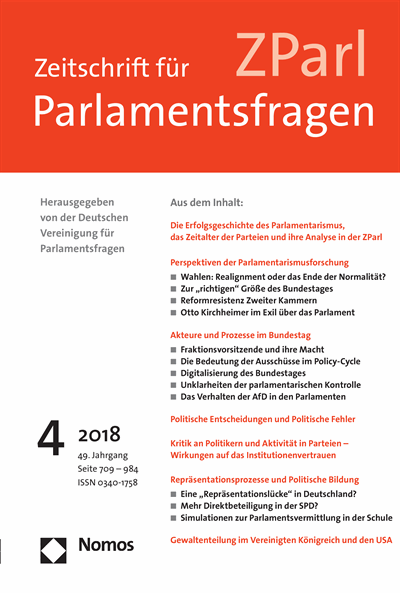
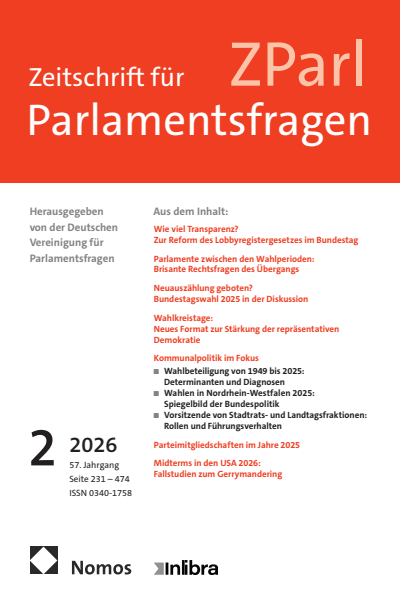
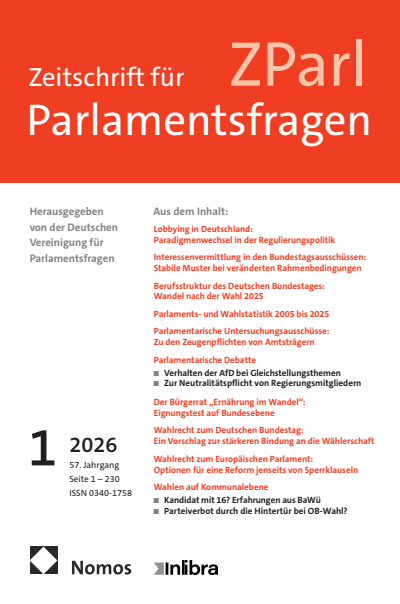
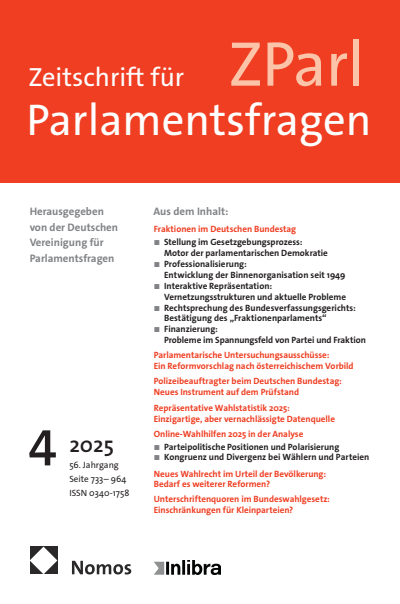
In der ZParl werden alle Bereiche der Politik behandelt, in denen es um Legitimations- und Repräsentationsfragen geht. Bundes- und Landesparlamentarismus, Aspekte der kommunalen Ebene und Verfassungsfragen sowie Probleme des internationalen Parlamentsvergleichs stehen im Vordergrund. Auch die parlamentarische Entwicklung anderer Staaten wird behandelt. Die ZParl vermittelt wissenschaftlich gesicherte und systematisch strukturierte politische Informationen. Den größten Raum nehmen die Dokumentationen und Analysen ein. Zudem finden sich in jedem Heft Aufsätze, die wichtige Themen umfassender betrachten und neue Denkanstöße geben. Immer wieder ist die ZParl Plattform für Diskussionen; zudem werden die jeweils neuesten Titel zu allgemeinen Parlamentsfragen vorgestellt und Neuerscheinungen zu den Schwerpunktthemen eines Heftes im Literaturteil besprochen. In ihren „Mitteilungen“ unterrichtet die ZParl unter anderem über die Seminare, Diskussionsforen und Vortragsveranstaltungen der Deutsche Vereinigung für Parlamentsfragen (DVParl).Die Hefte eines jeden Jahrgangs sind mit einem Sach- und Personenregister versehen. Damit erhält jeder Band den Charakter eines Nachschlagewerkes zur Institutionen- und vergleichenden Regierungslehre. In den mehr als vierzig Jahren ihres Bestehens ist die ZParl als „Datenbank“ ein Beitrag zur Chronik der Bundesrepublik geworden.Homepage: www.zparl.nomos.de
In the face of its historic, tragic discontinuity, the revival of German parliamentarism in the mid-20th century shows that institutional development is not necessarily path-dependent. Contingent factors shaped the revival. One contributing factor...
To this day, the young Otto Kirchheimer is regarded as a strong critical voice of the Weimar Republic’s parliamentary system. The article discusses Kirchheimer’s less known writings on parliamentarism during his years of exile in Paris and New...
Using the analytical tools of V.O. Key’s “theory of critical elections” and Peter Hall’s concept of paradigmatic “third order change”, the article places democratic electoral processes in changing socio-historical contextual...
After the 2017 Bundestag election, the Bundestag consists of 709 members. In the public’s opinion this number has been criticized for being too high. The article sets out to determine the criteria for a “correct” number of members of...
This is a paradox. Political science literature has often rung the death bell for Second Chambers. They have been declared as no longer being of importance, or even lacking legitimacy. In Ireland, Italy, Canada and the UK the political parties had...
Despite the pivotal position chairpersons of the parliamentary party groups (PPG) in the German Bundestag hold, they are substantively understudied. In particular, there is no scholarly work on the chairpersons’ power to steer PPGs. This study...
The committees of the Bundestag are often understood as the place where the real work of parliament takes place. Surprisingly, they have not been studied very thoroughly in empirical political science. This is, in part, due to their work not being...
The comprehensive digitization of communication does not exclude parliamentarism. It encroaches on its working methods as well as on its operation mode. Authenticity, directness and originality of parliamentarian debates are declining. Integrity and...
It is a widely held belief that the parliament’s ability to control the cabinet is a critical element for the functioning of a democracy. This article questions this hypothesis. The study of core theses of realistic democracy theory led to the...
Britain’s constitution has radically changed. Long standing and firmly established principles of the former “political constitution“ - like parliamentary sovereignty - are being questioned and go so far for them being labelled as...
Since Donald Trump was elected president, the U. S. political system of “checks and balances“ has been facing previously unknown challenges. With no prior political experience, Trump over the last two years has tried to roll back the legislative...
Imparity of parliamentary influence, common to both the acceptance of the Versailles Treaty by the Weimar National Assembly and the current struggle in the British House of Commons over the Brexit deal, was also a grave problem for the German...
The 1968 legislation succeeded in transforming the state of emergency in Germany: it no longer entails the executive’s overwhelming prerogative. Hence, Parliament’s rights and structures as well as the constitutional state and its functioning...
Although the term “mistake” is used regularly when political actions are judged, so far (German) political science has not developed a substantial concept of policy mistakes. Nevertheless, a holistic and policy-oriented concept of state error...
Based on survey data from April 2018, this article demonstrates that the “Alternative für Deutschland” (AfD) has emerged from a “gap of representation” as perceived by a relevant percentage of German voters. In addition, the dimensions are...
The “Alternative für Deutschland” (AfD) is now represented in all 16 German state parliaments, the Bundestag and the European Parliament. In the European Parliament, the ideological and personal conflicts of the federal AfD have led to the...
A healthy balance between trust and criticism is seen as an ingredient of democratic government. Starting from this normative assumption, the article analyses whether and to what extent the public’s enduring negative view on politicians might...
In attitude and participation research it is argued that political participation can counteract political disaffection. However, the relationships between action and attitude level are complicated, in particular due to inconsistent causal...
The present picture, which can be drawn from the German party democracy, is a hazy one: On the one hand, for some time now the turnout and the number of party members has been rising again. On the other hand, it is difficult to argue that the...
Parliamentary democracies can be characterized as party democracies, since in many respects parties are key actors in political decision-making, the recruitment of officials and elected representatives, and the exercise of power. Intra-party...
One central question of civic education is how we can relieve political apathy as sort of de-parliamentarisation from the bottom upÓ. How can we use the increased motivation to participate to foster an appreciative approach to parliamentarism? One...
This article is dedicated to capturing the wide array of topics ZParl has been covering since its inception in 1969. ZParl’s mission has always been to serve as a “mirror” for parliamentary research. Four focal points came to the fore of our...