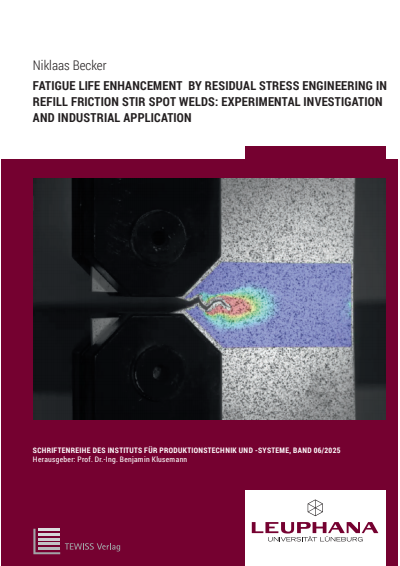
Fatigue life enhancement by residual stress engineering in refill friction stir spot welds: Experimental investigation and industrial application
- Autor:innen:
- Reihe:
- Schriftenreihe des Instituts für Produktionstechnik und -systeme, Band 06/2025
- Verlag:
- 2025
Zusammenfassung
In times of increasing resource scarcity and the global push to reduce greenhouse gas emissions, lightweight design plays a crucial role in achieving sustainable mobility. However, higher material utilization in lightweight structures also raises challenges for structural integrity, particularly under dynamic loading conditions in the transport sector. This dissertation investigates the failure of spot welds performed as Refill Friction Stir Spot Welding (Refill FSSW), an advanced solid-state joining process suitable for high-strength aluminum alloys which are known as not weldable using conventional fusion-based methods. By avoiding melting, Refill FSSW prevents hot cracking and porosity and promotes fine, recrystallized grain structures, making it highly relevant for lightweight applications. The research focuses on understanding the failure mechanisms and fatigue performance of Refill FSSW joints. Detailed experimental and analytical studies reveal that residual stresses, rather than microstructural features, are the dominant factor influencing fatigue behavior. Based on this finding, a novel geometric approach to control and exploit residual stresses was developed, resulting in fatigue life improvements of up to 4000% under consistent load conditions. The industrial applicability of Refill FSSW is demonstrated through its implementation within the LESSMAT research project, including process qualification and the production of a full-scale lightweight demonstrator in railway vehicle engineering. Overall, this work provides new insights into the role of residual stresses in fatigue performance and establishes strategies for enhancing the structural integrity and durability of lightweight welded joints.
Schlagworte
Publikation durchsuchen
Bibliographische Angaben
- Copyrightjahr
- 2025
- ISBN-Online
- 978-3-69030-152-7
- Verlag
- TEWISS, Garbsen
- Reihe
- Schriftenreihe des Instituts für Produktionstechnik und -systeme
- Band
- 06/2025
- Sprache
- Deutsch
- Seiten
- 109
- Produkttyp
- Monographie
Inhaltsverzeichnis
- Titelei/Inhaltsverzeichnis Kein Zugriff Seiten i - xviii
- 1.1 Motivation and research gap Kein Zugriff
- 1.2 Objectives and approach Kein Zugriff
- 1.3 Industrial application of refill FSSW as part of the technology transfer lightweight design project LESSMAT Kein Zugriff
- 1.4 Thesis structure Kein Zugriff
- 2.1 Aluminium and aluminium alloys Kein Zugriff
- 2.2 Residual stresses Kein Zugriff
- 2.3 Refill friction stir spot welding Kein Zugriff
- 2.4 Linear elastic fracture mechanics Kein Zugriff
- 2.5 Fatigue crack growth Kein Zugriff
- 3.1 Welding technology and equipment Kein Zugriff
- 3.2 Welding parameter and materials Kein Zugriff
- 3.3 Optical and scanning electron microscopy Kein Zugriff
- 3.4 Hardness measurements Kein Zugriff
- 3.5 Tensile testing Kein Zugriff
- 3.6 Fatigue testing Kein Zugriff
- 3.7 Crack propagation Kein Zugriff
- 3.8 Temperature measurements Kein Zugriff
- 3.9 Digital image correlation Kein Zugriff
- 3.10 Determination of Residual stress Kein Zugriff
- 4.1 Crack propagation behavior in the microstructurally effected zone of refill FSSW executed as blind welds in single sheet metal configuration Kein Zugriff
- 4.2 Microstructural investigations Kein Zugriff
- 4.5 Conclusions Kein Zugriff
- 5.1 Investigation of the correlation between energy input, residual stresses and mechanical properties in spot welds performed by refill FSSW Kein Zugriff
- 5.2 Discussion Kein Zugriff
- 5.3 Conclusions Kein Zugriff
- 6.1 Microstructure and hardness analyses Kein Zugriff
- 6.2 Fatigue life properties and fracture mode Kein Zugriff
- 6.3 Residual stresses Kein Zugriff
- 6.4 Discussion Kein Zugriff
- 6.5 Conclusions Kein Zugriff
- 7.1 Manufacturing concept Kein Zugriff
- 7.2 Mechanical qualification Kein Zugriff
- 7.3 Production and mechanical validation of the demonstrator Kein Zugriff
- Chapter 8: Summary and conclusions Kein Zugriff Seiten 83 - 84
- References Kein Zugriff Seiten 85 - 98
- A Fatigue results - reference specimens Kein Zugriff
- B Fatigue results - modified specimens Kein Zugriff
- C Geometrie of 3D-printed web structure Kein Zugriff
- D Welding parameter and results BBD Kein Zugriff
- E Fatigue results - defectiv specimens Kein Zugriff