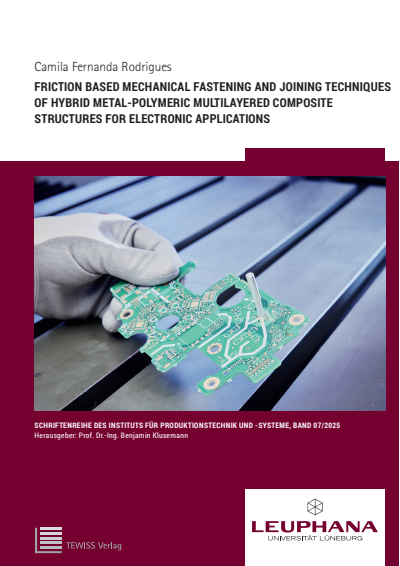
Friction based mechanical fastening and joining techniques of hybrid metal–polymeric multilayered composite structures for electronic applications
- Autor:innen:
- Reihe:
- Schriftenreihe des Instituts für Produktionstechnik und -systeme, Band 07/2025
- Verlag:
- 2025
Zusammenfassung
The growing demand for smaller, more efficient electronic devices is driving the need for innovative PCB joining techniques. Traditional methods are limited in terms of mechanical reliability and thermal stress. Friction riveting (FricRiveting) is emerging as a promising solderfree alternative. This research project investigates the feasibility of using FricRiveting for PCB assembly, with a focus on optimizing process parameters and understanding joint performance. Joints were produced using AA-2024-T351 rivets and FR4 laminate. Various experimental techniques were employed to characterize the joints, including optical microscopy, infrared thermography, mechanical testing and advanced thermal analyses such as differential scanning calorimetry (DSC) and thermogravimetric analysis (TGA). The findings show that rivets can be effectively anchored within the FR4, provided the process temperature is kept below 360°C. However, excessive heat causes the epoxy resin to degrade, which has a negative impact on the long-term integrity and reliability of the joint. The study highlights rotational speed and friction force as crucial parameters for joint quality. In conclusion, FricRiveting shows great promise for PCB applications, offering a sustainable and robust joining method. However, further optimization is essential to mitigate the effects of thermal degradation and integrate the process into high-volume automated manufacturing lines.
Schlagworte
Publikation durchsuchen
Bibliographische Angaben
- Copyrightjahr
- 2025
- ISBN-Online
- 978-3-69030-160-2
- Verlag
- TEWISS, Garbsen
- Reihe
- Schriftenreihe des Instituts für Produktionstechnik und -systeme
- Band
- 07/2025
- Sprache
- Deutsch
- Seiten
- 111
- Produkttyp
- Monographie
Inhaltsverzeichnis
- Titelei/Inhaltsverzeichnis Kein Zugriff Seiten i - xviii
- 1.1 Motivation Kein Zugriff
- 1.2 Objectives and approach Kein Zugriff
- 1.3 Thesis structure Kein Zugriff
- 2.1 Printed circuit boards (PCBs) Kein Zugriff
- 2.2 PCB Assembly Technologies Kein Zugriff
- 2.3 FricRiveting Process Kein Zugriff
- 2.4 Aluminum 2xxx series Kein Zugriff
- 3.1 Base Materials Kein Zugriff
- 3.2 Methods Kein Zugriff
- 4.1 Joint formation Kein Zugriff
- 4.2 Process temperature evolution Kein Zugriff
- 4.3 Mechanical properties of the joints Kein Zugriff
- 4.4 Summary of the results Kein Zugriff
- 5.1 Cross-Section analysis of temperature-induced degradation in FR4 laminates Kein Zugriff
- 5.2 Thermal Characterization (DSC and TGA) Kein Zugriff
- 5.3 Chemical and microstructural characterization (Raman Spectroscopy) Kein Zugriff
- 5.4 Chemical Characterization (SEM/EDX) Kein Zugriff
- 5.5 Summary of the results Kein Zugriff
- 6.1 Aluminum rivets of 4 mm diameter Kein Zugriff
- 6.2 Aluminum rivet of 3 mm diameter Kein Zugriff
- 6.3 Aluminum rivet with a diameter of 2.5 mm Kein Zugriff
- 6.4 Mechanical properties Kein Zugriff
- 6.5 Summary of the results Kein Zugriff
- Chapter 7 Summary and Conclusion Kein Zugriff Seiten 91 - 94
- References Kein Zugriff Seiten 95 - 102
- A – Box Behnken Design (BBD) Kein Zugriff
- B – SEM/EDX Spectra Kein Zugriff