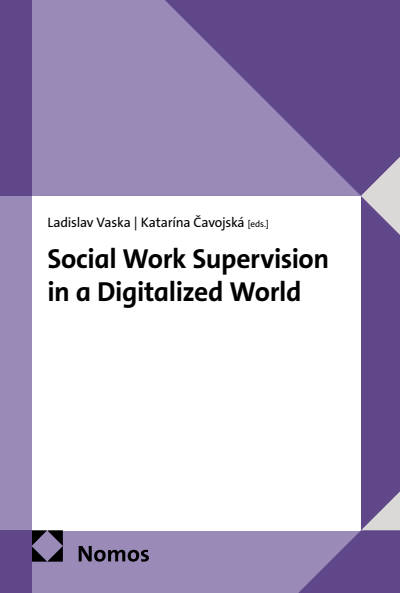
Social Work Supervision in a Digitalized World
- Herausgeber:innen:
- |
- Verlag:
- 2026
Zusammenfassung
Der Band bietet die erste umfassende monografische Analyse der Online-Supervision in der Sozialen Arbeit. Vor dem Hintergrund fortschreitender Digitalisierung untersucht er Veränderungen supervisorischer Prozesse, Beziehungen und Rahmenbedingungen in digitalen und hybriden Settings. Auf der Grundlage theoretischer Ansätze und origineller empirischer Forschung analysiert die Publikation zentrale ethische, relationale und methodische Herausforderungen der Online-Supervision, ihre Chancen und Grenzen sowie zukünftige Entwicklungsperspektiven. Internationale Beiträge bringen eine vergleichende Perspektive in die Analyse ein. Der Band richtet sich an Forschende, Supervisor:innen, Praktiker:innen sowie Studierende der Sozialen Arbeit.
Mit Beiträgen von Rusudan Asatiani | Filip Bambúch | Peter Brnula | Katarína Čavojská | Nona Chachanidze | Alžbeta Brozmanová Gregorová | Martina Hrozenská | Eva Mydlíková | Shorena Sadzaglishvili | Erik Šatara | Michaela Šavrnochová | Ladislav Vaska | Jana Budoš Vrťová Dieser Titel erscheint auch Open Access.
Publikation durchsuchen
Bibliographische Angaben
- Auflage
- 1/2026
- Copyrightjahr
- 2026
- ISBN-Print
- 978-3-7560-3702-5
- ISBN-Online
- 978-3-7489-6851-1
- Verlag
- Nomos, Baden-Baden
- Sprache
- Englisch
- Seiten
- 286
- Produkttyp
- Sammelband
Inhaltsverzeichnis
- INTRODUCTION
- Autor:innen:Download Kapitel (PDF)
- From the Digitalization of Social Work to the Integration of Information and Communication Technologies in Social Work Supervision in Global Contexts
- The Process of Integrating Information and Communication Technologies into Supervision in Social Work
- Classification of Forms of Social Work Supervision Conducted through Information and Communication Technologies
- The Current State of the Issue in Slovakia
- Autor:innen: |Download Kapitel (PDF)
- Ethical Dimensions of the Research
- Research Quality and Trustworthiness
- Limitations of the Study
- Data Collection and Analysis
- Characteristics of Research Participants
- Autor:innen:Download Kapitel (PDF)
- Distance and Online Supervision
- Theoretical Framework of Online Supervision
- Changes in the Experience of Supervision
- Beginning Supervisees
- Needs of Beginning Supervisee
- Main Research Findings
- Form of Supervision
- Technological and Practical Aspects of the Supervisory Session
- Relationship and Interaction Between Supervisor and Supervisee
- Content and Benefits of the Supervisory Session
- Emotional Disposition and Reflexivity
- Discussion
- Practical Recommendations for the Development of Distance and Hybrid Supervision
- Autor:innen:Download Kapitel (PDF)
- Introduction
- Definition of the Supervisory Relationship
- Building the Supervisory Relationship in the Online Environment
- Prior (Non-)Experience, Personal Contact, and the Development of a Trust-Based Supervisory Relationship
- Building a Trusting Relationship and a Sense of Safety in Online Supervision: Technological, Contextual, and Ethical Framework
- The Role of the Supervisor in Building Trust and Creating a Safe Online Environment
- The Limitations of the Online Environment in Building the Supervisory Relationship
- Perceptions of the Limitations of Online Supervision – the Supervisees’ Perspective
- Limitations of Online Supervision from the Perspective of Supervisors
- Professional Competence of the Supervisor
- The Supervisor’s Approach as a Prerequisite for Building a Supervisory Relationship
- Discussion
- Autor:innen:Download Kapitel (PDF)
- Spatial Representation of Online Supervision
- Technical and Visual Aspects of Online Supervision
- The Emotional Aspect of Online Supervision
- Interaction and Dynamics of Supervision
- Distance and Incompleteness of the Relationship
- Administrative and Clinical Supervision in Visualisations of Online Supervision
- Functions of Supervision in Visualizations of Online Supervision
- Autor:innen: |Download Kapitel (PDF)
- Introduction
- Ethics in Supervision
- Ethical Issues in Supervision Conducted in the Online Environment
- Results and Discussion
- Trust and the Supervisory Relationship as a Core Ethical Principle of Online Supervision
- Security and Confidentiality in Online Supervision
- Responsibility in Online Supervision
- Competence
- Informed Consent and the Supervisory Contract
- Discussion
- Autor:innen:Download Kapitel (PDF)
- Introduction
- Perspectives of supervisors
- Technical Limitations
- Creative Limitations
- Communication and Nonverbal Aspects
- Temporal and Geographical Efficiency
- 1. Confidentiality
- 2. Informed consent
- 3. Digital security
- Emotional Aspects
- Risk of Insufficient Focus
- Perspectives of supervisees
- The Supervisor’s Personality and Trust
- Technical Limitations
- Communication and Nonverbal Aspects
- Temporal and Geographical Efficiency
- Emotional Aspects
- Shared dimensions of the supervisory process
- Discussion
- Autor:innen:Download Kapitel (PDF)
- Introduction
- The Benefits of Supervision from the Supervisors’ Perspective
- The Benefits of Supervision from the Supervisees’ Perspective
- Comparative Analysis of The Benefits of Online Supervision from the Perspectives of Supervisors and Supervisees
- Discussion
- Autor:innen:Download Kapitel (PDF)
- Introduction
- Technical Barriers and Their Consequences
- Loss of Personal Contact and Nonverbal Communication
- Challenges in Maintaining Professional Boundaries
- Health and Psychological Consequences
- Ethical Issues and Security
- 1 . Concerns and Internal Barriers
- Uncertainty in the Online Environment
- Fear of the Unknown
- Fear of Losing Personal Contact
- Discomfort in the Online Space
- Resistance from Supervisees
- 2. Technical Barriers
- Lack of Technical Skills among Supervisees and Supervisors
- Technical Limitations – Internet Connection
- Lack of Access to Equipment
- Disruptive External Factors
- Language Barrier
- 3. Limitations of Expressivity and Creativity
- Limited Use of Physical Aids
- 4. Limitations in Perceiving Nonverbal Communication
- Limited Perception of the Whole Body
- Loss of Micro-Signals
- 5. Trust, Intimacy, and Safety
- Loss of Trust and Intimacy
- Reduced Sense of Safety
- 6. Limitations Resulting from the Loss of Physical Contact
- Weakened Emotional Connection
- Lack of Physical Closeness as a Factor in Understanding
- Limited Expression of Feelings
- Reduced Informal Relationships
- 7. Limitations of Group Supervision
- 8. Limitations of the Supervisory Process
- Difficulty in Attuning to Supervision
- Limited Perception of Context and the Use of Silence in Online Supervision
- Increased Directiveness, Formal Structure, and Pressure for Results in Online Supervision
- Easier Loss of Attention
- Time Constraints
- Reduced Perceived Importance of Online Supervision
- Mental Absence of Supervisees
- Faster Dissipation of Emotions
- 9. Limitations in Building the Supervisory Relationship
- Interconnection Between Categories of Online Supervision Limitations
- Discussion
- Autor:innen: |Download Kapitel (PDF)
- a) Development and Normalization of Online Supervision
- b) Standardization and Ethics
- c) Technical and Spatial Prerequisites
- d) Suitability in Relation to the Type and Goal of Supervision
- e) Hybrid Models and Process Design
- f) Public Awareness and Expectation Management
- g) Accessibility and Capacity
- h) Risks to Quality and Formalization
- i) Digitalization of Processes and Emerging Technologies
- a) Historical Context of the Development and Normalization of Online Supervision
- c) Intervening Factors
- d) Strategies
- e) Consequences
- The Future of Online Supervision: Key Findings and Implications for Practice
- Autor:innen: | |Download Kapitel (PDF)
- Introduction
- Professional Supervision in Social Work: Core Functions
- Experience in Georgia
- Professional Supervision in the National Agency for Crime Prevention, Non-Custodial Sentences and Probation
- Professional Supervision in the LEPL Agency for State Care and Assistance to (Statutory) Victims of Human Trafficking
- Professional Supervision in the Office of Resource Officers of Educational Institutions
- Research Methodology
- 1. Main Supervisory Practices
- 2. Consistency of Supervision Practices
- 3. Legislative and Policy Frameworks
- 4. Challenges in the Supervisory Process
- 5. Strategies to Address Supervision Challenges
- 6. Challenges of Online Supervision
- Discussion
- Conclusion
- CONCLUSIONSeiten 279 - 282 Download Kapitel (PDF)
- EDITORS AND CONTRIBUTORSSeiten 283 - 286 Download Kapitel (PDF)