, um zu prüfen, ob Sie einen Vollzugriff auf diese Publikation haben.
Monographie Kein Zugriff
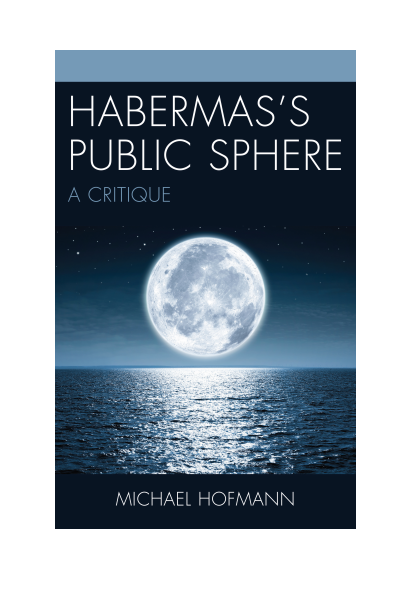
Habermas’s Public Sphere
A Critique
Autor:innen:
Verlag:
2017
Zusammenfassung
Habermas’s Public Sphere: A Critique analyzes the evolution of Juergen Habermas’s social and political theory from the 1950s to the present by focusing on the explicit and on the tacit changes in his thinking about The Structural Transformation of the Public Sphere, his global academic bestseller, which has been translated into 30 languages. Integrating “public sphere,” “discourse,” and “reason,” the three categories at the center of his lifelong work as a scholar and as a public intellectual, Habermas’s classic public sphere concept has deeply influenced an unusually high number of disciplines in the social sciences and in the humanities. In the process, its complex methodology, whose sources are not always identified, can be perplexing and therefore lead to misunderstandings.
While Habermas’s “Further Reflections on the Public Sphere” (1992) contain several far-reaching clarifications, they still do not identify a number of the most important sources for his methodology, above all Herbert Marcuse and Ernst Bloch. Hence, a key purpose of this study is to thoroughly analyze the Marxist critique of ideology that Habermas uses in dialectical fashion for his theory reconstruction of Immanuel Kant’s liberal ideal of a rational-critical public as the organizational principle of the constitutional state and as the method of Enlightenment. Such dialectical thinking allows him to appropriate the structure of Reinhart Koselleck’s Critique and Crisis and of Carl Schmitt’s writings on the modern state while simultaneously upending their conservative critique of Liberalism and of the Enlightenment. However, this strategy restricts the application of his concept to his stylizations of the French Revolution and of his British “model case.”
This critique reinvigorates Habermas’s seminal distinction between the purely political polis of antiquity, which excludes the private economy from the res publica, and the modern public sphere with its rational-critical discourse about commodity exchange and social labor in the political economy. At the same time, it identifies the crises of seventeenth-century England and the Dutch Republic as the origins of the new channels of public communication used to constantly evaluate the role of state power as political facilitator and regulator of an increasingly complex, dynamic, and crisis-prone market economy.
Schlagworte
Publikation durchsuchen
Bibliographische Angaben
Auflage
1/2017
Copyrightjahr
2017
ISBN-Print
978-1-61147-988-1
ISBN-Online
978-1-61147-989-8
Verlag
University Press Copublishing, Lanham
Sprache
Englisch
Seiten
271
Produkttyp
Monographie
Inhaltsverzeichnis
KapitelSeiten
Contents Kein Zugriff
Preface Kein Zugriff
1.1. After Fifty Years: The Public Sphere, Reason, and Democracy Kein Zugriff
1.2. The Concept’s Lasting Contribution to Critical Theory and Practice Kein Zugriff
1.3. The Concept’s Key Challenge Kein Zugriff
1.4. The Concept’s Contradictory Sources Kein Zugriff
1.5. The Concept’s Interdisciplinary Structure Kein Zugriff
2.1. Revolutionary Dialectic: Synthesizing Rousseau and the Physiocrats? Kein Zugriff
2.2. Revolutionary Philosophy: Uncoerced or Predetermined Opinion Publique? Kein Zugriff
2.3. Revolutionary Mythology: Conservative/Liberal Uses of de Tocqueville’s Ambivalence as an “Aristocratic Liberal” in The Old Regime and the Revolution Kein Zugriff
2.4. Revolutionary Romantic: From Moral Theater to Aesthetic Utopia (Schiller) Kein Zugriff
3.1. Establishing the Third Estate as the Nation in England in 1832: Transcending History through a Unique Critique of Ideology? Kein Zugriff
3.2. The English Century: One Nation under Say’s Law and a Vast Secular Boom? Kein Zugriff
3.3. Early Challenges to the Bourgeois Public: Hegel on Class Antagonism, Ricardo on Victims of Machinery, and Carlyle on the Callous “Cash Nexus” Kein Zugriff
3.4. Property and Reform in Parliament: The Dialectic of Corn and Factory Legislation Kein Zugriff
4.1. Crisis and Critique: The Origins of Political Economy in the Political Public Sphere of the Seventeenth Century Kein Zugriff
4.2. The Fiscal-Military State of the Modern Whigs and Its Critique in the Political Public Sphere Kein Zugriff
4.3. The Moral Public Sphere and the Rise of Civilized Barbarism Kein Zugriff
4.4. Moral Censure of the Political Public Sphere in the Eighteenth Century Kein Zugriff
I Kein Zugriff
II Kein Zugriff
III Kein Zugriff
IV Kein Zugriff
Selected Bibliography Kein Zugriff Seiten 243 - 256