, um zu prüfen, ob Sie einen Vollzugriff auf diese Publikation haben.
Monographie Kein Zugriff
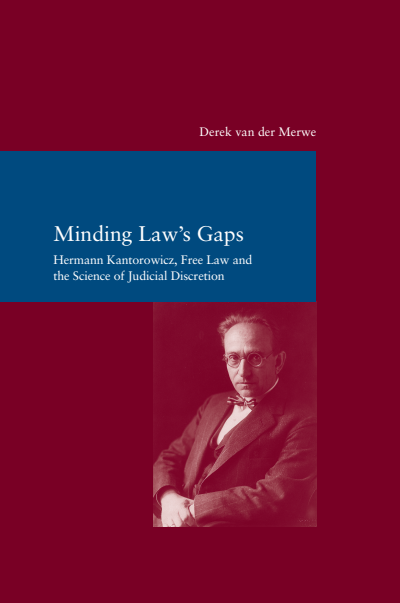
Minding Law's Gaps
Hermann Kantorowicz, Free Law and the Science of Judicial Discretion- Autor:innen:
- Reihe:
- Studien zur Rechtstheorie, Band 2
- Verlag:
- 2026
Zusammenfassung
Hermann Kantorowicz, Rechtstheorie, Geschichte 1900–1930, Rechtsphilosophie, Recht, Freirechtsschule, Rechtsmethodologie, Kulturwissenschaft, Richteramt, Rechtserkenntnis, Rechtsschaffung, Normsetzung
Publikation durchsuchen
Bibliographische Angaben
- Auflage
- 1/2026
- Copyrightjahr
- 2026
- ISBN-Print
- 978-3-465-04675-2
- ISBN-Online
- 978-3-465-14675-9
- Verlag
- Klostermann, Frankfurt am Main
- Reihe
- Studien zur Rechtstheorie
- Band
- 2
- Sprache
- Englisch
- Seiten
- 499
- Produkttyp
- Monographie
Inhaltsverzeichnis
KapitelSeiten
- Table of Contents Kein Zugriff
- Acknowledgments Kein Zugriff
- Preface Kein Zugriff
- 1. Jurisprudential Background Kein Zugriff
- 2. Hermann Kantorowicz’s Life and Career Kein Zugriff
- 3. His Character Kein Zugriff
- (i) His ‘Copernican turn’ to critical philosophy Kein Zugriff
- (ii) The a priori categories of pure reason Kein Zugriff
- (iii) Synthetic a priori judgements Kein Zugriff
- (iv) The distinction between theoretical and practical philosophy Kein Zugriff
- (i) The relationship between the human mind and moral laws Kein Zugriff
- (ii) The concept of and need for a metaphysics of morals Kein Zugriff
- (iii) Law and ethics (morality) Kein Zugriff
- (iv) The categorical imperative Kein Zugriff
- (i) The science of law Kein Zugriff
- (ii) Law Kein Zugriff
- (iii) The universal principle of right Kein Zugriff
- (iv) Law and coercion Kein Zugriff
- 1.2.1 Introduction Kein Zugriff
- 1.2.2 Rationale for a philosophy of right Kein Zugriff
- (i) Right, law and legal science Kein Zugriff
- (ii) Right and freedom Kein Zugriff
- (1) Right as law Kein Zugriff
- (2) The Volksgeist and the World Spirit Kein Zugriff
- 2.1 Introduction Kein Zugriff
- 2.2.1 The object of cognition of philosophy is value Kein Zugriff
- 2.2.2 Philosophy is clearly distinguishable from psychology Kein Zugriff
- 2.2.3 Philosophy employs a distinctive ‘critical’ method Kein Zugriff
- 2.2.4 Neo-Kantian philosophy is a middle way between idealism and positivism Kein Zugriff
- 2.2.5 The defining feature of the critical method is its transcendence Kein Zugriff
- 2.2.6 The requirements for universally valid (objective) knowledge Kein Zugriff
- 2.2.7 A philosophy of science is a second order activity Kein Zugriff
- 2.2.8 Attachment of meaning is attachment of value Kein Zugriff
- 2.2.9 A philosophy of history Kein Zugriff
- (i) Legal positivism (‘general jurisprudence’) and legal philosophy Kein Zugriff
- (ii) The speculative metaphysics of natural law Kein Zugriff
- (iii) The historicism of positivist legal science Kein Zugriff
- (i) Individual-ethical and social ideals of law Kein Zugriff
- (ii) Legal philosophical Hegelianism and Kantianism Kein Zugriff
- (iii) A system of social purposes Kein Zugriff
- (iv) Law as a social phenomenon related to a social value type Kein Zugriff
- (v) Law and justice Kein Zugriff
- (vi) Excursus: Radbruch’s later perspective on law as a social phenomenon related to social value Kein Zugriff
- (i) General comments on methodology Kein Zugriff
- (ii) Method dualism in legal science Kein Zugriff
- (iii) Two broad themes of legal methodology Kein Zugriff
- (iv) The relationship of legal concept construction to its empirical substrate Kein Zugriff
- (v) The systematising function of legal science Kein Zugriff
- 3.1 Philosophical relativism Kein Zugriff
- 3.2 Relativism in legal philosophy Kein Zugriff
- 1. Background Kein Zugriff
- 2.1 The dogma of instrumentality Kein Zugriff
- 2.2 Greek and Roman conceptions of law Kein Zugriff
- 2.3 From the European Middle Ages to the Enlightenment Kein Zugriff
- 2.4 18th-century natural law Kein Zugriff
- 2.5 Montesquieu’s doctrine of the separation of powers Kein Zugriff
- 2.6 Article 4 of the Code Civil Kein Zugriff
- 3.1. Introduction Kein Zugriff
- 3.2 An ‘historical’ understanding of the civil law Kein Zugriff
- 3.3 The arguments against codification Kein Zugriff
- 3.4 The problem(s) with the Code Napoleon Kein Zugriff
- 3.5 The historical method better than codification for law reform Kein Zugriff
- 3.6 The Volksgeist Kein Zugriff
- 3.7 Savigny’s method of legal interpretation Kein Zugriff
- 3.8 Early reaction against the legal historical method Kein Zugriff
- 4.1 Introduction Kein Zugriff
- 4.2 Jhering’s ‘conversion’ and Kantorowicz’s take on his conversion Kein Zugriff
- 4.3.1 Introduction Kein Zugriff
- 4.3.2 Struggle is the source of right Kein Zugriff
- (i) The battle for right is a duty to the self Kein Zugriff
- (ii) The battle for right is also a duty to society Kein Zugriff
- (iii) The battle for right is central to all law Kein Zugriff
- 5.1 A Germanist perspective Kein Zugriff
- 5.2 The social task of private law Kein Zugriff
- 6.1 Introduction Kein Zugriff
- 6.2 Le bon juge Magnaud Kein Zugriff
- 6.3.1 The scientific and technical elements of law Kein Zugriff
- 6.3.2 Libre recherche scientifique Kein Zugriff
- 7. Ernst Zitelmann (1852–1923) Kein Zugriff
- 8.1 Introduction Kein Zugriff
- 8.2 The free discovery of law Kein Zugriff
- 8.3 The sources of adjudicatory norms Kein Zugriff
- 1. Background to the Publication of Der Kampf um die Rechtswissenschaft Kein Zugriff
- 2.1 Preface Kein Zugriff
- 2.2 The consequences for law of the new approach Kein Zugriff
- 2.3.1. The primacy of the will over reason Kein Zugriff
- 2.3.2. Legal interpretation is not an exercise in logic Kein Zugriff
- 2.3.3. The historical approach to law Kein Zugriff
- 2.3.4. Legal science is no different from the scientific method of the social sciences Kein Zugriff
- 2.3.5 Law and theology Kein Zugriff
- 2.4 The consequences for adjudication of the new approach Kein Zugriff
- 2.5 The ideals of the free law movement Kein Zugriff
- 3.1 Introduction Kein Zugriff
- 3.2 Free law theory does not promote a ‘lawless’ jurisprudence Kein Zugriff
- 3.3.1 Core features of free law theory Kein Zugriff
- 3.3.2 The gap-filling role of free law Kein Zugriff
- 3.3.3 Free law represents reciprocity between the reason of logic and a sense of justice Kein Zugriff
- 3.3.4 Hans Kelsen, judicial discretion and gaps in the law Kein Zugriff
- 3.3.5 Not impressed: Rudolf Stammler’s critique of free law theory Kein Zugriff
- 3.4 Kantorowicz: groundbreaking, unconventional, unappreciated Kein Zugriff
- (i) Exposing the judicial ‘crypto sociologists’ Kein Zugriff
- (ii) A ‘science of justice’ rather than a ‘science of law’ Kein Zugriff
- (iii) Filling gaps in the law Kein Zugriff
- 3.5.2 Three modes of adjudication Kein Zugriff
- 3.6 Interessenjurisprudenz – a jurisprudence of interests Kein Zugriff
- 3.7.1 The rationality of law and its practice Kein Zugriff
- 3.7.2 Anti-formalist responses to the formal rationality of law Kein Zugriff
- 3.7.3 Counter demands for the recognition of absolute formal values Kein Zugriff
- 3.7.4 Weber’s assessment of anti-formalist movements Kein Zugriff
- 3.7.5 Paul Vinogradoff and the ‘crisis’ in modern jurisprudence Kein Zugriff
- 1. Introduction Kein Zugriff
- 2. Epochs of Legal Philosophy Kein Zugriff
- (i) Law’s inviolability Kein Zugriff
- (ii) Law’s autocracy (its non-invitational nature) Kein Zugriff
- (iii) Law’s externality Kein Zugriff
- 3.1.2 What justifies legal coercion? Kein Zugriff
- 3.1.3What is the right content of law? Kein Zugriff
- 3.2 Is Stammler’s definition of ‘right law’ materially (empirically) true? Kein Zugriff
- 3.3 Is Stammler’s definition of ‘right law’ formally (logically) correct? Kein Zugriff
- 4.1 Right law conceived as a unity of effect rather than a unity of essence Kein Zugriff
- 4.2 The absence of objective values does not impede a conceptionof right law Kein Zugriff
- 4.3 ‘Critical’ relativism: objective values but not universal truths Kein Zugriff
- 4.4 Relativist legal philosophy and legal definition Kein Zugriff
- 5. Stammler’s Method for Right Law Debunked Kein Zugriff
- 1.1.1 Background: sociology of law as an auxiliary science to law Kein Zugriff
- 1.1.2 The scientific nature of a sociology of law Kein Zugriff
- 1.1.3 Method dualism confirmed Kein Zugriff
- (i) Background: basic principles of the historical school of law Kein Zugriff
- 1. For the jurist, law belongs to the present; for the historian, it belongs to the past Kein Zugriff
- 2. For the jurist, law is a normative system; for the historian, law is a fact Kein Zugriff
- 3. For the jurist, law is a practical science; for the historian, a theoretical science Kein Zugriff
- 4. For the jurist, law is about structure, purpose and uniformity; for the historian, law is about complexity, diversity and an evolving consciousness Kein Zugriff
- (iii) Savigny’s historicist legacy for dogmatic legal science: Begriffsjurisprudenz Kein Zugriff
- (i) The formalist epoch of the early Middle Ages (6th–11th centuries) Kein Zugriff
- (ii) The formalist epoch of the medieval glossators (12th–13th centuries) Kein Zugriff
- (iii) The finalist epoch of the Italian consiliators (14th–15th centuries) Kein Zugriff
- (iv) The formalist epoch of French humanism and the Germanreception movement (16th–17th centuries) Kein Zugriff
- (v) The finalism of the natural law epoch (17th–18th centuries) Kein Zugriff
- (vi) The formalist epoch of the 19th-century German historical school Kein Zugriff
- (vii) The new finalist / formalist epoch from the mid-19th century Kein Zugriff
- 2.1 Law has no phenomenological ‘intuitions of essence’ Kein Zugriff
- 2.2 Identifying meaning constructs of the law (Sinngebilde) Kein Zugriff
- 3.1 Background: sociology as a concept, types of sociology and its relation to other culture sciences Kein Zugriff
- 3.2 The different modes of cognition of sociology of law and dogmatic legal science: a third mode of cognition of law unveiled Kein Zugriff
- (i) Objects of cognition experienced as reality (Da-Sein) Kein Zugriff
- (ii) Objects of cognition as meaning constructs (So-Sein) Kein Zugriff
- (iii) Objects of cognition as judgements of value (Dasein-Sollen) Kein Zugriff
- (i) Legal sciences of meaning Kein Zugriff
- (ii) Legal sciences of value Kein Zugriff
- (iii) Legal sciences of reality Kein Zugriff
- (i) The dogmatic-constructive conception Kein Zugriff
- (ii) The empirical conception Kein Zugriff
- (iii) The critical conception Kein Zugriff
- 4.4 Extra-legal conceptions of the state Kein Zugriff
- 5. Gustav Radbruch’s Version of Method Trialism Kein Zugriff
- 1.1 Content Kein Zugriff
- (i) The world of reality Kein Zugriff
- (ii) The world of objective meaning Kein Zugriff
- (iii) The world of values Kein Zugriff
- 1.3 Form, relation, purpose Kein Zugriff
- 1.4 Classification of the individual sciences Kein Zugriff
- 2.1 The concept ‘law’ Kein Zugriff
- 2.2 Legal science Kein Zugriff
- (i) Types of formal law Kein Zugriff
- (ii) Types of free law Kein Zugriff
- (i) ‘Practical’ reasons Kein Zugriff
- (ii) ‘Theoretical’ reasons Kein Zugriff
- 3.1 Legal realism, free law theory and sociology of law Kein Zugriff
- 3.2 The substantive realist theory on the nature of law: law comprises facts, not rules Kein Zugriff
- 3.3 The formal realist theory on the nature of legal science: it is an empirical, not a rational science Kein Zugriff
- 1. The ‘Legitimate Core’ of Free Law Theory Kein Zugriff
- 2. The Positivist Scourge in Adjudicatory Practice Kein Zugriff
- 3.1 Aufwertungsjurisprudenz (revaluation jurisprudence) Kein Zugriff
- 3.2 Nazi injustice: Radbruch (and Kantorowicz) Kein Zugriff
- Bibliography Kein Zugriff Seiten 445 - 456
- Index of Persons Kein Zugriff Seiten 457 - 460
- Index of Subjects Kein Zugriff Seiten 461 - 474