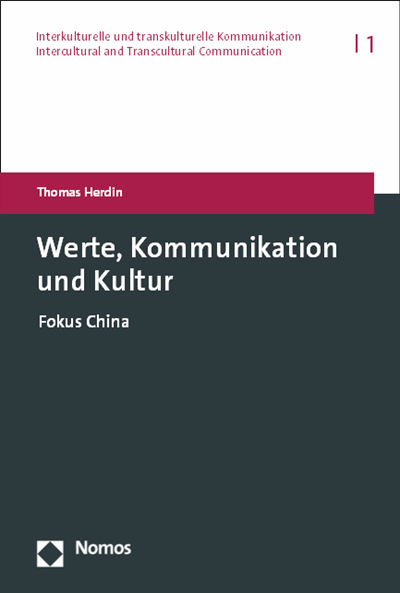
Werte, Kommunikation und Kultur
Fokus China- Autor:innen:
- Reihe:
- Interkulturelle und transkulturelle Kommunikation | Intercultural and Transcultural Communication, Band 1
- Verlag:
- 2018
Zusammenfassung
Das Feld der interkulturellen Kommunikation wird nach wie vor von bipolar-vergleichenden Typologiekonzepten dominiert. In Zeiten der fortschreitenden Globalisierung greifen diese jedoch viel zu kurz. Im vorliegenden Buch erfolgt eine Verzahnung der Begriffe Werte, Kommunikation und Kultur, wodurch ein innovativer Zugang geschaffen wird, um aktuelle gesellschaftliche Entwicklungen fundiert untersuchen zu können. Neue Ansätze und Modelle werden vorgestellt, die auf dem Sowohl-als-auch-Denkrahmen basieren. Daran schließt eine Diskussion zum Thema De-Westernisierung an, die auf Basis einer kritischen Synopse asiatischer (chinesischer) kommunikationswissenschaftlicher Ansätze gründet und das Potenzial für die Weiterentwicklung des Faches auslotet. Im empirischen Teil werden aktuelle Werthaltungen und kulturelle Transformationsprozesse in der Volksrepublik China analysiert, um ein komplexeres Verständnis von dem dort vorherrschenden kulturellen Wertgefüge zu erlangen.
Publikation durchsuchen
Bibliographische Angaben
- Auflage
- 1/2018
- Copyrightjahr
- 2018
- ISBN-Print
- 978-3-8487-4389-6
- ISBN-Online
- 978-3-8452-8652-5
- Verlag
- Nomos, Baden-Baden
- Reihe
- Interkulturelle und transkulturelle Kommunikation | Intercultural and Transcultural Communication
- Band
- 1
- Sprache
- Deutsch
- Seiten
- 742
- Produkttyp
- Monographie
Inhaltsverzeichnis
- Titelei/Inhaltsverzeichnis Kein Zugriff Seiten 1 - 32
- Betrachtungen aus der Metaebene Kein Zugriff
- Relevanz, Methodik und empirische Forschungsziele Kein Zugriff
- China, die Chinesinnen und Chinesen Kein Zugriff
- Persönlicher Zugang und inhaltliche Bedeutung Kein Zugriff
- Termini, Zitate und Quellen Kein Zugriff
- Künstlerische Werke Kein Zugriff
- Aktuelle Entwicklungen Kein Zugriff
- Die kulturelle Landkarte der Bedeutung mittels Werte dechiffrieren Kein Zugriff
- 2.2.1 Das interkulturelle Paradigma Kein Zugriff
- 2.2.2 Das transkulturelle Paradigma Kein Zugriff
- Kulturelle Perspektive und Zeitorientierung Kein Zugriff
- Kontext, Werte und Untersuchungseinheiten Kein Zugriff
- 2.3.1 Das „Value Survey Module“ (VSM) von Hofstede Kein Zugriff
- 2.3.2 Der Werteansatz von Inglehart und der World Value Survey (WVS) Kein Zugriff
- 2.3.3 Die Wertesynthese nach Klages Kein Zugriff
- 2.3.4 Der Schwartz-Value-Survey (SVS) Kein Zugriff
- 3.1.1 Vom Potential der Metapher Kein Zugriff
- Metaphern: ein kultureller Diskurs Kein Zugriff
- Von Universalien und kulturellen Varianzen Kein Zugriff
- Die Bedeutung von Gesicht, Lächeln, Herz und Lebensenergie Kein Zugriff
- Intrakulturelle Unterschiede und Wertewandel Kein Zugriff
- Das Momentum der Irritation zur zwischenmenschlichen Konsolidierung nutzen Kein Zugriff
- 3.2 Metaphorische Modelle vom Festen (Eisberg) und vom Flüssigen (Wellen und Strömungen) Kein Zugriff
- Ursprung der Eisbergmetapher Kein Zugriff
- Drei Ebenen von Kultur Kein Zugriff
- Percepta: Die Ebene des Wahrnehmbaren Kein Zugriff
- Concepta: Die verborgene Dimension von Kultur Kein Zugriff
- Der Prozess der sozialen Kognition: Kategorisieren und Stereotypisieren Kein Zugriff
- Interkulturelle Ratgeberliteratur: ein kritisch zu beleuchtende Vermittlung von Rezeptwissen Kein Zugriff
- Problematiken: inhaltleeres Imitationsverhalten und trügerisches Kompetenzgefühl Kein Zugriff
- Festkörper versus Fluidum Kein Zugriff
- Räumlich versus zeitlich Kein Zugriff
- Verharren versus Schnappschuss Kein Zugriff
- 3.4.2 Ein erster Modellüberblick Kein Zugriff
- Verbindung der Sozialisationsphasen mit Werthaltungen und Kommunikation Kein Zugriff
- Die dysphotische Zone: Phase der sekundären Sozialisation und Bereich der Sekundärwerte Kein Zugriff
- Abgrenzung der Sekundärwerte von den Primärwerten aus evolutionsbiologischer, moralphilosophischer und soziologischer Sicht Kein Zugriff
- Die euphotische Zone: Phase der tertiären Sozialisation Kein Zugriff
- Dynamik 1/3: Ströme der Globalisierung Kein Zugriff
- Dynamik 2/3: Wellen und Verwirbelungen Kein Zugriff
- Dynamik 3/3: Schockwellen Kein Zugriff
- 4.1.1 Kultur: kein a priori-Phänomen Kein Zugriff
- 4.1.2 Der Tanz zwischen Innen und Außen Kein Zugriff
- 4.1.3 Die Verbindung zwischen Empathie und Introspektion Kein Zugriff
- 4.1.4 Xenophobie und Exotismus Kein Zugriff
- Etisch: Kulturtypologien in der interkulturellen Forschung Kein Zugriff
- Emisch: Kulturerfahrung Kein Zugriff
- Das Dilemma: methodologischer Nationalismus und kontextarmes Konzeptualisieren Kein Zugriff
- Die fünf Phasen Kein Zugriff
- 1. Phase: Kontakt: Erkennen der kulturellen Wahrnehmungsfilter Kein Zugriff
- 2. Phase: Induktion: vom Erfahrungspool zu etischen Kulturkonzepten Kein Zugriff
- 3. Phase: kultursensitive Modifikation: Elizitieren von Schlüsselkonzepten Kein Zugriff
- 4. Phase: Deduktion: Transformation theoretischer Erkenntnis auf die pragmatische Ebene Kein Zugriff
- 5. Phase: Feedbackschleife: qualitative Kontrolle und Evaluation der Anwendbarkeit Kein Zugriff
- 4.3.1 Kritik am bipolaren Typologiekonstrukt Individualismus versus Kollektivismus Kein Zugriff
- Darstellung der vier Verhaltensweisen an den asiatischen Beispielen von „Gesicht“ und „Harmonie“ Kein Zugriff
- 5.1.1 Ein Blick zurück: Jaspers Achsenzeit Kein Zugriff
- 5.1.2 Verschiebung wirtschaftlicher Kräfteverhältnisse Kein Zugriff
- 5.1.3 Sozialwissenschaften als Produkt der modernen westlichen Welt Kein Zugriff
- 5.2.1 Kritik an einem westlich geprägten Wissenschaftsdiskurs in der Kommunikationswissenschaft Kein Zugriff
- 5.2.2 Westliche Dominanz bei Lehrmaterialien, Curricula und Lehrenden Kein Zugriff
- 5.2.3 Loslösungsprozesse Kein Zugriff
- 5.2.4 Der Terminus Kommunikation in China Kein Zugriff
- Die vier Entwicklungsphasen Kein Zugriff
- Erste Phase: Zeit des Umbruchs Kein Zugriff
- Zweite Phase: Öffnung und Reproduktion Kein Zugriff
- Dritte Phase: Beginn der kritischen Evaluation Kein Zugriff
- Vierte Phase: Aufbruch in die Eigenständigkeit Kein Zugriff
- Wissenschaftliche Einrichtungen und Fachgesellschaften Kein Zugriff
- Fachzeitschriften und Publikationen in und über China Kein Zugriff
- Die aktuelle Situation Kein Zugriff
- Gegenseitiges Lernen: Bereicherung anstatt Elimination Kein Zugriff
- Reflexion wissenschaftstheoretischer Grundannahmen Kein Zugriff
- Konkretisierungen des Begriffs der De-Westernisierung Kein Zugriff
- Prinzipien für die Entwicklung eines asiatischen Paradigmas Kein Zugriff
- Binnensicht und Außensicht Kein Zugriff
- 5.3.2 Panasiatische Wertekonzeptionen Kein Zugriff
- 5.3.3 Kulturantagonistische Werteansätze Kein Zugriff
- Singulär-kulturelle Ansätze Kein Zugriff
- Konfuzianismus Kein Zugriff
- Taoismus Kein Zugriff
- Paradoxien Kein Zugriff
- Qi/chi: Energie, Energiefluss und Lebensenergie Kein Zugriff
- Buddhismus Kein Zugriff
- Das Harmonie-Modell Kein Zugriff
- Das „Double-Swing“-Modell der interkulturellen Kommunikation Kein Zugriff
- Das I Ging-Modell von Kommunikation Kein Zugriff
- 5.4.1 Methodologischer Nationalismus Kein Zugriff
- 5.4.2 Ethnozentrischer Dualismus Kein Zugriff
- 5.4.3 Kontextarmes Konzeptualisieren Kein Zugriff
- 5.4.4 Komplexität und emotionaler Zugang Kein Zugriff
- 5.4.5 Idealisierung und mangelnde Evaluierung Kein Zugriff
- 5.4.6 Limitationen der De-Westernisierung Kein Zugriff
- Von der Mikro- bis zur Metaebene Kein Zugriff
- Zielgruppe und Zielregion Kein Zugriff
- Polaritätsfeld West – Ost Kein Zugriff
- Polaritätsfeld Stabilität – Wandel Kein Zugriff
- Polaritätsfeld Statuserhöhung – Selbsttranszendenz Kein Zugriff
- Polaritätsfeld Individualismus – Kollektivismus Kein Zugriff
- Polaritätsfeld Jung – Alt Kein Zugriff
- Der Polaritätsfeldansatz: vom Entweder-oder zum Sowohl-als-auch Kein Zugriff
- Drei-Generationen-Perspektive Kein Zugriff
- Einbindung inter- und transkultureller Aspekte Kein Zugriff
- Umfrageforschung und Feldzugang in China Kein Zugriff
- Centergründung, ExpertInnenkonferenz, Finanzierung Kein Zugriff
- Kulturell geprägte Unterschiede im Antwortverhalten Kein Zugriff
- Äquivalenz in der interkulturellen Forschung Kein Zugriff
- Die Methoden- und Forscher-Triangulation Kein Zugriff
- 7.2 Sequentielle Verbindung qualitativer und quantitativer Forschung Kein Zugriff
- 7.3 Schritt 1: Qualitative Exploration Kein Zugriff
- 7.4.1 Der Fragebogen: Grundwerte und Sekundärwerte Kein Zugriff
- 7.4.2 Stichprobenbeschreibungen Kein Zugriff
- 7.4.3 Stichprobenbeschreibung #1: ManagerInnen in Shanghai und Peking 2007 Kein Zugriff
- Geografischer Fokus: Peking und Shanghai Kein Zugriff
- Sozidemografische Daten Kein Zugriff
- Ausbildung und Beruf Kein Zugriff
- 7.4.4 Stichprobenbeschreibung #2: Chinesische Studierende in Shanghai 2014 Kein Zugriff
- Stichprobenbeschreibung Kein Zugriff
- Spezifische studienrelevante Merkmale Kein Zugriff
- 7.4.5 Stichprobenbeschreibung #3: Salzburger Studierende 2015 Kein Zugriff
- Stichprobenbeschreibung Kein Zugriff
- Spezifische studienrelevante Merkmale Kein Zugriff
- Internationale Erfahrung Kein Zugriff
- Leitfadenorientierte Experteninterviews: chinesische WissenschaftlerInnen Kein Zugriff
- Leitfadengestützte problemzentrierte Interviews: Studierende Kein Zugriff
- Gruppeninterviews und Gruppendiskussionen Kein Zugriff
- Experteninterviews, problemzentrierte Interviews und Gruppeninterviews Kein Zugriff
- Fragebögen Kein Zugriff
- Das rezeptive Interview Kein Zugriff
- Bestimmung des Ausgangsmaterials Kein Zugriff
- Prozess Datenerhebung, Interviewdurchführung, Transkription und Zitation Kein Zugriff
- Die Fragestellung der Analyse Kein Zugriff
- Ablaufmodell der strukturierenden Inhaltsanalyse (inhaltliche Strukturierung) Kein Zugriff
- 8.1.1 Ausgangslage: ein Blick zurück Kein Zugriff
- Unterschiede in den Werthaltungen zwischen Peking-Shanghai unter Beachtung der Drei-Generationen-Perspektive Kein Zugriff
- Vergleich der Wertehaltungen in den Jahren 1988, 1995 und 2007 Kein Zugriff
- Werthaltungen heutiger Studierender in China Kein Zugriff
- Wertänderungen im 26-jährigen Zeitvergleich: keine Verwestlichung Kein Zugriff
- Werteprioritäten Studierende (2014) im Vergleich zu ManagerInnen (2007) Kein Zugriff
- Werteprioritäten im Überblick seit 1988 bis heute Kein Zugriff
- Vergleich Shanghai – Salzburg Kein Zugriff
- Intrakulturelle Veränderungen innerhalb Österreichs Kein Zugriff
- Stabile Merkmale: soziodemografische Daten, Berufsstatus und Grundwerte Kein Zugriff
- Veränderbare Merkmale: Identität, Arbeitswelt und Internationalisierung Kein Zugriff
- Einfluss unabhängiger Merkmale auf Grundwerte Kein Zugriff
- Einflussfaktoren auf die Werte von Lebensstil und Identität Kein Zugriff
- Einflussfaktoren auf die Werte von Internationalisierung Kein Zugriff
- Einflussfaktoren auf die Werte in der Arbeitswelt Kein Zugriff
- Einschätzung über die Bestimmung des eigenen Lebens Kein Zugriff
- Konnotation Individualismus: Gefahr selbstsüchtigen Strebens und Vernachlässigung sozialer Pflichten Kein Zugriff
- Freie Meinungsäußerung Kein Zugriff
- 9.1.2 Das Circumplex: Dekonstruktion der Individualismus-Kollektivismus-Typologie Kein Zugriff
- Unsicherheit vor Veränderung Kein Zugriff
- Passive Einflussfaktoren: Tradition, tradierte Strukturen und generationenübergreifende Wertevermittlung Kein Zugriff
- Aktive Einflussfaktoren: aktive Wertevermittlung der Eltern, in den Ausbildungsstätten und seitens der Regierung Kein Zugriff
- Geringe Berührungsängste Kein Zugriff
- Bewusstsein gegenüber der eigenen Tradition Kein Zugriff
- Belebung traditioneller Werte Kein Zugriff
- Das aufkeimende neue Selbstbewusstsein Kein Zugriff
- Materialismus im Aufwind Kein Zugriff
- Vertrauenskrise im Arbeitsalltag Kein Zugriff
- Verpflichtung gegenüber Angehörigen, Bekannten und Institutionen Kein Zugriff
- Institutionelles Vertrauen versus Vertrauen zu Mitmenschen Kein Zugriff
- Verpflichtung Kein Zugriff
- Abkühlung des gesellschaftlichen Klimas und apathische Gleichgültigkeit Kein Zugriff
- Einflussfaktoren, die zum Aufweichen sozialer Strukturen führen Kein Zugriff
- Furcht vor Degeneration gesellschaftlicher Moral Kein Zugriff
- Soziale Dauerbaustelle China Kein Zugriff
- Gesellschaftliche Ebene Kein Zugriff
- Individuelle Ebene: mianzi und guanxi als soziales Korrektiv Kein Zugriff
- Suche nach dem Gleichgewicht: von gesellschaftlicher Harmonie und innerer Balance Kein Zugriff
- Zwischen Selbstverantwortung und Egoismus Kein Zugriff
- Gefahr eines überbordenden utilitaristischen Individualismus Kein Zugriff
- Zwischen Leistungsorientierung und Hedonismus Kein Zugriff
- Die Dankbarkeit-Verpflichtungs-Spirale Kein Zugriff
- Solidarität zwischen den Generationen? Kein Zugriff
- 10.1.1 Positives Europabild Kein Zugriff
- Imagebildung und Nationalstolz Kein Zugriff
- Selbststärkung durch Bildung Kein Zugriff
- Wichtigkeit beruflicher Ziele Kein Zugriff
- Umgang mit europäischen Angestellten: Diskrepanz zwischen Offenheit & Zurückhaltung Kein Zugriff
- Vertrauen zu europäischen Vorgesetzten Kein Zugriff
- 10.2.2 Fremd- und Selbstbild Kein Zugriff
- Vorstellung über „ideale“ Vorgesetzte Kein Zugriff
- Reaktion auf Schwierigkeiten bei Arbeitstätigkeiten Kein Zugriff
- Form der Leistungsberichtserstattung Kein Zugriff
- Bevorzugte Arbeitsweise Kein Zugriff
- Abhängigkeit des Gehaltes Kein Zugriff
- Bevorzugte Gehaltsform Kein Zugriff
- Typenbildung Identität Kein Zugriff
- Typenbildung Arbeitswelt Kein Zugriff
- Typenbildung Internationalisierung Kein Zugriff
- Korrelationen innerhalb der Typenbildungen Kein Zugriff
- Unterschiede in der Typenbildung zwischen Shanghai und Peking Kein Zugriff
- Einordnung der chinesischen und österreichischen Studierenden in die bestehende Typologie Kein Zugriff
- Das transkulturelle Wellen-und-Strömungsmodell Kein Zugriff
- Implementierung des Sowohl-als-auch-Denkrahmens Kein Zugriff
- Der Beitrag von Metaphern im interkulturellen Diskurs Kein Zugriff
- De-Westernisierung der Kommunikationswissenschaft? Kein Zugriff
- a) Relative Stabilität der primären Werthaltungen auf Basis des Schwartz Value Survey (SVS) mit geringfügigem Wandel in China Kein Zugriff
- b) Überwiegend diametrale Werthaltungen zwischen West und Ost Kein Zugriff
- c) Keine Verwestlichung, aber Anzeichen einer Wertesynthese in China Kein Zugriff
- d) Innere Ausdifferenzierung auf Basis der Sekundärwerte (Lebensstil, Arbeitswelt, Internationalisierung) Kein Zugriff
- Weder Konvergenz, noch Divergenz, noch Hybridisierung ... Kein Zugriff
- … sondern unterschiedliche Modernisierungspfade Kein Zugriff
- Entzauberung der Fremde Kein Zugriff
- 11.3 Aufruf Kein Zugriff
- Literaturvereichnis Kein Zugriff Seiten 681 - 740
- Nachwort Kein Zugriff Seiten 741 - 742
Literaturverzeichnis (1012 Einträge)
Es wurden keine Treffer gefunden. Versuchen Sie einen anderen Begriff.
- Adler, N. J. (2008). International dimensions of organizational behavior. Mason, Ohio: Thomson. Google Scholar öffnen DOI: 10.5771/9783845286525
- Alatas, F. S. (2006). Alternative discourses in Asian social science: Responses to Eurocentrism. New Delhi: SAGE Publications. Google Scholar öffnen DOI: 10.5771/9783845286525
- Alatas, F. S. (2010). The definition and types of alternative discourse. In G. Wang (Ed.), De-Westernizing Communication Research: Altering Questions and Changing Frameworks. London: Routledge. Google Scholar öffnen DOI: 10.5771/9783845286525
- Alpermann, B. (2004). Dimensionen sozialer Probleme in der VR China – regionale und sektorale Facetten. In K. Kupfer (Ed.), Sozialer Sprengstoff in China? Dimensionen sozialer Probleme in der Volksrepublik. Essen: Asienstiftung. Google Scholar öffnen DOI: 10.5771/9783845286525
- Altbach, P. G. (2009). The giants awake: The present and future of higher education systems in China and India. In S. Marginson & M. Van der Wende (Eds.), Higher Education to 2030, Volume 2: Globalisation (Vol. 22, pp. 179-203). Paris: OeCD (Organisation for Economic Co-operation and Development)/ Centre for Educational Research and Innovation (CERI). Google Scholar öffnen DOI: 10.5771/9783845286525
- Altbach, P. G. (2014). El despertar de los gigantes: presente y futuro de los sistemas de educación superior en China e India. Education Policy Analysis Archives, 22(46), 1-29. doi: 10.14507/epaa.v22n46.2014 Google Scholar öffnen DOI: 10.5771/9783845286525
- Altbach, P. G. (2014). Regulación estatal y segregación educativa en la Provincia de Buenos Aires. Archivos Analíticos de Políticas Educativas, 22(46), 1-32. Google Scholar öffnen DOI: 10.5771/9783845286525
- Altbach, P. G., Reisberg, L., & Rumbley, L. E. (2009). Trends in Global Higher Education: Tracking an Academic Revolution. A Report Prepared for the UNESCO 2009 World Conference on Higher Education. Paris: United Nations Educational, Scientific and Cultural Organization. Google Scholar öffnen DOI: 10.5771/9783845286525
- Amarasinghe, A. D. (2012). Understanding intercultural facework behaviours. Journal of International Communication, 18(2), 175-188. Google Scholar öffnen DOI: 10.5771/9783845286525
- An, R. (2004). Lun shehui x inren weiji kunjing de chengyin an rui (Über die schwierige Lage der Ursache der gesellschaftlichen Vertrauenskrise). Nationalities Research in Qinghai, 2015(1), 7-10. Google Scholar öffnen DOI: 10.5771/9783845286525
- Antes, P. (2006). Grundriss der Religionsgeschichte: von der Prähistorie bis zur Gegenwart. Stuttgart: W. Kohlhammer Verlag. Google Scholar öffnen DOI: 10.5771/9783845286525
- Appadurai, A. (1996). Modernity at large: Cultural dimensions of globalization. Minneapolis: University of Minnesota Press. Google Scholar öffnen DOI: 10.5771/9783845286525
- Aronson, E., Akert, R. M., & Wilson, T. D. (2008). Sozialpsychologie. London et al.: Prentice Hall. Google Scholar öffnen DOI: 10.5771/9783845286525
- ARWU (Academic Ranking of World Universities). (2015). Academic Ranking of World Universities 2015. Retrieved 20.04.2016 http://www.shanghairanking.com/de/ARWU2015.html Google Scholar öffnen DOI: 10.5771/9783845286525
- Asante, M. K. (1998). The afrocentric idea. Philadelphia, PA: Temple University Press. Google Scholar öffnen DOI: 10.5771/9783845286525
- Asante, M. K. (2006). The rhetoric of globalisation: The Europeanisation of human ideas. Journal of Multicultural Discourses, 1(2), 152-158. Google Scholar öffnen DOI: 10.5771/9783845286525
- Asante, M. K. (2011). De-Westernizing communication: Strategies for neutralizing cultural myths. In G. Wang (Ed.), De-Westernizing Communication Research: Altering Questions and Changing Frameworks (pp. 21-27). New York: Routledge. Google Scholar öffnen DOI: 10.5771/9783845286525
- Asante, M. K., & Gudykunst, W. B. (1989). Preface. In M. K. Asante & W. B. Gudykunst (Eds.), Handbook of international and intercultural communication. Newbury Park et al.: SAGE Publications. Google Scholar öffnen DOI: 10.5771/9783845286525
- Asante, M. K., & Miike, Y. (2013). Paradigmatic issues in intercultural communication studies: An Afrocentric-Asiacentric dialogue. China Media Research, 9(3), 1-19. Google Scholar öffnen DOI: 10.5771/9783845286525
- Aschauer, W. (2017). Das gesellschaftliche Unbehagen in der EU: Ursachen, Dimensionen, Folgen. Wiesbaden: Springer Fachmedien. Google Scholar öffnen DOI: 10.5771/9783845286525
- Assmann, A. (2007). Geschichte im Gedächtnis: Von der individuellen Erfahrung zur öffentlichen Inszenierung. München: C.H. Beck. Google Scholar öffnen DOI: 10.5771/9783845286525
- Assmann, J. (1988). Kollektives Gedächtnis und kulturelle Identität. In J. Assmann & T. Hölscher (Eds.), Kultur und Gedächtnis (pp. 9-19). Frankfurt am Main: Suhrkamp. Google Scholar öffnen DOI: 10.5771/9783845286525
- Assmann, J. (1990). Ma'at: Gerechtigkeit und Unsterblichkeit im alten Ägypten. München: C. H. Beck. Google Scholar öffnen DOI: 10.5771/9783845286525
- Atteslander, P. (2003). Methoden der empirischen Sozialforschung. Berlin/New York: Walter de Gruyter. Google Scholar öffnen DOI: 10.5771/9783845286525
- Averbeck, S. (2008). Comparative history of communication studies: France and Germany. The Open Communication Journal, 2, 1-13. Google Scholar öffnen DOI: 10.5771/9783845286525
- Averbeck, S. (2013). “Globalisation” and related key concepts in communication studies: Findings of a qualitative content analysis of journals in the field. In I. Trivundža Tomanić, N. Carpentier, H. Nieminen & et al. (Eds.), PAST, FUTURE AND CHANGE: CONTEMPORARY ANALYSIS OF EVOLVING MEDIA SCAPES (pp. 55-68). Ljubljana: University of Ljubljana Press. Google Scholar öffnen DOI: 10.5771/9783845286525
- Averbeck-Lietz, S. (2012). Communication studies beyond the national: Connections and disconnections between research communities and how to study them. Global Media Journal German Edition, 2(2), 1-10. Google Scholar öffnen DOI: 10.5771/9783845286525
- Bachleitner, R., Weichbold, M., Aschauer, W., & Pausch, M. (2014). Methodik und Methodologie interkultureller Umfrageforschung: zur Mehrdimensionalität der funktionalen Äquivalenz. Wiesbaden: Springer Fachmedium. Google Scholar öffnen DOI: 10.5771/9783845286525
- Baik, Y.-S. (2002). Conceptualizing ‘Asia’ in modern Chinese mind: a Korean perspective. Inter-Asia Cultural Studies, 3(2), 277-286. doi: 10.1080/146493702200000017 Google Scholar öffnen DOI: 10.5771/9783845286525
- Bairoch, P. (1982). International industrialization levels from 1750 to 1980. Journal of European Economic History, 11(2), 269-333. Google Scholar öffnen DOI: 10.5771/9783845286525
- Bandura, A. (1986). Social foundations of thought and action. A social cognitive theory. Englewoods Cliff, NJ: Prentice Hall. Google Scholar öffnen DOI: 10.5771/9783845286525
- Bandura, A., & Walters, R. H. (1963). Social learning and personality development. New York: Holt, Rinehart & Winston. Google Scholar öffnen DOI: 10.5771/9783845286525
- Bardi, A., & Schwartz, S. H. (2003). Values and behavior: strength and structure of relations. Personality and social psychology bulletin, 29(10), 1207-1220. Google Scholar öffnen DOI: 10.5771/9783845286525
- Baron, R. A., Byrne, D., & Branscombe, N. R. (2006). Social psychology. Boston et al.: Pearson. Google Scholar öffnen DOI: 10.5771/9783845286525
- Baskerville, R. F. (2003). Hofstede never studied culture. Accounting, organizations and society, 28(1), 1-14. Google Scholar öffnen DOI: 10.5771/9783845286525
- Basso, K. H. (1976). "Wise words" of the Western apache: Metaphor and semantic theory. In K. H. Basso & H. Selby (Eds.), Meaning in anthropology (pp. 99-121). Albuquerque: University of New Mexico Press. Google Scholar öffnen DOI: 10.5771/9783845286525
- Basso, K. H., & Selby, H. A. (1976). Meaning in anthropology. Albuquerque: University of New Mexico Press. Google Scholar öffnen DOI: 10.5771/9783845286525
- Baudot, J. (2001). Building a world community: Globalisation and the common good. Washington: University of Washington Press. Google Scholar öffnen DOI: 10.5771/9783845286525
- Bauman, Z. (1999). Culture as praxis. London: SAGE Publications. Google Scholar öffnen DOI: 10.5771/9783845286525
- Bauman, Z. (2003). Flüchtige Moderne. Frankfurt/Main: Suhrkamp Verlag. Google Scholar öffnen DOI: 10.5771/9783845286525
- Beck, U. (1986). Risikogesellschaft. Auf dem Weg in eine andere Moderne. Frankfurt am Main: Suhrkamp. Google Scholar öffnen DOI: 10.5771/9783845286525
- Beck, U. (1997). Was ist Globalisierung? Frankfurt am Main: Suhrkamp Verlag. Google Scholar öffnen DOI: 10.5771/9783845286525
- Beck, U. (2004). Der kosmopolitische Blick oder: Krieg ist Frieden. Frankfurt am Main: Suhrkamp. Google Scholar öffnen DOI: 10.5771/9783845286525
- Beck, U. (2005). Europäisierung - Soziologie für das 21. Jahrhundert. Politik und Zeitgeschichte, 34-35, 3-11. Google Scholar öffnen DOI: 10.5771/9783845286525
- Beck, U., & Grande, E. (2010). Jenseits des methodologischen Nationalismus: Außereuropäische und europäische Variationen der Zweiten Moderne. Soziale Welt, 61(3-4), 187-216. Google Scholar öffnen DOI: 10.5771/9783845286525
- Bell, D. A., & Chaibong, H. (2003). Confucianism for the modern world. New York: Cambridge University Press. Google Scholar öffnen DOI: 10.5771/9783845286525
- Bell, D. A., & Chaibong, H. (2003). Introduction: The contemporary relevance of Confucianism. In D. A. Bell & H. Chaibong (Eds.), Confucianism for the modern world (pp. 1-28). New York: Cambridge University Press. Google Scholar öffnen DOI: 10.5771/9783845286525
- Bellers, J., & Porsche-Ludwig, M. (2010). Achsenzeiten-Mythos und Zukunft der Geschichte: ein ideen- und geistesgeschichtlicher Überblick von Aristoteles bis Heidegger. Münster: LIT Verlag. Google Scholar öffnen DOI: 10.5771/9783845286525
- Bentele, G., & Beck, K. (1994). Information – Kommunikation – Massenkommunikation: Grundbegriffe und Modelle der Publizistik- und Kommunikationswissenschaft. In O. Jarren (Ed.), Medien und Journalismus. 1. Eine Einführung (pp. 15-50). Opladen: Westdeutscher Verlag. Google Scholar öffnen DOI: 10.5771/9783845286525
- Berger, P. L., & Luckmann, T. (1966). The social construction of reality. New York: Anchor Books. Google Scholar öffnen DOI: 10.5771/9783845286525
- Berger, P. L., & Luckmann, T. (2009/1969). Die gesellschaftliche Konstruktion der Wirklichkeit. Frankfurt/Main: S. Fischer Verlag. Google Scholar öffnen DOI: 10.5771/9783845286525
- Berry, J. W. (1980). Introduction to methodology. In H. C. Triandis & J. W. Berry (Eds.), Handbook of cross-cultural psychology (pp. 1-28). Boston: Allyn & Bacon. Google Scholar öffnen DOI: 10.5771/9783845286525
- Berry, J. W. (1989). Imposed etics-emics-derived etics: The operationalization of a compelling idea. International Journal of Psychology, 24(6), 721-735. Google Scholar öffnen DOI: 10.5771/9783845286525
- Berry, J. W. (1999). Emics and etics: A symbiotic conception. Culture & Psychology, 5, 165-171. Google Scholar öffnen DOI: 10.5771/9783845286525
- Berry, J. W., & Dasen, P. R. (1974). Culture and cognition: Readings in cross-cultural psychology. Lodon: Methuen. Google Scholar öffnen DOI: 10.5771/9783845286525
- Berry, J. W., & Dasen, P. R. (1974). History and method in the cross-cultural study of cognition. In J. W. Berry & P. R. Dasen (Eds.), Culture and cognition: Readings in cross-cultural psychology (pp. 1-22). London: Methuen. Google Scholar öffnen DOI: 10.5771/9783845286525
- Bersick, S. (2010). Perceptions of Asia in Europe. Asia Europe Journal, 8(2), 245-255. doi: 10.1007/s10308-010-0261-z Google Scholar öffnen DOI: 10.5771/9783845286525
- Bertelsmann Stiftung. (2006). Interkulturelle Kompetenz – Schlüsselqualifikation des 21. Jahrhunderts? Thesenpapier der Bertelsmann Stiftung auf Basis der Interkulturellen-Kompetenz-Modelle von Dr. Darla K. Deardorff. Retrieved 02.04.2016 https://www.jugendpolitikineuropa.de/downloads/4-20-2300/bertelsmann_intkomp.pdf Google Scholar öffnen DOI: 10.5771/9783845286525
- Bhabha, H. K. (1994). The location of culture. London: Routledge. Google Scholar öffnen DOI: 10.5771/9783845286525
- Bie, D.-r., & Yi, M.-c. (2014). The context of higher education development and policy response in China. Studies in Higher Education, 39(8), 1499-1510. doi: 10.1080/03075079.2014.949545 Google Scholar öffnen DOI: 10.5771/9783845286525
- Billig, M. (1995). Banal nationalism. London: SAGE Publications. Google Scholar öffnen DOI: 10.5771/9783845286525
- Bindt, C., Huber, A., & Hecher, K. (2008). Vorgeburtliche Entwicklung. In B. Herpertz-Dahlmann, F. Resch, M. Schulte-Markwort & A. Warnke (Eds.), Entwicklungspsychiatrie – Biopsychologische Grundlagen und die Entwicklung psychischer Störungen (Vol. 2, pp. 89-117). Stuttgart/New York Schattauer. Google Scholar öffnen DOI: 10.5771/9783845286525
- Birowo, M. A., & Hanitzsch, T. (2002). Asiatische oder transkulturelle Perspektive. In A. Hepp & M. Löffelholz (Eds.), Grundlagentexte zur transkulturellen Kommunikation (pp. 774-794). Konstanz: UVK-Verlagsgesellschaft (UTB). Google Scholar öffnen DOI: 10.5771/9783845286525
- Bjørnskov, C. (2006). The determinants of trust. Retrieved 10.02.2016, from The Ratio Institute http://pure.au.dk/portal/files/39599381/cb_trust.pdf Google Scholar öffnen DOI: 10.5771/9783845286525
- Bjørnskov, C. (2007). Determinants of generalized trust: a cross-country comparison. Public choice, 130(1-2), 1-21. Google Scholar öffnen DOI: 10.5771/9783845286525
- Black, M. (1996 [orig. 1977]). Mehr über die Metapher. In A. Haverkamp (Ed.), Die Theorie der Metapher (Vol. 1, pp. 379-413). Darmstadt: Wissenschaftliche Buchgesellschaft. Google Scholar öffnen DOI: 10.5771/9783845286525
- Blasko, D. G. (1999). Only the tip of the iceberg: Who understands what about metaphor? Journal of pragmatics, 31(12), 1675-1683. Google Scholar öffnen DOI: 10.5771/9783845286525
- Blume, G. (2001). Schmerzen der Gesellschaft, Zeit Online. Retrieved from http://www.zeit.de/2001/20/Schmerzen_der_Gesellschaft et http://pdf.zeit.de/2001/20/Schmerzen_der_Gesellschaft.pdf Google Scholar öffnen DOI: 10.5771/9783845286525
- Blume, G. (2008). China ist kein Reich des Bösen: Trotz Tibet muss Berlin auf Peking setzen. Hamburg: Edition Körber-Stiftung. Google Scholar öffnen DOI: 10.5771/9783845286525
- Blumenberg, H. (1996 [orig. 1960]). Paradigmen zu einer Metaphorologie. In A. Haverkamp (Ed.), Die Theorie der Metapher. Darmstadt: Wissenschaftliche Buchgesellschaft. Google Scholar öffnen DOI: 10.5771/9783845286525
- Blumer, H. (1969). Symbolic interactionism. Perspective and method. Englewood Cliff, NJ: Prentice Hall. Google Scholar öffnen DOI: 10.5771/9783845286525
- Blumer, H. (1973). Der methodologische Standort des symbolischen Interaktionismus. Bielefeld: Arbeitsgruppe Bielefelder Soziologen. Google Scholar öffnen DOI: 10.5771/9783845286525
- BMBF, B. f. B. u. F. (2012). China – auch beim Wassermanagement Hand in Hand. Retrieved 13.02.16 http://www.bmbf.de/de/818.php Google Scholar öffnen DOI: 10.5771/9783845286525
- BMWI, B. f. W. u. E. (2012). Spezielle Regelungen beim Incoming Tourismus aus der Volksrepublik China. Retrieved 13.02.2016 http://www.bmwi.de/DE/Themen/Tourismus/Internationale-Zusammenarbeit/incoming-tourismus-aus-china.html Google Scholar öffnen DOI: 10.5771/9783845286525
- Boatcă, M. (2012). Désoccidentaliser la sociologie. L'Europe au mirroir de la Chine. European Societies, 14(5), 784-786. doi: 10.1080/14616696.2012.748932 Google Scholar öffnen DOI: 10.5771/9783845286525
- Bolles, R. C. (1993). The story of psychology: A thematic history. Belmont, CA: Thomson Brooks/Cole Publishing Co. Google Scholar öffnen DOI: 10.5771/9783845286525
- Bolten, J. (2007a). Interkulturelle Kompetenz. Erfurt: Landeszentrale für politische Bildung. Google Scholar öffnen DOI: 10.5771/9783845286525
- Bolten, J. (2007b). Einführung in die interkulturelle Wirtschaftskommunikation. Göttingen: Vandenhoeck & Ruprecht. Google Scholar öffnen DOI: 10.5771/9783845286525
- Bond, M. H. (1994). Into the heart of collectivism: A personal and scientific journey. In U. Kim, H. C. Triandis, C. Kagitcibasi, S.-C. Choi & G. Yoon (Eds.), Individualism and collectivism: Theories, method, and applications (pp. 66-76). Thousand Oaks, CA: SAGE Publications. Google Scholar öffnen DOI: 10.5771/9783845286525
- Bond, M. H. (2002). Reclaiming the Iidividual from Hofstede's ecological analysis – a 20-year odyssey: Comment on Oyserman et al. Psychological bulletin, 128(1), 73-77. Google Scholar öffnen DOI: 10.5771/9783845286525
- Bond, M. H. (2010). Reaching this stage in studying the psychology of the Chinese. In M. H. Bond (Ed.), The Oxford handbook of Chinese psychology (pp. 1-3). Oxford: Oxford University Press. Google Scholar öffnen DOI: 10.5771/9783845286525
- Bond, M. H., & Hwang, K.-k. (1990). The social psychology of Chinese people. In M. H. Bond (Ed.), The psychology of the Chinese people (pp. 213-266). Hong Kong/Oxford/New York: Oxford University Press. Google Scholar öffnen DOI: 10.5771/9783845286525
- Bonfadelli, H. (1981). Die Sozialisationsperspektive in der Massenkommunikationsforschung: Neue Ansätze, Methoden und Resultate zur Stellung der Massenmedien im Leben der Kinder und Jugendlichen. Berlin: Spiess. Google Scholar öffnen DOI: 10.5771/9783845286525
- Bornschier, V. (2001). Generalisiertes Vertrauen und die frühe Verbreitung der Internetnutzung im Gesellschaftsvergleich. KZfSS Kölner Zeitschrift für Soziologie und Sozialpsychologie, 53(2), 233-257. Google Scholar öffnen DOI: 10.5771/9783845286525
- Bourdieu, P. (1983). Ökonomisches Kapital, kulturelles Kapital, soziales Kapital. In R. Kreckel (Ed.), Soziale Ungleichheiten (pp. 183-198). Göttingen: Schwartz. Google Scholar öffnen DOI: 10.5771/9783845286525
- Bourdieu, P. (1986). The forms of capital. In J. G. Richardson (Ed.), Handbook of theory and research for the sociology of education (pp. 241-258). New York: Greenwood Press. Google Scholar öffnen DOI: 10.5771/9783845286525
- Brake, T., Walker, D. M., & Walker, T. (1995). Doing business internationally. New York: McGrawth-Hill. Google Scholar öffnen DOI: 10.5771/9783845286525
- Brewer, M. B., & Yuki, M. (2010). Culture and social identity. In S. Kitayama & D. Cohen (Eds.), Handbook of cultural psychology (pp. 307-322). New York: Guilford Press. Google Scholar öffnen DOI: 10.5771/9783845286525
- Breyer-Mayländer, T. (2010). Einführung in das Medienmanagement. München et al.: Oldenbourg Verlag. Google Scholar öffnen DOI: 10.5771/9783845286525
- Brüggemann, M., & Wessler, H. (2014). Transnational communication as deliberation, ritual, and strategy. Communication Theory, 24(4), 394-414. doi: 10.1111/comt.12046 Google Scholar öffnen DOI: 10.5771/9783845286525
- Buber, M. (1997 [orig. 1923]). Das dialogische Prinzip. Heidelberg: Verlag Lambert Schneider. Google Scholar öffnen DOI: 10.5771/9783845286525
- Buchheim, P., Cierpka, M., & Seifert, T. (2000). Lindauer Texte: Texte zur psychotherapeutischen Fort-und Weiterbildung. Heidelberg/Berlin: Springer. Google Scholar öffnen DOI: 10.5771/9783845286525
- Buckingham, W. (2014). Communicating not-knowing-education, taoism and epistemological chaos. China Media Research, 10(4), 10-19. Google Scholar öffnen DOI: 10.5771/9783845286525
- Bude, H. (2000). Qualitative Generationenforschung. In U. Flick, E. von Kardorff & I. Steinke (Eds.), Qualitative Forschung (pp. 187-194). Reinbek bei Hamburg: Rowohlt. Google Scholar öffnen DOI: 10.5771/9783845286525
- Bugental, J. F. T. (1967). Challenges of humanistic psychology. New York: McGraw-Hill. Google Scholar öffnen DOI: 10.5771/9783845286525
- Burgess, S. M., & Steenkamp, J.-B. (2006). Marketing renaissance: How research in emerging markets advances marketing science and practice. International Journal of Research in Marketing, 23(4), 337-356. Google Scholar öffnen DOI: 10.5771/9783845286525
- Burkart, R. (2002). Kommunikationswissenschaft. Grundlagen und Problemfelder. Wien/Köln/Weimar: Böhlau Verlag. Google Scholar öffnen DOI: 10.5771/9783845286525
- Bürklin, W., & Klein, M. (1998). Wahlen und Wählerverhalten: Eine Einführung. Opladen: Leske & Budrich. Google Scholar öffnen DOI: 10.5771/9783845286525
- Caballero, R. (2007). Book review (Metaphor in culture by Zoltán Kövecses in 2005). Metaphor and Symbol, 22(1), 109-118. Google Scholar öffnen DOI: 10.5771/9783845286525
- Cameron, L. (2003). Metaphor in educational discourse. London: Continuum. Google Scholar öffnen DOI: 10.5771/9783845286525
- Cameron, L. (2007a). Confrontation or complementarity? Metaphor in language use and cognitive metaphor theory. Annual Review of Cognitive Linguistics, 5(1), 107-135. Google Scholar öffnen DOI: 10.5771/9783845286525
- Cameron, L. (2007b). Patterns of metaphor use in reconciliation talk. Discourse & Society, 18(2), 197-222. Google Scholar öffnen DOI: 10.5771/9783845286525
- Cameron, L., Maslen, R., Todd, Z., Maule, J., Stratton, P., & Stanley, N. (2009). The discourse dynamics approach to metaphor and metaphor-led discourse analysis. Metaphor and Symbol, 24(2), 63-89. Google Scholar öffnen DOI: 10.5771/9783845286525
- Campbell, D. T., & Fiske, D. W. (1959). Convergent and discriminant validation by the multitrait-multimethod matrix. Psychological bulletin, 56, 81-105. Google Scholar öffnen DOI: 10.5771/9783845286525
- Cantauw, C. (1995). Arbeit, Freizeit, Reisen: Die feinen Unterschiede im Alltag. Münster et al.: Waxmann Verlag. Google Scholar öffnen DOI: 10.5771/9783845286525
- Cao, J.-X. (2009). The analysis of tendency of transition from collectivism to individualism in China. Cross-Cultural Communication, 5(4), 42-50. Google Scholar öffnen DOI: 10.5771/9783845286525
- Cao, Q. (2014). China’s soft power: Formulations, contestations and communication. In Q. Cao, H. Tian & P. Chilton (Eds.), Discourse, Politics and Media in Contemporary China (pp. 171). Amsterdam: John Benjamins Publishing Company. Google Scholar öffnen DOI: 10.5771/9783845286525
- Cappai, G. (2005). Der interkulturelle Vergleich. Herausforderungen und Strategien einer sozialwissenschaftlichen Methode. In I. Srubar, J. Renn & U. Wenzel (Eds.), Kulturen vergleichen. Sozial-und kulturwissenschaftliche Grundlagen und Kontroversen (pp. 48-78). Wiesbaden: VS Verlag für Sozialwissenschaften. Google Scholar öffnen DOI: 10.5771/9783845286525
- Carey, J. (1975). A cultural approach to communication. Communication, 2(1), 1-22. Google Scholar öffnen DOI: 10.5771/9783845286525
- Carey, J. (1992). A cultural approach to communication. In J. Carey (Ed.), Communication as culture: essays on media and society (pp. 13-36). New York: Routledge. Google Scholar öffnen DOI: 10.5771/9783845286525
- Castells, M. (1996). The rise of the network society. Oxford: Blackwell. Google Scholar öffnen DOI: 10.5771/9783845286525
- Castells, M. (2001). Das Informationszeitalter I: Der Aufstieg der Netzwerkgesellschaft. Opladen: Leske & Budrich. Google Scholar öffnen DOI: 10.5771/9783845286525
- CCTV Dialogue (Producer). (2016, 20.04.2016). Dialogue 12/11/2016 WTO in global trade. Retrieved from http://cctv.cntv.cn/lm/dialogue/ Google Scholar öffnen DOI: 10.5771/9783845286525
- Chai, C. u., & Chai, W. (1969). Introduction. In J. Ü. Legge (Ed.), I Ching: Book of changes (pp. xxvii-xcii). New York: Bantam. Google Scholar öffnen DOI: 10.5771/9783845286525
- Chang, C. (2007). Asian communication tradition and communicative rationality: Rethinking models for intercultural studies. Intercultural Communication Studies, 16(2), 71-80. Google Scholar öffnen DOI: 10.5771/9783845286525
- Chang, C.-y. (2013). Tao – A new way of thinking: A translation of the Tao Tê Ching with an introduction and commentaries. Philadelphia: Singing Dragon. Google Scholar öffnen DOI: 10.5771/9783845286525
- Chang, H.-C. (2011). Predestined relation (yuan). The passionate and the helpless of Chinese communication. China Media Research, 7(4), 68-76. Google Scholar öffnen DOI: 10.5771/9783845286525
- Chang, H.-C. (2014). Language and words communication in the analects of Confucius. In M. K. Asante, Y. Miike & J. Yin (Eds.), The Global Intercultural Communication Reader (pp. 255-272). New York: Routledge. Google Scholar öffnen DOI: 10.5771/9783845286525
- Chang, H.-C., & Holt, G. R. (1991). The concept of yuan and Chinese interpersonal relationships. In S. Ting-Toomey (Ed.), Cross-cultural interpersonal communication (pp. 28-57). Newbury Park, CA et al.: SAGE Publications. Google Scholar öffnen DOI: 10.5771/9783845286525
- Chang, H.-C., & Holt, G. R. (1994). A Chinese perspective on face as inter-relational concern. In S. Ting-Toomey (Ed.), The challenge of facework: Cross-cultural and interpersonal issues (pp. 95-132). Newbury Park, CA et al.: SAGE Publications. Google Scholar öffnen DOI: 10.5771/9783845286525
- Chang, H.-C., Holt, R., & Luo, L. (2006). Representing East Asians in intercultural communication textbooks: A select review. Review of Communication, 6(4), 312-328. doi: 10.1080/15358590601014604 Google Scholar öffnen DOI: 10.5771/9783845286525
- Charteris-Black, J. (2004). Corpus approaches to critical metaphor analysis. Basingstoke: Palgrave-MacMillan. Google Scholar öffnen DOI: 10.5771/9783845286525
- Chen, C., Lee, S.-y., & Stevenson, H. W. (1995). Response style and cross-cultural comparisons of rating scales among East Asian and North American students. Psychological Science, 6(3), 170-175. Google Scholar öffnen DOI: 10.5771/9783845286525
- Chen, C.-C., & Lee, Y.-T. (2010). Introduction. The diversity and dynamism of Chinese philosophies on leadership. In C.-C. Chen & Y.-T. Lee (Eds.), Leadership and management in China: Philosophies, theories and practices. Cambridge: Cambridge University Press. Google Scholar öffnen DOI: 10.5771/9783845286525
- Chen, G.-M. (2000). Problems and prospect of Chinese communication study. Paper presented at the Annual meeting of the national communication associations (86th), Seattle, WA. Google Scholar öffnen DOI: 10.5771/9783845286525
- Chen, G.-M. (2001). Toward transcultural understanding. In V. H. Milhouse, M. K. Asante & P. O. Nwosu (Eds.), Transcultural Realities: Interdisciplinary Perspectives on Cross-Cultural Relations: Interdisciplinary Perspectives on Cross-Cultural Relations (pp. 55-70). Thousand Oaks/London/New Delhi: SAGE Publications. Google Scholar öffnen DOI: 10.5771/9783845286525
- Chen, G.-M. (2004). Theories and principles of Chinese communication. Taipei, Taiwan: Wunan. Google Scholar öffnen DOI: 10.5771/9783845286525
- Chen, G.-M. (2004). The two faces of Chinese communication Communication studies faculty publications. Rhode Island: The University of Rhode Island. Google Scholar öffnen DOI: 10.5771/9783845286525
- Chen, G.-M. (2006). Asian communication studies: What and where to now. Review of Communication, 6(4), 295-311. doi: 10.1080/15358590601014596 Google Scholar öffnen DOI: 10.5771/9783845286525
- Chen, G.-M. (2007). The impact of Feng Shui on Chinese communication. China Media Research, 3(4), 102-109. Google Scholar öffnen DOI: 10.5771/9783845286525
- Chen, G.-M. (2007). Intercultural communication studies by ACCS scholars on the Chinese: an updated bibliography. In S. J. Kulich & M. H. Prosser (Eds.), Intercultural Perspectives on Chinese Communication (pp. 302-337). Shanghai: SISU Intercultural Institute. Google Scholar öffnen DOI: 10.5771/9783845286525
- Chen, G.-M. (2008a). Towards transcultural understanding: A harmony theory of Chinese communication. China Media Research, 4(4), 1-13. Google Scholar öffnen DOI: 10.5771/9783845286525
- Chen, G.-M. (2008b). Bian (Change): A perpetual discourse of I Ching. Intercultural Communication Studies, 17(4), 7-16. Google Scholar öffnen DOI: 10.5771/9783845286525
- Chen, G.-M. (2009). Beyond the dichotomy of communication studies. Asian Journal of Communication, 19(4), 398-411. doi: 10.1080/01292980903293312 Google Scholar öffnen DOI: 10.5771/9783845286525
- Chen, G.-M. (2009). A Chinese model of intercultural leadership. In D. K. Deardorff (Ed.), The Sage handbook of intercultural competence (pp. 196-208). Thousand Oaks/New Delhi: SAGE Publications. Google Scholar öffnen DOI: 10.5771/9783845286525
- Chen, G.-M. (2009). Toward an I Ching model of communication. China Media Research, 5(3), 72-81. Google Scholar öffnen DOI: 10.5771/9783845286525
- Chen, G.-M. (2010). Study on Chinese communication behaviors: China Review Academic Publishers. Google Scholar öffnen DOI: 10.5771/9783845286525
- Chen, G.-M. (2011). An introduction to key concepts in understanding the Chinese: harmony as the foundation of Chinese communication. China Media Research, 7(4), 1-13. Google Scholar öffnen DOI: 10.5771/9783845286525
- Chen, G.-M. (2013). The two faces of Chinese communication. In K. Molefi, M. Yoshitaka & Y. Jing (Eds.), The Global Intercultural Communication Reader (pp. 27-36). London: Routledge. Google Scholar öffnen DOI: 10.5771/9783845286525
- Chen, G.-m., & An, R. (2009). A Chinese model of intercultural leadership competence. In D. K. Deardorff (Ed.), The Sage handbook of intercultural competence (pp. 196-208). Thousand Oaks, CA et al.: SAGE Publications. Google Scholar öffnen DOI: 10.5771/9783845286525
- Chen, G.-M., & Chung, J. (1993). The impact of Confucianism on organizational communication. Paper presented at the Anual Meeting of the Speech Comunication Asociation (79th), Miami Beach, Fl. Google Scholar öffnen DOI: 10.5771/9783845286525
- Chen, G.-M., & Miike, Y. (2006). The ferment and future of communication studies in Asia: Chinese and Japanese perspectives. China Media Research, 2(1), 1-12. Google Scholar öffnen DOI: 10.5771/9783845286525
- Chen, G.-M., & Miike, Y. (2006). The ferment and future of communication studies in Asia: Chinese and Japanese Perspectives. China Media Research, 2(1), 1-12. Google Scholar öffnen DOI: 10.5771/9783845286525
- Chen, G.-M., Miyahara, A., & Kim, M.-S. (2013). East Asian communication studies. In P. Simonson (Ed.), The handbook of communication history (pp. 467-481). New York, NY et al.: Routledge. Google Scholar öffnen DOI: 10.5771/9783845286525
- Chen, G.-M., & Starosta, W. J. (2003). Asian approaches to human communication: A dialogue. Intercultural Communication Studies, 12, 1-15. Google Scholar öffnen DOI: 10.5771/9783845286525
- Chen, K.-H. (2010). Asia as method: Toward deimperialization. Durham/London: Duke University Press. Google Scholar öffnen DOI: 10.5771/9783845286525
- Chen, M.-J. (2002). Transcending paradox: The Chinese “middle way” perspective. Asia Pacific Journal of Management, 19, 179–199. Google Scholar öffnen DOI: 10.5771/9783845286525
- Chen, Y. (2001). Engpässe aufgrund ungleicher Sexualproportion auf den Heiratsmärkten Chinas und der Europäischen Union, insbesondere Deutschlands. (Doctoral dissertation), Philipps-Universität Marburg, Marburg. Google Scholar öffnen DOI: 10.5771/9783845286525
- Chen, Y., Yao, M., & Yan, W. (2014). Materialism and well-being among Chinese college students: The mediating role of basic psychological need satisfaction. Journal of health psychology, 19(10), 1232-1240. Google Scholar öffnen DOI: 10.5771/9783845286525
- Chen, Z. (1989). Zang xiang (Theory of internal organs). In W. Jin (Ed.), (pp. 1003-1012). Google Scholar öffnen DOI: 10.5771/9783845286525
- Chen, Z. (2014). Interkulturelle Kommunikation aus chinesischer Perspektive. Frankfurt am Main: Peter Lang. Google Scholar öffnen DOI: 10.5771/9783845286525
- Cheng, C.-Y. (1987). Chinese philosophy and contemporary human communication theory. In D. L. Kincaid (Ed.), Communication theory: Eastern and Western perspectives (pp. 23-43). San Diego: Academic Press. Google Scholar öffnen DOI: 10.5771/9783845286525
- Cheng, C.-Y. (1988). The I Ching as a symbolic system of integrated communication. In W. Dissanayake (Ed.), Communication theory. The Asian perspective (pp. 79-104). Singapore: The Asian Mass Communication Research and Information Centre. Google Scholar öffnen DOI: 10.5771/9783845286525
- China Education Center. (o. J.). China University Ranking. Retrieved 20.04.2016 http://www.chinaeducenter.com/en/universityranking1.php Google Scholar öffnen DOI: 10.5771/9783845286525
- Chinese Cultural Connection. (1987). Chinese values and the search for cultural-free dimensions of culture. Journal of Cross-Cultural Psychology, 18, 143-164. Google Scholar öffnen DOI: 10.5771/9783845286525
- Christians, C. G. (2011). The philosophy of technology. Journalism Studies, 12(6), 727-737. doi: 10.1080/1461670x.2011.614809 Google Scholar öffnen DOI: 10.5771/9783845286525
- Chu, G. C. (1985). In search of an Asian perspective of communication theory. In W. Dissanayake (Ed.), Communication theory. The Asian perspective (pp. 126-138). Singapore: The Asian Mass Communication Research and Information Centre. Google Scholar öffnen DOI: 10.5771/9783845286525
- Chuang, R. (2002). An examination of taoist and buddhist perspectives on interpersonal conflicts, emotions, and adversities. Intercultural Communication Studies, 11(1), 23-40. Google Scholar öffnen DOI: 10.5771/9783845286525
- Chuang, R., & Chen, G.-M. (2003). Buddhist perspectives and human communication. Intercultural Communication Studies, 12(4), 65-80. Google Scholar öffnen DOI: 10.5771/9783845286525
- Chui, K. (2011). Conceptual metaphors in gesture. Cognitive Linguistics, 22(3), 437-458. Google Scholar öffnen DOI: 10.5771/9783845286525
- Chung, J. (2008). The Chi/Qi/Ki of organizational communication: The process of Generating energy flow with dialectics. China Media Research, 4(3), 92-100. Google Scholar öffnen DOI: 10.5771/9783845286525
- Chung, J. (2011). Chi (Qi) process: the interplay of opposites in selected communication context. China Media Research, 7(4), 85-92. Google Scholar öffnen DOI: 10.5771/9783845286525
- Chung, J., Hara, K., Yang, C., & Ryu, J.-M. (2003). Contemporary chi'i/ki research in East Asian countries: Implications to communication research. Intercultural Communication Studies, 12, 41-66. Google Scholar öffnen DOI: 10.5771/9783845286525
- Chung, J., & Ho, M. (2009). Public relations, I-Ching, and chi (qi/ki) theory: A new model from an old philosophy. China Media Research, 5(3), 94-101. Google Scholar öffnen DOI: 10.5771/9783845286525
- CIA (Central Intelligence Agency). (o.J.). The world factbook. Country comparison: Total fertility rate. Retrieved 20.04.2016 https://www.cia.gov/library/publications/resources/the-world-factbook/rankorder/2127rank.html Google Scholar öffnen DOI: 10.5771/9783845286525
- CIIC (China Internet Information Center). (2006). China und Österreich fördern Studentenaustausch. Retrieved 09.04.2016 http://german.china.org.cn/archive2006/txt/2006-05/31/content_2240688.htm Google Scholar öffnen DOI: 10.5771/9783845286525
- CIIC (China Internet Information Center). (2006). China und Österreich fördern Studentenaustausch. Retrieved 20.04.2016 http://german.china.org.cn/archive2006/txt/2006-05/31/content_2240688.htm Google Scholar öffnen DOI: 10.5771/9783845286525
- Clarke, J., Hall, S., Jefferson, T., & Roberts, B. (1976). Subcultures, cultures and class: A theoretical overview. In S. Hall & T. Jefferson (Eds.), Resistance through rituals: Youth subcultures in post-war Britain (pp. 9-74). London: Routledge. Google Scholar öffnen DOI: 10.5771/9783845286525
- Clarke, J., Hall, S., Jefferson, T., & Roberts, B. (1981). Subkulturen, Kulturen und Klasse. In S. Hall & T. Jefferson (Eds.), Jugendkultur als Widerstand. Milieus, Rituale, Provokationen (pp. 39-131). Frankfurt. Google Scholar öffnen DOI: 10.5771/9783845286525
- Cliff, T. (2015). Post-socialist aspirations in a Neo-Danwei. China Journal, 73, 132-157. Google Scholar öffnen DOI: 10.5771/9783845286525
- Coulson, S. (2008). Metaphor comprehension and the brain. In R. W. Gibbs Jr. (Ed.), The Cambridge handbook of metaphor and thought (pp. 177-194). Cambridge: Cambridge University Press. Google Scholar öffnen DOI: 10.5771/9783845286525
- Craig, R. T. (2007). Issue forum introduction: Cultural bias in communication theory. Communication Monographs, 74(2), 256-258. doi: 10.1080/03637750701390101 Google Scholar öffnen DOI: 10.5771/9783845286525
- Csikszentmihalyi, M. (1999). If we are so rich, why aren't we happy? American psychologist, 54(10), 821. Google Scholar öffnen DOI: 10.5771/9783845286525
- Cui, B. G., & Hou, Y. L. (2012). 在融合中转型的中国传媒产业 [Convergence and transformation: China's media industry development]. In B. G. Cui (Ed.), 中国传媒产业报告 ZhongguoChuanmeiChanyeBaogao [Report on development of China's media industry] (pp. 4). Beijing: China Social Sciences Press. Google Scholar öffnen DOI: 10.5771/9783845286525
- Curran, J., & Park, M.-J. (2000a). De-Westernizing media studies. London: Routledge. Google Scholar öffnen DOI: 10.5771/9783845286525
- Curran, J., & Park, M.-J. (2000b). Beyond globalization theory. In J. Curran & M.-J. Park (Eds.), De-Westernizing media studies (pp. 3-18). London: Routledge. Google Scholar öffnen DOI: 10.5771/9783845286525
- Cushman, D., & Kincaid, L. (1987). Introduction and initial insights. In L. Kincaid (Ed.), Communication theory: Eastern and Western perspectives (pp. 1-10). San Diego: Academic Press. Google Scholar öffnen DOI: 10.5771/9783845286525
- DAAD (Deutscher Akademischer Austauschdienst). (2012). 985-Projekt. Retrieved 20.04.2016 http://www.daad.org.cn/studium-und-forschung-in-china/hochschullisten-und-hochschulrankings/985-projekt Google Scholar öffnen DOI: 10.5771/9783845286525
- DAAD (Deutscher Akademischer Austauschdienst). (2014). 211-Projekt. Retrieved 20.04.2016 http://www.daad.org.cn/studium-und-forschung-in-china/hochschullisten-und-hochschulrankings/211-projekt Google Scholar öffnen DOI: 10.5771/9783845286525
- Dann, H.-D., Humpert, W., Krause, F., & Tennstädt, K.-C. (1982). Analyse und Modifikation Subjektiver Theorien von Lehrern Forschungsbericht 43 des Zentrum 1 Bildungsforschung, Sonderforschungsbereich (Vol. 23). Konstanz: Universität Konstanz. Google Scholar öffnen DOI: 10.5771/9783845286525
- Darity, W. A. (2008). International encyclopedia of the social sciences (2 ed.). Detroit, Mich: Macmillan Reference USA, Thomson Gale Google Scholar öffnen DOI: 10.5771/9783845286525
- Davies, G. (2001). Voicing concerns: contemporary Chinese critical inquiry. Lanham et al.: Rowman & Littlefield. Google Scholar öffnen DOI: 10.5771/9783845286525
- Davies, G. (2009). Worrying about China: The language of Chinese critical inquiry. Cambridge: Harvard University Press. Google Scholar öffnen DOI: 10.5771/9783845286525
- DCJWB (Deutsch-Chinesisches Jahr der Wissenschaft und Bildung). (2009/2010). Retrieved 09.04.2016 http://www.dcjwb.net Google Scholar öffnen DOI: 10.5771/9783845286525
- De Jong, M. G., Steenkamp, J.-B., Fox, J.-P., & Baumgartner, H. (2008). Using item response theory to measure extreme response style in marketing research: A global investigation. Journal of marketing research, 45(1), 104-115. Google Scholar öffnen DOI: 10.5771/9783845286525
- Delhey, J., Newton, K., & Welzel, C. (2011). How general is trust in “most people”? Solving the radius of trust problem. American Sociological Review, 76(5), 786-807. Google Scholar öffnen DOI: 10.5771/9783845286525
- Delius, U. (2009). Verfolgte Autoren in China: Menschenrechtsreport Nr. 61. from Gesellschaft für bedrohte Völker Google Scholar öffnen DOI: 10.5771/9783845286525
- Denzin, N. K. (1970). The research act: A theoretical introduction to sociological methods. Chicago: Aldine. Google Scholar öffnen DOI: 10.5771/9783845286525
- Denzin, N. K., & Lincoln, Y. S. (2000). Handbook of qualitative research. Thousand Oaks, CA: SAGE Publications. Google Scholar öffnen DOI: 10.5771/9783845286525
- DGPuK Erfurt. (2011). Beyond ‚center‘ and ‚periphery‘: (De-)Westernization in international and intercultural communication, University of Erfurt. Google Scholar öffnen DOI: 10.5771/9783845286525
- Di Giacinto, L. (2009). Der Mensch und das Schicksal: Überlegungen eines christlichen ru. In L. Henningsen & H. Roetz (Eds.), Menschenbilder in China (pp. 79-94). Wiesbaden: Otto Harrassowitz Verlag. Google Scholar öffnen DOI: 10.5771/9783845286525
- Diefenbach, T. (2003). Holismus als methodologischer Ansatz in den Kulturwissenschaften. In A. Bergs & S. I. Curdts (Eds.), Holismus und Individualismus in den Wissenschaften (pp. 25-41). Frankfurt am Main et al.: Peter Lang. Google Scholar öffnen DOI: 10.5771/9783845286525
- Ding, D. D. (2003). The emergence of technical communication in China—Yi Jing (I Ching) The budding of a tradition. Journal of business and technical communication, 17(3), 319-345. Google Scholar öffnen DOI: 10.5771/9783845286525
- Dissanayake, W. (1985). The need for the study of Asian approaches to communication. Paper presented at the AMIC conference on Asian Communication theories, Bangkok/Thailand. https://dr.ntu.edu.sg/bitstream/handle/10220/950/AMIC_1985_10_15.pdf?sequence=1 Google Scholar öffnen DOI: 10.5771/9783845286525
- Dissanayake, W. (1988a). Communication theory: The Asian perspective. Singapore: Asian Mass Communication Research and Information Centre. Google Scholar öffnen DOI: 10.5771/9783845286525
- Dissanayake, W. (1988b). The need for Asian approaches to communication. In W. Dissanayake (Ed.), Communication theory: The Asian perspective (pp. 39-55). Singapore: The Asian Mas Communication Research and Information Centre. Google Scholar öffnen DOI: 10.5771/9783845286525
- Dissanayake, W. (2003). Asian approaches to human communication. Retrospect and prospect. Intercultural Communication Studies, 12(4), 17-38. Google Scholar öffnen DOI: 10.5771/9783845286525
- Dissanayake, W. (2009). The desire to excavate Asian theories of communication: One strand of the history. Journal of Multicultural Discourses, 4(1), 7-27. doi: 10.1080/17447140802651629 Google Scholar öffnen DOI: 10.5771/9783845286525
- Dissanayake, W. (2009). The production of Asian theories of communication: Contexts and challenges. Asian Journal of Communication, 19(4), 453-468. doi: 10.1080/01292980903293411 Google Scholar öffnen DOI: 10.5771/9783845286525
- Dissanayake, W. (2013). Personhood, agency, and communication – A buddhist viewpoint. China Media Research, 9(1), 11-24. Google Scholar öffnen DOI: 10.5771/9783845286525
- Donald, S. H. (2011). Chinese media studies: A belated introduction? Media International Australia, 138, 57-65. Google Scholar öffnen DOI: 10.5771/9783845286525
- Donges, P. (2011). Politische Organisationen als Mikro-Meso-Makro-Link. In T. Quandt & B. Scheufele (Eds.), Ebenen der Kommunikation: Mikro-Meso-Makro-Links in der Kommunikationswissenschaft (pp. 217-231). Wiesbaden: VS Verlag für Sozialwissenschaften. Google Scholar öffnen DOI: 10.5771/9783845286525
- Dorfman, P. W., & Howell, J. P. (1988). Dimensions of national culture & effective leadership patterns: Hofstede revisited. In R. N. Farmer & E. G. McGoun (Eds.), Advances in international comparative management: A research annual (pp. 127-150). Greenwich/USA: Jai Press. Google Scholar öffnen DOI: 10.5771/9783845286525
- Dornes, M. (2001). Der kompetente Säugling. Die präverbale Entwicklung des Menschen. Frankfurt: Geist und Psyche, Fischer. Google Scholar öffnen DOI: 10.5771/9783845286525
- Downing, J. (2012). De-Westernizing communication research: Altering questions and changing frameworks. Chinese Journal of Communication, 5(2), 243-245. doi: 10.1080/17544750.2012.664444 Google Scholar öffnen DOI: 10.5771/9783845286525
- Dragga, S. (1999). Ethical intercultutal technical communication: Looking through the lens of confucian ethics. Technical Communication Quarterly, 8(4), 365-381. Google Scholar öffnen DOI: 10.5771/9783845286525
- Durham, W. H. (1990). Advances in evolutionary culture theory. Annual Review of Anthropology, 19, 187-210. Google Scholar öffnen DOI: 10.5771/9783845286525
- Durham, W. H. (1991). Coevolution: Genes, culture, and human diversity. Stanford, CA: Stanford University Press. Google Scholar öffnen DOI: 10.5771/9783845286525
- Dworschak, H. (1998). Vertrautheit und Staunen. Zur Problematik interkulturellen Verstehens. In G. Fröhlich & I. Mörth (Eds.), Symbolische Anthropologie der Moderne. Kulturanalysen nach Clifford Geertz (pp. 67). Frankfurt/New York: Campus Verlag. Google Scholar öffnen DOI: 10.5771/9783845286525
- Eco, U. (1985). Semiotik und Philosophie der Sprache. München: Wilhelm Fink Verlag. Google Scholar öffnen DOI: 10.5771/9783845286525
- ECREA European Communication Research and Education Association. (2012). Papers from ALAIC-ECREA joint Task Force panel online. Retrieved 11.12.2016 http://ecrea.eu/news/article/id/184 Google Scholar öffnen DOI: 10.5771/9783845286525
- Eder, T. (2010). Zur kognitiven Theorie der Metapher in der Literaturwissenschaft. In F. J. Czernin & T. Eder (Eds.), Zur Metapher. Die Metapher in Philosophie, Wissenschaft und Literatur (pp. 167-195). München: Wilhelm Fink Verlag. Google Scholar öffnen DOI: 10.5771/9783845286525
- Egger, R., & Herdin, T. (2010). Tourismus im Spannungsfeld von Polaritäten (Vol. 2). Wien/Berlin: Lit-Verlag. Google Scholar öffnen DOI: 10.5771/9783845286525
- Egri, C. P., & Ralston, D. A. (2004). Generation cohorts and personal values: A comparison of China and the United States. Organization Science, 15(2), 210-220. Google Scholar öffnen DOI: 10.5771/9783845286525
- Eisenstadt, S. N. (2000). Multiple modernities. Daedalus, 129(1), 1-29. Google Scholar öffnen DOI: 10.5771/9783845286525
- Ekman, P., Levenson, R. W., & Friesen, W. V. (1983). Autonomic nervous system activity distinguishes among emotions. Science, 221(4616), 1208-1210. Google Scholar öffnen DOI: 10.5771/9783845286525
- El Difraoui, A. (2011). Die Rolle der neuen Medien im Arabischen Frühling. Bundeszentrale für politische Bildung, 3. Google Scholar öffnen DOI: 10.5771/9783845286525
- Ellis, R. J., & Thompson, M. (1997). Preface: Remembering Aaron Wildavsky, the cultural theorist. In R. J. Ellis & M. Thompson (Eds.), Culture matters: Essays in honor of Aaron Wildavsky (pp. xiii-xviii). Boulder/CO: Westview Press. Google Scholar öffnen DOI: 10.5771/9783845286525
- Endruweit, G., Trommsdorff, G., & Berger, G. (1989). Wörterbuch der Soziologie (Vol. 1). Stuttgart: Ferdinand Enke Verlag. Google Scholar öffnen DOI: 10.5771/9783845286525
- EPU (Eurasia Pacific Uninet). (2007). China’s Changing Values and its Impact on Society, Culture and Economy – an East-West Perspective. Paper presented at the China’s Changing Values and its Impact on Society, Culture and Economy – an East-West Perspective, Fudan University. http://www.eurasiapacific.net/data/File/PROGRAM_Changing%20values_110607.pdf Google Scholar öffnen DOI: 10.5771/9783845286525
- EPU (Eurasia Pacific Uninet). (o. J.). Retrieved 20.04.2016, from http://www.eurasiapacific.net/ Google Scholar öffnen DOI: 10.5771/9783845286525
- Erdheim, M. (1988). Zur Ethnospsychoanalyse von Exotismus und Xenophobie. In M. Erdheim (Ed.), Die Psychoanalyse und das Unbewusste in der Kultur (pp. 258-265). Frankfurt: Suhrkamp Verlag. Google Scholar öffnen DOI: 10.5771/9783845286525
- Erdheim, M. (1992). Das Eigene und das Fremde. Über ethnische Identität. Psyche, 46(8), 730-744. Google Scholar öffnen DOI: 10.5771/9783845286525
- Erll, A. (2008). Kollektives Gedächtnis und Erinnerungskulturen. In A. Nünning & V. Nünning (Eds.), Einführungen in die Kulturwissenschaften.Theoretische Grundlagen – Ansätze – Perspektiven (pp. 156-185). Stuttgart: Metzler. Google Scholar öffnen DOI: 10.5771/9783845286525
- Esarey, A., & Xiao, Q. (2011). Digital communication and political change in China. International Journal of Communication, 5, 298-319. Google Scholar öffnen DOI: 10.5771/9783845286525
- Esser, H. (1999). Inklusion, Integration und ethnische Schichtung. Journal für Konflikt- und Gewaltforschung, 1, 5-34. Google Scholar öffnen DOI: 10.5771/9783845286525
- Eunicke-Morell, C. (2002). Empathie als Entwicklungsparameter im paargruppenanalytischen Prozess. (Dissertation), Johann Wolfgang Goethe-Universität Frankfurt am Main, Frankfurt am Main. Retrieved from http://publikationen.ub.uni-frankfurt.de/oai/container/index/docId/2267 Google Scholar öffnen DOI: 10.5771/9783845286525
- Fairbank, J. K. (2011). The great Chinese revolution: 1800-1985. New York, NY: Harper & Row. Google Scholar öffnen DOI: 10.5771/9783845286525
- Fang, H., Eggleston, K. N., Rizzo, J. A., Rozelle, S., & Zeckhauser, R. J. (2012). The returns to education in China: Evidence from the 1986 compulsory education law. Cambridge: National Bureau of Economic Research. Google Scholar öffnen DOI: 10.5771/9783845286525
- Fang, T., & Faure, G. O. (2011). Chinese communication characteristics: A Yin Yang perspective. International Journal of Intercultural Relations, 35(3), 320-333. doi: 10.1016/j.ijintrel.2010.06.005 Google Scholar öffnen DOI: 10.5771/9783845286525
- Farrell, D., Beinhocker, E., Gersch, U., Greenberg, E., Stephenson, E., Ablett, J., . . . Devan, J. (2006). From 'Made in China' to 'Sold in China': The rise of the Chinese urban consumer. McKinsey Global Institute, 63. Google Scholar öffnen DOI: 10.5771/9783845286525
- Faure, G. O., & Fang, T. (2008). Changing Chinese values: Keeping up with paradoxes. International business review, 17(2), 194-207. doi: 10.1016/j.ibusrev.2008.02.011 Google Scholar öffnen DOI: 10.5771/9783845286525
- Featherstone, M., & Lash, S. (1999). Spaces of culture: City, nation, world. Thousand Oaks, CA: SAGE Publications. Google Scholar öffnen DOI: 10.5771/9783845286525
- Feng, C.-s. (1998). A brief review of Chinese contributions to communication and media studies. Javnost - The Public, 5(1), 71-78. Google Scholar öffnen DOI: 10.5771/9783845286525
- Feng, H. (2011). Politeness (keqi): The fragrance of Chinese communication. China Media Research, 7(4), 53-60. Google Scholar öffnen DOI: 10.5771/9783845286525
- Feng, X. (2003). Konzeptuelle Metaphern und Textkohärenz. Tübingen: Gunter Narr Verlag. Google Scholar öffnen DOI: 10.5771/9783845286525
- Fichte, H. (1976). Haiti. In H. Fichte (Ed.), Xango: Die afroamerikanischen Religionen. Bahia. Haiti. Trinidad (pp. 117-217). Frankfurt am Main: Fischer. Google Scholar öffnen DOI: 10.5771/9783845286525
- Fieldhouse, D. K. (1973). Economics and empire 1830-1914. London: Weidenfeld & Nicolson. Google Scholar öffnen DOI: 10.5771/9783845286525
- Fielding, N. G., & Fielding, J. L. (1986). Linking data. The articulation of qualitative and quantitative methods in social research. Beverly Hills: SAGE Publications. Google Scholar öffnen DOI: 10.5771/9783845286525
- Fischer, R., Ferreira, M. C., Assmar, E., Redford, P., Harb, C., Glazer, S., . . . Kumar, N. (2009). Individualism-collectivism as Descriptive Norms Development of a Subjective Norm Approach to Culture Measurement. Journal of Cross-Cultural Psychology, 40(2), 187-213. Google Scholar öffnen DOI: 10.5771/9783845286525
- Fish, J. S. (2008). Durkheim, Émile. In W. A. Darity (Ed.), International encyclopedia of the social sciences (2 ed., pp. 465-467). Detroit, Mich: Macmillan Reference USA, Thomson Gale. Google Scholar öffnen DOI: 10.5771/9783845286525
- Fisher, G. (1988). Mindsets: The role of culture and perception in international relations. Yarmouth, Maine: Intercultural Press. Google Scholar öffnen DOI: 10.5771/9783845286525
- Fiske, A. P. (1992). The four elementary forms of sociality: Framework for a unified theory of social relations. Psychological review, 99(4), 689-723. Google Scholar öffnen DOI: 10.5771/9783845286525
- Fiske, S. T., & Taylor, S. E. (1991). Social cognition. New York et al.: Mc Grawth-Hill. Google Scholar öffnen DOI: 10.5771/9783845286525
- Fletcher, R., & Fang, T. (2006). Assessing the impact of culture on relationship creation and network formation in emerging Asian markets. European Journal of Marketing, 40(3/4), 430-446. Google Scholar öffnen DOI: 10.5771/9783845286525
- Flick, U. (2008). Triangulation. Eine Einführung. Wiesbaden: VS Verlag für Sozialwissenschaften. Google Scholar öffnen DOI: 10.5771/9783845286525
- Foerster, H. v. (1997). Entdecken oder Erfinden. Wie läßt sich Verstehen verstehen? In H. Gumin & H. Meier (Eds.), Einführung in den Konstruktivismus. München/Zürich: Piper Verlag. Google Scholar öffnen DOI: 10.5771/9783845286525
- Foerster, H. v. (1998). Das Konstruieren einer Wirklichkeit. In P. Watzlawick (Ed.), Die erfundene Wirklichkeit. Wie wissen wir, was wir zu wissen glauben? Beiträge zum Konstruktivismus (Vol. 10, pp. 39-60). München/Zürich: Piper Verlag. Google Scholar öffnen DOI: 10.5771/9783845286525
- Fontana, A., & Frey, J. H. (2000). The interview: From structured questions to negotiated text. In N. K. Denzin & Y. S. Lincoln (Eds.), Handbook of qualitative research (pp. 645-672). Thousand Oaks, CA et al.: Sage Publications. Google Scholar öffnen DOI: 10.5771/9783845286525
- Forbes, G., Zhang, X., Doroszewicz, K., & Haas, K. (2011). Relationships between individualism–collectivism, gender, and direct or indirect aggression: A study in China, Poland, and the US. Aggressive Behavior, 35(1), 24-30. Google Scholar öffnen DOI: 10.5771/9783845286525
- Franz, U. (2008). Porträt: Deng Xiaoping. Retrieved 10.04.2016, from BPB (Bundeszentrale für politische Bildung) http://www.bpb.de/internationales/asien/china/44262/deng-xiaoping?p=all Google Scholar öffnen DOI: 10.5771/9783845286525
- Freire, P. (1973). Pädagogik der Unterdrückten. Stuttgart: Kreuz-Verlag. Google Scholar öffnen DOI: 10.5771/9783845286525
- French, W., & Bell, C. (1994). Organisationsentwicklung. Bern/Stuttgart/Wien: Haupt. Google Scholar öffnen DOI: 10.5771/9783845286525
- French, W. L., & Bell, C. (1973). Organization development: Behavioral science interventions for organization improvement. Englewood Cliffs, NJ: Prentice-Hall. Google Scholar öffnen DOI: 10.5771/9783845286525
- French, W. L., & Bell, C. H. (1979). Organizational development. New Jersey: Prentice Hall. Google Scholar öffnen DOI: 10.5771/9783845286525
- Freyer, B., & Muhar, A. (2006). Transdisziplinäre Kooperation in der universitären Ausbildung. Die Fallstudie 'Leben 2014' in der Nationalparkregion Hohe Tauern/Oberpinzgau. Wien: Fakultas. Google Scholar öffnen DOI: 10.5771/9783845286525
- Friedman, H. S., & Schustack, M. W. (2004). Persönlichkeitspsychologie und differentielle Psychologie. München: Pearson. Google Scholar öffnen DOI: 10.5771/9783845286525
- Fröhlich, G., & Mörth, I. (1998). Symbolische Anthropologie der Moderne: Kulturanalysen nach Clifford Geertz. Frankfurt Google Scholar öffnen DOI: 10.5771/9783845286525
- New York: Campus Verlag. Google Scholar öffnen DOI: 10.5771/9783845286525
- Fu, P. P., & Tsui, A. S. (2003). Utilizing printed media to understand desired leadership attributes in the People's Republic of China. Asia Pacific Journal of Management, 20(4), 423-446. Google Scholar öffnen DOI: 10.5771/9783845286525
- Fuchs-Heinritz, W. (2007). Kultur. In W. Fuchs-Heinritz, R. Lautmann, O. Rammstedt & H. Wienold (Eds.), Lexikon zur Soziologie (pp. 374). Wiesbaden: VS Verlag für Sozialwissenschaften. Google Scholar öffnen DOI: 10.5771/9783845286525
- Fuhrmann, M. (2001). Aristoteles Poetik. Stuttgart: Reclam. Google Scholar öffnen DOI: 10.5771/9783845286525
- Fukuyama, F. (1992). The end of history and the last man. New York, NY: The Free Press. Google Scholar öffnen DOI: 10.5771/9783845286525
- Fukuyama, F. (1999). Social capital and civil society. Paper presented at the Conference on Second Generation Reforms, Washington, DC. Google Scholar öffnen DOI: 10.5771/9783845286525
- Galtung, J., & Vincent, R. C. (1995). Global glasnost: Toward a new world information and communication order? Cresskill, NJ: Hampton Press. Google Scholar öffnen DOI: 10.5771/9783845286525
- Gannon, M. J. (1994). Understanding global cultures: Metaphoric journeys through 17 countries. Thousand Oaks, CA: SAGE Publications. Google Scholar öffnen DOI: 10.5771/9783845286525
- Gannon, M. J., Locke, E. A., Gupta, A., Audia, P., & Kristof-Brown, A. L. (2005). Cultural metaphors as frames of reference for nations: A six-country study. International Studies of Management & Organization, 35(4), 37-47. Google Scholar öffnen DOI: 10.5771/9783845286525
- Gannon, M. J., & Pillai, R. (2010). Understanding global cultures: Metaphorical journeys through 29 nations, clusters of nations, continents, and diversity (Vol. 4). Thousand Oaks, California: SAGE Publications. Google Scholar öffnen DOI: 10.5771/9783845286525
- Gao, G., & Xiao, X. (2002). Intercultural/lnterpersonal communication research in China: A preliminary review. In W. Jia, L. X. & H. D.R. (Eds.), Chinese communication theory and research: Reflections, new frontiers, and new directions (pp. 21-35). Westport, CT: Ablex. Google Scholar öffnen DOI: 10.5771/9783845286525
- Garz, D., & Kraimer, K. (1991). Qualitativ-empirische Sozialforschung: Konzepte, Methoden, Analysen. Opaden: Westdeutscher Verlag. Google Scholar öffnen DOI: 10.5771/9783845286525
- Geert, H. (1991). Cultures and organizations: Software of the mind. New York: McGraw-Hill. Google Scholar öffnen DOI: 10.5771/9783845286525
- Geert Hofstede Center. (o. J.a). Country comparison. Retrieved 20.04.2016 http://geert-hofstede.com/countries.html Google Scholar öffnen DOI: 10.5771/9783845286525
- Geert Hofstede Center. (o. J.b). China. Retrieved 20.04.2016 http://geert-hofstede.com/china.html Google Scholar öffnen DOI: 10.5771/9783845286525
- Geertz, C. (1973). The interpretation of cultures. New York: Basic Books. Google Scholar öffnen DOI: 10.5771/9783845286525
- Geertz, C. (1973/1983/1987). Dichte Beschreibung. In C. Geertz (Ed.), Dichte Beschreibung. Beiträge zum Verstehen kultureller Systeme. Frankfurt: Suhrkamp. Google Scholar öffnen DOI: 10.5771/9783845286525
- Geertz, C. (1973/1983/1987). Dichte Beschreibung. Beiträge zum Verstehen kultureller Systeme. Frankfurt: Suhrkamp. Google Scholar öffnen DOI: 10.5771/9783845286525
- Geertz, C. (1988). Works and lives: The anthropologist as author. Stanford: Stanford University Press. Google Scholar öffnen DOI: 10.5771/9783845286525
- Geertz, C. (1993). Die künstlichen Wilden: Der Anthropologe als Schriftsteller. Frankfurt: Carl Hanser. Google Scholar öffnen DOI: 10.5771/9783845286525
- Gehlen, A. (1941). Der Mensch: Seine Natur und seine Stellung in der Welt. Berlin: Junker & Dünnhaupt. Google Scholar öffnen DOI: 10.5771/9783845286525
- Gehring, P. (2010). Erkenntnis durch Metaphern? Methodologische Bemerkungen zur Metaphernforschung. In M. Junge (Ed.), Metaphern in Wissenskulturen (pp. 203-220). Wiesbaden: VS Verlag für Sozialwissenschaften. Google Scholar öffnen DOI: 10.5771/9783845286525
- Gentner, D. (1983). Structure-mapping: A theoretical framework for analogy. Cognitive science, 7(2), 155-170. Google Scholar öffnen DOI: 10.5771/9783845286525
- Gentner, D., & Bowdle, B. (2008). Metaphor as structure-mapping. In R. W. Gibbs Jr. (Ed.), The Cambridge handbook of metaphor and thought (pp. 109-128). Cambridge: Cambridge University Press. Google Scholar öffnen DOI: 10.5771/9783845286525
- Gerrig, R. J. (2015). Psychologie. Halbergmoos: Pearson. Google Scholar öffnen DOI: 10.5771/9783845286525
- Gerrig, R. J., & Zimbardo, P. (2008). Psychologie (Vol. 18). München: Pearson. Google Scholar öffnen DOI: 10.5771/9783845286525
- Gevorgyan, G., Manucharova, N., & Srivastava, J. (2015). Culture and multitasking among Chinese internet users: the effects of cultural Appeals on multitasking and information processing patterns in online media environment. China Media Research, 11(1), 1-11. Google Scholar öffnen DOI: 10.5771/9783845286525
- Gibbs Jr., R. W. (1994). The poetics of mind: Figurative thought, language, and understanding. Cambridge: Cambridge University Press. Google Scholar öffnen DOI: 10.5771/9783845286525
- Gibbs Jr., R. W. (1999). Taking metaphor out of our heads and putting it into the cultural world. In R. W. Gibbs Jr. & G. J. Steen (Eds.), Metaphor in cognitive linguistics (pp. 145-166). Amsterdam: John Benjamins Publishing Company. Google Scholar öffnen DOI: 10.5771/9783845286525
- Gibbs Jr., R. W. (2003). Embodied experience and linguistic meaning. Brain and language, 84(1), 1-15. Google Scholar öffnen DOI: 10.5771/9783845286525
- Gibbs Jr., R. W. (2008). Metaphor and thought: The state of the art. In R. W. Gibbs Jr. (Ed.), The Cambridge handbook of metaphor and thought (pp. 3-13). Cambridge: Cambridge University Press. Google Scholar öffnen DOI: 10.5771/9783845286525
- Gibbs Jr., R. W. (2010). The wonderful, chaotic, creative, heroic, challenging world of Researching and Applying Metaphor. In G. Low, Z. Todd, A. Deignan & L. Cameron (Eds.), Researching and applying metaphor in the real world (pp. 1-18). Amsterdam/Philadelphia: John Benjamins Publishing Company. Google Scholar öffnen DOI: 10.5771/9783845286525
- Gibbs Jr., R. W., & Cameron, L. (2008). The social-cognitive dynamics of metaphor performance. Cognitive Systems Research, 9, 64-75. Google Scholar öffnen DOI: 10.5771/9783845286525
- Gibbs Jr., R. W., Lima, P. L. C., & Francozo, E. (2004). Metaphor is grounded in embodied experience. Journal of pragmatics, 36(7), 1189-1210. Google Scholar öffnen DOI: 10.5771/9783845286525
- Giddens, A. (1997). Sociology, 3rd edition (3 ed.). Cambridge: Polity Press. Google Scholar öffnen DOI: 10.5771/9783845286525
- Giddens, A. (1999). Soziologie, 2. überarbeitete Auflage. Graz/Wien: Nausner & Nausner. Google Scholar öffnen DOI: 10.5771/9783845286525
- Gillessen, M. (2003). Wie aus Höflichkeiten Irritationen werden: ein chinesisch-deutscher Normvergleich. Sozialwissenschaftlicher Fachinformationsdienst SoFid Kultursoziologie + Kunstsoziologie, 2(2003), 9-48. Google Scholar öffnen DOI: 10.5771/9783845286525
- Gilroy, P. (1993). The Black Atlantic: Modernity and double consciousness. Cambridge: Harvard University Press. Google Scholar öffnen DOI: 10.5771/9783845286525
- Gilroy, P. (2004). Der Black Atlantik. In M. Hager (Ed.), Der Black Atlantic (pp. 12-32). Berlin: Haus der Kulturen der Welt. Google Scholar öffnen DOI: 10.5771/9783845286525
- Giobbi, M. T. (2012). The Myth of Freud's Iceberg. Retrieved 11.04.2016 http://www.mgiobbi.com/2012/02/myth-of-freuds-iceberg.html Google Scholar öffnen DOI: 10.5771/9783845286525
- Giora, R. (2008). Is metaphor unique? In R. W. Gibbs Jr (Ed.), The Cambridge handbook of metaphor and thought (pp. 143-160). Cambridge: Cambridge University Press. Google Scholar öffnen DOI: 10.5771/9783845286525
- Glasersfeld, E. v. (1997). Konstruktion der Wirklichkeit und des Begriffs der Objektivität. In H. Gumin & H. Meier (Eds.), Einführung in den Konstruktivismus (pp. 9-39). München/Zürich: Piper Verlag. Google Scholar öffnen DOI: 10.5771/9783845286525
- Glasersfeld, E. v. (1998). Einführung in den radikalen Konstruktivismus. In P. Watzlawick (Ed.), Die erfundene Wirklichkeit. Beiträge zum Konstruktivismus (pp. 16-38). München: Piper Verlag. Google Scholar öffnen DOI: 10.5771/9783845286525
- Glenn, N. D. (1977). Cohort analysis (Vol. 5). Beverly Hills: SAGE Publications. Google Scholar öffnen DOI: 10.5771/9783845286525
- Goffman, E. (1955). On face-work: An analysis of ritual elements in social interaction. Psychiatry: Journal for the Study of Interpersonal Processes, 18(3), 213-231. Google Scholar öffnen DOI: 10.5771/9783845286525
- Goffman, E. (1967). Interaction ritual. New York: Doubleday. Google Scholar öffnen DOI: 10.5771/9783845286525
- Goldberger, J. (2012). Das Bildungssystem in der Volksrepublik China. Über Variablen und Konstanten. In GATE-Germany (Ed.), Bildungsmarketing in China. Erfolgreich rekrutieren und Kooperationen knüpfen. Ein Leitfaden für deutsche Hochschulen (pp. 18-29). Bielefeld: W. Bertelsmann Verlag. Google Scholar öffnen DOI: 10.5771/9783845286525
- Goonasekera, A., & Kuo, E. C. Y. (2000). Foreword. In: Toward an Asian theory of communication [special issue]. Asian Journal of Communication, 10(2), vii-xiii. Google Scholar öffnen DOI: 10.5771/9783845286525
- Gordon, R. D. (1998). A spectrum of scholars: Multicultural diversity and human communication theory. Human Communication: Journal of the Asian & Pacific Communication Association, 2(1), 1-7. Google Scholar öffnen DOI: 10.5771/9783845286525
- Gordon, R. D. (2007). The Asian communication scholar for the 21st century. China Media Research, 3(4), 50-59. Google Scholar öffnen DOI: 10.5771/9783845286525
- Gordon, R. D. (2007). Beyond the Failures of Western Communication Theory. Journal of Multicultural Discourses, 2(2), 89-107. doi: 10.2167/md090.0 Google Scholar öffnen DOI: 10.5771/9783845286525
- Gordon, R. D. (2007a). The Asian communication scholar for the 21st century. China Media Research, 3(4), 50-59. Google Scholar öffnen DOI: 10.5771/9783845286525
- Gransow, B. (2008). Bevölkerungspolitik und demographische Entwicklung: Zu viel, zu alt, zu männlich? Demographie und Bevölkerungspolitik. Der Bürger im Staat, 58(3-4), 217-222. Google Scholar öffnen DOI: 10.5771/9783845286525
- Griese, C., & Marburger, H. (2012). Interkulturelle Öffnung: Ein Lehrbuch. Berlin: Oldenbourg Verlag. Google Scholar öffnen DOI: 10.5771/9783845286525
- Grothus, U. (2012). Transnationale Bildung – Gesamtüberblick, Modelle, Erfahrungen. Paper presented at the Transfer von Studienangeboten ins Ausland – Modelle, Internationale Perspektiven und Hürden, Leipzig. Google Scholar öffnen DOI: 10.5771/9783845286525
- Grüne, A., & Ulrich, D.-C. (2012). Editorial: (De-)Westernizing media and journalism studies: Demarcating, transcending and subverting Borders. Global Media Journal German Edition, 2(2), 1-10. Google Scholar öffnen DOI: 10.5771/9783845286525
- Gu, J. (2011). Spatial recruiting competition in Chinese higher education system. Higher Education, 63(2), 165-185. doi: 10.1007/s10734-011-9429-8 Google Scholar öffnen DOI: 10.5771/9783845286525
- Gu, M. (2010). Understanding Chinese company law (Vol. 2). Hong Kong: Hong Kong University Press. Google Scholar öffnen DOI: 10.5771/9783845286525
- Gu, Y. (1990). Politness phenomena in modern Chinese. Journal of pragmatics, 14, 237-257. Google Scholar öffnen DOI: 10.5771/9783845286525
- Gu, Z. (2012). Confucian family values as universal values in the 21st century. In K. Mühlhahn & N. van Looy (Eds.), The Globalization of Confucius and Confucianism (pp. 32-42). Münster: Lit-Verlag. Google Scholar öffnen DOI: 10.5771/9783845286525
- Gudykunst, W. B. (2002a). Cross-cultural communication: Introduction. In W. B. Gudykunst & B. Mody (Eds.), Handbook of international and intercultural communication (pp. 19-23). Thousand Oaks, CA: SAGE Publications. Google Scholar öffnen DOI: 10.5771/9783845286525
- Gudykunst, W. B. (2002b). Issues in cross-cultural communication research. In W. B. Gudykunst & B. Mody (Eds.), Handbook of international and intercultural communication (Vol. 2, pp. 165-177). Thousand Oaks, CA: SAGE Publications. Google Scholar öffnen DOI: 10.5771/9783845286525
- Gudykunst, W. B. (2002c). Intercultural communication theories. In W. B. Gudykunst & B. Mody (Eds.), Handbook of international and intercultural communication (Vol. 2, pp. 179-182). Thousand Oaks, CA: SAGE Publications. Google Scholar öffnen DOI: 10.5771/9783845286525
- Gudykunst, W. B., & Kim, Y. Y. (1992). Communicating with strangers: An approach to intercultural communication. New York: Random House. Google Scholar öffnen DOI: 10.5771/9783845286525
- Gudykunst, W. B., & Mody, B. (2002). Handbook of international and intercultural communication (2 ed.). Thousand Oaks, CA: SAGE Publications. Google Scholar öffnen DOI: 10.5771/9783845286525
- Gudykunst, W. B., & Ting-Toomey, S. (1988). Culture and interpersonal communication. Newbury Park, CA: SAGE Publications. Google Scholar öffnen DOI: 10.5771/9783845286525
- Gumin, H., & Meier, H. (1997). Einführung in den Konstruktivismus. München/Zürich: Piper Verlag. Google Scholar öffnen DOI: 10.5771/9783845286525
- Gunaratne, S. A. (2005). Asian philosophies and authoritarian press practice: A remarkable contradiction. Javnost - The Public, 12(2), 23-38. Google Scholar öffnen DOI: 10.5771/9783845286525
- Gunaratne, S. A. (2005b). The Dao of the press: A humanocentric theory. New York: Hampton Press. Google Scholar öffnen DOI: 10.5771/9783845286525
- Gunaratne, S. A. (2007). Let many journalisms bloom: Cosmology, orientalism, and freedom. China Media Research, 3(4), 60-73. Google Scholar öffnen DOI: 10.5771/9783845286525
- Gunaratne, S. A. (2008). Falsifying two Asian paradigms and De-Westernizing science. Communication, Culture & Critique, 1(1), 72-85. doi: 10.1111/j.1753-9137.2007.00008.x Google Scholar öffnen DOI: 10.5771/9783845286525
- Gunaratne, S. A. (2009). Emerging global divides in media and communication theory: European universalism versus non-Western reactions. In G. Wang (Ed.), De-Westernizing Communication Research: Altering Questions and Changing Frameworks (pp. 28-49). London/New York: Routledge. Google Scholar öffnen DOI: 10.5771/9783845286525
- Gunaratne, S. A. (2009). Globalization: A non-Western perspective. The bias of social science/communication oligopoly. Communication, Culture & Critique, 2(1), 60-82. doi: 10.1111/j.1753-9137.2008.01029.x Google Scholar öffnen DOI: 10.5771/9783845286525
- Gunaratne, S. A. (2010). De-Westernizing communication/social science research: opportunities and limitations. Media, Culture & Society, 32(3), 473-500. doi: 10.1177/0163443709361159 Google Scholar öffnen DOI: 10.5771/9783845286525
- Gunaratne, S. A. (2014). Blending East-West philosophies to metatheorize mediatization and revise new paradigms. In R. S. Fortner & M. Fackler (Eds.), The Handbook of Media and Mass Communication Theory (pp. 819-843). Chichster, West Sussex: Wiley. Google Scholar öffnen DOI: 10.5771/9783845286525
- Guo, X. (2015). A pathfinder in communication studies in China – A glimpse of professor Shao Peiren’s academic achievement. China Media Research, 11(1), 55-67. Google Scholar öffnen DOI: 10.5771/9783845286525
- Gyr, U. (1988). Touristenkultur und Reisealltag. Volkskundlicher Nachholbedarf in der Tourismusforschung. Zeitschrift für Volkskunde, 84(2), 224-239. Google Scholar öffnen DOI: 10.5771/9783845286525
- Gyr, U. (1992). Sightseeing, Souvenirs und Spezialitäten: Symbole und Symbolkonsum in massentouristischer Sicht. In P. Michel (Ed.), Symbolik von Weg und Reise (pp. 223-239). Bern: Peter Lang. Google Scholar öffnen DOI: 10.5771/9783845286525
- Ha, L., & Pratt, C. B. (2000). Chinese and non‐Chinese scholars’ contributions to communication research on greater China, 1978–98. Asian Journal of Communication, 10(1), 95-114. doi: 10.1080/01292980009364777 Google Scholar öffnen DOI: 10.5771/9783845286525
- Habermas, J. (Producer). (2001, 11.12.2016). Schmerzen in der Gesellschaft: Jürgen Habermas im Gespräch mit Pekinger Künstlern und Intellektuellen über Menschenrechte und Marxismus sowie Chinas Weg in die globalisierte Moderne. Ein Gespräch, moderiert von Georg Blume. Retrieved from www.zeit.de/2001/20/Schmerzen_der_Gesellschaft Google Scholar öffnen DOI: 10.5771/9783845286525
- Hadland, A. (2012). Theoretical overview and introduction. Chinese Journal of Communication, 5(3), 253-261. doi: 10.1080/17544750.2012.701413 Google Scholar öffnen DOI: 10.5771/9783845286525
- Hafez, K. (2013). The methodology trap – Why media and communication studies are not really international. Communications - The European Journal of Communication Research, 38(3), 323-329. doi: 10.1515/commun-2013-0019 Google Scholar öffnen DOI: 10.5771/9783845286525
- Hagemann, T., & Vaudt, S. (2012). Strategien und Instrumente der Organisationsentwicklung zur Interkulturellen Öffnung. In C. Griese & H. Marburger (Eds.), Interkulturelle Öffnung: Ein Lehrbuch (pp. 61-78). München: Oldenbourg Verlag. Google Scholar öffnen DOI: 10.5771/9783845286525
- Hahn, A. (1998). ‚Partizipative ‘Identitäten—Ausgrenzung aus systemtheoretischer Sicht. In R. Eckert (Ed.), Wiederkehr des „Volksgeistes “?: Ethnizität, Konflikt und politische Bewältigung (pp. 143-181). Opladen: Leske + Budrich. Google Scholar öffnen DOI: 10.5771/9783845286525
- Haiqing, Y. (2011). Doing Chinese media studies: A reflection on the field's history and methodology. Media International Australia, 138, 66-79. Google Scholar öffnen DOI: 10.5771/9783845286525
- Haire, M., Ghiselli, E. E., & Porter, L. W. (1966). Managerial thinking: An international study. New York: Wiley. Google Scholar öffnen DOI: 10.5771/9783845286525
- Hairong, F. (2011). Politeness (keqi). The fragrance of Chinese Communication. China Media Research, 7(4), 53-60. Google Scholar öffnen DOI: 10.5771/9783845286525
- Hall, E. T. (1959). The silent language. New York: Doubleday. Google Scholar öffnen DOI: 10.5771/9783845286525
- Hall, E. T. (1966). The hidden dimension. New York: Doubleday. Google Scholar öffnen DOI: 10.5771/9783845286525
- Hall, E. T. (1976/1981). Beyond culture. New York: Doubleday. Google Scholar öffnen DOI: 10.5771/9783845286525
- Hall, E. T., & Hall, M. R. (1990). Understanding cultural differences. Yarmouth, ME: Intercultural Press. Google Scholar öffnen DOI: 10.5771/9783845286525
- Hall, S. (1994). Rassismus und kulturelle Identität. Ausgewählte Schriften 2. Hamburg: Argument-Verlag. Google Scholar öffnen DOI: 10.5771/9783845286525
- Hamberger, E., & Luger, K. (2008). Transdisziplinäre Kommunikation: Aktuelle Be-Deutungen des Phänomens Kommunikation im fächerübergreifenden Dialog. Wien: Österreichischer Kunst- und Kulturverlag. Google Scholar öffnen DOI: 10.5771/9783845286525
- Hamilton, D. L., & Sherman, J. W. (1942). Stereotypes. In R. S. J. Wyer & T. K. Scrull (Eds.), Handbook of Social Cognition (Vol. 2, pp. 1-68). Hillsdale, NJ: Lawrence Erlbaum. Google Scholar öffnen DOI: 10.5771/9783845286525
- Hammond, S., & Gao, H. (2002). Pan Gu’s paradigm: Chinese education’s return to holistic communication in learning. In X. Lu, W. Jia & D. R. Heisey (Eds.), Chinese communication studies: Contexts and comparisons (pp. 227-244). Westport, CT: Ablex. Google Scholar öffnen DOI: 10.5771/9783845286525
- Han, B.-C. (2011). Müdigkeitsgesellschaft. Berlin: Matthes & Seitz. Google Scholar öffnen DOI: 10.5771/9783845286525
- Hannerz, U. (1997). Fluxos, fronteiras, híbridos: Palavras-chave da antropologia transnacional. Mana, 3(1), 7-39. Google Scholar öffnen DOI: 10.5771/9783845286525
- Hansen, K. P. (1995). Kultur und Kulturwissenschaft. Eine Einführung. Tübingen/Basel: Francke. Google Scholar öffnen DOI: 10.5771/9783845286525
- Hara, K. (2006). The concept of Omoiyari (altruistic sensitivity) in Japanese relational communication. Intercultural Communication Studies, 15(1), 24-32. Google Scholar öffnen DOI: 10.5771/9783845286525
- Hartmann, M., & Weiser, B. (2007). Unbewusste Inkompetenz? Selbstüberschätzung bei StudienanfängerInnen. Wien. Google Scholar öffnen DOI: 10.5771/9783845286525
- Harzing, A.-W., Brown, M., Köster, K., & Zhao, S. (2012). Response style differences in cross-national research. Dispositional and situational determinants. Management International Review, 52(3), 341-363. Google Scholar öffnen DOI: 10.5771/9783845286525
- Hasenstab, M. (1999). Interkulturelles Management. Bestandsaufnahme und Perspektiven. Berlin: Wissenschaft & Praxis. Google Scholar öffnen DOI: 10.5771/9783845286525
- Haußer, K., Mayring, P., & Strehmel, P. (1982). Praktische Probleme bei der Inhaltsanalyse offen erhobener Kognitionen, diskutiert am Beispiel der Variablen" Berufsinteresse arbeitsloser Lehrer. In H.-D. Dann, W. Humpert, F. Krause & K.-C. Tennstädt (Eds.), Analyse und Modifikation subjektiver Theorien von Lehrern. Forschungsbericht 43 des Zentrum 1 Bildungsforschung, Sonderforschungsbereich 23 (Vol. 43, pp. 159-173). Konstanz: Universität Konstanz. Google Scholar öffnen DOI: 10.5771/9783845286525
- Haverkamp, A. (1977). Die Theorie der Metapher (Vol. 1). Darmstadt: Wissenschaftliche Buchgesellschaft. Google Scholar öffnen DOI: 10.5771/9783845286525
- Haverkamp, A. (1996). Die Theorie der Metapher (Vol. 2). Darmstadt: Wissenschaftliche Buchgesellschaft. Google Scholar öffnen DOI: 10.5771/9783845286525
- Hayhoe, R. (1983). Towards the forging of a Chinese university ethos: Zhendan and Fudan, 1903-1919. The China Quarterly, 94, 323-241. Google Scholar öffnen DOI: 10.5771/9783845286525
- Hegel, G. W. F. (1963 [orig. 1812]). Wissenschaft der Logik: Band 1. Hamburg: Verlag von Felix Meiner. Google Scholar öffnen DOI: 10.5771/9783845286525
- Heimerdinger, T. (2008). Der gelebte Konjunktiv. Zur Pragmatik von Ratgeberliteratur in alltagskultureller Perspektive. In A. Hahnemann & D. Oels (Eds.), Sachbuch und populäres Wissen im 20. Jahrhundert (pp. 97-108). Frankfurt et al.: Peter Lang. Google Scholar öffnen DOI: 10.5771/9783845286525
- Heimerdinger, T., Simon, M., & Voges, N. (2008). Aporien des Alltags – Ratgeberliteratur und spätmoderne Ratlosigkeit. Natur & Geist. Das Forschungsmagazin der Johannes Gutenberg-Universität Mainz, 24(1), 13-16. Google Scholar öffnen DOI: 10.5771/9783845286525
- Heinemann, M. (1998). Sprachliche und soziale Stereotype. Frankfurt am Main et al.: Lang. Google Scholar öffnen DOI: 10.5771/9783845286525
- Heintze, J., Zhu, J., & Yu, B. (2013). Perspektiven der Entwicklungsdynamik im chinesischen Hochschulwesen. In M. F. Buck & M. Kabaum (Eds.), Ideen und Realitäten von Universitäten (pp. 53-81). Frankfurt am Main et al.: Peter Lang. Google Scholar öffnen DOI: 10.5771/9783845286525
- Heisey, D. R. (2000a). Chinese perspectives in rhetoric and communication. Stamford, CT: Ablex. Google Scholar öffnen DOI: 10.5771/9783845286525
- Heisey, D. R. (2000b). Introduction: Chinese perspectives coming of age in the West and serving as a balance in theory and practice. In D. R. Heisey (Ed.), Chinese perspectives in rhetoric and communication (pp. xi-xx). Stamford, CT: Ablex. Google Scholar öffnen DOI: 10.5771/9783845286525
- Heisey, D. R. (2002). Advances in communication and culture. Intercultural Communication Studies, 11(2), 1-20. Google Scholar öffnen DOI: 10.5771/9783845286525
- Helfferich, C. (2011). Die Qualität qualitativer Daten: Manual für die Durchführung qualitativer Interviews. Wiesbaden: VS Verlag für Sozialwissenschaften. Google Scholar öffnen DOI: 10.5771/9783845286525
- Hellriegel, D., Slocum, J. W., & Woodman, R. W. (1986). Organizational behavior. St. Paul, MN: West Publishing Company. Google Scholar öffnen DOI: 10.5771/9783845286525
- Henecka, H. P. (2006). Grundkurs Soziologie. Konstanz: UVK Verlagsgesselschaft. Google Scholar öffnen DOI: 10.5771/9783845286525
- Hennig, C. (1997). Reiselust: Touristen, Tourismus und Urlaubskultur. Frankfurt am Main: Insel Verlag. Google Scholar öffnen DOI: 10.5771/9783845286525
- Hepp, A. (2006). Transkulturelle Kommunikation. Konstanz: UVK (UTB). Google Scholar öffnen DOI: 10.5771/9783845286525
- Hepp, A. (2011). Kommunikationsnetzwerke und kulturelle Verdichtungen: Theoretische und methodologische Überlegungen. In J. Fuhse & C. Stegbauer (Eds.), Kultur und mediale Kommunikation in sozialen Netzwerken (pp. 13-30). Wiesbaden: VS Verlag für Sozialwissenschaften. Google Scholar öffnen DOI: 10.5771/9783845286525
- Hepp, G. F. (2001). Wertewandel und bürgerschaftliches Engagement–Perspektiven für die politische Bildung. Das Parlament: Aus Politik und Zeitgeschichte, 29, 31-38. Google Scholar öffnen DOI: 10.5771/9783845286525
- Herder, J. G. (1967 [orig. 1774]). Auch eine Philosophie der Geschichte zur Bildung der Menschheit. Frankfurt am Main: Suhrkamp Verlag. Google Scholar öffnen DOI: 10.5771/9783845286525
- Herdin, T. (2000). Kommunikation und interkulturelle Kompetenz im Management. Unter Berücksichtigung der Adaptionsleistungen deutschsprachiger Ausländer in Thailand. (Dissertation), Universität Salzburg, Salzburg. Google Scholar öffnen DOI: 10.5771/9783845286525
- Herdin, T. (2006). Media, culture and modernization in China. Medien Journal – Zeitschrift für Kommunikationskultur, 30(2-3). Google Scholar öffnen DOI: 10.5771/9783845286525
- Herdin, T. (2006). Re-thinking culture: Challenges in the field of media and communication. Medien Journal, 30, 4-14. Google Scholar öffnen DOI: 10.5771/9783845286525
- Herdin, T. (2007). First results of the empirical study: China’s Changing Values. Paper presented at the China’s changing values and its impact on society, culture and economy – an east-west perspective, Fudan University. Google Scholar öffnen DOI: 10.5771/9783845286525
- Herdin, T. (2012). Deconstructing typologies: Overcoming the limitations of the binary opposition paradigm. International Communication Gazette, 74(7), 603-618. Google Scholar öffnen DOI: 10.5771/9783845286525
- Herdin, T. (2014). China going global? In S. Hahn & S. Nadel (Eds.), Asian Migrants in Europe. Transcultural Connections (pp. 157-168). Göttingen: V&R unipress. Google Scholar öffnen DOI: 10.5771/9783845286525
- Herdin, T. (2014b). Das (verdeckte) rezeptive Interview: Eine methodische Perle im "Land des Lächelns"? Paper presented at the Methodentagung "Sozialforschung im interkulturellen Konext", Universität Salzburg. Google Scholar öffnen DOI: 10.5771/9783845286525
- Herdin, T., & Luger, K. (2008). Kultur als Medium der Kommunikation. In E. Hamberger & K. Luger (Eds.), Transdisziplinäre Kommunikation. Aktuelle Be-Deutungen des Phänomens Kommunikation im fächerübergreifenden Dialog (pp. 143-171). Wien: Österreichischer Kunst- und Kulturverlag. Google Scholar öffnen DOI: 10.5771/9783845286525
- Herdin, T., & Luger, K. (2010). Wir – Die Anderen. Interkulturelles Begegnungsfeld Tourismus. In R. Egger & T. Herdin (Eds.), Tourismus im Spannungsfeld von Polaritäten (pp. 337-357). Wien/Berlin: Lit-Verlag. Google Scholar öffnen DOI: 10.5771/9783845286525
- Herdin, T., & Maier-Rabler, U. (2011). Going East: Asiatische Universitäten als Kooperationspartner. Das kommunikationswissenschaftliche Master-Exchange-Programm mit China Wirtschaft und Management (Schriftenreihe zur Wirtschaftswissenschaftlichen Forschung und Praxis) (Vol. 15, pp. 61-73). Wien: FH des bfi Wien. Google Scholar öffnen DOI: 10.5771/9783845286525
- Herdin, T., Zheng, B., Li, S., & Aschauer, W. (2015). 全球化背景下中国的价值观变迁与跨文化差异传播 [The Transition of Chinese values and Cross-culture difference in the Context of Globalization]. Xin Wen Da Xue [Journalism Bimonthly], 129(1), 43-48. Google Scholar öffnen DOI: 10.5771/9783845286525
- Hidalgo, N. M. (1993). Multicultural teacher introspection. In T. Perry & J. Fraser (Eds.), Freedom’s plow: Teaching in the multicultural classroom (pp. 99-106). New York: Routledge. Google Scholar öffnen DOI: 10.5771/9783845286525
- Hillmann, K.-H. (2001). Zur Wertewandelforschung: Einführung, Übersicht und Ausblick. In G. W. Oesterdiekhoff & N. Jegelka (Eds.), Werte und Wertewandel in westlichen Gesellschaften. Resultate und Perspektiven der Sozialwissenschaften (pp. 15-40). Opladen: Leske & Budrich. Google Scholar öffnen DOI: 10.5771/9783845286525
- Hillmann, K.-H. (2002). Sozialisation. In G. Endruweit & G. Trommsdorff (Eds.), Wörterbuch der Soziologie (pp. 500-508). Stuttgart: Lucius und Lucius. Google Scholar öffnen DOI: 10.5771/9783845286525
- Hillmann, K.-H. (2007). Wörterbuch der Soziologie. Stuttgart: Kröner. Google Scholar öffnen DOI: 10.5771/9783845286525
- Hitlin, S., & Piliavin, J. A. (2004). Values: Reviving a dormant concept. Annual review of sociology, 359-393. Google Scholar öffnen DOI: 10.5771/9783845286525
- Ho, D. Y.-F., & Chiu, C.-Y. (1994). Component ideas of individualism, collectivism, and social organization: An application in the study of Chinese culture. In U. Sim, H. C. Triandis, C. Kagiticibasi, C. Choi & G. C. Yoon (Eds.), Individualism and collectivism: Theory, method and applications (pp. 137-156). Newbury Park, CA: SAGE Publications. Google Scholar öffnen DOI: 10.5771/9783845286525
- Hoffmann-Nowotny, H.-J. (2000). Migration, soziale Ungleichheit und ethnische Konflikte. In I. Gogolin & B. Nauck (Eds.), Migration, gesellschaftliche Differenzierung und Bildung (pp. 157-178). Opladen: Westdeutscher Verlag. Google Scholar öffnen DOI: 10.5771/9783845286525
- Hofstede, G. (1980a). Culture's consequences: International differences in work-related values (Vol. 5). Newbury Park, CA: SAGE Publications. Google Scholar öffnen DOI: 10.5771/9783845286525
- Hofstede, G. (1980b). Motivation, leadership, and organization: do American theories apply abroad? Organizational dynamics, 9(1), 42-63. Google Scholar öffnen DOI: 10.5771/9783845286525
- Hofstede, G. (1991). Cultures and organizations: Software of the mind. New York: McGraw-Hill. Google Scholar öffnen DOI: 10.5771/9783845286525
- Hofstede, G. (2001a). Lokales Denken, globales Handeln: Interkulturelle Zusammenarbeit und globales Management. Nördlingen: C.H. Beck. Google Scholar öffnen DOI: 10.5771/9783845286525
- Hofstede, G. (2001b). Culture’s consequences: Comparing values, behaviors, institutions, and organizations across nations. Beverly Hills, CA: SAGE Publications. Google Scholar öffnen DOI: 10.5771/9783845286525
- Hofstede, G. (2002). Dimensions do not exist: A reply to Brendan McSweeney. Human relations, 55, 1-7. Google Scholar öffnen DOI: 10.5771/9783845286525
- Hofstede, G. (2004). Epi-dialogue. In H. Vinken, J. Soeters & P. Ester (Eds.), Comparing Cultures: Dimensions of Culture in a Comparative Perspective. Leiden/Boston: Brill. Google Scholar öffnen DOI: 10.5771/9783845286525
- Hofstede, G. (2006). Lokales Denken, globales Handeln: Interkulturelle Zusammenarbeit und globales Management. München: Beck. Google Scholar öffnen DOI: 10.5771/9783845286525
- Hofstede, G. (2007a). Asian management in the 21st century. Asia Pacific Journal of Management, 24(4), 411-420. Google Scholar öffnen DOI: 10.5771/9783845286525
- Hofstede, G. (2007b). A European in Asia. Asian Journal of Social Psychology, 10(1), 16-21. Google Scholar öffnen DOI: 10.5771/9783845286525
- Hofstede, G. (o. J.). What about China? Retrieved 20.04.2016 http://geert-hofstede.com/china.html Google Scholar öffnen DOI: 10.5771/9783845286525
- Hofstede, G., & Bond, M. H. (1988). The Confucius connection: From cultural roots to economic growth. Organizational dynamics, 16(4), 5-21. Google Scholar öffnen DOI: 10.5771/9783845286525
- Hofstede, G., Hofstede, G. J., & Minkov, M. (2010). Cultures and organizations. New York, NY: McGraw-Hill Publishing. Google Scholar öffnen DOI: 10.5771/9783845286525
- Hogg, M. A., & Vaughan, G. M. (2008). Social psychology. London et al.: Pearson/Prentice Hall. Google Scholar öffnen DOI: 10.5771/9783845286525
- Holmes, H., & Tangtongtavy, S. (1997). Working with the Thais: A guide to managing in Thailand. Bangkok: White Lotus. Google Scholar öffnen DOI: 10.5771/9783845286525
- Holt, R. (2011). Reciprocity (Bao): The balancing mechanism of Chinese communication. China Media Research, 7(4), 44-52. Google Scholar öffnen DOI: 10.5771/9783845286525
- Hong, J. (2011). Mapping 'Chinese media studies': A diagnostic survey. Media International Australia, 138, 88-97. Google Scholar öffnen DOI: 10.5771/9783845286525
- Hong, Y. (2010). The politics of a socialist harmonious society in the aftermath of China's neoliberal development. Chinese Journal of Communication, 3(3), 311-328. Google Scholar öffnen DOI: 10.5771/9783845286525
- Hong, Y. (2011). Reading the twelfth five-year plan: China's communication-driven mode of economic restructuring. International Journal of Communication, 5, 1-20. Google Scholar öffnen DOI: 10.5771/9783845286525
- Hou, J., Montgomery, C., & McDowell, L. (2014). Exploring the diverse motivations of transnational higher education in China: complexities and contradictions. Journal of Education for Teaching, 40(3), 300-318. doi: 10.1080/02607476.2014.903028 Google Scholar öffnen DOI: 10.5771/9783845286525
- House, R. J., Hanges, P. J., Javidan, M., Dorfman, P. W., & Gupta, V. (2004). Culture, leadership, and organizations: The GLOBE study of 62 societies. Thousand Oaks, CA/London/New Delhi: SAGE Publications. Google Scholar öffnen DOI: 10.5771/9783845286525
- House, R. J., Javidan, M., & Dorfman, P. W. (2004). Nontechnical summary of GLOBE findings. In R. J. House, P. J. Hanges, M. Javidan, P. W. Dorfman & A. Gupta (Eds.), Culture, leadership, and organizations – the Globe Study of 62 societies (pp. 29-48). Thousand Oaks, CA: SAGE Publications. Google Scholar öffnen DOI: 10.5771/9783845286525
- House, R. J., Javidan, M., Hanges, P. J., & Dorfman, P. W. (2002). Understanding cultures and implicit leadership theories across the globe: an introduction to project GLOBE. Journal of World Business, 37(1), 3-10. Google Scholar öffnen DOI: 10.5771/9783845286525
- Howell, W. C., & Fleishmann, E. A. (1982). Human performance and productivity, Vol.2: Information Processing and decision making. Hillsdale, NJ: Lawrence Erlbaum. Google Scholar öffnen DOI: 10.5771/9783845286525
- Hsiao, S.-Y. P. (1983). Bipolarität als Ganzheit im chinesischen Denken und Leben. Zeitschrift für Ganzheitsforschung, 27, 147-158. Google Scholar öffnen DOI: 10.5771/9783845286525
- Hu, Z. (2007). The Chinese model and paradigm of media studies. Global Media and Communication, 3(3), 335-339. Google Scholar öffnen DOI: 10.5771/9783845286525
- Hu, Z., & Ji, D. (2014). Retrospection, prospection and the pursuit of anintegrated approach for China’s communication and journalism Studies. Javnost - The Public, 20(4), 5-16. doi: 10.1080/13183222.2013.11009124 Google Scholar öffnen DOI: 10.5771/9783845286525
- Hu, Z., Lei, Z., & Deqiang, J. (2013). Globalization, social reform and the shifting paradigms of communication studies in China. Media, Culture & Society, 35(1), 147-155. doi: 10.1177/0163443712464569 Google Scholar öffnen DOI: 10.5771/9783845286525
- Huang, J. K. (1997). Communication concepts in the ancient Chinese culture. In X. P. Sun (Ed.), Essays on Chinese Communication (pp. 21-32). Beijing: People's Press. Google Scholar öffnen DOI: 10.5771/9783845286525
- Huang, N. (2008). Wie Chinesen denken: Denkphilosophie, Welt-u nd Menschenbilder in China. München: Oldenbourg Verlag. Google Scholar öffnen DOI: 10.5771/9783845286525
- Huang, Y.-H. (2010). Theorizing Chinese communication research: A holistic framework for comparative studies. Chinese Journal of Communication, 3(1), 95-113. doi: 10.1080/17544750903528880 Google Scholar öffnen DOI: 10.5771/9783845286525
- Huang, Y.-H. C. (2011). Favor (Renqing): Characteristics and practice from a resourced-based perspective. China Media Research, 7(4), 34-43. Google Scholar öffnen DOI: 10.5771/9783845286525
- Hubbard, K. A. B., Adams, J. H., & Whitten, D. D. (2008). Issues in conducting empirical research in the people’s republic of China: A case study of primary research on purchasing practices in Chinese small businesses. International Business & Economics Research Journal (IBER), 7(7), 41-46. Google Scholar öffnen DOI: 10.5771/9783845286525
- Huntington, S. P. (1993). The clash of civilizations? Foreign Affairs, 72(3), 22-49. Google Scholar öffnen DOI: 10.5771/9783845286525
- Huntington, S. P. (1997). The clash of civilizations and the remaking of world order. New York, NY: Simon & Schuster. Google Scholar öffnen DOI: 10.5771/9783845286525
- Hurrelmann, K. (2001). Einführung in die Sozialisationstheorie. Über den Zusammenhang von Sozialstruktur und Persönlichkeit. Weinheim/Basel: Beltz Verlag. Google Scholar öffnen DOI: 10.5771/9783845286525
- Hurrelmann, K. (2006). Einführung in die Sozialisationstheorie. Weinheim/Basel: Beltz Verlag. Google Scholar öffnen DOI: 10.5771/9783845286525
- Hwang, A., Francesco, A. M., & Kessler, E. (2003). The relationship between individualism-collectivism, face, and feedback and learning processes in Hong Kong, Singapore, and the United States. Journal of Cross-Cultural Psychology, 34(1), 72-91. Google Scholar öffnen DOI: 10.5771/9783845286525
- Hwang, J. C. (2002). Masculinity index and communication style: An East Asian perspective. In W. Jia, X. Lu & D. R. Heisey (Eds.), Chinese communication theory and research: Reflections, new frontiers, and new directions (pp. 85-101). Westport, CT: Ablex. Google Scholar öffnen DOI: 10.5771/9783845286525
- Hwang, K.-K. (1997/1998). Guanxi and Mientze: Conflict Resolution in Chinese Society. Intercultural Communication Studies, 7(1), 17-39. Google Scholar öffnen DOI: 10.5771/9783845286525
- IAMCR (International Association for Media and Communication Research). (2013). Special session F) Changing geography of the field: Crisis, pwwer shifts and alternative constructs. Retrieved 20.04.2016 http://www.iamcr2013dublin.org/content/special-session-f-changing-geography-field-crisis-power-shifts-and-alternative-constructs Google Scholar öffnen DOI: 10.5771/9783845286525
- ICA International Communication Association. (2012). ICA Election Results. Peter Vorderer Elected President-Elect Select, 40(9). Google Scholar öffnen DOI: 10.5771/9783845286525
- Indurkhya, B. (1991). Modes of metaphor. Metaphor and Symbolic Activity, 6(1), 1-27. Google Scholar öffnen DOI: 10.5771/9783845286525
- Inglehart, R. (1971). The silent revolution in Europe: Intergenerational change in post-industrial societies. The American political science review, 65(4), 991-1017. Google Scholar öffnen DOI: 10.5771/9783845286525
- Inglehart, R. (1977). The silent revolution: Changing values and political styles among Western publics. Princeton, NJ: Princeton University Press. Google Scholar öffnen DOI: 10.5771/9783845286525
- Inglehart, R. (1984). Wertewandel in den westlichen Gesellschaften: Politische Konsequenzen von materialistischen und postmaterialistischen Prioritäten. In H. Klages & P. Kmieciak (Eds.), Wertewandel und Gesellschaftlicher Wandel (pp. 279-316). Frankfurt am Main: Campus Verlag. Google Scholar öffnen DOI: 10.5771/9783845286525
- Inglehart, R. (1989). Kultureller Umbruch: Wertwandel in der westlichen Welt. Frankfurt am Main et al.: Campus-Verlag. Google Scholar öffnen DOI: 10.5771/9783845286525
- Inglehart, R. (1997). Modernization and Postmodernization: Cultural, economic, and political change in 43 Societies. Princeton, NJ: Princeton University Press. Google Scholar öffnen DOI: 10.5771/9783845286525
- Inglehart, R. (2000). Globalization and postmodern values. The Washington Quarterly, 23(1), 215-228. Google Scholar öffnen DOI: 10.5771/9783845286525
- Inglehart, R., & Welzel, C. (2005). Modernization, cultural change and democrazy. Cambridge: Cambridge University Press. Google Scholar öffnen DOI: 10.5771/9783845286525
- Inkeles, A., & Levinson, D. J. (1954). National character: The study of modal personality and sociocultural systems. In G. Lindzey (Ed.), Handbook of social psychology (Vol. 2, pp. 977-1020). Reading, MA: Addison-Wesley. Google Scholar öffnen DOI: 10.5771/9783845286525
- Inkeles, A., & Levinson, D. J. (1997). National character: The study of modal personality and sociocultural systems. In A. Inkeles (Ed.), National character: A psycho-social perspective. New Brunswick, NJ: Transaction. Google Scholar öffnen DOI: 10.5771/9783845286525
- Inoguchi, T. (2003/2004/2005/2006/2007). AsiaBarometer Survey Data. AsiaBarometer is a registered trademark of Takashi Inoguchi, president of the University of Niigata Prefecture, Japan, and director of the AsiaBarometer Project. Pstass address: The Asiabarometer Project, University of Niigata Prefecture, Tokoyo Satellite, Koyosha KS Building 9th floor, 1-17-8 Nishikata, Bunkyo-ku, Tokyo 113-0024, Japan, E-mail address: info@asiabarometer.org. Retrieved 20.04.2016, from AsiaBarometer Project http://www.asiabarometer.org Google Scholar öffnen DOI: 10.5771/9783845286525
- International Communication Association. (2013). Book Reviews. Communication research methods. Journal of Communication, 63, E3-E6. Google Scholar öffnen DOI: 10.5771/9783845286525
- Ishii, S. (2001). An emerging rationale for triworld communication studies from Buddhist perspectives. Human Communication, 4(1), 1-10. Google Scholar öffnen DOI: 10.5771/9783845286525
- Ishii, S. (2006). Complementing contemporary intercultural communication research with East Asian sociocultural perspectives and practices. China Media Research, 2(1), 13-20. Google Scholar öffnen DOI: 10.5771/9783845286525
- Ishii, S. (2007). Exploring the path to Buddhist enlightenment (Bodhi) as ultimate communication. China Media Research, 3(4), 42-49. Google Scholar öffnen DOI: 10.5771/9783845286525
- Ishii, S. (2007a). A Western contention for Asia-centred communication scholarship paradigms: A commentary on Gordon's paper. Journal of Multicultural Discourses, 2(2), 108-114. Google Scholar öffnen DOI: 10.5771/9783845286525
- Ishii, S. (2009). Conceptualising Asian communication ethics: a Buddhist perspective. Journal of Multicultural Discourses, 4(1), 49-60. doi: 10.1080/17447140802651645 Google Scholar öffnen DOI: 10.5771/9783845286525
- Jäkel, O. (1997). Metaphern in abstrakten Diskurs-Domänen: Eine kognitiv-linguistische Untersuchung anhand der Bereiche Geistestätigkeit, Wirtschaft und Wissenschaft. Frankfurt am Main: Peter Lang. Google Scholar öffnen DOI: 10.5771/9783845286525
- Jäkel, O. (2003). Wie Metaphern Wissen schaffen. Hamburg: Verlag Dr. Kovač. Google Scholar öffnen DOI: 10.5771/9783845286525
- Jakobson, R. (1971). Selected Writings Vol 2: Word and Language. Hague, Netherlands: Mouton. Google Scholar öffnen DOI: 10.5771/9783845286525
- Jalbert, M. (1998). Travailler avec un interprète en consultation psychiatrique. Prisme, 8(3), 94-111. Google Scholar öffnen DOI: 10.5771/9783845286525
- Jandt, F. E. (1995). Intercultural Communication: An Introduction. Thousand Oakes, CA: SAGE Publications. Google Scholar öffnen DOI: 10.5771/9783845286525
- Jaspers, K. (1949). Vom Ursprung und Ziel der Geschichte. München: Piper & Co. Verlag. Google Scholar öffnen DOI: 10.5771/9783845286525
- Jaspers, K. (1951). Way to wisdom: An introduction to philosophy. New Haven, CT/London: Yale University Press. Google Scholar öffnen DOI: 10.5771/9783845286525
- Ji, L. J., Lee, A., & Guo, T. (2010). The thinking styles of Chinese people. In M. H. Bond (Ed.), The Oxford handbook of Chinese psychology (pp. 155-167). Oxford: Oxford University Press. Google Scholar öffnen DOI: 10.5771/9783845286525
- Jia, W. (2001). The remaking of the Chinese character and identity in the 21st century: The Chinese face practices: Greenwood Publishing Group. Google Scholar öffnen DOI: 10.5771/9783845286525
- Jia, W. (2002). Introduction: The significance of Chinese communication theory and research in a globalizing world. In W. Jia, X. Lu & D. R. Heisey (Eds.), Chinese communication theory and research-reflections, new frontiers and new directions (pp. xiii-xvii). Westport, CT/London: Ablex. Google Scholar öffnen DOI: 10.5771/9783845286525
- Jia, W., & He, M. (2007). Status of chinese communication studies since 2000 and prospects during the first half of the 21st century. In S. J. Kulich & M. H. Prosser (Eds.), Intercultural Perspectives on Chinese Communication. Shanghai: SISU Intercultural Insitute. Google Scholar öffnen DOI: 10.5771/9783845286525
- Jia, W., & Heisey, D. (2000). Chinese communication scholarship as an expansion of the communication and culture paradigm. In D. R. Heisey (Ed.), Chinese perspectives in rhetoric and communication (pp. 139-161). Stanford, CT: Ablex. Google Scholar öffnen DOI: 10.5771/9783845286525
- Jia, W., Liu, H., Wang, R., & Lui, X. (2014). Contemporary Chinese communication scholarship. An emerging alternative paradigm. In R. S. Fortner & P. M. Fackler (Eds.), The Handbook of Media and Mass Communication Theory (pp. 741-765). Hoboken, NJ: John Wiley & Sons. Google Scholar öffnen DOI: 10.5771/9783845286525
- Jia, W., Lu, X., & Heisey, D. R. (2002). Chinese communication theory and research: Reflections, new frontiers, and new directions. Westport, CT: Ablex. Google Scholar öffnen DOI: 10.5771/9783845286525
- Jiang, F. (2013). On the three waves of China's communication studies: A commemoration of the 30th anniversary of Schramm's visit to China & China's communication studies in post-Schramm times. Studies in Communication Sciences, 13(2), 107-116. doi: 10.1016/j.scoms.2013.11.005 Google Scholar öffnen DOI: 10.5771/9783845286525
- Joas, H. (2012). Vielfalt der Moderne – Ansichten der Moderne. Frankfurt am Main: Fischer-Taschenbuch-Verlag. Google Scholar öffnen DOI: 10.5771/9783845286525
- Johnson, T. P. (1998). Approaches to equivalence in cross-cultural and cross-national survey research. ZUMA-Nachrichten spezial, 3, 1-40. Google Scholar öffnen DOI: 10.5771/9783845286525
- Joint, E. (2000). Foreword. Asian Journal of Communication, 10(2), 7-12. doi: 10.1080/01292980009364780 Google Scholar öffnen DOI: 10.5771/9783845286525
- Jones, E. (1961). The life and work of Sigmund Freud (Vol. 1). New York: Basic Books. Google Scholar öffnen DOI: 10.5771/9783845286525
- Julian, W. A. (2014). A simple glimpse of the present times - Hand in hand with Dao De Jing. China Media Research, 10(4), 48-58. Google Scholar öffnen DOI: 10.5771/9783845286525
- Junge, M. (2010a). Einleitung. In M. Junge (Ed.), Metaphern in Wissenskulturen. Wiesbaden: VS Verlag für Sozialwissenschaften. Google Scholar öffnen DOI: 10.5771/9783845286525
- Kâğitçibaşi, Ç. (1994). A critical appraisal of individualism and collectivism: Toward a new formulation. In U. Kim, H. C. Triandis, Ç. Kâğitçibaşi, S.-C. Choi & G. Yoon (Eds.), Individualism and collectivism: Theory, method, and applications (pp. 52-65). Thousand Oaks, CA: SAGE Publications. Google Scholar öffnen DOI: 10.5771/9783845286525
- Kâğitçibaşi, Ç. (1997). Individualism and collectivism. In J. W. Berry, M. H. Segall & Ç. Kâğitçibaşi (Eds.), Handbook of cross-cultural psychology: Vol. 3. Social behavior and applications (Vol. 3, pp. 1-49). Boston: Allyn and Bacon. Google Scholar öffnen DOI: 10.5771/9783845286525
- Kâğıtçıbaşı, Ç. (1996). Family and human development across cultures: A view from the other side. Mahwah, NJ: Lawrence Erlbaum. Google Scholar öffnen DOI: 10.5771/9783845286525
- Kâğitçibaşi, Ç., & Berry, J. W. (1989). Cross-cultural psychology: Current research and trends. Annual review of psychology, 40, 493-531. Google Scholar öffnen DOI: 10.5771/9783845286525
- Kang, Y.-K. (1981). Prinzip und Methode in der Philosophie Wonhyos. Amsterdam: Rodopi. Google Scholar öffnen DOI: 10.5771/9783845286525
- Kashima, E. S., & Kashima, Y. (1998). Culture and language. The Case of cultural dimensionsand personal pronoun use. Journal of Cross-Cultural Psychology, 29(3), 461-486. Google Scholar öffnen DOI: 10.5771/9783845286525
- Kashima, Y. (2000). Conceptions of culture and person for psychology. Journal of Cross-Cultural Psychology, 31(1), 14-32. Google Scholar öffnen DOI: 10.5771/9783845286525
- Kashima, Y. (2002). Culture and self: A cultural dynamical analysis. In Y. Kashima, M. Foddy & M. Platow (Eds.), Self and identity: Personal, social, and symbolic (pp. 207-226). Mahway, NJ: Lawrence Erlbaum. Google Scholar öffnen DOI: 10.5771/9783845286525
- Kaufert, J. M. (1990). Sociological and anthropological perspectives on the impact of interpreters on clinician/client communication. Santé culture Health, 7(2-3), 209-235. Google Scholar öffnen DOI: 10.5771/9783845286525
- Keane, M. (2006). From made in China to created in China. International Journal of Cultural Studies, 9(3), 285-296. Google Scholar öffnen DOI: 10.5771/9783845286525
- Keane, M. (2011). China media research: The trans-disciplinary challenge. Media International Australia, 138, 80-87. Google Scholar öffnen DOI: 10.5771/9783845286525
- Kekes, J. (1995). Moral wisdom and good lives. New York: Cornell University Press. Google Scholar öffnen DOI: 10.5771/9783845286525
- Kekes, J. (1996). The morality of pluralism. Princeton, NJ: Princeton University Press. Google Scholar öffnen DOI: 10.5771/9783845286525
- Kekes, J. (2007). The illusions of egalitarianism. New York: Cornell University Press. Google Scholar öffnen DOI: 10.5771/9783845286525
- Kelle, U., & Erzberger, C. (2005). Qualitative und quantitative Methoden: Kein Gegensatz. In U. Flick, E. von Kardorff & I. Steinke (Eds.), Qualitative Forschung (pp. 299-309). Reinbek bei Hamburg: Rowohlt. Google Scholar öffnen DOI: 10.5771/9783845286525
- Kennedy, P. (2005). Aufstieg und Fall der großen Mächte. Frankfurt am Main: Fischer. Google Scholar öffnen DOI: 10.5771/9783845286525
- Khoo, O. (2011). Chinese media studies from an inter-Asian perspective. Media International Australia, Incorporating Culture & Policy, 138, 128-136. Google Scholar öffnen DOI: 10.5771/9783845286525
- Kim, K.-D. (1999). Toward culturally "independent" social sciences: The issue of indigenization in East Asia: International Sociological Association. Google Scholar öffnen DOI: 10.5771/9783845286525
- Kim, M., Chen, G., & Miyahara, A. (2008). Communication as an academic field: East Asia. In W. Donsbach (Ed.), The International Encyclopedia of Communication (pp. 602-609). Oxford: Blackwell Publishing. Google Scholar öffnen DOI: 10.5771/9783845286525
- Kim, M.-S. (2002). Non-Western perspectives on human communication: Implications for theory and practice. Thousand Oaks, CA: SAGE Publications. Google Scholar öffnen DOI: 10.5771/9783845286525
- Kim, M.-S. (2007). The four cultures of cultural research. Communication Monographs, 74(2), 279-285. doi: 10.1080/03637750701393063 Google Scholar öffnen DOI: 10.5771/9783845286525
- Kim, M.-S. (2009). Cultural bias in communication science: Challenges of overcoming ethnocentric paradigms in Asia. Asian Journal of Communication, 19(4), 412-421. doi: 10.1080/01292980903293338 Google Scholar öffnen DOI: 10.5771/9783845286525
- Kim, M.-S. (2010). Intercultural communication in Asia: Current state and future prospects. Asian Journal of Communication, 20(2), 166-180. doi: 10.1080/01292981003693351 Google Scholar öffnen DOI: 10.5771/9783845286525
- Kim, M.-S., & Hubbard, A. S. E. (2007). Intercultural communication in the global village: How to understand “the other”. Journal of Intercultural Communication Research, 36(3), 223-235. doi: 10.1080/17475750701737165 Google Scholar öffnen DOI: 10.5771/9783845286525
- Kim, U. (1994). Individualism and collectivism: Conceptual clarification and elaboration. In U. Kim, H. C. Triandis, Ç. Kâğitçibaşi, S.-C. Choi & G. Yoon (Eds.), Individualism and collectivism: Theory, method, and applications (pp. 19-40). Thousand Oaks, CA: SAGE Publications. Google Scholar öffnen DOI: 10.5771/9783845286525
- Kim, U., Triandis, H. C., Kâğitçibaşi, Ç., Choi, S.-C., & Yoon, G. (1994). Individualism and collectivism: Theories, method, and applications Thousand Oaks, CA: SAGE Publications. Google Scholar öffnen DOI: 10.5771/9783845286525
- Kincaid, D. L. (1987a). Communication theory: Eastern and Western perspectives. San Diego, CA: Academic Press. Google Scholar öffnen DOI: 10.5771/9783845286525
- Kincaid, D. L. (1987b). Preface. In D. L. Kincaid (Ed.), Communication theory: Eastern and Western perspectives (pp. xiii-xiv). San Diego, CA: Academic Press. Google Scholar öffnen DOI: 10.5771/9783845286525
- Kincaid, D. L. (1987c). Communication East and West: Points of Departure. In D. L. Kincaid (Ed.), Communication theory: Eastern and Western perspectives (pp. 331-340). San Diego, CA: Academic Press. Google Scholar öffnen DOI: 10.5771/9783845286525
- Kintsch, W. (2000). Metaphor comprehension: A computational theory. Psychonomic Bulletin & Review, 7(2), 257-266. Google Scholar öffnen DOI: 10.5771/9783845286525
- Kintsch, W. (2008). How the mind computes the meaning of metaphor: A simulation based on LSA. In R. W. Gibbs Jr. (Ed.), The Cambridge handbook of metaphor and thought (pp. 129-142). Cambridge: Cambridge University Press. Google Scholar öffnen DOI: 10.5771/9783845286525
- Kirkpatrick, A., & Zhichang, X. (2002). Chinese pragmatic norms and ‘China English’. World Englishes, 21(2), 269-279. Google Scholar öffnen DOI: 10.5771/9783845286525
- Kishan Thussu, D. (2014). De-Americanising media studies and the rise of “Chindia”. Javnost - The Public, 20(4), 31-44. doi: 10.1080/13183222.2013.11009126 Google Scholar öffnen DOI: 10.5771/9783845286525
- Klages, H. (1984). Wertorientierungen im Wandel: Rückblick, Gegenwartsanalyse, Prognose. Frankfurt am Main/New York: Campus Verlag. Google Scholar öffnen DOI: 10.5771/9783845286525
- Klages, H. (1988). Wertedynamik. Über die Wandelbarkeit des Selbstverständlichen. Zürich: Edition Interfromm. Google Scholar öffnen DOI: 10.5771/9783845286525
- Klages, H. (1989). Wert. In G. Endruweit & G. Trommsdorff (Eds.), Wörterbuch der Soziologie (pp. 807-811). Stuttgart: dtv./Enke. Google Scholar öffnen DOI: 10.5771/9783845286525
- Klages, H. (1992). Die gegenwärtige Situation der Wert-und Wertwandelforschung – Probleme und Perspektiven. In H. Klages, H.-J. Hippler & W. Herbert (Eds.), Werte und Wandel: Ergebnisse und Methoden einer Forschungstradition (pp. 5-39). Frankfurt am Main: Campus Verlag. Google Scholar öffnen DOI: 10.5771/9783845286525
- Klages, H. (1993). Traditionsbruch als Herausforderung: Perspektiven der Wertewandelsgesellschaft. Frankfurt am Main/New York: Campus Verlag. Google Scholar öffnen DOI: 10.5771/9783845286525
- Klages, H. (1998). Werte und Wertewandel. In B. Schäfers & W. Zapf (Eds.), Handwörterbuch zur Gesellschaft Deutschlands (pp. 698-709). Opladen: Leske + Budrich. Google Scholar öffnen DOI: 10.5771/9783845286525
- Klages, H. (2001a). Brauchen wir eine Rückkehr zu traditionellen Werten? Aus Politik und Zeitgeschichte, 29, 7-14. Google Scholar öffnen DOI: 10.5771/9783845286525
- Klages, H. (2001b). Werte und Wertewandel. In B. Schäfers & W. Zapf (Eds.), Handwörterbuch zur Gesellschaft Deutschlands (pp. 726-738). Opladen: Leske + Budrich. Google Scholar öffnen DOI: 10.5771/9783845286525
- Klages, H. (2002). Der blockierte Mensch: Zukunftsaufgaben gesellschaftlicher und organisatorischer Gestaltung. Frankfurt am Main/New York: Campus Verlag. Google Scholar öffnen DOI: 10.5771/9783845286525
- Klages, H., & Kmieciak, P. (1984). Einführung. In H. Klages & P. Kmieciak (Eds.), Wertewandel und gesellschaftlicher Wandel (pp. 11-19). Frankfurt am Main: Campus Verlag. Google Scholar öffnen DOI: 10.5771/9783845286525
- Klein, M., & Arzheimer, K. (1999). Ranking-und Rating-Verfahren zur Messung von Wertorientierungen, untersucht am Beispiel des Inglehart-Index. Empirische Befunde eines Methodenexperiments. KOLNER ZEITSCHRIFT FUR SOZIOLOGIE UND SOZIALPSYCHOLOGIE, 51, 550-564. Google Scholar öffnen DOI: 10.5771/9783845286525
- Kleining, G. (1994). Qualitativ-heuristische Sozialforschung: Schriften zur Theorie und Praxis. Hamburg-Harvestehude: Fechner. Google Scholar öffnen DOI: 10.5771/9783845286525
- Kluckhohn, C. (1951). Values and value-orientations in the theory of action: An exploration in definition and classification. In T. Parsons & E. Shils (Eds.), Towards a general theory of action (pp. 338-433). Cambridge, MA: Harvard University Press. Google Scholar öffnen DOI: 10.5771/9783845286525
- Kluckhohn, F. R., & Strodtbeck, F. L. (1961). Variations in value orientations. Evaston, Ill.: Row, Peterson. Google Scholar öffnen DOI: 10.5771/9783845286525
- Knapp, K., & Knapp-Potthoff, A. (1987). Instead of an Introduction: Conceptual Issues in Analyzing Intercultural Communication. In K. Knapp, W. Enninger & A. Knapp-Potthoff (Eds.), Analyzing Intercultural Communication (pp. 1-13). Berlin: Mouton - de Gruyter. Google Scholar öffnen DOI: 10.5771/9783845286525
- Kneuer, M., & Demmelhuber, T. (2012). Die Bedeutung neuer Medien für die Demokratieentwicklung. Informationen zur Politischen Bildung, Bd, 35, 30-38. Google Scholar öffnen DOI: 10.5771/9783845286525
- Knutson, T. J., Komolsevin, R., Chatiketu, P., & Smith, V. R. (2003). A cross-cultural comparison of Thai and US American rhetorical sensitivity: implications for intercultural communication effectiveness. International Journal of Intercultural Relations, 27(1), 63-78. Google Scholar öffnen DOI: 10.5771/9783845286525
- Köhne, O. (1981). Polarität: Einführung in die Polaritätstheorie. Mannheim: Verlag Sokrates. Google Scholar öffnen DOI: 10.5771/9783845286525
- Komin, S. (1990). Culture and work-related values in Thai organizations. International Journal of Psychology, 25(3-6), 681-704. Google Scholar öffnen DOI: 10.5771/9783845286525
- Komin, S. (1991). Psychology of the Thai people: Values and behavioral patterns. Bangkok: National Institute of Development Administration (NIDA). Google Scholar öffnen DOI: 10.5771/9783845286525
- Konegen, N., & Sondergeld, K. (1985). Wissenschaftstheorie für Sozialwissenschaftler: eine problemorientierte Einführung. Opladen: Leske & Budrich. Google Scholar öffnen DOI: 10.5771/9783845286525
- Konersmann, R. (2011). Figuratives Wissen. In R. Konersmann (Ed.), Wörterbuch der philosophischen Metaphern (pp. 7-24). Darmstadt: WBG (Wissenschaftliche Buchgesellschaft). Google Scholar öffnen DOI: 10.5771/9783845286525
- König, R. (1945). Zwei Grundbegriffe der Familiensoziologie, Desintegartion und Desorganisation der Familie. Schweizer Zeitschrift für Volkswirtschaft und Statistik, 81, 522-550. Google Scholar öffnen DOI: 10.5771/9783845286525
- Körner, J. (1998). Einfühlung: Über Empathie. Forum der Psychoanalyse. Zeitschrift für klinische Theorie und Praxis, 14(1), 1-17. Google Scholar öffnen DOI: 10.5771/9783845286525
- Kövecses, Z. (2000a). The concept of anger: Universal or culture specific? Psychopathology, 33(4), 159-170. Google Scholar öffnen DOI: 10.5771/9783845286525
- Kövecses, Z. (2000b). Metaphor and emotion: Language, culture, and body in human feeling. Cambridge: Cambridge University Press. Google Scholar öffnen DOI: 10.5771/9783845286525
- Kövecses, Z. (2005). Metaphor in culture. Universality and variation. Cambridge: Cambridge University Press. Google Scholar öffnen DOI: 10.5771/9783845286525
- Kövecses, Z. (2006). Embodiment, experiential focus, and diachronic change in metaphor. Paper presented at the Selected Proceedings of the 2005 Symposium on New Approaches in English Historical Lexis (HEL-LEX), Somerville, MA. Google Scholar öffnen DOI: 10.5771/9783845286525
- Kövecses, Z. (2010a). Metaphor and culture. Acta Universitatis Sapientiae Philologica, 2(2), 197-220. Google Scholar öffnen DOI: 10.5771/9783845286525
- Kövecses, Z. (2010b). Metaphor. New York: Oxford University Press. Google Scholar öffnen DOI: 10.5771/9783845286525
- Kövecses, Z. (2010c). Metaphor, Language and Culture. D.E.L.T.A., 26, 739-757. Google Scholar öffnen DOI: 10.5771/9783845286525
- Kreckel, R. (1983). Soziale Ungleichheiten (Soziale Welt Sonderband 2). Göttingen: Schwartz. Google Scholar öffnen DOI: 10.5771/9783845286525
- Krusche, D. (1983). Japan. Konkrete Fremde. Dialog mit einer fernen Kultur. Stuttgart: S. Hirzel Verlag. Google Scholar öffnen DOI: 10.5771/9783845286525
- Kuckartz, U. (2007). Einführung in die computergestützte Analyse qualitativer Daten. Wiesbaden: VS Verlag für Sozialwissenschaften. Google Scholar öffnen DOI: 10.5771/9783845286525
- Kuckartz, U., Dresing, T., Rädiker, S., & Stefer, K. (2008). Qualitative Evaluation. Der Einstieg in die Praxis. Wiesbaden: VS Verlag für Sozialwissenschaften. Google Scholar öffnen DOI: 10.5771/9783845286525
- Kulich, S. J., & Prosser, M. H. (2007). Intercultural perspectives on chinese communication. Shanghai: SISU Intercultural Institute. Google Scholar öffnen DOI: 10.5771/9783845286525
- Kulich, S. J., & Zhang, R. (2010). The multiple frames of “Chinese” values: From tradition to modernity and beyond. In M. H. Bond (Ed.), The Oxford handbook of Chinese psychology (pp. 241-278). Oxford: Oxford University Press. Google Scholar öffnen DOI: 10.5771/9783845286525
- Kuo, E. C. Y. (2010). Editorial. Asian Journal of Communication, 20(2), 147-151. doi: 10.1080/01292981003732134 Google Scholar öffnen DOI: 10.5771/9783845286525
- Kuo, E. C. Y., & Chew, H. E. (2009). Beyond ethnocentrism in communication theory: Towards a culture-centric approach. Asian Journal of Communication, 19(4), 422-437. doi: 10.1080/01292980903293361 Google Scholar öffnen DOI: 10.5771/9783845286525
- Kyong-Dong, K. (1999). Toward culturally ‘independent’ social science: The issue of indigenization in East Asia. Social Knowledge: Heritage, Challenges, Perspectives. East Asia: Sociology in East Asia and Its Struggle for Creativity, 63-72. Google Scholar öffnen DOI: 10.5771/9783845286525
- Lakoff, G., & Johnson, M. (1980). Metaphors we live by. Chicago: University of Chicago Press. Google Scholar öffnen DOI: 10.5771/9783845286525
- Lakoff, G., & Johnson, M. (1998). Leben in Metaphern: Konstruktion und Gebrauch von Sprachbildern. Heidelberg: Carl-Auer-Systeme Verlag. Google Scholar öffnen DOI: 10.5771/9783845286525
- Lakoff, G., & Johnson, M. (2003). Afterword. In G. Lakoff & M. Johnson (Eds.), Metaphors we live by (pp. 243-276). Chicago: University of Chicago Press. Google Scholar öffnen DOI: 10.5771/9783845286525
- L'Alsace. (2011). Es geht um Kalinka Bamberski — und um das Strafmonopol des Staates. Retrieved 20.04.2016 http://www.lalsace.fr/actualite/2011/03/25/es-geht-um-kalinka-bamberski-und-um-das-strafmonopol-des-staates Google Scholar öffnen DOI: 10.5771/9783845286525
- Lamnek, S. (2010). Qualitative Sozialforschung. Weinheim/Basel: Belz Verlag. Google Scholar öffnen DOI: 10.5771/9783845286525
- Lapham, R. J., & Bulatao, R. (1981). Research on the population of China: Proceedings of a workshop. Washington, DC. Google Scholar öffnen DOI: 10.5771/9783845286525
- Larcher, D. (1992). Kulturschock. Fallgeschichten aus dem sozialen Dschungel. Bozen: ALPHA & BETA. Google Scholar öffnen DOI: 10.5771/9783845286525
- Latorre, P. (2004). Was heißt hier eigentlich „Kultur “? Anthropologische Fragen an die interkulturelle Kommunikationsforschung. In J. Bolten (Ed.), Interkulturelles Handeln in der Wirtschaft. Positionen - Modelle - Perspektiven - Projekte (pp. 25-39). Sternenfels: Verlag Wissenschaft und Praxis. Google Scholar öffnen DOI: 10.5771/9783845286525
- Lauf, E. (2005). National diversity of major international journals in the field of communication. Journal of Communication, 55(1), 139-151. Google Scholar öffnen DOI: 10.5771/9783845286525
- Lautmann, R. (1994). Mesoebene. In W. Fuchs-Heinritz, R. Lautmann, O. Rammstedt & H. Wienold (Eds.), Lexikon zur Soziologie. (Vol. 432). Opladen: Westdeutscher Verlag. Google Scholar öffnen DOI: 10.5771/9783845286525
- Layes, G. (2003). Interkulturelles Identitaetsmanagement. In A. Thomas, E.-U. Kienast & S. Schroll-Machl (Eds.), Handbuch interkulturelle Kommunikation und Kooperation. Band 1: Grundlagen und Praxisfelder. (Vol. 1, pp. 117-125). Göttingen: Vandenhoeck & Ruprecht. Google Scholar öffnen DOI: 10.5771/9783845286525
- Leanza, Y. (2005). Roles of community interpreters in pediatrics as seen by interpreters, physicians and researchers. Interpreting, 7(2), 167-192. Google Scholar öffnen DOI: 10.5771/9783845286525
- Lee, B., & Tamborini, R. (2005). Third‐person effect and internet pornography: The influence of collectivism and internet self‐efficacy. Journal of Communication, 55(2), 292-310. Google Scholar öffnen DOI: 10.5771/9783845286525
- Lee, F. (2012). Chinas Hochkonjunktur der Proteste. Retrieved 14.04.2016, from Zeit online http://blog.zeit.de/china/2012/07/30/chinas-hochkonjunktur-der-proteste/ Google Scholar öffnen DOI: 10.5771/9783845286525
- Lee, P. S.-N. (2008). The challenges of communication education in Asia. In I. Banerjee & S. Logan (Eds.), Asian communication handbook (pp. 58-66). Singapore: Asian Media Information and Communication Centre AMIC. Google Scholar öffnen DOI: 10.5771/9783845286525
- Lee, P. S.-N. (2010). “De-Westernizing” communication studies in Chinese societies? In G. Wang (Ed.), De-Westernizing Communication Research: Altering Questions and Changing Frameworks (pp. 79-92). London/New York: Routledge. Google Scholar öffnen DOI: 10.5771/9783845286525
- Lee, S.-H. (1999). Sociology from an East Asian perspective. In S.-H. Lee (Ed.), Social Knowledge: Heritage, Challenges, Perspectives. East Asia: Sociology in East Asia and Its Struggle for Creativity. Madrid: International Sociological Association. Google Scholar öffnen DOI: 10.5771/9783845286525
- Lee, T. H. C. (1988). Chinesische Ideen in transkultureller Begrifflichkeit. In F. M. Wimmer (Ed.), Vier Fragen zur Philosophie in Afrika, Asien und Lateinamerika (pp. 117-143). Wien: Passagen. Google Scholar öffnen DOI: 10.5771/9783845286525
- Leeds‐Hurwitz, W. (1990). Notes in the history of intercultural communication: The Foreign Service Institute and the mandate for intercultural training. Quarterly Journal of Speech, 76(3), 262-281. Google Scholar öffnen DOI: 10.5771/9783845286525
- Leeds‐Hurwitz, W. (1998). Notes in the history of intercultural communication: The foreign service institute and the mandate for intercultural training. In J. N. Martin, T. K. Nakayama & L. A. Flores (Eds.), Readings in Intercultural Contexts (pp. 15-19). Mountain View, CA: Mayfield. Google Scholar öffnen DOI: 10.5771/9783845286525
- Leggett, K., & Chang, L. (2000). China to restrict market tesearch for foreign clients. Wall Street Journal - Eastern Edition, 10, A12. Google Scholar öffnen DOI: 10.5771/9783845286525
- Lehner, F. (1979). Die "Stille Revolution": Zur Theorie und Realitt des Wertewandels in hochindustrialisierten Gesellschaften. In H. Klages & P. Kmieciak (Eds.), Wertewandel und gesellschaftlicher Wandel. Frankfurt am Main/New York: Campus Verlag. Google Scholar öffnen DOI: 10.5771/9783845286525
- Leiris, M. (1977). Die eigene und die fremde Kultur. Frankfurt: Syndikat Autoren- und Verl.-Ges. Google Scholar öffnen DOI: 10.5771/9783845286525
- Lenkersdorf, C. (2006). The Tojolabal Language and Their Social Sciences. Journal of Multicultural Discourses, 1(2), 97-114. doi: 10.2167/md015.0 Google Scholar öffnen DOI: 10.5771/9783845286525
- Lent, J. A. (1975). Asian mass communications: Selected information sources. Journal of Broadcasting & Electronic Media, 19(3), 321-340. doi: 10.1080/08838157509363794 Google Scholar öffnen DOI: 10.5771/9783845286525
- Lent, J. A. (1975). Asian mass communications: Selected information sources. Journal of Broadcasting & Electronic Media. doi: 10.1080/08838157509363794 Google Scholar öffnen DOI: 10.5771/9783845286525
- Leung, K. W. Y., Chu, L., & Lee, P. S. N. (2006). Journalism and communication education and research in Hong Kong. In K. W. Y. Leung, L. Chu & P. S. N. Lee (Eds.), Global Trends in Communication Education and Research (pp. 189-209). New York: Hampton Press. Google Scholar öffnen DOI: 10.5771/9783845286525
- Leutner, M. (1994). Feldforschung in der VR China: Praktische Erfahrungen und methodische Überlegungen einer Sozialhistorikerin. In S. Linhart, E. Pilz & R. Sieder (Eds.), Sozialwissenschaftliche Methoden in der Ostasienforschung (pp. 73-83). Wien: Institut für Japanologie der Universität Wien. Google Scholar öffnen DOI: 10.5771/9783845286525
- Lévi-Strauss, C. (1969). The elementary structures of kinship. Boston: Beacon Press. Google Scholar öffnen DOI: 10.5771/9783845286525
- Li, H., & Lee, C.-C. (2014). Guanxinetworks and the gatekeeping practices of communication journals in China. Chinese Journal of Communication, 7(4), 355-372. doi: 10.1080/17544750.2014.965185 Google Scholar öffnen DOI: 10.5771/9783845286525
- Li, L., & Witteborn, S. (2012). Confucianism in the Chinese media: an analysis of the revolutionary history television drama In Those Passionate Days. Chinese Journal of Communication, 5(2), 160-177. Google Scholar öffnen DOI: 10.5771/9783845286525
- Li, M.-Y. (2009). On the traditional Chinese notion of “harmony”: Resources to the intercultural communication. China Media Research, 5(1), 55-58. Google Scholar öffnen DOI: 10.5771/9783845286525
- Li, W. (2011). Zhongguo xinwen chuanboxue boshihou liudongzhan xianzhang [The status of postdoctoral research stations in journalism communication in China]. Journalism Evolution, 2(25), 67-76. Google Scholar öffnen DOI: 10.5771/9783845286525
- Li, Y. (2010). 新闻学与传播学国家社科基金论文产出力研究 [An analysis of the productivity of China’s National Social Science Foundation-funded journalism communication research]. 西南民族大学学报(人文社科版) Xinnan Minzu Daxue Xuebao: Renwen Shekeban [Journal of Southwest University for Nationalities: Humanities and Social Science], 4, 228-231. Google Scholar öffnen DOI: 10.5771/9783845286525
- Liao, S. W. (1998). Wuoguo ershi nian lai chuanboxue yanjiu de huigu [A review of China's communication research in the past two decades]. Journalism University [Xinwen Daxue], Winter, 24-30. Google Scholar öffnen DOI: 10.5771/9783845286525
- Lin, C., & Clair, R. P. (2003). Western conceptualizations of Chinese culture and their impact on cross-cultural studies on Chinese organizations. Paper presented at the Annual meeting of the International Communication Association, San Diego, CA. http://www.allacademic.com/meta/p111826_index.html Google Scholar öffnen DOI: 10.5771/9783845286525
- Lin, M. (1999). The search for modernity: Chinese intellectuals and cultural discourse in teh Post-Mao era. London: Macmillan Press. Google Scholar öffnen DOI: 10.5771/9783845286525
- Lincoln, Y. S., & Guba, E. G. (1985). Naturalistic Inquiry. Thousand Oaks, CA et al.: SAGE Publications. Google Scholar öffnen DOI: 10.5771/9783845286525
- Lindzey, G., Gilbert, D., & Fiske, S. T. (1998). The handbook of social psychology: Oxford University Press. Google Scholar öffnen DOI: 10.5771/9783845286525
- Linggi, D. (2011). Vertrauen in China: Ein kritischer Beitrag zur kulturvergleichenden Sozialforschung. Wiesbaden: VS Verlag für Sozialwissenschaften. Google Scholar öffnen DOI: 10.5771/9783845286525
- Liping, S. The biggest threat to China is not social turmoil but social decay, China Digital Timea. Retrieved from http://chinadigitaltimes.net/2009/03/sun-liping-孙立平-the-biggest-threat-to-china-is-not-social-turmoil-but-social-decay/ Google Scholar öffnen DOI: 10.5771/9783845286525
- Little, A. C., & Perrett, D. I. (2007). Using composite images to assess accuracy in personality attribution to faces. British Journal of Psychology, 98(1), 111-126. Google Scholar öffnen DOI: 10.5771/9783845286525
- Littlemore, J. (2003). The effect of cultural background on metaphor interpretation. Metaphor and Symbol, 18(4), 273-288. Google Scholar öffnen DOI: 10.5771/9783845286525
- Liu, C., & Wang, S. (2009). Transformation of Chinese cultural values in the era of globalization: individualism and chinese youth. Intercultural Communication Studies, 18(2), 54-71. Google Scholar öffnen DOI: 10.5771/9783845286525
- Liu, D. (2001). Revisiting the perils of ‘Designer Pidgin Scholarship’. In G. Davies (Ed.), Voicing Concerns: Contemporary Chinese Critical Inquiry. Boston: Rowman & Littlefield. Google Scholar öffnen DOI: 10.5771/9783845286525
- Liu, N. C. (2007). Research universities in China. Baltimore: The John Hopkins University Press. Google Scholar öffnen DOI: 10.5771/9783845286525
- Liu, N. R. (2008). Restructuring China’s adult higher education: an examination of the driving forces behind the reform. Research in Post-Compulsory Education, 13(1), 107-121. doi: 10.1080/13596740801903703 Google Scholar öffnen DOI: 10.5771/9783845286525
- Liu, S. (2011). Hierarchy (Dengji) -- A pyramid of interconnected relationships. China Media Research, 7(4), 77-84. Google Scholar öffnen DOI: 10.5771/9783845286525
- Liu, S., & Yu, W. X. (2000). Cross-cultural communication: Pulling down walls surrounding cultures. Heilongjiang City: Heilongjiang People's Publishing House. Google Scholar öffnen DOI: 10.5771/9783845286525
- Liu, T., & Shang, X. (1991). Wo guo zhengfu xinr en xianzhuang ji ch ongjian (Der gegenwärtige Zustand des Vertrauens in die chinesische Regierung und dessen Wiederaufbau). Zeitschrift für Sozialismusstudien der Provinz Hubei, 2, 70-72. Google Scholar öffnen DOI: 10.5771/9783845286525
- Liu, Y.-M. (2008). Naturalistic Chi (Qi)-based philosophy as a foundation of Chi (Qi) theory of communication. China Media Research, 4(3), 83-91. Google Scholar öffnen DOI: 10.5771/9783845286525
- Lo, V.-h. (2006). Communication research in Taiwan. In K. W. Y. Leung, L. Chu & P. S. N. Lee (Eds.), Global Trends in Communication Education and Research (pp. 177-187). Cresskill, NJ: Hampton Press. Google Scholar öffnen DOI: 10.5771/9783845286525
- Löchte, A. (2005). Johann Gottfried Herder: Kulturtheorie und Humanitätsidee der Ideen, Humanitätsbriefe und Adrastea. Würzburg: Königshausen & Neumann. Google Scholar öffnen DOI: 10.5771/9783845286525
- Löffelholz, M., & Hepp, A. (2002). Transkulturelle Kommunikation: Einführung in die Grundlagentexte. In A. Hepp & M. Löffelholz (Eds.), Grundlagentexte zur transkulturellen Kommunikation (pp. 11-33). Konstanz: UVK-Verlagsgesellschaft (UTB). Google Scholar öffnen DOI: 10.5771/9783845286525
- Loy, D. (1988). Nondualität. Über die Natur der Wirklichkeit. Frankfurt am Main: Wolfgang Krüger Verlag. Google Scholar öffnen DOI: 10.5771/9783845286525
- Lu, L., & Gilmour, R. (2006). Individual‐oriented and socially oriented cultural conceptions of subjective well‐being: Conceptual analysis and scale development. Asian Journal of Social Psychology, 9(1), 36-49. doi: 10.1111/j.1367-2223.2006.00183.x Google Scholar öffnen DOI: 10.5771/9783845286525
- Lu, X. (1998). An interface between individualistic and collectivistic orientations in Chinese cultural values and social relations. The Howard Journal of Communication, 9(2), 91-107. Google Scholar öffnen DOI: 10.5771/9783845286525
- Lu, X. (1998b). Rhetoric in ancient China, fifth to third century, BCE: A comparison with classical Greek rhetoric. South Carolina: University of South Carolina Press. Google Scholar öffnen DOI: 10.5771/9783845286525
- Lu, X. (2000). The influence of classical chinese rhetoric on contemporary Chinese political. In D. R. Heisey (Ed.), Chinese perspectives in rhetoric and communication (pp. 3-23). Stamford, CT: Ablex. Google Scholar öffnen DOI: 10.5771/9783845286525
- Lu, X. (2002a). Chinese culture and communication: Diverse contexts and comparison with the west. In X. Lu, W. Jia & D. R. Heisey (Eds.), Chinese communication studies: Context and comparisons (pp. 1-14). Westport, CT: Ablex. Google Scholar öffnen DOI: 10.5771/9783845286525
- Lu, X. (2002b). Comparative studies of Chinese and Western rhetorics: Reflections and challenges. In W. Jia, X. Lu & D. R. Heisey (Eds.), Chinese communication theory and research: Reflections, new frontiers, and new directions (pp. 105-120). Westport, CT: Ablex. Google Scholar öffnen DOI: 10.5771/9783845286525
- Lu, X., Jia, W., & Heisey, D. R. (2002). Chinese communication studies: Contexts and comparisons. Westport, CT: Ablex. Google Scholar öffnen DOI: 10.5771/9783845286525
- Lu, X., & Perry, E. J. (1997). The changing Chinese workplace in historical and comparative perspective. In X. Lu & E. J. Perry (Eds.), Danwei: The changing Chinese workplace in historical and comparative perspective. New York: Taylor & Francis. Google Scholar öffnen DOI: 10.5771/9783845286525
- Lübke, I. (2004). Von HOFhäusern und Hutongs zu HOCHhäusern und Stadtautobahnen. Impressionen zum Pekinger Weg in die Moderne. Kassel: Universität Kassel. Google Scholar öffnen DOI: 10.5771/9783845286525
- Luft, J., & Ingham, H. (1955). The Johari Window, a graphic model for interpersonal relations. Los Angeles: Western Training Laboratory in Group Development, University of California at Los Angeles. Google Scholar öffnen DOI: 10.5771/9783845286525
- Luger, K. (2004). Horizontverschiebungen. Imagination und Erfahrung von Fremdheit im Tourismus. In K. Luger, C. Baumgartner & K. Wöhler (Eds.), Ferntourismus wohin? Der globale Tourismus erobert den Horizont (pp. 39-56). Innsbruck: Studienverlag. Google Scholar öffnen DOI: 10.5771/9783845286525
- Luhmann, N. (2000). Vertrauen: Ein Mechanismus der Reduktion sozialer Komplexität. Stuttgart: Lucius und Lucius. Google Scholar öffnen DOI: 10.5771/9783845286525
- Lynch, D. (2010). The Study of Chinese Communication in the 2010s. International Journal of Communication, 4, 495-500. Google Scholar öffnen DOI: 10.5771/9783845286525
- Ma, C.-L. R. (2011). Social relations (guanxi): A Chinese approach to interpersonal communication. China Media Research, 7(4), 25-33. Google Scholar öffnen DOI: 10.5771/9783845286525
- Ma, E. K. W. (2000). Rethinking media studies. In J. Curran & M.-J. Park (Eds.), De-Westernizing media studies (pp. 21-23). London: Routledge. Google Scholar öffnen DOI: 10.5771/9783845286525
- Ma, Q., Zhang, Y., & Liu, Y. (2011, 30.06.2011-31-06.2011). On challenges of Chinese-English translation of publicity materials under the background of globalization. Paper presented at the 2011 International Conference on Control, Automation and Systems Engineering (CASE), Singapore Management University. Google Scholar öffnen DOI: 10.5771/9783845286525
- Ma, R. (2011). Social relations (Guanxi). A Chinese approach to interpersonal communication. China Media Research, 7(4), 25-33. Google Scholar öffnen DOI: 10.5771/9783845286525
- Ma, W. (2007). The flagship university and China’s economic reform. In P. G. Altbach & J. Balán (Eds.), World class worldwide: Transforming research universities in Asia and Latin America (pp. 31-53). Baltimore: The John Hopkins University Press. Google Scholar öffnen DOI: 10.5771/9783845286525
- Ma, Y. (2015). Online Chinese nationalism and its nationalist discourses. In G. D. Rawnsley & M.-y. T. Rawnsley (Eds.), Routledge handbook of Chinese media (pp. 203-216). London/New York: Routledge. Google Scholar öffnen DOI: 10.5771/9783845286525
- Magala, S. (2005). Cross-Cultural Competence. London: Routledge. Google Scholar öffnen DOI: 10.5771/9783845286525
- Magala, S. (2009). Diversity, Darwin and democracy. London: Palgrave Macmillan. Google Scholar öffnen DOI: 10.5771/9783845286525
- Majce, G. (1989). Generation. In G. Endruweit & G. Trommsdorff (Eds.), Wörterbuch der Soziologie (Vol. 2, pp. 233-234). Stuttgart: Ferdinand Enke Verlag. Google Scholar öffnen DOI: 10.5771/9783845286525
- Maletzke, G. (1963). Psychologie der Massenkommunikation. Hamburg: Universität Hamburg, Hans-Bredow-Institut für Rundfunk und Fernsehen. Google Scholar öffnen DOI: 10.5771/9783845286525
- Mall, R. A., & Hülsemann, H. (1989). Die drei Geburtsorte der Philosophie: China, Indien, Europa. Bonn: Bouvier. Google Scholar öffnen DOI: 10.5771/9783845286525
- Marcus, J. (2009). Der Einfluss von Erhebungsformen auf den Postmaterialismus-Index. Methoden - Daten - Analysen, 3(2), 137-166. Google Scholar öffnen DOI: 10.5771/9783845286525
- Martin, J. N., & Nakayama, T. K. (1999). Thinking dialectically about culture and communication. Communication Theory, 9, 1-25. Google Scholar öffnen DOI: 10.5771/9783845286525
- Martin, J. N., & Nakayama, T. K. (2000). Intercultural communication in contexts. Mountain View, CA: Mayfield. Google Scholar öffnen DOI: 10.5771/9783845286525
- Maslow, A. H. (1967). Self-actualization and beyond. In J. F. T. Bugental (Ed.), Challenges of humanistic psychology. New York: McGraw-Hill. Google Scholar öffnen DOI: 10.5771/9783845286525
- Maslow, A. H. (1970). Motivation and personality. New York: Harper. Google Scholar öffnen DOI: 10.5771/9783845286525
- Massey, D. (1995). The conceptualization of place. In D. Massey & P. Jess (Eds.), A place in the world? Places, Cultures and Globalization (pp. 45-77). Milton Keynes: Oxford University Press. Google Scholar öffnen DOI: 10.5771/9783845286525
- Max-Neef, M. A. (2005). Foundations of transdisciplinarity. Ecological economics, 53(1), 5-16. Google Scholar öffnen DOI: 10.5771/9783845286525
- Mayring, P. (2002). Qualitative Sozialforschung. Eine Anleitung zu qualitativen Denken. Weinheim et al.: Beltz. Google Scholar öffnen DOI: 10.5771/9783845286525
- Mayring, P. (2015). Qualitative Inhaltsanalyse: Grundlagen und Techniken (Vol. 12). Weinheim et al.: Beltz. Google Scholar öffnen DOI: 10.5771/9783845286525
- McLuhan, M. (1964). Understanding media: The extensions of man. New York: The New American Library. Google Scholar öffnen DOI: 10.5771/9783845286525
- McQuail, D. (2000). Some reflections on the western bias of media theory. Asian Journal of Communication, 10(2), 1-13. doi: 10.1080/01292980009364781 Google Scholar öffnen DOI: 10.5771/9783845286525
- McSweeney, B. (2002). Hofstede’s model of national cultural differences and their consequences: A triumph of faith-a failure of analysis. Human relations, 55(1), 89-118. Google Scholar öffnen DOI: 10.5771/9783845286525
- Mendenhall, M. E., Punnett, B. J., & Ricks, D. (1995). Global management. Cambridge, MA: Blackwell. Google Scholar öffnen DOI: 10.5771/9783845286525
- Menon, V. (1988). Preface. In W. Dissanayake (Ed.), Communication theory. The Asian perspective (pp. 9-10). Singapore: The Asian Mass Communication Research and Information Centre. Google Scholar öffnen DOI: 10.5771/9783845286525
- Merritt, A. (2000). Culture in the cockpit: Do Hofstede’s dimensions replicate? Journal of Cross-Cultural Psychology, 31(3), 283-301. Google Scholar öffnen DOI: 10.5771/9783845286525
- Merton, R. K., Fiske, M., & Kendall, P. L. (1956). The focused interview. Glencoe, Ill: Free Press. Google Scholar öffnen DOI: 10.5771/9783845286525
- Metz-Göckel, H. (2010). Dual-Process-Theorien. Gestalt Theory, 32(4), 323. Google Scholar öffnen DOI: 10.5771/9783845286525
- Metzler, D. (1999). "Achsenzeit". Zur Entwicklung eines geschichtsphilosophischen Epochebegriffs für das Altertum, Sitzungsberichte der Leibniz-Sozietät. Paper presented at the Sitzungsberichte der Leibniz-Sozietät. Google Scholar öffnen DOI: 10.5771/9783845286525
- Meuser, M., & Nagel, U. (1991). ExpertInneninterviews - vielfach erprobt, wenig bedacht: Ein Beitrag zur qualitativen Methodendiskussion. In D. Garz & K. Kraimer (Eds.), Qualitativ-empirische Sozialforschung: Konzepte, Methoden, Analysen (pp. 441-471). Opladen: Westdt. Verlag. Google Scholar öffnen DOI: 10.5771/9783845286525
- Meyer, J. W. (2000). Globalization. Sources and effects on national states and societies. International Sociology, 15(2), 233-248. Google Scholar öffnen DOI: 10.5771/9783845286525
- Meyer, J. W., Boli-Bennett, J., & Chase-Dunn, C. (1975). Convergence and divergence in development. Annual review of sociology, 1, 223-246. Google Scholar öffnen DOI: 10.5771/9783845286525
- Meyrowitz, J. (1985). No sense of place: The impact of electronic media on social behavior. New York: Oxford University Press. Google Scholar öffnen DOI: 10.5771/9783845286525
- Meyrowitz, J. (1994). Medium theory. In D. Crowley & D. Mitchell (Eds.), Communication theory today (pp. 50-77). Stanford: Stanford University Press. Google Scholar öffnen DOI: 10.5771/9783845286525
- Mian, M. (2007). 4-2-1 Problem: New Partnership Explores Aging in China. Social Impact, 25-29. Google Scholar öffnen DOI: 10.5771/9783845286525
- Mierau, P. (2006). Nationalsozialistische Expeditionspolitik. Deutsche Asien-Expeditionen 1933-45. München: Herbert Utz Verlag. Google Scholar öffnen DOI: 10.5771/9783845286525
- Miike, Y. (2002). Theorizing culture and communication in the Asian context: An assumptive foundation. Intercultural Communication Studies, XI(1), 1-21. Google Scholar öffnen DOI: 10.5771/9783845286525
- Miike, Y. (2003). Beyond Eurocentrism in the intercultural field: Searching for an Asiacentric paradigm. In W. J. Starosta & G. M. Chen (Eds.), International and Intercultural Communication Annual 26: Ferment in the intercultural field: Axiology/value/praxis (pp. 243-276). Thousand Oaks, CA: SAGE Publications. Google Scholar öffnen DOI: 10.5771/9783845286525
- Miike, Y. (2003). Toward an alternative metatheory of human communication: An Asiacentric vision. Intercultural Communication Studies, 12(4), 39-64. Google Scholar öffnen DOI: 10.5771/9783845286525
- Miike, Y. (2006). Non-Western theory in Western research? An asiacentric agenda for Asian communication studies. Review of Communication, 6(1-2), 4-31. doi: 10.1080/15358590600763243 Google Scholar öffnen DOI: 10.5771/9783845286525
- Miike, Y. (2007). An Asiacentric reflection on Eurocentric bias in communication theory. Communication Monographs, 74(2), 272-278. doi: 10.1080/03637750701390093 Google Scholar öffnen DOI: 10.5771/9783845286525
- Miike, Y. (2009). New frontiers in Asian communication theory: an introduction. Journal of Multicultural Discourses, 4(1), 1-5. doi: 10.1080/17447140802663145 Google Scholar öffnen DOI: 10.5771/9783845286525
- Miike, Y. (2010). An anatomy of Eurocentrism in communication scholarship. The role of Asiacentricity in De-Westernizing theory and research. China Media Report Overseas, 6(2), 1-12. Google Scholar öffnen DOI: 10.5771/9783845286525
- Miike, Y. (2010). Culture as text and culture as theory: Asiacentricity and its raison d’être in intercultural communication research. In T. K. Nakayama & R. T. Halualani (Eds.), The handbook of critical intercultural communication (pp. 190-213). Oxford et al.: Wiley-Blackwell. Google Scholar öffnen DOI: 10.5771/9783845286525
- Miike, Y. (2012). Cultural traditions and communication theory: Clarifying the Asiacentric paradigm. China Media Research, 8(3), 3-5. Google Scholar öffnen DOI: 10.5771/9783845286525
- Miike, Y. (2014). The asiacentric turn in asian communication theory. Shifting paradigms and changing perspectives. In M. K. Asante, Y. Miike & J. Yin (Eds.), The Global Intercultural Communication Reader. New York: Routledge. Google Scholar öffnen DOI: 10.5771/9783845286525
- Miike, Y., & Chen, G.-M. (2003). Asian Approaches to Human Communication: A Selected Bibliography. Intercultural Communication Studies, XII(4), 209-218. Google Scholar öffnen DOI: 10.5771/9783845286525
- Miles, M., & Huberman, M. (1984). Qualitative data analysis: A sourcebook of new methods. Newbury Park: SAGE Publications. Google Scholar öffnen DOI: 10.5771/9783845286525
- Min, H., & Xiuwen, Y. (2001). Educational assessment in China: Lessons from history and future prospects. Assessment in Education: Principles, Policy & Practice, 8(1), 5-10. doi: 10.1080/09695940120033216 Google Scholar öffnen DOI: 10.5771/9783845286525
- Min, W. (2004). Chinese higher education. In P. G. Altbach & T. Umakoshi (Eds.), Asian universities: Historical perspectives and contemporary challenges (pp. 53-84). Baltimore: The John Hopkins University Press. Google Scholar öffnen DOI: 10.5771/9783845286525
- Mingran, T. (2012). An evaluation of confucian sympathy from the perspective of evolutionary ethics. In K. Mühlhahn & N. van Looy (Eds.), The Globalization of Confucius and Confucianism (Vol. 32-42, pp. 32). Münster: Lit-Verlag. Google Scholar öffnen DOI: 10.5771/9783845286525
- MoE (Ministry of Education). (2014). Education Statistics 2014. Retrieved 20.04.2016 http://old.moe.gov.cn/publicfiles/business/htmlfiles/moe/moe_2812/201409/175222.html Google Scholar öffnen DOI: 10.5771/9783845286525
- MoE (Ministry of Education). (2015). China attracts more overseas students in 2014. Retrieved 20.04.2016 http://old.moe.gov.cn/publicfiles/business/htmlfiles/moe/moe_2809/201503/185164.html Google Scholar öffnen DOI: 10.5771/9783845286525
- MoE KPCh (Ministry of Education of the People’s Republic of China). (o. J.). 211工程”简介. Retrieved 20.04.2016 http://www.moe.gov.cn/publicfiles/business/htmlfiles/moe/moe_648/index.html Google Scholar öffnen DOI: 10.5771/9783845286525
- MoE KPCh (Ministry of Education of the People’s Republic of China). (o. J.). 2010年教育统计数据. Retrieved 20.04.2016 http://www.moe.edu.cn/publicfiles/business/htmlfiles/moe/s6200/list.html Google Scholar öffnen DOI: 10.5771/9783845286525
- MoE KPCh (Ministry of Education of the People’s Republic of China). (o.J.). “211工程”学校名单. Retrieved 20.04.2016 http://www.moe.edu.cn/publicfiles/business/htmlfiles/moe/moe_94/201002/82762.html Google Scholar öffnen DOI: 10.5771/9783845286525
- MoF KPCh (Ministry of Finance of the People’s Republic of China). (2012). 关于2011年中央和地方预算执行情况与 2012年中央和地方预算草案的报告. Retrieved 20.04.2016 http://www.mof.gov.cn/zhengwuxinxi/caizhengxinwen/201203/t20120316_635884.html Google Scholar öffnen DOI: 10.5771/9783845286525
- Monge, P. R. (1998). Communication theory for a globalizing world. In J. S. Trent (Ed.), Communication: Views from the helm for the 21st century (pp. 3-7). Boston, MA: Allyn & Bacon. Google Scholar öffnen DOI: 10.5771/9783845286525
- Moore, C. (1992). Heart talk. Bangkok: White Lotus. Google Scholar öffnen DOI: 10.5771/9783845286525
- Moores, S. (2006). Ortskonzepte in einer Welt der Ströme. In A. Hepp, F. Krotz, S. Moores & C. Winter (Eds.), Konnektivität, Netzwerk und Fluss. Konzepte gegenwärtiger Medien-, Kommunikations- und Kulturtheorie (pp. 189-205). Wiesbaden: VS Verlag. Google Scholar öffnen DOI: 10.5771/9783845286525
- Moorman, R. H., & Blakely, G. L. (1995). Individualism-collectivism as an individual difference predictor of organizational citizenship behavior. Journal of organizational behavior, 16(2), 127-142. Google Scholar öffnen DOI: 10.5771/9783845286525
- Morgan, D. (1988). Focus groups as qualitative research. Newbury Park: SAGE Publications. Google Scholar öffnen DOI: 10.5771/9783845286525
- Morgan, D. (1997). Focus groups as qualitative research. Thousand Oaks/London/Delhi: SAGE Publications. Google Scholar öffnen DOI: 10.5771/9783845286525
- Mortari, L. (2008). The ethic of delicacy in phenomenological research. International Journal of Qualitative Studies on Health and Well-being, 3(1), 3-17. Google Scholar öffnen DOI: 10.5771/9783845286525
- Muhar, A., Vilsmaier, U., & Freyer, B. (2006). The polarity field concept: A new approach for integrated regional planning and sustainability processes. GAIA, 15(3), 200-205. Google Scholar öffnen DOI: 10.5771/9783845286525
- Mullen, B., Brown, R., & Smith, C. (1992). Ingroup bias as a function of salience, relevance, and status: An integration. European Journal of Social Psychology, 22(2), 103-122. Google Scholar öffnen DOI: 10.5771/9783845286525
- Müller, S., & Gelbrich, K. (2014). Interkulturelle Kommunikation. München: Vahlen. Google Scholar öffnen DOI: 10.5771/9783845286525
- Muppidi, S., & Pradhan, S. (2012). China (.cn). In S. Muppidi (Ed.), Asian communication handbook (pp. 202-214). Singapore: AMIC (Asian Media Information and Communication Centre). Google Scholar öffnen DOI: 10.5771/9783845286525
- Myers, D. G. (2005). Psychologie. Heidelberg: Springer Medizin Verlag. Google Scholar öffnen DOI: 10.5771/9783845286525
- Nain, Z. (2000). Globalized theories and national controls: The state, the market, and the Malaysian media. In J. Curran & M.-J. Park (Eds.), De-Westernizing media studies (pp. 139-153). London: Routledge. Google Scholar öffnen DOI: 10.5771/9783845286525
- Nakayama, N. (1973). Mujunteki sosoku no ronri (the logic of Soku). Kyoto: Hyakka En. Google Scholar öffnen DOI: 10.5771/9783845286525
- NCCU (National Chengchi University). (2008, 13.-14.12.2008). Paper presented at the De-Westernizing Communication Research: What is the Next Step? , Taipeh, Taiwan. Google Scholar öffnen DOI: 10.5771/9783845286525
- Nic, J. (2011). A meta-review of Chinese media studies, 1998-2008. Media International Australia, 138, 112-127. Google Scholar öffnen DOI: 10.5771/9783845286525
- Nip, J. (2011). A meta-review of Chinese media studies, 1998-2008. Media International Australia, Incorporating Culture & Policy, 138(112). Google Scholar öffnen DOI: 10.5771/9783845286525
- Nisbett, R. (2010). The geography of thought: How Asians and Westerners think differently... and why. New York at al.: Simon and Schuster. Google Scholar öffnen DOI: 10.5771/9783845286525
- Noelle-Neumann, E. (1978). Werden wir alle Proletarier? Wertewandel in unserer Gesellschaft. Zürich: Edition Interform. Google Scholar öffnen DOI: 10.5771/9783845286525
- Noelle-Neumann, E. (1985). Politik und Wertewandel. Geschichte und Gegenwart, 1, 3-15. Google Scholar öffnen DOI: 10.5771/9783845286525
- Nolte, H. (1999). Annäherungen zwischen Handlungstheorien und Systemtheorien. Zeitschrift für Soziologie, 28(2), 93-113. Google Scholar öffnen DOI: 10.5771/9783845286525
- Nordenstreng, K., & Brown, A. (1998). Inventory of textbooks in communication studies around the world. Javnost - The Public, 5(1), 79-89. Google Scholar öffnen DOI: 10.5771/9783845286525
- Nye, J. S. (1991). Bound to lead. The changing nature of American power. New York: Basic Books. Google Scholar öffnen DOI: 10.5771/9783845286525
- Nye, J. S. (2004). Soft Power. The means to success in world politics. New York: Public affairs. Google Scholar öffnen DOI: 10.5771/9783845286525
- o. V. (2007). Mit Kung Fu und Beharrlichkeit gegen den chinesischen Staat, Süddeutsche Zeitung. Retrieved from http://www.sueddeutsche.de/panorama/bildstrecke-mit-kung-fu-und-beharrlichkeit-gegen-den-chinesischen-staat-1.675908 Google Scholar öffnen DOI: 10.5771/9783845286525
- o. V. (2009/2010). DCJWB ((Deutsch-Chinesischen Jahr der Wissenschaft und Bildung). Retrieved 20.04.2016, from http://www.dcjwb.net Google Scholar öffnen DOI: 10.5771/9783845286525
- o. V. (2010). Wu und Yang weichen den Baggern, Süddeutsche Zeitung. Retrieved from http://www.sueddeutsche.de/panorama/ende-des-widerstands-wu-und-yang-weichen-den-baggern-1.677031 Google Scholar öffnen DOI: 10.5771/9783845286525
- OeAD (Österreichische Austauschdienst)-Gesellschaft m.b.H.). (o. J.). Ernst Mach-Stipendien – Eurasia-Pacific Uninet. Retrieved 20.04.2016 https://www.oead.at/projekte_kooperationen/projekte_netzwerke/eurasia_pacific_uninet/ Google Scholar öffnen DOI: 10.5771/9783845286525
- Oesterdiekhoff, G. W. (2001). Werte und Wertewandel in westlichen Gesellschaften. Resultate und Perspektiven der Sozialwissenschaften. Opladen: Leske + Budrich. Google Scholar öffnen DOI: 10.5771/9783845286525
- Oetzel, J., Ting-Toomey, S., Masumoto, T., Yokochi, Y., Pan, X., Takai, J., & Wilcox, R. (2001). Face and facework in conflict: A cross-cultural comparison of China, Germany, Japan, and the United States. Communication Monographs, 68(3), 235-258. Google Scholar öffnen DOI: 10.5771/9783845286525
- Oliver, R. T. (1962). Culture and communication: The problem of penetrating national and cultural boundaries. Springfield, Ill: Charles C. Thomas. Google Scholar öffnen DOI: 10.5771/9783845286525
- Oliver, R. T. (1971). Communication and culture in ancient India and China. New York: Syracuse University Press. Google Scholar öffnen DOI: 10.5771/9783845286525
- Osgood, C. (1951). Culture: Its empirical and non-empirical character. Southwestern Journal of Anthropology, 7, 202-214. Google Scholar öffnen DOI: 10.5771/9783845286525
- Oyserman, D., Coon, H. M., & Kemmelmeier, M. (2002). Rethinking individualism and collectivism: evaluation of theoretical assumptions and meta-analyses. Psychological bulletin, 128(1), 3. doi: 10.1037//0033-2909.128.1.3 Google Scholar öffnen DOI: 10.5771/9783845286525
- Panaino, A. (2002). New Perspectives for an intercultural approach to the sciences of antiquity between East and West. Some Reflections on the cultural meaning of the MELAMMU Project. I. Paper presented at the Ideologies as intercultural phenomena. Proceedings of the third annual symposium of the Assyrian and Babylonian Intellectual Heritage Project; Mellamu Smposia III Milano, Milan. Google Scholar öffnen DOI: 10.5771/9783845286525
- Park, S. H., & Luo, Y. (2001). Guanxi and organizational dynamics: Organizational networking in Chinese firms. Strategic management journal, 22(5), 455-477. Google Scholar öffnen DOI: 10.5771/9783845286525
- Parsons, T. (1951). The social system. Glencoe: Free Press. Google Scholar öffnen DOI: 10.5771/9783845286525
- Parsons, T., & Shils, E. (1962). Towards a general theory of action: Theoretical foundations for the social sciences: Harper Row. Google Scholar öffnen DOI: 10.5771/9783845286525
- Patton, M. Q. (1990). Qualitative evaluation and research methods. London/Thousand Oaks/New Delhi: SAGE Publications. Google Scholar öffnen DOI: 10.5771/9783845286525
- Payette, A. (2016). Local Confucian revival in China ritual teachings, ‘Confucian’ learning and cultural resistance in Shandong. China Report, 52(1), 1-18. Google Scholar öffnen DOI: 10.5771/9783845286525
- Pearce, C. L., & Osmond, C. P. (1996). Metaphors for change: The ALPs model of change management. Organizational dynamics, 24(3), 23-35. Google Scholar öffnen DOI: 10.5771/9783845286525
- Peng, K., & Nisbett, R. E. (1999). Culture, dialectics and reasoning about contradiction. American psychologist, 54(9), 741-754. Google Scholar öffnen DOI: 10.5771/9783845286525
- Peng, K., Spencer-Rodgers, J., & Zhong, N. (2006). Naive dialecticism and the Tao of Chinese thought. In U. Kim, K.-k. Hwang & K.-S. Yang (Eds.), Indigenous and cultural psychology. Understanding people in context (pp. 247-262). New York: Springer. Google Scholar öffnen DOI: 10.5771/9783845286525
- Peuckert, R. (2003). Werte. In B. Schäfers (Ed.), Grundbegriffe der Soziologie. Opladen: Leske + Budrich. Google Scholar öffnen DOI: 10.5771/9783845286525
- Phillips, H. P. (1966). Thai peasant personality. California: University of California Press. Google Scholar öffnen DOI: 10.5771/9783845286525
- Pielenz, M. (1993). Argumentation und metapher. Tübingen: Narr-Verlag. Google Scholar öffnen DOI: 10.5771/9783845286525
- Pietschmann, H. (1996). Phänomenologie der Naturwissenschaft. Wissenschaftstheoretische und philosophische Probleme der Physik. Berlin/Heidelberg: Springer. Google Scholar öffnen DOI: 10.5771/9783845286525
- Pike, K. L. (1966). Language in relation to a unified theory of the structure of human behavior. The Hague: Mouton. Google Scholar öffnen DOI: 10.5771/9783845286525
- Poerner, M. (2011). Chinesisch in der Fremde: Interkulturelles Rezeptwissen, kollektive Identitätsentwürfe und die internationale Expansion chinesischer Unternehmen. Münster et al.: Waxmann. Google Scholar öffnen DOI: 10.5771/9783845286525
- Pohl, K.-H. (1998). Spielzeug des Zeitgeistes. Kritische Bestandsaufnahme der Daoismus-Rezeption im Westen. minima sinica, 1, 1-23. Google Scholar öffnen DOI: 10.5771/9783845286525
- Pornpitakpan, C. (2000). Trade in Thailand: A three-way cultural comparison. Business Horizons, 43(2), 61-70. Google Scholar öffnen DOI: 10.5771/9783845286525
- Pugh, G. E. (1977). The biological origin of human values. New York: Basic Books. Google Scholar öffnen DOI: 10.5771/9783845286525
- Putnam, L. L. (2001). 2000 ICA Presidential Address: Shifting voices, oppositional discourse, and new visions for communication studies. Journal of Communication, 51(1), 38-51. Google Scholar öffnen DOI: 10.5771/9783845286525
- Qi, L. (Producer). (2010, 10.04.2016). The Dating Game by Jiangsu TV. Retrieved from http://www.chinadaily.com.cn/china/2010-04/24/content_9770152.htm Google Scholar öffnen DOI: 10.5771/9783845286525
- Qiang, N., & Wolff, M. (2003). The Chinglish syndrome: Do recent developments endanger the language policy of China? English Today, 19(4), 30-35. Google Scholar öffnen DOI: 10.5771/9783845286525
- Qin, Z. (1997). Several Communicative Characteristics in Chinese Traditional Culture. In X. Sun (Ed.), Hua Xia Chuan Bo Lun: Zhong Guo Chuan Tong Wen Hua Zhong De Chuan Bo [Hua Xia Communication Theory: The Communication in Chinese Traditional Culture] (pp. 33-55). Beijing: Ren Min Chu Ban She [Peking: People Publish House]. Google Scholar öffnen DOI: 10.5771/9783845286525
- QS World University Rankings. (o. J.). Top 10 Universities in China 2015. Retrieved 20.04.2016 http://www.topuniversities.com/university-rankings-articles/brics-rankings/top-10-universities-china-2015 Google Scholar öffnen DOI: 10.5771/9783845286525
- Quasthoff, U. (1973). Soziales Vorurteil und Kommunikation - eine sprachwissenschaftliche Analyse des Stereotyps. Frankfurt am Main: Fischer Athenäum. Google Scholar öffnen DOI: 10.5771/9783845286525
- Quasthoff, U. (1998). Stereotype in Alltagsargumentationen. Ein Beitrag zur Dynamisierung der Stereotypenforschung. In M. Heinemann (Ed.), Sprachliche und soziale Stereotype (pp. 47-72). Frankfurt am Main/Berlin/Bern/New York/Paris/Wien: Lang. Google Scholar öffnen DOI: 10.5771/9783845286525
- Ralston, D. A. (2008). The crossvergence perspective: Reflections and projections. Journal of International Business Studies, 39(1), 27-40. Google Scholar öffnen DOI: 10.5771/9783845286525
- Ralston, D. A., Gustafson, D. J., Cheung, F. M., & Terpstra, R. H. (1993). Differences in managerial values: A study of US, Hong Kong and PRC managers. Journal of International Business Studies, 24(2), 249-275. Google Scholar öffnen DOI: 10.5771/9783845286525
- Rauchenzauner, E. (2008). Schlüsselereignisse in der Medienberichterstattung. Wiesbaden: VS Verlag für Sozialwissenschaften. Google Scholar öffnen DOI: 10.5771/9783845286525
- Ray, T. (2012). To de-westernize, yes, but with a critical edge: A response to Gunaratne and others. Media, Culture & Society, 34(2), 238-249. Google Scholar öffnen DOI: 10.5771/9783845286525
- Redding, G. (1977). Some perceptions of psychological needs among managers in South-East Asia. In Y. H. Poortina (Ed.), Basic problems in cross-cultural psychology (pp. 339-343). Amsterdam: Swets & Zeitlinger. Google Scholar öffnen DOI: 10.5771/9783845286525
- Redding, G. (1993). Cultural effects on the marketing process in Southeast Asia. In T. D. Weinshall (Ed.), Societal culture and management (pp. 217-232). Berlin/New York: de Gruyter. Google Scholar öffnen DOI: 10.5771/9783845286525
- Redding, G., & Wong, G. Y. Y. (2008). The psychology of Chinese organizational behaviour. In M. H. Bond (Ed.), The Psychology of Chinese People (pp. 267-295). Oxford: Oxford University Press. Google Scholar öffnen DOI: 10.5771/9783845286525
- Reddy, M. J. (1979). The conduit metaphor: A case of frame conflict in our language about language. In A. Ortony (Ed.), Metaphor and thought (pp. 164-201). Cambridge: Cambridge University Press. Google Scholar öffnen DOI: 10.5771/9783845286525
- Redfern, K., & Crawford, J. (2004). An empirical investigation of the ethics position questionnaire in the people's republic of China. Journal of Business Ethics, 50(3), 199-210. Google Scholar öffnen DOI: 10.5771/9783845286525
- Reimer, M., & Camp, E. (2006). Metapher. What is metaphor? A tentative characterization. In E. Lepore & B. C. S. Smith (Eds.), The Oxford Handbook of Philosophy of Language (pp. 845-863). Oxford: Oxford University Press. Google Scholar öffnen DOI: 10.5771/9783845286525
- Reiter, F. C. (2002). Religionen in China: Geschichte, Alltag, Kultur. München: C. H. Beck. Google Scholar öffnen DOI: 10.5771/9783845286525
- Rice, R. E., & Atkin, C. K. (1989). Theory and principles of public communication campaigns. In R. E. Rice & C. K. Atkin (Eds.), Public Communications Campaigns (pp. 3-19). Thousand Oaks, CA/London/New Delhi: SAGE Publications. Google Scholar öffnen DOI: 10.5771/9783845286525
- Richter, C., Gebauer, S., Heberer, T., & Hafez, K. (2010). Die China-Berichterstattung in den deutschen Medien (Vol. 5). Berlin: Heinrich-Böll-Stiftung. Google Scholar öffnen DOI: 10.5771/9783845286525
- Rippl, S., & Seipel, C. (2008). Methoden kulturvergleichender Sozialforschung. Wiesbaden: VS Verlag für Sozialwissenschaften. Google Scholar öffnen DOI: 10.5771/9783845286525
- Ritzer, G. (1993). The McDonaldization of society: An investigation into the changing character of contemporary social life. Thousand Oaks, CA: Pine Forge Press. Google Scholar öffnen DOI: 10.5771/9783845286525
- Roccas, S., Sagiv, L., Schwartz, S. H., & Knafo, A. (2002). The big five personality factors and personal values. Personality and social psychology bulletin, 28, 789-801. Google Scholar öffnen DOI: 10.5771/9783845286525
- Roetz, H. (1992). Die chinesische Ethik der Achsenzeit: Eine Rekonstruktion unter dem Aspekt des Durchbruchs zu postkonventionellem Denken. Frankfurt am Main: Suhrkamp. Google Scholar öffnen DOI: 10.5771/9783845286525
- Rogers, E. M., & Hart, W. B. (2002). The history of intercultural, international, and development communication. In W. B. Gudykunst & B. Mody (Eds.), Handbook of international and intercultural communication (pp. 1-18). Thousand Oaks, CA: SAGE Publications. Google Scholar öffnen DOI: 10.5771/9783845286525
- Rogers, E. M., & Storey, J. D. (1987). Communication campaigns. In C. R. Berger & S. H. Chaffee (Eds.), Handbook of Communication Science (pp. 817-846). London/Beverly Hills/New Delhi: SAGE Publications. Google Scholar öffnen DOI: 10.5771/9783845286525
- Rohan, M. J. (2000). A rose by any name? The values construct. Personality and social psychology review, 4(3), 255-277. Google Scholar öffnen DOI: 10.5771/9783845286525
- Rokeach, M. (1960). The open and closed mind: Investigations into the nature of belief systems and personality systems. New York: Basic Books. Google Scholar öffnen DOI: 10.5771/9783845286525
- Rokeach, M. (1968). Beliefs, attitudes and values: A theory of organization and change. San Francisco: Jossey-Bass. Google Scholar öffnen DOI: 10.5771/9783845286525
- Rokeach, M. (1973). The nature of human values. New York: Free Press. Google Scholar öffnen DOI: 10.5771/9783845286525
- Rolshoven, J. (1995). Der ethnographische Blick als touristischer Blick. In C. Cantauw (Ed.), Arbeit, Freizeit, Reisen. Die feinen Unterschiede im Alltag (pp. 41-54). Münster/New York: Waxmann. Google Scholar öffnen DOI: 10.5771/9783845286525
- Röpke, J. (1998). Lernen in der unternehmerischen Wissensgesellschaft: Von Inputlogik zu Selbstevolution. In P. e. a. Klemmer (Ed.), Liberale Grundrisse einer zukunftsfähigen Gesellschaft (pp. 135-152). Baden-Baden: Nomos. Google Scholar öffnen DOI: 10.5771/9783845286525
- Rosen, S. (2009). Contemporary Chinese youth and the state. The Journal of Asian Studies, 68(2), 359-369. Google Scholar öffnen DOI: 10.5771/9783845286525
- Ross, H., & Zhang, R. (2006). Guest Editors' Introduction. Chinese Education & Society, 39(3), 3-9. Google Scholar öffnen DOI: 10.5771/9783845286525
- Rössel, J. (2006). Ronald Inglehart: Daten auf der Suche nach einer Theorie–Analysen des weltweiten Wertewandels. In S. Moebius & D. Quadflieg (Eds.), Kultur. Theorien der Gegenwart (pp. 722-733). Wiesbaden: VS Verlag für Sozialwissenschaften. Google Scholar öffnen DOI: 10.5771/9783845286525
- Rothlauf, J. (2009). Interkulturelles Management. München: Oldenbourg Verlag. Google Scholar öffnen DOI: 10.5771/9783845286525
- Ruch, F. L., & Zimbardo, P. G. (1974). Lehrbuch der Psychologie. Eine Einführung für Studenten der Psychologie, Medizin und Pädagogik. Berlin: Springer. Google Scholar öffnen DOI: 10.5771/9783845286525
- Rudolf, G. (1996). Operationalisierte Psychodynamische Diagnostik (OPD): Die Einschätzung des Strukturniveaus. In P. Buchheim, M. Cierpka & T. Seifert (Eds.), Lindauer Texte. Texte zur psychotherapeutischen Fort- und Weiterbildung (pp. 275-292). Berlin et al.: Springer. Google Scholar öffnen DOI: 10.5771/9783845286525
- Rühl, M. (2008). Kommunikationskulturen der Weltgesellschaft: Theorie der Kommunikationswissenschaft. Wiesbaden: VS Verlag für Sozialwissenschaften. Google Scholar öffnen DOI: 10.5771/9783845286525
- Ryan, J. (2011). Introduction. In J. Ryan (Ed.), Education reform in China: Changing concepts, contexts and practices (pp. 1-17). New York: Routledge. Google Scholar öffnen DOI: 10.5771/9783845286525
- Ryan, R. M., Huta, V., & Deci, E. L. (2008). Living well: A self-determination theory perspective on eudaimonia. Journal of happiness studies, 9(1), 139-170. Google Scholar öffnen DOI: 10.5771/9783845286525
- Said, E. W. (1979/1994b). Orientalism. New York: Vintage Books. Google Scholar öffnen DOI: 10.5771/9783845286525
- Said, E. W. (1981). Orientalismus. Frankfurt am Main/Berlin/Wien: Ullstein. Google Scholar öffnen DOI: 10.5771/9783845286525
- Said, E. W. (1994a). Kultur und Imperialismus. Frankfurt: Fischer. Google Scholar öffnen DOI: 10.5771/9783845286525
- Samovar, L., Porter, R., & McDaniel, E. (2010). Communication between cultures. Boston: Wadsworth. Google Scholar öffnen DOI: 10.5771/9783845286525
- Satoshi, I. (2007). A Western Contention for Asia-centred Communication Scholarship Paradigms: A Commentary on Gordon's Paper. Journal of Multicultural Discourses, 2(2), 108-114. Google Scholar öffnen DOI: 10.5771/9783845286525
- Sausmikat, N. (2005). Die Kultur des High Speed Urbanismus. ARCH+, 175. Google Scholar öffnen DOI: 10.5771/9783845286525
- Scannell, P. (1996). Radio, television, and modern life: A phenomenological approach. Oxford: Blackwell. Google Scholar öffnen DOI: 10.5771/9783845286525
- Schäffter, O. (1991). Modi des Fremderlebens: Deutungsmuster im Umgang mit Fremdheit. In O. Schäffter (Ed.), Das Fremde: Erfahrungsmöglichkeiten zwischen Faszination und Bedrohung (pp. 11-42). Opladen: VS Verlag für Sozialwissenschaften. Google Scholar öffnen DOI: 10.5771/9783845286525
- Schein, E. H. (1980). Organizational psychology. Englewood Cliffs, NJ: Prentice-Hall Inc. Google Scholar öffnen DOI: 10.5771/9783845286525
- Schein, E. H. (1985). Organizational culture and leadership. San Francisco/Washington/London: Jossey-Bass. Google Scholar öffnen DOI: 10.5771/9783845286525
- Schein, E. H. (1995). Organisationskultur. Bergisch-Gladbach: Ehp. Google Scholar öffnen DOI: 10.5771/9783845286525
- Schein, E. H. (2004). Organizational culture and leadership. San Francisco/Washington/London: Jossey-Bass. Google Scholar öffnen DOI: 10.5771/9783845286525
- Scherr, A. (2008). Sozialisation, Person, Individuum. In H. Korte & B. Schäfers (Eds.), Einführung in Hauptbegriffe der Soziologie (pp. 45-68). Wiesbaden: VS Verlag für Sozialwissenschaften. Google Scholar öffnen DOI: 10.5771/9783845286525
- Schmidt, C. M. (2002). Metaphor and cognition: A cross-cultural study of indigenous and universal constructs in stock exchange reports. Journal of Intercultural Communication, 5. Google Scholar öffnen DOI: 10.5771/9783845286525
- Schmidt, C. M. (2008). Von der Organisationstheorie zu indigener Konzeptualisierung— ein cross-kultureller Vergleich kognitiver Modelle. In C. Rogier & J. Thalheim (Eds.), Kooperation und Effizienz in der Unternehmenskommunikation: inner-und außerbetriebliche Kommunikationsaspekte von Corporate Identity und Interkulturalität (pp. 31-48). Wiesbaden: VS Verlag für Sozialwissenschaften. Google Scholar öffnen DOI: 10.5771/9783845286525
- Schmidt, P., Bamberg, S., Davidov, E., Herrmann, J., & Schwartz, S. H. (2007). Die Messung von Werten mit dem “Portraits Value Questionnaire”. Zeitschrift für Sozialpsychologie, 38(4), 261-275. doi: 10.1024/0044-3514.38.4.261 Google Scholar öffnen DOI: 10.5771/9783845286525
- Schmitt, R. (2003). Methode und Subjektivität in der Systematischen Metaphernanalyse. Forum Qualitative Forschung / Forum: Qualitative Research, 4(2), 1-26. Google Scholar öffnen DOI: 10.5771/9783845286525
- Schmitz, W. H. (2012). Geleitwort. In U. Schröder (Ed.), Kommunikationstheoretische Fragestellungen in der kognitiven Metaphernforschung. Tübingen: Narr-Verlag. Google Scholar öffnen DOI: 10.5771/9783845286525
- Schnell, R., Hill, P. B., & Esser, E. (2013). Methoden der empirischen Sozialforschung (Vol. 10). München: Oldenbourg Verlag. Google Scholar öffnen DOI: 10.5771/9783845286525
- Schrader, A., Nikles, B. W., & Griese, H. M. (1979). Die zweite Generation: Sozialisation und Akkulturation ausländischer Kinder in der Bundesrepublik Deutschland. Königstein, Ts: Äthenäum. Google Scholar öffnen DOI: 10.5771/9783845286525
- Schröder, U. (2012). Kommunikationstheoretische Fragestellungen in der kognitiven Metaphernforschung. Tübingen: Narr-Verlag. Google Scholar öffnen DOI: 10.5771/9783845286525
- Schulz von Thun, F. (1981). Miteinander reden. 1. Störungen und Klärungen. Allgemeine Psychologie der Kommunikation. Reinbek bei Hamburg: Rowohlt Taschenbuch Verlag. Google Scholar öffnen DOI: 10.5771/9783845286525
- Schulze, G. (2005). Die Erlebnisgesellschaft: Kultursoziologie der Gegenwart. Frankfurt am Main et al.: Campus Verlag. Google Scholar öffnen DOI: 10.5771/9783845286525
- Schwartz, S. H. (1992). Universals in the content and structure of values: Theoretical advances and empirical tests in 20 countries. Advances in experimental social psychology, 25(1), 1-65. Google Scholar öffnen DOI: 10.5771/9783845286525
- Schwartz, S. H. (1994). Beyond individualism/collectivism: New cultural dimensions of values. In U. Kim, H. C. Triandis, C. Kagiticibasi, S.-C. Choi & G. Yoon (Eds.), Individualism and Collectivism. Theory, Method and Applications (pp. 85-122). London/New Delhi: SAGE Publications. Google Scholar öffnen DOI: 10.5771/9783845286525
- Schwartz, S. H. (2006). Les valeurs de base de la personne: theorie, mesures et applications [Basic human values: Theory, measurement, and applications]. Revue française de sociologie, 47(4), 249-288. Google Scholar öffnen DOI: 10.5771/9783845286525
- Schwartz, S. H. (2006). A theory of cultural value orientations: Explication and applications. Comparative sociology, 5(2), 137-182. Google Scholar öffnen DOI: 10.5771/9783845286525
- Schwartz, S. H. (2009). Draft users manual: Proper use of the Schwarz Value Survey. Retrieved 02.11.2016, from Centre for Cross Cultural Comparisons crossculturalcentre.homestead.com/DraftManual_SVS_14Feb2009.doc Google Scholar öffnen DOI: 10.5771/9783845286525
- Schwartz Value Survey Dataset. (2005). Schwartz Value Survey (SVS). Retrieved 02.11.2016 http://geobase.huji.ac.il:8080/catalog/?dataset=0789 Google Scholar öffnen DOI: 10.5771/9783845286525
- Schwinn, T. (2006). Konvergenz, Divergenz oder Hybridisierung? KZfSS Kölner Zeitschrift für Soziologie und Sozialpsychologie, 58(2), 201-232. Google Scholar öffnen DOI: 10.5771/9783845286525
- Schwinn, T. (2009). Multiple modernities: Konkurrierende Thesen und offene Fragen. Ein Literaturbericht in konstruktiver Absicht/Multiple Modernities: Competing theses and open questions: A literature report with a constructive intention. Zeitschrift für Soziologie, 38(6), 454-476. Google Scholar öffnen DOI: 10.5771/9783845286525
- Scrone, R., & Li, L. (2011). Catching flies with honey: Using Chinese and American proverbs to teach cultural dimensions. International Journal of Management Education, 9(2). doi: 10.3794/ijme.92.324 Google Scholar öffnen DOI: 10.5771/9783845286525
- Seidman, M. (1999). A guide to polarity therapy. Berkeley, CA: North Atlantic Books. Google Scholar öffnen DOI: 10.5771/9783845286525
- Servaes, J. (2000). Reflections on the differences in Asian and European values and communication modes. Asian Journal of Communication, 10(2), 53-70. doi: 10.1080/01292980009364784 Google Scholar öffnen DOI: 10.5771/9783845286525
- SGS-mission (Salzburg Global Seminar). (o. J.). Our mission. Retrieved 20.04.2016 http://www.salzburgglobal.org/who-we-are/our-mission.html Google Scholar öffnen DOI: 10.5771/9783845286525
- SGS-session (Salzburg Global Seminar). (2004, 9.12. – 16.12.2004). Session #423 “China and the global economy”. Paper presented at the Session #423 “China and the global economy”, Salzburg. Google Scholar öffnen DOI: 10.5771/9783845286525
- Shan, B., & Xiao, J. (2014). The communicative wisdom in the analects of Confucius: A comparative perspective. China Media Research, 10(4), 59-68. Google Scholar öffnen DOI: 10.5771/9783845286525
- Shannon, C. E., & Weaver, W. (1949). The mathematical theory of communication. Urbana, Ill: The University of Illinois Press. Google Scholar öffnen DOI: 10.5771/9783845286525
- Shao, P., & Liao, W. (2008). A historical review of academic debating of journalism and communication studies in mainland China (1978-2008). China Media Report Overseas, 5(1), 1-17. Google Scholar öffnen DOI: 10.5771/9783845286525
- Shao, P., & Liao, W. (2009). A review of journalism & communication studies in China. China Media Report Overseas, 5(1), 1-16. Google Scholar öffnen DOI: 10.5771/9783845286525
- Shaomi, K., & Loo, R. (1999). Cross-cultural response styles on the Kirton Adaption-Innovation Inventory. Social Behavior and Personality: an international journal, 27(4), 413-419. Google Scholar öffnen DOI: 10.5771/9783845286525
- Shen, Z. (2004). Dangjin Zhongguo shehui de xinren weiji: Biaoxian, benzhi ji qi yingxiang [Die Vertrauenskrise in der gegenwärtigen chinesischen Gesellschaft. Erscheinung, Wesen und Auswirkung]. Reform und Entwicklung, 7, 55-57. Google Scholar öffnen DOI: 10.5771/9783845286525
- Shi, T. (1996). Survey research in China. Research in micropolitics, 5, 213-250. Google Scholar öffnen DOI: 10.5771/9783845286525
- Shi, T. (2001). Cultural values and political trust: a comparison of the People's Republic of China and Taiwan. Comparative Politics, 401-419. Google Scholar öffnen DOI: 10.5771/9783845286525
- Shimizu, H. (2001). Japanese adolescent boys’ senses of empathy (omoiyari) and Carol Gilligan’s perspectives on the morality of care: A phenomenological approach. Culture & Psychology, 7(4), 453-475. Google Scholar öffnen DOI: 10.5771/9783845286525
- Shiomi, K., & Loo, R. (1999). Cross-cultural response styles o the Kirton adaptation-innovation inventory. Social Behavior and Personality: an international journal, 27(4), 413-420. Google Scholar öffnen DOI: 10.5771/9783845286525
- Shi-Xu. (2006). Editorial: Researching multicultural discourses. Journal of Multicultural Discourses, 1(1), 1-5. doi: 10.1080/10382040608668527 Google Scholar öffnen DOI: 10.5771/9783845286525
- Shi-Xu. (2009). Reconstructing Eastern paradigms of discourse studies. Journal of Multicultural Discourses, 4(1), 29-48. doi: 10.1080/17447140802651637 Google Scholar öffnen DOI: 10.5771/9783845286525
- Shuanglong, L. (2007). The generation differences between undergraduates and their parents in information age. Paper presented at the China's changing values and its impact on society, culture and economy, Fudan University, Shanghai. www.eurasiapacific.net/index.php?page=content&pid=17 Google Scholar öffnen DOI: 10.5771/9783845286525
- Shuter, R. (2012). The centrality of culture and indigenous values. China Media Research, 8(3), 1-3. Google Scholar öffnen DOI: 10.5771/9783845286525
- Singer, J. (2011). Symbole für den Wirtschaftsaufschwung oder Signal für eine heraufziehende Krise? . Journal Universität Leipzig, 2, 15. Google Scholar öffnen DOI: 10.5771/9783845286525
- Sivakumar, K., & Nakata, C. (2001). The stampede toward Hofstede's framework: Avoiding the sample design pit in cross-cultural research. Journal of International Business Studies, 32(3), 555-574. Google Scholar öffnen DOI: 10.5771/9783845286525
- Sklair, L. (2006). Competing conceptions of globalization. In C. K. Chase-Dunn (Ed.), Global Social Change: Comparative and Historical Perspectives (Vol. 5, pp. 59-78). Baltimore, MD: John Hopkins University Press. Google Scholar öffnen DOI: 10.5771/9783845286525
- Sloterdijk, P. (1989). Eurotaoismus: Zur Kritik der politischen Kinetik. Frankfurt am Main: Suhrkamp. Google Scholar öffnen DOI: 10.5771/9783845286525
- Smith, A. G. (1966). Introduction: Communication and Culture. In A. G. Smith (Ed.), Communication and culture: readings in the codes of human interaction (pp. 1-10). New York, NY et al.: Holt, Rinehart and Winston. Google Scholar öffnen DOI: 10.5771/9783845286525
- Smith, P. B. (2002). Culture’s consequences: Something old and something new. Human relations, 55(1), 119-135. Google Scholar öffnen DOI: 10.5771/9783845286525
- So, C. Y. K. (2010). The rise of Asian communication research: a citation study of SSCI journals. Asian Journal of Communication, 20(2), 230-247. doi: 10.1080/01292981003693419 Google Scholar öffnen DOI: 10.5771/9783845286525
- Sohm, S., Klossek, A. M., & Linke, B.-M. (2008). Chinesische Unternehmen in Deutschland. Chancen und Herausforderungen. Gütersloh: Bertelsmann-Stiftung. Google Scholar öffnen DOI: 10.5771/9783845286525
- Søndergaard, M. (1994). Research note: Hofstede's consequences: a study of reviews, citations and replications. Organizational Studies, 15(3), 447-456. Google Scholar öffnen DOI: 10.5771/9783845286525
- Spencer-Oatey, H., & Xing, J. (2009). The impact of culture on interpreter behaviour. In H. Kotthoff & H. Spencer-Oatey (Eds.), Handbook of Intercultural Communication (pp. 219-236). Berlin: Mouton de Gruyter. Google Scholar öffnen DOI: 10.5771/9783845286525
- Sronce, R., & Li, L. (2011). Catching flies with honey: Using Chinese and American proverbs to teach cultural dimensions. International Journal of Management Education, 9(2), 1-11. Google Scholar öffnen DOI: 10.5771/9783845286525
- St. Clair, R. N. (1999). Cultural wisdom, communication theory, and the metaphor of resonance. Intercultural Communication Studies, 8(1), 79-102. Google Scholar öffnen DOI: 10.5771/9783845286525
- Staehle, W. (1994). Management. Eine verhaltenswissenschaftliche Perspektive. München: Vahlen. Google Scholar öffnen DOI: 10.5771/9783845286525
- Starosta, W. J. (2006). Rhetoric and culture: An integrative view. China Media Research, 2(4), 65-74. Google Scholar öffnen DOI: 10.5771/9783845286525
- Starosta, W. J. (2008). Thoughts on Chi. China Media Research, 4(3), 107-109. Google Scholar öffnen DOI: 10.5771/9783845286525
- Statista. (2016). Durchschnittliches Jahresgehalt eines Beschäftigten in China von 2004 bis 2014 (in Yuan) auf Basis der Daten des National Bureau of Statistics of China. Retrieved 02.11.2016 http://de.statista.com/statistik/daten/studie/219744/umfrage/durchschnittliches-jahresgehalt-eines-beschaeftigten-in-china/ Google Scholar öffnen DOI: 10.5771/9783845286525
- Steinhardt, H. C. (2012). How is high trust in China possible? Comparing the origins of generalized trust in three Chinese societies. Political Studies, 60(2), 434-454. Google Scholar öffnen DOI: 10.5771/9783845286525
- Stening, B. W., & Everett, J. E. (1984). Response styles in a cross-cultural managerial study. The Journal of Social Psychology, 122(2), 151-156. Google Scholar öffnen DOI: 10.5771/9783845286525
- Stening, B. W., & Zhang, M. Y. (2007). Methodological challenges confronted when conducting management research in China. International Journal of Cross Cultural Management, 7(1), 121-142. Google Scholar öffnen DOI: 10.5771/9783845286525
- Störig, H. J. (1995). Kleine Weltgeschichte der Philosophie. Stuttgart et al.: Verlag W. Kohlhammer. Google Scholar öffnen DOI: 10.5771/9783845286525
- Strauss, A. L. (1994). Grundlagen qualitativer Sozialforschung: Datenanalyse und Theoriebildung in der empirischen soziologischen Forschung. München: Wilhelm Fink Verlag. Google Scholar öffnen DOI: 10.5771/9783845286525
- Strauss, A. L., & Corbin, J. M. (1990). Basics of qualitative research (Vol. 15). Newbury Park, CA: SAGE Publications. Google Scholar öffnen DOI: 10.5771/9783845286525
- Su, L. I.-W. (2000). Mapping in thought and language as evidenced in Chinese. Hanxue Yanjiu (Chinese Studies), 18(1). Google Scholar öffnen DOI: 10.5771/9783845286525
- Su, L. I.-W. (2002). What can metaphors tell us about culture? Language and Linguistics, 3(3), 589-613. Google Scholar öffnen DOI: 10.5771/9783845286525
- Sucharowski, W. (2010). Metaphern und die Unternehmenskommunikation. In M. Junge (Ed.), Metaphern in Wissenskulturen (pp. 87-107). Wiesbaden: VS Verlag für Sozialwissenschaften. Google Scholar öffnen DOI: 10.5771/9783845286525
- Sumner, W. G. (1906). Folksways. New York: Ginn. Google Scholar öffnen DOI: 10.5771/9783845286525
- Sun, X. (1997). Qian Yan [Foreword]. In X. Sun (Ed.), Hua Xia Chuan Bo Lun: Zhong Guo Chuan Tong Wen Hua Zhong De Chuan Bo [Hua Xia Communication Theory: The Communication in Chinese Traditional Culture] (pp. 1-7). Beijing: Ren Min Chu Ban She [People Publish House]. Google Scholar öffnen DOI: 10.5771/9783845286525
- Sun, Z. (2002). Communication studies in China: State of the art. In W. Jia, X. Lu & D. R. Heisey (Eds.), Chinese communication theory and research: Reflections, new frontiers, and new directions (pp. 3-19). Westport, CT/London: Ablex. Google Scholar öffnen DOI: 10.5771/9783845286525
- Tabery, T. (2009). Selbstkultivierung und Weltgestaltung: die praxiologische Philosophie des Yan Yuan (1635-1704) (Vol. 23). Wiesbaden: Otto Harrassowitz Verlag. Google Scholar öffnen DOI: 10.5771/9783845286525
- Tajfel, H. (1981). Human groups and social categories: Studies in social psychology. Cambridge: Cambridge University Press. Google Scholar öffnen DOI: 10.5771/9783845286525
- Tajfel, H., & Turner, J. C. (1979). An integrative theory of intergroup conflict. The social psychology of intergroup relations, 33(47), 74. Google Scholar öffnen DOI: 10.5771/9783845286525
- Tajfel, H., & Turner, J. C. (2004). The Social Identity Theory of Intergroup Behavior. In S. Worchel & W. G. Austin (Eds.), Psychology of intergroup relations (pp. 7-24). Chicago: Nelson-Hall. Google Scholar öffnen DOI: 10.5771/9783845286525
- Takahashi, K., Ohara, N., Antonucci, T. C., & Akiyama, H. (2002). Commonalities and differences in close relationships among the Americans and Japanese: A comparison by the individualism/collectivism concept. International Journal of Behavioral Development, 26(5), 453-465. Google Scholar öffnen DOI: 10.5771/9783845286525
- Taki, S. (2011). Cross-cultural communication and metaphorical competence. International Journal of Language Studies, 5(1), 47-62. Google Scholar öffnen DOI: 10.5771/9783845286525
- Tang, W., & Darr, B. (2012). Chinese nationalism and its political and social origins. Journal of Contemporary China, 21(77), 811-826. Google Scholar öffnen DOI: 10.5771/9783845286525
- Tang, Y. (2001). Some reflections on new confucianism in mainland Chinese Culture of the 1990s. In G. Davies (Ed.), Voicing Concerns: Contemporary Chinese Critical Inquiry. Boston: Rowman & Littlefield. Google Scholar öffnen DOI: 10.5771/9783845286525
- Tang, Y. (2014). The paradox of chinese communication: The case of Keqi. China Media Research, 10(4), 69-78. Google Scholar öffnen DOI: 10.5771/9783845286525
- Tang, Y. (2015). Confucianism, buddhism, daoism, christianity, and Chinese culture. Heidelberg: Springer-Verlag. Google Scholar öffnen DOI: 10.5771/9783845286525
- Tao, J. (2012). Die Natur des Menschen und das Fundament der Moral. eine chinesisch-konfuzianische Perspektive. In H. Joas (Ed.), Vielfalt der Moderne. Ansichten der Moderne (pp. 91-111). Frankfurt am Main: S. Fischer Verlag. Google Scholar öffnen DOI: 10.5771/9783845286525
- Tenbruck, F. (1989). Die kulturellen Grundlagen der Gesellschaft: Der Fall der Moderne. Opladen: VS Verlag für Sozialwissenschaften. Google Scholar öffnen DOI: 10.5771/9783845286525
- THE Times Higher Education World University Rankings. (o. J.). World University Rankings. Retrieved 11.12.2016 https://www.timeshighereducation.com/world-university-rankings Google Scholar öffnen DOI: 10.5771/9783845286525
- Thøgersen, S., & Anru, N. (2008). 'He Is he, and I am I': Individual and collective among China's rural elderly. European Journal of East Asian Studies, 7(1), 11-37. Google Scholar öffnen DOI: 10.5771/9783845286525
- Thøgersen, S., & Heimer, M. (2006). Introduction. In M. Heimer & S. Thøgersen (Eds.), Doing fieldwork in China (pp. 1-23). Copenhagen: NIAS Press (Nordic Instiute of Asian Studies). Google Scholar öffnen DOI: 10.5771/9783845286525
- Thomas, A. (1996). Analyse der Handlungswirksamkeit von Kulturstandards. In A. Thomas (Ed.), Psychologie interkulturellen Handelns (pp. 107-135). Göttingen: Hogrefe. Google Scholar öffnen DOI: 10.5771/9783845286525
- Thompson, W. E., & Hickey, J. V. (1999). Society in focus: An introduction to sociology (3 ed. Vol. 3). New York: Addison Wesley Longman. Google Scholar öffnen DOI: 10.5771/9783845286525
- Thussu, D. K. (2009). Internationalizing media studies. London/New York: Routledge. Google Scholar öffnen DOI: 10.5771/9783845286525
- Thussu, D. K. (2013). De-Americanising media studies and the rise of “Chindia”. Javnost - The Public, 20(4), 31-44. Google Scholar öffnen DOI: 10.5771/9783845286525
- Tillmann, K.-J. (1989). Sozialisationstheorien. Reinbeck bei Hamburg: Rowohlt. Google Scholar öffnen DOI: 10.5771/9783845286525
- Ting-Jun, W. (2006). Journalism education in China: A historical perspective. In K. W. Y. Leung, J. Kenny & P. S. Lee (Eds.), Global trends in communication research and education (pp. 133-157). Cresskill, NJ: Hampton Press. Google Scholar öffnen DOI: 10.5771/9783845286525
- Ting-Toomey, S. (1999). Communication across cultures. New York: Guilford Press. Google Scholar öffnen DOI: 10.5771/9783845286525
- Tomlinson, J. (1999). Globalization and culture. Chicago: University of Chicago Press. Google Scholar öffnen DOI: 10.5771/9783845286525
- Transparency International. (2014). Corruption Perception Index 2014. Google Scholar öffnen DOI: 10.5771/9783845286525
- Triandis, H. C. (1972). The analysis of subjective culture. New York: Wiley. Google Scholar öffnen DOI: 10.5771/9783845286525
- Triandis, H. C. (1989). The self and social behavior in differing cultural contexts. Psychological review, 96, 506-520. Google Scholar öffnen DOI: 10.5771/9783845286525
- Triandis, H. C. (1994a). Theoretical and methodological approaches to the study of collectivism and individualism. In U. Kim, H. C. Triandis, Ç. Kâğitçibaşi, S.-C. Choi & G. Yoon (Eds.), Individualism and collectivism: Theory, method, and applications (pp. 41-51). Thousand Oaks, CA: SAGE Publicastions. Google Scholar öffnen DOI: 10.5771/9783845286525
- Triandis, H. C. (1994b). Major cultural syndromes and emotion. In S. Kitayama & H. R. Markus (Eds.), Emotion and culture: Empirical studies of mutual influence (pp. 285-308). Washington, DC: American Psychological Association. Google Scholar öffnen DOI: 10.5771/9783845286525
- Triandis, H. C. (1995). Individualism and collectivism. Boulder, CO: Westview Press. Google Scholar öffnen DOI: 10.5771/9783845286525
- Triandis, H. C., & Berry, J. W. (1980). Handbook of cross-cultural psychology (Vol. 3). Boston et al.: Allyn & Bacon. Google Scholar öffnen DOI: 10.5771/9783845286525
- Trivundza Tomanic, I., Carpentier, N., Nieminen, H., & et al. (2013). Past, Future and Change: Contemporary Analysis of Evolving Media Scapes. Ljubljana: University of Ljubljana Press. Google Scholar öffnen DOI: 10.5771/9783845286525
- Trommsdorff, G. (1989). Sozialisation und Werthaltungen im Kulturvergleich. In G. Trommsdorff (Ed.), Sozialisation im Kulturvergleich (pp. 97-121). Stuttgart: Ferdinand Enke Verlag. Google Scholar öffnen DOI: 10.5771/9783845286525
- Trompenaars, F. (1993). Riding the waves of culture: Understanding cultural diversity in business. London: Nicholas Brearly Publishing. Google Scholar öffnen DOI: 10.5771/9783845286525
- Trümpy, H. (1985). Anstandsbücher als volkskundliche Quellen. In K. Beitl (Ed.), Probleme der Gegenwartsvolkskunde (pp. 153-169). Wien: Österreichische Zeitschrift für Volkskunde. Google Scholar öffnen DOI: 10.5771/9783845286525
- Tsui, A. S. (2004). Contributing to global management knowledge: A case for high quality indigenous research. Asia Pacific Journal of Management, 21(4), 491-513. Google Scholar öffnen DOI: 10.5771/9783845286525
- Ulich, D., Haußer, K., Mayring, P., Strehmel, P., Kandler, M., & Degenhardt, B. (1985). Psychologie der Krisenbewältigung: eine Längsschnittuntersuchung an arbeitslosen Lehrern. Weinheim: Beltz. Google Scholar öffnen DOI: 10.5771/9783845286525
- UNESCO. (o. J.). Immaterielles Kulturerbe. Retrieved 20.04.2016 http://www.unesco.at/kultur/immat_kulturerbe.htm Google Scholar öffnen DOI: 10.5771/9783845286525
- Universität Mannheim. (2014). Prof. Peter Vorderer tritt ICA-Präsidentschaft an. Retrieved 20.04.2016 https://www.uni-mannheim.de/forum/uni_intern/intern_2_2014/Prof.%20Peter%20Vorderer%20tritt%20ICA-Pr%C3%A4sidentschaft%20an/ Google Scholar öffnen DOI: 10.5771/9783845286525
- Universität Salzburg. (2016). Studierendenstatistik. Statistiken über Studierende, Studien und Studienabschlüsse. Retrieved 20.04.2016 https://online.uni-salzburg.at/plus_online/StudierendenStatistik.html Google Scholar öffnen DOI: 10.5771/9783845286525
- Urban, D., & Mayerl, J. (2006). Regressionsanalyse: Theorie, Technik und Anwendung. Wiesbaden: VS Verlag für Sozialwissenschaften. Google Scholar öffnen DOI: 10.5771/9783845286525
- Urry, J. (1990). The tourist gaze. Leisure and travel in contemporary societies. London: SAGE Publications. Google Scholar öffnen DOI: 10.5771/9783845286525
- Urry, J. (2000). Sociology beyond societies. Mobilites for the twenty-first century. London: Routledge. Google Scholar öffnen DOI: 10.5771/9783845286525
- Urry, J. (2003). Global complexity. Cambridge: Polity Press. Google Scholar öffnen DOI: 10.5771/9783845286525
- Urry, J. (2005). The complexities of the global. Theory, Culture & Society, 22(5), 235-254. Google Scholar öffnen DOI: 10.5771/9783845286525
- Uslaner, E. M. (2002). The moral foundations of trust. Cambridge: Cambridge University Press. Google Scholar öffnen DOI: 10.5771/9783845286525
- Usunier, J.-C., & Lee, J. (2009). Marketing across cultures. Harlow: FT, Financial Times Prentice Hall. Google Scholar öffnen DOI: 10.5771/9783845286525
- Veleda, C. (2009). Regulación estatal y segregación educativa en la Provincia de Buenos Aires. Revista de Política Educativa, 1(1), 37-66. Google Scholar öffnen DOI: 10.5771/9783845286525
- Vereinte Nationen. (2012). Millenniums-Entwicklungsziele Bericht 2012. Retrieved 20.04.2016 http://www.un.org/depts/german/millennium/mdg_report%202012_german.pdf Google Scholar öffnen DOI: 10.5771/9783845286525
- Verwiebe, R., & Wegener, B. (2000). Social inequality and the perceived income justice gap. Social Justice Research, 13(2), 123-149. Google Scholar öffnen DOI: 10.5771/9783845286525
- Volkan, V. D. (2001). Das Versagen der Diplomatie. Zur Psychoanalyse nationaler, ethnischer und religiöser Konflikte. Gießen: Psychosozial-Verlag. Google Scholar öffnen DOI: 10.5771/9783845286525
- von Senger, H. (1991). The book of stratagems: Tactics for triumph and survival. New York: Viking Press. Google Scholar öffnen DOI: 10.5771/9783845286525
- Voronov, M., & Singer, J. A. (2002). The myth of individualism-collectivism: A critical review. The Journal of Social Psychology, 142(4), 461-480. Google Scholar öffnen DOI: 10.5771/9783845286525
- Voswinkel, S. (2011). Paradoxien entgrenzter Arbeit. WestEnd H, 1(2011), 93-102. Google Scholar öffnen DOI: 10.5771/9783845286525
- Waisbord, S. (2013). A metatheory of mediatization and globalization? Journal of Multicultural Discourses, 8(3), 182-189. Google Scholar öffnen DOI: 10.5771/9783845286525
- Waisbord, S. (2014). United and fragmented: Communication and media studies in Latin America. Journal of Latin American Communication Research, 4(1), 1-22. Google Scholar öffnen DOI: 10.5771/9783845286525
- Waisbord, S., & Mellado, C. (2014). De-westernizing Communication Studies: A Reassessment. Communication Theory, 24(4), 361-372. doi: 10.1111/comt.12044 Google Scholar öffnen DOI: 10.5771/9783845286525
- Waldenfels, B. (1997). Topographie des Fremden. Frankfurt am Main: Suhrkamp. Google Scholar öffnen DOI: 10.5771/9783845286525
- Wallerstein, I. M. (1999). Eurocentrism and its avatars: The dilemmas of social science. In I. M. Wallerstein (Ed.), The end of the world as we know it: Social Science for the tewnty-first century (pp. 168-184). Minneapolis: University of Minnesota Press. Google Scholar öffnen DOI: 10.5771/9783845286525
- Wang, A., & Zheng, Y. (2008). Special report: Reconstruction after earthquake. Xinhua. Google Scholar öffnen DOI: 10.5771/9783845286525
- Wang, C., & Dowker, A. (2010). A cross-cultural study of metaphoric understanding. In G. Low, Z. Todd, A. Deignan & L. Cameron (Eds.), Researching and applying metaphor in the real world (pp. 105-122). Amsterdam/Philadelphia: John Benjamins Publishing Company. Google Scholar öffnen DOI: 10.5771/9783845286525
- Wang, F. (2010). China’s population destiny: The looming crisis. Retrieved 20.04.2016, from Brookings Institution http://www.brookings.edu/research/articles/2010/09/china-population-wang Google Scholar öffnen DOI: 10.5771/9783845286525
- Wang, G. (2009). Editorial. Asian Journal of Communication, 19(4), 359-365. doi: 10.1080/01292980903293221 Google Scholar öffnen DOI: 10.5771/9783845286525
- Wang, G. (2009). Going beyond the dualistic view of culture and market economy: Learning from the localization of reality television in Greater China. Chinese Journal of Communication, 2(2), 127-139. Google Scholar öffnen DOI: 10.5771/9783845286525
- Wang, G. (2010). De-Westernizing communication research: Altering questions and changing frameworks. London/New York: Routledge. Google Scholar öffnen DOI: 10.5771/9783845286525
- Wang, G. (2011). Paradigm Shift and the Centrality of Communication discipline. International Journal of Communication, 5, 1458-1466. Google Scholar öffnen DOI: 10.5771/9783845286525
- Wang, G. (2011a). Preface. In G. Wang (Ed.), De-Westernizing Communication Research: Altering Questions and Changing Frameworks (pp. 14-15). London: Routledge. Google Scholar öffnen DOI: 10.5771/9783845286525
- Wang, G. (2011b). Beyond de-Westernizing communication research: an introduction. In G. Wang (Ed.), De-Westernizing Communication Research: Altering Questions and Changing Frameworks (pp. 1-17). London/New York: Routledge. Google Scholar öffnen DOI: 10.5771/9783845286525
- Wang, G. (2014). Culture, paradigm, and communication theory: A matter of boundary or commensurability? Communication Theory, 24(4), 373-393. doi: 10.1111/comt.12045 Google Scholar öffnen DOI: 10.5771/9783845286525
- Wang, G., & Kuo, E. C. Y. (2010). The Asian communication debate: culture-specificity, culture-generality, and beyond. Asian Journal of Communication, 20(2), 152-165. doi: 10.1080/01292981003693344 Google Scholar öffnen DOI: 10.5771/9783845286525
- Wang, G., & Liu, Z.-B. (2010). What collective? Collectivism and relationalism from a Chinese perspective. Chinese Journal of Communication, 3(1), 42-63. Google Scholar öffnen DOI: 10.5771/9783845286525
- Wang, G., & Shen, V. (2000). East, west, communication, and theory: Searching for the meaning of searching for Asian communication theories. Asian Journal of Communication, 10(2), 14-32. doi: 10.1080/01292980009364782 Google Scholar öffnen DOI: 10.5771/9783845286525
- Wang, J., & Murphy, P. (2010). In the office vs. outside the office: Supervisor–subordinate guanxi maintenance among Chinese and Western managers in China. Chinese Journal of Communication, 3(2), 147-166. doi: 10.1080/17544751003740342 Google Scholar öffnen DOI: 10.5771/9783845286525
- Wang, N., & Zou, Y. (2011). Yin-Yang theory and globalization. Studies in Sociology of Science, 2(2), 38-49. Google Scholar öffnen DOI: 10.5771/9783845286525
- Wang, Q. (2005). Home. Retrieved 20.04.2016 https://wangqingsong.wordpress.com/category/works/page/6/ Google Scholar öffnen DOI: 10.5771/9783845286525
- Wang, S.-f. S. (2006). Journalism and communication education in Taiwan: an observation in a transitional society. In K. W. Y. Leung, L. Chu & P. S. N. Lee (Eds.), Global Trends in Communication Education and Research (pp. 159-176). New York: Hampton Press. Google Scholar öffnen DOI: 10.5771/9783845286525
- Wang, T. (2015). Intercultural Logical Analysis of Business Communication. From Daoism and Vagueness. Sociology Study, 5(1), 74.81. doi: 10.17265/2159‐5526/2015.01.008 Google Scholar öffnen DOI: 10.5771/9783845286525
- Wang, Y. a., & Kulich, S. J. (2014). Inter/cultural communication. Representation and construction of culture. Language and Intercultural Communication, 14(4), 508-512. doi: 10.1080/14708477.2014.950808 Google Scholar öffnen DOI: 10.5771/9783845286525
- Waterhouse, V. G. (1974). The history and development of tagmemics. The Hague: Mouton. Google Scholar öffnen DOI: 10.5771/9783845286525
- Watkins, D., & Cheung, S. (1995). Culture, gender, and response buis. An analysis of responses to the self-description questionnaire. Journal of Cross-Cultural Psychology, 26(5), 490-504. Google Scholar öffnen DOI: 10.5771/9783845286525
- Weaver, G. R. (1993). Understanding and coping with cross-cultural adjustment stress. In R. M. Paige (Ed.), Education for the intercultural experience (pp. 137-167). Yarmouth, ME: Intercultural Press. Google Scholar öffnen DOI: 10.5771/9783845286525
- Webb, E. J., Campbell, D. T., Schwartz, R. D., & Sechrest, L. (1966). Unobtrusive measures: Nonreactive research in the social sciences. Chicago: Rand McNally. Google Scholar öffnen DOI: 10.5771/9783845286525
- Weggel, O. (1994). Die Asiaten—Gesellschaftsordnungen, Wirtschaftssysteme, Denkformen, Glaubensweisen, Alltagsleben, Verhaltensstile. München: dtv. Google Scholar öffnen DOI: 10.5771/9783845286525
- Weggel, O. (1997). Die Asiaten. München: Deutscher Taschenbuchverlag. Google Scholar öffnen DOI: 10.5771/9783845286525
- Weggel, O. (2002). China. München: C. H. Beck. Google Scholar öffnen DOI: 10.5771/9783845286525
- Wei, G. (2005). Shixi dangdai Zhungguo xinren weiji wenti (Eine vorläufige Analyse des Problems der Vertrauenskrise im gegenwärtigen China). Journal of Liaoning Administration College, 7(3), 115-116. Google Scholar öffnen DOI: 10.5771/9783845286525
- Wei, H. (2015). Make traditions come to life today. Retrieved 12.04.2016, from ChinaCulture.org http://www.chinaculture.org/2015-03/12/content_606586.htm Google Scholar öffnen DOI: 10.5771/9783845286525
- Weiming, T. (2001). Mutual learning as an agenda for social development. In J. Baudot (Ed.), Building a world community: Globalisation and the common good. Seattle/Washington: University of Washington Press. Google Scholar öffnen DOI: 10.5771/9783845286525
- Weinfeld, J. (1992). Polarität und DIalektik in Beziehung auf Gesellschaftsdynamik. Frankfurt am Main et al.: Peter Lang. Google Scholar öffnen DOI: 10.5771/9783845286525
- Welsch, W. (1992). Transkulturalität: Lebensformen nach der Auflösung der Kulturen. In K. Luger & R. Renger (Eds.), Dialog der Kulturen. Die multikulturelle Gesellschaft und die Medien (pp. 147-169). Wien: Österreichischer Kunst- und Kulturverlag. Google Scholar öffnen DOI: 10.5771/9783845286525
- Welsch, W. (1995a). Transkulturalität: Die veränderte Verfasstheit heutiger Kulturen. In F. Duve & S. W. Klassik (Eds.), Sichtweisen. Die Vielheit der Einheit (pp. 83-122). Weimar: Edition Weimarer Klassik/Wilhelm Fink Verlag. Google Scholar öffnen DOI: 10.5771/9783845286525
- Welsch, W. (1995b). Transkulturalität. Zur veränderten Verfasstheit heutiger Kulturen. Zeitschrift für Kulturaustausch, 45(1), 39-44. Google Scholar öffnen DOI: 10.5771/9783845286525
- Welsch, W. (1999). Transculturality: The puzzling form of cultures today. In M. Featherstone & S. Lash (Eds.), Spaces of culture: City, nation, world (pp. 194-213). London: SAGE Publications. Google Scholar öffnen DOI: 10.5771/9783845286525
- Welzel, C. (2009). Werte- und Wertewandelforschung. In V. Kaina & A. Römmele (Eds.), Politische Soziologie (pp. 109-139). Wiesbaden: VS Verlag für Sozialwissenschaften. Google Scholar öffnen DOI: 10.5771/9783845286525
- Wenninger, G., & EDV-Verlag Saage Hessisch Lichtenau. (2000). Lexikon der Psychologie. Heidelberg et al.: Spektrum, Akad. Verlag. Google Scholar öffnen DOI: 10.5771/9783845286525
- Wessler, H., & Brüggemann, M. (2012). Transnationale Kommunikation: Eine Einführung. Wiesbaden: Springer-Verlag. Google Scholar öffnen DOI: 10.5771/9783845286525
- Wilhelm, R. (1987). Lao-tse und der Taoismus. Stuttgart/Bad Cannstatt: Friedrich Frommann Verlag. Google Scholar öffnen DOI: 10.5771/9783845286525
- Williams, R. (1981). Culture. London: Fontana. Google Scholar öffnen DOI: 10.5771/9783845286525
- Wilson, J. (2007). China’s transformation towards capitalism. In D. Lane & M. Myant (Eds.), Varieties of Capitalism in Post-Communist Countries (pp. 239-257). Houndmills: Palgrave. Google Scholar öffnen DOI: 10.5771/9783845286525
- Wilson, T. D. (2002). Strangers to ourselves. Discovering the adaptive unconscious. Cambridge/London: Harvard University Press. Google Scholar öffnen DOI: 10.5771/9783845286525
- Wimmer, A., & Glick Schiller, N. (2002). Methodological nationalism and beyond: Nation–state building, migration and the social sciences. Global networks, 2(4), 301-334. Google Scholar öffnen DOI: 10.5771/9783845286525
- Winter, C. (2002). Transkulturelles Kommunikationsmanagement. Konstanz: UVK-Verlagsgesellschaft. Google Scholar öffnen DOI: 10.5771/9783845286525
- Witzel, A. (1985). Das problemzentrierte Interview. In G. Jüttemann (Ed.), Qualitative Forschung in der Psychologie: Grundfragen, Verfahrensweisen, Anwendungsfelder (pp. 448-464). Weinheim/Basel: Beltz. Google Scholar öffnen DOI: 10.5771/9783845286525
- Witzel, A. (2000). Das problemzentrierte Interview. Forum Qualitative Sozialforschung/Forum: Qualitative Social Research, 1(1). Google Scholar öffnen DOI: 10.5771/9783845286525
- Wobst, M. (2007). Deutschland und China: Die wechselseitige Wahrnehmung in den vergangenen 15 Jahren. In A. Richter (Ed.), China und die Wahrnehmung der Welt (pp. 321-330). Wiesbaden: Otto Harrassowitz Verlag. Google Scholar öffnen DOI: 10.5771/9783845286525
- Wodak, R., Matouschek, B., & Januschek, F. (1993). Österreichs Einstellungen zu seinen ostmitteleuropäischen Nachbarn: Studien zum fremdenfeindlichen öffentlichen Diskurs Österreichs während und nach der" Wende" von 1989. Wien: Institut für Sprachwissenschaft – Angewandte Sprachwissenschaft. Google Scholar öffnen DOI: 10.5771/9783845286525
- Wodak, R., & Van Dijk, T. A. (2000). Racism at the Top. Klagenfurt: Drava. Google Scholar öffnen DOI: 10.5771/9783845286525
- Wolff, S. (1992). Die Anatomie der Dichten Beschreibung. In J. Matthes (Ed.), Zwischen den Kulturen? Die Sozialwissenschaften vor dem Problem des Kulturvergleichs (pp. 339-361). Göttingen: Otto Schwartz Verlag. Google Scholar öffnen DOI: 10.5771/9783845286525
- Wong, N., Rindfleish, A., & Burroughs, J. E. (2003). Do reverse-worded items confound measures in cross-cultural consumer research? The case of the material values scale. Journal of Consumer Research, 30(1), 72-91. Google Scholar öffnen DOI: 10.5771/9783845286525
- Wong, Y. H., & Leung, T. K. P. (2001). Gunaxi: Relationsship marketing in a Chinese context. New York: International Business Press. Google Scholar öffnen DOI: 10.5771/9783845286525
- World Bank and the Development Research Center of the State Council, P. R. C. (2013). China 2030: Building a Modern, Harmonious, and Creative Society. Washington, DC: World Bank. Google Scholar öffnen DOI: 10.5771/9783845286525
- Wössner, J. (1986). Soziologie: Einführung und Grundlegung. Köln: Böhlau Verlag. Google Scholar öffnen DOI: 10.5771/9783845286525
- Wu, T. (2006). Journalism education in China: a historical perspective. In K. W. Y. Leung, L. Chu & P. S. N. Lee (Eds.), Global Trends in Communication Education and Research (pp. 133-157). Cresskill, NJ: Hampton Press. Google Scholar öffnen DOI: 10.5771/9783845286525
- Wu, T. J. (2011). 中国新闻传播史 Zhongguo xinwen chuanboshi [A history of journalism and communication in China]. Shanghai: Fudan University Press. Google Scholar öffnen DOI: 10.5771/9783845286525
- Wu, Y. (2009). On the Relationship Between Metaphor and Cultural Models–with data from Chinese and English language. Metaphorik, 17, 115-134. Google Scholar öffnen DOI: 10.5771/9783845286525
- WVS World Value Survey Association. (2009). World Value Survey 2005 Official Data File. Retrieved 20.04.2016 www.worldvaluesurvey.org Google Scholar öffnen DOI: 10.5771/9783845286525
- Xiao, X. (2002). The assimiliation of western learning: An overlooked area of intercultural communication. In W. Jia, X. Lu & D. R. Heisey (Eds.), Chinese communication theory and research: Reflections, new frontiers and new directions (pp. 21-35). Westport, CT: Ablex. Google Scholar öffnen DOI: 10.5771/9783845286525
- Xiao, X. (2011). Rites (Li) The Symbolic Making of Chinese Humanity. China Media Research, 7(4), 61-67. Google Scholar öffnen DOI: 10.5771/9783845286525
- Xiao, X., & Chen, G.-M. (2009). Communication competence and moral competence: a Confucian perspective. Journal of Multicultural Discourses, 4(1), 61-74. doi: 10.1080/17447140802651652 Google Scholar öffnen DOI: 10.5771/9783845286525
- Xiaodong, D. (o. J.). Intercultural communication theory in China: thirty years review. Google Scholar öffnen DOI: 10.5771/9783845286525
- Xiaoge, X. (2000). Asian perspectives in communication: Assessing the search. American Communication Journal, 3(3). Google Scholar öffnen DOI: 10.5771/9783845286525
- Xie, P. (2004). Shixi dangpian woguo xinren weiji xianxiang cunzai de genben yuanyin [Eine vorläufige Analyse der grundlegenden Ursachen des Phänomens der Vertrauenskrise im gegenwärtigen China]. Journal of Liaoning Educational Administration Institute, 21(9), 14-15. Google Scholar öffnen DOI: 10.5771/9783845286525
- Xu, K., Lin, M., & Haridakis, P. (2015). Being Addicted to Chinese Twitter: Exploring the Roles of Users’ Expected Outcomes and Deficient Self-regulation in Social Network Service Addiction. China Media Research, 11(2), 1-16. Google Scholar öffnen DOI: 10.5771/9783845286525
- Xu, X. (2000). Asian perspectives in communication: Assessing the search. American Communication Journal, 3(3). Google Scholar öffnen DOI: 10.5771/9783845286525
- Xu, Y. (1998). Wuoguo chuanboxue yanjiu de de yu shi [Chinese communications: achievements and weaknesses]. Xinwen yu Chuanbo Yianjiu, 4, 2-8. Google Scholar öffnen DOI: 10.5771/9783845286525
- Yan, S. (2014). How China Is Represented in Communication Journals a Content Anal. (Master), Florida State University. Google Scholar öffnen DOI: 10.5771/9783845286525
- Yang, C., & Zhang, L. J. (2015). China English in trouble: Evidence from teacher dyadic talk. System, 51, 39-50. Google Scholar öffnen DOI: 10.5771/9783845286525
- Yang, S., & Stening, B. W. (2011). Cultural and ideological roots of materialism in China. Social indicators research, 108(3), 441-452. Google Scholar öffnen DOI: 10.5771/9783845286525
- Yang, T. (2003). Dangjin woguo xinren weiji xianxiang cunzai de shenceng yuanyin jiexi (Analyse der tiefer liegenden Gründe für das Phänomen der Vertrauenskrise im gegenwärtigen China). Tangdu Journal, 77(19), 102-105. Google Scholar öffnen DOI: 10.5771/9783845286525
- Yao, T.-I. (2008). The dialectic relations among Li (Noumenon), Chi (Energy) and Shih (Position) in organizational communication. China Media Research, 4(3). Google Scholar öffnen DOI: 10.5771/9783845286525
- Yao, Y. (2010). The end of Beijing consensus. Foreign Affairs, 2. Google Scholar öffnen DOI: 10.5771/9783845286525
- Yin, J. (2009). Negotiating the centre: Towards an Asiacentric feminist communication theory. Journal of Multicultural Discourses, 4(1), 75-88. doi: 10.1080/17447140802651660 Google Scholar öffnen DOI: 10.5771/9783845286525
- Yoshikawa, M. J. (1987). The double-swing model of intercultural communication between the East and the West. In D. L. Kincaid (Ed.), Communication theory: Eastern and Western perspectives (pp. 319-329). San Diego, CA: Academic Press. Google Scholar öffnen DOI: 10.5771/9783845286525
- Yoshikawa, M. J. (1988). Japanese and American modes of communication and implications for managerial and organizational behavior. In W. Dissanayake (Ed.), Communication theory. The Asian perspective (pp. 150-182). Singapore: The Asian Mass Communication Research and Information Centre. Google Scholar öffnen DOI: 10.5771/9783845286525
- Yoshikawa, M. J. (2015). Double-Swing Model. In J. M. Bennett (Ed.), The SAGE encyclopedia of intercultural comptence (pp. 278-280). Thousand Oaks/CA: SAGE Publications. Google Scholar öffnen DOI: 10.5771/9783845286525
- You, J.-s. (2005). A study of social trust in South Korea. Paper presented at the 100th Annual Meeting of the American Sociological Association, Philadelphia, PA. Google Scholar öffnen DOI: 10.5771/9783845286525
- Yousefi, H. R. (2013). Die Bühnen des Denkens: Neue Horizonte des Philosophierens. Münster et al. : Waxmann Verlag. Google Scholar öffnen DOI: 10.5771/9783845286525
- Yu, N. (1998). The contemporary theory of metaphor: A perspective from Chinese. Amsterdam/Philadelphia: John Benjamins Publishing. Google Scholar öffnen DOI: 10.5771/9783845286525
- Yu, N. (2000). Figurative uses of finger and palm in Chinese and English. Metaphor and Symbol, 15(3), 159-175. Google Scholar öffnen DOI: 10.5771/9783845286525
- Yu, N. (2008). Metaphor from body and culture. In R. W. Gibbs Jr. (Ed.), The Cambridge handbook of metaphor and zhought (pp. 247-261). Cambridge: Cambridge University Press. Google Scholar öffnen DOI: 10.5771/9783845286525
- Yuan, Z. (1986). Woguo chuanboxue yanjiu qingkuang [The situation of communication studies in China]. Newsletter of the Journalism Association, 3, 12-15. Google Scholar öffnen DOI: 10.5771/9783845286525
- Yum, J. O. (1988). The impact of Confucianism on interpersonal relationships and communication patterns in East Asia. Communications Monographs, 55(4), 374-388. Google Scholar öffnen DOI: 10.5771/9783845286525
- Yum, J. O. (2007). Confucianism and communication: Jen, Li, and Ubuntu. China Media Research, 3(4), 15-22. Google Scholar öffnen DOI: 10.5771/9783845286525
- Zha, Q. (2011). China’s move to mass higher education in a comparative perspective. Compare: A Journal of Comparative and International Education, 41(6), 751-768. doi: 10.1080/03057925.2011.590316 Google Scholar öffnen DOI: 10.5771/9783845286525
- Zhai, X. (1998). zhong guo ren she hui xing dong de jie gou: ge ren zhu yi he ji ti zhu yi de zhong jie [The structure of social acting in China: The end of individualism versus collectivism]. Journal of Nanjing University, 57(1), 123-130. Google Scholar öffnen DOI: 10.5771/9783845286525
- Zhang, F. (2006). Kulturthema: Lächeln. Das chinesische Lächeln aus deutscher Perspektive im Spiegel des Alltagslebens. Hamburg: Kovač. Google Scholar öffnen DOI: 10.5771/9783845286525
- Zhang, G. (1999). Fudan chuanboxue yanjiu de guoqu, xianzai he weilai [The past, present and future of communication studies at Fudan University]. In J. Yun, Y. Long & Y. Han (Eds.), Chuanboxue zai Zhonguo [Communications in China] (pp. 133-140). Beijing: Beijing Broadcasting Institute Press. Google Scholar öffnen DOI: 10.5771/9783845286525
- Zhang, G.-l. (2005). The rise, development and trends of the Chinese communication studies. Theory Journal, 11(2), 5-10. Google Scholar öffnen DOI: 10.5771/9783845286525
- Zhang, J. Y. (2015). The 'credibility paradox' in China's science communication: Views from scientific practitioners. Public Underst Sci, 24(8), 913-927. doi: 10.1177/0963662515598249 Google Scholar öffnen DOI: 10.5771/9783845286525
- Zhang, M. Y., & Stening, B. W. (2010). China 2.0: The transformation of an emerging superpower and the new opportunities. Singapore: John Wiley & Sons. Google Scholar öffnen DOI: 10.5771/9783845286525
- Zhang, Y. B. (2008). Asian communication modes. In W. Donsbach (Ed.), The International Encyclopedia of Communication: Blackwell References Online. Google Scholar öffnen DOI: 10.5771/9783845286525
- Zhang, Z.-X., Chen, C.-C., Liu, L. A., & Liu, X.-F. (2008). Chinese traditions and Western theories: Influences on business leaders in China. In C.-C. Chen & Y.-T. Lee (Eds.), Leadership management in China: philosophies, theories, and practices. Cambridge University Press, London (pp. 239-271). Cambridge: Cambridge University Press. Google Scholar öffnen DOI: 10.5771/9783845286525
- Zhao, P. (2014). Understanding Intersubjectivity through Confucius’s Notions of Ren, Shu, and Junzi. China Media Research, 10(4), 20-28. Google Scholar öffnen DOI: 10.5771/9783845286525
- Zheng, J. (2012). Online-sales portual evaluates Chinese cities on buying power, China Daily USA. Retrieved from http://usa.chinadaily.com.cn/epaper/2012-07/19/content_15600132.htm Google Scholar öffnen DOI: 10.5771/9783845286525
- Zheng, Y. (2003). Zouxiang Shashu zhi Lu [Ein neuer Trend: Freunde betrügen]. In Y. Zheng (Ed.), Zhongguo Sheshui zhong de Xinren [Vertrauen in der chinesischen Gesellschaft] (pp. 263-290). Beijing: China City Press. Google Scholar öffnen DOI: 10.5771/9783845286525
- Zhou, B. (2006). Audience research trends in mainland China: An analysis of three major journalism and mass communication journals, 1985–2002. Asian Journal of Communication, 16(2), 119-131. doi: 10.1080/01292980600638595 Google Scholar öffnen DOI: 10.5771/9783845286525
- Zhou, P., & Leydesdorff, L. (2006). The emergence of China as a leading nation in science. Research Policy, 35(1), 83-104. doi: 10.1016/j.respol.2005.08.006 Google Scholar öffnen DOI: 10.5771/9783845286525
- Zhou, R., & Xiting, H. (2000). A cross-cultural study of the metaphorical representation of time. Modern Foreign Languages, 22. Google Scholar öffnen DOI: 10.5771/9783845286525
- Zhou, Y., & Li, L. (2005). A cross-cultural comparison of Chinese and English metaphor. US-China Foreign Language, 3(4), 23-32. Google Scholar öffnen DOI: 10.5771/9783845286525
- Ziegler, M. (1998). Überlegungen zur Forschungslogik eines methodologischen Nonkonformisten. In G. Fröhlich & I. Mörth (Eds.), Symbolische Anthropologie der Moderne. Kulturanalysen nach Clifford Geertz (pp. 51-66). New York/Frankfurt am Main: Campus. Google Scholar öffnen DOI: 10.5771/9783845286525
- Ziegler, M. (1998b). Dichte Beschreibung – essayistisches Theoretisieren und persönlicher Standort in der Interpretation. In W. Kannonier-Finster & M. Ziegler (Eds.), Exemplarische Erkenntnis: Zehn Beiträge zur interpretativen Erforschung sozialer Wirklichkeit (pp. 65-91). Wien: Studien-Verlag. Google Scholar öffnen DOI: 10.5771/9783845286525
- Zimbardo, P. G., & Gerrig, R. J. (2008). Psychologie (Vol. 18). München: Pearson. Google Scholar öffnen DOI: 10.5771/9783845286525
- Zou, D. (2004). Zhengu chengxin queshi yu chongjian tanjiu [Dem Verlust und der Wiederherstellung des Vetrauens in die Regierung auf den Grund gehen]. Journal of Chongqing University (Social Sciences Edition), 10(3), 45-48. Google Scholar öffnen DOI: 10.5771/9783845286525
- Zuckmayer, C. (1947). Des Teufels General: Drama in drei Akten. Stockholm: S. Fischer Verlag. Google Scholar öffnen DOI: 10.5771/9783845286525
- Zuckmayer, C. (1947). Des Teufels General: Drama in drei Akten. Wien: Schönbrunnverlag. Google Scholar öffnen DOI: 10.5771/9783845286525
- Zulin, S., & Angang, H. (2000). Heighten the development and transformation of China's higher education. Chinese Education & Society, 33(1), 60-67. doi: 10.2753/ced1061-1932330160 Google Scholar öffnen DOI: 10.5771/9783845286525