, um zu prüfen, ob Sie einen Vollzugriff auf diese Publikation haben.
Monographie Kein Zugriff
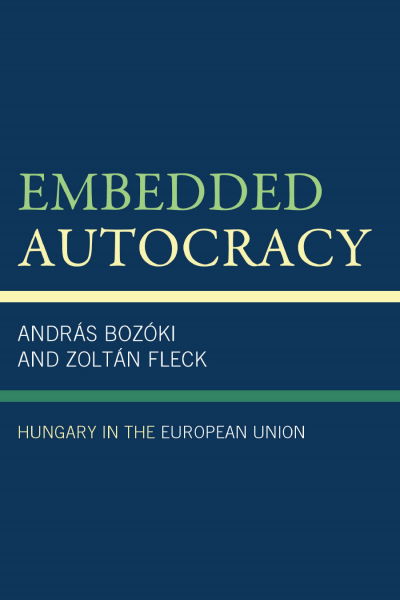
Embedded Autocracy
Hungary in the European Union
Autor:innen:
|
Verlag:
2024
Zusammenfassung
Embedded Autocracy: Hungary in the European Union considers the new Hungarian autocracy as a political regime that is deeply entrenched in the make-up of Hungarian society. The deterioration of the social conditions of democracy did not begin in 2010, when Viktor Orbán came to power, so it cannot be reduced to a leadership issue only. András Bozóki and Zoltán Fleck avoid the trap of historical determinism as well. The Orbán's regime is not based solely on the autocratic traits of the leader, nor on simply institutional failures, but on social contexts and cultural configurations. The analysis employed in this book is complex. Hungary's democratic future depends on our ability to understand the mechanisms of autocracy embedded in society. Scenarios for the destruction of democracy are voluminous, and autocratic legalism is one of them, which requires complex analytical tools to understand. Bozóki and Fleck describe the unexpected collapse of Hungarian democracy with the aim of contributing to the exposure of the structural weaknesses of contemporary democracy. Understanding the operational characteristics of the first autocratic regime within the European Union will contribute to the success of those policy makers who aspire to guard the stability of democracy.
Publikation durchsuchen
Bibliographische Angaben
Auflage
1/2024
Copyrightjahr
2024
ISBN-Print
978-1-7936-3606-5
ISBN-Online
978-1-7936-3607-2
Verlag
Lexington, Lanham
Sprache
Englisch
Seiten
372
Produkttyp
Monographie
Inhaltsverzeichnis
KapitelSeiten
Contents Kein Zugriff
Acronyms Kein Zugriff
Acknowledgments Kein Zugriff
Introduction Kein Zugriff Seiten 1 - 14
Mechanisms of Deterioration Kein Zugriff Seiten 15 - 62
“The Future Has Begun” Kein Zugriff Seiten 63 - 90
Deconsolidation of Liberal Democracy Kein Zugriff Seiten 91 - 122
Dynamics of Autocratization Kein Zugriff Seiten 123 - 168
Authoritarian Accommodation Kein Zugriff Seiten 169 - 218
Enabling and Constraining Kein Zugriff Seiten 219 - 246
The Transformation of Judiciary Kein Zugriff Seiten 247 - 268
Aspects of Legitimacy and Personalization of Power Kein Zugriff Seiten 269 - 320