, um zu prüfen, ob Sie einen Vollzugriff auf diese Publikation haben.
Monographie Kein Zugriff

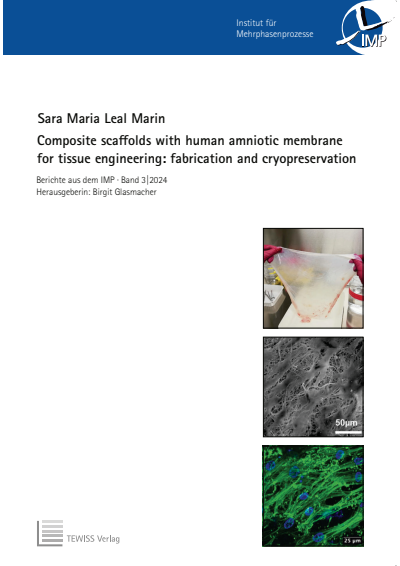
Composite scaffolds with human amniotic membrane for tissue engineering: fabrication and cryopreservation

Autor:innen:
Reihe:
Berichte aus dem IMP, Band 03/2024
Verlag:
 2024

Zusammenfassung

Human amniotic membrane (hAM) from placentas is currently used in dermatology as a biomaterial for plastic surgery skin grafts and as a biological dressing for skin burns, wounds, chronic leg ulcers, eye healing and other applications. Due to its unique properties, hAM is considered an important potential source of scaffold material with promising applications in regenerative medicine and tissue engineering (TE). However, the clinical application of hAM faces some challenges regarding immunogenicity, patient specificity, and changes in mechanical properties. Therefore, it is important to develop a TE membrane material that mimics the structure and functional properties of native hAM and remains stable during storage. The main objective of the work was to develop, characterize, and efficiently store artificial electrospun composite scaffolds that mimic the structural and functional properties of native hAM. Therefore, composite scaffolds were produced that exhibit enhanced biocompatibility, mechanical strength, and inherent antibacterial properties, making them promising candidates for various clinical applications.

Schlagworte


Publikation durchsuchen


Bibliographische Angaben

Copyrightjahr
2024
ISBN-Print
978-3-69030-011-7
ISBN-Online
978-3-69030-011-7
Verlag
TEWISS, Garbsen
Reihe
Berichte aus dem IMP
Band
03/2024
Sprache
Deutsch
Seiten
153
Produkttyp
Monographie

Inhaltsverzeichnis

KapitelSeiten
  1. Titelei/Inhaltsverzeichnis Kein Zugriff Seiten I - XIV
  2. 1. Introduction Kein Zugriff Seiten 1 - 2
    1. 2.1 Tissue Engineering Kein Zugriff
      1. 2.2.1 Fetal tissues Kein Zugriff
      2. 2.2.2 Collection and Preparation Kein Zugriff
      3. 2.2.3 Biological Properties Kein Zugriff
      4. 2.2.4 Mechanical Properties Kein Zugriff
      1. 2.3.1 Physical Principle Kein Zugriff
      2. 2.3.2 Slow Freezing Kein Zugriff
      3. 2.3.3 Vitrification Kein Zugriff
      4. 2.3.4 Freeze-drying Kein Zugriff
      5. 2.3.5 Thawing Kein Zugriff
      6. 2.3.6 Influence of sample size Kein Zugriff
      1. 3.1.1 Current challenges in the application of native hAM Kein Zugriff
        1. 3.1.2.1 Allogeneic grafts Kein Zugriff
        2. 3.1.2.2 Hydrogels Kein Zugriff
        3. 3.1.2.3 3D printing Kein Zugriff
        4. 3.1.2.4 Electrospinning Kein Zugriff
      2. 3.1.3 Composites Kein Zugriff
      3. 3.1.4 Commercial products Kein Zugriff
      4. 3.1.5 Engineering artificial membranes Kein Zugriff
    1. 3.2 Cryopreservation of native hAM Kein Zugriff
    2. 3.3 Cryopreservation of cells and cell-seeded tissue-engineered constructs Kein Zugriff
    3. 3.4 Aims and Hypotheses Kein Zugriff
      1. 4.1.1 hAM collection Kein Zugriff
      2. 4.1.2 hAM storage Kein Zugriff
      3. 4.1.3 Freeze-drying Kein Zugriff
      4. 4.1.4 Cryomilling Kein Zugriff
        1. 4.2.1.1 Solution preparation and electrospinning process Kein Zugriff
        2. 4.2.1.2 Solution properties Kein Zugriff
        1. 4.2.2.1 Synthesis of MNPs and particle size measurement Kein Zugriff
        2. 4.2.2.2 Solution preparation and electrospinning process Kein Zugriff
        3. 4.2.2.3 Vibrating sample magnetometry Kein Zugriff
        4. 4.2.2.4 Specific absorption rate Kein Zugriff
        1. 4.3.1.1 Scanning electron microscopy Kein Zugriff
        2. 4.3.1.2 Contact angle Kein Zugriff
        1. 4.3.2.1 Fourier-transform infrared spectroscopy Kein Zugriff
        2. 4.3.2.2 Raman spectroscopy Kein Zugriff
      1. 4.4.1 Tensile properties Kein Zugriff
      2. 4.4.2 Protein release Kein Zugriff
        1. 4.4.3.1 Sample preparation and incubation Kein Zugriff
        2. 4.4.3.2 Surface and chemical analysis Kein Zugriff
        3. 4.4.3.3 Differential scanning calorimetry Kein Zugriff
      3. 4.4.4 Antibacterial activity Kein Zugriff
        1. 4.4.5.1 Cell seeding Kein Zugriff
        2. 4.4.5.2 Metabolic activity Kein Zugriff
        3. 4.4.5.3 Laser scanning microscopy Kein Zugriff
        4. 4.4.5.4 SEM Kein Zugriff
        5. 4.4.5.5 Live-dead Kein Zugriff
        1. 4.4.6.1 Slow freezing Kein Zugriff
        2. 4.4.6.2 Vitrification Kein Zugriff
    1. 4.5 Statistical Analysis Kein Zugriff
      1. 5.1.1 hAM collection Kein Zugriff
      2. 5.1.2 hAM storage Kein Zugriff
      3. 5.1.3 Freeze-drying Kein Zugriff
      4. 5.1.4 Cryomilling Kein Zugriff
        1. 5.2.1.1 Solution properties Kein Zugriff
        2. 5.2.1.2 Surface morphology Kein Zugriff
        3. 5.2.1.3 Contact angle Kein Zugriff
        1. 5.2.2.1 Synthesis of MNPc and particle size Kein Zugriff
        2. 5.2.2.2 Electrospinning Kein Zugriff
        3. 5.2.2.3 VSM Kein Zugriff
        4. 5.2.2.4 Specific absorption rate Kein Zugriff
      1. 5.3.1 Fourier-transform infrared spectroscopy Kein Zugriff
      2. 5.3.2 Raman spectroscopy Kein Zugriff
      1. 5.4.1 Tensile properties Kein Zugriff
      2. 5.4.2 Protein release Kein Zugriff
        1. 5.4.3.1 Surface and chemical analysis Kein Zugriff
        2. 5.4.3.2 Differential scanning calorimetry Kein Zugriff
      3. 5.4.4 Antibacterial activity Kein Zugriff
        1. 5.4.5.1 PCL+hAM Kein Zugriff
        2. 5.4.5.2 PCL+MNPs Kein Zugriff
        1. 5.4.1.1 Slow freezing PCL+MNPs Kein Zugriff
        2. 5.4.1.2 Vitrification PCL+MNPs Kein Zugriff
        3. 5.4.1.3 Slow freezing PCL+hAM Kein Zugriff
    1. 6.1 hAM storage and processing Kein Zugriff
      1. 6.2.1 Solution properties Kein Zugriff
        1. 6.2.2.1 Surface morphology Kein Zugriff
        2. 6.2.2.2 Chemical composition Kein Zugriff
        1. 6.2.3.1 Synthesis and characterization of MNPs Kein Zugriff
        2. 6.2.3.2 Electrospinning Kein Zugriff
        3. 6.2.3.3 Magnetic response Kein Zugriff
        4. 6.2.3.4 Biocompatibility Kein Zugriff
        5. 6.2.3.5 Cryopreservation Kein Zugriff
      1. 6.3.1 Tensile properties Kein Zugriff
      2. 6.3.2 Protein release Kein Zugriff
      3. 6.3.1 Degradation behaviour Kein Zugriff
      4. 6.3.2 Antibacterial activity Kein Zugriff
      5. 6.3.3 Biocompatibility Kein Zugriff
      6. 6.3.4 Cryopreservation Kein Zugriff
  3. 7. Conclusion and Outlook Kein Zugriff Seiten 109 - 112
  4. 8. References Kein Zugriff Seiten 113 - 134
    1. 9.1 Supplementary Data Kein Zugriff

Ähnliche Veröffentlichungen

aus dem Schwerpunkt "Materialfluss & Fördertechnik", "Produktionstechnik"
Cover der Ausgabe: f+h Jahrgang 75 (2025), Heft 8
Ausgabe Kein Zugriff
Fördertechnik Materialfluss Logistik 4.0
Jahrgang 75 (2025), Heft 8
Cover der Ausgabe: O+P Fluidtechnik Jahrgang 69 (2025), Heft Mobility-2
Ausgabe Kein Zugriff
Industriehydraulik – Mobilhydraulik - Pneumatik
Jahrgang 69 (2025), Heft Mobility-2
Cover der Ausgabe: MY FACTORY Jahrgang 66 (2025), Heft 07
Ausgabe Kein Zugriff
Das Magazin für Produktionsverantwortliche
Jahrgang 66 (2025), Heft 07
Cover der Ausgabe: O+P Fluidtechnik Jahrgang 69 (2025), Heft 5
Ausgabe Kein Zugriff
Industriehydraulik – Mobilhydraulik - Pneumatik
Jahrgang 69 (2025), Heft 5
Cover der Ausgabe: f+h Jahrgang 75 (2025), Heft fokus-KMU
Ausgabe Kein Zugriff
Fördertechnik Materialfluss Logistik 4.0
Jahrgang 75 (2025), Heft fokus-KMU