, um zu prüfen, ob Sie einen Vollzugriff auf diese Publikation haben.
Monographie Kein Zugriff
Globalizing Southeastern Europe
Emigrants, America, and the State since the Late Nineteenth Century
Autor:innen:
Verlag:
2016
Zusammenfassung
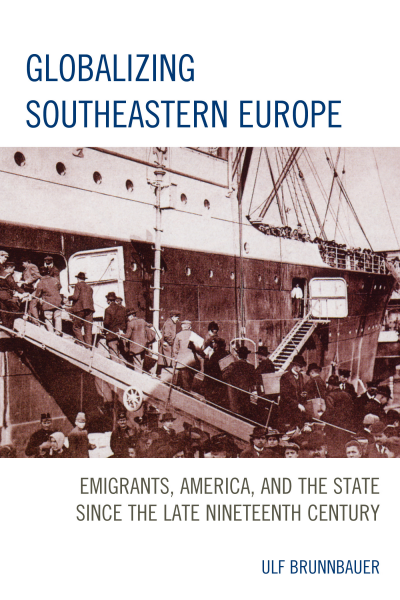
At the end of the nineteenth century, Southeastern Europe became a prime sending region of emigrants to overseas countries, in particular the United States. This massive movement of people ended in 1914 but remained consequential long thereafter, as emigration had created networks, memories, and attitudes that shaped social and political practices in Southeastern Europe long after the emigrants had left. This book’s main concern is to reconstruct the political and socioeconomic impact of emigration on Southeastern Europe. In contrast to migration studies’ traditional focus on immigration, this book concentrates on the sending countries. The author provides a comparative analysis of the socioeconomic causes and consequences of emigration and argues that migrant networks and emulation effects were crucial for the persistence of migration inclinations. It also brings the state back in the emigration story and discusses political responses towards emigration by governments in the region before 1914. Emigration policy became closely aligned with nation-building and social engineering. These stances continued even after emigration had subsided: interwar Yugoslavia, which is studied in detail, tried to create a Yugoslav “diaspora” in America by turning emigrants from its territory into expatriate citizens. Hence, a nationalizing state exploited transnational linkages. The book closes with the emigration policies of communist Yugoslavia until the early 1960s,when experiments and experiences of the government were crucial for its eventual decision to liberalize labor migration to the West (the only communist government to do so). A paramount reason for this was the fact that emigrants, both as a place of memory and a source of remittances, continued to be significant. This book therefore presents emigration as a complex social phenomenon that requires a multifaceted historical approach in order to reveal the effects of migration on different temporal and spatial scales.
Schlagworte
Publikation durchsuchen
Bibliographische Angaben
Auflage
1/2016
Copyrightjahr
2016
ISBN-Print
978-1-4985-1955-7
ISBN-Online
978-1-4985-1956-4
Verlag
Lexington, Lanham
Sprache
Englisch
Seiten
358
Produkttyp
Monographie
Inhaltsverzeichnis
KapitelSeiten
Contents Kein Zugriff
Figures Kein Zugriff
Tables Kein Zugriff
Preface Kein Zugriff
Acknowledgments Kein Zugriff
Chapter One. Introduction Kein Zugriff Seiten 1 - 36
Chapter Two. Overseas Emigration from the Balkans until 1914 Kein Zugriff Seiten 37 - 92
Chapter Three. To Make a Living in America—and at Home Kein Zugriff Seiten 93 - 144
Chapter Four. The Politics of Emigration Kein Zugriff Seiten 145 - 206
Chapter Five. Nationalism, the State and the Emigrants in the Interwar Period Kein Zugriff Seiten 207 - 256
Chapter Six. The Emerging Communist Emigration Regime Kein Zugriff Seiten 257 - 310
Chapter Seven. Conclusions Kein Zugriff Seiten 311 - 324
Bibliography Kein Zugriff Seiten 325 - 342
Index Kein Zugriff Seiten 343 - 356
About the Author Kein Zugriff Seiten 357 - 358
Ähnliche Veröffentlichungen
aus dem Schwerpunkt "Soziologie allgemein"
Sammelband Vollzugriff
Karen Kastenhofer, Marius Albiez, Pauline Riousset, Constanze Scherz, Michael Decker