, um zu prüfen, ob Sie einen Vollzugriff auf diese Publikation haben.
Monographie Kein Zugriff
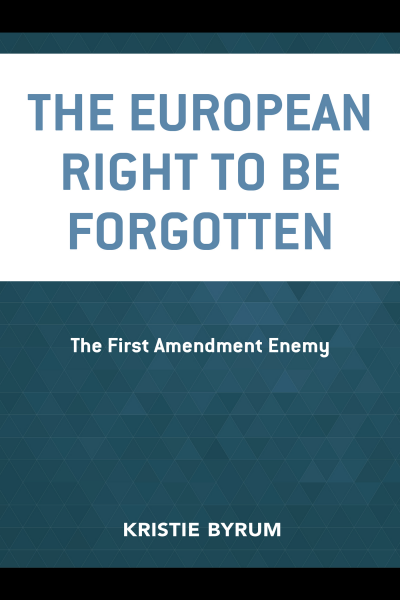
The European Right to Be Forgotten
The First Amendment Enemy
Autor:innen:
Verlag:
2018
Zusammenfassung
The European Right to be Forgotten: The First Amendment Enemy asserts that the right to be forgotten provision of the European General Data Protection Regulation threatens the free flow of information within a global society. In a thoughtful explanation of how the regulation functions as an enemy of the United States’ First Amendment, the book addresses the marketplace of ideas, communication in democracy, the specter of government intervention, censorship, and the distortion of history in the Right to be Forgotten environment. While RTBF advocates point to the regulation as a privacy victory, the author explains how the erasure of data from search engine results foretells negative consequences for social, political, and economic environments. In a rallying cry to preserve freedom of information in the technology driven era, the author presents “The Free Speech Manifesto for the Digital Age: Seven Tenets to Preserve Information Flow in Democracy.” This book offers a unique communications-based perspective on the Right to be Forgotten and precisely documents why a corresponding regulation in the United States conflicts with constitutional protections.
Schlagworte
Publikation durchsuchen
Bibliographische Angaben
Auflage
1/2018
Copyrightjahr
2018
ISBN-Print
978-1-4985-4960-8
ISBN-Online
978-1-4985-4961-5
Verlag
Lexington, Lanham
Sprache
Englisch
Seiten
178
Produkttyp
Monographie
Inhaltsverzeichnis
KapitelSeiten
Contents Kein Zugriff
Acknowledgments Kein Zugriff
Preface Kein Zugriff
Introduction Kein Zugriff
1 The Landscape Kein Zugriff Seiten 1 - 18
2 The Marketplace of Ideas Kein Zugriff Seiten 19 - 36
3 Communication in Democracy Kein Zugriff Seiten 37 - 54
4 The Specter of Government Intervention Kein Zugriff Seiten 55 - 76
5 Distorting History Kein Zugriff Seiten 77 - 94
6 Refuting the Privacy Argument Kein Zugriff Seiten 95 - 114
7 The Free Speech Manifesto for the Digital Age Kein Zugriff Seiten 115 - 124
8 The Preferred Position of Freedom of Information Kein Zugriff Seiten 125 - 132
9 Defining Freedom of Information in the Digital Age Kein Zugriff Seiten 133 - 144
Epilogue Kein Zugriff Seiten 145 - 146
Appendixes Kein Zugriff Seiten 147 - 156
References Kein Zugriff Seiten 157 - 170
Index Kein Zugriff Seiten 171 - 176
About the Author Kein Zugriff Seiten 177 - 178
Ähnliche Veröffentlichungen
aus dem Schwerpunkt "Sprachwissenschaft & Linguistik"