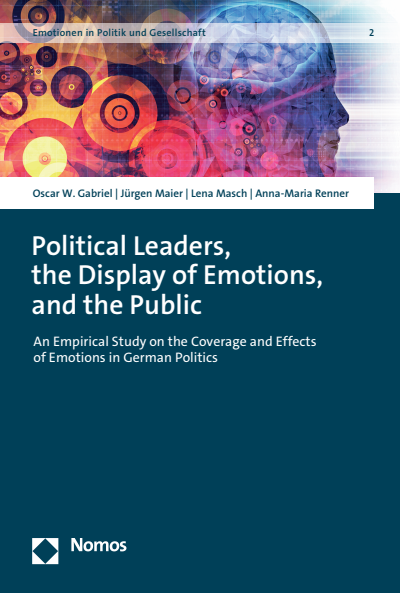
Political Leaders, the Display of Emotions, and the Public
An Empirical Study on the Coverage and Effects of Emotions in German Politics- Autor:innen:
- | | |
- Reihe:
- Emotionen in Politik und Gesellschaft, Band 2
- Verlag:
- 2023
Zusammenfassung
Emotionen gelten seit jeher als wichtiges Element der politischen Kommunikation. Neuere Forschungen belegen die Bedeutung von Emotionen für die individuelle Informationsverarbeitung und die politische Urteilsbildung. Strategisch eingesetzt werden Emotionen so zu einem Instrument der Beeinflussung von Menschen. Basierend auf Inhaltsanalysen von TV-Nachrichten und politischen Talkshows in Deutschland zeigt das Buch, mit welchen Emotionen das Fernsehen Politikerinnen und Politiker dargestellt und welche Techniken eingesetzt werden, um beim Zuschauer Emotionen zu erzeugen. Mit Hilfe von Experimenten wird vor dem Hintergrund der Theorie der emotionalen Ansteckung dem Einfluss von emotional dargestellten Politikerinnen und Politikern auf politische Einstellungen nachgegangen.
Schlagworte
Publikation durchsuchen
Bibliographische Angaben
- Copyrightjahr
- 2023
- ISBN-Print
- 978-3-7560-1187-2
- ISBN-Online
- 978-3-7489-1782-3
- Verlag
- Nomos, Baden-Baden
- Reihe
- Emotionen in Politik und Gesellschaft
- Band
- 2
- Sprache
- Englisch
- Seiten
- 294
- Produkttyp
- Monographie
Inhaltsverzeichnis
- Titelei/Inhaltsverzeichnis Kein Zugriff Seiten 1 - 16
- 1.1. Emotions–A Core Element of Political Life Kein Zugriff
- 1.2. The Emergence of Research on Emotions in Politics–a Brief Overview Kein Zugriff
- 1.3. The Assumption of the Important (and Further Increasing) Role of Emotions in Politics Kein Zugriff
- 1.4. Are Emotions Really That Relevant? Some Arguments Why the Role of Emotions in Politics Might be Overrated Kein Zugriff
- 1.5. The Plan of the Book Kein Zugriff
- 2.1. Untangling the Core Concepts: Attitudes, Emotions, Mood Kein Zugriff
- 2.2.1. Valence Models and Valence-Arousal Models Kein Zugriff
- 2.2.2. Discrete and Basic Emotions Kein Zugriff
- 2.2.3. Dimensional Approaches Kein Zugriff
- 2.3.1. Primacy of Affect and Motivated Political Reasoning Kein Zugriff
- 2.3.2. Affective Intelligence Kein Zugriff
- 2.3.3. Emotional Contagion Kein Zugriff
- Choosing formats and channels Kein Zugriff
- Sampling Kein Zugriff
- Units of analysis Kein Zugriff
- Observations Kein Zugriff
- Dependent variables Kein Zugriff
- Independent variables Kein Zugriff
- 3.2.1. Design Kein Zugriff
- 3.2.2. Stimulus Kein Zugriff
- 3.2.3. Participants Kein Zugriff
- 3.2.4. Measurements Kein Zugriff
- 4.1.1. Previous Research Kein Zugriff
- Candidate characteristics Kein Zugriff
- Personal Characteristics Kein Zugriff
- Professional Characteristics Kein Zugriff
- Characteristics of the Context Kein Zugriff
- 4.1.3. Results Kein Zugriff
- 4.2.1. Potential Effects of Persuasive Camera Shots Kein Zugriff
- 4.2.2. Evidence on the Use of Persuasive Camera Shots in Televised Political Coverage Kein Zugriff
- 4.2.3. Results Kein Zugriff
- 4.3. Summary and Conclusion Kein Zugriff
- 5.1. State of the Art Kein Zugriff
- 5.2. Expectations Kein Zugriff
- 5.3. Operationalization and Data Preparation Kein Zugriff
- 5.4.1. Are Recipients Able to Perceive Emotions Displayed by Politicians on TV? Kein Zugriff
- 5.4.2. How Accurate is the Perception of Emotions? Kein Zugriff
- 5.4.3. How Strong are the Perceived Emotions? Kein Zugriff
- 5.4.4. Through Which Channels are Emotions Perceived? Kein Zugriff
- 5.5. Summary and Conclusion Kein Zugriff
- 6.1. The Role of the Experiment in Our Study Design Kein Zugriff
- 6.2. The Impact of Emotional Messages on the Image of German Political Leaders: Theoretical Perspectives and Hypotheses Kein Zugriff
- 6.3.1. Conceptualizations Kein Zugriff
- 6.3.2. Empirical Findings Kein Zugriff
- 6.4.1. How Emotional Displays Shape the General Assessment of the Political Leaders Kein Zugriff
- 6.4.2. The Impact of Emotional Appeals on Political Leaders’ Likeability Kein Zugriff
- 6.4.3. The Impact of Emotional Appeals on Political Leaders’ Trustworthiness Kein Zugriff
- 6.4.4. Emotional Appeals and the Attribution of Leadership Quality to Politicians Kein Zugriff
- 6.4.5. The Impact of Emotional Appeals on the Attribution of Competence to Political Leaders Kein Zugriff
- 6.4.5. The Impact of Emotional Appeals on the Attribution of Leadership Characteristics in a Competitive Setting Kein Zugriff
- 6.5. Summary and Conclusion Kein Zugriff
- 7.1.1. Hypotheses Kein Zugriff
- 7.1.2. Operationalization and Analysis Strategy Kein Zugriff
- 7.1.3. Results Kein Zugriff
- 7.1.4. Summary Kein Zugriff
- 7.2.1. Expectations Kein Zugriff
- 7.2.2. Operationalization Kein Zugriff
- 7.2.3. Results Kein Zugriff
- 7.2.4. Summary Kein Zugriff
- 7.3.1. Concept and Hypotheses Kein Zugriff
- 7.3.2. Operationalization Kein Zugriff
- 7.3.3. Results Kein Zugriff
- 7.3.4. Summary Kein Zugriff
- 7.4.1. Do Female Politicians Suffer from an Emotional Double Bind? Kein Zugriff
- Effects of German female politicians’ emotions Kein Zugriff
- Effects of German male politicians’ emotions Kein Zugriff
- 7.4.3. Methods Kein Zugriff
- 7.4.4. Results Kein Zugriff
- 7.4.5. Summary Kein Zugriff
- 7.5.1. Concept and Hypotheses Kein Zugriff
- 7.5.2. Operationalization Kein Zugriff
- 7.5.3. Results Kein Zugriff
- 7.5.4. Summary Kein Zugriff
- 7.6. Summary and Conclusion Kein Zugriff
- 8.1. Key Findings Kein Zugriff
- 8.2. Practical Implications for Politicians, Voters, and the Media Kein Zugriff
- 8.3. Open Questions and Suggestions for Further Research Kein Zugriff
- References Kein Zugriff Seiten 261 - 294
Literaturverzeichnis (564 Einträge)
Es wurden keine Treffer gefunden. Versuchen Sie einen anderen Begriff.
- References Google Scholar öffnen DOI: 10.5771/9783748917823
- Abelson, R. (1963). Computer simulation of “hot” cognition. In S. Tomkins & D. Messick (eds.), Computer simulation of personality (pp. 277–98). New York, NY: Wiley. Google Scholar öffnen DOI: 10.5771/9783748917823
- Abramson, P. M. (1983). Political attitudes in America. Formation and change. San Francisco, CA: Freeman Press. Google Scholar öffnen DOI: 10.5771/9783748917823
- Adam, S. & Maier, M. (2010). Personalization of politics: A critical review and agenda for research. Communication Yearbook, 34, 213–57. Google Scholar öffnen DOI: 10.5771/9783748917823
- Adolphs, R. (2006). Perception and emotion: How we recognize facial expressions. Current Directions in Psychological Science, 15(5), 222–6. Google Scholar öffnen DOI: 10.5771/9783748917823
- Ajzen, I. (1988). Attitudes, personality, and behavior. Chicago, IL: Dorsey Press. Google Scholar öffnen DOI: 10.5771/9783748917823
- Albæk, E., Van Dalen, A., Jebril, N., & de Vreese, C. H. (2014). Political journalism in comparative perspective. New York, NY: Cambridge University Press. Google Scholar öffnen DOI: 10.5771/9783748917823
- Alexander, F. (1959). Emotional factors in voting behavior. In E. Burdick & A. J. Brodbeck (eds.), American voting behavior (pp. 300–7). Glencoe, IL: Free Press. Google Scholar öffnen DOI: 10.5771/9783748917823
- Alexander, M. G., & Wood, W. (2000). Women, men and positive emotions: A social role interpretation. In A. H. Fischer (ed.), Gender and emotion. Social psychological perspectives (pp. 89–211). Cambridge: Cambridge University Press. Google Scholar öffnen DOI: 10.5771/9783748917823
- Almond. G. A. & Verba, S. (1963). The civic culture. Political attitudes and democracy in five nations. Princeton, NJ: Princeton University Press. Google Scholar öffnen DOI: 10.5771/9783748917823
- Almond, G. A., & Verba, S. (1989). The civic culture revisited. Newbury Park, CA: Sage. Google Scholar öffnen DOI: 10.5771/9783748917823
- Archer, D., Iritani, B., Kimes, D. D., & Barrios, M. (1983). Face-ism: Five studies of sex differences in facial prominence. Journal of Personality and Social Psychology, 45(4), 725–35. Google Scholar öffnen DOI: 10.5771/9783748917823
- Arendt, F. (2012). A newspapers effect on the strength of automatic associations in memory. Journal of Media Psychology, 24(1), 1–8. Google Scholar öffnen DOI: 10.5771/9783748917823
- Aristotle (2018). Rhetoric. Indianapolis, IN: Hackett. Google Scholar öffnen DOI: 10.5771/9783748917823
- Arnold, M. B. (1960). Emotion and personality. New York, NY: Columbia University Press. Google Scholar öffnen DOI: 10.5771/9783748917823
- Asch, S. E. (1946). Forming impressions of personality. Journal of Abnormal Social Psychology, 41(3), 258–90. Google Scholar öffnen DOI: 10.5771/9783748917823
- Atkinson, A. P., Dittrich, W. H., Gemmell, A. J., & Young, A. W. (2004). Emotion perception from dynamic and static body expressions in point-light and full-light displays. Perception, 33(6), 717–46. Google Scholar öffnen DOI: 10.5771/9783748917823
- Bäck, H., & Debus, M. (2016). Political parties, parliament, and legislative speechmaking. New York, NY: Palgrave Macmillan. Google Scholar öffnen DOI: 10.5771/9783748917823
- Baggaley, J., Ferguson, M., & Brooks, P. (1980). Psychology of the TV image. New York, NY: Praeger. Google Scholar öffnen DOI: 10.5771/9783748917823
- Bakker, I., van der Voordt, T., Vink, P., & de Boon, J. (2014). Pleasure, arousal, dominance: Mehrabian and Russel revisited. Current Psychology, 33(3), 405–21. Google Scholar öffnen DOI: 10.5771/9783748917823
- Bargh, J. A. (1997). The automaticity of everyday life. In R. Wyer (ed.), The automaticity of everyday life: Advances in social cognition (Vol. 10, pp. 1–62). Mahwah, NJ: Erlbaum. Google Scholar öffnen DOI: 10.5771/9783748917823
- Barrett, F. L., & Russell, J. A. (1999). The structure of current affect: Controversies and emerging consensus. Current Directions in Psychological Science, 8(1), 10–4. Google Scholar öffnen DOI: 10.5771/9783748917823
- Barsade, S. G. (2002). The ripple effect: Emotional contagion and is influence on group behavior. Administrative Science Quarterly, 47(4), 644–75. Google Scholar öffnen DOI: 10.5771/9783748917823
- Bauer, N. M. (2014). Emotional, sensitive, and unfit for office? Gender stereotype activation and support for female candidates. Political Psychology, 36(6), 691–708. Google Scholar öffnen DOI: 10.5771/9783748917823
- Bauer, N. M. (2016). The effects of counterstereotypic gender strategies in candidate evaluations. Political Psychology, 38(2), 279–95. Google Scholar öffnen DOI: 10.5771/9783748917823
- Beichelt, T. (2021). Homo Emotionalis. Zur Systematisierung von Gefühlen in der Politik. Wiesbaden: Springer. Google Scholar öffnen DOI: 10.5771/9783748917823
- Bennett, E. M., & Goodwin, H. M. (1958). Emotional aspects of political behavior: The woman voter. Genetic Psychology Monographs, 48(1), 3–53. Google Scholar öffnen DOI: 10.5771/9783748917823
- Benoit, W. L. (2007). Communication in political campaigns. New York, NY: Peter Lang. Google Scholar öffnen DOI: 10.5771/9783748917823
- Benoit, W. L. (2017). Meta-analysis of research on the functional theory of political campaign discourse. Speaker and Gavel, 54(1), 7–50. Google Scholar öffnen DOI: 10.5771/9783748917823
- Berelson, B. R., Lazarsfeld, P. F., & McPhee, W. N. (1954). Voting. A study of opinion formation in a presidential campaign. Chicago, IL: University of Chicago Press. Google Scholar öffnen DOI: 10.5771/9783748917823
- Bericat, E. (2016). The sociology of emotions: Four decades of progress. Current Sociology, 64(3), 491–513. Google Scholar öffnen DOI: 10.5771/9783748917823
- Bittner, A. (2011). Platform or personality: The role of party leaders in elections. Oxford: Oxford University Press. Google Scholar öffnen DOI: 10.5771/9783748917823
- Bono, J. E., & Illies, R. (2006). Charisma, positive emotions and mood contagion. Leadership Quarterly, 17(4), 317–34. Google Scholar öffnen DOI: 10.5771/9783748917823
- Boone, R. T., & Buck, R. (2003). Emotional expressivity and trustworthiness: The role of nonverbal behavior in the evolution of cooperation. Journal of Nonverbal Behavior, 27(3), 163–82. Google Scholar öffnen DOI: 10.5771/9783748917823
- Borod, J. C., Pick, L. H., Hall, S., Sliwinski, M., Madigan, N., Obler, L. K., Welkowitz, J., Canino, E., Erhan, H. M., Goral, M., Morrison, C., & Tabert, M. (2000). Relationships among facial, prosodic, and lexical channels of emotional perceptual processing. Cognition and Emotion, 14(2), 193–211. Google Scholar öffnen DOI: 10.5771/9783748917823
- Bos, L., van der Brug, W. &, de Vreese, C. H. (2010). Media coverage of right-wing populist leaders. Communications, 35(2), 141–63. Google Scholar öffnen DOI: 10.5771/9783748917823
- Bouhuys, A. L., Bloem, G. M., & Groothuis, T. G. G. (1995). Induction of depressed and elated mood by music influences the perception of facial emotional expressions in healthy subjects. Journal of Affective Disorders, 33(4), 215–26. Google Scholar öffnen DOI: 10.5771/9783748917823
- Bower, G. H. (1991). Mood congruity of social judgments. In J. P. Forgas (ed.), Emotion and social judgments (pp. 31–53). Oxford: Pergamon Press. Google Scholar öffnen DOI: 10.5771/9783748917823
- Brader, T. (2005). Striking a responsive chord: How political ads motivate and persuade voters by appealing to emotions. American Journal of Political Science, 49(2), 388–405. Google Scholar öffnen DOI: 10.5771/9783748917823
- Brader, T. (2006). Campaigning for hearts and minds: How emotional appeals in political ads work. Chicago, IL/London: Chicago University Press. Google Scholar öffnen DOI: 10.5771/9783748917823
- Brader, T., & Marcus, G. E. (2013). Emotions and political psychology. In L. Huddy, D. O. Sears, & J. S. Levy (eds.), The Oxford handbook of political psychology (2nd edition, pp. 165–204). Oxford/New York, NY: Oxford University Press. Google Scholar öffnen DOI: 10.5771/9783748917823
- Braithwaite, V. (1998). Communal and exchange trust norms: Their value base and relevance for institutional trust. In V. Braithwaite & M. Levi (eds.). Trust & governance (Vol.1, pp. 46–74). New York, NY: Russel Sage Foundations. Google Scholar öffnen DOI: 10.5771/9783748917823
- Brants, K., & van Praag, P. (2006). Signs of media logic: Half a century of political communication in the Netherlands. Javnost, 13(1), 25–40. Google Scholar öffnen DOI: 10.5771/9783748917823
- Brescoll, V. (2016). Leading with their hearts? How gender stereotypes lead to biased evaluations of female leaders. Leadership Quarterly, 27(3), 415–28. Google Scholar öffnen DOI: 10.5771/9783748917823
- Brescoll, V., & Uhlmann, E. L. (2008). Can an angry woman get ahead? Status conferral, gender, and expression of emotion in the workplace. Psychological Science, 19(3), 268–75. Google Scholar öffnen DOI: 10.5771/9783748917823
- Breunig, C., & Engel, B. (2015). Massenkommunikation 2015: Funktionen und Images der Medien im Vergleich. Ergebnisse der ARD/ZDF-Landzeitstudie. Media Perspektiven 7–8/2015, 323–41. Google Scholar öffnen DOI: 10.5771/9783748917823
- Breunig, C., Handel, M., & Kessler, B. (2020). Massenkommunikation 1964-2020: Mediennutzung im Langzeitvergleich – Ergebnisse der ARD/ZDF-Langzeitstudie. Media Perspektiven, 7–8/2015, 410–32. Google Scholar öffnen DOI: 10.5771/9783748917823
- Brody, L. R. (2000). The socialization of gender differences in emotional expressions: Display rules, infant temperament, and differentiation. In A. H. Fischer (ed.), Gender and emotion: Social psychological perspectives (pp. 24–47). Cambridge: Cambridge University Press. Google Scholar öffnen DOI: 10.5771/9783748917823
- Brody, L. R., & Hall, J. A. (2000). Gender, emotion, and expression. In M. Lewis & J. M. Haviland-Jones (eds.), Handbook of emotions (pp. 338–49). New York, NY: Guilford Press. Google Scholar öffnen DOI: 10.5771/9783748917823
- Brody, L. R., Hall, J. A., & Stokes, L. R. (2016). Gender and emotion: Theory, findings, and context. In L. F. Barrett, M. Lewis & J. M. Haviland-Jones (eds.), Handbook of emotion (4th edition, pp. 369–92). New York, NY: Guilford Press. Google Scholar öffnen DOI: 10.5771/9783748917823
- Brooks, D. J. (2011). Testing the double standard for candidate emotionality: Voter reactions to tears and anger of male and female politicians. Journal of Politics, 73(2), 597–615. Google Scholar öffnen DOI: 10.5771/9783748917823
- Brooks, D. J. (2013). He runs, she runs: Why gender stereotypes do not harm women candidates. Princeton, NJ: Princeton University Press. Google Scholar öffnen DOI: 10.5771/9783748917823
- Buck, R. 1984. The communication of emotions. New York, NY: Guilford Press. Google Scholar öffnen DOI: 10.5771/9783748917823
- Bucy, E. P. (1998). The emotional appropriateness heuristic: Viewer assessments of televised presidential reactions to compelling news events. College Park, MD: University of Maryland. (unpublished doctoral thesis) Google Scholar öffnen DOI: 10.5771/9783748917823
- Bucy, E. P. (2000). Emotional and evaluative consequences of inappropriate leader displays. Communication Research, 27(2), 194–226. Google Scholar öffnen DOI: 10.5771/9783748917823
- Bucy, E. P. (2016). The look of losing, then and now: Nixon, Obama, and nonverbal indicators of opportunity lost. American Behavioral Scientist, 60(14), 1772–98. Google Scholar öffnen DOI: 10.5771/9783748917823
- Bucy, E. P., & Bradley, S. D. (2004). Presidential expressions and viewer emotion: Counterempathic responses to televised leader displays. Social Science Information, 43(1), 59–94. Google Scholar öffnen DOI: 10.5771/9783748917823
- Bucy, E. P., & Grabe, M. E. (2007). Taking television seriously: A sound and image bite analysis of presidential campaign coverage, 1992–2004. Journal of Communication, 57(4), 652–75. Google Scholar öffnen DOI: 10.5771/9783748917823
- Bucy, E. P., & Grabe, M. E. (2008). “Happy warriors” revisited: Hedonic and agonic display repertoires of presidential candidates on the evening news. Politics and Life Science, 27(1), 78–98. Google Scholar öffnen DOI: 10.5771/9783748917823
- Bucy, E. P., & Newhagen, J. E. (1999a). The emotional appropriateness heuristic: Processing televised presidential reactions to the news. Journal of Communication, 49(4), 59–79. Google Scholar öffnen DOI: 10.5771/9783748917823
- Bucy, E. P., & Newhagen, J. E. (1999b). The micro‐and macrodrama of politics on television: Effects of media format on candidate evaluations. Journal of Broadcasting and Electronic Media, 43(2), 193–210. Google Scholar öffnen DOI: 10.5771/9783748917823
- Bundesregierung (2018). Das Bundeskabinett. Retrieved from https://www.bundesregierung.de/Content/DE/_Anlagen/Bundeskabinett_PDF.pdf;jsessionid=F12BD4B78FB98281DE545C7E963C4483.s4t2?__blob=publicationFileandv=38 Google Scholar öffnen DOI: 10.5771/9783748917823
- Burgess, D. G., & Borgida, E. (1999). Who women are, who women should be: Descriptive and prescriptive gender stereotyping in sex discrimination. Psychology, Public Policy, and Law, 5(3), 665–92. Google Scholar öffnen DOI: 10.5771/9783748917823
- Burgoon, J. K. (1980). Nonverbal communication research in the 1970s: An overview. Communication Yearbook, 4, 179–97. Google Scholar öffnen DOI: 10.5771/9783748917823
- Bystrom, D. G., & Kaid, L. L. (2002). Are women candidates transforming campaign communication? A comparison of advertising videostyles in the 1990s. In C. S. Rosenthal (eds.), Women transforming Congress (pp. 146–69). Norman, OK: University of Oklahoma Press. Google Scholar öffnen DOI: 10.5771/9783748917823
- Bystrom, D. G., & Miller, J. L. (1999). Gendered communication styles and strategies in campaign 1996: The videostyles of women and men candidates. In L. L. Kaid & D. G. Bystrom (eds.), The electronic election: Perspectives on the 1996 campaign communication (pp. 293–303). Mahwah, NJ: Lawrence Erlbaum. Google Scholar öffnen DOI: 10.5771/9783748917823
- Bystrom, D. G., Banwart, M. C., Kaid, L. L., & Robertson, T. A. (2004). Gender and candidate communication. New York, NY: Routledge. Google Scholar öffnen DOI: 10.5771/9783748917823
- Cacioppo, J. T., & Gardner, W. L. (1999). Emotion. Annual Review of Psychology, 50, 191–214. Google Scholar öffnen DOI: 10.5771/9783748917823
- Calder, A. J., Keane, J., Manly, T., Sprengelmeyer, R., Scott, S., Nimmo-Smith, I., & Young, A. W. (2003). Facial expression recognition across the adult life span. Neuropsychologia, 41(2), 195–202. Google Scholar öffnen DOI: 10.5771/9783748917823
- Campbell, A., Gurin, G., & Miller, W. E. (1954). The voter decides. Evanston, IL: Row, Peterson. Google Scholar öffnen DOI: 10.5771/9783748917823
- Campbell, A., Converse, P. E., Miller, W. E., & Stokes, D. E. (1960). The American voter. New York, NY: Wiley. Google Scholar öffnen DOI: 10.5771/9783748917823
- Caprara, G. V., Barbaranelli, C., & Zimbardo, P. G. (1997). Politicians uniquely simple personalities. Nature, 385, 493. Google Scholar öffnen DOI: 10.5771/9783748917823
- Caprara, G. V., Barbaranelli, C., & Zimbardo, P. G. (2002). When parsimony subdues distinctiveness: Simplified public perceptions of politicians’ personality. Political Psychology, 23(1), 77–95. Google Scholar öffnen DOI: 10.5771/9783748917823
- Carlson, T. (2001). Gender and political advertising across cultures: A comparison of male and female political advertising in Finland and the US. European Journal of Communication, 16(2), 131–54. Google Scholar öffnen DOI: 10.5771/9783748917823
- Carmines, E. G., & Stimson, J. A. (1980). The two faces of issue voting. American Political Science Review, 74(1), 78–91. Google Scholar öffnen DOI: 10.5771/9783748917823
- Carstensen, L. L., Gottman. J. M., & Levenson. R. W. (1995). Emotional behavior in long-term marriage. Psychology and Aging, 10(1), 140–9. Google Scholar öffnen DOI: 10.5771/9783748917823
- Cassino, D., & Lodge, M. (2007). The primacy of affect in political evaluations. In R. W. Neuman, G. Marcus, A. Cigler, & M. MacKuen (eds.), The affect effect: Dynamics of emotion in political thinking and behavior (pp. 124–51). Chicago, IL: University of Chicago Press. Google Scholar öffnen DOI: 10.5771/9783748917823
- Chanley, V.A. (2002). Trust in government in the aftermath of 9/11: Determinants and consequences. Political Psychology, 23(3), 469–83. Google Scholar öffnen DOI: 10.5771/9783748917823
- Cho, J., Boyle, M. P., Keum, H., Shevy, M. D., McLeod, D. M., Shah, D. V., & Pan, Z. (2003). Media, terrorism, and emotionality: Emotional differences in media content and public reactions to the September 11th terrorist attacks. Journal of Broadcasting and Electronic Media, 47(3), 309–27. Google Scholar öffnen DOI: 10.5771/9783748917823
- Christ, W. G., Thorson, E., & Caywood, C. (1994). Do attitudes toward political advertising affect information processing of televised political commercials? Journal of Broadcasting & Electronic Media, 38(3), 251–70. Google Scholar öffnen DOI: 10.5771/9783748917823
- Ciabattari, T. (2001). Changes in men’s conversative gender ideologies: Cohort and period influences. Gender and Society, 15(4), 574–91. Google Scholar öffnen DOI: 10.5771/9783748917823
- Cicero (2001). On the ideal orator. Oxford: Oxford University Press. Google Scholar öffnen DOI: 10.5771/9783748917823
- Clevenger, T., & Knepprath, E. (1966). A quantitative analysis of logical and emotional content in selected campaign addresses of Eisenhower and Stevenson. Western Speech 30(3), 144–50. Google Scholar öffnen DOI: 10.5771/9783748917823
- Clore, G. L., & Gasper, K. (2000). Feeling is believing: Some affective influences on beliefs. In N. H. Frijda, A. S. R. Manstead & S. Bem (eds.), Emotions and beliefs: How feelings influence thoughts (pp. 10–44). Cambridge: Cambridge University Press. Google Scholar öffnen DOI: 10.5771/9783748917823
- Clore, G. L., Gasper, K., & Garvin, E. (2001). Affect as information. In J. P. Forgas (ed.), Handbook of affect and social cognition (pp. 121–44). Mahwah, NJ: Erlbaum. Google Scholar öffnen DOI: 10.5771/9783748917823
- Clore, G. L., & Isbell, L. M. (2001). Emotion as virtue and vice. In J. H. Kuklinski (ed.), Citizens and politics: Perspectives from political psychology (pp. 103–23). Cambrigde: Cambridge University Press. Google Scholar öffnen DOI: 10.5771/9783748917823
- Clore, G. L., Schwarz, N., & Conway, M. (1994). Affective causes and consequences of social information processing. In R. S. Wyer & T. K. Srull (ed.), Handbook of social cognition: Basic processes (Vol. 1, pp. 323–417). Hillsdale, NJ: Lawrence Erlbaum. Google Scholar öffnen DOI: 10.5771/9783748917823
- Cohen, J., Tsfati, Y, & Sheafer, T. (2008). The influence of presumed media influence in politics: Do politicians’ perceptions of media power matter? Public Opinion Quarterly, 72(2), 331–44. Google Scholar öffnen DOI: 10.5771/9783748917823
- Costa Lobo, M., & Curtice, J. (2015). Personality politics? The role of leader evaluations in democratic elections. Oxford: Oxford University Press. Google Scholar öffnen DOI: 10.5771/9783748917823
- Crigler, A., Just, M., & Belt, T. (2006). The three faces of negative campaigning: The democratic implications of attack ads, cynical news, and fear arousing messages. In D. P. Redlawsk (ed.), Feeling politics: Emotions in political information processing (pp. 135–63). New York, NY: Palgrave. Google Scholar öffnen DOI: 10.5771/9783748917823
- Crivelli, C., & Fridlund, A. J. (2018). Facial displays are tools for social influence. Trends in Cognitive Sciences, 22(5), 388–99. Google Scholar öffnen DOI: 10.5771/9783748917823
- Cuddy, A. J. C., Fiske, S. T., & Glick, P. (2008). Warmth and competence as universal dimensions of social perception: The stereotype content model and the BIAS map. Advances in Experimental Social Psychology, 40, 61–149. Google Scholar öffnen DOI: 10.5771/9783748917823
- Cumming, E., & Henry, W. E. (1961). Growing old: The process of disengagement. New York, NY: Basic Books. Google Scholar öffnen DOI: 10.5771/9783748917823
- Dahl, R. A. (1971). Polyarchy. Participation and opposition. New Haven, CT: Yale University Press. Google Scholar öffnen DOI: 10.5771/9783748917823
- Dalton, R. J. (2004). Democratic challenges, democratic choices: The erosion of political support in advanced industrial democracies. Oxford: Oxford University Press. Google Scholar öffnen DOI: 10.5771/9783748917823
- Dalton, R. J. (2008). Citizen politics: Public opinion and political parties in advanced western democracies (5th edition). Washington, DC: CQ Press. Google Scholar öffnen DOI: 10.5771/9783748917823
- Dalton, R. J. (2013). The apartisan American: Dealignment and changing electoral politics. Thousand Oaks, CA: CQ Press. Google Scholar öffnen DOI: 10.5771/9783748917823
- Dalton, R. J. (2017). Political trust in North America. In S. Zmerli & T. W. G. van der Meer (eds.), Handbook on political trust (pp. 375–94). Cheltenham: Edward Elgar. Google Scholar öffnen DOI: 10.5771/9783748917823
- Damen, F., van Knippenberg, B., & van Knippenberg, D. (2008). Leader affective displays and attribution of charisma: The role of arousal. Journal of Applied Social Psychology, 38(10), 2594–614. Google Scholar öffnen DOI: 10.5771/9783748917823
- Davies, M. M., Berry, C., & Clifford, B. (1985). Unkindest cuts? Some effects of picture editing on recall of television news information. Journal of Educational Television, 11(2), 85–98. Google Scholar öffnen DOI: 10.5771/9783748917823
- de Vreese, C. H., Reinemann, C., Esser, F., Hopmann, D. N., Aalberg, T., Van Aelst, P., Berganza, R., Hubé, N., Legnante, G., Matthes, J., Papathanassopoulos, S., Salgado, S., Sheafer, T., Stanyer, J., & Strömbäck, J. (2017). Conclusion: Assessing news performance. In C. H. de Vreese, F. Esser & D. N. Hopmann (eds.), Comparing political journalism (pp. 168–83). London: Routledge. Google Scholar öffnen DOI: 10.5771/9783748917823
- Deak, A. (2011). Brain and emotion: Cognitive neuroscience of emotions. Review of Psychology, 18(2), 71–80. Google Scholar öffnen DOI: 10.5771/9783748917823
- DeFleur, M. L. (1970). Theories of mass communication (2nd edition). New York, NY: David McKay. Google Scholar öffnen DOI: 10.5771/9783748917823
- Delli Carpini, M. X., & Keeter, S. (1996). What Americans know about politics and why it matters. New Haven, CT: Yale University Press. Google Scholar öffnen DOI: 10.5771/9783748917823
- Deutscher Bundestag (2017a). Alters- und Sozialstruktur: weibliche Abgeordnete. Retrieved from https://www.bundestag.de/blob/272482/07548b0b36d708c3a751a85711cdccbb/kapitel_03_06_weibliche_abgeordnete-pdf-data.pdf Google Scholar öffnen DOI: 10.5771/9783748917823
- Deutscher Bundestag (2017b). Frauen und Männer. Retrieved from https://www.bundestag.de/abgeordnete/biografien/mdb_zahlen_19/frauen_maenner/529508 Google Scholar öffnen DOI: 10.5771/9783748917823
- Diener, E., Sandvik, E., & Larsen, R. J. (1985). Age and sex effects for emotional intensity. Developmental Psychology, 21(3), 542–46. Google Scholar öffnen DOI: 10.5771/9783748917823
- Dimberg, U., & Lundquist, L. O. (1990). Gender differences in facial reactions to facial expressions. Biological Psychology, 30(2), 151–59. Google Scholar öffnen DOI: 10.5771/9783748917823
- Doherty, R. W. (1998). Emotional contagion and social judgment. Motivation and Emotion, 22(3), 187–209. Google Scholar öffnen DOI: 10.5771/9783748917823
- Donsbach, W. (1991). Exposure to political content in newspapers: The impact of cognitive dissonance on readers selectivity. European Journal of Communication, 6(2), 155–86. Google Scholar öffnen DOI: 10.5771/9783748917823
- Donsbach, W., & Büttner, K. (2005). Boulevardisierungstrend in deutschen Fernsehnachrichten: Darstellungsmerkmale der Politikberichterstattung vor den Bundestagswahlen 1983, 1990 und 1998. Publizistik, 50(1), 21–38. Google Scholar öffnen DOI: 10.5771/9783748917823
- Dowd, M. (2008). Can Hillary cry her way back to the White House? Retrieved from https://www.nytimes.com/2008/01/09/opinion/08dowd.html Google Scholar öffnen DOI: 10.5771/9783748917823
- Drew, D. G., & Cadwell, R. (1985). Some effects of video editing on perceptions of television news. Journalism Quarterly, 62(4), 828–49. Google Scholar öffnen DOI: 10.5771/9783748917823
- Drinkmann, N., & Caballero, C. (2007). Eine Frau ist eine Frau ist eine Frau? Die Berichterstattung über die Kandidaten der Bundestagswahl 2004. In C. Holtz-Bacha & N. König-Reiling (eds.), Warum nicht gleich? Wie die Medien mit Frauen in der Politik umgehen (pp. 167–203). Wiesbaden: VS Verlag. Google Scholar öffnen DOI: 10.5771/9783748917823
- Duhaney, A., & McKelvie, S. J. (1993). Gender differences in accuracy of identification and rated intensity of facial expressions. Perceptual and Motor Skills, 76(3), 716–18. Google Scholar öffnen DOI: 10.5771/9783748917823
- Dumitrescu, D. (2016). Nonverbal communication in politics: A review of research developments, 2005-2015. American Behavioral Scientist, 60(14), 1656–75. Google Scholar öffnen DOI: 10.5771/9783748917823
- Dumitrescu, D., Gidengil, E., & Stolle, D. (2015). Candidate confidence and electoral appeal: An experimental study of the effect of nonverbal confidence on voter evaluations. Political Science Research and Methods, 3(1), 43–52. Google Scholar öffnen DOI: 10.5771/9783748917823
- Durand, K., Gallay, M., Seigneuric, A., Robichon, F., & Baudouin, J. Y. (2007). The development of facial emotion recognition: The role of configural information. Journal of Experimental Child Psychology, 97(1), 14–27. Google Scholar öffnen DOI: 10.5771/9783748917823
- Eagly, A. H., & Chaiken, S. (1993). The psychology of attitudes. Fort Worth, TX: Harcourt Brace Jovanovich. Google Scholar öffnen DOI: 10.5771/9783748917823
- Eagly. A. H., & Mladinic, A. (1989). Gender stereotypes and attitudes toward women and men. Personality and Social Psychology Bulletin, 15(4), 543–58. Google Scholar öffnen DOI: 10.5771/9783748917823
- Eagly, A. H., & Johannesen-Schmidt, M. C. (2001). The leadership style of women and men. Journal of Social Issues, 57(4), 781–97. Google Scholar öffnen DOI: 10.5771/9783748917823
- Eckes, T. (2002). Paternalistic and envious stereotypes: Testing predictions from the stereotype content model. Sex Roles, 47(3/4), 99–114. Google Scholar öffnen DOI: 10.5771/9783748917823
- Edgar, C., McRorie, M., & Sneddon, I. (2012). Emotional intelligence, personality and the decoding of non-verbal expressions of emotion. Personality and Individual Differences, 52(3), 295–300. Google Scholar öffnen DOI: 10.5771/9783748917823
- Ekman, P. (1984). Expression and the nature of emotion. In K. Scherer & P. Ekman (eds.), Approaches to emotion (pp. 319–44). New York, NY: Psychological Press. Google Scholar öffnen DOI: 10.5771/9783748917823
- Ekman, P. (1992a). Are there basic emotions? Psychological Review, 99(3), 550–3. Google Scholar öffnen DOI: 10.5771/9783748917823
- Ekman, P. (1992b). An argument for basic emotions. Cognition and Emotion, 6(3/4), 169–200. Google Scholar öffnen DOI: 10.5771/9783748917823
- Ekman, P. (1994). Strong evidence for universals in facial expressions: A reply to Russell’s mistaken critique. Psychological Bulletin, 115(2), 268–87. Google Scholar öffnen DOI: 10.5771/9783748917823
- Ekman, P., & Cordaro, D. (2011). What is meant by calling emotions basic. Emotion Review, 3(4), 364–70. Google Scholar öffnen DOI: 10.5771/9783748917823
- Ekman, P., & Friesen, W. V. (1971). Constants across cultures in the face and emotion. Journal of Personality and Social Psychology, 17(2), 124–29. Google Scholar öffnen DOI: 10.5771/9783748917823
- Ekman, P., & Friesen, W. V. (1975). Unmasking the face: A guide to recognizing emotions from facial clues. Englewoods Cliff: Prentice-Hall. Google Scholar öffnen DOI: 10.5771/9783748917823
- Ekman, P., Friesen, W. V., & Ellsworth, P. (1982). What emotion categories or dimensions can observers judge from facial behavior? In P. Ekman (ed.), Emotion in the human face (pp. 39-55). New York, NY: Cambridge University Press. Google Scholar öffnen DOI: 10.5771/9783748917823
- Elfenbein, H. A. (2014). The many faces of emotional contagion: An affective process theory of affective linkage. Organizational Psychology Review, 4(4), 326–62. Google Scholar öffnen DOI: 10.5771/9783748917823
- Elfenbein, H. A., & Ambady, N. (2002). On the universality and cultural specificity of emotion recognition: A meta-analysis. Psychological Bulletin, 128(2), 203–35. Google Scholar öffnen DOI: 10.5771/9783748917823
- Elmelund-Præstekær, C. (2010). Beyond American negativity: Toward a general understanding on the determinants of negative campaigning. European Political Science Review, 2(1), 137–56. Google Scholar öffnen DOI: 10.5771/9783748917823
- Engel, B., & Breunig, C. (2015). Massenkommunikation 2015: Mediennutzung im Intermediavergleich. Media Perspektiven, 7–8/2015, 310–22. Google Scholar öffnen DOI: 10.5771/9783748917823
- Erisen, C. (2009). Affective contagion: The impact of subtle affective cues in political thinking. Stony Brook, NY: Stony Brook University. (unpublished doctoral thesis) Google Scholar öffnen DOI: 10.5771/9783748917823
- Erisen, C., Lodge, M., & Taber, C. S. (2014). Affective contagion in effortful political thinking. Political Psychology, 35(2), 187–206. Google Scholar öffnen DOI: 10.5771/9783748917823
- Erwin, R. J., Gur, R. C., Skolnick, B., Mawhinney-Hee, M., & Smailis, J. (1992). Facial emotion discrimination: I. Task construction and behavioral findings in normal subjects. Psychiatry Research, 42(3), 231–40. Google Scholar öffnen DOI: 10.5771/9783748917823
- Esser, F. (1999). “Tabloidization” of news: A comparative analysis of Anglo-American and German press journalism. European Journal of Communication, 14(3), 291–324. Google Scholar öffnen DOI: 10.5771/9783748917823
- Esser, F., de Vreese, C. H., Hopmann, D. N., Aalberg, T., Van Aelst, P., Berganza, R., Hubé, N., Legnante, G., Matthes, J., Papathanassopoulos, S., Reinemann, C., Salgado, S., Sheafer, T., Stanyer, J., & Strömbäck, J. (2017). The explanatory logic: Factors that shape political news. In C. H. de Vreese, F. Esser & D. N. Hopmann (eds.), Comparing political journalism (pp. 22–32). London: Routledge. Google Scholar öffnen DOI: 10.5771/9783748917823
- European Commission (2018). Standard Eurobarometer 88, Autumn 2017: Media use in the European Union. Brussels: European Commission. Google Scholar öffnen DOI: 10.5771/9783748917823
- European Parliamentary Research Service (2019). Women in politics: A global perspective. Retrieved from https://www.europarl.europa.eu/RegData/etudes/BRIE/2019/635543/EPRS_BRI(2019)635543_EN.pdf Google Scholar öffnen DOI: 10.5771/9783748917823
- Falter, J. W. (1972). Ein Modell zur Analyse individuellen politischen Verhaltens. Politische Vierteljahresschrift, 13(4), 547–66. Google Scholar öffnen DOI: 10.5771/9783748917823
- Fazio, R. H. (1986). How do attitudes guide behavior? In R. M. Sorrentino & E. T. Higgins (eds.), Handbook of motivation and cognition: Foundations of social behavior (pp. 204–43). New York, NY: Guilford Press. Google Scholar öffnen DOI: 10.5771/9783748917823
- Fazio, R. H., Kardes, F. R., & Powell, M. (1986). On the automatic activation of attitudes. Journal of Personality and Social Psychology, 50(2), 229–38. Google Scholar öffnen DOI: 10.5771/9783748917823
- Feingold, A. (1992). Good-looking people are not what we think. Psychological Bulletin, 111(2), 304–41. Google Scholar öffnen DOI: 10.5771/9783748917823
- Fischer, A. H., & Manstead, A. S. R. (2000). The relation between gender and emotion in different cultures. In A. H. Fischer (ed.), Gender and emotion: Social psychological perspectives (pp. 71–94). Cambridge: Cambridge University Press. Google Scholar öffnen DOI: 10.5771/9783748917823
- Fischer, A. H., Mosquera, P. M., Vianen, A. E. M., & Manstead, A. S. R. (2004). Gender and culture differences in emotion. Emotion, 4(1), 87–94. Google Scholar öffnen DOI: 10.5771/9783748917823
- Fiske, S. T., Cuddy, J. C., & Glick, P. (2006). Universal dimensions of social cognition: Warmth and competence. Trends in Cognitive Sciences, 11(2), 77–83. Google Scholar öffnen DOI: 10.5771/9783748917823
- Fiske, S. T., & Taylor, S. E. (2017). Social cognition: From brain to culture (3rd edition). London: Sage. Google Scholar öffnen DOI: 10.5771/9783748917823
- Forgas, J. P. (1994). The role of emotion in social judgments: An introductory review and an Affect Infusion Model (AIM). European Journal of Social Psychology, 24(1), 1–24. Google Scholar öffnen DOI: 10.5771/9783748917823
- Forgas, J. P. (1995). Mood and judgment: The affect infusion model (AIM). Psychological Bulletin, 111(1), 39–66. Google Scholar öffnen DOI: 10.5771/9783748917823
- Fridkin, K. L., & Kenney, P. J. (2012). The impact of negative campaigning on citizens’ actions and attitudes. In H. A. Semetko & M. Scammell (eds.), The SAGE handbook of political communication (pp. 173–85). Los Angeles, CA: Sage. Google Scholar öffnen DOI: 10.5771/9783748917823
- Frijda, N. H. (1986). The emotions. New York, NY: Cambridge University Press. Google Scholar öffnen DOI: 10.5771/9783748917823
- Fulcher, M., Sutfin, E., & Patterson, C. J. (2008). Individual differences in gender development: Associations with parental sexual orientation, attitudes, and division of labor. Sex Roles, 58(5–6), 330–41. Google Scholar öffnen DOI: 10.5771/9783748917823
- Fuller, J. (2010). What is happening to news: The information explosion and the crisis in journalism. Chicago, IL: University of Chicago Press. Google Scholar öffnen DOI: 10.5771/9783748917823
- Gabriel, O. W. (2019). Der Einfluss emotionaler Botschaften auf die Einstellungen zum politischen Führungspersonal. Ergebnisse einer experimentellen Studie. In J. Mayerl, T. Krause, A. Wahl & M. Wuketich (eds.), Einstellungen und Verhalten in der empirischen Sozialforschung. Analytische Konzepte, Anwendungen und Analyseverfahren (pp. 273–99). Wiesbaden: Springer VS. Google Scholar öffnen DOI: 10.5771/9783748917823
- Gabriel, O. W., & Kornelius, B. (2011). Die baden-württembergische Landtagswahl vom 27. März 2011: Zäsur oder Zeitenwende? Zeitschrift für Parlamentsfragen, 42(4), 748–68. Google Scholar öffnen DOI: 10.5771/9783748917823
- Gabriel, O. W. & Maier, J. (2022). Regieren und Emotionen. In K.-R. Korte & M. Florack (eds.), Handbuch Regierungsforschung. (pp. 723–34). Wiesbaden: Springer VS. Google Scholar öffnen DOI: 10.5771/9783748917823
- Gabriel, O. W. & Masch, L. (2017). Displays of emotion and citizen support for Merkel und Gysi. How emotional contagion affects evaluation of leadership. Politics and Life Sciences, 36(1), 80–103. Google Scholar öffnen DOI: 10.5771/9783748917823
- Gabriel, O. W., & Neller, K. (2005). Kandidatenorientierungen und Wahlverhalten bei den Bundestagswahlen 1994–2002. In J. W. Falter, O. W. Gabriel & B. Weßels (eds.), Wahlen und Wähler. Analysen aus Anlass der Bundestagswahl 2002 (pp. 213–43). Wiesbaden: VS Verlag für Sozialwissenschaften. Google Scholar öffnen DOI: 10.5771/9783748917823
- Gallup (2017). Media use and evaluations. Retrieved from https://news.gallup.com/poll/1663/media-use-evaluation.aspx Google Scholar öffnen DOI: 10.5771/9783748917823
- Galtung, J., & Ruge, M. H. (1965). The structure of foreign news: The presentation of the Congo, Cuba and Cyprus crisis in four Norwegian newspapers. Journal of Peace Research, 2(1), 64–91. Google Scholar öffnen DOI: 10.5771/9783748917823
- Garzia, D. (2017). Voter evaluation of candidates and party leaders. In K. Arzheimer, J. Evans & M. S. Lewis-Beck (eds.), The Sage handbook of electoral behaviour (pp. 633–53). Los Angeles: Sage. Google Scholar öffnen DOI: 10.5771/9783748917823
- Geise, S., & Rössler, P. (2012). Visuelle Inhaltsanalyse: Ein Vorschlag zur theoretischen Dimensionierung der Erfassung von Bildinhalten. Medien & Kommunikationswissenschaft, 60(3), 341–61. Google Scholar öffnen DOI: 10.5771/9783748917823
- Gerstlé, J., & Nai, A. (2019). Negativity, emotionality and populist rhetoric in election campaigns worldwide, and their effects on media attention and electoral success. European Journal of Communication, 34(4), 410–44. Google Scholar öffnen DOI: 10.5771/9783748917823
- Giltrow, D. (1977). More than meets the eye: Discrepancies in cognitive and affective adult student responses to live television production styles. In T. Bates & J. Robinson (eds.), Evaluating educational television and radio. Milton Keynes: Open University Press. Google Scholar öffnen DOI: 10.5771/9783748917823
- Glaab, M., & Weigl, M. (2013). Politik und Regieren in Bayern: Rahmenbedingungen, Strukturmerkmale, Entwicklungen. In M. Glaab & M. Weigl (eds.), Politik und Regieren in Bayern (pp. 19–96). Wiesbaden: VS Verlag für Sozialwissenschaften. Google Scholar öffnen DOI: 10.5771/9783748917823
- Glaser, J., & Salovey, P. (1998). Affect in electoral politics. Personality and Social Psychology Review, 2(3), 156–72. Google Scholar öffnen DOI: 10.5771/9783748917823
- Glinitzer, K., & Jungmann, N. (2019). Spitzenkandidaten. In S. Roßteutscher, R. Schmitt-Beck, H. Schoen, B. Weßels, C. Wolf, B. Barkela, I. Bauer, I. Bieber, K. Blinzler, M. Blumenberg, J. E. Blumenstiel, H. Bucher, M. Dietz, T. Faas, L. Gärtner, H. Giebler, K. Glinitzer, T. Gummer, L. Heiber, S. Huber, N. Jungmann, A. Kratz, J. Lichteblau, M. Maier, J. Maier, R. Melcher, M. Reißinger, S. Richter, J. Roßmann, L. Schackmann, A. Schäfer, P. Scherer, A. Staudt, L.-C. Stövsand, A.-K. Stroppe, A. Wagner, & A. Wuttke, Zwischen Polarisierung und Beharrung: Die Bundestagswahl 2017 (pp. 247–61). Baden-Baden: Nomos. Google Scholar öffnen DOI: 10.5771/9783748917823
- Gooty, J., Connelly, S., Griffith, J., & Gupta, A. (2010). Leadership, affect and emotions: A state of the science review. Leadership Quarterly, 21(6), 979–1004. Google Scholar öffnen DOI: 10.5771/9783748917823
- Grabe, M. E., & Bucy. E. P. (2009). Image bite politics: News and the visual framing of elections. New York, NY: Oxford University Press. Google Scholar öffnen DOI: 10.5771/9783748917823
- Graber, D. A. (1990). Seeing is remembering: How visuals contribute to learning from television news. Journal of Communication, 40(3), 134–55. Google Scholar öffnen DOI: 10.5771/9783748917823
- Graber, D. A. (1996). Say it with pictures. Annals of the American Academy of Political and Social Science, 546(1), 85–96. Google Scholar öffnen DOI: 10.5771/9783748917823
- Graber, D. A. (2004). Mediated politics and citizenship in the twenty-first century. Annual Review of Psychology, 55(1), 545–71. Google Scholar öffnen DOI: 10.5771/9783748917823
- Gray, J. A. (1982). The neuropsychology of anxiety. Oxford: Oxford University Press. Google Scholar öffnen DOI: 10.5771/9783748917823
- Gross, J. J., & John, O. P. (1995). Facets of emotional expressivity: Three self-report factors and their correlates. Personality and Individual Differences, 19(4), 555–68. Google Scholar öffnen DOI: 10.5771/9783748917823
- Gross, J. J., Carstensen, L. L., Pasupathi, M., Tsai, J., Hsu, A. Y. C., & Skorpen, C. G. (1997). Emotion and aging: Experience, expression, and control. Psychology and Aging, 12(4), 590–99. Google Scholar öffnen DOI: 10.5771/9783748917823
- Groves, R. M., Presser, S., & Dipko, S. (2004). The role of topic interest in survey participation decisions. Public Opinion Quarterly, 68(1), 2–31. Google Scholar öffnen DOI: 10.5771/9783748917823
- Gscheidle, C., & Geese, S. (2017). Die Informationsqualität der Fernsehnachrichten aus Zuschauersicht. Ergebnisse einer Repräsentativbefragung zur Bewertung der Fernsehnachrichten 2016. Media Perspektiven, 6/2017, 310–24. Google Scholar öffnen DOI: 10.5771/9783748917823
- Gunsch, M. A., Brownlow, S., Haynes, S. E., & Mabe, Z. (2000). Differential forms linguistic content of various of political advertising. Journal of Broadcasting & Electronic Media, 44(1), 27–42. Google Scholar öffnen DOI: 10.5771/9783748917823
- Haddock, G., Maio, G. R., Arnold, K. & Huskinson, T. (2008). Should persuasion be affective or cognitive? The moderating effects of need for affect and need for cognition. Personality and Social Psychology Bulletin, 34(6), 769–78. Google Scholar öffnen DOI: 10.5771/9783748917823
- Hall, J. A. (1984). Nonverbal sex differences: Communication accuracy and expressive style. Baltimore, MD: John Hopkins University Press. Google Scholar öffnen DOI: 10.5771/9783748917823
- Hall, J. A., & Matsumoto, D. (2004). Gender differences in judgments of multiple emotions from facial expressions. Emotion, 4(2), 201–6. Google Scholar öffnen DOI: 10.5771/9783748917823
- Hallin, D. C. (1992). Sound bite news: Television coverage of elections, 1968–88. Journal of Communication, 42(2), 5–24. Google Scholar öffnen DOI: 10.5771/9783748917823
- Hallin, D. C., & Mancini, P. (1985). Speaking of the president: Political structure and representation form in U.S. and Italian television. Mass Communication Review Yearbook, 5, 205–26. Google Scholar öffnen DOI: 10.5771/9783748917823
- Hallin, D. C., & Mancini, P. (2004). Comparing media systems: Three models of media and politics. New York, NY: Cambridge University Press. Google Scholar öffnen DOI: 10.5771/9783748917823
- Hampson, E., van Anders, S. M., & Mullin, L. I. (2006). A female advantage in the recognition of emotional facial expressions: Test of an evolutionary hypothesis. Evolution and Human Behavior, 27(6), 401–16. Google Scholar öffnen DOI: 10.5771/9783748917823
- Hareli, S., Shomrat, N., & Hess, U. (2009). Emotional versus neutral expressions and perceptions of social dominance and submissiveness. Emotion, 9(3), 378–84. Google Scholar öffnen DOI: 10.5771/9783748917823
- Hareli, S., Berkovitch, N., Livnat, L., & David, S. (2013). Anger and shame as determinants of perceived competence. International Journal of Psychology, 48(6), 1080–9. Google Scholar öffnen DOI: 10.5771/9783748917823
- Harrison, D. W., Gorelczenko, P. M., & Cook, J. (1990). Sex differences in the functional asymmetry for facial affect perception. International Journal of Neuroscience, 52(1–2), 11–6. Google Scholar öffnen DOI: 10.5771/9783748917823
- Hartmann, G. W. (1936). A field experiment on the comparative effectiveness of “emotional” and “rational” political leaflets in determining election results. Journal of Abnormal and Social Psychology, 31(1), 99–114. Google Scholar öffnen DOI: 10.5771/9783748917823
- Hatfield, E., Cacioppo, J. T., & Rapson, R. L. (1992). Primitive emotional contagion. In M. S. Clark (ed.), Review of personality and social psychology: Emotion and social behavior (pp. 151–77). Thousand Oaks, CA: Sage. Google Scholar öffnen DOI: 10.5771/9783748917823
- Hatfield, E., Cacioppo, J. T., & Rapson, R. L. (1993). Emotional contagion. Current Directions in Psychological Sciences, 2(3), 96–9. Google Scholar öffnen DOI: 10.5771/9783748917823
- Hatfield, E., Cacioppo, J. T., & Rapson, R. L. (1994). Emotional contagion. New York, NY: Cambridge University Press. Google Scholar öffnen DOI: 10.5771/9783748917823
- Haumer, F., & Donsbach, W. (2009). The rivalry of nonverbal cues on the perception of politicians by television viewers. Journal of Broadcasting and Electronic Media, 53(2), 262–79. Google Scholar öffnen DOI: 10.5771/9783748917823
- Hayes, A. F. (2013). Introduction to mediation, moderation, and conditional process analysis: A regression-based approach. New York, NY: Guilford Press. Google Scholar öffnen DOI: 10.5771/9783748917823
- Helmreich, R. L., Spence, J. T., & Wilhelm, J. A. (1981). A psychometric analysis of the Personal Attributes Questionnaire. Sex Roles, 7(11), 1097–1108. Google Scholar öffnen DOI: 10.5771/9783748917823
- Heidenreich, F. (2014). Gefühle ins Recht setzen: Wann sind politische Emotionen (noch) demokratisch? Zeitschrift für Politikwissenschaft, 23(4), 575-583. Google Scholar öffnen DOI: 10.5771/9783748917823
- Heidenreich, F. & Schaal, G. S. (2012). Versuch eines Überblicks: Politische Theorie und Emotionen. Baden-Baden: Nomos. Google Scholar öffnen DOI: 10.5771/9783748917823
- Herman, C. P. (1990). Pessimistic rumination and electoral defeat: A shorter but wider view. Psychological Inquiry, 1(1), 64–5. Google Scholar öffnen DOI: 10.5771/9783748917823
- Hess, U., & Kirouac, G. (2000). Emotion expression in groups. In M. Lewis, J. M. Haviland-Jones & L. F. Barrett (eds.), Handbook of emotions (2nd edition, pp. 504–21). New York, NY: Guilford Press. Google Scholar öffnen DOI: 10.5771/9783748917823
- Hester, J. B., & Dougall, E. (2007). The efficiency of constructed week sampling for content analysis of online news. Journalism & Mass Communication Quarterly, 84(4), 811–24. Google Scholar öffnen DOI: 10.5771/9783748917823
- Hetherington, M. J., & Rudolph, T. J. (2015). Why Washington won’t work. Polarization, political trust, and the governing crisis. Chicago, IL: University of Chicago Press. Google Scholar öffnen DOI: 10.5771/9783748917823
- Hitchon, J. C., Chang, C., & Harris, R. (1997). Should women emote? Perceptual bias and opinion change in response to political ads for candidates of different genders. Political Communication, 14(1), 49–69. Google Scholar öffnen DOI: 10.5771/9783748917823
- Hockin, T. A. (1971). The roles of the loyal opposition in Britain’s House of Commons: Three historical paradigms. Parliamentary Affairs, 25(1), 50–68. Google Scholar öffnen DOI: 10.5771/9783748917823
- Hoffmann, H., Kessler, H., Eppel, T., Rukavina, S., & Traue, H. C. (2010). Expression intensity, gender and facial emotion recognition: Women recognize only subtle facial emotions better than men. Acta Psychologica, 135(3), 278–83. Google Scholar öffnen DOI: 10.5771/9783748917823
- Hoheisel, B., & Kryspin-Exner, I. (2005). Emotionserkennung in Gesichtern und emotionales Gesichtergedächtnis. Zeitschrift für Neuropsychologie, 16(2), 77–87. Google Scholar öffnen DOI: 10.5771/9783748917823
- Höijer, B. (2010). Emotional anchoring and objectification in the media reporting on climate change. Public Understanding of Science, 19(6), 717–31. Google Scholar öffnen DOI: 10.5771/9783748917823
- Hojo, H. (1987). Psychophysical scaling of smiling faces. Japanese Psychological Research, 29(1), 37–41. Google Scholar öffnen DOI: 10.5771/9783748917823
- Hojo, H. (1988). Analysis of saliency of facial features through psychophysical scaling. Japanese Psychological Research, 30(1), 42–6. Google Scholar öffnen DOI: 10.5771/9783748917823
- Holtz-Bacha, C. (1991). From public monopoly to a dual broadcasting system in Germany. European Journal of Communication, 6(2), 223–33. Google Scholar öffnen DOI: 10.5771/9783748917823
- Holtz‐Bacha, C., Kaid, L. L., & Johnston, A. (1994). Political television advertising in western democracies: A comparison of campaign broadcasts in the United States, Germany, and France. Political Communication, 11(1), 67–80. Google Scholar öffnen DOI: 10.5771/9783748917823
- Holtz-Bacha, C., & Lesser, E.-M. (2016). Die Königin, der Rausschmeißer und die gemeine Filzlaus: Die Wahlwerbespots der Parteien im Bundestagswahlkampf 2013. In C. Holtz-Bacha (ed.), Die Massenmedien im Wahlkampf: Die Bundestagswahl 2013 (pp. 71–90). Wiesbaden: Springer VS. Google Scholar öffnen DOI: 10.5771/9783748917823
- Houghton, D. H. (2009). Political psychology: Situations, individuals, and cases. New York, NY/London: Routledge. Google Scholar öffnen DOI: 10.5771/9783748917823
- Hovland, C. I. & Janis, I. L. (1970). An overview of persuability research. In K. K. Sereno & C. D. Mortensen (eds.), Foundations of communication theory (pp. 222–33). New York, NY: Harper and Row. Google Scholar öffnen DOI: 10.5771/9783748917823
- Hovland, C. I., & Weiss, W. (1951). The influence of source credibility on communication effectiveness. Public Opinion Quarterly, 15(4), 635–50. Google Scholar öffnen DOI: 10.5771/9783748917823
- Huber, S. (2015). What comes first, character traits or political assessments? An experimental study. In M. Costa Lobo & J. Curtice (eds.), Personality politics? The role of leader evaluations in democratic elections (pp. 38–60). Oxford: Oxford University Press. Google Scholar öffnen DOI: 10.5771/9783748917823
- Huddy, L. (1994). The political significance of voters’ gender stereotypes. In M. X. Delli Carpini, L. Huddy & R. Y. Shapiro (eds.), Research in micropolitics: New directions in political psychology (Vol. 4, pp. 169–93). Greenwich, CT: JAI. Google Scholar öffnen DOI: 10.5771/9783748917823
- Humphrey, R. & Pollack, J. (2008). Leading with emotional labor. Journal of Managerial Psychology, 32(2), 151–68. Google Scholar öffnen DOI: 10.5771/9783748917823
- Hurwitz, J., & Peffley, M. (1987). How are foreign policy attitudes structured? A hierarchical model. American Political Science Review, 81(4), 1099–1120. Google Scholar öffnen DOI: 10.5771/9783748917823
- Inter-Parliamentary Union (2018). Women in national parliament. Retrieved from http://www.ipu.org/wmn-e/classif.htm Google Scholar öffnen DOI: 10.5771/9783748917823
- Isaacowitz, D. M., Löckenhoff, C. E., Lane, R. D., Wright, R., Sechrest, L., Riedel, R., & Costa, P. T. (2007). Age differences in recognition of emotion in lexical stimuli and facial expressions Psychology and Aging, 22(1), 147–59. Google Scholar öffnen DOI: 10.5771/9783748917823
- Izard, C. E. (1971). The face of emotion. New York, NY: Appleton-Century-Crofts. Google Scholar öffnen DOI: 10.5771/9783748917823
- Izard, C. E. (1994). Die Emotionen des Menschen: Eine Einführung in die Grundlagen der Emotionspsychologie (3rd edition). Weinheim: Beltz. Google Scholar öffnen DOI: 10.5771/9783748917823
- Jackman, S., & Sniderman, P. S. (2002). Institutional organization of choice spaces: A political conception of political psychology. In K. R. Monroe (ed.), Political psychology (pp. 209–24). Mahwah, NJ/London: Erlbaum. Google Scholar öffnen DOI: 10.5771/9783748917823
- Jacobs, L. R., & Shapiro, R. Y. (2000). Politicians don’t pander: Political manipulation and the loss of democratic responsiveness. Chicago, IL/London: University of Chicago Press. Google Scholar öffnen DOI: 10.5771/9783748917823
- James, W. (1884). What is an emotion? Mind, 9, 188-205. Google Scholar öffnen DOI: 10.5771/9783748917823
- Jamieson, K. H. (1995). Beyond the double bind: Women and leadership. Oxford: Oxford University Press. Google Scholar öffnen DOI: 10.5771/9783748917823
- Jansen, A., Bente, G., & Krämer, N. C. (2010). Wahlkampf 2005: Eine inhaltsanalytische Untersuchung der Inszenierung von Angela Merkel und Gerhard Schröder in den Fernsehnachrichten unter Berücksichtigung des Geschlechterstereotyps. In T. Faas, K. Arzheimer & S. Roßteutscher (eds.), Information – Wahrnehmung – Emotion: Politische Psychologie in der Wahl- und Einstellungsforschung (pp. 33–50). Wiesbaden: VS Verlag. Google Scholar öffnen DOI: 10.5771/9783748917823
- Jerit, J. (2004). Survival of the fittest: Rhetoric during a course of an election campaign. Political Psychology, 25(4), 563–75. Google Scholar öffnen DOI: 10.5771/9783748917823
- Johnston, A. (1999). Political advertising during the 1996 North Carolina Senate race: The Helms and Gantt rematch. In L. L. Kaid & D. G. Bystrom (eds.), The electronic election: Perspectives on the 1996 campaign communication (pp. 303–15). Mahwah, NJ: Erlbaum. Google Scholar öffnen DOI: 10.5771/9783748917823
- Johnston, A., & Kaid, L. L. (2002). Image ads and issue ads in U.S. presidential advertising: Using videostyle to explore stylistic differences in televised political ads from 1952 to 2000. Journal of Communication, 52(2), 281–300. Google Scholar öffnen DOI: 10.5771/9783748917823
- Jones, P. E., Hoffmann, L. H, & Young, D. G. (2012). Online emotional appeals and political participation: The effect of candidate affect on mass behavior. New Media & Society, 15(7), 1132–50. Google Scholar öffnen DOI: 10.5771/9783748917823
- Joyce, M. (2012). The Soviet montage cinema of the 1920s. In J. Nelmes (ed.), Introduction to film studies (5th edition, pp. 445–79). New York, NY: Routledge. Google Scholar öffnen DOI: 10.5771/9783748917823
- Juen, F., Huber, E. B., & Peham, D. (2012). Geschlechts-und Altersunterschiede in der Emotionserkennung von Kindern und Jugendlichen. Zeitschrift für Entwicklungspsychologie und Pädagogische Psychologie, 44(4), 178–91. Google Scholar öffnen DOI: 10.5771/9783748917823
- Juslin, P. N., & Laukka, P. (2003). Communication of emotions in vocal expression and music performance: Different channels, same code? Psychological Bulletin, 129(5), 770–814. Google Scholar öffnen DOI: 10.5771/9783748917823
- Kaase, M., & Newton, K. (1995). Beliefs in government. Oxford: Oxford University Press. Google Scholar öffnen DOI: 10.5771/9783748917823
- Kahneman, D., & Tversky, A. (2000). Prospect theory: An analysis of decision under risk. In D. Kahneman & A. Tversky (eds.), Choices, values, and frames (pp. 17–43). Cambridge: Cambridge University Press. Google Scholar öffnen DOI: 10.5771/9783748917823
- Kaid, L. L. (1999). Comparing and contrasting the styles and effects of political advertising in European democracies. In L. L. Kaid (ed.), Television and politics in evolving European democracies (pp. 219–36). New York, NY: Nova Science. Google Scholar öffnen DOI: 10.5771/9783748917823
- Kaid, L. L., & A. Johnston (2001). Videostyle in presidential campaigns: Style and content of televised political advertising. Westport, CT: Greenwood. Google Scholar öffnen DOI: 10.5771/9783748917823
- Kaid, L. L., Leland, C., & Whitney, S. (1992). The impact of televised political ads: Evoking viewer responses in the 1988 presidential campaign. Southern Communication Journal, 57(4), 285–95. Google Scholar öffnen DOI: 10.5771/9783748917823
- Kaid, L. L., & Tedesco, J.C. (1999). Presidential candidate presentation: Videostyle in the 1996 presidential spots. In L. L. Kaid & D. G. Bystrom (eds.), The electronic election: Perspectives on the 1996 campaign communication (pp. 209–21). Mahwah, NJ: Erlbaum. Google Scholar öffnen DOI: 10.5771/9783748917823
- Kamps, K. (1998). „Zur Politik nach Bonn...“ In K. Kamps & M. Meckel (eds.), Fernsehnachrichten. Prozesse, Strukturen, Funktionen (pp. 39–48). Opladen: Westdeutscher Verlag. Google Scholar öffnen DOI: 10.5771/9783748917823
- Kämpfer, S., & Mutz, M. (2014). Der Einfluss positiver und negativer Stimmungen von Befragten auf ihr Antwortverhalten in politischen Meinungsumfragen. Politische Vierteljahresschrift, 55(2), 268–94. Google Scholar öffnen DOI: 10.5771/9783748917823
- Kappas, A. (2009). Ausdruck: Kommunikations- und Regulationsmedium. In G. Stemmler (ed.), Psychologie der Emotion (pp. 387–443). Göttingen: Hogrefe. Google Scholar öffnen DOI: 10.5771/9783748917823
- Kappas, A., Hess, U., Barr, C. L., & Kleck, R. E. (1994). Angle of regard: The effect of vertical viewing angle on the perception of facial expressions. Journal of Nonverbal Behavior, 18(4), 263–80. Google Scholar öffnen DOI: 10.5771/9783748917823
- Kelly, J. R., & Hutson-Comeaux, S. L. (1999). Gender-emotion stereotypes are context specific. Sex Roles, 40(1–2), 107–20. Google Scholar öffnen DOI: 10.5771/9783748917823
- Kepplinger, H. M. (1982). Visual biases in television campaign coverage. Communication Research, 9(3), 432–46. Google Scholar öffnen DOI: 10.5771/9783748917823
- Kepplinger, H. M. (1987). Darstellungseffekte. Experimentelle Untersuchungen zur Wirkung von Pressefotos und Fernsehfilmen. Freiburg: Alber. Google Scholar öffnen DOI: 10.5771/9783748917823
- Kepplinger, H. M. (1998). Die Demontage der Politik in der Informationsgesellschaft. Freiburg: Alber. Google Scholar öffnen DOI: 10.5771/9783748917823
- Kepplinger, H. M. (2010). Nonverbale Medienkommunikation: Der Einfluss von Gestik, Mimik und Sprechweise auf den Betrachter. Wiesbaden: VS Verlag für Sozialwissenschaften. Google Scholar öffnen DOI: 10.5771/9783748917823
- Kepplinger, H. M., Brosius, H. B., & Staab, J. F. (1991). Opinion formation in mediated conflicts and crisis: A theory of cognitive-affective media effects. International Journal of Public Opinion Research, 3(2), 132–56. Google Scholar öffnen DOI: 10.5771/9783748917823
- Kepplinger, H. M., & Donsbach, W. (1986). The influences of changes in camera perspective on the perception of a speaker. Communication, 12(2), 38–43. Google Scholar öffnen DOI: 10.5771/9783748917823
- Kepplinger, H. M., & Donsbach, W. (1990). The impact of camera perspectives on the perception of a speaker. Studies in Educational Evaluation, 16(1), 133–56. Google Scholar öffnen DOI: 10.5771/9783748917823
- Kern, M. (1989). 30-second politics: Political advertising in the eighties. New York, NY: Praeger. Google Scholar öffnen DOI: 10.5771/9783748917823
- Kinder, D. R. (1986). Presidential character revisited. In R. R. Lau & D. O. Sears (eds.), Political cognition (pp. 233–56). Hillsdale, NJ: Lawrence Erlbaum. Google Scholar öffnen DOI: 10.5771/9783748917823
- Kinder, D. R., Peters, M. D., Abelson, R. P., & Fiske, S. T. (1980). Presidential prototypes. Political Behavior, 2(4), 315–37. Google Scholar öffnen DOI: 10.5771/9783748917823
- Kipper, P. (1986). Television camera movement as a source of perceptual information. Journal of Broadcasting and Electronic Media, 30(3), 295–307. Google Scholar öffnen DOI: 10.5771/9783748917823
- Kirchgässner, G., & Pommerehne, W. W. (1993). Low-cost decisions as a challenge to public choice. Public Choice, 77(1), 107–15. Google Scholar öffnen DOI: 10.5771/9783748917823
- Kirouac, G., & Doré, F. Y. (1983). Accuracy and latency of judgment fo facial expressions of emotion. Perceptual and Motor Skills, 57(3), 683–6. Google Scholar öffnen DOI: 10.5771/9783748917823
- Klein, M., & Ohr, D. (2001). Die Wahrnehmung der politischen und persönlichen Eigenschaften von Helmut Kohl und Gerhard Schröder und ihr Einfluss auf die Wahlentscheidung bei der Bundestagswahl 1998. In H.-D. Klingemann & M. Kaase (eds.), Wahlen und Wähler. Analysen aus Anlass der Bundestagswahl 1998 (pp. 91–132). Wiesbaden: Westdeutscher Verlag. Google Scholar öffnen DOI: 10.5771/9783748917823
- Kliemt, H. (1986). The veil of insignificance. European Journal of Political Economy, 2(3), 333–44. Google Scholar öffnen DOI: 10.5771/9783748917823
- Kommission zur Ermittlung der Konzentration im Medienbereich (2021). 23. Jahresbericht 2021. Retrieved 21 April 2023 from https://www.kek-online.de/fileadmin/user_upload/KEK/Publikationen/Jahresberichte/23._Jahresbericht.pdf Google Scholar öffnen DOI: 10.5771/9783748917823
- König, A. M., Eagly, A. H., Mitchell, A. A., & Ristikari, T. (2011). Are leader stereotypes masculine? A meta-analysis of three research paradigms. Psychological Bulletin, 137(4), 616–42. Google Scholar öffnen DOI: 10.5771/9783748917823
- Korte, K. R. (ed.) (2015). Emotionen und Politik. Begründungen, Konzeptionen und Praxisfelder einer politikwissenschaftlichen Emotionsforschung. Baden-Baden: Nomos. Google Scholar öffnen DOI: 10.5771/9783748917823
- Kraft, R. N. (1986). The role of cutting in the evaluation and retention of a film. Journal of Experimental Psychology, 12(1), 155–63. Google Scholar öffnen DOI: 10.5771/9783748917823
- Krendl, A., & Ambady, N. (2010). Older adults decoding of emotions: Role of dynamic versus static cues and age-related cognitive decline. Psychology and Aging, 25(4), 788–93. Google Scholar öffnen DOI: 10.5771/9783748917823
- Krupnikov, Y., & Bauer, N. (2014). The relationship between campaign negativity, gender and campaign context. Political Behavior, 36(1), 167–88. Google Scholar öffnen DOI: 10.5771/9783748917823
- Kühne, R., Schemer, C., Matthes, J., & Wirth, W. (2011). Affective priming in political campaigns: How campaign-induced emotions prime political opinions. International Journal of Public Opinion Research, 23(4), 485–507. Google Scholar öffnen DOI: 10.5771/9783748917823
- Lamplmayr, E., & Kryspin-Exner, I. (2011). Gender-Aspekte in der Neuropsychologie: Neuronale, kognitive und emotionale Geschlechterunterschiede. In J. Lehrner, G. Pusswald, E. Fertl, W. Strubreither, W., & I. Krypsin-Exner (eds.), Klinische Neuropsychologie: Grundlagen – Diagnostik – Rehabilitation (pp. 739–49). Wien: Springer. Google Scholar öffnen DOI: 10.5771/9783748917823
- Lang, A. (1991). Emotion, formal features, and memory of televised political advertisements. In F. Biocca (ed.), Television and political advertising (Vol. 1, pp. 221¬43). Hillsdale, NJ: Erlbaum. Google Scholar öffnen DOI: 10.5771/9783748917823
- Lang, A., Geiger, S., Strickwerda, M., & Sumner, J. (1993). The effects of related and unrelated cuts on television viewers attention, processing capacity, and memory. Communication Research, 20(1), 4–29. Google Scholar öffnen DOI: 10.5771/9783748917823
- Lang, A., Zhou, S., Schwartz, N., Bolls, P. D., & Potter, R. F. (2000). The effects of edits on arousal, attention, and memory for television messages: When an edit is an edit can an edit be too much? Journal of Broadcasting and Electronic Media, 44(1), 94–109. Google Scholar öffnen DOI: 10.5771/9783748917823
- Lanzetta, J. T., Sullivan, D. G., Masters, R. D., & McHugo, G. J. (1985). Emotional and cognitive responses to televised images of political leaders. In S. Kraus & R. M. Perloff (eds.), Mass media and political thought: An information-processing approach (pp. 85–116). Beverly Hills, CA: Sage. Google Scholar öffnen DOI: 10.5771/9783748917823
- Larsen, R. J., & Diener, E. (1992). Promises and problems with the circumplex model of emotion. In M. S. Clark (ed.), Review of personality and social psychology: Emotion (Vol. 13, pp. 25–59). Newbury Park, CA: Sage. Google Scholar öffnen DOI: 10.5771/9783748917823
- Lau, R. R. (1986). Political schemata, candidate evaluations and voting behavior. In R. R. Lau & D. O. Sears (eds.), Political cognition (pp. 95–126). Hillsdale, NJ: Erlbaum. Google Scholar öffnen DOI: 10.5771/9783748917823
- Lau, R. R., & Redlawsk, D. P. (2006). How voters decide: Information processing in election campaigns. Cambridge: Cambridge University Press. Google Scholar öffnen DOI: 10.5771/9783748917823
- Lazarus, R. S. (1982). Thoughts on the relations between emotion and cognition. American Psychologist, 37(9), 1019–24. Google Scholar öffnen DOI: 10.5771/9783748917823
- Lazarus, R. S. (1984). On the primacy of cognition. American Psychologist, 39(2), 124–9. Google Scholar öffnen DOI: 10.5771/9783748917823
- Lazarus, R. S. (1999). The cognition-emotion debate: A bit of history. In T. Dalgleish & M. Power (eds.), Handbook of cognitions and emotions (pp. 1–19). New York, NY: Wiley. Google Scholar öffnen DOI: 10.5771/9783748917823
- Lee, R. S. (1978). Credibility of newspaper and TV news. Journalism Quarterly, 55(2), 282–7. Google Scholar öffnen DOI: 10.5771/9783748917823
- Levenson, R. W. (1996). Biological substrates of empathy and facial modulation of emotion: Two facets of the scientific legacy of John Lanzetta. Motivation and Emotion, 20(3), 185–204. Google Scholar öffnen DOI: 10.5771/9783748917823
- Levenson, R. W. (1999). The intrapersonal functions of emotion. Cognition and Emotion, 13(5), 481–504. Google Scholar öffnen DOI: 10.5771/9783748917823
- Levenson, R. W., Carstensen, L. L., Friesen, W. V., & Ekman, P. (1991). Emotion, physiology, and expression in old age. Psychology and Aging, 6(1), 28–35. Google Scholar öffnen DOI: 10.5771/9783748917823
- Lewis, K. M. (2000). When leaders display emotions: How followers respond to negative emotional expression of male and female leaders. Journal of Organizational Behavior, 21(2), 221–34. Google Scholar öffnen DOI: 10.5771/9783748917823
- Lewis-Beck, M., Jacobi, W. G., Norpoth, H., & Weisberg, H. F. (2008). The American voter revisited. Ann Arbor, MI: University of Michigan Press. Google Scholar öffnen DOI: 10.5771/9783748917823
- Lijphart, A. (2012). Patterns of democracy. Government forms and performance in thirty-six countries (2nd edition). New Haven, CT: Yale University Press. Google Scholar öffnen DOI: 10.5771/9783748917823
- Lippmann, W. (1922). Public opinion. New York, NY: MacMillan. Google Scholar öffnen DOI: 10.5771/9783748917823
- Listhaug, O. (1995). The dynamics of trust in politicians. In H.-D. Klingemann & D. Fuchs (eds.), Citizen and the state (p. 261–97). Oxford: Oxford University Press. Google Scholar öffnen DOI: 10.5771/9783748917823
- Lodge, M., McGraw, K. M., & Stroh, P. (1989). An impression-driven model of candidate evaluation. American Political Science Review, 83(2), 399–419. Google Scholar öffnen DOI: 10.5771/9783748917823
- Lodge, M., & Taber, C. S. (2000). Three steps toward a theory of motivated political reasoning. In A. Lupia, M. D. McCubbins & S. L. Popkin (eds.), Elements of reason: Cognition, choice, and the bounds of rationality (pp. 183–213). Cambridge: Cambridge University Press. Google Scholar öffnen DOI: 10.5771/9783748917823
- Lodge, M., & Taber, C. S. (2005). The automaticity of affect for political leaders, groups, and issues: An experimental test of the hot cognition hypothesis. Political Psychology, 26(3), 455–82. Google Scholar öffnen DOI: 10.5771/9783748917823
- Lodge, M., & Taber, C. S. (2013). The rationalizing voter. Cambridge: Cambrigde University Press. Google Scholar öffnen DOI: 10.5771/9783748917823
- Lodge, M., Taber, C. S., & Weber, C. (2006). First steps toward a dual-process accessibility model of political beliefs, attitudes, and behavior. In D. P. Redlawsk (ed.), Feeling politics: Emotion in political information processing (pp. 11–30). New York, NY: Palgrave. Google Scholar öffnen DOI: 10.5771/9783748917823
- Lombard, M., & Ditton, T. (1997). At the heart of it all: The concept of presence. Journal of Computer-Mediated Communication, 3(2). doi: 10.1111/j.1083-6101.1997.tb00072.x Google Scholar öffnen DOI: 10.5771/9783748917823
- Lombard, M., Reich, R. D., Grabe, M. E., Bracken, C. C., & Ditton, T. B. (2000). Presence and television. Human Communication Research, 26(1), 75–98. Google Scholar öffnen DOI: 10.5771/9783748917823
- Lundqvist, D., Flykt, A., & Öhman, A. (1998). The Karolinska directed emotional faces–KDEF. Stockholm: Karolinska Institutet, Psychology section. Google Scholar öffnen DOI: 10.5771/9783748917823
- Lupia, A. & McCubbins, M. D. (1998). The democratic dilemma: Can citizens learn what they need to know? New York, NY: Cambridge University Press. Google Scholar öffnen DOI: 10.5771/9783748917823
- Machiavelli, N. (2018). The prince. Mountain View, CA: CreateSpace Independent Publishing Platform. Google Scholar öffnen DOI: 10.5771/9783748917823
- MacKuen, M., Marcus, G. E., Neuman, R. L., & Keele, S. (2007). The third way: The theory of affective intelligence and American democracy. In G. E. Marcus, R. W. Neuman & M. MacKuen (eds.), Affective intelligence and political judgment (pp. 124–51). Chicago, IL/London: University of Chicago Press. Google Scholar öffnen DOI: 10.5771/9783748917823
- Madera, J. M., & Smith, D. B. (2009). The effects of leader negative emotions on evaluations of leadership in a crisis situation: The role of anger and sadness. Leadership Quarterly, 20(2), 103–14. Google Scholar öffnen DOI: 10.5771/9783748917823
- Maier, J. (2021). Will fouls in politics be punished? An experiment on the effect of incivility on the support for the sender and for the political system. In A. S. Walter (ed.), Political incivility in the parliamentary, electoral and media arena: Crossing boundaries. London: Routledge, 200–18. Google Scholar öffnen DOI: 10.5771/9783748917823
- Maier, J., Glantz, A., & Bathelt, S. (2009). Was wissen die Bürger über Politik? Zur Erforschung der politischen Kenntnisse in der Bundesrepublik Deutschland 1949 bis 2008. Zeitschrift für Parlamentsfragen, 40(3), 561–78. Google Scholar öffnen DOI: 10.5771/9783748917823
- Maier, J., Glogger, I., Otto, L. P., & Bast, J. (2023). Is there a visual bias in televised debates? Evidence from Germany, 2002–17. Visual Communication, 22(2), 221–42. Google Scholar öffnen DOI: 10.5771/9783748917823
- Maier, J., & Jansen, C. (2017). When do candidates attack in election campaigns? Exploring the determinants of negative candidate messages in German televised debates. Party Politics, 23(5), 549–59. Google Scholar öffnen DOI: 10.5771/9783748917823
- Maier, J. & Nai, A. (2020). Roaring candidates in the spotlight. Campaign negativity, emotions, and media coverage in 107 national elections. International Journal of Press/Politics, 25(4), 576–606. Google Scholar öffnen DOI: 10.5771/9783748917823
- Maier, M. (2002). Zur Konvergenz des Fernsehens in Deutschland. Ergebnisse qualitativer und repräsentativer Zuschauerbefragungen. Konstanz: UVK. Google Scholar öffnen DOI: 10.5771/9783748917823
- Maio, G. R., & Esses, V. M. (2001). The need for affect: Individual differences in the motivation to approach and avoid emotions. Journal of Personality, 69(4), 583–615. Google Scholar öffnen DOI: 10.5771/9783748917823
- Maio, G. R., & Haddock, G. (2009). The psychology of attitudes and attitude change. Los Angeles, CA: Sage. Google Scholar öffnen DOI: 10.5771/9783748917823
- Malatesta, C. Z., Izard, C. E., Culver, C., & Nicolich, M. (1987). Emotion communication skills in young, middle-aged, and older women. Psychology and Aging, 2(2), 193–203. Google Scholar öffnen DOI: 10.5771/9783748917823
- Mandell, L., & Shaw, D. L. (1973). Judging people in the news–unconsciously: Effect of camera angle and bodily activity. Journal of Broadcasting, 17(3), 353–62. Google Scholar öffnen DOI: 10.5771/9783748917823
- Marcinkowski, F., & Nieland, J. (2002). Medialisierung im politischen Mehrebenensystem: Eine Spurensuche im nordrhein-westfälischen Landtagswahlkampf. In U. Alemann & S. Marschall (eds.), Parteien in der Mediendemokratie (pp. 81–115). Wiesbaden: Westdeutscher Verlag. Google Scholar öffnen DOI: 10.5771/9783748917823
- Marcus, G. E. (1988). The structure of emotional response: 1984 presidential candidates. American Political Science Review, 82(3), 737–61. Google Scholar öffnen DOI: 10.5771/9783748917823
- Marcus, G. E. (2002). The sentimental citizen: Emotion in democratic politics. University Park, PA: Pennsylvania State University Press. Google Scholar öffnen DOI: 10.5771/9783748917823
- Marcus, G. E. (2003). The psychology of emotions and politics. In D. O. Sears, L. Huddy & R. Jervis (eds.), The Oxford handbook of political psychology (pp. 182–221). Oxford: Oxford University Press. Google Scholar öffnen DOI: 10.5771/9783748917823
- Marcus, G. E., & MacKuen, M. B. (1993). Anxiety, enthusiasm, and the vote: The emotional underpinnings of learning and involvement during presidential campaigns. American Political Science Review, 87(3), 672–85. Google Scholar öffnen DOI: 10.5771/9783748917823
- Marcus, G. E., & MacKuen, M. B. (2001). Emotions and politics: The dynamic of emotionality. In J. H. Kuklinski (ed.), Citizens and politics: Perspectives from political psychology (pp. 41–67). Cambridge: Cambridge University Press. Google Scholar öffnen DOI: 10.5771/9783748917823
- Marcus, G. E., MacKuen, M., & Neuman, R. W. (2011). Parsimony and complexity: Developing and testing theories of affective intelligence. Political Psychology, 32(2), 323–36. Google Scholar öffnen DOI: 10.5771/9783748917823
- Marcus, G. E., Neuman, R. W., & MacKuen, M. (eds.) (2000). Affective intelligence and political judgment. Chicago, IL/London: University of Chicago Press. Google Scholar öffnen DOI: 10.5771/9783748917823
- Marcus, G. E., Sullivan, J. L., Theiss-Morse, E., & Stevens, D. (2005). The emotional foundation of political cognition: The impact of extrinsic anxiety on the formation of political tolerance judgments. Political Psychology, 26(6), 949–63. Google Scholar öffnen DOI: 10.5771/9783748917823
- Markowitz-Elfassi, D., & Tsfati, Y. (2019). How does beauty shape political television news? The effect of Israeli politicians’ facial attractiveness on the tone of their news coverage. Journalism, 20(1), 1397–1414. Google Scholar öffnen DOI: 10.5771/9783748917823
- Masch, L. (2020). Politicians’ expressions of anger and leadership evaluations: Empirical evidence from Germany. Baden-Baden: Nomos. Google Scholar öffnen DOI: 10.5771/9783748917823
- Masch, L. & Gabriel, O.W. (2020). How emotional displays of political leaders shape citizens attitudes: The case of German Chancellor Angela Merkel. German Politics, 29(2), 158–79. Google Scholar öffnen DOI: 10.5771/9783748917823
- Masters, R. D. (1989). Nature of politics. New Haven, CT: Yale University Press. Google Scholar öffnen DOI: 10.5771/9783748917823
- Masters, R. D. (1990). Candidate rhetoric, political leadership, and electoral success: The broader context of ‘pessimistic rumination’. Psychological Inquiry, 1(1), 65–8. Google Scholar öffnen DOI: 10.5771/9783748917823
- Masters, R. D. (1994). Differences in responses of black and whites to American leaders. Politics and the Life Sciences, 13(2), 183–94. Google Scholar öffnen DOI: 10.5771/9783748917823
- Masters, R. D., & de Waal, F. B. M. (1989). Gender and political cognition: Integrating evolutionary biology and political science. Politics and Life Sciences, 8(1), 3–39. Google Scholar öffnen DOI: 10.5771/9783748917823
- Masters, R. D., & Sullivan, D. G. (1989a). Nonverbal displays and political leadership in France and the United States. Political Behavior, 11(2), 123–56. Google Scholar öffnen DOI: 10.5771/9783748917823
- Masters, R. D., & Sullivan, D. G. (1989b). Facial displays and political leadership in France. Behavioural Processes, 19(1–3), 1–30. Google Scholar öffnen DOI: 10.5771/9783748917823
- Masters, R. D., & Sullivan, D. G. (1993). Nonverbal behavior and leadership: Emotion and cognition in political information processing. In S. Iyengar & W. J. McGuire (eds.), Explorations in political psychology (pp. 150–82). Durham, NC/London: Duke University Press. Google Scholar öffnen DOI: 10.5771/9783748917823
- Masters, R. D., Sullivan, D. G., Lanzetta, J. T., McHugo, G. J., & Englis, B. G. (1986). The facial displays of leaders: Toward and ethnology of human politics. Journal of Social and Biological Structures, 9(4), 319–43. Google Scholar öffnen DOI: 10.5771/9783748917823
- Masters, R. D., Sullivan, D. G., Feola, A., & McHugo, G. J. (1987). Television coverage of candidates’ display behavior during the 1984 Democratic primaries in the United States. International Political Science Review, 8(2), 121–30. Google Scholar öffnen DOI: 10.5771/9783748917823
- Matthes, J. & Marquart, F. (2013). Werbung auf niedrigem Niveau? Publizistik, 58(3), 247–66. Google Scholar öffnen DOI: 10.5771/9783748917823
- Matsumoto, D. (1992). American-Japanese cultural differences in the recognition of universal facial expressions. Journal of Cross-Cultural Psychology, 23(1), 72–84. Google Scholar öffnen DOI: 10.5771/9783748917823
- Matsumoto, D., & Ekman, P. (1989). American-Japanese cultural differences in intensity ratings of facial expressions of emotion. Motivation and Emotion, 13(2), 143–57. Google Scholar öffnen DOI: 10.5771/9783748917823
- Matsumoto, D., LeRoux, J., Wilson-Cohn, C., Raroque, J., Kooken, K., Ekman, P., Yrizarry, N., Loewinger, S., Uchida, H, Yee, A., Amo, L., & Goh, A. (2000). A new test to measure emotion recognition ability: Matsumoto and Ekman’s Japanese and Caucasian brief affect recognition Test (JACBART). Journal of Nonverbal Behavior, 24(3), 179–209. Google Scholar öffnen DOI: 10.5771/9783748917823
- Maurer, M. (2007). Themen, Argumente, rhetorische Strategien: Die Inhalte des TV-Duells. In M. Maurer, C. Reinemann, J. Maier & M. Maier, Schröder gegen Merkel: Wahrnehmung und Wirkung des TV-Duells 2005 im Ost-West-Vergleich (pp. 33–52). Wiesbaden: VS Verlag für Sozialwissenschaften. Google Scholar öffnen DOI: 10.5771/9783748917823
- Maurer, M. (2016). Nonverbale politische Kommunikation. Wiesbaden: Springer VS. Google Scholar öffnen DOI: 10.5771/9783748917823
- Maurer, M., Reinemann, C., Maier, J. & Maier, M. (2007). Schröder gegen Merkel. Wahrnehmung und Wirkung des TV-Duells 2005 im Ost-West-Vergleich. Wiesbaden: Verlag für Sozialwissenschaften. Google Scholar öffnen DOI: 10.5771/9783748917823
- Maurer, T. (2009). Fernsehen – als Quelle politischer Information überschätzt? Eine Bestandsaufnahme des Angebotes und der Nutzung des „politischen Leitmediums“. In F. Marcinkowski & B. Pfetsch (eds.), Politik in der Mediendemokratie (pp. 129–50). Wiesbaden: VS Verlag. Google Scholar öffnen DOI: 10.5771/9783748917823
- Mayer, J. D., DiPaolo, M., & Salovey, P. (1990). Perceiving affective content in ambiguous visual stimuli: A component of emotional intelligence. Journal of Personality Assessment, 54(3–4), 772–81. Google Scholar öffnen DOI: 10.5771/9783748917823
- Mayer, J. D., Gaschke, Y. N., Braverman, D. L., & Evans, T. W. (1992). Mood-congruent judgment is a general effect. Journal of Personality and Social Psychology, 63(1), 119–32. Google Scholar öffnen DOI: 10.5771/9783748917823
- Mayer, J. D., & Geher, G. (1996). Emotional intelligence and the identification of emotion. Intelligence, 22(2), 89–113. Google Scholar öffnen DOI: 10.5771/9783748917823
- Mayer, J. D., Salovey, P., & Caruso, D. R. (2008). Emotional intelligence: New ability or eclectic traits? American Psychologist, 63(6), 503–17. Google Scholar öffnen DOI: 10.5771/9783748917823
- Mayer, W. G. (1993). Poll trends: Trends in media usage. Public Opinion Quarterly, 57(4), 593–611. Google Scholar öffnen DOI: 10.5771/9783748917823
- Mazzoleni, G. (1987). Media logic and party logic in campaign coverage: The Italian general election of 1983. European Journal of Communication, 2(1), 81–103. Google Scholar öffnen DOI: 10.5771/9783748917823
- McCain, T. A., Chilberg, J., & Wakshlag, J. (1977). The effect of camera angle on source credibility and attraction. Journal of Broadcasting, 21(1), 35–46. Google Scholar öffnen DOI: 10.5771/9783748917823
- McDermott, M. L. (1998). Race and gender cues in low-information elections. Political Research Quarterly, 51(4), 895–918. Google Scholar öffnen DOI: 10.5771/9783748917823
- McDougall, W. (1926). An introduction to social psychology. Boston, MA: Luce. Google Scholar öffnen DOI: 10.5771/9783748917823
- McHugo, G. J., Lanzetta, J. T., & Bush, L. K. (1991). The effect of attitudes on emotional reactions to expressive display of political leaders. Journal of Nonverbal Behavior, 15(1), 19–41. Google Scholar öffnen DOI: 10.5771/9783748917823
- McHugo, G. J., Lanzetta, J. T., Sullivan, D. G., Masters, R. D., & Englis, B. G. (1985). Emotional reactions to a political leader’s expressive displays. Journal of Personality and Social Psychology, 49(6), 1513–29. Google Scholar öffnen DOI: 10.5771/9783748917823
- Mehrabian, A. (1972). Nonverbal communication. Chicago, IL: Aldine-Atherton. Google Scholar öffnen DOI: 10.5771/9783748917823
- Mehu, M., Grammer, K., & Dunbar, R. I. M. (2007). Smiles when sharing. Evolution and Human Behavior, 28(6), 415–22. Google Scholar öffnen DOI: 10.5771/9783748917823
- Mendolia, M., & Kleck, R. E. (1991). Watching people talk about their emotions: Inferences in response to full-face vs. profile expressions. Motivation and Emotion, 15(4), 229–42. Google Scholar öffnen DOI: 10.5771/9783748917823
- Messaris, P., Eckman, B., & Gumpert, G. (1979). Editing structure in the televised versions of the 1976 presidential debates. Journal of Broadcasting, 23(3), 359–69. Google Scholar öffnen DOI: 10.5771/9783748917823
- Mill, A., Allik, J., Realo, A., & Valk, R. (2009). Age-related differences in emotion recognition ability: A cross-sectional study. Emotion, 9(5), 619–30. Google Scholar öffnen DOI: 10.5771/9783748917823
- Miller, A. H., Wattenberg, M. P., & Malanchuk, O. (1986). Schematic assessments of presidential candidates. American Political Science Review, 80(2), 521–40. Google Scholar öffnen DOI: 10.5771/9783748917823
- Millerson, G. (1994). Video camera techniques (2nd edition). Oxford: Focal Press Google Scholar öffnen DOI: 10.5771/9783748917823
- Millerson, G. (2001). Video production handbook (3rd edition). New York, NY: Focal Press. Google Scholar öffnen DOI: 10.5771/9783748917823
- Millerson, G., & Owens, J. (2008). Video production handbook (4th edition). Burlington, VT: Focal Press. Google Scholar öffnen DOI: 10.5771/9783748917823
- Moeller, S. D. (1999). Compassion fatigue: How the media sell disease, famine, war and death. New York, NY: Routledge. Google Scholar öffnen DOI: 10.5771/9783748917823
- Montagne, B., Kessels, R. P., Frigerio, E., de Haan, E. H., & Perrett, D. I. (2005). Sex differences in the perception of affective facial expressions: Do men really lack emotional sensitivity? Cognitive Processing, 6(2), 136–41. Google Scholar öffnen DOI: 10.5771/9783748917823
- Moreno, C., Borod, J. C., Welkowitz, J., & Alpert, M. (1993). The perception of facial emotion across the adult life span. Developmental Neuropsychology, 9(3–4), 305–14. Google Scholar öffnen DOI: 10.5771/9783748917823
- Mowrer, O. H. (1960). Learning theory and behavior. NewYork, NY: Wiley. Google Scholar öffnen DOI: 10.5771/9783748917823
- Mutz, D. C. (2007). Effects of “in-your-face” television discourse on perceptions of a legitimate opposition. American Political Science Review, 101(4), 621–35. Google Scholar öffnen DOI: 10.5771/9783748917823
- Mutz, D. C. (2015). In-your-face-politics: The consequences of uncivil media. Princeton, NJ: Princeton University Press. Google Scholar öffnen DOI: 10.5771/9783748917823
- Mutz, D. C., & Reeves, B. (2005). The new videomalaise: Effects of televised incivility on political trust. American Political Science Review, 99(1), 1–15. Google Scholar öffnen DOI: 10.5771/9783748917823
- Nabi, R. L. (2003). Exploring the framing effects of emotion: Do discrete emotions differentially influence information accessibility, information seeking, and policy preference? Communication Research, 30(2), 224–47. Google Scholar öffnen DOI: 10.5771/9783748917823
- Nagel, F. (2012). Die Wirkung verbaler und nonverbaler Kommunikation in TV-Duellen: Eine Untersuchung am Beispiel von Gerhard Schröder und Angela Merkel. Wiesbaden: VS Verlag. Google Scholar öffnen DOI: 10.5771/9783748917823
- Nagel, F., Maurer, M., & Reinemann, C. (2012). Is there a visual dominance in political communication? How verbal, visual and vocal communication shape viewers’ impressions of political candidates. Journal of Communication, 62(5), 833–50. Google Scholar öffnen DOI: 10.5771/9783748917823
- Nai, A. (2021). Fear and loathing in populist campaigns? Comparing the communication style of populists and non-populists in elections worldwide. Journal of Political Marketing, 20(2), 219–50. Google Scholar öffnen DOI: 10.5771/9783748917823
- Nai, A., & Maier, J. (2021). The wrath of candidates: Drivers of fear and enthusiasm appeals in election campaigns across the globe. Journal of Political Marketing. doi: 10.1080/15377857.2021.1930327 Google Scholar öffnen DOI: 10.5771/9783748917823
- Neblo, M. A. (2007). Philosophical psychology with political interest. In R. W. Neuman, G. Marcus, A. Cigler & M. MacKuen (eds.), The affect effect: Dynamics of emotion in political thinking and behavior (pp. 25–47). Chicago, IL: University of Chicago Press. Google Scholar öffnen DOI: 10.5771/9783748917823
- Neuman, R. W., Marcus, G., Cigler, A., & MacKuen, M. (2007a). Theorizing affects effect. In R. W. Neuman, G. Marcus, A. Cigler & M. MacKuen (eds.), The affect effect: Dynamics of emotion in political thinking and behavior (pp. 1–20). Chicago, IL: University of Chicago Press. Google Scholar öffnen DOI: 10.5771/9783748917823
- Neuman, R. W., Marcus, G., Cigler, A., & MacKuen, M. (eds.). (2007b). The affect effect: Dynamics of emotion in political thinking and behavior. Chicago, IL/London: University of Chicago Press. Google Scholar öffnen DOI: 10.5771/9783748917823
- Newhagen, J. E., & Reeves, B. (1991). Emotion and memory responses for negative political advertising: A study of television commercials used in the 1988 presidential election. In F. Biocca (ed.), Television and political advertising (pp. 197–220). Hillsdale, NJ: Erlbaum. Google Scholar öffnen DOI: 10.5771/9783748917823
- Newton, J. S., Masters, R. D., McHugo, G. J., & Sullivan, D. G. (1987). Making up our minds: Effects of network coverage on viewer impression of leaders. Polity, 20(2), 226–46. Google Scholar öffnen DOI: 10.5771/9783748917823
- Nielsen (2018). Time flies: U.S. adults now spend nearly half a day interacting with media. Retrieved from https://www.nielsen.com/us/en/insights/news/2018/time-flies-us-adults-now-spend-nearly-half-a-day-interacting-with-media.html Google Scholar öffnen DOI: 10.5771/9783748917823
- Oatley, K., & Jenkins, J. M. (1996). Understanding emotions. Oxford: Blackwell. Google Scholar öffnen DOI: 10.5771/9783748917823
- Oatley, K. (2009). Creative expression and communication of emotions in the visual and narrative arts. In R. J. Davidson, K. R. Scherer & H. H. Goldsmith(eds.), Handbook of affective sciences (pp. 481–502). Oxford/New York, NY: Oxford University Press. Google Scholar öffnen DOI: 10.5771/9783748917823
- Oatley, K., & Johnson-Laird, P. N. (1987). Towards a cognitive theory of emotions. Cognition & Emotion, 1, 29-50. Google Scholar öffnen DOI: 10.5771/9783748917823
- Ohr, D. (2020). Kandidatenorientierungen und Wahlentscheidung. In T. Faas, O. W. Gabriel & J. Maier (eds.), Politikwissenschaftliche Einstellungs- und Verhaltensforschung: Handbuch für Wissenschaft und Studium (pp. 480–501). Baden-Baden: Nomos. Google Scholar öffnen DOI: 10.5771/9783748917823
- Ohr, D., Klein, M., & Rosar, U. (2013). Bewertung der Kanzlerkandidaten und Wahlentscheidung bei der Bundestagswahl 2009. In B. Weßels, H. Schoen & O. W. Gabriel (eds.), Wahlen und Wähler: Analysen aus Anlass der Bundestagswahl 2009 (pp. 206–30). Wiesbaden: Springer VS. Google Scholar öffnen DOI: 10.5771/9783748917823
- Ohr, D., & Oscarsson, H. (2011). Leader traits, leader image and vote choice. In K. Aarts, A. Blais & H. Schmitt (eds), Political leaders and democratic elections (pp. 187–214). Oxford: Oxford University Press. Google Scholar öffnen DOI: 10.5771/9783748917823
- Ortony, A., Clore, G., & Collins, A. (1988). The cognitive structure of emotions. Cambridge/New York, NY: Cambridge University Press. Google Scholar öffnen DOI: 10.5771/9783748917823
- Ortony, A., & Turner, T. J. (1990). What’s basic about basic emotions? Psychological Review, 97(3), 315–31. Google Scholar öffnen DOI: 10.5771/9783748917823
- Ottati, V. C., Terkildsen, N., & Hubbard, C. (1997). Happy faces elicit heuristic processing in a televised impression formation task: A cognitive tuning approach. Personality and Social Psychology Bulletin, 23(11), 1144–56. Google Scholar öffnen DOI: 10.5771/9783748917823
- Owens, J., & Millerson, G. (2012). Television production (15th edition). New York, NY: Focal Press. Google Scholar öffnen DOI: 10.5771/9783748917823
- Panksepp, J. (1982). Toward a general psychobiological theory of emotions. Behavioral and Brain Sciences, 5, 407–67. Google Scholar öffnen DOI: 10.5771/9783748917823
- Pantti, M. (2010). The value of emotion: An examination of television journalists’ notions on emotionality. European Journal of Communication, 25(2), 168–81. Google Scholar öffnen DOI: 10.5771/9783748917823
- Parry, G. (1976). Trust, distrust, and consensus. British Journal of Political Science, 6(1), 129–42. Google Scholar öffnen DOI: 10.5771/9783748917823
- Patterson, T. E., & McClure, R. (1976). The unseeing eye: The myth of television power in national politics. New York, NY: Putnam. Google Scholar öffnen DOI: 10.5771/9783748917823
- Patterson, T. E. (1993). Out of order. New York, NY: Vintage. Google Scholar öffnen DOI: 10.5771/9783748917823
- Patzer, G. L. (1985). The physical attractiveness phenomena. New York, NY: Plenum. Google Scholar öffnen DOI: 10.5771/9783748917823
- Peffley, M. A., & Hurwitz, J. (1985). A hierarchical model of attitude constraint. American Journal of Political Science, 29(4), 871–90. Google Scholar öffnen DOI: 10.5771/9783748917823
- Perloff, R. M. (1998). Political communication: Politics, press, and public in America. New York, NY: Routledge. Google Scholar öffnen DOI: 10.5771/9783748917823
- Petrides, K. V., & Furnham, A. (2003). Trait emotional intelligence: Behavioural validation in two studies of emotion recognition and reactivity to mood induction. European Journal of Personality, 17(1), 39–57. Google Scholar öffnen DOI: 10.5771/9783748917823
- Petty, R. E., & Cacioppo, J. T. (1986). The elaboration likelihood model of persuasion. In R. E. Petty & J. T. Cacioppo (eds.), Communication and persuasion (pp. 1–24). New York, NY: Springer. Google Scholar öffnen DOI: 10.5771/9783748917823
- Pew Research Center (2013). 12 trends shaping digital news. Retrieved from http://www.pewresearch.org/fact-tank/2013/10/16/12-trends-shaping-digital-news/ Google Scholar öffnen DOI: 10.5771/9783748917823
- Pew Research Center (2018). Party identification trend, 1992-2017. Retrieved from http://www.people-press.org/2018/03/20/party-identification-trends-1992-2017/. Google Scholar öffnen DOI: 10.5771/9783748917823
- Pfetsch, B. (1996). Convergence through privatization? Changing media environments and televised politics in Germany. European Journal of Communication, 11(4), 427–51. Google Scholar öffnen DOI: 10.5771/9783748917823
- Pfetsch, B. (1998). Regierungen unter den Bedingungen medialer Allgegenwart. In U. Sarcinelli (ed.), Politikvermittlung und Demokratie in der Mediengesellschaft (pp. 233–52). Opladen/Wiesbaden: Westdeutscher Verlag. Google Scholar öffnen DOI: 10.5771/9783748917823
- Plasser, F. (2005). From hard to soft news standards? How political journalists in different media systems evaluate the shifting quality of news. Harvard International Journal of Press/Politics, 10(2), 47–68. Google Scholar öffnen DOI: 10.5771/9783748917823
- Plasser, F., & Plasser, G. (2002). Global political campaigning: A worldwide analysis of campaign professionals and their practices. Westport, CT: Praeger. Google Scholar öffnen DOI: 10.5771/9783748917823
- Plutchik, R. (1980). A general psychoevolutionary theory of emotion. In R. Plutchik & H. Kellerman (eds.), Emotion: Theory, research, and experience (Vol. 1, pp. 3-31). New York, NY: Academic Press. Google Scholar öffnen DOI: 10.5771/9783748917823
- Plutchik, R. E., & Conte, H. R. (1997). Circumplex models of personality and emotions. Washington, DC: American Psychological Association. Google Scholar öffnen DOI: 10.5771/9783748917823
- Pontzen, D. (2006). Nur Bild, BamS und Glotze? Medialisierung der Politik aus Sicht der Akteure. Hamburg: LIT. Google Scholar öffnen DOI: 10.5771/9783748917823
- Pontzen, D. (2013). Politiker in der Medialisierungspirale? Eine Abgeordnetenbefragung auf Landes-, Bundes- und EU-Ebene. Marburg: Tectum Verlag. Google Scholar öffnen DOI: 10.5771/9783748917823
- Popkin, S. L. (1991). The reasoning voter: Communication and persuasion in presidential elections. Chicago, IL: University of Chicago Press. Google Scholar öffnen DOI: 10.5771/9783748917823
- Potter, R. F., & Bolls, P. D. (2012). Psychophysiological measurement and meaning: Cognitive and emotional processing of media. New York, NY: Routledge. Google Scholar öffnen DOI: 10.5771/9783748917823
- Power, M., & Dalgleish, T. (2008). Cognition and emotion: From order to disorder (2nd edition). Hove/New York, NY: Psychology Press. Google Scholar öffnen DOI: 10.5771/9783748917823
- Prior, M. (2007). Post-broadcast democracy: How media choice increases inequality in political involvement and polarizes elections. Cambridge: Cambridge University Press. Google Scholar öffnen DOI: 10.5771/9783748917823
- Provine, R. R. (1992). Contagious laughter: Laughter is a sufficient stimulus for laughs and smiles. Bulletin of the Psychonomic Society, 30(1), 1–4. Google Scholar öffnen DOI: 10.5771/9783748917823
- Quintilian (2015). Institutes of oratory, or, education of an orator. Mountain View, CA: CreateSpace Independent Publishing Platform. Google Scholar öffnen DOI: 10.5771/9783748917823
- Rahn, W. M. (2000). Affect as information: The role of public mood in political reasoning. In A. Lupia, M. D. McCubbins & S. L. Popkin (eds.), Elements of reason: Cognition, choice, and the bounds of rationality (pp. 130–50). Cambridge: Cambridge University Press. Google Scholar öffnen DOI: 10.5771/9783748917823
- Rahn, W. M., Aldrich, J. H., Borgida, E. & Sullivan, J. L. (1990). A social-cognitive model of candidate appraisal. In J. A. Ferejohn & J. H. Kuklinski (eds.), Information and democratic processes (pp. 136–59). Urbana, IL: University of Illinois Press. Google Scholar öffnen DOI: 10.5771/9783748917823
- Redlawsk, D. P. (2006). Feeling politics: New research into emotion and politics. In D. P. Redlawsk (ed.), Feeling politics: Emotion in political information processing (pp. 1–10). New York, NY: Palgrave. Google Scholar öffnen DOI: 10.5771/9783748917823
- Redlawsk, D. P., Civettini, A. J. W., & Lau, R. R. (2007). Affective intelligence and voting: Information processing and learning in a campaign. In G. E. Marcus, R. W. Neuman & M. MacKuen (eds.), Affective intelligence and political judgment (pp. 152–79). Chicago, IL/London: University of Chicago Press. Google Scholar öffnen DOI: 10.5771/9783748917823
- Redlawsk, D. P., & Lau, R. R. (2013). Behavioral decision-making. In L. Huddy, D. O. Sears & J. S. Levy (eds.), The Oxford handbook of political psychology (2nd edition, pp. 130–64). Oxford/New York, NY: Oxford University Press. Google Scholar öffnen DOI: 10.5771/9783748917823
- Reeves, B., & Nass, C. (1996). The media equation: How people treat computers, television, and new media like real people and places. Stanford, CA: CSLI Publications. Google Scholar öffnen DOI: 10.5771/9783748917823
- Reinemann, C., Stanyer, J., & Scherr, S. (2017). Hard and soft news. In C. H. de Vreese, F. Esser & D. N. Hopmann (eds.), Comparing political journalism (pp. 131–49). London: Routledge. Google Scholar öffnen DOI: 10.5771/9783748917823
- Remington, N. E., Fabrigar, L. R., & P. S. Visser (2000). Reexamining the circumplex model of affect. Journal of Personality and Social Psychology, 79(2), 286–300. Google Scholar öffnen DOI: 10.5771/9783748917823
- Rennels, J. L., & Kayl, A. J. (2015). Differences in expressivity based on attractiveness: Target or perceiver effects? Journal of Experimental Social Psychology, 60, 163–72. Google Scholar öffnen DOI: 10.5771/9783748917823
- Renner, A. M. (2019). Should female politicians avoid appearing emotions? Gender-specific effects of Politicians’ emotions on the attribution of competence and warmth. Politische Psychologie, 7(1), 112–32. Google Scholar öffnen DOI: 10.5771/9783748917823
- Ridout, T. N., & Searles, K. (2011). It’s my campaign I’ll cry if I want to: How and when campaigns use emotional appeals. Political Psychology, 32(3), 439–58. Google Scholar öffnen DOI: 10.5771/9783748917823
- Riediger, M., Voelkle, M. C., Ebner, N. C., & Lindenberger, U. (2011). Beyond “happy, angry, or sad?” Age-of-poser and age-of-rater effects on multi-dimensional emotion perception. Cognition and Emotion, 25(6), 968–82. Google Scholar öffnen DOI: 10.5771/9783748917823
- Riffe, D., Aust, C. F., & Lacy, S. R. (1993). The effectiveness of random, consecutive day and constructed week sampling in newspaper content analysis. Journalism & Mass Communication Quarterly, 70(1), 133–9. Google Scholar öffnen DOI: 10.5771/9783748917823
- Riggio, H. R., & Riggio, R. E. (2010). Appearance-based trait inferences and voting: Evolutionary roots and implications for leadership. Journal of Nonverbal Behavior, 34(2), 119–25. Google Scholar öffnen DOI: 10.5771/9783748917823
- Robinson, J. P., & Levy, M. R. (1986). The main source: Learning from television news. Beverly Hills, CA: Sage. Google Scholar öffnen DOI: 10.5771/9783748917823
- Rogin, M. (1969). Politics, emotions, and the Wallace vote. British Journal of Sociology, 20(1), 27-49. Google Scholar öffnen DOI: 10.5771/9783748917823
- Romano, S. T., & Bordieri, J. E. (1989). Physical attractiveness stereotypes and students’ perceptions of college professors. Psychological Reports, 64(3), 1099–1102. Google Scholar öffnen DOI: 10.5771/9783748917823
- Rosar, U., Klein, M., & Beckers, T. (2008). The frog pond beauty contest: Physical attractiveness and electoral success of the constituency candidates at the North Rhine-Westphalia state election of 2005. European Journal of Political Research, 47(1), 64–79. Google Scholar öffnen DOI: 10.5771/9783748917823
- Roseman, I. J. (1984). Cognitive determinants of emotion: A structural theory. Review of Personality and Social Psychology, 5, 11–36. Google Scholar öffnen DOI: 10.5771/9783748917823
- Roseman, I. J, Abelson, R. & Ewing, M. F. (1986). Emotion and political cognition: Emotional appeals in political communication. In R. R. Lau & D. O. Sears (eds.), Political Cognition (pp. 279–94). Hillsdale, NJ: Lawrence Erlbaum. Google Scholar öffnen DOI: 10.5771/9783748917823
- Roseman, I. J., Spindel, M. S., & Jose, P. E. (1990). Appraisals of emotion-eliciting events: Testing a theory of discrete emotions. Journal of Personality and Social Psychology, 59(5), 899–915. Google Scholar öffnen DOI: 10.5771/9783748917823
- Rosenberg, M. J. (1960). A structural theory of attitude dynamics. Public Opinion Quarterly, 24(2), 319–40. Google Scholar öffnen DOI: 10.5771/9783748917823
- Rössler, P., Marquart, F., Kerstin, J., & Bomhoff, J. (2009). Die Erhebung von Fotonachrichtenfaktoren im journalistischen Alltag: Wie selektieren Bildredakteure Pressefotos? Paper presented at the Annual meeting of the German Communication Association (DGPuK). Berlin. Google Scholar öffnen DOI: 10.5771/9783748917823
- Roßteutscher, S., & Scherer, P. (2014). Ideologie. In R. Schmitt-Beck, H. Rattinger, S. Roßteutscher, B. Weßels, C. Wolf, I. Bieber, M. S. Blumenberg, J. E. Blumenstiel, T. Faas, A. Förster, H. Giebler, I. Glogger, T. Gummer, S. Huber, M. Krewel, P. Lamers, J. Maier, J. Partheymüller, T. Plischke, J. Roßmann, A. Schäfer, P. Scherer, M. Steinbrecher, A. Wagner, & E. Wiegand, Zwischen Fragmentierung und Konzentration: Die Bundestagswahl 2013. (pp. 213–23). Baden-Baden: Nomos. Google Scholar öffnen DOI: 10.5771/9783748917823
- Rotter, N. G., & Rotter, G. S. (1988). Sex differences in the encoding and decoding of negative facial emotions. Journal of Nonverbal Behavior, 12(2), 139–48. Google Scholar öffnen DOI: 10.5771/9783748917823
- Rudman, L. A., & Glick, P. (2001). Prescriptive gender stereotypes and backlash toward agentic women. Journal of Social Issues, 57(4), 743–62. Google Scholar öffnen DOI: 10.5771/9783748917823
- Ruffman, T., Henry, J. D., Livingstone, V., & Phillips, L. H. (2008). A meta-analytic review of emotion recognition and aging: Implications for neuropsychological models of aging. Neuroscience and Biobehavioral Reviews, 32(4), 863–81. Google Scholar öffnen DOI: 10.5771/9783748917823
- Ruhrmann, G., & Göbbel, R. (2007). Veränderung der Nachrichtenfaktoren und Auswirkungen auf die journalistische Praxis in Deutschland: Abschlussbericht für Netzwerk Recherche e.V. Retrieved from https://netzwerkrecherche.org/files/nr-studie-nachrichtenfaktoren.pdf Google Scholar öffnen DOI: 10.5771/9783748917823
- Ruhrmann, G., Woelke, J., Maier, M., & Diehlmann, N. (2003). Der Wert von Nachrichten im deutschen Fernsehen: Ein Modell zur Validierung von Nachrichtenfaktoren (pp. 99–144). Opladen: Springer VS. Google Scholar öffnen DOI: 10.5771/9783748917823
- Runge, T. E., Frey, D., Gollwitzer, P. M., Helmreich, R. L., & Spence, J. T. (1981). Masculine (instrumental) and feminine (expressive) traits. Journal of Cross-Cultural Psychology, 12(2), 142–62. Google Scholar öffnen DOI: 10.5771/9783748917823
- Russel, J. A. (1980). A circumplex model of affect. Journal of Personality and Social Psychology, 39(6), 1161–78. Google Scholar öffnen DOI: 10.5771/9783748917823
- Russell, J. A., & Barrett, F. L. (1999). Core affect, prototypical emotional episodes, and other things called emotion: Dissecting the elephant. Journal of Personality and Social Psychology, 76(5), 805–19. Google Scholar öffnen DOI: 10.5771/9783748917823
- Russell, J. A., & Bullock, M. (1987). Fuzzy concepts and the perception of emotion in facial expressions. Social Cognition, 4(3), 309–41. Google Scholar öffnen DOI: 10.5771/9783748917823
- Rychlowska, M., Manstead, A. S. R., & van der Schalk, J. (2019). The many faces of smiles. In U. Hess & S. Hareli (eds.), The social nature of emotion expression: What emotions can tell us about world (pp. 227–45). Cham: Springer VS. Google Scholar öffnen DOI: 10.5771/9783748917823
- Sande, Ø. (1971). The perception of foreign news. Journal of Peace Research, 8(3–4), 221–37. Google Scholar öffnen DOI: 10.5771/9783748917823
- Sasson, N. J., Pinkham, A. E., Richard, J., Hughett, P., Gur, R. E., & Gur, R. C. (2010). Controlling for response biases clarifies sex and age differences in facial affect recognition. Journal of Nonverbal Behavior, 34(4), 207–21. Google Scholar öffnen DOI: 10.5771/9783748917823
- Scacco, J. M., & Coe, K. (2017). Acting “presidential”: The modern campaign meets the ubiquitous presidency. In R. E. Denton (ed.), Political campaign communication: Theory, method and practice (pp. 303–26). New York, NY: Lexington Books. Google Scholar öffnen DOI: 10.5771/9783748917823
- Scammell, M., & Langer, A. I. (2006). Political advertising: Why is it so boring? Media, Culture & Society, 28(5), 763–84. Google Scholar öffnen DOI: 10.5771/9783748917823
- Schaal, G. S. (2010). Der emotive turn in der Politikwissenschaft. Österreichische Zeitschrift für Politikwissenschaft, 39(2), 139–40. Google Scholar öffnen DOI: 10.5771/9783748917823
- Schaefer, R. J. (1997). Edition strategies in television news documentaries. Journal of Communication, 47(4), 69–88. Google Scholar öffnen DOI: 10.5771/9783748917823
- Schatz, H., Immer, N., & Marcinkowski, F. (1989). Der Vielfalt eine Chance? Empirische Befunde zu einem zentralen Argument für die Dualisierung des Rundfunks in der Bundesrepublik Deutschland. Rundfunk und Fernsehen, 37(1), 6–24. Google Scholar öffnen DOI: 10.5771/9783748917823
- Scheff, T. (2015). Toward defining basic emotions. Qualitative Inquiry, 21(2), 111–21. Google Scholar öffnen DOI: 10.5771/9783748917823
- Schemer, C. (2009). Politische Kampagnen für Herz und Verstand. Affektive und kognitive Einflüsse der Massenmedien auf politische Einstellungen. Baden-Baden: Nomos. Google Scholar öffnen DOI: 10.5771/9783748917823
- Schemer, C. (2010). Der affektive Einfluss von politischer Werbung in Kampagnen auf Einstellungen. Medien and Kommunikationswissenschaft, 58(2), 227–46. Google Scholar öffnen DOI: 10.5771/9783748917823
- Schemer, C., & Schäfer, A. (2020). Psychophysiologische Messungen. In T. Faas, O. W. Gabriel & J. Maier (eds.), Politikwissenschaftliche Einstellungs- und Verhaltensforschung: Handbuch für Wissenschaft und Studium (pp. 681–98). Baden-Baden: Nomos. Google Scholar öffnen DOI: 10.5771/9783748917823
- Scherer, K. R. (2001). Emotion. In M. Hewstone, & W. Stroebe (eds.), Introduction to social psychology: A European perspective (pp. 151–95). Oxford: Blackwell. Google Scholar öffnen DOI: 10.5771/9783748917823
- Scherer, K. R., (2005). What are emotions? And how can they be measured? Social Science Information, 44(4), 695–729. Google Scholar öffnen DOI: 10.5771/9783748917823
- Scheufele, B., & Gasteiger, C. (2007). Berichterstattung, Emotionen und politische Legitimierung: Eine experimentelle Untersuchung zum Einfluss der Politikberichterstattung auf die Legitimierung politischer Entscheidungen am Beispiel von Bundeswehreinsätzen. Medien & Kommunikation, 55(4), 534–54. Google Scholar öffnen DOI: 10.5771/9783748917823
- Schlater, R. (1970). Effect of speed of presentation on recall of television messages. Journal of Broadcasting, 14(2), 207–14. Google Scholar öffnen DOI: 10.5771/9783748917823
- Schoen, H. (2004). Kandidatenorientierungen im Wahlkampf: Eine Analyse zu den Bundestagswahlkämpfen 1980–1998. Politische Vierteljahresschrift, 45(3), 321–45. Google Scholar öffnen DOI: 10.5771/9783748917823
- Schoen, H. (2006). Beeinflusst Angst politische Einstellungen? Eine Analyse der öffentlichen Meinung während des Golfkriegs 1991. Politische Vierteljahresschrift, 47(3), 441–64. Google Scholar öffnen DOI: 10.5771/9783748917823
- Schoenewolf, G. (1990). Emotional contagion: Behavioral induction in individuals and groups. Modern Psychoanalysis, 15(1), 49–61. Google Scholar öffnen DOI: 10.5771/9783748917823
- Schwarz, N. (1990). Feeling as information: Informational and motivational functions of affective States. In E. T. Higgins & R. M. Sorrentino (eds.), Handbook of motivation and cognition: Foundations of social behavior (Vol. 2, pp. 527–61). New York, NY: Guilford Press. Google Scholar öffnen DOI: 10.5771/9783748917823
- Schwarz, N. (2012). Feelings-as-information theory. In P. van Lange, A. Kruglanski & E. T. Higgins (eds.), Handbook of theories of social psychology (Vol. 1, pp. 289–308). Thousand Oaks, CA: Sage. Google Scholar öffnen DOI: 10.5771/9783748917823
- Schwarz, N., & Bless, H. (1991). Happy and mindless, but sad and smart? The impact of affective states on analytic reasoning. In J. Forgas (ed.), Emotions and social judgment (pp. 55–71). Oxford: Pergamon Press. Google Scholar öffnen DOI: 10.5771/9783748917823
- Schwarz, N., & Clore, G. L. (1988). How do I feel about it? Informative functions of affective states. In K. Fiedler & J. Forgas (eds.), Affect, cognition, and social behavior (pp. 44–62). Toronto: Hogrefe. Google Scholar öffnen DOI: 10.5771/9783748917823
- Schwarz, N. & Kurz, E. (1989). What’s in a picture? The impact of face-ism on trait attribution. European Journal of Social Psychology, 19(4), 311–16. Google Scholar öffnen DOI: 10.5771/9783748917823
- Seiter, J. S., Weger, H., Kinzer, H. J. & Jensen Sandry, A. (2009). Impression management in televised debates: The effect of background nonverbal behavior on audience perceptions of debaters’ likeability. Communication Research Reports, 26(1), 1–11. Google Scholar öffnen DOI: 10.5771/9783748917823
- Shields, S. A. (2005). The politics of emotion in everyday life: “Appropriate” emotion and claims on identity. Review of General Psychology, 9(1), 3–15. Google Scholar öffnen DOI: 10.5771/9783748917823
- Shields, S. A., & MacDowell, K. A. (1987). “Appropriate” emotion in politics: Judgments of a televised debate. Journal of Communication, 37(2), 78–89. Google Scholar öffnen DOI: 10.5771/9783748917823
- Shimanoff, S. B. (1985). Expressing emotions in words: Verbal patterns of interaction. Journal of Communication, 35(3), 16–31. Google Scholar öffnen DOI: 10.5771/9783748917823
- Sides, J., Shaw, D., Grossmann, M., & Lipsitz, K. (2015). Campaigns and elections (2nd edition). New York, NY: W. W. Norton. Google Scholar öffnen DOI: 10.5771/9783748917823
- Singer, J. A., & Salovey, P. (1988). Mood and memory: Evaluating the network theory of affect. Clinical Psychology Review, 8(2), 211–51. Google Scholar öffnen DOI: 10.5771/9783748917823
- Sniderman, P. M. (2002). Taking sides. A fixed choice theory of political reasoning. In A. Lupia, M. D. McCubbins & S. L. Popkin (eds.), Elements of reason. Cognition, choice, and the bounds of rationality (pp. 67–84). Cambridge: Cambridge University Press. Google Scholar öffnen DOI: 10.5771/9783748917823
- Sniderman, P. M., Brody, R., & Tetlock, P. E. (1991). Reasoning and choice: Explorations in political psychology. Cambridge: Cambridge University Press. Google Scholar öffnen DOI: 10.5771/9783748917823
- Spezio, M. L., & Adolphs, R. (2007). Emotional processing and political judgement: Towards integrating political psychology and decision neuroscience. In R. W. Neuman, G. Marcus, A. Crigler & M. MacKuen (eds.), The affect effect: Dynamics of emotion in political thinking and behavior (pp. 71–95). Chicago, IL: University of Chicago Press. Google Scholar öffnen DOI: 10.5771/9783748917823
- Spier, T. (2011). Welche politischen Einstellungen haben die Mitglieder der Parteien? In T. Spier, M. Klein, U. von Alemann, H. Hoffmann, A. Laux, A. Nonnenmacher & K. Rohrbach (eds.), Parteimitglieder in Deutschland. (pp. 121–37). Wiesbaden: VS Verlag für Sozialwissenschaften. Google Scholar öffnen DOI: 10.5771/9783748917823
- Sporer, S. L. (2001). Recognizing faces of other ethnic groups: An integration of theories. Psychology, Public Policy, and Law, 7(1), 36–97. Google Scholar öffnen DOI: 10.5771/9783748917823
- Staab, J. F. (1998). Faktoren aktueller Berichterstattung: Die Nachrichtenwert-Theorie und ihre Anwendung auf das Fernsehen. In K. Kamps & M. Meckel (eds.), Fernsehnachrichten: Prozesse, Strukturen, Funktionen (pp. 49–64), Wiesbaden: VS Verlag für Sozialwissenschaften. Google Scholar öffnen DOI: 10.5771/9783748917823
- Stapelton, C. & Dawkins, E. R. (2022). Catching my anger: How political elites create angrier citizens. Political Research Quarterly, 75(3), 754-765. Google Scholar öffnen DOI: 10.5771/9783748917823
- statista (2018). Average daily TV viewing time per person in selected countries worldwide in 2016 (in minutes). Retrieved from https://www.statista.com/statistics/276748/average-daily-tv-viewing-time-per-person-in-selected-countries/ Google Scholar öffnen DOI: 10.5771/9783748917823
- Steenbergen, M. R., & C. Ellis (2006). Fear and loathing in American election: Context, traits, and negative candidate effect. In D. P. Redlawsk (ed.), Feeling politics: Emotions in political information processing (pp. 109–33). New York, NY: Palgrave. Google Scholar öffnen DOI: 10.5771/9783748917823
- Stewart, P. A., Bucy, E. P., & Mehu, M. (2015). Strengthening bonds and connecting with followers: A biobehavioral inventory of political smiles. Politics and the Life Sciences, 34(1), 73–92. Google Scholar öffnen DOI: 10.5771/9783748917823
- Stewart, P. A., & Dowe, P. K. F. (2013). Interpreting president Barack Obama’s facial displays of emotions: Revisiting the Dartmouth Group. Political Psychology, 34(3), 369–85. Google Scholar öffnen DOI: 10.5771/9783748917823
- Stewart, P. A., Waller, B. M., & Schubert, J. N. (2009). Presidential speechmaking style: Emotional response to micro-expressions of facial affect. Motivation and Emotion, 33(2), 125–35. Google Scholar öffnen DOI: 10.5771/9783748917823
- Strongman, K. T. (2003). The psychology of emotions: From everyday life to theory (5th edition). Chichester: Wiley. Google Scholar öffnen DOI: 10.5771/9783748917823
- Stroud, L. R., Glaser, J., & Salovey, P. (2005). The effects of partisanship and candidate emotionality on voter preference. Imagination, Cognition and Personality, 25(1), 25–44. Google Scholar öffnen DOI: 10.5771/9783748917823
- Sullivan, D. G. (1996). Emotional response to the nonverbal behaviour of French and American political leaders. Political Behavior, 18(3), 311–25. Google Scholar öffnen DOI: 10.5771/9783748917823
- Sullivan, D. G., & Masters, R. D. (1987). “Gut reactions” and the political effects of the media. PS: Political Science & Politics, 20(4), 880–9. Google Scholar öffnen DOI: 10.5771/9783748917823
- Sullivan, D. G., & Masters, R. D. (1988). Happy warriors: Leaders’ facial display, viewers’ emotions, and political support. American Journal of Political Science, 32(2), 345–68. Google Scholar öffnen DOI: 10.5771/9783748917823
- Sullivan, D. G. & Masters, R. D. (1993). Nonverbal behavior and leadership: Emotion and cognition in political information processing. In S. Iyengar & W. J. McGuire (eds.), Explorations in political psychology (pp. 150–82). Durham, NC: Duke University Press. Google Scholar öffnen DOI: 10.5771/9783748917823
- Sullivan, D. G., Masters, R. D., Lanzetta, J. T., McHugo, G. J., Englis, B. G., & Plate, E. F. (1991). Facial displays and political leadership: Some experimental findings. In G. Schubert & R. D. Masters (eds.), Primate politics (pp. 188–206). Carbondale, IL: Southern Illinois University Press. Google Scholar öffnen DOI: 10.5771/9783748917823
- Sullivan, S., & Ruffman, T. (2004a). Emotion recognition deficits in the elderly. International Journal of Neuroscience, 114(3), 403–32. Google Scholar öffnen DOI: 10.5771/9783748917823
- Sullivan, S., & Ruffman, T. (2004b). Social understanding: How does it fare with advancing years? British Journal of Psychology, 95(1), 1–18. Google Scholar öffnen DOI: 10.5771/9783748917823
- Suzuki, A., Hoshino, T., Shigemasu, K., & Kawamura, M. (2007). Decline or improvement? Age-related differences in facial expression recognition. Biological psychology, 74(1), 75–84. Google Scholar öffnen DOI: 10.5771/9783748917823
- Sye, T., Coté, S., & Saavedra, R. (2005). The contagious leader: Impact of the leaders’ mood on the mood of group members, group affective tone, and group processes. Journal of Applied Psychology, 90(2), 295–305. Google Scholar öffnen DOI: 10.5771/9783748917823
- Tedesco, J. C. (2002). Televised political advertising effects. Evaluating responses during the 2000 Robb-Allen Senatorial election. Journal of Advertising, 31(1), 37–48. Google Scholar öffnen DOI: 10.5771/9783748917823
- Tedesco, J. C., & Kaid, L. L. (2003). Style and effects of the Bush and Gore spots. In L. L. Kaid, J. C. Tedesco, D. G. Bystrom, M. S. McKinney (eds.), The millennium election: Communication in the 2000 campaign (pp. 5–16). Lanham, MD: Rowman & Littlefield. Google Scholar öffnen DOI: 10.5771/9783748917823
- Tenscher, J. (2010). Salto mediale? Medialisierung aus der Perspektive deutscher Landtagsabgeordneter. In M. Edinger & W. J. Patzelt (eds.), Politik als Beruf (pp. 375–95). Wiesbaden: VS Verlag für Sozialwissenschaften. Google Scholar öffnen DOI: 10.5771/9783748917823
- Terhorst, S. (2012). Sprachstrategien und Rollen politischer Akteure in der parlamentarischen Arena: Eine Inhaltsanalyse am Beispiel der Haushaltsdebatten in Nordrhein-Westfalen zwischen 2000 und 2001 (doctoral thesis). Retrieved from https://duepublico.uni-duisburg-essen.de/servlets/DerivateServlet/Derivate-31258/Terhorst_Diss.pdf Google Scholar öffnen DOI: 10.5771/9783748917823
- Terracciano, A., Merritt, M., Zonderman, A. B., & Evans, M. K. (2003). Personality traits and sex differences in emotion recognition among African Americans and Caucasians. Annals of the New York Academy of Sciences, 1000, 309–12. Google Scholar öffnen DOI: 10.5771/9783748917823
- Thayer, J., & Johnsen, B. H. (2000). Sex differences in judgement of facial affect: A multivariate analysis of recognition errors. Scandinavian Journal of Psychology, 41(3), 243–6. Google Scholar öffnen DOI: 10.5771/9783748917823
- The Media Insight Project (2014). The personal news cycle. Retrieved from http://www.americanpressinstitute.org/wp-content/uploads/2014/03/The_Media_Insight_Project_The_Personal_News_Cycle_Final.pdf Google Scholar öffnen DOI: 10.5771/9783748917823
- Theiss-Morse, E., & Barton, D. G. (2017). Emotion, cognition, and political trust. In S. Zmerli & T. W. G. van der Meer (eds.), Handbook on political trust (pp. 160–75). Cheltenham/Northampton: Edward Elgar. Google Scholar öffnen DOI: 10.5771/9783748917823
- Thibault, P., Bourgeois, P., & Hess, U. (2006). The effect of group-identification on emotion recognition: The case of cats and basketball players. Journal of Experimental Social Psychology, 42(5), 676–83. Google Scholar öffnen DOI: 10.5771/9783748917823
- Thomassen, J. J. (ed.) (2014). Elections and democracy: Representation and accountability. Oxford: Oxford University Press. Google Scholar öffnen DOI: 10.5771/9783748917823
- Thompson, R. & Bowen, C. J. (2009). Grammar of the shot (2nd edition). Oxford: Elsevier. Google Scholar öffnen DOI: 10.5771/9783748917823
- Thompson, A. E., & Voyer, D. (2014). Sex differences in the ability to recognise non-verbal displays of emotion: A meta-analysis. Cognition and Emotion, 28(7), 1164–95. Google Scholar öffnen DOI: 10.5771/9783748917823
- Thorsen, E., Christ, W. G., & Caywood, C. (1991). Effects of issue-image strategies, attack and support appeals, music, and visual content in political commercials. Journal of Broadcasting and Electronic Media, 35(4), 465–86. Google Scholar öffnen DOI: 10.5771/9783748917823
- Tiedens, L. Z. (2001). Anger and advancement versus sadness and subjugation: The effect of negative emotion expressions on social status conferral. Journal of Personality and Social Psychology, 80(1), 86–94. Google Scholar öffnen DOI: 10.5771/9783748917823
- Tiemens, R. K. (1970). Some relationship of camera angle to communicator credibility. Journal of Broadcasting 14(4), 483–90. Google Scholar öffnen DOI: 10.5771/9783748917823
- Tiemens, R. K. (2005). A content analysis of political speeches on TV. In K. Smith, S. Moriarty, G. Barbatsis & K. Kenney (eds.), Handbook of visual communication: Theory, methods, and media (pp. 385–404). New York, NY: Routledge. Google Scholar öffnen DOI: 10.5771/9783748917823
- Tiemens, R. K., Sillars, M. O., Alexander, D. C., & Werling, D. (1988). Television coverage of Jesse Jacksons speech to the 1984 Democratic National Convention. Journal of Broadcasting and Electronic Media, 32(1), 1–22. Google Scholar öffnen DOI: 10.5771/9783748917823
- Todorov, A. (2008). Evaluating faces on trustworthiness: An extension of systems for recognition of emotions signaling approach/avoidance behaviors. Annals of the New York Academy of Sciences, 1124(1), 208–24. Google Scholar öffnen DOI: 10.5771/9783748917823
- Todorov, A., Baron, S. G., & Oosterhof, N. N. (2008). Evaluating face trustworthiness: A model based approach. Social Cognitive and Affective Neuroscience, 3(2), 119–27. Google Scholar öffnen DOI: 10.5771/9783748917823
- Todorov, A., Pakrashi, M., & Oosterhof, N. N. (2009). Evaluating faces on trustworthiness after minimal time exposure. Social Cognition, 27(6), 813–33. Google Scholar öffnen DOI: 10.5771/9783748917823
- Tomkins, S. S. (1962). Affect, imagery, and consciousness: The positive affects (Vol. 1). New York, NY: Springer. Google Scholar öffnen DOI: 10.5771/9783748917823
- Tomkins, S. S. (1984). Affect theory. In K. R. Scherer & P. Ekman (eds.), Approaches to emotion (pp. 163-195). Hillsdale, NJ: Erlbaum. Google Scholar öffnen DOI: 10.5771/9783748917823
- Torcal, M. (2017). Political trust in Western and Southern Europe. In S. Zmerli & T. W. G. van der Meer (eds.), Handbook on political trust (pp. 418–39). Cheltenham/Northampton: Edward Elgar. Google Scholar öffnen DOI: 10.5771/9783748917823
- Tracy, J. L., & Robins, R. W. (2008). The automaticity of emotion recognition. Emotion, 8(1), 81–95. Google Scholar öffnen DOI: 10.5771/9783748917823
- Tyler, T. R. (2001). The psychology of dissatisfaction with government. In J. R. Hibbing & E. Theiss-Morse (eds.), What is it about government that Americans dislike? (pp. 227–42). Cambridge, MA: Cambridge University Press. Google Scholar öffnen DOI: 10.5771/9783748917823
- Umbricht, A., & Esser, F. (2017). The push to popularize politics: Understanding the audience-friendly packaging of political news in six media systems since the 1960s. Journalism Studies, 17(1), 100–21. Google Scholar öffnen DOI: 10.5771/9783748917823
- Uslaner, E. M. (ed.) (2018). The Oxford handbook of social and political trust. Oxford: Oxford University Press. Google Scholar öffnen DOI: 10.5771/9783748917823
- van Deth, J. W. (2000). Das Leben, nicht die Politik ist wichtig. In O. Niedermayer & B. Westle (eds.), Demokratie und Partizipation (pp. 115–35). Wiesbaden: Westdeutscher Verlag. Google Scholar öffnen DOI: 10.5771/9783748917823
- van Ham, C., Thomassen. J., Aarts, K. & Andweg, R. (eds.) (2017). Myth and reality of the legitimacy crisis. Explaining trends and cross-national differences in established democracies. Oxford: Oxford University Press. Google Scholar öffnen DOI: 10.5771/9783748917823
- van Kleef, G. A. (2009). How emotions regulate social life: The emotions as social information (EASI) model. Current Directions in Psychological Science, 18(3), 184–8. Google Scholar öffnen DOI: 10.5771/9783748917823
- van Kleef, G. A. (2016). The interpersonal dynamics of emotion: Towards an integrative theory of emotions as social information. Cambridge: Cambridge University Press. Google Scholar öffnen DOI: 10.5771/9783748917823
- Van Remoortere, A., Walgrave, S., & Vliegenthart, R. (2023). Mass media occurrence as a political career maker. International Journal of Press/Politics, 28(1), 201–18. Google Scholar öffnen DOI: 10.5771/9783748917823
- Vetter, A., & Brettschneider, F. (1998). Idealmaße für Kanzlerkandidaten. ZUMA-Nachrichten, 43, 90–115. Google Scholar öffnen DOI: 10.5771/9783748917823
- Völkl, K. (2009). Der Einfluss der Bundespolitik auf die Stimmabgabe der Bürger bei Landtagswahlen unter besonderer Berücksichtigung der Stärke der Parteibindung. In O. W. Gabriel, B. Weßels & J. W. Falter (eds.), Wahlen und Wähler. Analysen aus Anlass der Bundestagswahl 2005 (pp. 480–96). Wiesbaden: VS Verlag für Sozialwissenschaften. Google Scholar öffnen DOI: 10.5771/9783748917823
- Vos, D. (2013). The vertical glass ceiling: Explaining female politicians’ underrepresentation in television news. Communications, 38(4), 389–410. Google Scholar öffnen DOI: 10.5771/9783748917823
- Vuoskoski, J. K., & Eerola, T. (2011). The role of mood and personality in the perception of emotions represented by music. Cortex, 47(9), 1099–1106. Google Scholar öffnen DOI: 10.5771/9783748917823
- Wagner, H. L., MacDonald, C. J., & Manstead, A. S. (1986). Communication of individual emotions by spontaneous facial expressions. Journal of Personality and Social Psychology, 50(4), 737–43. Google Scholar öffnen DOI: 10.5771/9783748917823
- Waismel-Manor, I., & Tsfati, Y. (2011). Why do better-looking members of Congress receive more television coverage? Political Communication, 28(4), 440–63. Google Scholar öffnen DOI: 10.5771/9783748917823
- Wang, L., Restubog, S., Shao, B., Vinh, L., & van Kleef, G. (2018). Does anger expression help or harm leader effectiveness? The role of competence-based versus integrity-based violations and abusive supervision. Academy of Management Journal, 61(3), 1050–72. Google Scholar öffnen DOI: 10.5771/9783748917823
- Warren, M. (2017). What kinds of trust does a democracy need. In S. Zmerli & T. W. G.van der Meer (eds.), Handbook on political trust (pp. 33–52). Cheltenham/Northampton: Edward Elgar. Google Scholar öffnen DOI: 10.5771/9783748917823
- Watson, J. B. (1930). Behaviorism. Chicago, IL: University of Chicago Press. Google Scholar öffnen DOI: 10.5771/9783748917823
- Watzlawick, P., Beavin Bavelas, J., & Jackson, D. D. (1967). Pragmatics of human communication: A study of interactional patterns, pathologies, and paradoxes. New York, NY: W.W. Norton. Google Scholar öffnen DOI: 10.5771/9783748917823
- Way, B. M., & Masters, R. D. (1996). Political attitudes: Interactions of cognition and affect. Motivation and Cognition, 20(3), 205–36. Google Scholar öffnen DOI: 10.5771/9783748917823
- Weber, M. (1978). Economy and society. Berkeley, CA: University of California Press. Google Scholar öffnen DOI: 10.5771/9783748917823
- Weber, C. (2013). Emotions, campaigns, and political participation. Political Research Quarterly, 66(2), 414–28. Google Scholar öffnen DOI: 10.5771/9783748917823
- Weiner, B., & Graham, S. (1984). An attributional approach to emotional development. In C. E. Izard, J. Kagan & R. B. Zajonc (eds.), Emotions, cognitions, and behavior (pp. 167–91). Cambridge: Cambridge University Press. Google Scholar öffnen DOI: 10.5771/9783748917823
- Weischenberg, S., Malik, M., & Scholl, A. (2006). Die Souffleure der Mediengesellschaft: Report über die Journalisten in Deutschland. Konstanz: UVK. Google Scholar öffnen DOI: 10.5771/9783748917823
- Williams, L. M., Mathersul, D., Palmer, D. M., Gur, R. C., Gur, R. E., & Gordon, E. (2009). Explicit identification and implicit recognition of facial emotions: I. Age effects in males and females across 10 decades. Journal of Clinical and Experimental Neuropsychology, 31(3), 257–77. Google Scholar öffnen DOI: 10.5771/9783748917823
- Willis, J., & Todorov, A. (2006). First Impressions: “Making up Your Mind after a 100-ms Exposure to a Face Source”. Psychological Science, 17(7), 592–8. Google Scholar öffnen DOI: 10.5771/9783748917823
- Wundt, W. (1907). Grundzüge der Psychologie. Leipzig: Wilhelm Engelmann. Google Scholar öffnen DOI: 10.5771/9783748917823
- Yarwood, M. (2022). Psychology of human emotion. An open access textbook. State College, PA: Pensylvania State University. Retrieved from https://psu.pb.unizin.org/psych425/ Google Scholar öffnen DOI: 10.5771/9783748917823
- Zajonc, R. B. (1968). Attitudinal effects of mere exposure. Journal of Personality and Social Psychology, 9(2), 1–27. Google Scholar öffnen DOI: 10.5771/9783748917823
- Zajonc, R. B. (1980). Feeling and thinking: Preferences need no inferences. American Psychologist, 35(2), 151–75. Google Scholar öffnen DOI: 10.5771/9783748917823
- Zajonc, R. B. (1984). On the primacy of affect. American Psychologist, 39(2), 117–23. Google Scholar öffnen DOI: 10.5771/9783748917823
- Zajonc, R. B. (1998). Emotions. In D. T. Gilbert, S. Fiske, S., & L. Gardner (eds.), The handbook of social psychology (pp. 591–632). New York, NY: Oxford University Press. Google Scholar öffnen DOI: 10.5771/9783748917823
- Zajonc, R. B. (2000). Feeling and thinking: Closing the debate over the independence of affect. In J. P. Forgas (ed.), Feeling and thinking: The role of affect in social cognition (pp. 31–58). New York, NY: Cambridge University Press. Google Scholar öffnen DOI: 10.5771/9783748917823
- Zajonc, R. B. (2008). Feeling and thinking: Preferences need no inferences. In R. H. Fazio & R. E. Petty (eds.), Attitudes: Their structure, function, and consequences (pp. 151–75). New York, NY/Hove: Psychology Press. Google Scholar öffnen DOI: 10.5771/9783748917823
- Zaller, J. R. (1992). The nature and origins of mass opinion. Cambridge: Cambridge University Press. Google Scholar öffnen DOI: 10.5771/9783748917823
- Zettl, H. (2011). Television production handbook (11th edition). Boston, MA: Wadsworth. Google Scholar öffnen DOI: 10.5771/9783748917823
- Zmerli, S., & Newton, K. (2017). Objects of political and social trust: Scales and hierarchies. In S. Zmerli & T. W. G. van der Meer (eds.), Handbook on political trust (pp. 104–24). Cheltenham/Northhampton: Elgar. Google Scholar öffnen DOI: 10.5771/9783748917823
- Zmerli, S. & van der Meer, T. W. G. (eds.) (2017). Handbook on political trust. Cheltenham/Northampton: Elgar. Google Scholar öffnen DOI: 10.5771/9783748917823
- Zuckerman, M., Lipets, M. S., Koivumaki, J. H., & Rosenthal, R. (1975). Encoding and decoding nonverbal cues of emotion. Journal of Personality and Social Psychology, 32(6), 1068–76. Google Scholar öffnen DOI: 10.5771/9783748917823
- Zullow, H. M., & Seligman, M. E. P. (1990). Pessimistic rumination predicts defeat of presidential candidates, 1900 to 1984. Psychological Inquiry, 1(1), 52–61. Google Scholar öffnen DOI: 10.5771/9783748917823