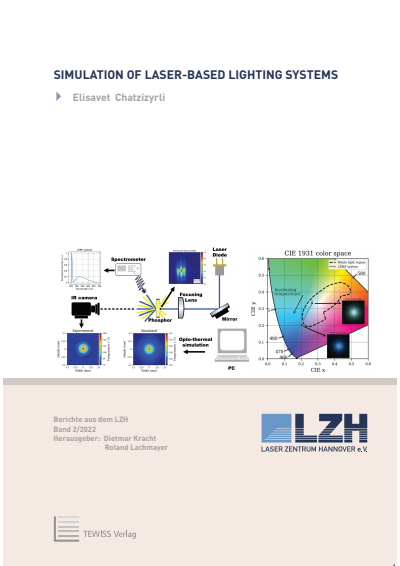
Laser-excited remote phosphor systems are a new technology that has the potential to become the go-to lighting solution, particularly for applications requiring high luminances and luminous powers. However, the temperature dependence of the phosphor material is the performance bottleneck in these systems; the absorption and emission characteristics change with temperature, and after a certain temperature threshold is exceeded, luminescence is quenched. To incorporate these effects into optical system design, a simulation framework that combines optical and thermal analysis tools has been developed: ray tracing software within the geometric optics regime is used in conjunction with heat transfer calculations performed employing the finite element method. The temperature-dependent absorption coefficient, or equivalently the mean free path, the emission spectrum, and the quantum efficiency are all considered while modeling the phosphor material. Furthermore, when appropriate, the possible surface treatment techniques on the phosphor are taken into account by employing an additional surface scattering model. Both steady-state and transient opto-thermal analysis are implemented. In the first case, steady-state analysis can be used to quickly estimate the thermal response of a system given known material parameters, or to perform parameter investigation. Despite the higher computational cost, the latter case is ideal for studying the material response within the thermal quenching regime or for determining material parameters in cases where these are not known a priori. In this thesis, the thermal response of the phosphor for a wide range of pumping powers has been experimentally validated. Temperatures simulated and experimentally measured using thermal imaging techniques are compared in transmissive and reflective setups for polished and/or ground single-crystal phosphor samples. Finally, the opto-thermal simulation framework is used in an optimization scheme, demonstrating that this simulation tool can be an invaluable tool in the design and prototyping of phosphor-converted light sources.
Schlagworte
Publikation durchsuchen
Bibliographische Angaben
Auflage
1/2022
Copyrightjahr
2022
ISBN-Online
978-3-95900-748-1
Verlag
TEWISS, Garbsen
Reihe
Berichte aus dem LZH
Band
02/2022
Sprache
Deutsch
Seiten
156
Produkttyp
Monographie
Inhaltsverzeichnis
KapitelSeiten
Preface Kein Zugriff
Contents Kein Zugriff
List of Symbols Kein Zugriff
Kurzfassung Kein Zugriff
Abstract Kein Zugriff
1 Introduction Kein Zugriff Seiten 1 - 6
2.1 Fundamental concepts Kein Zugriff
2.2 Laser diodes Kein Zugriff
2.3 Phosphors Kein Zugriff
3.1 Radiation transport diffusion approximation - FEM Kein Zugriff
3.2 Kubelka-Munk theory - thermal resistance model Kein Zugriff
3.3 Ray tracing - FEM Kein Zugriff
4.1 Simulation framework overview Kein Zugriff
4.2 Optical analysis Kein Zugriff
4.3 Thermal analysis Kein Zugriff
5.1 Thermal imaging fundamentals Kein Zugriff
5.2 Measured simulation parameters Kein Zugriff
5.3 Comparison between simulated and experimentaltemperature profiles Kein Zugriff
5.4 Summary and outlook Kein Zugriff
6.1 Optical analysis Kein Zugriff
6.2 Phosphor sample optimization Kein Zugriff
6.3 Laser-source effect on opto-thermal performance Kein Zugriff
6.4 Summary and outlook Kein Zugriff
7 Summary and outlook Kein Zugriff Seiten 121 - 126
Bibliography Kein Zugriff Seiten 127 - 138
Standards and Regulations Kein Zugriff Seiten 139 - 140
Appendix Kein Zugriff Seiten 141 - 152
List of Publications Kein Zugriff Seiten 153 - 154