, um zu prüfen, ob Sie einen Vollzugriff auf diese Publikation haben.
Monographie Kein Zugriff
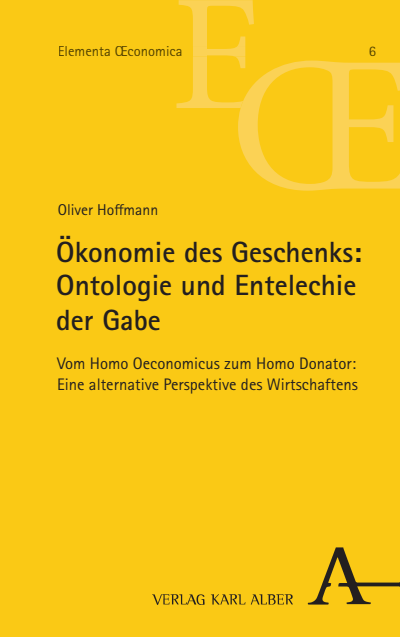
Ökonomie des Geschenks: Ontologie und Entelechie der Gabe
Vom Homo Oeconomicus zum Homo Donator: Eine alternative Perspektive des Wirtschaftens- Autor:innen:
- Reihe:
- Elementa Œconomica, Band 6
- Verlag:
- 2025
Zusammenfassung
Schenken ist mehr als Großzügigkeit – es ist ein Akt mit sozialer, kultureller und ökonomischer Sprengkraft. Dieses Buch zeigt, wie die Gabe Vertrauen stiftet, Gemeinschaft strukturiert, aber auch Abhängigkeiten erzeugt. Es analysiert Schenkrituale von indigenen Kulturen bis zur digitalen Ökonomie und fragt: Kann eine Gesellschaft jenseits des Marktes existieren? Mit transdisziplinärem Zugriff vereint der Band philosophische, soziologische und anthropologische Perspektiven. Er richtet sich an alle, die Wirtschaft, Beziehung und Moral neu denken wollen.Prof. Dr. Dr. Oliver Hoffmann forscht zu psychologischen, sozialen und kulturellen Grundlagen ökonomischen Handelns.
Schlagworte
Publikation durchsuchen
Bibliographische Angaben
- Auflage
- 1/2025
- Copyrightjahr
- 2025
- ISBN-Print
- 978-3-495-99035-3
- ISBN-Online
- 978-3-495-99036-0
- Verlag
- Karl Alber, Baden-Baden
- Reihe
- Elementa Œconomica
- Band
- 6
- Sprache
- Deutsch
- Seiten
- 184
- Produkttyp
- Monographie
Inhaltsverzeichnis
KapitelSeiten
- Titelei/Inhaltsverzeichnis Kein Zugriff Seiten 1 - 12
- Einleitung: Warum schenken wir? Die Ökonomie des Gebens im Überblick Kein Zugriff Seiten 13 - 18
- 1.1 Historische Beispiele und Rituale des Gabentauschs und Überblick über die Funktion des Schenkens Kein Zugriff
- 1.2.1 Schenken als Mechanismus sozialer Kohäsion und kollektiver Strukturierung Kein Zugriff
- 1.2.2 Schenken als rituelle Handlung Kein Zugriff
- 1.2.3 Schenken und Reziprozität: Gegenseitigkeit alsVerpflichtung Kein Zugriff
- 1.2.4 Schenken als spirituelle Geste Kein Zugriff
- 1.2.5 Schenken als ökonomisches Prinzip Kein Zugriff
- 2.1 Luxus und Überschuss als kulturelles Konzept Kein Zugriff
- 2.2 Umverteilung als Alternative zur Akkumulation Kein Zugriff
- 2.3 Überschuss und gesellschaftliche Werte Kein Zugriff
- 3.1 Geschenke als Instrumente von Macht und Abhängigkeit Kein Zugriff
- 3.2 Das "schädliche Geschenk" – Manipulation und Schuldgefühle Kein Zugriff
- 3.3 Machtfreie Schenkökonomien Kein Zugriff
- 4.1 Abgrenzung von Geschenk und Altruismus Kein Zugriff
- 4.2 Psychologische Motivationen hinter dem Geben Kein Zugriff
- 4.3 Verbindung von Altruismus und nachhaltigemWirtschaften Kein Zugriff
- 5.1 Ontologie der Gabe: Vom Objekt zur Begegnung Kein Zugriff
- 5.2 Soziale Bindungen und Individualität durch Schenken Kein Zugriff
- 5.3 Freiheit und Gemeinschaft im Schenkprozess Kein Zugriff
- 5.4 Balance zwischen persönlichem Geben und kollektiver Nachhaltigkeit Kein Zugriff
- 6.1 Jacques Derrida und das unbedingte Geschenk Kein Zugriff
- 6.2 Grenzen des bedingungslosen Schenkens Kein Zugriff
- 6.3 Praktische Umsetzung eines idealen Schenkens Kein Zugriff
- 7.1 Widerspruch zu Marktlogiken – Angebot und Nachfrage Kein Zugriff
- 7.2 Alternative ökonomische Strukturen und Gemeinschaften Kein Zugriff
- 7.3 Ethische Herausforderungen an Marktinteressen Kein Zugriff
- 8.1 Das Geschenk als Ausdruck von Zuneigung und Empathie Kein Zugriff
- 8.2 Das emotionale Risiko des Schenkens Kein Zugriff
- 8.3 Emotionale Auswirkungen einer Geschenkökonomie Kein Zugriff
- Schlusswort: Eine neue Ökonomie des Schenkens Kein Zugriff Seiten 169 - 178
- Literaturverzeichnis Kein Zugriff Seiten 179 - 184
Literaturverzeichnis (119 Einträge)
Es wurden keine Treffer gefunden. Versuchen Sie einen anderen Begriff.
- Appadurai, A. (1986). The Social Life of Things: Commodities in Cultural Perspective. Cambridge: Cambridge University Press. Google Scholar öffnen DOI: 10.5771/9783495990360
- Aquin, Th. von (2015). Summa Theologiae. Hamburg: Felix Meiner Verlag. Google Scholar öffnen DOI: 10.5771/9783495990360
- Arendt, H. (1958). The Human Condition. Chicago: University of Chicago Press. Google Scholar öffnen DOI: 10.5771/9783495990360
- Ariely, D. (2012). The (Honest) Truth About Dishonesty: How We Lie to Everyone – Especially Ourselves. New York: HarperCollins. Google Scholar öffnen DOI: 10.5771/9783495990360
- Aristoteles (2015). Nikomachische Ethik. Übers. von O. Höffe. Berlin: Akademie Verlag. Google Scholar öffnen DOI: 10.5771/9783495990360
- Bataille, G. (1988). The Accursed Share. Vol. I: Consumption. New York: Zone Books. Google Scholar öffnen DOI: 10.5771/9783495990360
- Batson, C. D. (1991). The Altruism Question: Toward a Social-Psychological Answer. Hillsdale: Erlbaum. Google Scholar öffnen DOI: 10.5771/9783495990360
- Batson, C. D. (2011). Altruism in Humans. New York: Oxford University Press. Google Scholar öffnen DOI: 10.5771/9783495990360
- Baudrillard, J. (1993). Symbolic Exchange and Death. London: Sage Publications. Google Scholar öffnen DOI: 10.5771/9783495990360
- Bauman, Z. (2005). Work, Consumerism and the New Poor. Buckingham: Open University Press. Google Scholar öffnen DOI: 10.5771/9783495990360
- Beecher, J. (1986): Charles Fourier: The Visionary and His World. Berkeley: University of California Press. Google Scholar öffnen DOI: 10.5771/9783495990360
- Benkler, Y. (2006). The Wealth of Networks: How Social Production Transforms Markets and Freedom. New Haven: Yale University Press. Google Scholar öffnen DOI: 10.5771/9783495990360
- Berkes, F. / Folke, C. (1998). Linking Social and Ecological Systems: Management Practices and Social Mechanisms for Building Resilience. Cambridge: Cambridge University Press. Google Scholar öffnen DOI: 10.5771/9783495990360
- Béteille, A. (1993). The Idea of Natural Inequality and Other Essays. Oxford: Oxford University Press. Google Scholar öffnen DOI: 10.5771/9783495990360
- Bhattacharya, R. (2001). The Spirit of Giving in Indian Philosophy. Delhi: Motilal Banarsidass. Google Scholar öffnen DOI: 10.5771/9783495990360
- Bhattacharya, S. (2001). Hindu Ethics: Purity, Abortion, and Euthanasia. Oxford: Oxford University Press. Google Scholar öffnen DOI: 10.5771/9783495990360
- Bloch, M. / Parry, J. (1989). Money and the Morality of Exchange. Cambridge: Cambridge University Press. Google Scholar öffnen DOI: 10.5771/9783495990360
- Bloom, P. (2013). Just Babies: The Origins of Good and Evil. New York: Crown. Google Scholar öffnen DOI: 10.5771/9783495990360
- Boas, F. (1897). The Social Organization and the Secret Societies of the Kwakiutl Indians. Washington: Smithsonian Institution. Google Scholar öffnen DOI: 10.5771/9783495990360
- Bollier, D. (2014). Think Like a Commoner: A Short Introduction to the Life of the Commons. Gabriola Island: New Society Publishers. Google Scholar öffnen DOI: 10.5771/9783495990360
- Boltanski, L. / Chiapello, E. (2005). Der neue Geist des Kapitalismus. Konstanz: UVK. Google Scholar öffnen DOI: 10.5771/9783495990360
- Boltanski, L. / Thévenot, L. (2006). On Justification: Economies of Worth. Princeton: Princeton University Press. Google Scholar öffnen DOI: 10.5771/9783495990360
- Bourdieu, P. (1977). Outline of a Theory of Practice. Cambridge: Cambridge University Press. Google Scholar öffnen DOI: 10.5771/9783495990360
- Bourdieu, P. (1984). Distinction: A Social Critique of the Judgement of Taste. Cambridge: Harvard University Press. Google Scholar öffnen DOI: 10.5771/9783495990360
- Bourdieu, P. (1986). The Forms of Capital. In: Richardson, J. G. (Hrsg.), Handbook of Theory and Research for the Sociology of Education. Greenwood Press. Google Scholar öffnen DOI: 10.5771/9783495990360
- Bourdieu, P. (1998). Praktische Vernunft: Zur Theorie des Handelns. Frankfurt am Main: Suhrkamp. Google Scholar öffnen DOI: 10.5771/9783495990360
- Burke, P. (1998). The European Renaissance: Centres and Peripheries. Oxford: Blackwell. Google Scholar öffnen DOI: 10.5771/9783495990360
- Caillé, A. (2000). Anthropologie du don: Le tiers paradigme. Paris: La Découverte. Google Scholar öffnen DOI: 10.5771/9783495990360
- Caputo, J. D. (1997). Deconstruction in a Nutshell: A Conversation with Jacques Derrida. New York: Fordham University Press. Google Scholar öffnen DOI: 10.5771/9783495990360
- Carrier, J. G. (1995). Gifts and Commodities: Exchange and Western Capitalism Since 1700. London: Routledge. Google Scholar öffnen DOI: 10.5771/9783495990360
- Critchley, S. (1999). Ethics-Politics-Subjectivity: Essays on Derrida, Levinas and Contemporary French Thought. London: Verso. Google Scholar öffnen DOI: 10.5771/9783495990360
- Csikszentmihalyi, M. (1992). Flow: The Psychology of Happiness. London: Rider. Google Scholar öffnen DOI: 10.5771/9783495990360
- Daly, H. E. (1996). Beyond Growth: The Economics of Sustainable Development. Boston: Beacon Press. Google Scholar öffnen DOI: 10.5771/9783495990360
- Derrida, J. (1991). Donner le temps: La fausse monnaie. Paris: Galilée. Google Scholar öffnen DOI: 10.5771/9783495990360
- Derrida, J. (1992). Given Time: I. Counterfeit Money. Chicago: University of Chicago Press. Google Scholar öffnen DOI: 10.5771/9783495990360
- Derrida, J. (2018): Die Gesetze der Gastfreundschaft. Metaphora. Journal for Literary Theory and Media. EV 3. Google Scholar öffnen DOI: 10.5771/9783495990360
- Douglas, M. (1990). The Gift and Reciprocity: Perspectives on Human Generosity. London: Routledge. Google Scholar öffnen DOI: 10.5771/9783495990360
- Duby, G. (1978). The Chivalrous Society. University of California Press. Google Scholar öffnen DOI: 10.5771/9783495990360
- Dumont, L. (1980). Homo Hierarchicus: The Caste System and Its Implications. Chicago: University of Chicago Press. Google Scholar öffnen DOI: 10.5771/9783495990360
- Esposito, J. (2002). Islam: The Straight Path. Oxford: Oxford University Press. Google Scholar öffnen DOI: 10.5771/9783495990360
- Firth, R. (1959). Economics of the New Zealand Maori. Wellington: Government Printer. Google Scholar öffnen DOI: 10.5771/9783495990360
- Firth, R. (1970). Themes in Economic Anthropology. London: Tavistock. Google Scholar öffnen DOI: 10.5771/9783495990360
- Fourier, C. (1971): The Theory of the Four Movements. Cambridge: Cambridge University Press. Google Scholar öffnen DOI: 10.5771/9783495990360
- Frankl, V. E. (1997). Man’s Search for Meaning. Boston: Beacon Press. Google Scholar öffnen DOI: 10.5771/9783495990360
- Georgescu-Roegen, N. (1971). The Entropy Law and the Economic Process. Cambridge: Harvard University Press. Google Scholar öffnen DOI: 10.5771/9783495990360
- Godbout, J. T. (1998). The World of the Gift. Montreal: McGill-Queen’s University Press. Google Scholar öffnen DOI: 10.5771/9783495990360
- Godelier, M. (1999). The Enigma of the Gift. Chicago: University of Chicago Press. Google Scholar öffnen DOI: 10.5771/9783495990360
- Gombrich, R. (1988). Theravāda Buddhism: A Social History from Ancient Benares to Modern Colombo. London: Routledge. Google Scholar öffnen DOI: 10.5771/9783495990360
- Graeber, D. (2011). Debt: The First 5,000 Years. New York: Melville House. Google Scholar öffnen DOI: 10.5771/9783495990360
- Gregory, C. A. (1982). Gifts and Commodities. London: Academic Press. Google Scholar öffnen DOI: 10.5771/9783495990360
- Habermas, J. (1981). The Theory of Communicative Action. Vol. 1: Reason and the Rationalization of Society. Boston: Beacon Press. Google Scholar öffnen DOI: 10.5771/9783495990360
- Harvey, D. (2014). Seventeen Contradictions and the End of Capitalism. London: Profile Books. Google Scholar öffnen DOI: 10.5771/9783495990360
- Harvey, P. (2000). An Introduction to Buddhism: Teachings, History and Practices. Cambridge: Cambridge University Press. Google Scholar öffnen DOI: 10.5771/9783495990360
- Henaff, M. (2010). The Price of Truth: Gift, Money, and Philosophy. Stanford: Stanford University Press. Google Scholar öffnen DOI: 10.5771/9783495990360
- Hendry, J. (1993). Wrapping Culture: Politeness, Presentation and Power in Japan and Other Societies. Oxford: Clarendon Press. Google Scholar öffnen DOI: 10.5771/9783495990360
- Hoffmann, O. (2024a): Von der Ökonomie der Psyche. Erinnerung und Imagination als mentale Ressourcen und ökonomische Erkenntnisprozesse. Baden Baden: Nomos. Google Scholar öffnen DOI: 10.5771/9783495990360
- Hoffmann, O. (2024b): Die Ökonomie der Erinnerung. Innere Austauschprozesse als Weg zu mentaler Effizienz. Baden Baden: Nomos. Google Scholar öffnen DOI: 10.5771/9783495990360
- Hoffmann, O. (2025a): Die Ökonomie des Buddhismus – Eine Philosophie des Wachstums, Konsums und Sinn in einer Zeit der Umbrüche. Transökonomische Modelle und die Integration einer Ethik der Suffizienz und der interdependenten Ressourcenstrukturen. Baden-Baden: Karl Alber. Google Scholar öffnen DOI: 10.5771/9783495990360
- Hoffmann, O. (2025b): Die Grenzen des Wachstums. Über Luxus, Konsum, Kapitalismus und die Krise der Moderne. München: Oekom Verlag. Google Scholar öffnen DOI: 10.5771/9783495990360
- Honneth, A. (1992). Kampf um Anerkennung: Zur moralischen Grammatik sozialer Konflikte. Frankfurt am Main: Suhrkamp. Google Scholar öffnen DOI: 10.5771/9783495990360
- Hyde, L. (1983). The Gift: Creativity and the Artist in the Modern World. New York: Vintage. Google Scholar öffnen DOI: 10.5771/9783495990360
- Illich, I. (1973). Tools for Conviviality. New York: Harper & Row. Google Scholar öffnen DOI: 10.5771/9783495990360
- Jackson, T. (2009). Prosperity without Growth: Economics for a Finite Planet. London: Earthscan. Google Scholar öffnen DOI: 10.5771/9783495990360
- Jonas, H. (1979). Das Prinzip Verantwortung: Versuch einer Ethik für die technologische Zivilisation. Frankfurt am Main: Suhrkamp. Google Scholar öffnen DOI: 10.5771/9783495990360
- Kallis, G. (2018). Degrowth. Newcastle upon Tyne: Agenda Publishing. Google Scholar öffnen DOI: 10.5771/9783495990360
- Kolm, S.-C. (2006). Reciprocity: An Economics of Social Relations. Cambridge: Cambridge University Press. Google Scholar öffnen DOI: 10.5771/9783495990360
- Komter, A. (2005). Social Solidarity and the Gift. Cambridge: Cambridge University Press. Google Scholar öffnen DOI: 10.5771/9783495990360
- Kopytoff, I. (1986). The Cultural Biography of Things: Commoditization as Process. In A. Appadurai (Hrsg.), The Social Life of Things: Commodities in Cultural Perspective (S. 64–91). Cambridge: Cambridge University Press. Google Scholar öffnen DOI: 10.5771/9783495990360
- Latour, B. (2018). Down to Earth: Politics in the New Climatic Regime. Cambridge: Polity Press. Google Scholar öffnen DOI: 10.5771/9783495990360
- Lévinas, E. (1961). Totalité et Infini: Essai sur l’extériorité. Paris: Martinus Nijhoff. Google Scholar öffnen DOI: 10.5771/9783495990360
- Levinas, E. (1969). Totality and Infinity: An Essay on Exteriority. Pittsburgh: Duquesne University Press. Google Scholar öffnen DOI: 10.5771/9783495990360
- Levinas, E. (1979). Totality and Infinity: An Essay on Exteriority. Pittsburgh: Duquesne University Press. Google Scholar öffnen DOI: 10.5771/9783495990360
- Lévi-Strauss, C. (1949). Strukturale Anthropologie. München: Beck. Google Scholar öffnen DOI: 10.5771/9783495990360
- Lévi-Strauss, C. (1969). The Elementary Structures of Kinship. Boston: Beacon Press. Google Scholar öffnen DOI: 10.5771/9783495990360
- Lipovetsky, G. (2007). Der Luxus des Lebens. München: Hanser. Google Scholar öffnen DOI: 10.5771/9783495990360
- Malaka, T. (2001). Altruismus und die Grenzen des Egoismus: Eine sozialpsychologische Analyse. München: Fink. Google Scholar öffnen DOI: 10.5771/9783495990360
- Malinowski, B. (1922). Argonauts of the Western Pacific. London: Routledge. Google Scholar öffnen DOI: 10.5771/9783495990360
- Marion, J.-L. (1997). Étant donné: Essai d’une phénoménologie de la donation. Paris: Presses Universitaires de France. Google Scholar öffnen DOI: 10.5771/9783495990360
- Marion, J.-L. (2011). The Reason of the Gift. Charlottesville: University of Virginia Press. Google Scholar öffnen DOI: 10.5771/9783495990360
- Marion, J.-L. (2012). Being Given: Toward a Phenomenology of Givenness. Stanford: Stanford University Press. Google Scholar öffnen DOI: 10.5771/9783495990360
- Marx, K. (1867). Das Kapital: Kritik der politischen Ökonomie. Berlin: Dietz Verlag. Google Scholar öffnen DOI: 10.5771/9783495990360
- Mauss, M. (1925). Die Gabe. Form und Funktion des Austauschs in archaischen Gesellschaften. Frankfurt am Main: Suhrkamp. Google Scholar öffnen DOI: 10.5771/9783495990360
- Meadows, D. H. / Meadows, D. L. / Randers, J. (2004). Limits to Growth: The 30-Year Update. White River Junction: Chelsea Green Publishing. Google Scholar öffnen DOI: 10.5771/9783495990360
- Meadows, D. H. / Meadows, D. L. / Randers, J. / Behrens, W. W. (1972). The Limits to Growth. New York: Universe Books. Google Scholar öffnen DOI: 10.5771/9783495990360
- Miller, D. (2001). The Dialectics of Shopping. Chicago: University of Chicago Press. Google Scholar öffnen DOI: 10.5771/9783495990360
- Munn, N. (1986). The Fame of Gawa: A Symbolic Study of Value Transformation in a Massim (Papua New Guinea) Society. Durham: Duke University Press. Google Scholar öffnen DOI: 10.5771/9783495990360
- Naess, A. (1989). Ecology, Community and Lifestyle: Outline of an Ecosophy. Cambridge: Cambridge University Press. Google Scholar öffnen DOI: 10.5771/9783495990360
- Nussbaum, M. C. (2011). Creating Capabilities: The Human Development Approach. Cambridge: Belknap Press. Google Scholar öffnen DOI: 10.5771/9783495990360
- Nye, J. S. (2004). Soft Power: The Means to Success in World Politics. New York: PublicAffairs. Google Scholar öffnen DOI: 10.5771/9783495990360
- Ostrom, E. (1990). Governing the Commons: The Evolution of Institutions for Collective Action. Cambridge: Cambridge University Press. Google Scholar öffnen DOI: 10.5771/9783495990360
- Parry, J. (1986). The Gift, the Indian Gift and the 'Indian Gift'. Man, 21(3), S. 453–473. Google Scholar öffnen DOI: 10.5771/9783495990360
- Piliavin, J. A. / Charng, H. W. (1990). Altruism: A Review of Recent Theory and Research. Annual Review of Sociology, 16, S. 27–65. Google Scholar öffnen DOI: 10.5771/9783495990360
- Polanyi, K. (1944). The Great Transformation: Politische und ökonomische Ursprünge von Gesellschaften. Frankfurt am Main: Suhrkamp. Google Scholar öffnen DOI: 10.5771/9783495990360
- Rawls, J. (1971). A Theory of Justice. Cambridge: Harvard University Press. Google Scholar öffnen DOI: 10.5771/9783495990360
- Raworth, K. (2017). Doughnut Economics: Seven Ways to Think Like a 21st-Century Economist. London: Random House. Google Scholar öffnen DOI: 10.5771/9783495990360
- Raworth, K. (2017). Doughnut Economics: Seven Ways to Think Like a 21st-Century Economist. London: Random House Business. Google Scholar öffnen DOI: 10.5771/9783495990360
- Sahlins, M. (1972). Stone Age Economics. Chicago: Aldine-Atherton. Google Scholar öffnen DOI: 10.5771/9783495990360
- Schumacher, E. F. (1973). Small is Beautiful: A Study of Economics as if People Mattered. London: Blond & Briggs. Google Scholar öffnen DOI: 10.5771/9783495990360
- Schweitzer, F. (1999). Practical Theology: International Perspectives. Leuven: Peeters Publishers. Google Scholar öffnen DOI: 10.5771/9783495990360
- Schweizer, T. (1999). Embeddedness of Economic Systems. New York: Cambridge University Press. Google Scholar öffnen DOI: 10.5771/9783495990360
- Sen, A. (1987). On Ethics and Economics. Oxford: Blackwell. Google Scholar öffnen DOI: 10.5771/9783495990360
- Sen, A. (1999). Development as Freedom. Oxford: Oxford University Press. Google Scholar öffnen DOI: 10.5771/9783495990360
- Seneca (2020): Vom glückseligen Leben (De Vita Beata). Übersetzt von Fritz-Heiner Mutschler. Ditzingen: Reclam. Google Scholar öffnen DOI: 10.5771/9783495990360
- Sennett, R. (2008). The Craftsman. New Haven: Yale University Press. Google Scholar öffnen DOI: 10.5771/9783495990360
- Simmel, G. (1900). Philosophie des Geldes. Leipzig: Duncker & Humblot. Google Scholar öffnen DOI: 10.5771/9783495990360
- Sombart, W. (1913). Luxus und Kapitalismus. München: Duncker & Humblot. Google Scholar öffnen DOI: 10.5771/9783495990360
- Speth, J. G. (2008). The Bridge at the Edge of the World: Capitalism, the Environment, and Crossing from Crisis to Sustainability. New Haven: Yale University Press. Google Scholar öffnen DOI: 10.5771/9783495990360
- Strathern, M. (1988). The Gender of the Gift: Problems with Women and Problems with Society in Melanesia. Berkeley: University of California Press. Google Scholar öffnen DOI: 10.5771/9783495990360
- Testart, A. (1998). Critique du don: Études sur la circulation non marchande. Paris: Éditions de la Maison des Sciences de l’Homme. Google Scholar öffnen DOI: 10.5771/9783495990360
- Titmuss, R. M. (1970). The Gift Relationship: From Human Blood to Social Policy. London: Allen & Unwin. Google Scholar öffnen DOI: 10.5771/9783495990360
- Trivers, R. (1971). The Evolution of Reciprocal Altruism. The Quarterly Review of Biology, 46 (1). Google Scholar öffnen DOI: 10.5771/9783495990360
- Turner, V. (1969). The Ritual Process: Structure and Anti-Structure. Chicago: Aldine. Google Scholar öffnen DOI: 10.5771/9783495990360
- Valeri, V. (1985). Kingship and Sacrifice: Ritual and Society in Ancient Hawaii. Chicago: University of Chicago Press. Google Scholar öffnen DOI: 10.5771/9783495990360
- Van Gennep, A. (1909). Les rites de passage. Paris: É. Nourry. Google Scholar öffnen DOI: 10.5771/9783495990360
- Veblen, T. (1899). The Theory of the Leisure Class. New York: Macmillan. Google Scholar öffnen DOI: 10.5771/9783495990360
- Weber, M. (2003). Wirtschaft und Gesellschaft. Tübingen: Mohr Siebeck. Google Scholar öffnen DOI: 10.5771/9783495990360
- Weil, S. (1952). The Need for Roots: Prelude to a Declaration of Duties towards Mankind. London: Routledge. Google Scholar öffnen DOI: 10.5771/9783495990360
- Weiner, A. B. (1992). Inalienable Possessions: The Paradox of Keeping-While-Giving. Berkeley: University of California Press. Google Scholar öffnen DOI: 10.5771/9783495990360
- Zahavi, D. (2014). Self and Other: Exploring Subjectivity, Empathy, and Shame. Oxford: Oxford University Press. Google Scholar öffnen DOI: 10.5771/9783495990360