Search results (68,996)

Parent Topic
Search Parent Topic
Access
Type of Publication
Search Type of Publication
Publication Year
Language
Search Language
Publisher
Search Publisher
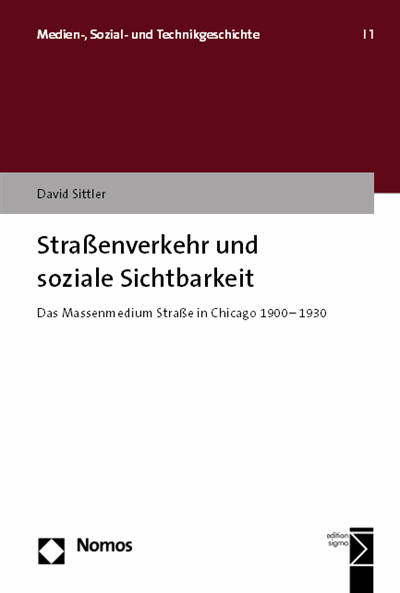
Cover of book: Straßenverkehr und soziale Sichtbarkeit
Series
Publisher: Nomos Verlagsgesellschaft mbH & Co. KG, Baden-Baden
This series compiles publications which present the histories of the media, society and technology as reciprocal. It welcomes studies on phenomena that are characterised by the persistence of their specific materiality and practices. Consequently, from a methodological perspective it aims to focus on innovative historiographical processes, such as historical praxeology, historical ethnography or the analysis of traceable chains of actors and their actions, among others. The publications examine how the ethnomethodology and technological methods used in the 'longue durée' approach to the study of history have a bearing on the present and influence the media and media practices today. They reveal the genealogies of media history, which are underpinned by perspectives from the histories of art, society, technology and science at the same time. These publications may be written in either German or English.
Go to series
Cover of book: Bilateral Diplomacy and EU Membership
Series
Publisher: Nomos Verlagsgesellschaft mbH & Co. KG, Baden-Baden
The series "Salzburg European Union Studies" aims at publishing interdisciplinary works tackling salient questions of European integration. The general success story of European integration has repeatedly shown signs of stalemate and rupture: With its finalité being still unclear, the project of integration is contested. A hybrid of supranational and intergovernmental elements, the Union’s institutional set-up is permanently “under construction”. The persisting discrepancy between market and monetary integration on the one hand and the democratic quality of decision-making as well as the lack of a European social dimension on the other constitutes one major source of the dissent. The financial and economic crisis has triggered intensive debates about European economic governance and better modes of co-ordination of economic policy, mutual surveillance and sanctions. The Union has also considerably raised the stakes by launching a new constitutional process at the turn of the century. Debates inside and outside the two Conventions were not only about institutions and procedures but also about values and identities, about the effects of EU policies on labour markets, welfare concepts and the European society in general. Last but not least, international competition challenges the European project and demands a stronger role in foreign affairs and in the relationship with its neighbouring countries.
Go to series