Official Journal of the International Society for Knowledge Organization
Editors:
Natália Bolfarini Tognoli (Universidade Federal Fluminense - UFF, Brasil) | Lu An (Wuhan University, China) (Deputy Editor) | Thiago Barros (Federal University of Rio Grande do Sul, Brazil) (Managing Editor) | Maja Žumer (University of Ljubljana, Slovenia) (Deputy Editor)
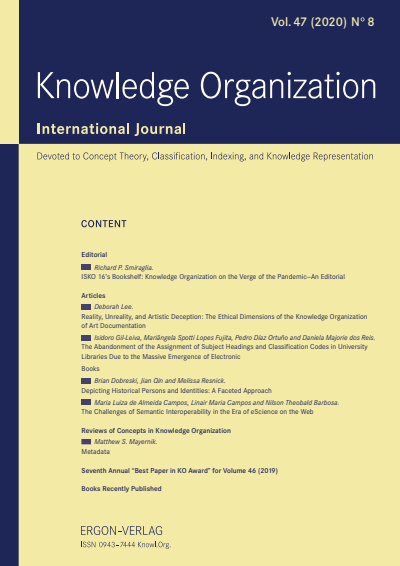
Archives are responsible for presenting historical materials to users while also placing them in context. Historical individuals and their identities pose specific challenges for the archive, including how to negotiate changing cultural perspectives...
The Sixteenth International Conference on Knowledge Organization was to have been held in Aalborg, Denmark in July 2020. Cancelled due to COVID-19, the proceedings were published online on 4 December 2020 containing 48 full papers, 17 short papers...
Metadata in various forms pervades our institutions, technologies, and daily lives. Metadata is a distinct focus of academic research and professional practice for many people within the library and information sciences (LIS). This article is an...
The ethics of describing and indexing works which have an element of deception is an important topic within the arena of knowledge organization (KO). However, what happens if the unreal element is for artistic purposes and is part of the experience...
The massive and unstoppable emergence of electronic books in libraries has altered their organization. This disruptive technology has led to structural changes. Currently, an e-book exists only if its metadata exists. The objective of this article...
This article is an exploratory study that intends to present semantic interoperability initiatives in the area of information science and computer science. It discusses these initiatives, focusing on open science and eScience, aiming at pointing out...
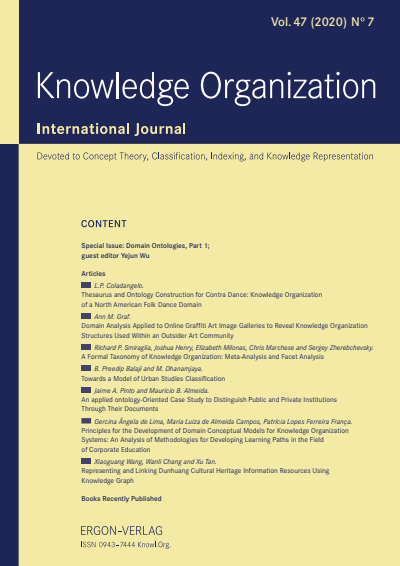
Nearly fifty years after the incorporation of the International Society for Knowledge Organization and the introduction of its formal scientific journal Knowledge Organization, a comprehensive encyclopedia of the domain appeared. The practice of...
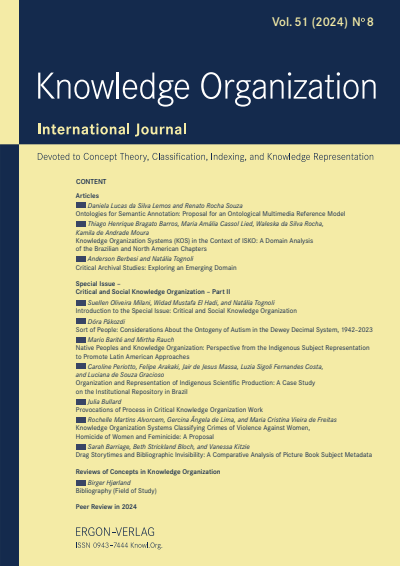
The institutions we create shape many of the activities we engage insofar as they are pervasive entities in our society. In an era full of new technologies, including the semantic web, there is a movement toward sound conceptual modeling for...
Domain analysis is useful for examination of individual spheres of intellectual activity, both academic and otherwise, and has been used in the knowledge organization (KO) literature to explore specific communities and uses, including web...
This article presents a set of principles for knowledge modeling in knowledge organization systems in specific domains. It discusses the representational problem, comparing the abstraction mechanisms present in the theories related to representation...
This study employs a knowledge graph approach to realize the representation and association of information resources, promote the research, teaching, and dissemination of Dunhuang cultural heritage (CH). The Dunhuang Mogao Grottoes is a UNESCO world...
This case study aims to preserve and disseminate cultural heritage information about the North American community folk dance tradition of contra dance through development of a thesaurus of choreographic terms and a domain ontology. A survey of dance...
Evolution of cities is a subject of research for over a hundred years in the organization of urban knowledge systems. Locating five key methodological approaches used by urban scholars and practitioners, this paper demonstrates different...
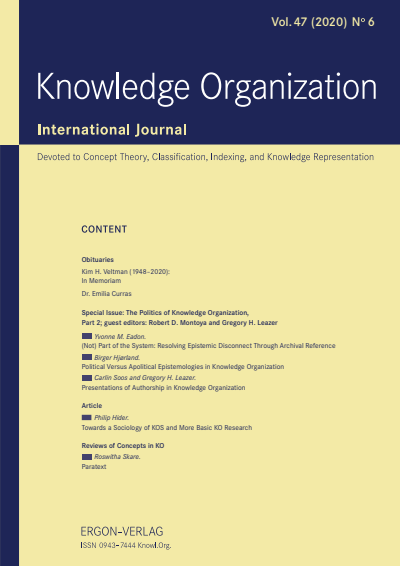
Information seeking practices of conspiracists are examined by introducing the new archival user group of “conspiracist researchers.” The epistemic commitments of archival knowledge organization (AKO), rooted in provenance and access/secrecy,...
This article presents Gérard Genette’s concept of the paratext by defining the term and by describing its characteristics. The use of the concept in disciplines other than literary studies and for media other than printed books is discussed. The...
Section 1 raises the issue of this article: whether knowledge organization systems (KOS) and knowledge organization processes (KOP) are neutral or political by nature and whether it is a fruitful ideal that they should be neutral. These questions...
The “author” is a concept central to many publication and documentation practices, often carrying legal, professional, social, and personal importance. Typically viewed as the solitary owner of their creations, a person is held responsible for...
It is suggested that the knowledge organization (KO) field places greater emphasis on basic research that examines the sociology of KO systems (KOS) and the broader, environmental reasons for the development of both formal and informal KOS. This...
Scholars and practitioners have exposed the limitations of traditional Euro-American approaches to knowledge organization (KO) when it comes to Indigenous topics. To develop more effective KO practices, there is a need for KO practitioners to...