Official Journal of the International Society for Knowledge Organization
Editors:
Natália Bolfarini Tognoli (Universidade Federal Fluminense - UFF, Brasil) | Lu An (Wuhan University, China) (Deputy Editor) | Thiago Barros (Federal University of Rio Grande do Sul, Brazil) (Managing Editor) | Maja Žumer (University of Ljubljana, Slovenia) (Deputy Editor)
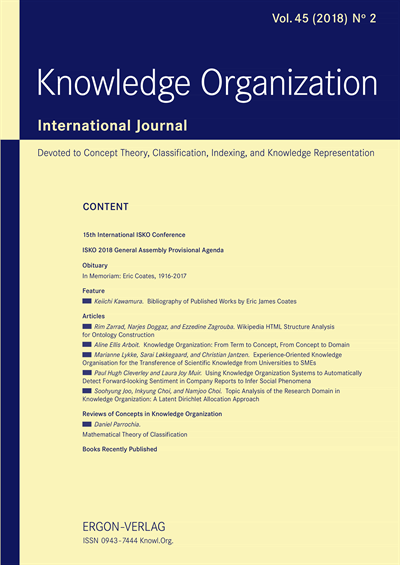
Based on text mining, this study explored topics in the research domain of knowledge organization. A text corpus consisting of titles and abstracts was generated from 282 articles of the Knowledge Organization journal for the recent ten years from...
We investigate whether existing knowledge organization systems (KOS) for strong and hesitant forward-looking sentiment could be improved to detect social phenomena. Five judges identified examples of strong/hesitant forward-looking sentiment that...
Previously, the main problem of information extraction was to gather enough data. Today, the challenge is not to collect data but to interpret and represent them in order to deduce information. Ontologies are considered suitable solutions for...
This is the fourth in a series of papers on classification based on phenomena instead of disciplines. Together with types, levels and facets that have been discussed in the previous parts, themes and rhemes are further structural components of such...
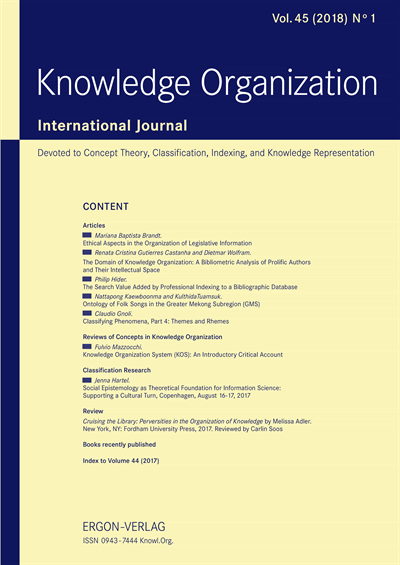
The goal of this research is to analyze ethical questions related to the organization of legislative information (bills, laws, and speeches) within the scope of the Brazilian Federal legislature (Chamber of Deputies and Federal Senate). Field...
This contribution discusses the notion of knowledge organization system (KOS), introducing both its broad and narrow meanings. It focuses more in-depth on KOSs as semantic tools, by critically analyzing a number of KOS typologies that have been...
This research aims to develop an ontology of the GMS folk songs for further utility in the areas of knowledge discovery and research pertaining to the humanities and social sciences domains. Ontology development processes are comprised of three...
The domain of knowledge organization (KO) represents a foundational area of information science. One way to better understand the intellectual structure of the KO domain is to apply bibliometric methods to key contributors to the literature. This...
Gross et al. (2015) have demonstrated that about a quarter of hits would typically be lost to keyword searchers if contemporary academic library catalogs dropped their controlled subject headings. This article reports on an investigation of the...