, to see if you have full access to this publication.
Journal Partial access
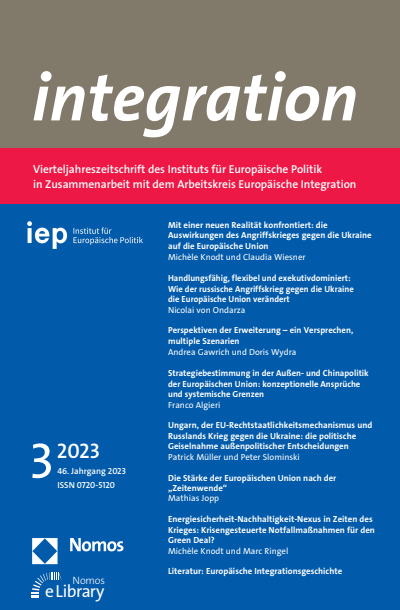
integration
Vierteljahreszeitschrift des Instituts für Europäische Politik in Zusammenarbeit mit dem Arbeitskreis Europäische Integration
Editors:
Prof. Dr. Frank Schimmelfennig (Vorsitz), Zürich | Prof. Dr. Thomas Christiansen, Rom | Prof. Dr. Friedrich Heinemann, Mannheim | Prof. Dr. Mathias Jopp, Berlin | Prof. Dr. Friedemann Kainer, Mannheim | Prof. Dr. Michèle Knodt, Darmstadt | Dr. Barbara Lippert, Berlin | Prof. Dr. Hartmut Marhold, Berlin | Prof. Dr. Franz Mayer, Bielefeld | Prof. Dr. Peter-Christian Müller-Graff, Heidelberg | Prof. Dr. Martin Nettesheim, Tübingen | Prof. Dr. Joachim Schild, Trier | Prof. Dr. Wolfgang Wessels, Köln
European democracy is undergoing profound change. The various crises of the past 15 years and the transformations associated with modernisation, globalisation, geopolitics and Europeanisation are threatening the trust of citizens in political actors...
This contribution analyses possible consequences of the expected gains of far-right parties in the election year of 2024 on the politics of the European Union (EU). It discusses what goals far-right parties pursue and whether they might gain...
To date, there is no set procedure for the allocation of seats in the European Parliament. On a meeting of the Committee on Constitutional Affairs (AFCO) in February 2024, the establishment of a permanent system was addressed based on three...
What kind of European Union (EU) emerges from the “polycrisis”? This article argues that the EU is developing into a “reinsurance polity”. In this system of public reinsurance, the nation states remain the direct insurers of their citizens...
The division of powers in the federally structured European Union, the lack of fixed political coalitions, the absence of effective control of voting behaviour in the European Parliament by parliamentary group leaderships and the structure of...
This text is an attempt to read the election results in Poland on 15 October 2023 as a symptom of deeper changes in society. The author defends the thesis that democratic and liberal attitudes, supressed but still present in society, have been...
European security policy is still widely regarded as the realm of national and “positive” states. In contrast to this conventional view, this article argues that the European Union – and the broader European multi-level system – can be...
This article analyses the impact of recent reforms in the Common European Asylum System on the governance structure of asylum and border policies of the European Union (EU). Drawing on the Core State Power framework and New Intergovernmentalism, we...
On October 15, 2023, the Law and Justice Party (PiS) lost majority in parliamentary elections. Two months later, a new government of the Civic Coalition, Third Way, and the New Left, under the leadership of Donald Tusk was sworn in, with an...
The changed geostrategic situation of the European Union (EU) since Russia’s invasion of Ukraine is particularly evident in the Baltic Sea region due to its geographical proximity and shared history with Russia. After years of enlargement fatigue,...
The article analyses the role that the single currency currently plays in an international financial system dominated by the dollar and what measures can be taken to support the position of the euro in the international hierarchy of currencies. In...
The energy crisis in the European Union (EU) escalated with Russia’s invasion of Ukraine on 24 February 2022. In addition to rising energy prices, the almost forgotten concern about energy security came into focus, potentially displacing other...
EU-Turkey relations could benefit from closer cooperation on Energy and climate. More renewable energy and lower greenhouse gas emissions could be realised and would help both the European Union (EU) and Turkey to reduce their energy trade with...
As part of a “polycrisis”, the threats posed by COVID-19 and Russia's attack on Ukraine have brought questions of “security” and solidarity back into the spotlight of European debates. In the history of the European Union (EU), however,...
This article analyses the strength and resilience of the European Union (EU) after the “Zeitenwende”. The completely new situation of threat emanating from Russia did not lead to the EU falling apart, as might have been expected. To the...
In response to the Russian war of aggression against Ukraine, the European Union (EU) has taken short-, medium- and long-term measures in the area of energy policy. They address both the goal of security of supply and sustainability. In doing so,...
The Russian war of aggression against Ukraine poses an enormous challenge also for the crisis-tested European Union (EU). The analysis of the impact on its institutional structures shows that so far there has been no radical transformation of the...
The European Council granted the status of accession candidates of the European Union (EU) to Ukraine and the Republic of Moldova on 23 June 2022, Georgia could soon follow. The urgent calls of the Ukrainian President Volodymyr Zelenskyy for a...
The foreign policy of the European Union (EU) is characterized by a specific systemic complexity and a high degree of institutionalization. This is reflected in the managing of cooperation and diplomacy with other actors in international relations....