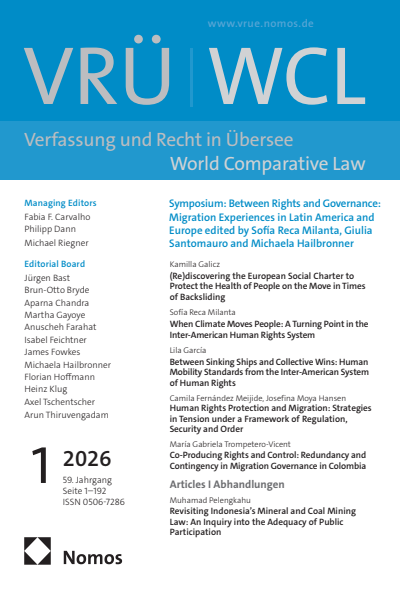
Prof. Dr. Jürgen Bast, Justus-Liebig-Universität Gießen | Prof. Dr. Brun-Otto Bryde, Justus-Liebig-Universität Gießen | Dr. Fabia Fernandes Carvalho, University of Melbourne | Prof. Dr. Philipp Dann, Humboldt Universität zu Berlin | Prof. Dr. Anuscheh Farahat, Universität Wien | Prof. Dr. Isabel Feichtner, Julius-Maximilian-Universität Würzburg | Prof. Dr. James Fowkes, Universität Münster | Prof. Dr. Michaela Hailbronner, Justus-Liebig-Universität Gießen | Prof. Dr. Florian Hoffmann, Pontifícia Universidade Católica do Rio de Janeiro, | Prof. Heinz Klug, S.J.D. J.D., B.A., University of Wisconsin-Madison | Prof. Dr. Michael Riegner, Universität Erfurt | Prof. Arun Thiruvengadam, Azim Premji University India | Prof. Dr. Axel Tschentscher, Universität Bern
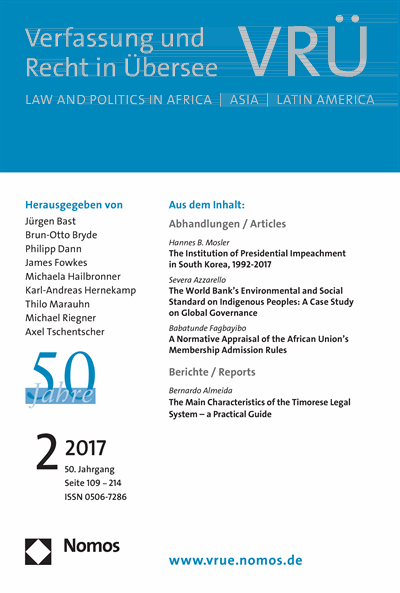
Presidential impeachment is a mechanism used to protect democracy from system-threatening malpractice by an incumbent, which is a phenomenon that is occurring increasingly often in young presidential democracies around the world. This article...
The independence of Timor-Leste in 2002 resulted in the creation of a new legal system, which had to navigate a difficult transition from the legal systems inherited from the former Portuguese, Indonesian and United Nations administrations to a new...
Secondary law-making by international organisations is an increasingly important phenomenon, as it directly affects individuals and communities worldwide. However, the internal regulation does not always keep pace with the growing number of...
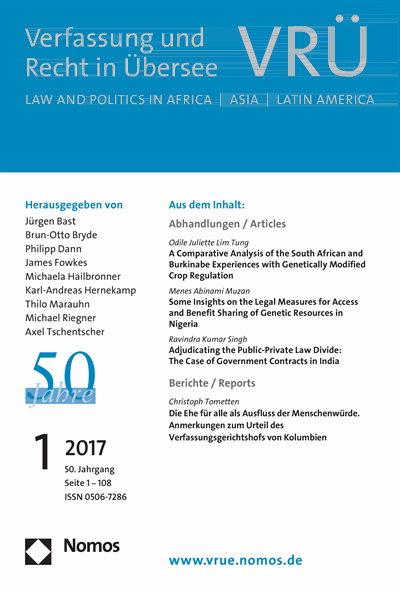
Over the past two decades, the adoption of genetically modified (GM) crops has been moderate in Africa with mainly four countries, namely South Africa, Burkina Faso, Egypt and Sudan that commercialize such crops. While South Africa is set on the...
As a general rule, where a matter falls purely in the realm of contract law (i.e. where there is a contractual dispute, pure and simple, in relation to a contract with the Government/State), a writ petition cannot be moved under article 32 or 226 of...
On April 28th, 2016, the Constitutional Court of Colombia decided that same-sex couples have a constitutional right to marry. This decision draws on the jurisprudence of courts in other countries which have decided, since 2002, that excluding...
This article analyzes the effectiveness of Nigeria’s genetic resources regime as an appropriate measure to engender adequate conservation and sustainable use of biodiversity, particularly in the face of global economic realities, best practices...
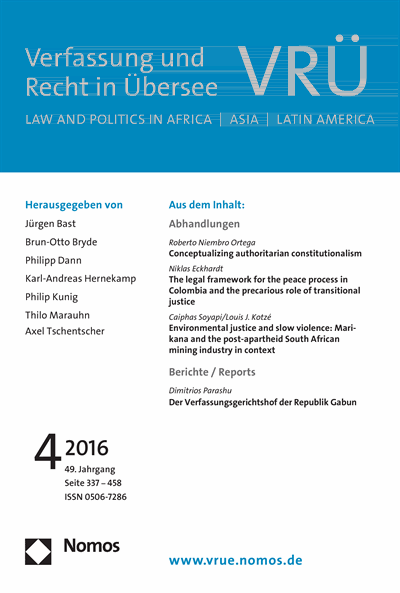
Authoritarian constitutionalism is a new category used by constitutional law scholars to refer to a distinct type of regime wherein there are faulty practices and a constitution with an authoritarian content. With these characteristics in mind it...
The Constitutional Court of the Republic of Gabon, established in 1991, enjoys all the competences of comparable African Constitutional Courts, influenced by the French Constitutional Law. Especially the execution of its competence regarding...
South Africa has come a long way since the constitutional revolution that swept the country in the early 1990s. The Constitution of the Republic of South Africa, 1996 introduced and continues to drive far-reaching changes to the political, social...
Four years ago the Colombian government has entered into peace negotiations with the guerilla group FARC in order to terminate the armed conflict which has been raging in the country for more than fifty years. The most controversial issue has...