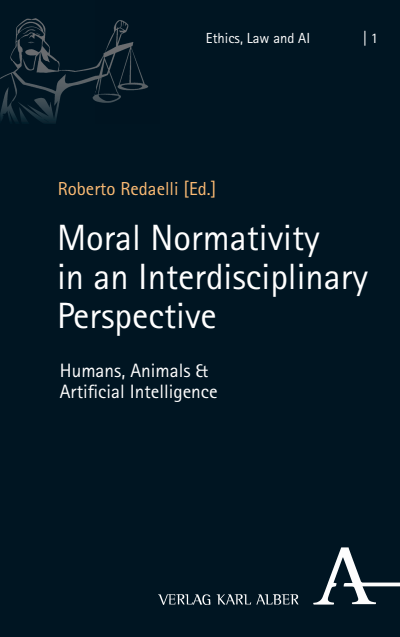
Moral Normativity in an Interdisciplinary Perspective
Humans, Animals & Artificial Intelligence- Editors:
- Series:
- Ethics, Law and AI, Volume 1
- Publisher:
- 2023
Summary
Nowadays many disciplines are devoting particular attention from a variety of perspectives to the normative nature of our ways of life. From linguistics to jurisprudence, from anthropology to philosophy, from economics to neuroscience, the subject of moral normativity constitutes a Gordian knot of the present age, towards which the efforts of scientific and philosophical understanding are directed.The following volume aims to reach a better understanding of moral normativity. It collects works by primatologists, sociologists, philosophers of law, ethicists, and phenomenologists to illustrate their contributions to resolving issues regarding the normative profile of ethical concepts, judgments and reasons, i.e., the source of the binding force that guides the behaviour of the human agent. With contributions byJohn J. Drummond | Federico L.G. Faroldi | Edoardo Fittipaldi | Roberto Redaelli | Alessio Rotundo | Richard Wrangham
Keywords
Search publication
Bibliographic data
- Copyright year
- 2023
- ISBN-Print
- 978-3-495-99428-3
- ISBN-Online
- 978-3-495-99429-0
- Publisher
- Karl Alber, Baden-Baden
- Series
- Ethics, Law and AI
- Volume
- 1
- Language
- English
- Pages
- 141
- Product type
- Edited Book
Table of contents
- Titelei/Inhaltsverzeichnis No access Pages 1 - 6
- Moral Normativity in Humans, Animals & Artificial Intelligence. An Introduction No access Pages 7 - 10Authors:
- Authors:
- 1. Repression of competition: a critical condition for the evolution of cooperation. No access
- 2. Reduction of competition among males in humans No access
- 3. Self-domestication: evidence for the execution of alpha males in the Pleistocene. No access
- 4. Implication of communally approved execution for the evolution of morality. No access
- 5. Intergroup competition: the traditional hypothesis No access
- 6. Sex differences in the origin and dynamics of the moral system No access
- 7. Morality and groupishness No access
- 8. Conclusion: the transition from Might to Right and the emergence of Homo duplex No access
- Authors:
- 1. Introduction No access
- 2. A conceptualization for »norm« and »normative behavior«, and its theorical premises No access
- 3.1.1.1. Anger No access
- 3.1.1.2 Indignation No access
- 3.1.1.3 Disgust No access
- 3.2.1.1 Guilt No access
- 3.2.1.2 Shame No access
- 3.2.1.3 Pride No access
- 4. Conclusion No access
- Authors:
- 1. Introduction No access
- 2. Epistemic norms No access
- 3. Practical norms No access
- Authors:
- Part One. Raymond Aron and the Ethnologist’s Judgment No access
- Part Two. Merleau-Ponty and Social Anthropology No access
- Authors:
- 1. Normativity: from humans to artificiaI intelligence No access
- 2. The normative question: some preliminary remarks No access
- 3. Digital normativity & artificial intelligence No access
- 4. Artificial intelligence from a postphenomenological perspective and the notion of quasi-normativity. Some indications for a solution to the normative question in the field of AI ethics No access
- 5. Brief conclusions: the hybrid origin of normativity and AI No access
- Authors:
- 1. Introduction No access
- 2.1 AGI, Alignment, Reinforcement Learning No access
- 2.2 The Human Compatible Approach No access
- 3. Problems with the human compatible framework. No access
- Case 1: Paperclip Scenario No access
- Case 2: Self-driving cars and the trolley problem No access
- 4.2. Methodological Remarks No access
- 5 Conclusion and Further Work No access
- Abstracts No access Pages 135 - 138
- List of Contributors No access Pages 139 - 141
Bibliography (199 entries)
No match found. Try another term.
- Ågren, J. A., Davies, N. G., & Foster, K. R. (2019). Enforcement is central to the evolution of cooperation. Nature, Ecology and Evolution, 3(7), 1018–1029. https://doi.org/10.1038/s41559-019-0907-1 Open Google Scholar doi.org/10.5771/9783495994290-11
- Alexander, R. D. (1971). The search for an evolutionary philosophy of man. Proc Roy Soc Victoria, 84, 99–120. Open Google Scholar doi.org/10.5771/9783495994290-11
- Alexander, R. D. (1979). Darwinism and Human Affairs. University of Washington Press. Open Google Scholar doi.org/10.5771/9783495994290-11
- Alexander, R. D. (1982). Biology and the moral paradoxes. J.Social. Biol. Struct., 5, 389–395. Open Google Scholar doi.org/10.5771/9783495994290-11
- Alexander, R. D. (1987). The Biology of Moral Systems. Aldine de Gruyter. Open Google Scholar doi.org/10.5771/9783495994290-11
- Alexander, R. D. (1990). How did humans evolve? Reflections on the uniquely unique species. The University of Michigan. Open Google Scholar doi.org/10.5771/9783495994290-11
- Andirkó, A., Moriano, J., Vitriolo, A., Kuhlwilm, M., Testa, G., & Boeckx, C. (2021). Fine-grained temporal mapping of derived high-frequency variants supports the mosaic nature of the evolution of Homo sapiens. bioRxiv 2021.01.22.427608. https://doi.org/doi.org/10.1101/2021.01.22.427608 Open Google Scholar doi.org/10.5771/9783495994290-11
- Bauer, M., Blattman, C., Chytilová, J., Henrich, J., Miguel, E., & Mitts, T. (2016). Can war foster cooperation? Journal of Economic Perspectives, 30, 249–274. https://doi.org/dx.doi.org/10.1257/jep.30.3.249 Open Google Scholar doi.org/10.5771/9783495994290-11
- Boehm, C. (1999). Hierarchy in the forest: the evolution of egalitarian behavior. Harvard University Press. Open Google Scholar doi.org/10.5771/9783495994290-11
- Boehm, C. (2008). Purposive social selection and the evolution of human altruism. Cross-Cultural Research, 42(4), 319–352. Open Google Scholar doi.org/10.5771/9783495994290-11
- Boehm, C. (2012). Moral Origins: The Evolution of Virtue, Altruism, and Shame. Basic Books. Open Google Scholar doi.org/10.5771/9783495994290-11
- Boehm, C. (2018). Collective intentionality: A basic and early component of moral evolution. Philosophical Psychology, 31(5), 680–702. https://doi.org/DOI: 10.1080/09515089.2018.1486607 Open Google Scholar doi.org/10.5771/9783495994290-11
- Brooks, J., Onishi, E., Clark, I. R., Bohn, M., & Yamamoto, S. (2021). Uniting against a common enemy: Perceived outgroup threat elicits ingroup cohesion in chimpanzees. PLoS ONE, 16(e0246869), 1–17. https://doi.org/doi.org/10.1371/journal. pone.0246869 Open Google Scholar doi.org/10.5771/9783495994290-11
- Burkart, J. M., Brügger, R. K., & van Schaik, C. P. (2018). Evolutionary origins of morality: insights from non-human primates. Frontiers in Sociology, 3(17), 1–12. https://doi.org/10.3389/fsoc.2018.00017 Open Google Scholar doi.org/10.5771/9783495994290-11
- Choi, J.-K., & Bowles, S. (2007). The coevolution of parochial altruism and war. Science, 318, 636–640. Open Google Scholar doi.org/10.5771/9783495994290-11
- Chudek, M., & Henrich, J. (2011). Culture–gene coevolution, norm-psychology and the emergence of human prosociality. Trends in Cognitive Sciences, 15 (5), 218–226. https://doi.org/10.1016/j.tics.2011.03.003 Open Google Scholar doi.org/10.5771/9783495994290-11
- Cieri, R. L., Churchill, S. E., Franciscus, R. G., Tan, J., & Hare, B. (2014). Craniofacial feminization, social tolerance, and the origins of behavioral modernity. Current Anthropology, 55, 419–443. https://doi.org/http://www.jstor.org/stable/10.1086/677209 Open Google Scholar doi.org/10.5771/9783495994290-11
- Curry, O. S., Chesters, M. J., & Van Lissa, C. J. (2019b). Mapping morality with a compass: Testing the theory of ›morality-as-cooperation‹ with a new questionnaire. Journal of Research in Personality, 78, 106–124. https://doi.org/https://doi.org/10.1016/j.jrp.2018.10.008 Open Google Scholar doi.org/10.5771/9783495994290-11
- Curry, O. S., Mullins, D. A., & Whitehouse, H. (2019a). Is It Good to Cooperate? Testing the Theory of Morality-as-Cooperation in 60 Societies. Current Anthropology, 60(1), 47–69. Open Google Scholar doi.org/10.5771/9783495994290-11
- de Waal, F. B. M. (2006). Primates and Philosophers: How Morality Evolved. Princeton University Press. Open Google Scholar doi.org/10.5771/9783495994290-11
- Durkheim, É. (1973 (1914)). The dualism of human nature and its social conditions. In R. N. Bellah (Ed.), Emile Durkheim on Morality and Society: Selected Writings (pp. 149–163). University of Chicago Press. Open Google Scholar doi.org/10.5771/9783495994290-11
- Durkheim, É. (1995 (1912)). The Elementary Forms of Religious Life. The Free Press. Open Google Scholar doi.org/10.5771/9783495994290-11
- Dyble, M. (2021). The evolution of altruism through war is highly sensitive to population structure and to civilian and fighter mortality. Proceedings of the National Academy of Sciences, 118(e2011142118), 1–6. https://doi.org/10.1073/pnas.2011142118 Open Google Scholar doi.org/10.5771/9783495994290-11
- Engelmann, J. M., Clift, J. B., Herrmann, E., & Tomasello, M. (2017). Social disappointment explains chimpanzees’ behaviour in the inequity aversion task. Proceedings of the Royal Society B, 284, 20171502. https://doi.org/doi.org/10.1098/rspb.2017.1502 Open Google Scholar doi.org/10.5771/9783495994290-11
- Engelmann, J. M., Herrmann, E., & Tomasello, M. (2016). The effects of being watched on resource acquisition in chimpanzees and human children. Animal Cognition, 19(1), 147–151. Open Google Scholar doi.org/10.5771/9783495994290-11
- Flinn, M. V., Geary, D. C., & Ward, C. V. (2005). Ecological dominance, social competition, and coalitionary arms races: Why humans evolved extraordinary intelligence. Evolution and Human Behavior, 26, 10–46. https://doi.org/10.1016/j.evolhumbehav.2004.08.005 Open Google Scholar doi.org/10.5771/9783495994290-11
- Frank, S. A. (2003). Perspective: repression of competition and the evolution of cooperation. Evolution, 57(4), 693–705. Open Google Scholar doi.org/10.5771/9783495994290-11
- Frank, S. A. (2013). A new theory of cooperation. In K. Summers & B. Crespi (Eds.), Human Social Evolution. The Foundational Works of Richard D. Alexander (pp. 40–47). Oxford University Press. Open Google Scholar doi.org/10.5771/9783495994290-11
- Freud, S. (1989 (1930)). Civilization and Its Discontents (J. Strachey, Ed.). W. W. Norton. Open Google Scholar doi.org/10.5771/9783495994290-11
- Glowacki, L., Wilson, M. L., & Wrangham, R. (2020). The evolutionary anthropology of war. Journal of Economic Behavior and Organization, 178, 963–982. https://doi.org/10.1016/j.jebo.2017.09.014 Open Google Scholar doi.org/10.5771/9783495994290-11
- Goodall, J. (1986). The Chimpanzees of Gombe: Patterns of Behavior. Harvard University Press. Open Google Scholar doi.org/10.5771/9783495994290-11
- Greene, J. D., & Young, L. (2020). The cognitive neuroscience of moral judgment and decision-making. In M. S. Gazzaniga (Ed.), The Cognitive Neurosciences (Vol. 6). MIT Press. Open Google Scholar doi.org/10.5771/9783495994290-11
- Haidt, J. (2012). The Righteous Mind: Why Good People Are Divided by Politics and Religion. Pantheon. Open Google Scholar doi.org/10.5771/9783495994290-11
- Henrich, J., & Muthukrishna, M. (2021). The origins and psychology of human cooperation. Annual Review of Psychology, 72, 207–240. https://doi.org/10.1146/annurev-psych-081920-042106 Open Google Scholar doi.org/10.5771/9783495994290-11
- Hublin, J.-J., Ben-Ncer, A., Bailey, S. E., Freidline, S. E., Neubauer, S., Skinner, M. M., Bergmann, I., Le Cabec, A., Benazzi, S., Harvati, K., & Gunz, P. (2017). New fossils from Jebel Irhoud, Morocco and the pan-African origin of Homo sapiens. Nature, 546, 289–292. Open Google Scholar doi.org/10.5771/9783495994290-11
- Hudson, V. M., Bowen, D. L., & Nielsen, P. L. (2020). The First Political Order: How Sex Shapes Governance and National Security Worldwide. Columbia University Press. Open Google Scholar doi.org/10.5771/9783495994290-11
- Kluver, J., Frazier, R., & Haidt, J. (2014). Behavioral ethics for Homo economicus, Homo heuristicus, and Homo duplex. Organizational Behavior and Human Decision Processes, 123, 150–158. https://doi.org/10.1016/j.obhdp.2013.12.004 Open Google Scholar doi.org/10.5771/9783495994290-11
- Kundu, P., & Cummins, D. D. (2013). Morality and conformity: The Asch paradigm applied to moral decisions. Social Influence, 8(4), 268–279, DOI: https://doi.org/10.1080/15534510.2012.727767 Open Google Scholar doi.org/10.5771/9783495994290-11
- Leach, H. (2003). Human domestication reconsidered. Current Anthropology, 44(3), 349–368. https://doi.org/10.1086/368119 Open Google Scholar doi.org/10.5771/9783495994290-11
- McAuliffe, K., & Santos, L. R. (2018). Do animals have a sense of fairness? In K. Gray & J. Graham (Eds.), Atlas of Moral Psychology (pp. 393–400). Guilford Press. Open Google Scholar doi.org/10.5771/9783495994290-11
- Páez, D., Rimé, B., Basabe, N., & Wlodarczyk, A. (2015). Psychosocial effects of perceived emotional synchrony in collective gatherings. Journal of Personality and Social Psychology, 108, 711–729. https://doi.org/10.1037/pspi0000014 Open Google Scholar doi.org/10.5771/9783495994290-11
- Paley, C. (2021). Beyond Bad: How Obsolete Morals Are Holding Us Back. Hodder & Stoughton. Open Google Scholar doi.org/10.5771/9783495994290-11
- Palombit, R. A. (2014). Sexual conflict in nonhuman primates. Advances in the Study of Behavior, 46, 191–280. Open Google Scholar doi.org/10.5771/9783495994290-11
- Radford, A. N., Majolo, B., & Aureli, F. (2016). Within-group behavioural consequences of between-group conflict: a prospective review. Proc R Soc B, 283(20161567),1–10. https://doi.org/http://dx.doi.org/10.1098/rspb.2016.1567 Open Google Scholar doi.org/10.5771/9783495994290-11
- Rosaldo, M. Z. (1974). Women, culture and society: a theoretical overview. In M. Z. Rosaldo & L. Lamphere (Eds.), Woman, Culture and Society (pp. 17–42). Stanford University Press. Open Google Scholar doi.org/10.5771/9783495994290-11
- Samuni, L., Mielke, A., Preis, A., Crockford, C., & Wittig, R. M. (2020). Intergroup Competition Enhances Chimpanzee (Pan troglodytes verus) In-group Cohesion. International Journal of Primatology, 41, 342–362. https://doi.org/10.1007/s10764-019-00112-y Open Google Scholar doi.org/10.5771/9783495994290-11
- Shilling, C., & Mellor, P. A. (1998). Durkheim, morality and modernity: collective effervescence, homo duplex and the sources of moral action. British Journal of Sociology, 49(2), 193–209. https://doi.org/10.2307/591309 Open Google Scholar doi.org/10.5771/9783495994290-11
- Smuts, B. B. (1992). Male aggression against women: an evolutionary perspective. Human Nature, 3, 1–44. Open Google Scholar doi.org/10.5771/9783495994290-11
- Smuts, B. B. (1995). The evolutionary origins of patriarchy. Human Nature, 6, 1–32. Open Google Scholar doi.org/10.5771/9783495994290-11
- Spikins, P., French, J. C., John-Wood, S., & Dytham, C. (2021). Theoretical and methodological approaches to ecological changes, social behaviour and human intergroup tolerance 300,000 to 30,000 BP. Journal of Archaeological Method and Theory, 28(1), 53–75. https://doi.org/10.1007/s10816-020-09503-5 Open Google Scholar doi.org/10.5771/9783495994290-11
- Sripada, C. S., & Stich, S. (2006). A framework for the psychology of norms. In P. Carruthers, S. Laurence, & S. Stich (Eds.), Evolution and Cognition. The Innate Mind, Vol. 2. Culture and Cognition (pp. 280–301). Oxford University Press. Open Google Scholar doi.org/10.5771/9783495994290-11
- Summers, K., Crespi, B. J., & Flinn, M. V. (2020). Were Humans Their Own Most Important Selective Pressure for Cooperation and Morality? A Critical Review of Richard Wrangham’s The Goodness Paradox. Evolutionary Behavioral Sciences. https://doi.org/10.1037/ebs0000203 Open Google Scholar doi.org/10.5771/9783495994290-11
- Theofanopoulou, C., Gastaldon, S., O’Rourke, T., Samuels, B. D., Martins, P. T., Delogu, F., Alamri, S., & Boeckx, C. (2017). Self-domestication in Homo sapiens: Insights from comparative genomics. PLoS ONE, 12(10), e0185306. https://doi.org/https://doi.org/10.1371/journal.pone.0185306 Open Google Scholar doi.org/10.5771/9783495994290-11
- Tomasello, M. (2016). A Natural History of Human Morality. Harvard University Press. Open Google Scholar doi.org/10.5771/9783495994290-11
- Turchin, P., Currie, T. E., Turner, E. A. L., & Gavrilets, S. (2013). War, space, and the evolution of Old World complex societies. Proceedings of the National Academy of Sciences, 110(41), 16384–16389. https://doi.org/10.1073/pnas.1308825110 Open Google Scholar doi.org/10.5771/9783495994290-11
- West, S. A., Cooper, G. A., Ghoul, M. B., & Griffin, A. S. (2021). Ten recent insights for our understanding of cooperation. Nature, Ecology and Evolution, 5(4), 419–430. https://doi.org/10.1038/s41559-020-01384-x Open Google Scholar doi.org/10.5771/9783495994290-11
- Wrangham, R. W. (2018). Two types of aggression in human evolution. Proceedings of the National Academy of Sciences, 115(2), 245–253. https://doi.org/10.1073/pnas.1713611115 Open Google Scholar doi.org/10.5771/9783495994290-11
- Wrangham, R. W. (2019a). The Goodness Paradox: The Strange Relationship Between Virtue and Violence in Human Evolution. Alfred A. Knopf. Open Google Scholar doi.org/10.5771/9783495994290-11
- Wrangham, R. (2019b). Hypotheses for the evolution of reduced reactive aggression in the context of human self-domestication. Frontiers in Psychology, 10(1914), 1–11. https://doi.org/10.3389/fpsyg.2019.01914 Open Google Scholar doi.org/10.5771/9783495994290-11
- Wrangham, R. W. (2021). Targeted conspiratorial killing, human self-domestication and the evolution of groupishness. Evolutionary Human Sciences, 3(e26), 1–21. https://doi.org/10.1017/ehs.2021.20 Open Google Scholar doi.org/10.5771/9783495994290-11
- Zanella, M., Vitriolo, A., Andirko, A., Martins, P. T., Sturm, S., O’Rourke, T., Laugsch, M., Malerba, N., Skaros, A., Trattaro, S., Germain, P.-L., Mihailovic, M., Merla, G., Rada-Iglesias, A., Boeckx, C., & Testa, G. (2019). Dosage analysis of the 7q11.23 Williams region 1 identifies BAZ1B as a major human gene patterning the modern human face and underlying self-domestication. Science Advances, 5(eaaw7908). https://doi.org/10.1126/sciadv.aaw7908 Open Google Scholar doi.org/10.5771/9783495994290-11
- Angyal, Andras, 1941. Disgust and related aversions. Journal of Abnormal and Social Psychology, 36: 393–412. Open Google Scholar doi.org/10.5771/9783495994290-31
- Bovet, Pierre, 1917. Le respect: essai de psychologie morale. Revue de Théologie et de Philosophie, 5, 2: 204–222. Open Google Scholar doi.org/10.5771/9783495994290-31
- Bovet, Pierre, 1925/1928. Le sentiment religieux et la psychologie de l’enfant. English translation The Child’s Religion. London & Toronto (ON): Dent & Sons. Open Google Scholar doi.org/10.5771/9783495994290-31
- De Waal, Frans, 1996. Good Natured: The Origins of Right and Wrong in Humans and Other Animals. Cambridge (MA) & London: Harvard University Press. Open Google Scholar doi.org/10.5771/9783495994290-31
- DSM-5, 2013. Diagnostic and Statistical Manual of Mental Disorders. American Psychiatric Publishing: Washington (DC) & London. Open Google Scholar doi.org/10.5771/9783495994290-31
- Ferenczi, Sándor 1925. Psychoanalysis of sexual habits. The International Journal of Psycho-Analysis, 6: 372–404. Open Google Scholar doi.org/10.5771/9783495994290-31
- Fittipaldi, Edoardo, 2016a. Introduction: Continental Legal Realism. In Enrico Pattaro & Corrado Roversi (eds.), Legal Philosophy in the Twentieth Century: The Civil Law World. Tome 2: Main Orientations and Topics. Dordrecht: Springer. Open Google Scholar doi.org/10.5771/9783495994290-31
- Fittipaldi, Edoardo, 2016b. Leon Petrażycki’s Theory of Law. In Enrico Pattaro & Corrado Roversi (eds.), Legal Philosophy in the Twentieth Century: The Civil Law World, Tome 2: Main Orientations and Topics. Dordrecht: Springer. Open Google Scholar doi.org/10.5771/9783495994290-31
- Fittipaldi, Edoardo, 2021a. Reducing Norms to Superegoic Emotions. Etica & Politica / Ethics & Politics, 23, 2021, 2: 283–307. Open Google Scholar doi.org/10.5771/9783495994290-31
- Fittipaldi, Edoardo, 2021b. On Searle’s Derivation and Its Relation to Constitutive Rules: A Social Scientist’s Perspective. In Paolo Di Lucia & Edoardo Fittipaldi, Revisiting Searle on Deriving »Ought« from »Is«. Cham: Palgrave Macmillan Open Google Scholar doi.org/10.5771/9783495994290-31
- Fittipaldi, Edoardo, 2022a. Norma. Una concettualizzazione per la sociologia del diritto e le altre scienze sociali. Milan: LED. Open Google Scholar doi.org/10.5771/9783495994290-31
- Fittipaldi, Edoardo, 2022b. From Norms to Normative Behaviors. L’Ircocervo, 21, 2: 233–249. Open Google Scholar doi.org/10.5771/9783495994290-31
- Fittipaldi, Edoardo, 2023. Petrażycki’s Puzzle of Jural Emotions: Bridging the Psychological Theory of Law with Modern Social and Psychological Sciences. In Edoardo Fittipaldi & A. Javier Treviño (eds.), Leon Petrażycki: Law, Emotions, Society. Routledge: New York & London. Open Google Scholar doi.org/10.5771/9783495994290-31
- Freud, Sigmund, 1929/1981. Das Unbehagen in der Kultur. English translation Civilization and Its Discontents in Sigmund Freud (James Strachey ed.), The Future of an Illusion, Civilization and Its Discontents and Other Works. London: The Hogarth Press and The Institute of Psychoanalysis. Open Google Scholar doi.org/10.5771/9783495994290-31
- Freud, Sigmund, 1932/1981. Neue Folge der Vorlesungen zur Einführung in die Psychoanalyse. English translation New Introductory Lectures on Psycho-Amnalysis in Sigmund Freud (James Strachey ed.), New Introductory Lectures on Psycho-Analysis and Other Works. London: The Hogarth Press and The Institute of Psychoanalysis. Open Google Scholar doi.org/10.5771/9783495994290-31
- Gibbs, Jack P. 1968. Norms. II. The Study of Norms. In David L. Sills & Robert K. Merton (eds.), The International Encyclopaedia of Social Sciences, vol. 11, London & New York: The Macmillan Co. & The Free Press. Open Google Scholar doi.org/10.5771/9783495994290-31
- Goodall, Jane, 1986. The Chimpanzees of Gombe: Patterns of Behavior. Cambridge (MA) & London: The Belknap Press of Harvard University Press. Open Google Scholar doi.org/10.5771/9783495994290-31
- Haidt, Jonathan, 2002. The Moral Emotions. In Klaus Scherer, Richard Davidson, & H. Hill Goldsmith, Handbook of Affective Sciences. Oxford: Oxford University Press. Open Google Scholar doi.org/10.5771/9783495994290-31
- Herz, Rachel, 2012/13. That’s Disgusting: Unraveling the Mysteries of Repulsion. New York & London: W.W. Norton & Company. Open Google Scholar doi.org/10.5771/9783495994290-31
- Kurczewski, Jacek, 1976. Ambiguous Reciprocity. The Polish Sociological Bulletin, 2: 5–16. Open Google Scholar doi.org/10.5771/9783495994290-31
- Lewis, Helen B. 1971. Shame and Guilt in Neurosis. New York: International Universities Press. Open Google Scholar doi.org/10.5771/9783495994290-31
- Lewis, Michael, 1992. Shame. The Exposed Self. New York: The Free Press. Open Google Scholar doi.org/10.5771/9783495994290-31
- Müller-Braunschweig, Carl, 1922. Psychoanalytische Gesichtspunkte zur Psychogenese der Moral, insbesondere des moralischen Aktes. Imago, 7: 237–250. Open Google Scholar doi.org/10.5771/9783495994290-31
- Pattaro, Enrico, 2005. The Law and the Right: A Reappraisal of the Reality that Ought to Be. Dordrecht: Springer. Open Google Scholar doi.org/10.5771/9783495994290-31
- Petrażycki, Leon, 1908/1933. Vvedenie v izučenie prava i nravstvennosti. Osnovy èmocional’noj psihologii. Abridged translation of the 3rd ed. Methodologie des Rechts und der Moral. Zugleich eine neue allgemeine logische Lehre von der Bildung der allgemeinen Begriffe und Theorien. Paris: Sirey. Open Google Scholar doi.org/10.5771/9783495994290-31
- Petrażycki, Leon 1909–1910. Teorija prava i gosudarstva v sviazi s teoriej nravstvennosti. Saint Petersburg: Ekateringofskoe Pečatnoe Delo. Open Google Scholar doi.org/10.5771/9783495994290-31
- Piaget, Jean, 1932/1948. Le jugement moral chez l’enfant. English translation The Moral Judgement of the Child. Glencoe (IL): The Free Press. Open Google Scholar doi.org/10.5771/9783495994290-31
- Pinker, Steven, 2011. The Better Angels of Our Nature: Why Violence Has Declined. New York: Penguin Books. Open Google Scholar doi.org/10.5771/9783495994290-31
- Rozin, Paul, & April E. Fanlon, 1987. A Perspective on Disgust. 94, 1: 23–41. Open Google Scholar doi.org/10.5771/9783495994290-31
- Rycroft, Charles, 1968/1995. A Critical Dictionary of Psychoanalysis. 2nd ed. London: Penguin Books. Open Google Scholar doi.org/10.5771/9783495994290-31
- Sandler, Joseph, 1960. On the Concept of SuperEgo. The Psychoanalytic Study of the Child, 15 (3): 128–162. Open Google Scholar doi.org/10.5771/9783495994290-31
- Sherman, Gary D., Jonathan Haidt, & James A. Coan, n.d. The Psychophysiology of Moral Disgust: Throat Tightness and Heart Rate Deceleration. Unpublished manuscript. Open Google Scholar doi.org/10.5771/9783495994290-31
- Tangney, June P., & Ronda L. Dearing, 2002. Shame and Guilt. London: The Guildford Press. Open Google Scholar doi.org/10.5771/9783495994290-31
- Tomasello, Michael, 2019. Becoming Human: A Theory of Ontogeny. London & Cambridge (MA): The Belknap Press of Harvard University Press. Open Google Scholar doi.org/10.5771/9783495994290-31
- Widen, Sherri C., & James A. Russell, 2010. The »Disgust Face« Conveys Anger to Children. Emotion, 10(4): 455–466. Open Google Scholar doi.org/10.5771/9783495994290-31
- Wrangham, Richard, 2017/2018. Two types of aggression in human evolution. Proceedings of the National Academy of Sciences of the United States of America, available at https://www.pnas.org/content/115/2/245 (accessed May 28th, 2021). Open Google Scholar doi.org/10.5771/9783495994290-31
- Wrangham, Richard, 2019. The Goodness Paradox: The Strange Relationship between Virtue and Violence. New York: Pantheon Books. Open Google Scholar doi.org/10.5771/9783495994290-31
- Bicchieri, Cristina, Ryan Muldoon, and Alessandro Sontuoso. 2018. Social Norms. In The Stanford Encyclopedia of Philosophy, edited by Edward N. Zalta, Winter 2018. Metaphysics Research Lab, Stanford University. https://plato.stanford.edu/archives/win2018/entries/social-norms/. Open Google Scholar doi.org/10.5771/9783495994290-67
- Crane, Tim. 2001. Intentional Objects. Ratio 14 (4): 336–49. Open Google Scholar doi.org/10.5771/9783495994290-67
- Drummond, John J. 1979. On Seeing a Material Thing in Space: The Role of Kinaesthesis in Visual Perception. Philosophy and Phenomenological Research 40 (1): 19–32. Open Google Scholar doi.org/10.5771/9783495994290-67
- Drummond, John J. 2010. Self-Responsibility and Eudaimonia. In Philosophy Phenomenology Sciences, edited by Carlo Ierna, Hanne Jacobs, and Filip Mattens, 441–60. Dordrecht: Springer. Open Google Scholar doi.org/10.5771/9783495994290-67
- Drummond, John J. 2012. Intentionality without Representationalism. In The Oxford Handbook of Contemporary Phenomenology, edited by Dan Zahavi, 115–33. Oxford: Oxford University Press. Open Google Scholar doi.org/10.5771/9783495994290-67
- Drummond, John J. 2013. Phenomenology, Eudaimonia, and the Virtues. In Phenomenology and Virtue Ethics, ed by Kevin Hermberg and Paul Gyllenhammer, 97–112. New York: Bloomsbury Academic. Open Google Scholar doi.org/10.5771/9783495994290-67
- Drummond, John J. 2017. Having the Right Attitudes. The New Yearbook for Phenomenology and Phenomenological Philosophy 15: 142–63. Open Google Scholar doi.org/10.5771/9783495994290-67
- Drummond, John J. 2022 Sympathetic Respect, Respectful Sympathy. Ethical Theory and Moral Practice 25 (1): 123–137. Open Google Scholar doi.org/10.5771/9783495994290-67
- Husserl, Edmund. 1969. Formal and Transcendental Logic. Translated by Dorion Cairns. The Hague: Martinus Nijhoff. Open Google Scholar doi.org/10.5771/9783495994290-67
- Husserl, Edmund. 1970a. Cartesian Meditations: An Introduction to Phenomenology. Translated by Dorion Cairns. The Hague: Martinus Nijhoff. Open Google Scholar doi.org/10.5771/9783495994290-67
- Husserl, Edmund. 1970b. The Crisis of European Sciences and Transcendental Phenomenology: An Introduction to Phenomenological Philosophy. Translated by David Carr. Evanston, IL: Northwestern University Press. Open Google Scholar doi.org/10.5771/9783495994290-67
- Husserl, Edmund. 1973. Experience and Judgment: Investigations in a Genealogy of Logic. Edited by Ludwig Landgrebe. Translated by James S. Churchill and Karl Ameriks. Evanston, IL: Northwestern University Press. Open Google Scholar doi.org/10.5771/9783495994290-67
- Husserl, Edmund. 1989a. Aufsätze und Vorträge (1922–1937). Edited by Thomas Nenon and Hans Rainer Sepp. The Hague: Martinus Nijhoff. Open Google Scholar doi.org/10.5771/9783495994290-67
- Husserl, Edmund. 1989b. Ideas Pertaining to a Pure Phenomenology and to a Phenomenological Philosophy. Second Book: Studies in the Phenomenology of Constitution. Translated by Richard Rojcewicz and André Schuwer. Dordrecht: Kluwer. Open Google Scholar doi.org/10.5771/9783495994290-67
- Husserl, Edmund. 1997. Thing and Space: Lectures of 1907. Translated by Richard Rojcewicz. Dordrecht: Kluwer Academic Publishers. Open Google Scholar doi.org/10.5771/9783495994290-67
- Husserl, Edmund. 2001a. Analyses Concerning Passive and Active Synthesis: Lectures on Transcendental Logic. Translated by Anthony Steinbock. Dordrecht: Kluwer. Open Google Scholar doi.org/10.5771/9783495994290-67
- Husserl, Edmund. 2001b. Logical Investigations. Edited by Dermot Moran. Translated by J. N. Findlay. Vol. 2. 2 vols. London and New York: Routledge. Open Google Scholar doi.org/10.5771/9783495994290-67
- Husserl, Edmund. 2014. Ideas for a Pure Phenomenology and Phenomenological Philosophy. First Book: General Introduction to Pure Phenomenology. Translated by Daniel O. Dahlstrom. Indianapolis, IN: Hackett Publishing Company. Open Google Scholar doi.org/10.5771/9783495994290-67
- Korsgaard, Christine M. 1996. The Sources of Normativity. Cambridge and New York: Cambridge University Press. Open Google Scholar doi.org/10.5771/9783495994290-67
- Stueber, Karsten R. 2005. How to Think about Rules and Rule Following. Philosophy of the Social Sciences 35 (3): 307–23. Open Google Scholar doi.org/10.5771/9783495994290-67
- Taylor, Charles. 1989. Sources of the Self: The Making of the Modern Identity. Cambridge, MA: Harvard University Press. Open Google Scholar doi.org/10.5771/9783495994290-67
- Aron, Raymond. 1948 [1938]. Introduction à la philosophie de l’histoire. Gallimard, Paris. Open Google Scholar doi.org/10.5771/9783495994290-83
- Aron, Raymond. 1964. »The Rationality of Modern Society«, in Bulletin of the Atomic Scientists. Vol. XX, N° 1. Open Google Scholar doi.org/10.5771/9783495994290-83
- Aron, Raymond. 1970. »Le Paradoxe du même et de l’autre«, in Échanges et communications, ed. J. Pouillon and P. Maranda, Studies in Genetal Anthropology, V. Vol. II. The Hague, Mouton. Open Google Scholar doi.org/10.5771/9783495994290-83
- Aron, Raymond. 2011 [1946]. »La Philosophie de l’histoire«, in Dimensions de la conscience historique. Paris, Les Belles Lettres. Open Google Scholar doi.org/10.5771/9783495994290-83
- Aron, Raymond. 2011 [1957]. »La notion du sens de l’histoire«, in Dimensions de la conscience historique. Paris, Les Belles Lettres. Open Google Scholar doi.org/10.5771/9783495994290-83
- Aron, Raymond. 2011 [1959]. »De l’objet de l’histoire«, in Dimensions de la conscience historique. Paris, Les Belles Lettres. Open Google Scholar doi.org/10.5771/9783495994290-83
- Aron, Raymond. 2011 [1960]. »L’aube de l’histoire universelle«, in Dimensions de la conscience historique. Paris, Les Belles Lettres. Open Google Scholar doi.org/10.5771/9783495994290-83
- Bimbenet, Etienne. 2004. Nature et Humanité. Merleau-Ponty – le problèbe anthropologique. Paris, Vrin. Open Google Scholar doi.org/10.5771/9783495994290-83
- Broekman, Jan M. 1971, Strukturalismus. Freiburg / München, Verlag Karl Alber. Open Google Scholar doi.org/10.5771/9783495994290-83
- Bruzina, Ronald. 1981. »Dependence on Language and Autonomy of Reason«, in Man and World, 14. Open Google Scholar doi.org/10.5771/9783495994290-83
- Bruzina, Ronald. 2001. »Construction in Phenomenology«, in The Reach of Reflection: Issues for Phenomenology’s Second Century. Steven Crowell, Lester Embress, Samuel J. Julian (eds.). Center for Advanced Research in Phenomenology. Open Google Scholar doi.org/10.5771/9783495994290-83
- Goldman, Marcio. 2004. »Lévi-Strauss et les sens de l’histoire«, in Les temps modernes, Vol. 628. Issue 3. Open Google Scholar doi.org/10.5771/9783495994290-83
- Jacquet-Francillon, François. 2017. »Questions à l’anti-humanisme de Claude Lévi-Strauss«, in Le Télémaque, 2, N° 52. Presses universitaires de Caen. Open Google Scholar doi.org/10.5771/9783495994290-83
- Lévi-Strauss, Claude. 1963 [1949]. »History and Anthropology«, in Structural Anthropology. Basic Books. Open Google Scholar doi.org/10.5771/9783495994290-83
- Lévi-Strauss, Claude. 1983 [1952]. »Race and History«, in Structural Anthropology. Volume 2. Chicago, The University of Chicago Press. Open Google Scholar doi.org/10.5771/9783495994290-83
- Lévi-Strauss, Claude. 1983 [1956]. »The Three Humanisms«, Structural Anthropology. Volume 2. Chicago, The University of Chicago Press. Open Google Scholar doi.org/10.5771/9783495994290-83
- Lévi-Strauss, Claude. 2021 [1962]. Wild Thought. Chicago, The University of Chicago Press. Open Google Scholar doi.org/10.5771/9783495994290-83
- Merleau-Ponty, Maurice. 1964 [1947]. »The Metaphysical in Man«, in Sense and Non-Sense. Evanston, IL, Northwestern University Press. Open Google Scholar doi.org/10.5771/9783495994290-83
- Merleau-Ponty, Maurice. 1964 [1962]. »An Unpublished Text by Maurice Merleau-Ponty: A Prospectus of His Work«, in The Primacy of Perception. Evanston, IL, Northwestern University Press. Open Google Scholar doi.org/10.5771/9783495994290-83
- Merleau-Ponty, Maurice. 1964 [1959]. »Form Mauss to Claude Lévi-Strauss«, in Signs. Evanston, IL, Northwestern University Press. Open Google Scholar doi.org/10.5771/9783495994290-83
- Merleau-Ponty, Maurice. 1968 [1964]. The Visible and the Invisible. Evanston, IL, Northwestern University Press. Open Google Scholar doi.org/10.5771/9783495994290-83
- Merleau-Ponty, Maurice. 1970 [1968]. Themes from the Lectures. Evanston, IL, Northwestern University Press. Open Google Scholar doi.org/10.5771/9783495994290-83
- Merleau-Ponty, Maurice. 1973 [1955]. The Adventures of Dialectic. Evanston, IL, Northwestern University Press. Open Google Scholar doi.org/10.5771/9783495994290-83
- Merleau-Ponty, Maurice. 2010 [2003]. Institution and Passivity: Course Notes from the Collège de France (1954–1955). Evanston, IL, Northwestern University Press. Open Google Scholar doi.org/10.5771/9783495994290-83
- Merleau-Ponty, Maurice. 2012 [1945]. Phenomenology of Perception. Routledge, London and New York. Open Google Scholar doi.org/10.5771/9783495994290-83
- Terzi, Roberto. 2017. »Institution, événement et histoire chez Merleau-Ponty«, in Bulletin Open Google Scholar doi.org/10.5771/9783495994290-83
- d’analyse phénoménologique, XIII, 3. Open Google Scholar doi.org/10.5771/9783495994290-83
- Bagnoli, C. (2017). Constructivism in metaethics. In: Zalta, E. N. (Ed), The stanford encyclopedia of philosophy (Winter 2017 edn). Open Google Scholar doi.org/10.5771/9783495994290-105
- Brennan, T., Dieterich, W., Ehret, B (2009). Evaluating the predictive validity of the COMPAS risk and needs assessment system. Crim Justice Behav 36, 21–40. https://doi.org/10.1177/0093854808326545 Open Google Scholar doi.org/10.5771/9783495994290-105
- Cristianini, N. (2023). The shortcut: why intelligent machines do not think like us. Boca Raton/London/New York: CRC Press. Open Google Scholar doi.org/10.5771/9783495994290-105
- Crowell, S. (2013). Normativity and phenomenology in Husserl and Heidegger. Cambridge: Cambridge University Press. Open Google Scholar doi.org/10.5771/9783495994290-105
- Crowell, S. (2015). Second-person phenomenology. In: Szanto, T., Moran, D. (Eds), Phenomenology of sociality. Discovering the ›we‹, 70–89. New York: Routledge. Open Google Scholar doi.org/10.5771/9783495994290-105
- Crowell, S. (2019). Second-person reasons: Darwall, Levinas, and the phenomenology of reason. In: Fagenblat, M., Erdur, M. (Eds.), Levinas and analytic philosophy: second-person normativity and the moral life, 4–28. New York: Routledge. Open Google Scholar doi.org/10.5771/9783495994290-105
- Darwall, S. (2006). The second-person standpoint: morality, respect, and accountability. Cambridge: Harvard University Press. Open Google Scholar doi.org/10.5771/9783495994290-105
- Fittipaldi, E. (2012). Everyday legal ontology. Milano: LED. Open Google Scholar doi.org/10.5771/9783495994290-105
- Fourneret, E., Yvert, B. (2020). Digital Normativity: a challenge for human subjectivation. Front Artif Intell 3:27. https://doi.org/10.3389/frai.2020.00027 Open Google Scholar doi.org/10.5771/9783495994290-105
- Funke, A., Redaelli, R. (2021). Rethinking the sources of normativity in ethics. Ethics & Politics 2: 257–260. Open Google Scholar doi.org/10.5771/9783495994290-105
- He, F., Wang, Y., Xiu, Y., Zhang, Y., Chen, L. (2021). Artificial intelligence in prenatal ultrasound diagnosis. Front Med 8:729978. https://doi.org/10.3389/fmed.2021.729978 Open Google Scholar doi.org/10.5771/9783495994290-105
- Heinämaa, S., Hartimo, M., Hirvonen, I. (2022). Contemporary phenomenologies of normativity: norms, goals, and values. New York: Routledge. Open Google Scholar doi.org/10.5771/9783495994290-105
- Ihde, D. (1990). Technology and the lifeworld: from garden to earth. Bloomington and Indianapolis: Indiana University Press. Open Google Scholar doi.org/10.5771/9783495994290-105
- Johnson, D. G. (2006). Computer systems: moral entities but not moral agents. Ethics Inf Technol 8: 195–204. https://doi.org/10.1007/s10676-006-9111-5 Open Google Scholar doi.org/10.5771/9783495994290-105
- Korsgaard, C. M. (1996). The sources of normativity. New York: Cambridge University Press. Open Google Scholar doi.org/10.5771/9783495994290-105
- Korsgaard, C. M. (2009). Self-constitution: agency, identity, and integrity. Oxford: Oxford University Press. Open Google Scholar doi.org/10.5771/9783495994290-105
- Krijnen, C. (2019). Concepts of normativity: Kant or Hegel? Leiden: Brill. Open Google Scholar doi.org/10.5771/9783495994290-105
- LeBar, M. (2008). Aristotelian constructivism. Soc Philos Policy 25: 182–213. https://doi.org/10.1017/S0265052508080072 Open Google Scholar doi.org/10.5771/9783495994290-105
- Loidolt, S. (2019). Experience and normativity: the phenomenological approach. In: Cimino, A., Leijenhorst, C. (Eds), Phenomenology and experience: new perspectives. Leiden and Boston: Brill. Open Google Scholar doi.org/10.5771/9783495994290-105
- Margalit, A., Raz, J. (1990). National self-determination. J Philos 87: 439–461. https://doi.org/10.2307/2026968 Open Google Scholar doi.org/10.5771/9783495994290-105
- Okrent, M. (1999). Heidegger and Korsgaard on human reflection. Philos Top, 27: 47–76. https://doi.org/10.5840/philtopics19992724 Open Google Scholar doi.org/10.5771/9783495994290-105
- Rawls, J. (1980). Kantian constructivism in moral theory. J Philos, 77: 515–572. https://doi.org/10.2307/2025790 Open Google Scholar doi.org/10.5771/9783495994290-105
- Redaelli, R. (2021). A relational account of moral normativity: the Neo-Kantian notion of we-subject. J Transcend Philos 2: 303–320. https://doi.org/10.1515/jtph-2021-0014. Open Google Scholar doi.org/10.5771/9783495994290-105
- Redaelli, R. (2023). From tool to mediator. A postphenomenological approach to artificial intelligence. In: Possati, L. (Ed), Humanizing Artificial Intelligence: Psychoanalysis and the Problem of Control. Berlin: De Gruyter. Open Google Scholar doi.org/10.5771/9783495994290-105
- Rosenberger, R., Verbeek P.-P. (2015). A Field Guide to Postphenomenology. In: Rosenberger, R., Verbeek, P.-P. (Eds.), Postphenomenological Investigations: Essays on Human-Technology Relations, 9–41. London: Lexington Books. Open Google Scholar doi.org/10.5771/9783495994290-105
- Schloßberger, M. (2019). Phänomenologie der Normativität. Entwurf einer materialen Anthropologie im Anschluss an Max Scheler und Helmuth Plessner. Basel: Schwabe. Open Google Scholar doi.org/10.5771/9783495994290-105
- Smith, W. H. (2012). The phenomenology of moral normativity. London and New York: Routledge. Open Google Scholar doi.org/10.5771/9783495994290-105
- Staiti, A. (2015). Praktische Identität aus phänomenologischer Sicht: Korsgaard und Husserl. Phänomenol Forsch 1: 171–188. https://doi.org/10.28937/1000107764 Open Google Scholar doi.org/10.5771/9783495994290-105
- Tomasello, M. (2009). Why we cooperate. Cambridge: MIT Press. Open Google Scholar doi.org/10.5771/9783495994290-105
- Tomasello, M. (2016). A natural history of human morality. Cambridge and London: Harvard University Press. Open Google Scholar doi.org/10.5771/9783495994290-105
- Tomasello, M. (2019). Becoming human: a theory of ontogeny. Cambridge: Harvard University Press. Open Google Scholar doi.org/10.5771/9783495994290-105
- Verbeek, P.-P. (2008a). Cyborg intentionality: rethinking the phenomenology of human–technology relations. Phenomenol Cogn Sci 7: 387–395. https://doi.org/10.1007/s11097-008-9099-x Open Google Scholar doi.org/10.5771/9783495994290-105
- Verbeek, P.-P. (2008b). Obstetric ultrasound and the technological mediation of morality: a postphenomenological analysis. Hum Stud 31: 11–26. https://doi.org/10.1007/s10746-007-9079-0 Open Google Scholar doi.org/10.5771/9783495994290-105
- Verbeek, P.-P. (2011). Moralizing technology: understanding and designing the morality of things. Chicago and London: University of Chicago Press. Open Google Scholar doi.org/10.5771/9783495994290-105
- Wallach, W., Allen, C. (2009). Moral machines: teaching robots right from wrong. Oxford: OUP. Open Google Scholar doi.org/10.5771/9783495994290-105
- Wedgwood, R. (2007). The nature of normativity. Oxford: OUP. Open Google Scholar doi.org/10.5771/9783495994290-105
- Wrangham, R. (2019). The goodness paradox: the strange relationship between virtue and violence in human evolution. New York: Pantheon. Open Google Scholar doi.org/10.5771/9783495994290-105
- Awad, Edmond, Sohan Dsouza, Azim Shariff, Iyad Rahwan, and Jean-François Bonnefon. 2020. Universals and variations in moral decisions made in 42 countries by 70,000 participants. Proceedings of the National Academy of Sciences, 117, 5, pp. 2332–2337. Open Google Scholar doi.org/10.5771/9783495994290-123
- Bostrom, Nick. 2014. Superintelligence: paths, dangers, strategies, Oxford: Oxford University Press. Open Google Scholar doi.org/10.5771/9783495994290-123
- Faroldi, Federico L. G. 2019. Hyperintensionality and Normativity. Dordrecht: Springer. Open Google Scholar doi.org/10.5771/9783495994290-123
- Faroldi, Federico L. G. 2021. Towards a Logic of Value and Disagreement via Imprecise Measures. Bulletin of the Section of Logic, 50, 2, pp. 131–149. Open Google Scholar doi.org/10.5771/9783495994290-123
- Faroldi, Federico L. G. Reasons-based AI Ethics, ms., 2023. Open Google Scholar doi.org/10.5771/9783495994290-123
- Fine, Kit. 2012. Counterfactuals without Possible Worlds. Journal of Philosophy, 109, 3, pp. 221–246. Open Google Scholar doi.org/10.5771/9783495994290-123
- Fine, Kit. 2017. Truthmaker Semantics. In: A Companion to the Philosophy of Language, ed. by Bob Hale, Crispin Wright, and Alexander Miller, 2nd ed., ms, Blackwell, London, pp. 556–77. Open Google Scholar doi.org/10.5771/9783495994290-123
- Gabriel, Iason. 2020. Artificial Intelligence, Values, and Alignment. Minds and Machine. Open Google Scholar doi.org/10.5771/9783495994290-123
- Ng, A. Y. and Stuart Russell. 2000. Algorithms for inverse reinforcement learning. In: Proc. 17th Intl. Conf. on Machine Learning (ICML-2000), ed. by P. Langley, Morgan Kaufmann, pp. 663–670. Open Google Scholar doi.org/10.5771/9783495994290-123
- Ngo, Richard. 2020 AI Safety from First Principles, ms. Open Google Scholar doi.org/10.5771/9783495994290-123
- Pearl, Judea. 2000. Causality: Models, Reasoning, and Inference. Cambridge: Cambridge University Press. Open Google Scholar doi.org/10.5771/9783495994290-123
- Pettigrew, Richard. 2019. Choosing for Changing Selves. Oxford: Oxford University Press. Open Google Scholar doi.org/10.5771/9783495994290-123
- Russell, Stuart. 2019. Human Compatible: Artificial Intelligence and the Problem of Control. Viking. Open Google Scholar doi.org/10.5771/9783495994290-123
- Talbert, Matthew. 2019. Moral Responsibility. In: The Stanford Encyclopedia of Philosophy, ed. by Edward N. Zalta, Winter 2019, Metaphysics Research Lab, Stanford University. Open Google Scholar doi.org/10.5771/9783495994290-123
- MacAskill, William, Krister Bykvist and Toby Ord. 2020. Open Google Scholar doi.org/10.5771/9783495994290-123
- Moral Uncertainty. Oxford: Oxford University Press. Open Google Scholar doi.org/10.5771/9783495994290-123