, to see if you have full access to this publication.
Monograph No access
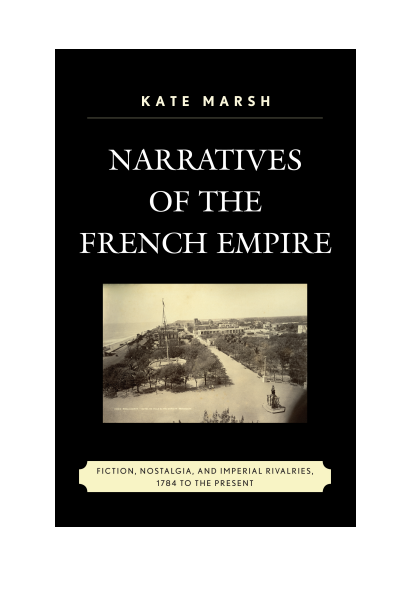
Narratives of the French Empire
Fiction, Nostalgia, and Imperial Rivalries, 1784 to the Present
Authors:
Publisher:
2013
Summary
This study interrogates how the French empire was imagined in three literary representations of French colonialism: the conquest of Tahiti, and the established colonial systems in Martinique and in India. The study is the first in either English or French to demonstrate that representations of power relations, as well as the broader discourses with which they were linked, were as closely concerned with probing the similarities and differences of rival European colonial systems as they were with reinforcing their imagined superiority over the colonized, and that such power relations should not be conceptualized as a dualistic categorization of ‘colonizer’ versus ‘colonized’. In doing so, it aims to go beyond examining the interaction between colonized and colonizer, or between colonial centre and periphery, and to interrogate instead the circulation of ideas and practices across different sites of European colonialism, drawing attention to a historical complexity which has been neglected in the necessary race to recover voices previously occluded from academic analysis. In exploring how the notion of the French empire overseas was construed and how it was infused with meaning at three different historical moments, 1784, 1835 and 1938, it demonstrates how precarious the French empire was perceived to be, in terms of both European rivalry and resistance from the colonized, and how the rhetoric of a French colonisation douce was pitted against the inscribed excesses of the more powerful British empire. Rather than employing the sorts of recuperative agenda which focus on how the colonized were elided (viz., Subaltern Studies) or on the writings of the formerly colonized (viz., Francophone Studies), the study concerns itself specifically with how French colonialism and imperialism were perceived, and thus offers a further corrective to any generalizations about European colonialism and imperialism. More particularly, by examining how the representational strategy of nostalgia is used in these texts, the study demonstrates how perceived loss, and nostalgia for an imperial past, played a role in dynamically shaping the French colonial enterprise across its various manifestations.
Keywords
Search publication
Bibliographic data
Edition
1/2013
Copyright Year
2013
ISBN-Print
978-0-7391-7656-6
ISBN-Online
978-0-7391-7657-3
Publisher
Lexington, Lanham
Language
English
Pages
131
Product Type
Monograph
Table of contents
ChapterPages
Contents No access
Acknowledgments No access
Introduction No access
Chapter One: Colonial Encounters and Empires in Contact No access Pages 1 - 20
Chapter Two: Tahiti: La Nouvelle Cythère, the Morality of Colonialism, and Pseudo-Foreign Letters No access Pages 21 - 42
Chapter Three: Martinique, Slavery, and Emancipation: Louis de Maynard de Queilhe’s Outre-mer No access Pages 43 - 64
Chapter Four: ‘Une effrayante épidémie’: The Red Threat, Indian Decolonization, and Désordres à Pondichéry No access Pages 65 - 94
Chapter Five: Competing Colonialisms, Competing Memories: The After-Lives of Empire No access Pages 95 - 106