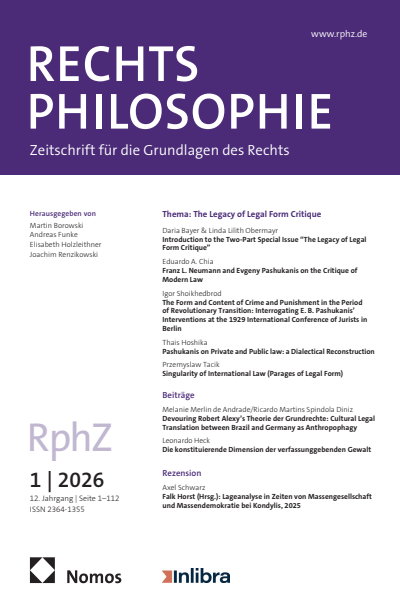
This special issue revisits the Marxian and Pashukanian critique of the legal form, addressing persistent misconceptions in both legal practice and critical scholarship. Far from being a mere attack on liberal jurisprudence, materialist legal...
This article examines the legal theories of Evgeny Pashukanis and Franz L. Neumann. Pashukanis’s commodity-form thesis foreclosed the possibility of socialist jurisprudence beyond capitalist social relations. In contrast, Neumann, reacting to the...
Drawing on a newly discovered transcript of a speech that Evgeny Pashukanis delivered at the 1929 International Conference of Jurists in Berlin, this article critically re-examines Pashukanis’ treatment of crime and punishment during the period of...
This article revisits the contested relationship between private and public law in Pashukanis. It argues that the nature of the private-public law distinction can only be grasped through a dialectical reconstruction. Accordingly, it reinterprets...
The paper offers a re-elaboration of the concept of the legal form as applied to international law. In order to move forward from Evgeny Pashukanis’s and China Miéville’s accounts, it expounds the concept of singularity. As I argue,...
Drawing on the Brazilian concept of anthropophagy, not only as a metaphor but as a cultural technique, this article explores how legal translation operates, driven by constellations of desire and embedded in social, cultural, and historical layers...
“Constituent” power is usually interpreted as an unconstituted and unconstrained force. This understanding leads to a paradox and rests on an inadequate theory of law. The constituent character of this power is better understood as referring to...