KNOWLEDGE ORGANIZATION is a forum for all those interested in the organization of knowledge on a universal or a domain-specific scale, using concept-analytical or concept-synthetical approaches, as well as quantitative and qualitative methodologies. KNOWLEDGE ORGANIZATION also addresses the intellectual and automatic compilation and use of classification systems and thesauri in all fields of knowledge, with special attention being given to the problems of terminology. KNOWLEDGE ORGANIZATION publishes original articles, reports on conferences and similar communications, as well as book reviews, letters to the editor, and an extensive annotated bibliography of recent classification and indexing literature. KNOWLEDGE ORGANIZATION should therefore be available at every university and research library of every country, at every information center, at colleges and schools of library and information science, in the hands of everybody interested in the fields mentioned above and thus also at every office for updating information on any topic related to the problems of order in our information-flooded times.
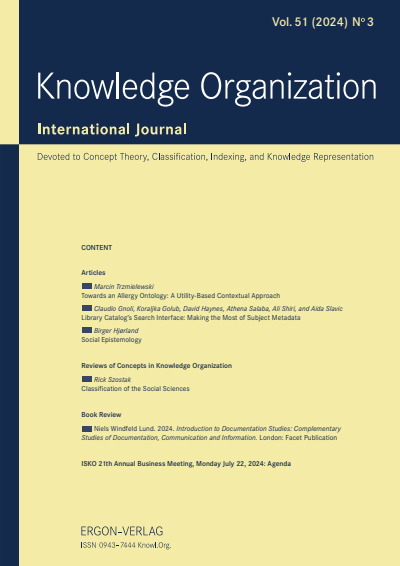
The aim of the present article is to report the construction of a medical knowledge organization system (MKOS) for the Allergy Unit of the Montpellier University Hospital in France, according to a utility-based contextual approach. The inputs from...
This article addresses the underutilization of knowledge organization systems (KOS) elements in online library catalogs, hindering effective subject-based search and discovery. It highlights the International Society for Knowledge Organization's...
The term “social epistemology” (SE) was first used by the library and information scientist Jesse Shera in 1951, but soon the term became muddled, and it did not become influential at that time. Later, it became known as the name for two...
This article discusses the nature of social science, emphasizing characteristics important to knowledge organization. It addresses the nature of social science disciplines, and compares social science to natural science and the humanities. It...