, to see if you have full access to this publication.
Monograph No access
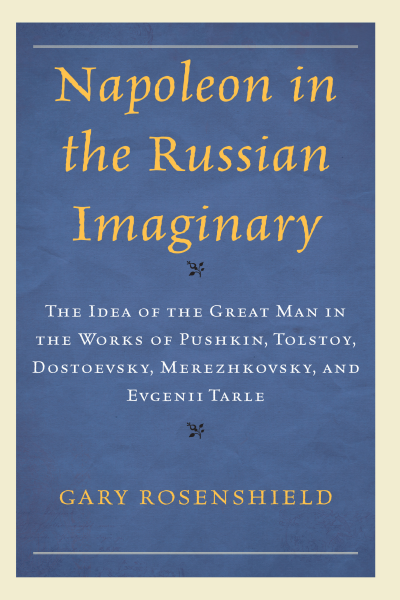
Napoleon in the Russian Imaginary
The Idea of the Great Man in the Works of Pushkin, Tolstoy, Dostoevsky, Merezhkovsky, and Evgenii Tarle
Authors:
Publisher:
2023
Summary
Napoleon today is still a figure who fascinates both his admirers and detractors because of his seminal role in European history at the end of the eighteenth and beginning of the nineteenth centuries, straddling the French Revolution and the enormous empire that he fashioned through military conquest. Napoleon in the Russian Imaginary focuses on the response of Russia's greatest writers—poets, novelists, critics, and historians—to the idea of "Great Man" as an agent of transformational change as it manifests itself in the person and career of Napoleon. After Napoleon's defeat at Waterloo in 1815 and his subsequent exile to St. Helena, in much of Europe a re-evaluation of Napoleon's person, stature, and historical significance occurred, as thinkers and writers witnessed the gradual reestablishment of repressive regimes throughout Europe. This re-evaluation in Russia would have to wait until Napoleon's death in 1821, but when it came to pass, it continued to occupy the imagination of Russia's greatest writers for over 130 years. Although Napoleon's invasion of Russia and subsequent defeat had a profound effect on Russian culture and Russian history, for Russian writers what was most important was the universal significance of Napoleon’s desire for world conquest and the idea of unbridled ambition which he embodied. Russian writers saw this, for good or ill, as potentially determining the spiritual and moral fate of future generations. What is particularly fascinating is their attempt to confront each other about this idea in a creative dialogue, with each succeeding writer addressing himself and responding to his predecessor and predecessors.
Keywords
Search publication
Bibliographic data
Edition
1/2023
Copyright Year
2023
ISBN-Print
978-1-6669-2522-7
ISBN-Online
978-1-6669-2523-4
Publisher
Lexington, Lanham
Language
English
Pages
236
Product Type
Monograph
Table of contents
ChapterPages
Contents No access
Acknowledgments No access
Notes No access
“Recollections in Tsarskoe Selo”: The Original Version No access
“Recollections in Tsarskoe Selo”: The First Revised Version No access
“Napoleon on Elba” No access
Two Commissions: “On His Majesty’s Return” and “Prince of Orange” No access
“Freedom” (1817) and “Recollections in Tsarskoe Selo” (1819) No access
Notes No access
“Napoleon” (1821) No access
“Why Were You Sent and Who Sent You” (Zachem Ty Soslan Byl I Kto Tebia Poslal, 1824) No access
“A Motionless Guard Dozed on the Tsar’s Threshold” (Nedvizhnyj Strazh Dremal Na Tsarstvennom Poroge, 1824) No access
“To the Sea” (K Moriu, 1824) No access
Napoleon Imposters and the Napoleonic Idea No access
“The Hero” (Geroi, 1830) No access
Notes No access
Views of Napoleon No access
Pierre: Napoleon and Ideas No access
Andrei: Napoleon and Glory (Kleos) No access
Conclusions: Pierre and Andrei, 1812–1820 No access
Notes No access
Chance No access
Necessity No access
Command No access
Behavior, Mannerisms, and Physical Traits No access
Napoleon as Dupe No access
Napoleon as Comic Actor No access
Napoleon: Stupidity, Incompetence, and Self-Awareness No access
Napoleon as Moral Monster No access
The Great Man, Freedom in History, and Moral Responsibility No access
Notes No access
Historical Influence No access
Hero Worship No access
Great Men and Their Fields of Endeavor: Raskolnikov the Humanitarian No access
Greatness and Morality: Raskolnikov as Absolute Egoist No access
Peter, the Russian Great Man, the Idea, and Cultural-Historic Change No access
Hero-Worship, Egoism, and the Annihilation of Personality No access
Notes No access
Destroying Tolstoy’s Napoleon No access
Deconstructing Dostoevsky’s Napoleon No access
Mythologizing Napoleon No access
Notes No access
The Political Context No access
Napoleon (1936): The Great Man No access
Napoleon (1936): Tyrant and Egoist No access
Napoleon’s Invasion of Russia: Napoleon Diminished No access