"Law and Politics in Africa, Asia and Latin America" analyses legal and constitutional developments in all states or regions outside of Europe as well as their regional and international integration. Founded in 1968 and inspired by decolonization and the idea of a cooperative new beginning, the Journal also promotes a special interest in contributions on 'Law and development'. The journal aims to provide a forum for a variety of perspectives on these fields of interest, be they focused on one country or comparative, theoretical or methodological in nature. Next to extensive articles, the journal publishes shorter reports about current events or conferences as well as book reviews. As a special service, each issue of "Law and Politics in Africa, Asia and Latin America" contains an international bibliography of relevant publications from around the world. This is compiled in cooperation with the Leibniz-Institute for Global and Regional Studies in Hamburg (GIGA). "Law and Politics" addresses authors and readers on all continents and aims to serve as a forum of mutual exchange. The journal is open for contributions from legal and social sciences as well as for analyses from practitioners. The journal is published quarterly and welcomes contributions in German, English, Spanish and French. Website: www.vrue.nomos.de
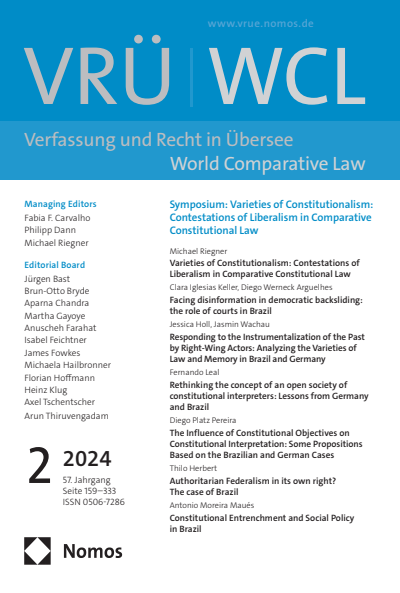
This overview article introduces the special issue on “Varieties of Constitutionalism: Contestations of Liberalism in Comparative Constitutional Law”, which concludes a collaborative research project with the same theme. The project mapped...
This paper examines how democratic institutions respond to disinformation when it is weaponized by elected officials for illiberal purposes. It focuses on the role of courts in countering disinformation in Brazil from 2018 to 2022, when the country...
This article explores the varieties of law and memory in Brazil and Germany, aiming to understand how and to what extent each country juridified their past. In doing so, we strive to understand this phenomenon from a contemporary perspective and...
The concept of an “open society of constitutional interpreters”, originally formulated by Peter Häberle, is one of the most overused clichés in Brazilian constitutionalism. In this paper, drawing on (i) criticisms formulated against Häberle's...
Constitutional objectives are often general and vague. They constitute future-oriented norms that usually have a high political content and are binding on all branches of the state, despite not providing exhaustive clarifications about who is to...
With the establishment of the military regime in Brazil in April 1964, the military achieved its long-standing objective of exerting lasting influence as a key political actor. Despite its commitment to “restore the rule of law” and fortify...
The 1988 Constitution promoted the expansion of social policy in Brazil, but other constitutional rules on fiscal policy limited the sources and funding of social spending. This paper discusses how the original text of the Constitution and its...