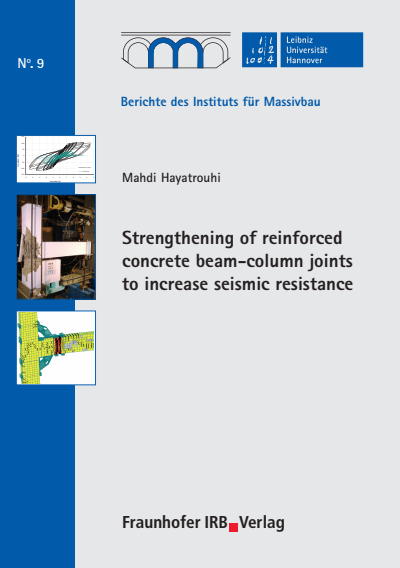
Strengthening of reinforced concrete beam-column joints to increase seismic resistance.
- Authors:
- Series:
- Berichte des Instituts für Massivbau der Universität Hannover, Volume 9
- Publisher:
- 2014
Summary
The categorized literature review of retrofitting and strengthening methods of reinforced concrete (RC) beam-column joints clarified that non-disruptiveness; practical implementation, ductility and perseverance of lateral resistance as well as economical issues still remain the most challenging aspects of seismically retrofitting the vulnerable existing RC beam-column joints. Current research attempted to observe the seismic design principals of RC frame structures in seismic retrofitting of the vulnerable frames as a strategy of retrofitting based on the capacity design concept. Accordingly, the beam sidesway mechanism was redefined for seismic retrofitting by relocating the beam plastic hinges far enough away from the joints. Consequently, with introducing innovative energy dissipation devices such as Multi Functional Corbels (HMFC) and Harmonica Damper Plates (HHDP), the innovative Retrofitting Techniques 1 and 2 (RT1 and RT2) were proposed. The introduced devices of HMFC and HHDP as a passive energy dissipation system absorb energy through inelastic deformations. The proposed RT1 and RT2 were experimentally evaluated through a series of 3/4-scale beam-column joint specimens under an extremely severe loading history. The excellent performance of retrofitted specimens through the experimental study confirmed that the proposed retrofitting techniques (RT1 and RT2) are able to retain structural integrity with the minimum strength and stiffness degradation. As intended, the energy dissipation capacity was dramatically increased and beam sidesway mechanism was actually formed. Furthermore, a series of non-linear finite element analysis using ATENA was carried out on all reference and retrofitted specimens. The FEM models were validated with experimental outcomes. Subsequently, the validated models were utilized to develop a new simplified method for upgrading based on the advantages of RT1 and RT2. In the new proposed innovative Retrofitting Technique 3 (RT3), HHDP was replaced by Frictional-Bending Damper Plate (HFBDP) which dissipates energy based on friction and bending. The effectiveness and reliability of the proposed RT3 was investigated through a numerical analysis. As confirmed through experimental and numerical investigation, all acceptance criteria of ACI Committee 374 [ACI 374.1-05] were effectively satisfied by the proposed retrofitting techniques.
Keywords
Search publication
Bibliographic data
- Edition
- 1/2014
- Copyright Year
- 2014
- ISBN-Print
- 978-3-8167-9177-5
- ISBN-Online
- 978-3-8167-9178-2
- Publisher
- Fraunhofer IRB Verlag, Stuttgart
- Series
- Berichte des Instituts für Massivbau der Universität Hannover
- Volume
- 9
- Language
- English
- Pages
- BC
- Product Type
- Monograph
Table of contents
- Titelei/Inhaltsverzeichnis Partial access Pages i - xxv
- 1.1 Introduction No access
- 1.2 Motivation of the research No access
- 1.3 Objectives No access
- 1.4 Organization of the research No access
- 2.1 Introduction No access
- 2.2 Seismic behaviour of substandard RC beam-column Joints No access
- 2.2.1 Summary of results No access
- 2.3.1.1 Vacuum impregnation procedure No access
- 2.3.1.2 Vacuum injection technique No access
- 2.3.1.3 Pressure injection technique No access
- 2.3.1.4 Removal and replacement technique No access
- 2.3.1.5 Thin steel plate and pressure-injection technique No access
- 2.3.2.1 Masonry block jacketing technique No access
- 2.3.2.2 Partial masonry infill technique No access
- 2.3.2.3 Prestressed concrete jacketing technique No access
- 2.3.2.4 Concrete jacketing No access
- 2.3.2.5 Concrete jacketing using HPFRC No access
- 2.3.2.6 Concrete jacketing using UNIDO strengthening technique No access
- 2.3.2.7 Steel jacketing No access
- 2.3.2.8 Diagonal steel bracing methods No access
- 2.3.2.9 Planar joint expansion No access
- 2.3.3.1 Utilization of carbon-fiber-reinforced polymer, CFRP No access
- 2.3.3.2 Utilization of glass-fiber-reinforced polymer, GFRP No access
- 2.3.4 The summary of the results and discussion No access
- 2.4.1 The bond and shear requirements within the beam-column joints No access
- 2.4.2 Summary and conclusions of the codes comparison No access
- 3.1 Introduction No access
- 3.2 Seismic design principals of structures and joints No access
- 3.3 Performance-based retrofitting through developing the beam plastic No access
- 3.3.1 Strategy of seismic retrofitting through the capacity design concept No access
- 3.3.2 Forces acting on an exterior beam-column joint No access
- 3.3.3 Strength and Failure Sequence Diagram (SFSD) No access
- 3.4.1 General description No access
- 3.4.2 Hysteretic behaviour No access
- 3.5.2 Hysteretic behaviour No access
- 3.6 An Innovative strengthening and retrofitting technique through No access
- 3.6.1 Approach and modified SFSD No access
- 3.6.2 Upgrading the resistance to bond-slip of the beam bottom bars No access
- 3.6.3 Procedure for designing and developing No access
- 3.7 An Innovative strengthening and retrofitting technique through No access
- HMFC and Harmonica Damper Plates (HHDP), No access
- 3.7.1 Approach and modified SFSD No access
- 3.7.2 Upgrading the resistance to bond-slip of the beam bottom bars No access
- 3.7.3 Procedure for designing and developing No access
- 4.1 Introduction No access
- 4.2.1.1 Material properties No access
- 4.2.1.2 Design, dimensions and details No access
- 4.2.1.3 Production of test specimens No access
- 4.2.2.1 Design, dimensions and details No access
- 4.2.2.2 Fabrication of H1, H2 and H3 No access
- 4.2.3.1 Design, dimensions and details No access
- 4.2.3.2 Fabrication of D No access
- 4.2.4.1.1 Design of retrofitted specimen BD-H1 No access
- 4.2.4.1.2 Retrofitting details of specimen BD-H1 No access
- 4.2.4.2.1 Design of retrofitted specimen SD-H2-D No access
- 4.2.4.2.2 Retrofitting details of specimen SD-H2-D No access
- 4.2.4.3.1 Design of retrofitted specimen BD-H3-D No access
- 4.2.4.3.2 Retrofitting details of specimen BD-H3-D No access
- 4.3.1 General specifications No access
- 4.3.2 Details and fabrication of the loading setup No access
- 4.3.3 Testing procedure and loading history No access
- 4.4 Instrumentation No access
- 4.5.1.1.1 Specimen description No access
- 4.5.1.1.2 Strength sequences and damage mechanisms No access
- 4.5.1.1.3 Joint behaviour No access
- 4.5.1.1.4 Decomposition of lateral displacement No access
- 4.5.1.2.1 Specimen description No access
- 4.5.1.2.2 Strength sequences and damage mechanisms No access
- 4.5.1.2.3 Joint behaviour No access
- 4.5.1.2.4 Decomposition of lateral displacement No access
- 4.5.2.1.1 Specimen description No access
- 4.5.2.1.2 Strength sequences and damage mechanisms No access
- 4.5.2.1.3 Joint behaviour No access
- 4.5.2.1.4 Behaviour of Multifunctional Corbel (HMFC) No access
- 4.5.2.1.5 Decomposition of lateral displacement No access
- 4.5.2.2.1 Specimen description No access
- 4.5.2.2.2 Strength sequences and damage mechanisms No access
- 4.5.2.2.3 Joint behaviour No access
- 4.5.2.2.4 Behaviour of Multifunctional Corbel (HMFC) No access
- 4.5.2.2.5 Behaviour of Harmonica Damper Plate (HHDP) No access
- 4.5.2.2.6 Decomposition of lateral displacement No access
- 4.5.2.3.1 Specimen description No access
- 4.5.2.3.2 Strength sequences and damage mechanisms No access
- 4.5.2.3.3 Joint behaviour No access
- 4.5.2.3.4 Behaviour of Multifunctional Corbel (HMFC) No access
- 4.5.2.3.5 Behaviour of Harmonica Damper Plate (HHDP) No access
- 4.5.2.3.6 Decomposition of lateral displacement No access
- 4.6.1.1 Strengths in the category of BD No access
- 4.6.1.2 Strengths in the category of SD No access
- 4.6.1.3 Strengths in all specimens No access
- 4.6.2.1 Energy dissipations in the category of BD No access
- 4.6.2.2 Energy dissipations in the category of SD No access
- 4.6.2.3 Energy dissipation in all specimens No access
- 4.6.3 Damage mechanisms No access
- 4.6.4 Hierarchy of strength No access
- 4.6.5 Joint behaviour No access
- 4.6.6 Decomposition of lateral displacement No access
- 5.1 Introduction No access
- 5.2.1.1 The relation of Stress-strain for concrete No access
- 5.2.1.2 Biaxial stress failure criterion for concrete No access
- 5.2.1.3 Models of smeared cracks No access
- 5.2.2 Constitutive modelling for reinforcement No access
- 5.2.3 Constitutive modelling for reinforcement bond No access
- 5.2.3 Constitutive modelling for Von Mises plasticity No access
- 5.2.4 Constitutive modelling for interface No access
- 5.3 Element types No access
- 5.4 Solutions of nonlinear equations No access
- 5.5 Numerical models for reference units No access
- 5.6.1 Sensitivity of element size No access
- 5.6.2 Sensitivity of fracture energy No access
- 5.6.3 Sensitivity of cyclic reinforcement No access
- 5.6.4 Sensitivity of tension stiffening No access
- 5.6.5 Sensitivity of cracking model No access
- 5.7 Numerical models for retrofitted specimens No access
- 5.8.1 Reference unit BD-B No access
- 5.8.2 Reference unit SD-B No access
- 5.8.3 Retrofitted specimen BD-H1 No access
- 5.8.4 Retrofitted specimen SD-H2-D No access
- 5.8.5 Retrofitted specimen BD-H3-D No access
- 5.9 Developing a new upgrading method, Retrofitting Technique 3 (RT3) No access
- 6.1.1.1 Strength No access
- 6.1.1.2 Energy dissipation No access
- 6.1.1.3 Damage mechanisms No access
- 6.1.1.4 Hierarchy of strength No access
- 6.1.1.5 Joint behaviour No access
- 6.1.1.6 Decomposition of lateral displacement No access
- 6.1.2 Conclusions of numerical study No access
- 6.1.3 General conclusion No access
- 6.2 Recommendations for further research No access
- References No access Pages 270 - 278
- Appendix A: Supplementary Reviews of Laboratory Activities No access Pages 279 - 281
- Appendix B: Scheme and Details of Loading Setup No access Pages 282 - 304
- Appendix C: Installation of Specimens into the Loading Setup No access Pages 305 - 307
- Appendix D: Decomposition of Specimen Deformation No access Pages 308 - 312
- Appendix E: Concept of Relative Energy Dissipation Ratio No access Pages 313 - BC