, to see if you have full access to this publication.
Volume No access

Volume 73 (2019), Edition 3

Die Unternehmung
Authors:
Journal:
Die Unternehmung
Publisher:
 2019


Bibliographic data

ISSN-Print
0042-059X
ISSN-Online
0042-059X
Publisher
Nomos, Baden-Baden
Language
German
Product type
Volume

Articles

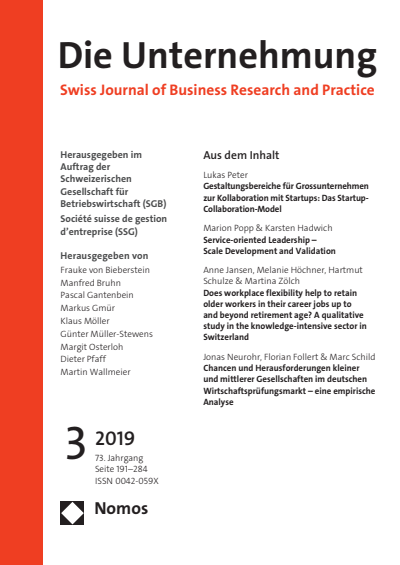
Cover of Volume: Die Unternehmung Volume 73 (2019), Edition 3
Article
Full access

Page I - II
Nomos Verlagsgesellschaft mbH & Co. KG, Baden-Baden 2019

Cover of Volume: Die Unternehmung Volume 73 (2019), Edition 3
Article
Full access

Page 191 - 192
Nomos Verlagsgesellschaft mbH & Co. KG, Baden-Baden 2019

Cover of Volume: Die Unternehmung Volume 73 (2019), Edition 3
Article
Full access

Page 193 - 212
Nomos Verlagsgesellschaft mbH & Co. KG, Baden-Baden 2019
Authors:

Cover of Volume: Die Unternehmung Volume 73 (2019), Edition 3
Article
Full access

Page 213 - 228
To successfully offer services, organizations have to recognize the relevance of their service employees and enable them to demonstrate a service-oriented behavior towards their customers. Service-oriented leadership specifically addresses this...
Nomos Verlagsgesellschaft mbH & Co. KG, Baden-Baden 2019
Authors:

Cover of Volume: Die Unternehmung Volume 73 (2019), Edition 3
Article
Full access

Page 229 - 249
Little is known about how relevant workplace flexibility is on continued work in one’s career job - a type of bridge employment that should best help to reduce the negative aspects of skilled worker shortage. We therefore examined the role of...
Nomos Verlagsgesellschaft mbH & Co. KG, Baden-Baden 2019
Authors:

Cover of Volume: Die Unternehmung Volume 73 (2019), Edition 3
Article
Full access

Page 250 - 275
Nomos Verlagsgesellschaft mbH & Co. KG, Baden-Baden 2019
Authors:

Cover of Volume: Die Unternehmung Volume 73 (2019), Edition 3
Article
Full access

Page 276 - 278
Nomos Verlagsgesellschaft mbH & Co. KG, Baden-Baden 2019
Authors:

Cover of Volume: Die Unternehmung Volume 73 (2019), Edition 3
Article
Full access

Page 279 - 281
Nomos Verlagsgesellschaft mbH & Co. KG, Baden-Baden 2019

Cover of Volume: Die Unternehmung Volume 73 (2019), Edition 3
Article
Full access

Page 282 - 284
Nomos Verlagsgesellschaft mbH & Co. KG, Baden-Baden 2019

Bibliography (273 entries)

  1. Argyris, C./Schön, D. A. (1996). Organizational learning II: theory, method, and practice. Reading Mass: Addison-Wesley. Open Google Scholar doi.org/10.5771/0042-059X-2019-3-193
  2. Barney, J. (1991). Firm Resources and Sustained Competitive Advantage. Journal of Management, 17(99), 120. Open Google Scholar doi.org/10.5771/0042-059X-2019-3-193
  3. Baumöl, U. (2008). Change Management in Organisationen. Situative Methodenkonstruktion für flexible Veränderungsprozesse. Wiesbaden: Gabler Verlag. Open Google Scholar doi.org/10.5771/0042-059X-2019-3-193
  4. Becker, J. et al. (2009). Developing Maturity Models for IT Management. Business & Information Systems Engineering, 1(3), 213–222. Open Google Scholar doi.org/10.5771/0042-059X-2019-3-193
  5. Berghaus, S./Back, A. (2016). Gestaltungsbereiche der Digitalen Transformation: Entwicklung eines Reifegradmodells. Die Unternehmung. Swiss Journal for Research and Practice, 70(2), 98–122. Open Google Scholar doi.org/10.5771/0042-059X-2019-3-193
  6. Berman, S. J. (2012). Digital transformation: opportunities to create new business models. Strategy & Leadership, 40(2), 16–24. Open Google Scholar doi.org/10.5771/0042-059X-2019-3-193
  7. Blank, S. (2015). Lean Innovation Management – Making Corporate Innovation Work. Gefunden am 1.7.18 unter http://steveblank.com/2015/06/26/lean-innovation-management-making-corporate-innovation-work/. Open Google Scholar doi.org/10.5771/0042-059X-2019-3-193
  8. Blohm, I. (2013). Open Innovation Communities – Absorptive Capacity und kollektive Ideenbewertung. Dissertation, Technische Universität München. Open Google Scholar doi.org/10.5771/0042-059X-2019-3-193
  9. Bonzom, A./Netessine, S. (2016). How do the world’s biggest companies deal with the startup revolution. Gefunden am 23.8.17 unter http://698640.hs-sites.com/500corporations. Open Google Scholar doi.org/10.5771/0042-059X-2019-3-193
  10. Bourreau, M. et al. (2012). The Impact of a Radical Innovation on Business Models: Incremental Adjustments or Big Bang? Industry and Innovation, 19(5), 415–435. Open Google Scholar doi.org/10.5771/0042-059X-2019-3-193
  11. Chakravarty, A. et al. (2013). Information Technology Competencies, Organizational Agility, and Firm Performance: Enabling and Facilitating Roles. Information Systems Research, 24(4), 976–997. Open Google Scholar doi.org/10.5771/0042-059X-2019-3-193
  12. Chesbrough, H. (2017). The Future of Open Innovation. The future of open innovation is more extensive, more collaborative, and more engaged with a wider variety of participants. Research-Technology Management, 60(1), 35–38. Open Google Scholar doi.org/10.5771/0042-059X-2019-3-193
  13. Chesbrough, H./Brunswicker, S. (2014), “A Fad or a Phenomenon? The Adoption of Open Innovation Practices in Large Firms”. Research Technology Management, 57(2), 16–25. Open Google Scholar doi.org/10.5771/0042-059X-2019-3-193
  14. Clarysse, B./Yusubova, A. (2014). Success factors of business accelerators. Technology Business Incubation Mechanisms and Sustainable Regional Development, Proceedings. Open Google Scholar doi.org/10.5771/0042-059X-2019-3-193
  15. Cravens, D. W., et al. (2009). Management framework guiding strategic thinking in rapidly changing markets. Journal of Marketing Management, 25(1/2), 31–49. Open Google Scholar doi.org/10.5771/0042-059X-2019-3-193
  16. Davison, R.M. et al. (2012). The Roles of Theorie in Canonical Action Research. MIS Quarterly, Vol. 3, No. 3, S. 763–765. Open Google Scholar doi.org/10.5771/0042-059X-2019-3-193
  17. De Bruin, T. et al. (2005). Understanding the Main Phases of Developing a Maturity Assessment Model. In Australasian Conference on Information Systems (ACIS). Australasian Chapter of the Association for Information Systems. Open Google Scholar doi.org/10.5771/0042-059X-2019-3-193
  18. DeVellis, R. F. (2003). Scale Development: theory and applications (2nd ed.). Thousand Oaks, CA: Sage Publications 2003. Open Google Scholar doi.org/10.5771/0042-059X-2019-3-193
  19. Dyer, J. H. et al. (2004). When to Ally and when to Acquire. Harvard Business Review, July-August 2004. Open Google Scholar doi.org/10.5771/0042-059X-2019-3-193
  20. Eisenhardt, K. M./Martin, J. A. (2000). Dynamic Capabilites: What are They? Strategic Management Journal, 21(10), 1105–1121. Open Google Scholar doi.org/10.5771/0042-059X-2019-3-193
  21. Galliers, R. D./ Jarvenpaa, S. (2002). Editorial. The Journal of Strategic Information Systems, 11(1), 1–3. Open Google Scholar doi.org/10.5771/0042-059X-2019-3-193
  22. Gaponova, O.S./Korshunov, I.A. (2018). Deploying a Corporate Learning System at the Innovative Startup. Russian Education & Society, 60:4, 289–314. Open Google Scholar doi.org/10.5771/0042-059X-2019-3-193
  23. Green, W./Cluley, R. (2014). The field of radical innovation: Making sense of organizational cultures and radical innovation. Industrial Marketing Management, 43(8), 1343–1350. Open Google Scholar doi.org/10.5771/0042-059X-2019-3-193
  24. Grippa, F. et al. (2018). Collaborative Innovation Networks: Building Adaptive and Resilient Organizations. Cham: Springer. Open Google Scholar doi.org/10.5771/0042-059X-2019-3-193
  25. Hansen, A. M. et al. (2011). Rapid Adaptation in Digital Transformation: A Participatory Process for Engaging IS and Business Leaders. MIS Quarterly Executive, 10(4), 175–185. Open Google Scholar doi.org/10.5771/0042-059X-2019-3-193
  26. Hathaway, I. (2016). “What Startup Accelerators Really Do”. Harvard Business Review, 7, 2016. Open Google Scholar doi.org/10.5771/0042-059X-2019-3-193
  27. Henfridsson, O./Lind, M. (2014). Information systems strategizing, organizational sub-communities, and the emergence of a sustainability strategy. Journal of Strategic Information Systems, 23(1), 11–28. Open Google Scholar doi.org/10.5771/0042-059X-2019-3-193
  28. Hevner, A. et al. (2004). Design science in information systems research. MIS Quar-terly, 28(1), 75–105. Open Google Scholar doi.org/10.5771/0042-059X-2019-3-193
  29. Hoffmann, W. H./Schaper-Rinkel, W. (2001). Acquire or Ally? -A Strategy Framework for Deciding Between Acquisition and Cooperation. MIR: Management International Review, 41(2), 131–159. Open Google Scholar doi.org/10.5771/0042-059X-2019-3-193
  30. Jahani, B. et al. (2010). Measurement of enterprise architecture readiness within organizations. Business Strategy Series, 11(3), 177–191. Open Google Scholar doi.org/10.5771/0042-059X-2019-3-193
  31. Kale, P./Puranam, P. (2004). Choosing Equity Stakes in Technology-Sourcing Relationships: An Integrative Framework. California Management Review, 46(3), 77–99. Open Google Scholar doi.org/10.5771/0042-059X-2019-3-193
  32. Kohler, T. (2016), “Corporate accelerators: Building bridges between corporations and startups”. Business Horizons, 59(3), 347–357. Open Google Scholar doi.org/10.5771/0042-059X-2019-3-193
  33. Kupp, M. et al. (2017). Corporate accelerators: fostering innovation while bringing together startups and large firms. Journal of Business Strategy, Vol. 38 Issue: 6, S.47 – 53. Open Google Scholar doi.org/10.5771/0042-059X-2019-3-193
  34. Leimeister, J.M. (2004). Pilotierung virtueller Communities im Gesundheitsbereich – Bedarfsgerechte Entwicklung, Einführung und Betrieb. Dissertation, Universität Hohenheim. Open Google Scholar doi.org/10.5771/0042-059X-2019-3-193
  35. Lichtenthaler, U. (2016). Five steps to transforming innovation processes: continually adjusting to new environments. Journal of Business Strategy, Vol. 37 Issue: 5, S.39 – 45. Open Google Scholar doi.org/10.5771/0042-059X-2019-3-193
  36. Lopez-Hernandez, A.K. et al. (2018). Team collaboration capabilities as a factor in startup success. Journal of Technololgy Management & Innovation, 2018. Volume 13, Issue 4. Open Google Scholar doi.org/10.5771/0042-059X-2019-3-193
  37. Lyytinen, K./Rose, G. M. (2003). The Disruptive Nature of Information Technology Innovations: The Case of Internet Computing in Systems Development Organizations. MIS Quarterly, 27(4), 557–595. Open Google Scholar doi.org/10.5771/0042-059X-2019-3-193
  38. Mahmoud-Jouini, S.B. et al. (2018). Key Factors in Building a Corporate Accelerator Capability. Research-Technology Management, 61:4, 26–34. Open Google Scholar doi.org/10.5771/0042-059X-2019-3-193
  39. Malone, T.W./Crowston, K. (1994). The interdisciplinary study of coordination”. ACM Computing Surveys (CSUR), 26(1), 87–119. Open Google Scholar doi.org/10.5771/0042-059X-2019-3-193
  40. March, S.T./Storey, V.C. (2008). Design science in the information systems discipline: An introduction to the special issue on design science research. MIS Quarterly, 32(4), 725–730. Open Google Scholar doi.org/10.5771/0042-059X-2019-3-193
  41. Mayring, P. (2002). Einführung in die qualitative Sozialforschung – eine Anleitung zum qualitativen Denken. [Introduction to qualitative social research]. Weinheim, Germany: Beltz Verlag. Open Google Scholar doi.org/10.5771/0042-059X-2019-3-193
  42. Mercandetti, F. et al. (2017). Innovation by Collaboration between Startups and SMEs in Switzerland. Technology Innovation Management Review, December 2017, Vol.7, Issue 12. Open Google Scholar doi.org/10.5771/0042-059X-2019-3-193
  43. Mintzberg, H. (2015), “We Need Both Networks and Communities”. Harvard Business Review, 10, 2015. Open Google Scholar doi.org/10.5771/0042-059X-2019-3-193
  44. Mocker, V. et al. (2015). Winning Together: A guide to successful corporate-startup collaborations. Nesta. Gefunden am 11.7.18 unter https://www.nesta.org.uk/sites/default/files/winning-together-sum- mary_0.pdf. Open Google Scholar doi.org/10.5771/0042-059X-2019-3-193
  45. Moreau, F. (2013). The Disruptive Nature of Digitization: The Case of the Recorded Music Industry. International Journal of Arts Management, 15(2), 18–31. Open Google Scholar doi.org/10.5771/0042-059X-2019-3-193
  46. Mumford, E. (2001). Advice for an action researcher. In: Information & People, Vol. 14, Iss: 1, S.12 – 27. Open Google Scholar doi.org/10.5771/0042-059X-2019-3-193
  47. Österle, H. (1995). Business Engineering: Prozess- und Systementwicklung. Springer- Verlag Berlin Heidelberg GmbH. Open Google Scholar doi.org/10.5771/0042-059X-2019-3-193
  48. Oxford Dictionaries (2017), “Ecosystem”, Oxford Dictionary. Oxford: Oxford University Press. Gefunden am 11.7.18 unter https://en.oxforddictionaries.com/definition/ecosystem. Open Google Scholar doi.org/10.5771/0042-059X-2019-3-193
  49. Park, J.-H./Bae, Z.-T. (2018). When are ‘sharks’ beneficial? Corporate venture capital investment and startup innovation performance. Technology Analysis & Strategic Management, 30:3, 324–336. Open Google Scholar doi.org/10.5771/0042-059X-2019-3-193
  50. Patton, M. Q. (2015). Qualitative Research & Evaluation Methods: Integrating Theory and Practice (4 ed.), Thousand Oaks, CA: SAGE Publications. Open Google Scholar doi.org/10.5771/0042-059X-2019-3-193
  51. Pauwels, C. et al. (2016). Understanding a new generation incubation model: The accelerator. Technovation 50–51:13–24. Open Google Scholar doi.org/10.5771/0042-059X-2019-3-193
  52. Peffers, K. et al. (2006). The design science research process: A model for producing and presenting information systems research. Proceedings of the First International Conference on Design Science Research in Information Systems and Technology (DESRIST 2006), 83–106. Open Google Scholar doi.org/10.5771/0042-059X-2019-3-193
  53. Peffers, K. et al. (2007). A Design Science Research Methodology for Information Systems Research. Journal of Management Information Systems, 24 (3), 45–77. Open Google Scholar doi.org/10.5771/0042-059X-2019-3-193
  54. Quaadgras, A. et al. (2014). Management commitments that maximize business impact from IT. Journal of Information Technology, 29(2), 114–127. Open Google Scholar doi.org/10.5771/0042-059X-2019-3-193
  55. Richter, N. et al. (2017). Outsourcing creativity: An abductive study of open innovation using corporate accelerators. Creative Innovation Management, 2018; 27: 69–78. Open Google Scholar doi.org/10.5771/0042-059X-2019-3-193
  56. Rittel, H./Webbe, M.r (1984) Planning problems are wicked problems. Developments in Design Methodology, N. Cross (ed.), John Wiley & Sons, New York, 135–144. Open Google Scholar doi.org/10.5771/0042-059X-2019-3-193
  57. Röglinger, M. et al. (2012). Maturity models in business process management. Business Process Management Journal, 18(2), 328–346. Open Google Scholar doi.org/10.5771/0042-059X-2019-3-193
  58. Rosenzweig, P. (2013). What Makes Strategic Decisions Different. Harvard Business Review, November, 2013. Open Google Scholar doi.org/10.5771/0042-059X-2019-3-193
  59. Rüegg-Stürm, J. (2004) The new St. Gallen management model: basic categories of an approach to integrated management. Palgrave Macmillan, Basingstoke, 88. Open Google Scholar doi.org/10.5771/0042-059X-2019-3-193
  60. Schmidt, C. (2004). The Analysis of Semi-structured Interviews. In U. Flick, E. Von Kardoff, & I. Steinke (eds.), A Companion to Qualitative Research (pp. 253–257). Los Angeles, CA: SAGE Publications Ltd. Open Google Scholar doi.org/10.5771/0042-059X-2019-3-193
  61. Shivakumar, R. (2014). How To Tell Which Decisions Are Strategic. California Management Review, 56(3), 78–97. Open Google Scholar doi.org/10.5771/0042-059X-2019-3-193
  62. Simon, H.A. (1996). The Sciences of the Artificial. MIT Press: Cambridge, MA, USA. Open Google Scholar doi.org/10.5771/0042-059X-2019-3-193
  63. Sinclair, J. et al. (1995). Collins Cobuild English Dictionary. Harper Collins Publishers, London. Open Google Scholar doi.org/10.5771/0042-059X-2019-3-193
  64. Smorodinskaya, N. et al. (2017). Innovation Ecosystems vs. Innovation Systems in Terms of Collaboration and Co-Creation of Value. Proceedings of the 50th Hawaii International Conference on System Sciences, Big Island, Hawaii, January 4–7, 2017, 5245–5254. Open Google Scholar doi.org/10.5771/0042-059X-2019-3-193
  65. Stippler, M. et al. (2011). Führung – Überblick über Ansätze, Entwicklungen, Trends. Gütersloh: Bertelsmann Stiftung. Open Google Scholar doi.org/10.5771/0042-059X-2019-3-193
  66. Stoller-Schai, D. (2003). E-Collaboration: Die Gestaltung internetgestützter kollaborativer Handlungsfelder. Dissertation, University of St.Gallen. Difo-Druck, Bamberg. Open Google Scholar doi.org/10.5771/0042-059X-2019-3-193
  67. Strauss, A. L./Corbin, J. M. (1990): Basics of qualitative research: Grounded theory procedures and techniques. Newbury Park, Calif.: SAGE. Open Google Scholar doi.org/10.5771/0042-059X-2019-3-193
  68. Suominen, A. et al. (2016). Innovation Systems and Ecosystems: A Review and Synthesis. XXVII ISPIM Innovation Conference. Porto, Portugal, 19–22 June 2016. Open Google Scholar doi.org/10.5771/0042-059X-2019-3-193
  69. Tech, R. (2018). Financing High-Tech Startups – Using Productive Signaling to Efficiently Overcome the Liability of Complexity. Cham: Springer. Open Google Scholar doi.org/10.5771/0042-059X-2019-3-193
  70. Teece, D. J. et al. (1997). Dynamic Capabilities and Strategic Management. Strategic Management Journal, 18(7), 509–533. Open Google Scholar doi.org/10.5771/0042-059X-2019-3-193
  71. Tornatzky, L. G. et al. (1990). The processes of technological innovation. Lexington, Massachuttes. Open Google Scholar doi.org/10.5771/0042-059X-2019-3-193
  72. Vaishnavi, V.K./Kuechler, W. (2007). Design Science Research Methods and Patterns: Innovating Information and Communication Technology. Auerbach Publications, New York. Open Google Scholar doi.org/10.5771/0042-059X-2019-3-193
  73. Van Aken, J. E. (2005). Management Research as a Design Science: Articulating the Research Products of Mode 2 Knowledge Production in Management. British Journal of Management, 16(1), 19–36. Open Google Scholar doi.org/10.5771/0042-059X-2019-3-193
  74. Villalonga, B./McGahan, A. M. (2005). The Choice among Acquisitions, Alliances, and Divestitures. Strategic Management Journal, 26(13), 1183–1208. Open Google Scholar doi.org/10.5771/0042-059X-2019-3-193
  75. Vom Brocke, J. et al. (2009). Reconstructing the giant: On the importance of rigour in documenting the literature search process. ECIS 2009 Proceedings. Open Google Scholar doi.org/10.5771/0042-059X-2019-3-193
  76. Waters-Lynch, J./Potts, J. (2017). The social economy of coworking spaces: a focal point model of coordination. Review of Social Economy, 2017. Open Google Scholar doi.org/10.5771/0042-059X-2019-3-193
  77. Weiblen, T./Chesbrough, H. W. (2015). Engaging with Startups to Enhance Corporate Innovation. California Management Review, 57(2), 66–90. Open Google Scholar doi.org/10.5771/0042-059X-2019-3-193
  78. Wennberg, K. et al. (2016). Variable risk preferences in new firm growth and survival. Journal of Business Venturing, 31(4), 408–427. Open Google Scholar doi.org/10.5771/0042-059X-2019-3-193
  79. Werro, T. (2017). How Corporates Innovate with Startups – Options and Guidelines for Collaborative Open Innovation with Examples from Silicon Valley. Masterarbeit, Universität St.Gallen. Open Google Scholar doi.org/10.5771/0042-059X-2019-3-193
  80. Weiblen, T./Chesbrough, H. W. (2015). Engaging with Startups to Enhance Corporate Innovation”, California Management Review, 57(2), 66–90. Open Google Scholar doi.org/10.5771/0042-059X-2019-3-193
  81. Winter, R. (2011). Business Engineering Navigator. Berlin, Heidelberg: Springer Berlin Heidelberg. Open Google Scholar doi.org/10.5771/0042-059X-2019-3-193
  82. Yoo, Y. et al. (2010). The New Organizing Logic of Digital Innovation: An Agenda for Information Systems Research. Information Systems Research. Open Google Scholar doi.org/10.5771/0042-059X-2019-3-193
  83. Avolio, B.J., et al. (1991): Leading in the 1990s: The four I′s of transformational leadership, in: Journal of European Industrial Training, Vol. 15, No. 4, S. 9–16. Open Google Scholar doi.org/10.5771/0042-059X-2019-3-213
  84. Bagozzi, R.P./Phillips, L.W. (1982): Representing and testing organizational theories: A holistic construal, in: Administrative Science Quarterly, Vol. 27, S. 459–489. Open Google Scholar doi.org/10.5771/0042-059X-2019-3-213
  85. Bagozzi, R.P./Yi, Y. (1988): On the evaluation of structural equation models, in: Journal of the Academy of Marketing Science, Vol. 16, S. 74–94. Open Google Scholar doi.org/10.5771/0042-059X-2019-3-213
  86. Bass, B.M. (1985): Leadership and Performance beyond Expectation, New York, NY. Open Google Scholar doi.org/10.5771/0042-059X-2019-3-213
  87. Benkenstein, M., et al. (2017): Topics for Service Management Research-A European Perspective, in: Journal of Service Management Research, Vol. 1, No. 1, S. 4–21. Open Google Scholar doi.org/10.5771/0042-059X-2019-3-213
  88. Berry, L.L./Parasuraman, A. (1992): Service Marketing starts from within, in: Marketing Management, Vol. 1, No. 1, S. 24–34. Open Google Scholar doi.org/10.5771/0042-059X-2019-3-213
  89. Bettencourt, L.A., et al. (2001): A Comparison of Attitude, Personality, and Knowledge Predictors of Service-Oriented Organizational Citizenship Behaviors, in: Journal of Applied Psychology, Vol. 86, S. 29–41. Open Google Scholar doi.org/10.5771/0042-059X-2019-3-213
  90. Bitner, M., et al. (1990): The Service Encounter: Diagnosing Favorable and Unfavorable Incidents, in: Journal of Marketing, Vol. 54 No. 1, S. 71–84. Open Google Scholar doi.org/10.5771/0042-059X-2019-3-213
  91. Borucki, C.C./Burke, M.J. (1999): An examination of service-related antecedents to retail store performance, in: Journal of Organizational Behavior, Vol. 20 No. 6, S. 943–962. Open Google Scholar doi.org/10.5771/0042-059X-2019-3-213
  92. Bowen, D.E./Lawler, E.E. (1992): Total quality-oriented human resources management, in: Organizational Dynamics, Vol. 20, No. 4, S. 29–41. Open Google Scholar doi.org/10.5771/0042-059X-2019-3-213
  93. Bowen, D.E./Schneider, B. (1985): Boundary-spanning-role employees and the service encounter: Some guidelines for management and research, in: Czepiel, J.A., et al. (Eds.): The service encounter, Lexington, MA, S. 127–147. Open Google Scholar doi.org/10.5771/0042-059X-2019-3-213
  94. Bowen, D.E./Schneider, B. (1988): Services marketing and management: Implications for organizational behavior, in: Research in Organizational Behavior, Vol. 10, S. 43–80. Open Google Scholar doi.org/10.5771/0042-059X-2019-3-213
  95. Bowen, D.E./Schneider, B. (2014): A service climate synthesis and future research agenda, in: Journal of Service Research, Vol. 17, S. 5–22. Open Google Scholar doi.org/10.5771/0042-059X-2019-3-213
  96. Burke, M.J., et al. (1992): Reconceptualizing psychological climate in a retail service environment: A multiple-stakeholder perspective, in: Journal of Applied Psychology, Vol. 77, S. 717–729. Open Google Scholar doi.org/10.5771/0042-059X-2019-3-213
  97. Büttgen, M./Österle, L. (2017): Mitarbeiterführung im Dienstleistungsmanagement, in: Corsten, H./Roth, S. (Eds.): Handbuch Dienstleistungsmanagement, München, S. 945–964. Open Google Scholar doi.org/10.5771/0042-059X-2019-3-213
  98. Chen, F.F. (2007): Sensitivity of goodness of fit indexes to lack of measurement invariance, in: Structural Equation Modeling, Vol. 14, S. 464–504. Open Google Scholar doi.org/10.5771/0042-059X-2019-3-213
  99. Chen, T.J./Wu, C.M. (2017): Improving the turnover intention of tourist hotel employees: Transformational leadership, leader-member exchange, and psychological contract breach, in: International Journal of Contemporary Hospitality Management, Vol. 29, S. 1914–1936. Open Google Scholar doi.org/10.5771/0042-059X-2019-3-213
  100. Chen, Z., et al. (2015): How Does a Servant Leader Fuel the Service Fire? A Multilevel Model of Servant Leadership, Individual Self Identity, Group Competition Climate, and Customer Service Performance, in: Journal of Applied Psychology, Vol. 100, S. 1–11. Open Google Scholar doi.org/10.5771/0042-059X-2019-3-213
  101. Cheung, G.W./Rensvold, R.B. (2002): Evaluating goodness-of-fit indexes for testing measurement invariance, in: Structural Equation Modeling, Vol. 9, S. 233–255. Open Google Scholar doi.org/10.5771/0042-059X-2019-3-213
  102. DeVellis, R.F. (2017): Scale Development Theory and Applications, Chapel Hill, NC. Open Google Scholar doi.org/10.5771/0042-059X-2019-3-213
  103. Ehrhart, M.G. (2004): Leadership and Procedural Justice Climate as Antecedents of Unit-Level Organizational Citizenship Behavior, Personnel Psychology, Vol. 57, S. 61–94. Open Google Scholar doi.org/10.5771/0042-059X-2019-3-213
  104. Fiedler, F.E. (1967): A Theory of Leadership Effectiveness, New York, NY. Open Google Scholar doi.org/10.5771/0042-059X-2019-3-213
  105. Fornell, C./Larcker, D.F. (1981): Evaluating Structural Equation Models with Unobservable Variables and Measurement Error, in: Journal of Marketing Research, Vol. 18, S. 39–50. Open Google Scholar doi.org/10.5771/0042-059X-2019-3-213
  106. Glaser, B.G/Strauss, A.L. (1967): The Discovery of Grounded Theory. Strategies for Qualitative Research, Chicago. Open Google Scholar doi.org/10.5771/0042-059X-2019-3-213
  107. Graham, J.W. (1991): Servant-leadership in organizations: Inspirational and moral, in: The Leadership Quarterly, Vol. 2, S. 105–119. Open Google Scholar doi.org/10.5771/0042-059X-2019-3-213
  108. Gregory Stone, A., et al. (2004): Transformational versus servant leadership: a difference in leader focus, in: Leadership & Organization Development Journal, Vol. 25, S. 349–361. Open Google Scholar doi.org/10.5771/0042-059X-2019-3-213
  109. Hackman, J.R./Oldham, G.R. (1975): Development of the Job Diagnostic Survey, in: Journal of Applied Psychology, Vol. 60, S. 159–170. Open Google Scholar doi.org/10.5771/0042-059X-2019-3-213
  110. Hallowell, R., et al. (1996): Internal service quality, customer and job satisfaction: Linkages and implications for management, in: People and Strategy, Vol. 19, No. 2, S. 20–31. Open Google Scholar doi.org/10.5771/0042-059X-2019-3-213
  111. Heskett, J.L., et al. (1994): Putting the Service-Profit Chain to Work, in: Harvard Business Review, Vol. 72, No. 2, S. 164–174. Open Google Scholar doi.org/10.5771/0042-059X-2019-3-213
  112. Homburg, C./Stock, R.M. (2005): Exploring the Conditions Under Which Salesperson Work Satisfaction Can Lead to Customer Satisfaction, in: Psychology & Marketing, Vol. 22, S. 393–420. Open Google Scholar doi.org/10.5771/0042-059X-2019-3-213
  113. Hong, Y., et al. (2013): Missing Link in the Service Profit Chain: A Meta-Analytic Review of the Antecedents, Consequences, and Moderators of Service Climate, in: Journal of Applied Psychology, Vol. 98, S. 237–267. Open Google Scholar doi.org/10.5771/0042-059X-2019-3-213
  114. Horwitz, F.M./Neville, M.A. (1996): Organization design for service excellence: A review of the literature, in: Human Resource Management, Vol. 35, S. 471–492. Open Google Scholar doi.org/10.5771/0042-059X-2019-3-213
  115. Jiang, K., et al. (2015): Developing collective customer knowledge and service climate: The interaction between service-oriented high-performance work systems and service leadership, in: Journal of Applied Psychology, Vol. 100, S. 1089–1107. Open Google Scholar doi.org/10.5771/0042-059X-2019-3-213
  116. Jun, M., et al. (2006): TQM practice in maquiladora: Antecedents of employee satisfaction and loyalty, in: Journal of Operations Management, Vol. 24, S. 791–812. Open Google Scholar doi.org/10.5771/0042-059X-2019-3-213
  117. Kindström, D. (2010): Towards a service-based business model-Key aspects for future competitive advantage, in: European Management Journal, Vol. 28, No. 6, S. 479–490. Open Google Scholar doi.org/10.5771/0042-059X-2019-3-213
  118. Liao, H./Chuang, A. (2004): A multilevel investigation of factors influencing employee service performance and customer outcomes, in: The Academy of Management Journal, Vol. 47, S. 41–58. Open Google Scholar doi.org/10.5771/0042-059X-2019-3-213
  119. Liden, R.C., et al. (2008): Servant leadership: Development of a multidimensional measure and multi-level assessment, in: The Leadership Quarterly, Vol. 19, S. 161–177. Open Google Scholar doi.org/10.5771/0042-059X-2019-3-213
  120. Liden, R.C., et al. (2014): Servant Leadership and Serving Culture: Influence of individual and unit performance, in: Academy of Management Journal, Vol. 57, S. 1434–1452. Open Google Scholar doi.org/10.5771/0042-059X-2019-3-213
  121. Lytle, R.S., et al. (1998): SERV*OR: A Managerial Measure of Organizational Service-Orientation, in: Journal of Retailing, Vol. 74, S. 455–489. Open Google Scholar doi.org/10.5771/0042-059X-2019-3-213
  122. MacKenzie, S.B., et al. (2011): Construct measurement and validation procedures in MIS and behavioral research: Integrating new and existing techniques, in: MIS Quarterly, Vol. 35, S. 293–334. Open Google Scholar doi.org/10.5771/0042-059X-2019-3-213
  123. Meffert, H., et al. (2018): Dienstleistungsmarketing: Grundlagen-Konzepte-Methoden, Wiesbaden. Open Google Scholar doi.org/10.5771/0042-059X-2019-3-213
  124. Nerdinger, F.W./Pundt, A. (2018): Leadership of Service Employees-A Narrative Review, in: Journal of Service Management Research, Vol. 2, No. 1, S. 3–15. Open Google Scholar doi.org/10.5771/0042-059X-2019-3-213
  125. Nunnally, J.C. (1978): Psychometric Theory, New York, NY. Open Google Scholar doi.org/10.5771/0042-059X-2019-3-213
  126. Ong, A.D./van Dulmen, M.H.M. (2007): Oxford Handbook of Methods in Positive Psychology, New York, NY. Open Google Scholar doi.org/10.5771/0042-059X-2019-3-213
  127. Pearse, N.J. (2017): Service of followers as a leadership competency: a social exchange perspective, in: Journal of Management Development, Vol. 36, S. 361–375. Open Google Scholar doi.org/10.5771/0042-059X-2019-3-213
  128. Peter, J.P. (1981): Construct validity: A review of basic issues and marketing practices, in: Journal of Marketing Research, Vol. 18, S. 133–145. Open Google Scholar doi.org/10.5771/0042-059X-2019-3-213
  129. Popli, S./Rizvi, I.A. (2015): Exploring the relationship between service orientation, employee engagement and perceived leadership style: a study of managers in the private service sector organizations in India, in: Journal of Services Marketing, Vol. 29, No. 1, S. 59–70. Open Google Scholar doi.org/10.5771/0042-059X-2019-3-213
  130. Popli, S./Rizvi, I.A. (2017): Leadership style and service orientation: the catalytic role of employee engagement, in: Journal of Service Theory and Practice, Vol. 27, S. 292–310. Open Google Scholar doi.org/10.5771/0042-059X-2019-3-213
  131. Rafferty, A.E./Griffin, M.A. (2004): Dimensions of transformational leadership: Conceptual and empirical extensions, in: The Leadership Quarterly, Vol. 15, S. 329–354. Open Google Scholar doi.org/10.5771/0042-059X-2019-3-213
  132. Salvaggio, A.N., et al. (2007): Manager Personality, manager service quality orientation, and service climate: test of a model, in: Journal of Applied Psychology, Vol. 92, S. 1741–1750. Open Google Scholar doi.org/10.5771/0042-059X-2019-3-213
  133. Schneider, B./Bowen, D.E. (1985): Employee and Customer Perceptions of Service in Banks: Replication and Extension, in: Journal of Applied Psychology, Vol. 70, S. 423–433. Open Google Scholar doi.org/10.5771/0042-059X-2019-3-213
  134. Schneider, B./Bowen, D.E. (1993): The Service Organization: Human Resources Management Is Crucial, in: Organizational Dynamics, Vol. 21, No. 4, S. 39–52. Open Google Scholar doi.org/10.5771/0042-059X-2019-3-213
  135. Schneider, B., et al. (1998): Linking service climate and customer perceptions of service quality: Tests of a causal model, in: Journal of Applied Psychology, Vol. 83, S. 150–163. Open Google Scholar doi.org/10.5771/0042-059X-2019-3-213
  136. Schneider, B., et al. (2005): Understanding organization-customer links in service settings, in: Academy of Management Journal, Vol. 48, S. 1017–1032. Open Google Scholar doi.org/10.5771/0042-059X-2019-3-213
  137. Schneider, B., et al. (2017): Organizational climate and culture: Reflections on the history of the constructs in the Journal of Applied Psychology, in: Journal of Applied Psychology, Vol. 102, S. 468–482. Open Google Scholar doi.org/10.5771/0042-059X-2019-3-213
  138. Shimp, T.A./Sharma, S. (1987): Consumer ethnocentrism: Construction and validation of the CETSCALE, in: Journal of Marketing Research, Vol. 24, S. 280–289. Open Google Scholar doi.org/10.5771/0042-059X-2019-3-213
  139. Steenkamp, J.B.E./Baumgartner, H. (1998): Assessing measurement invariance in cross-national consumer research, in: Journal of Consumer Research, Vol. 25, No. 1, S. 78–90. Open Google Scholar doi.org/10.5771/0042-059X-2019-3-213
  140. Susskind, A.M., et al. (2003): Customer service providers’ attitudes relating to customer service and customer satisfaction in the customer-server exchange, in: Journal of Applied Psychology, Vol. 88, S. 197–187. Open Google Scholar doi.org/10.5771/0042-059X-2019-3-213
  141. Wirtz, J./Jerger, C. (2016): Managing service employees: literature review, expert opinions, and research directions, in: The Service Industries Journal, Vol. 36, No. 15–16, S.757 – 788. Open Google Scholar doi.org/10.5771/0042-059X-2019-3-213
  142. Yukl, G. (1989): Managerial Leadership: A Review of Theory and Research, in: Journal of Management, Vol. 15, S. 251–189. Open Google Scholar doi.org/10.5771/0042-059X-2019-3-213
  143. Yukl, G. (1999): An evaluation of conceptual weaknesses in transformational and charismatic leadership theories, in: The Leadership Quarterly, Vol. 10, S. 285–305. Open Google Scholar doi.org/10.5771/0042-059X-2019-3-213
  144. Yukl, G. (2012): Effective leadership behavior: What we know and what questions need more attention, in: The Academy of Management Perspectives, Vol. 26, No. 4, S. 66–85. Open Google Scholar doi.org/10.5771/0042-059X-2019-3-213
  145. Zablah, A.R., et al. (2016): A cross-lagged test of the association between customer satisfaction and employee job satisfaction in a relational context, in: Journal of Applied Psychology, Vol. 101, No. 5, S. 743–755. Open Google Scholar doi.org/10.5771/0042-059X-2019-3-213
  146. Alcover C-M, Topa G, Parry E, et al. (2014) Bridge employment: an introduction and overview of the handbook. In: Alcover C-M, Topa G, Parry E, et al. (eds) Bridge Employment: A Research Handbook. Abingdon, Oxon: Routledge, pp. 3–24. Open Google Scholar doi.org/10.5771/0042-059X-2019-3-229
  147. Bal PM & Lange AHD (2015) From flexibility human resource management to employee engagement and perceived job performance across the lifespan: A multisample study. Journal of Occupational and Organizational Psychology 88(1): 126–154. DOI: 10.1111/joop.12082. Open Google Scholar doi.org/10.5771/0042-059X-2019-3-229
  148. Bal PM, Jong SBD, Jansen PGW, et al. (2012) Motivating Employees to Work Beyond Retirement: A Multi-Level Study of the Role of I-Deals and Unit Climate. Journal of Management Studies 49(2): 306–331. DOI: 10.1111/j.1467 – 6486.2011.01026.x. Open Google Scholar doi.org/10.5771/0042-059X-2019-3-229
  149. Beehr TA & Bennett MM (2015) Working After Retirement: Features of Bridge Employment and Research Directions. Work, Aging and Retirement 1(1): 112–128. DOI: 10.1093/workar/wau007. Open Google Scholar doi.org/10.5771/0042-059X-2019-3-229
  150. Bieling G, Stock RM & Dorozalla F (2015) Coping with Demographic Change in Job Markets: How Age Diversity Management Contributes to Organisational Performance. German Journal of Human Resource Management: Zeitschrift für Personalforschung 29(1): 5–30. DOI: 10.1177/239700221502900101. Open Google Scholar doi.org/10.5771/0042-059X-2019-3-229
  151. Breaugh JA & Farabee AM (2012) Telecommuting and Flexible Work Hours: Alternative Work Arrangements that Can Improve the Quality of Work Life. In: Work and Quality of Life. International Handbooks of Quality-of-Life. Springer, Dordrecht, pp. 251–274. DOI: 10.1007/978–94–007–4059–4_14. Open Google Scholar doi.org/10.5771/0042-059X-2019-3-229
  152. Bundesamt für Sozialversicherungen (BSV) (2017) Altervorsorge 2020 – Die Vorlage. Available at: https://www.bsv.admin.ch/bsv/de/home/sozialversicherungen/ahv/reformen-revisionen/altersvorsorge2020/vorlage.html (accessed 10 July 2018). Open Google Scholar doi.org/10.5771/0042-059X-2019-3-229
  153. Bundesamt für Statistik (BfS) (2018) Schlüsselindikator Freiwilligenarbeit. Available at: https://www.bfs.admin.ch/bfs/de/home/statistiken/soziale-sicherheit/sozialberichterstattung/indikatoren-altersvorsorge/lebensqualitaet-alter.html (accessed 11 February 2018). Open Google Scholar doi.org/10.5771/0042-059X-2019-3-229
  154. Bundesamt für Statistik (BFS) / Federal Statistical Office (FSO) (2015) Szenarien Zur Bevölkerungsentwicklung Der Schweiz – 2015–2045. Neuchâtel: Bundesamt für Statistik (BFS). Available at: https://www.bfs.admin.ch/bfs/de/home/statistiken/kataloge-datenbanken/publikationen.assetdetail.350324.html (accessed 9 July 2018). Open Google Scholar doi.org/10.5771/0042-059X-2019-3-229
  155. Cahill KE, Giandrea MD, Quinn JF, et al. (2013) Bridge Employment. In: The Oxford Handbook of Retirement. New York: Oxford University Press, pp. 293–310. Open Google Scholar doi.org/10.5771/0042-059X-2019-3-229
  156. Cahill KE, James JB & Pitt-Catsouphes M (2015) The Impact of a Randomly Assigned Time and Place Management Initiative on Work and Retirement Expectations. Work, Aging and Retirement 1(4): 350–368. DOI: 10.1093/workar/wav012. Open Google Scholar doi.org/10.5771/0042-059X-2019-3-229
  157. Chung H & Tijdens K (2013) Working time flexibility components and working time regimes in Europe: using company-level data across 21 countries. The International Journal of Human Resource Management 24(7): 1418–1434. DOI: 10.1080/09585192.2012.712544. Open Google Scholar doi.org/10.5771/0042-059X-2019-3-229
  158. Damman M (2016) Blended Work and Employment Participation of Older Workers: A Further Discussion. Work, Aging and Retirement 2(4): 384–389. DOI: 10.1093/workar/waw022. Open Google Scholar doi.org/10.5771/0042-059X-2019-3-229
  159. Deller, J., Liedtke, P. M., & Maxin, L. M. (2009) Old-Age Security and Silver Workers: An Empirical Survey Identifies Challenges for Companies, Insurers and Society. The Geneva Papers on Risk and Insurance – Issues and Practice, 34(1), 137–157. https://doi.org/10.1057/gpp.2008.44. Open Google Scholar doi.org/10.5771/0042-059X-2019-3-229
  160. Dendinger, V. M., Adams, G. A., & Jacobson, J. D. (2005) Reasons for Working and Their Relationship to Retirement Attitudes, Job Satisfaction and Occupational Self-Efficacy of Bridge Employees. The International Journal of Aging and Human Development, 61(1), 21–35. https://doi.org/10.2190/K8KU-46LH-DTW5-44TU. Open Google Scholar doi.org/10.5771/0042-059X-2019-3-229
  161. Desombre T, Kelliher C, Macfarlane F, et al. (2006) Re-Organizing Work Roles in Health Care: Evidence from the Implementation of Functional Flexibility. British Journal of Management 17(2): 139–151. DOI: 10.1111/j.1467 – 8551.2005.00473.x. Open Google Scholar doi.org/10.5771/0042-059X-2019-3-229
  162. Dingemans E, Henkens K & van Solinge H (2017) Working retirees in Europe: individual and societal determinants. Work, Employment and Society 31(6): 972–991. DOI: 10.1177/0950017016664677. Open Google Scholar doi.org/10.5771/0042-059X-2019-3-229
  163. Dropkin J, Moline J, Kim H, et al. (2016) Blended Work as a Bridge Between Traditional Workplace Employment and Retirement: A Conceptual Review. Work, Aging and Retirement 2(4): 373–383. DOI: 10.1093/workar/waw017. Open Google Scholar doi.org/10.5771/0042-059X-2019-3-229
  164. Earl C & Taylor P (2015) Is Workplace Flexibility Good Policy? Evaluating the Efficacy of Age Management Strategies for Older Women Workers. Work, Aging and Retirement 1(2): 214–226. DOI: 10.1093/workar/wau012. Open Google Scholar doi.org/10.5771/0042-059X-2019-3-229
  165. Elovainio M, Forma P, Kivimäki M, et al. (2005) Job demands and job control as correlates of early retirement thoughts in Finnish social and health care employees. Work & Stress 19(1): 84–92. DOI: 10.1080/02678370500084623. Open Google Scholar doi.org/10.5771/0042-059X-2019-3-229
  166. Fasbender, U., Wang, M., Voltmer, J.-B., & Deller, J. (2016) The Meaning of Work for Post-retirement Employment Decisions. Work, Aging and Retirement, 2(1), 12–23. https://doi.org/10.1093/workar/wav015. Open Google Scholar doi.org/10.5771/0042-059X-2019-3-229
  167. Gareis K, Korte WB & Gareis K (2002) ICTs and the Adaptability of Work Arrangements in the EU. ECIS 2002 Proceedings. Paper 54. Available at: http://citeseerx.ist.psu.edu/viewdoc/download?doi=10.1.1.822.8911&rep=rep1&type=pdf (accessed 9 July 2018). Open Google Scholar doi.org/10.5771/0042-059X-2019-3-229
  168. Gobeski KT & Beehr TA (2009) How retirees work: predictors of different types of bridge employment. Journal of Organizational Behavior 30(3): 401–425. DOI: 10.1002/job.547. Open Google Scholar doi.org/10.5771/0042-059X-2019-3-229
  169. Hill EJ, Grzywacz JG, Allen S, et al. (2008) Defining and conceptualizing workplace flexibility. Community, Work & Family 11(2): 149–163. DOI: 10.1080/13668800802024678. Open Google Scholar doi.org/10.5771/0042-059X-2019-3-229
  170. Höpflinger F (2015) Späte Erwerbsjahre und nachberufliche Arbeitsformen. 2. vollständig überarbeitete Auflage. In: Zölch M & Mücke A (eds). Bern: Haupt Verlag, pp. 434–451. Open Google Scholar doi.org/10.5771/0042-059X-2019-3-229
  171. Jahoda M (1997) Manifest and latent functions. In: Nicholson N (ed.) The Blackwell Encyclopedic Cictionary of Organizational Psychology. Oxford, UK: Blackwell, pp. 317–318. Open Google Scholar doi.org/10.5771/0042-059X-2019-3-229
  172. Jex SM & Grosch J (2013) Retirement decision making. In: Wang M (ed.) The Oxford Handbook of Retirement. New York: Oxford University Press, pp. 267–279. Open Google Scholar doi.org/10.5771/0042-059X-2019-3-229
  173. Kelliher C & Riley M (2003) Beyond efficiency: some By-products of functional flexibility. The Service Industries Journal 23(4): 98–113. DOI: 10.1080/02642060412331301032. Open Google Scholar doi.org/10.5771/0042-059X-2019-3-229
  174. Kim S & Feldman DC (2000) Working in Retirement: The Antecedents of Bridge Employment and Its Consequences for Quality of Life in Retirement. Academy of Management Journal 43(6): 1195–1210. DOI: 10.2307/1556345. Open Google Scholar doi.org/10.5771/0042-059X-2019-3-229
  175. Kröll C & Nüesch S (2017) The effects of flexible work practices on employee attitudes: evidence from a large-scale panel study in Germany. The International Journal of Human Resource Management 0(0): 1–21. DOI: 10.1080/09585192.2017.1289548. Open Google Scholar doi.org/10.5771/0042-059X-2019-3-229
  176. Kuckartz U (2016) Qualitative Inhaltsanalyse – Methoden, Praxis, Computerunterstützung. 3., überarbeitete Auflage. Weinheim: Beltz Juventa. Open Google Scholar doi.org/10.5771/0042-059X-2019-3-229
  177. Lawton C & Wheatley D (2018) The Quality of Work Among Older Workers. In: Caven V & Nachmias S (eds) Hidden Inequalities in the Workplace. Cham: Springer International Publishing, pp. 91–126. DOI: 10.1007/978–3–319–59686–0_5. Open Google Scholar doi.org/10.5771/0042-059X-2019-3-229
  178. Loretto W & Vickerstaff S (2015) Gender, age and flexible working in later life. Work, Employment & Society 29(2): 233–249. DOI: 10.1177/0950017014545267. Open Google Scholar doi.org/10.5771/0042-059X-2019-3-229
  179. Matz-Costa C & Pitt-Catsouphes M (2010) Workplace Flexibility as an Organizational Response to the Aging of the Workforce: A Comparison of Nonprofit and For-Profit Organizations. Journal of Social Service Research 36(1): 68–80. DOI: 10.1080/01488370903333645. Open Google Scholar doi.org/10.5771/0042-059X-2019-3-229
  180. Maxin L & Deller J (2011) Activities in Retirement: Individual Experience of Silver Work. Comparative Population Studies 35(4). Available at: http://www.comparativepopulationstudies.de/index.php/CPoS/article/view/57 (accessed 9 July 2018). Open Google Scholar doi.org/10.5771/0042-059X-2019-3-229
  181. Meyer, J. P., Stanley, D. J., Herscovitch, L., & Topolnytsky, L. (2002) Affective, Continuance, and Normative Commitment to the Organization: A Meta-analysis of Antecedents, Correlates, and Consequences. Journal of Vocational Behavior, 61(1), 20–52. https://doi.org/10.1006/jvbe.2001.1842. Open Google Scholar doi.org/10.5771/0042-059X-2019-3-229
  182. McNamara TK, Brown M & Pitt-Catsouphes M (2012) Motivators for and barriers against workplace flexibility: comparing nonprofit, for-profit, and public sector organizations. Community, Work & Family 15(4): 487–500. DOI: 10.1080/13668803.2012.732789. Open Google Scholar doi.org/10.5771/0042-059X-2019-3-229
  183. Mor-Barak, M. E. (1995) The Meaning of Work for Older Adults Seeking Employment: The Generativity Factor. The International Journal of Aging and Human Development, 41(4), 325–344. https://doi.org/10.2190/VGTG-EPK6-Q4BH-Q67Q. Open Google Scholar doi.org/10.5771/0042-059X-2019-3-229
  184. Pleau RL (2010) Gender Differences in Postretirement Employment. Research on Aging 32(3): 267–303. DOI: 10.1177/0164027509357706. Open Google Scholar doi.org/10.5771/0042-059X-2019-3-229
  185. Polkinghorne DE (2005) Language and meaning: Data collection in qualitative research. Journal of Counseling Psychology 52(2): 137–145. DOI: 10.1037/0022–0167.52.2.137. Open Google Scholar doi.org/10.5771/0042-059X-2019-3-229
  186. Possenriede D, Hassink WHJ & Plantenga J (2016) Does temporal and locational flexibility of work increase the supply of working hours? Evidence from the Netherlands. IZA Journal of Labor Policy 5(1). DOI: 10.1186/s40173–016–0072-y. Open Google Scholar doi.org/10.5771/0042-059X-2019-3-229
  187. Reilly PA (1998) Balancing Flexibility – Meeting the Interests of Employer and Employee. European Journal of Work and Organizational Psychology 7(1): 7–22. DOI: 10.1080/135943298398934. Open Google Scholar doi.org/10.5771/0042-059X-2019-3-229
  188. Reilly PA (2001) Flexibility at Work: Balancing the Interest of Employer and Employee. Hampshire: Gower Publishing Limited. Open Google Scholar doi.org/10.5771/0042-059X-2019-3-229
  189. Rosso, B. D., Dekas, K. H., & Wrzesniewski, A. (2010). On the meaning of work: A theoretical integration and review. Research in Organizational Behavior, 30, 91–127. https://doi.org/10.1016/j.riob.2010.09.001. Open Google Scholar doi.org/10.5771/0042-059X-2019-3-229
  190. Schnell T, Höge T & Pollet E (2013) Predicting meaning in work: Theory, data, implications. The Journal of Positive Psychology 8(6): 543–554. DOI: 10.1080/17439760.2013.830763. Open Google Scholar doi.org/10.5771/0042-059X-2019-3-229
  191. SECO (2016) Fachkräftemangel in der Schweiz Indikatorensystem zur Beurteilung der Fachkräftenachfrage. Bern: Staatssekretariat für Wirtschaft (SECO). Open Google Scholar doi.org/10.5771/0042-059X-2019-3-229
  192. Shacklock K & Brunetto Y (2011) A model of older workers’ intentions to continue working. Personnel Review 40(1–2): 252–274. DOI: 10.1108/00483481111106110. Open Google Scholar doi.org/10.5771/0042-059X-2019-3-229
  193. Sloan Center on Aging & Work at Boston College (n.d.) What is Workplace Flexibility? Available at: http://workplaceflexibility.bc.edu/ (accessed 9 July 2018). Open Google Scholar doi.org/10.5771/0042-059X-2019-3-229
  194. Trageser J, Hammer S & Fliedner J (2012) Altersrücktritt im Kontext der demographischen Entwicklung. BSV-Forschungsbericht Nr. 11/12. Bern: Bundesamt für Sozialversicherungen. Open Google Scholar doi.org/10.5771/0042-059X-2019-3-229
  195. Truxillo DM, Cadiz DM & Hammer LB (2015) Supporting the Aging Workforce: A Review and Recommendations for Workplace Intervention Research. Annual Review of Organizational Psychology and Organizational Behavior 2(1): 351–381. DOI: 10.1146/annurev-orgpsych-032414–111435. Open Google Scholar doi.org/10.5771/0042-059X-2019-3-229
  196. Van den Berg PT & van der Velde MEG (2005) Relationships of Functional Flexibility with Individual and Work Factors. Journal of Business and Psychology 20(1): 111–129. DOI: 10.1007/s10869–005–6994–9. Open Google Scholar doi.org/10.5771/0042-059X-2019-3-229
  197. Van Yperen NW & Wörtler B (2017) Blended Working and the Employability of Older Workers, Retirement Timing, and Bridge Employment. Work, Aging and Retirement 3(1): 102–108. DOI: 10.1093/workar/waw036. Open Google Scholar doi.org/10.5771/0042-059X-2019-3-229
  198. Van Yperen NW, Rietzschel EF & Jonge KMMD (2014) Blended Working: For Whom It May (Not) Work. PLOS ONE 9(7): e102921. DOI: 10.1371/journal.pone.0102921. Open Google Scholar doi.org/10.5771/0042-059X-2019-3-229
  199. Veth KN, Van der Heijden BIJM, Korzilius HPLM, et al. (2018) Bridge Over an Aging Population: Examining Longitudinal Relations Among Human Resource Management, Social Support, and Employee Outcomes Among Bridge Workers. Frontiers in Psychology 9. DOI: 10.3389/fpsyg.2018.00574. Open Google Scholar doi.org/10.5771/0042-059X-2019-3-229
  200. Wang M & Shultz KS (2010) Employee Retirement: A Review and Recommendations for Future Investigation. Journal of Management 36(1): 172–206. DOI: 10.1177/0149206309347957. Open Google Scholar doi.org/10.5771/0042-059X-2019-3-229
  201. Wang M, Zhan Y, Liu S, et al. (2008) Antecedents of bridge employment: A longitudinal investigation. Journal of Applied Psychology 93(4): 818–830. DOI: 10.1037/0021–9010.93.4.818. Open Google Scholar doi.org/10.5771/0042-059X-2019-3-229
  202. Wang M, Jex SM & Grosch J (2014) In: Retirement Decision Making. Available at: http://www.oxfordhandbooks.com/view/10.1093/oxfordhb/9780199746521.001.0001/oxfordhb-9780199746521-e-17. Open Google Scholar doi.org/10.5771/0042-059X-2019-3-229
  203. Weichbrodt J, Tanner A, Josef B, et al. (2014) Die Entwicklung von Arbeitsflexibilität in Organisationen anhand des FlexWork-Phasenmodells. Wirtschaftspsychologie 4/2014: 11–22. Open Google Scholar doi.org/10.5771/0042-059X-2019-3-229
  204. Wöhrmann AM, Deller J & Wang M (2014) Postretirement Career Planning: Testing a Model Based on Social Cognitive Career Theory. Journal of Career Development 41(5): 363–381. DOI: 10.1177/0894845313507749. Open Google Scholar doi.org/10.5771/0042-059X-2019-3-229
  205. Wrzesniewski A & Dutton JE (2001) Crafting a Job: Revisioning Employees as Active Crafters of Their Work. The Academy of Management Review 26(2): 179–201. DOI: 10.2307/259118. Open Google Scholar doi.org/10.5771/0042-059X-2019-3-229
  206. Zeytinoglu IU, Cooke GB & Mann SL (2009) Flexibility: Whose Choice Is It Anyway? Relations Industrielles / Industrial Relations 64(4): 555–574. Open Google Scholar doi.org/10.5771/0042-059X-2019-3-229
  207. Backhaus/Kirsch (2015): Perspektiven des Berufsstandes der Wirtschaftsprüfer 2025, in: Baetge/Kirsch (Hrsg.), Aktuelle Entwicklungen in der Rechnungslegung und Prüfung – Her-ausforderungen und Perspektiven : Beiträge und Diskussionen zum 30. Münsterischen Tages-gespräch der Münsteraner Gesprächskreises Rechnungslegung und Prüfung e.V. am 11. Juni 2015, S. 135–159, Düsseldorf. Open Google Scholar doi.org/10.5771/0042-059X-2019-3-250
  208. Bax, M. (2015): Wirtschaftsprüfer haben gute Jobchancen, http://www.wiso-net.de/document/WWON__WW%2012755094, zugegriffen: 12. April 2018. Open Google Scholar doi.org/10.5771/0042-059X-2019-3-250
  209. Bhaskar, K./Flower, J./Sellers, R. (2019): Disruption in the audit market : the future of the big four, London. Open Google Scholar doi.org/10.5771/0042-059X-2019-3-250
  210. Braun, S./Quick, R./Wolz, M. (2018): Prüferwechsel auf dem deutschen Prüfungsmarkt – Betreiben Unternehmen erfolgreich Opinion Shopping?, in: Die Unternehmung, Jg. 72, S. 255–284. Open Google Scholar doi.org/10.5771/0042-059X-2019-3-250
  211. Breyer, F. (2015): Mikroökonomik – Eine Einführung, Berlin und Heidelberg. Open Google Scholar doi.org/10.5771/0042-059X-2019-3-250
  212. Bruhn, M. (2005): Kooperation im Dienstleistungssektor, in: Zentes, J./Morschett B. (Hrsg.): Kooperationen, Allianzen und Netzwerke – Grundlagen – Ansätze – Perspektiven, 2. Aufl., Wiesbaden, S. 1277–1302. Open Google Scholar doi.org/10.5771/0042-059X-2019-3-250
  213. Burg, T./ Klüber, J./Langenbrink, S./Pott, C. (2017): Industrie 4.0: Chancen und Risiken für die Wirtschaftsprüfung, in: WP-Praxis, Jg. 6, S. 122–130. Open Google Scholar doi.org/10.5771/0042-059X-2019-3-250
  214. Europäische Kommission (2005): Benutzerleitfaden zur Definition von KMU, http://publications.europa.eu/resource/cellar/79c0ce87-f4dc-11e6-8a35-01aa75ed71a1.0004.01/DOC_1, zugegriffen: 17. Januar 2018. Open Google Scholar doi.org/10.5771/0042-059X-2019-3-250
  215. Feld, K./Kreisel, H./Baum, G. (2013): Bedeutung der IT für die Abschlussprüfung, in: Die Wirtschaftsprüfung, Jg. 66, S. 565–578. Open Google Scholar doi.org/10.5771/0042-059X-2019-3-250
  216. Friese, M. (1998): Kooperation als Wettbewerbsstrategie für Dienstleistungsunternehmen, Wiesbaden. Open Google Scholar doi.org/10.5771/0042-059X-2019-3-250
  217. Gantzel, K. (1962): Wesen und Begriff der mittelständischen Unternehmung, Köln und Opla-den. Open Google Scholar doi.org/10.5771/0042-059X-2019-3-250
  218. Gow, I./Kells, S. (2018): The Big Four : The Curious Past and Perilous Future of the Global Accounting Monopoly, Oakland. Open Google Scholar doi.org/10.5771/0042-059X-2019-3-250
  219. Günterberg, B./Wolter, H. (2002): Unternehmensgrößenstatistik 2001/2002 – Daten und Fak-ten –, Bonn, https://www.ifm-bonn.org//uploads/tx_ifmstudies/IfM-Materialien-157_2003.pdf, zugegriffen: 13.11.2017. Open Google Scholar doi.org/10.5771/0042-059X-2019-3-250
  220. Hardes, H./Uhly, A. (2007): Grundzüge der Volkswirtschaftslehre, 9. Aufl., München. Open Google Scholar doi.org/10.5771/0042-059X-2019-3-250
  221. Hausmann, U. (2015): Personal halten und gewinnen in Steuerkanzleien, in: Deutsches Steu-errecht, Jg. 53, S. 1020–1024. Open Google Scholar doi.org/10.5771/0042-059X-2019-3-250
  222. Herdzina, K./Seiter, S. (2015): Einführung in die Mikroökonomik, 12. Aufl., München. Open Google Scholar doi.org/10.5771/0042-059X-2019-3-250
  223. Heßler, A./Mosebach, P. (2013): Strategie und Marketing im Web 2.0 – Handbuch für Steu-erberater und Wirtschaftsprüfer. Wiesbaden. Open Google Scholar doi.org/10.5771/0042-059X-2019-3-250
  224. Heuser, S./Quick, R./Schmidt, F. (2015): Die Anbieterkonzentration auf dem deutschen Prü-fungsmarkt – Eine empirische Untersuchung der Jahre 2010–2013, in: Die Unternehmung, Jg. 69, S. 81–109. Open Google Scholar doi.org/10.5771/0042-059X-2019-3-250
  225. Hossenfelder, J. (2016): Die digitale Transformation wirkt sich auf Portfolio und Organisation aus – Lünendonk®-Studie 2016: Wirtschaftsprüfungs- und Steuerberatungs-Gesellschaften in Deutschland, in: WP-Praxis, Jg. 5, S. 313–317. Open Google Scholar doi.org/10.5771/0042-059X-2019-3-250
  226. Hubert, F. (2015): VWL für BWLer, Herne. Open Google Scholar doi.org/10.5771/0042-059X-2019-3-250
  227. IFAC (2017): IFAC GLOBAL SMP SERVEY: 2016 RESULTS, http://www.ifac.org/publications-resources/2016-ifac-global-smp-survey-report-summary, zugegriffen: 12. Februar 2018. Open Google Scholar doi.org/10.5771/0042-059X-2019-3-250
  228. IfM (2016): KMU-Definition des IfM Bonn, https://www.ifm-bonn.org/definitionen/kmu-definition-des-ifm-bonn/, zugegriffen: 17. Januar 2018. Open Google Scholar doi.org/10.5771/0042-059X-2019-3-250
  229. IfM (2018): Mittelstandsdefinition des IfM Bonn, https://www.ifm-bonn.org/definitionen/mittelstandsdefinition-des-ifm-bonn/, zugegriffen: 16. Februar 2018. Open Google Scholar doi.org/10.5771/0042-059X-2019-3-250
  230. Immerschitt, W./Stumpf, M. (2014): Employer Branding für KMU – Der Mittelstand als attrakti-ver Arbeitgeber, Wiesbaden. Open Google Scholar doi.org/10.5771/0042-059X-2019-3-250
  231. Jarillo, J. (1988): On Strategic Networks, in: Strategic Management Journal, Vol. 9, S. 31–41. Open Google Scholar doi.org/10.5771/0042-059X-2019-3-250
  232. Kempf, D. (2013): Aktuelle Entwicklungen und Trends in der IT, in: Die Wirtschaftsprüfung, Jg. 66, S. 579–585. Open Google Scholar doi.org/10.5771/0042-059X-2019-3-250
  233. Johnsy, J./Gisa, G. (2018): A Comparative Study On Recruitment & Selection Process In Big Four Accounting Firms, in: Research Review International Journal of Multidisciplinary, Vol. 03, S. 348–352. Open Google Scholar doi.org/10.5771/0042-059X-2019-3-250
  234. Kiesow, A./Thomas, O. (2016): Digitale Transformation der Abschlussprüfung, in: Die Wirt-schaftsprüfung, Jg. 70, S. 709–716. Open Google Scholar doi.org/10.5771/0042-059X-2019-3-250
  235. Klein/Naumann (2015): Wirtschaftsprüfung in einem sich wandelnden Umfeld: strategische Herausforderungen für den Berufsstand der Wirtschaftsprüfer, in: Die Wirtschaftsprüfung, Jg. 69, S. 561–569. Open Google Scholar doi.org/10.5771/0042-059X-2019-3-250
  236. Kolmar, M. (2017): Grundlagen der Mikroökonomik – Ein integrativer Ansatz, Berlin und Hei-delberg. Open Google Scholar doi.org/10.5771/0042-059X-2019-3-250
  237. Kozikowski, M./Schmid, P. (2017): Digitalisierung in der Wirtschaftsprüfungs- und Steuerbe-ratungspraxis, in: Die Wirtschaftsprüfung, Jg. 71, S. 458–464. Open Google Scholar doi.org/10.5771/0042-059X-2019-3-250
  238. Küting, K. (2000), Das deutsche Prüfungswesen in der Kritik, in: Frankfurter Allgemeine Zei-tung vom 23.2.2000, Jg. 45, S. 23. Open Google Scholar doi.org/10.5771/0042-059X-2019-3-250
  239. Laschewski, C./Risse, M./Weinzierl, R. (2017): Anbieterkonzentration und prüfungsbezo-gene Spezialisierung auf dem Markt für die Abschlussprüfung kapitalmarktorientierter Unter-nehmen, in: Der Betrieb, Jg. 70, S. 1597–1606. Open Google Scholar doi.org/10.5771/0042-059X-2019-3-250
  240. Lenz, H./Schmidt, M. (1999): Das strategische Netzwerk als Organisationsform internationaler Prüfungs- und Beratungsunternehmen – die Entwicklung zur "Global Professional Services Firm", in: Engelhard, J./Sinz, E. (Hrsg.): Kooperation im Wettbewerb – Neue Formen und Gestaltungskonzepte im Zeichen von Globalisierung und Informationstechnologie; 61. wissen-schaftliche Jahrestagung des Verbandes der Hochschullehrer für Betriebswirtschaft e.V. 1999 in Bamberg, Wiesbaden, S. 113–150. Open Google Scholar doi.org/10.5771/0042-059X-2019-3-250
  241. Lesage, C./Ratzinger-Sakel, N.V.S./Kettunen, J. (2017): Consequences of the Abandon-ment of Mandatory Joint Audit: An Empirical Study of Audit Cost and Audit Quality Effects, in: European Accounting Review, Jg. 26, S. 311–339. Open Google Scholar doi.org/10.5771/0042-059X-2019-3-250
  242. Lieder, H./Goldshteyn, M. (2013): Effizienzsteigerung der Abschlussprüfung durch Daten-analyse, in: Die Wirtschaftsprüfung, Jg. 66, S. 586–595. Open Google Scholar doi.org/10.5771/0042-059X-2019-3-250
  243. Loitz, R. (2017): Künstliche Intelligenz für die Wirtschaftsprüfung auf dem Prüfstand – Künstli-che Intelligenz schafft neue Möglichkeiten für Wirtschaftsprüfer, in: Der Betrieb, Jg. 70, Nr. 39, S. M4–M5. Open Google Scholar doi.org/10.5771/0042-059X-2019-3-250
  244. Lombardi, D./Bloch, R./Vasarhelyi, M. (2014): The Future of Audit, in: Journal of Infor-mation Systems and Technology Management, Vol. 11, S. 21–32. Open Google Scholar doi.org/10.5771/0042-059X-2019-3-250
  245. Lünendonk. (2017): Lünendonk®-Studie 2017: Wirtschaftsprüfung und Steuerberatung in Deutschland – Umsätze – Märkte – Strukturen – Tendenzen – Honorare. Open Google Scholar doi.org/10.5771/0042-059X-2019-3-250
  246. Marten, K./Quick, R./Ruhnke, K. (2015): Wirtschaftsprüfung – Grundlagen des betriebswirt-schaftlichen Prüfungswesens nach nationalen und internationalen Normen, 5. Aufl., Stuttgart. Open Google Scholar doi.org/10.5771/0042-059X-2019-3-250
  247. Marten, K./Schultze, W. (1998): Konzentrationsentwicklungen auf dem deutschen und euro-päischen Prüfungsmarkt, in: Schmalenbachs Zeitschrift für betriebswirtschaftliche Forschung, Jg. 50, S. 360–386. Open Google Scholar doi.org/10.5771/0042-059X-2019-3-250
  248. Odenthal, R. (2017): Big Data und Abschlussprüfung – Datenanalysen im Kontext prüferischer Urteilsbildung, in: Die Wirtschaftsprüfung, Jg. 71, S. 546–554. Open Google Scholar doi.org/10.5771/0042-059X-2019-3-250
  249. Olney, M. (2014): Wiley-Schnellkurs Mikroökonomie, Weinheim. Open Google Scholar doi.org/10.5771/0042-059X-2019-3-250
  250. Petersen, K./Zwirner, C./Boecker, C. (2010): Der Wirtschaftsprüfungsmarkt in Deutschland : Ergebnisse einer Analyse in DAX, MDAX, SDAX und TecDAX, in: Internationale und kapital-marktorientierte Rechnungslegung, Jg. 10, S. 217–224. Open Google Scholar doi.org/10.5771/0042-059X-2019-3-250
  251. Peterson, J. (2017): Count down : the past, present and uncertain future of the big four ac-counting firms by Jim Peterson, Bingley. Open Google Scholar doi.org/10.5771/0042-059X-2019-3-250
  252. Pfohl, H. (2013): Abgrenzung der Klein- und Mittelbetriebe von Großbetrieben, in: Pfohl, H. (Hrsg.): Betriebswirtschaftslehre der Mittel- und Kleinbetriebe – Größenspezifische Probleme und Möglichkeiten zu ihrer Lösung, 5. Aufl., Berlin, S. 1–26. Open Google Scholar doi.org/10.5771/0042-059X-2019-3-250
  253. Pindyck, R./Rubinfeld, D. (2015): Mikroökonomie, 8. Aufl., Hallbergmoos. Open Google Scholar doi.org/10.5771/0042-059X-2019-3-250
  254. Prüfungsstelle für das Wirtschaftsprüfungsexamen bei der Wirtschaftsprüferkammer (2017): Berufsexamina 2016 – Bericht der Prüfungsstelle für das Wirtschaftsprüfungsexamen bei der Wirtschaftsprüferkammer, https://www.wpk.de/uploads/tx_templavoila/WPK-Bericht_Pruefungsstelle_2016.pdf, zugegriffen: 12. April 2018. Open Google Scholar doi.org/10.5771/0042-059X-2019-3-250
  255. Quick, R./Sattler, M. (2011): Das Erfordernis der Umsatzunabhängigkeit und die Konzentrati-on auf dem deutschen Markt für Abschlussprüferleistungen, in: Zeitschrift für Betriebswirt-schaft, Jg. 81, S. 61–98. Open Google Scholar doi.org/10.5771/0042-059X-2019-3-250
  256. Ramirez, C. (2012): How Big Four Audit Firms Control Standard-Setting in Accounting and Auditing, in: Huault, I./ Richard, C. (Hrsg.): Finance: The Discreet Regulator, London, S. 40–58. Open Google Scholar doi.org/10.5771/0042-059X-2019-3-250
  257. Rega, I./Teipel, G. (2016): Digitalisierung in der Wirtschaft und im Berufsstand, in: Die Wirt-schaftsprüfung, Jg. 70, S. 39–45. Open Google Scholar doi.org/10.5771/0042-059X-2019-3-250
  258. Roland Berger Strategy Constultants & BDI (2015): Die Digitale Transformation der Indu-strie. Was sie bedeutet. Wer gewinnt. Was jetzt zu tun ist. Eine europäische Studie von Roland Berger Strategy Consultants im Auftrag des BDI, https://bdi.eu/publikation/news/die-digitale-transformation-der-industrie/, zugegriffen: 16. Januar 2018. Open Google Scholar doi.org/10.5771/0042-059X-2019-3-250
  259. Schmidt, A./Kiefer, C. (2005): Kooperationen zwischen mittelständischen Unternehmen, in: Zentes, J./Swoboda, B./Morschett, D. (Hrsg.): Kooperationen, Allianzen und Netzwerke – Grundlagen – Ansätze – Perspektiven, 2. Aufl., Wiesbaden, 1357–1381. Open Google Scholar doi.org/10.5771/0042-059X-2019-3-250
  260. Scholz, C. (2014): Grundzüge des Personalmanagements, 2. Aufl., München. Open Google Scholar doi.org/10.5771/0042-059X-2019-3-250
  261. Schruff, L. (1973): Der Wirtschaftsprüfer und seine Pflichtprüfungsmandate – eine Marktstruk-turuntersuchung, Düsseldorf. Open Google Scholar doi.org/10.5771/0042-059X-2019-3-250
  262. Sunder, S. (2003): Politisch-ökonomische Betrachtungen zum Zusammenbruch der Rech-nungslegung in den USA, in: Die Wirtschaftsprüfung, Jg. 56, S. 141–150. Open Google Scholar doi.org/10.5771/0042-059X-2019-3-250
  263. Sydow, J. (1992): Strategische Netzwerke – Evolution und Organisation, Wiesbaden. Open Google Scholar doi.org/10.5771/0042-059X-2019-3-250
  264. Varian, H. (2016): Grundzüge der Mikroökonomik, 9. Aufl., Berlin. Open Google Scholar doi.org/10.5771/0042-059X-2019-3-250
  265. Velte, P. (2011): Empirische Evidenz der Anbieterkonzentration am deutschen Prüfungsmarkt, in: Internationale und kapitalmarktorientierte Rechnungslegung, Jg. 11, S. 594–599. Open Google Scholar doi.org/10.5771/0042-059X-2019-3-250
  266. Velte, P./Drews, P. (2018): Herausforderungen in der Wirtschaftsprüfung durch den Einsatz von Big-Data-Technologien, in: Der Betrieb, Jg. 71, S. 2581–2585. Open Google Scholar doi.org/10.5771/0042-059X-2019-3-250
  267. Wild, A. (2013): Der Markt für Wirtschaftsprüfung in Deutschland, Tübingen. Open Google Scholar doi.org/10.5771/0042-059X-2019-3-250
  268. Winkeljohann, N. (2017): PWC will schneller beraten und maschinell prüfen, in: Frankfurter Allgemeine Zeitung vom 12.10.2017, S. 25. Open Google Scholar doi.org/10.5771/0042-059X-2019-3-250
  269. Winkeljohann, N./Kayser, H. (2015): Von der Prüfung zur intelligenten Analyse, in: Frankfur-ter Allgemeine Zeitung vom 31.3.2015, Jg. 76, S. V4. Open Google Scholar doi.org/10.5771/0042-059X-2019-3-250
  270. Woll, A. (2011): Volkswirtschaftslehre, 16. Aufl., München. Open Google Scholar doi.org/10.5771/0042-059X-2019-3-250
  271. Worret, D. (2016): Are "Big Four audits" really better? : some remarks on the "Big Four dichot-omy" in the German audit market, in: International journal of critical accounting, Vol. 8., S. 246–279. Open Google Scholar doi.org/10.5771/0042-059X-2019-3-250
  272. WPK (2017): Liste der Abschlussprüfer und Prüfungsgesellschaften für die Durchführung von Auswahlverfahren (Artikel 16 Absatz 2 EU-Verordnung Nr. 537/2014), Stand vom 16. November 2017, https://www.wpk.de/berufsregister/pdf/abschlusspruefer, zugegriffen: 16. November 2017. Open Google Scholar doi.org/10.5771/0042-059X-2019-3-250
  273. WPK (2018): Mitgliederstatistik der WPK – Stand 1. Januar 2018, https://www.wpk.de/fileadmin/documents/WPK/Organisation/WPK-Statistiken_Januar_2018.pdf, zugegriffen: 27. April 2018. Open Google Scholar doi.org/10.5771/0042-059X-2019-3-250

Latest issues

Die Unternehmung
See all issues
Cover der Ausgabe: Die Unternehmung Jahrgang 79 (2025), Heft 3
Ausgabe Full access
Swiss Journal of Business Research and Practice
Jahrgang 79 (2025), Heft 3
Cover der Ausgabe: Die Unternehmung Jahrgang 78 (2024), Heft 4
Ausgabe Partial access
Swiss Journal of Business Research and Practice
Jahrgang 78 (2024), Heft 4
Cover der Ausgabe: Die Unternehmung Jahrgang 78 (2024), Heft 3
Ausgabe Partial access
Swiss Journal of Business Research and Practice
Jahrgang 78 (2024), Heft 3
Cover der Ausgabe: Die Unternehmung Jahrgang 78 (2024), Heft 2
Ausgabe Partial access
Swiss Journal of Business Research and Practice
Jahrgang 78 (2024), Heft 2
Cover der Ausgabe: Die Unternehmung Jahrgang 78 (2024), Heft 1
Ausgabe Partial access
Swiss Journal of Business Research and Practice
Jahrgang 78 (2024), Heft 1