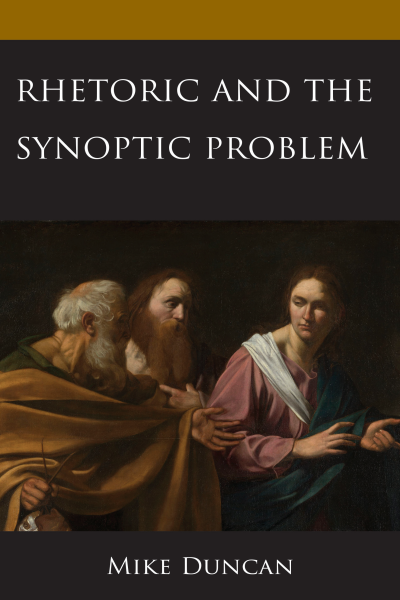
Rhetoric and the Synoptic Problem
- Authors:
- Publisher:
- 2022
Summary
Mike Duncan argues that the Farrer Hypothesis is the best working solution to the Synoptic Problem in New Testament studies by way of rhetorical theory, as he sees the Synoptic Problem as less about source and textual criticism and more as a writing problem that concerns how and why they were composed The book’s six chapters feature case studies of different aspects of gospel rhetoric, such as how the different post-resurrection accounts interact with each other and how the apostles are portrayed from gospel to gospel. These chapters form a collective argument—that the synoptic gospels are competing rhetorical narratives about Jesus, with the authors of Luke and Matthew reacting to previous gospels with the goal of superseding the previously composed versions of Jesus’s life. However, Duncan acknowledges that the Farrer Hypothesis has special difficulties and cannot be pushed beyond an educated guess, that the Synoptic Problem remains an unsolvable problem due to a lack of evidence and lost original context, and that it is only a philosophical acceptance of the inaccessibility of a solution that paradoxically allows a frank and unsentimental view of the alternatives.
Keywords
Search publication
Bibliographic data
- Edition
- 1/2022
- Copyright Year
- 2022
- ISBN-Print
- 978-1-9787-1308-6
- ISBN-Online
- 978-1-9787-1309-3
- Publisher
- Lexington, Lanham
- Language
- English
- Pages
- 284
- Product Type
- Monograph
Table of contents
- Dedication No access
- Contents No access
- List of Tables No access
- Acknowledgments No access
- A Brief Summary, and Example, of the Synoptic Problem No access
- Ok, So What Do I Think? No access
- Notes No access
- Ancient Commentators—Second Century CE No access
- Third–Fifth-Century CE Commentators—The Augustinian and Two-Source Hypothesis No access
- German Higher Criticism and the Q Hypothesis No access
- The Farrer Hypothesis (FH) No access
- Proto-Luke and the Rest No access
- Rhetoric Enters the Fray No access
- Notes No access
- The Post-Resurrection Narratives No access
- The Post-Resurrection Appearances in 1 Corinthians and Paul’s Revelations No access
- The Absence of Post-Resurrection Appearances in the Gospel of Mark No access
- The Post-Resurrection Appearances in the Gospel of Matthew No access
- The Post-Resurrection Appearances in the Gospel of Luke No access
- The Post-Resurrection Appearances in the Gospel of John No access
- The Post-Resurrection Appearances and the Different Versions of Paul’s Conversion in Acts of the Apostles No access
- Conclusion No access
- Notes No access
- First Argument: The Case of Mark 1:1-3 No access
- The Universal Features of Writing No access
- Second Argument: Universal Writing and the Farrer Hypothesis No access
- Problem #1: The Death of Hermann Gӧring No access
- Problem #2: The Four Perspectives in Rashomon No access
- Problem #3: The Trolley No access
- Sweeping the Table with Abduction No access
- Losing a Battle to Win the War No access
- Notes No access
- Limitations of Previous Studies on the Baptist No access
- Baptism, but no Baptist: the Pauline epistles No access
- The Baptist in the Gospel of Mark No access
- Baptism in the First Century CE No access
- John the Baptist in Josephus’s Jewish Antiquities No access
- The Author of Mark’s Creation of the Jesus–John Link No access
- John the Baptist in the Gospel of Matthew No access
- John the Baptist in the Gospel of Luke No access
- The Baptist in Acts No access
- The Baptist in the Gospel of John No access
- Conclusion No access
- Notes No access
- The First Four Apostles No access
- The Disciples Say Nothing No access
- Family Matters No access
- The Parables No access
- Have You Still No Faith? No access
- The Preferred Disciples No access
- The Reveal No access
- The Transfiguration No access
- The Role of Judas No access
- How Does Q Fit In? No access
- Notes No access
- Motivation in the Introduction to Luke No access
- The Purpose of Luke’s Prologue No access
- The Physical Order and Method of the Composition of the Gospel of Luke No access
- Three Plausible Motives. Or Rather, One Big One, For “Destroying” the Sermon of the Mount No access
- Notes No access
- Notes No access
- Scenario 1: The Standard Position No access
- Scenario 2: Josephus as Terminus post quem for Mark No access
- Scenario 3: Marcion as Second Gospel No access
- Scenario 4: Papias No access
- Scenario 5: Augustine No access
- Scenario 6: Some Educated Guesswork No access
- Note No access
- Bibliography No access Pages 259 - 272
- Index No access Pages 273 - 282
- About the Author No access Pages 283 - 284