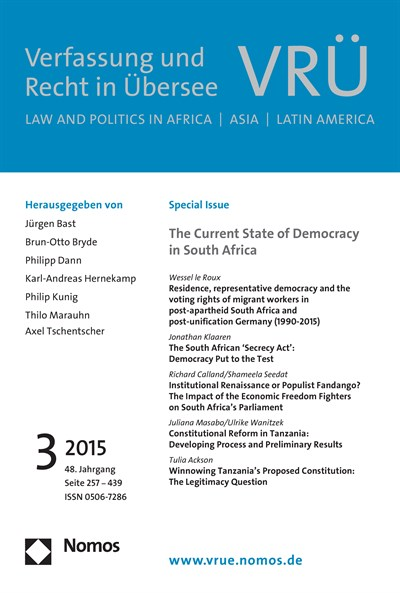
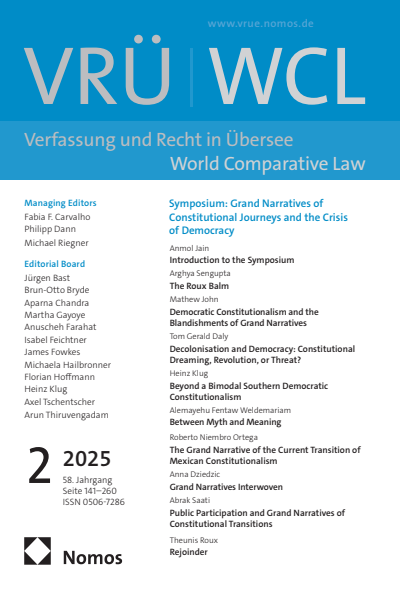
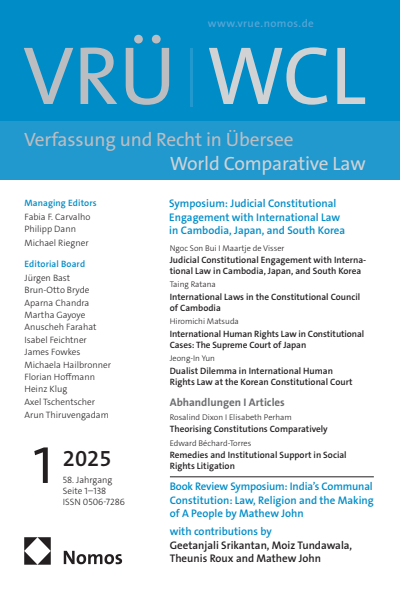
"Law and Politics in Africa, Asia and Latin America" analyses legal and constitutional developments in all states or regions outside of Europe as well as their regional and international integration. Founded in 1968 and inspired by decolonization and the idea of a cooperative new beginning, the Journal also promotes a special interest in contributions on 'Law and development'. The journal aims to provide a forum for a variety of perspectives on these fields of interest, be they focused on one country or comparative, theoretical or methodological in nature. Next to extensive articles, the journal publishes shorter reports about current events or conferences as well as book reviews. As a special service, each issue of "Law and Politics in Africa, Asia and Latin America" contains an international bibliography of relevant publications from around the world. This is compiled in cooperation with the Leibniz-Institute for Global and Regional Studies in Hamburg (GIGA). "Law and Politics" addresses authors and readers on all continents and aims to serve as a forum of mutual exchange. The journal is open for contributions from legal and social sciences as well as for analyses from practitioners. The journal is published quarterly and welcomes contributions in German, English, Spanish and French. Website: www.vrue.nomos.de
Over the past 25 years, migration has surfaced as one of the core features of globalisation to impact on established constitutional democracies from the North (such as Germany) and young constitutional democracies from the South (such as South...
The ongoing debate and consideration of the Protection of State Information Bill (often termed the ‘Secrecy’ Bill or Act) has provided a true test for the post-apartheid South African democracy. Using a case study of that legislation’s period...
Twenty one years into its democratic life, modern South Africa faces a number of ‘growing pains’. While the ruling African National Congress (ANC) has decisively won five national elections in a row since 1994, never falling below 62% of the...
The United Republic of Tanzania, consisting of the two partners in the Union, Mainland Tanzania (formerly Tanganyika) and Zanzibar, is undertaking comprehensive constitutional reforms. The reform process, once finalised, will replace the current...
The Proposed Constitution is a product of the Constituent Assembly convened by the President of the United Republic of Tanzania to enact the New Constitution upon which Tanzanians would ultimately vote, on a yes or no basis, in a referendum. The...
This article reviews issues concerning the way that Uganda ought to be dealing with its past. It examines what a transitional justice process ought to look like, and what its component parts should be. The article examines the rights to justice,...
The South African Constitution under chapter 9 establishes state institutions that are mandated with the obligation to strengthen the concept of constitutional democracy in the Republic. The Constitution requires that other organs of state, through...